Article

Energy-Efficient Enclosures in Natural Convection Systems Using Partition Control

Department of Naval Architecture and Ocean Engineering, Pusan National University, 2, Busandaehak-ro 63beon-gil, Geumjeong-gu, Busan 46241, Republic of Korea
*
Author to whom correspondence should be addressed.
Energies 2025, 18(23), 6267; https://doi.org/10.3390/en18236267
Submission received: 13 October 2025 / Revised: 19 November 2025 / Accepted: 26 November 2025 / Published: 28 November 2025
(This article belongs to the Section B: Energy and Environment)

Abstract

Improving energy efficiency and thermal management in enclosure-based systems requires an understanding of how internal geometry governs buoyancy-driven flow and heat transfer. This study employs a partition-based control strategy to regulate flow organization and thermal stratification in natural convection enclosures. Numerical simulations are performed in a differentially heated square cavity with a bottom-attached adiabatic partition ( H = 0.0 L 0.9 L ) for Rayleigh numbers ( R a ) ranging from 10 3 to 10 6 . The analysis examines how buoyancy–geometry interaction drives vortex suppression, extinction, and regeneration, shaping the thermal performance of energy-efficient enclosures. Flow evolution is characterized using vortex center trajectories, the local Nusselt number difference ( Δ N u ), and classification into the Thermal Transition Layer (TTL) and Conduction-Dominated Zone (CDZ). Increasing partition height progressively decouples the upper and lower cavity regions. At low R a , suppression occurs gradually and symmetrically, maintaining a single-vortex structure up to large H. At high R a , strong buoyancy induces nonlinear transitions from dual vortices to regenerated upper vortices. Cold wall circulation is suppressed more strongly than that near the hot wall, producing pronounced thermal asymmetry and reduced heat transfer. At the maximum partition height ( H = 0.9 L ), the surface-averaged Nusselt number decreases by approximately 75– 92 % across all R a , indicating strong cooling suppression due to geometric confinement. TTL/CDZ mapping reveals that rapid CDZ growth and TTL expansion beyond H 0.4 L lead to a sharp decline in the average Nusselt number. These findings provide a quantitative framework for predicting suppression-driven transitions and guiding partition-controlled, energy-efficient enclosure design under varying buoyancy conditions.

1. Introduction

Natural convection in enclosed cavities has attracted extensive attention due to its critical role in a wide range of engineering and industrial applications, including building ventilation systems [1,2] and passive ventilation configurations such as Trombe wall designs [3], electronic cooling and thermal management systems [4,5,6], thermal energy storage [7,8], and LNG insulation systems [9,10]. This buoyancy-driven phenomenon is primarily governed by cavity geometry and thermal boundary conditions, which dictate the onset, strength, and structure of convective motion. Among various configurations, the square cavity with differentially heated vertical walls has become a benchmark model for exploring fundamental convection mechanisms.
The numerical study by Vahl Davis [11] solved the Boussinesq equations in such a cavity, revealing a transition from conduction- to convection-dominated heat transfer with increasing Rayleigh number ( R a ). Subsequent works employed advanced numerical techniques—such as spectral methods [12], nanofluid models [13], and differential quadrature methods [14] to improve solution accuracy and extend the analysis to R a values up to 10 7 . At extreme buoyancy forcing, further studies pushed R a up to 10 16 , necessitating turbulence modeling and grid adaptation strategies [15,16,17]. In parallel, recent research has shifted toward understanding the effects of non-uniform boundary conditions [18,19,20,21] and internal geometrical modifications on flow regimes, including sidewall or ceiling heating [18], bottom–top thermal configurations [19], localized heat sources [20], and double-diffusive convection [21].
As the field of natural convection advanced, research attention expanded to include enclosures containing internal partitions, recognizing their significant impact on heat transfer characteristics. A range of studies [22,23,24,25,26,27,28,29,30,31] systematically investigated the influence of a single vertical partition in square cavities. Bilgen [22] examined partially divided enclosures across a wide Rayleigh number range ( R a = 10 4 to 10 11 ), reporting that increasing the partition length suppresses convective mixing and promotes a transition toward conduction-dominated heat transfer. Oztop et al. [23] analyzed the role of floor-mounted adiabatic partitions for R a = 10 3 to 10 6 , finding that partition height directly affects vortex formation and global heat transfer. Alsayegh [24] extended this line of work to enclosures with varying aspect ratios (up to R a = 5 × 10 4 ), showing that sufficiently long partitions effectively isolate the cavity, reducing convective transport.
Further studies have explored diverse partition geometries and material properties. Nakhi et al. [25] examined inclined heated fins using the finite volume method and identified the fin’s length and inclination angle as critical factors for Nusselt number performance. Zimmerman et al. [26] used the SIMPLER algorithm to study finitely conducting baffles, revealing that thermal stratification intensifies and heat transfer decreases at lower R a ( 1 × 10 4 3.5 × 10 5 ), while the effect diminishes at higher R a . Selimefendigil et al. [27] found that both partition conductivity and nanoparticle concentration enhance convective heat transfer (up to 14.11%) in conjugate natural convection scenarios. Yasuri et al. [28] introduced magnetic fields and found that while heat transfer increases with R a , magnetic damping reduces convective intensity. Khatamifar et al. [29] focused on conductive partition thickness (0.05 to 0.2), demonstrating that thicker partitions increase thermal resistance, thereby suppressing convective performance. Joubert et al. [30] conducted a comparative study of Direct Numerical Simulation (DNS), Large Eddy Simulation (LES) and Reynolds Averaged Numerical Simulation (RANS) models for turbulent natural convection at R a = 2.5 × 10 10 , and demonstrated that LES and DNS approaches more accurately capture the thermal stratification than RANS. Khorasanizadeh et al. [31] investigated Cu–water nanofluid convection in the presence of a bottom-embedded baffle, showing that centering the baffle and increasing nanoparticle volume improved heat transfer and reduced entropy generation.
In addition to single partitions, several studies have explored the influence of baffle configuration and placement. Jetli et al. [32] showed that vertically offset baffles reduce heat transfer, but higher baffle conductivity improves convective mixing by disrupting stratified regions. Sun [33] confirmed that baffles induce stratification and suppress circulation, especially at higher R a . Saravanan et al. [34] studied baffles with internal heat generation, demonstrating that central placement enhances heat transfer, whereas wall-adjacent baffles suppress it. Bilgen [35] analyzed natural convection in square cavities with a single thin fin attached to the heated wall, showing that the fin strongly modifies the flow structure and suppresses convection at moderate Rayleigh numbers due to conduction-dominated thermal fields.
More complex configurations with multiple partitions have also been examined. Han et al. [36] investigated dual-partition enclosures under radiative heat transfer, emphasizing that radiation significantly alters thermal gradients and reduces convective dominance at high temperatures. Costa [37] simulated square cavities with partitions of varying thermal conductivity ( R a = 10 3 to 10 6 ), concluding that high conductivity promotes thermal diffusion, while low conductivity reinforces stratification. Collectively, these findings demonstrate that the geometry, location, and material properties of internal partitions play a decisive role in modulating vortex structure, thermal stratification, and convective heat transfer. Strategic use of internal obstructions thus offers a promising design parameter for thermal optimization in enclosure-based systems.
In addition to partition-related configurations, several studies have explored natural convection in more geometrically complex or dynamically varying enclosures. These include investigations of asymmetrical shapes, curved or multi-compartment geometries [38,39,40,41,42]. Other studies focused on enclosures with localized heat sources and embedded obstacles [43,44,45,46,47]. Additional research has considered transient boundary conditions, external magnetic fields, and entropy generation in nanofluid-filled cavities [48,49], while these works expand the understanding of convection under diverse conditions, they remain peripheral to the core mechanisms governing partition-induced flow transitions.
Despite extensive research on natural convection in enclosures, the influence of partition length on the coupled evolution of vortex structure, thermal stratification, and localized heat transfer asymmetry remains incompletely characterized. Previous studies have primarily addressed limited geometric configurations or selected operating conditions, often lacking a systematic framework capable of capturing the continuous yet transition from convection-dominated to conduction-dominated regimes. In particular, the interplay between buoyancy-driven inertia at various R a and partition-induced confinement—including phenomena such as vortex suppression, extinction, and subsequent partition-induced regeneration—has not been quantitatively mapped in prior literature.
The present study addresses these gaps through a comprehensive numerical investigation of steady-state, laminar natural convection in a square cavity equipped with a bottom-mounted vertical adiabatic partition of varying height ( H = 0.0 L 0.9 L ), over a wide Rayleigh number range ( R a = 10 3 10 6 ). Novel diagnostic approaches are introduced, including vortex center trajectory mapping to capture structural reorganizations, the local Nusselt number difference ( Δ N u ) to quantify vertical heat transfer imbalance, and a thermal regime classification into the Thermal Transition Layer (TTL) and Conduction-Dominated Zone (CDZ) to link local transport characteristics with global performance. This multi-metric analysis enables the identification of critical partition heights marking abrupt structural and thermal regime shifts, particularly the high– R a progression from dual-vortex circulation to upper-vortex dominance and finally to conduction-limited stratification.
By integrating these physically grounded metrics, the study establishes a predictive framework for understanding and optimizing partition-induced convection behavior, with direct relevance to the design of thermally efficient enclosure systems such as electronics cooling, energy storage, and cryogenic insulation. Furthermore, because the proposed analysis framework is geometry-independent, it can be extended to multi-partition and non-rectangular enclosures. By integrating vortex tracking, Δ N u , and TTL/CDZ, the method reveals quantitative features not identified in earlier studies—such as the vertical transition height and the redistribution of conduction- and convection-dominant zones—providing clearer design-oriented insight into geometry-driven heat-transfer behavior.

2. Numerical Details

2.1. Physical and Numerical Formulation

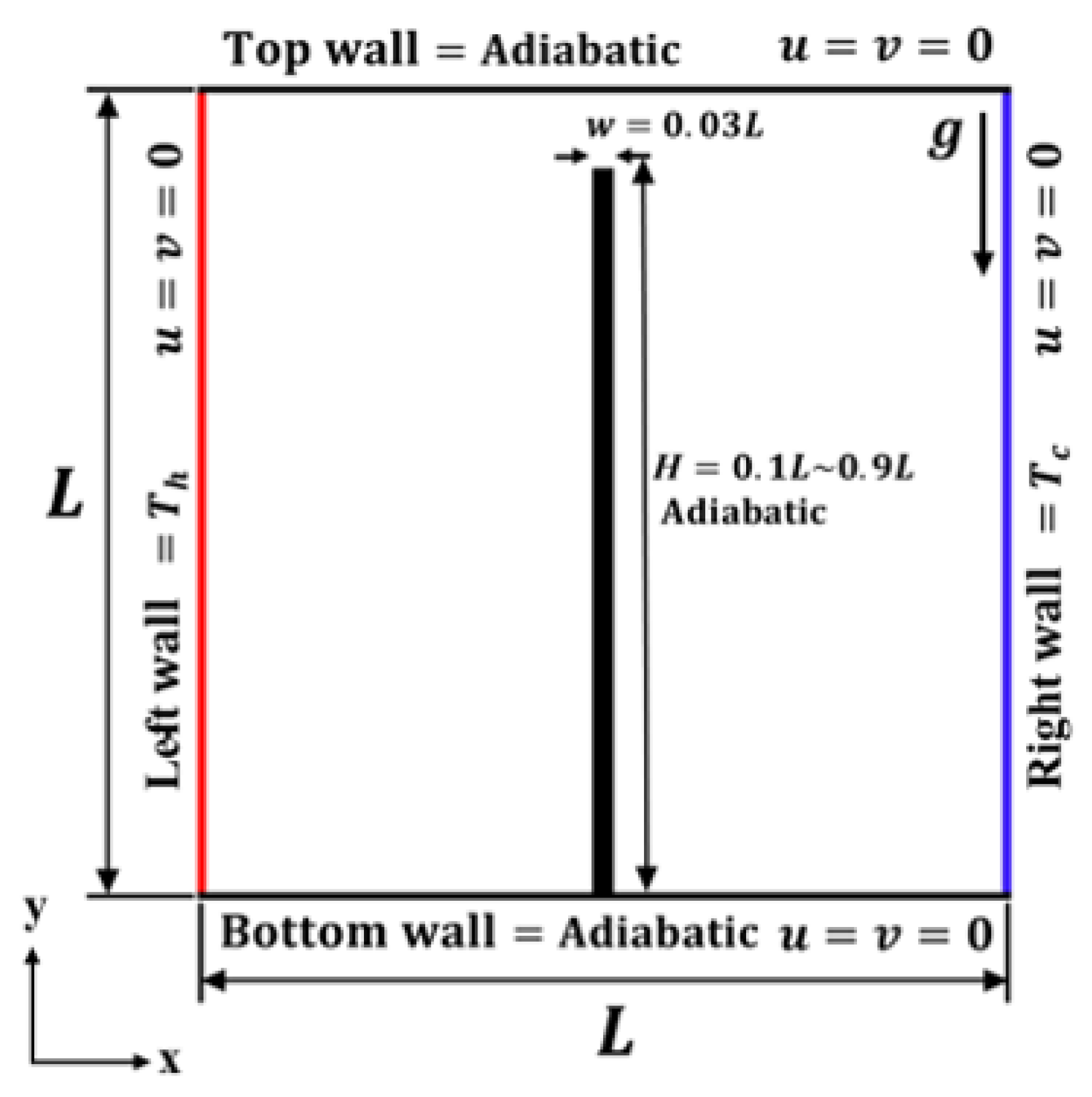
This study examines steady, two-dimensional, laminar natural convection within a differentially heated square cavity featuring a centrally located vertical adiabatic partition, as illustrated in Figure 1. The left and right vertical walls are maintained at constant temperatures, T h (hot) and T c (cold), respectively, while the top and bottom walls are adiabatic. Here, L denotes the side length of the square cavity, which serves as the characteristic length scale for non-dimensionalization. A vertical partition of fixed thickness w = 0.03 L extends upward from the bottom wall, with its height H systematically varied from 0.1 L to 0.9 L . Similar boundary conditions have also been employed in studies of enclosures containing internal obstacles [40,41,42].
The fluid is assumed to be Newtonian, incompressible, and governed by the Boussinesq approximation, where density variations are only considered in the buoyancy term of the momentum equations. The Boussinesq approximation is valid in the present study since the temperature difference between the hot and cold walls yields | β Δ T = 0.069 | , which is a commonly used practical bound for the approximation in buoyancy-driven flows. well within the recommended limit of 0.1 [50]. Therefore, density variation effects are sufficiently small to justify the use of the incompressible form of the Navier–Stokes and energy equations.
The flow remains laminar throughout the analysis. To facilitate generalization and comparison, the governing equations are nondimensionalized using the following characteristic scales:
x = x * L * , y = y * L * , u = u * L * α , v = v * L * α , P = P * L * 2 ρ α 2 , θ = T * T c * T h * T c *
where x , y represent the dimensionless spatial coordinates; u , v are the dimensionless velocity components; P is the dimensionless pressure; and θ is the dimensionless temperature.
The dimensionless governing equations for mass, momentum, and energy conservation are expressed as follows:
u x + v y = 0
u u x + v u y = P x + 1 P r 2 u x 2 + 2 u y 2
u v x + v v y = P y + 1 P r 2 v x 2 + 2 v y 2 + R a P r θ
u θ x + v θ y = 1 P r 2 θ x 2 + 2 θ y 2
The dimensionless parameters governing the flow are the Rayleigh number R a and the Prandtl number P r , defined as:
R a = g β T h * T c * L * 3 ν α , P r = ν α
where g is the gravitational acceleration, β is the thermal expansion coefficient, ν is the kinematic viscosity, and α is the thermal diffusivity of the fluid. In this study, the Rayleigh number is varied from R a = 10 3 to 10 6 to capture regimes ranging from weak natural convection to strong laminar buoyancy-driven flows. The Prandtl number is fixed at P r = 0.71 , corresponding to air.
Although weak unsteadiness has been reported near R a = 10 6 in certain geometries—particularly in open or non-rectangular cavities—the classical square-cavity benchmarks [11,12,13,14,15,16,17] consistently demonstrate that flow remains steady and laminar up to this range for P r = 0.71 . This justification supports the use of a steady, laminar, and two-dimensional formulation while acknowledging that the validity may depend on geometric configuration in more complex enclosures.
The evaluation of heat transfer is carried out through the Nusselt number, which characterizes the thermal gradient at the solid–fluid interface. The local Nusselt number on the heated boundary is expressed as:
N u ( y ) = θ n wall ,
with θ denoting the nondimensional temperature and n the outward normal direction from the wall.
To assess the net thermal transport, the surface-averaged Nusselt number is obtained by averaging the local distribution along the nondimensional wall height:
N u ¯ = 0 1 N u ( y ) d y ,
which provides a single representative measure of the global heat-transfer performance across the heated surface.
The boundary conditions are shown in Figure 1. All solid walls are impermeable and satisfy the no-slip condition ( u = v = 0 ). The left and right vertical walls are isothermal at θ = 1 and θ = 0 , respectively. The top and bottom walls and the vertical partition are adiabatic, θ n = 0 . For pressure, a homogeneous Neumann condition ( P n = 0 ) is applied on boundaries.
The governing equations were discretized using a finite-volume formulation with the SIMPLE pressure–velocity coupling algorithm. Second-order upwind and second-order central differencing schemes were applied to the convective and diffusive terms, respectively. A non-uniform mesh with geometric stretching was employed near the heated and cooled walls to adequately resolve the boundary layers, resulting in a minimum wall-normal grid spacing of approximately Δ y min / L 0.005 . Under-relaxation factors of 0.3, 0.7, and 0.9 were used for pressure, velocity, and temperature, respectively. Steady-state convergence was typically achieved within 1200–2000 iterations, during which the residuals decreased smoothly without oscillations, and global mass and energy balances were continuously monitored to ensure numerical consistency.

2.2. Grid Dependency Study

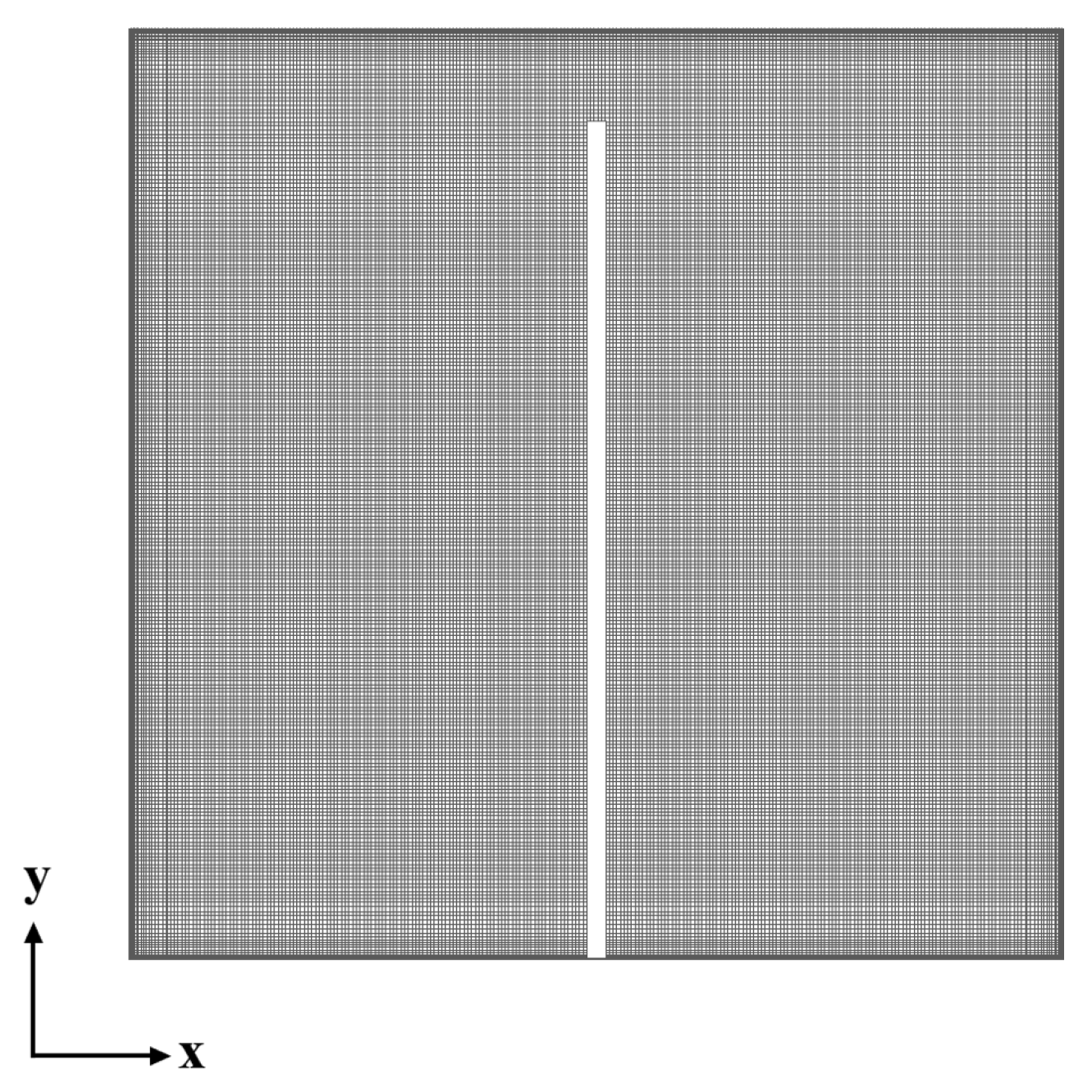
Figure 2 shows the present grid system. A grid resolution of 202 × 202 in the horizontal (x) and vertical (y) directions was adopted to ensure a balance between computational efficiency and solution accuracy. The grid is non-uniform, with mesh refinement applied near all solid boundaries—including the hot and cold vertical walls as well as the adiabatic partition—to adequately resolve steep velocity and temperature gradients in the thermal and velocity boundary layers.
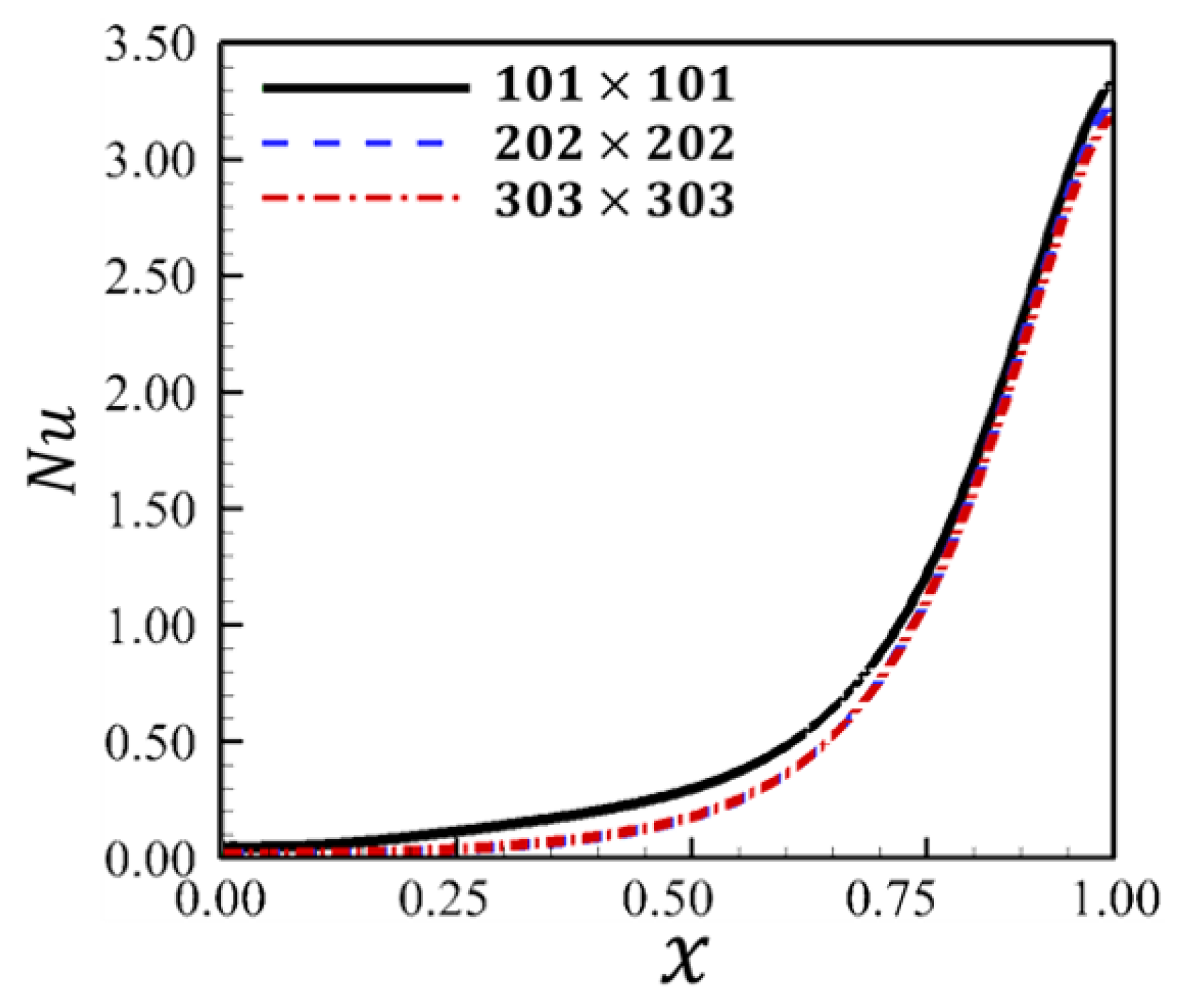
To examine the sensitivity of the results to grid resolution, simulations were carried out using three different mesh sizes: a coarse grid ( 101 × 101 ), a medium grid ( 202 × 202 ), and a fine grid ( 303 × 303 ). Figure 3 compares the local Nusselt number distributions along the hot wall for these three grids at R a = 10 6 and H = 0.9 . All cases show similar overall trends, but the coarse grid slightly overestimates the Nusselt number. The medium and fine grids produce nearly identical results, suggesting that further refinement beyond the medium grid has a minimal effect.
The surface-averaged Nusselt number for each case is summarized in Table 1 to further quantify the grid dependency. The results confirm that the medium grid captures the essential thermal and flow characteristics with less than 2.32% deviation from the fine-grid result. Therefore, the medium grid with 202 × 202 was selected for all subsequent simulations to ensure both accuracy and computational efficiency.

2.3. Numerical Validations

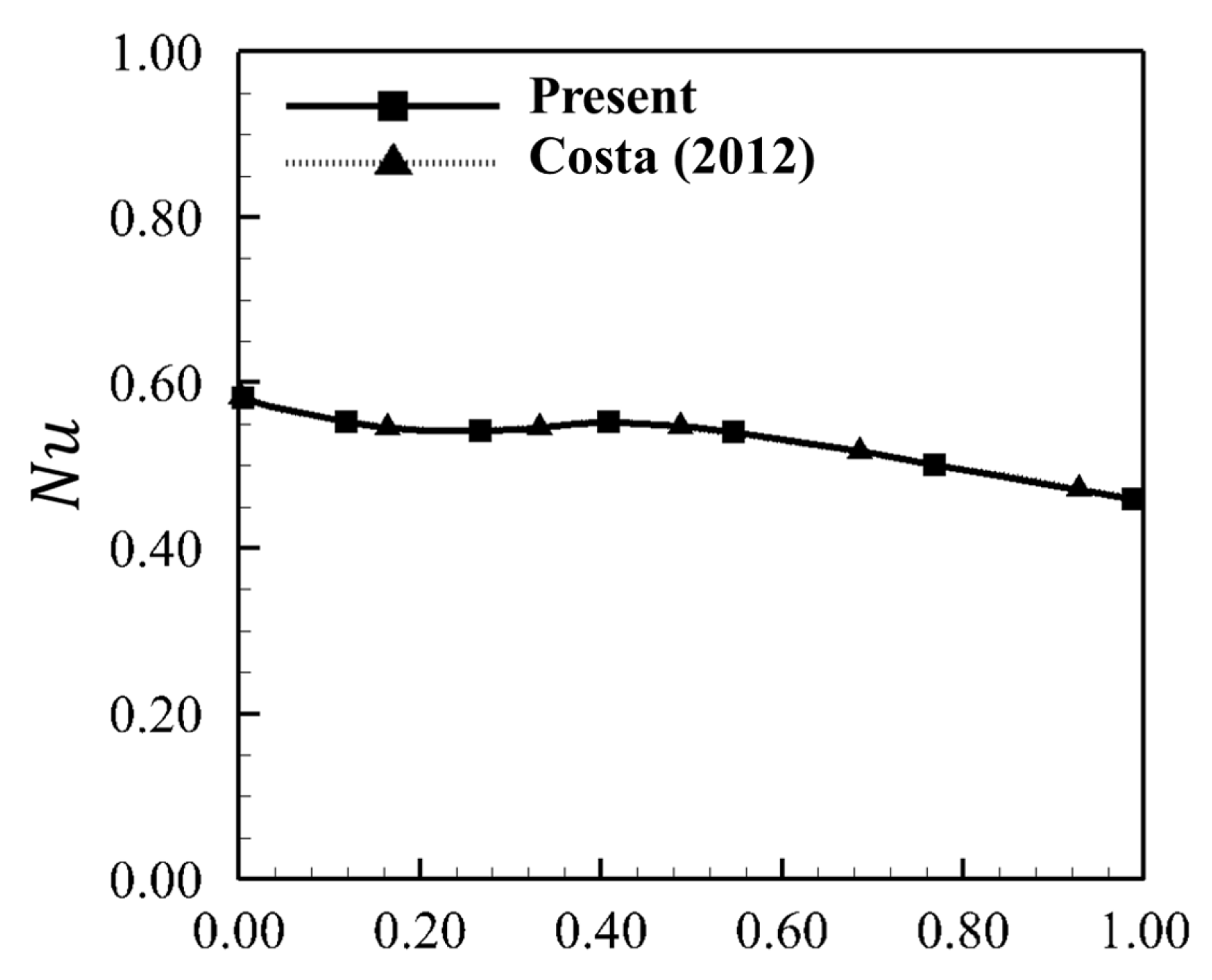
To ensure the reliability of the numerical approach, a validation study was performed through two steps: (1) comparison with established benchmark results for classical square cavity natural convection, and (2) comparison with reference studies involving internal partitions. First, the surface-averaged Nusselt numbers N u ¯ at the hot wall were compared with benchmark solutions from Vahl Davis [11] and Markatos et al. [15] for Rayleigh numbers ranging from R a = 10 3 to 10 6 . As shown in Figure 4 and Table 2, the present results show excellent agreement, with deviations less than 2.33% across all cases. This confirms the reliability of the numerical discretization and solution scheme for classical cavity configurations.
The percentage deviation shown in Table 2 was calculated as Difference (%) = | N u present N u reference | N u reference × 100 . All validation cases were computed using the grid resolution of 202 × 202, which was confirmed to be grid-independent in Section 2.2. Furthermore, the global heat flux balance between the hot and cold walls was verified, with discrepancies less than 0.002%, confirming the conservation of thermal energy in the numerical solution.
To more clearly establish the reliability of the model under a single-partition configuration, the present numerical results were compared with the finned-cavity benchmark reported by Bilgen [35]. For the case of R a = 10 4 , the surface-averaged Nusselt number is N u present = 1.905 , whereas the reference value is N u reference = 1.95 . The corresponding relative deviation is approximately 2.3 % , indicating excellent agreement with the published benchmark.
In addition, to validate the model under partitioned configurations, further comparison was made with the results of Costa [37], who analyzed natural convection in square cavities with two vertical adiabatic partitions at R a = 10 6 , while this geometry is more complex than the present single-partition configuration, it provides a conservative and rigorous benchmark for validating the flow structure and heat transfer predictions. The use of this more challenging reference strengthens the robustness of the present model. As shown in Figure 4, the local Nusselt number along the heated wall closely matches the profile reported by Costa [37], with minimal deviation across the domain. This agreement confirms the validity of the present numerical method in capturing heat transfer. Overall, the validation results demonstrate that the present numerical approach is capable of accurately predicting natural convection characteristics for both classical and partitioned cavity configurations across a broad range of R a .

3. Results and Discussion

The results are presented to reveal how partition height and Rayleigh number influence the overall flow and heat transfer characteristics inside the cavity. Key observations are drawn from the analysis of streamlines, isotherms, and Nusselt number distributions, which provide insight into the development of buoyancy-driven convection and its suppression by the partition.

3.1. Flow and Thermal Fields

This section focuses on the detailed behavior of flow and thermal structures across varying Rayleigh numbers. Streamlines, isotherms, and local Nusselt number distributions (computed using Equation (7)) are employed to examine how partition height affects vortex dynamics and thermal stratification. These visual and quantitative parameters allow for consistent comparison of flow transitions under different thermal conditions.

3.1.1. R a = 10 3 and R a = 10 4

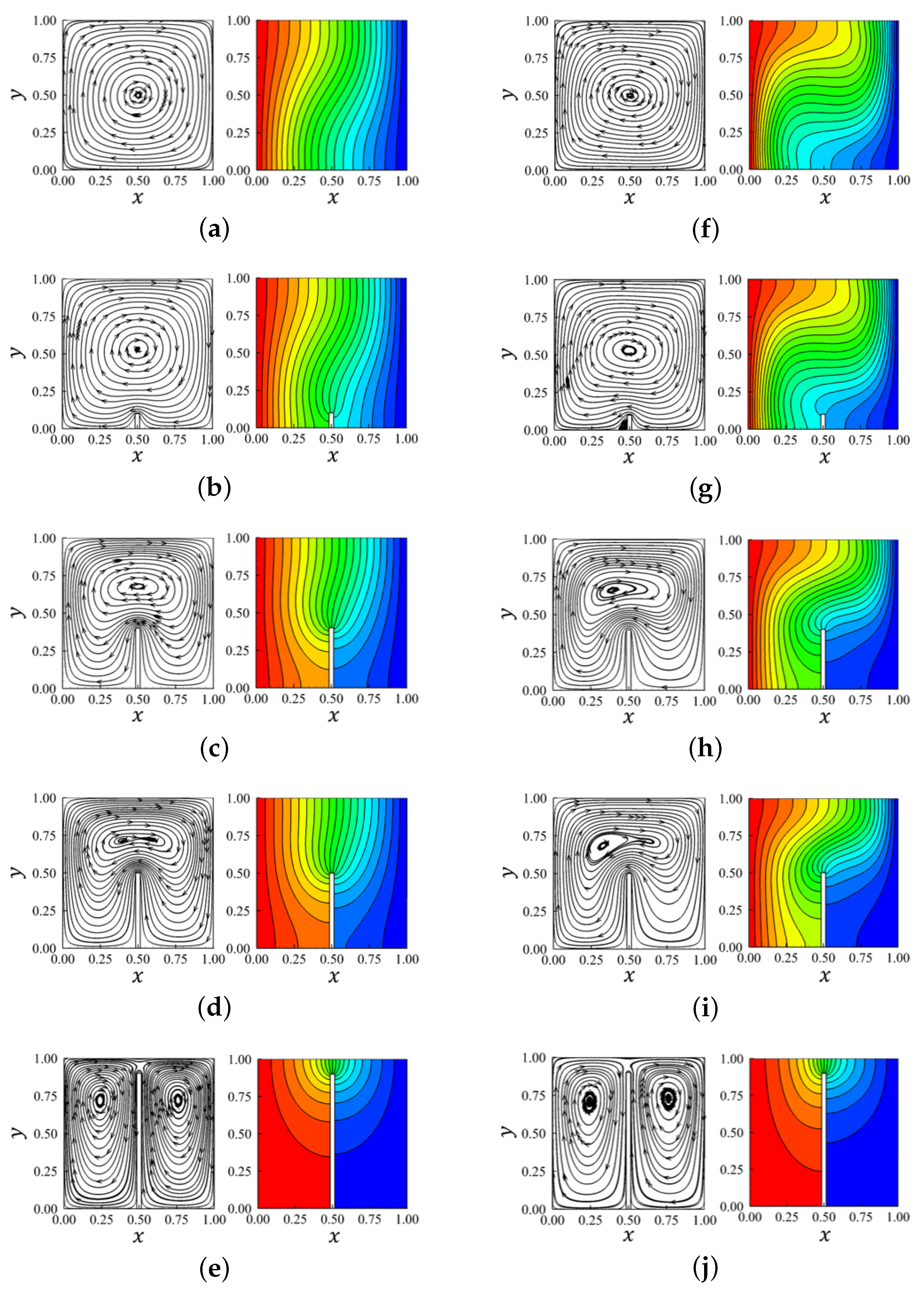
No and Low Partition Cases ( H = 0.0 L and H = 0.1 L )
The flow and thermal characteristics under no partition ( H = 0.0 L ) and low partition ( H = 0.1 L ) conditions provide a baseline for understanding the effects of internal obstruction on natural convection. As shown in Figure 5a,f, the no-partition case exhibits a well-established, single, clockwise recirculating vortex that spans the entire cavity at both R a = 10 3 and 10 4 . Heated fluid rises along the left hot wall, flows across the top, descends the right cold wall, and returns along the bottom, forming a symmetric buoyancy-driven loop consistent with classical results [11,12,13,14,15,16,17].
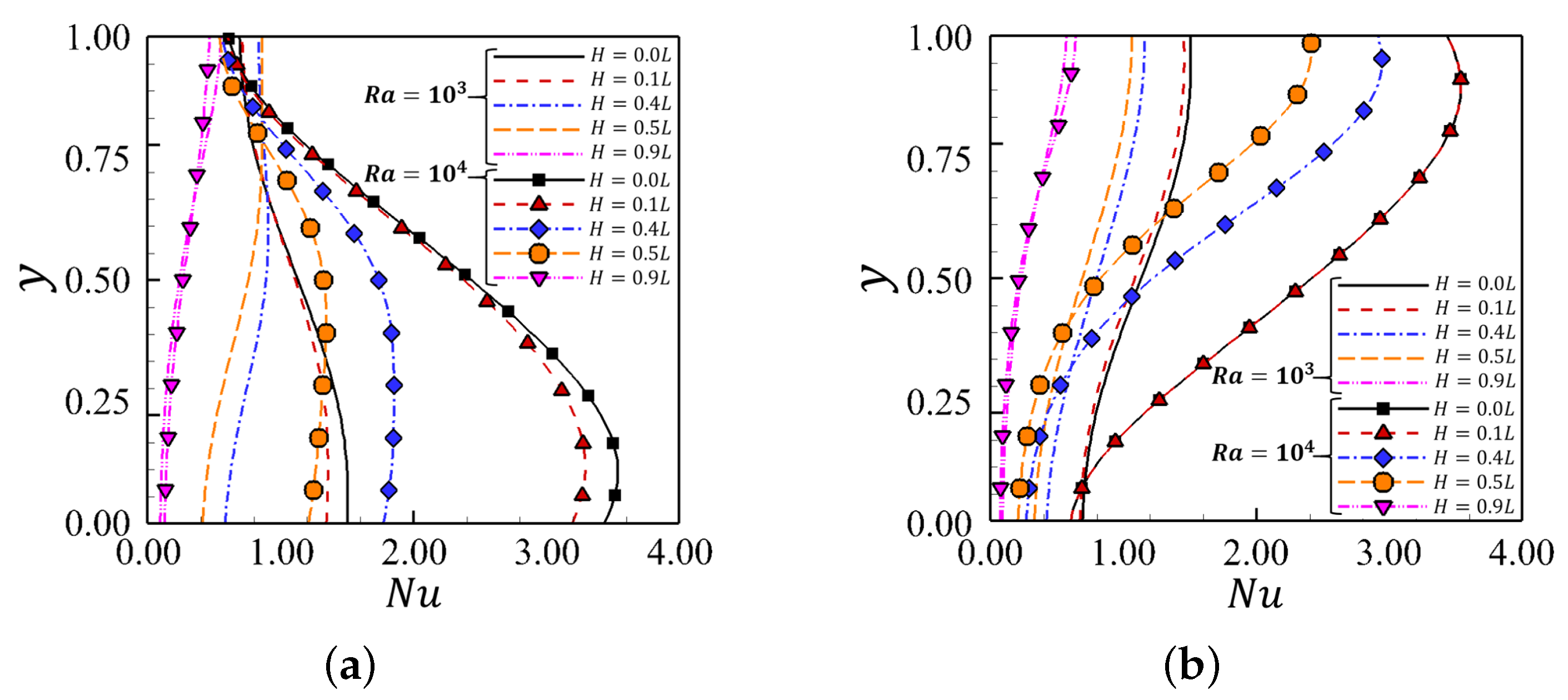
The isotherms reflect this circulation, transitioning from vertical near the sidewalls to inclined contours toward the center (Figure 5a), indicating weak but coherent convective transport. Near the bottom-left hot wall, steep temperature gradients and densely packed isotherms yield high local N u values, which gradually decrease with height due to boundary layer thickening (Figure 6a). On the cold wall, strong impingement at the top results in high N u , while thermal stagnation at the bottom leads to flattened N u profiles (Figure 6b). At R a = 10 4 , the vortex becomes more compressed, with thinner thermal boundary layers and steeper N u gradients on both sidewalls, confirming the shift toward convection-dominated behavior [11,12,13,14,15,16,17].
Introducing a low partition ( H = 0.1 L ) (Figure 5b,g) does not significantly disrupt the overall recirculation. However, the descending cold fluid begins interacting with the partition’s upper surface, shifting the vortex center slightly upward and weakening circulation near the bottom. This localized obstruction reduces fluid momentum in the lower cavity region, particularly at R a = 10 4 .
The thermal field remains broadly similar to the no-partition case, but subtle changes emerge. At the bottom of the hot wall, flow deceleration near the partition causes heat accumulation and wider isotherm spacing, slightly reducing N u (Figure 6a). In contrast, the upper hot wall remains unaffected, maintaining strong upward flow and N u levels similar to those in the H = 0.0 L case. On the cold wall, descending flow continues to impinge near the top, producing a steep N u gradient, while the lower region exhibits flow stagnation, horizontal isotherms, and nearly constant, low N u values (Figure 6b).
The partition’s influence increases with Rayleigh number. At R a = 10 3 , its effects are modest, limited to a minor shift in vortex location and slight suppression near the bottom. In contrast, at R a = 10 4 , the stronger descending flow is visibly hindered by the partition, intensifying thermal stratification and reducing circulation in the lower right region (Figure 5g). This leads to steeper N u gradients at the top of the cold wall and earlier flattening near the bottom (Figure 6b). Likewise, the lower hot wall shows denser isotherms and steeper N u gradients compared to the no-partition case, indicating localized boundary layer thinning under stronger buoyancy (Figure 6a). These findings are consistent with previous studies on early thermal stratification caused by descending flow obstruction [22]. This comparison between H = 0.0 L and H = 0.1 L illustrates that even a small partition can introduce localized flow resistance, altering heat transfer near the cavity base—especially under high Rayleigh numbers while preserving the global convective loop at low obstruction levels.
Mid Partition ( H = 0.4 L , 0.5 L )
As the partition height increases to H = 0.4 L , it further compresses the primary vortex upward and weakens the lower circulation compared to H = 0.1 L , indicating stronger suppression in the lower region (Figure 5c,h). On the left hot wall, this suppression thickens the thermal boundary layer and reduces the effective heat exchange area, leading to thermal stagnation near the wall and conduction-controlled region. As a result, the temperature gradient decreases and the local N u at the bottom becomes lower than at H = 0.1 L , as shown in Figure 6a. In contrast, the upward flow along the upper left hot wall remains relatively unaffected, preserving loosely spaced isotherms and a N u distribution similar to that of H = 0.1 L .
On the right cold wall, the descending flow continues to impinge strongly at the top, maintaining a thin thermal boundary layer and forming dense isotherms, which correspond to a gradual N u increase (Figure 6b). With increasing R a , the descending flow gains more momentum, enhancing heat exchange along the upper wall: the boundary layer becomes thinner and the convection-dominated region expands, resulting in steeper N u gradients. However, at the lower cold wall, weakened recirculation forms a stagnant layer, suppressing fluid mixing and intensifying thermal stratification, which causes the N u to flatten earlier (Figure 5c,h, and Figure 6b).
Compared to R a = 10 3 , the suppression becomes significantly stronger at R a = 10 4 . The upward flow along the left hot wall becomes relatively dominant, tilting the main vortex toward the left. The bottom-left isotherms become denser, indicating a thinner thermal boundary layer and steeper N u gradient (Figure 6a). Meanwhile, the cold wall’s lower region exhibits stronger stratification and conduction-controlled layer, with nearly flat N u profiles (Figure 6b).
Importantly, at H = 0.5 L , the partition height reaches a threshold where the lower recirculation region becomes partially divided, marking the onset of a structural transition in the cavity flow (Figure 5d,i). The momentum of cold fluid moving leftward along the bottom is further reduced, restricting access to the lower hot wall. As a result, two weak inner vortices appear in the upper half of the cavity, aligned along the hot and cold walls, forming a horizontally symmetric left–right vortex pair embedded within the main circulation. The thermal field exhibits stronger suppression in the lower region: isotherms near the lower hot wall become loosely packed due to stagnation, while those near the lower cold wall show more horizontal stratification than at H = 0.4 L . The N u distribution reflects this change— N u at the lower hot wall decreases further and the cold wall N u flattens earlier, as seen in Figure 6a,b. In contrast, the upper region remains convection-dominated, preserving dense isotherms and an active N u profile (Figure 5d,i, and Figure 6a).
Interestingly, for H = 0.4 L and H = 0.5 L , a noteworthy reversal in the vertical distribution of N u appears on the left hot wall when comparing R a = 10 3 and R a = 10 4 . At R a = 10 4 , N u becomes significantly larger at the lower region than at the top, whereas R a = 10 3 still exhibits higher N u at the upper section. This reversed trend contrasts sharply with the lower-partition cases ( H = 0.0 L and H = 0.1 L ), where higher Rayleigh numbers typically enhance top-wall convection. The shift implies a fundamental restructuring of the convective loop, where increased buoyancy, instead of promoting upward heat transport, intensifies the lower vortex near the partition base, redirecting thermal energy downward. Moreover, the inflection observed in the N u profiles may indicate the early onset of vertical flow separation [24].
Notably, at R a = 10 4 , a clear asymmetry emerges between the lower sections of the hot and cold walls, while the left hot wall maintains a relatively thin thermal boundary layer and higher local N u due to persistent upward flow, the right cold wall exhibits strong thermal stratification and flattened N u values, indicative of suppressed convection and conduction-controlled. This contrast underscores the partition’s uneven influence on the cavity’s lower thermal zones.
The stronger suppression observed along the cold wall arises from the interaction between buoyancy-driven boundary-layer thinning and inertia redistribution. As cooled fluid descends, the boundary layer becomes thinner and accelerates downward, forming a narrow, inertia-dominated jet that is more strongly impeded by the partition tip. This results in early momentum loss, premature detachment, and a rapid transition to conduction-dominated transport along the cold wall. In contrast, the upward-moving hot-wall boundary layer carries weaker inertia, making it less sensitive to vertical obstruction. The combined effects of Rayleigh number and partition height determine the vertical location where these asymmetric layers interact, thereby setting the onset of stratification and the collapse of circulation.
High Partition ( H = 0.9 L )
When the partition height increases to H = 0.9 L , its influence on natural convection becomes dominant, fundamentally restructuring the internal flow and thermal field. Compared to H = 0.5 L , the lower circulation region is further suppressed and nearly vanishes, effectively confining convective motion to the upper portion of the cavity. The descending cold fluid along the right wall stagnates near the partition tip, failing to circulate along the bottom or reach the lower hot wall. This blockage eliminates interaction between the upper and lower domains, as seen in Figure 5e,j, where the streamlines show a strong decoupling and complete flow stagnation in the lower region.
The thermal field reflects these changes distinctly. Near the bottom of the left hot wall, the isotherms become flatter and more widely spaced than those at H = 0.5 L , indicating a diminished temperature gradient and enhanced conduction-dominated behavior. On the lower right cold wall, the isotherms display pronounced horizontal stratification, and thermal gradients weaken further. These features correspond to the local Nusselt number distributions in Figure 6a,b, where the bottom regions of both walls exhibit nearly uniform and minimal N u values, confirming diffusion-controlled heat transfer in the lower cavity. In contrast, convection remains active in the upper region. The left hot wall maintains curved isotherms and a relatively stable N u profile, while the upper cold wall shows densely packed isotherms and a noticeable N u gradient. Although the gradient is less steep than in lower partition cases, it still indicates sustained, albeit weakened, convective heat transfer in the upper domain.
The suppression effects intensify as Rayleigh number increases. At R a = 10 4 , the descending cold flow is more forcefully blocked near the partition, leading to further stagnation along the lower cold wall and a clearer asymmetry in the overall flow. As shown in Figure 5j, the main vortex becomes more left-leaning, with its core shifting toward the hot wall. This leftward tilt highlights the unequal flow resistance imposed by the partition, with the cold side more significantly obstructed. However, despite the stronger buoyancy, the N u values near the cavity base remain almost unchanged between R a = 10 3 and 10 4 (Figure 6a,b), underscoring the persistent conduction dominance in that region. Meanwhile, enhanced heat transfer continues to be observed at the upper left hot wall and upper right cold wall.
This case confirms that beyond a critical partition height, vertical convective coupling is nearly severed. The flow becomes stratified, and natural convection transitions to a layered structure dominated by conduction at the bottom and convection in the top region. The overall system exhibits strong thermal asymmetry and localized transport limitation, marking the upper bound of partition-induced suppression in the present configuration.

3.1.2. R a = 10 5

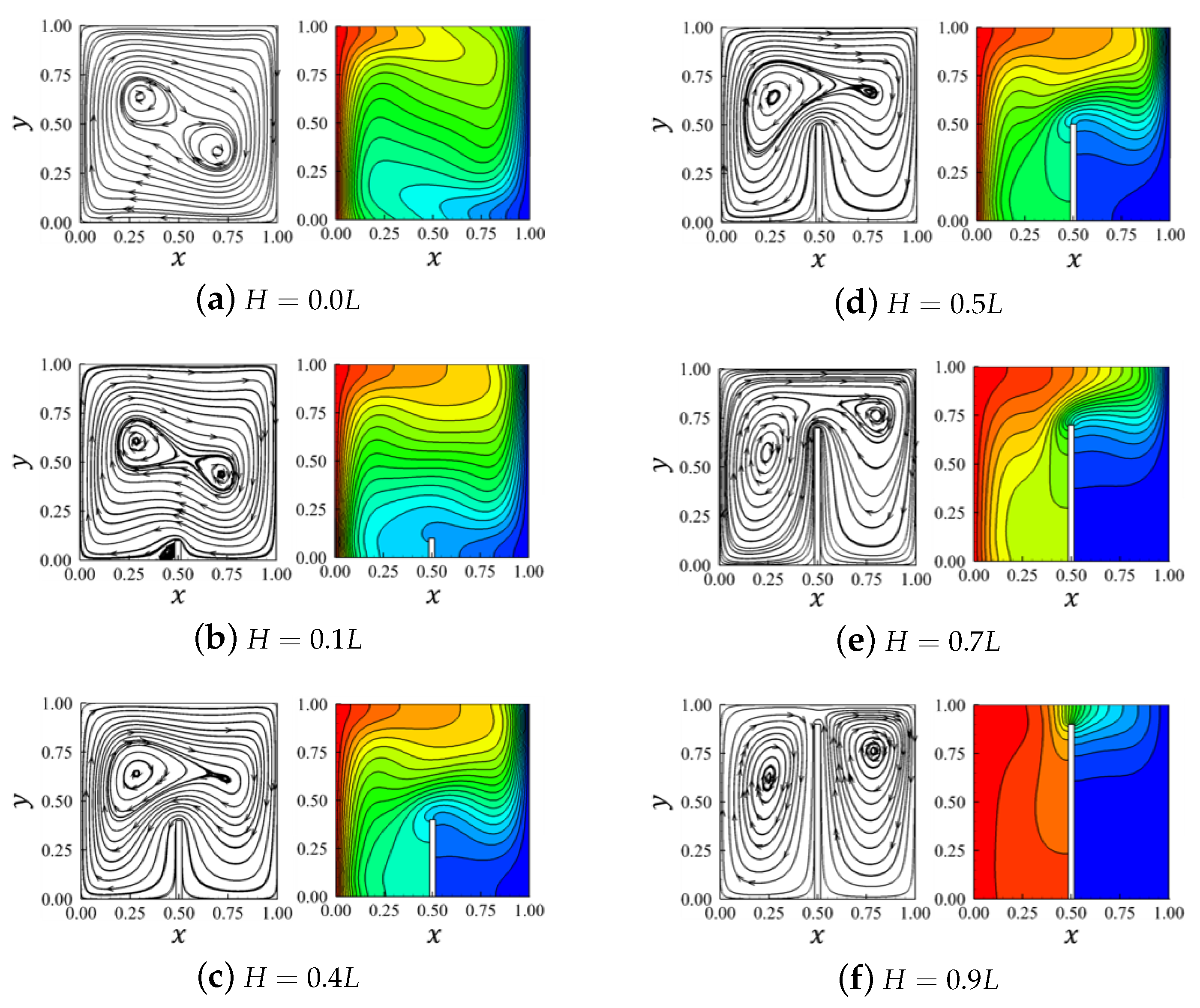
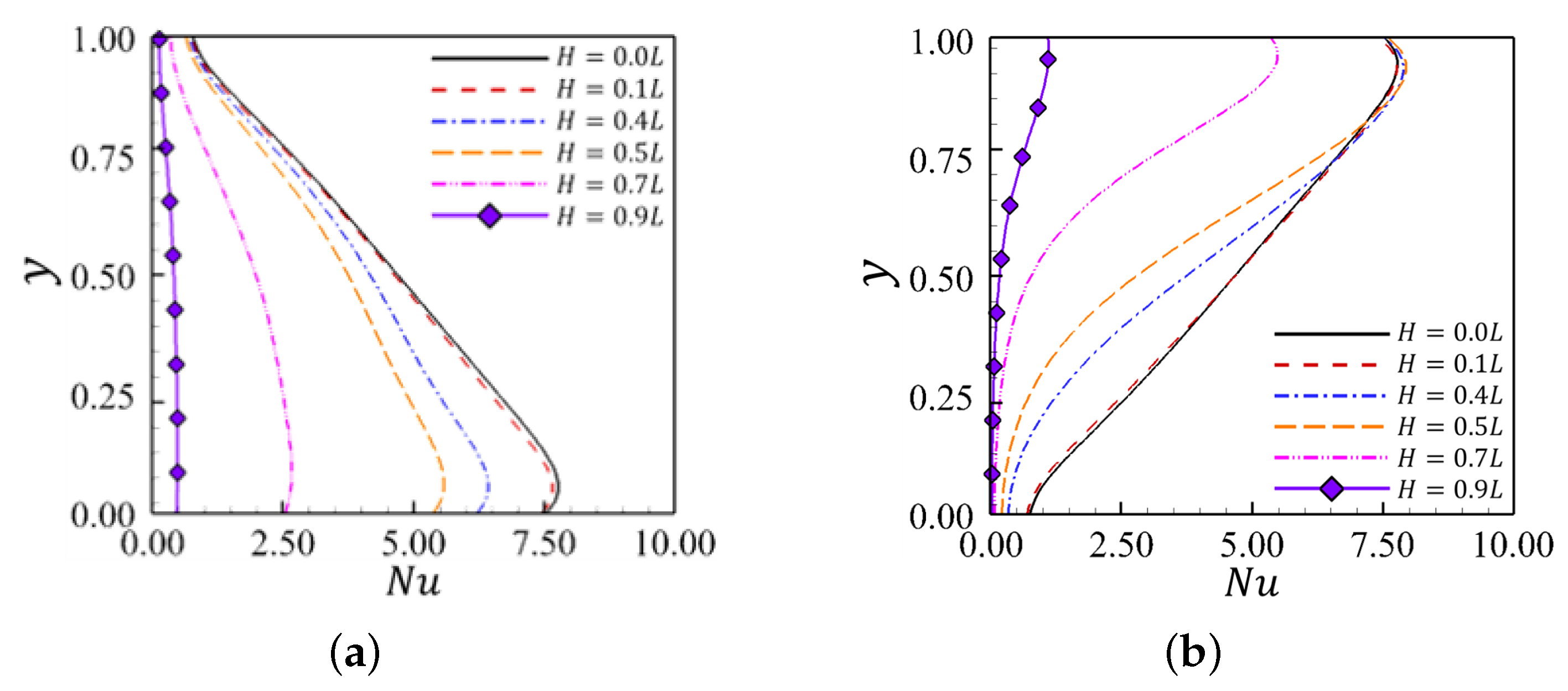
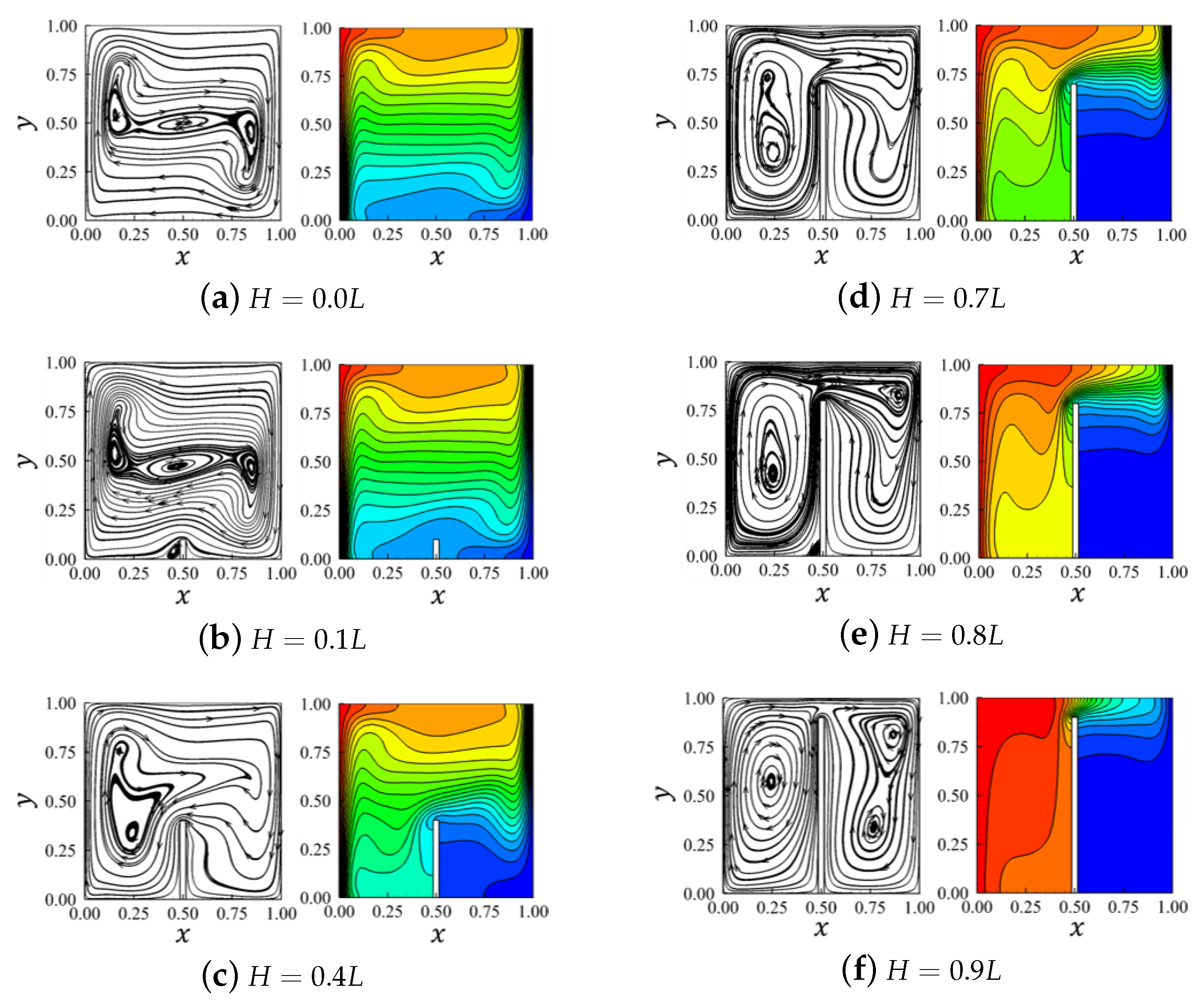
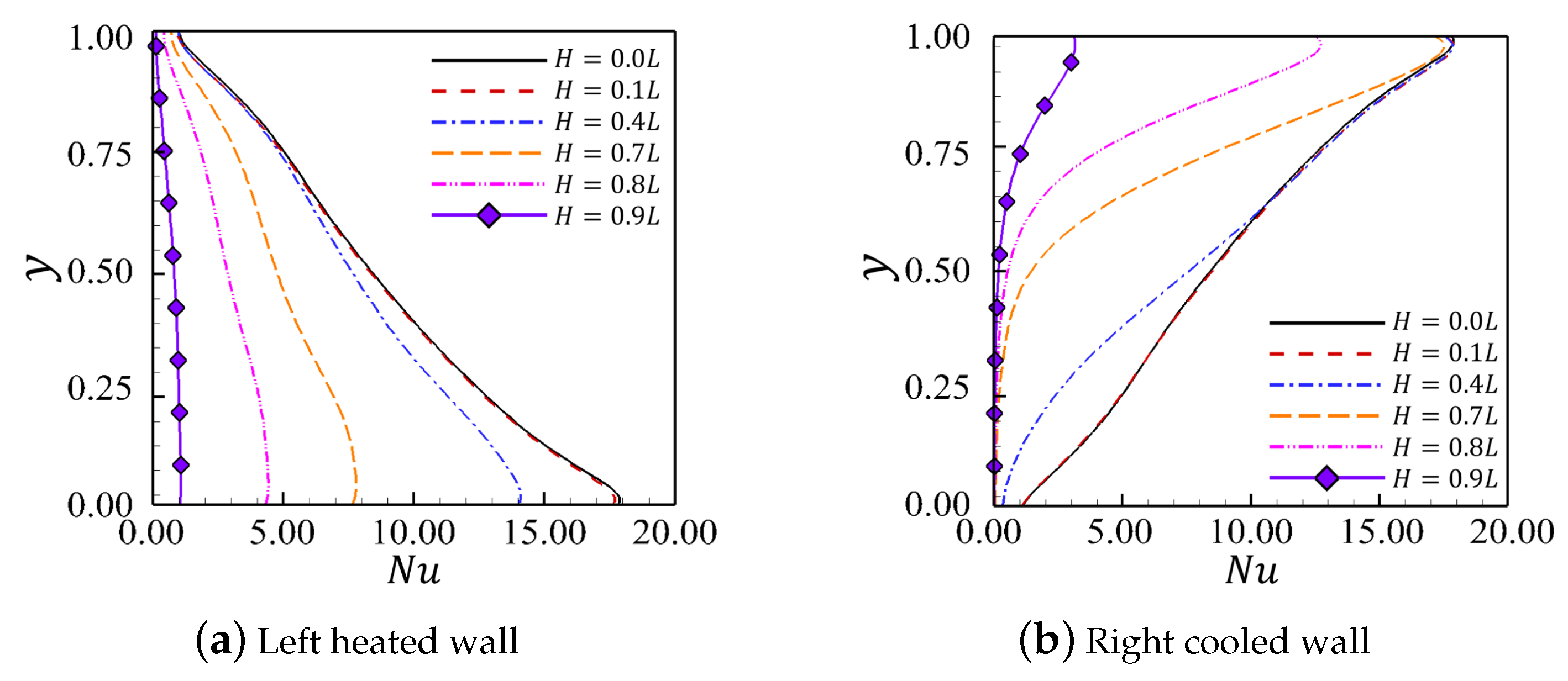
At R a = 10 5 , stronger buoyancy forces lead to more complex flow structures and intensified convection. Unlike R a = 10 3 and 10 4 , where partition height effects can be grouped, the R a = 10 5 regime shows highly nonlinear and sensitive responses, requiring case-by-case analysis. Without a partition ( H = 0.0 L ), the single clockwise vortex at lower R a transitions into two clockwise vortices in the upper-left and lower-right regions (Figure 7a), consistent with classical cavity convection [11,12,13,14,15,16,17,25,38,43]. Enhanced inertial effects steepen thermal gradients at the bottom-left hot wall and top-right cold wall, producing sharp N u peaks (Figure 8a,b), while the bottom-right cold wall remains weakly active with low N u . When a short partition is introduced ( H = 0.1 L ), the overall flow pattern remains similar, but the lower-right vortex weakens as descending cold fluid is partially redirected upward near the partition tip. This results in reduced recirculation in the lower region and lower N u values along the bottom of both walls, particularly near the bottom-left corner (Figure 7b and Figure 8a,b), while strong convection persists in the upper domain.
At mid partition heights ( H = 0.4 L and H = 0.5 L ), the lower-right vortex undergoes marked suppression and reorganization. At H = 0.4 L , the lower right vortex is strongly suppressed and compressed, while the dominant upper right clockwise vortex enlarges and extends rightward (Figure 7c). The descending cold fluid loses momentum at the partition tip and is redirected upward, leading to diffusion-controlled heat transfer in the lower domain, with horizontally aligned isotherms and uniformly low N u (Figure 8a,b). At H = 0.5 L , partial recovery occurs as a weak secondary vortex reappears in the upper-right region adjacent to the cold wall (Figure 7d). Although the flow remains asymmetric, localized recirculation is sustained, indicating that suppression at high R a is non-monotonic and can be partially reversed under stronger inertial effects. This trend aligns with previous findings [37], which reported that vortex deformation intensifies and sensitivity to partition-induced disturbances increases with higher Rayleigh numbers.
At H = 0.7 L , the upper-left vortex strengthens and expands, while the secondary upper-right vortex, initiated at H = 0.5 L , becomes more pronounced (Figure 7e). Circulation is now confined to the upper layer, indicating a transition from asymmetric to more symmetric upper-layer dynamics. The lower region remains conduction-dominated, with widely spaced horizontal isotherms and further reduced N u along both bottom walls (Figure 8a,b). In the upper domain, the right-side vortex dominates heat transfer, producing steep N u growth along the upper-right cold wall, while the upper-left hot wall sustains moderate convection with a gradual N u decline toward the top. This confirms that stratification intensifies relative to H = 0.5 L , concentrating convective transport in the upper layer.
At H = 0.9 L , the flow becomes fully stratified (Figure 7f): no coherent circulation forms in the lower region, and streamlines are confined above the partition. The increased height blocks the lower flow path, leaving the lower domain thermally and dynamically stagnant. Isotherms near both bottom walls are widely spaced and horizontal, and N u values drop to their minimum (Figure 8a,b), indicating conduction-dominated transport. In the upper layer, convection persists, with the right-side cold wall showing tightly packed isotherms and steep N u growth from strong descending flow impingement, while the upper-left hot wall exhibits a gradual N u decline toward the top due to weakened thermal gradients. Heat transfer is therefore concentrated in the upper-right region, producing a strongly asymmetric stratified regime. Overall, the flow at R a = 10 5 evolves from a dual-vortex structure to a dominant upper vortex, then to an upper dual-vortex system, and finally to full stratification, underscoring the heightened sensitivity of high- R a convection to partition height.

3.1.3. R a = 10 6

At R a = 10 6 for H = 0.0 L and H = 0.1 L , the flow exhibits a more complex and vigorous convective pattern compared to R a = 10 5 (Figure 9a,b). Two dominant clockwise vortices form in the upper-left and lower-right regions, while smaller vortical motions appear near the cavity center, indicating intensified buoyancy-driven circulation. At H = 0.1 L , the right vortex becomes slightly smaller and a small secondary vortex appears near the partition tip, marking the onset of lower flow suppression. This reduces thermal gradients near the bottom of the hot wall and marginally decreases N u at the bottom corners (Figure 10a,b), while strong convection persists in the upper region.
At H = 0.4 L , the vortical structures are reorganized: the right-side vortex, which has been progressively shrinking since H = 0.1 L , nearly disappears, while the central vortex shifts downward toward the lower-left region and merges partially with the left-side circulation. The upper-left vortex migrates upward and slightly contracts, redistributing momentum toward the upper domain (Figure 9c). This reorganization marks the onset of vertical stratification, with flow activity concentrated above the partition. In the lower region, isotherms near both vertical walls become horizontally stretched and sparse, indicating reduced convective transport and an increasing dominance of conduction. Correspondingly, the local N u values near the bottom of both the left hot wall and the right cold wall drop markedly compared to H = 0.0 L and H = 0.1 L (Figure 10a,b). In contrast, N u along the upper portion of the right cold wall continues to rise, confirming that strong convection is sustained only in the upper layer, accompanied by pronounced asymmetry under high-buoyancy conditions.
From H = 0.4 L to 0.7 L , the overall flow structure remains largely unchanged, as shown in Figure 9d, with the right vortex suppressed and momentum concentrated in the upper region. The thermal field and local N u distributions (Figure 10a,b) evolve gradually: along the left hot wall, N u decreases progressively over the entire height, indicating weakening convection; along the right cold wall, the lower section experiences intensified stratification and stagnant flow, causing N u to drop sharply and then level off, whereas the upper section maintains high N u values comparable to those at lower partition heights. Compared to R a = 10 3 10 5 , the suppression is stronger at R a = 10 6 , particularly along the right cold wall, which is more sensitive to vertical flow disruption.
A distinct reorganization occurs at H = 0.8 L (Figure 9e), where the two upper vortices on the left merge into a single large clockwise vortex, and an additional small vortex forms near the upper-right cold wall. This redistribution of momentum further strengthens heat transfer along the right wall, as seen in the sharp N u rise in Figure 10b, while convection along the left hot wall remains moderate.
At H = 0.9 L , a notable structural change occurs as two vortices appear near the right partition: a dominant upper vortex occupying most of the upper cavity and a smaller lower vortex confined to the bottom-right corner (Figure 9f). This configuration produces a gap flow phenomenon, effectively isolating the upper and lower regions. The upper cavity sustains strong convection, with tightly packed isotherms and a steep N u increase along the right cold wall, while the left hot wall maintains moderate convection near the top (Figure 10a,b). In contrast, the lower cavity remains largely stagnant, characterized by horizontally layered isotherms and conduction-dominated heat transfer, leading to low and nearly uniform N u values along both lower wall sections. These features at H = 0.9 L are consistent with the overall trend observed across partition heights, where vortex merging and separation progressively intensify upper dominance and suppress lower-zone convection.

3.2. Structural Transitions Inferred from Vortex Center Trajectories

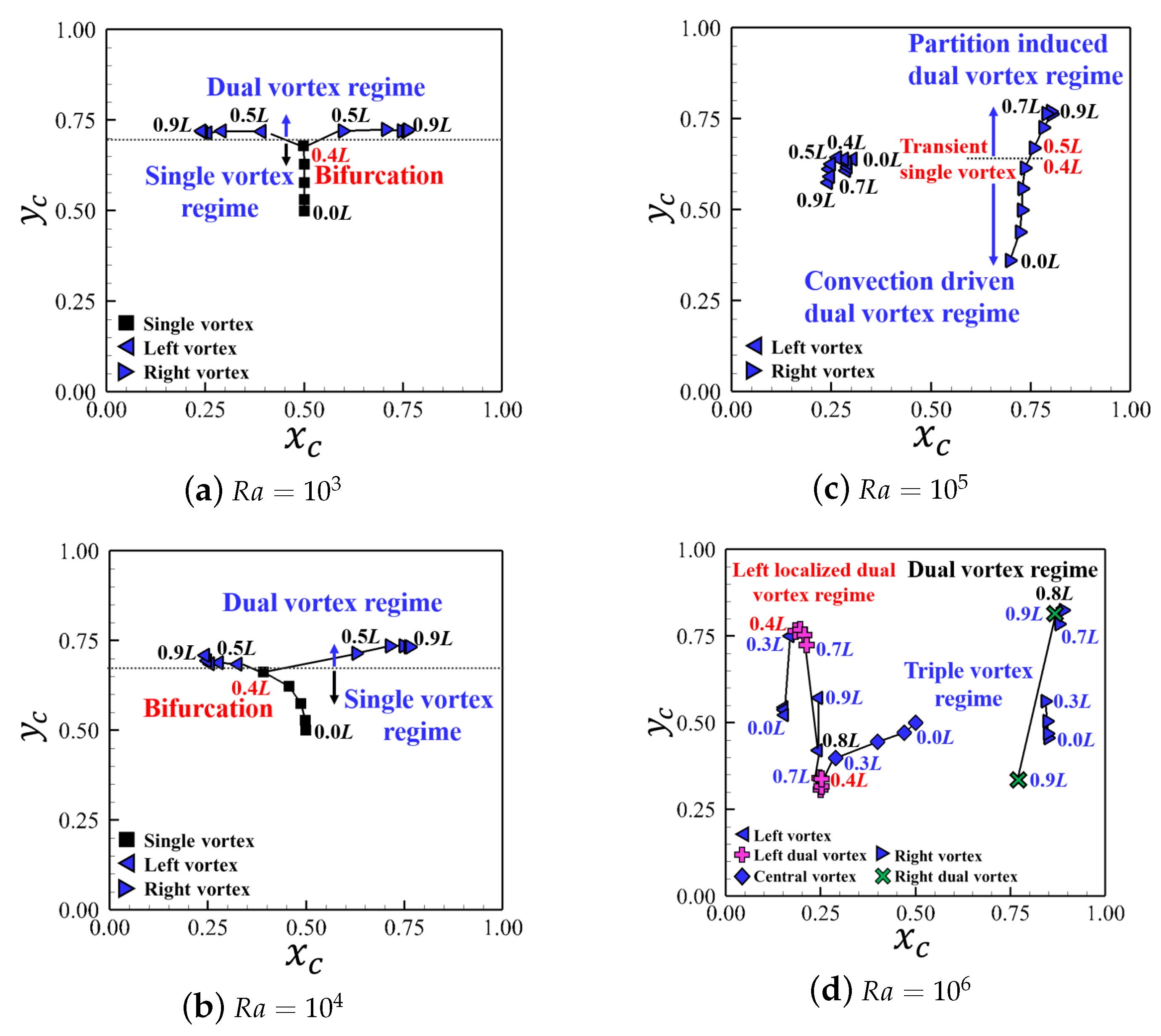
The evolution of vortex structures with increasing partition height H was analyzed for Rayleigh numbers ranging from R a = 10 3 to 10 6 , using the trajectories of vortex centers ( x c , y c ) extracted from the streamlines, as shown in Figure 5, Figure 7, and Figure 9. These trajectories, summarized in Figure 11, quantitatively represent the internal flow reorganization and enable the identification of key transitions such as vertical suppression, lateral confinement, vortex merging and separation, and increasing asymmetry. The vertical and horizontal displacements of vortex centers are strongly correlated with the development of thermal stratification and the progressive suppression of the lower convective domain.
For R a = 10 3 , the vortex center exhibits a gradual upward shift from H = 0.0 L to 0.4 L , as shown in Figure 11a corresponding to Figure 5a–c for flow fields, indicating increasing confinement despite maintaining a single-vortex structure. At H = 0.5 L (Figure 11a; see also Figure 5d), a structural bifurcation occurs, with the vortex splitting into two centers positioned symmetrically along the vertical walls. Both vortices shift upward and laterally, marking a transient reorganization of the flow. From H = 0.6 L to 0.9 L (Figure 11a; see also Figure 5e–j), the vortex centers stabilize, with negligible vertical displacement and reduced horizontal movement, indicating uniform suppression across the lower domain, while convection remains balanced along both walls.
For R a = 10 4 , from H = 0.0 L to 0.4 L , the single vortex center exhibits a gradual upward and leftward shift, as shown in Figure 11b, corresponding to Figure 5f–h. This reflects the early onset of lateral confinement and mild stratification, with asymmetry developing even before vortex splitting, accompanied by a consistent vertical rise in the vortex position. At H = 0.5 L , a structural bifurcation occurs (Figure 11b; see also Figure 5i), where the vortex separates into left and right centers. The left vortex shifts laterally toward the left wall, indicating asymmetric confinement, while the right vortex rises toward the upper region. From H = 0.6 L to 0.9 L , the left and right vortices remain laterally confined along the left and right walls, respectively, with limited vertical displacement. Compared to R a = 10 3 , asymmetry and suppression emerge earlier and more clearly, due to stronger lateral shifts and earlier lower-right flow deactivation.
For R a = 10 5 , although a dual-vortex structure due to strong convection is initially present at H = 0.0 L (Figure 11c; see also Figure 7a), significant structural transformation occurs with increasing partition height. From H = 0.0 L to 0.4 L (Figure 7a–c), the left vortex gradually strengthens while the right vortex weakens and nearly vanishes by H = 0.4 L , effectively forming a transient single-vortex structure. At H = 0.5 L (Figure 7d), a new right vortex emerges near the cold wall in the upper region, likely induced by partition-driven flow reorganization. This new vortex grows in strength and rises from H = 0.6 L to 0.9 L (Figure 7e–h), establishing an asymmetric dual-vortex structure with both vortices confined in the upper domain.
For R a = 10 6 , a highly complex flow with three distinct vortex centers, driven by strong buoyancy forces, is present from the beginning at H = 0.0 L (Figure 11d; see also Figure 9a), with the central vortex located near mid-height and the left and right vortices situated symmetrically on either side. From H = 0.1 L to 0.7 L , the flow undergoes a distinct transition driven by vortex suppression and structural reorganization. The central vortex migrates downward into the lower-left region and grows in size, while the left vortex shifts upward and weakens. At the same time, the right vortex experiences progressive suppression, shrinking steadily until it completely disappears by H = 0.4 L and remains absent thereafter. This transformation results in full confinement along the cold wall and establishes the upper-dominated flow patterns that persist up to H = 0.7 L .
At H = 0.8 L , another distinct transition occurs. A new right vortex forms in the upper-right corner near the cold wall, while the pre-existing upper-left vortex disappears entirely (Figure 11d; see also Figure 9e). This reorganization shifts the dominant circulation toward the right side of the upper cavity and alters the momentum distribution and thermal transport pathways.
At H = 0.9 L , a final transition occurs in which the right vortex splits into two vertically stacked vortices near the cold wall—an upper vortex and a smaller lower vortex—while the left vortex remains confined to the upper-left region (Figure 9f; see also Figure 11d). This vertical division in the right-side circulation further redistributes momentum within the upper cavity, creating a distinct gap flow separation between the upper and lower vortical cells. The lower cavity remains stagnant, confirming complete suppression of convective motion in that region.
Across all R a , the flow evolution with increasing partition height follows a sequence of distinct structural transitions, ranging from stable single-vortex states to bifurcated dual-vortex systems, transient single-vortex configurations, newly generated vortices, and final stratified patterns, driven by the interplay of buoyancy, partition-induced confinement, and vortex merging or separation.

3.3. Analysis of Local Heat Transfer Modes Using Local Nusselt Number Differences

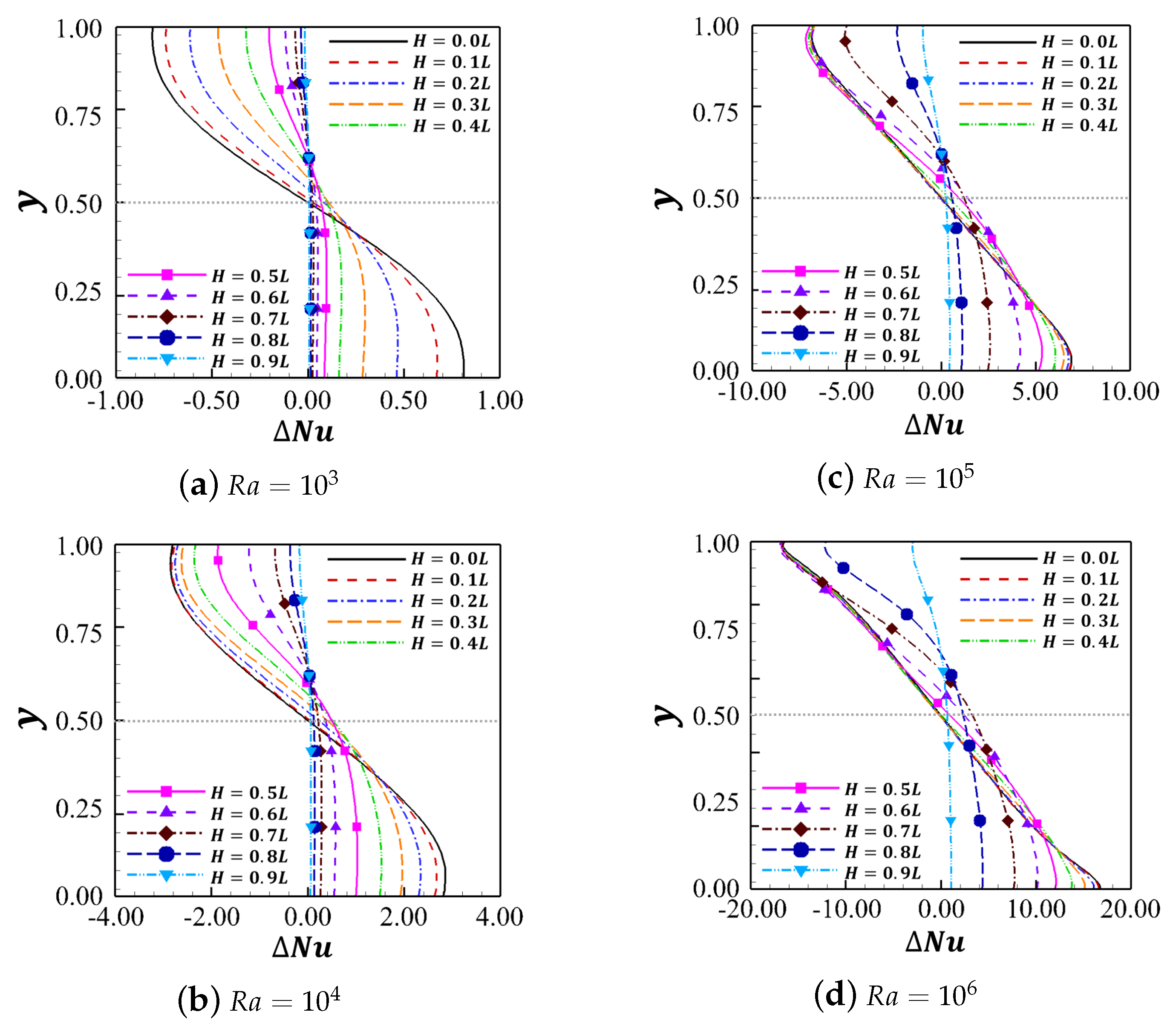
The effect of partition height on asymmetric heat transfer between the hot and cold walls is quantitatively examined using the local Nusselt number difference ( Δ N u ), as shown in Figure 12. The parameter Δ N u is defined as Δ N u = N u h o t N u c o l d , representing the pointwise difference in local Nusselt number between the two vertical walls at the same height. Positive values indicate stronger heat transfer on the hot wall, whereas negative values reflect enhanced heat transfer on the cold wall. This metric directly reveals how the partition alters vertical heat transfer distributions by inducing flow obstruction and convection suppression.
At R a = 10 3 and 10 4 , Δ N u remains small throughout the vertical domain for all partition heights (Figure 12a,b), reflecting near-symmetric convection. For R a = 10 3 , Δ N u gradually decreases across the full height as H increases, indicating uniform suppression on both walls. The Δ N u 0 zone steadily shifts upward, suggesting bottom-up expansion of the suppressed region.
For R a = 10 4 , this transition becomes more spatially distinct. When H 0.4 L , Δ N u curves remain similar in shape and magnitude. However, for H 0.5 L , the mid-to-upper region begins to flatten, indicating early signs of vertical differentiation in suppression. As with R a = 10 3 , the Δ N u 0 zone shifts upward, but to a lesser extent, implying that cold wall activity is more resilient at this R a .
At R a = 10 5 , asymmetry becomes more pronounced (Figure 12c). For low H, Δ N u shows steep gradients, positive at the bottom, negative at the top, indicating spatially separated convection on each wall. From H = 0.5 L onward, the curves begin to flatten, especially for H 0.8 L , where Δ N u 0 appears in the upper region ( y > 0.6 ). This does not indicate restored symmetry but rather simultaneous weakening of both walls’ convection. The upward growth of the Δ N u 0 region reflects vertically expanding suppression and thermal stratification due to the partition.
At R a = 10 6 , Δ N u profiles show the most severe asymmetry (Figure 12d). For H 0.4 L , Δ N u spans large positive values near the bottom ( y < 0.4 ) and strong negative values near the top ( y > 0.7 ), reflecting intense but spatially divided convection: hot-wall dominant below, cold wall dominant above. As H increases to 0.8 L and 0.9 L , the lower Δ N u values approach zero, indicating full suppression of hot-wall convection. Meanwhile, the upper Δ N u becomes increasingly negative ( Δ N u < 10 ), signaling that residual cold wall activity is confined to a thin upper region. This results in an extreme imbalance, not due to competing flows but due to near-complete collapse of one side’s convection.
In summary, the Δ N u profiles clearly capture how partition height affects wall convection. At low R a , the partition induces gradual, symmetric suppression. As R a increases, the suppression becomes spatially distinct and asymmetric, eventually isolating active convection into narrow vertical zones. The Δ N u metric thus serves as an effective diagnostic tool for assessing the progression of partition-induced thermal isolation.
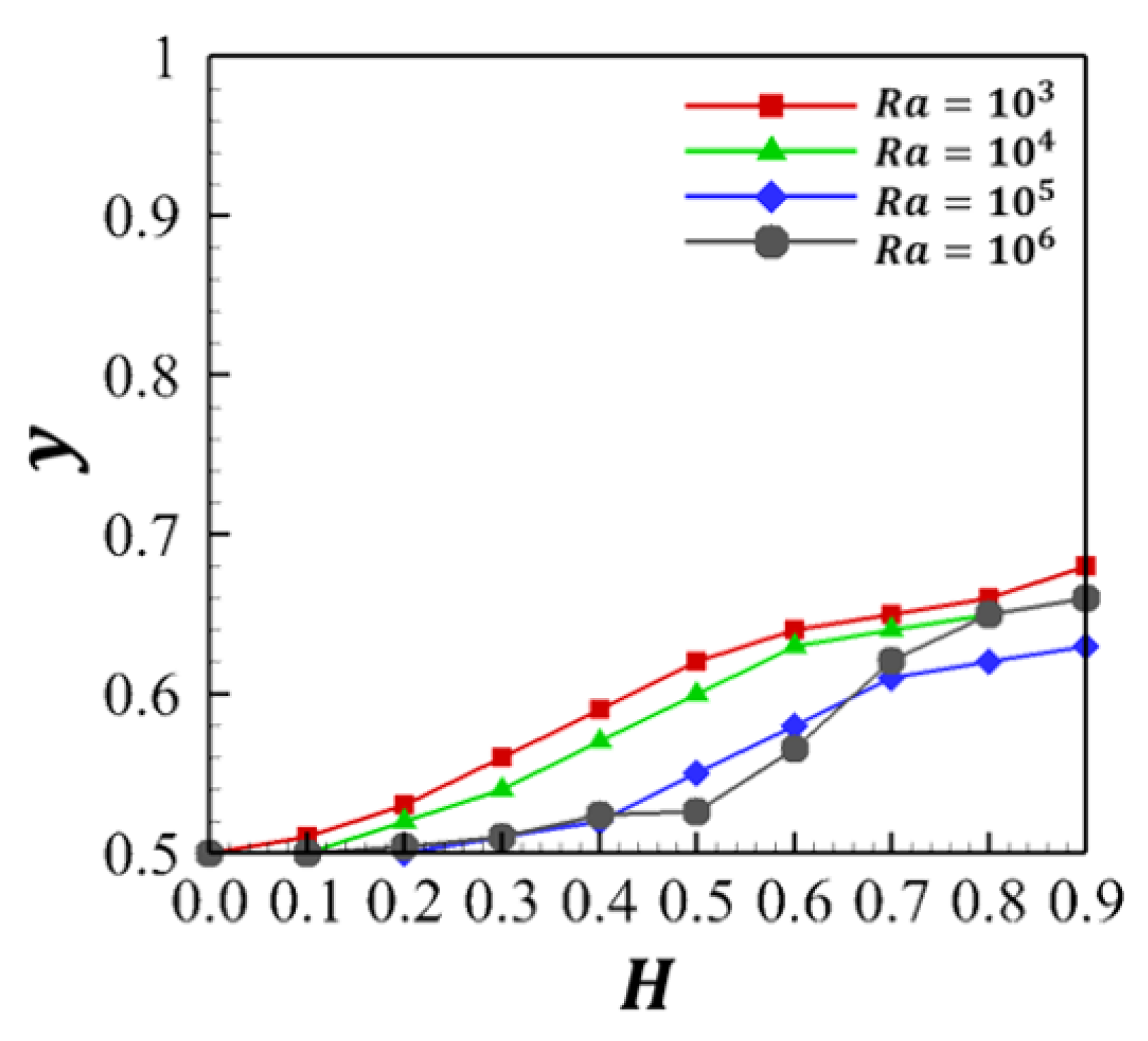
To complement the Δ N u distributions presented in Figure 12 and Figure 13 visualizes the vertical position of Δ N u = 0 , representing the location of thermal balance between the hot and cold walls, as a function of H and R a . When H = 0 , the zero-crossing position is located near the mid-height of the cavity ( y 0.5 ) for all R a cases. As H increases, this position progressively shifts upward. For R a = 10 3 , the shift occurs gradually and continuously across the entire H range, while R a = 10 4 exhibits a similar trend but remains slightly lower in the cavity. In contrast, at R a = 10 5 and 10 6 , the balance position remains nearly unchanged for H 0.4 L , but rises sharply once H exceeds approximately 0.5 L , indicating a distinct transition height. These results suggest that, at low R a , partition-induced suppression expands upward progressively from the bottom, whereas at high R a , suppression remains localized until a critical partition height is reached, beyond which the upper shift in the thermal balance point accelerates rapidly. Figure 13 therefore provides a concise quantitative summary of the trends identified in Figure 12, highlighting how the interplay between partition height and buoyancy strength governs the vertical redistribution of heat transfer asymmetry.

3.4. Thermal Regime Classification and Global Heat Transfer Trends

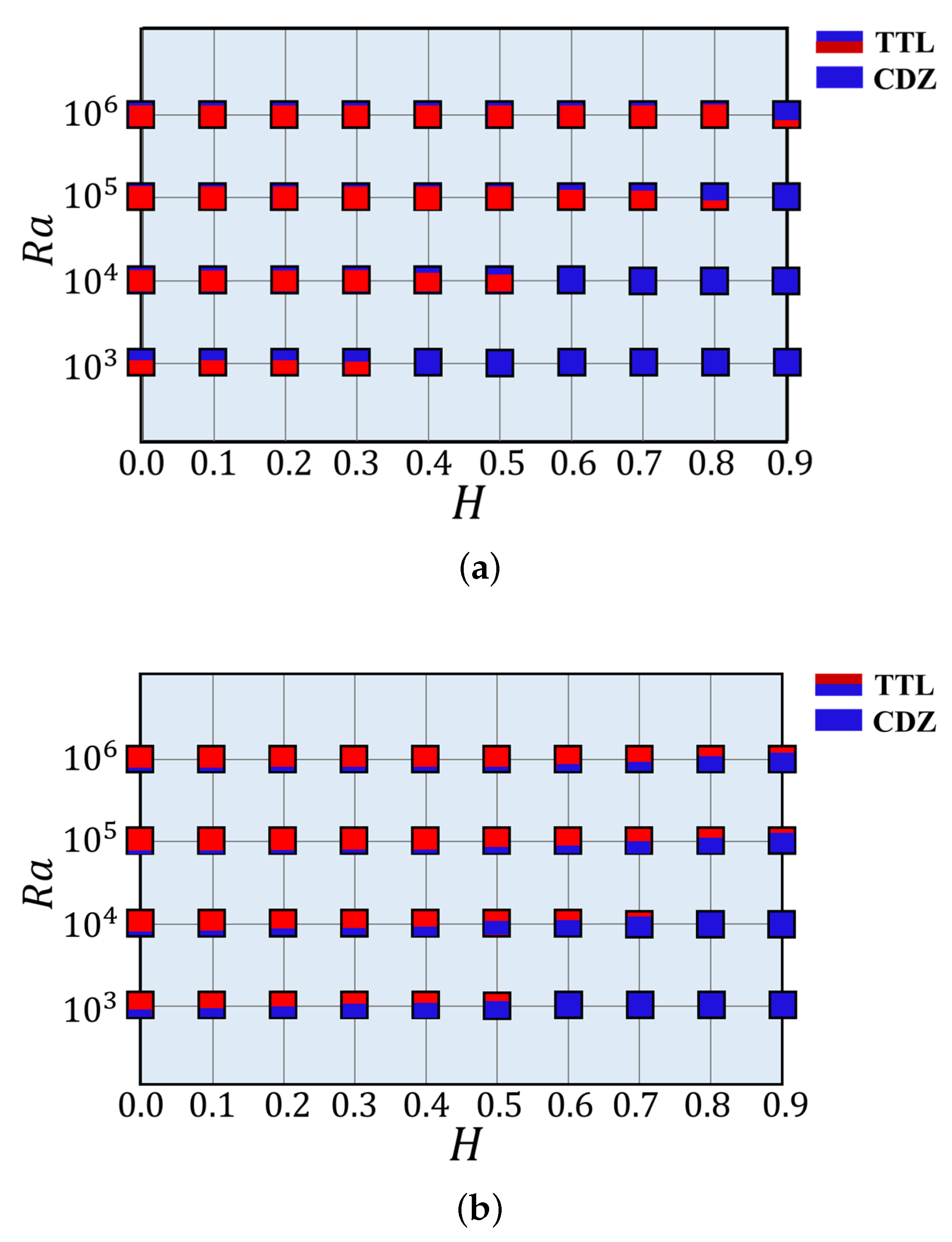
The vertical redistribution of heat transfer asymmetry and the upward shift in the Δ N u = 0 location identified in Figure 12 and Figure 13 can be further interpreted by classifying the local wall heat transfer into distinct thermal regimes, as shown in Figure 14. Two regimes are defined based on the local Nusselt number: the Thermal Transition Layer (TTL) and the Conduction-Dominated Zone (CDZ). The TTL corresponds to wall regions where N u values straddle unity, indicating the coexistence of convective and conductive transport. Its vertical extent represents the degree to which convection remains active along the wall despite partition-induced suppression. In contrast, the CDZ is defined by N u < 1 , marking regions where conduction prevails due to significant weakening of wall convection.
At low Rayleigh numbers ( R a = 10 3 10 4 ), the TTL remains shallow and grows slowly with partition height, while the CDZ is limited to the lower cold wall. This is consistent with the limited asymmetry and weak suppression inferred from the Δ N u profiles in Figure 12. At higher Rayleigh numbers ( R a = 10 5 10 6 ), stronger buoyancy along the hot wall drives the TTL upward, whereas the CDZ expands rapidly along the cold wall. This behavior confirms that cold wall convection is suppressed earlier and more strongly, while hot-wall convection remains active in the upper cavity even at larger partition heights.
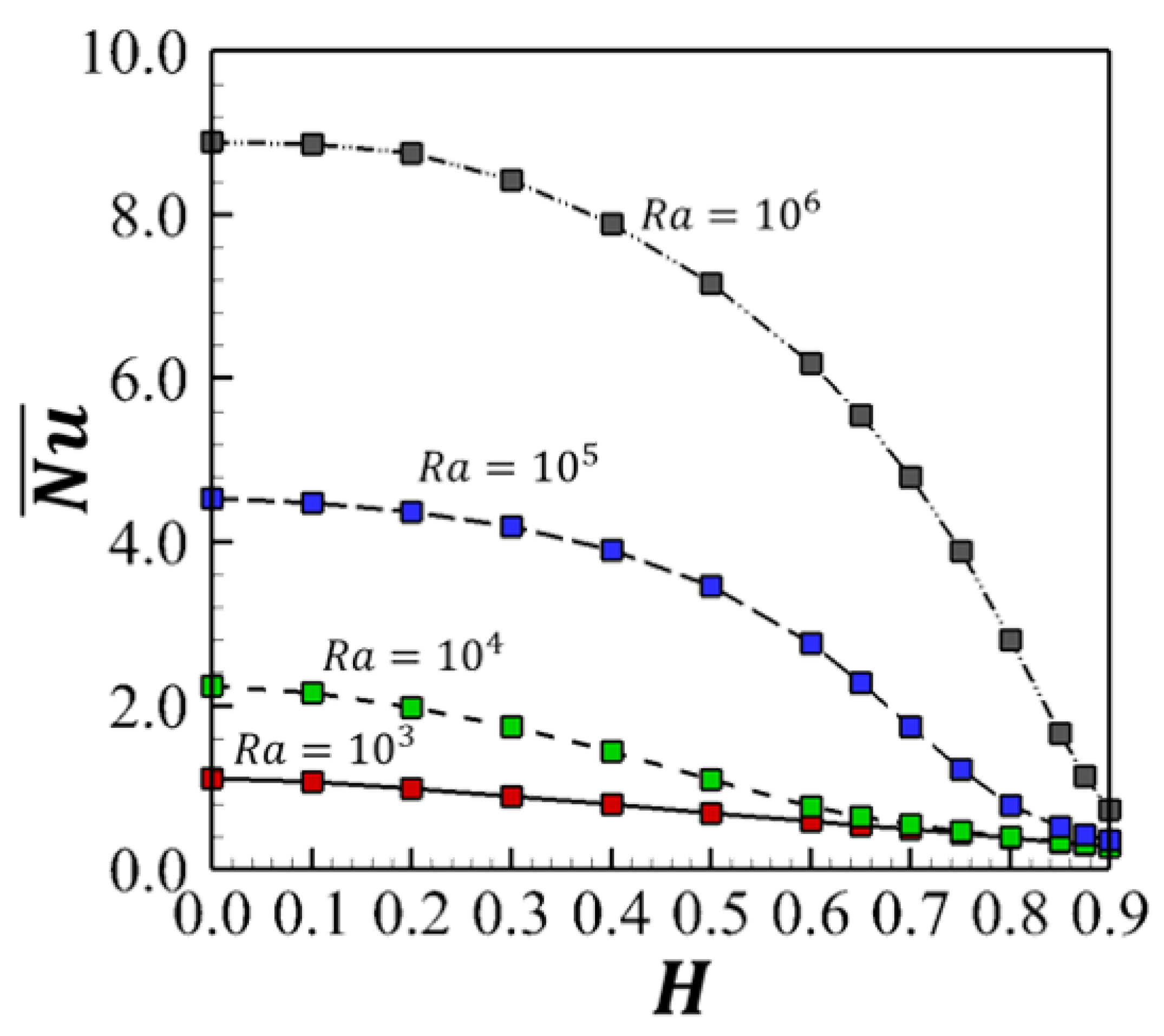
These local regime transitions are reflected in the global heat transfer characteristics shown in Figure 15. The surface-averaged Nusselt number ( N u ¯ ) decreases monotonically with increasing H for all R a , but the rate of decrease depends on the interplay between TTL extension and CDZ growth. For R a = 10 3 10 4 , the gradual TTL growth results in only a modest N u ¯ decline. In contrast, at R a = 10 5 10 6 , rapid CDZ expansion and upward TTL extension cause N u ¯ to drop sharply beyond H 0.4 L . Once H 0.8 L , N u ¯ converges to a low, nearly constant value across all R a , indicating that conduction dominates throughout most of the cavity and active convection is confined to a narrow upper-hot-wall region. At this stage, the overall heat-transfer rate is markedly reduced, with the surface-averaged Nusselt number exhibiting an overall decline of about 75–92% between H = 0.0 L and H = 0.9 L across all R a , as shown in Figure 15.
Overall, the combined interpretation of Figure 12, Figure 13, Figure 14 and Figure 15 demonstrates that increasing partition height and R a not only intensifies local heat transfer asymmetry but also shifts the system toward a conduction-dominated regime, with convection increasingly restricted to the upper hot-wall zone.

4. Conclusions

This study systematically examined the effects of partition height (H) and Rayleigh number ( R a ) on natural convection in a differentially heated cavity, revealing the coupled evolution of flow structures, heat transfer asymmetry, and regime transitions.
Increasing partition height progressively decouples the upper and lower cavity regions, with the degree of vertical coupling strongly dependent on buoyancy strength. At low R a ( 10 3 10 4 ), the flow remains largely single-vortex for small H, with suppression confined to the lower zone. In contrast, at high R a ( 10 5 10 6 ), strong buoyancy drives nonlinear structural transitions—progressing from dual-vortex circulation to dominant upper vortices and eventually to conduction-dominated stratified states—accompanied by earlier and stronger suppression along the cold wall than the hot wall.
Vortex trajectory analysis quantitatively captured these reorganizations, showing upward migration under vertical suppression, lateral confinement toward sidewalls, vortex merging, disappearance, and partition-induced regeneration. At higher R a , critical heights were identified where major reorganizations occurred, marking the shift from convection-dominated to stratified regimes.
The local Nusselt number difference ( Δ N u ) proved to be a physically meaningful measure of vertical heat transfer imbalance. At low R a , Δ N u trends reflected gradual, symmetric suppression, while at high R a the profiles exhibited sharp vertical separation of convection zones, with Δ N u 0 regions migrating upward rapidly beyond a critical partition height of about 0.5 L . At R a = 10 6 , convection became confined to narrow zones near the top, with one wall nearly thermally inactive, indicating extreme partition-induced isolation.
Thermal regime classification into the Thermal Transition Layer (TTL) and the Conduction-Dominated Zone (CDZ) further clarified the link between local wall transport and global performance. At low R a , the TTL remained shallow and CDZ growth was limited, resulting in gradual declines in the surface-averaged Nusselt number ( N u ¯ ). At high R a , a sharp drop in N u ¯ occurred beyond H 0.4 L due to rapid cold wall CDZ expansion and hot-wall TTL rise. For H 0.8 L , all R a cases converged to a conduction-dominated state with active convection confined to a thin upper zone of the hot wall. The presence of a tall partition ( H = 0.9 L ) significantly suppresses heat transfer, with the average Nusselt number decreasing by approximately 75–87% for low R a ( 10 3 10 4 ), and by 91–92% for higher R a ( 10 5 10 6 ).
Overall, partition height and Rayleigh number act synergistically to intensify thermal asymmetry, promote upper-layer dominance, and accelerate the onset of conduction-limited stratification. These findings establish a comprehensive physical framework for predicting natural convection behavior in partitioned enclosures and provide quantitative metrics—vortex trajectories, Δ N u , TTL/CDZ mapping for evaluating suppression mechanisms relevant to thermal management and energy-efficient enclosure design.
Importantly, the combined diagnostic framework introduces predictive criteria that were not available in previous partition-convection studies, enabling clear identification of structural reorganizations and the onset of stratification. By quantifying the vertical transition height through Δ N u and mapping the evolution of conduction- and convection-dominated zones using TTL/CDZ, the framework provides actionable guidance for optimizing enclosure geometry and thermal performance. Because the diagnostic metrics are geometry-independent, the methodology is readily extendable to multi-partition domains and non-rectangular enclosures, broadening its practical applicability across a wide range of thermally efficient system designs. In practical terms, the reduction in the Nusselt number translates directly into lower heat leakage and suppressed convective transport, both of which enhance the thermal resistance of the enclosure. This partition-induced suppression is particularly beneficial in insulation-oriented systems—such as cryogenic and LNG tanks, thermal insulation panels, and passive cooling housings—where minimizing heat ingress is essential. Conversely, in electronics cooling applications requiring controlled heat removal, the proposed diagnostic framework can inform the optimal placement and height of partitions to manage flow pathways and avoid premature stratification. These findings establish a clear quantitative link between Nusselt-number reduction, increased thermal resistance, and improved energy-efficient enclosure performance across both insulation and heat-dissipation applications.

Author Contributions

Conceptualization, H.S.Y.; Investigation, R.K.; Methodology, R.K.; Validation, R.K.; Writing—original draft preparation, R.K.; Writing—review and editing, A.R.N. and H.S.Y.; Supervision, H.S.Y. All authors have read and agreed to the published version of the manuscript.

Funding

This work was funded by the Institute of Energy Technology Evaluation and Planning (KETEP) and the Ministry of Trade, Industry and Energy (MOTIE) of the Republic of Korea (20224000000090).

Informed Consent Statement

Not applicable.

Data Availability Statement

The data that support the findings of this study are available from the corresponding author upon reasonable request.

Acknowledgments

This work was supported by 2025 BK21 FOUR Program of Pusan National University.

Conflicts of Interest

The authors declare that there is no conflicts of interest.

References

  1. Park, B.; Lee, S. Investigation of the energy saving efficiency of a natural ventilation strategy in a multistory school building. Energies 2020, 13, 1746. [Google Scholar] [CrossRef]
  2. Pastori, S.; Mereu, R.; Mazzucchelli, E.S.; Passoni, S.; Dotelli, G. Energy performance evaluation of a ventilated façade system through CFD modeling and comparison with international standards. Energies 2021, 14, 193. [Google Scholar] [CrossRef]
  3. Myroniuk, K.; Furdas, Y.; Zhelykh, V.; Adamski, M.; Gumen, O.; Savin, V.; Mitoulis, S.A. Passive ventilation of residential buildings using the trombe wall. Buildings 2024, 14, 3154. [Google Scholar] [CrossRef]
  4. Lee, J.B.; Kim, H.J.; Kim, D.K. Experimental study of natural convection cooling of vertical cylinders with inclined plate fins. Energies 2016, 9, 391. [Google Scholar] [CrossRef]
  5. Adhikari, R.; Beyragh, D.; Pahlevani, M.; Wood, D. A numerical and experimental study of a novel heat sink design for natural convection cooling of LED grow lights. Energies 2020, 13, 4046. [Google Scholar] [CrossRef]
  6. Liu, J.; Guo, W.; Yin, M.; Xi, W.; Sunden, B. Flow and heat transfer characteristic of regenerative cooling channels using supercritical CO2 with circular tetrahedral lattice structures. Case Stud. Therm. Eng. 2025, 71, 106204. [Google Scholar] [CrossRef]
  7. Moench, S.; Dittrich, R. Influence of natural convection and volume change on numerical simulation of phase change materials for latent heat storage. Energies 2022, 15, 2746. [Google Scholar] [CrossRef]
  8. Abrha, A.K.; Teklehaymanot, M.K.; Kahsay, M.B.; Nydal, O.J. Charging of an Air–Rock Bed Thermal Energy Storage under Natural and Forced Convection. Energies 2024, 17, 4952. [Google Scholar] [CrossRef]
  9. Włodek, T.; Łaciak, M. Rollover prevention model for stratified liquefied natural gas in storage tanks. Energies 2023, 16, 7666. [Google Scholar] [CrossRef]
  10. Sun, Q.; Zhang, Y.; Lv, Y.; Peng, D.; Zhang, S.; Lu, Z.; Yan, J. Comparative Analysis of Heat Transfer in a Type B LNG Tank Pre-Cooling Process Using Various Refrigerants. Energies 2024, 17, 4013. [Google Scholar] [CrossRef]
  11. De Vahl Davis, G. Natural convection of air in a square cavity: A bench mark numerical solution. Int. J. Numer. Methods Fluids 1983, 3, 249–264. [Google Scholar] [CrossRef]
  12. Le Quéré, P.; De Roquefortt, T.A. Computation of natural convection in two-dimensional cavities with Chebyshev polynomials. J. Comput. Phys. 1985, 57, 210–228. [Google Scholar] [CrossRef]
  13. Khanafer, K.; Vafai, K.; Lightstone, M. Buoyancy-driven heat transfer enhancement in a two-dimensional enclosure utilizing nanofluids. Int. J. Heat Mass Transf. 2003, 46, 3639–3653. [Google Scholar] [CrossRef]
  14. Lo, D.; Young, D.; Tsai, C.C. High resolution of 2D natural convection in a cavity by the DQ method. J. Comput. Appl. Math. 2007, 203, 219–236. [Google Scholar] [CrossRef]
  15. Markatos, N.C.; Pericleous, K. Laminar and turbulent natural convection in an enclosed cavity. Int. J. Heat Mass Transf. 1984, 27, 755–772. [Google Scholar] [CrossRef]
  16. Barakos, G.; Mitsoulis, E.; Assimacopoulos, D. Natural convection flow in a square cavity revisited: Laminar and turbulent models with wall functions. Int. J. Numer. Methods Fluids 1994, 18, 695–719. [Google Scholar] [CrossRef]
  17. Wang, X.; Wei, Y.; Shen, X. Numerical investigation of the first bifurcation for natural convection of fluids enclosed in a 2D square cavity with Pr lower than 1.0. Energy Convers. Manag. 2009, 50, 2504–2512. [Google Scholar] [CrossRef]
  18. Aydin, O.; Ünal, A.; Ayhan, T. Natural convection in rectangular enclosures heated from one side and cooled from the ceiling. Int. J. Heat Mass Transf. 1999, 42, 2345–2355. [Google Scholar] [CrossRef]
  19. Corcione, M. Effects of the thermal boundary conditions at the sidewalls upon natural convection in rectangular enclosures heated from below and cooled from above. Int. J. Therm. Sci. 2003, 42, 199–208. [Google Scholar] [CrossRef]
  20. Basak, T.; Roy, S.; Balakrishnan, A. Effects of thermal boundary conditions on natural convection flows within a square cavity. Int. J. Heat Mass Transf. 2006, 49, 4525–4535. [Google Scholar] [CrossRef]
  21. Beghein, C.; Haghighat, F.; Allard, F. Numerical study of double-diffusive natural convection in a square cavity. Int. J. Heat Mass Transf. 1992, 35, 833–846. [Google Scholar] [CrossRef]
  22. Bilgen, E. Natural convection in enclosures with partial partitions. Renew. Energy 2002, 26, 257–270. [Google Scholar] [CrossRef]
  23. Oztop, H.; Bilgen, E. Natural convection in differentially heated and partially divided square cavities with internal heat generation. Int. J. Heat Fluid Flow 2006, 27, 466–475. [Google Scholar] [CrossRef]
  24. Alsayegh, R. Numerical investigation of trihybrid nanofluid heat transfer in a cavity with a hot baffle. Case Stud. Therm. Eng. 2025, 65, 105584. [Google Scholar] [CrossRef]
  25. Ben-Nakhi, A.; Chamkha, A.J. Effect of length and inclination of a thin fin on natural convection in a square enclosure. Numer. Heat Transf. 2006, 50, 381–399. [Google Scholar] [CrossRef]
  26. Zimmerman, E.; Acharya, S. Natural convection in an enclosure with a vertical baffle. Commun. Appl. Numer. Methods 1988, 4, 631–638. [Google Scholar] [CrossRef]
  27. Selimefendigil, F.; Öztop, H.F. Conjugate natural convection in a cavity with a conductive partition and filled with different nanofluids on different sides of the partition. J. Mol. Liq. 2016, 216, 67–77. [Google Scholar] [CrossRef]
  28. Karimdoost Yasuri, A.; Izadi, M.; Hatami, H. Numerical study of natural convection in a square enclosure filled by nanofluid with a baffle in the presence of magnetic field. Iran. J. Chem. Chem. Eng. 2019, 38, 209–220. [Google Scholar] [CrossRef]
  29. Khatamifar, M.; Lin, W.; Armfield, S.; Holmes, D.; Kirkpatrick, M. Conjugate natural convection heat transfer in a partitioned differentially-heated square cavity. Int. Commun. Heat Mass Transf. 2017, 81, 92–103. [Google Scholar] [CrossRef]
  30. Joubert, P.; Le Quéré, P.; Béghein, C.; Collignan, B.; Couturier, S.; Glockner, S.; Groleau, D.; Lubin, P.; Musy, M.; Sergent, A.; et al. A numerical exercise for turbulent natural convection and pollutant diffusion in a two-dimensional partially partitioned cavity. Int. J. Therm. Sci. 2005, 44, 311–322. [Google Scholar] [CrossRef]
  31. Khorasanizadeh, H.; Amani, J.; Nikfar, M. Numerical investigation of Cu-water nanofluid natural convection and entropy generation within a cavity with an embedded conductive baffle. Sci. Iran. 2012, 19, 1996–2003. [Google Scholar] [CrossRef]
  32. Jetli, R.; Acharya, S. Buoyancy-induced heat transfer in a vertical enclosure with offset partial vertical dividers. Appl. Math. Model. 1988, 12, 411–422. [Google Scholar] [CrossRef]
  33. Sun, Y.; Emery, A. Effects of wall conduction, internal heat sources and an internal baffle on natural convection heat transfer in a rectangular enclosure. Int. J. Heat Mass Transf. 1997, 40, 915–929. [Google Scholar] [CrossRef]
  34. Saravanan, S.; Vidhya kumar, A.R. Natural convection in square cavity with heat generating baffles. Appl. Math. Comput. 2014, 244, 1–9. [Google Scholar] [CrossRef]
  35. Bilgen, E. Natural convection in cavities with a thin fin on the hot wall. Int. J. Heat Mass Transf. 2005, 48, 3493–3505. [Google Scholar] [CrossRef]
  36. Han, C.Y.; Baek, S.W. The effects of radiation on natural convection in a rectangular enclosure divided by two partitions. Numer. Heat Transf. Part A Appl. 2010, 37, 249–270. [Google Scholar] [CrossRef]
  37. Costa, V.A.F. Natural convection in partially divided square enclosures: Effects of thermal boundary conditions and thermal conductivity of the partitions. Int. J. Heat Mass Transf. 2012, 55, 7812–7822. [Google Scholar] [CrossRef]
  38. Gawas, A.S.; Patil, D.V. Rayleigh-Bénard type natural convection heat transfer in two-dimensional geometries. Appl. Therm. Eng. 2019, 153, 543–555. [Google Scholar] [CrossRef]
  39. Al-Farhany, K.; Al-Muhja, B.; Ali, F.; Khan, U.; Zaib, A.; Raizah, Z.; Galal, A.M. The Baffle Length Effects on the Natural Convection in Nanofluid-Filled Square Enclosure with Sinusoidal Temperature. Molecules 2022, 27, 4445. [Google Scholar] [CrossRef] [PubMed]
  40. Kang, D.H.; Ha, M.Y.; Yoon, H.S.; Choi, C. Bifurcation to unsteady natural convection in square enclosure with a circular cylinder at Rayleigh number of 107. Int. J. Heat Mass Transf. 2013, 64, 926–944. [Google Scholar] [CrossRef]
  41. Park, H.K.; Ha, M.Y.; Yoon, H.S.; Park, Y.G.; Son, C. A numerical study on natural convection in an inclined square enclosure with a circular cylinder. Int. J. Heat Mass Transf. 2013, 66, 295–314. [Google Scholar] [CrossRef]
  42. Yoon, H.S.; Shim, Y.J. Classification of flow modes for natural convection in a square enclosure with an eccentric circular cylinder. Energies 2021, 14, 2788. [Google Scholar] [CrossRef]
  43. Zhang, J.K.; Li, B.W.; Dong, H.; Luo, X.H.; Lin, H. Analysis of magneto-hydrodynamics (MHD) natural convection in 2D cavity and 3D cavity with thermal radiation effects. Int. J. Heat Mass Transf. 2017, 112, 216–223. [Google Scholar] [CrossRef]
  44. Zontul, H.; Hamzah, H.; Sahin, B. Impact of periodic magnetic source on natural convection and entropy generation of ferrofluids in a baffled cavity. Int. J. Numer. Methods Heat Fluid Flow 2021, 31, 3547–3575. [Google Scholar] [CrossRef]
  45. Faraji, H.; Teggar, M.; Arshad, A.; Arıcı, M.; Berra, E.M.; Choukairy, K. Lattice Boltzmann simulation of natural convection heat transfer phenomenon for thermal management of multiple electronic components. Therm. Eng. 2023, 45, 102126. [Google Scholar] [CrossRef]
  46. Zaim, A.; Aissa, A.; Mebarek-Oudina, F.; Mahanthesh, B.; Lorenzini, G.; Sahnoun, M.; Ganaoui, M.E. Galerkin finite element analysis of magneto-hydrodynamic natural convection of Cu-water nanoliquid in a baffled U-shaped enclosure. Propuls. Power Res. 2020, 9, 383–393. [Google Scholar] [CrossRef]
  47. Ma, J.; Xu, F. Transient flows around a fin at different positions. Procedia Eng. 2015, 126, 393–398. [Google Scholar] [CrossRef][Green Version]
  48. Armaghani, T.; Kasaeipoor, A.; Izadi, M.; Pop, I. MHD natural convection and entropy analysis of a nanofluid inside T-shaped baffled enclosure. Int. J. Numer. Methods Heat Fluid Flow 2018, 28, 2916–2941. [Google Scholar] [CrossRef]
  49. Hu, J.T.; Mei, S.J. Natural convection in nanofluid enclosure under magnetic field: Entropy generation and economic analysis. Propuls. Power Res. 2024, 13, 273–293. [Google Scholar] [CrossRef]
  50. Kundu, P.K.; Cohen, I.M.; Dowling, D.R.; Capecelatro, J. Fluid Mechanics; Elsevier: Amsterdam, The Netherlands, 2024. [Google Scholar]
Figure 1. Schematic of the computational domain, coordinate system, and boundary conditions for a differentially heated square cavity with a bottom-mounted vertical adiabatic partition.
Energies 18 06267 g001
Figure 2. Typical grid distribution for the medium-resolution mesh (202 × 202), showing local refinement near solid boundaries.
Energies 18 06267 g002
Figure 3. Grid independence test based on the local Nusselt number distribution along the hot wall at R a = 10 6 for H = 0.9 L , comparing grid resolutions of 101 × 101, 202 × 202 and 303 × 303.
Energies 18 06267 g003
Figure 4. Comparison of local Nusselt number distributions along the heated wall at R a = 10 6 between the present study and Costa [37].
Energies 18 06267 g004
Figure 5. Streamlines and isotherms for R a = 10 3 (left column: (ae)) and R a = 10 4 (right column: (fj)) at partition heights of H = 0.0 L , 0.1 L , 0.4 L , 0.5 L , and 0.9 L . Subfigures (a,f) correspond to H = 0.0 L , (b,g) to H = 0.1 L , (c,h) to H = 0.4 L , (d,i) to H = 0.5 L , and (e,j) to H = 0.9 L .
Energies 18 06267 g005
Figure 6. Local Nusselt number distribution for R a = 10 3 and 10 4 at partition heights of H = 0.0 L , 0.1 L , 0.4 L , 0.5 L , and 0.9 L : (a) Left heated wall, (b) Right cooled wall.
Energies 18 06267 g006
Figure 7. Streamlines (left) and isotherms (right) for partition heights H = 0.0 L , 0.1 L , 0.4 L , 0.5 L , 0.7 L , and 0.9 L at R a = 10 5 .
Energies 18 06267 g007
Figure 8. Local Nusselt number distributions at R a = 10 5 for partition heights H = 0.0 L , 0.1 L , 0.4 L , 0.5 L , 0.7 L , and 0.9 L . (a) Left heated wall, (b) Right cooled wall.
Energies 18 06267 g008
Figure 9. Streamlines (left) and isotherms (right) for partition heights H = 0.0 L , 0.1 L , 0.4 L , 0.7 L , 0.8 L , and 0.9 L at R a = 10 6 .
Energies 18 06267 g009
Figure 10. Local Nusselt number distribution for R a = 10 6 and partition heights of H = 0.0 L , 0.1 L , 0.4 L , 0.5 L , 0.7 L , 0.8 L , and 0.9 L . (a) Local Nusselt number on the left wall; (b) Local Nusselt number on the right wall.
Energies 18 06267 g010
Figure 11. Vortex-center trajectories ( x c , y c ) for R a = 10 3 10 6 and partition height ratios H = 0.0 L 0.9 L . Key transition points (e.g., vortex merging, disappearance, upper-zone dominance) are annotated to clearly show partition-induced flow reorganizations.
Energies 18 06267 g011
Figure 12. Local Nusselt-number difference Δ N u = N u hot N u cold for R a = 10 3 10 6 and H = 0.0 L 0.9 L . Positive values indicate hot-wall dominance and negative values indicate cold wall dominance.
Energies 18 06267 g012
Figure 13. Vertical location where Δ N u = 0 , for R a = 10 3 10 6 and partition height ratios H = 0.0 L 0.9 L . Upward movement of this balance point indicates suppression of the lower convection zone and increased upper-zone dominance.
Energies 18 06267 g013
Figure 14. Classification of convection regimes on the (a) left heated wall and (b) right cooled wall for R a = 10 3 10 6 and partition-height ratios H = 0.0 L 0.9 L . Red: convection-dominated ( N u 1 ). Blue: conduction-dominated ( N u < 1 ). Mixed cells indicate the Thermal Transition Layer (TTL).
Energies 18 06267 g014
Figure 15. Variation of the total surface-averaged Nusselt number ( N u ¯ ) with partition height H for Rayleigh numbers ranging from R a = 10 3 to 10 6 .
Energies 18 06267 g015
Table 1. Surface-averaged Nusselt number ( N u ¯ ) and relative difference with respect to the fine grid at R a = 10 6 and H = 0.9 L .
Grid Resolution Nu ¯ Relative Difference vs. Fine (%)
101 × 101 (coarse)0.7295.94
202 × 202 (medium)0.7572.32
303 × 303 (fine)0.7750.00
Table 2. Comparison of surface-averaged Nusselt numbers ( N u ¯ ) from the present study with benchmark results from Vahl Davis [11] and Markatos et al. [15]. The percentage difference is calculated as, Difference   ( % ) = N u present N u reference N u reference × 100 .
Ra PresentVahl Davis [11]Markatos et al. [15]
Nu ¯ Nu ¯ Difference (%) Nu ¯ Difference (%)
10 3 1.1181.1180.0001.1080.903
10 4 2.2462.2430.1342.2012.045
10 5 4.5334.5190.3104.4302.325
10 6 8.8968.7991.1028.7541.622
Disclaimer/Publisher’s Note: The statements, opinions and data contained in all publications are solely those of the individual author(s) and contributor(s) and not of MDPI and/or the editor(s). MDPI and/or the editor(s) disclaim responsibility for any injury to people or property resulting from any ideas, methods, instructions or products referred to in the content.