Optimizing Heat Pump Control in an NZEB via Model Predictive Control and Building Simulation

 , , and
Abstract
1. Introduction
- Development of a detailed and realistic NZEB simulation model, capturing real-world complexity and accuracy.
- A fair comparison of RBC and MPC strategies.
- Inclusion of key performance metrics, such as electrical energy costs, PV self-consumption, self-sufficiency, and indoor comfort challenges across varying seasonal conditions.
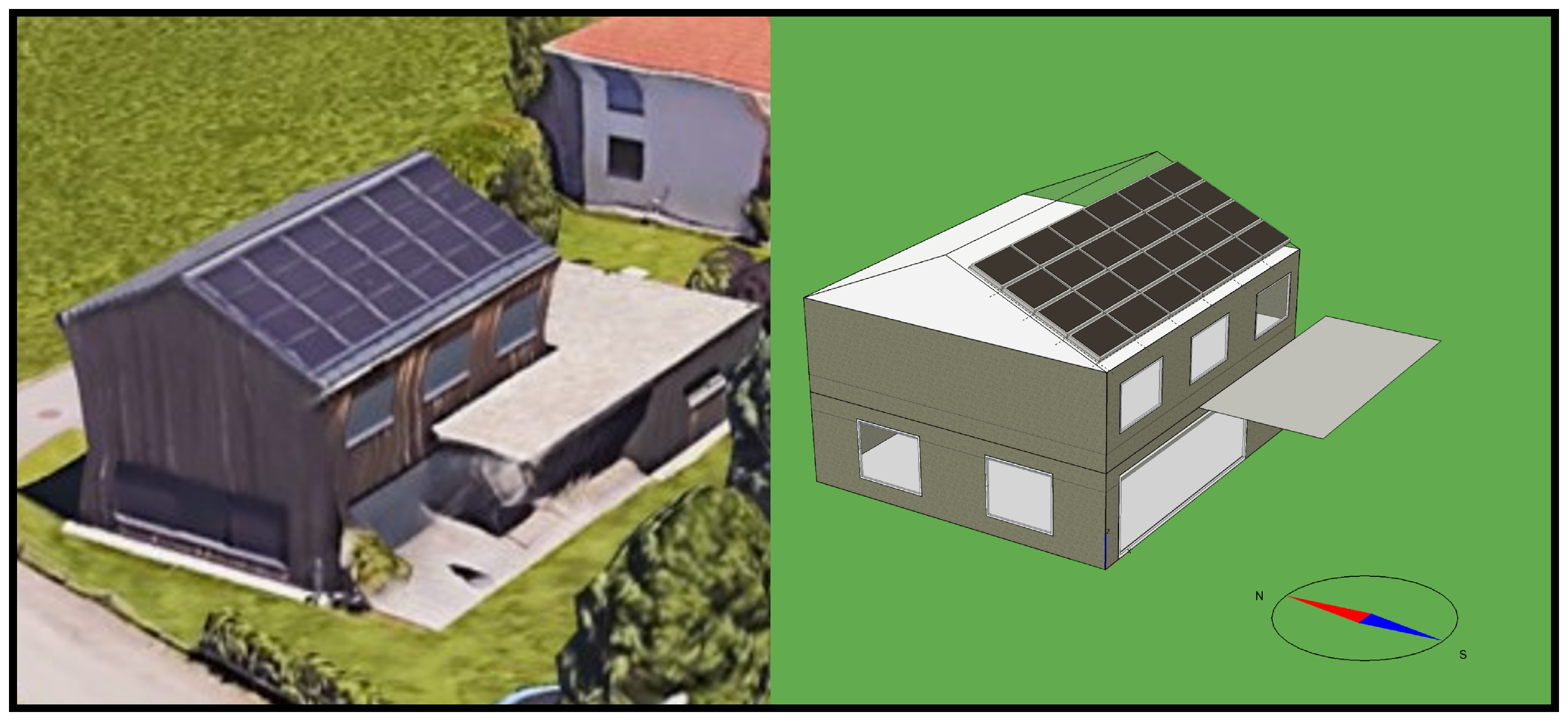
- Modeling the building in IDA ICE covering all components and specific characteristics of the real building located in the Central European Alpine region, which is used for simulation.
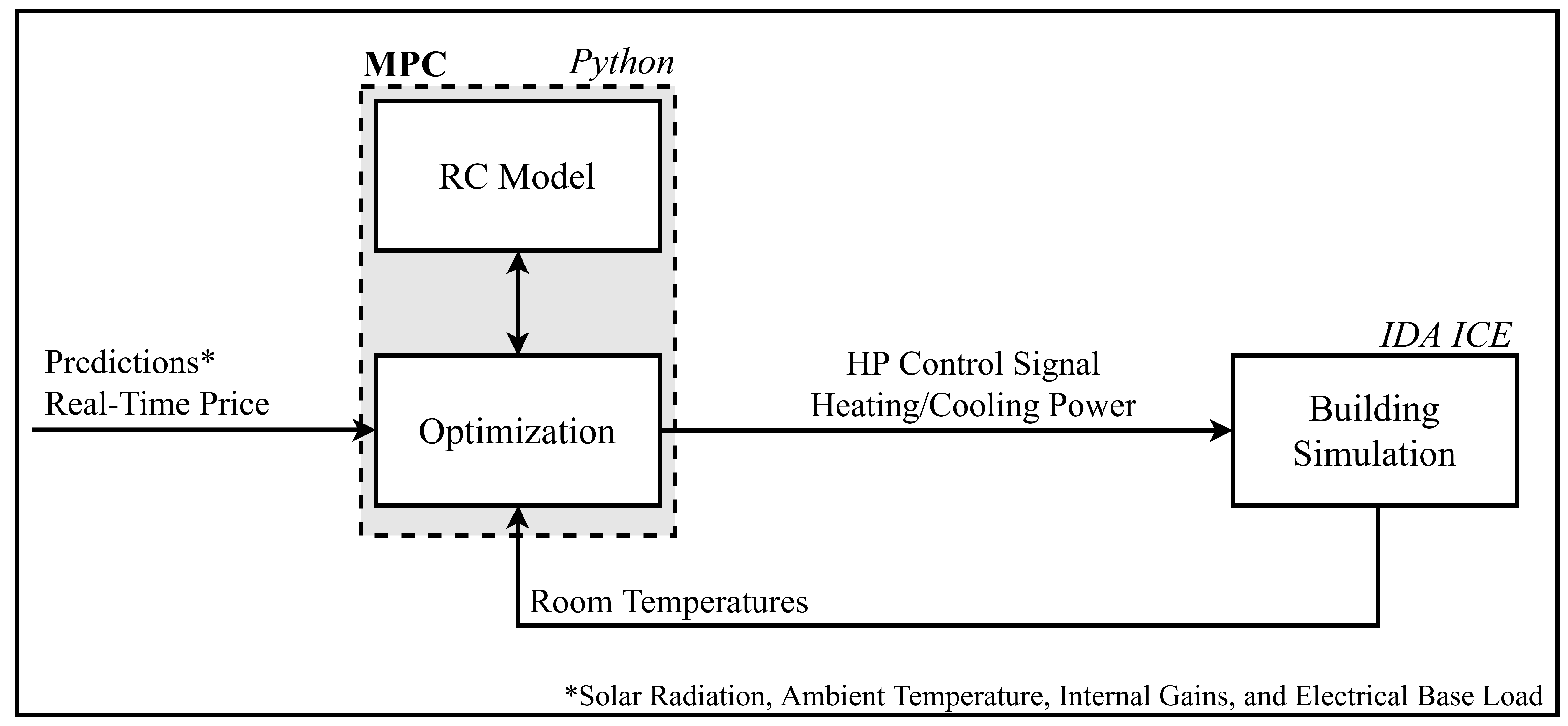
- Developing a co-simulative MPC optimization setup with Python and IDA ICE covering both, a two-story NZEB IDA ICE and an RC model. This setup integrates key energy systems, including a PV system and a ground-source HP connected to an underfloor distribution system (UDS) for heating and cooling.
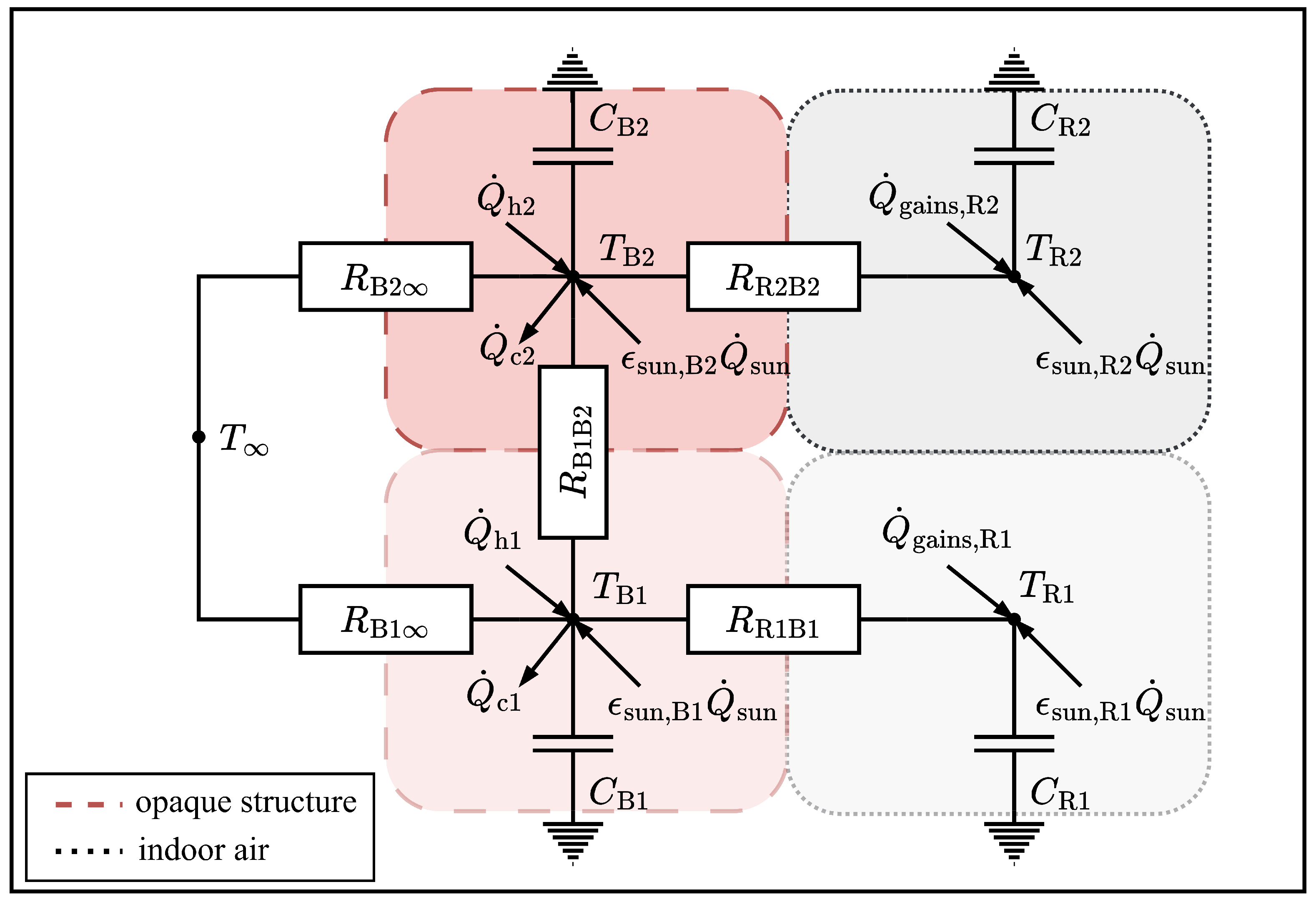
- Optimizing based on an RC model in Python, which is derived from transient energy balances. The state space representation remains linear with piece-wise constant parameters, enabling the use of MILP methods, resulting in a computationally efficient algorithm that ensures a global optimum.
- Mitigating prediction uncertainties and external disturbances through a robust MPC framework tailored to dynamic building conditions.
- Using the thermal mass of the building to serve as flexibility for DR. Exploiting this load-shifting potential in two separate scenarios, we optimize to (1) increase the PV self-consumption and (2) to reduce the total electrical energy costs.
2. Methodology
2.1. Simulation Study Concept
2.2. IDA ICE System Overview
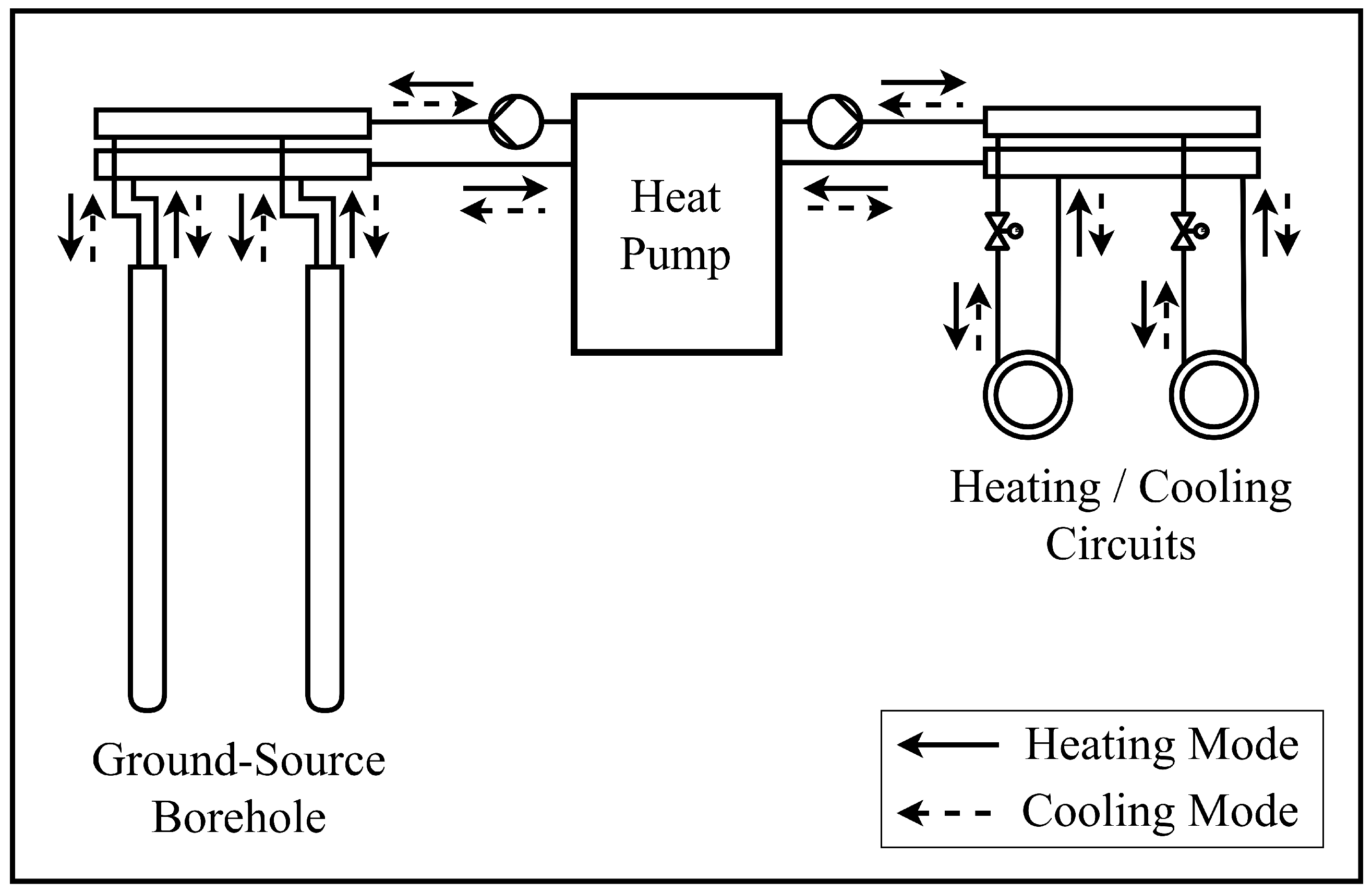
- Heating and Cooling System: A ground-source HP system is modeled, providing heating and cooling through UDS.
- Photovoltaic System: A 6.7 kWp PV system is included, providing power for the HP system and the internal use, and further reflecting the building’s renewable energy generation capacity.
- Internal Gains: Internal heat gains from equipment, occupants, and lighting are considered as perfectly predicted based on typical residential usage patterns (cf. Table 2).
2.2.1. IDA ICE Building Model
2.2.2. IDA ICE Heat Pump System Model
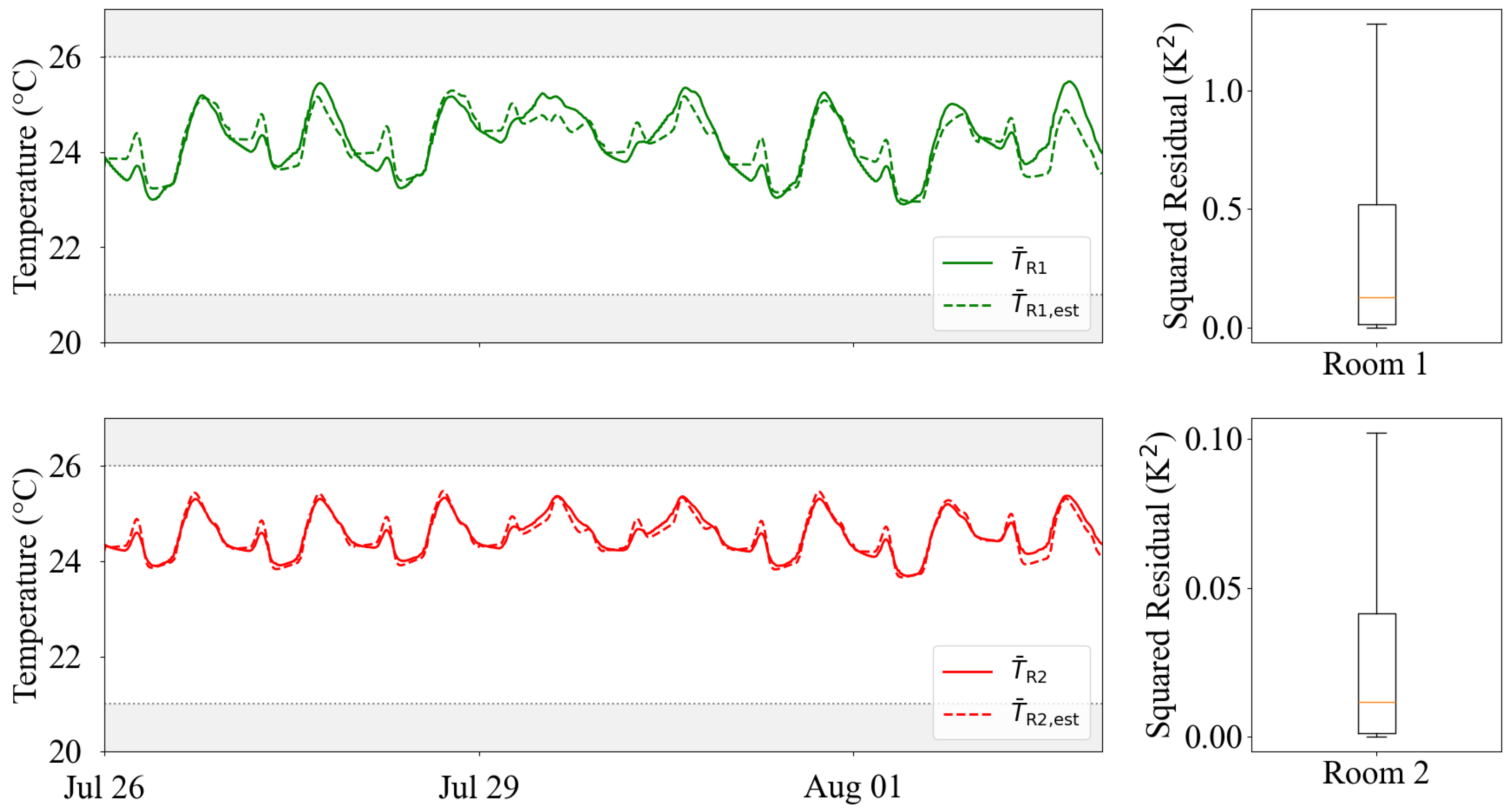
2.3. Modeling
2.4. Optimization
- and is the cooling power via building envelope for room 1 and room 2 during the time period p, respectively.
- and is the heating power via building envelope for room 1 and room 2 during the time period p, respectively.
- is the electrical heat pump power during the time period p.
- is the total electrical grid power during the time period p, where positive values indicate consumption.
- is the electrical power consumed from the grid during the time period p.
- is the electrical power feed-in to the grid during the time period p.
- is a binary variable indicating if power is consumed during the time period p.
- is a binary variable indicating if power is feed-in during the time period p.
- is a binary variable indicating if the HP is in the cooling mode during the time period p.
- is a binary variable indicating if the HP is in the heating mode during the time period p.
- is a column vector for the temperatures consisting of , , and . and are the temperatures of room 1 and 2 at time point i, respectively. and are the temperatures of building envelopes 1 and 2 at time point i, respectively.
- is the steady state solution according to Equation (22) during time period p.
- is the control vector. It is a column vector according to Equation (21) with the heating and cooling powers and their efficiencies during the time period p.
- is the PV power during the time period p.
- is the electrical base load during the time period p.
- is the price signal for consumption during the time period p.
- is the price signal for feed-in during the time period p.
- is a column vector of the matrix form according to Equation (21) during time period p representing the model inputs such as ambient temperature or the internal gains.
- is the length of a time period.
- is the energy efficiency ratio of the HP for cooling.
- is the coefficient of performance of the HP for heating.
- is the maximum cooling power of the HP.
- is the maximum heating power of the HP.
- and are lower bounds of the room temperature of room 1 and 2, respectively.
- and are upper bounds of the room temperature of room 1 and 2, respectively.
- is a column vector with the initial temperatures of at the time point .
- is the coefficient matrix according to Equation (21).
- N is the number of time periods.
- M is used for a big M constraint.
- is the set of the time period indices.
- is the set of the time point indices.
3. Results
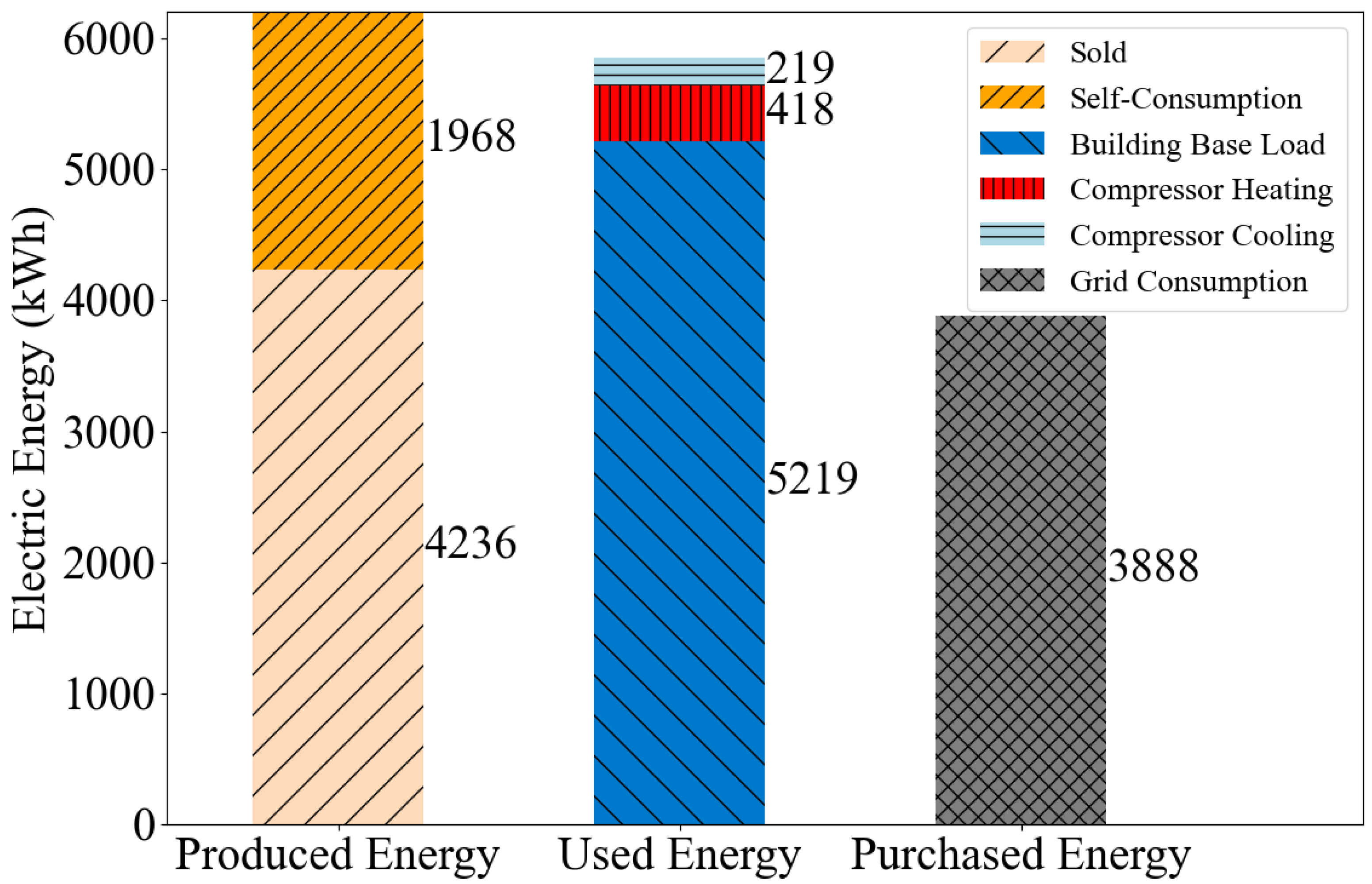
3.1. NZEB Case Study
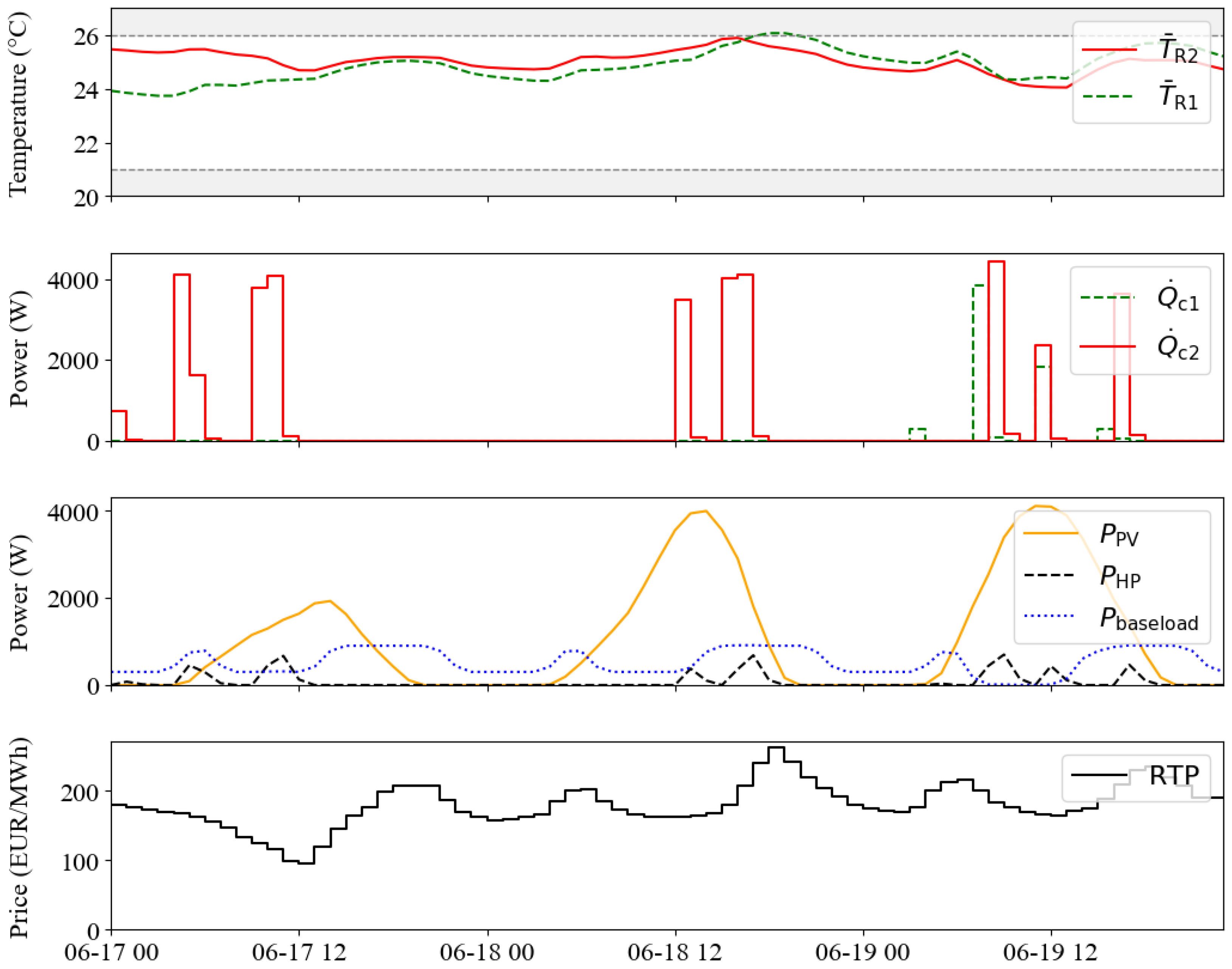
3.2. Analysis of MPC Potential
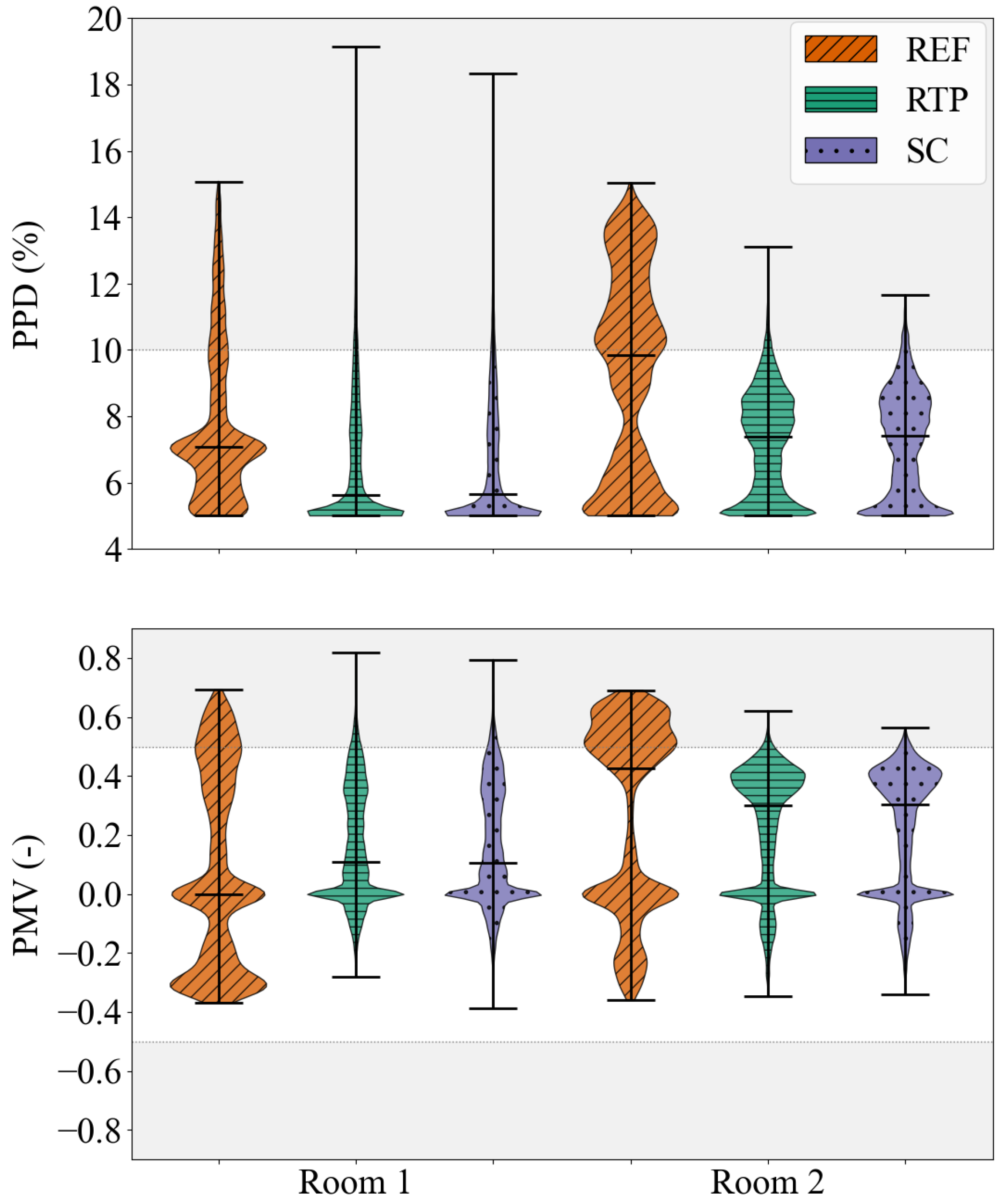
3.3. Comfort Conditions
4. Practical Considerations
5. Conclusions
Author Contributions
Funding
Data Availability Statement
Acknowledgments
Conflicts of Interest
Abbreviations
| CLO | Clothing insulation |
| COP | Coefficient of Performance |
| DHW | Domestic Hot Water |
| DR | Demand Response |
| DSM | Demand Side Management |
| EER | Energy Efficiency Ratio |
| EU | European Union |
| HP | Heat Pump |
| HVAC | Heating, Ventilation, and Air Conditioning |
| MET | Metabolic equivalent of task |
| MILP | Mixed-Integer Linear Programming |
| MPC | Model Predictive Control |
| NZEB | Net-Zero Energy Building |
| nZEB | Nearly Zero-Energy Building |
| ODE | Ordinary Differential Equation |
| PEM | Prediction Error Method |
| PMV | Predicted Mean Vote |
| PPD | Predicted Percentage of Dissatisfied |
| PV | Photovoltaic |
| RBC | Rule-Based Control |
| RC | Resistor-Capacitor |
| REF | Reference |
| RTP | Real-Time Price |
| SC | Self-Consumption |
| SFH | Single-Family House |
| UDS | Underfloor Distribution System |
Appendix A

References
- International Energy Agency. Tracking Clean Energy Progress 2023; Technical Report; International Energy Agency: Paris, France, 2023. [Google Scholar]
- European Parliament and the Council of the European Union. DIRECTIVE (EU) 2024/1275 OF THE EUROPEAN PARLIAMENT AND OF THE COUNCIL; Technical Report; European Parliament and the Council of the European Union: Brussels, Belgium, 2024; Available online: http://data.europa.eu/eli/dir/2024/1275/oj (accessed on 25 September 2024).
- Hermelink, A.; Schimschar, S.; Boermans, T.; Pagliano, L.; Zangheri, P.; Armani, R.; Voss, K.; Musall, E. Towards Nearly Zero-Energy Buildings—Definition of Common Principles Under the EPBD—Final Report; Technical Report ESDE10788; European Commission: Brussels, Belgium, 2013. [Google Scholar]
- D’Agostino, D.; Mazzarella, L. What is a Nearly zero energy building? Overview, implementation and comparison of definitions. J. Build. Eng. 2019, 21, 200–212. [Google Scholar] [CrossRef] [Scilit]
- Marszal, A.; Heiselberg, P.; Bourrelle, J.; Musall, E.; Voss, K.; Sartori, I.; Napolitano, A. Zero Energy Building—A review of definitions and calculation methodologies. Energy Build. 2011, 43, 971–979. [Google Scholar] [CrossRef] [Scilit]
- Ochs, F.; Franzoi, N.; Dermentzis, G.; Monteleone, W.; Magni, M. Monitoring and simulation-based optimization of two multi-apartment NZEBs with heat pump, solar thermal and PV. J. Build. Perform. Simul. 2024, 17, 1–26. [Google Scholar] [CrossRef] [Scilit]
- Belussi, L.; Barozzi, B.; Bellazzi, A.; Danza, L.; Devitofrancesco, A.; Fanciulli, C.; Ghellere, M.; Guazzi, G.; Meroni, I.; Salamone, F.; et al. A review of performance of zero energy buildings and energy efficiency solutions. J. Build. Eng. 2019, 25, 100772. [Google Scholar] [CrossRef] [Scilit]
- Elsland, R.; Peksen, I.; Wietschel, M. Are Internal Heat Gains Underestimated in Thermal Performance Evaluation of Buildings? Energy Procedia 2014, 62, 32–41. [Google Scholar] [CrossRef] [Scilit]
- Paoletti, G.; Pascual Pascuas, R.; Pernetti, R.; Lollini, R. Nearly Zero Energy Buildings: An Overview of the Main Construction Features across Europe. Buildings 2017, 7, 43. [Google Scholar] [CrossRef] [Scilit]
- Péan, T.Q.; Salom, J.; Costa-Castelló, R. Review of control strategies for improving the energy flexibility provided by heat pump systems in buildings. J. Process Control 2019, 74, 35–49. [Google Scholar] [CrossRef] [Scilit]
- Oskouei, M.Z.; Şeker, A.A.; Tunçel, S.; Demirbaş, E.; Gözel, T.; Hocaoğlu, M.H.; Abapour, M.; Mohammadi-Ivatloo, B. A Critical Review on the Impacts of Energy Storage Systems and Demand-Side Management Strategies in the Economic Operation of Renewable-Based Distribution Network. Sustainability 2022, 14, 2110. [Google Scholar] [CrossRef] [Scilit]
- Panda, S.; Mohanty, S.; Rout, P.K.; Sahu, B.K.; Parida, S.M.; Samanta, I.S.; Bajaj, M.; Piecha, M.; Blazek, V.; Prokop, L. A comprehensive review on demand side management and market design for renewable energy support and integration. Energy Rep. 2023, 10, 2228–2250. [Google Scholar] [CrossRef] [Scilit]
- Bee, E.; Prada, A.; Baggio, P. Demand-Side Management of Air-Source Heat Pump and Photovoltaic Systems for Heating Applications in the Italian Context. Environments 2018, 5, 132. [Google Scholar] [CrossRef] [Scilit]
- Bee, E.; Prada, A.; Baggio, P.; Psimopoulos, E. Air-source heat pump and photovoltaic systems for residential heating and cooling: Potential of self-consumption in different European climates. Build. Simul. 2019, 12, 453–463. [Google Scholar] [CrossRef] [Scilit]
- Pinamonti, M.; Prada, A.; Baggio, P. Rule-Based Control Strategy to Increase Photovoltaic Self-Consumption of a Modulating Heat Pump Using Water Storages and Building Mass Activation. Energies 2020, 13, 6282. [Google Scholar] [CrossRef] [Scilit]
- Thür, A.; Calabrese, T.; Streicher, W. Smart grid and PV driven ground heat pump as thermal battery in small buildings for optimized electricity consumption. Sol. Energy 2018, 174, 273–285. [Google Scholar] [CrossRef] [Scilit]
- Toradmal, A.; Kemmler, T.; Thomas, B. Boosting the share of onsite PV-electricity utilization by optimized scheduling of a heat pump using buildings thermal inertia. Appl. Therm. Eng. 2018, 137, 248–258. [Google Scholar] [CrossRef] [Scilit]
- Wang, Z.; Luther, M.B.; Horan, P.; Matthews, J.; Liu, C. On-site solar PV generation and use: Self-consumption and self-sufficiency. Build. Simul. 2023, 16, 1835–1849. [Google Scholar] [CrossRef] [Scilit]
- Drgoňa, J.; Arroyo, J.; Cupeiro Figueroa, I.; Blum, D.; Arendt, K.; Kim, D.; Ollé, E.P.; Oravec, J.; Wetter, M.; Vrabie, D.L.; et al. All you need to know about model predictive control for buildings. Annu. Rev. Control 2020, 50, 190–232. [Google Scholar] [CrossRef] [Scilit]
- Afram, A.; Janabi-Sharifi, F. Theory and applications of HVAC control systems – A review of model predictive control (MPC). Build. Environ. 2014, 72, 343–355. [Google Scholar] [CrossRef] [Scilit]
- Kim, D.; Lee, J.; Do, S.; Mago, P.J.; Lee, K.H.; Cho, H. Energy Modeling and Model Predictive Control for HVAC in Buildings: A Review of Current Research Trends. Energies 2022, 15, 7231. [Google Scholar] [CrossRef] [Scilit]
- Oldewurtel, F.; Parisio, A.; Jones, C.N.; Gyalistras, D.; Gwerder, M.; Stauch, V.; Lehmann, B.; Morari, M. Use of model predictive control and weather forecasts for energy efficient building climate control. Energy Build. 2012, 45, 15–27. [Google Scholar] [CrossRef] [Scilit]
- Olympios, A.V.; Sapin, P.; Freeman, J.; Olkis, C.; Markides, C.N. Operational optimisation of an air-source heat pump system with thermal energy storage for domestic applications. Energy Convers. Manag. 2022, 273, 116426. [Google Scholar] [CrossRef] [Scilit]
- Weeratunge, H.; Narsilio, G.; de Hoog, J.; Dunstall, S.; Halgamuge, S. Model predictive control for a solar assisted ground source heat pump system. Energy 2018, 152, 974–984. [Google Scholar] [CrossRef] [Scilit]
- Kuboth, S.; Heberle, F.; König-Haagen, A.; Brüggemann, D. Economic model predictive control of combined thermal and electric residential building energy systems. Appl. Energy 2019, 240, 372–385. [Google Scholar] [CrossRef] [Scilit]
- Péan, T.; Lumbieres, D.R.; Colet, A.; Bellanco, I.; Neugebauer, M.J.; Carbonell, D.; Iñarga, J.I.; García, C.C.; Salom, J. Co-simulation studies of optimal control for natural refrigerant heat pumps. In Proceedings of the CLIMA 2022 Conference, Rotterdam, The Netherlands, 22–25 May 2022. [Google Scholar] [CrossRef]
- Wei, Z.; Calautit, J. Predictive control of low-temperature heating system with passive thermal mass energy storage and photovoltaic system: Impact of occupancy patterns and climate change. Energy 2023, 269, 126791. [Google Scholar] [CrossRef] [Scilit]
- Baumann, C.; Huber, G.; Alavanja, J.; Preißinger, M.; Kepplinger, P. Experimental validation of a state-of-the-art model predictive control approach for demand side management with a hot water heat pump. Energy Build. 2023, 285, 112923. [Google Scholar] [CrossRef] [Scilit]
- Kuboth, S.; Weith, T.; Heberle, F.; Welzl, M.; Brüggemann, D. Experimental Long-Term Investigation of Model Predictive Heat Pump Control in Residential Buildings with Photovoltaic Power Generation. Energies 2020, 13, 6016. [Google Scholar] [CrossRef] [Scilit]
- Pean, T.; Costa-Castello, R.; Fuentes, E.; Salom, J. Experimental Testing of Variable Speed Heat Pump Control Strategies for Enhancing Energy Flexibility in Buildings. IEEE Access 2019, 7, 37071–37087. [Google Scholar] [CrossRef] [Scilit]
- Wang, D.; Zheng, W.; Wang, Z.; Wang, Y.; Pang, X.; Wang, W. Comparison of reinforcement learning and model predictive control for building energy system optimization. Appl. Therm. Eng. 2023, 228, 120430. [Google Scholar] [CrossRef] [Scilit]
- Michailidis, I.T.; Baldi, S.; Pichler, M.F.; Kosmatopoulos, E.B.; Santiago, J.R. Proactive control for solar energy exploitation: A german high-inertia building case study. Appl. Energy 2015, 155, 409–420. [Google Scholar] [CrossRef] [Scilit]
- Hu, M.; Xiao, F.; Jørgensen, J.B.; Li, R. Price-responsive model predictive control of floor heating systems for demand response using building thermal mass. Appl. Therm. Eng. 2019, 153, 316–329. [Google Scholar] [CrossRef] [Scilit]
- Mylonas, A.; Macià-Cid, J.; Péan, T.Q.; Grigoropoulos, N.; Christou, I.T.; Pascual, J.; Salom, J. Optimizing Energy Efficiency with a Cloud-Based Model Predictive Control: A Case Study of a Multi-Family Building. Energies 2024, 17, 5113. [Google Scholar] [CrossRef] [Scilit]
- Fop, D.; Yaghoubi, A.R.; Capozzoli, A. Validation of a Model Predictive Control Strategy on a High Fidelity Building Emulator. Energies 2024, 17, 5117. [Google Scholar] [CrossRef] [Scilit]
- Mazzeo, D.; Matera, N.; Cornaro, C.; Oliveti, G.; Romagnoni, P.; De Santoli, L. EnergyPlus, IDA ICE and TRNSYS predictive simulation accuracy for building thermal behaviour evaluation by using an experimental campaign in solar test boxes with and without a PCM module. Energy Build. 2020, 212, 109812. [Google Scholar] [CrossRef] [Scilit]
- EQUA Simulation AB. IDA Indoor Climate and Energy (IDA ICE). Version 5.0. 2024. Available online: https://www.equa.se/en/ida-ice (accessed on 26 December 2024).
- APG. Exaa Spot Market Prices. 2023. Available online: https://markttransparenz.apg.at (accessed on 25 September 2024).
- DIN EN 16798-1:2022-03; Energetische Bewertung von Gebäuden_- Lüftung von Gebäuden_- Teil_1: Eingangsparameter für das Innenraumklima zur Auslegung und Bewertung der Energieeffizienz von Gebäuden bezüglich Raumluftqualität, Temperatur, Licht und Akustik_- Modul M1-6; Deutsche Fassung EN_16798-1:2019. Available online: https://www.dinmedia.de/de/norm/din-en-16798-1/349622591 (accessed on 26 December 2024).
- DIN EN ISO 52000-1:2018-03; Energieeffizienz von Gebäuden_- Festlegungen zur Bewertung der Energieeffizienz von Gebäuden_- Teil_1: Allgemeiner Rahmen und Verfahren (ISO_52000-1:2017); Deutsche Fassung EN_ISO_52000-1:2017. Available online: https://www.dinmedia.de/de/norm/din-en-iso-52000-1/262236179 (accessed on 26 December 2024).
- OIB-Richtlinie 6, Energieeinsparung und Wärmeschutz. OIB-330.6-036/23. Available online: https://www.oib.or.at/de/oib-richtlinien/richtlinien/2023/oib-richtlinie-6 (accessed on 26 December 2024).
- Study Area in Central European Alpine Region of Vorarlberg, Austria. 2024. Available online: https://earth.google.com (accessed on 15 November 2024).
- American Society of Heating, Refrigerating and Air-Conditioning Engineers. ASHRAE Handbook—Fundamentals (SI Edition); ASHRAE: Atlanta, GA, USA, 2017. [Google Scholar]
- Wohlgenannt, P.; Huber, G.; Rheinberger, K.; Kolhe, M.; Kepplinger, P. Comparison of demand response strategies using active and passive thermal energy storage in a food processing plant. Energy Rep. 2024, 12, 226–236. [Google Scholar] [CrossRef] [Scilit]



| Component | Floor/Orientation | Area (m2) | Material | Thickness (m) | tot. U-Value (W/(m2 K)) |
|---|---|---|---|---|---|
| Base plate with floor | 1st | 90.0 | concrete + reinforcement (0.25), bituminous sheeting (0.005), leveling screed (0.08), thermal insulation panel (0.16), cement screed + vapor barrier (0.07), flooring (0.015) | 0.58 | 0.16 |
| External wall | 1st/North | 23.3 | timber frame (0.09), wood fiber insulation (0.28), insulated timber frame (0.075), plasterboard (0.015) | 0.46 | 0.10 |
| 1st/West | 16.6 | ||||
| 1st/East | 23.4 | ||||
| 1st/South | 8.8 | ||||
| 2nd/North | 21.8 | ||||
| 2nd/West | 23.4 | ||||
| 2nd/East | 21.1 | ||||
| 2nd/South | 18.2 | ||||
| Windows | 1st/North | 0.7 | insulated glazing | 0.008 | 0.74 |
| 1st/West | 6.8 | ||||
| 1st/East | - | ||||
| 1st/South | 17.2 | ||||
| 2nd/North | 4.2 | ||||
| 2nd/West | - | ||||
| 2nd/East | 2.3 | ||||
| 2nd/South | 7.8 | ||||
| Floor/Ceiling | 1st/2nd | 90.0 | flooring (0.015), | 0.5 | 0.165 |
| cement screed + vapor | |||||
| barrier (0.07), | |||||
| thermal insulation panel + | |||||
| impact sound insulation (0.115), | |||||
| insulated timber frame with | |||||
| oriented stranded board (0.285), | |||||
| plasterboard (0.015) | |||||
| Roof | 2nd | 92.0 | board stacked ceiling (0.12), | 0.38 | 0.13 |
| wood insulation + | |||||
| vapor barrier (0.24), | |||||
| vapor-permeable wood fiber board (0.016) |
| Category | Day of Week | Schedule (h) | No. of People (-)/Total Power (W) | Activity Level (MET)/Avg. Heat Gain (W) | Total Energy Yearly (kWh) |
|---|---|---|---|---|---|
| Occupancy | Weekdays | 0 [8–15], 0.5 [15–17], 1 otherwise | 2.0/- | 1.0/- | - |
| Weekend | 1 [0–24] | ||||
| Equipment | Weekdays | 0 [8–15], 0.5 [15–17], 1 otherwise | -/150.0 | -/114.4 | 1002.0 |
| Weekend | 1 [0–24] | ||||
| Lighting | Daily | 1 [6–8, 15–23], 0 otherwise | -/300.0 | -/125.0 | 1095.0 |
| PEM Parameter | Parameter | Value |
|---|---|---|
| REF | RTP | SC | Deviation (RTP/SC) | |
|---|---|---|---|---|
| HP operation cost (€) | 82.26 | 47.31 | 46.58 | −42.49%/−43.37% |
| specific HP operation cost (ct/kWh) | 12.91 | 6.73 | 6.56 | −47.91%/−49.26% |
| HP electricity consumption (kWh) | 636.70 | 702.99 | 710.59 | +2.33%/+3.43% |
| HP electricity heating (kWh) | 418.09 | 425.14 | 429.90 | +1.68%/+2.82% |
| HP electricity cooling (kWh) | 218.61 | 277.85 | 280.69 | +27.09%/+28.39% |
| total electricity cost (€) | 722.52 | 687.58 | 686.85 | −4.84%/−4.94% |
| produced PV energy (kWh) | 6204.49 | 6204.49 | 6204.49 | - |
| used energy (kWh) | 5855.27 | 5921.56 | 5929.15 | +1.13%/+1.26% |
| grid consumption (kWh) | 3888.33 | 3717.52 | 3705.71 | −4.39%/−4.69% |
| self-consumption ratio (%) | 31.70 | 35.52 | 35.82 | +3.82%pt./+4.12%pt. |
| self-sufficiency ratio (%) | 33.59 | 37.22 | 37.50 | +3.63%pt./+3.91%pt. |
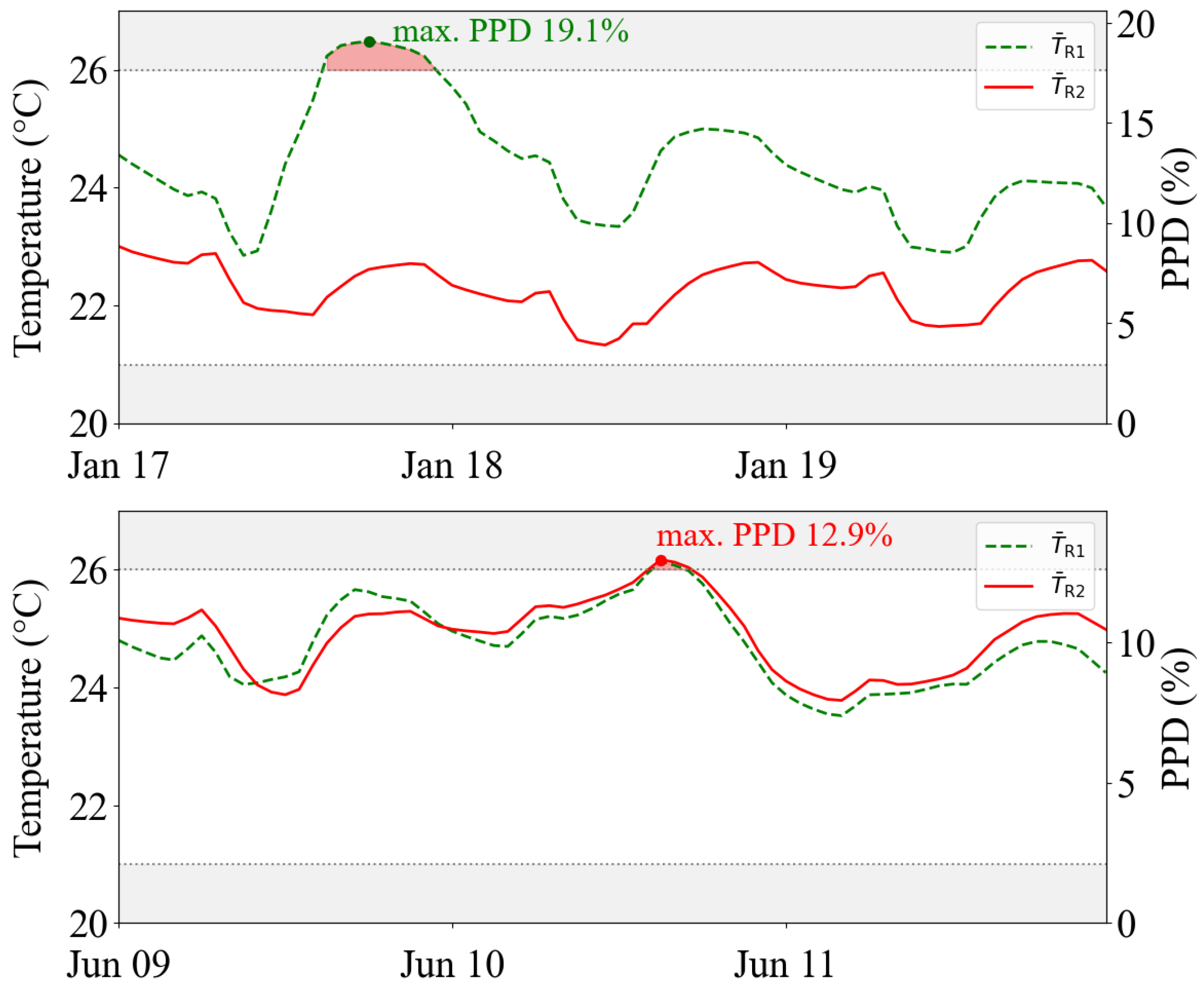
| max. PPD (%) | 15.08 | 19.14 | 18.34 | - |
| avg. PPD (%) | 7.18 | 5.90 | 5.92 | - |
| heating demand (kWh/m2a) | 9.29 | 9.45 | 9.55 | +1.68%/+2.82% |
| cooling demand (kWh/m2a) | 4.86 | 6.17 | 6.24 | +27.09%/+28.39% |
Disclaimer/Publisher’s Note: The statements, opinions and data contained in all publications are solely those of the individual author(s) and contributor(s) and not of MDPI and/or the editor(s). MDPI and/or the editor(s) disclaim responsibility for any injury to people or property resulting from any ideas, methods, instructions or products referred to in the content. |
© 2024 by the authors. Licensee MDPI, Basel, Switzerland. This article is an open access article distributed under the terms and conditions of the Creative Commons Attribution (CC BY) license (https://creativecommons.org/licenses/by/4.0/).
Share and Cite
Baumann, C.; Wohlgenannt, P.; Streicher, W.; Kepplinger, P. Optimizing Heat Pump Control in an NZEB via Model Predictive Control and Building Simulation. Energies 2025, 18, 100. https://doi.org/10.3390/en18010100
Baumann C, Wohlgenannt P, Streicher W, Kepplinger P. Optimizing Heat Pump Control in an NZEB via Model Predictive Control and Building Simulation. Energies. 2025; 18(1):100. https://doi.org/10.3390/en18010100
Chicago/Turabian StyleBaumann, Christian, Philipp Wohlgenannt, Wolfgang Streicher, and Peter Kepplinger. 2025. "Optimizing Heat Pump Control in an NZEB via Model Predictive Control and Building Simulation" Energies 18, no. 1: 100. https://doi.org/10.3390/en18010100
APA StyleBaumann, C., Wohlgenannt, P., Streicher, W., & Kepplinger, P. (2025). Optimizing Heat Pump Control in an NZEB via Model Predictive Control and Building Simulation. Energies, 18(1), 100. https://doi.org/10.3390/en18010100