Article

Renewable Energy Expansion in West Pomerania: Integrating Local Potential with Global Sustainability Goals


Research Center for Management of Energy Sector, Institute of Management, University of Szczecin, Cukrowa Street 8, 71-004 Szczecin, Poland
*
Author to whom correspondence should be addressed.
Energies 2025, 18(1), 103; https://doi.org/10.3390/en18010103
Submission received: 25 November 2024 / Revised: 12 December 2024 / Accepted: 24 December 2024 / Published: 30 December 2024
(This article belongs to the Special Issue Policy and Economic Analysis of Energy Systems)

Abstract

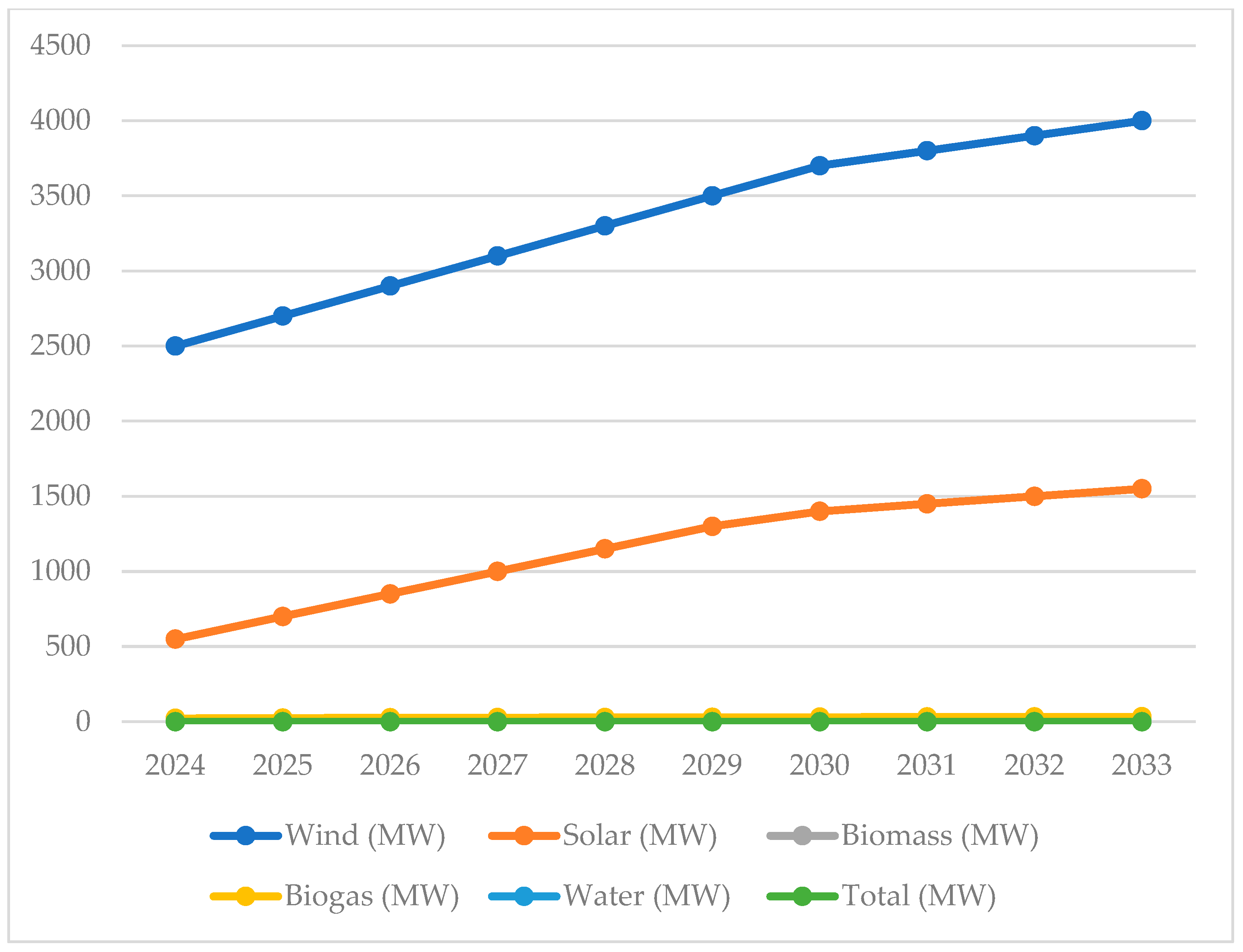
The expansion of renewable energy sources (RES) is essential to achieving regional sustainability in alignment with global climate goals. This study investigates the dynamics and projected growth of RES in West Pomerania, Poland, a region with significant potential due to its geographical characteristics and supportive policy frameworks. Historical data from 2010 to 2023 were used to perform a time series analysis that evaluated the annual growth rate (AGR) of various RES technologies, including wind, solar, biomass, and biogas. The analysis revealed a consistent upward trend in RES capacity, particularly in wind and solar energy, demonstrating effective resource mobilisation in the region. Subsequently, a forecasting model was employed to project the growth of the RES capacity through 2033 based on historical trends and technological advancements. The results indicate significant anticipated increases in RES capacity, highlighting West Pomerania’s potential to reduce its reliance on fossil fuels. This growth supports increased energy security and environmental sustainability. This study addresses a notable gap in the literature by linking regional renewable energy development with broader policy frameworks, such as the European Green Deal, and exploring the specific challenges of grid integration and economic disparities in the context of local energy transitions. These findings highlight the importance of sustained investment and policy support to scale renewable infrastructure while aligning regional initiatives with international sustainability goals. By bridging this gap, this study concludes that the West Pomerania strategy can serve as a model for other regions aiming to enhance their renewable energy portfolios and effectively meet the climate goals of the EU.
Keywords: regional energy policy; EU climate targets; regional energy policy; energy transition regional energy policy; EU climate targets; regional energy policy; energy transition