Compound-Specific C/H Isotopic Signature of Ultra-Deep Hydrocarbon Fluids from the Shuntuoguole Area in the Tarim Basin, Northwestern China



Abstract
1. Introduction
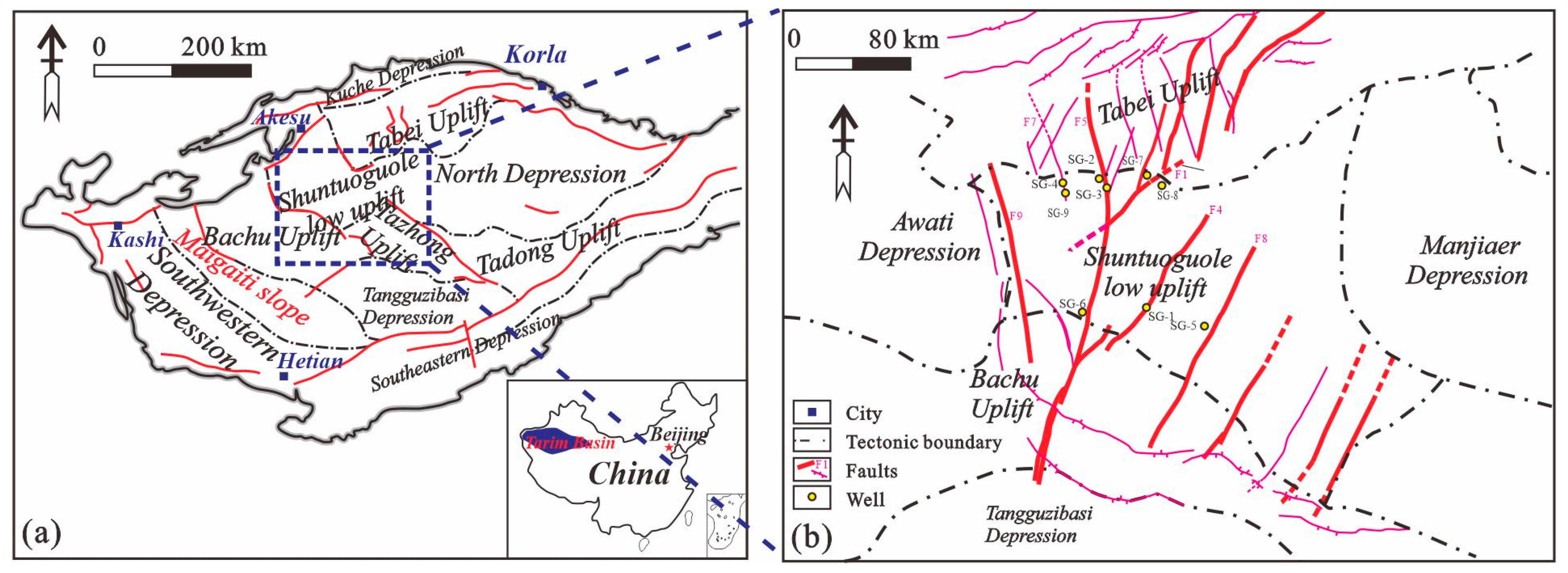
2. Geologic Setting
3. Samples and Experiments Methods
4. Results
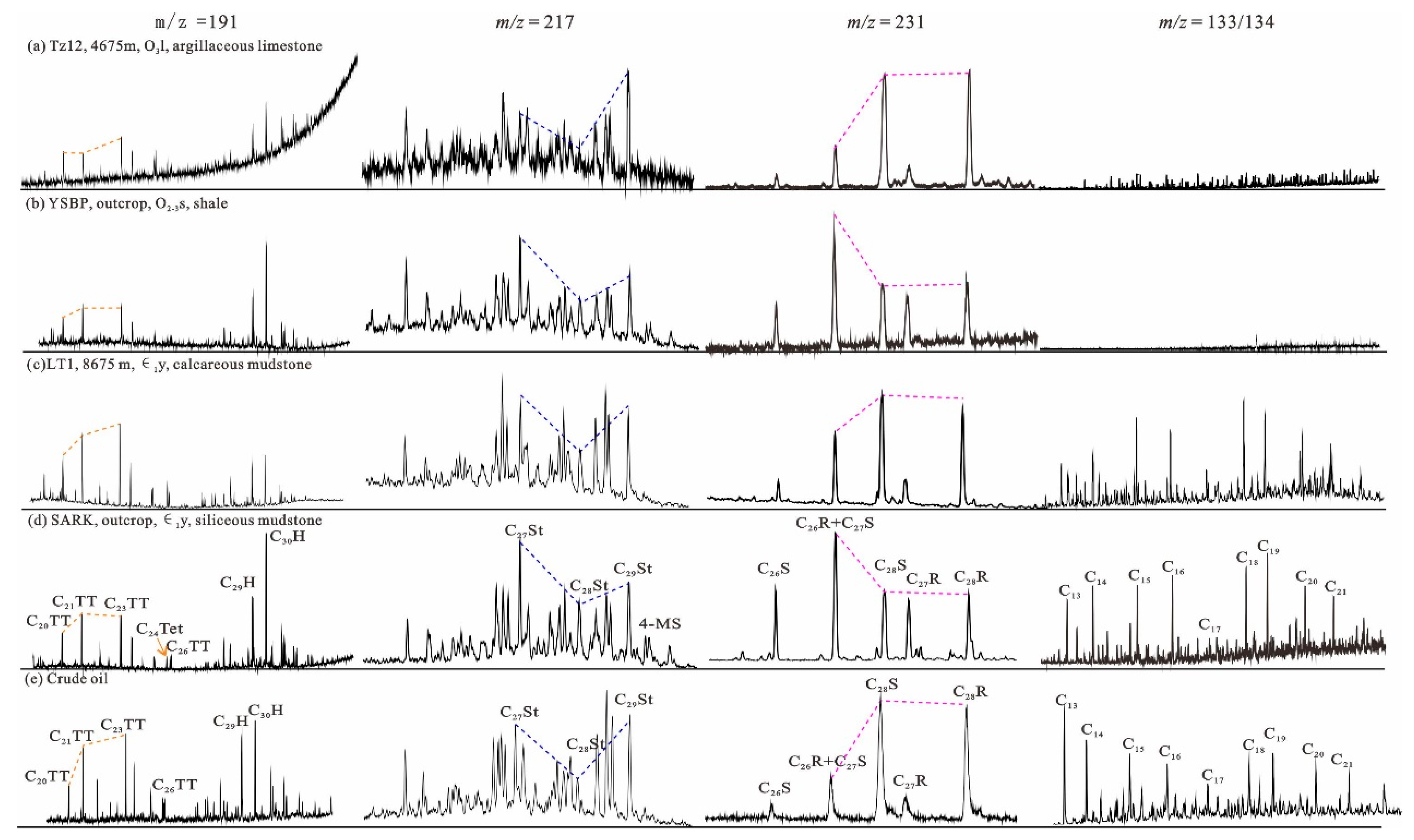
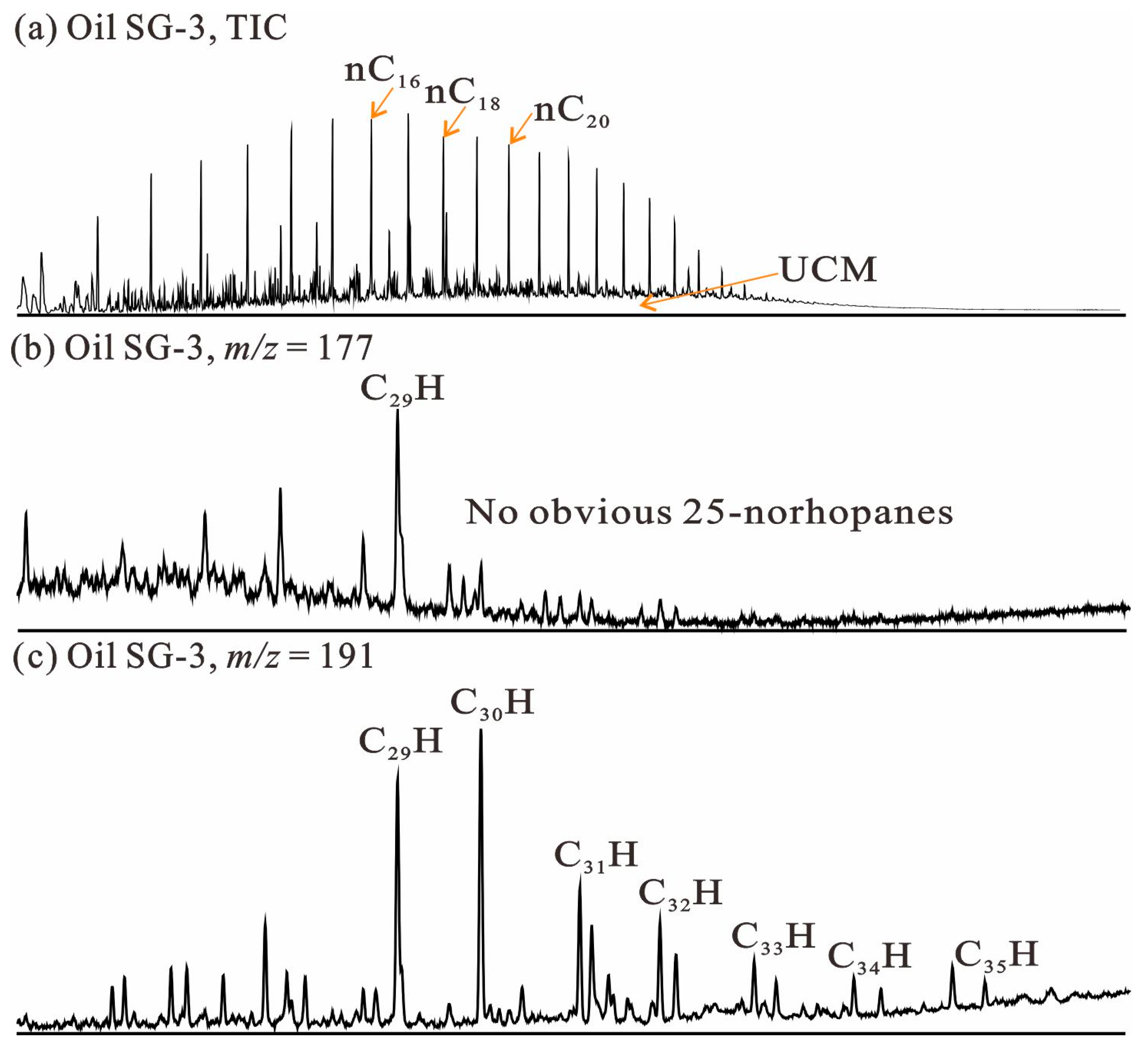
4.1. Biomarkers
4.2. δ13C of STGL Oils and Their Group Components
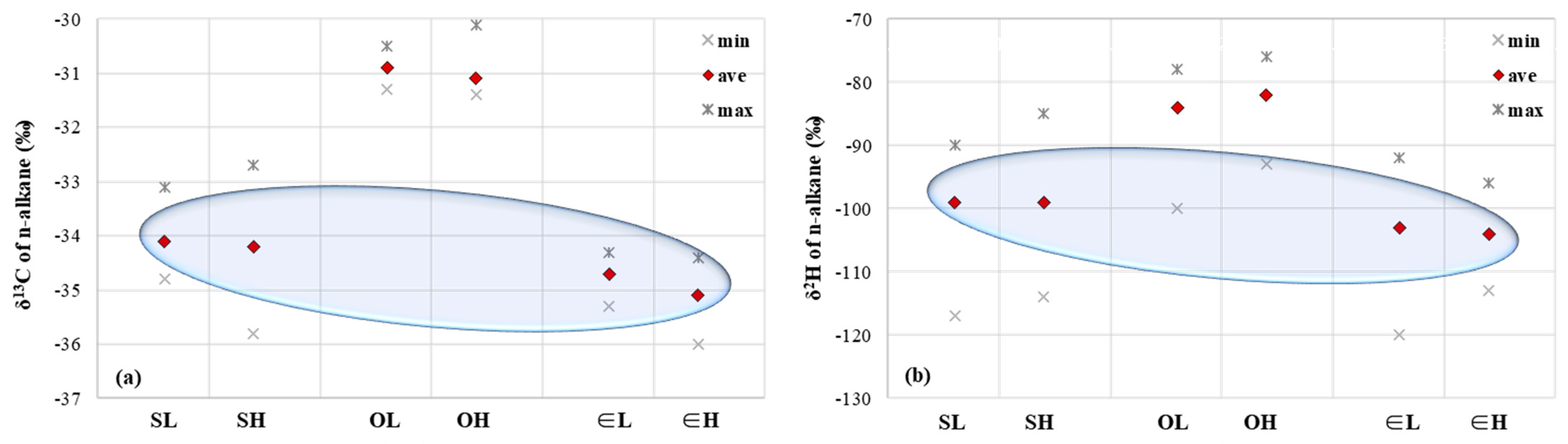
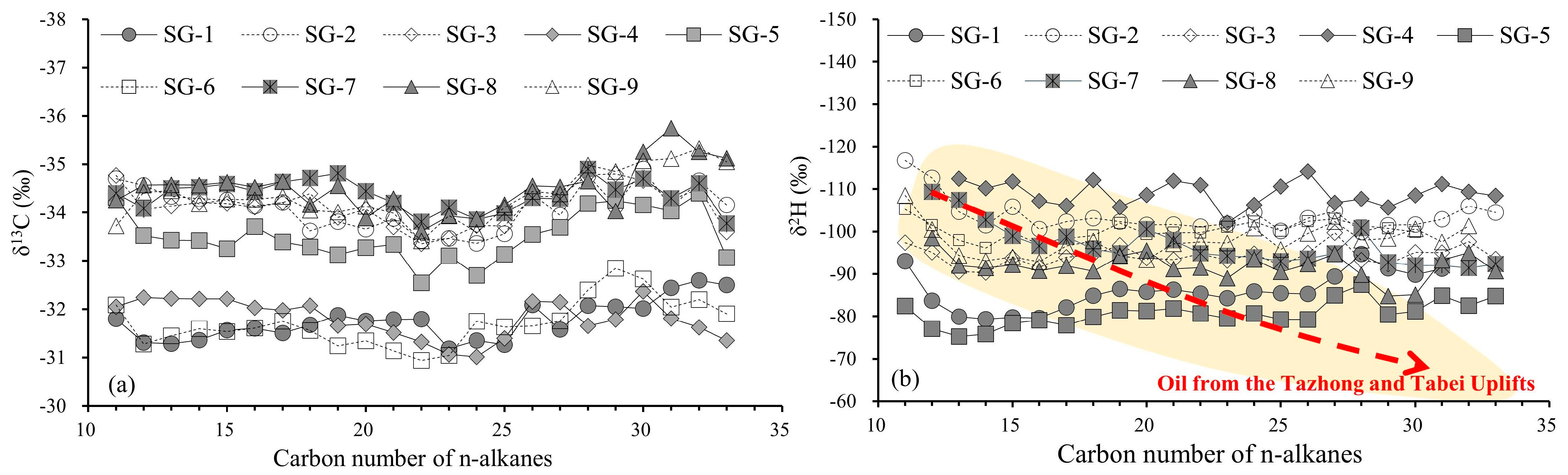
4.3. Compound-Specific δ13C of n-Alkanes
4.4. Compound-Specific δ2H of n-Alkanes
5. Discussion
5.1. Secondary Alterations
- (1)
- Biodegradation
- (2)
- Thermal alteration
- (3)
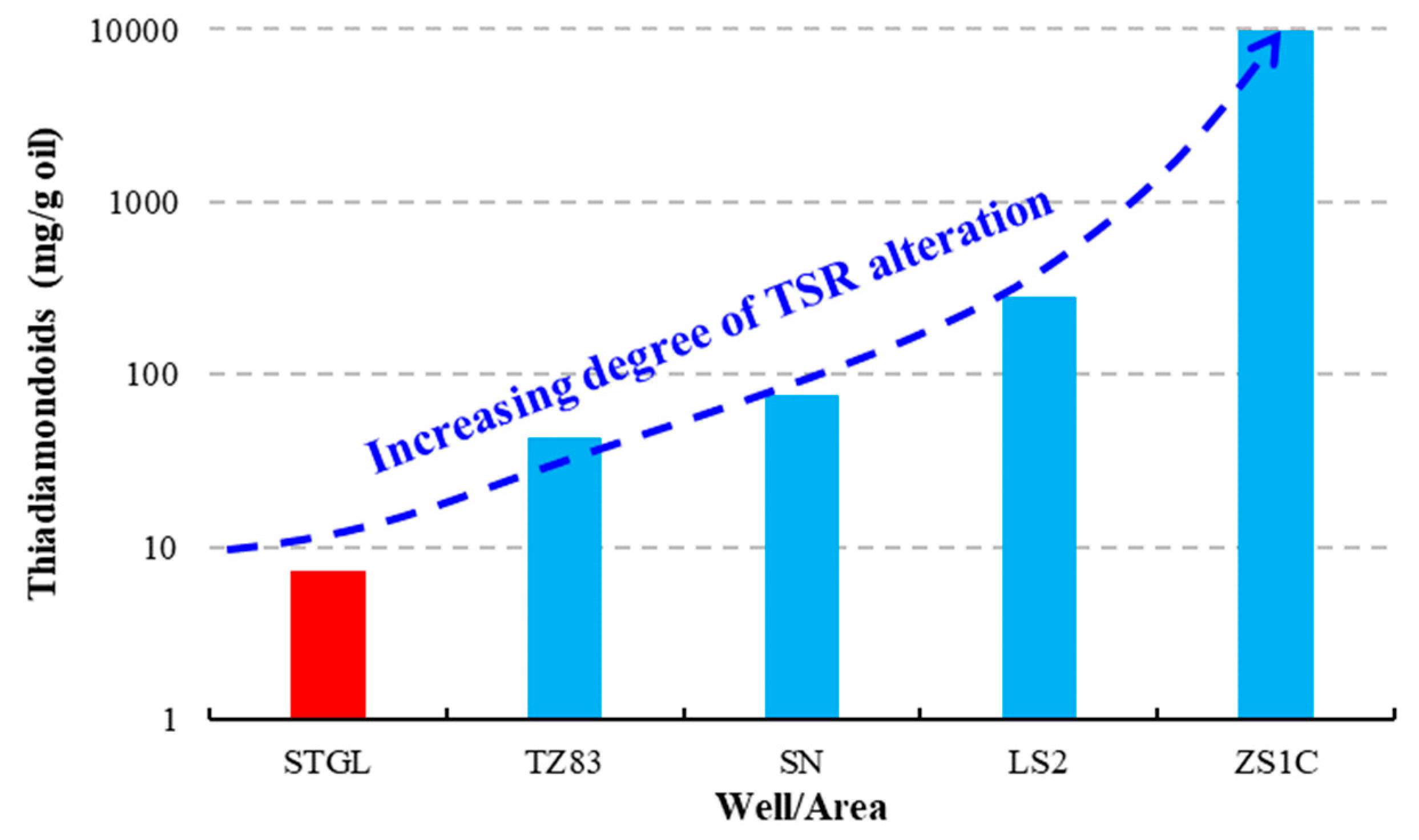
- TSR alteration
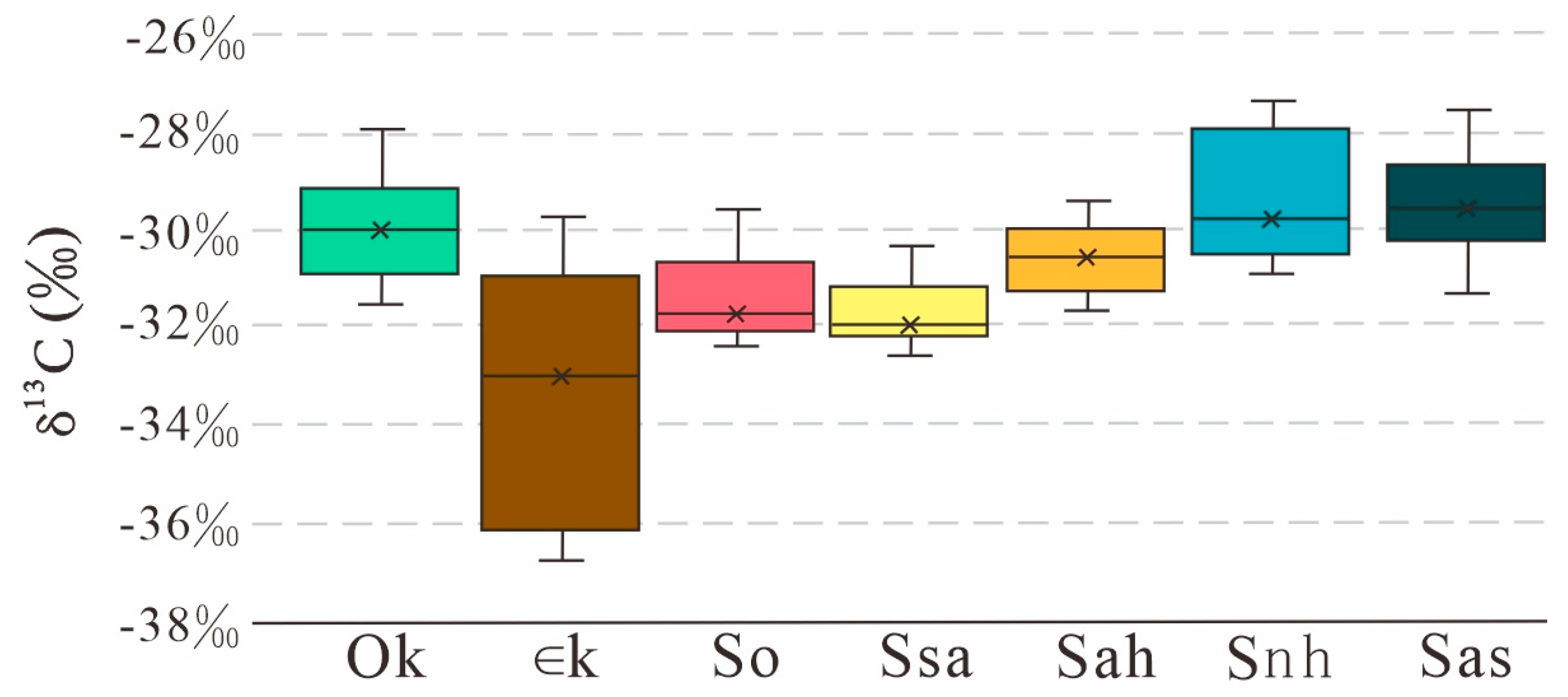
5.2. Oil–Source Correlation
5.3. Insights into Deep to Ultra-Deep Petroleum Exploration in the Tarim Basin
6. Conclusions
Author Contributions
Funding
Institutional Review Board Statement
Informed Consent Statement
Data Availability Statement
Acknowledgments
Conflicts of Interest
References
- Liu, J.; Geng, A.; Xiong, Y. The application of stable carbon and hydrogen isotopic compositions of individual n-alkanes to Paleozoic oil/source rock correlation enigmas in the Huanghua depression, China. J. Petrol. Sci. Eng. 2006, 54, 70–78. [Google Scholar] [CrossRef] [Scilit]
- Li, W.; Li, J.; Lu, S.; Chen, G.; Pang, X.; Zhang, P.; He, T. Evaluation of gas-in-place content and gas-adsorbed ratio using carbon isotope fractionation model: A case study from Longmaxi shales in Sichuan Basin, China. Int. J. Coal Geol. 2022, 249, 103881. [Google Scholar] [CrossRef] [Scilit]
- Li, W.; Lu, S.; Li, J.; Zhao, S.; Zhang, P.; Li, X.; Wang, J. Research progress on isotopic fractionation in the process of shale gas/coalbed methane migration. Petrol. Explor. Dev. 2022, 49, 1069–1084. [Google Scholar] [CrossRef] [Scilit]
- Murillo, W.A.; Horsfield, B.; Vieth-Hillebrand, A. Unraveling petroleum mixtures from the South Viking Graben, North Sea: A study based on d13Cof individual hydrocarbons and molecular data. Org. Geochem. 2019, 137, 103900. [Google Scholar] [CrossRef] [Scilit]
- Hu, T.; Pang, X.; Jiang, F.; Zhang, C.; Wu, G.; Hu, M.; Jiang, L.; Wang, Q.; Xu, T.; Hu, Y.; et al. Dynamic continuous hydrocarbon accumulation (DCHA): Existing theories and a new unified accumulation model. Earth-Sci. Rev. 2022, 232, 104109. [Google Scholar] [CrossRef] [Scilit]
- Jia, W.; Chen, S.; Zhu, X.; Peng, P.; Xiao, Z. D/H ratio analysis of pyrolysis-released n-alkanes from asphaltenes for correlating oils from different sources. J. Anal. Appl. Pyrol. 2017, 126, 99–104. [Google Scholar] [CrossRef] [Scilit]
- Jia, W.; Wang, Q.; Peng, P.; Xiao, Z.; Li, B. Isotopic compositions and biomarkers in crude oils from the Tarim Basin: Oil maturity and oil mixing. Org. Geochem. 2013, 57, 95–106. [Google Scholar] [CrossRef] [Scilit]
- He, T.; Li, W.; Lu, S.; Yang, E.; Jing, T.; Ying, J.; Zhu, P.; Wang, X.; Pan, W.; Zhang, B.; et al. Quantitatively unmixing method for complex mixed oil based on its fractions carbon isotopes: A case from the Tarim Basin, NW China. Petrol. Sci. 2023, 20, 102–113. [Google Scholar] [CrossRef] [Scilit]
- He, T.; Li, W.; Lu, S.; Yang, E.; Jing, T.; Ying, J.; Zhu, P.; Wang, X.; Pan, W.; Chen, Z. Distribution and isotopic signature of 2-alkyl-1,3,4-trimethylbenzenes in the Lower Paleozoic source rocks and oils of Tarim Basin: Implications for the oil-source correlation. Petrol. Sci. 2022, 19, 2572–2582. [Google Scholar] [CrossRef] [Scilit]
- Schimmelmann, A.; Sessions, A.L.; Boreham, C.; Edwards, D.; Logan, G.A.; Summons, R.E. D/H ratios in terrestrially sourced petroleum systems. Org. Geochem. 2004, 35, 1169–1195. [Google Scholar] [CrossRef] [Scilit]
- Pedentchouk, N.; Freeman, K.; Harris, N. Different response of delta D values of n-alkanes, isoprenoids, and kerogen during thermal maturation. Geochim. Cosmochim. Acta 2006, 70, 2063–2072. [Google Scholar] [CrossRef] [Scilit]
- Li, C.; Sessions, A.L.; Kinnaman, F.S.; Valentine, D.L. Hydrogen-isotopic variability in lipids from Santa Barbara Basin sediments. Geochim. Cosmochim. Acta 2009, 73, 4803–4823. [Google Scholar] [CrossRef] [Scilit]
- Yang, H.; Liu, W.G.; Leng, Q.; Hren, M.T.; Pagani, M. Variation in n-alkane dD values from terrestrial plants at high latitude: Implications for paleoclimate reconstruction. Org. Geochem. 2011, 42, 283–288. [Google Scholar] [CrossRef] [Scilit]
- Murillo, W.A.; Horsfield, B.; Garcin, Y.; Vieth, A.; Sachse, D. Compound-specific δ2H and δ13C values of n-alkanes as a tool to unravel complex petroleum mixtures in the South Viking Graben, Norway. Org. Geochem. 2021, 152, 104167. [Google Scholar] [CrossRef] [Scilit]
- Tang, Y.; Huang, Y.; Ellis, G.S.; Wang, Y.; Kralert, P.G.; Gillaizeau, B.; Ma, Q.; Hwang, R. A kinetic model for thermally induced hydrogen and carbon isotope fractionation of individual n-alkanes in crude oil. Geochim. Cosmochim. Acta 2005, 69, 4505–4520. [Google Scholar] [CrossRef] [Scilit]
- Sachse, D.; Billault, I.; Bowen, G.J.; Chikaraishi, Y.; Dawson, T.E.; Feakins, S.J.; Kahmen, A. Molecular Paleohydrology: Interpreting the Hydrogen-Isotopic Composition of Lipid Biomarkers from Photosynthesizing Organisms. Annu. Rev. Earth Planet. Sci. 2012, 40, 221–249. [Google Scholar] [CrossRef] [Scilit]
- Huang, H.; Zhang, S.; Su, J. Palaeozoic oil–source correlation in the Tarim Basin, NW China: A review. Org. Geochem. 2016, 94, 32–46. [Google Scholar] [CrossRef] [Scilit]
- Zhu, G.; Milkov, A.V.; Li, J.; Xue, N.; Chen, Y.; Hu, J.; Li, T.; Zhang, Z.; Chen, Z. Deepest oil in Asia: Characteristics of petroleum system in the Tarim basin, China. J. Petrol. Sci. Eng. 2021, 199, 108246. [Google Scholar] [CrossRef] [Scilit]
- Wang, Q.; Hao, F.; Cao, Z.; Tian, J. Heteroatom compounds in oils from the Shuntuoguole low uplift, Tarim Basin characterized by (+ESI) FT-ICR MS: Implications for ultra-deep petroleum charges and alteration. Mar. Petrol. Geol. 2021, 134, 105321. [Google Scholar] [CrossRef] [Scilit]
- Deng, S.; Zhao, R.; Kong, Q.; Li, Y.; Li, B. Two distinct strike-slip fault networks in the Shunbei area and its surroundings, Tarim Basin: Hydrocarbon accumulation, distribution, and controlling factors. AAPG Bull. 2022, 106, 77–102. [Google Scholar] [CrossRef] [Scilit]
- Jiao, F. Significance of oil and gas exploration in NE strike-slip fault belts in Shuntuoguole area of Tarim Basin. Oil Gas Geol. 2017, 38, 831–839. [Google Scholar]
- Bian, Q.; Deng, S.; Lin, H.; Han, J. Strike-slip salt tectonics in the Shuntuoguole Low Uplift, Tarim Basin, and the significance to petroleum exploration. Mar. Petrol. Geol. 2022, 139, 105600. [Google Scholar] [CrossRef] [Scilit]
- He, T.; Lu, S.; Li, W.; Tan, Z.; Zhang, X. Effect of Salinity on Source Rock Formation and Its Control on the Oil Content in Shales in the Hetaoyuan Formation from the Biyang Depression, Nanxiang Basin, Central China. Energy Fuels 2018, 32, 6698–6707. [Google Scholar] [CrossRef] [Scilit]
- He, T.; Lu, S.; Li, W.; Sun, D.; Pan, W.; Zhang, B.; Tan, Z.; Ying, J. Paleoweathering, hydrothermal activity and organic matter enrichment during the formation of earliest Cambrian black strata in the northwest Tarim Basin, China. J. Petrol. Sci. Eng. 2020, 189, 106987. [Google Scholar] [CrossRef] [Scilit]
- He, T.; Lu, S.; Li, W.; Wang, W.; Sun, D.; Pan, W.; Zhang, B. Geochemical characteristics and effectiveness of thick, black shales in southwestern depression, Tarim Basin. J. Petrol. Sci. Eng. 2020, 185, 106607. [Google Scholar] [CrossRef] [Scilit]
- He, T.; Li, W.; Lu, S.; Pan, W.; Ying, J.; Zhu, P.; Yang, E.; Wang, X.; Zhang, B.; Sun, D. Mechanism and geological significance of anomalous negative δ13Ckerogen in the Lower Cambrian, NW Tarim Basin, China. J. Petrol. Sci. Eng. 2022, 208, 109384. [Google Scholar] [CrossRef] [Scilit]
- Peters, K.; Walters, C.; Moldowan, J. The Biomarker Guide: Biomarkers and Isotopes in Petroleum Exploration and Earth History; Cambridge University Press: Cambridge, UK, 2005. [Google Scholar]
- Lu, H.; Shen, C.; Zhang, Z.; Liu, M.; Sheng, G.; Peng, P.; Hsu, C.S. 2,3,6-/2,3,4-aryl isoprenoids in Paleocene crude oils from Chinese Jianghan Basin: Constrained by water column stratification. Energy Fuels 2015, 29, 4690–4700. [Google Scholar] [CrossRef] [Scilit]
- Sun, Y.; Xu, S.; Lu, H.; Cuai, P. Source facies of the Paleozoic petroleum systems in the Tabei uplift, Tarim Basin, NW China: Implications from aryl isoprenoids in crude oils. Org. Geochem. 2003, 34, 629–634. [Google Scholar] [CrossRef] [Scilit]
- Summons, R.E.; Powell, T.G. Identification of aryl isoprenoids in source rocks and crude oils: Biological markers for the green sulphur bacteria. Geochim. Cosmochim. Acta 1987, 51, 557–566. [Google Scholar] [CrossRef] [Scilit]
- Requejo, A.G.; Allan, J.; Creaney, S.; Gray, N.R.; Cole, K.S. Aryl isoprenoids and diaromatic carotenoids in Paleozoic source rocks and oils from the Western Canada and Williston Basins. Org. Geochem. 1992, 19, 245–264. [Google Scholar] [CrossRef] [Scilit]
- Sun, Y.; Chen, Z.; Xu, S.; Cai, P. Stable carbon and hydrogen isotopic fractionation of individual n-alkanes accompanying biodegradation: Evidence from a group of progressively biodegraded oils. Org. Geochem. 2005, 36, 225–238. [Google Scholar] [CrossRef] [Scilit]
- Asif, M.; Grice, K.; Fazeelat, T. Assessment of petroleum biodegradation using stable hydrogen isotopes of individual saturated hydrocarbon and polycyclic aromatic hydrocarbon distributions in oils from the Upper Indus Basin, Pakistan. Org. Geochem. 2009, 40, 301–311. [Google Scholar] [CrossRef] [Scilit]
- Cai, C.; Zhang, C.; He, H.; Tang, Y. Carbon isotope fractionation during methane-dominated TSR in East Sichuan Basin gasfields, China: A review. Mar. Petrol. Geol. 2013, 48, 100–110. [Google Scholar] [CrossRef] [Scilit]
- Cai, C.; Amrani, A.; Worden, R.H.; Xiao, Q.; Wang, T.; Gvirtzman, Z.; Li, H.; Said-Ahmad, W.; Jia, L. Sulfur isotopic compositions of individual organosulfur compounds and their genetic links in the Lower Paleozoic petroleum pools of the Tarim Basin, NW China. Geochim. Cosmochim. Acta 2016, 182, 88–108. [Google Scholar] [CrossRef] [Scilit]
- Cai, C.; Xiao, Q.; Fang, C.; Wang, T.; He, W.; Li, H. The effect of thermochemical sulfate reduction on formation and isomerization of thiadiamondoids and diamondoids in the Lower Paleozoic petroleum pools of the Tarim Basin, NW China. Org. Geochem. 2016, 101, 49–62. [Google Scholar] [CrossRef] [Scilit]
- Cai, C.; Zhang, C.; Worden, R.H.; Wang, T.; Li, H.; Jiang, L.; Huang, S.; Zhang, B. Application of sulfur and carbon isotopes to oil–source rock correlation: A case study from the Tazhong area, Tarim Basin, China. Org. Geochem. 2015, 83–84, 140–152. [Google Scholar] [CrossRef] [Scilit]
- Ma, A.L.; Jin, Z.J.; Zhu, C.S.; Gu, Y. Detection and significance of higher thiadiamondoids and diamondoidthiols in oil from the Zhongshen 1C well of the Tarim Basin, NW China. Sci. China Earth Sci. 2018, 61, 1440–1450. [Google Scholar] [CrossRef] [Scilit]
- Zhu, G.Y.; Zhang, Y.; Zhang, Z.Y.; Li, T.T.; He, N.N.; Grice, K.; Neng, Y.; Greenwood, P. High abundance of alkylated diamondoids, thiadiamondoids and thioaromatics in recently discovered sulfur-rich LS2 condensate in the Tarim Basin. Org. Geochem. 2018, 123, 136–143. [Google Scholar] [CrossRef] [Scilit]
- Yang, L.; Xing, J.; Xue, W.; Zheng, L.; Wang, R.; Xiao, D. Characteristics and Key Controlling Factors of the Interbedded-TypeShale-Oil Sweet Spots of Qingshankou Formation in Changling Depression. Energies 2023, 16, 6213. [Google Scholar] [CrossRef] [Scilit]
- Zhu, X. Carbon and Hydrogen Isotopic Characteristics of n-Alkanes in the Cambrian-Ordovician Source Rocks and Deep Oils from the Tarim Basin; University of Chinese Academy of Sciences: Beijing, China, 2019; pp. 1–114. [Google Scholar]
- Chen, S. Pyrolytical Methods for Determining the Structure and Hydrogen Isotopic Composition of Macromolecules and Their Applications in Studying the Genesis of Petroleum from the Tarim Basin; University of Chinese Academy of Sciences: Beijing, China, 2017; pp. 1–138. [Google Scholar]
- Zhou, C. Study on Oil Source, Maturity and Charge Episodes of Marine Crude Oil in Cratonic Region of Tarim Basin; University of Chinese Academy of Sciences: Beijing, China, 2021; pp. 1–207. [Google Scholar]




| IM. | Strata | Depth (m) | ρ/(g/mL) | δ13Coil (‰) | δ13CSA (‰) | δ13CAH (‰) | δ13CNH (‰) | δ13CAS (‰) |
|---|---|---|---|---|---|---|---|---|
| SG-1 | O | >6500 | n.d. | −29.4 | −30.3 | −29.1 | −26.9 | −28.6 |
| SG-2 | O2y–O1y | >6500 | n.d. | −32.1 | −32.5 | −30.9 | −30.3 | −31.2 |
| SG-3 | O | >6500 | n.d. | −32.0 | −32.4 | −30.7 | −30.2 | −29.6 |
| SG-4 | O | 7750–7800 | 0.849 | −31.0 | −31.1 | −30.6 | −30.2 | −30.5 |
| SG-5 | O2y | 7754–7876 | 0.804 | −30.9 | −31.2 | −29.3 | −27.9 | −27.8 |
| SG-6 | O2y | 7945–7948 | 0.829 | −30.1 | −31.0 | −30.6 | −30.4 | −30.1 |
| SG-7 | O | >6500 | n.d. | n.d. | n.d. | n.d. | n.d. | n.d. |
| SG-8 | O2y | >6500 | n.d. | −32.2 | −32.4 | −31.4 | −30.7 | −30.4 |
| SG-9 | O | >6500 | n.d. | −32.2 | −32.3 | −30.6 | −29.5 | −28.8 |
| IM. | SG-1 | SG-2 | SG-3 | SG-4 | SG-5 | SG-6 | SG-7 | SG-8 | SG-9 |
|---|---|---|---|---|---|---|---|---|---|
| nC11 | −31.8 | −34.7 | −34.8 | −32.1 | −34.3 | −32.1 | −34.4 | −34.3 | −33.7 |
| nC12 | −31.3 | −34.6 | −34.1 | −32.2 | −33.5 | −31.3 | −34.1 | −34.6 | −34.4 |
| nC13 | −31.3 | −34.3 | −34.1 | −32.2 | −33.4 | −31.4 | −34.5 | −34.6 | −34.4 |
| nC14 | −31.4 | −34.3 | −34.2 | −32.2 | −33.4 | −31.6 | −34.5 | −34.6 | −34.2 |
| nC15 | −31.6 | −34.3 | −34.2 | −32.2 | −33.3 | −31.5 | −34.6 | −34.6 | −34.3 |
| nC16 | −31.6 | −34.1 | −34.1 | −32.0 | −33.7 | −31.6 | −34.4 | −34.5 | −34.3 |
| nC17 | −31.5 | −34.2 | −34.2 | −32.0 | −33.4 | −31.8 | −34.6 | −34.6 | −34.3 |
| nC18 | −31.7 | −33.6 | −34.4 | −32.1 | −33.3 | −31.6 | −34.7 | −34.2 | −34.0 |
| nC19 | −31.9 | −33.8 | −33.9 | −31.7 | −33.1 | −31.2 | −34.8 | −34.6 | −34.0 |
| nC20 | −31.8 | −33.7 | −34.1 | −31.7 | −33.3 | −31.3 | −34.4 | −33.9 | −34.1 |
| nC21 | −31.8 | −33.9 | −33.7 | −31.5 | −33.3 | −31.1 | −34.2 | −34.3 | −34.0 |
| nC22 | −31.8 | −33.4 | −33.4 | −31.3 | −32.5 | −30.9 | −33.8 | −33.6 | −33.4 |
| nC23 | −31.2 | −33.5 | −33.5 | −31.1 | −33.1 | −31.0 | −34.1 | −33.9 | −33.9 |
| nC24 | −31.4 | −33.4 | −33.7 | −31.0 | −32.7 | −31.7 | −33.9 | −33.9 | −33.6 |
| nC25 | −31.3 | −33.6 | −33.7 | −31.4 | −33.1 | −31.6 | −34.0 | −34.2 | −34.1 |
| nC26 | −32.1 | −34.4 | −34.3 | −32.2 | −33.6 | −31.7 | −34.3 | −34.6 | −34.4 |
| nC27 | −31.6 | −33.9 | −34.3 | −32.1 | −33.7 | −31.8 | −34.3 | −34.5 | −34.4 |
| nC28 | −32.1 | −34.8 | −34.8 | −31.7 | −34.2 | −32.4 | −34.9 | −34.7 | −35.0 |
| nC29 | −32.0 | −34.1 | −34.8 | −31.8 | −34.2 | −32.8 | −34.5 | −34.0 | −34.9 |
| nC30 | −32.0 | −34.9 | −34.7 | −32.4 | −34.2 | −32.6 | −34.7 | −35.3 | −35.1 |
| nC31 | −32.4 | −34.1 | −34.3 | −31.8 | −34.0 | −32.0 | −34.3 | −35.5 | −35.1 |
| nC32 | −32.6 | −34.7 | −34.5 | −31.6 | −34.4 | −32.2 | −34.6 | −35.3 | −35.3 |
| nC33 | −32.5 | −34.2 | −33.6 | −31.3 | −33.1 | −31.9 | −33.8 | −35.1 | −35.0 |
| IM. | SG-1 | SG-2 | SG-3 | SG-4 | SG-5 | SG-6 | SG-7 | SG-8 | SG-9 |
|---|---|---|---|---|---|---|---|---|---|
| nC11 | −93 | −117 | −97 | n.d. | −82 | −105 | n.d. | n.d. | −108 |
| nC12 | −84 | −113 | −95 | n.d. | −77 | −101 | −109 | −98 | −101 |
| nC13 | −80 | −105 | −91 | −112 | −75 | −98 | −107 | −92 | −94 |
| nC14 | −79 | −102 | −90 | −110 | −76 | −96 | −103 | −91 | −93 |
| nC15 | −80 | −106 | −94 | −112 | −78 | −100 | −99 | −92 | −94 |
| nC16 | −80 | −101 | −92 | −107 | −79 | −97 | −97 | −91 | −93 |
| nC17 | −82 | −102 | −94 | −106 | −78 | −98 | −99 | −92 | −97 |
| nC18 | −85 | −103 | −95 | −112 | −80 | −99 | −96 | −91 | −98 |
| nC19 | −86 | −102 | −97 | −106 | −81 | −102 | −95 | −94 | −94 |
| nC20 | −86 | −102 | −94 | −109 | −81 | −99 | −101 | −96 | −93 |
| nC21 | −86 | −102 | −93 | −112 | −82 | −100 | −98 | −91 | −97 |
| nC22 | −85 | −101 | −95 | −111 | −81 | −100 | −95 | −91 | −98 |
| nC23 | −84 | −102 | −93 | −102 | −80 | −101 | −94 | −89 | −97 |
| nC24 | −86 | −105 | −95 | −106 | −81 | −102 | −94 | −93 | −101 |
| nC25 | −86 | −100 | −92 | −111 | −79 | −100 | −93 | −90 | −96 |
| nC26 | −85 | −103 | −95 | −114 | −79 | −102 | −94 | −92 | −100 |
| nC27 | −89 | −105 | −100 | −107 | −85 | −103 | −95 | −95 | −102 |
| nC28 | −95 | −100 | −93 | −108 | −87 | −101 | −101 | −90 | −98 |
| nC29 | −91 | −101 | −92 | −106 | −80 | −101 | −93 | −85 | −98 |
| nC30 | −90 | −102 | −95 | −108 | −81 | −100 | −92 | −85 | −101 |
| nC31 | −91 | −103 | −95 | −111 | −85 | n.d. | −92 | −93 | −98 |
| nC32 | n.d. | −106 | −98 | −109 | −83 | n.d. | −91 | −95 | −101 |
Disclaimer/Publisher’s Note: The statements, opinions and data contained in all publications are solely those of the individual author(s) and contributor(s) and not of MDPI and/or the editor(s). MDPI and/or the editor(s) disclaim responsibility for any injury to people or property resulting from any ideas, methods, instructions or products referred to in the content. |
© 2024 by the authors. Licensee MDPI, Basel, Switzerland. This article is an open access article distributed under the terms and conditions of the Creative Commons Attribution (CC BY) license (https://creativecommons.org/licenses/by/4.0/).
Share and Cite
Xu, J.; He, T.; Zeng, Q.; Zhao, Y.; Wen, Z. Compound-Specific C/H Isotopic Signature of Ultra-Deep Hydrocarbon Fluids from the Shuntuoguole Area in the Tarim Basin, Northwestern China. Energies 2024, 17, 1211. https://doi.org/10.3390/en17051211
Xu J, He T, Zeng Q, Zhao Y, Wen Z. Compound-Specific C/H Isotopic Signature of Ultra-Deep Hydrocarbon Fluids from the Shuntuoguole Area in the Tarim Basin, Northwestern China. Energies. 2024; 17(5):1211. https://doi.org/10.3390/en17051211
Chicago/Turabian StyleXu, Jin, Taohua He, Qianghao Zeng, Ya Zhao, and Zhigang Wen. 2024. "Compound-Specific C/H Isotopic Signature of Ultra-Deep Hydrocarbon Fluids from the Shuntuoguole Area in the Tarim Basin, Northwestern China" Energies 17, no. 5: 1211. https://doi.org/10.3390/en17051211
APA StyleXu, J., He, T., Zeng, Q., Zhao, Y., & Wen, Z. (2024). Compound-Specific C/H Isotopic Signature of Ultra-Deep Hydrocarbon Fluids from the Shuntuoguole Area in the Tarim Basin, Northwestern China. Energies, 17(5), 1211. https://doi.org/10.3390/en17051211