Review

Solar Window Innovations: Enhancing Building Performance through Advanced Technologies

by
Mehrdad Ghamari
and
Senthilarasu Sundaram
*
School of Computing, Engineering and Digital Technologies, Teesside University, Tees Valley, Middlesbrough TS1 3BX, UK
*
Author to whom correspondence should be addressed.
Energies 2024, 17(14), 3369; https://doi.org/10.3390/en17143369
Submission received: 13 June 2024 / Revised: 6 July 2024 / Accepted: 8 July 2024 / Published: 9 July 2024
(This article belongs to the Collection Featured Papers in Solar Energy and Photovoltaic Systems Section)

Abstract

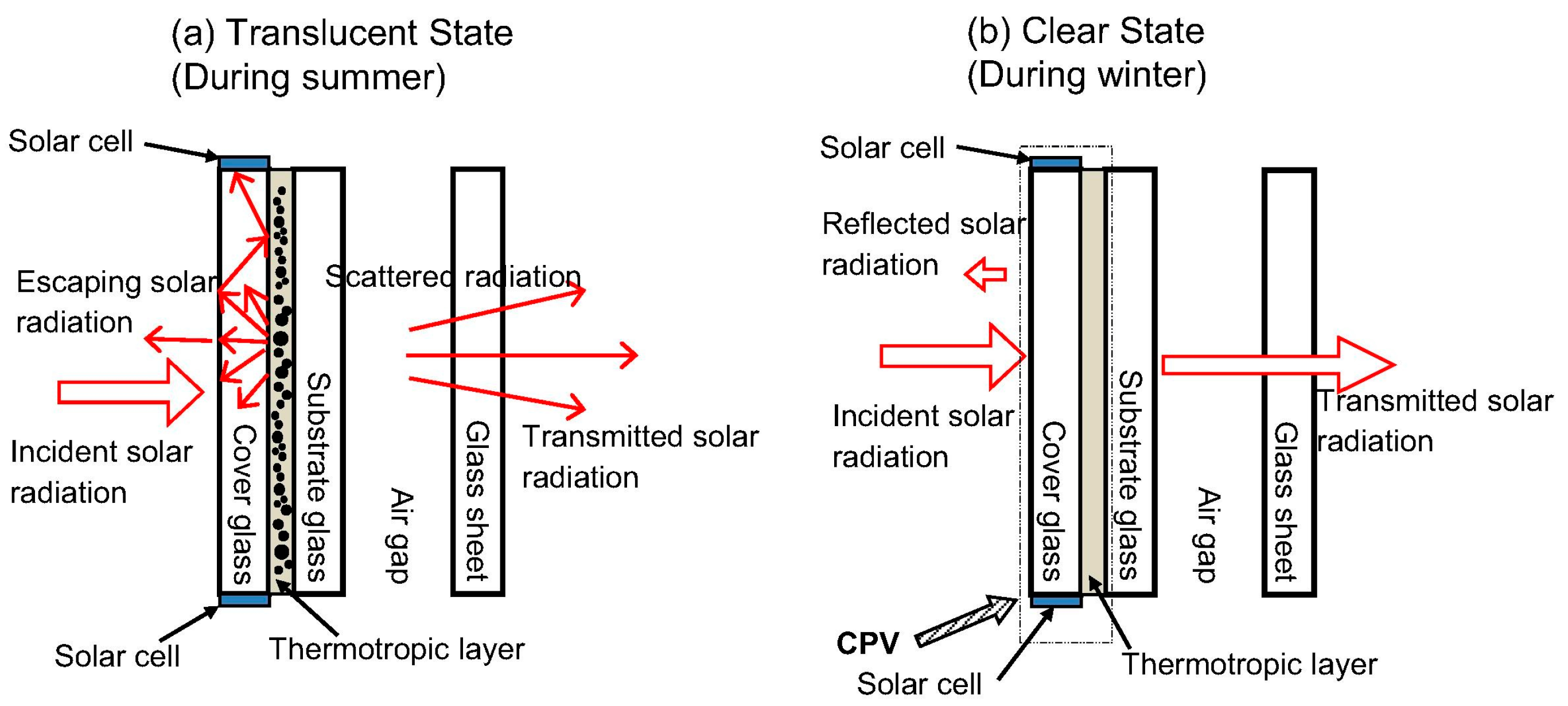
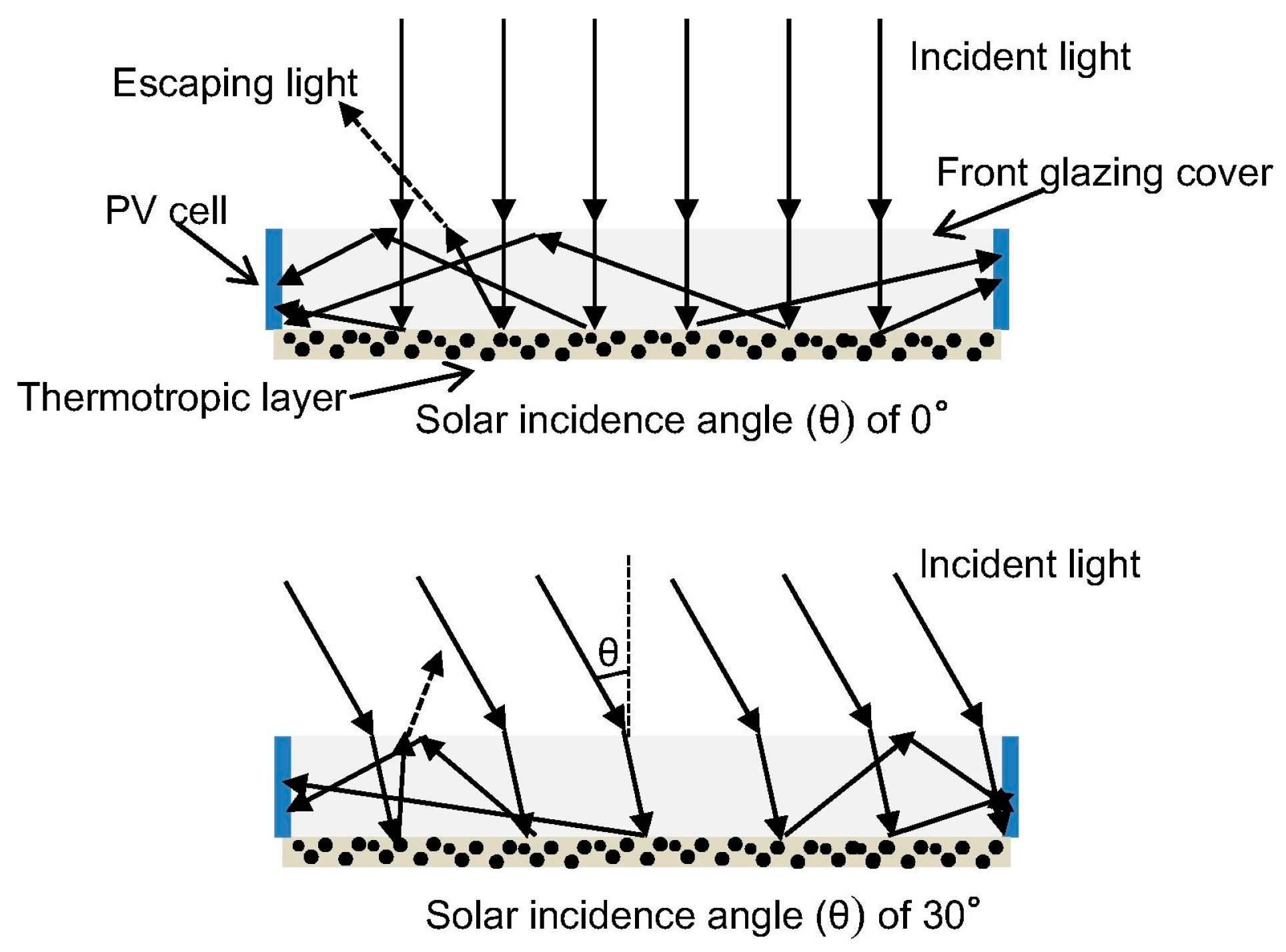
Building-integrated photovoltaic (BIPV) glazing systems with intelligent window technologies enhance building energy efficiency by generating electricity and managing daylighting. This study explores advanced BIPV glazing, focusing on building-integrated concentrating photovoltaic (BICPV) systems. BICPV integrates concentrating optics, such as holographic films, luminescent solar concentrators (LSC), Fresnel lenses, and compound parabolic concentrators (CPCs), with photovoltaic cells. Notable results include achieving 17.9% electrical efficiency using cylindrical holographic optical elements and crystalline silicon cells at a 3.5× concentration ratio. Dielectric CPCs showed 97.7% angular acceptance efficiency in simulations and 94.4% experimentally, increasing short-circuit current and maximum power by 87.0% and 96.6%, respectively, across 0° to 85° incidence angles. Thermochromic hydrogels and thermotropic smart glazing systems demonstrated significant HVAC energy savings. Large-area 1 m2 PNIPAm-based thermotropic window outperformed conventional double glazing in Singapore. The thermotropic parallel slat transparent insulation material (TT PS-TIM) improved energy efficiency by up to 21.5% compared to double glazing in climates like London and Rome. Emerging dynamic glazing technologies combine BIPV with smart functions, balancing transparency and efficiency. Photothermally controlled methylammonium lead iodide PV windows achieved 68% visible light transmission, 11.3% power conversion efficiency, and quick switching in under 3 min. Polymer-dispersed liquid crystal smart windows provided 41–68% visible transmission with self-powered operation.
Keywords: solar windows; building-integrated photovoltaics (BIPVs); zero-energy buildings; energy efficiency; concentrating optics; thermotropic smart glazing; dynamic glazing technologies solar windows; building-integrated photovoltaics (BIPVs); zero-energy buildings; energy efficiency; concentrating optics; thermotropic smart glazing; dynamic glazing technologies