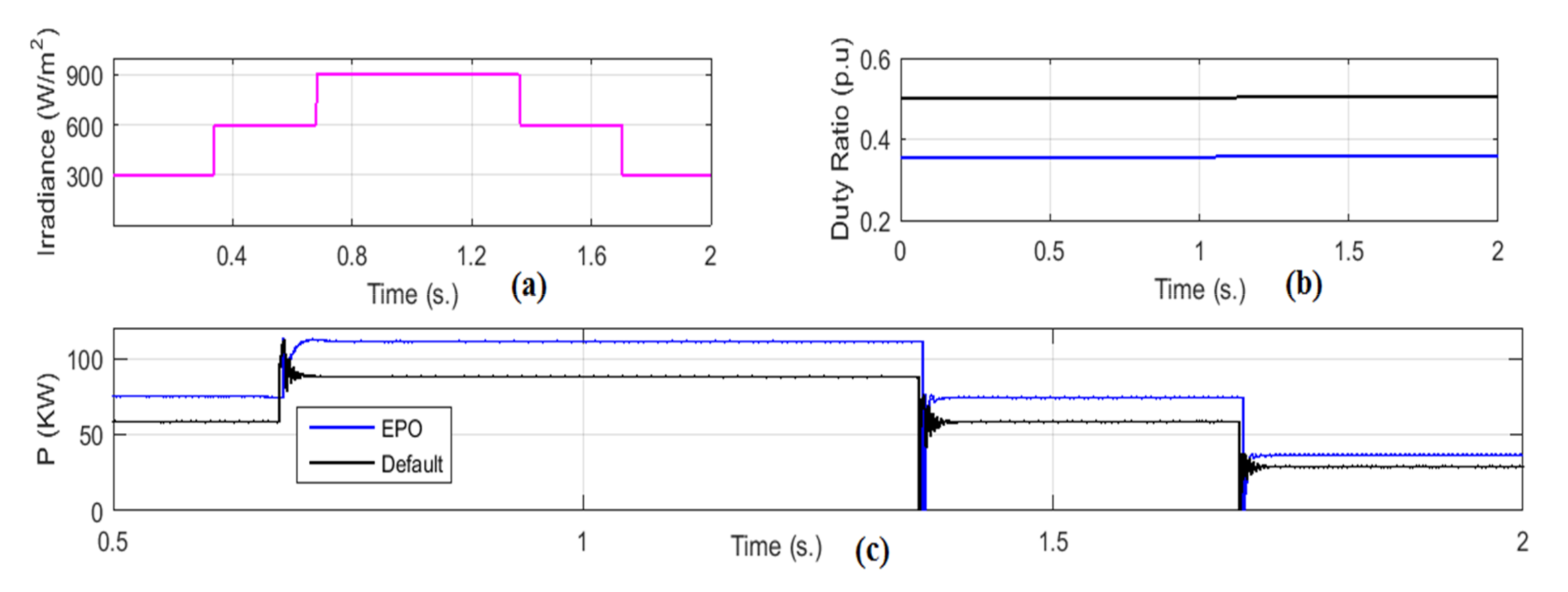
An Optimized PV Control System Based on the Emperor Penguin Optimizer





Abstract
1. Introduction
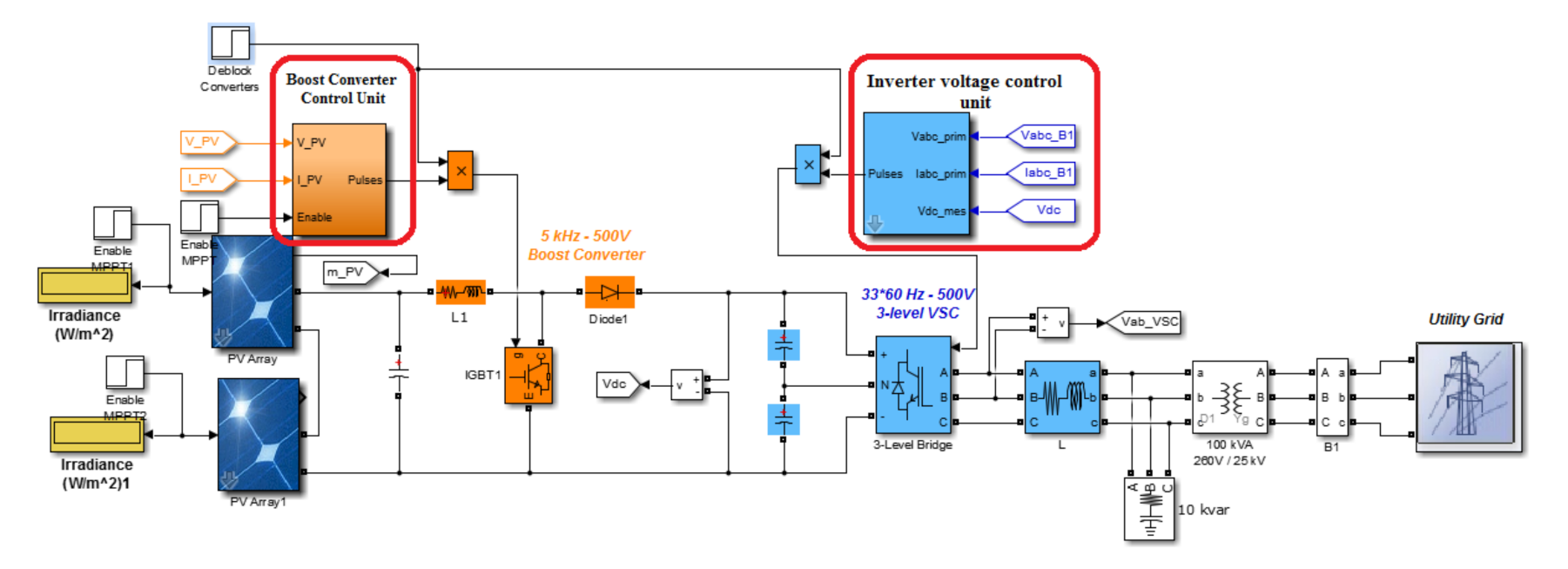
2. PV System under Study
3. Objective Function and Optimization Algorithms
3.1. Objective Function
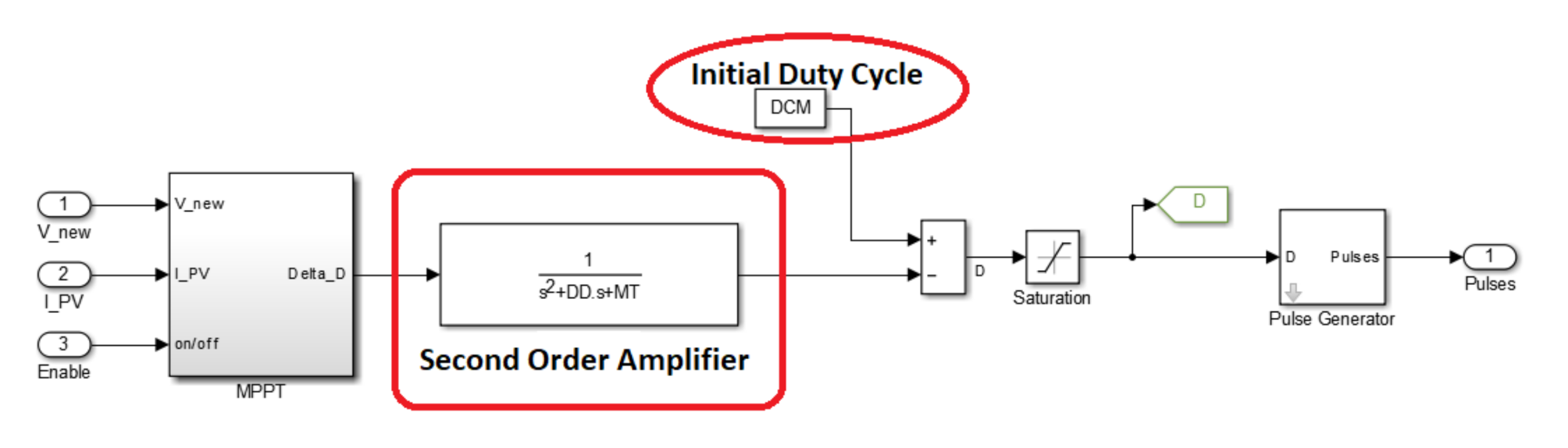
- Dc—the initial setting of duty cycle of the DC booster.
- Ct—the charging time of the amplifier (sec)
- Dt—the discharging time of the amplifier (sec)
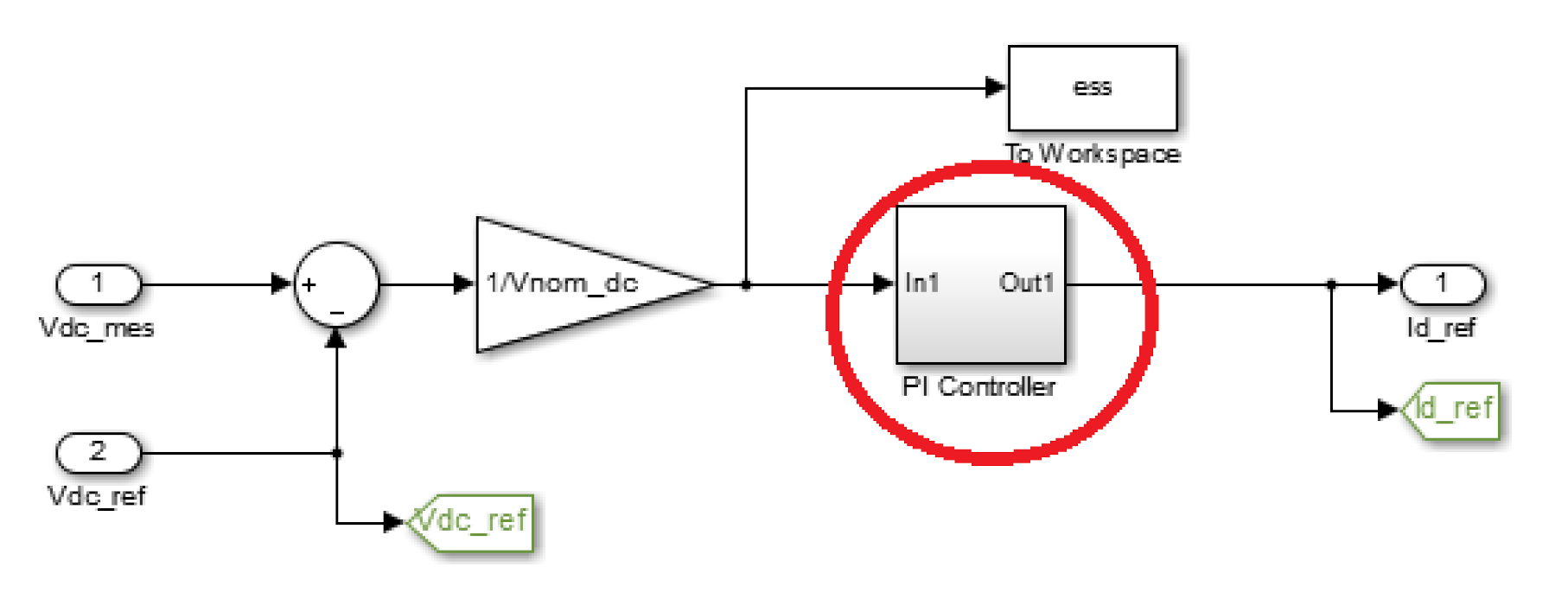
- P—the proportional gain of the PI controller
- I—the integral gain of the PI controller
- Ptot—the total output power of the lumped arrays (W)
- DD and MT—the gains used in SOA transfer function. They are the functions of the charging and discharging times of the SOA (sec-2).
3.2. The Proposed Optimization Algorithm (EPO)
- T0—the temperature profile all around the huddle
- MI—the maximum number of iterations
- CI—the current iteration.
- S(A)—the social forces of emperor penguins.
- P (x)—the current position vector of the emperor penguin
- A, C—anti-collision factors between neighbors
- Pep(x)—the vector of the best optimal solutions found.
- M—the movement parameter that maintains a gap between search agents for collision avoidance.
- Pg (ac) defines the polygon grid accuracy by comparing the difference between emperor penguins.
- f & l—control parameters for better exploration and exploitation.
- P(x+1) represents the next updated position of the emperor penguin.
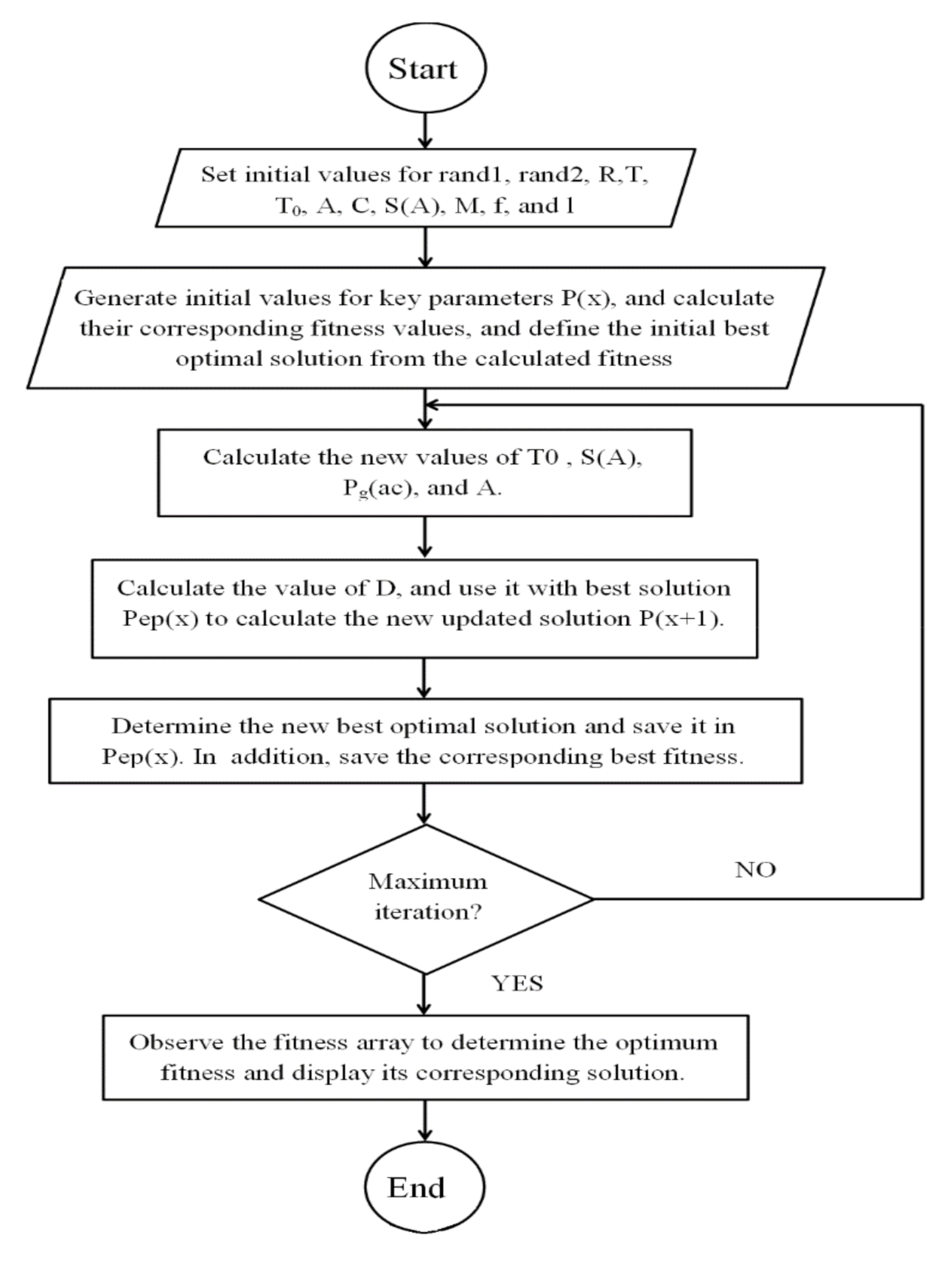
- Step 1: set initial values for rand1, rand2, R, T, T0, A, C, S(A), M, f, and l.
- Step 2: generate initial values for key parameters P(x), and calculate their corresponding fitness values (objective function).
- Step 3: define the initial best optimal solution from the calculated fitness.
- Step 4: start the first iteration by calculating the new values of T0, S(A), Pg(ac), and A.
- Step 5: calculate the value of D, and use it with best solution Pep(x) to calculate the new updated solution P(x+1).
- Step 6: determine the new best optimal solution and save it in Pep(x). Besides, save the corresponding best fitness.
- Step 7: check if the iterations have ended, if not return to Step 4 and repeat until the maximum number of iterations is reached.
- Step 8: observe the fitness array to determine the optimum fitness and display its corresponding solution.
4. Results and Comparison
5. Conclusions
Author Contributions
Funding
Institutional Review Board Statement
Informed Consent Statement
Data Availability Statement
Conflicts of Interest
References
- Iftikhar, R.; Ahmad, I.; Arsalan, M.; Naz, N.; Ali, N.; Armghan, H. MPPT for photovoltaic system using nonlinear controller. Hindawi Int. J. Photoenergy 2018, 2018, 11. [Google Scholar] [CrossRef] [Scilit]
- Priyadarshi, N.; Padmanaban, S.; Kiran Maroti, P.; Sharma, A. An extensive practical investigation of FPSO-based MPPT for grid integrated PV system under variable operating conditions with anti-islanding protection. IEEE Syst. J. 2019, 13, 1861–1871. [Google Scholar] [CrossRef] [Scilit]
- El-Helw, H.M.; Al-Hasheem, M.; Marei, M.I. Control strategies for the DAB based PV interface system. PLoS ONE 2016, 11, e0161856. [Google Scholar] [CrossRef] [Scilit] [PubMed]
- Priyadarshi, N.; Padmanaban, S.; Bhaskar, M.S.; Blaabjerg, F.; Holm-Nielsen, J.B.; Azam, F.; Sharma, A.K. A hybrid photovoltaic-fuel cell-based single-stage grid integration with lyapunov control scheme. IEEE Syst. J. 2020, 14, 3334–3342. [Google Scholar] [CrossRef] [Scilit]
- Gupta, M.; Saxena, R. Modeling and comparative analysis of PV module with improved perturbation and observation based MPPT technique for PV applications. Arch. Curr. Res. Int. 2018, 15, 1–12. [Google Scholar] [CrossRef] [Scilit]
- Premila, T.R.; Krishna Kumar, R. A comprehensive review on various optimization techniques assisted perturb and observe MPPT algorithm for a PV system. Int. J. Pure Appl. Math. 2018, 118, 51–63. [Google Scholar]
- Bhaskar Ranjana, M.S.; Sanjeevikumar, P.; Blaabjerg, F.; Azam, F. New CUK–SEPIC converter based photovoltaic power system with hybrid GSA–PSO algorithm employing MPPT for water pumping applications. IET Power Electron. 2020, 13, 2824–2830. [Google Scholar]
- Priyadarshi, N.; Sanjeevikumar, P.; Holm-Nielsen, J.B.; Bhaskar Ranjana, M.S. Internet of things augmented a novel PSO-employed modified zeta converter-based photovoltaic maximum power tracking system: Hardware realization. IET Power Electron. 2020, 13, 2775–2781. [Google Scholar] [CrossRef] [Scilit]
- Yussif, N.; Sabry, O.H.; Abdel-Khalik, A.S.; Ahmed, S.; Mohamed, A.M. Enhanced quadratic V/f-based induction motor control of solar water pumping system. Energies 2021, 14, 104. [Google Scholar] [CrossRef] [Scilit]
- Padmanaban, S.; Priyadarshi, N.; Bhaskar, M.S.; Holm-Nielsen, J.B.; Hossain, E.; Azam, F. A hybrid photovoltaic-fuel cell for grid integration with Jaya-based maximum power point tracking: Experimental performance evaluation. IEEE Access 2019, 7, 82978–82990. [Google Scholar] [CrossRef] [Scilit]
- Sanjeevikumar, P.; Priyadarshi, N.; Holm-Nielsen, J.B.; Bhaskar, M.S.; Azam, F.; Sharma, A.K.; Hossain, E. A novel modified sine-cosine optimized MPPT algorithm for grid integrated PV System under real operating conditions. IEEE Access 2019, 7, 10467–10477. [Google Scholar] [CrossRef] [Scilit]
- Sanjeevikumar, P.; Priyadarshi, N.; Bhaskar, M.S.; Holm-Nielsen, J.B.; Ramachandaramurthy, V.K.; Hossain, E. A hybrid ANFIS-ABC based MPPT controller for PV system with anti-islanding grid protection: Experimental realization. IEEE Access 2019, 7, 103377–103389. [Google Scholar]
- Priyadarshi, N.; Padmanaban, S.; Mihet-Popa, L.; Blaabjerg, F.; Azam, F. Maximum power point tracking for brushless DC motor-driven photovoltaic pumping systems using a hybrid ANFIS-FLOWER pollination optimization algorithm. Energies 2018, 11, 1067. [Google Scholar] [CrossRef] [Scilit]
- Priyadarshi, N.; Sharma, A.K.; Azam, F. A hybrid firefly-asymmetrical fuzzy logic controller based MPPT for PV-wind-fuel grid integration. Int. J. Renew. Energy Res. 2017, 7, 1546–1560. [Google Scholar]
- Mazaheri Salehi, P.; Solyali, D. A review on maximum power point tracking methods and their application. J. Solar Energy Res. 2018, 3, 123–133. [Google Scholar]
- Ram, J.P.; Rajasekar, N.; Miyatake, M. Design and overview of maximum power point tracking techniques in the wind and solar photovoltaic systems: A review. Renew. Sustain. Energy Rev. 2017, 73, 1138–1159. [Google Scholar] [CrossRef] [Scilit]
- Huang, Y.; Chen, X.; Ye, C. A hybrid maximum power point tracking approach for photovoltaic systems under partial shading conditions using a modified genetic algorithm and the firefly algorithm. Hindawi Int. J. Photoenergy 2017, 2018, 13. [Google Scholar] [CrossRef] [Scilit]
- Kumar, J.; Bahrani, P. Comprehensive review on maximum power point tracking methods for SPV system. Int. Res. J. Eng. Technol. 2017, 4. [Google Scholar]
- Erdem, Z. A review of MPPT algorithms for partial shading conditions. Acta Phys. Pol. Ser. 2017, 132, 1128–1133. [Google Scholar] [CrossRef] [Scilit]
- Ishaque, K.; Salam, Z. A deterministic particle swarm optimization maximum power point tracker for photovoltaic system under partial shading condition. IEEE Trans. Ind. Electron. 2013, 60, 3195–3206. [Google Scholar] [CrossRef] [Scilit]
- Lyden, S.; Haque, M.E. A simulated annealing global maximum power point tracking approach for PV modules under partial shading conditions. IEEE Trans. Power Electron. 2016, 31, 4171–4181. [Google Scholar] [CrossRef] [Scilit]
- Mohanty, S.; Subudhi, B.; Ray, P.K. New MPPT design using grey wolf optimization technique for photovoltaic system under partial shading conditions. IEEE Trans. Sustain. Energy 2016, 7, 181–188. [Google Scholar] [CrossRef] [Scilit]
- Seyedmahmoudian, M.; Rahmani, R.; Mekhilef, S.; Oo, A.M.T.; Stojcevski, A.; Soon, T.K.; Ghandhari, A.S. Simulation and hardware implementation of new maximum power point tracking technique for partially shaded PV system using hybrid DEPSO method. IEEE Trans. Sustain. Energy 2015, 6, 850–862. [Google Scholar] [CrossRef] [Scilit]
- Sundareswaran, K.; Peddapati, S.; Palani, S. MPPT of PV systems under partial shaded conditions through a colony of flashing fireflies. IEEE Trans. Energy Convers. 2014, 29, 463–472. [Google Scholar]
- Sundareswaran, K.; Sankar, P.; Nayak, P.S.R.; Simon, S.P.; Palani, S. Enhanced energy output from a PV system under partial shaded conditions through artificial bee colony. IEEE Trans. Sustain. Energy 2015, 6, 198–209. [Google Scholar] [CrossRef] [Scilit]
- Alajmi, B.N.; Ahmed, K.H.; Finney, S.J.; Williams, B.W. A maximum power point tracking technique for partially shaded photovoltaic systems in microgrids. IEEE Trans. Ind. Electron. 2013, 60, 1596–1606. [Google Scholar] [CrossRef] [Scilit]
- AL-Emam, M.; Marei, M.I.; El-khattam, W. A maximum power point tracking technique for PV under partial shading condition. In Proceedings of the IEEE India International Conference on Power Electronics (IICPE), Jaipur, India, 13–15 December 2018. [Google Scholar]
- Boztepe, M.; Guinjoan, F.; Quesada, G.V.; Silvestre, S.; Chouder, A.; Karatepe, E. Global MPPT scheme for photovoltaic string inverters based on restricted voltage window search algorithm. IEEE Trans. Ind. Electron. 2014, 61, 3302–3312. [Google Scholar] [CrossRef] [Scilit]
- Batzelis, E.I.; Kampitsis, G.E.; Papathanassiou, S.A.; Manias, S.N. Direct MPP calculation in terms of the single-diode PV model parameters. IEEE Trans. Energy Convers. 2015, 30, 226–236. [Google Scholar] [CrossRef] [Scilit]
- Kang, B.K.; Kim, S.T.; Bae, S.H.; Park, J.W. Diagnosis of output power lowering in a PV array by using the Kalman-filter algorithm. IEEE Trans. Energy Convers. 2012, 27, 885–894. [Google Scholar] [CrossRef] [Scilit]
- Seyedmahmoudian, M.; Mekhilef, S.; Rahmani, R.; Yusof, R.; Renani, E.T. Analytical modeling of partially shaded photovoltaic systems. Energies 2013, 6, 128–144. [Google Scholar] [CrossRef] [Scilit]
- Manickam, C.; Raman, G.R.; Raman, G.P.; Ganesan, S.I.; Nagamani, C. A hybrid algorithm for tracking of GMPP based on P&O and PSO with reduced power oscillation in string inverters. IEEE Trans. Ind. Electron. 2016, 63, 6097–6106. [Google Scholar]
- Chen, K.; Tian, S.; Cheng, Y.; Bai, L. An improved MPPT controller for photovoltaic system under partial shading condition. IEEE Trans. Sustain. Energy 2014, 5, 978–985. [Google Scholar] [CrossRef] [Scilit]
- Tey, K.S.; Mekhilef, S. Modified incremental conductance algorithm for photovoltaic system under partial shading conditions and load variation. IEEE Trans. Ind. Electron. 2014, 61, 5384–5392. [Google Scholar]
- Alajmi, B.N.; Marei, M.I.; Abdelsalam, I. A multi-port DC/DC converter based on two- quadrant inverter topology for PV systems. IEEE Trans. Power Electron. 2021, 36, 522–532. [Google Scholar] [CrossRef] [Scilit]
- Elserougi, A.A.; Diab, M.S.; Massoud, A.M.; Abdel-Khalik, A.S.; Ahmed, S. A switched PV approach for extracted maximum power enhancement of PV arrays during partial shading. IEEE Trans. Sustain. Energy 2015, 6, 767–772. [Google Scholar] [CrossRef] [Scilit]
- Choi, U.; Blaabjerg, F.; Lee, K. Control strategy of two capacitor voltages for separate MPPTs in photovoltaic systems using neutral-point-clamped inverters. IEEE Trans. Ind. Appl. 2015, 51, 3295–3303. [Google Scholar] [CrossRef] [Scilit]
- Rani, B.I.; Ilango, G.S.; Nagamani, C. Enhanced power generation from PV array under partial shading conditions by shade dispersion using Su Do Ku configuration. IEEE Trans. Sustain. Energy 2013, 4, 594–660. [Google Scholar] [CrossRef] [Scilit]
- Marei, M.I.; Alajmi, B.; Abdelsalam, I.; Alhajri, M.F. A PV interface system based on high-gain high-frequency link converter. In Proceedings of the 2018 53rd International Universities Power Engineering Conference (UPEC), Glasgow, UK, 1–6 September 2018. [Google Scholar]
- Uno, M.; Kukita, A. Two-switch voltage equalizer using an LLC resonant inverter and voltage multiplier for partially shaded series-connected photovoltaic modules. IEEE Trans. Ind. Appl. 2015, 51, 1587–1601. [Google Scholar] [CrossRef] [Scilit]
- Ghasemi, M.A.; Foroushani, H.M.; Parniani, M. Partial shading detection and smooth maximum power point tracking of PV arrays under PSC. IEEE Trans. Power Electron. 2016, 31, 6281–6292. [Google Scholar] [CrossRef] [Scilit]
- Ji, Y.H.; Jung, D.Y.; Kim, J.G.; Kim, J.H.; Lee, T.W.; Won, C.Y. A real maximum power point tracking method for mismatching compensation in PV array under partially shaded conditions. IEEE Trans. Power Electron. 2011, 26, 1001–1009. [Google Scholar] [CrossRef] [Scilit]
- Ramson, S.J.; Raju, K.L.; Vishnu, S.; Anagnostopoulos, T. Nature inspired optimization techniques for image processing—A short review. In Nature Inspired Optimization Techniques for Image Processing Applications; Springer: Cham, Switzerland, 2019. [Google Scholar]
- Mekontso, C.; Abubakar, A.; Madugu, S.; Ibrahim, O.; Adediran, Y.A. Review of optimization techniques for sizing renewable energy systems. Comput. Eng. Appl. 2019, 8, 13–30. [Google Scholar] [CrossRef] [Scilit]
- Logeswarana, T.; Senthil Kumarb, A. A review of maximum power point tracking algorithms for photovoltaic systems under uniform and non-uniform irradiances. Energy Procedia 2014, 54, 228–235. [Google Scholar] [CrossRef] [Scilit]
- Kolluru, V.R.; Patjoshi, R.K.; Panigrahi, R. A comprehensive review on maximum power tracking of a photovoltaic system under partial shading conditions. Int. J. Renew. Energy Res. 2019, 9, 12. [Google Scholar]
- Alshareef, M.; Lin, Z.; Ma, M.; Cao, W. Accelerated particle swarm optimization for photovoltaic maximum power point tracking under partial shading conditions. Energies 2019, 12, 18. [Google Scholar] [CrossRef] [Scilit]
- Hussaian Basha, C.H.; Rani, C. Evolutionary and metaphor-metaheuristic MPPT techniques for enhancing the operation of solar PV under partial shading condition. Int. J. Innov. Technol. Explor. Eng. 2019, 8, 2206–2216. [Google Scholar]
- Omar, O.A.; Badra, N.M.; Attia, M.A. Enhancement of on-grid PV system under irradiance and temperature variations using new optimized adaptive controller. Int. J. Electr. Comput. Eng. 2018, 8, 2650–2660. [Google Scholar] [CrossRef] [Scilit]
- Sameh, M.A.; Badr, M.A.; Mare, M.I.; Attia, M.A. Enhancing the performance of photovoltaic systems under partial shading conditions using cuttlefish algorithm. In Proceedings of the 2019 8th International Conference on Renewable Energy Research and Applications (ICRERA), Brasov, Romania, 3–6 November 2019. [Google Scholar]
- Sameh, M.A.; Badr, M.A.; Badr MA, L.; Marei, M.I.; Attia, M.A. Optimized PIA controller for photovoltaic system using hybrid particle swarm optimization and cuttlefish algorithms. In Proceedings of the 2018 7th International Conference on Renewable Energy Research and Applications (ICRERA), Paris, France, 14–17 October 2018. [Google Scholar]
- Eesa, A.S.; Brifcani AM, A.; Orman, Z. A new tool for global optimization problems-cuttlefish algorithm. Int. J. Math. Comput. Phys. Electr. Comput. Eng. 2014, 8, 1235–1239. [Google Scholar]
- Dhiman, G.; Kumar, V. Emperor penguin optimizer: A bio-inspired algorithm for engineering problems. Knowl. Based Syst. 2018, 159, 20–50. [Google Scholar] [CrossRef] [Scilit]



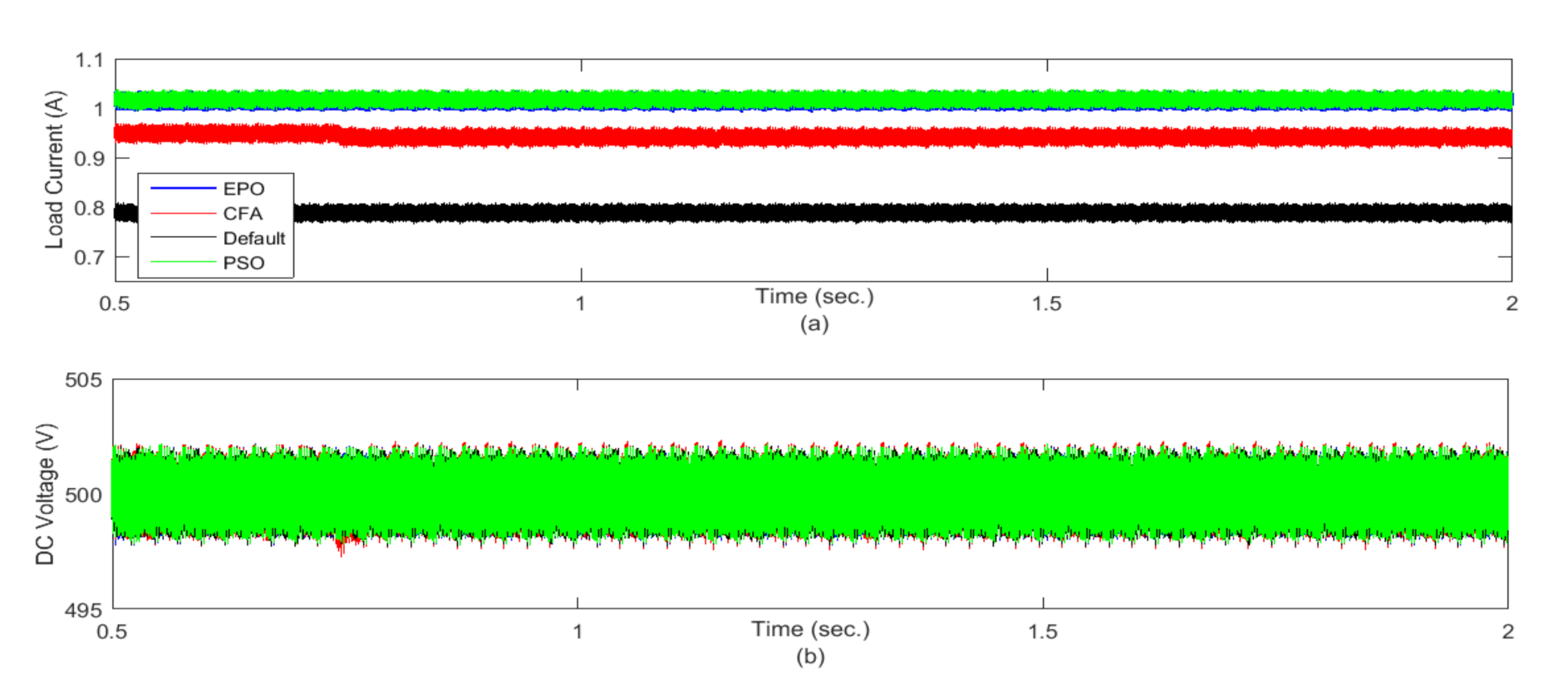
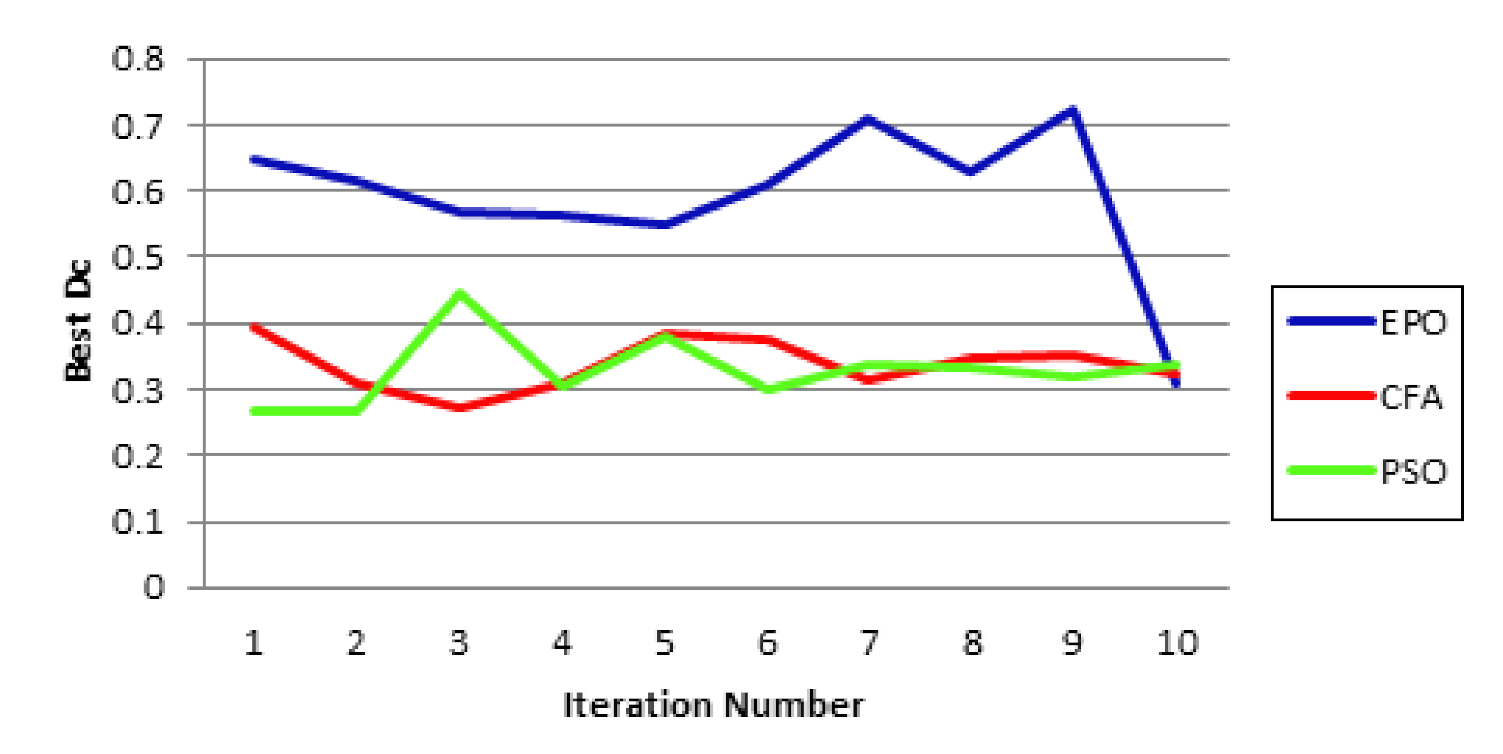
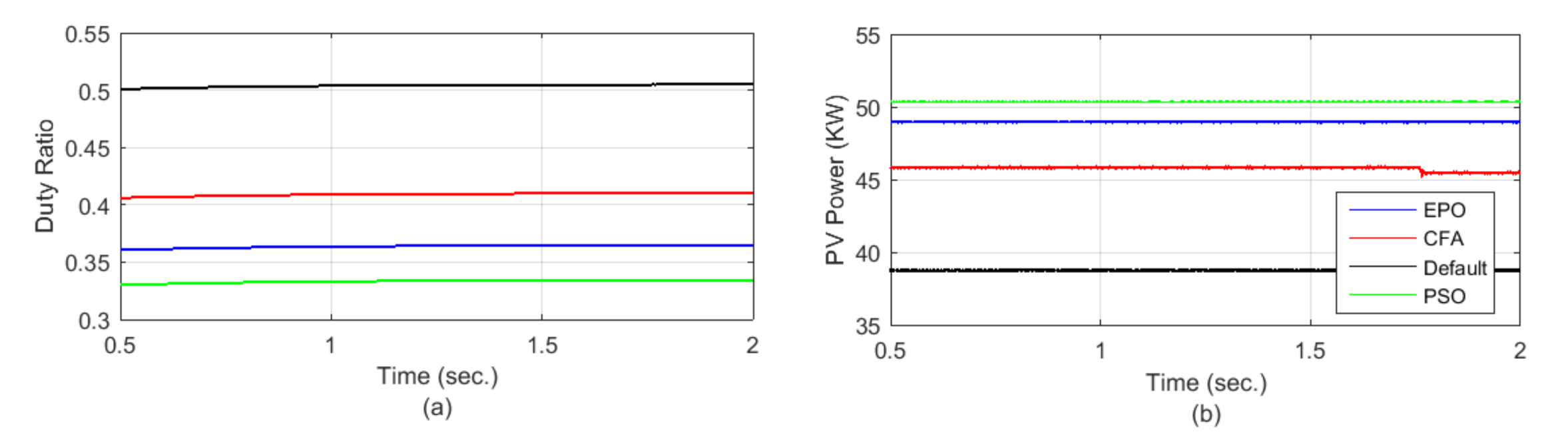


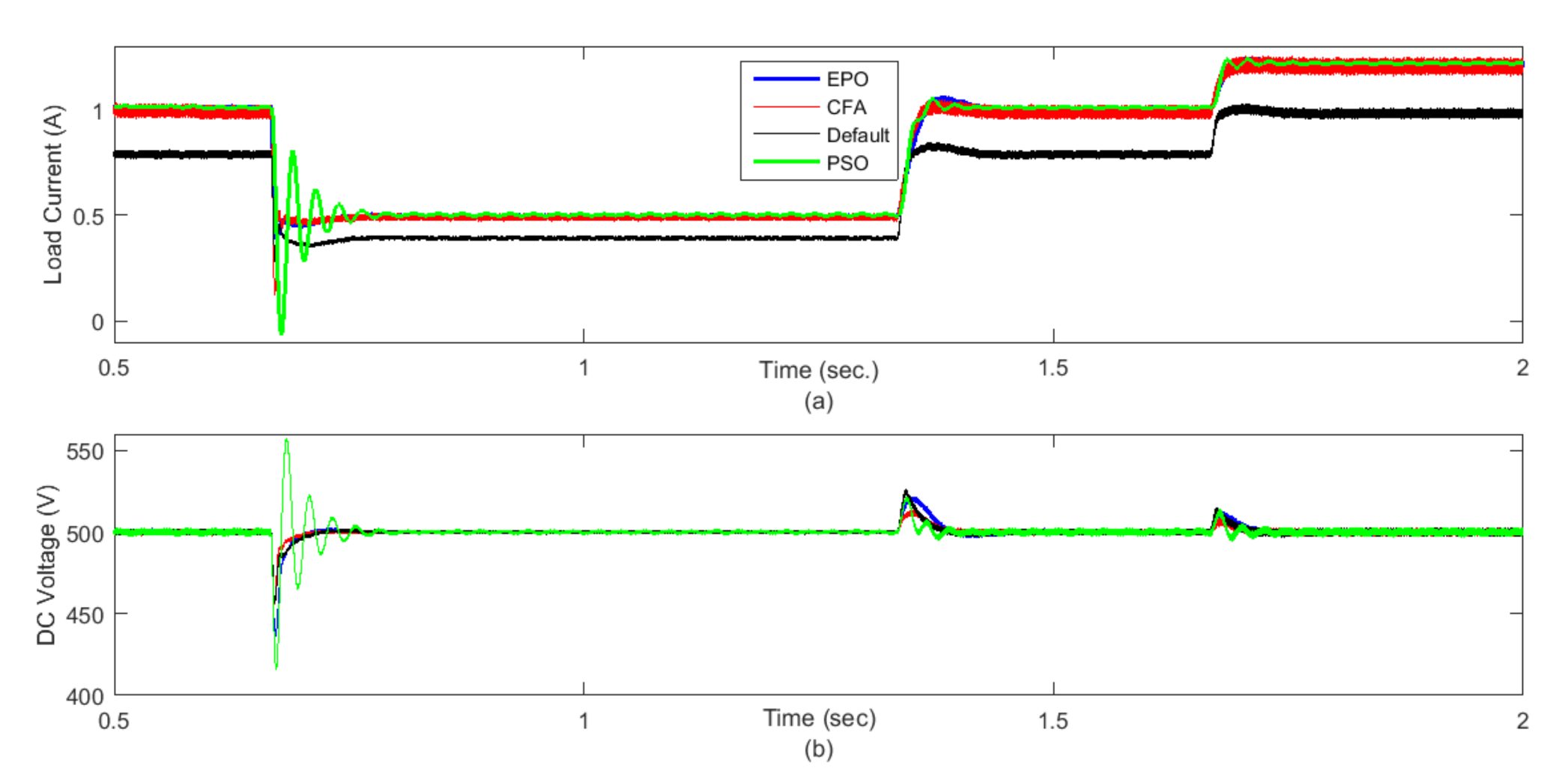
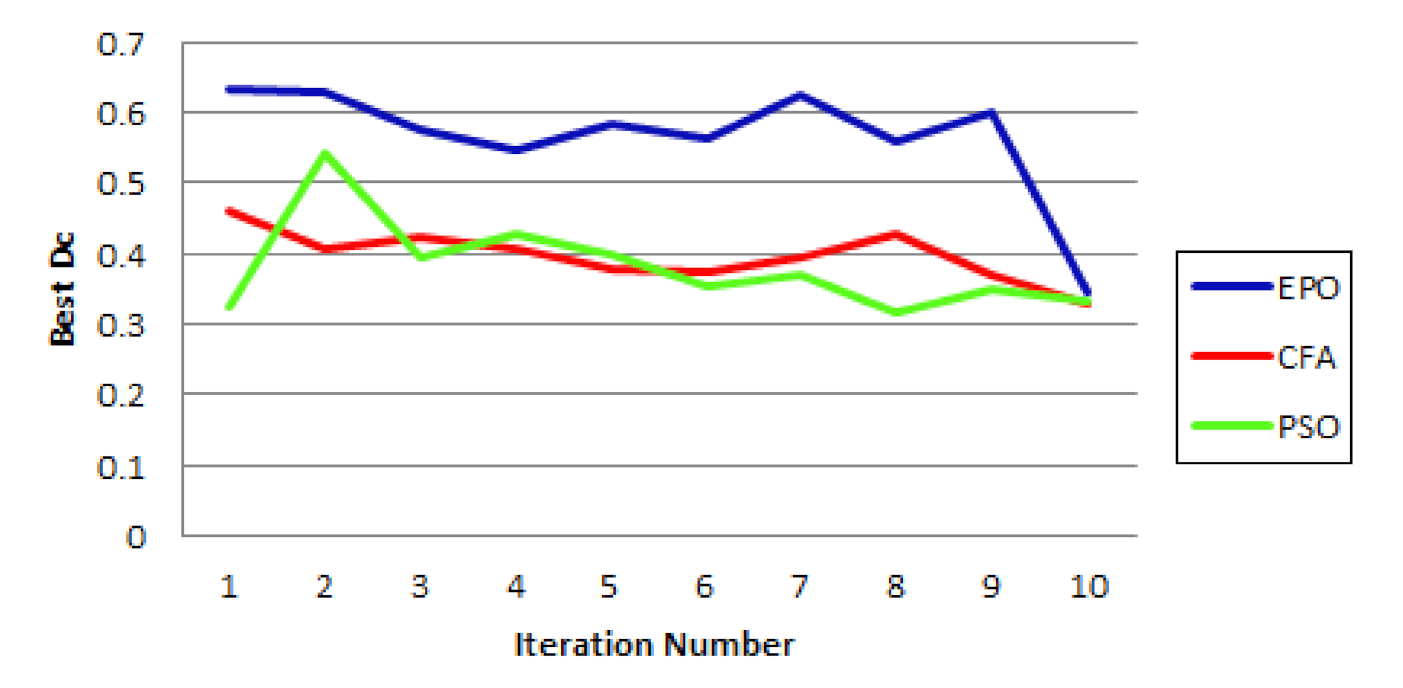
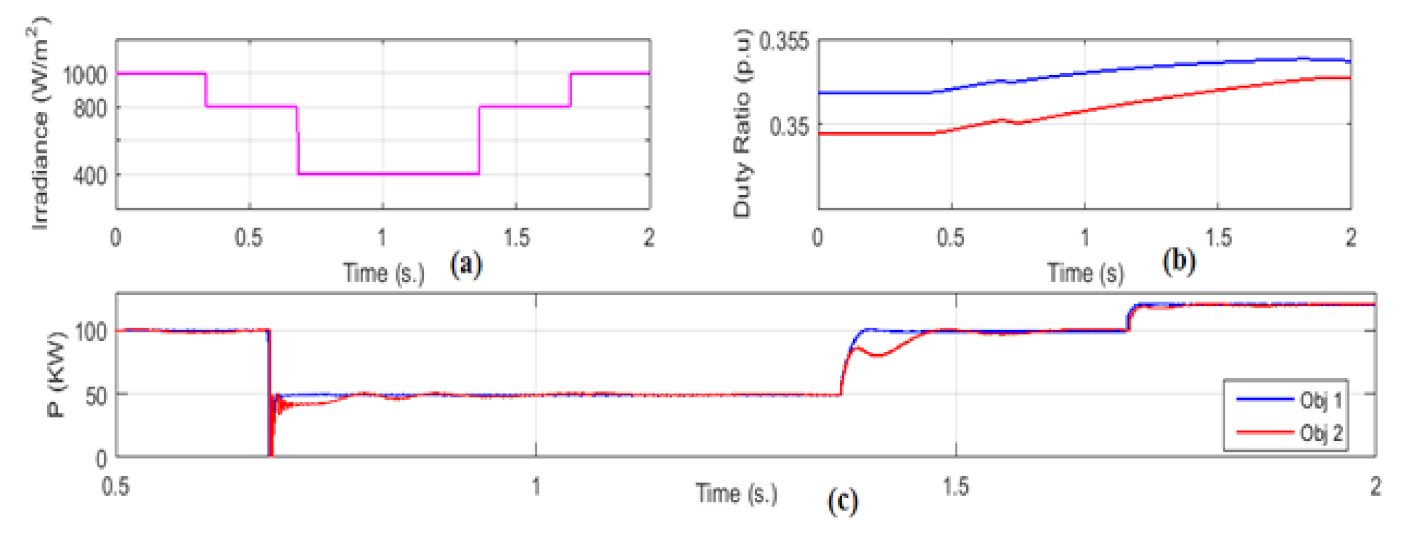
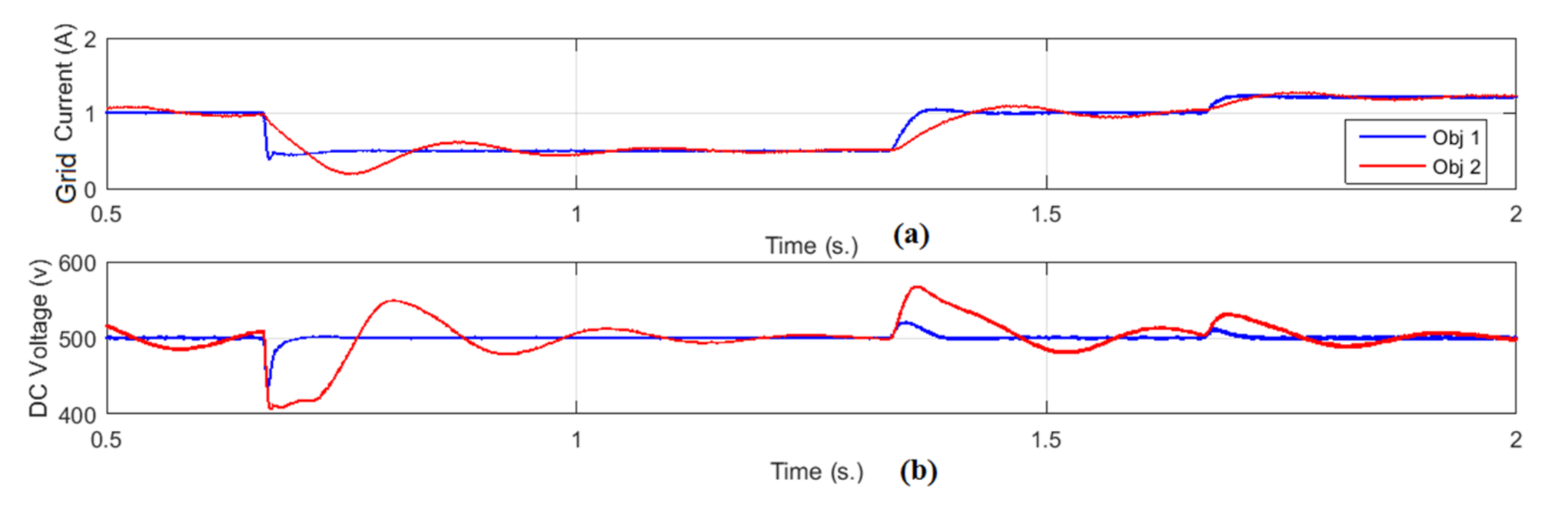


| Parameter | M | Rand 1 | Rand 2 | f | l |
|---|---|---|---|---|---|
| Minimum value | Set to 2 | 0 | 0 | 2 | 1.5 |
| Maximum value | 1 | 1 | 3 | 2 |
| Parameter | Default | PSO | CFA | EPO |
|---|---|---|---|---|
| DC | 0.5 | 0.338629 | 0.3974 | 0.3394 |
| Energy (KW. sec) | 155.02 | 196.978 | 184.79 | 197.843 |
| Max power (KW) | 78.282 | 99.89 | 94.08 | 100.7 |
| Max Power (%) | 74.55 | 95.17 | 89.6 | 95.9 |
| Parameter | Default | PSO | CFA | EPO |
|---|---|---|---|---|
| DC | 0.5 | 0.3289 | 0.4052 | 0.3599 |
| Energy (KW. sec) | 77.938 | 100.34 | 90.245 | 98.488 |
| Max power (KW) | 38.84 | 50.12 | 45.93 | 49.05 |
| Max power (%) | 76.15 | 98.27 | 90.05 | 96.17 |
| Parameter | Default | PSO | CFA | EPO |
|---|---|---|---|---|
| DC | 0.5 | 0.333 | 0.3638 | 0.3537 |
| Energy (KW. sec) | 139.86 | 179.3 | 173.07 | 173.75 |
| Max power (KW) | 97.75 | 121.5 | 119.91 | 120.66 |
| Max power (%) | 79.4 | 98.78 | 97.48 | 98.09 |
| Consumed time (sec.) | - | 60.45 | 59.31 | 58.98 |
| Parameter | PSO | CFA | EPO |
|---|---|---|---|
| Kp | 10 | 8.1624 | 3.408 |
| Ki | 811.87 | 721.3269 | 433.7475 |
| DD | 96.77 | 112.9311 | 149.1025 |
| MT | 138.063 | 184.1047 | 211.7289 |
| Parameter | Obj1 | Obj2 |
|---|---|---|
| DC | 0.3537 | 0.3489 |
| Kp | 3.408 | 0.3774 |
| Ki | 433.7475 | 59.6189 |
| DD | 149.1025 | 142.7446 |
| MT | 211.7289 | 75.5418 |
Publisher’s Note: MDPI stays neutral with regard to jurisdictional claims in published maps and institutional affiliations. |
© 2021 by the authors. Licensee MDPI, Basel, Switzerland. This article is an open access article distributed under the terms and conditions of the Creative Commons Attribution (CC BY) license (http://creativecommons.org/licenses/by/4.0/).
Share and Cite
Sameh, M.A.; Marei, M.I.; Badr, M.A.; Attia, M.A. An Optimized PV Control System Based on the Emperor Penguin Optimizer. Energies 2021, 14, 751. https://doi.org/10.3390/en14030751
Sameh MA, Marei MI, Badr MA, Attia MA. An Optimized PV Control System Based on the Emperor Penguin Optimizer. Energies. 2021; 14(3):751. https://doi.org/10.3390/en14030751
Chicago/Turabian StyleSameh, Mariam A., Mostafa I. Marei, M. A. Badr, and Mahmoud A. Attia. 2021. "An Optimized PV Control System Based on the Emperor Penguin Optimizer" Energies 14, no. 3: 751. https://doi.org/10.3390/en14030751
APA StyleSameh, M. A., Marei, M. I., Badr, M. A., & Attia, M. A. (2021). An Optimized PV Control System Based on the Emperor Penguin Optimizer. Energies, 14(3), 751. https://doi.org/10.3390/en14030751