A Transformer Fault Diagnosis Model Based On Hybrid Grey Wolf Optimizer and LS-SVM

 ,
,
Abstract
1. Introduction
2. Related Theory
2.1. Kernel Principal Component Analysis
2.2. Differential Evolution
2.2.1. Initialization of Population
2.2.2. Mutation
2.2.3. Crossover
2.2.4. Selection
2.3. Grey Wolf Optimizer
2.3.1. Social Hierarchy
2.3.2. Encircling Prey
2.3.3. Hunting
2.3.4. Attacking Prey
2.3.5. Searching Prey
| Algorithm 1. GWO pseudo-code |
| (1) Initialize the positions of grey wolf population Xi (i = 1,2,3…, n) randomly. (2) Initialize a, A, C. (3) Find α, β, and δ as the first three best solutions based on their fitness values. (4) t = 0. while t ≤ MaxIter do for each Wolfi pack do Update current wolf’s position according to Equation (15). end - Update a, A, and C as in Equations (16), (11) and (12). - Evaluate the positions of individual wolves. - Update α, β, and δ positions as the first best three solutions in the current population. - t = t + 1. end (5) Select the optimal grey wolf position. |
2.4. Least Square Support Vector Machine
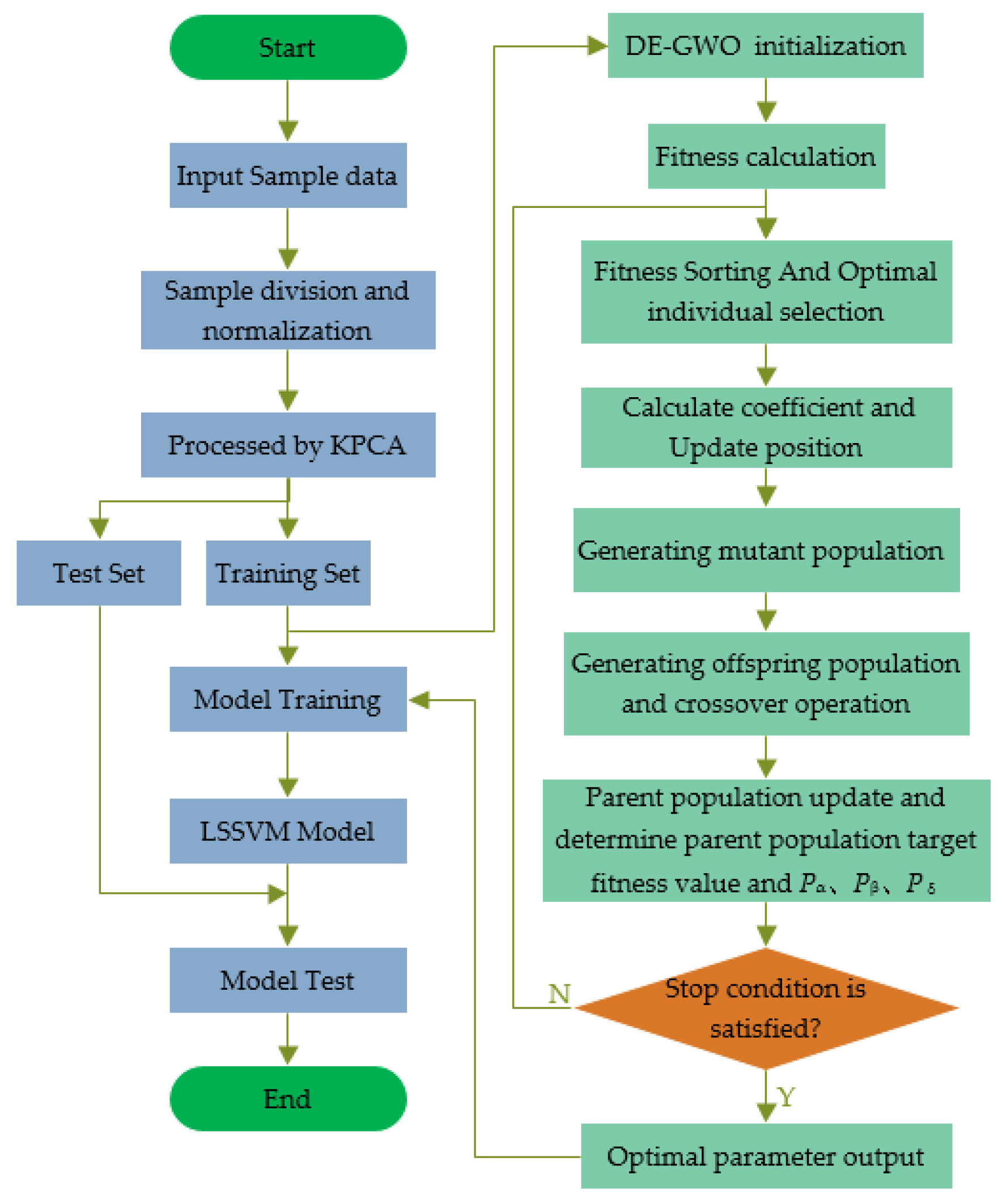
3. Fault Diagnosis Model Based on HGWO-LSSVM
4. Case study and Analysis
4.1. Fault Sample Collection
4.2. Feature Set Selection
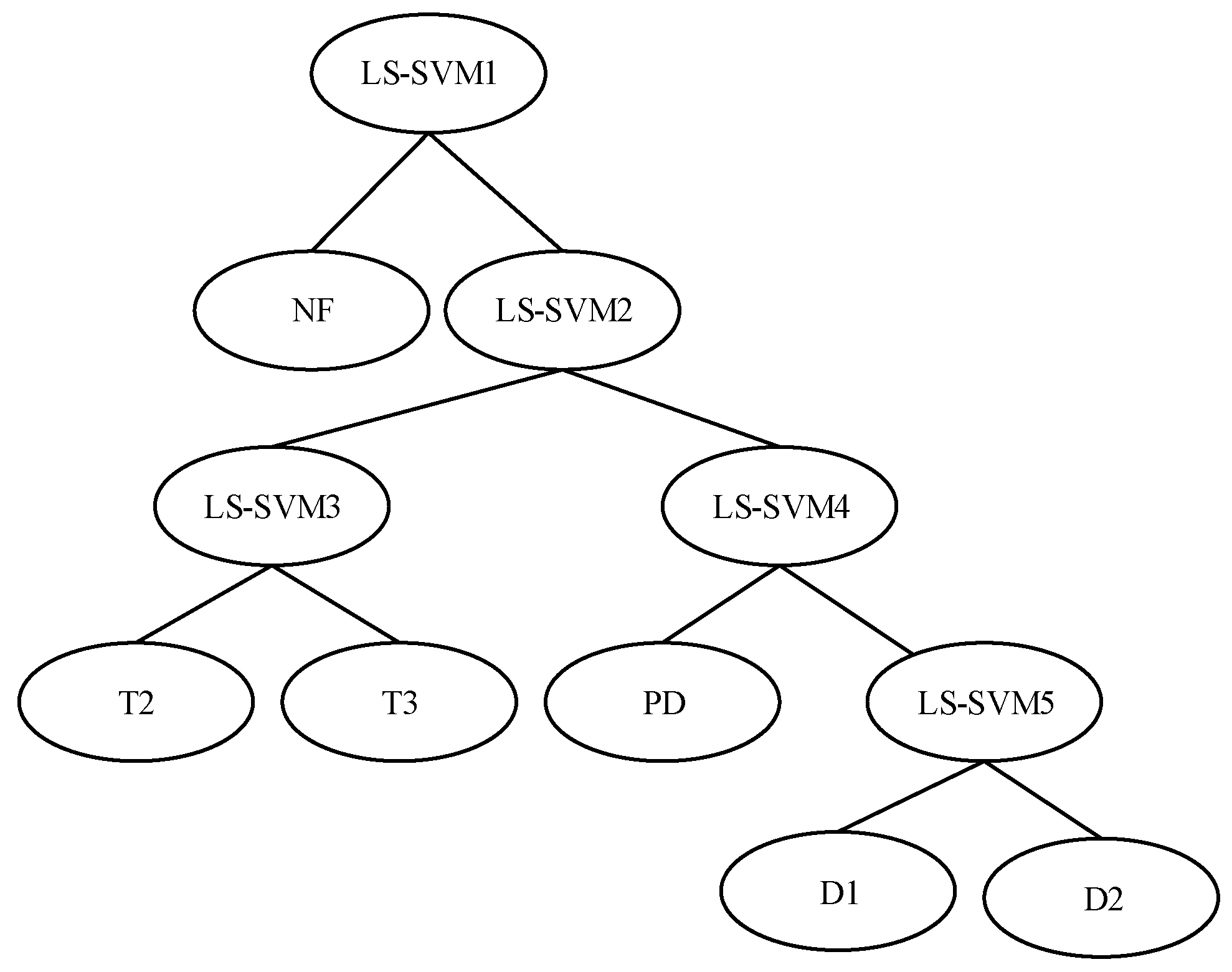
4.3. Multi-Class Classification Model
4.4. Results and Discussion
4.4.1. Example 1
4.4.2. Example 2
5. Conclusions
Author Contributions
Funding
Acknowledgments
Conflicts of Interest
References
- Faiz, J.; Soleimani, M. Dissolved gas analysis evaluation in electric power transformers using conventional methods a review. IEEE Trans. Dielectr. Electr. Insul. 2017, 24, 1239–1248. [Google Scholar] [CrossRef]
- IEEE Guide for the Interpretation of Gases Generated in Oil-Immersed Transformers; IEEE Standard C57.104-2008; Institute of Electrical and Electronics Engineers: Piscataway, NJ, USA, 2008.
- Guide for the Sampling of Gases and of Oil-Filled Electrical Equipment and for the Analysis of Free and Dissolved Gases; IEC Standard 60567; IEC: Geneva, Switzerland, 2005.
- Duval, M. A review of faults detectable by gas-in-oil analysis in transformers. IEEE Electr. Insul. Mag. 2002, 18, 8–17. [Google Scholar] [CrossRef]
- Duval, M.; Depabla, A. Interpretation of gas-in-oil analysis using new IEC publication 60599 and IEC TC 10 databases. IEEE Electr. Insul. Mag. 2001, 17, 31–41. [Google Scholar] [CrossRef]
- Duval, M. Dissolved gas analysis: It can save your transformer. IEEE Electr. Insul. Mag. 1989, 5, 22–27. [Google Scholar] [CrossRef]
- Rogers, R.R. IEEE and IEC Codes to Interpret Incipient Faults in Transformers, Using Gas in Oil Analysis. IEEE Trans. Electr. Insul. 1978, EI-13, 349–354. [Google Scholar] [CrossRef]
- Dornenburg, E.; Strittmatter, W. Monitoring oil-cooled transformers by gas-analysis. Brown Boveri Rev. 1974, 61, 238–247. [Google Scholar]
- Duval, M.; Lamarre, L. The Duval pentagon—A new complementary tool for the interpretation of dissolved gas analysis in transformers. IEEE Electr. Insul. Mag. 2014, 30, 9–12. [Google Scholar]
- Mansour, D.A. A new graphical technique for the interpretation of dissolved gas analysis in power transformers. In Annual Report Conference on Electrical Insulation and Dielectric Phenomena; IEEE: Piscataway, NJ, USA, 2012. [Google Scholar]
- Mansour, D.A. Development of a new graphical technique for dissolved gas analysis in power transformers based on the five combustible gases. IEEE Trans. Dielectr. Electr. Insul. 2015, 22, 2507–2512. [Google Scholar] [CrossRef]
- Liu, Z.X.; Song, B.; Li, E.W.; Mao, Y.; Wang, G.L. Study of “code absence” in the IEC three-ratio method of dissolved gas analysis. IEEE Electr. Insul. Mag. 2015, 31, 6–12. [Google Scholar] [CrossRef]
- Nagpal, T.; Brar, Y.S. Artificial neural network approaches for fault classification: Comparison and performance. Neural Comput. Appl. 2014, 25, 1863–1870. [Google Scholar] [CrossRef]
- Illias, H.A.; Xin, R.C.; Bakar, A.H.A. Hybrid modified evolutionary particle swarm optimisation-time varying acceleration coefficient-artificial neural network for power transformer fault diagnosis. Measurement 2016, 90, 94–102. [Google Scholar] [CrossRef]
- Ghoneim, S.S.M.; Taha, I.B.M.; Elkalashy, N.I. Integrated ANN-based proactive fault diagnostic scheme for power transformers using dissolved gas analysis. IEEE Trans. Dielectr. Electr. Insul. 2016, 23, 1838–1845. [Google Scholar] [CrossRef]
- Ganyun, L.V.; Haozhong, C.; Haibao, Z.; Lixin, D. Fault diagnosis of power transformer based on multi-layer SVM classifier. Electr. Power Syst. Res. 2005, 75, 9–15. [Google Scholar] [CrossRef]
- Fei, S.; Zhang, X. Fault diagnosis of power transformer based on support vector machine with genetic algorithm. Expert Syst. Appl. 2009, 36, 11352–11357. [Google Scholar] [CrossRef]
- Bacha, K.; Souahlia, S.; Gossa, M. Power transformer fault diagnosis based on dissolved gas analysis by support vector machine. Electr. Power Syst. Res. 2012, 83, 73–79. [Google Scholar] [CrossRef]
- Wei, C.; Tang, W.; Wu, Q. Dissolved gas analysis method based on novel feature prioritisation and support vector machine. IET Electr. Power Appl. 2014, 8, 320–328. [Google Scholar] [CrossRef]
- Koroglu, S.; Demircali, A. Diagnosis of Power Transformer Faults Based on Multi-layer Support Vector Machine Hybridized with Optimization Methods. Electr. Mach. Power Syst. 2016, 44, 2172–2184. [Google Scholar] [CrossRef]
- Li, J.; Zhang, Q.; Wang, K.; Wang, J.; Zhou, T.; Zhang, Y. Optimal dissolved gas ratios selected by genetic algorithm for power transformer fault diagnosis based on support vector machine. IEEE Trans. Dielectr. Electr. Insul. 2016, 23, 1198–1206. [Google Scholar] [CrossRef]
- Yuan, F.; Guo, J.; Xiao, Z.; Zeng, B.; Zhu, W.; Huang, S. A Transformer Fault Diagnosis Model Based on Chemical Reaction Optimization and Twin Support Vector Machine. Energies 2019, 12, 960. [Google Scholar] [CrossRef]
- Illias, H.A.; Zhao, W.L. Identification of transformer fault based on dissolved gas analysis using hybrid support vector machine-modified evolutionary particle swarm optimisation. PLoS ONE 2018, 13, e0191366. [Google Scholar] [CrossRef]
- Fang, J.; Zheng, H.; Liu, J.; Zhao, J.; Zhang, Y.; Wang, K. A Transformer Fault Diagnosis Model Using an Optimal Hybrid Dissolved Gas Analysis Features Subset with Improved Social Group Optimization-Support Vector Machine Classifier. Energies 2018, 11, 1922. [Google Scholar] [CrossRef]
- Paydarnia, H.; Hajiaghasi, S.; Abbaszadeh, K. Improved Structure of PNN Using PCA in Transformer Fault Diagnostic. Arab. J. Sci. Eng. 2014, 39, 4845–4851. [Google Scholar] [CrossRef]
- Yi, J.; Wang, J.; Wang, G. Improved probabilistic neural networks with self-adaptive strategies for transformer fault diagnosis problem. Adv. Mech. Eng. 2016, 8, 1687814015624832. [Google Scholar] [CrossRef]
- Carita, A.J.Q.; Leite, L.C.; Medeiros, A.P.P.; Barros, R. Bayesian Networks applied to Failure Diagnosis in Power Transformer. IEEE Lat. Am. Trans. 2013, 11, 1075–1082. [Google Scholar] [CrossRef]
- Abu-Siada, A.; Hmood, S.; Islam, S. A New Fuzzy Logic Approach for Consistent Interpretation of Dissolved Gas-in-Oil Analysis. IEEE Trans. Dielectr. Electr. Insul. 2013, 20, 2343–2349. [Google Scholar] [CrossRef]
- Abu-Siada, A.; Hmood, S. A new fuzzy logic approach to identify power transformer criticality using dissolved gas-in-oil analysis. Int. J. Electr. Power Energy Syst. 2015, 67, 401–408. [Google Scholar] [CrossRef]
- Noori, M.; Effatnejad, R.; Hajihosseini, P. Using dissolved gas analysis results to detect and isolate the internal faults of power transformers by applying a fuzzy logic method. IET Gener. Transm. Distrib. 2017, 11, 2721–2729. [Google Scholar] [CrossRef]
- Dai, J.; Song, H.; Sheng, G.; Jiang, X. Dissolved gas analysis of insulating oil for power transformer fault diagnosis with deep belief network. IEEE Trans. Dielectr. Electr. Insul. 2017, 24, 2828–2835. [Google Scholar] [CrossRef]
- Žarković, M.; Stojković, Z. Analysis of artificial intelligence expert systems for power transformer condition monitoring and diagnostics. Electr. Power Syst. Res. 2017, 149, 125–136. [Google Scholar] [CrossRef]
- Abu-Siada, A. Improved Consistent Interpretation Approach of Fault Type within Power Transformers Using Dissolved Gas Analysis and Gene Expression Programming. Energies 2019, 12, 730. [Google Scholar] [CrossRef]
- Vapnik, V.N. The Nature of Statistical Learning Theory; Springer: New York, NY, USA, 1995. [Google Scholar]
- Zhang, C.; He, Y.; Yuan, L.; He, W.; Xiang, S.; Li, Z. A Novel Approach for Diagnosis of Analog Circuit Fault by Using GMKL-SVM and PSO. J. Electron. Test. Theory Appl. 2016, 32, 531–540. [Google Scholar] [CrossRef]
- Zhang, A.; Chen, C.; Jiang, B. Analog circuit fault diagnosis based UCISVM. Neurocomputing 2016, 173, 1752–1760. [Google Scholar] [CrossRef]
- Dong, B.Y.; Ren, G. Analog Circuit Fault Diagnosis Using AdaBoost with SVM-Based Component Classifiers. Adv. Mater. Res. 2012, 591, 1414–1417. [Google Scholar] [CrossRef]
- Guo, K.; Zhu, Y.; San, Y. Analog Circuit Intelligent Fault Diagnosis Based on PCA and OAOSVM. Adv. Mater. Res. 2012, 468, 5. [Google Scholar] [CrossRef]
- Dong, B.Y.; Ren, G. GA Optimized Binary Tree SVM for Analog Circuit Fault Diagnosis. Appl. Mech. Mater. 2012, 235, 423–427. [Google Scholar] [CrossRef]
- Yan, X.; Jia, M. A novel optimized SVM classification algorithm with multi-domain feature and its application to fault diagnosis of rolling bearing. Neurocomputing 2018, 313, 47–64. [Google Scholar] [CrossRef]
- Zhou, S.; Qian, S.; Chang, W.; Xiao, Y.; Cheng, Y. A Novel Bearing Multi-Fault Diagnosis Approach Based on Weighted Permutation Entropy and an Improved SVM Ensemble Classifier. Sensors 2018, 18, 1934. [Google Scholar] [CrossRef]
- Cheng, Y.; Yuan, H.; Liu, H.; Lu, C. Fault diagnosis for rolling bearing based on SIFT-KPCA and SVM. Eng. Comput. 2017, 34, 53–65. [Google Scholar] [CrossRef]
- Liu, C.L.; Qi, W.X. Research on Fault Diagnosis Method of Wind Turbine Based on Wavelet Analysis and LS-SVM. Adv. Mater. Res. 2013, 724, 593–597. [Google Scholar] [CrossRef]
- Liu, H.; Wang, C.; Yan, W.J. Research on Fault Diagnosis of Drive Train in Wind Turbine Based on EMD and LSSVM. Adv. Mater. Res. 2012, 512, 763–770. [Google Scholar] [CrossRef]
- Liu, B.L. Study on the Fault Diagnosis of Turbine Based on Support Vector Machine. Appl. Mech. Mater. 2011, 55, 1803–1806. [Google Scholar] [CrossRef]
- Han, X.C.; Chua, P.S.K.; Lim, G.H. Feature Extraction, Optimization and Classification by Second Generation Wavelet and Support Vector Machine for Fault Diagnosis of Water Hydraulic Power System. Int. J. Fluid Power 2006, 7, 39–52. [Google Scholar]
- Kim, S.W.; Kim, S.J.; Seo, H.D.; Jung, J.R.; Yang, H.J.; Duval, M. New Methods of DGA Diagnosis using IEC TC 10 and Related Databases Part 1: Application of Gas-ratio Combinations. IEEE Trans. Dielectr. Electr. Insul. 2013, 20, 685–690. [Google Scholar]
- Lee, S.J.; Kim, Y.M.; Seo, H.D.; Jung, J.R.; Yang, H.J.; Duval, M. New Methods of DGA Diagnosis using IEC TC 10 and Related Databases Part 2: Application of Relative Content of Fault Gases. IEEE Trans. Dielectr. Electr. Insul. 2013, 20, 691–696. [Google Scholar]
- Huang, X.; Zhang, Y.; Liu, J.; Zheng, H.; Wang, K. A Novel Fault Diagnosis System on Polymer Insulation of Power Transformers Based on 3-stage GA–SA–SVM OFC Selection and ABC–SVM Classifier. Polymers 2018, 10, 1096. [Google Scholar] [CrossRef] [PubMed]
- Fan, J.; Wang, F.; Sun, Q.; Bin, F.; Liang, F.; Xiao, X. Hybrid RVM–ANFIS algorithm for transformer fault diagnosis. IET Gener. Transm. Distrib. 2017, 11, 3637–3643. [Google Scholar] [CrossRef]
- Mirjalili, S.; Mirjalili, S.M.; Lewis, A. Grey Wolf Optimizer. Adv. Eng. Softw. 2014, 69, 46–61. [Google Scholar] [CrossRef]
- Zhu, A.; Xu, C.; Li, Z.; Wu, J.; Liu, Z. Hybridizing grey wolf optimization with differential evolution for global optimization and test scheduling for 3D stacked SoC. J. Syst. Eng. Electron. 2015, 26, 317–328. [Google Scholar] [CrossRef]
- Saremi, S.; Mirjalili, S.Z.; Mirjalili, S.M. Evolutionary population dynamics and grey wolf optimizer. Neural Comput. Appl. 2015, 26, 1257–1263. [Google Scholar] [CrossRef]
- El-Fergany, A.A.; Hasanien, H.M. Single and Multi-Objective Optimal Power Flow Using Grey Wolf Optimizer and Differential Evolution Algorithms. Electr. Mach. Power Syst. 2015, 43, 1548–1559. [Google Scholar] [CrossRef]
- Singh, N.; Singh, S.B. A novel hybrid GWO-SCA approach for optimization problems. Eng. Sci. Technol. Int. J. 2017, 20, 1586–1601. [Google Scholar] [CrossRef]
- Gupta, S.; Deep, K. A novel Random Walk Grey Wolf Optimizer. Swarm Evol. Comput. 2019, 44, 101–112. [Google Scholar] [CrossRef]
- Daniel, E. Optimum Wavelet Based Homomorphic Medical Image Fusion Using Hybrid Genetic—Grey Wolf Optimization Algorithm. IEEE Sens. J. 2018, 18, 6804–6811. [Google Scholar] [CrossRef]
- Şenel, F.A.; Gökçe, F.; Yüksel, A.S.; Yiğit, T. A novel hybrid PSO–GWO algorithm for optimization problems. Eng. Comput. 2019, 35, 1359–1373. [Google Scholar] [CrossRef]
- Storn, R.; Price, K. Differential Evolution—A Simple and Efficient Heuristic for global Optimization over Continuous Spaces. J. Glob. Optim. 1997, 11, 341–359. [Google Scholar] [CrossRef]
- Yong, W.; Cai, Z. Combining Multiobjective Optimization with Differential Evolution to Solve Constrained Optimization Problems. IEEE Trans. Evol. Comput. 2012, 16, 117–134. [Google Scholar]
- Zhang, M.; Luo, W.; Wang, X. Differential evolution with dynamic stochastic selection for constrained optimization. Inf. Sci. 2008, 178, 3043–3074. [Google Scholar] [CrossRef]
- Kim, H.K.; Chong, J.K.; Park, K.Y.; Lowther, D.A. Differential Evolution Strategy for Constrained Global Optimization and Application to Practical Engineering Problems. IEEE Trans. Magn. 2007, 43, 1565–1568. [Google Scholar] [CrossRef]
- Fan, Q.; Wang, W.; Yan, X. Differential evolution algorithm with strategy adaptation and knowledge-based control parameters. Artif. Intell. Rev. 2019, 51, 219–253. [Google Scholar] [CrossRef]
- Nayak, S.K.; Rout, P.K.; Jagadev, A.K.; Swarnkar, T. Elitism-based multi-objective differential evolution with extreme learning machine for feature selection: A novel searching technique. Connect. Sci. 2018, 30, 362–387. [Google Scholar] [CrossRef]
- Das, S.; Mandal, A.; Mukherjee, R. An Adaptive Differential Evolution Algorithm for Global Optimization in Dynamic Environments. IEEE Trans. Cybern. 2014, 44, 966–978. [Google Scholar] [CrossRef] [PubMed]
- Sarker, R.A.; Elsayed, S.M.; Ray, T. Differential Evolution with Dynamic Parameters Selection for Optimization Problems. IEEE Trans. Evol. Comput. 2014, 18, 689–707. [Google Scholar] [CrossRef]
- Qu, B.Y.; Suganthan, P.N.; Liang, J.J. Differential Evolution with Neighborhood Mutation for Multimodal Optimization. IEEE Trans. Evol. Comput. 2012, 16, 601–614. [Google Scholar] [CrossRef]
- Ghosh, A.; Das, S.; Chowdhury, A.; Giri, R. An improved differential evolution algorithm with fitness-based adaptation of the control parameters. Inf. Sci. 2011, 181, 3749–3765. [Google Scholar] [CrossRef]
- Kaushik, A.; Indu, S.; Gupta, D. A Grey Wolf Optimization Approach for Improving the Performance of Wireless Sensor Networks. Wirel. Pers. Commun. 2019, 2, 1–21. [Google Scholar] [CrossRef]
- Nimma, K.; Al-Falahi, M.; Nguyen, H.; Jayasinghe, S.; Mahmoud, T.; Negnevitsky, M. Grey Wolf Optimization-Based Optimum Energy-Management and Battery-Sizing Method for Grid-Connected Microgrids. Energies 2018, 11, 847. [Google Scholar] [CrossRef]
- Hachimi, H.; Singh, N. A New Hybrid Whale Optimizer Algorithm with Mean Strategy of Grey Wolf Optimizer for Global Optimization. Math. Comput. Appl. 2018, 23, 14. [Google Scholar]
- Ghanamijaber, M. A hybrid fuzzy-PID controller based on grey wolf optimization algorithm in power system. Evolv. Syst. 2019, 10, 273–284. [Google Scholar] [CrossRef]
- Padhy, S.; Panda, S.; Mahapatra, S. A modified GWO technique based cascade PI-PD controller for AGC of power systems in presence of Plug in Electric Vehicles. Eng. Sci. Technol. Int. J. 2017, 20, 427–442. [Google Scholar] [CrossRef]
- Emary, E.; Zawbaa, H.M.; Hassanien, A.E. Binary grey wolf optimization approaches for feature selection. Neurocomputing 2016, 172, 371–381. [Google Scholar] [CrossRef]
- Lu, C.; Gao, L.; Li, X.; Xiao, S. A hybrid multi-objective grey wolf optimizer for dynamic scheduling in a real-world welding industry. Eng. Appl. Artif. Intell. 2017, 57, 61–79. [Google Scholar] [CrossRef]
- Komaki, G.M.; Kayvanfar, V. Grey Wolf Optimizer algorithm for the two-stage assembly flow shop scheduling problem with release time. J. Comput. Sci. 2015, 8, 109–120. [Google Scholar] [CrossRef]
- Sun, H.; Huang, Y.; Huang, C. A Review of Dissolved Gas Analysis in Power Transformers. Energy Procedia 2012, 14, 1220–1225. [Google Scholar] [CrossRef]
- Ghoneim, S.S.M.; Taha, I.B.M. A new approach of DGA interpretation technique for transformer fault diagnosis. Int. J. Electr. Power Energy Syst. 2016, 81, 265–274. [Google Scholar] [CrossRef]
- Xiang, C.; Zhou, Q.; Li, J.; Huang, Q.; Song, H.; Zhang, Z. Comparison of Dissolved Gases in Mineral and Vegetable Insulating Oils under Typical Electrical and Thermal Faults. Energies 2016, 9, 312. [Google Scholar] [CrossRef]
- De Faria, H., Jr.; Costa, J.G.S.; Olivas, J.L.M. A review of monitoring methods for predictive maintenance of electric power transformers based on dissolved gas analysis. Renew. Sustain. Energy Rev. 2015, 46, 201–209. [Google Scholar] [CrossRef]



| Fault Type | Total | N | T1 | T2 | T3 | PD | D1 | D2 | |
|---|---|---|---|---|---|---|---|---|---|
| Voltage Level | |||||||||
| 110 kV | 244 | 56 | 0 | 16 | 121 | 1 | 8 | 42 | |
| 220 kV | 734 | 184 | 2 | 63 | 222 | 55 | 63 | 145 | |
| 500 kV | 191 | 30 | 1 | 12 | 54 | 8 | 57 | 29 | |
| 750 kV | 112 | 10 | 2 | 1 | 0 | 0 | 5 | 94 | |
| Total | 1281 | 280 | 5 | 92 | 397 | 64 | 133 | 310 | |
| No. | H2 | CH4 | C2H2 | C2H4 | C2H6 | CO | CO2 | Actual Fault | IEC Ratio |
|---|---|---|---|---|---|---|---|---|---|
| 1 | 96 | 20.61 | 38.57 | 15.82 | 5.4 | 367 | 854 | D1 | D2 |
| 2 | 89 | 20.01 | 39.4 | 16.36 | 6.16 | 354 | 874 | D1 | D2 |
| 3 | 134.78 | 34.7 | 94.1 | 40.54 | 4.5 | 53.1 | 89.76 | D2 | D2 |
| 4 | 207.6 | 44.14 | 139 | 80.9 | 3.8 | 29.62 | 331.7 | D2 | D2 |
| 5 | 292.58 | 38.39 | 0 | 0.84 | 3.87 | 161.54 | 523.68 | PD | N |
| 6 | 522.2 | 43.21 | 1.01 | 1.02 | 16.73 | 158.6 | 2251.3 | PD | D2 |
| 7 | 529.75 | 58.96 | 1.27 | 5.06 | 18.12 | 160.5 | 2263.98 | PD | D2 |
| 8 | 2525.3 | 130.55 | 0 | 1.53 | 14.25 | 612.17 | 2687.13 | PD | PD |
| 9 | 3417.62 | 131.42 | 0 | 1.22 | 14.36 | 428.03 | 2770.29 | PD | PD |
| 10 | 5869.58 | 175.21 | 0 | 1.45 | 16.45 | 624.47 | 3684.56 | PD | PD |
| 11 | 4966.14 | 145.66 | 0 | 1.28 | 15.33 | 503.42 | 3397.51 | PD | PD |
| 12 | 6.82 | 10.13 | 0 | 74.85 | 3.81 | 662.43 | 5871.86 | T2 | T3 |
| 13 | 14 | 33.3 | 0 | 20.1 | 8 | 101 | 654 | T2 | T2 |
| 14 | 87 | 223.6 | 0 | 121.1 | 49.6 | 62 | 498 | T2 | T2 |
| 15 | 78 | 196.3 | 0 | 109.3 | 46.1 | 51 | 384 | T2 | T2 |
| 16 | 22.04 | 171.05 | 0 | 182.04 | 91.29 | 1651.57 | 16,390.39 | T2 | T2 |
| 17 | 82.74 | 108.92 | 3.91 | 249.8 | 28.06 | 809.04 | 2053.72 | T3 | T3 |
| 18 | 3.11 | 6.61 | 0.26 | 36.43 | 3.23 | 296.54 | 2367.99 | T3 | T3 |
| 19 | 3.05 | 5.84 | 0.27 | 37.28 | 3.38 | 256.61 | 2970.88 | T3 | T3 |
| 20 | 3.82 | 7.93 | 0.13 | 52.68 | 3.37 | 406.24 | 2770.54 | T3 | T3 |
| Feature Set | Content | |
|---|---|---|
| DGA gases | Total | H2, CH4, C2H2, C2H4, C2H6, CO, CO2 |
| Common | H2, CH4, C2H2, C2H4, C2H6 | |
| DGA gas ratios | Doernenberg | CH4/H2, C2H2/C2H4, C2H2/CH4, C2H6/C2H2 |
| Roger | C2H6/CH4, C2H2/C2H4, CH4/H2, C2H4/C2H6 | |
| IEC 60599 | C2H2/C2H4, CH4/H2, C2H4/C2H6 | |
| CIGRE gas ratio | C2H2/C2H6, H2/CH4, C2H4/C2H6, C2H2/H2, CO/CO2 | |
| Model | Training Sample | Test Sample | Classification Accuracy (%) | C | σ | Training Time (ms) |
|---|---|---|---|---|---|---|
| LS-SVM1 | 900 | 381 | 98.7 | 5.8263 | 1.8523 | 3264 |
| LS-SVM2 | 700 | 299 | 97.0 | 2.3560 | 2.6530 | 2646 |
| LS-SVM3 | 346 | 148 | 96.62 | 3.6382 | 1.8635 | 2235 |
| LS-SVM4 | 355 | 152 | 97.37 | 1.8693 | 0.9685 | 2024 |
| LS-SVM5 | 310 | 123 | 97.56 | 1.0635 | 0.8625 | 1956 |
| Method | IEC Three-Ratio | Rogers Ratio | Duval Triangle | Dornenburg Ratio | LSSVM | HGWO-LSSVM |
|---|---|---|---|---|---|---|
| Accuracy Rate | 75.41% | 63.84% | 73.73% | 53.26% | 88.75% | 97.45% |
| Model | Average | Classification Accuracy | Training Time (ms) | |
|---|---|---|---|---|
| Upper Limit(%) | Lower Limit(%) | |||
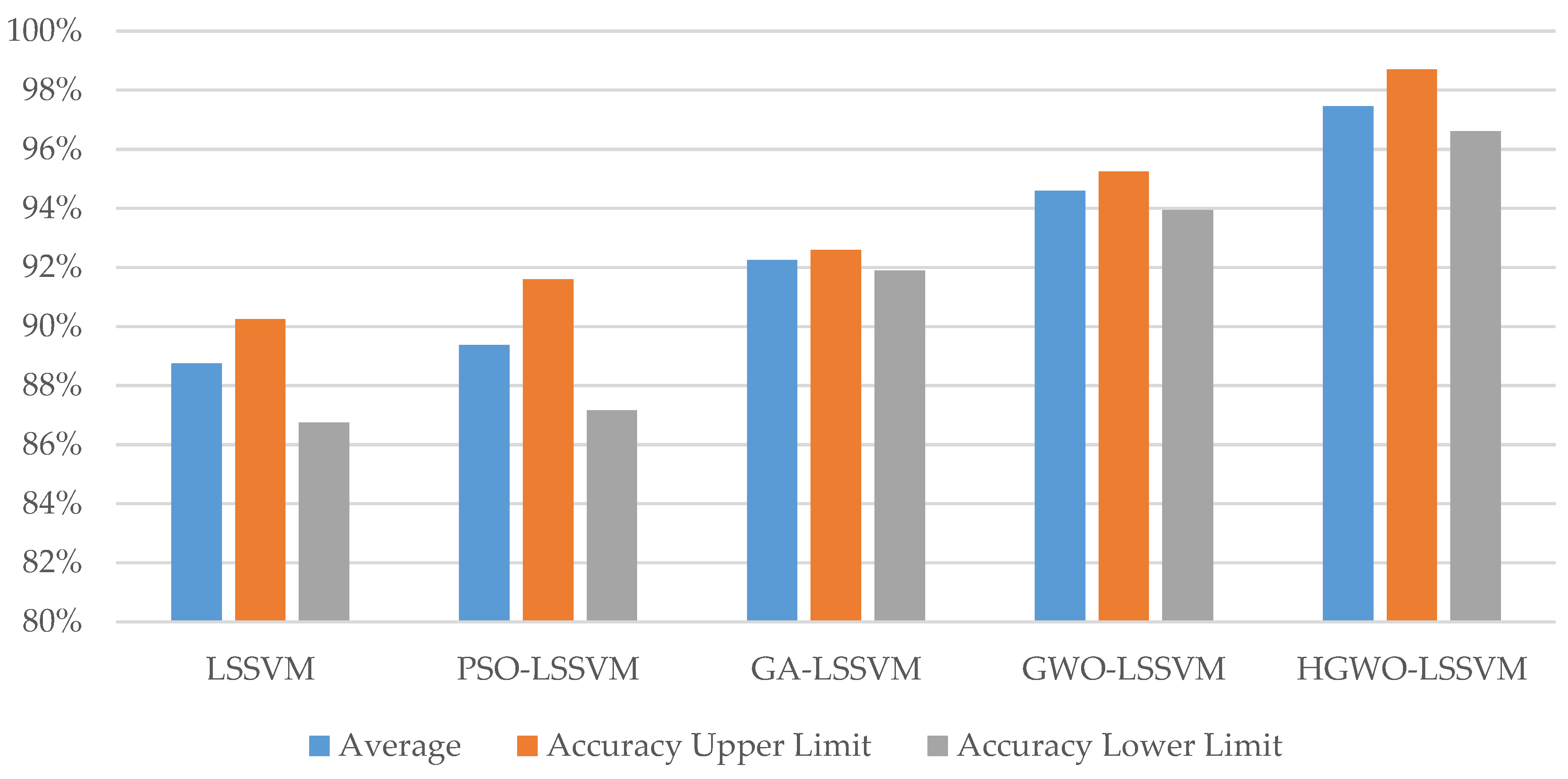
| LSSVM | 88.75 | 90.25 | 86.75 | 3654 |
| PSO-LSSVM | 89.38 | 91.6 | 87.16 | 3562 |
| GA-LSSVM | 92.25 | 92.6 | 91.9 | 4526 |
| GWO-LSSVM | 94.6 | 95.25 | 93.95 | 2615 |
| HGWO-LSSVM | 97.45 | 98.7 | 96.62 | 2135 |
| Model | Classification Accuracy (%) | |
|---|---|---|
| Dissolved Gases Concentration | OHFS | |
| LSSVM | 80.35 | 90.25 |
| PSO-LSSVM | 82.63 | 91.6 |
| GA-LSSVM | 83.55 | 92.6 |
| GWO-LSSVM | 85.28 | 95.25 |
| HGWO-LSSVM | 87.53 | 98.7 |
© 2019 by the authors. Licensee MDPI, Basel, Switzerland. This article is an open access article distributed under the terms and conditions of the Creative Commons Attribution (CC BY) license (http://creativecommons.org/licenses/by/4.0/).
Share and Cite
Zeng, B.; Guo, J.; Zhu, W.; Xiao, Z.; Yuan, F.; Huang, S. A Transformer Fault Diagnosis Model Based On Hybrid Grey Wolf Optimizer and LS-SVM. Energies 2019, 12, 4170. https://doi.org/10.3390/en12214170
Zeng B, Guo J, Zhu W, Xiao Z, Yuan F, Huang S. A Transformer Fault Diagnosis Model Based On Hybrid Grey Wolf Optimizer and LS-SVM. Energies. 2019; 12(21):4170. https://doi.org/10.3390/en12214170
Chicago/Turabian StyleZeng, Bing, Jiang Guo, Wenqiang Zhu, Zhihuai Xiao, Fang Yuan, and Sixu Huang. 2019. "A Transformer Fault Diagnosis Model Based On Hybrid Grey Wolf Optimizer and LS-SVM" Energies 12, no. 21: 4170. https://doi.org/10.3390/en12214170
APA StyleZeng, B., Guo, J., Zhu, W., Xiao, Z., Yuan, F., & Huang, S. (2019). A Transformer Fault Diagnosis Model Based On Hybrid Grey Wolf Optimizer and LS-SVM. Energies, 12(21), 4170. https://doi.org/10.3390/en12214170