

Net Load Carrying Capability of Generating Units in Power Systems


Abstract
1. Introduction
2. Net Load Carrying Capability
2.1. Ramping Capability Shortage Probability (RSP) and Ramping Capability Shortage Expectation (RSE)
2.2. Net Load Carrying Capability (NLCC)
3. Comparison of NLCC with ELCC
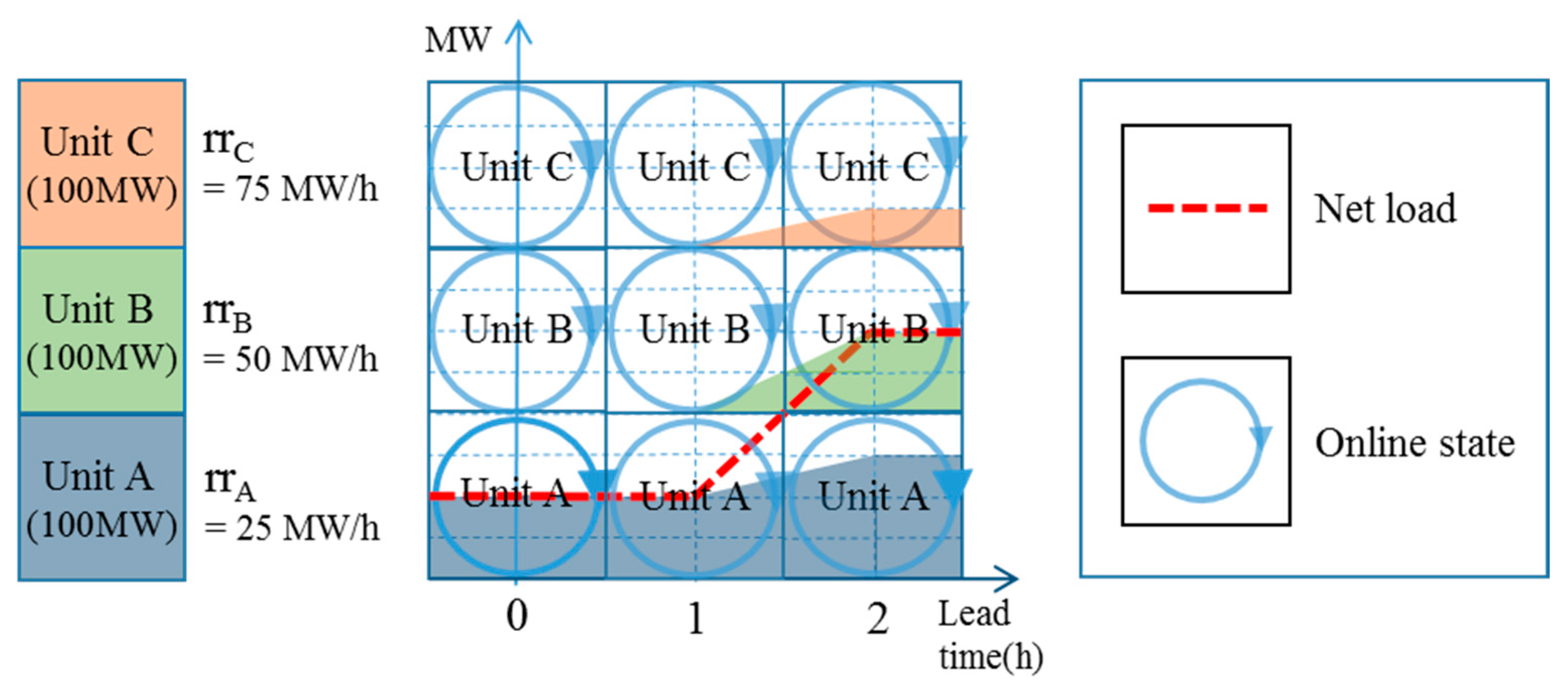
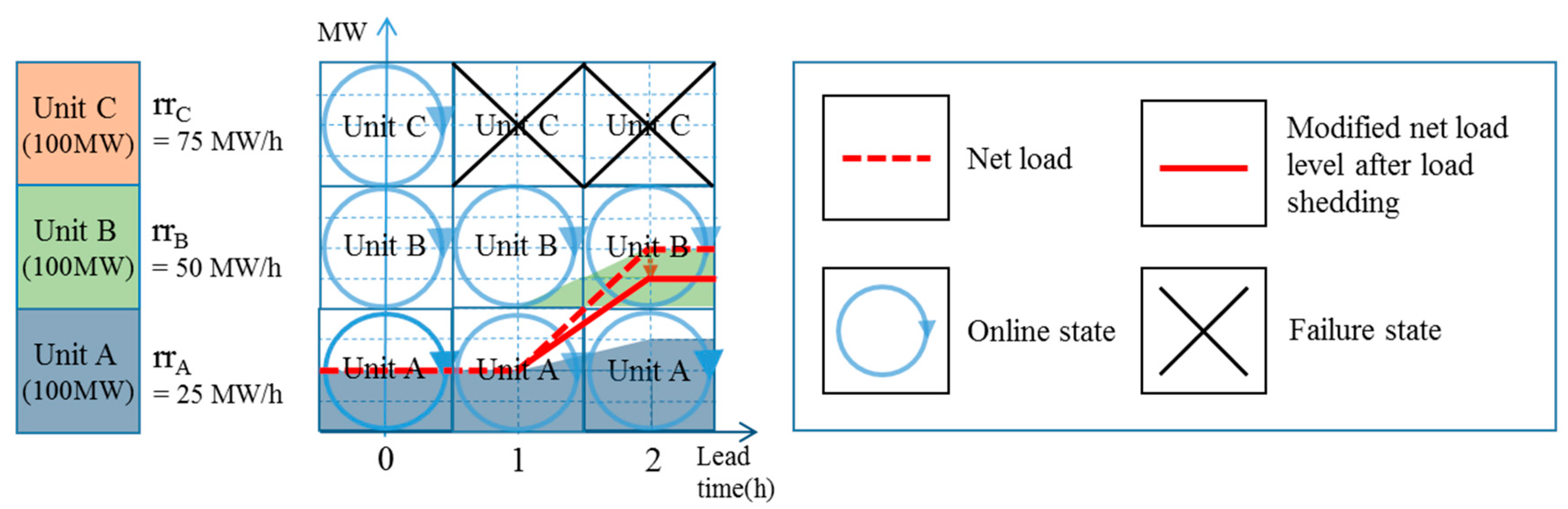
3.1. Description of Illustrative Example
3.2. Comparison of RSE and LOLE
3.3. Calculation Procedure of NLCC
4. Case Study
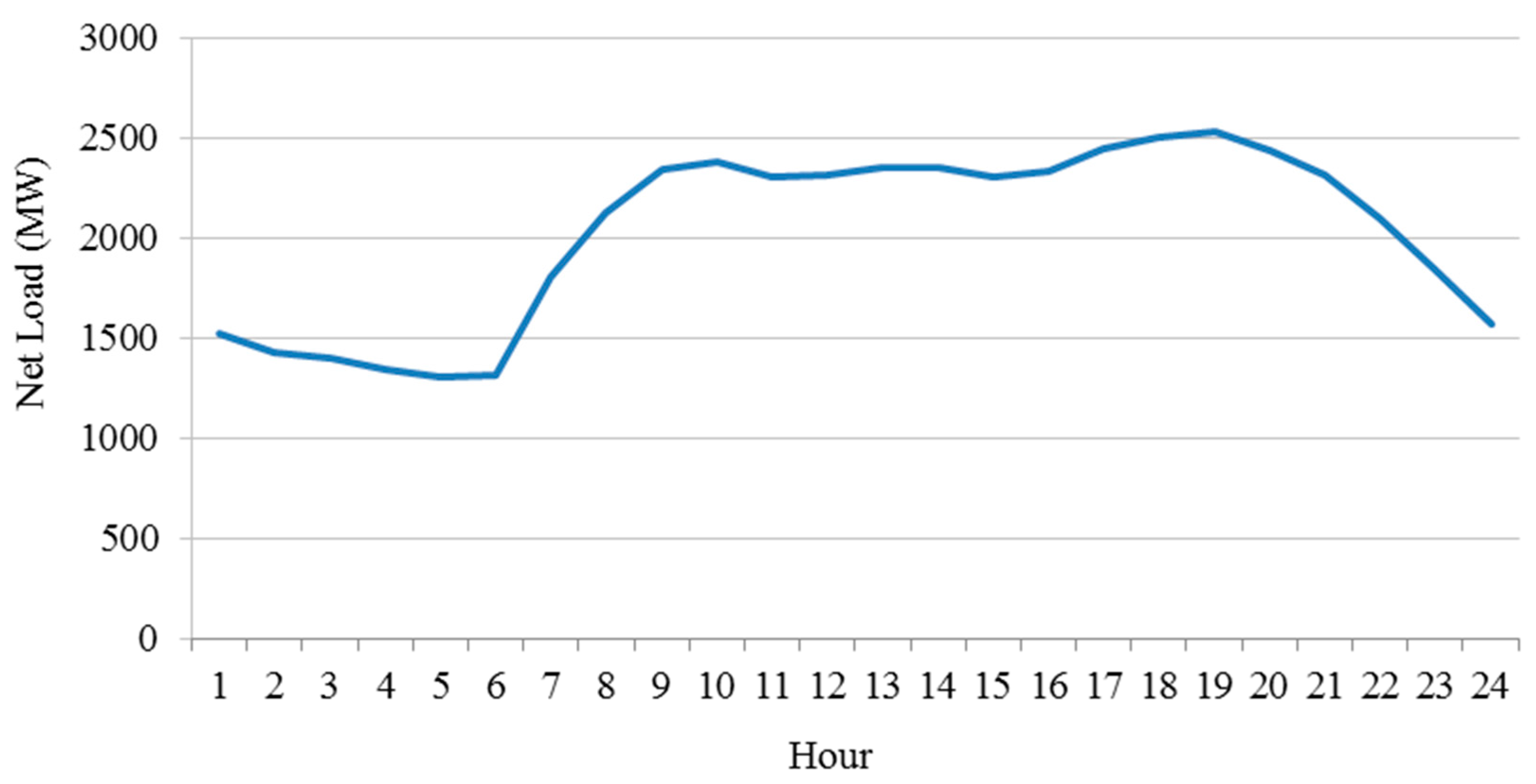
4.1. Basic Information
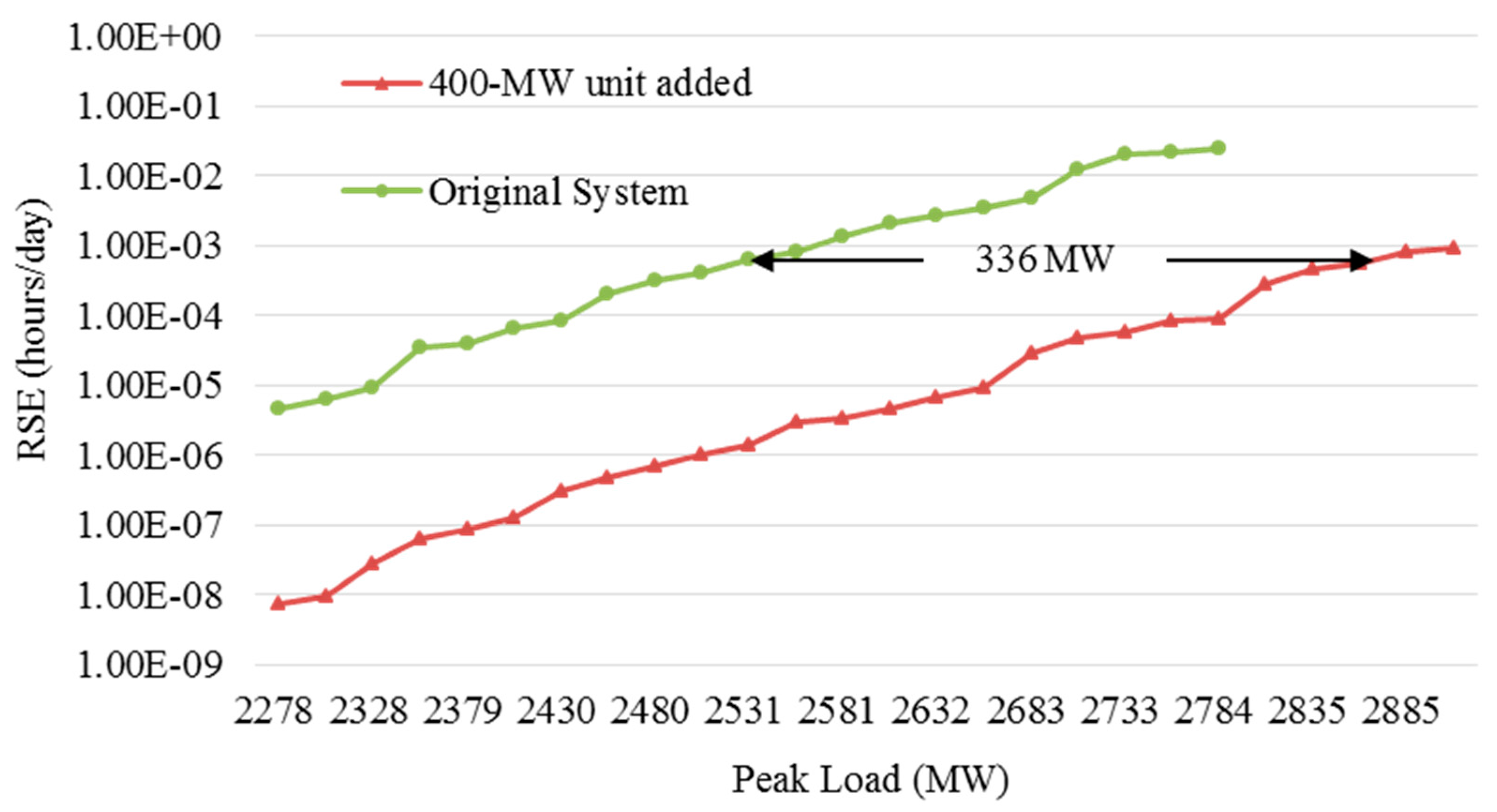
4.2. Scenario 1: Addition of a 400-MW Unit
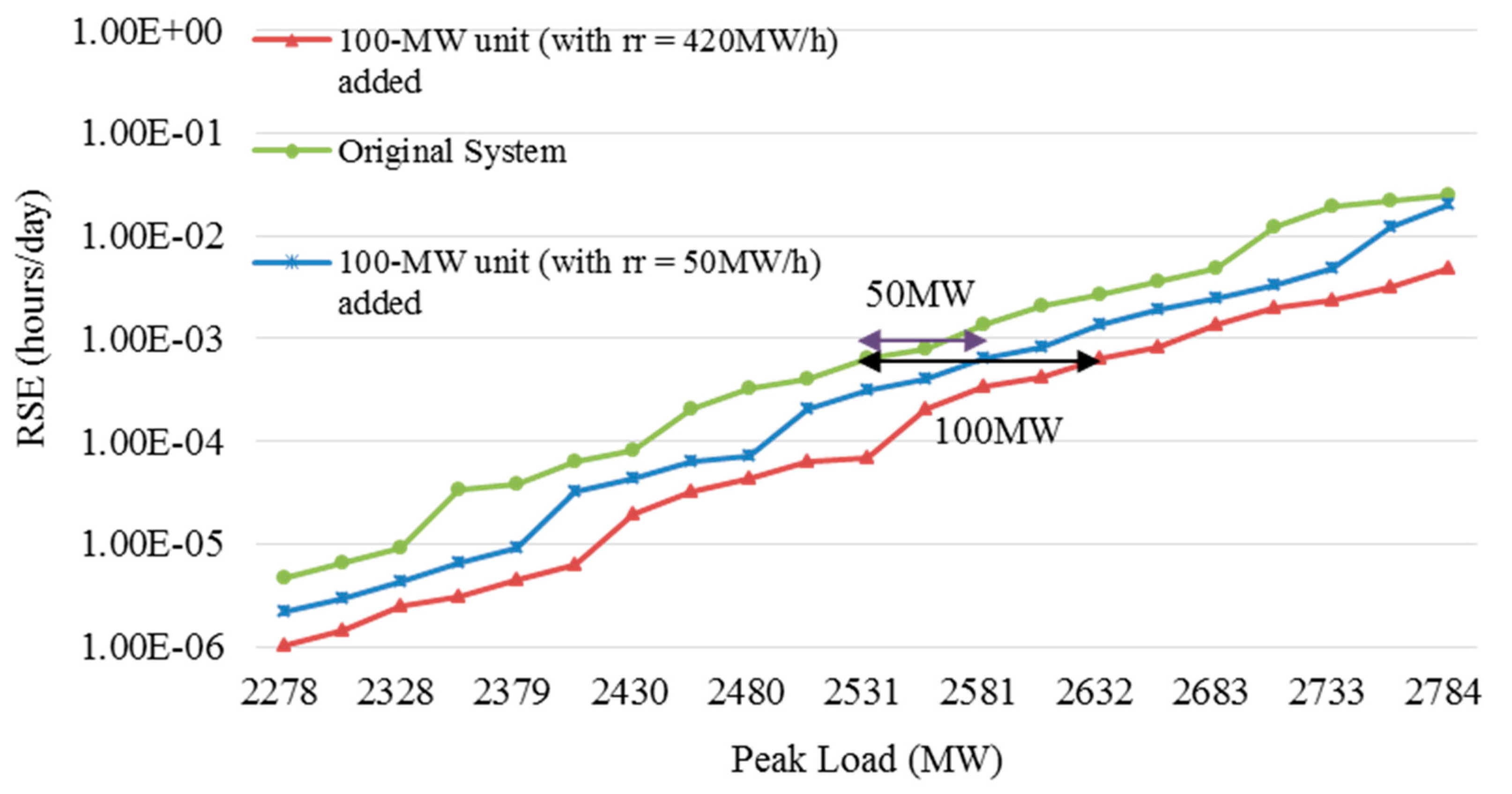
4.3. Scenario 2: Addition of a 100-MW Unit
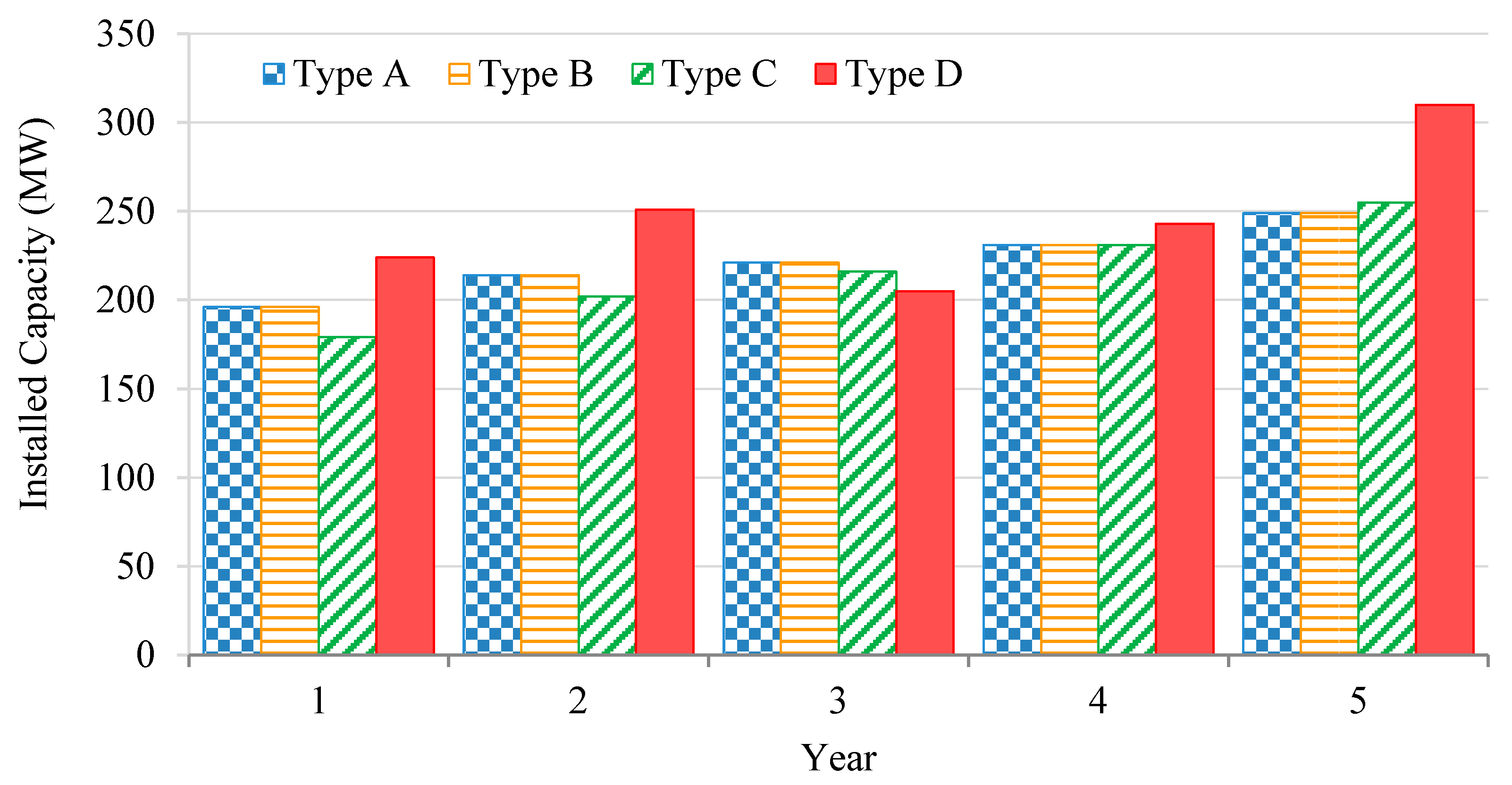
4.4. Scenario 3: Generation Expansion Planning (GEP)
5. Conclusions
Acknowledgments
Author Contributions
Conflicts of Interest
Nomenclature
| Ai,t | Random variable representing availability of unit i at time t (1 if available, 0 otherwise) |
| c | Element of Ct−Δt |
| Ct−Δt | Set of combination of Ai,t−Δt when Oi,t−Δt is non-zero for all i |
| e | Element of Et−Δt |
| Et−Δt | Set of NLFEt |
| FNLt | Forecast net load at time t |
| i | Index of generating unit |
| I | Set of generating unit |
| LOLPt | Loss of load probability at time t |
| NLFEt | Random variable representing net load forecast error at time t |
| Oi,t | Value representing whether unit i is on-line at time t |
| OCs,t | Outage capacity of failure scenario s at time t |
| Pi,t | Generation output of unit i at time t |
| Pmax,i | Maximum generation level of unit i |
| Prob(·) | Probability in the brackets. |
| Probc[·] | Probability of c if condition [∙] is satisfied, 0 otherwise. |
| RCRt | Ramping capability requirement at time t |
| rri | Ramp rate of unit i |
| RSPt | Ramping capability shortage probability at time t |
| s | Index of failure scenario |
| SRCt | System ramping capability at time t |
| t | Index of time |
| Δt | Minimum time interval between operating points |
Appendix A. ELCC Calculation for the Example in Section 3
Appendix A.1. Calculation Procedure of ELCC
Appendix A.2. ELCC for the Example

| # of Failed Unit | Avail. Capacity (MW) | Outage Capacity at 0 h (MW) | Outage Capacity at 1 h (MW) | Outage Capacity at 2 h (MW) | Prob. at 0 h & 2 h | Prob. at 1 h |
|---|---|---|---|---|---|---|
| 0 | 300 | 0 | 0 | 0 | ||
| 1 | 200 | 0 | 0 | 0 | ||
| 2 | 100 | 0 | 0 | 50 | ||
| 3 | 0 | 50 | 50 | 150 |
| Load Variance (%) | Load Level at 0 h/1 h/2 h (MW) | LOLP0 | LOLP1 | LOLP2 | LOLE (=LOLP0 + LOLP1 + LOLP2) (h/period) |
|---|---|---|---|---|---|
| 0 | 50/50/150 | ||||
| 5 | 52.5/52.5/157.5 | ||||
| 10 | 55/55/165 | ||||
| 15 | 57.5/57.5/172.5 | ||||
| 20 | 60/60/180 | ||||
| 25 | 62.5/62.5/187.5 | ||||
| 30 | 65/65/195 | ||||
| 35 | 67.5/67.5/202.5 | ||||
| 40 | 70/70/210 | ||||
| 45 | 72.5/72.5/217.5 | ||||
| 50 | 75/75/225 |
| # of Failed Unit | Available Capacity (MW) | Outage Capacity at 0 h (MW) | Outage Capacity at 1 h (MW) | Outage Capacity at 2 h (MW) | Prob. at 0 h & 2 h | Prob. at 1 h |
|---|---|---|---|---|---|---|
| 0 | 400 | 0 | 0 | 0 | ||
| 1 | 300 | 0 | 0 | 0 | ||
| 2 | 200 | 0 | 0 | 0 | ||
| 3 | 100 | 0 | 25 | 100 | ||
| 4 | 0 | 100 | 125 | 200 |
| Load Variance (%) | Load Level at 0 h/1 h/2 h (MW) | LOLP0 | LOLP1 | LOLP2 | LOLE (=LOLP0 + LOLP1 + LOLP2) (h/period) |
|---|---|---|---|---|---|
| 0 | 50/50/150 | ||||
| 5 | 52.5/52.5/157.5 | ||||
| 10 | 55/55/165 | ||||
| 15 | 57.5/57.5/172.5 | ||||
| 20 | 60/60/180 | ||||
| 25 | 62.5/62.5/187.5 | ||||
| 30 | 65/65/195 | ||||
| 35 | 67.5/67.5/202.5 | ||||
| 40 | 70/70/210 | ||||
| 45 | 72.5/72.5/217.5 | ||||
| 50 | 75/75/225 |
Appendix B. Failure and Repair Rates in Case Study
| Unit # | Failure Rate (occurrences/h) | Repair Rate (occurrences/h) |
|---|---|---|
| 1–5 | 1/2940 | 1/60 |
| 6–9 | 1/450 | 1/50 |
| 10 | 1/1960 | 1/40 |
| 11, 12 | 1/450 | 1/40 |
| 13 | 1/1960 | 1/40 |
| 14–16 | 1/1200 | 1/50 |
| 17–20 | 1/960 | 1/40 |
| 21–23 | 1/950 | 1/50 |
| 24 | 1/1150 | 1/100 |
| 25, 26 | 1/1100 | 1/150 |
References
- Huber, M.; Dimkova, D.; Hamacher, T. Integration of wind and solar power in Europe: Assessment of flexibility requirements. Energy 2014, 69, 236–246. [Google Scholar] [CrossRef] [Scilit]
- Lund, P.D.; Lindgren, J.; Mikkola, J.; Salpakari, J. Review of energy system flexibility measures to enable high levels of variable renewable electricity. Renew. Sustain. Energy Rev. 2015, 45, 785–807. [Google Scholar] [CrossRef] [Scilit]
- Mathiesen, B.V.; Lund, H.; Connolly, D.; Wenzel, H.; Østergaard, P.A.; Möller, B.; Nielsen, S.; Ridjan, I.; Karnøe, P.; Sperling, K. Smart Energy Systems for coherent 100% renewable energy and transport solutions. Appl. Energy 2015, 145, 139–154. [Google Scholar] [CrossRef] [Scilit]
- Spiecker, S.; Weber, C. The future of the European electricity system and the impact of fluctuating renewable energy—A scenario analysis. Energy Policy 2014, 65, 185–197. [Google Scholar] [CrossRef] [Scilit]
- Navid, N.; Rosenwald, G. Ramp Capability Product Design for MISO Markets; MISO: Carmel, IN, USA, 2013. [Google Scholar]
- Zhao, J.; Zheng, T.; Litvinov, E. A unified framework for defining and measuring flexibility in power system. IEEE Trans. Power Syst. 2015, 99, 1–9. [Google Scholar] [CrossRef] [Scilit]
- Deane, J.; Drayton, G.; Gallachóir, B.Ó. The impact of sub-hourly modelling in power systems with significant levels of renewable generation. Appl. Energy 2014, 113, 152–158. [Google Scholar] [CrossRef] [Scilit]
- Kubik, M.; Coker, P.J.; Barlow, J.F. Increasing thermal plant flexibility in a high renewables power system. Appl. Energy 2015, 154, 102–111. [Google Scholar] [CrossRef] [Scilit]
- Moiseeva, E.; Wogrin, S.; Hesamzadeh, M.R. Generation flexibility in ramp rates: Strategic behavior and lessons for electricity market design. Eur. J. Oper. Res. 2017, in press. [Google Scholar] [CrossRef] [Scilit]
- Oree, V.; Hassen, S.Z.S. A composite metric for assessing flexibility available in conventional generators of power systems. Appl. Energy 2016, 177, 683–691. [Google Scholar] [CrossRef] [Scilit]
- Belderbos, A.; Delarue, E. Accounting for flexibility in power system planning with renewables. Int. J. Electr. Power Energy Syst. 2015, 71, 33–41. [Google Scholar] [CrossRef] [Scilit]
- Brouwer, A.S.; van den Broek, M.; Seebregts, A.; Faaij, A. Operational flexibility and economics of power plants in future low-carbon power systems. Appl. Energy 2015, 156, 107–128. [Google Scholar] [CrossRef] [Scilit]
- Koltsaklis, N.E.; Georgiadis, M.C. A multi-period, multi-regional generation expansion planning model incorporating unit commitment constraints. Appl. Energy 2015, 158, 310–331. [Google Scholar] [CrossRef] [Scilit]
- Pereira, S.; Ferreira, P.; Vaz, A. Generation expansion planning with high share of renewables of variable output. Appl. Energy 2017, 190, 1275–1288. [Google Scholar] [CrossRef] [Scilit]
- Koltsaklis, N.E.; Liu, P.; Georgiadis, M.C. An integrated stochastic multi-regional long-term energy planning model incorporating autonomous power systems and demand response. Energy 2015, 82, 865–888. [Google Scholar] [CrossRef] [Scilit]
- Mejía-Giraldo, D.; McCalley, J.D. Maximizing future flexibility in electric generation portfolios. IEEE Trans. Power Syst. 2014, 29, 279–288. [Google Scholar] [CrossRef] [Scilit]
- Santos, M.J.; Ferreira, P.; Araújo, M. A methodology to incorporate risk and uncertainty in electricity power planning. Energy 2016, 115, 1400–1411. [Google Scholar] [CrossRef] [Scilit]
- Krishnan, V.; Das, T.; Ibanez, E.; Lopez, C.A.; McCalley, J.D. Modeling operational effects of wind generation within national long-term infrastructure planning software. IEEE Trans. Power Syst. 2013, 28, 1308–1317. [Google Scholar] [CrossRef] [Scilit]
- Lannoye, E.; Milligan, M.; Adams, J.; Tuohy, A.; Chandler, H.; Flynn, D.; O’Malley, M. Integration of variable generation: Capacity value and evaluation of flexibility. In Proceedings of the 2010 IEEE Power and Energy Society General Meeting, Detroit, MI, USA, 25–29 July 2010; pp. 1–6. [Google Scholar]
- Min, C.G.; Park, J.K.; Hur, D.; Kim, M.K. A risk evaluation method for ramping capability shortage in power systems. Energy 2016, 113, 1316–1324. [Google Scholar] [CrossRef] [Scilit]
- Garver, L.L. Effective load carrying capability of generating units. IEEE Trans. Power App. Syst. 1966, PAS-85, 910–919. [Google Scholar] [CrossRef] [Scilit]
- Abdullah, M.A.; Muttaqi, K.M.; Agalgaonkar, A.P.; Sutanto, D. A noniterative method to estimate load carrying capability of generating units in a renewable energy rich power grid. IEEE Trans. Sustain. Energy 2014, 5, 854–865. [Google Scholar] [CrossRef] [Scilit]
- Tan, Y.; Meegahapola, L.; Muttaqi, K.M. A review of technical challenges in planning and operation of remote area power supply systems. Renew. Sustain. Energy Rev. 2014, 38, 876–889. [Google Scholar] [CrossRef] [Scilit]
- Milligan, M.; Frew, B.; Zhou, E.; Arent, D.J. Advancing System Flexibility for High Penetration Renewable Integration; NREL: Golden, CO, USA, 2015.
- Milligan, M.; Porter, K. The capacity value of wind in the United States: Methods and implementation. Electr. J. 2006, 19, 91–99. [Google Scholar] [CrossRef] [Scilit]
- Wangdee, W.; Billinton, R. Considering load-carrying capability and wind speed correlation of WECS in generation adequacy assessment. IEEE Trans. Energy Convers. 2006, 21, 734–741. [Google Scholar] [CrossRef] [Scilit]
- Finon, D.; Pignon, V. Electricity and long-term capacity adequacy: The quest for regulatory mechanism compatible with electricity market. Util. Policy 2008, 16, 143–158. [Google Scholar] [CrossRef] [Scilit]
- Billinton, R.; Karki, R.; Gao, Y.; Huang, D.; Hu, P.; Wangdee, W. Adequacy assessment considerations in wind integrated power systems. IEEE Trans. Power Syst. 2012, 27, 2297–2305. [Google Scholar] [CrossRef] [Scilit]
- Chen, Z.; Wu, L.; Shahidehpour, M. Effective load carrying capability evaluation of renewable energy via stochastic long-term hourly based SCUC. IEEE Trans. Sustain. Energy 2015, 6, 188–197. [Google Scholar] [CrossRef] [Scilit]
- Min, C.G.; Kim, M.K. Flexibility-Based Evaluation of Variable Generation Acceptability in Korean Power System. Energies 2017, 10, 825. [Google Scholar]
- Billinton, R.; Allan, R. Reliability Evaluation of Power Systems, 2nd ed.; Springer Science & Business Media: New York, NY, USA, 2013. [Google Scholar]
- Keane, A.; Milligan, M.; Dent, C.J.; Hasche, B.; D’Annunzio, C.; Dragoon, K.; Holttinen, H.; Samaan, N.; Soder, L.; O’Malley, M. Capacity value of wind power. IEEE Trans. Power Syst. 2011, 26, 564–572. [Google Scholar] [CrossRef] [Scilit]
- Wood, A.J.; Wollenberg, B.F. Power Generation, Operation, and Control, 3rd ed.; John Wiley & Sons: Hoboken, NJ, USA, 2012. [Google Scholar]
| Failure Cases | Load Shedding or not at 1 h/2 h | Prob. at 0 h | Prob. at 1 h |
|---|---|---|---|
| - | N/N | ||
| A | N/Y | ||
| B | N/Y | ||
| C | N/N | ||
| A&B | N/Y | ||
| A&C | N/Y | ||
| B&C | N/Y | ||
| A&B&C | Y/Y | ||
| - | RSP1: | RSP2: | |
| Load Variance (%) | RSP1 | RSP2 | RSE (=RSP1 + RSP2) (h/period) |
|---|---|---|---|
| 0 | |||
| 5 | |||
| 10 | |||
| 15 | |||
| 20 | |||
| 25 | |||
| 30 | |||
| 35 | |||
| 40 | |||
| 45 | |||
| 50 |
| Load Variance (%) | RSP1 | RSP2 | RSE (=RSP1 + RSP2) (h/period) |
|---|---|---|---|
| 0 | |||
| 5 | |||
| 10 | |||
| 15 | |||
| 20 | |||
| 25 | |||
| 30 | |||
| 35 | |||
| 40 | |||
| 45 | |||
| 50 |
| Year | Peak Load (MW) | Load Growth (MW) |
|---|---|---|
| 0 | 2531 | - |
| 1 | 2708.025 | 177 |
| 2 | 2897.587 | 190 |
| 3 | 3100.418 | 203 |
| 4 | 3317.447 | 217 |
| 5 | 3549.668 | 232 |
| Unit Type | Rating (MW) | Priority in Merit Order | Ramp Rate (% of rating/h) |
|---|---|---|---|
| A | 0–400 | High | 100 |
| B | 0–400 | High | 80 |
| C | 0–400 | Low | 100 |
| D | 0–400 | Low | 80 |
| Unit Type | A | B | C | D |
|---|---|---|---|---|
| Total installed capacity (MW) | 1111 | 1111 | 1083 | 1233 |
© 2017 by the authors. Licensee MDPI, Basel, Switzerland. This article is an open access article distributed under the terms and conditions of the Creative Commons Attribution (CC BY) license (http://creativecommons.org/licenses/by/4.0/).
Share and Cite
Min, C.-G.; Kim, M.-K. Net Load Carrying Capability of Generating Units in Power Systems. Energies 2017, 10, 1221. https://doi.org/10.3390/en10081221
Min C-G, Kim M-K. Net Load Carrying Capability of Generating Units in Power Systems. Energies. 2017; 10(8):1221. https://doi.org/10.3390/en10081221
Chicago/Turabian StyleMin, Chang-Gi, and Mun-Kyeom Kim. 2017. "Net Load Carrying Capability of Generating Units in Power Systems" Energies 10, no. 8: 1221. https://doi.org/10.3390/en10081221
APA StyleMin, C.-G., & Kim, M.-K. (2017). Net Load Carrying Capability of Generating Units in Power Systems. Energies, 10(8), 1221. https://doi.org/10.3390/en10081221

