
Article

Aging Reduces the Efficiency of Parafoveal Lexical Activation During Chinese Sentence Reading
1
Department of Education and Psychology, Hong Kong Baptist University, Hong Kong, China
2
Department of Psychology, University of Macau, Macau, China
3
Center for Cognitive and Brain Sciences, University of Macau, Macau, China
4
Department of Psychology, The Education University of Hong Kong, Hong Kong, China
*
Author to whom correspondence should be addressed.
These authors contributed equally to this work.
J. Eye Mov. Res. 2026, 19(2), 35; https://doi.org/10.3390/jemr19020035
Submission received: 29 December 2025 / Revised: 27 February 2026 / Accepted: 19 March 2026 / Published: 1 April 2026

Abstract

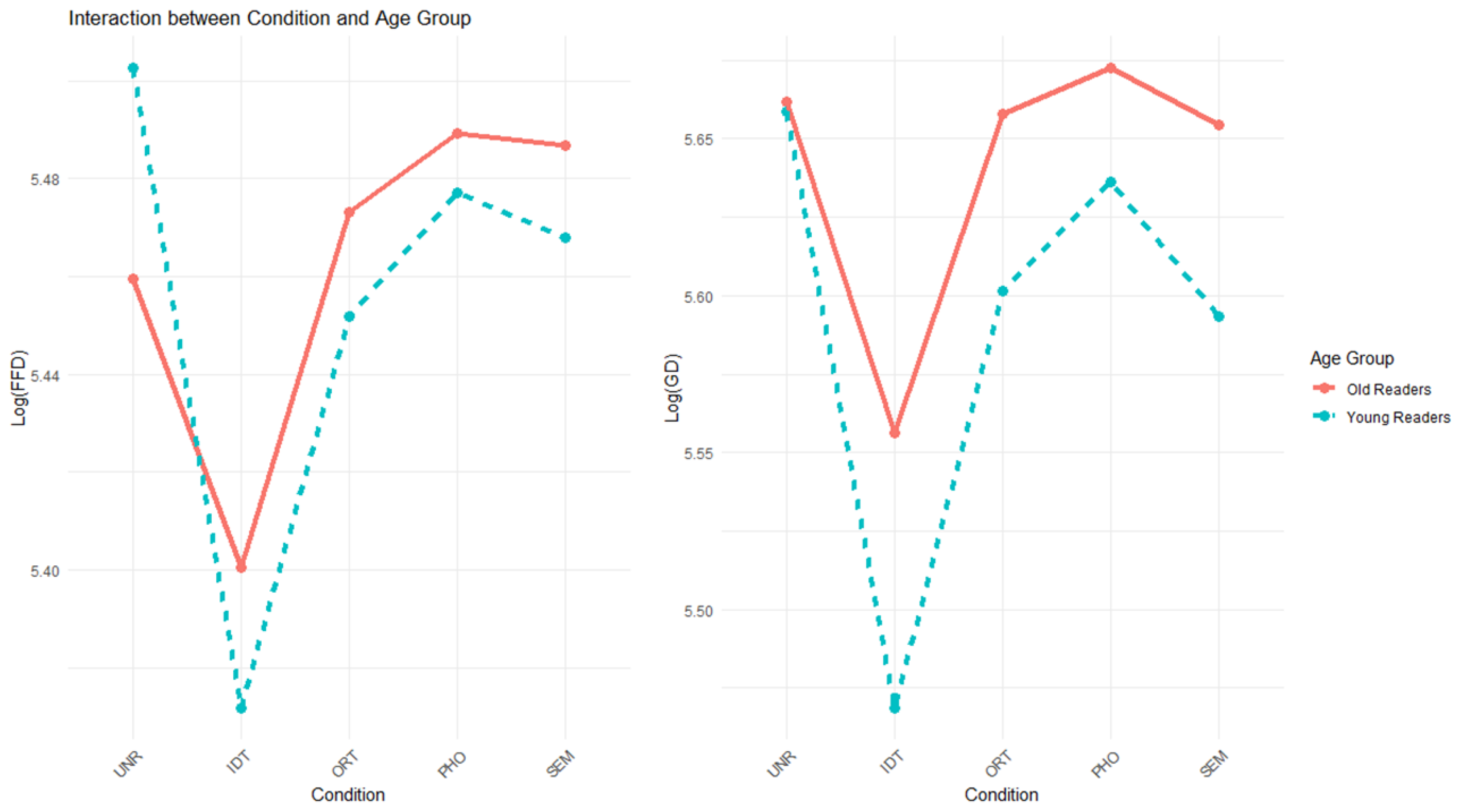
This study utilized the gaze-contingent boundary paradigm to examine age-related changes in parafoveal processing during Chinese sentence reading. A community sample of 65 older readers and 68 younger readers from Hong Kong read 130 sentences while their eye movements were recorded. In each sentence, an invisible boundary was placed just before a critical target word. Before the readers’ eye gaze crossed the boundary, a parafoveal preview was presented in the position of the target word. The preview could be identical, orthographically related, phonologically related, semantically related, or unrelated to the first character of the target word. Once the eye gaze passed the boundary, the preview characters changed to the target. For the younger readers, the related parafoveal previews facilitated the subsequent foveal processing of the target compared to the unrelated previews across early and late eye movement measures. In contrast, the older readers demonstrated a reduced identical preview benefit in early eye movement measures. They also showed benefits in other preview conditions only in later measures. These results suggest that older Chinese readers can extract linguistic information from parafoveal vision despite reduced visual acuity. However, the efficiency of parafoveal processing is reduced, potentially due to slower processing speed and less efficient spreading activation within the lexical network.
Keywords: cognitive aging; parafoveal processing; preview benefits; eye movement; Chinese reading cognitive aging; parafoveal processing; preview benefits; eye movement; Chinese reading