
Eye Movement Analysis: A Kernel Density Estimation Approach for Saccade Direction and Amplitude




Highlights
- Von Mises KDE models saccade directions correctly as circular data.
- Mixed 2D KDE integrates direction and amplitude into one coherent density.
- The method reveals subtle patterns that conventional analyses fail to detect.
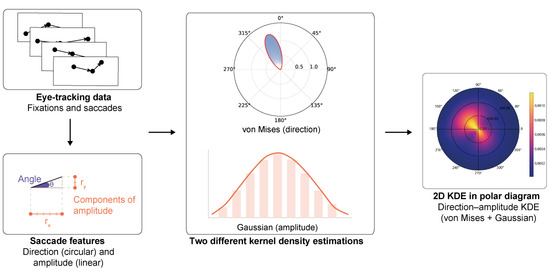
Abstract
1. Introduction
2. Theory
2.1. Saccades: A Window into Cognitive Processing During Learning
2.2. Existing Methods for Saccade Analysis and Visualization
2.2.1. Polar Diagrams
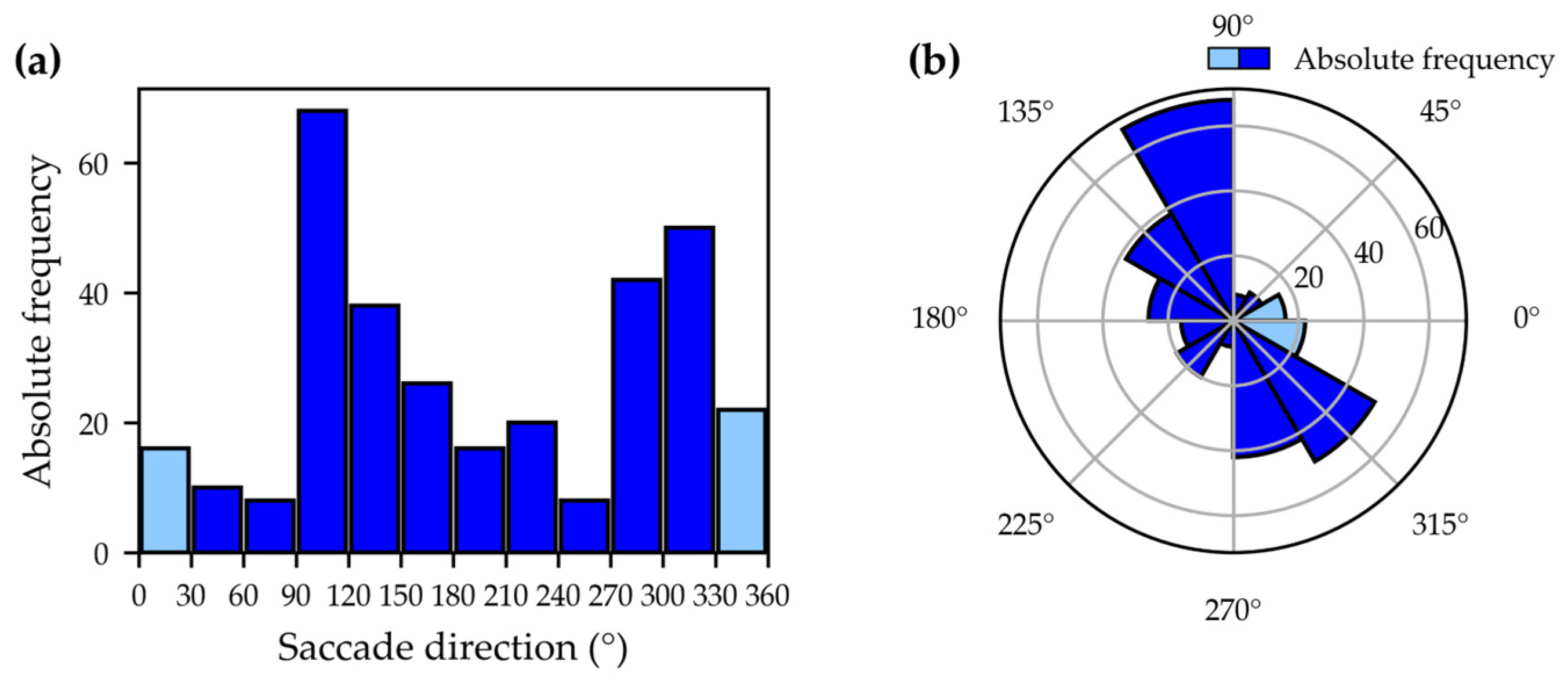
2.2.2. Absolute Frequency
2.2.3. Relative Frequency
2.2.4. Probability Distribution
3. Goals of a New Analytical Approach
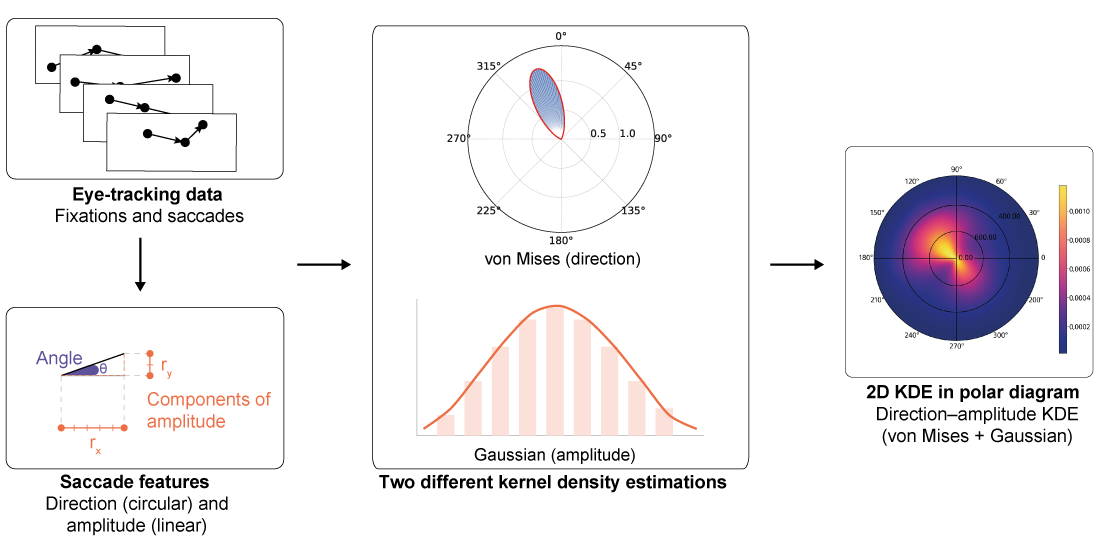
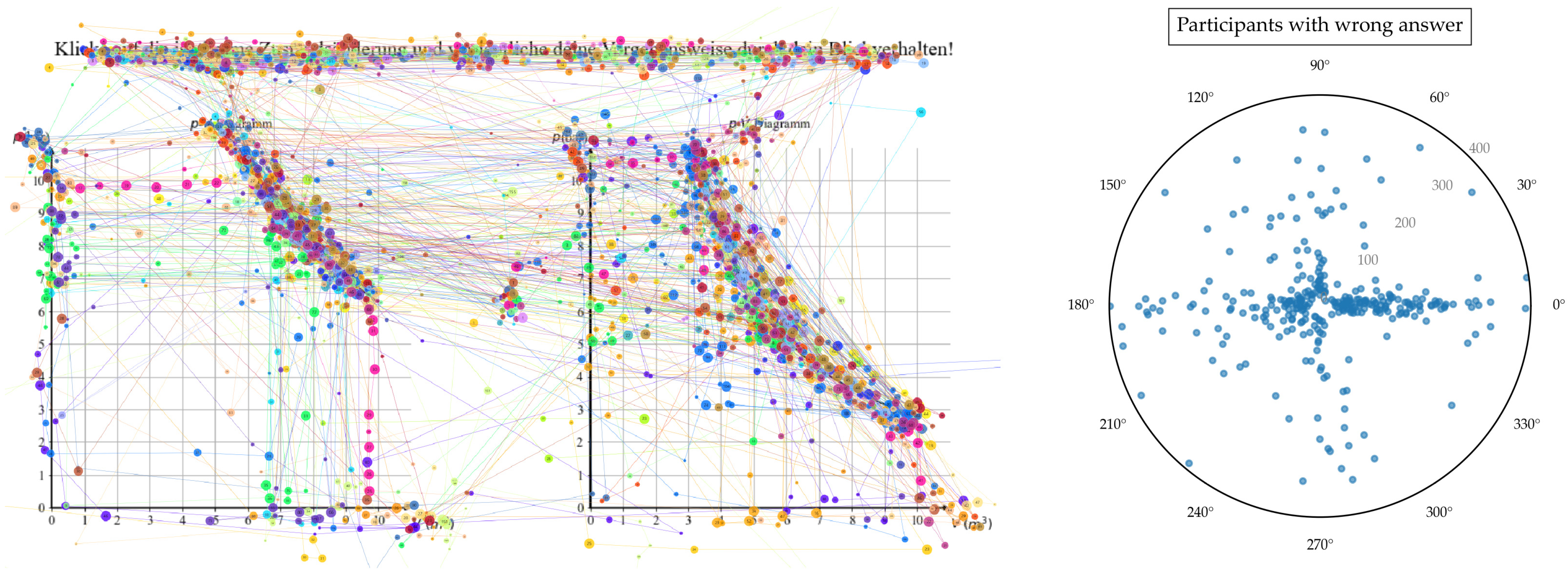
- Our first goal is to precisely visualize the saccade directions by a continuous representation using a suitable probability density in a polar diagram. This approach enables a fine-grained analysis of directional distributions and provides deeper insights into the dynamics of saccade behavior, thereby improving the interpretation of visual perception.
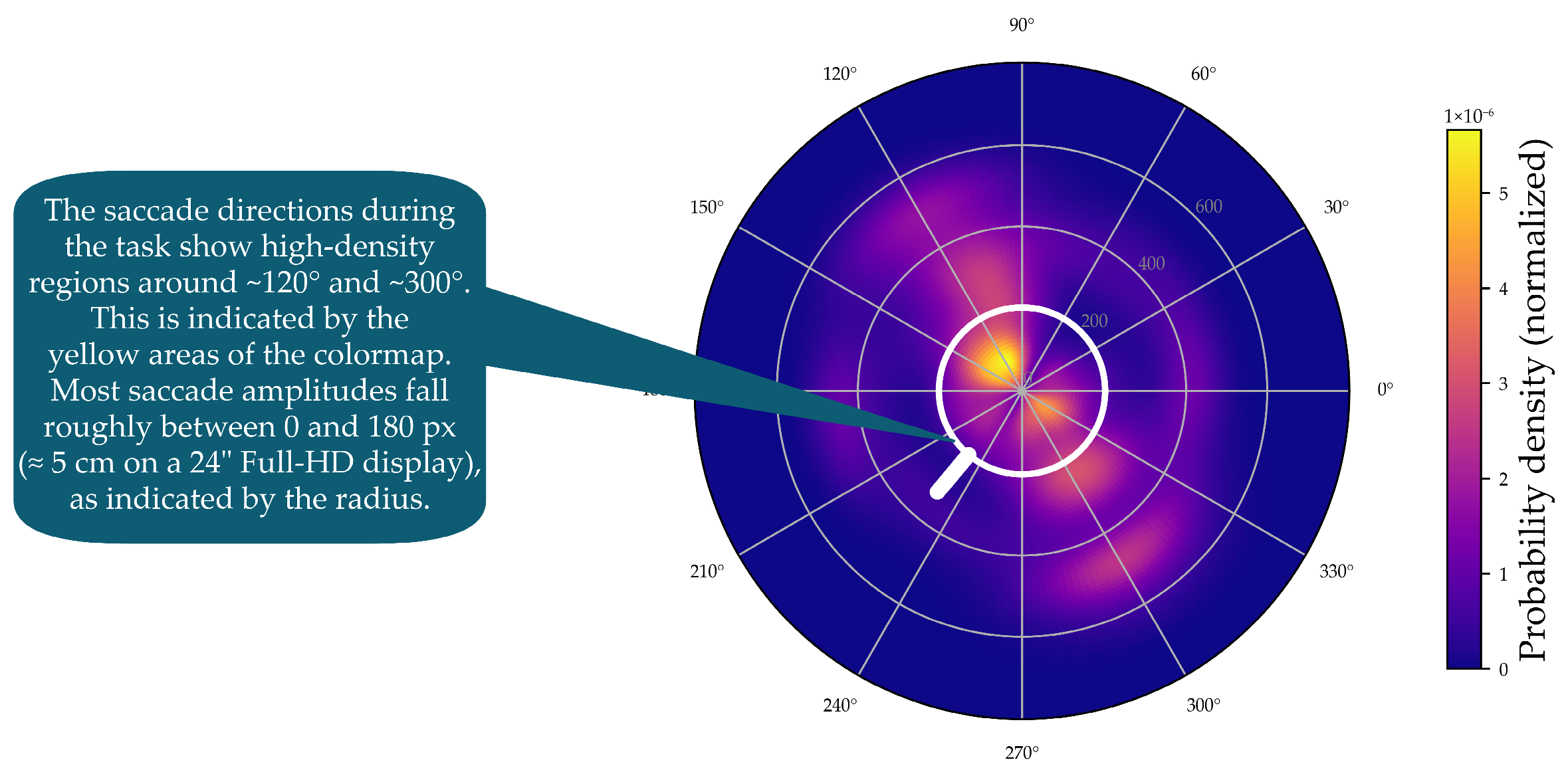
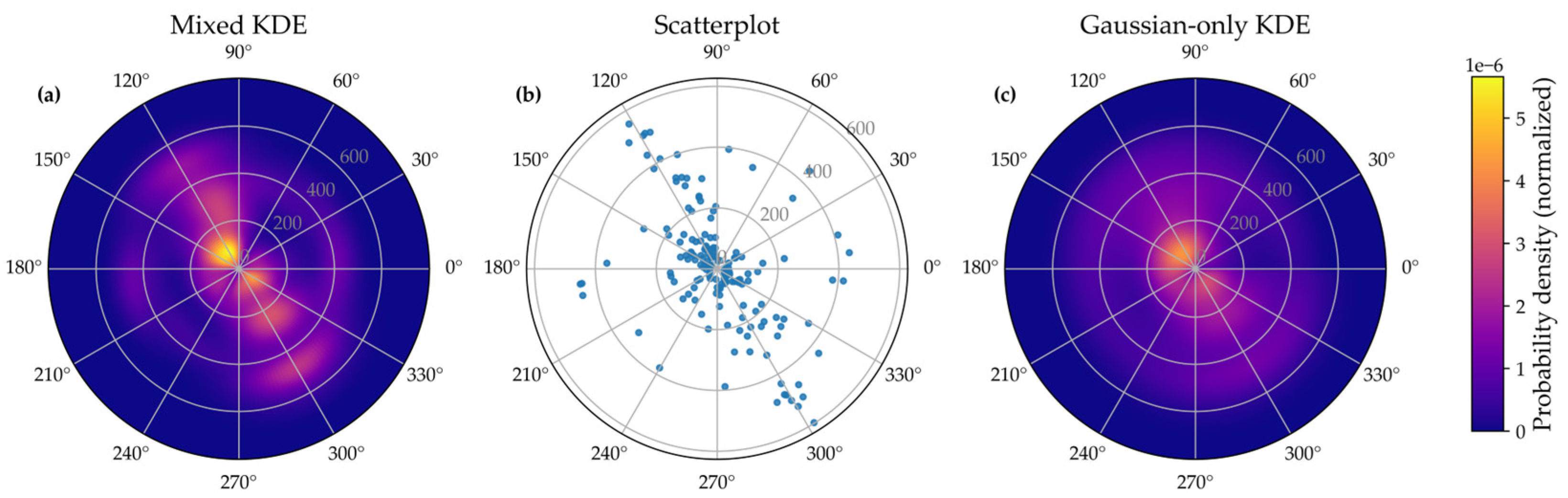
- Our second goal is to account not only for saccade directions but also for their amplitudes. For this purpose, we apply probability density estimation to both metrics simultaneously, allowing for a comprehensive analysis. By representing both probability densities in one polar diagram, we enable the simultaneous examination of direction and amplitude and thereby promote a holistic analysis of eye movements.
4. Saccade Analysis
4.1. Kernel Density Estimation for Analyzing the Distribution of Saccade Direction (Goal 1)
4.2. Kernel Density Estimation for Analyzing the Distribution of Saccade Direction and Saccade Amplitude (Goal 2)
4.3. Saccades and Cognitive Processing
5. Application Example: Selection Processes in Task Settings
5.1. Data Collection and Preprocessing
5.2. Grouping
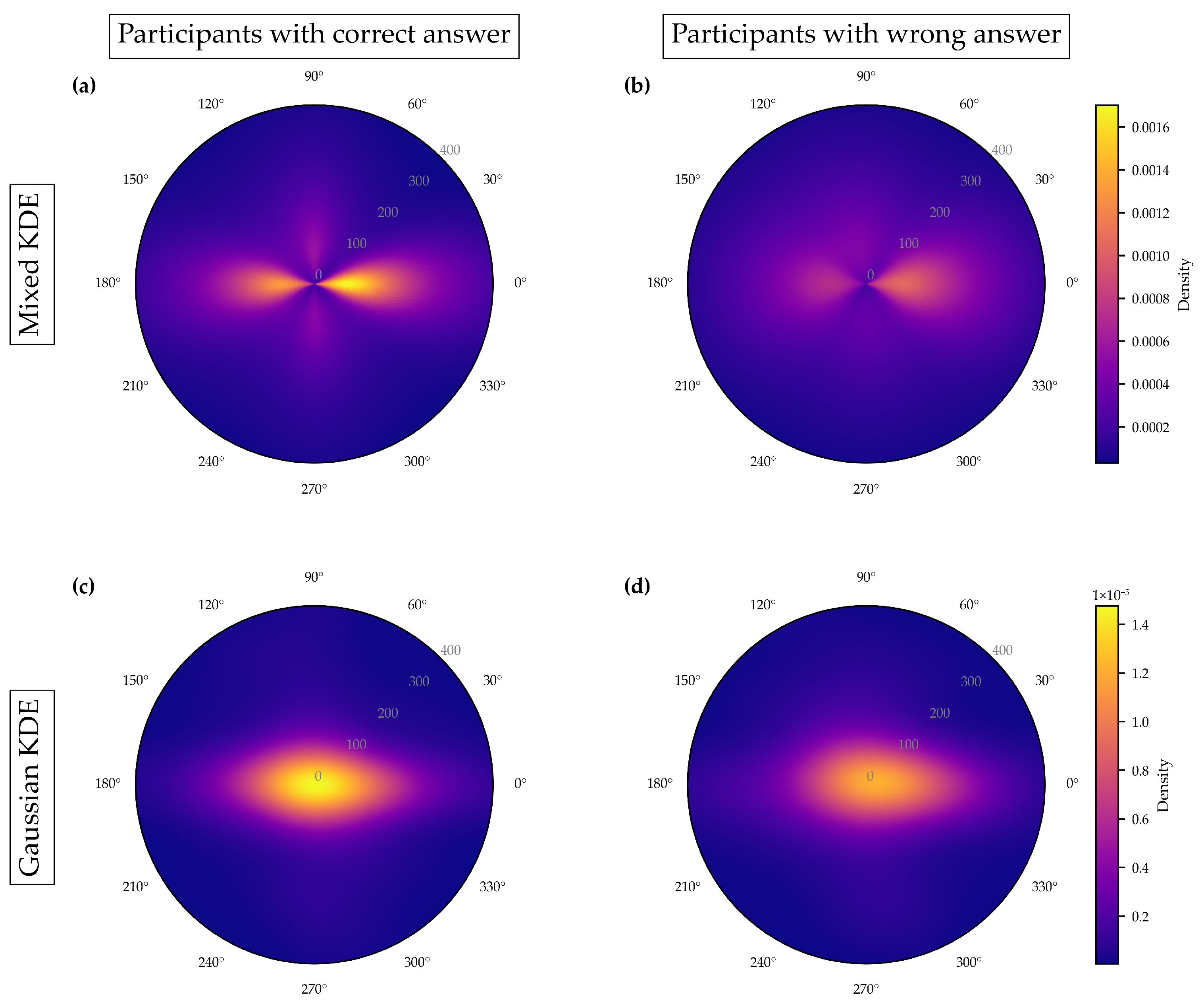
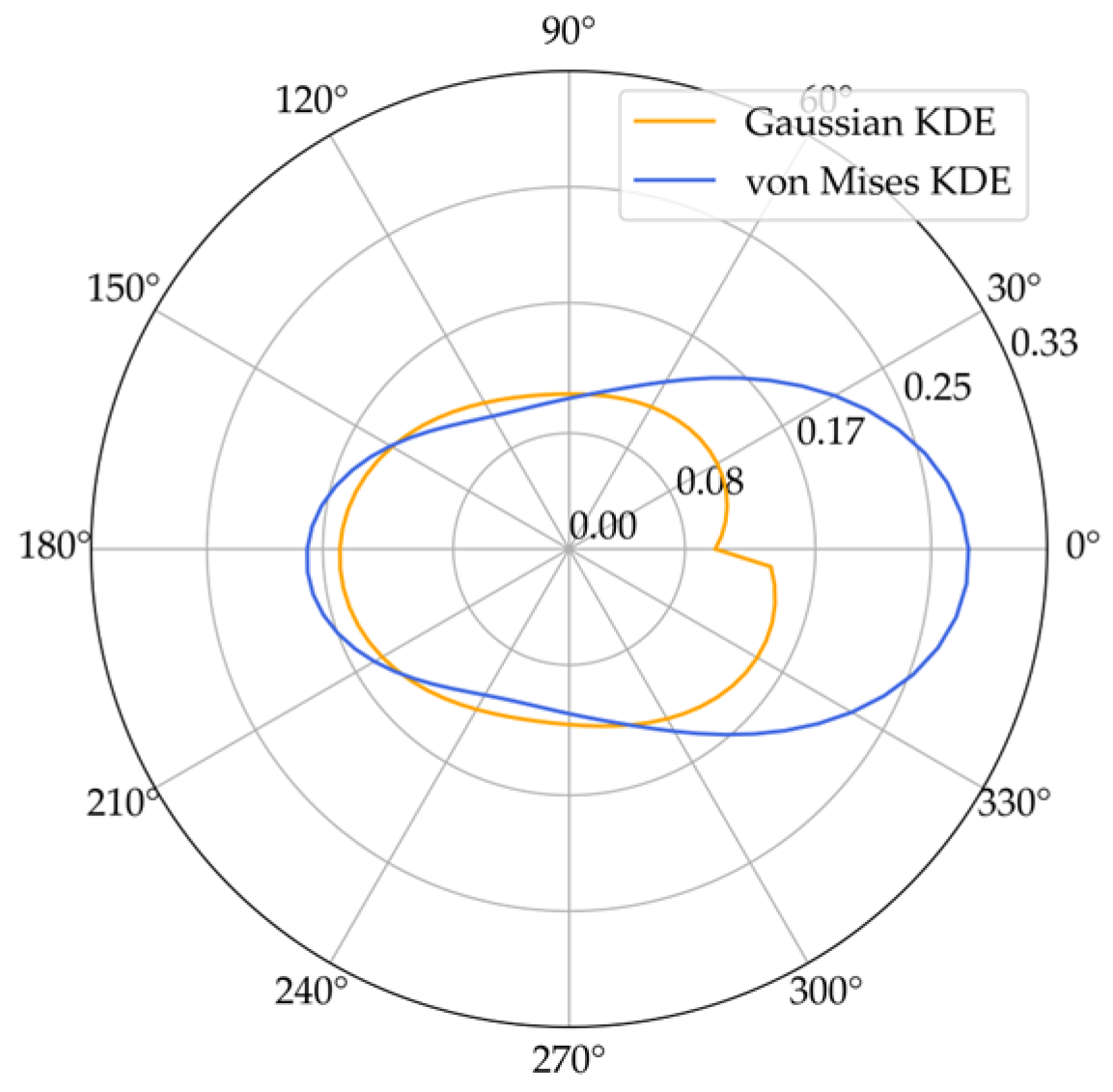
5.3. Comparison of the Application of 2D Mixed KDE and Gaussian-Only KDE to Real Data
6. Summary
7. Discussion and Outlook
Supplementary Materials
Author Contributions
Funding
Institutional Review Board Statement
Informed Consent Statement
Data Availability Statement
Acknowledgments
Conflicts of Interest
References
- Pouget, P. Introduction to the study of eye movements. In Eye Movement Research; Klein, C., Ettinger, U., Eds.; Springer: Cham, Switzerland, 2019; pp. 3–10. [Google Scholar]
- Klaib, A.F.; Alsrehin, N.O.; Melhem, W.Y.; Bashtawi, H.O.; Magableh, A.A. Eye tracking algorithms, techniques, tools, and applications with an emphasis on machine learning and Internet of Things technologies. Expert Syst. Appl. 2021, 166, 114037. [Google Scholar] [CrossRef] [Scilit]
- Hoyer, C.; Girwidz, R. Animation and interactivity in computer-based physics experiments to support the documentation of measured vector quantities in diagrams: An eye tracking study. Phys. Rev. Phys. Educ. Res. 2020, 16, 020124. [Google Scholar] [CrossRef] [Scilit]
- Hahn, L.; Klein, P. Analysis of eye movements to study drawing in the context of vector fields. Front. Educ. 2023, 8, 1162281. [Google Scholar] [CrossRef] [Scilit]
- König, P.; Wilming, N.; Kietzmann, T.C.; Ossandón, J.P.; Onat, S.; Ehinger, B.V.; Gameiro, R.R.; Kaspar, K. Eye movements as a window to cognitive processes. J. Eye Mov. Res. 2016, 9, 25. [Google Scholar] [CrossRef] [Scilit]
- Hahn, L.; Klein, P. Eye tracking in physics education research: A systematic literature review. Phys. Rev. Phys. Educ. Res. 2022, 18, 013102. [Google Scholar] [CrossRef] [Scilit]
- Le Meur, O.; Liu, Z. Saccadic model of eye movements for free-viewing condition. Vis. Res. 2015, 116, 152–164. [Google Scholar] [CrossRef] [Scilit]
- Port, N.L.; Trimberger, J.; Hitzeman, S.; Redick, B.; Beckerman, S. Micro and regular saccades across the lifespan during a visual search of “Where’s Waldo” puzzles. Vis. Res. 2016, 118, 144–157. [Google Scholar] [CrossRef] [Scilit] [PubMed]
- Samonds, J.M.; Geisler, W.S.; Priebe, N.J. Natural image and receptive field statistics predict saccade sizes. Nat. Neurosci. 2018, 21, 1591–1599. [Google Scholar] [CrossRef] [Scilit] [PubMed]
- Andersson, N.C.; Bischof, W.F.; Kingstone, A. Eye Tracking in Virtual Reality. In Virtual Reality in Behavioral Neuroscience: New Insights and Methods; Maymon, C., Grimshaw, G., Wu, Y.C., Eds.; Springer: Cham, Switzerland, 2023; pp. 73–100. [Google Scholar]
- Fisher, N.I. Statistical Analysis of Circular Data; Cambridge University Press: Cambridge, UK, 1993. [Google Scholar]
- Węglarczyk, S. Kernel density estimation and its application. ITM Web Conf. 2018, 23, 00037. [Google Scholar] [CrossRef] [Scilit]
- McCabe, P.; Korb, O.; Cole, J. Kernel density estimation applied to bond length, bond angle, and torsion angle distributions. J. Chem. Inf. Model. 2014, 54, 1284–1288. [Google Scholar] [CrossRef] [Scilit] [PubMed]
- Gilchrist, I.D. Saccades. In The Oxford Handbook of Eye Movements; Liversedge, S.P., Gilchrist, I.D., Everling, S., Eds.; Oxford University Press: Oxford, UK, 2011; pp. 86–94. [Google Scholar]
- Holmqvist, K.; Nyström, M.; Andersson, R.; Dewhurst, R.; Jarodzka, H.; Van de Weijer, J. Eye Tracking: A Comprehensive Guide to Methods and Measures; Oxford University Press: Oxford, UK, 2011. [Google Scholar]
- Girwidz, R.; Kohnle, A. Multimedia and Digital Media in Physics Instruction. In Physics Education: Challenges in Physics Education, 1st ed.; Fischer, H.E., Girwidz, R., Eds.; Springer: Cham, Switzerland, 2021; pp. 297–336. [Google Scholar]
- Rayner, K. The 35th Sir Frederick Bartlett Lecture: Eye movements and attention in reading, scene perception and visual search. Q. J. Exp. Psychol. 2009, 62, 1457–1506. [Google Scholar] [CrossRef] [Scilit]
- Krieber, M.; Bartl-Pokorny, K.D.; Pokorny, F.B.; Einspieler, C.; Langmann, A.; Körner, C.; Falck-Ytter, T.; Marschik, P.B. The relation between reading skills and eye movement patterns in adolescent readers: Evidence from a regular orthography. PLoS ONE 2016, 11, e0145934. [Google Scholar] [CrossRef] [Scilit] [PubMed]
- Tatler, B.W.; Baddeley, R.J.; Vincent, B.T. The long and the short of it: Spatial statistics at fixation vary with saccade amplitude and task. Vis. Res. 2006, 46, 1857–1862. [Google Scholar] [CrossRef] [Scilit]
- Cremers, J.; Klugkist, I. One direction? A tutorial for circular data analysis using R with examples in cognitive psychology. Front. Psychol. 2018, 9, 396689. [Google Scholar] [CrossRef] [Scilit] [PubMed]
- Fehlinger, P.; Becker-Genschow, S.; Watzka, B. Gaze behavior as a key to revealing strategies for identifying indirectly proportional graphs in thermodynamic and mathematical context. Phys. Rev. Phys. Educ. Res. 2025, 21, 020129. [Google Scholar] [CrossRef] [Scilit]
- Silverman, B.W. Density Estimation for Statistics and Data Analysis; Routledge: New York, NY, USA, 2018. [Google Scholar]
- Wasserman, L. All of Nonparametric Statistics; Springer: New York, NY, USA, 2006. [Google Scholar]
- Visual Angle Calculator. Available online: https://www.sr-research.com/visual-angle-calculator/ (accessed on 16 December 2025).
- Unema, P.; Pannasch, S.; Joos, M.; Velichkovsky, B.M. Time course of information processing during scene perception: The relationship between saccade amplitude and fixation duration. Vis. Cogn. 2005, 12, 473–494. [Google Scholar] [CrossRef] [Scilit]
- Zulkipli, N.S.; Satari, S.Z.; Yusoff, W.W. Descriptive analysis of circular data with outliers using Python programming language. Data Anal. Appl. Math. 2020, 1, 31–36. [Google Scholar] [CrossRef] [Scilit]







| Saccade Metric | Visualization | Icon | Cognition | Disadvantages | Advantages |
|---|---|---|---|---|---|
| Absolute frequencies | |||||
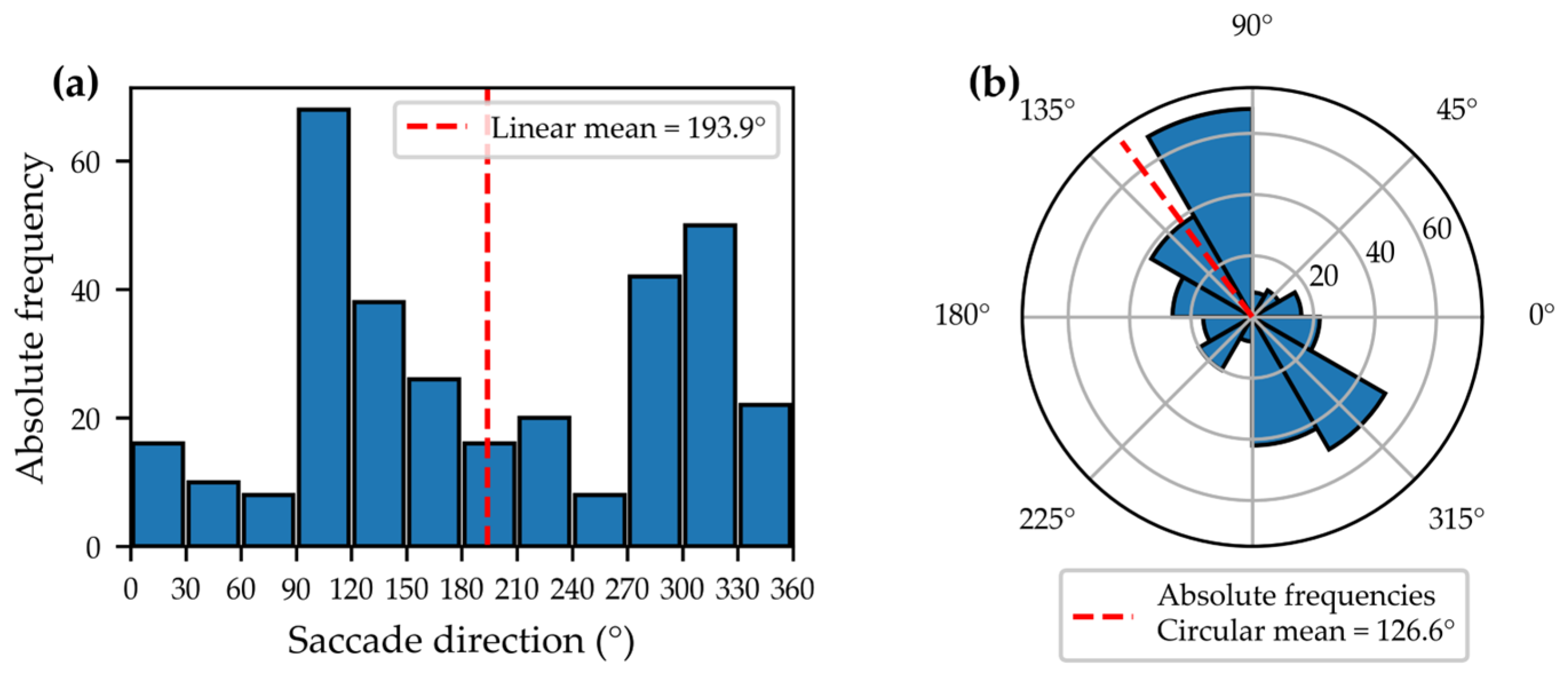
| Saccade direction | Cartesian histogram |  | Reading process | No continuity; interval-based representation; no group comparisons | — |
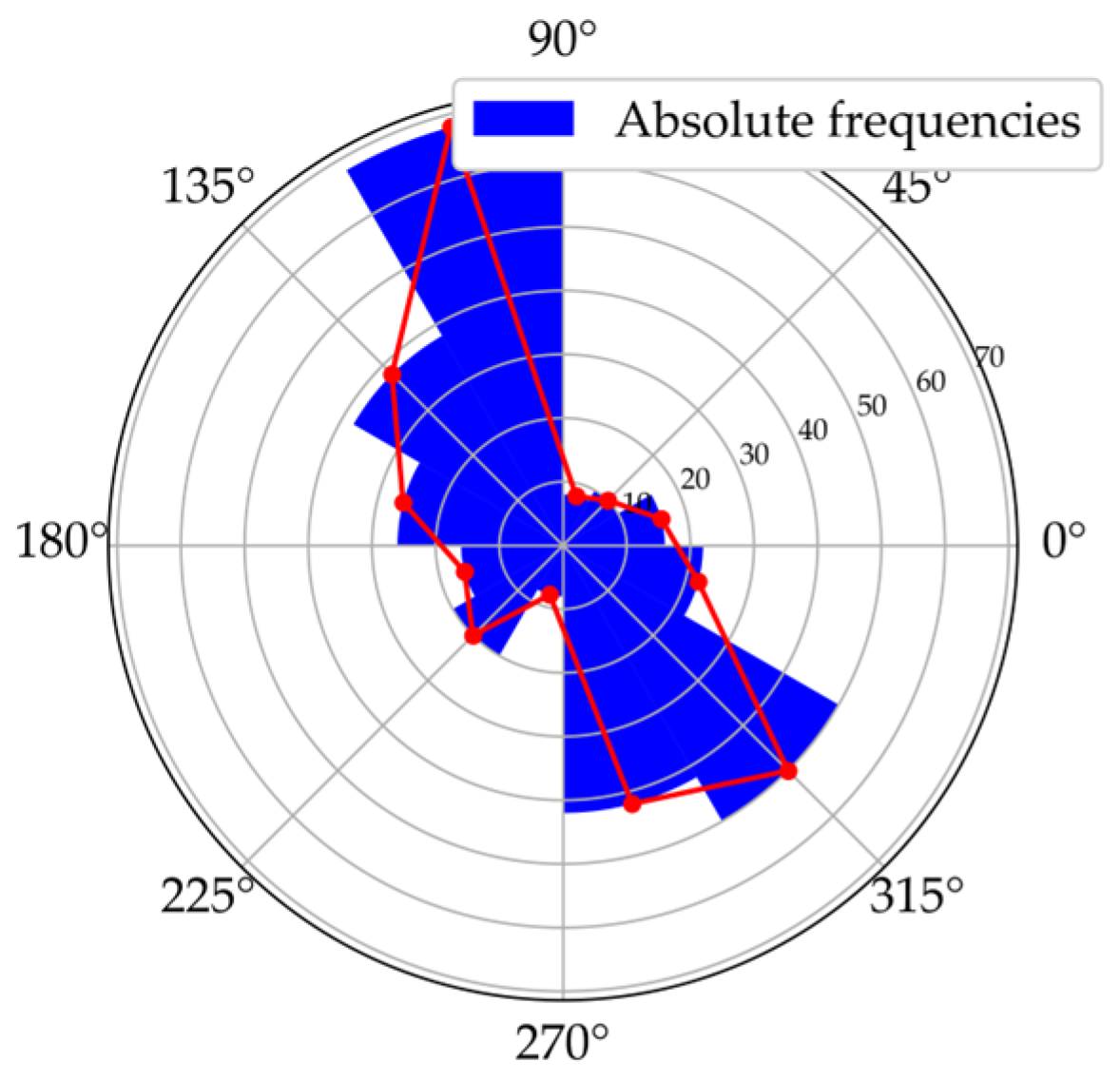
| Saccade direction | Polar histogram |  | Reading process | No group comparisons; interval-based representation | Improved continuity (circular layout); |
| Relative frequencies | |||||
| Saccade direction | Polar histogram | 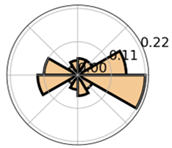 | Reading process | interval-based representation | Improved continuity (circular layout); group comparisons possible |
| Saccade direction | Polar histogram with line graph |  | Reading process | No estimation methods, imprecise directional trends | Improved continuity (circular layout); group comparisons possible; continuous line graph |
| Saccade direction and amplitude | Polar histogram and Cartesian histogram | 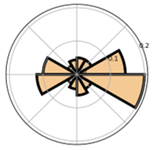  | Reading and organizational processes | Separate metrics, loss of integrated information | — |
| Gaussian-only KDE | |||||
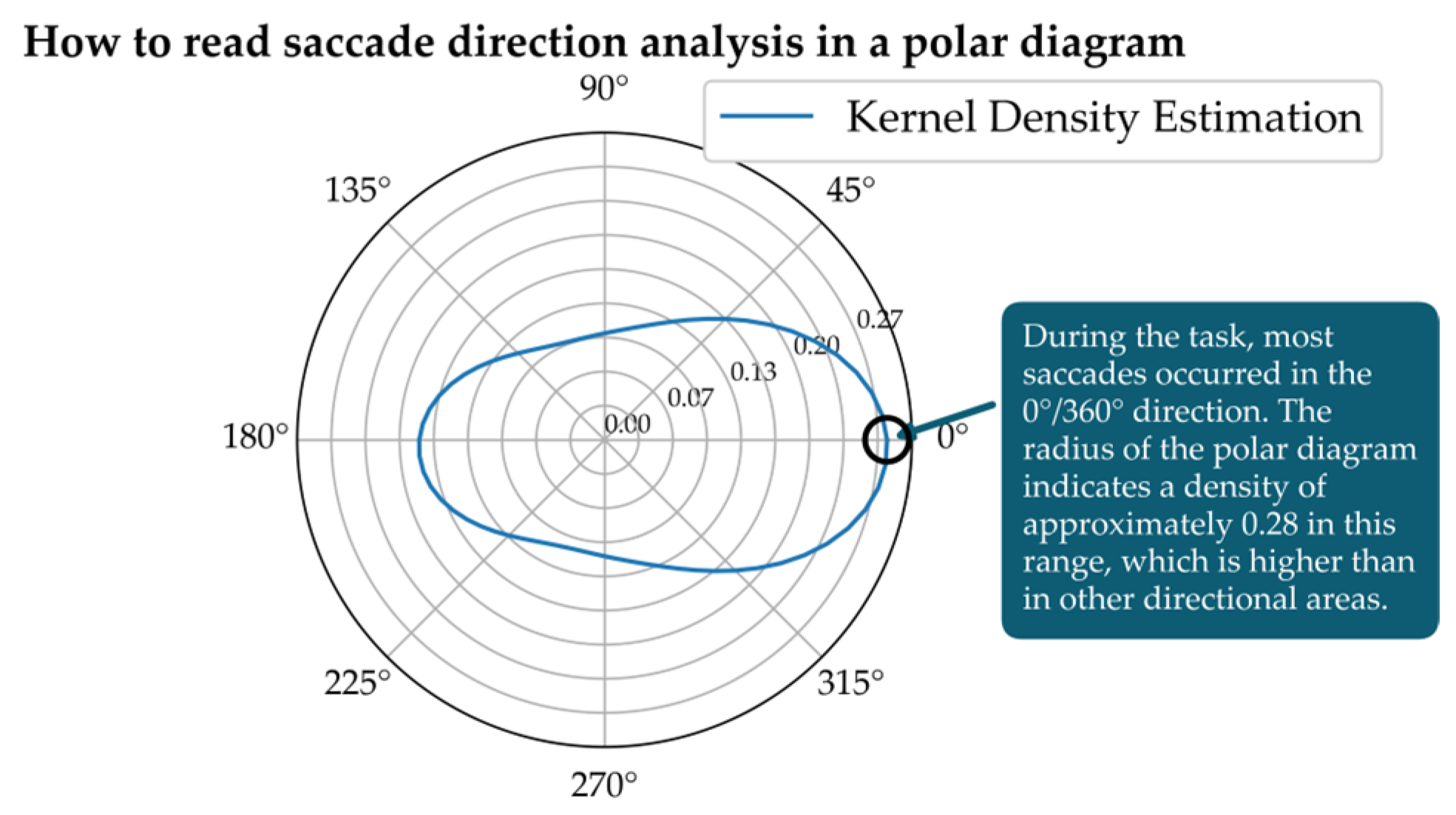
| Saccade direction | Polar diagram with line graph |  | Reading process | Risk of misestimating directionality | Continuity preserved; direction not interval-based |
| Saccade direction and amplitude | Polar diagram with heatmap |  | Reading and organizational processes | Risk of misestimating directionality | Integrated representation of both metrics |
| Saccade direction and amplitude | Polar diagram with discrete segments |  | Reading and organizational processes | Risk of misestimating directionality; Segmentation limits continuity | Integrated representation of both metrics |
| von Mises KDE | |||||
| Saccade direction | Polar diagram with line graph |  | Reading process | — | Continuity of data preserved |
| Saccade direction and amplitude | Polar diagram with heatmap |  | Reading and organizational processes | — | Integrated representation of both metrics |
Disclaimer/Publisher’s Note: The statements, opinions and data contained in all publications are solely those of the individual author(s) and contributor(s) and not of MDPI and/or the editor(s). MDPI and/or the editor(s) disclaim responsibility for any injury to people or property resulting from any ideas, methods, instructions or products referred to in the content. |
© 2026 by the authors. Licensee MDPI, Basel, Switzerland. This article is an open access article distributed under the terms and conditions of the Creative Commons Attribution (CC BY) license.
Share and Cite
Fehlinger, P.; Ertl, B.; Watzka, B. Eye Movement Analysis: A Kernel Density Estimation Approach for Saccade Direction and Amplitude. J. Eye Mov. Res. 2026, 19, 10. https://doi.org/10.3390/jemr19010010
Fehlinger P, Ertl B, Watzka B. Eye Movement Analysis: A Kernel Density Estimation Approach for Saccade Direction and Amplitude. Journal of Eye Movement Research. 2026; 19(1):10. https://doi.org/10.3390/jemr19010010
Chicago/Turabian StyleFehlinger, Paula, Bernhard Ertl, and Bianca Watzka. 2026. "Eye Movement Analysis: A Kernel Density Estimation Approach for Saccade Direction and Amplitude" Journal of Eye Movement Research 19, no. 1: 10. https://doi.org/10.3390/jemr19010010
APA StyleFehlinger, P., Ertl, B., & Watzka, B. (2026). Eye Movement Analysis: A Kernel Density Estimation Approach for Saccade Direction and Amplitude. Journal of Eye Movement Research, 19(1), 10. https://doi.org/10.3390/jemr19010010