1. Introduction: Financial Infrastructure Fragmentation and Small Open Economies
In this paper, fragmentation refers to the erosion of the universality and neutrality of global payment and settlement infrastructures, resulting in the coexistence of multiple, partially interoperable systems aligned with different geopolitical, legal, and regulatory regimes.
Global financial infrastructures constitute the foundational layer of the international monetary and financial system. Platforms such as SWIFT and Euroclear enable the circulation of payments, securities, and collateral across borders, underpinning international trade, capital mobility, and financial integration. For decades, these infrastructures were largely conceptualised as neutral technical utilities—efficient, standardised, and politically insulated mechanisms that facilitated global finance by reducing transaction costs and operational risk (
Scott & Zachariadis, 2012;
Norman, 2008).
This perception has changed markedly over the past decade. The increasing reliance on payment and settlement infrastructures as instruments of economic statecraft has revealed their deeply political character. The exclusion of banks from SWIFT, the immobilisation of securities and cash through Euroclear, and the growing legal complexity surrounding sanctioned assets have demonstrated that financial infrastructures are not merely passive conduits but active sites of power, governance, and contestation (
De Goede, 2020;
Anikin & Mishchenko, 2023). As a result, the “plumbing” of global finance has become a strategic arena in which geopolitical conflict is translated into financial constraints.
The weaponisation of financial infrastructure has generated both intended and unintended consequences. On the one hand, sanctions enforced through SWIFT and Euroclear have proven to be highly effective tools of coercion, capable of inflicting high economic costs without the use of military force. On the other hand, their use has undermined the perception of infrastructural neutrality that underpinned global trust in the Western-led financial order. This erosion of trust has been particularly consequential for countries and institutions that perceive themselves as politically vulnerable or strategically exposed to future sanctions (
Tulun, 2021;
Robinson et al., 2024).
In response, a growing number of non-Western economies—most notably within the BRICS grouping—have intensified efforts to design alternative payment, messaging, and settlement infrastructures. Initiatives such as BRICS Pay, proposals for BRICS-based clearing and settlement entities, and the development of cross-border CBDC platforms are explicitly framed as mechanisms to reduce dependence on Western-controlled infrastructures and to mitigate sanction-related risks (
Barbosa, 2020;
Shakhnazarov, 2025). Importantly, these initiatives are not primarily motivated by efficiency gains or technological superiority. Rather, they reflect strategic concerns about sovereignty, legal exposure, and geopolitical autonomy.
The emergence of these alternative systems has fuelled a rapidly expanding literature on global financial fragmentation, de-dollarisation, and the future of the international monetary system. Existing studies have examined the technical feasibility of alternative payment systems, the legal challenges associated with cross-border CBDC settlement, and the geopolitical implications of competing financial infrastructures (
Anikievich, 2024;
Xhelili, 2025). A consistent finding across this literature is that incumbent infrastructures such as SWIFT and Euroclear are unlikely to be replaced in the foreseeable future due to their overwhelming network effects, institutional embeddedness, and integration with global markets (
Scott et al., 2017;
Robinson et al., 2024).
However, the emphasis of this literature has remained predominantly systemic and macro-geopolitical. Much less attention has been paid to how the fragmentation of global financial infrastructure affects small, open economies that remain firmly embedded within the Western institutional framework but lack the scale or influence to shape infrastructure governance. This omission is analytically significant. Small financial centres often rely disproportionately on cross-border intermediation, reputational credibility, and regulatory trust. As a result, they may experience the consequences of fragmentation more acutely, even in the absence of direct technical exclusion from dominant infrastructures.
Historical experience further suggests that financial crises leave lasting institutional and reputational legacies that shape subsequent vulnerability. As argued by
Tooze (
2018), modern financial crises have transformed the global financial system by reconfiguring the role of states, central banks, and financial infrastructures. For small financial centres with a crisis history, confidence effects and reputational considerations are therefore likely to play a central role in how fragmentation-related shocks are transmitted.
This paper addresses this gap by focusing on Cyprus as a case study of a small, open, euro-area financial centre operating within an increasingly fragmented global payment and settlement system. Cyprus occupies a distinctive position in the international financial architecture. It is fully integrated into the European Union and the euro area, subject to the regulatory and supervisory framework of the European Banking Union, and deeply reliant on cross-border financial services, professional services, and international connectivity. At the same time, Cyprus has a history of crisis-induced trust erosion and heightened sensitivity to reputational and compliance risks (
Repousis et al., 2025).
Cyprus is selected as the case study because it represents a particularly informative example of a small, open, rule-taking financial centre operating within the European Union and the euro area. While sharing structural similarities with other European financial centres such as Malta, Luxembourg, or Ireland, Cyprus differs in several analytically relevant dimensions. It operates at a smaller scale, exhibits a higher degree of dependence on cross-border financial intermediation and professional services, and remains especially sensitive to confidence and reputational shocks following its banking crisis experience in 2012–2013.
Cyprus is selected over other small European financial centres because it combines three analytically relevant characteristics rarely observed simultaneously. First, it is a small EU and euro-area member that is fully embedded in Western financial and regulatory infrastructures, yet it lacks systemic importance or agenda-setting power in their governance. Second, its recent banking crisis (2012–2013) resulted in a pronounced erosion of trust, capital controls, and an externally imposed restructuring process, making confidence effects and reputational sensitivity structurally salient. Third, the Cypriot financial model relies disproportionately on cross-border intermediation, professional services, and correspondent banking, rendering it particularly exposed to indirect shocks originating from global infrastructural fragmentation.
While other jurisdictions such as Malta, Ireland, or Luxembourg share some of these features, Cyprus represents a lower-bound case in terms of scale, strategic autonomy, and post-crisis trust resilience. This makes it a particularly informative stress-test case for analysing how fragmentation affects rule-taking financial centres that are deeply integrated into dominant infrastructures but lack the capacity to diversify across competing systems.
These characteristics make Cyprus a useful “stress-test case” for examining the indirect effects of global payment and settlement infrastructure fragmentation. Its limited strategic autonomy, strong reliance on regulatory credibility, and heightened post-crisis trust sensitivity amplify the transmission of external geopolitical and infrastructural shocks. As such, the Cypriot case is not treated as idiosyncratic but as analytically representative of the vulnerabilities faced by small open financial centres that are deeply embedded in dominant financial infrastructures while lacking influence over their governance.
The central argument of the paper is that, for economies such as Cyprus, the primary risks associated with global payment-system fragmentation are indirect rather than technical. Cyprus is highly unlikely to be excluded from SWIFT or Euroclear, nor is it a plausible adopter of BRICS-led alternative infrastructures. Instead, fragmentation manifests through second-order effects: increased compliance burdens, heightened sanction risk perception, shifts in investor confidence, changes in funding conditions, and growing pressure to signal alignment and credibility within a politicised financial environment.
By analysing these indirect transmission channels, the paper contributes to the literature in three ways. First, it extends existing research on financial infrastructure and geopolitical power by shifting the focus from great powers and sanctioned states to small, rule-taking economies. Second, it bridges the gap between abstract discussions of infrastructure fragmentation and concrete financial stability concerns at the national level. Third, it positions Cyprus not as an exceptional or idiosyncratic case, but as a representative example of the challenges faced by small financial centres within the European Union and beyond.
The remainder of the paper is structured as follows.
Section 2 develops a conceptual framework that links financial infrastructure, network power, and fragmentation dynamics.
Section 3 examines the evolving role of SWIFT and Euroclear as politicised global infrastructures.
Section 4 analyses BRICS-led payment and settlement initiatives as parallel rather than substitutive systems.
Section 5 applies the framework to Cyprus, identifying key transmission channels through which global fragmentation affects the domestic financial system.
Section 6 presents a scenario analysis of alternative fragmentation paths and their implications for Cyprus.
Section 7 discusses policy implications at both national and EU levels, and
Section 8 concludes.
The paper shows that for small, rule-taking financial centres, fragmentation does not primarily operate through exclusion from dominant infrastructures, but through indirect and cumulative pressures on confidence, compliance capacity, funding conditions, and reputational positioning. By combining a conceptual framework with a scenario-based analysis, the study highlights how even managed coexistence between infrastructures increases operational complexity, while more severe fragmentation trajectories can challenge the sustainability of cross-border financial intermediation models.
2. Conceptual Framework: Financial Infrastructure, Power, and the Logic of Fragmentation
Financial infrastructures constitute the institutional and technical backbone of the global financial system. They enable the execution, settlement, and legal finality of financial transactions, thereby supporting trade, investment, and capital mobility across borders. Despite their centrality, such infrastructures have traditionally been analysed through a technocratic lens, emphasising efficiency, risk reduction, and standardisation rather than power relations or political embeddedness (
Norman, 2008;
Scott & Zachariadis, 2012).
Recent scholarship, however, has increasingly conceptualised financial infrastructures as socio-technical systems embedded in broader structures of political authority and economic governance (
De Goede, 2020). From this perspective, infrastructures are not neutral platforms but institutional arrangements that allocate access, define participation, and enforce rules. Control over infrastructure thus translates into structural power: the ability to shape outcomes not through direct intervention, but through the configuration of the systems on which others depend.
A key feature of global financial infrastructures is the presence of strong network effects. The value of a payment or settlement system increases with the number of users, counterparties, and jurisdictions connected to it. As adoption expands, switching costs rise, alternatives become less viable, and path dependence sets in (
Scott et al., 2017). These dynamics explain why infrastructures such as SWIFT and Euroclear have achieved near-universal adoption and why their displacement is exceedingly difficult even in the presence of political dissatisfaction.
However, network effects do not eliminate political risk; they merely redistribute it. When dominant infrastructures are perceived as politically neutral, network effects reinforce stability and trust. When infrastructures become politicised—through sanction enforcement, exclusions, or asset immobilisation—the same network effects generate vulnerability. Actors that are deeply embedded in the system face heightened exposure to political decisions taken beyond their control, while exit becomes prohibitively costly (
De Goede, 2020;
Tulun, 2021).
This tension between efficiency and vulnerability lies at the core of contemporary financial fragmentation. Fragmentation does not arise because incumbent infrastructures cease to function effectively, but because their political embeddedness undermines universal trust. In response, affected actors pursue strategies of risk diversification rather than full exit, investing in parallel systems that can be activated under adverse conditions. Fragmentation is therefore best understood as a process of partial redundancy and strategic hedging rather than systemic breakdown.
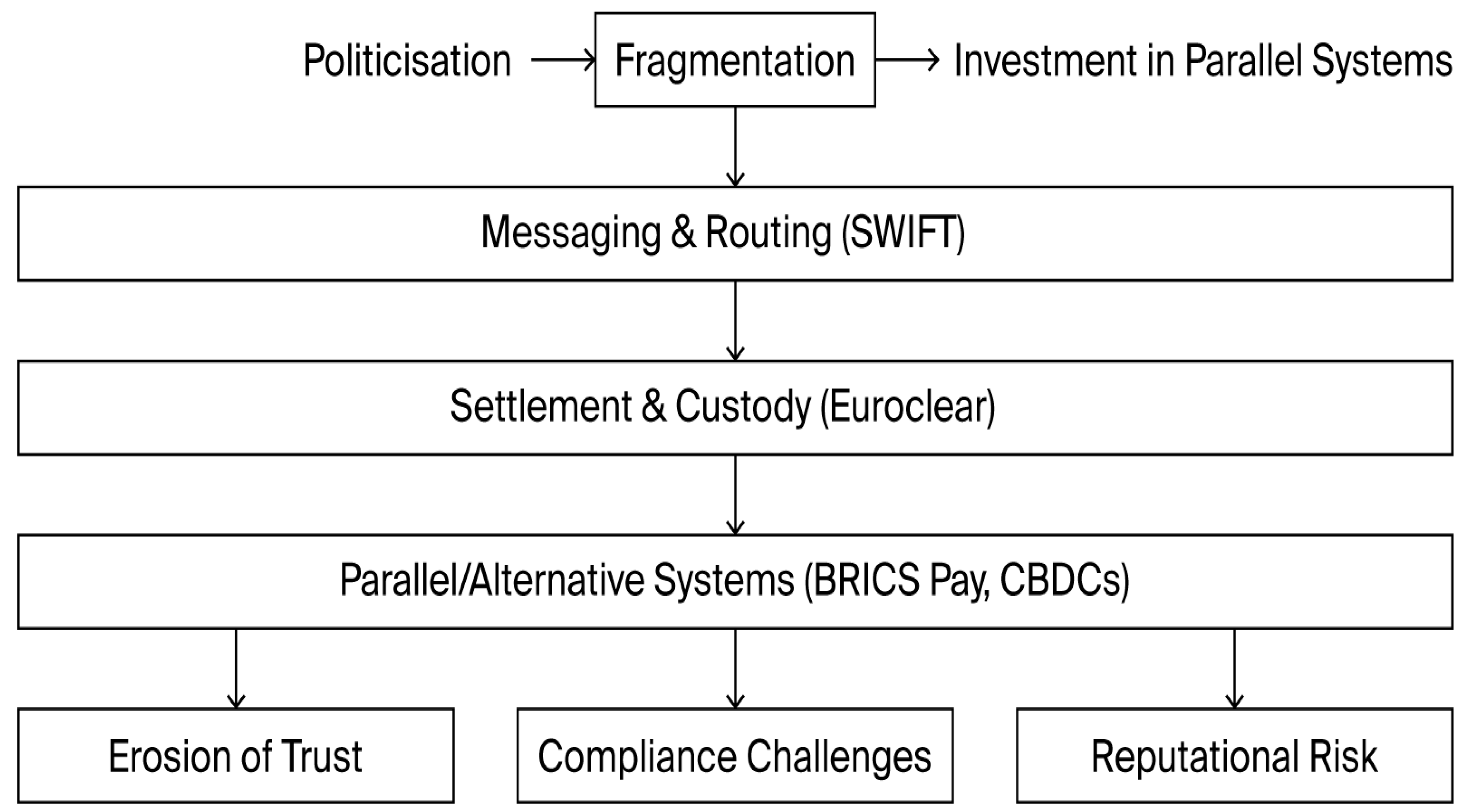
To analyse this process, the paper distinguishes between three interrelated layers of financial infrastructure.
The first layer consists of messaging and payment-routing infrastructures, exemplified by SWIFT. These systems coordinate communication between financial institutions, standardise transaction messages, and facilitate interoperability across jurisdictions. While they do not move funds themselves, they are indispensable for the execution of cross-border payments. Their centrality gives them significant coercive potential when access is restricted or withdrawn (
Anikin & Mishchenko, 2023).
The second layer comprises settlement, custody, and collateral infrastructures, such as Euroclear. These systems provide legal finality, asset safekeeping, and collateral mobilisation, making them critical for financial stability and market functioning. Unlike messaging systems, settlement infrastructures directly affect ownership rights and asset accessibility. As a result, their politicisation—most visibly through asset freezes—has profound legal and financial implications (
Grishin, 2023;
Aslanova, 2022).
The third layer includes parallel or alternative infrastructures, encompassing state-sponsored payment networks, bilateral settlement arrangements, and CBDC-based platforms promoted by BRICS economies. These systems aim to reduce dependence on incumbent infrastructures by creating alternative channels for payments and settlement. However, their effectiveness is constrained by governance fragmentation, limited network effects, and legal heterogeneity across participating jurisdictions (
Barbosa, 2020;
Shakhnazarov, 2025).
Fragmentation emerges from the interaction of these layers. Dominant infrastructures continue to perform core functions, but their politicisation incentivises investment in parallel systems. The result is not a clean bifurcation of the global financial system but a layered architecture characterised by overlapping jurisdictions, partial interoperability, and strategic ambiguity. This architecture increases systemic complexity and reduces transparency, particularly for actors operating across multiple regulatory and geopolitical environments (
Robinson et al., 2024).
Importantly, the consequences of fragmentation are not evenly distributed. Large economies and geopolitical powers may benefit from diversification and redundancy, while smaller economies face disproportionate adjustment costs. Small open financial centres typically lack the scale to influence infrastructure governance or to develop viable alternatives. At the same time, they are deeply integrated into global networks and therefore highly exposed to shifts in trust, compliance requirements, and risk perception.
This asymmetry highlights the relevance of a rule-taker versus rule-maker distinction. While major economies can shape the design and governance of infrastructures, small economies must adapt to changes decided elsewhere. Fragmentation thus translates into heightened uncertainty for rule-takers, who must continuously signal compliance, neutrality, and reliability to maintain access and credibility.
This argument is consistent with the broader literature on the financial vulnerability of small open economies, which emphasises their heightened exposure to external shocks, global risk cycles, and shifts in investor sentiment due to limited domestic market depth and reliance on external finance. In such economies, confidence effects and reputational dynamics often play a disproportionately large role in shaping financial stability outcomes, reinforcing the relevance of indirect transmission mechanisms.
From this conceptual perspective, fragmentation should not be analysed solely in terms of technical access to infrastructure. Instead, it should be understood as a multidimensional process affecting legal certainty, reputational capital, compliance burdens, and strategic positioning. These indirect effects are particularly salient for economies whose financial models depend on intermediation and trust rather than domestic market size.
This framework informs the subsequent analysis of Cyprus. Rather than asking whether Cyprus will adopt alternative payment systems—a question that presupposes unrealistic strategic autonomy—the paper examines how global infrastructure fragmentation reshapes the environment in which Cyprus operates. The focus is on transmission channels through which external geopolitical dynamics affect domestic financial stability, regulatory strategy, and economic resilience.
Table 1 and
Figure 1 summarise the three layers of global financial infrastructure and their respective vulnerabilities to politicisation, highlighting how fragmentation arises even without full replacement of incumbent systems.
The vulnerability of small open economies to external financial shocks has been extensively documented in the literature. Such economies are particularly exposed to global financial cycles, sudden reversals of capital flows, and confidence-driven dynamics due to limited domestic market depth and a high reliance on cross-border finance.
Rey (
2015) demonstrates that global financial conditions significantly constrain monetary and financial autonomy, even in countries with flexible exchange rate regimes. Similarly,
Ghosh et al. (
2016) show that capital inflow surges in open economies are often followed by abrupt and destabilising adjustments, underscoring the non-linear nature of financial vulnerability.
These insights suggest that small, rule-taking financial centres are structurally sensitive to external shifts in financial conditions and investor sentiment, reinforcing the relevance of indirect transmission channels in the context of global payment and settlement infrastructure fragmentation.
3. Global Financial Infrastructures Under Stress: From Technical Utilities to Instruments of Economic Statecraft
The contemporary phase of global financial fragmentation cannot be understood without a detailed examination of the two most critical pillars of the existing financial infrastructure: SWIFT and Euroclear. Although they operate at different layers of the financial system—messaging and settlement respectively—both have undergone a similar transformation. Once perceived primarily as technical utilities designed to enhance efficiency and reduce risk, they have increasingly become instruments through which political objectives are pursued and enforced.
This section analyses how SWIFT and Euroclear have come under geopolitical stress, how their roles have evolved, and how this evolution contributes to the fragmentation dynamics discussed in the previous section. The emphasis is not on operational details, but on the political, legal, and systemic implications of their changing functions.
3.1. SWIFT: From Neutral Messaging Network to Strategic Chokepoint
The Society for Worldwide Interbank Financial Telecommunication (SWIFT) occupies a uniquely central position in the global financial system. As the dominant interbank messaging network, SWIFT facilitates communication between more than 11,000 financial institutions across over 200 jurisdictions, standardising payment instructions, securities transactions, and other financial messages (
Scott & Zachariadis, 2012). While SWIFT does not itself transfer funds, its role as the primary communication layer makes it indispensable for the execution of cross-border transactions.
Historically, SWIFT was deliberately designed to be politically neutral. Its governance structure, cooperative ownership model, and emphasis on technical standardisation reflected a commitment to universality and non-discrimination. This neutrality was central to the development of trust in the system and to the emergence of strong network effects, which in turn reinforced SWIFT’s dominance (
Scott et al., 2017).
This perception of neutrality has been progressively eroded. Beginning with the exclusion of Iranian banks and intensifying with sanctions imposed on Russian financial institutions, SWIFT has been increasingly used as a tool of economic statecraft. Although SWIFT operates under Belgian law and formally complies with EU regulations, its disconnection decisions are widely perceived as aligned with Western geopolitical priorities (
Anikin & Mishchenko, 2023;
De Goede, 2020).
The effectiveness of SWIFT-based sanctions lies precisely in the network effects that underpin its dominance. Exclusion from SWIFT does not merely increase transaction costs; it can severely disrupt trade finance, cross-border payments, and access to global liquidity. As a result, SWIFT has emerged as a strategic chokepoint in the global financial system, capable of exerting pressure far beyond its formal technical remit.
At the same time, the politicisation of SWIFT has revealed the limits of coercive power rooted in network dominance. While exclusion imposes high costs on targeted actors, it also generates powerful incentives to invest in alternatives. Countries subject to or threatened by sanctions increasingly view reliance on SWIFT as a strategic vulnerability rather than a neutral convenience (
Tulun, 2021).
The literature consistently emphasises that these alternatives—such as national messaging systems or bilateral arrangements—are unlikely to displace SWIFT in the foreseeable future. Their limited geographic reach, weaker network effects, and interoperability challenges constrain their scalability (
Barbosa, 2020;
Robinson et al., 2024). Nevertheless, their very existence contributes to fragmentation by introducing redundancy and reducing the universality that once characterised global payment messaging.
Importantly, the consequences of SWIFT’s politicisation extend beyond sanctioned countries. For non-sanctioned actors, including banks and financial centres in small open economies, the transformation of SWIFT into a geopolitical instrument introduces new forms of uncertainty. Access to the system may be formally guaranteed, but perceptions of political alignment, compliance credibility, and reputational risk increasingly shape counterparties’ willingness to engage. In this sense, fragmentation operates through expectations and risk perceptions as much as through formal exclusion.
3.2. Euroclear: Settlement Infrastructure, Asset Freezes, and Legal Uncertainty
If SWIFT represents the communication layer of global finance, Euroclear occupies a similarly central role at the settlement and custody layer. As one of the world’s leading international central securities depositories (ICSDs), Euroclear provides settlement, safekeeping, and asset servicing for a vast volume of securities, including government bonds, corporate debt, and equities (
Norman, 2008). Its role is critical not only for market efficiency but also for financial stability, as it underpins collateral mobilisation and liquidity management.
Unlike SWIFT, Euroclear’s exposure to geopolitics has materialised primarily through sanction-driven asset immobilisation. The freezing of securities and cash linked to sanctioned entities—particularly following the imposition of sanctions on Russian financial institutions—has placed Euroclear at the centre of complex legal and political disputes (
Grishin, 2023;
Aslanova, 2022). These disputes concern not only sanctioned entities but also non-sanctioned investors whose assets have become indirectly inaccessible due to settlement-chain dependencies.
The immobilisation of assets through Euroclear has highlighted the legal dimension of settlement infrastructure. Settlement systems do not merely process transactions; they confer legal finality and define ownership rights. When access to assets is restricted for political reasons, questions arise regarding the protection of property rights, the hierarchy of claims, and the responsibilities of infrastructure operators operating under multiple legal regimes.
This legal uncertainty has significant systemic implications. Market participants rely on the predictability and finality provided by settlement infrastructures when making investment and funding decisions. When political considerations override or complicate these guarantees, confidence in the neutrality of the infrastructure is weakened. This, in turn, reinforces incentives to explore alternative settlement arrangements, even if these are less efficient or less liquid (
Madeleine, 2021).
As with SWIFT, the literature suggests that Euroclear’s dominance is unlikely to be challenged in the near term. Its integration with global markets, regulatory recognition, and role in euro-denominated securities markets create formidable barriers to exit. However, the politicisation of settlement and custody functions contributes to a broader perception that Western financial infrastructures are no longer purely technical institutions but extensions of political authority.
For small open financial centres, this development is particularly consequential. Settlement and custody services are central to cross-border financial intermediation, investment fund servicing, and capital market activity. Increased legal uncertainty surrounding asset accessibility can affect risk assessments, raise compliance costs, and amplify reputational concerns, even for institutions fully compliant with EU and international regulations.
3.3. Infrastructure Stress and the Dynamics of Fragmentation
Recent contributions emphasise that global financial and payment infrastructures are not merely technical arrangements but also sources of structural power.
Farrell and Newman (
2019) introduce the concept of “weaponized interdependence,” showing how states that control central nodes of global financial networks can exert coercive influence by leveraging infrastructural chokepoints. In this context, access to payment and settlement systems increasingly reflects geopolitical alignment rather than purely economic considerations.
This perspective is particularly relevant for small financial centres that are deeply embedded in dominant infrastructures but lack influence over their governance, making them especially sensitive to shifts in the political use of financial networks.
Taken together, the evolving roles of SWIFT and Euroclear illustrate how financial infrastructures become sites of geopolitical contestation. Their continued dominance ensures that fragmentation does not take the form of wholesale replacement. Instead, fragmentation manifests as a gradual erosion of universality, increasing reliance on parallel systems, and heightened sensitivity to political alignment.
Crucially, this process generates asymmetric effects. Large economies may leverage fragmentation to enhance strategic autonomy, while small economies bear adjustment costs without commensurate influence. The next section examines how BRICS-led initiatives fit into this evolving landscape and why their significance lies less in their technical capabilities than in their contribution to systemic fragmentation.
4. BRICS Payment and Settlement Initiatives: Parallel Infrastructures in a Fragmenting Global Financial System
Institutional analyses also point to growing concerns regarding the interoperability of payment systems in an increasingly fragmented environment. The
Bank for International Settlements (
2021) notes that parallel payment infrastructures and alternative settlement arrangements may coexist, but imperfect interoperability can raise operational complexity and legal uncertainty. For small financial centres, such developments may increase reliance on correspondent banking relationships and amplify indirect exposure to geopolitical and regulatory fragmentation.
The emergence of BRICS-led payment and settlement initiatives represents one of the most visible responses to the politicisation of Western-dominated financial infrastructures. These initiatives have attracted significant academic, policy, and media attention, often framed as evidence of an impending shift away from the existing global financial order. However, a careful examination of their objectives, design constraints, and institutional context suggests that their significance lies less in their capacity to replace incumbent infrastructures and more in their contribution to the ongoing fragmentation of the global financial system.
BRICS economies—Brazil, Russia, India, China, and South Africa—differ substantially in terms of financial development, legal systems, capital account openness, and geopolitical orientation. Despite these differences, they share a common concern regarding exposure to Western-controlled financial infrastructures, particularly in the context of sanction enforcement and geopolitical uncertainty (
Barbosa, 2020;
Shakhnazarov, 2025). This concern has provided the political impetus for exploring alternative arrangements for cross-border payments and settlement.
Among the most frequently discussed initiatives is BRICS Pay, a proposed payment platform designed to facilitate transactions between BRICS member states and potentially with third-party countries. Closely related are efforts to develop bilateral or multilateral settlement mechanisms based on central bank digital currencies (CBDCs), as well as proposals for BRICS-based clearing and settlement entities (
Anikievich, 2024). These initiatives are often presented as technological innovations, but their underlying motivation is fundamentally strategic: reducing reliance on infrastructures perceived as politically exposed.
From a technical perspective, however, BRICS initiatives face significant challenges. Payment and settlement systems derive their value from scale, interoperability, and trust. Incumbent infrastructures such as SWIFT and Euroclear benefit from decades of institutional embedding, regulatory recognition, and integration with global financial markets. By contrast, BRICS systems operate in an environment characterised by legal heterogeneity, fragmented regulatory frameworks, and limited cross-border trust among participating jurisdictions (
Barbosa, 2020).
Governance presents a particularly acute challenge. Effective financial infrastructures require clear rules regarding access, dispute resolution, data governance, and legal finality. Within the BRICS grouping, differences in legal traditions, political systems, and regulatory capacity complicate the establishment of harmonised governance structures. As a result, BRICS initiatives tend to rely on ad hoc arrangements or bilateral agreements rather than comprehensive multilateral frameworks, limiting their scalability and predictability (
Shakhnazarov, 2025).
Network effects further constrain the potential of BRICS infrastructures. While intra-BRICS trade and financial flows are significant, they remain small relative to global volumes processed through SWIFT and Euroclear. Without broad participation from non-BRICS actors, alternative systems struggle to achieve the critical mass necessary to rival incumbent infrastructures. This limitation is particularly relevant for currencies with limited internationalisation, which face additional barriers to widespread adoption in cross-border settlement.
The literature therefore converges on the view that BRICS-led systems are unlikely to displace Western infrastructures in the foreseeable future (
Robinson et al., 2024;
Xhelili, 2025). Instead, they are best understood as parallel infrastructures designed to operate alongside existing systems, providing redundancy and strategic optionality rather than universal alternatives. This coexistence contributes to fragmentation by reducing the singularity of global financial “rails” and introducing multiple, partially overlapping channels for payments and settlement.
For third-party economies, including small open financial centres within the European Union, the relevance of BRICS initiatives lies primarily in their systemic effects rather than in direct participation. The proliferation of parallel systems increases complexity in the global financial environment, complicates compliance and due diligence processes, and heightens the importance of geopolitical alignment in infrastructural choice. Financial institutions must navigate a landscape in which counterparties may operate across multiple payment and settlement channels, each associated with different legal, regulatory, and reputational risks.
Moreover, the existence of alternative infrastructures alters the strategic calculus of sanction enforcement. While SWIFT and Euroclear remain dominant, their coercive power may be diluted at the margin as sanctioned actors develop partial workarounds. This dynamic does not eliminate the effectiveness of sanctions but introduces greater uncertainty and heterogeneity into their impact. For non-sanctioned economies, this uncertainty translates into higher risk premia and increased pressure to demonstrate compliance credibility and political alignment.
Crucially, BRICS initiatives should not be interpreted as heralding a clean bifurcation of the global financial system into competing blocs. Rather, they contribute to a layered architecture characterised by selective connectivity, partial interoperability, and strategic ambiguity. Actors may remain integrated into Western infrastructures while simultaneously cultivating alternative channels as hedging mechanisms. This hybrid configuration complicates governance and reduces transparency, amplifying the indirect effects of fragmentation identified in the conceptual framework.
In this context, the analytical focus shifts away from questions of technological feasibility or ideological alignment and toward the systemic implications of coexistence. The next section applies this perspective to Cyprus, examining how the emergence of parallel infrastructures reshapes the environment in which a small, open, euro-area financial centre operates, even without direct engagement with BRICS systems.
5. Why Cyprus Matters: A Small Open Financial Centre in a Fragmenting System
The analytical relevance of Cyprus lies not in its systemic size or geopolitical influence, but in its structural characteristics as a small, open, and highly interconnected financial centre embedded within the European Union. In an increasingly fragmented global financial architecture, such economies are particularly exposed to indirect spillovers from infrastructural and geopolitical shifts, despite having limited capacity to shape the rules governing global financial systems.
Cyprus offers a revealing case because it combines deep integration into Western financial and regulatory structures with a business model that depends heavily on cross-border financial intermediation, professional services, and reputational credibility. As a result, changes in the governance, perception, and political embeddedness of global payment and settlement infrastructures are transmitted to the domestic economy through multiple channels, even in the absence of direct technical disruption.
5.1. Structural Characteristics of Cyprus as a Financial Centre
Cyprus is a member of the European Union and the euro area, subject to the regulatory and supervisory framework of the European Banking Union and the jurisdiction of the European Central Bank. Following the banking crisis of 2012–2013, the Cypriot financial system underwent extensive restructuring, recapitalisation, and regulatory tightening. These reforms strengthened prudential oversight and compliance standards but also reinforced the centrality of trust and credibility in the country’s financial model (
Gortsos, 2016;
Repousis et al., 2025).
The Cypriot economy exhibits a strong orientation toward services, with financial and professional services—banking, investment funds, legal services, accounting, and corporate administration—playing a disproportionate role relative to the size of the domestic market. This orientation makes Cyprus highly dependent on cross-border financial flows, correspondent banking relationships, and access to international payment and settlement infrastructures.
Unlike large financial centres, Cyprus does not benefit from scale or systemic importance that could insulate it from reputational shocks. Instead, its competitiveness relies on regulatory credibility, compliance with EU and international standards, and the perception of neutrality and reliability among international counterparties. This reliance creates a structural vulnerability to changes in global financial norms and to shifts in the perceived legitimacy of financial infrastructures.
At the same time, Cyprus’s historical experience with financial crisis and capital controls has left a legacy of heightened sensitivity to confidence and trust. Empirical studies suggest that public trust in the banking system remains more fragile in Cyprus than in larger euro-area economies, making confidence effects particularly salient (
Repousis et al., 2025). This fragility amplifies the transmission of external shocks, including those originating from global financial fragmentation.
Cyprus’s Payment Infrastructure in Context
Cyprus’s payment infrastructure is fully integrated into the Eurosystem and operates primarily through TARGET2, SEPA, and correspondent banking relationships denominated overwhelmingly in euros. Cross-border transactions in other currencies, including the US dollar, are largely mediated through correspondent banks rather than domestic clearing systems. Cyprus has no exposure to, nor participation in, alternative BRICS-linked payment infrastructures, reflecting both regulatory alignment and limited strategic incentives.
Following the 2012–2013 crisis, substantial reforms were implemented to strengthen payment system resilience, liquidity management, and supervisory oversight. These reforms reduced operational risk but increased dependence on external infrastructures and correspondent networks. Compared with larger European financial centres, Cyprus exhibits a higher reliance on external payment rails and reputational trust, while differing markedly from Middle Eastern centres that operate more diversified currency and settlement environments.
5.2. Transmission Channels of Global Financial Fragmentation
The literature on macroprudential regulation further suggests that small and open financial systems face distinct challenges in maintaining financial stability under external pressures.
Claessens and Ghosh (
2013) argue that emerging and small economies often require stronger regulatory and supervisory frameworks to mitigate spillovers from global financial cycles. In the context of infrastructure fragmentation, increased compliance costs and regulatory complexity may therefore interact with existing stability constraints, placing additional burdens on small financial centres.
Although the transmission channels identified in this section are analysed conceptually, they can be linked to observable empirical indicators that provide a basis for future measurement. Confidence and trust effects may be proxied by non-resident deposit volatility, changes in deposit maturity structure, or sudden shifts in liquidity preferences. Compliance and sanction-related pressures can be approximated through indicators such as compliance expenditure, the frequency of enhanced due diligence procedures, or changes in correspondent banking relationships. Capital flow and funding effects may be reflected in sovereign and bank funding spreads, reliance on central bank liquidity, or volatility in cross-border portfolio flows. Finally, reputational and strategic positioning effects can be indirectly assessed through changes in access to correspondent networks, international rankings, or supervisory scrutiny.
The purpose of this paper is not to estimate these effects quantitatively, but to identify and structure the channels through which fragmentation translates into financial stability risks for small open economies.
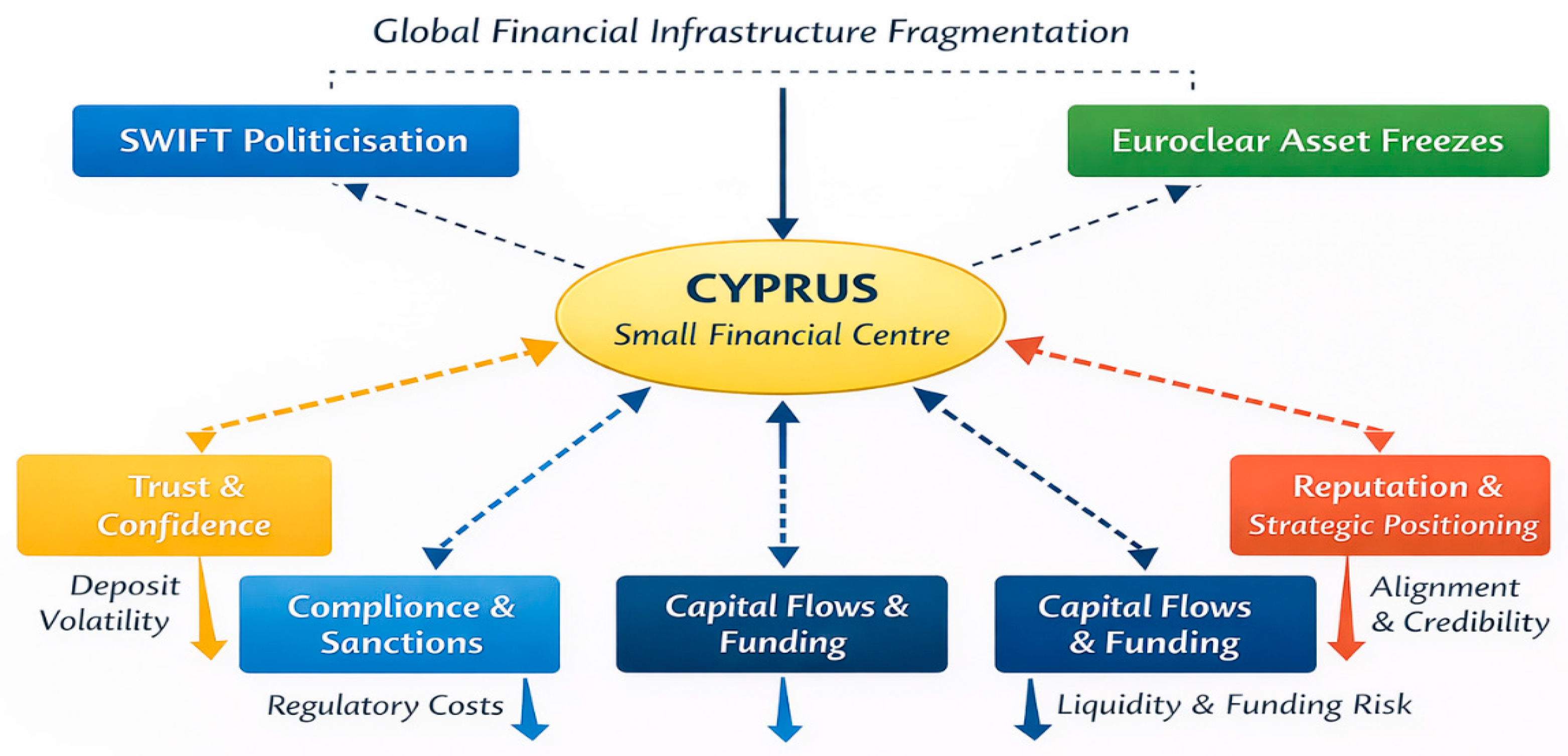
The fragmentation of global payment and settlement infrastructures affects Cyprus primarily through indirect transmission channels, rather than through exclusion or direct participation in alternative systems. Four such channels are particularly relevant.
5.2.1. Trust, Confidence, and Deposit Behaviour
Trust is a central asset for any financial centre, but it is especially critical for small economies with limited domestic funding bases. In Cyprus, past crises have heightened depositor sensitivity to external signals of risk, including geopolitical tensions and changes in international financial governance. Even without direct disruptions to payment systems, heightened uncertainty regarding the neutrality and stability of global financial infrastructure can influence depositor behaviour and precautionary liquidity preferences.
The perception that financial infrastructures are increasingly politicised may reinforce concerns about the security of cross-border assets and transactions, particularly among non-resident clients. In small financial systems, such concerns can generate rapid and disproportionate confidence effects due to the non-linear dynamics of trust erosion.
5.2.2. Compliance, Sanction Risk, and Regulatory Burden
A second key transmission channel operates through compliance and sanction risk. As alternative payment and settlement systems become associated with sanctioned actors or jurisdictions subject to heightened scrutiny, financial institutions in Cyprus face increased due-diligence requirements when engaging with international counterparties. Even when transactions are conducted entirely within Western infrastructures, the existence of fragmented payment channels complicates risk assessment and monitoring.
This dynamic increases compliance costs and places additional pressure on regulatory capacity. For small financial centres, these costs are not merely operational but strategic, as failure to demonstrate robust compliance can quickly translate into reputational damage and loss of correspondent relationships. In this context, compliance becomes both a defensive necessity and a competitive differentiator.
5.2.3. Capital Flows, Liquidity, and Funding Conditions
Global financial fragmentation may also affect Cyprus through changes in capital flows and funding conditions. The proliferation of parallel payment and settlement systems introduces uncertainty and may reduce overall liquidity in international markets, particularly during periods of geopolitical stress. For small economies that rely on external funding and cross-border intermediation, such shifts can raise funding costs and increase volatility.
Empirical research suggests that small financial centres are more sensitive to changes in global risk premia and investor sentiment than larger economies with deeper domestic capital markets (
Castro, 2013). In a fragmented system, these sensitivities may be amplified as investors reassess the risk associated with jurisdictions perceived as exposed to geopolitical or compliance uncertainty.
5.2.4. Financial Intermediation, Reputation, and Strategic Positioning
Finally, fragmentation affects Cyprus through its impact on the broader environment in which financial intermediation takes place. Cyprus’s role as an intermediary jurisdiction—facilitating investment, fund administration, and cross-border structuring—depends on its reputation for transparency, legal certainty, and alignment with international norms.
As global financial infrastructures become politicised, perceptions of neutrality and alignment gain importance. Small financial centres may face implicit pressure to signal adherence to dominant infrastructural regimes and regulatory standards, even when such signalling imposes additional costs. Failure to do so risks marginalisation, not through formal exclusion but through reduced willingness of counterparties to engage.
Table 2 and
Figure 2 map the main indirect transmission channels through which global financial fragmentation affects small, open financial centres, using Cyprus as an illustrative case.
5.3. Cyprus as a Representative Case
While Cyprus possesses certain idiosyncratic features, its experience is broadly representative of the challenges faced by small open financial centres within the European Union and beyond. Economies such as Malta, Ireland, and Luxembourg share similar dependencies on cross-border financial activity and reputational capital, albeit at different scales. Cyprus thus serves as a useful analytical lens through which to examine the broader implications of global financial fragmentation for rule-taking economies.
The significance of Cyprus lies precisely in its lack of strategic autonomy. It cannot realistically diversify across competing payment systems or influence the governance of global infrastructures. Instead, it must adapt to a fragmented environment shaped by decisions taken elsewhere. Understanding this adaptive process is essential for assessing the systemic consequences of financial infrastructure fragmentation beyond the perspective of major powers.
6. Scenario Analysis: Cyprus Under Alternative Fragmentation Paths
6.1. Methodological Approach to Scenario Analysis
This paper employs scenario analysis as its primary methodological tool in order to explore the implications of global payment and settlement infrastructure fragmentation for a small open financial centre. Scenario analysis is particularly appropriate in contexts characterised by high uncertainty, structural transformation, and limited historical precedent, where probabilistic forecasting or econometric modelling would be unreliable or misleading. Rather than predicting specific outcomes, the scenarios developed in this section are intended to identify plausible future states of the global financial system and to examine their differentiated transmission mechanisms.
The scenarios are distinguished along three key dimensions: (i) the speed at which fragmentation unfolds, (ii) the depth of infrastructural, legal, and regulatory divergence between competing systems, and (iii) the degree of geopolitical alignment embedded in payment and settlement infrastructures. By varying these dimensions, the analysis captures how incremental changes in global financial architecture can generate non-linear effects on confidence, compliance burdens, funding conditions, and reputational risk for rule-taking economies such as Cyprus.
The preceding sections have demonstrated that global payment and settlement infrastructures are increasingly subject to politicisation and fragmentation. For a small, open financial centre such as Cyprus, the consequences of these developments are transmitted primarily through indirect channels, notably confidence, regulatory compliance, funding conditions, and reputational dynamics. Given the high degree of uncertainty, the limited availability of historical precedents, and the complex interdependencies that characterise global financial infrastructures, scenario analysis provides an appropriate analytical framework. Scenario analysis enables policymakers and researchers to explore plausible future states of the world, assess systemic risks, and identify potential adjustment strategies in environments where probabilistic forecasting is neither feasible nor reliable.
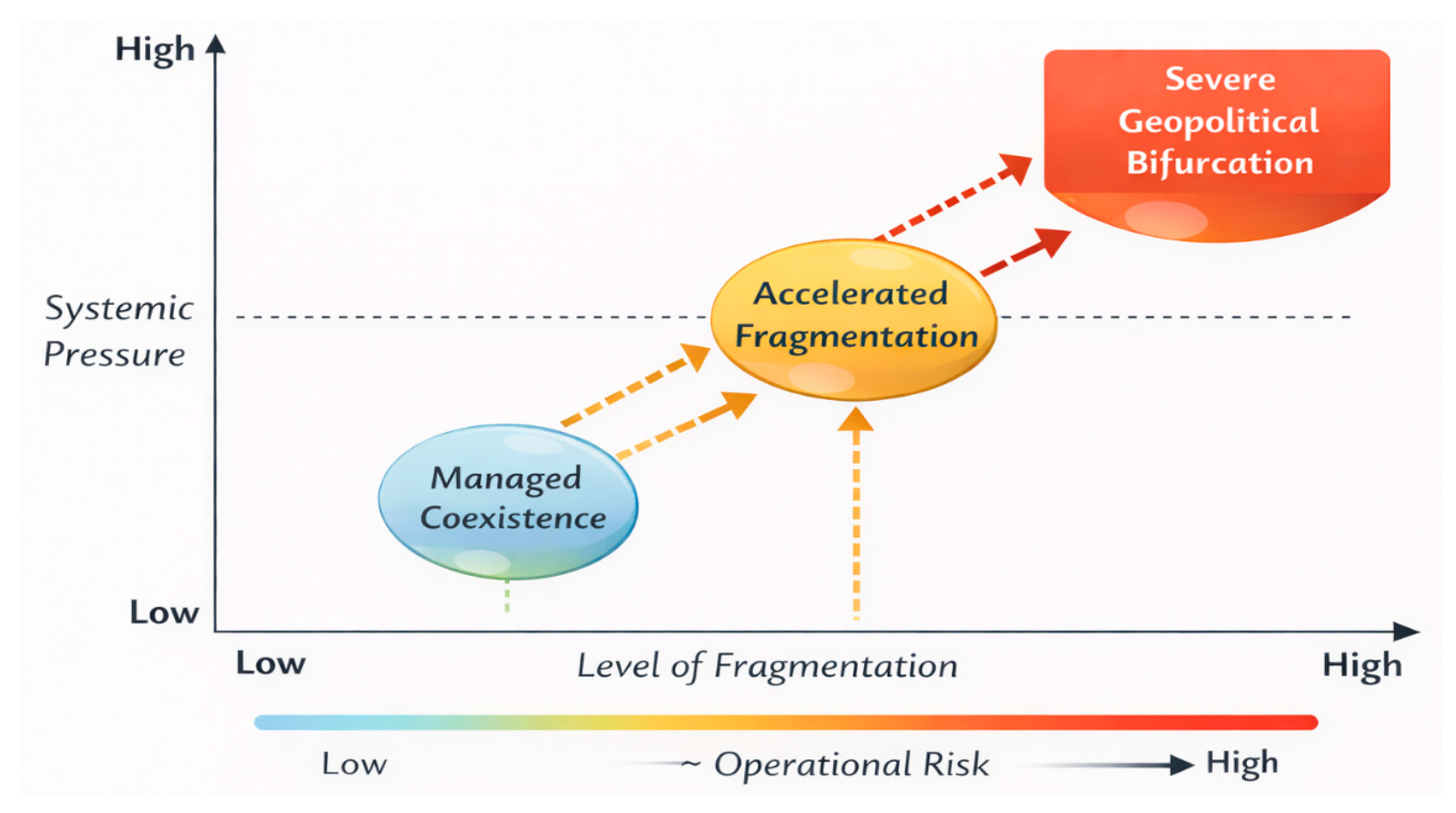
This section develops three stylised scenarios, differentiated by the speed and depth of fragmentation, the degree of geopolitical alignment of infrastructures, and the intensity of compliance and reputational pressures. These scenarios are not intended to be predictive. Rather, they serve as heuristic devices that illuminate the mechanisms through which structural changes in global financial infrastructures may affect Cyprus.
The scenarios differ along explicit driving assumptions. The accelerated fragmentation scenario assumes a sustained increase in geopolitical tensions, wider adoption of alternative payment and settlement arrangements among non-Western economies, and only partial interoperability between infrastructures. The severe geopolitical bifurcation scenario assumes the institutionalisation of competing infrastructural blocs, sharp legal and regulatory divergence, and the use of infrastructural access as a persistent instrument of geopolitical alignment. These assumptions are stylised but internally consistent, allowing for a transparent comparison of transmission mechanisms across scenarios.
The absence of formal mathematical modelling reflects the exploratory nature of the research question and the lack of stable empirical relationships in a rapidly evolving and politically contingent environment.
This study does not aim to provide empirical measurement or cross-country quantitative comparison of payment system usage, but rather to develop an analytically coherent framework for understanding indirect systemic effects under conditions of uncertainty.
6.2. Scenario 1: Managed Coexistence (Baseline Scenario)
Under the managed coexistence scenario, incumbent infrastructures such as SWIFT and Euroclear retain their central role in global payment and settlement activity, while alternative systems associated with BRICS and other non-Western actors expand only gradually. Parallel infrastructures emerge but remain marginal in terms of transaction volumes, liquidity, and systemic relevance. Governance arrangements, interoperability standards, and legal frameworks remain sufficiently robust to prevent major disruptions or fragmentation-induced shocks.
In this environment, Cyprus retains uninterrupted access to global financial networks. Compliance and due diligence requirements increase modestly, reflecting the need to monitor a more diverse infrastructural landscape, but these adjustments remain manageable within existing institutional capacities. Confidence effects are limited, as non-resident depositors and international counterparties do not perceive elevated systemic risk and therefore do not engage in precautionary withdrawal or reallocation of funds. Funding conditions remain broadly stable, with only minor adjustments to risk premia associated with heightened geopolitical uncertainty.
Overall, this scenario suggests that when fragmentation proceeds slowly and remains largely parallel rather than exclusionary, small open economies such as Cyprus can absorb the associated pressures without experiencing systemic stress. The primary challenge lies in maintaining alignment with dominant regulatory and infrastructural norms, rather than in managing acute financial instability.
6.3. Scenario 2: Accelerated Fragmentation
The accelerated fragmentation scenario assumes a more rapid proliferation of alternative payment and settlement infrastructures, driven by intensifying geopolitical tensions, increased adoption by BRICS economies, and growing awareness among global financial actors of the strategic vulnerabilities associated with reliance on Western-dominated systems. In this context, interoperability between infrastructures is partial, legal and regulatory frameworks remain heterogeneous, and compliance requirements become increasingly complex.
For Cyprus, the most immediate impact manifests through a significant rise in compliance and regulatory costs. Financial institutions are required to monitor multiple infrastructural channels, implement enhanced due diligence procedures, and ensure simultaneous adherence to European Union regulations and evolving international standards. Confidence effects become more pronounced, as depositors and counterparties adjust their behaviour in response to perceived increases in systemic risk, even in the absence of direct exclusion from core infrastructures. Capital flows become more volatile, and the cost of cross-border funding increases as lenders and counterparties demand higher compensation for uncertainty.
In this scenario, reputational considerations and strategic signalling acquire heightened importance. Cyprus must continuously demonstrate its commitment to established regulatory norms and financial transparency in order to preserve correspondent banking relationships and market access, while at the same time avoiding any perception of alignment with politically sensitive alternative infrastructures. Although access to SWIFT and Euroclear is preserved, the operational environment becomes markedly more complex, costly, and risk-intensive, underscoring the structural vulnerability of small open financial centres to indirect effects of infrastructural fragmentation.
6.4. Scenario 3: Severe Geopolitical Bifurcation
The severe geopolitical bifurcation scenario represents the most disruptive outcome. Global financial infrastructures become aligned along distinct geopolitical blocs, with SWIFT, Euroclear, and other Western-dominated systems constituting one bloc, and fully operational alternative payment and settlement networks emerging among BRICS countries and their allies. Legal regimes, compliance frameworks, and risk assessments diverge sharply, while interoperability between systems is either highly restricted or subject to political conditions. Systemic uncertainty is consequently elevated.
In this context, Cyprus faces acute reputational and compliance pressures. Engagement decisions by international counterparties increasingly depend on assessments of political alignment and perceived neutrality, rather than solely on financial fundamentals. Operational complexity rises sharply as financial institutions are required to navigate multiple infrastructures governed by incompatible legal and regulatory regimes. Liquidity and funding risks intensify as global capital markets become partially segmented, reducing diversification opportunities and increasing sensitivity to geopolitical shocks.
Confidence effects are particularly pronounced in this scenario. Non-resident depositors and investors may withdraw funds or demand substantial risk premia, even in the absence of formal sanctions or legal restrictions. Strategic positioning becomes a dominant concern for policymakers, as Cyprus must carefully manage its alignment with dominant Western infrastructures while preserving credibility, regulatory integrity, and insulation from politically sensitive alternative systems. This scenario highlights the structural constraints faced by small open economies, which lack influence over infrastructural governance yet bear a disproportionate share of the adjustment costs associated with fragmentation.
6.5. Comparative Insights
Taken together, the three scenarios reveal several consistent dynamics. First, the transmission of fragmentation effects to Cyprus is predominantly indirect, operating through trust, compliance, capital flows, and reputational channels rather than through explicit exclusion. Second, the degree of operational complexity and associated costs increases nonlinearly with the pace and depth of fragmentation, disproportionately affecting small, open financial centres. Third, strategic positioning and perception management become central policy challenges for rule-taking economies, as market access and funding conditions are increasingly shaped by compliance credibility and geopolitical signalling. Finally, even under conditions of severe bifurcation, hybrid infrastructural architectures are likely to persist. Incumbent systems are unlikely to be fully displaced, but the coexistence of parallel, partially interoperable infrastructures introduces redundancy, uncertainty, and systemic fragility.
By situating Cyprus within these alternative scenarios, the analysis establishes a clear link between macro-level transformations in global financial infrastructures and micro-level institutional and market outcomes. This linkage provides a conceptual foundation for policy recommendations that are both empirically grounded and theoretically informed.
Table 3 and
Figure 3 summarise the three fragmentation scenarios, illustrating how increasing levels of fragmentation amplify operational complexity, reputational pressure, and systemic risks for Cyprus.
The robustness of the conclusions derives from their grounding in well-established theoretical insights on financial vulnerability, network dependence, and small open economies, rather than from parameter estimation or statistical inference.
7. Policy Implications: Managing Fragmentation Without Strategic Autonomy
The scenario analysis highlights that global financial infrastructure fragmentation generates risks that are largely indirect, asymmetric, and difficult to manage for small open economies. Cyprus exemplifies a class of jurisdictions that are deeply integrated into the dominant financial architecture yet lack the strategic autonomy to influence its evolution. Policy responses must therefore focus not on infrastructural choice but on risk management, credibility preservation, and institutional adaptation within a constrained strategic environment.
This section distinguishes between policy implications at the national level (Cyprus) and at the supranational level (European Union), recognising that effective responses require coordination across governance layers.
7.1. Policy Implications for Cyprus
7.1.1. Regulatory Alignment as a Strategic Asset
For Cyprus, strict and visible alignment with EU regulatory, supervisory, and compliance standards is not merely a legal obligation but a strategic necessity. In a fragmented global financial system, regulatory credibility functions as a signalling mechanism that reduces counterparty uncertainty and mitigates reputational risk. Maintaining alignment with the European Banking Union, ECB supervision, and EU sanction frameworks helps anchor Cyprus firmly within the dominant infrastructural bloc.
This alignment becomes particularly important as alternative payment and settlement systems proliferate. Even without direct engagement, Cypriot institutions may face heightened scrutiny due to their cross-border exposure. A strong regulatory stance allows Cyprus to pre-empt reputational spillovers and to position compliance excellence as a competitive advantage rather than a cost.
7.1.2. Compliance Capacity and Institutional Resilience
Fragmentation increases the complexity of compliance and due diligence, particularly in relation to sanctions, correspondent banking, and counterparty risk assessment. For Cyprus, policy priorities should include sustained investment in compliance capacity, supervisory expertise, and institutional coordination. This includes enhancing the ability of financial institutions and regulators to monitor evolving payment channels, assess indirect exposure to alternative infrastructures, and respond swiftly to changes in global regulatory expectations.
Crucially, compliance should be understood as a system-level public good. Weaknesses in individual institutions can generate negative externalities for the entire financial centre. Policy measures that promote information sharing, supervisory coordination, and consistent enforcement are therefore essential for maintaining systemic credibility.
7.1.3. Managing Confidence and Communication
Given the historical sensitivity of the Cypriot financial system to confidence shocks, policymakers must place particular emphasis on communication and transparency. In a fragmented system, uncertainty can trigger precautionary behaviour even in the absence of direct threats. Clear communication regarding the stability of payment and settlement access, regulatory alignment, and institutional safeguards can help mitigate confidence-driven volatility.
This includes proactive engagement with international stakeholders—such as correspondent banks, investors, and supervisory authorities—to reaffirm Cyprus’s positioning within the dominant financial infrastructure and to address concerns related to geopolitical developments.
7.1.4. Avoiding Strategic Ambiguity
While diversification across infrastructures may appear attractive in theory, for small open economies it carries significant risks. Engagement with politically sensitive alternative payment systems may generate ambiguity regarding alignment, potentially undermining trust and increasing scrutiny. For Cyprus, a strategy of deliberate non-engagement with alternative infrastructures is likely to be more effective than attempts at hedging that exceed its institutional and geopolitical capacity.
7.2. Policy Implications for the European Union
7.2.1. Infrastructure Governance and Legal Clarity
At the EU level, fragmentation highlights the need for clearer governance frameworks governing financial infrastructures, particularly in relation to sanction enforcement and asset immobilisation. The experience of Euroclear demonstrates that legal uncertainty surrounding asset freezes can generate systemic risk and unintended spillovers, affecting not only sanctioned entities but also non-sanctioned investors and intermediaries.
Enhanced legal clarity regarding ownership rights, compensation mechanisms, and the responsibilities of infrastructure operators would reduce uncertainty and strengthen trust in EU-based settlement systems.
7.2.2. Protecting Small Member States from Asymmetric Spillovers
EU policymakers must recognise that the costs of financial fragmentation are unevenly distributed. Small member states with open financial systems are more exposed to reputational and compliance spillovers than larger economies. Mechanisms that support supervisory convergence, information sharing, and coordinated responses to geopolitical shocks can help mitigate these asymmetries.
This includes ensuring that sanction policy and infrastructural governance consider secondary effects on smaller financial centres and that adequate support mechanisms are in place to preserve financial stability across the Union.
7.2.3. Strategic Communication and Infrastructure Neutrality
Finally, the EU faces a broader strategic challenge in balancing the effectiveness of financial sanctions with the preservation of trust in its financial infrastructures. While the use of SWIFT and Euroclear as instruments of economic statecraft may be unavoidable, excessive politicisation risks accelerating fragmentation and undermining the long-term attractiveness of EU-based infrastructures.
Developing a coherent narrative around the rule-based use of financial infrastructure—emphasising legal certainty, proportionality, and predictability—can help maintain confidence among both member states and international partners.
7.3. Policy Trade-Offs and Constraints
Across both national and EU levels, policy responses to fragmentation involve trade-offs. Measures that enhance compliance and alignment may increase costs and reduce short-term competitiveness, while attempts to diversify or hedge may undermine credibility. For small open economies like Cyprus, the policy space is constrained by structural dependence on dominant infrastructures and by limited geopolitical influence.
Recognising these constraints is essential for designing realistic and effective policy responses. Rather than seeking autonomy or neutrality in an increasingly politicised system, small economies must focus on resilience through credibility, adaptability, and institutional strength.
8. Conclusions
This paper has examined the fragmentation of global payment and settlement infrastructures through the lens of a small, open, euro-area financial centre. By analysing the evolving roles of SWIFT, Euroclear, and emerging BRICS-led alternatives, the paper has argued that financial infrastructures can no longer be understood as neutral technical utilities. Instead, they have become key sites of geopolitical power, legal contestation, and strategic vulnerability.
The central contribution of the paper lies in shifting the analytical focus away from dominant economies and sanctioned states toward rule-taking financial centres that are deeply integrated into the existing global architecture but lack the capacity to shape its evolution. Using Cyprus as a case study, the analysis demonstrates that the most significant consequences of global infrastructure fragmentation are indirect rather than technical, transmitted through confidence, compliance, capital flows, and reputational dynamics.
The conceptual framework developed in the paper emphasises the role of network effects and politicisation in generating fragmentation. Dominant infrastructures such as SWIFT and Euroclear remain indispensable due to their scale, institutional embedding, and legal recognition. However, their increasing use as instruments of economic statecraft undermines perceptions of neutrality and incentivises investment in parallel systems. The result is a layered global financial architecture characterised by partial interoperability, legal heterogeneity, and strategic ambiguity rather than wholesale replacement of incumbent systems.
The empirical sections illustrate how these dynamics manifest in practice. The politicisation of SWIFT transforms a messaging network into a strategic chokepoint, while the use of Euroclear in sanction enforcement exposes the legal and systemic risks inherent in centralised settlement infrastructures. BRICS-led initiatives, while constrained by governance and network limitations, contribute to fragmentation by introducing alternative channels that reshape risk perceptions and strategic calculations across the global financial system.
For Cyprus, these developments generate a complex set of challenges. The country is unlikely to face direct exclusion from dominant infrastructures or to adopt alternative systems. Instead, fragmentation affects Cyprus through heightened compliance burdens, increased sensitivity to reputational risk, volatility in capital flows, and persistent confidence effects rooted in historical experience. The scenario analysis highlights that even under managed coexistence, incremental pressures accumulate, while accelerated fragmentation or severe bifurcation could materially challenge the sustainability of Cyprus’s financial intermediation model.
The policy implications underscore the constrained strategic space available to small open economies. Rather than pursuing infrastructural diversification or strategic ambiguity, Cyprus’s most effective response lies in reinforcing regulatory alignment, compliance credibility, and institutional resilience within the dominant financial framework. At the EU level, the analysis points to the need for clearer governance and legal frameworks for financial infrastructures, particularly in relation to sanctions and asset immobilisation, to limit unintended spillovers and preserve trust.
More broadly, the paper suggests that the costs of global financial fragmentation are unevenly distributed. While large economies may gain strategic autonomy or leverage, smaller economies bear disproportionate adjustment costs without commensurate influence. This asymmetry raises important questions for the future of financial integration, infrastructure governance, and economic cohesion within the European Union and beyond.
Several avenues for future research emerge from this analysis. Empirical work could examine how fragmentation affects funding costs, correspondent banking relationships, and deposit behaviour in small financial centres over time. Comparative studies across EU member states could shed light on the conditions under which regulatory credibility mitigates or amplifies fragmentation-related risks. Finally, further research is needed on the legal and governance implications of infrastructure politicisation, particularly in relation to investor protection and financial stability.
In conclusion, the fragmentation of global payment and settlement infrastructures represents a structural transformation of the international financial system. For small open economies like Cyprus, the challenge is not one of choosing between competing infrastructures but of navigating an increasingly politicised and complex environment in which access, trust, and credibility are continuously contested. Understanding and managing these dynamics is essential not only for national policymakers but also for preserving the integrity and resilience of the global financial system as a whole.
Limitations and Future Research
This study is subject to several limitations that point to avenues for future research. First, the analysis is primarily conceptual and scenario-based, focusing on the indirect transmission channels through which global financial infrastructure fragmentation affects small open economies. While this approach is appropriate given the forward-looking nature of the research question and the absence of long historical time series, it limits the ability to empirically quantify the magnitude of the identified effects.
Future research could complement the conceptual framework developed in this paper with descriptive or empirical analysis, examining indicators such as non-resident deposit dynamics, correspondent banking relationships, or funding cost differentials across small financial centres. Comparative studies across European jurisdictions, including Malta, Luxembourg, or Ireland, could further assess the extent to which regulatory credibility and financial system scale mitigate fragmentation-related risks.
Second, the scenario analysis necessarily abstracts from country-specific political and institutional nuances beyond the case of Cyprus. Extending the framework to other small open economies outside the euro area would help evaluate the generalisability of the findings and deepen understanding of how global financial fragmentation reshapes the stability and strategic positioning of peripheral financial centres in an increasingly politicised international financial system.