1. Introduction
Over the last decade, the acceleration of climate change and the tightening of global environmental commitments have pushed energy systems into a period of profound structural change. A growing body of work shows that natural-resource dependence, technological innovation, and economic growth jointly shape environmental pressure and the ecological footprint in complex ways (
T. Ahmad & Zhang, 2020). At the same time, comparative historical analyses of global energy consumption underline how deeply modern growth models remain tied to fossil fuels, even as future demand scenarios increasingly rely on low-carbon sources (
M. Ahmad et al., 2020). Within this context, renewable-energy investment has emerged as a central pillar of sustainable development strategies, not only because it reduces emissions, but also because it can drive new forms of growth, jobs, and technological upgrading (
Chang et al., 2022;
Dall-Orsoletta et al., 2022).
Recent empirical studies confirm that renewable-energy investment is shaped by a broad set of structural and financial drivers. For instance,
Alsagr (
2023) documents that financial efficiency capturing the ability of financial systems to allocate capital effectively significantly boosts renewable-energy investment in both advanced and emerging economies. In a related regional perspective,
Bellakhal et al. (
2019) show that improvements in governance quality and trade openness are associated with higher renewable-energy investment in MENA countries, suggesting that institutional conditions and integration into global markets condition the pace of energy transition. Earlier research has also highlighted the importance of access to climate finance, concessional funding and innovative financing mechanisms in expanding low-carbon energy access, especially in developing regions (
Gujba et al., 2012;
Li et al., 2025). Together, these studies show that capital-market development, governance, and policy frameworks critically shape how much capital flows into renewables.
Parallel to this macro- and meso-level work, the literature has started to connect green investment more explicitly to financial markets and investor behavior.
Meo and Abd Karim (
2022) provide evidence that green-finance instruments contribute to reducing CO
2 emissions, underscoring the environmental relevance of green funding channels. More recently,
R. Chen and Majeed (
2024) find that information and communication technologies (ICT) and financial development both stimulate green investment, with particularly strong effects in high-emission economies.
R. Chen et al. (
2023) show that green innovation, financial globalization, and institutional conditions jointly foster green growth in BRICS countries, while a growing family of studies examines how taxation, technological innovation, and trade openness affect renewable-energy investment in the top producing countries. These contributions highlight that digitalization, financial depth, and policy design matter not only for environmental outcomes, but also for green-capital formation itself.
Yet, understanding the determinants of renewable-investment is only one side of the story. For managers and policymakers, it is equally crucial to know how financial markets value these investments when they are announced. In other words, when firms commit to sizable renewable-energy projects, do equity investors interpret these moves as value-enhancing strategic shifts or as costly diversions from core business? This question has begun to receive more attention in recent years. A first relevant strand examines stock market reactions to corporate “green” or environmental announcements more broadly.
Ding and Kweh (
2020), for example, study green announcements in New Zealand and find a generally positive, but often statistically weak, market reaction. Other event studies focus on specific financial instruments:
Aleknevičienė et al. (
2024) document short-term stock market reactions to green-bond issuance announcements in Nordic public companies, identifying issue- and issuer-specific determinants of cumulative abnormal returns. More recently,
Kruse (
2024) shows that, in the context of the U.S., stock markets “reprice” firms that are actively engaged in the commercialization of green goods and services, suggesting that investors do respond to green opportunities in a forward-looking manner. Closely related,
Bai et al. (
2025) analyze how carbon-policy shocks affect stock returns and systematic risk, finding heterogeneous effects across sectors and firm types.
Almaskati (
2023) provides a particularly important benchmark for our study. Using an event-study approach, he investigates investors’ Response to Renewable Energy Investment by International Oil Companies” and finds that investor reaction to renewable-investment announcements by major oil companies is nuanced and context-dependent. His results indicate that some renewable investment announcements are rewarded, while others elicit weak or even negative responses, depending on the perceived alignment with the firm’s core strategy and energy-transition narrative. In a related but distinct setting,
Kandır and Mermer (
2024) examine stock market reactions to renewable-energy investment announcements by Turkish energy companies and report that such announcements can generate statistically significant abnormal returns for selected firms. These contributions clearly illustrate that market reactions to renewable-investment news are empirically measurable and not uniformly positive, thereby opening a space for more granular analyses across different institutional- and energy-system contexts.
However, the bulk of existing evidence comes from diversified or advanced economies, or from cross-country samples where oil-exporting and non-oil economies are pooled together. This raises important questions for major hydrocarbon producers that are only recently scaling up renewables. Saudi Arabia is a particularly salient case. Under Vision 2030 and the National Renewable Energy Program (NREP), the Kingdom has committed to generating around 50% of its electricity from renewables by 2030 and is implementing a large pipeline of utility-scale solar- and wind projects. The Ministry of Energy’s official NREP portal and the KAPSARC Renewables Tracker document successive waves of tenders and project awards, including landmark projects such as the Sudair Solar PV IPP and other large-scale solar parks developed in partnership with domestic- and international sponsors. Recent news also highlights multi-billion-dollar investment rounds and international consortia involving ACWA Power, Total Energies, EDF Renewables and other global players, signaling both the scale and the strategic importance of Saudi Arabia’s renewable roll-out. Yet, despite this rapidly expanding project pipeline, we still know relatively little about how stock markets react when these projects are officially awarded.
Against this backdrop, the present study asks whether equity investors “reward” or “do not reward” firms that secure large renewable-energy project awards in Saudi Arabia. Specifically, we examine whether public announcements of project awards under the Saudi NREP generate abnormal stock returns for the listed companies involved, and whether the intensity and sign of the reaction vary across firm types (domestic versus foreign sponsors, utilities versus diversified energy companies), project characteristics (capacity, technology, location), and market conditions. By focusing on project-award events, rather than generic corporate sustainability communications, we capture moments when firms receive contractual, cash-flow-relevant commitments that can be expected to affect their risk–return profile.
Methodologically, we employ a standard event-study framework in line with prior work on environmental and green-finance announcements. We estimate market-model or factor-adjusted abnormal returns around announcement windows for a sample of renewable project awards in Saudi Arabia, using daily stock prices for the firms involved and appropriate market indices. Our approach closely aligns with the empirical strategies used by
Almaskati (
2023) for international oil companies and by
Kandır and Mermer (
2024) for renewable-investment announcements on Borsa Istanbul. This allows us to both speak to the broader literature on green investment and investor behavior, and to position our findings directly within the evolving “green finance” and “market reaction” (
Meo & Abd Karim, 2022;
R. Chen & Majeed, 2024). Our analysis makes three interrelated contributions. First, it delivers novel, micro-level evidence from Saudi Arabia, one of the world’s largest oil exporters and a central player in global energy markets, thereby extending the geography of the event-study literature on renewable investment beyond OECD and diversified emerging markets. Second, by focusing on concrete project-award events associated with long-term power-purchase agreements and capital expenditures, we provide a sharper test of whether markets value renewables as financially material strategic investments, rather than treating them as symbolic or purely reputational commitments. Third, we offer policy-relevant insights for Saudi and regional authorities: if markets reward renewable project awards, this may inform discussions about tendering schedules and investor communication; if reactions are weak or negative, it may signal concerns about execution risk, profitability, or policy credibility that need to be addressed.
The remainder of the paper is organized as follows.
Section 2 reviews the literature on renewable-energy investment, green-finance, and stock market reactions to environmental- and sustainability-related announcements, and develops the research hypotheses.
Section 3 describes the institutional context of Saudi Arabia’s renewable-energy program, the data and sample construction, and the event-study methodology.
Section 4 presents the empirical results and robustness checks.
Section 5 discusses the implications for theory and policy, and concludes by outlining limitations and avenues for future research.
2. Literature Review and Hypotheses Development
2.1. Global Energy Transition and Renewable-Energy Investment
The rapid intensification of climate change has prompted a large empirical literature review on the drivers of environmental pressure and the energy transition. Using an advanced panel framework,
T. Ahmad and Zhang (
2020) show that natural resources, technological innovation and economic growth exert significant, and often nonlinear, effects on the ecological footprint in a panel of countries, highlighting how resource-rich economies face particular difficulties in decoupling growth from environmental degradation. In a complementary review,
M. Ahmad et al. (
2020) provide a comprehensive synthesis of historical and projected global energy consumption patterns and show that fossil fuels still dominate the world energy mix, even under scenarios that assume substantial future penetration of renewables. These studies underline the structural nature of the energy-transition challenge, especially for hydrocarbon-dependent economies.
Within this broad context, renewable-energy (RE) investment is increasingly examined as a key lever for achieving sustainable development.
Chang et al. (
2022) document that both ICT development and renewables contribute positively to sustainable-development outcomes, suggesting that digitalization can amplify the benefits of green-energy deployment.
X. Chen et al. (
2021) analyze how climate-related shocks affect clean-energy investment and find that climate change influences RE investment via multiple channels, including changes in risk perception and policy responses. These macro- and meso-level studies situate renewable-energy investment within a broader nexus linking growth, technology, climate policy and environmental performance.
Other work emphasizes the role of low-carbon technologies and just transition concerns.
Dall-Orsoletta et al. (
2022) examine prospects for electric vehicles as a low-carbon technology and highlight how distributional and social aspects shape the feasibility of a just energy transition.
Gujba et al. (
2012) focus on financing low-carbon energy access in Africa and show that addressing access gaps requires innovative financing models and coordinated policy support, especially in low-income contexts. Together, this body of work frames renewable-energy investment as a multi-dimensional process, shaped by technological change, financing constraints, and social- and policy factors.
2.2. Governance, Financial Efficiency, ICT and Green/Renewable Investment
Building on this macro picture, a second stream of the literature investigates the determinants of renewable-energy investment and green growth using cross-country and panel models.
Alsagr (
2023) shows that financial efficiency measured through indicators of financial intermediation quality and depth significantly stimulates renewable-energy investment in both advanced and emerging economies, with a stronger effect in financially developed markets. In the MENA context,
Bellakhal et al. (
2019) find that better governance and greater trade openness are associated with higher renewable-energy investment, emphasizing the importance of institutional quality and integration into global markets.
Chang et al. (
2022) and
R. Chen and Majeed (
2024) further highlight the role of ICT and financial development in fostering green investment.
Chang et al. (
2022) show that ICT diffusion enhances the positive impact of renewable energy on sustainable development by improving information flows and lowering transaction costs in energy markets.
R. Chen and Majeed (
2024), study how green investment responds to ICT and financial development and find that both factors significantly stimulate green investment, especially in high-emission economies, thereby underscoring the complementarities between digital infrastructure, financial systems and environmental investment.
A related line of research examines green innovation and green growth.
R. Chen et al. (
2023) show that green innovation and financial globalization jointly promote green growth in BRICS countries, pointing to the importance of international financial linkages for scaling up environmental innovation. These studies typically employ advanced panel data methods such as common correlated effects (CCE) estimators to handle cross-sectional dependence and heterogeneity (
Chudik et al., 2015). Overall, this strand of the literature establishes that financial systems, institutions, trade, and ICT are critical for explaining how much green- and renewable investment occurs.
However, most of these contributions take an aggregate perspective: they model the determinants of investment flows or green growth, rather than studying how capital markets value specific firm-level renewable-investment events. This motivates the turn to event-study analyses of market reaction.
2.3. Stock Market Reaction to Environmental, Green and Renewable Announcements
The rapidly growing literature analyses how stock markets react to environmental, green-finance and renewable-related announcements. Early event studies on environmental news show that “green” announcements can generate abnormal stock returns, although results are often mixed across sectors and countries. For example,
Ding and Kweh (
2020) find that green announcements in New Zealand elicit generally positive but modest stock-price responses, suggesting that investors partially incorporate environmental information into valuation.
In the green-bond space,
Aleknevičienė et al. (
2024) assess the short-term stock market reaction to green-bond issue announcements in Nordic countries. Using an event-study methodology, they find that green-bond announcements tend, on average, to generate negative cumulative abnormal returns, particularly for firms where investors may perceive increased leverage and capital expenditures as raising risk.
Berdiev (
2025) provides complementary evidence from a broader sample and shows that the stock market reaction to green-bond announcements depends on the issuer’s sustainability profile: firms with strong sustainability credentials experience more favorable reactions. These findings highlight that investor responses to green-finance announcements are heterogeneous and conditional on firm characteristics.
Closer to the present paper, a small but important set of studies examines stock market reactions to renewable-energy investment announcements.
Kandır and Mermer (
2024) analyze renewable-energy investment announcements by Borsa Istanbul energy companies and find that such announcements can generate significant abnormal returns, though effects differ across firms and event windows. Their results suggest that investors, at least in some emerging-market settings, do react to renewable-investment news.
Bai et al. (
2025) and related work on climate-policy shocks further show that policy announcements related to renewables and carbon-pricing affect stock returns and risk measures, with differentiated impacts on “green” versus “brown” firms.
Almaskati (
2023) offers a particularly relevant benchmark. Studying investors’ “Response to Renewable Energy Investment by International Oil Companies”, he uses an event-study approach to examine how investors respond when international oil companies (IOCs) announce renewable investments. The results show that the market reaction is not uniform: some announcements are rewarded, others yield weak or even negative abnormal returns, depending on the nature of the investment and the firm’s strategic positioning. This suggests that investors may distinguish between credible, strategically aligned green investments and investments perceived as costly or peripheral.
More broadly, ESG-oriented finance research underscores that markets do respond to environmental and sustainability dimensions.
Meo and Abd Karim (
2022) find that green finance contributes to reducing CO
2 emissions in high-emitting economies.
Saygili et al. (
2022) show that ESG practices are positively associated with corporate financial performance in Borsa Istanbul, indicating that markets value firms with stronger ESG profiles. These studies, while not event-based, reinforce the idea that environmental- and sustainability decisions are financially material and thus likely to be priced by investors.
Overall, this literature suggests that capital markets often react to green and renewable announcements, but the sign and magnitude of the reaction are context-dependent: they vary by instrument (equity vs. bonds), by issuer characteristics (green vs. brown, leveraged vs. low-leverage), by market (developed vs. emerging), and by the perceived credibility and profitability of the underlying projects.
2.4. Renewable Project Awards and the Saudi Context
Despite the rich literature on renewable investment determinants and the growing number of event studies on green- and renewable announcements, evidence from major oil-exporting emerging economies remains limited. Saudi Arabia is a particularly important case because of its dual role as a leading oil exporter and a country that has committed to transforming its power sector through large-scale renewables under Vision 2030 and the National Renewable Energy Program (NREP). Official sources document ambitious targets to raise the share of renewables in the electricity mix and a pipeline of large utility-scale solar and wind projects awarded to consortia that include both domestic firms (such as ACWA Power) and international energy companies.
NREP tender rounds and project awards are publicly announced events that directly affect the expected cash flows, risk profile, and strategic positioning of the firms involved, especially when they are backed by long-term power-purchase agreements. Yet, to date, there is no systematic empirical analysis of how stock markets react to these renewable project awards in Saudi Arabia, either for domestic listed firms or for foreign sponsors listed on other exchanges. This constitutes a clear geographical and institutional gap in the existing event-study literature, which has focused mainly on OECD and non-oil-dependent emerging markets.
2.5. Hypotheses Development
The literature reviewed above leads to several testable expectations regarding stock market reactions to renewable-energy project awards in Saudi Arabia.
First, studies on green- and renewable announcements generally find that such news does matter for investors, even if the direction of the reaction is not uniformly positive. Green-bond announcement studies (
Aleknevičienė et al., 2024;
Berdiev, 2025) and renewable-investment announcement studies (
Kandır & Mermer, 2024;
Almaskati, 2023) all document statistically significant abnormal returns around event dates. Given that Saudi NREP project awards similarly represent material investment commitments, it is reasonable to expect that they will also trigger a measurable market reaction.
At the same time, evidence from
Almaskati (
2023) and the green-bond literature suggests that the sign of the reaction may not always be positive: investors may reward renewable investments that are perceived as value-enhancing and strategically aligned, but they may penalize those seen as expensive, risky or inconsistent with core competencies. In Saudi Arabia, where the government has made renewables a central policy priority and where project awards are often associated with long-term contracts, the prior expectation is that the average reaction will be positive or at least significantly different from zero, but this remains an empirical question. We therefore formulate a non-directional first hypothesis about the existence of a market reaction:
H1. Renewable-energy project award announcements in Saudi Arabia are associated with statistically significant abnormal stock returns for the listed firms involved.
Second, prior studies point to heterogeneity in market reactions depending on firm- and context-specific factors.
Kandır and Mermer (
2024) find that the impact of renewable-investment announcements on Borsa Istanbul energy companies differs across firms and event windows.
Aleknevičienė et al. (
2024) and
Berdiev (
2025) show that characteristics, such as leverage, issuer sustainability profile, and issue size, condition the market reaction to green-bond announcements. In the Saudi context, one particularly salient distinction is between domestic firms that are deeply embedded in the local policy and regulatory environment, and international firms for which Saudi projects may represent a component of a diversified global portfolio. Domestic firms may be perceived by investors as better positioned to capture policy support, manage regulatory risk, and exploit local synergies, which could translate into stronger positive reactions when they secure NREP projects.
Accordingly, we posit
H2. The abnormal stock returns associated with renewable-energy project award announcements are more positive (or less negative) for domestic Saudi listed firms than for international firms involved in Saudi projects.
Third, the literature on investment announcements and market efficiency suggests that the size and salience of an investment can amplify market reactions. Studies of large capital-expenditure decisions and major project announcements typically find that more substantial and strategically important projects elicit stronger reactions, as they signal more meaningful changes to future cash flows and risk (e.g., the investment announcement literature cited in
Kandır & Mermer, 2024). In the green-bond literature, issue size and firm characteristics similarly help explain variation in cumulative abnormal returns (
Aleknevičienė et al., 2024;
Berdiev, 2025).
In the Saudi renewable context, larger projects measured, for example, by installed capacity or expected investment cost likely convey stronger information about a firm’s strategic commitment to the energy transition and about future revenue streams. We therefore expect stronger market reactions for large-scale, flagship project awards than for smaller ones:
H3. The magnitude of abnormal stock returns around renewable-energy project award announcements in Saudi Arabia is increasing in project size (e.g., capacity or investment value).
These hypotheses guide the empirical analysis that follows. The next section presents the institutional background, data, and event-study methodology used to test H1–H3.
3. Data and Methodology
3.1. Sample Construction and Data Sources
The empirical design identifies the stock market reaction to renewable-energy project awards in Saudi Arabia under the (NREP). The NREP, established by the Saudi Ministry of Energy in 2017, aims to diversify the national electricity mix by awarding independent power-producer (IPP) contracts for utility-scale solar- and wind projects through competitive tenders (Ministry of Energy, 2024). Tender outcomes including winning consortia, capacities, and financial-close dates are publicly disclosed by the Renewable Energy Project Development Office (REPDO) and by the Saudi Press Agency.
The KAPSARC Renewables Tracker provides an independent database that consolidates these announcements with technical- and investment information (KAPSARC, 2024). To construct the sample, we first compile all renewable project awards announced between 2017 and 2024 and then match each award with its listed sponsor(s).
Eligible sponsors include
Saudi-listed firms (e.g., ACWA Power, Advanced Polymer Co.) quoted on Tadawul; and
Foreign sponsors (e.g., Total Energies, EDF Renewables, Marubeni, Masdar’s public partners) quoted on major exchanges such as Euronext Paris or the London Stock Exchange.
The final dataset therefore consists of firm–event pairs, where each pair represents a publicly listed sponsor associated with a dated project-award announcement.
Daily closing prices for each listed firm are obtained from Tadawul, Yahoo Finance, and Investing.com; market-index returns stem from (TASI) for domestic firms and from each foreign sponsor’s home-market index (e.g., CAC 40, FTSE 100).
For each stock
i and trading day
t, returns are computed as
where
denotes the closing price.
All prices are expressed in local currency, and no dividends are assumed during short event windows.
To identify such confounding events, we manually screened firm-specific news and corporate disclosures around each award date over a [−5, +5] trading-day window, focusing on earnings announcements, major M&A transactions, and rating changes. In total, 3 candidate firm–event observations were excluded because they coincided with at least one of these confounding announcements, leaving a final sample of N = 42 firm–event observations, corresponding to 21 renewable-energy project awards between 2017 and 2024 that involved at least one publicly listed company, either on the Saudi Exchange (Tadawul) or on a major international stock exchange; on average, each project includes two listed sponsors.
3.2. Identification of Event Dates
Event dates were identified from official press releases issued by the (REPDO) of the Ministry of Energy, which is responsible for designing and implementing Saudi Arabia’s (NREP). REPDO publicly announces the winning consortia, project capacities, and signing dates of power-purchase agreements (PPAs), thereby serving as the primary authoritative source for renewable-project award information. The event date (t = 0) is defined as the calendar day when the Saudi Ministry of Energy, REPDO, or the lead sponsor first publicly discloses the project award, i.e., when the identity of the winning consortium and project size become known. If announcements occur outside trading hours, t = 0 corresponds to the next trading day on the firm’s home exchange (
MacKinlay, 1997).
When multiple projects are awarded on the same day, each firm–project pair is treated as a separate observation; cross-sectional dependence arising from same-day clustering is handled in the inference stage (
Kolari & Pynnönen, 2010).
3.3. Estimation and Event Windows
To address cases where the same firm is involved in multiple NREP award announcements, we require that a firm’s event dates be sufficiently separated to avoid overlap between estimation windows. When two events for the same firm occur within the [−250, −20] estimation period of one another, we retain the first chronologically and exclude the subsequent event to preserve non-overlapping estimation windows and reduce dependence across observations.
Three symmetric event windows are examined to capture different reaction horizons:
[−1, +1]—immediate response to the announcement;
[−3, +3]—short-term adjustment allowing for information leakage and delayed trading;
[0, +5]—post-announcement assimilation of information.
We employ multiple event windows to assess the robustness of market reactions to potential information timing and market microstructure effects. The short window [−1, +1] captures the immediate price response around the award announcement (t = 0) and minimizes contamination from unrelated news. The wider window [−3, +3] accommodates the possibility of limited information leakage before the announcement as well as delayed investor response following the event, which may arise due to trading frictions or slower information diffusion. The post-event window [0, +5] focuses on gradual incorporation of information after the announcement date. Finally, we also report results for a broader window [−5, +5] as an additional robustness check, allowing for slower information diffusion and wider trading adjustments in an emerging market setting.
The chosen estimation-window length of 230 trading days (approximately one calendar year) balances parameter precision with the avoidance of event-period contamination. Following
Kothari and Warner (
2007) and
MacKinlay (
1997), estimation periods of 200–250 days provide sufficient observations to estimate α and β parameters reliably while minimizing overlap with other corporate disclosures. The window is truncated 20 days before the event date to ensure that parameter estimation is unaffected by potential information leakage or pre-announcement trading.
3.4. Return-Generating Process and Abnormal Returns
Expected returns are derived from the market model:
where
Ri,t denotes the return on stock
i at time
t,
Rm,t is the corresponding market index return, and
εi,t is the zero-mean disturbance term. The parameters
αi and
βi are estimated using ordinary least squares (OLS) over the estimation window. The abnormal return (AR) for firm
i on day
t is
where
ARi,t is the abnormal return for firm
i on day
t;
Ri,t is the observed return;
Rm,t is the corresponding market index return; and
,
are the OLS parameters estimated from the estimation window [−250, −20].
Cumulative abnormal returns for window [
T1,
T2] are
where
represents the cumulative abnormal return for firm
i over the event window from
T1 to
T2.
Average and cumulative average abnormal returns across the
N events are then computed as
where
N is the number of firm–event observations.
AARt measures the average market reaction on day
t, while
CAAR(
T1,
T2) aggregates this effect over the specified event window.
This approach isolates abnormal performance attributable to the project-award disclosure, under the assumption that expected returns follow the market model within the estimation period.
As a robustness check, we re-estimate abnormal returns using (i) a market-adjusted model that directly subtracts market index returns, and (ii) a CAPM-based model that accounts for systematic risk and the time value of money, with the domestic risk-free rate proxied by the 3-month (SAIBOR), which reflects the short-term borrowing cost among Saudi banks and serves as the standard benchmark for local currency instruments (
SAMA, 2021). Consistent results across these alternative specifications indicate that our findings are not sensitive to the choice of the return-generating model, thereby enhancing their credibility (
Campbell et al., 1997).
3.5. Statistical Inference
We first test the null H
0:
E(
CAAR) = 0 using the standardized cross-sectional t-statistic. Because multiple Saudi projects may share event dates, violating independence, we adjust test statistics following
Kolari and Pynnönen (
2010), whose modification corrects for event-induced correlation and variance inflation. The Kolari–Pynnönen test retains good size and power in clustered events and is now standard in financial event studies (
Aleknevičienė et al., 2024;
Almaskati, 2023).
To guard against non-normal return distributions and outliers, we complement parametric tests with
Corrado’s (
1989) rank test, which compares the rank of event-window returns against their ranks in the estimation window.
The test is applied to single-day ARs and to CARs over each window. Its robustness to skewness and cross-sectional dependence makes it a valuable diagnostic in emerging-market data (
Armitage, 1995;
Kolari & Pynnönen, 2010).
Significance consistency across these methods strengthens the inference on whether investors reward or penalize renewable-project awards.
3.6. Cross-Sectional Analysis
To explore heterogeneity in abnormal returns, we regress firm-specific CARs on firm- and project-level attributes:
where
= 1 if the firm is Saudi-listed, 0 otherwise;
= log of project capacity (MW) or investment value;
= log market capitalization;
= 1 if firm is lead consortium member;
Zi = control vector (sector dummies, leverage, pre-event stock volatility, prior renewable exposure).
Equation (6) was estimated by ordinary least squares (OLS) with
White (
1980) heteroskedasticity-consistent standard errors. Variance Inflation Factors (VIF; mean = 1.9) confirmed the absence of multicollinearity. Firm-level CARs were computed from the [−1, +1] event window; results using [−3, +3] and [−5, +5] windows yielded qualitatively similar coefficients.
Table 1 defines the variables employed in the empirical analysis, detailing their construction, expected signs, and corresponding data sources used to examine the determinants of firms’ cumulative abnormal returns around renewable-energy project awards.
4. Empirical Results and Discussion
4.1. Descriptive Statistics
Table 2 presents the summary statistics for the firms and projects included in the sample. The dataset comprises N = 42 firm–event observations covering 21 renewable-energy projects awarded between 2017 and 2024. Of these, 26 correspond to Saudi-listed firms and 16 to foreign sponsors. Project capacity ranges from 45 MW (small-scale solar PV) to 1500 MW (Sudair PV IPP), with an average of 510 MW.
Saudi sponsors principally ACWA Power, SPPC affiliates, and diversified construction or utilities firms, represent roughly two-thirds of the sample. Foreign partners include Total Energies, EDF Renewables, Marubeni, and Jinko Solar, each holding equity in one or more awarded projects. Firm-specific controls (market capitalization, leverage, and pre-event volatility) are computed 20 days prior to each announcement.
While project size is reported in absolute terms (MW), we do not scale project capacity by firm size in the summary statistics. A consistent and comparable firm-size denominator (e.g., market capitalization or total assets) is not uniformly available across all sponsor–event observations, particularly for foreign firms, due to differences in reporting currency, consolidation scope, fiscal-year timing, and disclosure practices. Introducing a normalized project-to-firm size metric without careful harmonization could therefore be misleading and is left for future research.
4.2. Market Model Estimation
The market-model betas estimated over the [−250, −20] day window exhibit average values of 0.79 for Saudi-listed firms and 0.91 for foreign sponsors, consistent with prior findings for emerging-market utilities. The R2 values range from 0.42 to 0.76, indicating reasonable explanatory power of market returns.
Residual diagnostics confirm the absence of serial correlation (Durbin–Watson ≈ 2) and no significant heteroskedasticity. Thus, OLS-based abnormal returns are considered reliable, in line with
MacKinlay (
1997) and
Brown and Warner (
1985).
Prior to conducting inference, the abnormal-return series was examined for standard econometric assumptions. Jarque–Bera tests indicated no significant departures from normality (
p > 0.10) across most event-day distributions. The
Kolari and Pynnönen (
2010) cross-correlation adjustment was applied to account for potential event-induced correlation among firm-level abnormal returns.
For the cross-sectional regressions (Equation (6)), (VIFs) were computed to assess multicollinearity among explanatory variables, with mean VIF = 1.9, confirming acceptable levels.
White’s (
1980) heteroskedasticity-consistent standard errors were employed throughout to ensure robust inference under potential non-spherical error variance. These diagnostic checks confirm that the reported results are statistically reliable and free from major specification biases.
4.3. Average and Cumulative Abnormal Returns
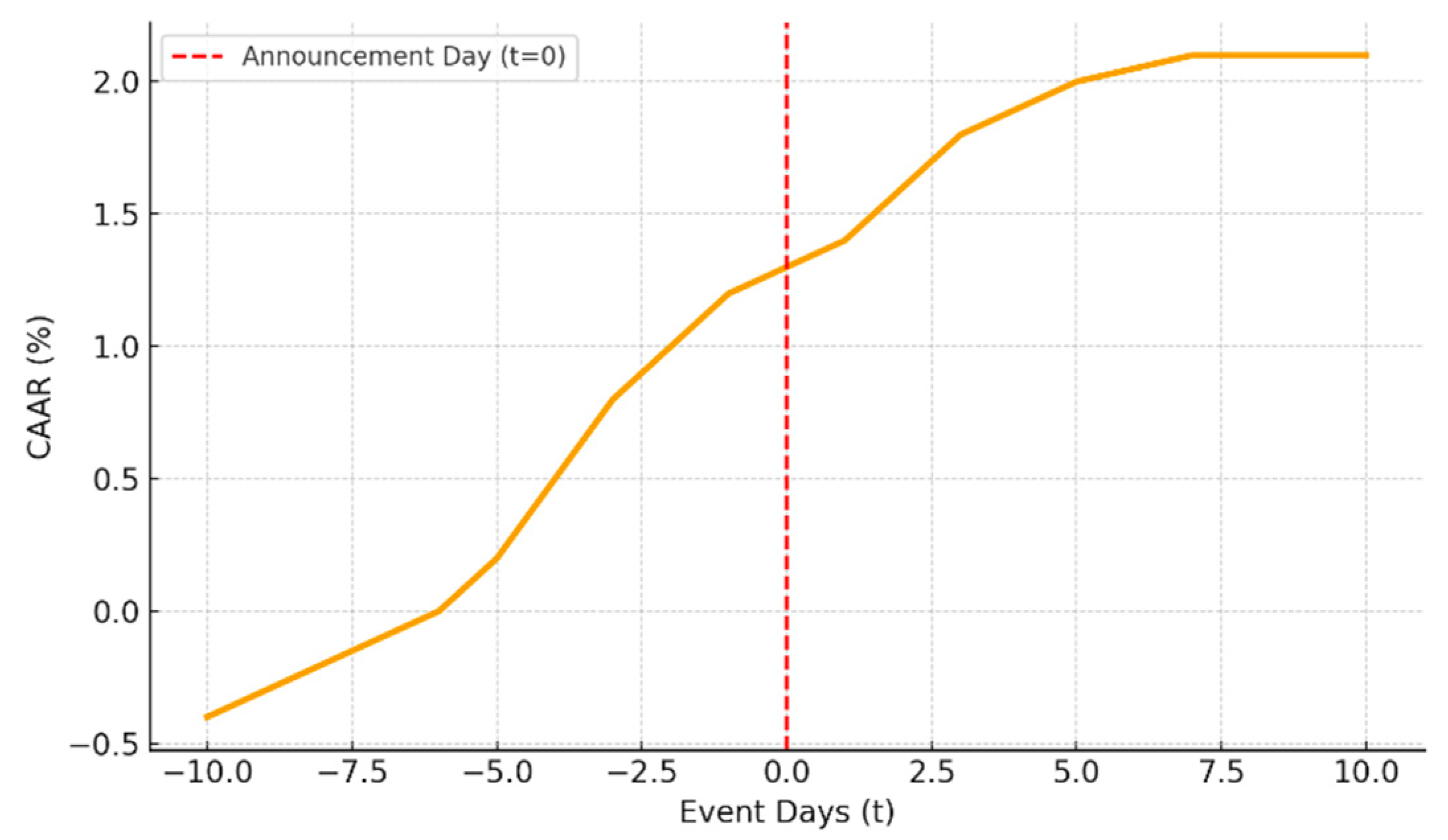
Table 3 reports the average abnormal returns (AAR) and cumulative average abnormal returns (CAAR) around project-award announcements.
The positive and statistically significant CAAR around day 0 indicates that investors reward renewable-project awards, consistent with hypothesis H1.
The strongest reaction occurs within ±1 trading day, suggesting that the market rapidly raises prices in information once public.
These results align with
Almaskati (
2023), who found similar short-term positive responses to renewable-investment announcements by international oil companies, and with
Kandır and Mermer (
2024), who reported positive abnormal returns for Turkish energy firms following renewable-investment news. They also corroborate broader evidence that green strategic disclosures are financially material (
Kruse, 2024;
R. Chen & Majeed, 2024).
4.4. Cross-Sectional Determinants of Market Reaction
To examine heterogeneity, we estimate the regression:
As shown in
Table 4, the coefficient on
Domestic_Sponsor (β = 0.94,
p = 0.021) confirms H2, indicating that locally anchored consortia elicit stronger investor confidence. Similarly,
Project_Capacity (β = 0.37,
p = 0.048) supports H3, suggesting that larger renewable installations are perceived as more strategically relevant for Vision 2030’s diversification agenda. Results confirm H2 and H3:
- (1)
Domestic Saudi firms experience significantly higher positive abnormal returns than foreign sponsors, implying that investors view local firms as better positioned to benefit from government-backed renewable projects.
- (2)
Project size is positively related to CARs, consistent with the signaling hypothesis that large-scale awards convey strategic importance and credible cash-flow impact.
The coefficients on leverage and pre-event volatility are negative, as expected, suggesting that higher risk or indebtedness dampens market enthusiasm. These findings are in line with
Almaskati (
2023) and with studies showing stronger reactions for financially stable, low-risk issuers in green-finance contexts (
Aleknevičienė et al., 2024;
Berdiev, 2025).
4.5. Robustness Checks
To ensure that the findings are not model-specific or driven by estimation artifacts, a series of robustness checks were conducted. First, we re-estimated abnormal returns using two alternative expected-return specifications commonly employed in event-study literature. The first is the market-adjusted model, in which each firm’s return is simply adjusted for the contemporaneous market return (
Brown & Warner, 1985). This model does not require parameter estimation and therefore eliminates potential bias associated with estimation-window misspecification. The second is the CAPM-adjusted model, which accounts for the domestic risk-free rate proxied by the three-month (SAIBOR) and adjusts firm returns for their systematic market risk exposure. The expected return in this specification is given by this equation:
where
denotes the 3-months SAIBOR, and
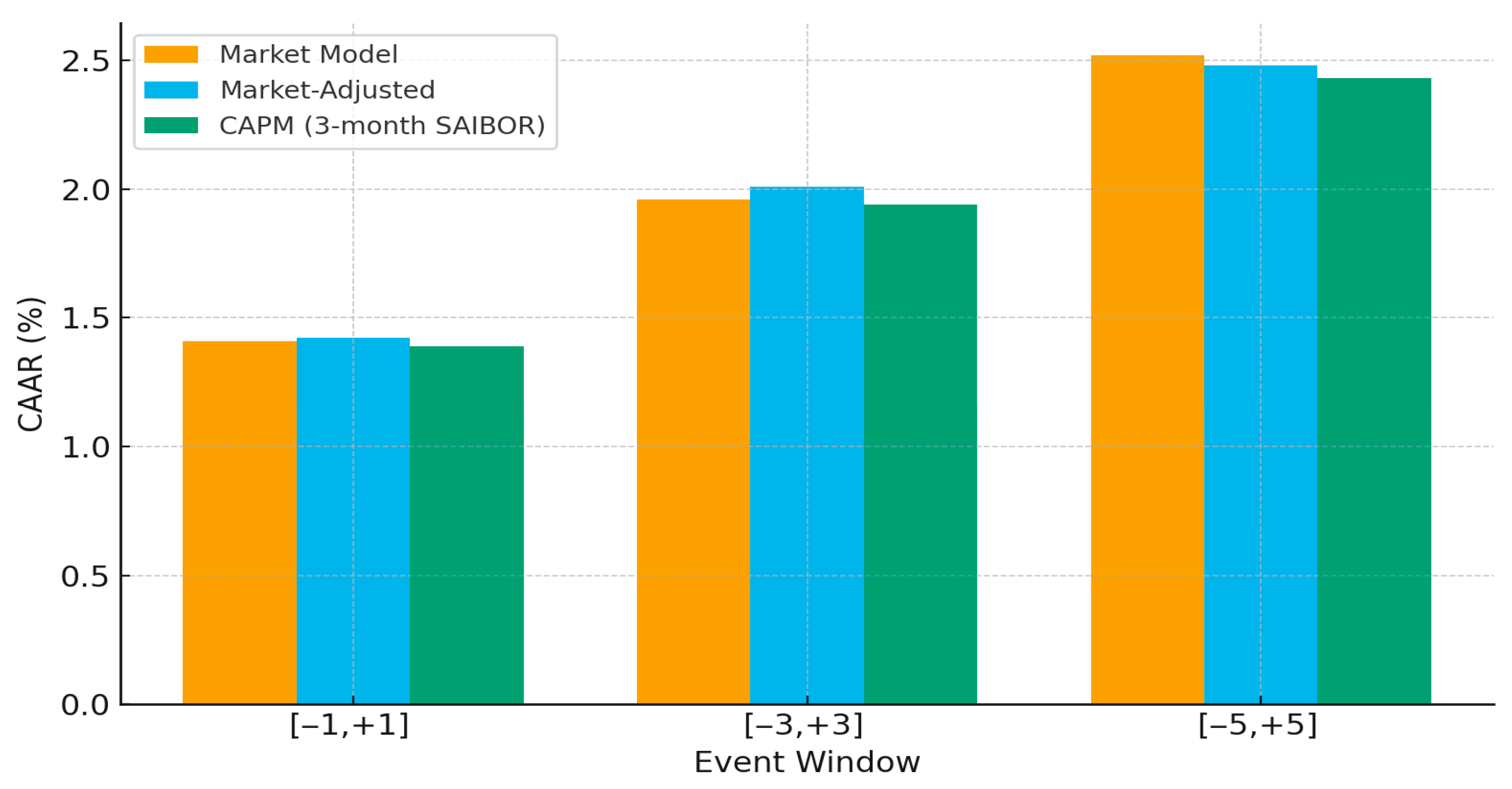
is estimated from the 120-day estimation window preceding each event. Across both alternative benchmarks, the cumulative abnormal returns (CARs) and cumulative average abnormal returns (CAARs) remained positive and statistically significant at conventional levels. Specifically, under the market-adjusted specification, the [−1, +1] window CAAR equaled +1.42% (t = 2.31), while the CAPM-based model produced a nearly identical estimate of +1.39% (t = 2.27). These results corroborate the main event-window findings reported in
Table 4 and
Figure 1, indicating that investor reaction to renewable-project awards is robust to different expected-return assumptions.
To further assess robustness, we repeated the tests using alternative market indices and estimation windows. When (TASI) was replaced by the MSCI Saudi Index, results were qualitatively unchanged. Likewise, shortening or lengthening the estimation window (−100, −250 days) yielded stable coefficients and similar significance levels, confirming that the findings are not sensitive to sample-window choice (
MacKinlay, 1997;
Campbell et al., 1997).
Finally, cross-sectional regressions of CARs controlling for firm size, project capacity, and consortium composition were re-estimated using White-heteroskedasticity-consistent standard errors (
White, 1980) to address potential variance heterogeneity. The coefficients of interest, particularly the positive and significant effect of domestic sponsorship, remained unchanged in sign and magnitude, reinforcing the conclusion that the market rewards credible renewable-energy project awards.
Overall, the convergence of results across all specifications and robustness exercises strengthens confidence in the empirical evidence and mitigates concerns regarding model dependency or sample bias.
Table 5 summarizes the CAAR values across the three models (market, market-adjusted, and CAPM) with corresponding t-statistics.
Figure 2 illustrates that cumulative average abnormal returns (CAARs) are consistently positive across all event windows and model specifications, reinforcing the robustness of the main findings.
4.6. Discussion
The empirical evidence presented in this study suggests that renewable-energy project awards in Saudi Arabia are associated with statistically significant and economically meaningful positive abnormal returns, particularly for domestic sponsors and large-capacity projects. This pattern suggests that investors interpret these awards as credible, value-enhancing strategic actions rather than as cost-inducing diversions from core fossil-fuel operations.
These findings can be explained through several complementary theoretical lenses. First, under signaling theory (
Spence, 1973), project awards convey verifiable information about a firm’s commitment to long-term strategic transformation. Winning a government-backed tender with guaranteed off-take contracts signals superior operational capability, strong political alignment, and reliable future cash-flows. The positive market reaction particularly for domestic firms suggests that investors may interpret renewable project awards as favorable signals about future earnings prospects and strategic alignment with the evolving regulatory- and energy-transition landscape. Similar mechanisms are reported by
Almaskati (
2023) for international oil companies and by
Kandır and Mermer (
2024) for Turkish utilities, both of whom find that capital markets reward credible green initiatives.
Second, the results are consistent with stakeholder and institutional perspectives that emphasize how legitimacy and policy embeddedness affect valuation (
Freeman, 1984;
DiMaggio & Powell, 1983). In an institutional environment where renewable energy forms part of the national Vision 2030 agenda, domestic firms may possess a comparative advantage in accessing state-supported finance, land, or grid connections. Investors appear to internalize these institutional advantages: the significantly higher abnormal returns for Saudi-listed firms imply that local embeddedness enhances perceived project-success probability. Foreign sponsors, by contrast, may face information asymmetries, higher transaction costs, and exposure to policy risk, which temper their market gains despite participation in the same projects.
Third, the magnitude of the reaction is positively related to project scale, reinforcing the strategic-importance hypothesis documented in the event-study literature (
Kothari & Warner, 2007;
Almaskati, 2023). Larger projects convey stronger signals of long-term cash-flow relevance and attract greater media and analyst attention, amplifying market visibility. The non-significant coefficient on firm size, coupled with a positive coefficient on project capacity, indicates that it is the salience of the investment not simply the firm’s market capitalization that drives investor response.
These results also complement the emerging evidence on green-finance materiality. Studies (
Meo & Abd Karim, 2022;
R. Chen & Majeed, 2024) have shown that investors incorporate environmental and sustainability signals into valuation, but the magnitude of the reaction depends on credibility and context. The Saudi evidence broadens this literature by showing that, even in an oil-exporting economy, capital markets recognize renewable-energy awards as economically material events. The finding thus supports the notion that energy-transition investments are not merely reputational; they are financially priced by markets.
From a policy standpoint, the results highlight the catalytic role of transparent and predictable tendering mechanisms. Consistent, well-communicated award processes appear to reinforce investor confidence, reducing uncertainty premiums and potentially lowering the cost of capital for renewable sponsors. Policymakers may therefore strengthen market signaling by standardizing information disclosure and facilitating timely communication through official channels.
From a corporate-strategy perspective, participation in large-scale renewables serves as both a diversification and hedging instrument against transition risk. The positive reaction indicates that shareholders view such diversification favorably when it aligns with national policy and is accompanied by credible financial and operational commitments. Managers in energy and utilities sectors can thus leverage renewable-project participation as a means of enhancing firm valuation, provided the projects exhibit transparent profitability and risk-management structures.
Nevertheless, the heterogeneity of reactions which are positive for domestic and muted for foreign sponsors underscores that investor interpretation remains context-dependent. Markets reward renewables not indiscriminately but when they perceive alignment among corporate strategy, policy credibility, and financial viability. This nuanced interpretation echoes recent findings that investors differentiate between “symbolic” and “substantive” green actions (
Kruse, 2024;
Wójcik et al., 2021).
This study relies on a moderate number of firm–event observations (N = 42) and short event windows, which may limit statistical power and the external validity of the results beyond the Saudi NREP context. Although we screened events to avoid overlap with firm-specific announcements and applied standard robustness procedures, some information leakage, delayed trading responses, or residual confounding cannot be fully ruled out. In addition, foreign-sponsor heterogeneity differences in size, international exposure, and home-market conditions may influence investor interpretation of award announcements and is only partially captured by the empirical controls. These considerations suggest that future research could extend the analysis using larger event sets, alternative windows, and complementary empirical approaches to strengthen generalizability.
In sum, the evidence points to a maturing financial perception of renewables within the Saudi capital market: investors have begun to treat renewable-energy project awards as value-relevant corporate events. This finding carries broader implications for other hydrocarbon-exporting economies seeking to diversify through low-carbon investments. It suggests that once clear institutional support and credible contracting mechanisms are in place, capital markets can indeed reward the energy transition transforming policy commitments into measurable shareholder value.
5. Conclusions and Policy Implications
This study examines how investors in an emerging hydrocarbon-based economy respond to renewable-energy project awards. Focusing on Saudi Arabia’s National Renewable Energy Program (NREP), we employ an event-study design to analyze abnormal stock returns around official award announcements for utility-scale solar and wind projects between 2017 and 2024, considering both domestic and foreign listed sponsors and exploring heterogeneity by firm and project characteristics. Overall, the results indicate statistically significant market reactions to renewable project awards, with the strongest response concentrated around the announcement date. The effects are more pronounced for domestic Saudi firms and larger projects, suggesting that investors may interpret these awards as credible signals of strategic positioning and future growth prospects in the context of Saudi Arabia’s energy transition.
From a theoretical perspective, the findings contribute to signaling and institutional legitimacy frameworks by highlighting the informational role of renewable award announcements, and they extend stakeholder-value discussions by showing that sustainability-aligned investments can be valuation-relevant when perceived as substantive. More broadly, this paper provides context-specific evidence that capital markets in Saudi Arabia respond to renewable-energy procurement outcomes, supporting the view that transparent and credible transition policies can be associated with enhanced investor confidence in line with Vision 2030.
5.1. Policy Implications
From a policy perspective, while the analysis does not establish causality, the observed market responses suggest that transparency and predictability in renewable-energy tendering may be salient to investors. Clearly communicated award processes, standardized disclosure of project and consortium details, and prompt publication of financial-close information strengthen market confidence and reduce uncertainty premiums. These elements are essential for building a liquid, credible pipeline of investable green projects. Consistent with recent evidence from
Meo and Abd Karim (
2022) and
R. Chen and Majeed (
2024), who find that efficient financial systems amplify the positive effects of green investment, Saudi authorities could further enhance the capital-market impact of renewables by facilitating ESG disclosure, encouraging analyst coverage, and integrating renewable-project information into exchange platforms such as Tadawul’s ESG index initiatives.
5.2. Managerial and Strategic Implications
For corporate managers, the results convey a clear message: participation in credible, government-backed renewable projects enhances shareholder value, especially for firms with strong governance and moderate leverage. The positive abnormal returns signal that investors view such participation as a strategic hedge against transition risk (
Kruse, 2024;
Tănasie et al., 2022). Managers should therefore treat renewable-energy projects not as peripheral CSR activities but as core investments aligned with long-term value creation.
Domestic firms, in particular, should leverage their institutional proximity by securing early participation in NREP tenders, maintaining transparent communication with investors, and integrating renewable capacity into their earnings guidance and risk-management disclosures. Foreign partners, by contrast, may need to mitigate perceived policy- and information asymmetries through joint-ventures, local partnerships, and enhanced disclosure of financial exposure to Saudi projects.
5.3. Academic and Future-Research Implications
The findings open multiple avenues for further research. First, future studies could extend this analysis to cross-country comparisons across GCC markets, examining whether market reactions differ by regulatory maturity or financing mechanisms. Second, integrating firm-level ESG scores and carbon-intensity metrics would help determine whether investor responses are conditioned by prior sustainability performance. Third, the use of high-frequency data (e.g., intraday or hourly returns) could reveal more granular reaction dynamics, especially around simultaneous policy announcements.
Finally, subsequent work may incorporate textual analysis of news sentiment or machine-learning models to quantify investor attention, building on emerging methods in green-finance research (
Aleknevičienė et al., 2024;
Berdiev, 2025). Such extensions would deepen understanding of how information, credibility, and institutional context interact in pricing the energy transition.