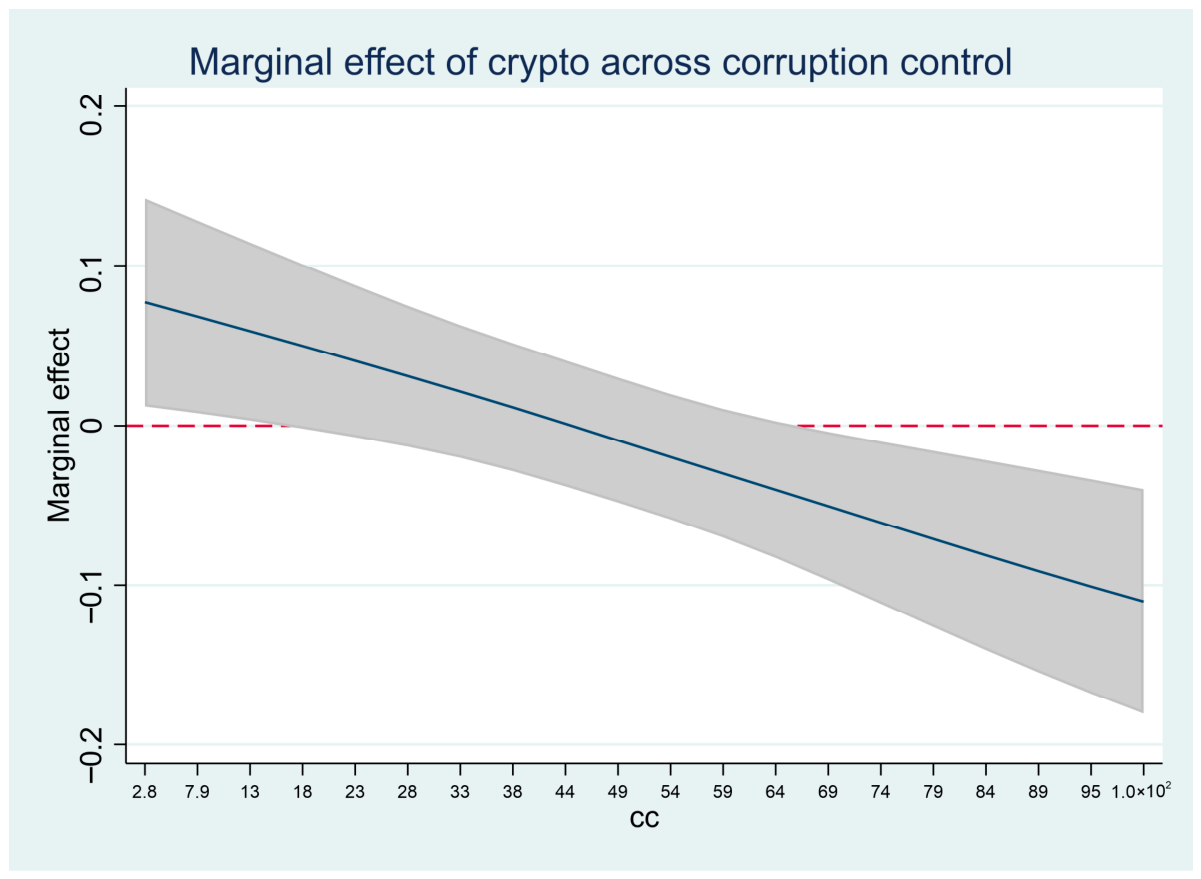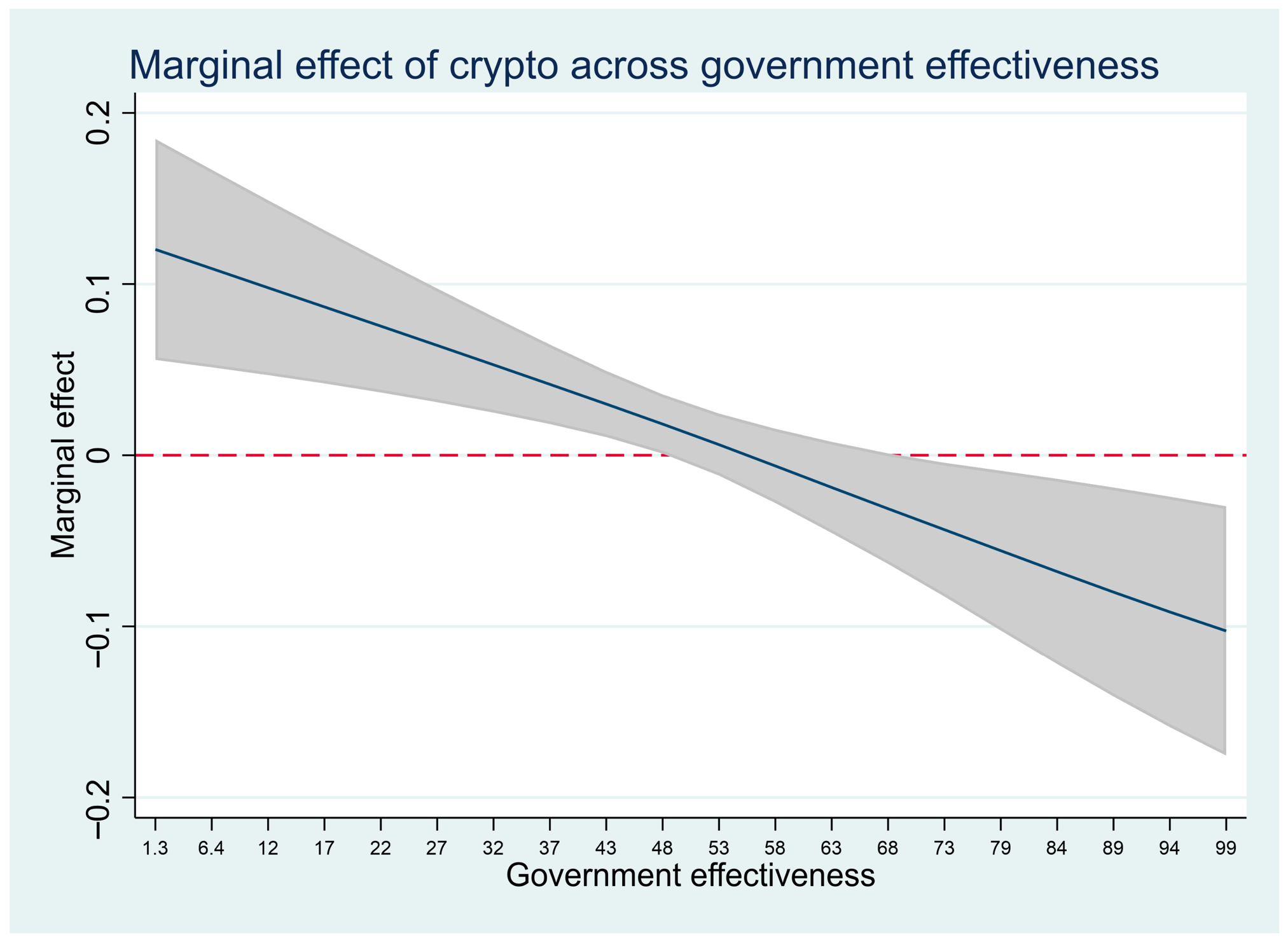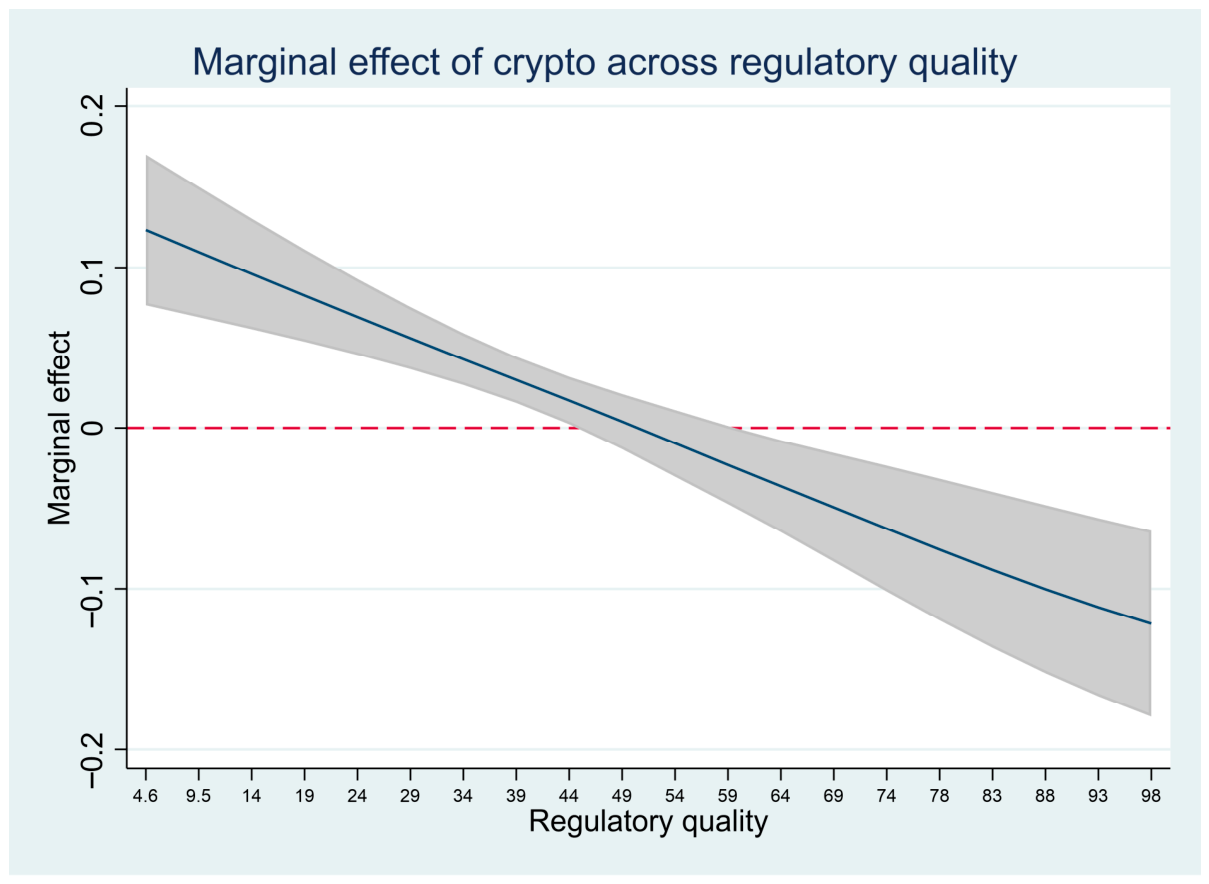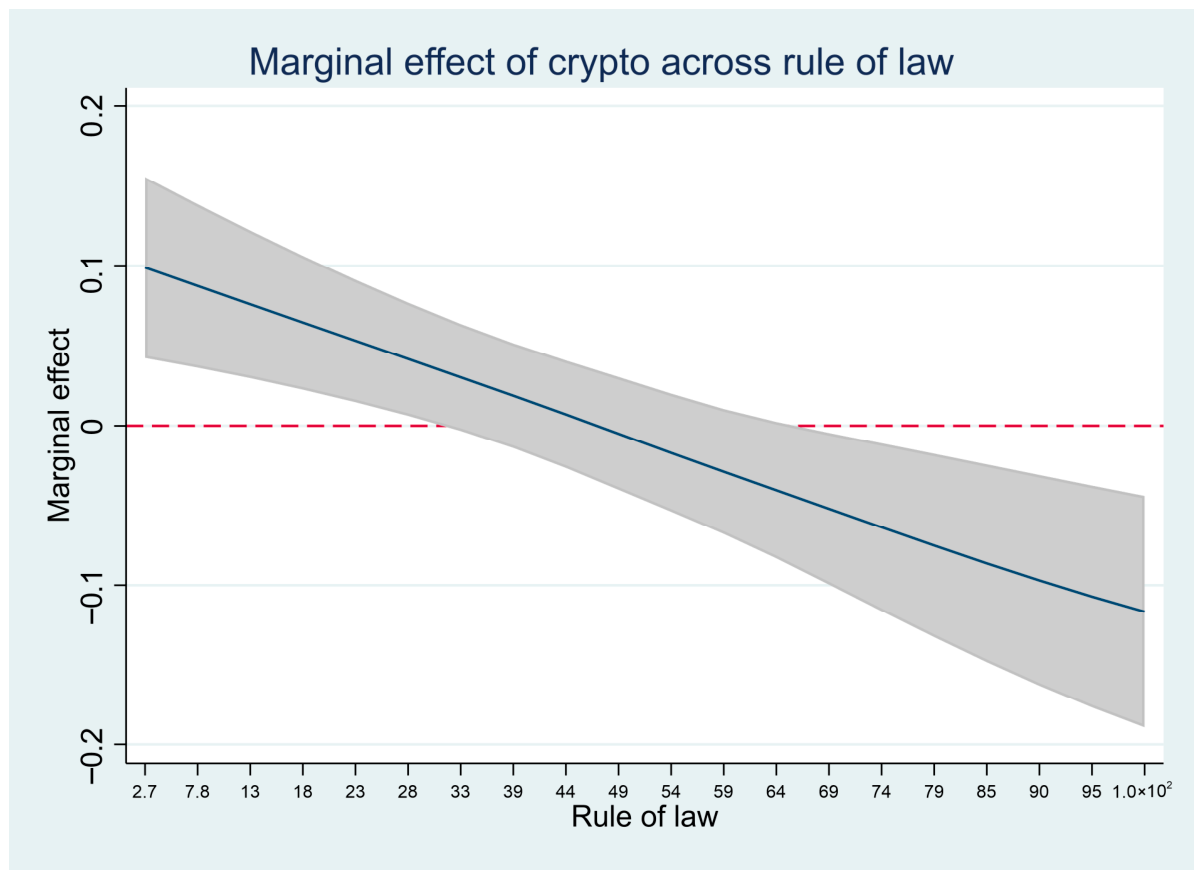

Cryptocurrency Adoption and Financial Resilience: A Worldwide Fractional Probit Analysis and Institutional Moderation

Abstract
1. Introduction
2. Literature Review
2.1. Improving Resilience Through Inclusion and Diversification
2.2. Resilience Challenge: Risks of Destabilisation and Contagion
2.3. The Institutional Substitution Framework: Crypto-Assets as Informal Reagents
3. Methodology
3.1. Research Framework
3.2. Data and Variables
3.3. Econometric Model
3.3.1. Baseline Model
- is the financial resilience score of country i;
- is the cryptocurrency adoption indicator;
- is a vector of control variables;
- represents the cumulative link function (probit).
3.3.2. Moderating Effect of Institutions
- is the financial resilience score of country i;
- denotes the institutional quality indicator.
4. Results
4.1. Effect of Cryptocurrencies on Financial Resilience
4.2. Moderating Role of Institutions
5. Conclusions
Funding
Institutional Review Board Statement
Informed Consent Statement
Data Availability Statement
Conflicts of Interest
Appendix A

| Variable | Description | Source |
|---|---|---|
| Financial resilience | Financial Resilience Index | Global Findex Database |
| Crypto adoption | Percentage of the population that uses cryptocurrency | (Chainalysis, 2023) |
| Account ownership | Percentage of the population that has a bank account | World development indicators (World Bank) |
| GDP per capita | Per capita GDP | World development indicators (World Bank) |
| Lower secondary completion rate | Percentage of the population with secondary education | World development indicators (World Bank) |
| Financial development | Domestic credit to private sector | World development indicators (World Bank) |
| Unemployment | Percentage of the population that is unemployed | World development indicators (World Bank) |
| Inflation | Consumer price inflation | World development indicators (World Bank) |
| Age dependency ratio | Dependency ratio of young and older people on working people | World development indicators (World Bank) |
| Share of agricultural sector | Value added from agriculture and forestry | World development indicators (World Bank) |
| Internet secure servers | Number of internet security devices | World development indicators (World Bank) |
| Corruption | Corruption control index | World governance indicators (World Bank) |
| Government Effectiveness | Governance Effectiveness index | World governance indicators (World Bank) |
| Regulation | Regulatory Quality index | World governance indicators (World Bank) |
| Government accountability | Government accountability and integrity index | World governance indicators (World Bank) |
| Rule of Law | Law and rule compliance index | World governance indicators (World Bank) |
| Variable | VIF | 1/VIF |
|---|---|---|
| GDP per capita | 3.12 | 0.321 |
| Share of agriculture in the economy | 3.07 | 0.326 |
| Lower secondary education completion rate | 2.68 | 0.373 |
| Age dependency ratio | 2.39 | 0.418 |
| Financial development | 2.15 | 0.466 |
| Secure internet servers per million | 1.97 | 0.509 |
| Unemployment | 1.27 | 0.789 |
| Inflation | 1.13 | 0.881 |
| Crypto adoption | 1.13 | 0.884 |
| Account ownership | 1.09 | 0.915 |
| Mean VIF | 2.00 |
| Variable | VIF | 1/VIF |
|---|---|---|
| Government Effectiveness | 30.900 | 0.032 |
| Rule of Law | 29.620 | 0.034 |
| Corruption | 14.380 | 0.070 |
| Regulatory Quality | 12.340 | 0.081 |
| Voice and Accountability | 4.850 | 0.206 |
| GDP per capita | 4.110 | 0.243 |
| Lower secondary education completion rate | 3.530 | 0.283 |
| Share of agriculture in the economy | 3.120 | 0.320 |
| Age dependency ratio | 2.950 | 0.339 |
| Financial development | 2.470 | 0.405 |
| Secure internet servers per million | 2.220 | 0.451 |
| Unemployment | 1.460 | 0.684 |
| Inflation | 1.310 | 0.765 |
| Crypto adoption | 1.220 | 0.821 |
| Account ownership | 1.140 | 0.875 |
| Mean VIF | 7.710 |
| Independent Variable | Full Sample | Low Income Countries (GDP per Capita < 13,845) | High Income Countries (GDP per Capita > 13,845) |
|---|---|---|---|
| Cryptocurrency adoption | 0.020 | 0.031 ** | −0.069 ** |
| (0.013) | (0.016) | (0.028) | |
| Account ownership | 1.811 *** | 1.563 *** | 3.855 *** |
| (0.458) | (0.545) | (1.055) | |
| Account ownership squared | −2.097 *** | −2.042 *** | −3.358 *** |
| (0.327) | (0.415) | (0.756) | |
| GDP per capita | 0.034 | −0.026 | 0.042 |
| (0.048) | (0.065) | (0.055) | |
| Lower secondary completion rate | 0.004 *** | 0.005 *** | 0.003 |
| (0.001) | (0.002) | (0.003) | |
| Financial development | −0.002 ** | −0.003 *** | 0.000 |
| (0.001) | (0.001) | (0.001) | |
| Unemployment rate | −0.002 | −0.001 | 0.019 * |
| (0.006) | (0.008) | (0.010) | |
| Inflation rate | −0.006 * | −0.007 * | 0.005 |
| (0.003) | (0.004) | (0.034) | |
| Age dependency ratio | −0.003 | −0.009 | −0.009 * |
| (0.004) | (0.006) | (0.005) | |
| Share of agricultural sector | 0.001 | −0.005 | 0.006 |
| (0.006) | (0.007) | (0.032) | |
| Secure internet servers | −0.009 | −0.001 | 0.042 * |
| (0.017) | (0.019) | (0.023) | |
| Constant | 0.020 | 0.031 ** | −0.069 ** |
| (0.013) | (0.016) | (0.028) | |
| Observations | 112 | 74 | 38 |
| Standard errors in parentheses |
| Independent Variables | Corruption | Government Effectiveness | Regulatory Quality | Voice and Accountability | Rule of Law |
|---|---|---|---|---|---|
| Cryptocurrency adoption | 0.092 ** | 0.139 *** | 0.149 *** | 0.089 ** | 0.117 *** |
| (0.041) | (0.041) | (0.028) | (0.040) | (0.035) | |
| Corruption | 0.004 | ||||
| (0.002) | |||||
| Corruption × crypto | −0.002 *** | ||||
| (0.001) | |||||
| Account ownership | 2.123 *** | 1.946 *** | 2.057 *** | 2.712 *** | 2.269 *** |
| (0.402) | (0.410) | (0.369) | (0.434) | (0.441) | |
| Account ownership squared | −2.416 *** | −2.296 *** | −2.409 *** | −2.890 *** | −2.549 *** |
| (0.306) | (0.298) | (0.270) | (0.331) | (0.330) | |
| GDP per capita | 0.013 | 0.003 | −0.029 | −0.022 | −0.019 |
| (0.053) | (0.052) | (0.042) | (0.045) | (0.054) | |
| Lower secondary completion rate | 0.005 *** | 0.006 *** | 0.006 *** | 0.006 *** | 0.005 *** |
| (0.002) | (0.002) | (0.002) | (0.002) | (0.002) | |
| Domestic credit to private sector | −0.001 * | −0.001 * | −0.001 * | −0.001 * | −0.001 * |
| (0.001) | (0.001) | (0.001) | (0.001) | (0.001) | |
| Unemployment rate | −0.001 | −0.003 | −0.001 | −0.001 | −0.001 |
| (0.006) | (0.006) | (0.005) | (0.006) | (0.006) | |
| Inflation rate | −0.006 ** | −0.006 ** | −0.005 ** | −0.005 * | −0.006 ** |
| (0.003) | (0.003) | (0.002) | (0.002) | (0.003) | |
| Age dependency ratio | −0.003 | −0.003 | −0.004 | −0.004 | −0.002 |
| (0.004) | (0.004) | (0.004) | (0.003) | (0.004) | |
| Share of agricultural sector | 0.001 | −0.001 | −0.002 | −0.001 | −0.002 |
| (0.006) | (0.006) | (0.005) | (0.005) | (0.006) | |
| Secure internet servers | −0.016 | −0.018 | −0.015 | −0.026 * | −0.016 |
| (0.015) | (0.015) | (0.014) | (0.014) | (0.015) | |
| Government Effectiveness | 0.005 * | ||||
| (0.003) | |||||
| Government Effectiveness × crypto | −0.003 *** | ||||
| (0.001) | |||||
| Regulatory Quality | 0.006 *** | ||||
| (0.002) | |||||
| Regulatory Quality × crypto | −0.003 *** | ||||
| (0.001) | |||||
| Voice and Accountability | 0.006 *** | ||||
| (0.002) | |||||
| Voice and Accountability × crypto | −0.002 *** | ||||
| (0.001) | |||||
| Rule of Law | 0.005 ** | ||||
| (0.002) | |||||
| Rule of Law × crypto | −0.003 *** | ||||
| (0.001) | |||||
| Constant | 0.092 ** | 0.139 *** | 0.149 *** | 0.089 ** | 0.117 *** |
| (0.041) | (0.041) | (0.028) | (0.040) | (0.035) | |
| Observations | 112 | 112 | 112 | 112 | 112 |
| Standard errors in parentheses | |||||


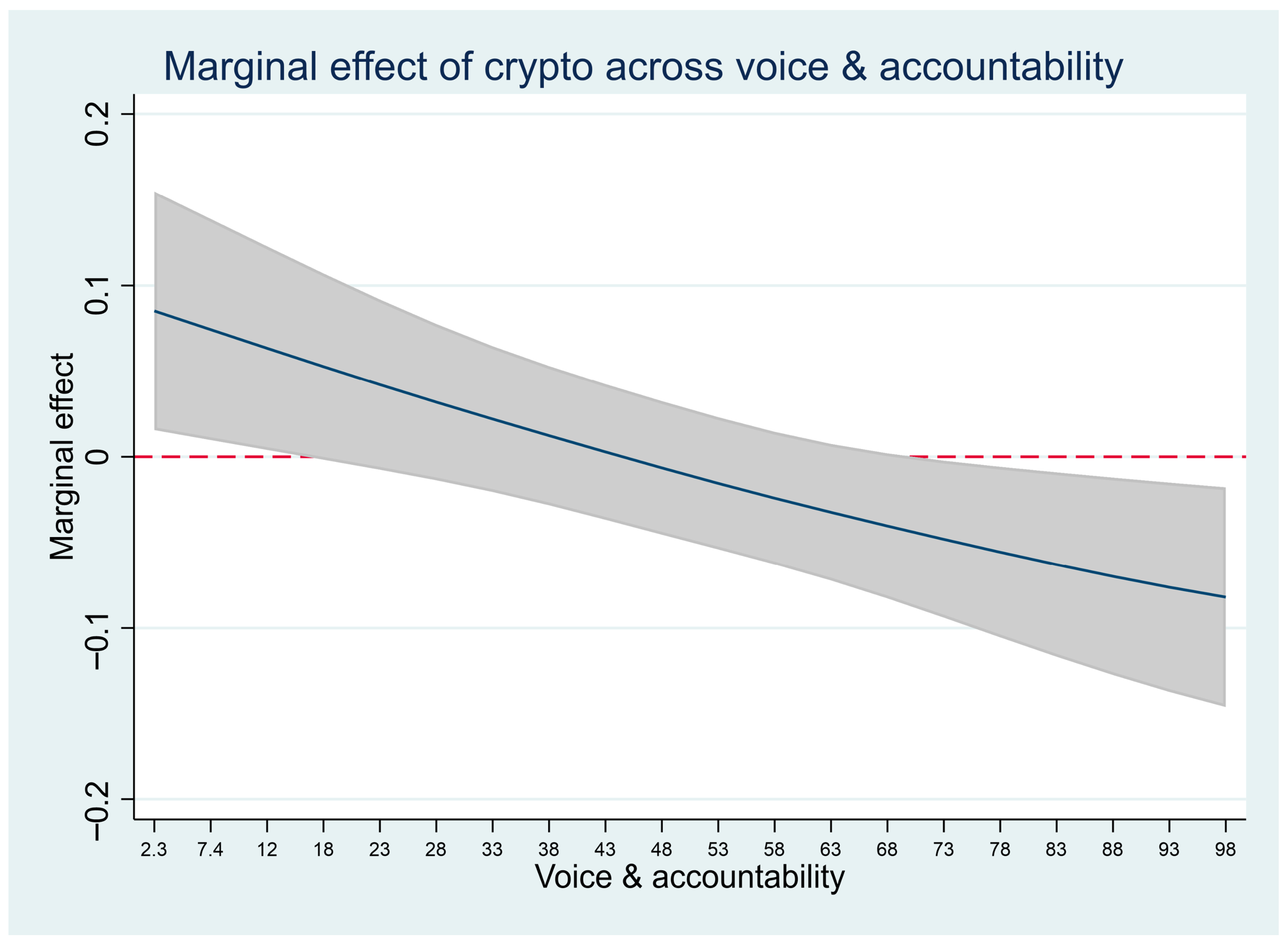

| 1 | When assessing resilience, it is crucial to distinguish between the different types of shocks that can threaten economic stability. These can be broadly classified into two groups. Direct financial shocks: These are shifts within the financial system itself that are either endogenous or exogenous, such as sudden currency devaluations, unexpected inflation spikes, or the abrupt contraction of available credit (liquidity shocks). Non-financial shocks: These originate outside the financial system but result in severe financial consequences. Examples include health shocks (e.g., a primary breadwinner falling ill and incurring high medical expenses and lost wages) and climate shocks (e.g., floods or droughts destroying agricultural yields or physical infrastructure). |
| 2 | As a result, the raw coefficient of 0.127 for cryptocurrency adoption in developing countries corresponds to an AME of 0.031. This implies that, on average, a one-unit increase in the cryptocurrency adoption index (or a shift from non-adoption to adoption in a binary context) is associated with a 3.1 percentage points increase in the probability of financial resilience, ceteris paribus. |
References
- Adekunle, A. O. (2024). Cryptocurrency market volatility and risk management during global crises: A systematic literature review (2013–2023). Sinergi International Journal of Accounting and Taxation, 2(1), 55–68. [Google Scholar] [CrossRef]
- Aiello, D., Baker, S. R., Balyuk, T., Di Maggio, M., Johnson, M. J., & Kotter, J. D. (2023). Who invests in crypto? Wealth, financial constraints, and risk attitudes. No. w31856. National Bureau of Economic Research. [Google Scholar]
- Akpa, A. F., & Gnidehou, M. G. (2025). Access to finance in the digital age: Does digital financial inclusion promote financial development in emerging countries? African Development Review, 37(2), e70009. [Google Scholar] [CrossRef]
- Aslanidis, N., Bariviera, A. F., & Perez-Laborda, A. (2021). Are cryptocurrencies becoming more interconnected? Economics Letters, 199, 109725. [Google Scholar] [CrossRef]
- Badawi, E., & Jourdan, G.-V. (2020). Cryptocurrencies: Emerging threats and defensive mechanisms: A systematic literature review. IEEE Access, 8, 200021–200037. [Google Scholar] [CrossRef]
- Ballis, A., Karagiorgis, A., Anastasiou, D., & Kallandranis, C. (2025). Cryptocurrency dynamics during global crises: Insights from Bitcoin’s interplay with traditional markets. International Review of Economics & Finance, 103, 104512. [Google Scholar] [CrossRef]
- Barber, B. M., & Odean, T. (2001). Boys will be boys: Gender, overconfidence, and common stock investment. Quarterly Journal of Economics, 116(1), 261–292. [Google Scholar] [CrossRef]
- Baumol, W. J. (1952). The transactions demand for cash: An inventory theoretic approach. Quarterly Journal of Economics, 66(4), 545–556. [Google Scholar] [CrossRef]
- Beavers, R., & Godek, J. (2024). Crypto household behavior and experience during COVID-19. Cogent Economics & Finance, 12(1), 2386388. [Google Scholar] [CrossRef]
- Bialowolski, P., Weziak-Bialowolska, D., Lee, M. T., Chen, Y., VanderWeele, T. J., & McNeely, E. (2021). The role of financial conditions for physical and mental health: Evidence from a longitudinal survey and insurance claims data. Social Science & Medicine, 281, 114041. [Google Scholar] [CrossRef]
- BIS, Bank for International Settlements. (2023). Financial stability risks from cryptoassets in emerging market economies (BIS papers No. 138). Available online: https://www.bis.org/publ/bppdf/bispap138.pdf (accessed on 15 January 2026).
- Bouri, E., Kamal, E., & Kinateder, H. (2023). FTX collapse and systemic risk spillovers from FTX token to major cryptocurrencies. Finance Research Letters, 58, 104289. [Google Scholar] [CrossRef]
- Chai, L., & Lu, Z. (2025). The association between financial strain and mental health: The mediating and moderating roles of sleep problems in the UK household longitudinal study (UKHLS). Journal of Affective Disorders, 377, 245–253. [Google Scholar] [CrossRef] [PubMed]
- Chainalysis. (2023). The 2023 global crypto adoption index. Chainalysis. Available online: https://www.chainalysis.com/blog/2023-global-crypto-adoption-index/ (accessed on 15 January 2026).
- Conlon, T., & McGee, R. (2020). Safe haven or risky hazard? Bitcoin during the COVID-19 bear market. Finance Research Letters, 35, 101607. [Google Scholar] [CrossRef]
- Cook, D. O., Kieschnick, R., & McCullough, B. D. (2008). Regression analysis of proportions in finance with self-selection. Journal of Empirical Finance, 15(5), 860–867. [Google Scholar] [CrossRef]
- Corbet, S., Hou, Y., Hu, Y., Larkin, C., & Oxley, L. (2020). Cryptocurrency safe-havens during the COVID-19 pandemic. Economics Letters, 194, 109377. [Google Scholar] [CrossRef]
- Dang, T. H. N., Balli, F., Balli, H. O., & Kilic, I. (2025). Demographic-governance factors shaping cryptocurrency holding behavior. Finance Research Letters, 85, 108143. [Google Scholar] [CrossRef]
- De Long, J. B., Shleifer, A., Summers, L. H., & Waldmann, R. J. (1990). Noise trader risk in financial markets. Journal of Political Economy, 98(4), 703–738. [Google Scholar] [CrossRef]
- Demirgüç-Kunt, A., Klapper, L., Singer, D., Ansar, S., & Hess, J. (2020). The Global Findex Database 2017: Measuring financial inclusion and opportunities to expand access to and use of financial services. The World Bank Economic Review, 34, S2–S8. [Google Scholar] [CrossRef]
- Du, Y., Wang, Q., & Zhou, J. (2023). How does digital inclusive finance affect economic resilience: Evidence from 285 cities in China. International Review of Financial Analysis, 88, 102709. [Google Scholar] [CrossRef]
- El Hajj, M., & Farran, I. (2024). The cryptocurrencies in emerging markets: Enhancing financial inclusion and economic empowerment. Journal of Risk Financial Management, 17(10), 467. [Google Scholar] [CrossRef]
- European Systemic Risk Board (ESRB). (2025). Crypto-assets and decentralised finance: Report on stablecoins, crypto-investment products and multi-function groups. ESRB. Available online: https://www.esrb.europa.eu/pub/pdf/reports/esrb.report202510_cryptoassets.en.pdf (accessed on 12 December 2025).
- Goodell, G., Al-Nakib, H. D., & Tasca, P. (2020). Digital currency and economic crises: Helping states respond. arXiv, arXiv:2006.03023v3. [Google Scholar] [CrossRef]
- Greenwood, J., & Jovanovic, B. (1990). Financial development, growth, and the distribution of income. Journal of Political Economy, 98(5), 1076–1107. [Google Scholar] [CrossRef]
- Guo, Y., Yousef, E., & Naseer, M. M. (2025). Examining the drivers and economic and social impacts of cryptocurrency adoption. FinTech, 4(1), 5. [Google Scholar] [CrossRef]
- Hegarty, T., & Whelan, K. (2022). The wisdom of no crowds: The reaction of betting markets to lockdown soccer games. Available online: https://EconPapers.repec.org/RePEc:cpr:ceprdp:17273 (accessed on 17 January 2026).
- Islam, K., & Chowdhury, M. (2024). From struggle to strain: Effects of financial distress on household vulnerability to poverty. International Journal of Social Economics, 52(8), 1117–1133. [Google Scholar] [CrossRef]
- Krause, D. (2025). Algorithmic stablecoins: Mechanisms, risks, and lessons from the fall of TerraUSD. Available online: https://ssrn.com/abstract=5092827 (accessed on 11 January 2025).
- Kutner, M. H., Nachtsheim, C. J., Neter, J., & Li, W. (2005). Applied linear statistical models (5th ed.). McGraw-Hill. [Google Scholar]
- Lanciano, E., Previati, D., & Ricci, O. (2026). Crypto ownership among young people: The effect of financial literacy, risk propensity and behavioural biases. The European Journal of Finance, 32(3), 399–419. [Google Scholar] [CrossRef]
- Lee, S., Lee, J., & Lee, Y. (2023). Dissecting the Terra-LUNA crash: Evidence from the spillover effect and information flow. Finance Research Letters, 58, 104289. [Google Scholar] [CrossRef]
- Levine, R. (2005). Finance and growth: Theory and evidence. In P. Aghion, & S. N. Durlauf (Eds.), Handbook of economic growth (Vol. 1B, pp. 865–934). Elsevier. [Google Scholar] [CrossRef]
- Liao, G. Y., & Caramichael, J. (2022). Stablecoins: Growth potential and impact on banking. International Finance Discussion Papers 1334. Board of Governors of the Federal Reserve System (U.S.). [CrossRef]
- Minarni, E. (2025). Cryptocurrency adoption and its influence on financial stability in emerging markets. Jurnal Konseling dan Pendidikan, 13(1), 420–431. [Google Scholar] [CrossRef]
- Minsky, H. P. (1986). Stabilizing an unstable economy. Yale University Press. [Google Scholar]
- Mullahy, J. (2015). Multivariate fractional regression estimation of econometric share models. Journal of Econometric Methods, 4(1), 71–100. [Google Scholar] [CrossRef]
- North, D. C. (1990). Institutions, institutional change and economic performance. Cambridge University Press. [Google Scholar]
- OECD. (2025). Improving the digital financial literacy of crypto-asset users. OECD Publishing. [Google Scholar] [CrossRef]
- Pacelli, V., Pampurini, F., & Quaranta, A. G. (2025). Cryptocurrencies and traditional financial markets: Interconnections, systemic risk, and implications for financial stability. Journal of Financial Stability, 72, 101312. [Google Scholar] [CrossRef]
- Papke, L. E., & Wooldridge, J. M. (1996). Econometric methods for fractional response variables with an application to 401(k) plan participation rates. Journal of Applied Econometrics, 11(6), 619–632. [Google Scholar] [CrossRef]
- Ramalho, E. A., Ramalho, J. J. S., & Murteira, J. M. R. (2011). Alternative estimating and testing empirical strategies for fractional regression models. Journal of Economic Surveys, 25(1), 19–68. [Google Scholar] [CrossRef]
- Santiago, A., López, M., & Ramírez, J. (2025). Contagion and resilience in stablecoin markets: Evidence from DCC-GARCH models during the Terra-Luna collapse. International Review of Financial Analysis, 97((Pt B)), 103456. [Google Scholar] [CrossRef]
- Schumpeter, J. A. (1934). The theory of economic development. Harvard University Press. [Google Scholar]
- Shahzad, S. J. H., Bouri, E., Kristoufek, L., & Saeed, T. (2025). Safe-haven properties of cryptocurrencies and stablecoins: Evidence from shock absorption and risk transmission during market turbulence. International Review of Financial Analysis, 98((Pt A)), 103512. [Google Scholar] [CrossRef]
- Shiller, R. J. (2017). Narrative economics: How stories go viral and drive major economic events. American Economic Review, 107(4), 967–1004. [Google Scholar] [CrossRef]
- Stiglitz, J. E., & Weiss, A. (1981). Credit rationing in markets with imperfect information. American Economic Review, 71(3), 393–410. Available online: https://www.jstor.org/stable/1802787 (accessed on 15 January 2026).
- Suri, T., Bharadwaj, P., & Jack, W. (2021). Fintech and household resilience to shocks: Evidence from digital loans in Kenya. Journal of Development Economics, 153, 102697. [Google Scholar] [CrossRef]
- Townsend, R. M. (1994). Risk and insurance in village India. Econometrica, 62(3), 539–591. [Google Scholar] [CrossRef]
- Verma, R., & Chatterjee, D. (2025). Relative impact of digital and traditional financial inclusion on financial resilience: Evidence from 13 emerging countries. Digital Finance—Transforming Financial Landscapes for Companies and Households, 133, 106233. [Google Scholar] [CrossRef]
- Verma, S., & Atri, A. (2024). Institutional quality, human capital, and technological innovation: Evidence from emerging economies. Technological Forecasting and Social Change, 198, 122956. [Google Scholar] [CrossRef]
- Viñuela, L., Fernández, A., & García, M. (2020). Cryptocurrencies, institutional quality, and financial stability: Opportunities and risks in regulated economies. Journal of Financial Regulation, 6(2), 145–168. [Google Scholar] [CrossRef]
- Waren, R. (2025). Sectoral exposures and contagion channels in cryptocurrency markets: A network analysis of systemic risk transmission. Journal of Financial Stability, 71, 101289. [Google Scholar] [CrossRef]
- Wei, Y., Wu, F., Zhou, P., & Kirkulak-Uludag, B. (2025). Exploring resilience in the cryptocurrency market: Risk transmission and network robustness. International Review of Financial Analysis, 106, 104546. [Google Scholar] [CrossRef]
- Win, T., Li, Y., & Zhang, X. (2025). Complex networks and risk contagion: Analyzing resilience in cryptocurrency markets. Journal of Financial Stability, 68, 101456. [Google Scholar] [CrossRef]
- Zou, X., Dai, W., & Meng, S. (2024). The impacts of digital finance on economic resilience. Sustainability, 16, 7305. [Google Scholar] [CrossRef]
| Study | Methodology | Main Results |
|---|---|---|
| Minarni (2025) | Literature review and qualitative analysis of cryptocurrency/DeFi adoption impacts on financial stability and inclusion in emerging markets. | DeFi innovation enhances resilience by providing decentralised tools for lending, borrowing, and earning interest without relying on central banks or traditional intermediaries. Promotes individual control, transparency (via blockchain), and economic stability in unstable environments. However, also notes volatility risks that can undermine stability if unregulated. |
| Win et al. (2025) | Complex networks analysis; DCC-GARCH (Dynamic Conditional Correlation GARCH) model for risk contagion in the crypto market (beyond Bitcoin). | Crypto market gains robustness as it matures. Leading cryptos (e.g., Bitcoin) act as net risk receivers (absorb shocks), while smaller/highly active ones can accelerate contagion. Confirms inherent technical risks, with lessons from crashes like Terra/Luna (2022). |
| Krause (2025) | Analysis of algorithmic stablecoin mechanisms and ecosystem failures (case study approach focused on technical design flaws). | Confirms that the technical functioning of cryptocurrencies is inherently risky. Draws key lessons from major crashes, such as the Terra (Luna) ecosystem collapse in May 2022. |
| Ballis et al. (2025) | Analysis of trading volumes, price behaviour, and safe-haven properties during global crises (e.g., COVID-19, Russia–Ukraine war, Israel–Palestine conflict). | Cryptocurrencies (esp. Bitcoin) attract investors during disruptions, with increased trading volumes. Act as diversification tools and perceived stable long-term digital assets, reducing dependence on traditional markets and enhancing portfolio resilience. |
| El Hajj and Farran (2024) | Structural equation modelling (SEM) on survey/construct data: cryptocurrency adoption (CA), financial inclusion (FI), user satisfaction (US), trust in institutions (TFIs), perceived economic empowerment (PEE). Focused on emerging markets. | Cryptocurrency adoption significantly improves FI, US, TFI, and PEE in developing countries. Positive relationships extend through interaction effects, promoting economic empowerment and inclusion. |
| Liao and Caramichael (2022) | Review/analysis of stablecoin roles in DeFi, collateral backing, and liquidity provision. | Stablecoins provide ~45% of liquidity in decentralised platforms and act as a “safe haven” against other crypto volatility. Support automated liquidations in DeFi as protection mechanisms. Dollar-pegged stablecoins can serve as a digital safe-haven currency during crypto distress. |
| Aslanidis et al. (2021) | Analysis of conditional/dynamic correlations (generalised DCC-class models) among cryptocurrencies, stocks, bonds, and gold. | Positive correlations among cryptocurrencies that vary over time but tend to increase overall. Cryptos are gradually losing internal diversification benefits, raising systemic/contagion risks. Negligible correlations with traditional assets in some periods. |
| Suri et al. (2021) | Fuzzy regression discontinuity (RD) design around M-Shwari credit score threshold; administrative + survey data from Kenya. Compares households just above vs. below the eligibility cutoff. | Digital fintech loans (e.g., M-Shwari) improve household resilience to shocks (illness, death, job loss, etc.). Eligible households are 6.3 per cent less likely to forego essential expenses (food, education, health). No substitution with other credit forms. Enhances financial access for the unbanked without creating over-indebtedness. |
| Badawi and Jourdan (2020) | Systematic literature review of emerging threats and defensive mechanisms in cryptocurrencies. | Highlights threats (e.g., cyber risks due to pseudo-anonymity) alongside defensive strategies. Underscores cryptocurrencies’ potential for portfolio diversification and strengthening individual resilience. |
| Study | Methodology | Main Results |
|---|---|---|
| Minarni (2025) | Qualitative literature review on cryptocurrency adoption and financial stability in emerging markets. | While crypto aids inclusion and DeFi innovation (lending/borrowing without central intermediaries), extreme volatility and speculation erode resilience in fragile economies. Amplifies vulnerabilities via risky behaviour; highlights regulatory challenges. |
| Shahzad et al. (2025) | Analysis of safe-haven properties, shock absorption, and transmission (likely correlation or regime-based models). | Cautions against overestimating stablecoins as safe havens. Stablecoins often absorb shocks without transmitting them, but their role is nuanced. |
| Lee et al. (2023) and Santiago et al. (2025) | Information theory/spillover analysis (Lee); lessons on stablecoin resilience and depegging risks (Santiago). | Massive contagion mechanisms in stablecoin failures (e.g., Terra/Luna). Propose pegging (linking to stable assets like USD or gold) to reduce volatility and protect against shocks. Highlight lessons from depegging events. |
| Waren (2025) | Likely theoretical or empirical analysis of sectoral exposures and contagion channels. | Examines sectoral exposures as a mechanism for crypto shocks affecting institutional resilience. Consistent with trust channel (post-FTX panic) and broader theoretical models of crypto-traditional finance interconnections. |
| Santiago et al. (2025) | Dynamic Conditional Correlation (DCC-GARCH) and related models for analysing contagion during events like Terra-Luna collapse; lessons on stablecoin resilience (drawing from volatility correlations and depegging analysis). | Highlights mechanisms of massive contagion in stablecoin failures (e.g., algorithmic stablecoins like UST). Proposes lessons for improving resilience of stablecoins, including design improvements to mitigate death spirals, volatility transmission, and spillovers to other crypto assets and traditional markets. |
| Conlon and McGee (2020) | Event study/safe-haven analysis during the COVID-19 bear market; comparison of Bitcoin returns with traditional assets (e.g., S&P 500). | Bitcoin does not act as a safe haven during acute bear markets; instead, it decreases in price in lockstep with equities. Contributes to investor pessimism and highlights heightened risks during prolonged market declines. |
| Bouri et al. (2023) | Lower tail dependence (downside risk) approach; Rotated Gumbel copula and GARCH copula quantile regression-based ΔCoVaR models. | Significant downside risk spillovers from FTX Token (FTT) to major cryptocurrencies (strongest to Solana due to staking exposure). |
| Pacelli et al. (2025) | Analysis of interconnections, tail risk connectedness (e.g., TENET networks or spillover models) between crypto and traditional markets. | Interconnections increase implications for financial stability, regulation, and risk management. Crypto shocks spread rapidly to traditional equities (and vice versa), with stronger downside effects. |
| Wei et al. (2025) | Contagion and spillover analysis across crypto sizes/maturities and traditional assets. | Smaller cryptos sometimes accelerate contagion; overall market develops robustness over time. Pronounced downside spillovers to traditional markets. |
| Corbet et al. (2020) | Analysis of liquidity–volatility interrelationships, contagion, and market dynamics during COVID-19 crisis periods (often using GARCH-type or correlation models). | During prolonged bear markets and crises, cryptocurrencies exhibit increased volatility and liquidity pressures, amplifying pessimism among investors. Shows interactions between crypto volatility and broader market panic, with limited safe-haven properties. |
| Variable | Obs | Mean | Std. Dev. | Min | Max |
|---|---|---|---|---|---|
| Financial resilience | 112 | 63.615 | 41.584 | 0.000 | 99.402 |
| Crypto adoption | 112 | 1.976 | 2.278 | 0.000 | 13.460 |
| Account ownership | 112 | 70.405 | 22.893 | 14.827 | 99.855 |
| GDP per capita | 112 | 15,077 | 18,446 | 263 | 86,102 |
| Lower secondary education completion rate | 112 | 78.375 | 22.206 | 8.887 | 107.969 |
| Financial development | 108 | 57.819 | 44.810 | 3.727 | 234.975 |
| Unemployment | 105 | 7.696 | 4.910 | 0.336 | 26.412 |
| Inflation | 112 | 4.570 | 6.961 | 0.115 | 64.028 |
| Age dependency ratio | 112 | 14.739 | 10.038 | 1.889 | 47.084 |
| Share of agriculture in the economy | 112 | 9.378 | 9.030 | 0.021 | 36.368 |
| Secure internet servers per million | 112 | 11,410 | 23,128 | 1 | 139,896 |
| Corruption | 112 | 51.464 | 29.694 | 2.765 | 99.654 |
| Government Effectiveness | 112 | 52.046 | 28.738 | 1.253 | 99.222 |
| Regulatory Quality | 112 | 51.570 | 29.279 | 4.625 | 98.139 |
| Voice and Accountability | 112 | 49.860 | 29.363 | 2.678 | 99.957 |
| Rule of Law | 112 | 51.178 | 29.063 | 2.341 | 98.410 |
| Independent Variable | Full Sample | Low Income Countries (GDP per Capita < 13,845) | High Income Countries (GDP per Capita > 13,845) |
|---|---|---|---|
| Cryptocurrency adoption | 0.089 | 0.127 * | −0.485 ** |
| (0.057) | (0.066) | (0.210) | |
| Account ownership | 7.996 *** | 6.329 ** | 27.029 *** |
| (2.160) | (2.457) | (7.152) | |
| Account ownership squared | −9.260 *** | −8.269 *** | −23.541 *** |
| (1.649) | (2.041) | (5.202) | |
| GDP per capita | 0.149 | −0.105 | 0.293 |
| (0.213) | (0.261) | (0.394) | |
| Lower secondary completion rate | 0.018 *** | 0.022 *** | 0.018 |
| (0.007) | (0.008) | (0.023) | |
| Financial development | −0.007 ** | −0.011 *** | 0.003 |
| (0.003) | (0.003) | (0.006) | |
| Unemployment rate | −0.011 | −0.004 | 0.133 * |
| (0.026) | (0.031) | (0.074) | |
| Inflation rate | −0.026 * | −0.027 * | 0.034 |
| (0.014) | (0.015) | (0.240) | |
| Age dependency ratio | −0.011 | −0.034 | −0.064 * |
| (0.019) | (0.025) | (0.038) | |
| Share of agricultural sector | 0.003 | −0.020 | 0.045 |
| (0.026) | (0.029) | (0.224) | |
| Secure internet servers | −0.039 | −0.005 | 0.295 * |
| (0.077) | (0.079) | (0.160) | |
| Constant | −1.949 | 0.854 | −12.339 *** |
| (2.037) | (2.490) | (4.060) | |
| Observations | 112 | 74 | 38 |
| Standard errors in parentheses |
| Independent Variables | Corruption | Government Effectiveness | Regulatory Quality | Voice and Accountability | Rule of Law |
|---|---|---|---|---|---|
| Cryptocurrency adoption | 0.436 ** | 0.664 *** | 0.738 *** | 0.435 ** | 0.563 *** |
| (0.200) | (0.210) | (0.157) | (0.200) | (0.176) | |
| Corruption | 0.017 | ||||
| (0.011) | |||||
| Corruption × crypto | −0.010 *** | ||||
| (0.004) | |||||
| Account ownership | 10.065 *** | 9.274 *** | 10.197 *** | 13.270 *** | 10.942 *** |
| (2.053) | (2.072) | (2.067) | (2.385) | (2.299) | |
| Account ownership squared | −11.451 *** | −10.942 *** | −11.939 *** | −14.139 *** | −12.293 *** |
| (1.687) | (1.659) | (1.724) | (1.987) | (1.860) | |
| GDP per capita | 0.063 | 0.014 | −0.144 | −0.110 | −0.093 |
| (0.254) | (0.249) | (0.208) | (0.216) | (0.257) | |
| Lower secondary completion rate | 0.026 *** | 0.027 *** | 0.028 *** | 0.028 *** | 0.026 *** |
| (0.008) | (0.008) | (0.008) | (0.008) | (0.008) | |
| Domestic credit to private sector | −0.007 * | −0.007 * | −0.006 | −0.006 * | −0.006 * |
| (0.004) | (0.004) | (0.004) | (0.004) | (0.004) | |
| Unemployment rate | −0.004 | −0.014 | −0.004 | −0.004 | −0.006 |
| (0.028) | (0.028) | (0.026) | (0.030) | (0.028) | |
| Inflation rate | −0.030 ** | −0.029 ** | −0.026 ** | −0.023 * | −0.029 ** |
| (0.015) | (0.014) | (0.011) | (0.012) | (0.014) | |
| Age dependency ratio | −0.015 | −0.015 | −0.017 | −0.021 | −0.012 |
| (0.018) | (0.019) | (0.018) | (0.016) | (0.019) | |
| Share of agricultural sector | 0.004 | −0.003 | −0.011 | −0.007 | −0.008 |
| (0.029) | (0.028) | (0.027) | (0.026) | (0.027) | |
| Secure internet servers | −0.077 | −0.084 | −0.074 | −0.129 * | −0.077 |
| (0.072) | (0.071) | (0.068) | (0.069) | (0.073) | |
| Government Effectiveness | 0.023 * | ||||
| (0.013) | |||||
| Government Effectiveness × crypto | −0.012 *** | ||||
| (0.004) | |||||
| Regulatory Quality | 0.032 *** | ||||
| (0.010) | |||||
| Regulatory Quality × crypto | −0.015 *** | ||||
| (0.004) | |||||
| Voice and Accountability | 0.032 *** | ||||
| (0.008) | |||||
| Voice and Accountability × crypto | −0.010 *** | ||||
| (0.004) | |||||
| Rule of Law | 0.026 ** | ||||
| (0.011) | |||||
| Rule of Law × crypto | −0.012 *** | ||||
| (0.004) | |||||
| Constant | −2.456 | −2.144 | −1.411 | −2.230 | −1.654 |
| (2.232) | (2.267) | (1.996) | (2.038) | (2.214) | |
| Observations | 112 | 112 | 112 | 112 | 112 |
| Standard errors in parentheses | |||||
Disclaimer/Publisher’s Note: The statements, opinions and data contained in all publications are solely those of the individual author(s) and contributor(s) and not of MDPI and/or the editor(s). MDPI and/or the editor(s) disclaim responsibility for any injury to people or property resulting from any ideas, methods, instructions or products referred to in the content. |
© 2026 by the author. Licensee MDPI, Basel, Switzerland. This article is an open access article distributed under the terms and conditions of the Creative Commons Attribution (CC BY) license.
Share and Cite
Ndiaye, B. Cryptocurrency Adoption and Financial Resilience: A Worldwide Fractional Probit Analysis and Institutional Moderation. J. Risk Financial Manag. 2026, 19, 344. https://doi.org/10.3390/jrfm19050344
Ndiaye B. Cryptocurrency Adoption and Financial Resilience: A Worldwide Fractional Probit Analysis and Institutional Moderation. Journal of Risk and Financial Management. 2026; 19(5):344. https://doi.org/10.3390/jrfm19050344
Chicago/Turabian StyleNdiaye, Babacar. 2026. "Cryptocurrency Adoption and Financial Resilience: A Worldwide Fractional Probit Analysis and Institutional Moderation" Journal of Risk and Financial Management 19, no. 5: 344. https://doi.org/10.3390/jrfm19050344
APA StyleNdiaye, B. (2026). Cryptocurrency Adoption and Financial Resilience: A Worldwide Fractional Probit Analysis and Institutional Moderation. Journal of Risk and Financial Management, 19(5), 344. https://doi.org/10.3390/jrfm19050344