Implementation and Resource Optimization of an Oral Anticancer Medication Clinical Pharmacy Trainee Program: Operational and Financial Impact at a Tertiary Cancer Centre


1
Department of Pharmacy, Sunnybrook Odette Cancer Centre, Toronto, ON M4N 3M5, Canada
2
Leslie Dan Faculty of Pharmacy, University of Toronto, Toronto, ON M5S 3M2, Canada
*
Author to whom correspondence should be addressed.
Curr. Oncol. 2026, 33(9), 523; https://doi.org/10.3390/curroncol33090523
Submission received: 17 July 2026
/
Revised: 26 August 2026
/
Accepted: 27 August 2026
/
Published: 31 August 2026
(This article belongs to the Special Issue Unveiling the Economic Impact of Cancer Treatment)
Simple Summary
The rapid growth in the number of oral anticancer medications is placing mounting operational and financial strain on outpatient hospital budgets, as the intensive clinical monitoring required to ensure patient safety demands the continuous expansion of licensed clinical pharmacist staffing—a model that is increasingly unsustainable within public healthcare systems. This study evaluates an innovative solution: embedding pharmacy co-op students into structured, algorithm-driven ambulatory care workflows at a comprehensive Canadian cancer centre. Over the evaluation period, the trainee resource safely absorbed over 600 complex clinical tasks and captured 43% of a full-time licensed pharmacist’s workload capacity. By leveraging supervised pharmacy trainees, the program expanded institutional workload capacity equivalent to a clinical pharmacist at approximately 65% of the total fiscal investment. This operational framework provides cancer centres with a blueprint to increase pharmacy capacity, optimize labor expenses, and actively contain institutional costs without compromising patient care.
Abstract
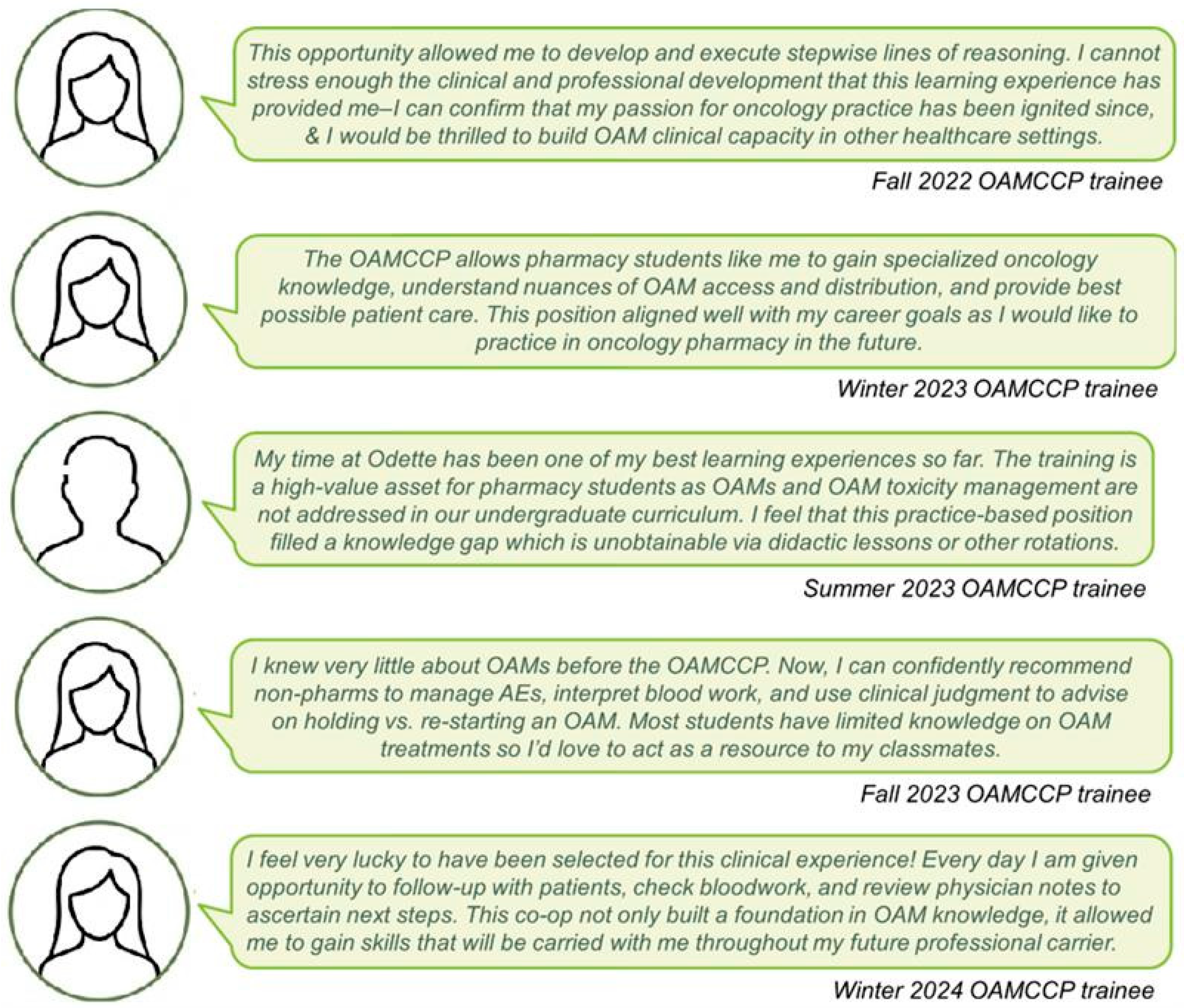
Background: The emergence of oral anticancer medications (OAMs) has increased demand for specialized clinical pharmacy services (CPSs). Concurrently, Canadian cross-sectional data highlights undergraduate education gaps, with fewer than 14% of community pharmacists reporting adequate training on OAM therapies. We designed, implemented, and evaluated a pharmacist-led Oral Anticancer Medication Clinical Co-op Program (OAMCCP) to bridge this experiential education gap while cost-effectively expanding institutional capacity. Methods: Launched in Fall 2022, the OAMCCP integrated one PharmD student per 16-week term into a multidisciplinary oncology specialty pharmacy. Trainees executed core ambulatory oncology clinical pharmacy key performance indicators (AOcpKPIs), including Best Possible Medication Histories (BPMHs), drug–drug interaction (DDI) screenings, and proactive adherence and toxicity follow-up. Student competency was verified by a licensed oncology pharmacist to maintain patient safety. Impact was quantified via self-reported task logging over 15 weeks, standardized 10-point patient satisfaction surveys, payroll expenditure comparisons, and student testimonials. Results: Trainees completed 673 clinical tasks (~45 tasks/week), contributing 16.2 h of direct clinical support weekly—effectively adding +0.43 full-time equivalent (FTE) to service capacity. Mean patient satisfaction was 9.5/10 (n = 29), with students successfully managing inquiries in 96.5% of encounters. Financially, a 1.0 FTE student (44,700 CAD/year cost) captured clinical capacity valued at 69,300 CAD/year (0.43 FTE pharmacist equivalence). Conclusions: The OAMCCP resolves experiential training gaps while presenting a safe, scalable, and financially viable human resource framework that expands oncology pharmacy services.