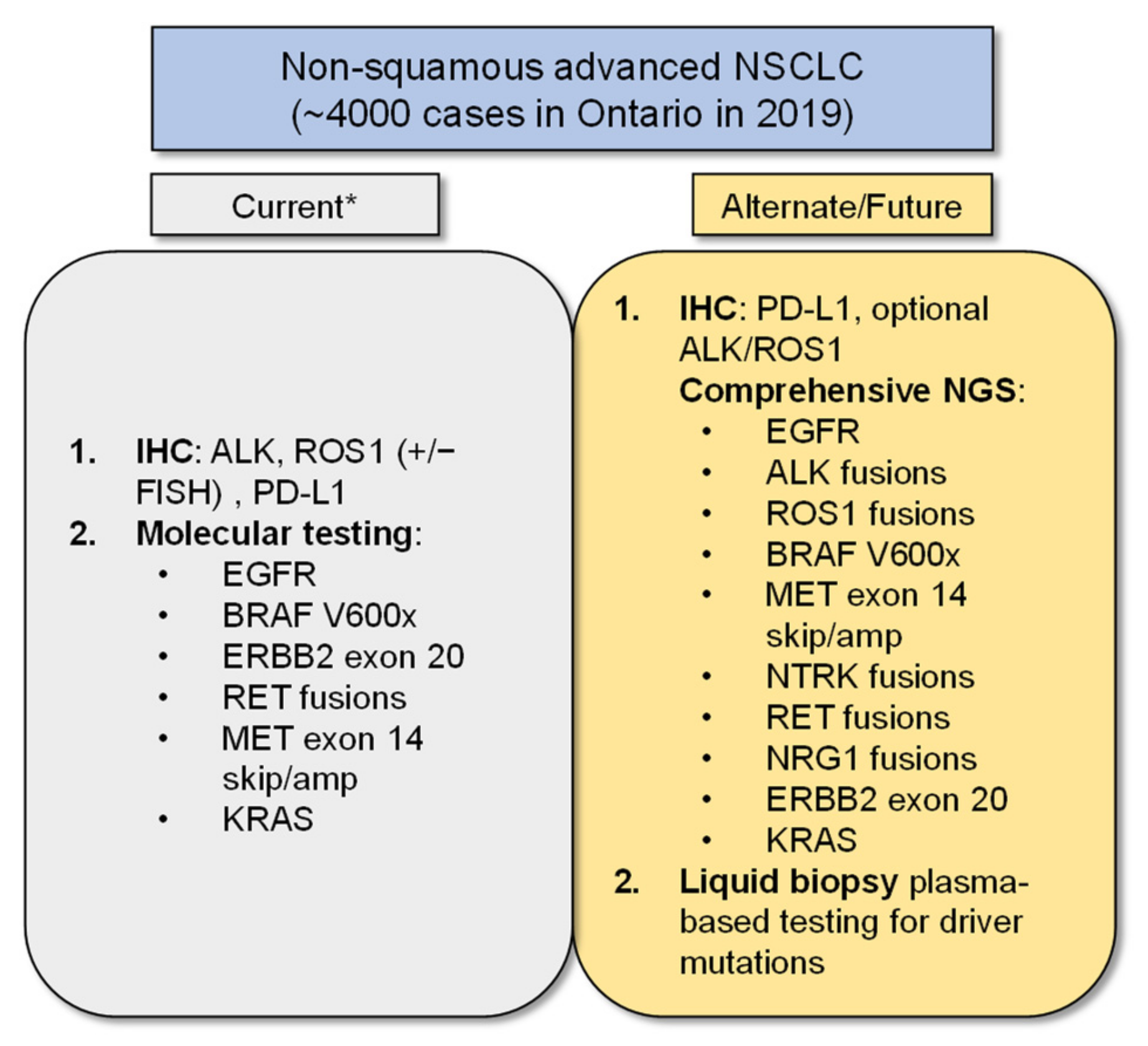
Reflex ROS1 IHC Screening with FISH Confirmation for Advanced Non-Small Cell Lung Cancer—A Cost-Efficient Strategy in a Public Healthcare System

 , , and
 Abstract
Share and Cite
Makarem, M.; Ezeife, D.A.; Smith, A.C.; Li, J.J.N.; Law, J.H.; Tsao, M.-S.; Leighl, N.B. Reflex ROS1 IHC Screening with FISH Confirmation for Advanced Non-Small Cell Lung Cancer—A Cost-Efficient Strategy in a Public Healthcare System. Curr. Oncol. 2021, 28, 3268-3279. https://doi.org/10.3390/curroncol28050284
Makarem M, Ezeife DA, Smith AC, Li JJN, Law JH, Tsao M-S, Leighl NB. Reflex ROS1 IHC Screening with FISH Confirmation for Advanced Non-Small Cell Lung Cancer—A Cost-Efficient Strategy in a Public Healthcare System. Current Oncology. 2021; 28(5):3268-3279. https://doi.org/10.3390/curroncol28050284
Chicago/Turabian StyleMakarem, Maisam, Doreen A. Ezeife, Adam C. Smith, Janice J. N. Li, Jennifer H. Law, Ming-Sound Tsao, and Natasha B. Leighl. 2021. "Reflex ROS1 IHC Screening with FISH Confirmation for Advanced Non-Small Cell Lung Cancer—A Cost-Efficient Strategy in a Public Healthcare System" Current Oncology 28, no. 5: 3268-3279. https://doi.org/10.3390/curroncol28050284
APA StyleMakarem, M., Ezeife, D. A., Smith, A. C., Li, J. J. N., Law, J. H., Tsao, M.-S., & Leighl, N. B. (2021). Reflex ROS1 IHC Screening with FISH Confirmation for Advanced Non-Small Cell Lung Cancer—A Cost-Efficient Strategy in a Public Healthcare System. Current Oncology, 28(5), 3268-3279. https://doi.org/10.3390/curroncol28050284