The Environmental Determinants of Skin Health: Linking Climate Change, Air Pollution, and the Dermatologic Disease Burden

 ,
,
Abstract
1. Introduction
2. Methodology
3. Overview of Air Pollutants and Climate Stressors
3.1. Common Air Pollutants
3.2. Climate Related Stressors
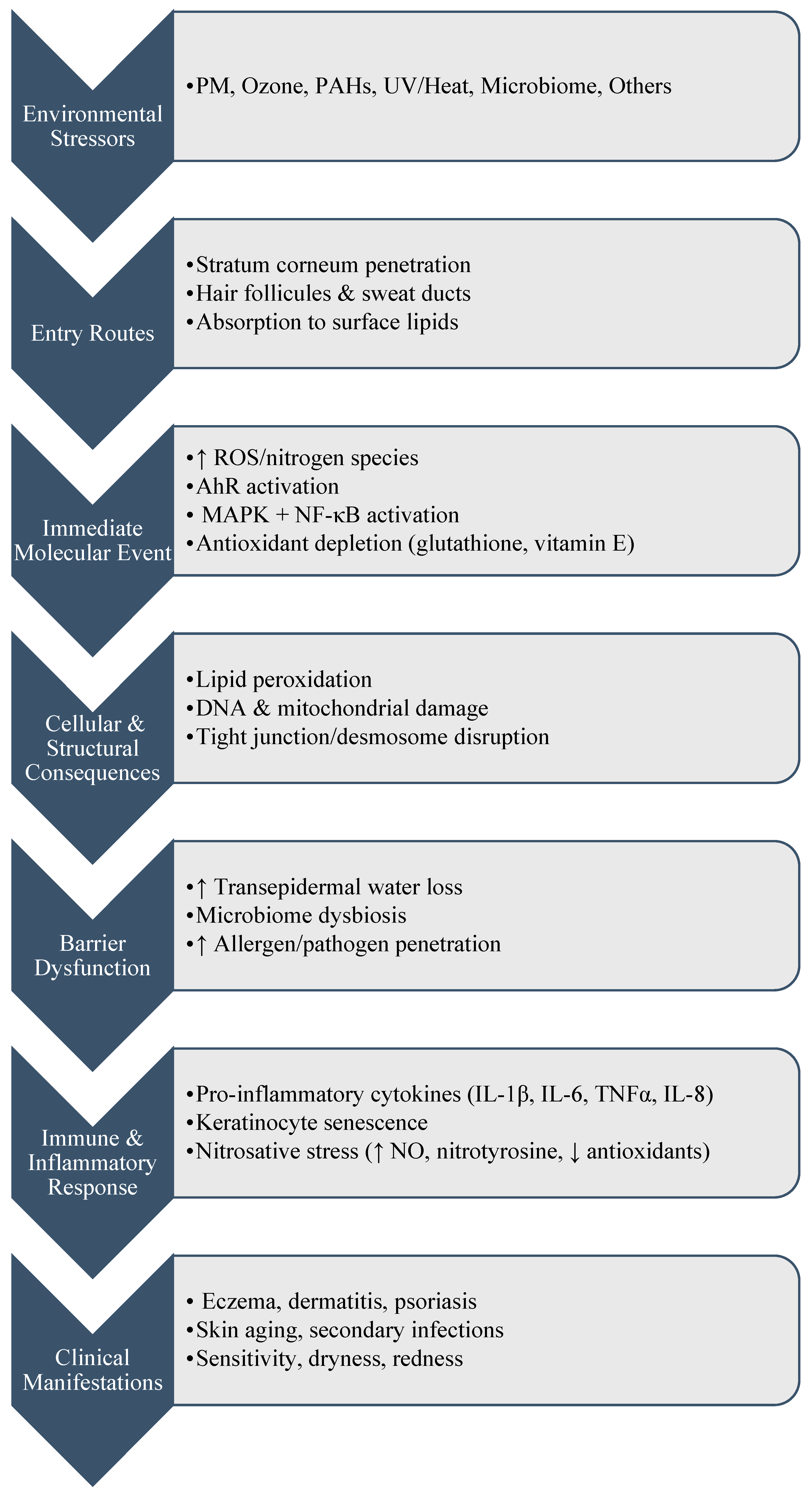
3.3. Pathophysiological Mechanisms
3.4. Dermatological Disorders Linked to Pollution and Climate Change
4. Vulnerable Populations and Global Disparities
5. Clinical and Public Health Implications
6. Future Directions and Research Gaps
7. Conclusions
Author Contributions
Funding
Institutional Review Board Statement
Informed Consent Statement
Data Availability Statement
Conflicts of Interest
Abbreviations
| UV | Ultraviolet |
| PAH | Polycyclic aromatic hydrocarbons |
| PM | Particulate matter |
| VOCs | Volatile organic compounds |
| NF-κB | Nuclear Factor kappa-light-chain-enhancer of activated B cells |
| MAPK | Mitogen-Activated Protein Kinase |
| IL-1β | Interleukin-1 beta |
| IL-6 | Interleukin-6 |
| TNF-α | Tumor Necrosis Factor alpha |
| IL-8 | Interleukin-8 |
| IL-17 | Interleukin-17 |
| Th17 | T helper 17 cell |
| AD | Atopic dermatitis |
| NO | Nitric oxide |
| AhR | Aryl hydrocarbon receptor |
References
- Yousef, H.; Alhajj, M.; Fakoya, A.O.; Sharma, S. Anatomy, Skin (Integument), Epidermis. In StatPearls; StatPearls Publishing LLC.: Treasure Island, FL, USA, 2025. [Google Scholar]
- Junior, V.H.; Mendes, A.L.; Talhari, C.C.; Miot, H.A. Impact of environmental changes on Dermatology. An. Bras. Dermatol. 2021, 96, 210–223. [Google Scholar] [CrossRef] [PubMed]
- Krutmann, J.; Moyal, D.; Liu, W.; Kandahari, S.; Lee, G.S.; Nopadon, N.; Xiang, L.F.; Seité, S. Pollution and acne: Is there a link? Clin. Cosmet. Investig. Dermatol. 2017, 10, 199–204. [Google Scholar] [CrossRef] [PubMed]
- Kim, Y.M.; Kim, J.; Han, Y.; Jeon, B.H.; Cheong, H.K.; Ahn, K. Short-term effects of weather and air pollution on atopic dermatitis symptoms in children: A panel study in Korea. PLoS ONE 2017, 12, e0175229. [Google Scholar] [CrossRef] [PubMed]
- Grether-Beck, S.; Felsner, I.; Brenden, H.; Marini, A.; Jaenicke, T.; Aue, N.; Welss, T.; Uthe, I.; Krutmann, J. Air pollution-induced tanning of human skin. Br. J. Dermatol. 2021, 185, 1026–1034. [Google Scholar] [CrossRef]
- To, T.; Zhu, J.; Stieb, D.; Gray, N.; Fong, I.; Pinault, L.; Jerrett, M.; Robichaud, A.; Ménard, R.; van Donkelaar, A.; et al. Early life exposure to air pollution and incidence of childhood asthma, allergic rhinitis and eczema. Eur. Respir. J. 2020, 55, 1900913. [Google Scholar] [CrossRef]
- Chen, P.; Zhang, Y.; Zhang, T.; Li, J.; Shen, M.; Mao, R.; Zhang, C. Association of air pollution with incidence of late-onset seborrhoeic dermatitis: A prospective cohort study in UK Biobank. Clin. Exp. Dermatol. 2024, 49, 1164–1170. [Google Scholar] [CrossRef]
- Manisalidis, I.; Stavropoulou, E.; Stavropoulos, A.; Bezirtzoglou, E. Environmental and Health Impacts of Air Pollution: A Review. Front. Public Health 2020, 8, 14. [Google Scholar]
- Bais, A.F.; Lucas, R.M.; Bornman, J.F.; Williamson, C.E.; Sulzberger, B.; Austin, A.T.; Wilson, S.R.; Andrady, A.L.; Bernhard, G.; McKenzie, R.L.; et al. Environmental effects of ozone depletion, UV radiation and interactions with climate change: UNEP Environmental Effects Assessment Panel, update 2017. Photochem. Photobiol. Sci. 2018, 17, 127–179. [Google Scholar] [CrossRef]
- Grzywa-Celińska, A.; Krusiński, A.; Milanowski, J. ‘Smoging kills’—Effects of air pollution on human respiratory system. Ann. Agric. Environ. Med. 2020, 27, 1–5. [Google Scholar]
- Gu, X.; Li, Z.; Su, J. Air pollution and skin diseases: A comprehensive evaluation of the associated mechanism. Ecotoxicol. Environ. Saf. 2024, 278, 116429. [Google Scholar] [CrossRef]
- Anderson, J.O.; Thundiyil, J.G.; Stolbach, A. Clearing the air: A review of the effects of particulate matter air pollution on human health. J. Med. Toxicol. 2012, 8, 166–175. [Google Scholar] [CrossRef]
- Kim, K.H.; Jahan, S.A.; Kabir, E.; Brown, R.J. A review of airborne polycyclic aromatic hydrocarbons (PAHs) and their human health effects. Environ. Int. 2013, 60, 71–80. [Google Scholar] [CrossRef]
- Mallah, M.A.; Changxing, L.; Mallah, M.A.; Noreen, S.; Liu, Y.; Saeed, M.; Xi, H.; Ahmed, B.; Feng, F.; Mirjat, A.A.; et al. Polycyclic aromatic hydrocarbon and its effects on human health: An overeview. Chemosphere 2022, 296, 133948. [Google Scholar] [CrossRef] [PubMed]
- Park, S.; Park, N.Y.; Lim, J.E.; Shin, M.Y.; Kim, S.; Moon, H.B.; Park, J.; Kho, Y.; Choi, K. Exposure assessment of PAHs on duplicate diet, indoor dust, and air measurements, and comparison with urinary biomonitoring: A family-based panel (CAFE-P) study. Environ. Int. 2025, 203, 109726. [Google Scholar] [CrossRef] [PubMed]
- Sousa, G.; Teixeira, J.; Delerue-Matos, C.; Sarmento, B.; Morais, S.; Wang, X.; Rodrigues, F.; Oliveira, M. Exposure to PAHs during Firefighting Activities: A Review on Skin Levels, In Vitro/In Vivo Bioavailability, and Health Risks. Int. J. Environ. Res. Public Health 2022, 19, 12677. [Google Scholar] [CrossRef] [PubMed]
- Zhang, Y.; Ding, J.; Shen, G.; Zhong, J.; Wang, C.; Wei, S.; Chen, C.; Chen, Y.; Lu, Y.; Shen, H.; et al. Dietary and inhalation exposure to polycyclic aromatic hydrocarbons and urinary excretion of monohydroxy metabolites—A controlled case study in Beijing, China. Environ. Pollut. 2014, 184, 515–522. [Google Scholar] [CrossRef]
- Jin, H.; Lin, Z.; Pang, T.; Wu, J.; Zhao, C.; Zhang, Y.; Lei, Y.; Li, Q.; Yao, X.; Zhao, M.; et al. Effects and mechanisms of polycyclic aromatic hydrocarbons in inflammatory skin diseases. Sci. Total Environ. 2024, 925, 171492. [Google Scholar] [CrossRef]
- Huang, S.; Li, H.; Wang, M.; Qian, Y.; Steenland, K.; Caudle, W.M.; Liu, Y.; Sarnat, J.; Papatheodorou, S.; Shi, L. Long-term exposure to nitrogen dioxide and mortality: A systematic review and meta-analysis. Sci. Total Environ. 2021, 776, 145968. [Google Scholar] [CrossRef]
- Koohgoli, R.; Hudson, L.; Naidoo, K.; Wilkinson, S.; Chavan, B.; Birch-Machin, M.A. Bad air gets under your skin. Exp. Dermatol. 2017, 26, 384–387. [Google Scholar] [CrossRef]
- Zhang, J.J.; Wei, Y.; Fang, Z. Ozone Pollution: A Major Health Hazard Worldwide. Front. Immunol. 2019, 10, 2518. [Google Scholar] [CrossRef]
- Craig, K. A Review of the Chemistry, Pesticide Use, and Environmental Fate of Sulfur Dioxide, as Used in California. Rev. Environ. Contam. Toxicol. 2019, 246, 33–64. [Google Scholar] [PubMed]
- Kim, K. Influences of Environmental Chemicals on Atopic Dermatitis. Toxicol. Res. 2015, 31, 89–96. [Google Scholar] [CrossRef] [PubMed]
- Hsiao, Y.Y.; Chen, Y.H.; Hung, W.T.; Tang, K.T. The relationship between outdoor air pollutants and atopic dermatitis of adults: A systematic review and meta-analysis. Asian Pac. J. Allergy Immunol. 2022, 40, 295–307. [Google Scholar] [CrossRef] [PubMed]
- Overbeek, S.A.; Braber, S.; Koelink, P.J.; Henricks, P.A.; Mortaz, E.; LoTam Loi, A.T.; Jackson, P.L.; Garssen, J.; Wagenaar, G.T.; Timens, W.; et al. Cigarette smoke-induced collagen destruction; key to chronic neutrophilic airway inflammation? PLoS ONE 2013, 8, e55612. [Google Scholar] [CrossRef]
- Morita, A. Tobacco smoke causes premature skin aging. J. Dermatol. Sci. 2007, 48, 169–175. [Google Scholar] [CrossRef]
- Kadac-Czapska, K.; Ośko, J.; Knez, E.; Grembecka, M. Microplastics and Oxidative Stress-Current Problems and Prospects. Antioxidants 2024, 13, 579. [Google Scholar] [CrossRef]
- Aristizabal, M.; Jiménez-Orrego, K.V.; Caicedo-León, M.D.; Páez-Cárdenas, L.S.; Castellanos-García, I.; Villalba-Moreno, D.L.; Ramírez-Zuluaga, L.V.; Hsu, J.T.S.; Jaller, J.; Gold, M. Microplastics in dermatology: Potential effects on skin homeostasis. J. Cosmet. Dermatol. 2024, 23, 766–772. [Google Scholar] [CrossRef]
- Kim, J.; Yu, S.; Choo, J.; Lee, H.; Hwang, S.Y. Per- and Polyfluoroalkyl Substance-Induced Skin Barrier Disruption and the Potential Role of Calcitriol in Atopic Dermatitis. Int. J. Mol. Sci. 2025, 26, 7085. [Google Scholar] [CrossRef]
- Zhao, M.; Yin, N.; Yang, R.; Li, S.; Zhang, S.; Faiola, F. Understanding the effects of per- and polyfluoroalkyl substances on early skin development: Role of ciliogenesis inhibition and altered microtubule dynamics. Sci. Total Environ. 2024, 913, 169702. [Google Scholar] [CrossRef]
- Zhao, X.; Han, Y.; Fu, M.; Zhou, S.; Yang, Y.; Zhang, W.; Peng, C.; Zhang, W.; Li, Q.; Zhu, Q.; et al. In vitro assessment of dermal penetration and skin barrier impairment by per- and polyfluoroalkyl substances (PFASs) from consumer products. Environ. Pollut. 2025, 385, 127049. [Google Scholar] [CrossRef]
- Paik, K.; Na, J.I.; Huh, C.H.; Shin, J.W. Particulate Matter and Its Molecular Effects on Skin: Implications for Various Skin Diseases. Int. J. Mol. Sci. 2024, 25, 9888. [Google Scholar] [CrossRef] [PubMed]
- Hartung, F.; Krutmann, J.; Haarmann-Stemmann, T. Evidence that the aryl hydrocarbon receptor orchestrates oxinflammatory responses and contributes to airborne particulate matter-induced skin aging. Free Radic. Biol. Med. 2025, 233, 264–278. [Google Scholar] [PubMed]
- Khunger, N.; Dash, A. Impact of Air Pollution on Skin Pigmentation: Mechanisms and Protective Strategies. Int. J. Dermatol. 2025, 64, 1788–1801. [Google Scholar] [CrossRef] [PubMed]
- Christou, A.; Giechaskiel, B.; Olofsson, U.; Grigoratos, T. Review of Health Effects of Automotive Brake and Tyre Wear Particles. Toxics 2025, 13, 301. [Google Scholar] [CrossRef]
- Wang, Y.; Li, X.; Yang, H.; Wu, Y.; Pu, Q.; He, W.; Li, X. A review of tire wear particles: Occurrence, adverse effects, and control strategies. Ecotoxicol. Environ. Saf. 2024, 283, 116782. [Google Scholar] [CrossRef]
- Broekhuizen, P. Airborne Release of Tyre Wear Particles—Update. 2024. Available online: https://www.researchgate.net/profile/Pieter-Broekhuizen/publication/378309611_Airborne_release_of_tyre_wear_particles_-_update_2024/links/65d38ffe01325d465211d375/Airborne-release-of-tyre-wear-particles-update-2024.pdf (accessed on 5 October 2025).
- Lebaka, V.R.; Ravi, P.; Reddy, M.C.; Thummala, C.; Mandal, T.K. Zinc Oxide Nanoparticles in Modern Science and Technology: Multifunctional Roles in Healthcare, Environmental Remediation, and Industry. Nanomaterials 2025, 15, 754. [Google Scholar] [CrossRef]
- Vaudagna, M.V.; Aiassa, V.; Marcotti, A.; Pince Beti, M.F.; Constantín, M.F.; Pérez, M.F.; Zoppi, A.; Becerra, M.C.; Silvero, M.J. Titanium Dioxide Nanoparticles in sunscreens and skin photo-damage. Development, synthesis and characterization of a novel biocompatible alternative based on their in vitro and in vivo study. J. Photochem. Photobiol. 2023, 15, 100173. [Google Scholar] [CrossRef]
- Araki, S.M.; Baby, A.R. New Perspectives on Titanium Dioxide and Zinc Oxide as Inorganic UV Filters: Advances, Safety, Challenges, and Environmental Considerations. Cosmetics 2025, 12, 77. [Google Scholar] [CrossRef]
- Roberts, W.E. Pollution as a risk factor for the development of melasma and other skin disorders of facial hyperpigmentation—Is there a case to be made? J. Drugs Dermatol. 2015, 14, 337–341. [Google Scholar]
- D’Orazio, J.; Jarrett, S.; Amaro-Ortiz, A.; Scott, T. UV radiation and the skin. Int. J. Mol. Sci. 2013, 14, 12222–12248. [Google Scholar] [CrossRef]
- Williams, M.L. Global warming, heat-related illnesses, and the dermatologist. Int. J. Womens Dermatol. 2021, 7, 70–84. [Google Scholar] [CrossRef] [PubMed]
- Hui-Beckman, J.W.; Goleva, E.; Leung, D.Y.M.; Kim, B.E. The impact of temperature on the skin barrier and atopic dermatitis. Ann. Allergy Asthma Immunol. 2023, 131, 713–719. [Google Scholar] [CrossRef] [PubMed]
- Montero-Vilchez, T.; Segura-Fernández-Nogueras, M.V.; Pérez-Rodríguez, I.; Soler-Gongora, M.; Martinez-Lopez, A.; Fernández-González, A.; Molina-Leyva, A.; Arias-Santiago, S. Skin Barrier Function in Psoriasis and Atopic Dermatitis: Transepidermal Water Loss and Temperature as Useful Tools to Assess Disease Severity. J. Clin. Med. 2021, 10, 359. [Google Scholar] [CrossRef] [PubMed]
- Grice, K.; Sattar, H.; Baker, H.; Sharratt, M. The relationship of transepidermal water loss to skin temperature in psoriasis and eczema. J. Investig. Dermatol. 1975, 64, 313–315. [Google Scholar] [CrossRef]
- Grice, E.A.; Segre, J.A. The skin microbiome. Nat. Rev. Microbiol. 2011, 9, 244–253. [Google Scholar] [CrossRef]
- Sargen, M.R.; Hoffstad, O.; Margolis, D.J. Warm, humid, and high sun exposure climates are associated with poorly controlled eczema: PEER (Pediatric Eczema Elective Registry) cohort, 2004-2012. J. Investig. Dermatol. 2014, 134, 51–57. [Google Scholar] [CrossRef]
- Parker, E.R.; Mo, J.; Goodman, R.S. The dermatological manifestations of extreme weather events: A comprehensive review of skin disease and vulnerability. J. Clim. Change Health 2022, 8, 100162. [Google Scholar] [CrossRef]
- Araviiskaia, E.; Berardesca, E.; Bieber, T.; Gontijo, G.; Sanchez Viera, M.; Marrot, L.; Chuberre, B.; Dreno, B. The impact of airborne pollution on skin. J. Eur. Acad. Dermatol. Venereol. 2019, 33, 1496–1505. [Google Scholar] [CrossRef]
- Kim, B.E.; Kim, J.; Goleva, E.; Berdyshev, E.; Lee, J.; Vang, K.A.; Lee, U.H.; Han, S.; Leung, S.; Hall, C.F.; et al. Particulate matter causes skin barrier dysfunction. J. Clin. Investig. 2021, 6, e145185. [Google Scholar] [CrossRef]
- Belzer, A.; Parker, E.R. Climate Change, Skin Health, and Dermatologic Disease: A Guide for the Dermatologist. Am. J. Clin. Dermatol. 2023, 24, 577–593. [Google Scholar] [CrossRef]
- Mitamura, Y.; Ogulur, I.; Pat, Y.; Rinaldi, A.O.; Ardicli, O.; Cevhertas, L.; Brüggen, M.C.; Traidl-Hoffmann, C.; Akdis, M.; Akdis, C.A. Dysregulation of the epithelial barrier by environmental and other exogenous factors. Contact Dermat. 2021, 85, 615–626. [Google Scholar] [CrossRef] [PubMed]
- Isler, M.F.; Coates, S.J.; Boos, M.D. Climate change, the cutaneous microbiome and skin disease: Implications for a warming world. Int. J. Dermatol. 2023, 62, 337–345. [Google Scholar] [CrossRef] [PubMed]
- Haykal, D.; Lim, H.W.; Calzavara-Pinton, P.; Fluhr, J.; Cartier, H.; Berardesca, E. The Impact of Pollution and Climate Change on Skin Health: Mechanisms, Protective Strategies, and Future Directions. JAAD Rev. 2025, 6, 1–11. [Google Scholar] [CrossRef]
- Stelmach, I.; Bobrowska-Korzeniowska, M.; Smejda, K.; Majak, P.; Jerzynska, J.; Stelmach, W.; Polańska, K.; Sobala, W.; Krysicka, J.; Hanke, W. Risk factors for the development of atopic dermatitis and early wheeze. Allergy Asthma Proc. 2014, 35, 382–389. [Google Scholar] [CrossRef]
- Tenchov, R.; Sasso, J.M.; Wang, X.; Zhou, Q.A. Aging Hallmarks and Progression and Age-Related Diseases: A Landscape View of Research Advancement. ACS Chem. Neurosci. 2024, 15, 1–30. [Google Scholar] [CrossRef]
- Tampa, M.; Nicolae, I.; Ene, C.D.; Mitran, C.I.; Mitran, M.I.; Matei, C.; Georgescu, S.R. The Interplay between Nitrosative Stress, Inflammation, and Antioxidant Defense in Patients with Lichen Planus. Antioxidants 2024, 13, 670. [Google Scholar] [CrossRef]
- Mulayim, M.K.; Kurutas, E.B.; Nazik, H.; Ozturk, P. Assessment of Oxidative/Nitrosative Stress and Raftlin in Vitiligo. Indian J. Dermatol. 2022, 67, 624. [Google Scholar] [CrossRef]
- Hänel, K.H.; Cornelissen, C.; Lüscher, B.; Baron, J.M. Cytokines and the skin barrier. Int. J. Mol. Sci. 2013, 14, 6720–6745. [Google Scholar] [CrossRef]
- Green, M.; Kashetsky, N.; Feschuk, A.; Maibach, H.I. Transepidermal water loss (TEWL): Environment and pollution—A systematic review. Ski. Health Dis. 2022, 2, e104. [Google Scholar]
- Yuki, T.; Hachiya, A.; Kusaka, A.; Sriwiriyanont, P.; Visscher, M.O.; Morita, K.; Muto, M.; Miyachi, Y.; Sugiyama, Y.; Inoue, S. Characterization of tight junctions and their disruption by UVB in human epidermis and cultured keratinocytes. J. Investig. Dermatol. 2011, 131, 744–752. [Google Scholar] [CrossRef]
- Sopian, N.A.; Jalaludin, J.; Abu Bakar, S.; Hamedon, T.R.; Latif, M.T. Exposure to Particulate PAHs on Potential Genotoxicity and Cancer Risk among School Children Living Near the Petrochemical Industry. Int. J. Environ. Res. Public Health 2021, 18, 2575. [Google Scholar] [CrossRef] [PubMed]
- Wei, B.; Zhou, Y.; Li, Q.; Zhen, S.; Wu, Q.; Xiao, Z.; Liao, J.; Zhu, B.; Duan, J.; Yang, X.; et al. Outdoor fine particulate matter exposure and telomere length in humans: A systematic review and meta-analysis. Ecotoxicol. Environ. Saf. 2024, 275, 116206. [Google Scholar] [CrossRef] [PubMed]
- Abdel-Mageed, H.M. Atopic dermatitis: A comprehensive updated review of this intriguing disease with futuristic insights. Inflammopharmacology 2025, 33, 1161–1187. [Google Scholar] [CrossRef] [PubMed]
- Bocheva, G.; Slominski, R.M.; Slominski, A.T. Environmental Air Pollutants Affecting Skin Functions with Systemic Implications. Int. J. Mol. Sci. 2023, 24, 10502. [Google Scholar] [CrossRef]
- Raharja, A.; Mahil, S.K.; Barker, J.N. Psoriasis: A brief overview. Clin. Med. 2021, 21, 170–173. [Google Scholar] [CrossRef]
- Kim, J.E.; Kim, H.R.; Kang, S.Y.; Jung, M.J.; Heo, N.H.; Lee, H.J.; Ryu, A.; Kim, H.O.; Park, C.W.; Chung, B.Y. Aryl Hydrocarbon Receptor and Autophagy-Related Protein Microtubule-Associated Protein Light Chain 3 Expression in Psoriasis. Ann. Dermatol. 2021, 33, 138–146. [Google Scholar] [CrossRef]
- Bellinato, F.; Adami, G.; Vaienti, S.; Benini, C.; Gatti, D.; Idolazzi, L.; Fassio, A.; Rossini, M.; Girolomoni, G.; Gisondi, P. Association Between Short-term Exposure to Environmental Air Pollution and Psoriasis Flare. JAMA Dermatol. 2022, 158, 375–381. [Google Scholar] [CrossRef]
- Faraz, K.; Seely, M.; Marano, A.L. The role of the environment in allergic skin disease. Curr. Allergy Asthma Rep. 2024, 24, 323–330. [Google Scholar] [CrossRef]
- Seastedt, H.; Nadeau, K. Factors by which global warming worsens allergic disease. Ann. Allergy Asthma Immunol. 2023, 131, 694–702. [Google Scholar]
- D’Amato, G.; D’Amato, M. Climate change, air pollution, pollen allergy and extreme atmospheric events. Curr. Opin. Pediatr. 2023, 35, 356–361. [Google Scholar] [CrossRef]
- Roberts, W. Air pollution and skin disorders. Int. J. Womens Dermatol. 2021, 7, 91–97. [Google Scholar] [CrossRef]
- Avogbe, P.H.; Ayi-Fanou, L.; Autrup, H.; Loft, S.; Fayomi, B.; Sanni, A.; Vinzents, P.; Møller, P. Ultrafine particulate matter and high-level benzene urban air pollution in relation to oxidative DNA damage. Carcinogenesis 2005, 26, 613–620. [Google Scholar] [CrossRef]
- Kim, K.E.; Cho, D.; Park, H.J. Air pollution and skin diseases: Adverse effects of airborne particulate matter on various skin diseases. Life Sci. 2016, 152, 126–134. [Google Scholar] [CrossRef] [PubMed]
- Puntoni, R.; Ceppi, M.; Gennaro, V.; Ugolini, D.; Puntoni, M.; La Manna, G.; Casella, C.; Franco Merlo, D. Occupational exposure to carbon black and risk of cancer. Cancer Causes Control 2004, 15, 511–516. [Google Scholar] [CrossRef] [PubMed]
- Liu, J.; Chen, Y.; Cao, H.; Zhang, A. Burden of typical diseases attributed to the sources of PM(2.5)-bound toxic metals in Beijing: An integrated approach to source apportionment and QALYs. Environ. Int. 2019, 131, 105041. [Google Scholar] [CrossRef] [PubMed]
- Han, H.S.; Seok, J.; Park, K.Y. Air Pollution and Skin Diseases. Ann. Dermatol. 2025, 37, 53–67. [Google Scholar] [CrossRef]
- Kee, N.G.; Kim, H.S.; Choi, H.; Kim, H.-J.; Seo, Y.R. Genomic Approach to the Assessment of Adverse Effects of Particulate Matters on Skin Cancer and Other Disorders and Underlying Molecular Mechanisms. J. Cancer Prev. 2021, 26, 153–161. [Google Scholar] [CrossRef]
- Huss-Marp, J.; Eberlein-König, B.; Breuer, K.; Mair, S.; Ansel, A.; Darsow, U.; Krämer, U.; Mayer, E.; Ring, J.; Behrendt, H. Influence of short-term exposure to airborne Der p 1 and volatile organic compounds on skin barrier function and dermal blood flow in patients with atopic eczema and healthy individuals. Clin. Exp. Allergy 2006, 36, 338–345. [Google Scholar] [CrossRef]
- Makino, E.T.; Jain, A.; Tan, P.; Nguyen, A.; Moga, A.; Charmel, C.; Kadoya, K.; Cheng, T.; Mehta, R.C. Clinical Efficacy of a Novel Two-Part Skincare System on Pollution-Induced Skin Damage. J. Drugs Dermatol. 2018, 17, 975–981. [Google Scholar]
- Bellinato, F.; Adami, G.; Furci, A.; Cattani, G.; Schena, D.; Girolomoni, G.; Gisondi, P. Association between short-term exposure to environmental air pollution and atopic dermatitis flare in patients treated with dupilumab. JAAD Int. 2023, 11, 72–77. [Google Scholar] [CrossRef]
- Xiong, Y.; Xia, Y.; Zhang, X.; Jiang, B.; Zhang, Z.; Xie, C.; Miao, X.; Lan, J.; Tao, J. Joint exposure to multiple air pollutants, genetic risk and incident psoriasis: A large-scale prospective cohort study. Br. J. Dermatol. 2025, 192, 420–429. [Google Scholar] [CrossRef] [PubMed]
- Stelmach, I.; Majak, P.; Jerzynska, J.; Podlecka, D.; Stelmach, W.; Polańska, K.; Ligocka, D.; Hanke, W. The effect of prenatal exposure to phthalates on food allergy and early eczema in inner-city children. Allergy Asthma Proc. 2015, 36, 72–78. [Google Scholar] [CrossRef] [PubMed]
- Torii, K.; Saito, C.; Furuhashi, T.; Nishioka, A.; Shintani, Y.; Kawashima, K.; Kato, H.; Morita, A. Tobacco smoke is related to Th17 generation with clinical implications for psoriasis patients. Exp. Dermatol. 2011, 20, 371–373. [Google Scholar] [CrossRef] [PubMed]
- Chapman, A.R.; Ahmed, A.K. Climate Justice, Humans Rights, and the Case for Reparations. Health Hum. Rights 2021, 23, 81–94. [Google Scholar]
- Luo, P.; Wang, D.; Luo, J.; Li, S.; Li, M.M.; Chen, H.; Duan, Y.; Fan, J.; Cheng, Z.; Zhao, M.M.; et al. Relationship between air pollution and childhood atopic dermatitis in Chongqing, China: A time-series analysis. Front. Public Health 2022, 10, 990464. [Google Scholar] [CrossRef]
- Quiros-Roldan, E.; Sottini, A.; Natali, P.G.; Imberti, L. The Impact of Immune System Aging on Infectious Diseases. Microorganisms 2024, 12, 775. [Google Scholar] [CrossRef]
- Sadhwani, V.N.; Vithalani, N.J.; Dani, A.P.; Hasani, R.J. Clinical Pattern of Dermatological Diseases in Geriatric Patients: A Cross-Sectional Study From Central India. Cureus 2025, 17, e78468. [Google Scholar] [CrossRef]
- Fadadu, R.P.; Green, M.; Jewell, N.P.; Grimes, B.; Vargo, J.; Wei, M.L. Association of Exposure to Wildfire Air Pollution With Exacerbations of Atopic Dermatitis and Itch Among Older Adults. JAMA Netw. Open 2022, 5, e2238594. [Google Scholar] [CrossRef]
- Wang, Z.; Man, M.Q.; Li, T.; Elias, P.M.; Mauro, T.M. Aging-associated alterations in epidermal function and their clinical significance. Aging 2020, 12, 5551–5565. [Google Scholar] [CrossRef]
- Trakatelli, M.; Barkitzi, K.; Apap, C.; Majewski, S.; De Vries, E. Skin cancer risk in outdoor workers: A European multicenter case-control study. J. Eur. Acad. Dermatol. Venereol. 2016, 30 (Suppl. S3), 5–11. [Google Scholar] [CrossRef]
- Chen, P.; Yang, Z.; Fan, Z.; Wang, B.; Tang, Y.; Xiao, Y.; Chen, X.; Luo, D.; Xiao, S.; Li, J.; et al. Associations of polysocial risk score with incident rosacea: A prospective cohort study of government employees in China. Front. Public Health 2023, 11, 1096687. [Google Scholar] [CrossRef] [PubMed]
- Hajat, A.; Hsia, C.; O’Neill, M.S. Socioeconomic Disparities and Air Pollution Exposure: A Global Review. Curr. Environ. Health Rep. 2015, 2, 440–450. [Google Scholar] [CrossRef] [PubMed]
- Ofenloch, R.F.; Schuttelaar, M.L.; Svensson, Å.; Bruze, M.; Naldi, L.; Cazzaniga, S.; Elsner, P.; Gonçalo, M.; Diepgen, T.L. Socioeconomic Status and the Prevalence of Skin and Atopic Diseases in Five European Countries. Acta Derm.-Venereol. 2019, 99, 309–314. [Google Scholar] [CrossRef]
- Christensen, E.M.M.; Jemec, G.; Saunte, D.M.L.; Mortensen, O.S. Introducing Social Dermatology. Acta Derm. Venereol. 2025, 105, adv42622. [Google Scholar] [CrossRef] [PubMed]
- Vanaria, R.J.; Bhupalam, V.; Marrero-Perez, A.; Chaudry, A.; Awad, N.; Nestor, M. Environmental Impact and Sustainability Associated with the Practice of Dermatology. J. Clin. Aesthet. Dermatol. 2025, 18, 50–55. [Google Scholar] [CrossRef]
- Urbach, F. Ultraviolet radiation and skin cancer of humans. J. Photochem. Photobiol. B 1997, 40, 3–7. [Google Scholar] [CrossRef]
- Silva, G.S.; Rosenbach, M. Climate change and dermatology: An introduction to a special topic, for this special issue. Int. J. Womens Dermatol. 2021, 7, 3–7. [Google Scholar] [CrossRef]
- Benedict, K.; Park, B.J. Invasive fungal infections after natural disasters. Emerg. Infect. Dis. 2014, 20, 349–355. [Google Scholar] [CrossRef]
- Marsden-Haug, N.; Goldoft, M.; Ralston, C.; Limaye, A.P.; Chua, J.; Hill, H.; Jecha, L.; Thompson, G.R., 3rd; Chiller, T. Coccidioidomycosis acquired in Washington State. Clin. Infect. Dis. 2013, 56, 847–850. [Google Scholar] [CrossRef]
- Fathy, R.; Nelson, C.A.; Barbieri, J.S. Combating climate change in the clinic: Cost-effective strategies to decrease the carbon footprint of outpatient dermatologic practice. Int. J. Womens Dermatol. 2021, 7, 107–111. [Google Scholar] [CrossRef]
- Hussein, R.S.; Bin Dayel, S.; Abahussein, O.; El-Sherbiny, A.A. Influences on Skin and Intrinsic Aging: Biological, Environmental, and Therapeutic Insights. J. Cosmet. Dermatol. 2025, 24, e16688. [Google Scholar] [CrossRef]
- Scientific Assessment of Ozone Depletion: 2022 Executive Summary. Available online: https://csl.noaa.gov/assessments/ozone/2022/executivesummary/ (accessed on 2 July 2025).
- American Academy of Dermatology Association. Position Statement on Climate and Health. 2018. Available online: https://server.aad.org/forms/policies/Uploads/PS/PS%20-%20Climate%20and%20Health.pdf (accessed on 9 July 2025).
- Parker, E.R.; Rosenbach, M.; Davis, M.D.P. The Voice of the American Dermatological Association: 2025 Official Policy Statement on Climate Change. J. Investig. Dermatol. 2025, 145, 1251–1256. [Google Scholar] [CrossRef]
- Niebel, D.; Tso, S.; Parker, E.R.; Rosenbach, M.; Tan, E.; Thio, H.B.; Coates, S.J.; Andersen, L.K.; Hecker, C.; Saha, S.; et al. Environmental Impact of Dermatology and Action Towards It: A Narrative Review. Int. J. Dermatol. 2025, 64, 1388–1400. [Google Scholar] [CrossRef]
- Duff, E.; Gilhooley, E.; Feighery, C. Sizing up the samples: Evaluating packaging waste generated by cosmeceutical products. Clin. Exp. Dermatol. 2023, 48, 545. [Google Scholar] [CrossRef]


| Stressor | Description | Mechanism | Associated Effect |
|---|---|---|---|
| Micro- and nanoplastics (MNPs) [27,28] | Plastic fragments from environmental degradation of larger plastics or direct industrial/consumer sources; microplastics (<5 mm) and nanoplastics (<1 μm) detected in air, water, food, and human tissues. | Exposure via inhalation, dermal contact, or ingestion; MNPs generate reactive oxygen species (ROS), disrupt epidermal barrier lipids, provoke keratinocyte inflammatory signaling (IL-1, IL-6, TNF), and perturb the skin microbiome. Nanoscales may translocate across compromised epithelia. | Mechanistic evidence suggests potential to impair barrier function and drive cutaneous inflammation, raising concern for contributions to premature skin aging and dermatitis, though direct human evidence remains limited. |
| Per- and polyfluoroalkyl substances (PFAS) [29,30,31] | Synthetic fluorinated compounds used for water-, grease-, and stain-resistant properties in textiles, packaging, cookware, and cosmetics; persistent in environment and bioaccumulative in humans. | Dermal contact and ingestion from consumer products; PFAS disrupt epidermal lipid metabolism and skin barrier composition, induce oxidative stress, dysregulate cytokines, and modulate systemic immune and epigenetic programs. | Associated with increased risk or worsening of immune-mediated dermatoses (e.g., atopic dermatitis, psoriasis), impaired barrier repair, altered skin lipid composition, and chronic pruritus/eczema-type presentations. |
| Ultrafine particles/traffic-related PM [32,33,34] | Airborne particles < 100 nm from combustion (traffic, industrial emissions, indoor fuel burning); capable of deep lung and skin deposition. | Dermal deposition and inhalation; activates AhR, oxidative pathways (ROS), lipid peroxidation, MAPK/NF-κB signaling, and downstream pro-inflammatory and matrix remodeling programs in keratinocytes and melanocytes. | Drives pigmentary disorders and hyperpigmentation (AhR-mediated melanogenesis), accelerates photoaging (MMP induction), exacerbates atopic dermatitis and acne via sebum oxidation and inflammatory cascades. |
| Tire/road-wear particles (TRWP) [35,36,37] | Particulate mixtures from mechanical abrasion of vehicle tires, brakes, and road surfaces; composed of rubber polymers, fillers, additives, metals; disperses into air, soil, and water. | Dermal and environmental exposure; TRWPs induce oxidative stress, inflammatory signaling, and perturb lipid metabolism in epidermal cells. Metal and PAH fractions (e.g., benzo[a]pyrene, naphthalene) contribute chemical-mediated toxicity. | Mechanistic data suggest potential for oxidative injury and low-grade chronic inflammation, possibly contributing to eczematous dermatitis (e.g., atopic or contact dermatitis), or accelerated extrinsic skin aging; human data remain sparse. |
| Engineered nanoparticles (TiO2, ZnO, Ag, etc.) [38,39,40] | Man-made nanomaterials intentionally produced for sunscreens, cosmetics, textiles, and electronics; metal and metal oxide nanoparticles with unique size- and surface-dependent properties. | Dermal exposure from topical products; can generate ROS, mitochondrial dysfunction, DNA/protein oxidative damage (effects amplified by UV co-exposure or compromised skin), modulated by particle coating, aggregation, and dose. | May increase epidermal cell stress and barrier impairment (↑TEWL), potentiate UV-induced damage, and for some metal NPs or poorly formulated products, contribute to contact sensitization or delayed healing in compromised skin. |
| Study | Population | Pollutant | Outcome | Findings | Additional Information |
|---|---|---|---|---|---|
| Huss-Marp., 2006 [80] | 12 atopic eczema (atopic dermatitis), 12 healthy adults | Volatile organic compounds (VOCs) and Der p 1 (house dust mite allergen) | Trans epidermal water loss (TEWL), dermal blood flow, atopy patch test (APT) reactivity | VOCs significantly increased TEWL (+34%, 95% CI: 7–69%); in AE patients, VOCs caused increased dermal blood flow; 6/7 AE patients showed enhanced APT reactions post-VOC exposure | Short-term controlled human exposure study; mechanistic evidence for pollution-induced barrier dysfunction and allergen sensitivity |
| Makino et al., 2018 [81] | 30 healthy adults | Air pollution/urban pollution mix (PM, PAHs etc.—study tested a topical day/night “LVS” product intended to protect vs. pollution) | Clinical skin aging/visible skin damage endpoints (wrinkles, redness, skin tone evenness, tactile roughness) | After 8 weeks in subjects living/working in a severely polluted environment (AQI reported > 300 during study window), treatment with the two-part skincare system (LVS) produced significant improvements vs. placebo in clinical grading (crow’s feet wrinkles, overall skin damage, tone evenness, roughness, visible redness). Biochemical markers (SQOOH and MDA) decreased on skin swabs and biopsies supported improved biomarkers. | Randomized, double-blind, placebo-controlled clinical usage study; endpoints included clinical grading, photography, sebum/skin swabs, biopsies. |
| Bellinato et al., 2023 [82] | 169 patients included in analysis (from 528 eligible; data on 1130 follow-up visits and ~5840 pollutant measurements). | PM10, PM2.5, NO2, NOx (ambient air pollutants measured from local monitoring station) | Atopic dermatitis (AD) flares (EASI score used—flare defined as EASI > 8) | Case-crossover analysis: short/medium-term increases in PM10, PM2.5, NO2 and NOx were associated with higher odds of AD flare in patients with moderate-to-severe AD treated with dupilumab. Example: every 10 µg/m3 increase at 60 days was associated with 82% (PM10), 67% (PM2.5), 113% (NO2) increased odds of flare (time windows varied; dose–response shown). | Observational case-crossover of patients on dupilumab (each patient as their own control). Retrospective extraction from clinical records (December 2018–December 2021). |
| Xiong et al., 2025 [83] | 451,064 UK Biobank participants (enrolled 2006–2010; followed to 2022); 4414 incident psoriasis cases during follow-up | Joint exposure score including PM2.5, PM2.5–10, PM10, NO2, NOx; also PM2.5 absorbance | Incident psoriasis (new diagnosis during follow-up) | Prospective cohort: higher combined air pollution exposure (air pollution score) associated with modestly increased risk of incident psoriasis overall; effect was stronger among those with high genetic risk (PRS). HRs for highest exposure/group with high genetic risk were elevated (e.g., HRs reported for various pollutants in high genetic risk + high exposure group up to ~1.7–1.8) | Large prospective epidemiologic study using UK Biobank exposures and polygenic risk score (PRS). Long median follow-up (~13.8 years). Good power; provides interaction with genetic susceptibility |
| Stelmach et al., 2025 [84] | 147 participants from the Polish Mother and Child Cohort (prenatal maternal urine and child urine measurements; children age 2 assessed) | Phthalates (prenatal maternal urine metabolites: monobenzyl phthalate and others measured) | Early eczema/atopic dermatitis and food allergy at age 2 | Higher maternal prenatal monobenzyl phthalate concentrations were associated with increased risk of food allergy in children in the first 2 years (OR 4.17, 95% CI 1.17–17.89). No clear associations were seen with child urine metabolites and allergic symptoms in this analysis. | Birth-cohort/exposure biomarker study (urine phthalate metabolites measured during 3rd trimester and in children at age 2). Observational; adjusted logistic regression used |
| Stelmach et al., 2014 [56] | 501 children (Polish Mother and Child Cohort Study, birth cohort evaluated for early outcomes in first year) | Multiple environmental exposures; tobacco exposure (cotinine) and ambient traffic/PM10 exposure evaluated | Atopic dermatitis and early wheeze/food allergy in first year of life | Among multiple factors, maternal exposure to increased PM10 concentration had a positive association with atopic dermatitis in univariate analyses. Other predictors: parental atopy, paternal education, frequency of house cleaning; breastfeeding reduced risk. Study supports traffic/PM exposure as a possible early risk factor. | Inner-city birth cohort analyses; exposure assessment via questionnaire and cotinine; part of clinical trial registration NCT01861548. Observational; some associations attenuated after multivariate adjustment (authors report which associations persisted). |
| Torii et al., 2011 [85] | Human PBMC samples: 27 healthy volunteers (used to define normal Th17%), 33 psoriasis patients who were smokers, and 21 psoriasis patients who were non-smokers—(PBMC analysis described). | Tobacco smoke (cigarette smoking; tobacco smoke extract used in vitro) | Immunologic endpoint relevant to psoriasis (Th17 percentage among CD3+ cells; IL-17/IL-22 expression) | Smokers (psoriasis patients who smoke) had higher circulating Th17% vs. non-smoker patients and healthy volunteers. Tobacco smoke extract induced Th17 generation in vitro and increased IL-17 and IL-22 expression—providing a mechanistic link between smoking (a pollutant/exposure) and psoriasis-relevant immune activation. | Ex vivo human PBMC measurements combined with in vitro TSE (tobacco smoke extract) experiments; publication type labeled as “Letter” but contains human subject data and mechanistic experiments. Not an epidemiologic trial of disease incidence but supports mechanistic/clinical implications. |
Disclaimer/Publisher’s Note: The statements, opinions and data contained in all publications are solely those of the individual author(s) and contributor(s) and not of MDPI and/or the editor(s). MDPI and/or the editor(s) disclaim responsibility for any injury to people or property resulting from any ideas, methods, instructions or products referred to in the content. |
© 2025 by the authors. Licensee MDPI, Basel, Switzerland. This article is an open access article distributed under the terms and conditions of the Creative Commons Attribution (CC BY) license (https://creativecommons.org/licenses/by/4.0/).
Share and Cite
Zieneldien, T.; Ma, S.; Tan, I.J.; Kim, J.; Busot, D.; Cohen, B.A. The Environmental Determinants of Skin Health: Linking Climate Change, Air Pollution, and the Dermatologic Disease Burden. Int. J. Environ. Res. Public Health 2025, 22, 1820. https://doi.org/10.3390/ijerph22121820
Zieneldien T, Ma S, Tan IJ, Kim J, Busot D, Cohen BA. The Environmental Determinants of Skin Health: Linking Climate Change, Air Pollution, and the Dermatologic Disease Burden. International Journal of Environmental Research and Public Health. 2025; 22(12):1820. https://doi.org/10.3390/ijerph22121820
Chicago/Turabian StyleZieneldien, Tarek, Sophia Ma, Isabella J. Tan, Janice Kim, Daniel Busot, and Bernard A. Cohen. 2025. "The Environmental Determinants of Skin Health: Linking Climate Change, Air Pollution, and the Dermatologic Disease Burden" International Journal of Environmental Research and Public Health 22, no. 12: 1820. https://doi.org/10.3390/ijerph22121820
APA StyleZieneldien, T., Ma, S., Tan, I. J., Kim, J., Busot, D., & Cohen, B. A. (2025). The Environmental Determinants of Skin Health: Linking Climate Change, Air Pollution, and the Dermatologic Disease Burden. International Journal of Environmental Research and Public Health, 22(12), 1820. https://doi.org/10.3390/ijerph22121820