Use of the Hypoxia–Age–Shock Index at Triage to Predict Mortality in Geriatric STEMI Patients Undergoing Primary PCI

 ,
,
Abstract
1. Introduction
2. Methods
2.1. Study Design and Population
2.2. Data Collection and Variables
2.3. Definition of Physiologic Indices
2.4. Clinical Outcomes
2.5. Statistical Analysis
3. Results
3.1. Age-Stratified Differences in Continuous Clinical and Laboratory Variables
3.2. Comparison of Categorical Clinical Characteristics and Outcomes Between Age Groups
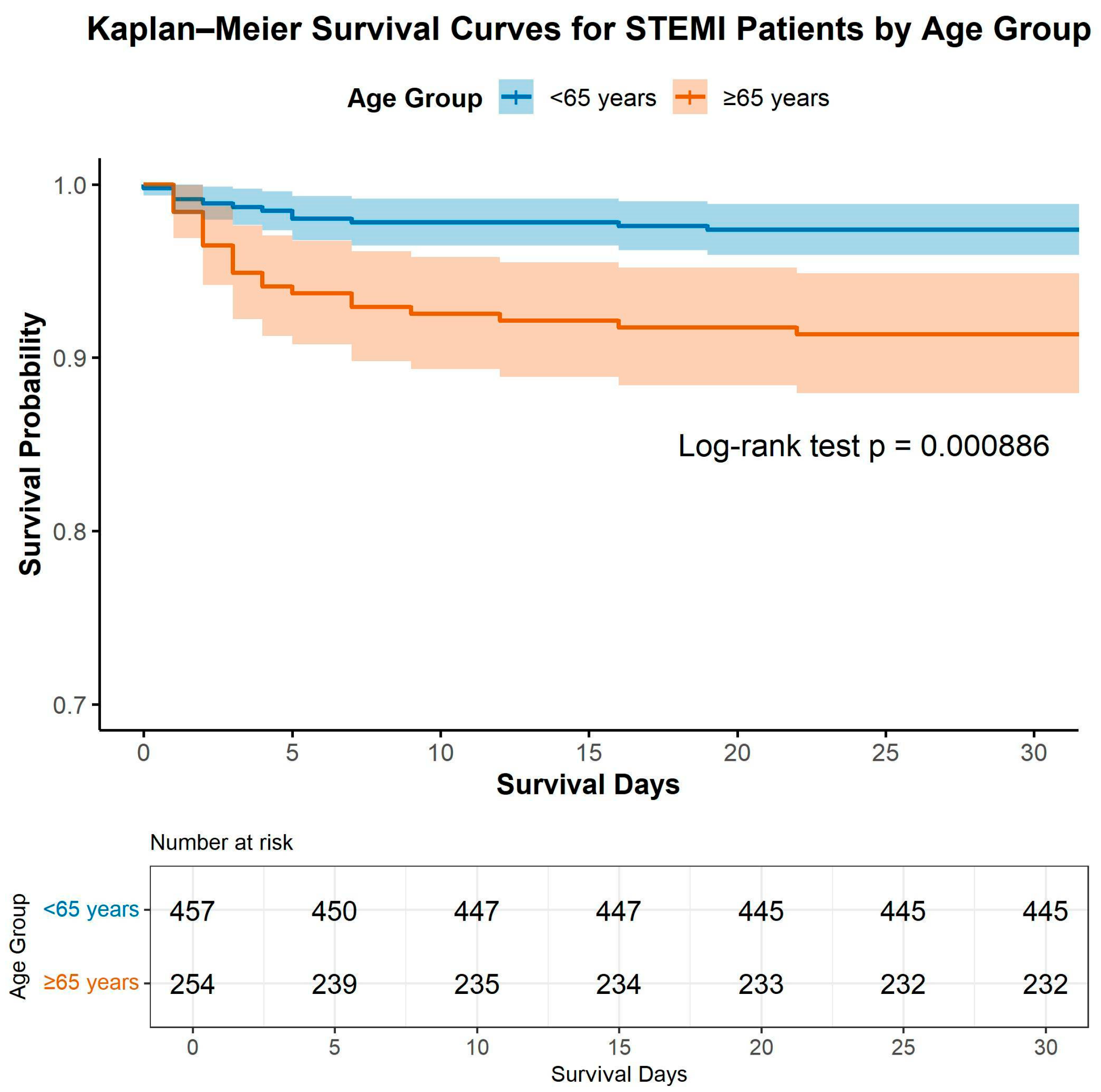
3.3. Kaplan–Meier Survival Analysis by Age Group
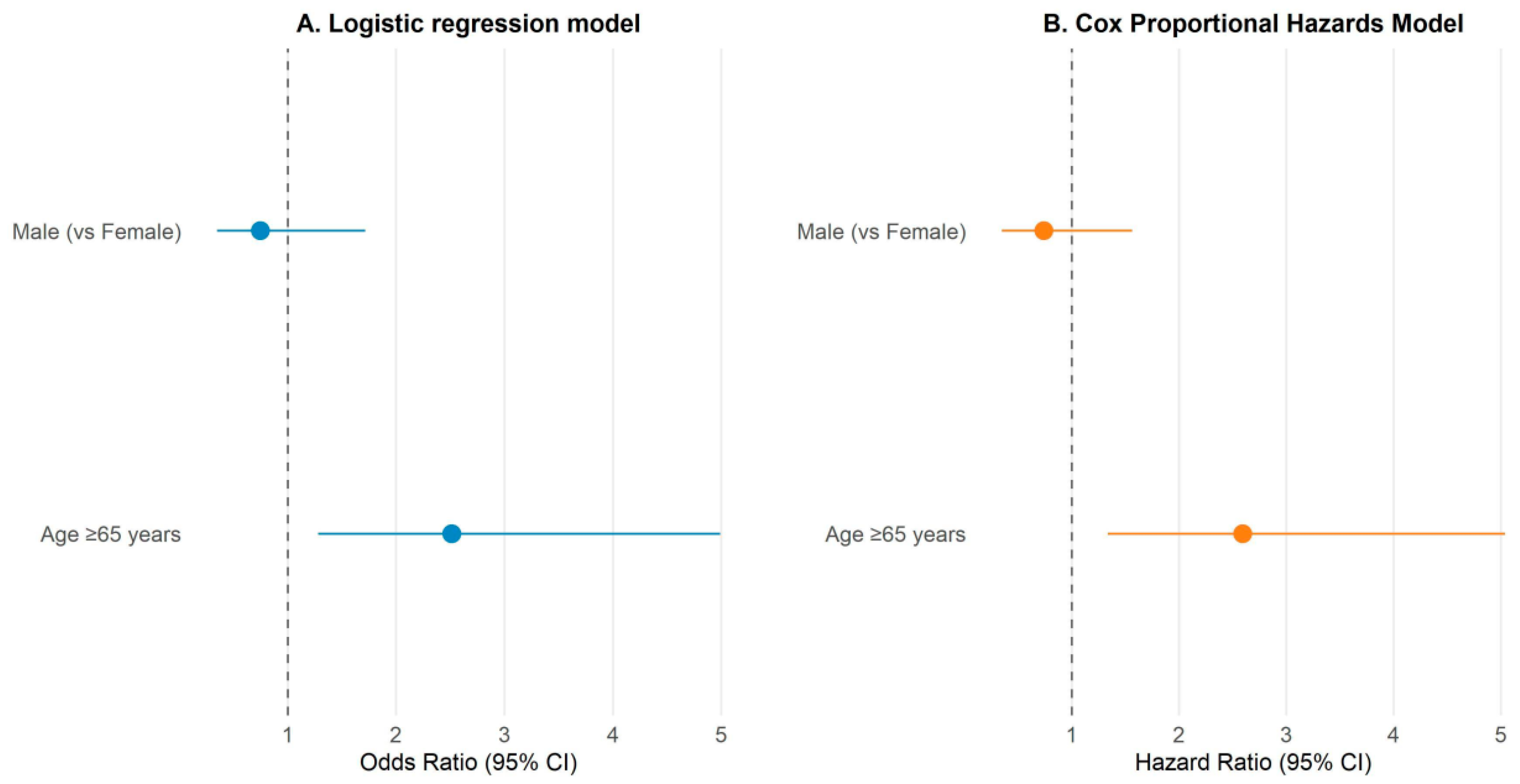
3.4. Multivariable Logistic Regression and Cox Proportional Hazards Analysis
3.5. Univariable and Multivariable Predictors of In-Hospital Mortality
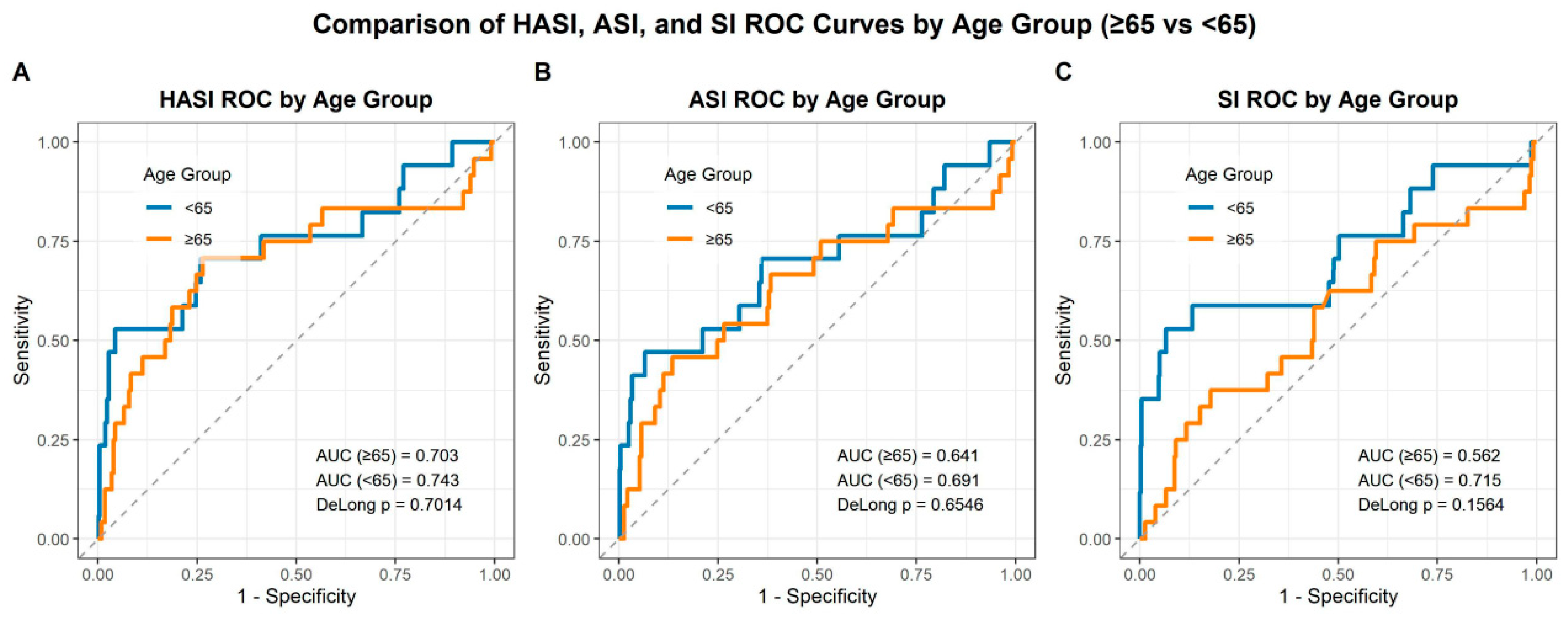
3.6. ROC Analysis and Pairwise Comparison of SI, ASI, and HASI for Predicting In-Hospital Mortality
4. Discussion
5. Conclusions
Supplementary Materials
Author Contributions
Funding
Institutional Review Board Statement
Informed Consent Statement
Data Availability Statement
Conflicts of Interest
References
- Biscaglia, S.; Guiducci, V.; Escaned, J.; Moreno, R.; Lanzilotti, V.; Santarelli, A.; Cerrato, E.; Sacchetta, G.; Jurado-Roman, A.; Menozzi, A.; et al. Complete or culprit-only PCI in older patients with myocardial infarction. N. Engl. J. Med. 2023, 389, 889–898. [Google Scholar] [CrossRef] [Scilit] [PubMed]
- Stähli, B.E.; Varbella, F.; Linke, A.; Schwarz, B.; Felix, S.B.; Seiffert, M.; Kesterke, R.; Nordbeck, P.; Witzenbichler, B.; Lang, I.M.; et al. Timing of complete revascularization with multivessel PCI for myocardial infarction. N. Engl. J. Med. 2023, 389, 1368–1379. [Google Scholar] [CrossRef] [Scilit]
- Thrane, P.G.; Olesen, K.K.W.; Thim, T.; Gyldenkerne, C.; Mortensen, M.B.; Kristensen, S.D.; Maeng, M. Mortality trends after primary percutaneous coronary intervention for ST-segment elevation myocardial infarction. J. Am. Coll. Cardiol. 2023, 82, 999–1010. [Google Scholar] [CrossRef] [Scilit]
- Kochar, A.; Chen, A.Y.; Sharma, P.P.; Pagidipati, N.J.; Fonarow, G.C.; Cowper, P.A.; Roe, M.T.; Peterson, E.D.; Wang, T.Y. Long-Term mortality of older patients with acute myocardial infarction treated in US clinical practice. J. Am. Heart Assoc. 2018, 7, e007230. [Google Scholar] [CrossRef] [Scilit]
- Lapostolle, F.; Petrovic, T.; Moiteaux, B.; Loyeau, A.; Boche, T.; Kalabang, R.K.; Le Bail, G.; Lamhaut, L.; Lafay, M.; Dupas, F.; et al. Evolution of REperfusion Strategies and impact on mortality in Old and Very OLD STEMI patients. The RESOVOLD-e-MUST study. Age Ageing 2024, 53, afad215. [Google Scholar] [CrossRef] [Scilit]
- Ting, M.; Hsieh, C.; Fan, C.; Sim, S.; Jaw, F.; Chen, P. Machine learning-enhanced hypoxia-age-shock index for predicting mortality in adult patients with STEMI undergoing primary PCI: A retrospective single-center cohort study. Hong Kong J. Emerg. Med. 2025, 32, e70047. [Google Scholar] [CrossRef] [Scilit]
- Wong, C.Y.; Lam, R.P.K.; Cheung, K.S.; Kwok, W.M.; Tsang, T.C.; Tsui, M.S.H.; Rainer, T.H. Structured prehospital chest pain assessment and clinical diagnostic score for prehospital identification of ST-segment elevation myocardial infarction before an electrocardiogram. Hong Kong J. Emerg. Med. 2025, 32, e12070. [Google Scholar] [CrossRef] [Scilit]
- Murphy, S.P.; McCarthy, C.P.; Cohen, J.A.; Rehman, S.; Jones-O’cOnnor, M.; Olshan, D.S.; Singh, A.; Vaduganathan, M.; Cui, J.; Januzzi, J.L.; et al. Application of the GRACE, TIMI, and TARRACO Risk Scores in Type 2 Myocardial Infarction. J. Am. Coll. Cardiol. 2020, 75, 344–345. [Google Scholar] [CrossRef] [Scilit]
- Ke, J.; Chen, Y.; Wang, X.; Wu, Z.; Chen, F. Indirect comparison of TIMI, HEART and GRACE for predicting major cardiovascular events in patients admitted to the emergency department with acute chest pain: A systematic review and meta-analysis. BMJ Open 2021, 11, e048356. [Google Scholar] [CrossRef] [Scilit] [PubMed]
- Sarıdaş, A.; Aydin, Ö.F. SHAP analysis and comparative performance of the HEART, HET, and SVEAT scores in 30-day MACE prediction. Am. J. Emerg. Med. 2025, 95, 1–6. [Google Scholar] [CrossRef] [Scilit]
- Goriki, Y.; Tanaka, A.; Nishihira, K.; Kawaguchi, A.; Natsuaki, M.; Watanabe, N.; Ashikaga, K.; Kuriyama, N.; Shibata, Y.; Node, K. A Novel predictive model for in-hospital mortality based on a combination of multiple blood variables in patients with ST-Segment-elevation myocardial infarction. J. Clin. Med. 2020, 9, 852. [Google Scholar] [CrossRef] [Scilit] [PubMed]
- Tang, N.; Liu, S.; Li, K.; Zhou, Q.; Dai, Y.; Sun, H.; Zhang, Q.; Hao, J.; Qi, C. Prediction of in-hospital mortality risk for patients with acute ST-elevation myocardial infarction after primary PCI based on predictors selected by GRACE score and two feature selection methods. Front. Cardiovasc. Med. 2024, 11, 1419551. [Google Scholar] [CrossRef] [Scilit] [PubMed]
- Yurtsever, G.; Çakir, A.; Bora, E.S. Evaluation of the success of shock index and its derivatives in determining mortality in STEMI cases applied to emergency department. Eur. Res. J. 2023, 9, 831–839. [Google Scholar] [CrossRef] [Scilit]
- Reinstadler, S.J.; Fuernau, G.; Eitel, C.; de Waha, S.; Desch, S.; Metzler, B.; Schuler, G.; Thiele, H.; Eitel, I. Shock Index as a Predictor of Myocardial Damage and Clinical Outcome in ST-Elevation Myocardial Infarction. Circ. J. 2016, 80, 924–930. [Google Scholar] [CrossRef] [Scilit]
- Zhou, J.; Shan, P.-R.; Xie, Q.-L.; Zhou, X.-D.; Cai, M.-X.; Xu, T.-C.; Huang, W.-J. Age shock index and age-modified shock index are strong predictors of outcomes in ST-segment elevation myocardial infarction patients undergoing emergency percutaneous coronary intervention. Coron. Artery Dis. 2019, 30, 398–405. [Google Scholar] [CrossRef] [Scilit]
- Kraler, S.; Mueller, C.; Libby, P.; Bhatt, D.L. Acute coronary syndromes: Mechanisms, challenges, and new opportunities. Eur. Heart J. 2025, 46, 2866–2889. [Google Scholar] [CrossRef] [Scilit]
- Merdji, H.; Levy, B.; Jung, C.; Ince, C.; Siegemund, M.; Meziani, F. Microcirculatory dysfunction in cardiogenic shock. Ann. Intensiv. Care 2023, 13, 38. [Google Scholar] [CrossRef] [Scilit]
- Hsieh, C.C.; Ting, M.J.; Chang, C.T.; Tsai, K.C.; Huang, Y.Y.; Fan, C.M.; Sun, J.T.; Wu, Y.H. Is the shock index associated with adverse outcomes among geriatric patients with COVID-19 in the emergency department triage? Int. J. Gerontol. 2023, 17, 177–182. [Google Scholar] [CrossRef]
- Hsieh, C.-C.; Jaw, F.-S.; Hsieh, C.-Y.; Yu, C.-J. Prehospital age-shock index and outcomes among patients with COVID-19 disease. Am. J. Emerg. Med. 2023, 66, 171. [Google Scholar] [CrossRef] [Scilit] [PubMed]
- Hsieh, C.-C.; Liu, C.-Y.; Tsai, K.-C.; Jaw, F.-S.; Chen, J. The hypoxia-age-shock index at triage to predict the outcomes of COVID-19 patients. Am. J. Emerg. Med. 2022, 65, 65–70. [Google Scholar] [CrossRef] [Scilit] [PubMed]
- Lee, K.; Jang, J.S.; Kim, J.; Suh, Y.J. Age shock index, shock index, and modified shock index for predicting postintubation hypotension in the emergency department. Am. J. Emerg. Med. 2020, 38, 911–915. [Google Scholar] [CrossRef] [Scilit]
- Yamada, Y.; Shimizu, S.; Yamamoto, S.; Matsuoka, Y.; Tsutsumi, Y.; Tsuchiya, A.; Kamitani, T.; Yamazaki, H.; Ogawa, Y.; Fukuhara, S.; et al. Prehospital shock index predicts 24-h mortality in trauma patients with a normal shock index upon emergency department arrival. Am. J. Emerg. Med. 2023, 70, 101–108. [Google Scholar] [CrossRef] [Scilit]
- Bin Choi, S.; Cho, S.J.; Yeom, S.-R.; Park, S.-W.; Cho, Y.M.; Huh, U.; Kim, Y.; Ryu, D.; Song, C.; Tae, W.U.; et al. The Age-Modified Shock Index: Predicting Massive Transfusion and Mortality in Traumatic Injury Patients. Emerg. Med. Int. 2025, 2025, 8754824. [Google Scholar] [CrossRef] [Scilit] [PubMed]
- Alsagaff, M.Y.; Kurniawan, R.B.; Purwati, D.D.; Haq, A.U.D.U.; Saputra, P.B.T.; Milla, C.; Kusumawardhani, L.F.; Budianto, C.P.; Susilo, H.; Oktaviono, Y.H. Shock index in the emergency department as a predictor for mortality in COVID-19 patients: A systematic review and meta-analysis. Heliyon 2023, 9, e18553. [Google Scholar] [CrossRef] [Scilit] [PubMed]
- Chen, P.-S.; Hsieh, C.-Y.; Jaw, F.-S.; Chen, H.-K.; Hsi, K.-Y.; Chang, H.-P. The hypoxia-age-shock index at triage is a useful and rapid tool. Am. J. Emerg. Med. 2024, 83, 154–155. [Google Scholar] [CrossRef] [Scilit] [PubMed]
- Oh, S.; Lee, K. The new combination of oxygen saturation with age shock index predicts the outcome of COVID-19 pneumonia. SAGE Open Med. 2023, 11, 20503121231203683. [Google Scholar] [CrossRef] [Scilit]
- Thygesen, K.; Alpert, J.S.; Jaffe, A.S.; Chaitman, B.R.; Bax, J.J.; Morrow, D.A.; White, H.D.; Executive Group on behalf of the Joint European Society of Cardiology (ESC)/American College of Cardiology (ACC)/American Heart Association (AHA)/World Heart Federation (WHF). Task Force for the Universal Definition of Myocardial Infarction Fourth Universal Definition of Myocardial Infarction. Circulation 2018, 138, e618–e651. [Google Scholar] [CrossRef]
- Zarbock, A.; Forni, L.; Koyner, J.L.; Gómez, H.; Pannu, N.; Ostermann, M.; Bellomo, R.; Kellum, J.A.; von Groote, T. Preventing acute kidney injury and its longer-term impact in the critically ill. Intensiv. Care Med. 2025, 51, 1331–1347. [Google Scholar] [CrossRef] [Scilit]



| Variable | <65 Years (n = 457) | ≥65 Years (n = 254) | p-Value |
|---|---|---|---|
| Age (years) | 52.25 ± 8.50 [54.00 (13.00)] | 73.34 ± 6.94 [72.00 (9.00)] | <0.001 * |
| BMI (kg/m2) | 26.63 ± 4.96 [26.10 (5.20)] | 24.30 ± 3.49 [24.20 (4.20)] | <0.001 * |
| SBP (mmHg) | 135.60 ± 30.04 [134.00 (37.00)] | 128.09 ± 32.30 [125.00 (34.75)] | <0.001 * |
| DBP (mmHg) | 89.06 ± 21.93 [90.00 (29.00)] | 76.47 ± 20.53 [74.00 (24.00)] | <0.001 * |
| HR (bpm) | 80.88 ± 20.00 [81.00 (25.00)] | 76.32 ± 21.60 [74.00 (25.75)] | 0.002 * |
| RR (/min) | 19.49 ± 2.80 [20.00 (2.00)] | 19.85 ± 2.95 [20.00 (2.00)] | 0.210 |
| BT (°C) | 36.04 ± 0.66 [36.10 (0.80)] | 36.05 ± 0.72 [36.10 (0.90)] | 0.300 |
| SpO2 (%) | 97.54 ± 3.70 [98.00 (3.00)] | 96.51 ± 4.00 [98.00 (3.75)] | <0.001 * |
| WBC (×103/μL) | 12.59 ± 3.84 [12.07 (4.62)] | 11.11 ± 4.04 [10.38 (4.29)] | <0.001 * |
| HGB (g/dL) | 15.30 ± 1.76 [15.50 (1.90)] | 13.33 ± 2.20 [13.60 (3.00)] | <0.001 * |
| Platelet (×103/μL) | 243.91 ± 63.14 [237.00 (73.00)] | 214.69 ± 67.91 [208.00 (80.00)] | <0.001 * |
| Creatinine (mg/dL) | 1.05 ± 0.91 [0.91 (0.32)] | 1.63 ± 1.96 [1.01 (0.58)] | <0.001 * |
| Troponin T (ng/L) | 914.01 ± 2184.07 [62.60 (629.70)] | 1602.36 ± 2764.56 [252.40 (1774.28)] | <0.001 * |
| CPK (U/L) | 693.40 ± 1290.80 [199.00 (519.50)] | 768.39 ± 1472.40 [206.50 (707.00)] | 0.675 |
| CK-MB (U/L) | 96.46 ± 187.75 [36.00 (68.00)] | 98.03 ± 149.37 [41.00 (79.00)] | 0.384 |
| SI | 0.62 ± 0.21 [0.59 (0.20)] | 0.62 ± 0.22 [0.60 (0.22)] | 0.763 |
| ASI | 32.34 ± 12.01 [30.78 (12.28)] | 45.72 ± 16.18 [43.66 (15.94)] | <0.001 * |
| HASI | 0.33 ± 0.13 [0.32 (0.12)] | 0.48 ± 0.18 [0.45 (0.17)] | <0.001 * |
| MV days | 10.91 ± 12.49 [7 (2–14)] | 8.05 ± 10.29 [3 (2–8)] | 0.2959 |
| ICU stay (days) | 4.68 ± 9.39 [3.00 (1.00)] | 4.82 ± 5.57 [3.00 (1.00)] | 0.001 * |
| Hospital stay (days) | 7.36 ± 11.94 [5.00 (2.00)] | 8.71 ± 8.30 [6.00 (3.75)] | <0.001 * |
| Number of occluded vessels | 2.09 ± 0.87 [2.00 (2.00)] | 2.37 ± 0.89 [3.00 (1.00)] | <0.001 * |
| D2W (min) | 74.73 ± 38.27 [69.00 (17.00)] | 79.66 ± 44.02 [69.00 (16.75)] | 0.170 |
| D2B (min) | 76.48 ± 38.35 [70.00 (17.00)] | 81.26 ± 44.15 [70.00 (17.00)] | 0.207 |
| Variable | Category | <65 Years (n = 457) | ≥65 Years (n = 254) | p-Value |
|---|---|---|---|---|
| Sex | Female | 30 (6.6%) | 76 (29.9%) | |
| Male | 427 (93.4%) | 178 (70.1%) | <0.001 * | |
| Comorbidities | DM | 125 (27.4%) | 100 (39.4%) | 0.0013 * |
| Dyslipidemia | 86 (18.8%) | 46 (18.1%) | 0.8949 | |
| CKD | 14 (3.1%) | 28 (11.0%) | <0.001 * | |
| HTN | 164 (35.9%) | 63 (24.8%) | 0.0031 * | |
| CAD | 33 (7.2%) | 31 (12.2%) | 0.0368 * | |
| Previous PCI | 20 (4.4%) | 11 (4.3%) | 1.000 | |
| Triage Class | 1 Resuscitation | 95 (20.8%) | 78 (30.7%) | 0.003 * |
| 2 Emergent | 265 (58.0%) | 114 (44.9%) | 0.001 * | |
| 3 Urgent | 96 (21.0%) | 56 (22.0%) | 0.746 | |
| 4 Less urgent | 1 (0.2%) | 6 (2.4%) | 0.006 * | |
| Killip Class | I No HF | 274 (60.0%) | 114 (44.9%) | <0.001 * |
| II Mild HF (rales) | 67 (14.7%) | 28 (11.0%) | 0.172 | |
| III Severe HF | 34 (7.4%) | 26 (10.2%) | 0.199 | |
| IV Cardiogenic shock | 82 (17.9%) | 86 (33.9%) | <0.001 * | |
| In-hospital Outcomes | LMCA occlusion | 20 (4.4%) | 22 (8.7%) | 0.0311 * |
| LAD occlusion | 391 (85.6%) | 221 (87.0%) | 0.673 | |
| LCX occlusion | 240 (52.6%) | 162 (63.8%) | 0.0052 * | |
| RCA occlusion | 304 (66.5%) | 197 (77.6%) | 0.0026 * | |
| TPM | 5 (1.1%) | 13 (5.1%) | 0.0025 * | |
| IABP | 12 (2.6%) | 18 (7.1%) | 0.0083 * | |
| MAE | 46 (10.1%) | 66 (26.0%) | <0.001 * | |
| ECMO | 18 (3.9%) | 13 (5.1%) | 0.5848 | |
| Intubation | 34 (7.4%) | 43 (16.9%) | <0.001 * | |
| CABG | 2 (0.4%) | 7 (2.8%) | 0.0122 * | |
| IHCA | 7 (1.5%) | 13 (5.1%) | 0.0113 * | |
| Cardiogenic shock | 64 (14.0%) | 68 (26.8%) | 0.002 * | |
| Acute kidney injury | 38 (8.3%) | 47 (18.5%) | 0.004 * | |
| ICU stay >5 days | 45 (9.8%) | 56 (22.0%) | 0.001 * | |
| Mortality | 17 (3.7%) | 24 (9.4%) | 0.003 * | |
| Readmission | 17 (3.7%) | 10 (3.9%) | 1.000 |
| A. Logistic Regression Analysis | |||
| Variable | OR | 95% CI | p-Value |
| (Intercept) | 0.051 | 0.020–0.115 | <0.001 * |
| Age Group ≥ 65 years | 2.51 | 1.28–4.99 | 0.0075 * |
| Male | 0.749 | 0.350–1.72 | 0.471 |
| B. Cox Proportional Hazards Analysis | |||
| Variable | HR | 95% CI | p-Value |
| Age Group ≥ 65 years | 2.59 | 1.34–5.04 | 0.0049 * |
| Male | 0.739 | 0.349–1.57 | 0.430 |
Disclaimer/Publisher’s Note: The statements, opinions and data contained in all publications are solely those of the individual author(s) and contributor(s) and not of MDPI and/or the editor(s). MDPI and/or the editor(s) disclaim responsibility for any injury to people or property resulting from any ideas, methods, instructions or products referred to in the content. |
© 2026 by the authors. Published by MDPI on behalf of the Lithuanian University of Health Sciences. Licensee MDPI, Basel, Switzerland. This article is an open access article distributed under the terms and conditions of the Creative Commons Attribution (CC BY) license.
Share and Cite
Ting, M.-J.; Chao, W.-J.; Chou, S.-F.; Sim, S.-S.; Chang, C.-J.; Hsieh, C.-C. Use of the Hypoxia–Age–Shock Index at Triage to Predict Mortality in Geriatric STEMI Patients Undergoing Primary PCI. Medicina 2026, 62, 365. https://doi.org/10.3390/medicina62020365
Ting M-J, Chao W-J, Chou S-F, Sim S-S, Chang C-J, Hsieh C-C. Use of the Hypoxia–Age–Shock Index at Triage to Predict Mortality in Geriatric STEMI Patients Undergoing Primary PCI. Medicina. 2026; 62(2):365. https://doi.org/10.3390/medicina62020365
Chicago/Turabian StyleTing, Man-Ju, Wan-Ju Chao, San-Fang Chou, Shyh-Shyong Sim, Chih-Jung Chang, and Chien-Chieh Hsieh. 2026. "Use of the Hypoxia–Age–Shock Index at Triage to Predict Mortality in Geriatric STEMI Patients Undergoing Primary PCI" Medicina 62, no. 2: 365. https://doi.org/10.3390/medicina62020365
APA StyleTing, M.-J., Chao, W.-J., Chou, S.-F., Sim, S.-S., Chang, C.-J., & Hsieh, C.-C. (2026). Use of the Hypoxia–Age–Shock Index at Triage to Predict Mortality in Geriatric STEMI Patients Undergoing Primary PCI. Medicina, 62(2), 365. https://doi.org/10.3390/medicina62020365