Pregnancy AI: Development and Internal Validation of an Artificial Intelligence Tool to Predict Live Births in ICSI and IVF Cycles Using Clinical Features and Embryo Images


Abstract
1. Introduction
2. Materials and Methods
2.1. Study Design
2.2. Ovarian Stimulation Characteristics
2.3. In Vitro Fertilization Characteristics
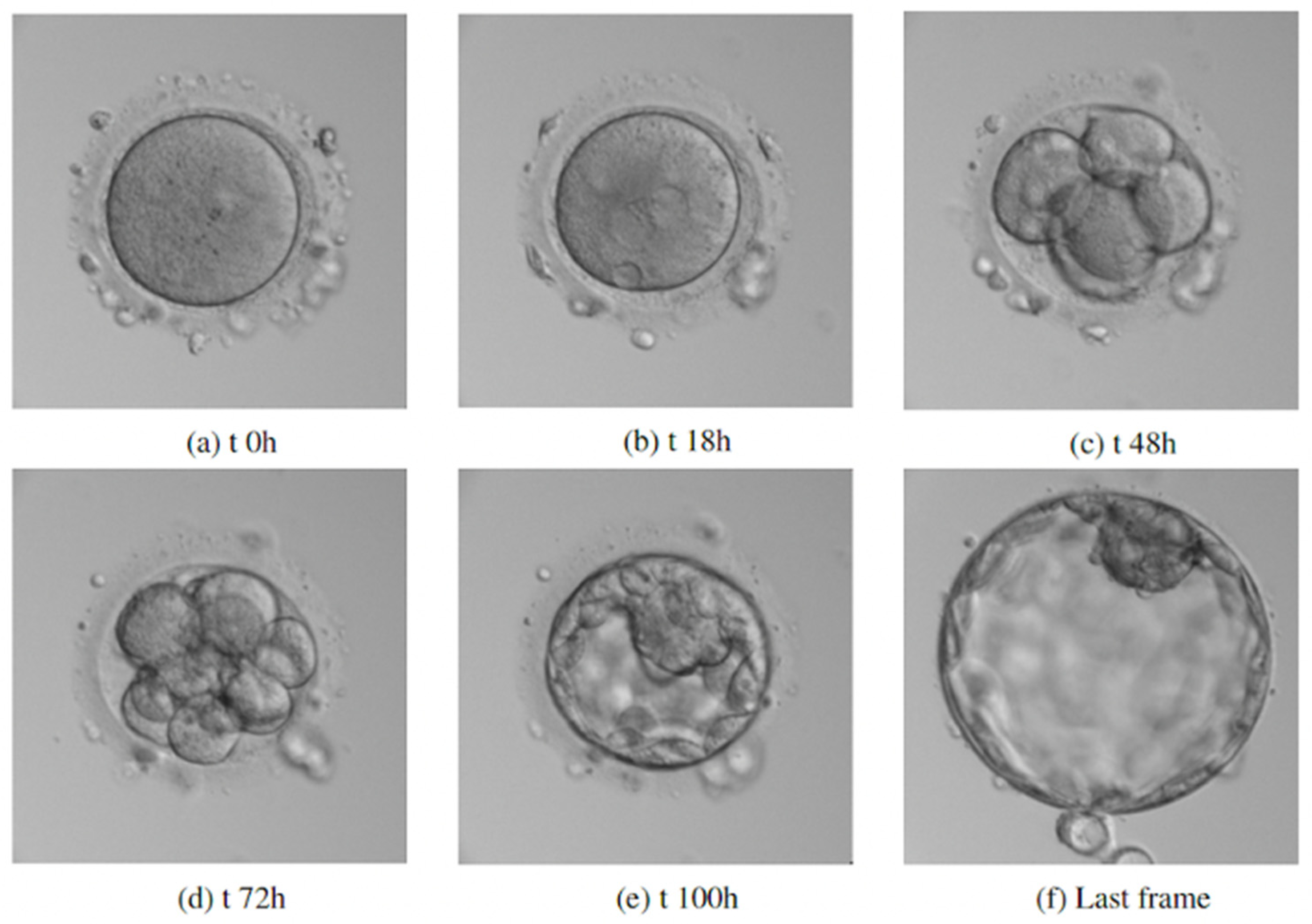
2.4. Time-Lapse Embryo Culture Images
2.5. Reproductive Outcome Measures
2.6. Building the Dataset
2.6.1. Clinical Feature Pre-Processing
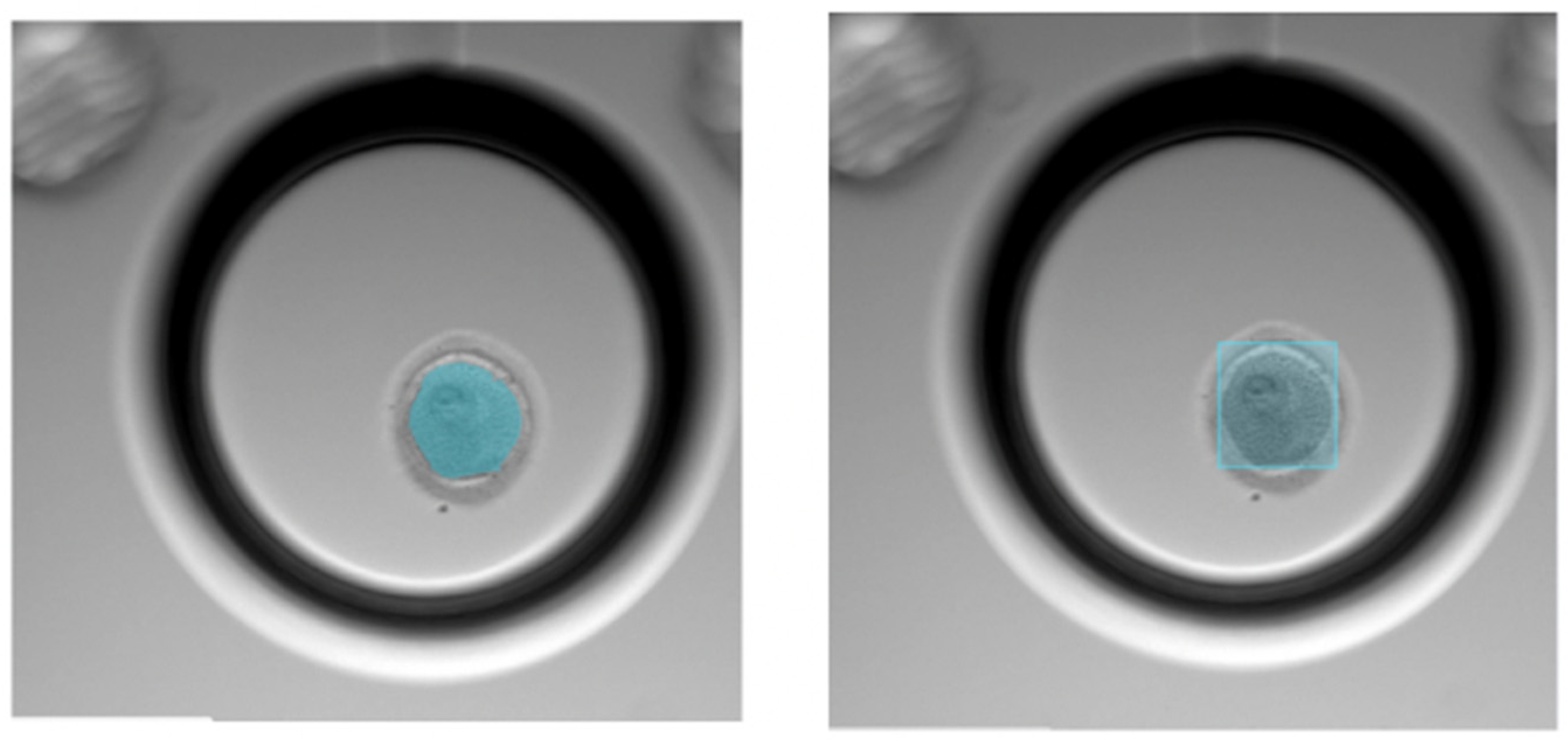
2.6.2. Image Pre-Processing and Normalization
2.6.3. Data Partitioning
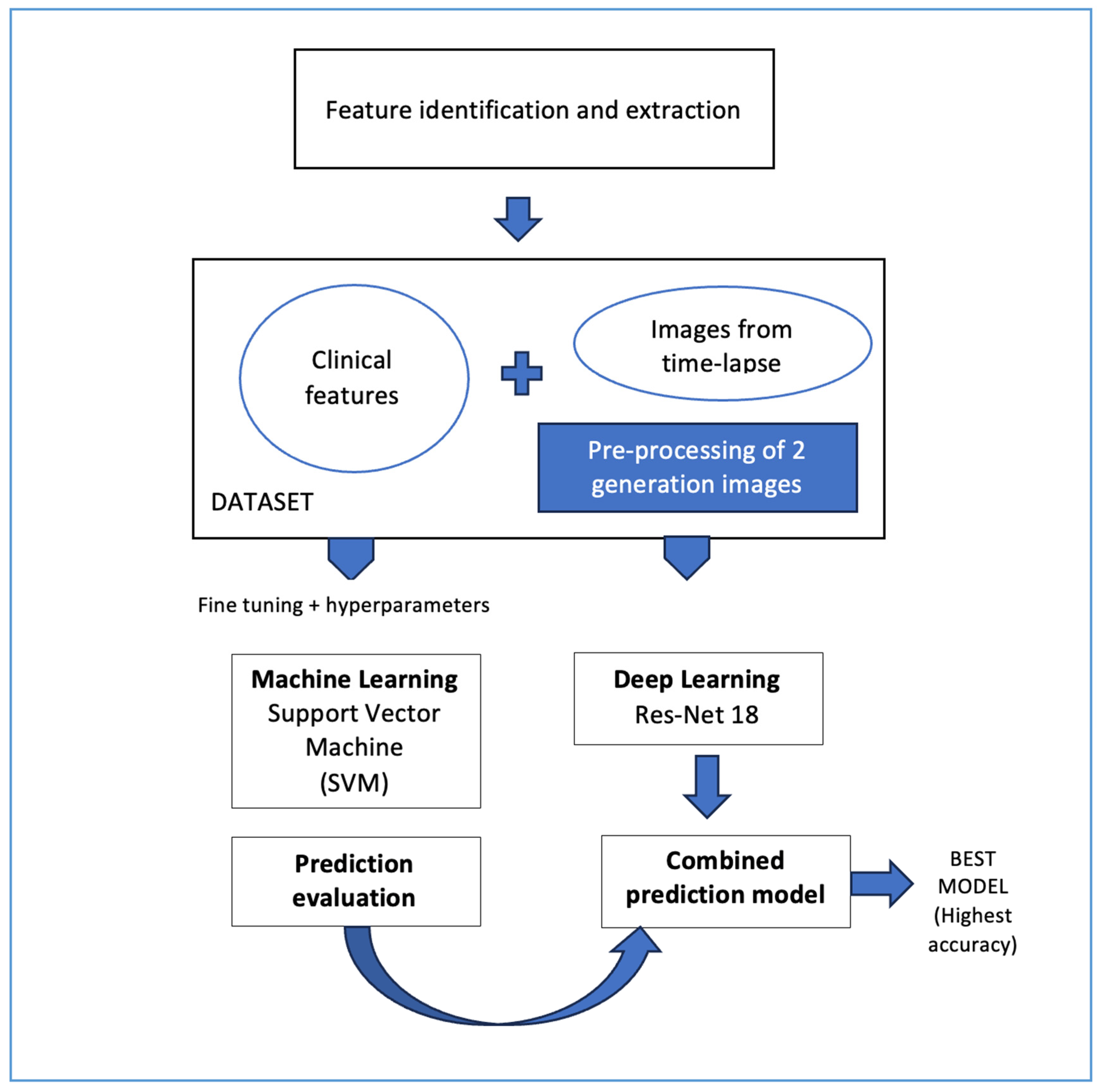
2.7. Building a Predictive Machine Learning Model
2.7.1. Support Vector Machine (SVM)
2.7.2. Convolutional Neural Network (CNN)
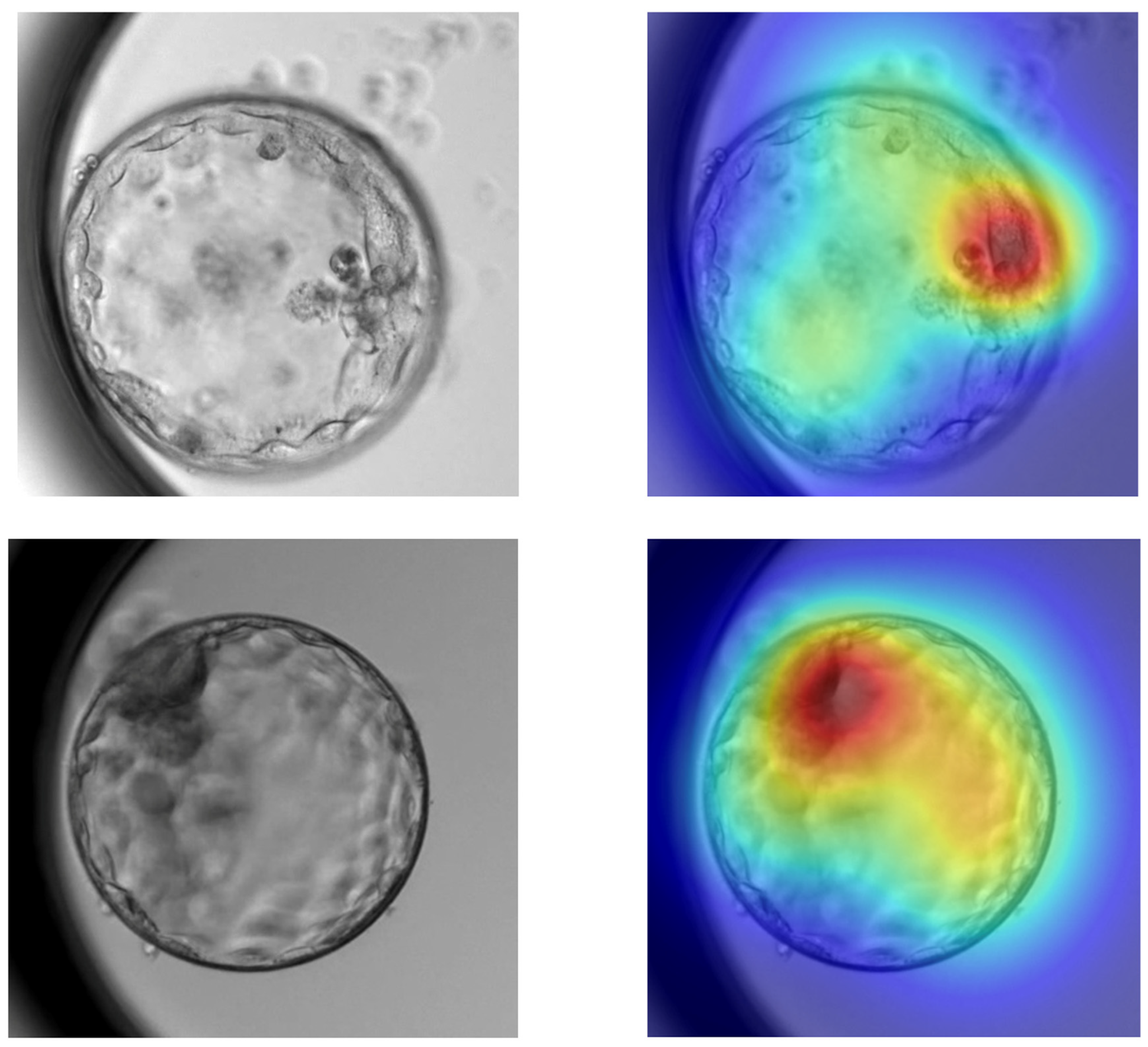
2.7.3. Grad-CAM
2.8. Evaluation of Model Performance
2.9. Estimating the Reduction in Time to Pregnancy
2.10. Statistical Analyses
2.11. Data Sharing
3. Results
3.1. Baseline Characteristics and Reproductive Outcomes

| Variable | Overall |
|---|---|
| Age (years) | 35.37 ± 4.51 |
| Body weight (kg) | 66.78 ± 14.29 |
| Height (cm) | 164.09 ± 6.75 |
| BMI (kg/m2) | 24.74 ± 5.29 |
| AMH (ng/mL) | 3.48 ± 3.15 |
| FSH (IU) | 6.76 ± 2.90 |
| AFC | 21.17 ± 14.36 |
| Duration of infertility (years) | 2.21 ± 2.13 |
| Estradiol day 6 (ng/mL) | 1651.07 ± 1847.22 |
| Estradiol ovulation trigger (ng/mL) | 8943.72 ± 5655.81 |
| Progesterone trigger or −1 day (ng/mL) | 3.30 ± 1.54 |
| Stimulation day trigger (days) | 11.93 ± 1.68 |
| Follicles > 14 mm last US | 11.78 ± 6.47 |
| Oocytes retrieved | 15.47 ± 9.53 |
| Variable | Overall |
|---|---|
| Age (years) | 37.88 ± 7.22 |
| Sperm concentration (M) | 38.80 ± 53.40 |
| Sperm motility a + b (%) | 36.88 ± 24.42 |
| Sperm morphology (%) | 7.38 ± 14.89 |
| DNA fragmentation (%) | 11.41 ± 14.54 |
| Tabaco | 19.29% |
| Alcohol | 64.69% |
| Alcohol | 64.69% |
3.2. AI Model Shows High Discriminating Power for Classifying Transferrable Embryos
3.3. AI Model Accurately Predicts Pregnancy Based on Embryo Time-Lapse Images and Clinical Data
| Clinical Data | |||||
|---|---|---|---|---|---|
| Accuracy | AUC | Precision | Sensitivity | F1-score | |
| Live birth | 67.26% | 0.65 | 64.1% | 66.7% | 63.8% |
| Clinical Pregnancy | 68.42% | 0.61 | 67.1% | 60.7% | 64.5% |
| Biochemical pregnancy | 67.67% | 0.63 | 64.1% | 66.7% | 63.8% |
| Single frame accuracy | |||||
| Accuracy | AUC | Precision | Sensitivity | F1-score | |
| Live birth | 54.23% | 0.56 | 61.1% | 60.9% | 59.8% |
| Clinical Pregnancy | 58.64% | 0.63 | 63.7% | 60.7% | 58.5% |
| Biochemical pregnancy | 65.65% | 0.60 | 64.2% | 66.7% | 61.8% |
| Multiple frames accuracy | |||||
| Accuracy | AUC | Precision | Sensitivity | F1-score | |
| Live birth | 57.45% | 0.67 | 71.5% | 68.1% | 69.3% |
| Clinical Pregnancy | 67.34% | 0.68 | 69.5% | 67.1% | 68.4% |
| Biochemical pregnancy | 72.45% | 0.69 | 75.5% | 71.4% | 71.5% |
| Combination frame + clinical data accuracy | |||||
| Accuracy | AUC | Precision | Sensitivity | F1-score | |
| Live birth | 71.98% | 0.76 | 77.1% | 76.3% | 76.2% |
| Clinical Pregnancy | 73.45% | 0.77 | 79.1% | 77.1% | 77.1% |
| Biochemical pregnancy | 77.87% | 0.79 | 83.1% | 79.3% | 80.3% |
3.4. Important Biological Features Recognized by the AI Model
3.5. AI Model Could Boost the Theoretical Probability of Pregnancy on the First Transfer
4. Discussion
Limitations and Future Directions
5. Conclusions
Supplementary Materials
Author Contributions
Funding
Institutional Review Board Statement
Informed Consent Statement
Data Availability Statement
Conflicts of Interest
References
- Kushnir, V.A.; Smith, G.D.; Adashi, E.Y. The Future of IVF: The New Normal in Human Reproduction. Reprod. Sci. 2022, 29, 849–856. [Google Scholar] [CrossRef]
- Liu, K.E.; Case, A. No 346-Advanced Reproductive Age and Fertility. J. Obstet. Gynaecol. Can. 2017, 39, 685–695. [Google Scholar] [CrossRef]
- Gardner, D.K.; Schoolcraft, W.B. Culture and transfer of human blastocysts. Curr. Opin. Obstet. Gynecol. 1999, 11, 307–311. [Google Scholar] [CrossRef] [PubMed]
- Rhenman, A.; Berglund, L.; Brodin, T.; Olovsson, M.; Milton, K.; Hadziosmanovic, N.; Holte, J. Which set of embryo variables is most predictive for live birth? A prospective study in 6252 single embryo transfers to construct an embryo score for the ranking and selection of embryos. Hum. Reprod. 2015, 30, 28–36. [Google Scholar] [CrossRef]
- Desai, N.; Goldberg, J.M.; Austin, C.; Falcone, T. Are cleavage anomalies, multinucleation, or specific cell cycle kinetics observed with time-lapse imaging predictive of embryo developmental capacity or ploidy? Fertil. Steril. 2018, 109, 665–674. [Google Scholar] [CrossRef]
- Esteva, A.; Kuprel, B.; Novoa, R.A.; Ko, J.; Swetter, S.M.; Blau, H.M.; Thrun, S. Dermatologist-level classification of skin cancer with deep neural networks. Nature 2017, 542, 115–118. [Google Scholar] [CrossRef]
- McKinney, S.M.; Sieniek, M.; Godbole, V.; Godwin, J.; Antropova, N.; Ashrafian, H.; Back, T.; Chesus, M.; Corrado, G.S.; Darzi, A.; et al. International evaluation of an AI system for breast cancer screening. Nature 2020, 577, 89–94. [Google Scholar] [CrossRef]
- Kanakasabapathy, M.K.; Sadasivam, M.; Singh, A.; Preston, C.; Thirumalaraju, P.; Venkataraman, M.; Bormann, C.L.; Draz, M.S.; Petrozza, J.C.; Shafiee, H. An automated smartphone-based diagnostic assay for point-of-care semen analysis. Sci. Transl. Med. 2017, 9, eaai7863. [Google Scholar] [CrossRef]
- Fanton, M.; Nutting, V.; Solano, F.; Maeder-York, P.; Hariton, E.; Barash, O.; Weckstein, L.; Sakkas, D.; Copperman, A.B.; Loewke, K. An interpretable machine learning model for predicting the optimal day of trigger during ovarian stimulation. Fertil. Steril. 2022, 118, 101–108. [Google Scholar] [CrossRef] [PubMed]
- Salih, M.; Austin, C.; Warty, R.R.; Tiktin, C.; Rolnik, D.L.; Momeni, M.; Rezatofighi, H.; Reddy, S.; Smith, V.; Vollenhoven, B.; et al. Embryo selection through artificial intelligence versus embryologists: A systematic review. Hum. Reprod. Open 2023, 2023, hoad031. [Google Scholar] [CrossRef] [PubMed]
- Fruchter-Goldmeier, Y.; Kantor, B.; Ben-Meir, A.; Wainstock, T.; Erlich, I.; Levitas, E.; Shufaro, Y.; Sapir, O.; Har-Vardi, I. An artificial intelligence algorithm for automated blastocyst morphometric parameters demonstrates a positive association with implantation potential. Sci. Rep. 2023, 13, 14617. [Google Scholar] [CrossRef]
- Shen, L.; Zhang, Y.; Chen, W.; Yin, X. The Application of Artificial Intelligence in Predicting Embryo Transfer Outcome of Recurrent Implantation Failure. Front. Physiol. 2022, 13, 885661. [Google Scholar] [CrossRef]
- Barnes, J.; Brendel, M.; Gao, V.R.; Rajendran, S.; Kim, J.; Li, Q.; Malmsten, J.E.; Sierra, J.T.; Zisimopoulos, P.; Sigaras, A.; et al. A non-invasive artificial intelligence approach for the prediction of human blastocyst ploidy: A retrospective model development and validation study. Lancet Digit. Health 2023, 5, e28–e40. [Google Scholar] [CrossRef] [PubMed]
- World Health Organization. WHO Laboratory Manual for the Examination and Processing of Human Semen, 5th ed.; World Health Organization: Geneva, Switzerland, 2010. [Google Scholar]
- Girshick, R. Fast r-cnn. In Proceedings of the IEEE International Conference on Computer Vision, Santiago, Chile, 7–13 December 2015; pp. 1440–1448. [Google Scholar]
- Kim, H.M.; Ko, T.; Kang, H.; Choi, S.; Park, J.H.; Chung, M.K.; Kim, M.; Kim, N.Y.; Lee, H.J. Improved prediction of clinical pregnancy using artificial intelligence with enhanced inner cell mass and trophectoderm images. Sci. Rep. 2024, 14, 3240. [Google Scholar] [CrossRef]
- Wen, J.Y.; Liu, C.F.; Chung, M.T.; Tsai, Y.C. Artificial intelligence model to predict pregnancy and multiple pregnancy risk following in vitro fertilization-embryo transfer (IVF-ET). Taiwan. J. Obstet. Gynecol. 2022, 61, 837–846. [Google Scholar] [CrossRef]
- Fjeldstad, J.; Qi, W.; Mercuri, N.; Siddique, N.; Meriano, J.; Krivoi, A.; Nayot, D. An artificial intelligence tool predicts blastocyst development from static images of fresh mature oocytes. Reprod. Biomed. Online 2024, 48, 103842. [Google Scholar] [CrossRef] [PubMed]
- Herbemont, C.; Sarandi, S.; Boujenah, J.; Cedrin-Durnerin, I.; Sermondade, N.; Vivot, A.; Poncelet, C.; Grynberg, M.; Sifer, C. Should we consider day-2 and day-3 embryo morphology before day-5 transfer when blastocysts reach a similar good quality? Reprod. Biomed. Online 2017, 35, 521–528. [Google Scholar] [CrossRef]
- Xiao, Y.; Zhang, P.; Wang, L.; Ko, Y.; Wang, M.; Xi, J.; Zhou, C.; Chen, X. Optimizing single blastocyst selection: The role of day 3 embryo morphology in vitrified-warmed blastocyst transfer cycles. Reprod. Biomed. Online 2024, 49, 104364. [Google Scholar] [CrossRef]
- Chéles, D.S.; Ferreira, A.S.; de Jesus, I.S.; Fernandez, E.I.; Pinheiro, G.M.; Dal Molin, E.A.; Alves, W.; de Souza, R.C.M.; Bori, L.; Meseguer, M.; et al. An image processing protocol to extract variables predictive of human embryo fitness for assisted reproduction. Appl. Sci. 2022, 12, 3531. [Google Scholar] [CrossRef]
- Liu, X.; Chen, Z.; Ji, Y. Construction of the machine learning-based live birth prediction models for the first in vitro fertilization pregnant women. BMC Pregnancy Childbirth 2023, 23, 476. [Google Scholar] [CrossRef]
- Salih, M.; Austin, C.; Mantravadi, K.; Seow, E.; Jitanantawittaya, S.; Reddy, S.; Vollenhoven, B.; Rezatofighi, H.; Horta, F. Deep learning classification integrating embryo images with associated clinical information from ART cycles. Sci. Rep. 2025, 15, 2076. [Google Scholar] [CrossRef] [PubMed]
- Borna, M.-R.; Sepehri, M.M.; Maleki, B. An artificial intelligence algorithm to select most viable embryos considering current process in IVF labs. Front. Artif. Intell. 2024, 7, 1375474. [Google Scholar] [CrossRef]
- Sun, L.; Li, J.; Zeng, S.; Luo, Q.; Miao, H.; Liang, Y.; Cheng, L.; Sun, Z.; Tai, W.H.; Han, Y.; et al. Artificial intelligence system for outcome evaluations of human in vitro fertilization-derived embryos. Chin. Med. J. 2024, 137, 1939–1949. [Google Scholar] [CrossRef]
- Mina, A.; Younesi, M.; Doohandeh, T.; Darzi, S.; Ardehjani, N.A.; Sheibani, S.; Hosseinirad, H.; Valizadeh, R. Predicting pregnancy outcomes in IVF cycles: A systematic review and diagnostic meta-analysis of artificial intelligence in embryo assessment. Contracept. Reprod. Med. 2025, 10, 59. [Google Scholar] [CrossRef]
- Khosravi, P.; Kazemi, E.; Zhan, Q.; Malmsten, J.E.; Toschi, M.; Zisimopoulos, P.; Sigaras, A.; Lavery, S.; Cooper, L.A.D.; Hickman, C.; et al. Deep learning enables robust assessment and selection of human blastocysts after in vitro fertilization. npj Digit. Med. 2019, 2, 21. [Google Scholar] [CrossRef] [PubMed]
- Peng, J.; Geng, X.; Zhao, Y.; Hou, Z.; Tian, X.; Liu, X.; Xiao, Y.; Liu, Y. Machine learning algorithms in constructing prediction models for assisted reproductive technology (ART) related live birth outcomes. Sci. Rep. 2024, 14, 32083. [Google Scholar] [CrossRef] [PubMed]


Disclaimer/Publisher’s Note: The statements, opinions and data contained in all publications are solely those of the individual author(s) and contributor(s) and not of MDPI and/or the editor(s). MDPI and/or the editor(s) disclaim responsibility for any injury to people or property resulting from any ideas, methods, instructions or products referred to in the content. |
© 2026 by the authors. Published by MDPI on behalf of the Lithuanian University of Health Sciences. Licensee MDPI, Basel, Switzerland. This article is an open access article distributed under the terms and conditions of the Creative Commons Attribution (CC BY) license.
Share and Cite
Minano Masip, J.; Borduas, P.; Kadoch, I.-J.; Phillips, S.; Precup, D.; Dufort, D. Pregnancy AI: Development and Internal Validation of an Artificial Intelligence Tool to Predict Live Births in ICSI and IVF Cycles Using Clinical Features and Embryo Images. Medicina 2026, 62, 364. https://doi.org/10.3390/medicina62020364
Minano Masip J, Borduas P, Kadoch I-J, Phillips S, Precup D, Dufort D. Pregnancy AI: Development and Internal Validation of an Artificial Intelligence Tool to Predict Live Births in ICSI and IVF Cycles Using Clinical Features and Embryo Images. Medicina. 2026; 62(2):364. https://doi.org/10.3390/medicina62020364
Chicago/Turabian StyleMinano Masip, Jaume, Penelope Borduas, Isaac-Jacques Kadoch, Simon Phillips, Doina Precup, and Daniel Dufort. 2026. "Pregnancy AI: Development and Internal Validation of an Artificial Intelligence Tool to Predict Live Births in ICSI and IVF Cycles Using Clinical Features and Embryo Images" Medicina 62, no. 2: 364. https://doi.org/10.3390/medicina62020364
APA StyleMinano Masip, J., Borduas, P., Kadoch, I.-J., Phillips, S., Precup, D., & Dufort, D. (2026). Pregnancy AI: Development and Internal Validation of an Artificial Intelligence Tool to Predict Live Births in ICSI and IVF Cycles Using Clinical Features and Embryo Images. Medicina, 62(2), 364. https://doi.org/10.3390/medicina62020364