


Abstract
Vascularised composite allotransplantation (VCA) has an evolving role in the reconstruction of complex functional and aesthetic deficits non-amenable to autologous or implant-based reconstructive modalities. International applications of VCA span upper extremity, face, abdominal wall, uterus, and penile transplantation, with more than 300 procedures performed worldwide. Among these, abdominal wall transplantation has uniquely contributed to the development of the sentinel skin flap (SSF) concept, in which solid organ transplant patients undergo simultaneous transplantation of a solid organ and a donor-derived vascularised skin flap, with the skin component of the SSF being trialled internationally as a means of monitoring for rejection within the solid organ allograft. Despite growing clinical success, VCA continues to face substantial barriers to wider adoption. Acute rejection remains highly prevalent, affecting up to 89% of recipients, with significant morbidity linked to intensive systemic immunosuppression. Challenges are further amplified by the unique immunological heterogeneity of composite grafts, ethical concerns surrounding identity-linked tissues, and the lack of standardised outcomes reporting across VCA subtypes. Advances in machine perfusion technologies and emerging cellular and biomaterial-based immunomodulation strategies show promise in reducing immunosuppression burden and improving graft longevity. This review outlines the current state of VCA, including clinical applications, outcomes, and mechanistic insights from pre-clinical studies, while highlighting key ethical considerations and evolving regulatory frameworks. Future progress will depend on standardised reporting systems, improved donor–recipient matching, better understanding of ischemia–reperfusion injury, and the development of next-generation immunosuppressive/immuno-modulatory therapies. Collectively, these innovations position VCA as a rapidly advancing field with significant potential to redefine reconstructive and transplant surgery.
1. Introduction
Vascularised Composite Allotransplantation (VCA) involves the transplantation of composite tissue allografts, as a functional unit, between an allo-incompatible donor and the recipient, with grafts typically involving a skin or mucosal component [1]. This specialised procedure has enabled significant advancements in reconstructive surgery, providing life-altering functional and aesthetic restoration to patients who have suffered significant tissue loss. VCA encompasses a broad range of composite tissue grafts which, when transplanted as entire subunits, offer unique functionally restorative applications, ranging from skin-containing hand, face, and abdominal wall transplants to uterine and penile allotransplantation [2,3,4,5]. The field of VCA has emerged as a solution to the limitations of conventional reconstructive techniques, such as autologous tissue transfer and prosthetics, which are often deficient in achieving full restoration of both the functional and aesthetic aspects of complex tissue defects [6,7].
Abdominal wall transplantation (AWT) VCA, aimed at providing primary abdominal closure following intestinal and/or multi-visceral organ transplantation, was first described in the literature in the early 2000s [8]. In intestinal/multi-visceral abdominal organ transplantation, closure is often complicated by tissue deficiency owed to prior laparotomy, ostomy construction, enterocutaneous fistulae, or abdominal wall fibrosis [8,9]. Although the initial aim of AWT was to achieve abdominal closure, a secondary function of the abdominal wall VCA later emerged. Gerlach et al. first reported the potential for the skin component of AW VCA to act as a ‘sentinel’ marker of immunological activity within the visceral allograft, termed thereafter as a Sentinel Skin Flap (SSF) transplant [10]. The high immunogenicity of skin, its external visibility, and its capacity to rapidly demonstrate skin changes such as erythema and soft-tissue oedema during rejection episodes, presents an attractive possible means of monitoring for the immunologically mediated rejection of visceral grafts [11]. Timely diagnosis of allograft rejection is essential to limit rejection-mediated morbidity and graft destruction, with delayed diagnosis associated with significantly inferior graft outcomes [12,13,14]. As such, international efforts have focused on the identification of serum biomarkers capable of accurately diagnosing allo-rejection prior to allograft injury. A number of candidate biomarkers have demonstrated clinical promise, such as ‘liquid biopsy’, aimed at identifying the presence (or absence) of donor-derived cell-free DNA in the recipient serum, a known marker of allograft destruction [15]. Liquid biopsy demonstrates a high negative predictive value (90–97%), rendering it clinically useful in the exclusion of allograft rejection [16]. However, the role of liquid biopsy remains limited in the diagnosis of allo-rejection, owing to its relatively low positive predictive value (33–56%) [16]. Further biomarkers of interest include CXCL-10, KIM-1, and NGAL. Despite the development of such biomarkers, transplant biopsy remains the gold standard in the diagnosis of rejection [17,18]. Although the development of more sensitive and specific rejection biomarkers represents significant progress in transplantation, the utility of serum markers relies fundamentally on patients physically presenting for assessment. SSF may offer a plausible solution to graft surveillance in the community, presenting potential avenues for both the remote physician monitoring and patient lead monitoring of sentinel grafts. Sentinel skin flap transplantation has since evolved to include broader applications than AWT, with current randomised control trials utilising smaller SSFs, such as the radial forearm free flap utilised in the SENTINEL trial, which aims to evaluate SSF in lung transplantation [19].
Significant progress has been made in VCA, spanning both pre-clinical and clinical domains alike [20]. The first successful hand transplant in 1998 and the first facial transplant in 2005 marked critical milestones in the field, paving the way for subsequent advances in microsurgical techniques, immunosuppressive protocols, and patient selection criteria [21,22]. However, a number of factors continue to impede the broader clinical application of VCA. The requirement for lifelong immunosuppression and the associated increased infective, neoplastic, and lymphoproliferative morbidity risk represents a significant barrier to VCA [23]. Although systemic immunosuppression is a fundamental requirement in solid organ transplantation (SOT), the risk–benefit to patients warrants more careful consideration in VCA, where the primary aim is that of functional and anatomical restoration as opposed to life-saving intervention for patients with end-stage organ disease, as in SOT. Despite systemic immunosuppression at similar or higher concentrations to that in SOT, the rate of acute and chronic allograft rejection remains disappointingly high, further emphasising the necessity for innovative immunomodulatory strategies within the field [24,25]. The psychological impact of VCA, both in terms of patient identity and donor consent, further complicates ethical considerations surrounding the procedure [26,27]. Although there are common barriers to donation, which traverse both SOT and VCA, the externally visibility of VCA grafts and the associated fear of ‘identity loss’ remain commonly cited barriers among those who oppose VCA donation [28].
In recent years, VCA research has focused on improving allograft survival rates, the minimisation of ischaemic reperfusion-mediated allograft injury, and the development of novel immune tolerance strategies [29,30,31]. Efforts to establish standardised regulatory frameworks and to expand accessibility to VCA remain critical for integrating these procedures into routine clinical practice. This review aims to outline the current applications, clinical outcomes, and challenges facing VCA. We explore the latest advancements, ethical considerations, and future directions of the field.
2. Current Applications
As of 2024, a total of 300 vascularised composite allotransplantations (VCAs) have been performed worldwide, including 148 upper extremity transplants, 80 uterine transplants, 48 face transplants, 46 abdominal wall transplants, five penis transplants, and two lower extremity transplants [32]. The initial OPTN/SRTR report revealed that, between 2014 and 2021, 31 uterus and 49 non-uterus VCA transplants were performed in the United States. The most transplanted VCA was the upper limb (48%), followed by the face (35%). Trauma (45%), infection (26%), and burn/explosion injuries (6%) were the leading causes necessitating VCA. The majority of recipients were male (74%), with the most common age group being 18–34 years (39%) [33]. The growing number of live births rendered possible through uterine transplantation speaks volumes for the potential of vascularised composite allotransplantation in achieving meaningful functional restoration [34]. Upper limb transplantation has witnessed similar patient-reported success with upper limb VCA recipients reporting a mean improvement in Disability of the Arm, Shoulder, and Hand (DASH) Score of 32.0 (p < 0.001) [35]. This demonstrates the significant capacity for upper extremity VCA to deliver functional restoration to patients. Although the functional outcomes of these grafts shed a hopeful light on the progress and potential of VCA, standardised reporting of outcomes is still lacking within this evolving clinical entity, rendering critical appraisal difficult on a global scale.
3. Clinical Outcomes
In 2020, the American Organ Procurement and Transplantation Network (OPTN) and the Scientific Registry of Transplant Recipients (SRTR) began including VCA patient data in their annual transplantation report. Although outcomes were limited to graft survival versus failure alone, this is an essential first step toward standardisation of reporting in VCA. Expert stakeholders in uterine VCA have emerged as the first to propose standardised reporting variables and define transplantation success within their VCA subdivision [36]. Preferred reporting of outcomes would certainly vary depending on the VCA subtype in question. This is especially relevant with respect to functional outcomes. Establishing a common metric for VCA functional success has proven difficult. Primarily, this difficulty is a result of the disparate functions of various VCA subtypes, rendering comparison with a common metric fundamentally invalid. Functional outcome measures would benefit from specificity to the VCA in question, such as DASH in upper limb VCA, which has been specifically validated for upper extremity functional assessment, with the included tasks being directly associated with patient-reported quality of life [37].
Although the functional viability of transplanted allografts is of definite importance, the immunological tolerance or hypo-reactivity of transplanted VCAs is fundamental to a successful post-transplant clinical course. A systematic review analysing the clinical course of 115 pooled VCA recipients from 1998 to 2021 reported that 89% of recipients experienced at least one episode of acute rejection, whereas 11% developed chronic rejection. Unfortunately, this resulted in 19% (11% facial and 22% upper-extremity) of VCAs being explanted with a mean time to explantation of 26.9 months. Complications associated with systemic immunosuppression were reported, with infectious (58%), metabolic (hyperglycaemia 47%, hypertension 17%, and hyperlipidaemia 13%), and malignant (7%) morbidity being among the most commonly reported [38]. Immediate surgical complications were also reported, with anastomotic complications being the most prevalent (11% facial, 17% upper-extremity, and 15% total). Fistulation was a relatively common complication of facial transplantation (7%), but did not complicate upper limb allotransplantation. There was a low rate of haematoma (3%) and seroma (1%) across facial and upper limb transplantation [38]. Lower extremity transplantation remains experimental, with inferior functional outcomes and surgical complications compared to that of upper extremity VCA [39]. The post-operative functional gains have been demonstrated as inferior in lower extremity VCA, with two of the patients who underwent lower extremity VCA reported as deceased within 6-months post-operatively [39]. A further one patient suffered significant morbidity and required explantation due to an immunosuppression-related CNS lymphoma [39].
Patient reported outcome measures (PROMs) are of critical importance in defining success in VCA. Despite several authors highlighting the need for the development of VCA-specific PROMs, the utilised outcome measures remain heterogenous in the literature [40,41]. Given that the primary aims of VCA centre around functional restoration and quality of life enhancement, it is sensical that the ideal VCA PROMs would evaluate these areas. Some authors highlight that these outcome measures alone fail to capture key challenges inherent in the post-transplant experience in VCA, which include the physiological, psychological, and financial burden of lifelong immunosuppression [42]. Others highlight the onerous rehabilitation course following VCA as requiring further exploration [41].
4. Challenges Facing VCA
The core challenges facing VCA are of an immunological origin. The immunogenicity of transplanted tissue is known to vary depending on the tissue type [43]. As such, the heterogenous combination of tissues, which constitute VCAs, present a complex immunological picture. Enhanced understanding of allorecognition, alloreactivity, and molecular mechanisms of rejection in VCA is essential if allograft rejection rates are to be improved. This section details the critical immunological aspects of VCA.
4.1. Immunology in VCA Allorecognition and Alloresponse Mechanisms
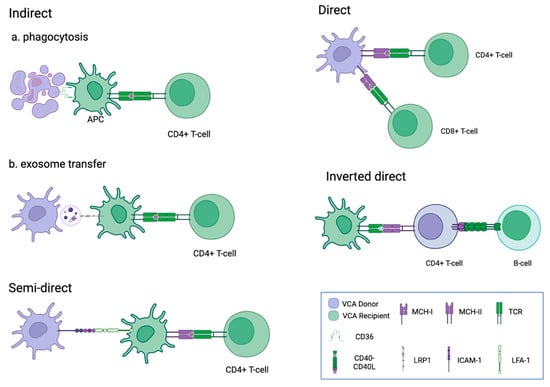
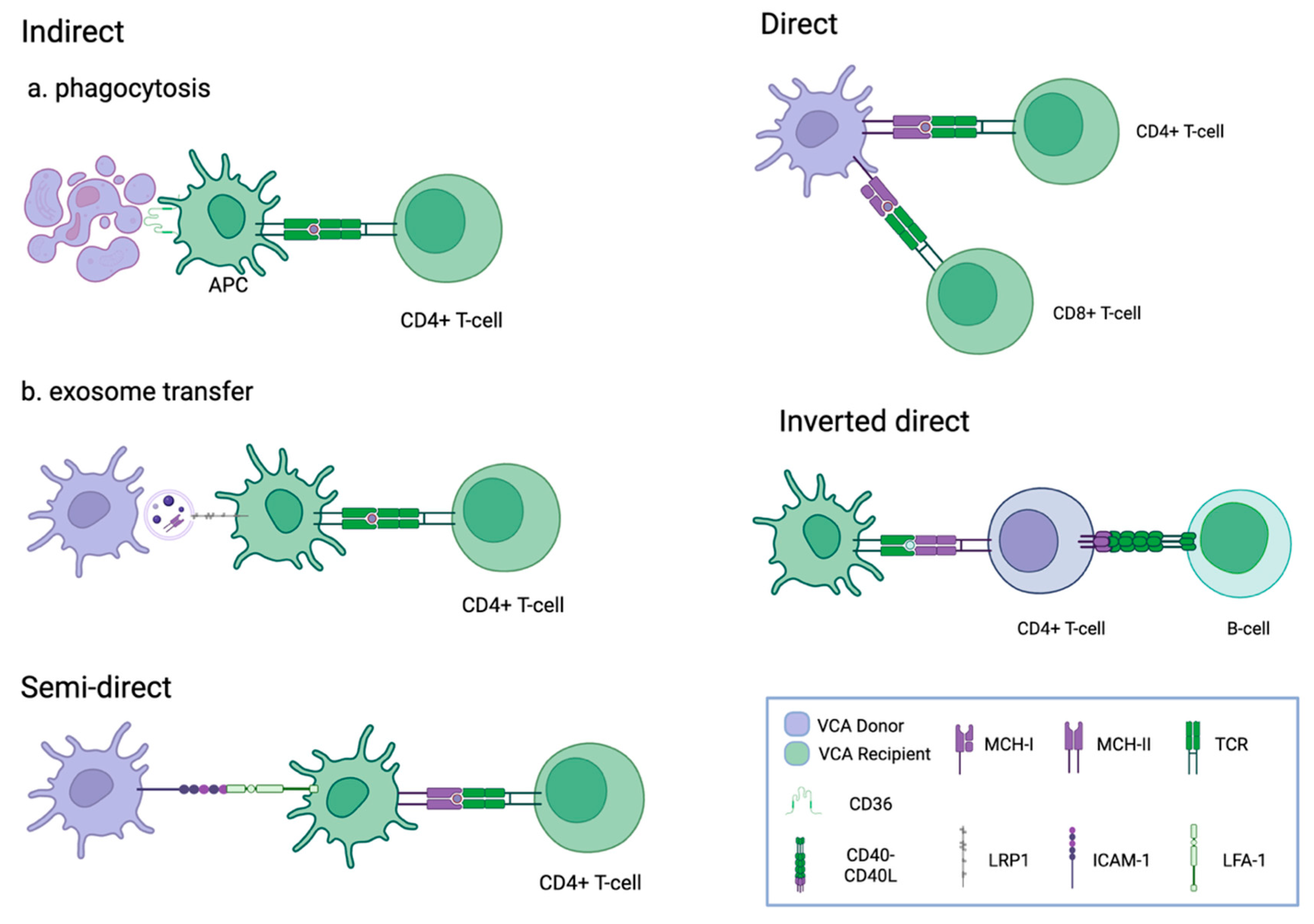
The cellular heterogeneity of composite allografts presents an immunological challenge for VCA, especially in skin- and mucosa-containing allografts, which are known to be highly immunogenic [43,44,45]. Acute rejection (AR) remains the most common immunological complication in VCA and SOT alike. Although AR can be treated effectively with rescue immunosuppressive treatments, the number and severity of AR episodes are predictive for chronic allograft rejection and, ultimately, increased risk of graft loss [24,46]. AR is primarily T-lymphocyte-mediated and occurs when donor-specific alloantigen is presented by resident antigen presenting cells (APCs) to T-lymphocytes through direct, inverse-direct, indirect, and semi-direct allorecognition mechanisms [47] (Figure 1). Direct allorecognition involves the presentation of intact donor MHC–peptide complexes by donor APCs to recipient T-lymphocytes (Figure 1). Contrastingly, the indirect allorecognition pathway involves both APC and T-lymphocytes, which are of recipient origin. Donor proteins are processed into peptides by recipient APCs through phagocytosis or exosome transfer and are presented on recipient MHC-II molecules for allorecognition by recipient T-cells (Figure 1). Inverted direct and semi-direct pathways are mechanistically similar, both involving the presentation of intact donor MHC molecules by recipient APCs (Figure 1). Additionally, the semi-direct pathway processes and presents donor antigens on the intact donor MHC (Figure 1).
Figure 1.
Modes of allorecognition in allotransplantation. In direct allorecognition, donor MHC I & II molecules on the surface of donor APCs are recognised as alloantigens by recipient T-lymphocytes. Inverted direct allorecognition, as the name would suggest, is inverse to the direct allorecognition pathway from a cellular perspective and involves the activation of passenger donor T-lymphocytes by MHC II molecules on the surface recipient APCs. Indirect allorecognition involves internalisation and the expression of donor alloantigens by recipient APCs through phagocytosis (a) or exome transfer (b) and are presented to recipient T-lymphocytes by recipient APCs. Semi-direct allorecognition involves the transfer of donor MHC II molecules to recipient APCs, which ultimately activate recipient T-lymphocytes. Created in BioRender. Marinescu, I. (2025) https://BioRender.com/q39a521, accessed on 18 January 2026.
Following allorecognition, alloreactive T-lymphocytes undergo rapid division and differentiation into effector T-cells (TEFF), with resultant alloantigen-specific destruction of donor tissues. The density of donor APCs in VCA, particularly in the case of skin- and mucosa-containing allografts, presents a commonly cited challenge for achieving allograft tolerance, as demonstrated by the improved allogenicity of VCA grafts following pre-transplantation depletion of donor leukocytes [48].
4.2. Allograft Rejection Rates in VCA
The incidence of acute rejection episodes in VCA have been outlined above, which far exceed that of solid organ counterparts (89% vs. 10–64%, respectively) [38,49,50]. Lung transplantation is largely considered one of the most challenging SOTs from an immunological perspective, with 29% of patients experiencing acute rejection within 1 year, which, although high, is significantly less prevalent than the 89% reported in VCA [38,51]. Contrary to the high AR rates in VCA, chronic rejection (CR) is reportedly lower (11%) in comparison to lung transplantation, where 50% and 67% of lung allografts are reported to succumb to chronic rejection within 5 and 10 years post-transplantation, respectively [38,52]. However, this comparison is somewhat premature given the relative infancy of VCA and the resultant paucity of long-term graft outcome data. The potent allogenic response, which too often complicates lung transplantation, is reportedly related to the high density of mucosal lymphatic tissue and its resident dense population of immune cells, in conjunction with constant exposure to external infective and inflammatory stimuli [53,54]. The lung presents many parallels to skin- and mucosa-containing allografts, with respect to their immunocyte density and interaction with the external environment. Many researchers posit that the characteristic skin and mucosal changes, which become externally visible during the early stages of rejection, likely result in a higher proportion of rejection episodes being diagnosed in VCA in comparison to SOT [24,55]. However, a dense population of immunocytes does not necessitate an effector response to allogenic tissue. The density of naïve T-lymphocytes in the lung, for example, presents a pool capable of transformation to Forkhead Box P3 positive (FOXP3+) regulatory T-cells (TREGs), if provided with the appropriate co-stimulation milieu. TREGs are indispensable in achieving allograft tolerance and immune homeostasis. They are potent inhibitors of antigen presentation, the TEFF and B-cell response, through a host of antigen specific and non-specific mechanisms [56]. An increased proportional population of FOXP3+ TREGs within the transplant micro-environment is essential for the induction of transplant tolerance [57].
4.3. Pre-Operative and Peri-Operative Optimisation Strategies
Human leukocyte antigen (HLA) incompatibility remains a key predictor of graft survival in SOT [58,59]. However, the degree of HLA-match in VCA remains extremely varied in reported studies [60]. Although HLA mismatch is not a contraindication to transplantation, it remains an important precipitant to alloreactivity [61]. Pre-operative donor–recipient matching has improved graft survival in SOT, but is not of equal relevance to all organs [58]. The role of HLA mismatch, in liver transplantation, for example, is reportedly less impactful on allograft outcomes than in kidney, heart, or lung transplantation [58]. The infrastructure for pre-transplant HLA typing is presently available on an international scale, but the role of HLA in VCA requires further delineation. The management of extensive soft-tissue injuries, which may involve blood product transfusion or cadaveric grafting, may result in a higher proportion of VCA recipients being pre-sensitised and the subsequent development of anti-HLA antibodies [62].
4.4. Ischaemic Reperfusion Injury and Tissue Preservation
Tissue ischaemia results in cellular apoptosis and necrosis through the production of toxic metabolites and reactive oxygen species [63,64]. Reperfusion following prolonged ischaemia further worsens electrolyte dyscrasias, the production of toxic metabolites, and subsequent tissue damage, such is the basis of ischaemia reperfusion injury (IRI) [65]. IRI is an important factor of consideration in composite grafts, as the many discrete tissue types display varied tolerance for ischaemic conditions. For example, skin and subcutaneous tissue are quite resilient to hypoxia and tolerate cold ischaemic time up to three times longer than skeletal muscle [66,67,68]. Vascular endothelium is notoriously susceptible to thrombosis following the release of reactive oxygen species-mediated platelet aggregation and complement activation [69]. The advent of machine perfusion (MP) devices has been highly effective in solid organ transplantation, with liver allografts stored utilising MP demonstrating higher graft viability and significantly lower graft injury rates [70]. At present, concerted pre-clinical efforts are being made toward enhancing understanding of the effects of IRI on composite grafts and in evaluating the potential role for MP devices to ameliorate VCA outcomes [71,72,73].
4.5. Systemic Immunosuppression Dosage Required and Associated Morbidity
VCA differs from SOT with respect to its purpose, where VCA grafts are aimed at functional restoration and SOT represents a life-saving intervention for patients with end-stage organ disease. As such, the cost–benefit of systemic immunosuppression, given the potential for increased infective, neoplastic, and lymphoproliferative morbidity, requires more careful consideration in VCA [74,75]. The risk of non-melanomatous skin cancer alone in transplant recipients is at least 65 times that of their non-immunosuppressed counterparts, with the behaviour of these cutaneous malignancies being significantly more aggressive [76,77]. This is of particular relevance considering that the mean reported doses of immunosuppressive agents required in upper extremity and facial VCA are reportedly greater than in SOT [25]. However, in the case of SSF transplantation, the levels of immunosuppression required are reportedly equivalent to that of SOT alone [2]. The difference in immunosuppressive requirements in upper extremity/facial VCA and in SSF presents a somewhat contradictory finding. Some authors posit that the relative complexity of composite grafts, such as in upper-limb VCA, which contain osseous, tendinous, and neurological components, may amplify the immunogenicity of these grafts [78]. The lack of consensus regarding optimal immunosuppressive protocols in VCA and the relative infancy of the acute and chronic VCA rejection data further confounds this comparison.
5. Novel Immunomodulatory Approaches in Allotransplantation
5.1. Adoptive Cellular Therapies
Adoptive cellular therapies (ACTs) are being trialled with promising success in SOT [79]. Both innate and adaptive immune cells have demonstrated their potential immunomodulatory capacity as ACTs in SOT, with mesenchymal stromal cells, regulatory myeloid cells, and regulatory T-lymphocytes being among the favoured cell types [80,81,82,83,84,85]. The ONE and the TWO study have demonstrated clinically important effects of ex-vivo expanded TREG therapies for immunomodulation in kidney transplantation [86,87]. Similarly, promising findings have been demonstrated in liver transplantation [85]. However, ex-vivo expansion of TREGs is not without its limitations; namely, the relative paucity of TREGs in peripheral blood, sample contamination by other CD4+ T-lymphocytes, and the paucity of Good Manufacturing Practice (GMP) expansion protocols [88,89,90,91]. The promise of ACTs to supersede modern immunosuppressive drugs and their associated morbidity represents a promising solution to many of the limitations of VCA. The degree to which the immunological mechanisms underpinning ACT-driven immunomodulation in SOT are understood facilitates progression at a rate greater than that currently achievable in VCA. Although the advancements in SOT present definite parallels, there are critical differences with regards to the immunogenicity of composite allografts, which demand further VCA specific trials. Although the immunogenicity of skin- and mucosa-containing VCAs pose a challenge, some VCA components may incur advantage from an immunomodulatory standpoint. Bone marrow (BM)-containing VCAs, for example, allow for the co-transplantation of passenger donor-specific haematopoietic progenitor cells, without the need for ex-vivo expansion. Vascularised BM transplantation has demonstrated the capacity to induce tolerance through mixed chimerism, prolonging graft survival in animal models [92,93,94]. The quality of evidence supporting the role of vascularised BM-induced tolerance in human VCA cohorts remains comparatively poor, limited to case series and observational studies, which lack both a comparator group and fail to report objective measures of chimerism [95].
5.2. Biomaterial-Based Immunoregulatory Strategies
In the case of VCA, the density of immunocytes, particularly within skin- and mucosa-containing allografts, may provide viable immunomodulatory targets, which supersede the need for ex-vivo expansion. However, the systemic administration of immunomodulatory agents, such as interleukin 2 (IL-2) or transforming growth factor beta (TGF-B), remain poorly tolerated, with significant off-target side-effects [96,97]. However, local administration has demonstrated clinical efficacy in a broad range of clinical applications, from wound healing to cartilage remodelling [98,99]. Biomaterials offer an advanced, modular toolbox capable of achieving highly controlled release of therapeutic agents whilst minimising off-target effects [97,100,101]. Achieving therapeutic effect can be challenging when delivering chemokines, growth factors, and/or interleukins, given the narrow therapeutic index of many of these agents and the severity of associated adverse reactions [102]. Biomaterials may be utilised to deliver controlled dosages of immunosuppressive drugs or immunoreactive cytokines/interleukins to the transplant micro-environment. The compositional and mechanical characteristics of these biomaterials are highly modifiable and can also significantly affect cellular behaviour [103].
Numerous pre-clinical animal studies have demonstrated capability in harnessing the power of biomaterials for the staged, localised delivery of bioactive modules capable of localised conversion of naïve CD4+ T-lymphocytes to FOXP3+ TREGs with potent immunomodulatory capacities [104,105,106]. Fisher et al. utilised micro-nanoparticles as a delivery mechanism for rapamycin, IL-2, and TGF-Beta in a rat hindlimb transplant model. This biomaterial-based strategy demonstrated increased TREG numbers and immunosuppressive activity within the allograft and draining lymphatic basin, resulting in allograft survival to the study endpoint at 300 days, despite the discontinuation of systemic immunosuppression [104].
More recently, micro-nanoparticles have been utilised to form artificial antigen presenting cells (aAPCs), which have demonstrated capacity to induce allorecognition and response mechanisms in-vivo [106]. The key applications of biomaterials for allotransplantation have been summarised (Table 1).
Table 1.
Summary of key biomaterial-driven immunomodulatory strategies in the allotransplantation literature. NP = Nanoparticle. MNP = Micro-nanoparticle. PLGA = Poly(lactic-co-glycolic acid). aAPC = Artificial Antigen Presenting Cell.
6. Latest Advancements, Ethical Considerations, and Future Directions
Progress in VCA is fundamentally reliant on the improvement of allograft survival. However, as with all emerging surgical entities, there remains significant debate with respect to the ethical implications of VCA for both the donor and recipient [27]. Overlooking the broader ethical context risks generating a non-feasible entity. This section outlines the latest advancements in VCA, the ethical considerations unique to VCA, and the likely future directions of the field.
6.1. Latest Advancements
The high throughput of scientific research, which has driven progress in SOT, provides a significant knowledge base from which VCA can advance. However, if VCA is to make meaningful progress, a concerted effort must be made to develop both preclinical and clinical research aimed at elucidating the immunological complexities of VCA. Recently, several groups have published impactful insights into VCA immunology utilising pre-clinical animal models. Kiefer et al. developed a rat hind-limb VCA model, which demonstrated the critical role of c-reactive protein (CRP) in VCA rejection through activation of non-classical monocytes [115]. The group further demonstrated the therapeutic potential of CRP stabilisation in attenuating acute allograft rejection [115]. Zhang et al. performed transcriptome profiling utilising a swine model to outline gene expression patterns during VCA rejection, generating numerous potential avenues for improved diagnostic and therapeutic strategies in VCA [116]. Goutard et al. demonstrated the superiority of sub-normothermic machine perfusion to static cold storage in VCA utilising a swine model, which was correlated using histopathological assessment of VCA biopsies [72]. Such pre-clinical research demonstrates promising progress in the field of VCA. Although ongoing research aims to delineate much of the immunological barriers to success in VCA, reconstructive surgeons continue to pioneer novel VCA subtypes capable of achieving functional and aesthetic restoration [117]. One such emergent VCA entity is the pioneering whole-eye transplant (WET), which aims to simultaneously restore sight and the deficient structural anatomical components, which are often lost in combination with severe facial injuries [118].
6.2. Ethical and Regulatory Considerations
The classification of VCA as an organ transplant has led to its regulation under the United States Department of Health and Human Services (DHHS) and the United Network for Organ Sharing (UNOS) [119]. Unlike solid organ transplants, VCA requires explicit consent from next-of-kin, even if the donor was a registered organ donor [120]. This raises ethical concerns, particularly in cases of facial or hand transplantation, where the identity-linked nature of the graft may affect donor families and recipients [121].
Internationally, VCA regulation varies. In the European Union, the 2010 Organ Directive provides a broad framework, but individual countries implement their own policies. France, a pioneer in VCA, mandates rigorous psychiatric evaluations and long-term follow-up for recipients. Spain has fully integrated VCA into its national transplant program, whereas Germany continues to develop its regulatory infrastructure. In contrast, countries such as India and Brazil have successfully performed VCA procedures, but lack standardised legal frameworks [122].
In the United Kingdom, VCA is governed by the Human Tissue Act 2004, which regulates the removal, storage, and use of human organs and tissues. The Human Tissue Authority (HTA) ensures compliance with ethical standards and proper consent procedures. The UK has performed several VCA procedures, including hand transplants, and continues to expand its expertise in the field.
Ireland is in the process of refining its legal framework for organ and tissue transplantation. The Human Tissue Bill aims to establish comprehensive regulations on the removal, retention, storage, and use of human tissue from deceased individuals, including provisions relevant to VCA [123]. However, specific legislation dedicated to VCA remains under development [122].
6.3. Future Directions
Despite its advancements, VCA faces several challenges that must be addressed to improve long-term outcomes. Key areas for future research include (Table 2):
Table 2.
Summary box detailing the key areas for pre-clinical and clinical research, which are likely to generate the future directions of VCA.
7. Conclusions
VCA presents an exciting opportunity for the surgical provision of functional and anatomical restoration to patients whose reconstructive needs exceed the capabilities of autologous tissue transfer and prostheses. Although the past two decades have demonstrated significant progress in VCA, with growing global numbers of successful uterine, abdominal wall, facial, and upper-extremity transplantation, there remains significant opportunity for further advancement across immunological, biomedical engineering, and regulatory domains.
Author Contributions
Conceptualization, C.M.H., F.D. and R.T.D.; Methodology, C.M.H. and R.T.D.; Investigation, C.M.H., M.O., F.D. and R.T.D.; Resources, C.M.H. and I.M.; Writing—original draft, C.M.H., M.O., I.M. and F.D.; Writing—review & editing, C.M.H., F.D., H.P.G. and R.T.D.; Visualization, I.M.; Supervision, H.P.G. and R.T.D. All authors have read and agreed to the published version of the manuscript.
Funding
Authors CMH and RTD would like to gratefully acknowledge the funding received for this research through the StAR MD Clinical Research Scholarship, Royal College of Surgeons in Ireland, and the Health Research Board, Ireland, Emerging Clinician Scientist Award 2024.
Data Availability Statement
No new data were created or analyzed in this study.
Conflicts of Interest
The authors declare no conflicts of interest.
References
- Murphy, B.D.; Zuker, R.M.; Borschel, G.H. Vascularized composite allotransplantation: An update on medical and surgical progress and remaining challenges. J. Plast. Reconstr. Aesthet. Surg. 2013, 66, 1449–1455. [Google Scholar] [CrossRef] [Scilit]
- Honeyman, C.; Stark, H.L.; Fries, C.A.; Gorantla, V.S.; Davis, M.R.; Giele, H. Vascularised composite allotransplantation in solid organ transplant recipients: A systematic review. J. Plast. Reconstr. Aesthetic Surg. 2021, 74, 316–326. [Google Scholar] [CrossRef] [Scilit]
- Shores, J.T.; Malek, V.; Lee, W.A.; Brandacher, G. Outcomes after hand and upper extremity transplantation. J. Mater. Sci. Mater. Med. 2017, 28, 72. [Google Scholar] [CrossRef] [Scilit]
- Brännström, M. Womb transplants with live births: An update and the future. Expert Opin. Biol. Ther. 2017, 17, 1105–1112. [Google Scholar] [CrossRef] [Scilit] [PubMed]
- Siemionow, M. The decade of face transplant outcomes. J. Mater. Sci. Mater. Med. 2017, 28, 64. [Google Scholar] [CrossRef] [Scilit]
- Grosu-Bularda, A.; Hodea, F.-V.; Cretu, A.; Lita, F.-F.; Bordeanu-Diaconescu, E.-M.; Vancea, C.-V.; Lascar, I.; Popescu, S.A. Reconstructive Paradigms: A Problem-Solving Approach in Complex Tissue Defects. J. Clin. Med. 2024, 13, 1728. [Google Scholar] [CrossRef] [Scilit] [PubMed]
- Becker, C.; Becker, A.M.; Dahlem, K.K.K.; Offergeld, C.; Pfeiffer, J. Aesthetic and functional outcomes in patients with a nasal prosthesis. Int. J. Oral Maxillofac. Surg. 2017, 46, 1446–1450. [Google Scholar] [CrossRef] [Scilit] [PubMed]
- Levi, D.M.; Tzakis, A.G.; Kato, T.; Madariaga, J.; Mittal, N.K.; Nery, J.; Nishida, S.; Ruiz, P. Transplantation of the abdominal wall. Lancet 2003, 361, 2173–2176. [Google Scholar] [CrossRef] [Scilit]
- Honeyman, C.; Dolan, R.; Stark, H.; Fries, C.A.; Reddy, S.; Allan, P.; Vrakas, G.; Vaidya, A.; Dijkstra, G.; Hofker, S.; et al. Abdominal Wall Transplantation: Indications and Outcomes. Curr. Transplant. Rep. 2020, 7, 279–290. [Google Scholar] [CrossRef] [Scilit]
- Gerlach, U.A.; Vrakas, G.; Sawitzki, B.; Macedo, R.; Reddy, S.; Friend, P.J.; Giele, H.; Vaidya, A. Abdominal Wall Transplantation: Skin as a Sentinel Marker for Rejection. Am. J. Transplant. 2016, 16, 1892–1900. [Google Scholar] [CrossRef] [Scilit]
- Barnes, J.; Issa, F.; Vrakas, G.; Friend, P.; Giele, H. The abdominal wall transplant as a sentinel skin graft. Curr. Opin. Organ Transplant. 2016, 21, 536–540. [Google Scholar] [CrossRef] [Scilit]
- Nair, R.; Agrawal, N.; Lebaeau, M.; Tuteja, S.; Chandran, P.K.; Suneja, M. Late acute kidney transplant rejection: Clinicopathological correlates and response to corticosteroid therapy. Transplant. Proc. 2009, 41, 4150–4153. [Google Scholar] [CrossRef] [Scilit]
- Nicholson, M.L.; Wheatley, T.J.; Horsburgh, T.; Edwards, C.M.; Veitch, P.S.; Bell, P.R. The relative influence of delayed graft function and acute rejection on renal transplant survival. Transpl. Int. 1996, 9, 415–419. [Google Scholar] [CrossRef]
- Reddy, K.S.; Davies, D.; Ormond, D.; Tuteja, S.; Lucas, B.A.; Johnston, T.D.; Waid, T.; McKeown, J.W.; Ranjan, D. Impact of acute rejection episodes on long-term graft survival following simultaneous kidney-pancreas transplantation. Am. J. Transplant. 2003, 3, 439–444. [Google Scholar] [CrossRef] [Scilit]
- Lo, Y.M.; Tein, M.S.; Pang, C.C.; Yeung, C.K.; Tong, K.L.; Hjelm, N.M. Presence of donor-specific DNA in plasma of kidney and liver-transplant recipients. Lancet 1998, 351, 1329–1330. [Google Scholar] [CrossRef] [Scilit]
- Oellerich, M.; Sherwood, K.; Keown, P.; Schütz, E.; Beck, J.; Stegbauer, J.; Rump, L.C.; Walson, P.D. Liquid biopsies: Donor-derived cell-free DNA for the detection of kidney allograft injury. Nat. Rev. Nephrol. 2021, 17, 591–603. [Google Scholar] [CrossRef] [Scilit]
- Park, S.; Sellares, J.; Tinel, C.; Anglicheau, D.; Bestard, O.; Friedewald, J.J. European Society of Organ Transplantation Consensus Statement on Testing for Non-Invasive Diagnosis of Kidney Allograft Rejection. Transpl. Int. 2023, 36, 12115. [Google Scholar] [CrossRef] [Scilit] [PubMed]
- Song, Y.; Wang, Y.; Wang, W.; Xie, Y.; Zhang, J.; Liu, J.; Jin, Q.; Wu, W.; Li, H.; Wang, J.; et al. Advancements in noninvasive techniques for transplant rejection: From biomarker detection to molecular imaging. J. Transl. Med. 2025, 23, 147. [Google Scholar] [CrossRef] [Scilit] [PubMed]
- Giele, H. SENTINEL—Efficacy and Mechanism of Sentinel Skin Flap Reduction of Solid Organ (Lung) Transplant Rejection: A Randomised Controlled Trial 2023. Available online: https://www.isrctn.com/ISRCTN13844252 (accessed on 18 January 2026).
- Hehir, C.M.; Dowling, G.P.; Calpin, G.G.; O’Connor, M.; Kelly, L.; Honeyman, C.S.; Stark, H.L.; Dolan, R.T. Vascularised Composite Allotransplantation—A guide to optimal dissemination of scientific outputs. J. Hand Microsurg. 2025, 17, 100161. [Google Scholar] [CrossRef] [Scilit]
- Nassimizadeh, M.; Nassimizadeh, A.K.; Power, D. Hand transplant surgery. Ann. R. Coll. Surg. Engl. 2014, 96, 571–574. [Google Scholar] [CrossRef] [Scilit] [PubMed]
- The Lancet. The first facial transplant. Lancet 2005, 366, 1984. [Google Scholar] [CrossRef] [Scilit]
- Uluer, M.C.; Brazio, P.S.; Woodall, J.D.; Nam, A.J.; Bartlett, S.T.; Barth, R.N. Vascularized Composite Allotransplantation: Medical Complications. Curr. Transplant. Rep. 2016, 3, 395–403. [Google Scholar] [CrossRef] [Scilit]
- Starzl, R.; Brandacher, G.; Lee, W.A.; Carbonell, J.; Zhang, W.; Schnider, J.; Gorantla, V.; Schneeberger, S.; Zheng, X.X. Review of the early diagnoses and assessment of rejection in vascularized composite allotransplantation. Clin. Dev. Immunol. 2013, 2013, 402980. [Google Scholar] [CrossRef] [Scilit]
- Rifkin, W.J.; Manjunath, A.K.; Kantar, R.S.; Jacoby, A.; Kimberly, L.L.; Gelb, B.E.; Diaz-Siso, J.R.; Rodriguez, E.D. A Comparison of Immunosuppression Regimens in Hand, Face, and Kidney Transplantation. J. Surg. Res. 2021, 258, 17–22. [Google Scholar] [CrossRef] [Scilit]
- Van Pilsum Rasmussen, S.E.; Ferzola, A.; Cooney, C.M.; Shores, J.T.; Lee, W.A.; Goldman, E.; Kaufman, C.L.; Brandacher, G.; Segev, D.L.; Henderson, M.L. Psychosocial factors and medication adherence among recipients of vascularized composite allografts. SAGE Open Med. 2020, 8, 2050312120940423. [Google Scholar] [CrossRef] [Scilit]
- Rose, J.; Cooney, C.M.; Kaufman, C.; Talbot, S.G.; Caplan, A.; Kahn, J.; Sugarman, J.; Shores, J.T.; Levin, L.S.; Brandacher, G.; et al. Evolving ethics, policy and reimbursement issues of vascularized composite allotransplantation: Symposium summary. SAGE Open Med. 2019, 7, 2050312119866944. [Google Scholar] [CrossRef] [Scilit]
- Rodrigue, J.R.; Tomich, D.; Fleishman, A.; Glazier, A.K. Vascularized Composite Allograft Donation and Transplantation: A Survey of Public Attitudes in the United States. Am. J. Transplant. 2017, 17, 2687–2695. [Google Scholar] [CrossRef] [Scilit]
- Arenas Hoyos, I.; Helmer, A.; Yerly, A.; Lese, I.; Hirsiger, S.; Zhang, L.; Casoni, D.; Garcia, L.; Petrucci, M.; Hammer, S.E.; et al. A local drug delivery system prolongs graft survival by dampening T cell infiltration and neutrophil extracellular trap formation in vascularized composite allografts. Front. Immunol. 2024, 15, 1387945. [Google Scholar] [CrossRef] [Scilit] [PubMed]
- Holguín-Ruíz, J.A.; Rodríguez, L.; Ferreira-Galvao, F.H.; Muñoz-Botina, J.; Bedoya Duque, M.A.; Varela-Vásquez, M.D.; Rodríguez-Galviz, H.; Zambrano-Galeano, R.; Castaño-Valencia, S.; Gutiérrez-Montes, J.O. An innovative ear transplantation for vascularized composite allotransplantation research in porcine model. Sci. Rep. 2024, 14, 30896. [Google Scholar] [CrossRef] [Scilit] [PubMed]
- Blades, C.M.; Navarro-Alvarez, N.; Huang, C.A.; Mathes, D.W. The Impact of Alloantibodies on Clinical VCA Outcomes and the Need for Immune Tolerance. Transplantology 2024, 5, 148–162. [Google Scholar] [CrossRef] [Scilit]
- Huelsboemer, L.; Boroumand, S.; Kochen, A.; Dony, A.; Moscarelli, J.; Hauc, S.C.; Stögner, V.A.; Formica, R.N.; Pomahac, B.; Kauke-Navarro, M. Immunosuppressive strategies in face and hand transplantation: A comprehensive systematic review of current therapy regimens and outcomes. Front. Transplant. 2024, 3, 1366243. [Google Scholar] [CrossRef] [Scilit] [PubMed]
- Hernandez, J.A.; Testa, G.; Naga, H.I.; Pogson, K.B.; Miller, J.M.; Booker, S.E.; Howell, J.; Poff, K.; Johannesson, L.; Israni, A.K.; et al. OPTN/SRTR 2021 Annual Data Report: Vascularized Composite Allograft. Am. J. Transplant. 2023, 23, S523–S545. [Google Scholar] [CrossRef] [Scilit] [PubMed]
- Jones, B.P.; Kasaven, L.; Vali, S.; Saso, S.; Jalmbrant, M.; Bracewell-Milnes, T.; Thum, M.Y.; Quiroga, I.; Friend, P.; Diaz-Garcia, C.; et al. Uterine Transplantation: Review of Livebirths and Reproductive Implications. Transplantation 2021, 105, 1695–1707. [Google Scholar] [CrossRef] [Scilit]
- Wells, M.W.; Rampazzo, A.; Papay, F.; Gharb, B.B. Two Decades of Hand Transplantation: A Systematic Review of Outcomes. Ann. Plast. Surg. 2022, 88, 335–344. [Google Scholar] [CrossRef] [Scilit]
- Johannesson, L.; Testa, G.; Flyckt, R.; Farrell, R.; Quintini, C.; Wall, A.; O’Neill, K.; Tzakis, A.; Richards, E.G.; Gordon, S.M.; et al. Guidelines for standardized nomenclature and reporting in uterus transplantation: An opinion from the United States Uterus Transplant Consortium. Am. J. Transplant. 2020, 20, 3319–3325. [Google Scholar] [CrossRef] [Scilit]
- Gummesson, C.; Atroshi, I.; Ekdahl, C. The disabilities of the arm, shoulder and hand (DASH) outcome questionnaire: Longitudinal construct validity and measuring self-rated health change after surgery. BMC Musculoskelet. Disord. 2003, 4, 11. [Google Scholar] [CrossRef] [Scilit]
- Milek, D.; Reed, L.T.; Echternacht, S.R.; Shanmugarajah, K.; Cetrulo, C.L., Jr.; Lellouch, A.G.; Langstein, H.N.; Leckenby, J.I. A Systematic Review of the Reported Complications Related to Facial and Upper Extremity Vascularized Composite Allotransplantation. J. Surg. Res. 2023, 281, 164–175. [Google Scholar] [CrossRef] [Scilit] [PubMed]
- Swanson, E.W.; Cheng, H.-T.; Lough, D.M.; Lee, W.P.A.; Shores, J.T.; Brandacher, G. Lower Extremity Allotransplantation: Are We Ready for Prime Time? Vasc. Compos. Allotransplant. 2015, 2, 37–46. [Google Scholar] [CrossRef] [Scilit]
- Fullerton, Z.H.; Tsangaris, E.; De Vries, C.E.; Klassen, A.F.; Aycart, M.A.; Sidey-Gibbons, C.J.; Pusic, A.L.; Pomahac, B. Patient-reported outcomes measures used in facial vascularized composite allotransplantation: A systematic literature review. J. Plast. Reconstr. Aesthet. Surg. 2022, 75, 33–44. [Google Scholar] [CrossRef] [Scilit]
- Tyner, C.E.; Slotkin, J.; Levin, L.S.; Tintle, S.M.; Kaufman, C.L.; Kisala, P.A.; Tulsky, D.S. Measuring Health-Related Quality of Life in Upper Extremity Vascularized Composite Allotransplantation: Development of New Patient-Reported Outcome Items for Hand Transplant. Arch. Phys. Med. Rehabil. 2025; in press.
- Bound Alberti, F.; Ridley, M.; Herrington, E.; Benedict, J.L.; Hall, S. What we still don’t know about vascularized composite allotransplantation (VCA) outcomes and quality of life measurements. Transplant. Rev. 2022, 36, 100708. [Google Scholar] [CrossRef] [Scilit]
- Leonard, D.; Amin, K.; Giele, H.; Fildes, J.; Wong, J. Skin Immunology and Rejection in VCA and Organ Transplantation. Curr. Transplant. Rep. 2020, 7, 251–259. [Google Scholar] [CrossRef] [Scilit]
- Kauke-Navarro, M.; Tchiloemba, B.; Haug, V.; Kollar, B.; Diehm, Y.; Safi, A.F.; Treister, N.S.; Annino, D.J.; Marty, F.M.; Lian, C.G.; et al. Pathologies of oral and sinonasal mucosa following facial vascularized composite allotransplantation. J. Plast. Reconstr. Aesthetic Surg. 2021, 74, 1562–1571. [Google Scholar] [CrossRef] [Scilit] [PubMed]
- Richters, C.D.; Hoekstra, M.J.; du Pont, J.S.; Kreis, R.W.; Kamperdijk, E.W. Immunology of skin transplantation. Clin. Dermatol. 2005, 23, 338–342. [Google Scholar] [CrossRef] [Scilit] [PubMed]
- Unadkat, J.V.; Schneeberger, S.; Horibe, E.H.; Goldbach, C.; Solari, M.G.; Washington, K.M.; Gorantla, V.S.; Cooper, G.M.; Thomson, A.W.; Lee, W.A. Composite tissue vasculopathy and degeneration following multiple episodes of acute rejection in reconstructive transplantation. Am. J. Transplant. 2010, 10, 251–261. [Google Scholar] [CrossRef] [Scilit] [PubMed]
- Afzali, B.; Lechler, R.; Hernandez-Fuentes, M. Allorecognition and the alloresponse: Clinical implications. Tissue Antigens 2007, 69, 545–556. [Google Scholar] [CrossRef] [Scilit]
- Ashraf, M.I.; Mengwasser, J.; Reutzel-Selke, A.; Polenz, D.; Führer, K.; Lippert, S.; Tang, P.; Michaelis, E.; Catar, R.; Pratschke, J.; et al. Depletion of donor dendritic cells ameliorates immunogenicity of both skin and hind limb transplants. Front. Immunol. 2024, 15, 1395945. [Google Scholar] [CrossRef] [Scilit]
- Lamb, K.E.; Lodhi, S.; Meier-Kriesche, H.U. Long-term renal allograft survival in the United States: A critical reappraisal. Am. J. Transplant. 2011, 11, 450–462. [Google Scholar] [CrossRef] [Scilit]
- Wiesner, R.H.; Demetris, A.J.; Belle, S.H.; Seaberg, E.C.; Lake, J.R.; Zetterman, R.K.; Everhart, J.; Detre, K.M. Acute hepatic allograft rejection: Incidence, risk factors, and impact on outcome. Hepatology 1998, 28, 638–645. [Google Scholar] [CrossRef] [Scilit]
- Yusen, R.D.; Edwards, L.B.; Kucheryavaya, A.Y.; Benden, C.; Dipchand, A.I.; Goldfarb, S.B.; Levvey, B.J.; Lund, L.H.; Meiser, B.; Rossano, J.W.; et al. The Registry of the International Society for Heart and Lung Transplantation: Thirty-second Official Adult Lung and Heart-Lung Transplantation Report—2015; Focus Theme: Early Graft Failure. J. Heart Lung Transplant. 2015, 34, 1264–1277. [Google Scholar] [CrossRef] [Scilit]
- Chambers, D.C.; Cherikh, W.S.; Goldfarb, S.B.; Hayes, D., Jr.; Kucheryavaya, A.Y.; Toll, A.E.; Khush, K.K.; Levvey, B.J.; Meiser, B.; Rossano, J.W.; et al. The International Thoracic Organ Transplant Registry of the International Society for Heart and Lung Transplantation: Thirty-fifth adult lung and heart-lung transplant report—2018; Focus theme: Multiorgan Transplantation. J. Heart Lung Transplant. 2018, 37, 1169–1183. [Google Scholar] [CrossRef] [Scilit]
- Hachem, R.R. The role of the immune system in lung transplantation: Towards improved long-term results. J. Thorac. Dis. 2019, 11, S1721–S1731. [Google Scholar] [CrossRef] [Scilit]
- Julliard, W.; Owens, L.A.; O’Driscoll, C.A.; Fechner, J.H.; Mezrich, J.D. Environmental Exposures-The Missing Link in Immune Responses After Transplantation. Am. J. Transplant. 2016, 16, 1358–1364. [Google Scholar] [CrossRef] [Scilit]
- Sarhane, K.A.; Tuffaha, S.H.; Broyles, J.M.; Ibrahim, A.E.; Khalifian, S.; Baltodano, P.; Santiago, G.F.; Alrakan, M.; Ibrahim, Z. A critical analysis of rejection in vascularized composite allotransplantation: Clinical, cellular and molecular aspects, current challenges, and novel concepts. Front. Immunol. 2013, 4, 406. [Google Scholar] [CrossRef] [Scilit] [PubMed]
- Cassano, A.; Chong, A.S.; Alegre, M.-L. Tregs in transplantation tolerance: Role and therapeutic potential. Front. Transplant. 2023, 2, 1217065. [Google Scholar] [CrossRef] [Scilit] [PubMed]
- Li, W.; Bribriesco, A.C.; Nava, R.G.; Brescia, A.A.; Ibricevic, A.; Spahn, J.H.; Brody, S.L.; Ritter, J.H.; Gelman, A.E.; Krupnick, A.S.; et al. Lung transplant acceptance is facilitated by early events in the graft and is associated with lymphoid neogenesis. Mucosal Immunol. 2012, 5, 544–554. [Google Scholar] [CrossRef] [Scilit]
- Zachary, A.A.; Leffell, M.S. HLA Mismatching Strategies for Solid Organ Transplantation—A Balancing Act. Front. Immunol. 2016, 7, 575. [Google Scholar] [CrossRef] [Scilit] [PubMed]
- Hafeez, M.S.; Awais, S.B.; Razvi, M.; Bangash, M.H.; Hsiou, D.A.; Malik, T.H.; Haq, M.U.; Awan, A.A.; Rana, A.A. HLA mismatch is important for 20-year graft survival in kidney transplant patients. Transplant. Immunol. 2023, 80, 101861. [Google Scholar] [CrossRef] [Scilit]
- Ng, Z.Y.; Lellouch, A.G.; Drijkoningen, T.; Chang, I.A.; Sachs, D.H.; Cetrulo, C.L., Jr. Vascularized Composite Allotransplantation-An Emerging Concept for Burn Reconstruction. J. Burn. Care Res. 2017, 38, 371–378. [Google Scholar] [CrossRef] [Scilit]
- Arrieta-Bolaños, E. Differential Alloreactivity: Lessons Learned From a Singular HLA Locus. HLA 2025, 106, e70489. [Google Scholar] [CrossRef] [Scilit]
- Geoghegan, L.; Al-Khalil, M.; Scarborough, A.; Murray, A.; Issa, F. Pre-transplant management and sensitisation in vascularised composite allotransplantation: A systematic review. J. Plast. Reconstr. Aesthetic Surg. 2020, 73, 1593–1603. [Google Scholar] [CrossRef] [Scilit]
- Pefanis, A.; Ierino, F.L.; Murphy, J.M.; Cowan, P.J. Regulated necrosis in kidney ischemia-reperfusion injury. Kidney Int. 2019, 96, 291–301. [Google Scholar] [CrossRef] [Scilit]
- Wu, M.Y.; Yiang, G.T.; Liao, W.T.; Tsai, A.P.; Cheng, Y.L.; Cheng, P.W.; Li, C.Y.; Li, C.J. Current Mechanistic Concepts in Ischemia and Reperfusion Injury. Cell. Physiol. Biochem. 2018, 46, 1650–1667. [Google Scholar] [CrossRef] [Scilit] [PubMed]
- Jiménez-Castro, M.B.; Cornide-Petronio, M.E.; Gracia-Sancho, J.; Peralta, C. Inflammasome-Mediated Inflammation in Liver Ischemia-Reperfusion Injury. Cells 2019, 8, 1131. [Google Scholar] [CrossRef] [Scilit]
- Wagh, M.; Pantazi, G.; Romeo, R.; Hurley, J.V.; Morrison, W.A.; Knight, K.R. Cold storage of rat skeletal muscle free flaps and pre-ischemic perfusion with modified UW solution. Microsurgery 2000, 20, 343–349. [Google Scholar] [CrossRef]
- Serafin, D.; Lesesne, C.B.; Mullen, R.Y.; Georgiade, N.G. Transcutaneous PO2 monitoring for assessing viability and predicting survival of skin flaps: Experimental and clinical correlations. J. Microsurg. 1981, 2, 165–178. [Google Scholar] [CrossRef] [Scilit] [PubMed]
- He, J.; Khan, U.Z.; Qing, L.; Wu, P.; Tang, J. Improving the ischemia-reperfusion injury in vascularized composite allotransplantation: Clinical experience and experimental implications. Front. Immunol. 2022, 13, 998952. [Google Scholar] [CrossRef] [Scilit]
- Wang, Y.; Liu, Y. Neutrophil-Induced Liver Injury and Interactions Between Neutrophils and Liver Sinusoidal Endothelial Cells. Inflammation 2021, 44, 1246–1262. [Google Scholar] [CrossRef] [Scilit] [PubMed]
- Nasralla, D.; Coussios, C.C.; Mergental, H.; Akhtar, M.Z.; Butler, A.J.; Ceresa, C.D.; Chiocchia, V.; Dutton, S.J.; García-Valdecasas, J.C.; Heaton, N.; et al. A randomized trial of normothermic preservation in liver transplantation. Nature 2018, 557, 50–56. [Google Scholar] [CrossRef] [Scilit]
- Duru, Ç.; Biniazan, F.; Hadzimustafic, N.; D’Elia, A.; Shamoun, V.; Haykal, S. Review of machine perfusion studies in vascularized composite allotransplant preservation. Front. Transplant. 2023, 2, 1323387. [Google Scholar] [CrossRef] [Scilit]
- Goutard, M.; Tawa, P.; Berkane, Y.; Andrews, A.R.; Pendexter, C.A.; de Vries, R.J.; Pozzo, V.; Romano, G.; Lancia, H.H.; Filz von Reiterdank, I.; et al. Machine Perfusion Enables 24-h Preservation of Vascularized Composite Allografts in a Swine Model of Allotransplantation. Transpl. Int. 2024, 37, 12338. [Google Scholar] [CrossRef] [Scilit]
- Fries, C.A.; Villamaria, C.Y.; Spencer, J.R.; Lawson, S.; Wang, L.; Raj, T.; Wolf, E.G.; Parida, B.K.; Gorantla, V.S.; Rickard, R.F.; et al. A Hyperbaric Warm Perfusion System Preserves Tissue Composites Ex vivo and Delays the Onset of Acute Rejection. J. Reconstr. Microsurg. 2019, 35, 97–107. [Google Scholar]
- Roberts, M.B.; Fishman, J.A. Immunosuppressive Agents and Infectious Risk in Transplantation: Managing the “Net State of Immunosuppression”. Clin. Infect. Dis. 2021, 73, e1302–e1317. [Google Scholar] [CrossRef] [Scilit] [PubMed]
- Friman, T.K.; Jäämaa-Holmberg, S.; Åberg, F.; Helanterä, I.; Halme, M.; Pentikäinen, M.O.; Nordin, A.; Lemström, K.B.; Jahnukainen, T.; Räty, R.; et al. Cancer risk and mortality after solid organ transplantation: A population-based 30-year cohort study in Finland. Int. J. Cancer 2022, 150, 1779–1791. [Google Scholar] [CrossRef] [Scilit] [PubMed]
- Euvrard, S.; Kanitakis, J.; Claudy, A. Skin cancers after organ transplantation. N. Engl. J. Med. 2003, 348, 1681–1691. [Google Scholar] [CrossRef] [Scilit]
- Lanz, J.; Bavinck, J.N.; Westhuis, M.; Quint, K.D.; Harwood, C.A.; Nasir, S.; Van-de-Velde, V.; Proby, C.M.; Ferrándiz, C.; Genders, R.E.; et al. Aggressive Squamous Cell Carcinoma in Organ Transplant Recipients. JAMA Dermatol. 2019, 155, 66–71. [Google Scholar] [CrossRef] [Scilit]
- Kaufman, C.L.; Marvin, M.R.; Chilton, P.M.; Hoying, J.B.; Williams, S.K.; Tien, H.; Ozyurekoglu, T.; Ouseph, R. Immunobiology in VCA. Transplant. Int. 2016, 29, 644–654. [Google Scholar] [CrossRef] [Scilit]
- Hoogduijn, M.J.; Issa, F.; Casiraghi, F.; Reinders, M.E.J. Cellular therapies in organ transplantation. Transpl. Int. 2021, 34, 233–244. [Google Scholar] [CrossRef] [Scilit]
- Perico, N.; Casiraghi, F.; Gotti, E.; Introna, M.; Todeschini, M.; Cavinato, R.A.; Capelli, C.; Rambaldi, A.; Cassis, P.; Rizzo, P.; et al. Mesenchymal stromal cells and kidney transplantation: Pretransplant infusion protects from graft dysfunction while fostering immunoregulation. Transpl. Int. 2013, 26, 867–878. [Google Scholar] [CrossRef] [Scilit] [PubMed]
- Reinders, M.E.; de Fijter, J.W.; Roelofs, H.; Bajema, I.M.; de Vries, D.K.; Schaapherder, A.F.; Claas, F.H.; van Miert, P.P.; Roelen, D.L.; van Kooten, C.; et al. Autologous bone marrow-derived mesenchymal stromal cells for the treatment of allograft rejection after renal transplantation: Results of a phase I study. Stem Cells Transl. Med. 2013, 2, 107–111. [Google Scholar] [CrossRef] [Scilit]
- Peng, Y.; Ye, Y.; Jia, J.; He, Y.; Yang, Z.; Zhu, X.; Huang, H.; Wang, W.; Geng, L.; Yin, S.; et al. Galectin-1-induced tolerogenic dendritic cells combined with apoptotic lymphocytes prolong liver allograft survival. Int. Immunopharmacol. 2018, 65, 470–482. [Google Scholar] [CrossRef] [Scilit]
- Conde, P.; Rodriguez, M.; van der Touw, W.; Jimenez, A.; Burns, M.; Miller, J.; Brahmachary, M.; Chen, H.M.; Boros, P.; Rausell-Palamos, F.; et al. DC-SIGN(+) Macrophages Control the Induction of Transplantation Tolerance. Immunity 2015, 42, 1143–1158. [Google Scholar] [CrossRef] [Scilit] [PubMed]
- Sawitzki, B.; Harden, P.N.; Reinke, P.; Moreau, A.; Hutchinson, J.A.; Game, D.S.; Tang, Q.; Guinan, E.C.; Battaglia, M.; Burlingham, W.J.; et al. Regulatory cell therapy in kidney transplantation (The ONE Study): A harmonised design and analysis of seven non-randomised, single-arm, phase 1/2A trials. Lancet 2020, 395, 1627–1639. [Google Scholar] [CrossRef] [Scilit] [PubMed]
- Todo, S.; Yamashita, K.; Goto, R.; Zaitsu, M.; Nagatsu, A.; Oura, T.; Watanabe, M.; Aoyagi, T.; Suzuki, T.; Shimamura, T.; et al. A pilot study of operational tolerance with a regulatory T-cell-based cell therapy in living donor liver transplantation. Hepatology 2016, 64, 632–643. [Google Scholar] [CrossRef] [Scilit]
- McCallion, O.; Cross, A.R.; Brook, M.O.; Hennessy, C.; Ferreira, R.; Trzupek, D.; Mulley, W.R.; Kumar, S.; Soares, M.; Roberts, I.S.; et al. Regulatory T cell therapy is associated with distinct immune regulatory lymphocytic infiltrates in kidney transplants. Med 2024, 6, 100561. [Google Scholar] [CrossRef] [Scilit]
- Brook, M.O.; Hester, J.; Petchey, W.; Rombach, I.; Dutton, S.; Bottomley, M.J.; Black, J.; Abdul-Wahab, S.; Bushell, A.; Lombardi, G.; et al. Transplantation Without Overimmunosuppression (TWO) study protocol: A phase 2b randomised controlled single-centre trial of regulatory T cell therapy to facilitate immunosuppression reduction in living donor kidney transplant recipients. BMJ Open 2022, 12, e061864. [Google Scholar] [CrossRef] [Scilit]
- Sakaguchi, S. Naturally arising CD4+ regulatory t cells for immunologic self-tolerance and negative control of immune responses. Annu. Rev. Immunol. 2004, 22, 531–562. [Google Scholar] [CrossRef] [Scilit] [PubMed]
- Baecher-Allan, C.; Brown, J.A.; Freeman, G.J.; Hafler, D.A. CD4+ CD25high regulatory cells in human peripheral blood. J. Immunol. 2001, 167, 1245–1253. [Google Scholar] [CrossRef] [Scilit]
- June, C.H.; Blazar, B.R. (Eds.) Clinical Application of Expanded CD4+ 25+ Cells. In Seminars in Immunology; Elsevier: Amsterdam, The Netherlands, 2006. [Google Scholar]
- Lavazza, C.; Budelli, S.; Montelatici, E.; Viganò, M.; Ulbar, F.; Catani, L.; Cannone, M.G.; Savelli, S.; Groppelli, E.; Lazzari, L.; et al. Process development and validation of expanded regulatory T cells for prospective applications: An example of manufacturing a personalized advanced therapy medicinal product. J. Transl. Med. 2022, 20, 14. [Google Scholar] [CrossRef] [Scilit]
- Lin, C.H.; Anggelia, M.R.; Cheng, H.Y.; Wang, A.Y.; Chuang, W.Y.; Lin, C.H.; Lee, W.A.; Wei, F.C.; Brandacher, G. The intragraft vascularized bone marrow component plays a critical role in tolerance induction after reconstructive transplantation. Cell. Mol. Immunol. 2021, 18, 363–373. [Google Scholar] [CrossRef] [Scilit]
- Wang, L.; Wang, Z.; Han, R.; Samanta, A.; Ge, G.; Levin, L.S.; Levine, M.H.; Hancock, W.W. Donor bone-marrow CXCR4+ Foxp3+ T-regulatory cells are essential for costimulation blockade-induced long-term survival of murine limb transplants. Sci. Rep. 2020, 10, 9292. [Google Scholar] [CrossRef] [Scilit]
- Oubari, H.; Van Dieren, L.; Lancia, H.; Dehnadi, A.; Jeljeli, M.; Randolph, M.; Benichou, G.; Kawai, T.; Cetrulo, C.L.; Lellouch, A.G. Long Term Immunosuppression Free Survival of a Face Allotransplant via Donor Hematopoietic Chimerism in Non Human Primates. Am. J. Transplant. 2025, 25, S535. [Google Scholar] [CrossRef] [Scilit]
- Barth, R.; Brazio, P.; Klassen, D.; Bojovic, B.; Kukuruga, D.; Drachenberg, C.; Bartlett, S.; Rodriguez, E. Immunologic Outcomes in Clinical Face Transplantation with Large Volume Vascularized Bone Marrow Component. Am. J. Transplant. 2013, 13, 331. [Google Scholar]
- Rokade, S.; Damani, A.M.; Oft, M.; Emmerich, J. IL-2 based cancer immunotherapies: An evolving paradigm. Front. Immunol. 2024, 15, 1433989. [Google Scholar] [CrossRef] [Scilit] [PubMed]
- Prud’homme, G.J. Pathobiology of transforming growth factor β in cancer, fibrosis and immunologic disease, and therapeutic considerations. Lab. Investig. 2007, 87, 1077–1091. [Google Scholar] [CrossRef] [Scilit]
- Puolakkainen, P.A.; Twardzik, D.R.; Ranchalis, J.E.; Pankey, S.C.; Reed, M.J.; Gombotz, W.R. The Enhancement in Wound Healing by Transforming Growth Factor-β1 (TGF-β1) Depends on the Topical Delivery System. J. Surg. Res. 1995, 58, 321–329. [Google Scholar] [CrossRef] [Scilit]
- Jung, H.; McClellan, P.; Welter, J.F.; Akkus, O. Chondrogenesis of Mesenchymal Stem Cells through Local Release of TGF-β3 from Heparinized Collagen Biofabric. Tissue Eng. Part A 2021, 27, 1434–1445. [Google Scholar] [CrossRef] [Scilit] [PubMed]
- Hubbell, J.A.; Thomas, S.N.; Swartz, M.A. Materials engineering for immunomodulation. Nature 2009, 462, 449–460. [Google Scholar] [CrossRef] [Scilit] [PubMed]
- Danhier, F.; Ansorena, E.; Silva, J.M.; Coco, R.; Le Breton, A.; Préat, V. PLGA-based nanoparticles: An overview of biomedical applications. J. Control. Release 2012, 161, 505–522. [Google Scholar] [CrossRef] [Scilit]
- Tang, Q. Therapeutic window of interleukin-2 for autoimmune diseases. Diabetes 2015, 64, 1912–1913. [Google Scholar] [CrossRef] [Scilit]
- O’Brien, F.J. Biomaterials & scaffolds for tissue engineering. Mater. Today 2011, 14, 88–95. [Google Scholar] [CrossRef] [Scilit]
- Fisher, J.D.; Balmert, S.C.; Zhang, W.; Schweizer, R.; Schnider, J.T.; Komatsu, C.; Dong, L.; Erbas, V.E.; Unadkat, J.V.; Aral, A.M.; et al. Treg-inducing microparticles promote donor-specific tolerance in experimental vascularized composite allotransplantation. Proc. Natl. Acad. Sci. USA 2019, 116, 25784–25789. [Google Scholar] [CrossRef] [Scilit]
- Sommerfeld, S.D.; Zhou, X.; Mejías, J.C.; Oh, B.C.; Maestas, D.R., Jr.; Furtmüller, G.J.; Laffont, P.A.; Elisseeff, J.H.; Brandacher, G. Biomaterials-based immunomodulation enhances survival of murine vascularized composite allografts. Biomater. Sci. 2023, 11, 4022–4031. [Google Scholar] [CrossRef] [Scilit]
- Rhodes, K.R.; Meyer, R.A.; Wang, J.; Tzeng, S.Y.; Green, J.J. Biomimetic tolerogenic artificial antigen presenting cells for regulatory T cell induction. Acta Biomater. 2020, 112, 136–148. [Google Scholar] [CrossRef] [Scilit]
- Miyamoto, Y.; Uno, T.; Yamamoto, H.; Li, X.-K.; Sakamoto, K.I.; Hashimoto, H.; Takenaka, H.; Kawashima, Y.; Kawarasaki, H. Pharmacokinetic and immunosuppressive effects of tacrolimus-loaded biodegradable microspheres. Liver Transplant. 2004, 10, 392–396. [Google Scholar] [CrossRef] [Scilit] [PubMed]
- Kauffman, K.J.; Kanthamneni, N.; Meenach, S.A.; Pierson, B.C.; Bachelder, E.M.; Ainslie, K.M. Optimization of rapamycin-loaded acetalated dextran microparticles for immunosuppression. Int. J. Pharm. 2012, 422, 356–363. [Google Scholar] [CrossRef] [Scilit]
- Forrest, M.L.; Won, C.-Y.; Malick, A.W.; Kwon, G.S. In vitro release of the mTOR inhibitor rapamycin from poly (ethylene glycol)-b-poly (ε-caprolactone) micelles. J. Control. Release 2006, 110, 370–377. [Google Scholar] [CrossRef] [Scilit] [PubMed]
- Jhunjhunwala, S.; Raimondi, G.; Thomson, A.W.; Little, S.R. Delivery of rapamycin to dendritic cells using degradable microparticles. J. Control. Release 2009, 133, 191–197. [Google Scholar] [CrossRef] [Scilit] [PubMed]
- Haddadi, A.; Elamanchili, P.; Lavasanifar, A.; Das, S.; Shapiro, J.; Samuel, J. Delivery of rapamycin by PLGA nanoparticles enhances its suppressive activity on dendritic cells. J. Biomed. Mater. Res. Part A 2008, 84, 885–898. [Google Scholar] [CrossRef] [Scilit]
- Yuan, X.B.; Yuan, Y.B.; Jiang, W.; Liu, J.; Tian, E.J.; Shun, H.M.; Huang, D.H.; Yuan, X.Y.; Li, H.; Sheng, J. Preparation of rapamycin-loaded chitosan/PLA nanoparticles for immunosuppression in corneal transplantation. Int. J. Pharm. 2008, 349, 241–248. [Google Scholar] [CrossRef] [Scilit]
- Jhunjhunwala, S.; Balmert, S.C.; Raimondi, G.; Dons, E.; Nichols, E.E.; Thomson, A.W.; Little, S.R. Controlled release formulations of IL-2, TGF-β1 and rapamycin for the induction of regulatory T cells. J. Control. Release 2012, 159, 78–84. [Google Scholar] [CrossRef] [Scilit]
- Steenblock, E.R.; Fahmy, T.M. A comprehensive platform for ex vivo T-cell expansion based on biodegradable polymeric artificial antigen-presenting cells. Mol. Ther. 2008, 16, 765–772. [Google Scholar] [CrossRef] [Scilit]
- Kiefer, J.; Zeller, J.; Schneider, L.; Thomé, J.; McFadyen, J.D.; Hoerbrand, I.A.; Lang, F.; Deiss, E.; Bogner, B.; Schaefer, A.L.; et al. C-reactive protein orchestrates acute allograft rejection in vascularized composite allotransplantation via selective activation of monocyte subsets. J. Adv. Res. 2024, 72, 401–420. [Google Scholar] [CrossRef] [Scilit]
- Zhang, L.; Arenas Hoyos, I.; Helmer, A.; Banz, Y.; Zubler, C.; Lese, I.; Hirsiger, S.; Constantinescu, M.; Rieben, R.; Gultom, M.; et al. Transcriptome profiling of immune rejection mechanisms in a porcine vascularized composite allotransplantation model. Front. Immunol. 2024, 15, 1390163. [Google Scholar] [CrossRef] [Scilit] [PubMed]
- Oubari, H.; Berkane, Y.; Cetrulo, C.L.; Lellouch, A.G. Emerging Entities in Vascularized Composite Allotransplantation: A New Layer to Ongoing Challenges. Transplant. Int. 2025, 38, 15420. [Google Scholar] [CrossRef] [Scilit] [PubMed]
- Nowogrodzki, J. World’s first whole-eye transplant: The innovations that made it possible. Nature 2024, 633, 500–501. [Google Scholar] [CrossRef] [Scilit]
- Cherikh, W.S.; Cendales, L.C.; Wholley, C.L.; Wainright, J.; Gorantla, V.S.; Klassen, D.K.; McDiarmid, S.V.; Levin, L.S. Vascularized composite allotransplantation in the United States: A descriptive analysis of the Organ Procurement and Transplantation Network Data. Am. J. Transplant. 2019, 19, 865–875. [Google Scholar] [PubMed]
- Rahmel, A. Vascularized Composite Allografts: Procurement, Allocation, and Implementation. Curr. Transplant. Rep. 2014, 1, 173–182. [Google Scholar] [CrossRef] [Scilit]
- Swindell, J.S. Facial allograft transplantation, personal identity and subjectivity. J. Med. Ethics 2007, 33, 449–453. [Google Scholar] [CrossRef] [Scilit]
- Thuong, M.; Petruzzo, P.; Landin, L.; Mahillo, B.; Kay, S.; Testelin, S.; Jablecki, J.; Laouabdia-Sellami, K.; Lopez-Fraga, M.; Dominguez-Gil, B. Vascularized composite allotransplantation—A Council of Europe position paper. Transpl. Int. 2019, 32, 233–240. [Google Scholar]
- Hehir, C.; Dolan, R. The Human Tissue Bill. Ir. Med. J. 2023, 116, P886. [Google Scholar]

Disclaimer/Publisher’s Note: The statements, opinions and data contained in all publications are solely those of the individual author(s) and contributor(s) and not of MDPI and/or the editor(s). MDPI and/or the editor(s) disclaim responsibility for any injury to people or property resulting from any ideas, methods, instructions or products referred to in the content. |
© 2026 by the authors. Published by MDPI on behalf of the Lithuanian University of Health Sciences. Licensee MDPI, Basel, Switzerland. This article is an open access article distributed under the terms and conditions of the Creative Commons Attribution (CC BY) license.