Quadratus Lumborum Block Versus Transversus Abdominis Plane Block in Laparoscopic Colorectal Surgery: A Systematic Review and Meta-Analysis

 ,
,  , , , , and
Abstract
1. Introduction
2. Methodology
2.1. Protocol Registration
2.2. Data Sources and Search Strategy
2.3. Eligibility Criteria
- Population (P): adult patients undergoing elective laparoscopic colorectal surgery.
- Intervention (I): QLB, regardless of the approach, local anesthetic concentration, or volume.
- Control (C): TAPB, regardless of the approach, local anesthetic concentration, or volume.
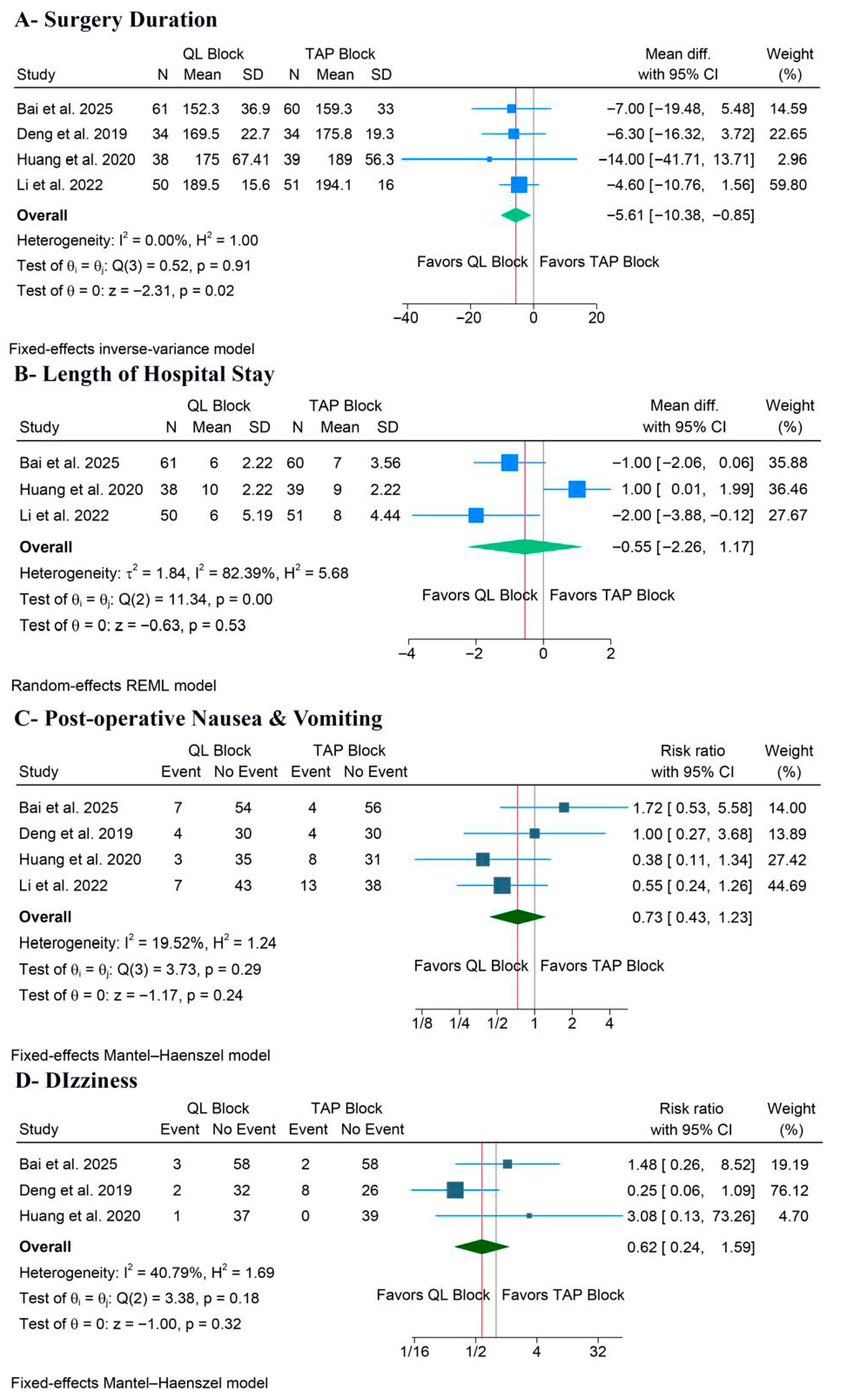
- Outcomes (O): The primary outcomes were postoperative opioid consumption at 24 h and intraoperative opioid consumption. Secondary outcomes included pain scores at different postoperative time points at rest and during movement, length of hospital stay (LoS), surgery duration, and postoperative adverse events.
2.4. Study Selection
2.5. Data Extraction
- Study characteristics: Study ID, country, study design, total number of patients, QLB details, TAPB group details, adjuvant analgesia, main inclusion criteria, pain assessment score, primary outcome, and follow-up duration.
- Participant baseline characteristics: number of participants in each group, age (years), gender (male/female), American Society of Anesthesiologists (ASA) classification, body mass index (BMI), and type of surgery.
- Outcome data: pain scores at all reported time points, total opioid/analgesic consumption, LoS, surgery duration, and postoperative adverse events.
2.6. Risk of Bias and Certainty of Evidence
2.7. Statistical Analysis
3. Results
3.1. Search Results and Study Selection
3.2. Characteristics of Included Studies
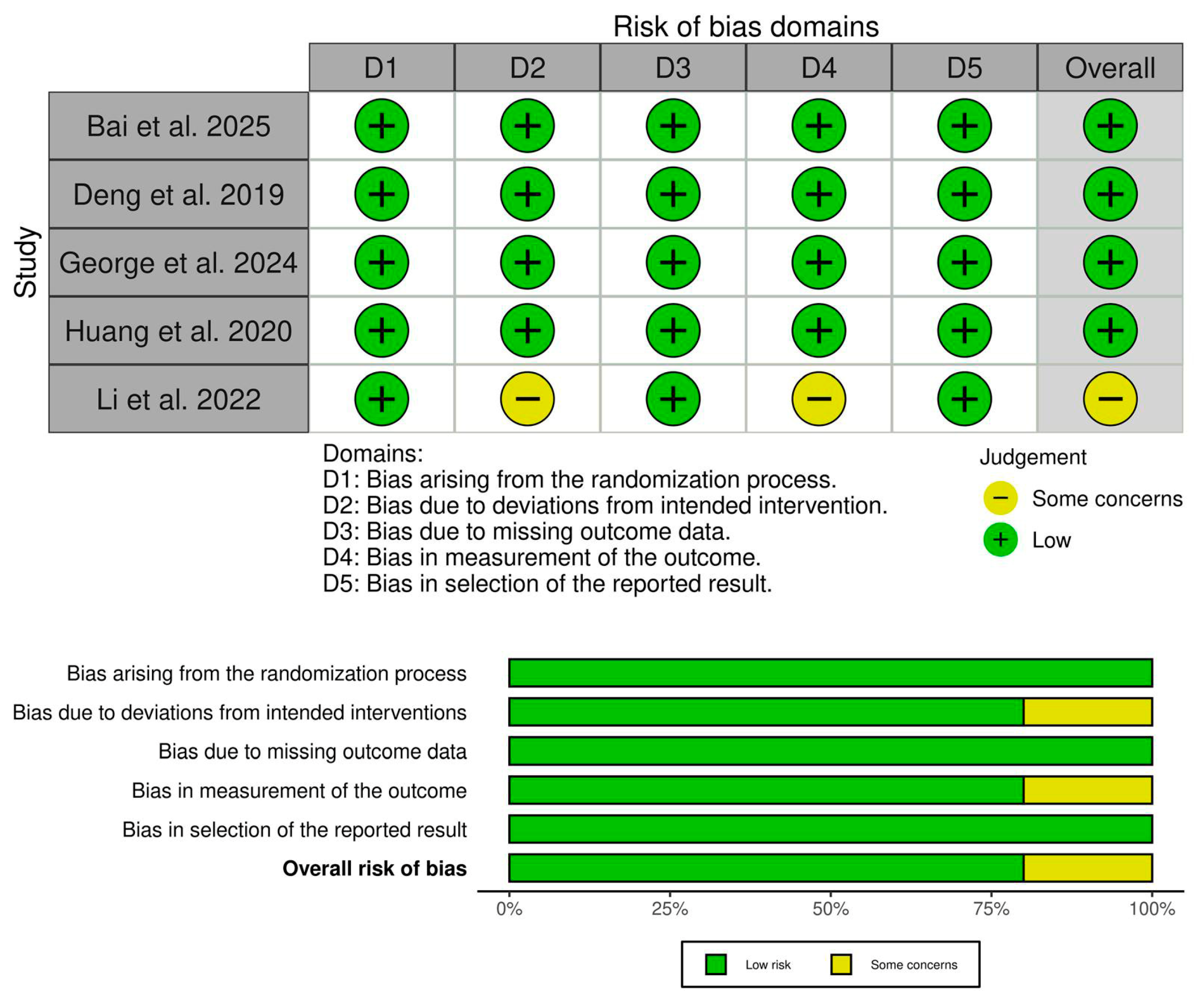
3.3. Risk of Bias and Certainty of Evidence
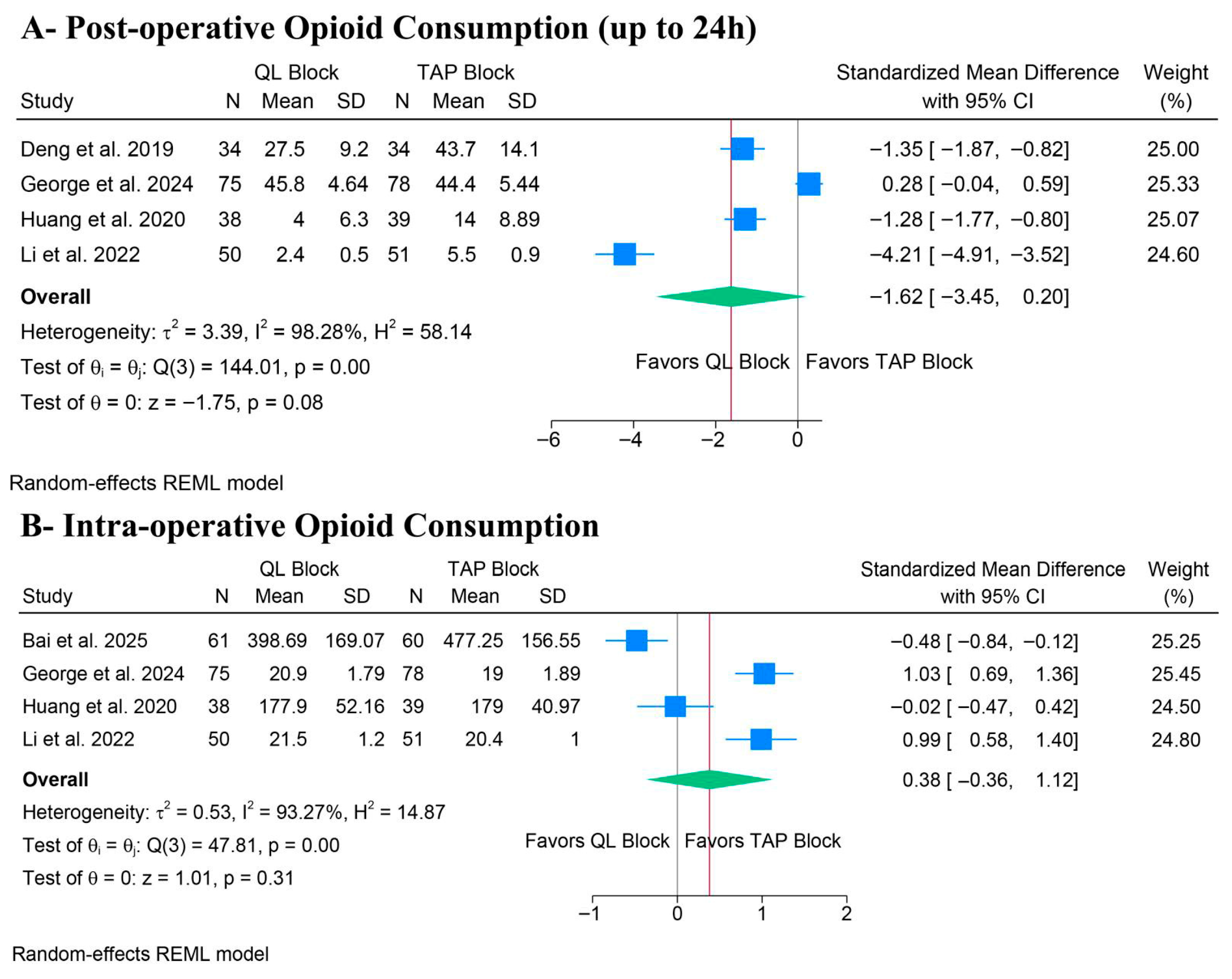
3.4. Primary Outcome: Opioid Consumption
3.5. Secondary Outcomes
3.5.1. Pain Score
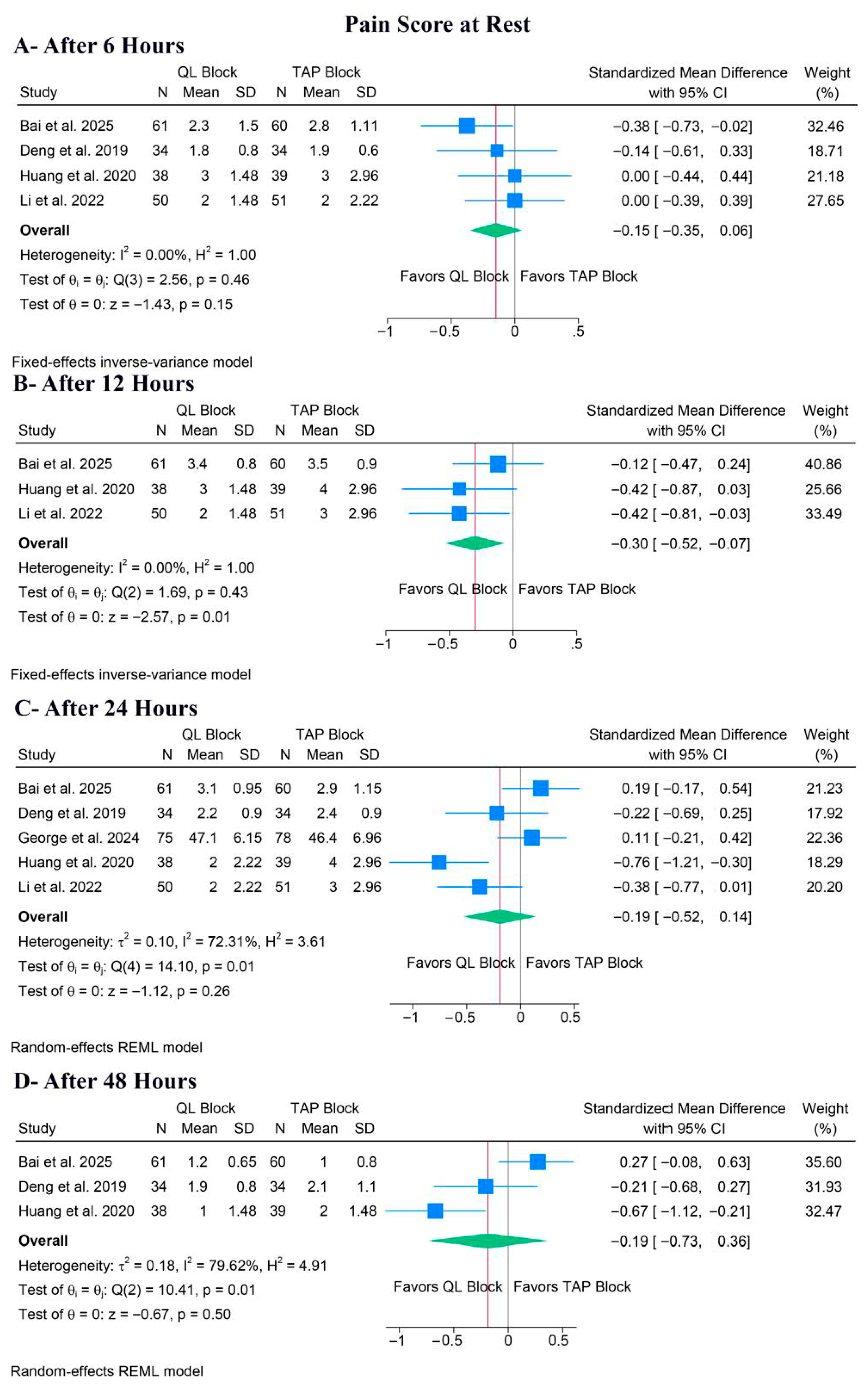
Pain at Rest
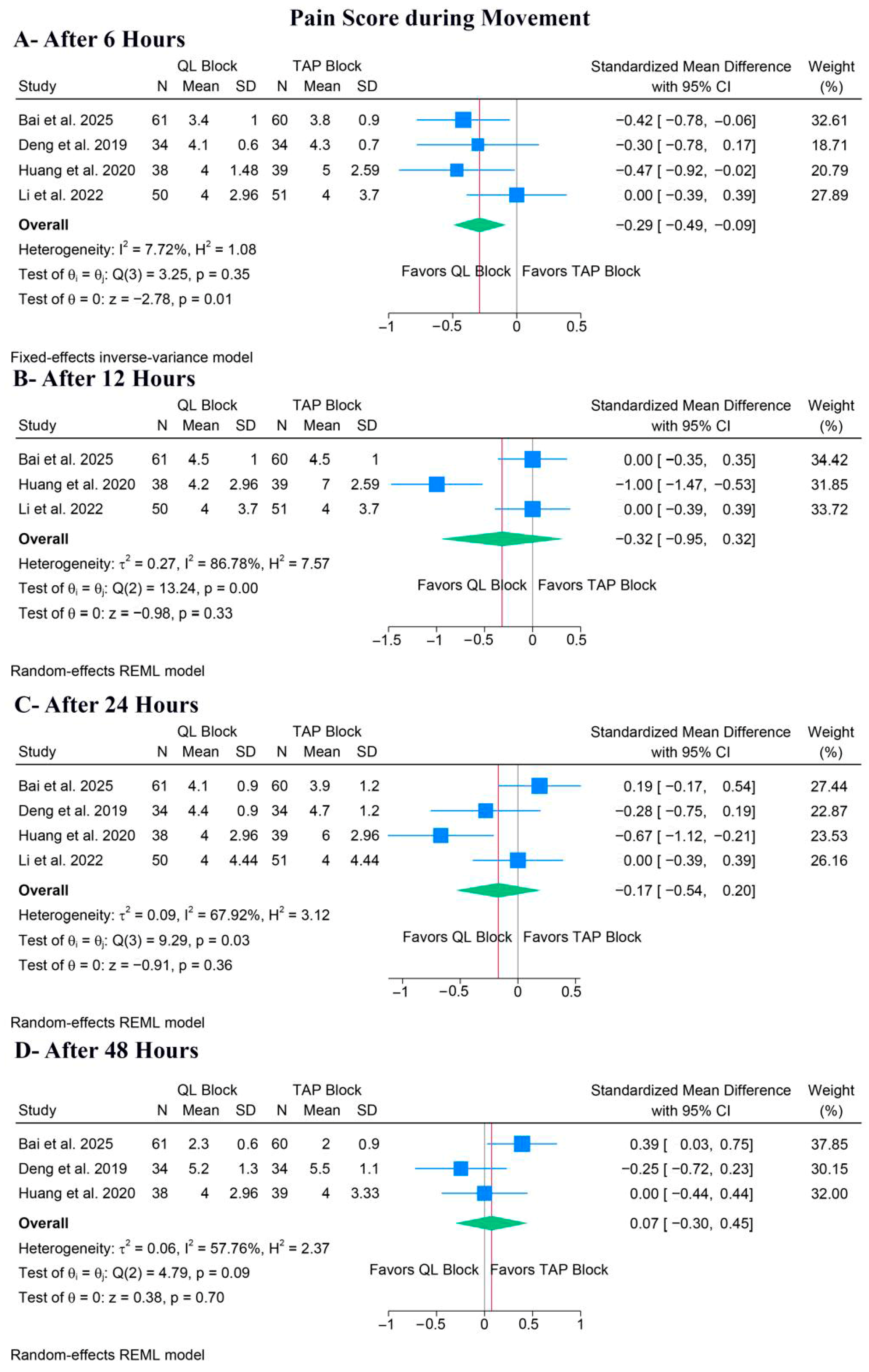
Pain During Movement
3.5.2. Surgery Duration and Hospital Stay
3.5.3. Postoperative Adverse Events
4. Discussion
5. Implications for Clinical Practice
6. Strengths and Limitations
7. Conclusions
Supplementary Materials
Author Contributions
Funding
Data Availability Statement
Conflicts of Interest
References
- Siegel, R.L.; Wagle, N.S.; Cercek, A.; Smith, R.A.; Jemal, A. Colorectal cancer statistics, 2023. CA Cancer J. Clin. 2023, 73, 233–254. [Google Scholar] [CrossRef]
- Shida, D.; Tagawa, K.; Inada, K.; Nasu, K.; Seyama, Y.; Maeshiro, T.; Miyamoto, S.; Inoue, S.; Umekita, N. Enhanced recovery after surgery (ERAS) protocols for colorectal cancer in Japan. BMC Surg. 2015, 15, 90. [Google Scholar] [CrossRef] [PubMed]
- Kannan, V.; Ullah, N.; Geddada, S.; Ibrahiam, A.; Munaf Shakir Al-Qassab, Z.; Ahmed, O.; Malasevskaia, I. Impact of “Enhanced Recovery After Surgery” (ERAS) protocols vs. traditional perioperative care on patient outcomes after colorectal surgery: A systematic review. Patient Saf. Surg. 2025, 19, 4. [Google Scholar] [CrossRef] [PubMed]
- Joshi, G.P.; Bonnet, F.; Kehlet, H.; Bonnet, F.; Camu, F.; Fischer, H.B.J.; Joshi, G.P.; Neugebauer, E.A.M.; Rawal, N.; Schug, S.A.; et al. Evidence-based postoperative pain management after laparoscopic colorectal surgery. Color. Dis. 2013, 15, 146–155. [Google Scholar] [CrossRef]
- Gedda, C.; Nygren, J.; Garpenbeck, A.; Hoffström, L.; Thorell, A.; Soop, M. Multimodal Analgesia Bundle and Postoperative Opioid Use Among Patients Undergoing Colorectal Surgery. JAMA Netw. Open 2023, 6, E2332408. [Google Scholar] [CrossRef]
- Portilho, A.S.; Olivé, M.L.V.; de Almeida Leite, R.M.; Tustumi, F.; Seid, V.E.; Gerbasi, L.S.; Pandini, R.V.; Horcel, L.d.A.; Araujo, S.E.A. The Impact of Enhanced Recovery After Surgery Compliance in Colorectal Surgery for Cancer. J. Laparoendosc. Adv. Surg. Tech. 2025, 35, 185–197. [Google Scholar] [CrossRef] [PubMed]
- Lohsiriwat, V.; Jitmungngan, R. Enhanced recovery after surgery in emergency colorectal surgery: Review of literature and current practices. World J. Gastrointest. Surg. 2019, 11, 41–52. [Google Scholar] [CrossRef]
- Simpson, J.C.; Bao, X.; Agarwala, A. Pain Management in Enhanced Recovery after Surgery (ERAS) Protocols. Clin. Colon Rectal Surg. 2019, 32, 121–128. [Google Scholar] [CrossRef]
- May, P.L.; Wojcikiewicz, T. Regional anaesthesia and fascial plane blocks for abdominal surgery: A narrative review. Dig. Med. Res. 2022, 5, 42. [Google Scholar] [CrossRef]
- Khersonsky, J.; Alavi, M.; Yap, E.N.; Campbell, C.I. Impact of Fascial Plane Block on Postoperative Length of Stay and Opioid Use Among Colectomy Patients Within an Established Enhanced Recovery After Surgery Program: A Retrospective Cohort Study. J. Pain Res. 2025, 18, 689–699. [Google Scholar] [CrossRef]
- Pilia, E.; Marrone, F.; Fusco, P. Efficacy of fascial plane blocks in enhanced recovery after surgery protocols for abdominal surgery: A brief meta-analysis. Eur. J. Anaesthesiol. Intensive Care 2025, 4, e0085. [Google Scholar] [CrossRef]
- Chin, K.J.; McDonnell, J.G.; Carvalho, B.; Sharkey, A.; Pawa, A.; Gadsden, J. Essentials of our current understanding: Abdominal wall blocks. Reg. Anesth. Pain Med. 2017, 42, 133–183. [Google Scholar] [CrossRef]
- Tsai, H.C.; Yoshida, T.; Chuang, T.Y.; Yang, S.F.; Chang, C.C.; Yao, H.Y.; Tai, Y.T.; Lin, J.A.; Chen, K.Y. Transversus Abdominis Plane Block: An Updated Review of Anatomy and Techniques. Biomed Res. Int. 2017, 2017, 8284363. [Google Scholar] [CrossRef]
- Brogi, E.; Kazan, R.; Cyr, S.; Giunta, F.; Hemmerling, T.M. Transversus abdominal plane block for postoperative analgesia: A systematic review and meta-analysis of randomized-controlled trials. Can. J. Anesth. Can. D’anesthésie 2016, 63, 1184–1196. [Google Scholar] [CrossRef]
- El-Boghdadly, K.; Elsharkawy, H.A.; Society, A.; Anesthesia, R.; Medicine, P. Transversus Abdominis Plane Versus Quadratus Lumborum Blocks for Abdominal Surgery: Where Are We Now ? ASRA Pain Med. Updat. 2019, 2020. Available online: https://asra.com/news-publications/asra-newsletter/newsletter-item/asra-news/2019/08/07/transversus-abdominis-plane-versus-quadratus-lumborum-blocks-for-abdominal-surgery-where-are-we-now- (accessed on 10 November 2025).
- Murouchi, T.; Iwasaki, S.; Yamakage, M. Quadratus lumborum block: Analgesic effects and chronological ropivacaine concentrations after laparoscopic surgery. Reg. Anesth. Pain Med. 2016, 41, 146–150. [Google Scholar] [CrossRef] [PubMed]
- Akerman, M.; Pejčić, N.; Veličković, I. A review of the quadratus lumborum block and ERAS. Front. Med. 2018, 5, 44. [Google Scholar] [CrossRef] [PubMed]
- Elsharwaky, H. How I Do It: Ultrasound-Guided Quadratus Lumborum Block. ASRA Pain Med. Updat. 2022, 15, 34–40. [Google Scholar]
- Bai, H.; Zhong, S.; Yang, X.; Hou, L.; Liu, Q.; Wang, Y.; Wang, Z.; Sun, B. Lateral quadratus lumborum block versus transversus abdominis plane block for perioperative analgesia in patients undergoing laparoscopic colorectal cancer surgery: A randomized, controlled clinical trial. BMC Anesthesiol. 2025, 25, 365. [Google Scholar] [CrossRef] [PubMed]
- Deng, W.; Long, X.; Li, M.; Li, C.; Guo, L.; Xu, G.; Yu, S. Quadratus lumborum block versus transversus abdominis plane block for postoperative pain management after laparoscopic colorectal surgery: A randomized controlled trial. Medicine 2019, 98, e18448. [Google Scholar] [CrossRef]
- George, R.M.; McSwain, J.R.; Gukasov, M.; Wilson, D.A.; Nitchie, H.; Wilson, S.H. Dermatomal spread in lateral quadratus lumborum blocks versus transversus abdominus plane blocks after laparoscopic colorectal surgery: A randomized clinical trial. Reg. Anesth. Pain Med. 2024, 1–6. [Google Scholar] [CrossRef]
- Huang, D.; Song, L.; Li, Y.; Xu, Z.; Li, X.; Li, C. Posteromedial quadratus lumborum block versus transversus abdominal plane block for postoperative analgesia following laparoscopic colorectal surgery: A randomized controlled trial. J. Clin. Anesth. 2020, 62, 109716. [Google Scholar] [CrossRef]
- Li, L.; Xu, Y.; Jiang, F.; Zhang, X. Quadratus Lumborum Block versus Transversus Abdominis Plane Block for Laparoscopic Radical Resection for Rectal Cancer. Iran. Red Crescent Med. J. 2022, 24. [Google Scholar] [CrossRef]
- Page, M.J.; McKenzie, J.E.; Bossuyt, P.M.; Boutron, I.; Hoffmann, T.C.; Mulrow, C.D.; Shamseer, L.; Tetzlaff, J.M.; Akl, E.A.; Brennan, S.E.; et al. The PRISMA 2020 statement: An updated guideline for reporting systematic reviews. Syst. Rev. 2021, 10, 89. [Google Scholar] [CrossRef]
- Higgins, J.P.T.; Thomas, J.; Chandler, J.; Cumpston, M.; Li, T.; Page, M.J.; Welch, V.J.H.W. (Eds.) Cochrane Handbook for Systematic Reviews of Interventions; John Wiley & Sons, Inc.: Hoboken, NJ, USA, 2023. [Google Scholar]
- Wan, X.; Wang, W.; Liu, J.; Tong, T. Estimating the sample mean and standard deviation from the sample size, median, range and/or interquartile range. BMC Med. Res. Methodol. 2014, 14, 135. [Google Scholar] [CrossRef]
- Sterne, J.A.C.; Savović, J.; Page, M.J.; Elbers, R.G.; Blencowe, N.S.; Boutron, I.; Cates, C.J.; Cheng, H.Y.; Corbett, M.S.; Eldridge, S.M.; et al. RoB 2: A revised tool for assessing risk of bias in randomised trials. BMJ 2019, 366, l4898. [Google Scholar] [CrossRef] [PubMed]
- Guyatt, G.H.; Oxman, A.D.; Kunz, R.; Vist, G.E.; Falck-Ytter, Y.; Schünemann, H.J. Rating Quality of Evidence and Strength of Recommendations: What is “quality of evidence” and why is it important to clinicians? BMJ Br. Med. J. 2008, 336, 995–998. [Google Scholar] [CrossRef] [PubMed]
- Guyatt, G.H.; Oxman, A.D.; Vist, G.E.; Kunz, R.; Falck-Ytter, Y.; Alonso-Coello, P.; Schünemann, H.J. Rating Quality of Evidence and Strength of Recommendations: GRADE: An emerging consensus on rating quality of evidence and strength of recommendations. BMJ Br. Med. J. 2008, 336, 924. [Google Scholar] [CrossRef]
- Lin, L.; Chu, H. Quantifying publication bias in meta-analysis. Biometrics 2018, 74, 785–794. [Google Scholar] [CrossRef]
- Mutlu, Ö.P.Z.; Tütüncü, A.; Kendigelen, P.; Kara Esen, B. Posterior transversus abdominis plane block versus lateral quadratus lumborum block in children undergoing open orchiopexy: A randomized clinical trial. Braz. J. Anesthesiol. Engl. Ed. 2024, 74, 744443. [Google Scholar] [CrossRef]
- Abdallah, F.W.; Laffey, J.G.; Halpern, S.H.; Brull, R. Duration of analgesic effectiveness after the posterior and lateral transversus abdominis plane block techniques for transverse lower abdominal incisions: A meta-analysis. Br. J. Anaesth. 2013, 111, 721–735. [Google Scholar] [CrossRef] [PubMed]
- El-Boghdadly, K.; Elsharkawy, H.; Short, A.; Chin, K.J. Quadratus lumborum block nomenclature and anatomical considerations. Reg. Anesth. Pain Med. 2016, 41, 548–549. [Google Scholar] [CrossRef]
- Liu, X.; Song, T.; Chen, X.; Zhang, J.; Shan, C.; Chang, L.; Xu, H. Quadratus lumborum block versus transversus abdominis plane block for postoperative analgesia in patients undergoing abdominal surgeries: A systematic review and meta-analysis of randomized controlled trials. BMC Anesthesiol. 2020, 20, 53. [Google Scholar] [CrossRef]
- Lee, K.Y.; Lee, S.Y.; Choi, M.; Kim, M.; Kim, J.H.; Song, J.M.; Yang, S.Y.; Yang, I.J.; Choi, M.S.; Han, S.R.; et al. The 2024 Korean Enhanced Recovery After Surgery (ERAS) guidelines for colorectal cancer: A secondary publication. Ann. Coloproctol. 2025, 41, 3–26. [Google Scholar] [CrossRef]
- Kehlet, H.; Wilmore, D.W. Evidence-based surgical care and the evolution of fast-track surgery. Ann. Surg. 2008, 248, 189–198. [Google Scholar] [CrossRef]
- Zhu, Q.; Li, L.; Yang, Z.; Shen, J.; Zhu, R.; Wen, Y.; Cai, W.; Liu, L. Ultrasound guided continuous Quadratus Lumborum block hastened recovery in patients undergoing open liver resection: A randomized controlled, open-label trial. BMC Anesthesiol. 2019, 19, 23. [Google Scholar] [CrossRef]
- Pirrera, B.; Alagna, V.; Lucchi, A.; Berti, P.; Gabbianelli, C.; Martorelli, G.; Mozzoni, L.; Ruggeri, F.; Ingardia, A.; Nardi, G.; et al. Transversus abdominis plane (TAP) block versus thoracic epidural analgesia (TEA) in laparoscopic colon surgery in the ERAS program. Surg. Endosc. 2018, 32, 376–382. [Google Scholar] [CrossRef] [PubMed]
- Neal, J.M.; Bernards, C.M.; Butterworth, J.F.; Di Gregorio, G.; Drasner, K.; Hejtmanek, M.R.; Mulroy, M.F.; Rosenquist, R.W.; Weinberg, G.L. ASRA practice advisory on local anesthetic systemic toxicity. Reg. Anesth. Pain Med. 2010, 35, 152–161. [Google Scholar] [CrossRef] [PubMed]
- Boleyn, J.; Hardie, K.; Burt, M.R.; Wieman, S. Local Anesthetic Systemic Toxicity During Transversus Abdominis Plane Block With Liposomal Bupivacaine. Am. Surg. 2023, 89, 4252–4254. [Google Scholar] [CrossRef]
- Ciechanowicz, S.; Patil, V. Lipid emulsion for local anesthetic systemic toxicity. Anesthesiol. Res. Pract. 2012, 2012, 131784. [Google Scholar] [CrossRef] [PubMed]



| Study ID | Study Design | Country | Total Participants | QLB Details | TAPB Details | Adjuvant Analgesia | Primary Outcome | Pain Assessment Score | Main Inclusion Criteria | Follow-Up Duration |
|---|---|---|---|---|---|---|---|---|---|---|
| Bai et al. 2025 [19] | RCT | China | 121 | Lateral QL block. 0.20 mL/side of 0.375% ropivacaine. | Bilateral TAP block. 0.20 mL/side of 0.375% ropivacaine. | Intraop: Remifentanil. Postop: IV sufentanil PCA, Flurbiprofen axetil (rescue). | Cumulative remifentanil administration during surgery. | VAS—0–10 | 18–80 years, ASA I-II, for elective laparoscopic radical resection (sigmoid or rectal). | 48 h |
| Deng et al. 2019 [20] | RCT | China | 68 | Posterior QLB 0.20 mL/side of 0.375% ropivacaine. | Posterior TAPB 0.20 mL/side of 0.375% ropivacaine. | Intraop: Remifentanil, Sufentanil. Postop: IV parecoxib, Sufentanil PCIA (rescue). | Cumulative sufentanil consumption (at 6, 24, 48 h). | NRS—0–10 | 18–70 years, ASA I or II, for laparoscopic colorectal surgery. | 48 h |
| George et al. 2024 [21] | RCT | USA | 153 | Lateral QL block 0.30 mL/side of 0.25% ropivacaine with 100 µg clonidine. | Bilateral TAP block 0.30 mL/side of 0.25% ropivacaine with 100 µg clonidine. | Postop: ERAS protocol (Acetaminophen, gabapentin, ketorolac). Rescue: Oral oxycodone, IV hydromorphone. | Dermatomal anesthetic spread. | VAS—0–100 | ≥18 years, for elective laparoscopic colorectal surgery | 24 h |
| Huang et al. 2020 [22] | RCT | China | 77 | Posteromedial QL block (LIFT approach): 0.20 mL/side of 0.375% ropivacaine. | Lateral TAP block 0.20 mL/side of 0.375% ropivacaine. | Postop: Paracetamol (1 g q8h), Parecoxib (40 mg q12h). Rescue: Morphine PCA. | Cumulative morphine consumption 24 h postoperatively. | VAS—0–10 | 40–80 years, ASA I-II, for elective laparoscopic radical resection (colorectal cancer). | 48 h (pain/opioids), 30 days (complications) |
| Li et al. 2022 [23] | RCT | China | 101 | QLB type 2 (Posterior approach). 0.20 mL/side of 0.375% ropivacaine. | Bilateral TAP block. 0.20 mL/side of 0.375% ropivacaine. | Intraop: Fentanyl, Remifentanil. Postop: Sufentanil PCA (with background infusion). | Quality of Recovery (QoR-15) scale at 24 h. | NRS—0–10 | 18–80 years, ASA I-III, for elective laparoscopic radical resection for rectal cancer. | 24 h |
| Study ID | Number of Participants in Each Group | Age (Years), Mean (SD) | Gender (Male/Female) | ASA I/II/III/IV | BMI, Mean (SD) | Type of Surgery | ||||||
|---|---|---|---|---|---|---|---|---|---|---|---|---|
| QLB | TAPB | QLB | TAPB | QLB | TAPB | QLB | TAPB | QLB | TAPB | QLB | TAPB | |
| Bai et al. 2025 [19] | 61 | 60 | 63 (53–67) | 60 (51.3–67.8) | 40 (65.6%) | 39 (65.0%) | 16/45/0 | 21/39/0 | 24.0 (3.1) | 23.9 (3.0) | Rectal resection: 28; Sigmoid resection: 33 | Rectal resection: 34; Sigmoid resection: 26 |
| Deng et al. 2019 [20] | 34 | 34 | 51.1 (13.8) | 53.5 (10.6) | 20 (58.8%) | 22 (64.7%) | 7/27/0 | 10/24/0 | 21.0 (6.4) | 27.3 (7.3) | R. Hemicolectomy: 14; L. Hemicolectomy: 4; Ant. Resection: 10; Sigmoid colectomy: 4; Ileocolic resection: 2 | R. Hemicolectomy: 16; L. Hemicolectomy: 5; Ant. Resection: 10; Sigmoid colectomy: 2; Ileocolic resection: 1 |
| George et al. 2024 [21] | 75 | 78 | 57.4 (15.2) | 57.7 (16.7) | 40 (53.3%) | 38 (48.7%) | NR | NR | 29.0 (6.3) | 27.8 (6.0) | Colectomy w/ and w/o colostomy: 52; Enterostomy anastomosis/closure: 11; Bowel resection w/ ileostomy: 7; Other infraumbilical surgeries: 5 | Colectomy w/ and w/o colostomy: 64; Enterostomy anastomosis/closure: 12; Bowel resection w/ ileostomy: 0; Other infraumbilical surgeries: 2 |
| Huang et al. 2020 [22] | 38 | 39 | 60.0 (10.8) | 63.0 (7.5) | 20 (52.6%) | 22 (56.4%) | 19/19/0 | 16/23/0 | 23.0 (3.1) | 23.1 (3.4) | Low anterior resection: 24; Abd. perineal resection: 3; Right-side colonic resection: 9; Left-side colonic resection: 1; Subtotal colectomy: 1 | Low anterior resection: 27; Abd. perineal resection: 2; Right-side colonic resection: 7; Left-side colonic resection: 3; Subtotal colectomy: 0 |
| Li et al. 2022 [23] | 50 | 51 | 67.9 (6.0) | 68.0 (6.3) | 23 (46.0%) | 25 (49.0%) | 3/30/17 | 4/32/15 | 23.1 (5.2) | 23.5 (4.8) | Laparoscopic radical resection for rectal cancer | |
| Certainty Assessment | Summary of Findings | ||||||||||
|---|---|---|---|---|---|---|---|---|---|---|---|
| Participants (Studies) Follow-up | Risk of Bias | Inconsistency | Indirectness | Imprecision | Publication bias | Overall Certainty of Evidence | Study Event Rates (%) | Relative Effect (95% CI) | Anticipated Absolute Effects | ||
| With [TAPB] | With [QLB] | Risk with [TAPB] | Risk Difference with [QLB] | ||||||||
| Opioid Consumption (Postop up to 24 h) | |||||||||||
| 397 (4 RCTs) | not serious | very serious a | not serious | very serious b,c | none | ⨁◯◯◯ Very low a,b,c | - | - | - | - | SMD 1.62 SD lower (3.45 lower to 0.2 higher) |
| Opioid Consumption (Intra-op) | |||||||||||
| 452 (4 RCTs) | not serious | very serious a | not serious | very serious b,c | none | ⨁◯◯◯ Very low a,b,c | - | - | - | - | SMD 0.38 SD higher (0.36 lower to 1.12 higher) |
| Pain at Rest (6 h) | |||||||||||
| 366 (4 RCTs) | not serious | not serious | not serious | Serious c | none | ⨁⨁⨁◯ Moderate c | - | - | - | - | SMD 0.15 SD lower (0.35 lower to 0.06 higher) |
| Pain at Rest (12 h) | |||||||||||
| 299 (3 RCTs) | not serious | not serious | not serious | Serious c | none | ⨁⨁⨁◯ Moderate c | - | - | - | - | SMD 0.3 SD lower (0.52 lower to 0.07 lower) |
| Pain at Rest (24 h) | |||||||||||
| 458 (5 RCTs) | not serious | Serious d | not serious | very serious b,c | none | ⨁◯◯◯ Very low b,c,d | - | - | - | - | SMD 0.19 SD lower (0.52 lower to 0.14 higher) |
| Pain at Rest (48 h) | |||||||||||
| 299 (3 RCTs) | not serious | very serious a | not serious | very serious b,c | none | ⨁◯◯◯ Very low a,b,c | - | - | - | - | SMD 0.19 SD lower (0.73 lower to 0.36 higher) |
| Pain during Movement (6 h) | |||||||||||
| 366 (4 RCTs) | not serious | not serious | not serious | Serious c | none | ⨁⨁⨁◯ Moderate c | - | - | - | - | SMD 0.2 SD lower (0.49 lower to 0.09 higher) |
| Pain during Movement (12 h) | |||||||||||
| 299 (3 RCTs) | not serious | very serious a | not serious | very serious b,c | none | ⨁◯◯◯ Very low a,b,c | - | - | - | - | SMD 0.32 SD lower (0.95 lower to 0.32 higher) |
| Pain during Movement (24 h) | |||||||||||
| 366 (4 RCTs) | not serious | Serious d | not serious | very serious b,c | none | ⨁◯◯◯ Very low b,c,d | - | - | - | - | SMD 0.17 SD lower (0.54 lower to 0.2 higher) |
| Pain during Movement (48 h) | |||||||||||
| 299 (3 RCTs) | not serious | Serious d | not serious | Serious c | none | ⨁⨁◯◯ Low c,d | - | - | - | - | SMD 0.07 SD higher (0.3 lower to 0.45 higher) |
| Surgery Duration (min) | |||||||||||
| 366 (4 RCTs) | not serious | not serious | not serious | very serious b,c | none | ⨁⨁◯◯ Low b,c | - | - | - | - | MD 5.61 min lower (10.38 lower to 0.85 lower) |
| Length of Hospital Stay (LoS) | |||||||||||
| 299 (3 RCTs) | not serious | very serious a | not serious | very serious b,c | none | ⨁◯◯◯ Very low a,b,c | - | - | - | - | MD 0.55 days lower (2.26 lower to 1.17 higher) |
| PONV | |||||||||||
| 366 (4 RCTs) | not serious | not serious | not serious | very serious b,e | none | ⨁⨁◯◯ Low b,e | 23/183 (12.6%) | 16/183 (8.7%) | RR 0.73 (0.43 to 1.23) | 23/183 (12.6%) | 34 fewer per 1000 (from 72 fewer to 29 more) |
| Dizziness | |||||||||||
| 299 (3 RCTs) | not serious | not serious | not serious | very serious b,e | none | ⨁⨁◯◯ Low b,e | 10/150 (6.7%) | 6/149 (4.0%) | RR 0.62 (0.24 to 1.59) | 10/150 (6.7%) | 25 fewer per 1000 (from 51 fewer to 39 more) |
Disclaimer/Publisher’s Note: The statements, opinions and data contained in all publications are solely those of the individual author(s) and contributor(s) and not of MDPI and/or the editor(s). MDPI and/or the editor(s) disclaim responsibility for any injury to people or property resulting from any ideas, methods, instructions or products referred to in the content. |
© 2026 by the authors. Published by MDPI on behalf of the Lithuanian University of Health Sciences. Licensee MDPI, Basel, Switzerland. This article is an open access article distributed under the terms and conditions of the Creative Commons Attribution (CC BY) license.
Share and Cite
Alharran, A.M.; Alazemi, W.B.; Alajmi, S.A.; Bahman, Y.A.; Alhajri, O.; Alenezi, A.A.; Alenezi, J.J.; Saif, D.S. Quadratus Lumborum Block Versus Transversus Abdominis Plane Block in Laparoscopic Colorectal Surgery: A Systematic Review and Meta-Analysis. Medicina 2026, 62, 92. https://doi.org/10.3390/medicina62010092
Alharran AM, Alazemi WB, Alajmi SA, Bahman YA, Alhajri O, Alenezi AA, Alenezi JJ, Saif DS. Quadratus Lumborum Block Versus Transversus Abdominis Plane Block in Laparoscopic Colorectal Surgery: A Systematic Review and Meta-Analysis. Medicina. 2026; 62(1):92. https://doi.org/10.3390/medicina62010092
Chicago/Turabian StyleAlharran, Abdullah M., Waleed Bader Alazemi, Saad A. Alajmi, Yousiff A. Bahman, Osamah Alhajri, Ali A. Alenezi, Jarrah J. Alenezi, and Duaij Salman Saif. 2026. "Quadratus Lumborum Block Versus Transversus Abdominis Plane Block in Laparoscopic Colorectal Surgery: A Systematic Review and Meta-Analysis" Medicina 62, no. 1: 92. https://doi.org/10.3390/medicina62010092
APA StyleAlharran, A. M., Alazemi, W. B., Alajmi, S. A., Bahman, Y. A., Alhajri, O., Alenezi, A. A., Alenezi, J. J., & Saif, D. S. (2026). Quadratus Lumborum Block Versus Transversus Abdominis Plane Block in Laparoscopic Colorectal Surgery: A Systematic Review and Meta-Analysis. Medicina, 62(1), 92. https://doi.org/10.3390/medicina62010092