Clinicopathological Predictors of Axillary Pathological Complete Response and Its Prognostic Significance in Clinically Node-Positive (cN+), HER2-Positive Breast Cancer Following Neoadjuvant Therapy
 , , , , , , , and
Abstract
1. Introduction
2. Materials and Methods
2.1. Study Design and Patient Selection
2.2. Inclusion Criteria
- Histopathologically confirmed invasive breast carcinoma;
- HER2 positivity confirmed by immunohistochemistry (IHC) or fluorescence in situ hybridization (FISH) (IHC 3+ or IHC 2+ with FISH amplification);
- Clinical or radiological confirmation of axillary lymph node involvement at diagnosis, with node positivity verified by fine-needle aspiration or core needle biopsy;
- Receipt of trastuzumab-based neoadjuvant systemic therapy;
- Underwent surgical treatment following completion of neoadjuvant therapy.
2.3. Exclusion Criteria
- Presence of distant metastases at diagnosis (cM1);
- Prior axillary surgery before neoadjuvant therapy;
- Absence of clinically or radiologically confirmed axillary lymph node involvement at diagnosis;
- Incomplete clinicopathological data;
- Follow-up duration of less than 6 months;
- Patients diagnosed with carcinoma of unknown primary (CUP) syndrome.
2.4. Clinical and Pathological Assessment
2.5. Neoadjuvant Therapy and Surgical Approach
2.6. Pathological Response Assessment
2.7. Adjuvant Therapy
2.8. Follow-Up and Survival Analysis
2.9. Statistical Analysis
3. Results
3.1. Patient Characteristics
3.2. Response to Neoadjuvant Therapy
3.3. Univariate Analysis of Factors Associated with ApCR
3.4. Multivariate Analysis of Factors Associated with ApCR
3.5. Survival Analysis
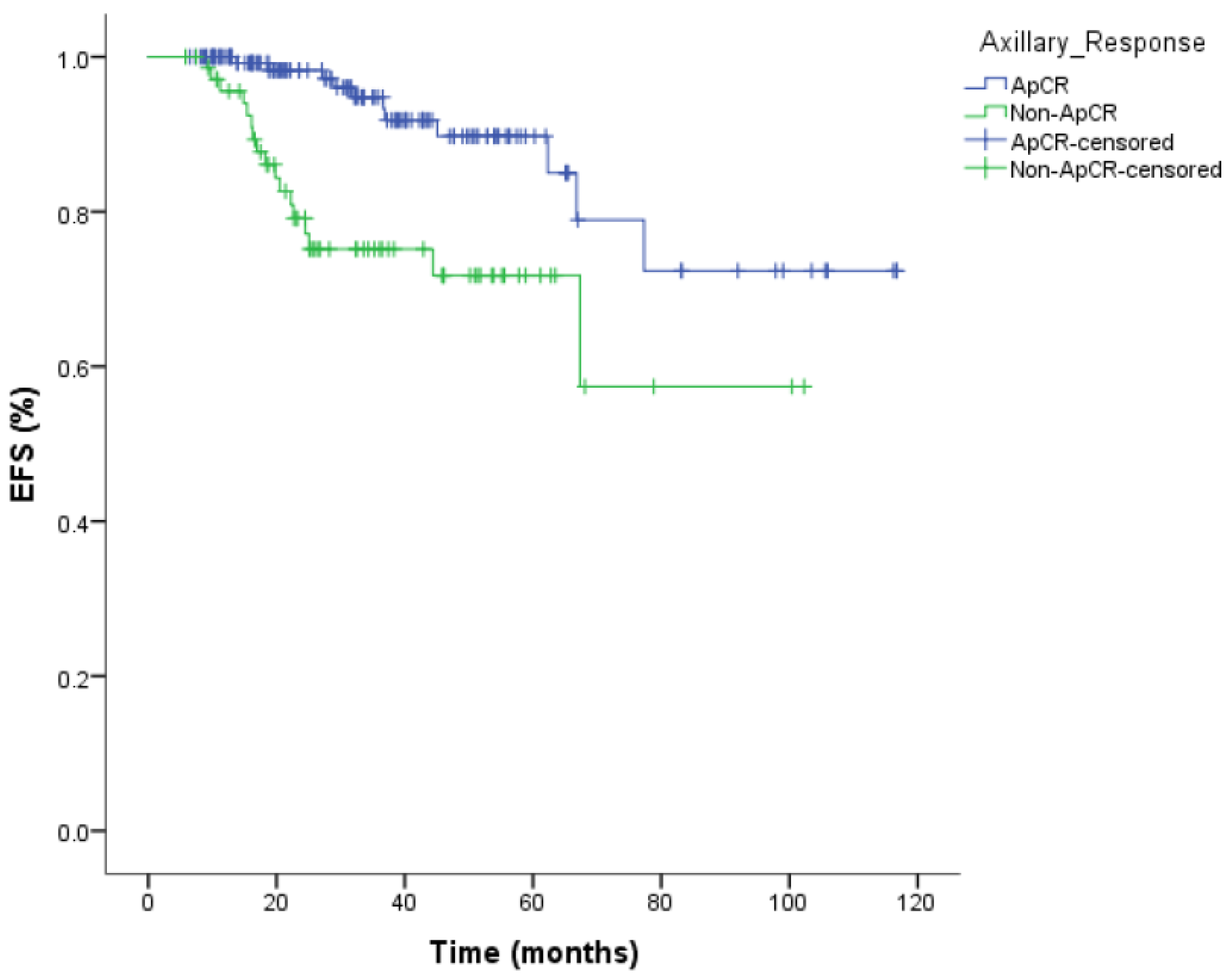
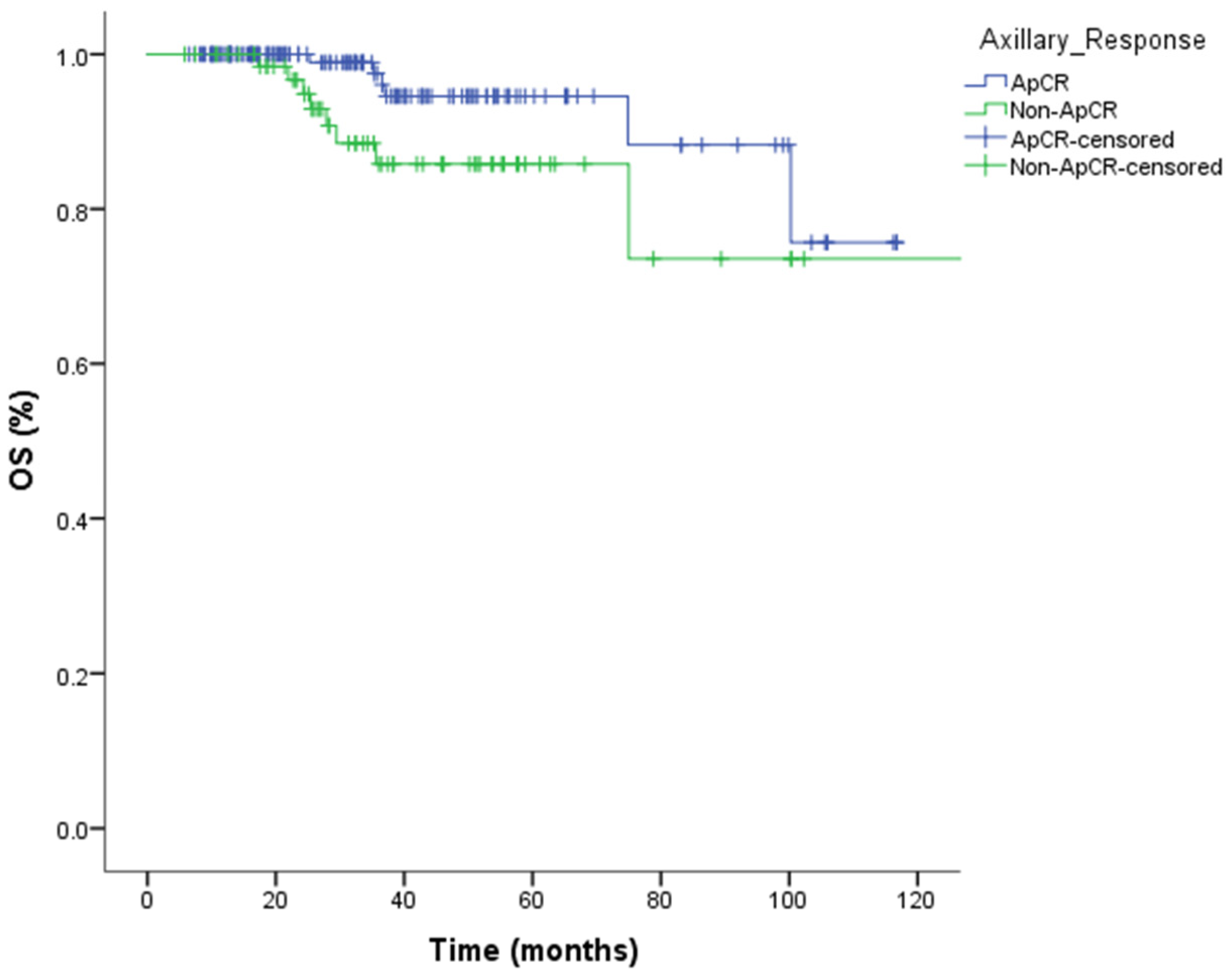
3.6. Impact of ApCR on Event-Free Survival and Overall Survival
4. Discussion
Strengths and Limitations
5. Conclusions
Author Contributions
Funding
Institutional Review Board Statement
Informed Consent Statement
Data Availability Statement
Conflicts of Interest
References
- Harper, N.W.; Hodges, K.B.; Stewart, R.L.; Wu, J.; Huang, B.; O’Connor, K.L.; Romond, E.H. Adjuvant treatment of triple-negative metaplastic breast cancer with weekly paclitaxel and platinum chemotherapy: Retrospective case review from a single institution. Clin. Breast Cancer 2019, 19, E495–E500. [Google Scholar] [CrossRef] [PubMed]
- Acheampong, T.; Kehm, R.D.; Terry, M.B.; Argov, E.L.; Tehranifar, P. Incidence Trends of Breast Cancer Molecular Subtypes by Age and Race/Ethnicity in the US from 2010 to 2016. JAMA Netw Open. 2020, 3, e2013226. [Google Scholar] [CrossRef] [PubMed]
- Shien, T.; Iwata, H. Adjuvant and neoadjuvant therapy for breast cancer. Jpn. J. Clin. Oncol. 2020, 50, 225–229. [Google Scholar] [CrossRef] [PubMed]
- Conforti, F.; Pala, L.; Bagnardi, V.; De Pas, T.; Colleoni, M.; Buyse, M.; Hortobagyi, G.; Gianni, L.; Winer, E.; Loibl, S.; et al. Surrogacy of Pathologic Complete Response in Trials of Neoadjuvant Therapy for Early Breast Cancer: Critical Analysis of Strengths, Weaknesses, and Misinterpretations. JAMA Oncol. 2022, 8, 1668–1675. [Google Scholar] [CrossRef]
- Cocco, D.; Shah, C.; Wei, W.; Wilkerson, A.; Grobmyer, S.R.; Al-Hilli, Z. Axillary lymph node dissection can be omitted in patients with limited clinically node-positive breast cancer: A National Cancer Database analysis. Br. J. Surg. 2022, 109, 1293–1299. [Google Scholar] [CrossRef]
- Esgueva, A.; Siso, C.; Espinosa-Bravo, M.; Sobrido, C.; Miranda, I.; Salazar, J.P.; Rubio, I.T. Leveraging the increased rates of pathologic complete response after neoadjuvant treatment in breast cancer to de-escalate surgical treatments. J. Surg. Oncol. 2021, 123, 71–79. [Google Scholar] [CrossRef] [PubMed]
- Tadros, A.B.; Yang, W.T.; Krishnamurthy, S.; Rauch, G.M.; Smith, B.D.; Valero, V.; Black, D.M.; Lucci, A.; Caudle, A.S.; DeSnyder, S.M.; et al. Identification of Patients with Documented Pathologic Complete Response in the Breast After Neoadjuvant Chemotherapy for Omission of Axillary Surgery. JAMA Surg. 2017, 152, 665–670. [Google Scholar] [CrossRef]
- Naoum, G.E.; Roberts, S.; Brunelle, C.L.; Shui, A.M.; Salama, L.; Daniell, K.; Gillespie, T.; Bucci, L.; Smith, B.L.; Ho, A.Y.; et al. Quantifying the Impact of Axillary Surgery and Nodal Irradiation on Breast Cancer–Related Lymphedema and Local Tumor Control: Long-Term Results from a Prospective Screening Trial. J. Clin. Oncol. 2020, 38, 3430–3438. [Google Scholar] [CrossRef]
- Che Bakri, N.A.; Kwasnicki, R.M.; Khan, N.; Ghandour, O.; Lee, A.; Grant, Y.; Dawidziuk, A.; Darzi, A.; Ashrafian, H.; Leff, D.R. Impact of Axillary Lymph Node Dissection and Sentinel Lymph Node Biopsy on Upper Limb Morbidity in Breast Cancer Patients: A Systematic Review and Meta-Analysis. Ann. Surg. 2023, 277, 572–580. [Google Scholar] [CrossRef] [PubMed] [PubMed Central]
- Hamilton, E.; Shastry, M.; Shiller, S.M.; Ren, R. Targeting HER2 heterogeneity in breast cancer. Cancer Treat. Rev. 2021, 100, 102286. [Google Scholar] [CrossRef]
- Liu, X.; Liu, Z.; Li, C.; Song, X.; Wang, X.; Li, S.; Yu, Z. PR status is a more decisive factor in efficacy of adding pertuzumab into neoadjuvant therapy for HER2-positive and lymph node-positive breast cancer than ER status: A real-world retrospective study in China. World J. Surg. Onc. 2023, 21, 296. [Google Scholar] [CrossRef] [PubMed]
- Amin, M.B.; Edge, Ş.B.; Greene, F.L.; Byrd, D.R.; Brookland, R.K.; Washington, M.K.; Gershenwald, J.E. AJCC Cancer Staging Manual, 8th ed.; Springer: Berlin/Heidelberg, Germany, 2017. [Google Scholar]
- Wolff, A.C.; Hammond, M.E.H.; Allison, K.H.; Harvey, B.E.; Mangu, P.B.; Bartlett, J.M.S.; Bilous, M.; Ellis, I.O.; Fitzgibbons, P.; Hanna, W.; et al. Human epidermal growth factor receptor 2 testing in breast Cancer: American Society of Clinical Oncology/College of American Pathologists Clinical Practice Guideline Focused Update. J. Clin. Oncol. 2018, 36, 2105–2122. [Google Scholar] [CrossRef] [PubMed]
- Allison, K.H.; Hammond, M.E.; Dowsett, M.; McKernin, S.E.; Carey, L.A.; Fitzgibbons, P.L.; Hayes, D.F.; Lakhani, S.R.; Chavez-MacGregor, M.; Perlmutter, J.; et al. Estrogen and progesterone receptor testing in breast Cancer: American Society of Clinical Oncology/College of American Pathologists Guideline Update. Arch. Pathol. Lab. Med. 2020, 144, 545–563. [Google Scholar] [CrossRef] [PubMed]
- Dowsett, M.; Nielsen, T.O.; A’Hern, R.; Bartlett, J.; Coombes, R.C.; Cuzick, J.; Ellis, M.; Henry, N.L.; Hugh, J.C.; Lively, T.; et al. Assessment of Ki67 in breast cancer: Recommendations from the International Ki67 in Breast Cancer Working Group. J. Natl. Cancer Inst. 2011, 103, 1656–1664. [Google Scholar] [CrossRef]
- Goldhirsch, A.; Winer, E.P.; Coates, A.S.; Gelber, R.D.; Piccart-Gebhart, M.; Thürlimann, B.; Senn, H.-J. Personalizing the treatment of women with early breast cancer: Highlights of the St Gallen International Expert Consensus on the primary therapy of early breast Cancer 2013. Ann. Oncol. 2013, 24, 2206–2223. [Google Scholar] [CrossRef]
- Gianni, L.; Pienkowski, T.; Im, Y.H.; Roman, L.; Tseng, L.-M.; Liu, M.-C.; Lluch, A.; Staroslawska, E.; De La Haba-Rodriguez, J.; Im, S.-A.; et al. Efficacy and safety of neoadjuvant pertuzumab and trastuzumab in women with locally advanced, inflammatory, or early HER2-positive breast cancer (NeoSphere): A randomised multicentre, open-label, phase 2 trial. Lancet Oncol. 2012, 13, 25–32. [Google Scholar] [CrossRef]
- Schneeweiss, A.; Chia, S.; Hickish, T.; Harvey, V.; Eniu, A.; Hegg, R.; Tausch, C.; Seo, J.H.; Tsai, Y.-F.; Ratnayake, J.; et al. Pertuzumab plus trastuzumab in combination with standard neoadjuvant anthracycline-containing and anthracycline-free chemotherapy regimens in patients with HER2-positive early breast cancer: A randomized phase II cardiac safety study (TRYPHAENA). Ann. Oncol. 2013, 24, 2278–2284. [Google Scholar] [CrossRef]
- Cortazar, P.; Zhang, L.; Untch, M.; Mehta, K.; Costantino, J.P.; Wolmark, N.; Bonnefoi, H.; Cameron, D.; Gianni, L.; Valagussa, P.; et al. Pathological complete response and long-term clinical benefit in breast cancer: The CTNeoBC pooled analysis. Lancet 2014, 384, 164–172. [Google Scholar] [CrossRef]
- Hamdy, O.; Atallah, K.; Elsergany, A.R.; Atwa, S.; Abdo, R.; Zaher, A.; Abdelhakiem, M. Omission of Axillary Surgery After Neoadjuvant Therapy in Her2-Positive Breast Cancer: Who Are the Candidates? Cancers 2025, 17, 562. [Google Scholar] [CrossRef] [PubMed] [PubMed Central]
- Fernandez-Gonzalez, S.; Falo, C.; Pla, M.J.; Verdaguer, P.; Nuñez, D.; Guma, A.; Soler, T.; Vethencourt, A.; Vázquez, S.; Fernandez-Montoli, M.E.; et al. Predictive factors for omitting lymphadenectomy in patients with node-positive breast cancer treated with neo-adjuvant systemic therapy. Breast J. 2020, 26, 888–896. [Google Scholar] [CrossRef] [PubMed]
- Harbeck, N.; Modi, S.; Pusztai, L.; Ohno, S.; Wu, J.; Kim, Ş.B.; Yoshida, A.; Fabi, A.; Cao, X.; Joseph, R.; et al. DESTINY-Breast11 Trial Investigators. Neoadjuvant trastuzumab deruxtecan alone or followed by paclitaxel, trastuzumab, and pertuzumab for high-risk HER2-positive early breast cancer (DESTINY-Breast11): A randomised, open-label, multicentre, phase III trial. Ann Oncol. 2025, ahead of print. [Google Scholar] [CrossRef] [PubMed]
- Cha, C.; Ahn, S.G.; Kim, D.; Lee, J.; Park, S.; Bae, S.J.; Kim, J.Y.; Park, H.S.; Park, S.; Kim, S.I.; et al. Axillary response according to neoadjuvant single or dual human epidermal growth factor receptor 2 (HER2) blockade in clinically node-positive, HER2-positive breast cancer. Int. J. Cancer 2021, 149, 1585–1592. [Google Scholar] [CrossRef] [PubMed] [PubMed Central]
- Mou, E.; Ji, J.; Liu, S.; Shu, L.; Zou, L.; Li, Z. Differences in axillary response and treatment implications in HER2 positive node positive breast cancer during neoadjuvant HER2 targeted dual therapy. Sci. Rep. 2024, 14, 26364. [Google Scholar] [CrossRef]
- Chen, W.; Li, F.X.; Lu, D.L.; Jiang, J.; Li, J. Differences between the efficacy of HER2(2+)/FISH-positive and HER2(3+) in breast cancer during dual-target neoadjuvant therapy. Breast 2023, 71, 69–73. [Google Scholar] [CrossRef] [PubMed] [PubMed Central]
- Inari, H.; Teruya, N.; Kishi, M.; Horii, R.; Akiyama, F.; Takahashi, S.; Ito, Y.; Ueno, T.; Iwase, T.; Ohno, S. Survival in Cytologically Proven Node-Positive Breast Cancer Patients with Nodal Pathological Complete Response after Neoadjuvant Chemotherapy. Cancers 2020, 12, 2633. [Google Scholar] [CrossRef] [PubMed] [PubMed Central]
- Ren, X.; Yu, Y.; Liu, L.; Xia, W.; Ni, R.; Wei, S.; Wu, J.; Wei, Q. Axillary response and outcome in breast cancer patients after neoadjuvant treatment: The role of radiotherapy in reducing recurrence in ypN0 patients with initially cN+ stage. Front. Oncol. 2023, 13, 1093155. [Google Scholar] [CrossRef] [PubMed] [PubMed Central]
- World Medical Association. World Medical Association Declaration of Helsinki: Ethical principles for medical research involving human subjects. JAMA 2013, 310, 2191–2194. [Google Scholar] [CrossRef]



| Characteristics | All n = 221 (%) | ApCR n = 150 (%) | Non-ApCR n = 71 (%) |
|---|---|---|---|
| Age | |||
| ≤50 | 130 (58.8) | 89 (59.3) | 41 (57.7) |
| >50 | 91 (41.2) | 61 (40.7) | 30 (42.3) |
| Body Mass Index (BMI) | |||
| <25 | 66 (29.9) | 47 (31.3) | 19 (26.8) |
| ≥25 | 155 (70.1) | 103 (68.7) | 52 (73.2) |
| Menopausal Status | |||
| Premenopausal | 125 (56.6) | 87 (58) | 38 (53.5) |
| Postmenopausal | 96 (43.4) | 63 (42) | 33 (46.5) |
| Pathological types | |||
| Ductal | 204 (92.3) | 136 (90.7) | 68 (95.8) |
| Other | 17 (7.7) | 14 (9.3) | 3 (4.2) |
| Tumor grade | |||
| Grade ½ | 61(27.6) | 43 (28.7) | 18 (25.3) |
| Grade 3 | 160 (72.4) | 107 (71.3) | 53 (74.7) |
| cT | |||
| cT1–T2 | 159 (72) | 114 (76) | 45 (63.4) |
| cT3–T4 | 62 (28) | 36 (24) | 26 (36.6) |
| cN | |||
| cN1 | 98 (44.3) | 70 (46.7) | 28 (39.4) |
| cN2–N3 | 123 (55.7) | 80 (54.3) | 43 (60.6) |
| Clinical TNM Stage | |||
| II | 78 (35.3) | 60 (40) | 18 (25.4) |
| III | 143 (64.7) | 90 (60) | 53 (74.6) |
| ER | |||
| Negative | 83 (37.6) | 61 (40.7) | 22 (31) |
| Positive | 138 (62.4) | 89 (59.3) | 49 (69) |
| PR | |||
| Negative | 104 (47.1) | 75 (50) | 29 (40.8) |
| Positive | 117 (52.9) | 75 (50) | 42 (59.2) |
| HR status | |||
| Negative | 81 (36.7) | 59 (39.3) | 22 (31) |
| Positive | 140 (63.3) | 91 (60.7) | 49 (69) |
| HER-2 | |||
| 2+/FISH+ | 26 (11.65) | 12 (8) | 14 (19.8) |
| 3+ | 195 (88.35) | 138 (92) | 57 (80.2) |
| Ki-67 | |||
| <20 | 17 (7.7) | 11 (7.3) | 6 (8.5) |
| ≥20 | 214 (92.3) | 139 (92.7) | 65 (91.5) |
| Breast surgery | |||
| Mastectomy | 127 (57.5) | 82 (54.7) | 45 (63.4) |
| BCS | 94 (42.5) | 68 (45.3) | 26 (36.6) |
| Axillary surgery | |||
| SLNB | 65 (29.4) | 54 (36) | 11 (15.5) |
| ALND | 156 (70.6) | 96 (64) | 60 (84.5) |
| Targeted therapy | |||
| Trastuzumab | 64 (29) | 45 (30) | 19 (26.8) |
| Trastuzumab + pertuzumab | 157 (71) | 105 (70) | 52 (73.2) |
| Characteristics | Odds Ratio (95% CI) | p Value |
|---|---|---|
| Age | 1.068 (0.602–1.893) | 0.823 |
| ≤50 | ||
| >50 | ||
| Body Mass Index (BMI) | 1.210 (0.633–2.313) | 0.565 |
| <25 | ||
| ≥25 | ||
| Menopausal Status | 1.199 (0.680–2.116) | 0.531 |
| Premenopausal | ||
| Postmenopausal | ||
| Pathological types | 0.429 (0.119–1.542) | 0.195 |
| Ductal | ||
| Other | ||
| Tumor grade | 1.247 (0.648–2.400) | 0.508 |
| Grade ½ | ||
| Grade 3 | ||
| cT | 1.830 (0.993–3.371) | 0.053 |
| cT1–T2 | ||
| cT3–T4 | ||
| cN | 1.344 (0.757–2.386) | 0.313 |
| cN1 | ||
| cN2–N3 | ||
| Clinical TNM Stage | 1.963 (1.049–3.673) | 0.035 |
| II | ||
| III | ||
| ER | 1.527 (0.838–2.780) | 0.167 |
| Negative | ||
| Positive | ||
| PR | 1.448 (0.818–2.564) | 0.204 |
| Negative | ||
| Positive | ||
| HR status | 0.692 (0.380–1.262) | 0.230 |
| Negative | ||
| Positive | ||
| HER-2 | 2.659 (1.122–6.299) | 0.026 |
| 2+/FISH+ | ||
| 3+ | ||
| Ki-67 | 0.870 (0.308–2.455) | 0.792 |
| <20 | ||
| ≥20 | ||
| Targeted therapy | 0.853 (0.454–1.602) | 0.620 |
| Trastuzumab | ||
| Trastuzumab + pertuzumab |
| Characteristics | Odds Ratio (95% CI) | p Value |
|---|---|---|
| Clinical TNM Stage | 2.251 (1.182–4.287) | 0.014 |
| III | ||
| II | ||
| HER-2 | 2.745 (1.138–6.619) | 0.025 |
| 2+/FISH+ | ||
| 3+ |
Disclaimer/Publisher’s Note: The statements, opinions and data contained in all publications are solely those of the individual author(s) and contributor(s) and not of MDPI and/or the editor(s). MDPI and/or the editor(s) disclaim responsibility for any injury to people or property resulting from any ideas, methods, instructions or products referred to in the content. |
© 2026 by the authors. Published by MDPI on behalf of the Lithuanian University of Health Sciences. Licensee MDPI, Basel, Switzerland. This article is an open access article distributed under the terms and conditions of the Creative Commons Attribution (CC BY) license.
Share and Cite
Bedir, Ş.; Yeşilova, U.A.; Tokoçin, M.; Çakan Demirel, B.; Bozkaya, Y.; Oyman, A.; Guliyev, M.; Abbasov, H.; Demirci, N.S.; Değerli, E.; et al. Clinicopathological Predictors of Axillary Pathological Complete Response and Its Prognostic Significance in Clinically Node-Positive (cN+), HER2-Positive Breast Cancer Following Neoadjuvant Therapy. Medicina 2026, 62, 200. https://doi.org/10.3390/medicina62010200
Bedir Ş, Yeşilova UA, Tokoçin M, Çakan Demirel B, Bozkaya Y, Oyman A, Guliyev M, Abbasov H, Demirci NS, Değerli E, et al. Clinicopathological Predictors of Axillary Pathological Complete Response and Its Prognostic Significance in Clinically Node-Positive (cN+), HER2-Positive Breast Cancer Following Neoadjuvant Therapy. Medicina. 2026; 62(1):200. https://doi.org/10.3390/medicina62010200
Chicago/Turabian StyleBedir, Şahin, Uğur Alp Yeşilova, Merve Tokoçin, Burçin Çakan Demirel, Yakup Bozkaya, Abdilkerim Oyman, Murad Guliyev, Hamza Abbasov, Nebi Serkan Demirci, Ezgi Değerli, and et al. 2026. "Clinicopathological Predictors of Axillary Pathological Complete Response and Its Prognostic Significance in Clinically Node-Positive (cN+), HER2-Positive Breast Cancer Following Neoadjuvant Therapy" Medicina 62, no. 1: 200. https://doi.org/10.3390/medicina62010200
APA StyleBedir, Ş., Yeşilova, U. A., Tokoçin, M., Çakan Demirel, B., Bozkaya, Y., Oyman, A., Guliyev, M., Abbasov, H., Demirci, N. S., Değerli, E., Usul, G., Şen, E., Bulut, N., & Erdem, G. U. (2026). Clinicopathological Predictors of Axillary Pathological Complete Response and Its Prognostic Significance in Clinically Node-Positive (cN+), HER2-Positive Breast Cancer Following Neoadjuvant Therapy. Medicina, 62(1), 200. https://doi.org/10.3390/medicina62010200