1. Introduction
Breast cancer remains a major global health issue and a heterogeneous disease in terms of its biological, histopathological, and molecular features [
1]. In clinical practice, stratification according to hormone receptor (HR) and HER2 status is fundamental for prognosis and treatment selection. Over the past decade, advances in accurately determining HER2 status have enabled clinicians to identify patients eligible for targeted anti-HER2 therapies, thereby personalizing treatment and significantly improving clinical outcomes [
2,
3,
4,
5].
A substantial proportion of tumors historically classified as HER2-negative show low-to-intermediate HER2 protein expression, exhibiting an immunohistochemistry (IHC) score of 1+ or 2+ and negative in situ hybridization (ISH) findings. These tumors, referred to as HER2-low, are considered a therapeutically relevant subset within the traditional HER2-negative category, although they do not constitute a single, uniform biological entity [
2,
3,
4,
5,
6,
7,
8,
9]. Recently, particularly since the emergence of dedicated analyses in 2020, HER2-low has become an established term in the literature, as the clinicopathological features and prognostic impact of this subtype have been investigated more systematically [
7,
8,
9,
10]. The development of novel antibody–drug conjugates (ADCs), especially trastuzumab deruxtecan (T-DXd), has been pivotal. In 2022, the phase III DESTINY-Breast04 trial showed that T-DXd significantly improved progression-free and overall survival rates compared with the physician’s choice treatment in patients with unresectable or metastatic HER2-low breast cancer. These findings established HER2-low disease as a clearly targetable subgroup and changed the standard of care in this setting [
10,
11,
12,
13,
14,
15]. More recently, the emerging term HER2-ultralow has been used to describe tumors with borderline or extremely low HER2 expression below the HER2-low threshold, further highlighting the clinical significance of the low-expression spectrum [
16,
17,
18,
19,
20,
21].
Beyond the simple HER2-positive versus HER2-negative dichotomy, HER2 expression is increasingly recognized as a dynamic rather than fixed feature of breast cancer, and similar intratumoral heterogeneity and temporal variability have been described in other tumor types, including gastric and endometrial carcinoma [
22,
23]. Several studies have revealed substantial rates of receptor discordance between primary tumors and residual, recurrent, or metastatic disease, including shifts between HER2-0, HER2-low, and HER2-positive categories after neoadjuvant chemotherapy [
19]. HER2 instability has direct clinical implications, as changes in HER2 status can alter therapeutic eligibility, allowing some patients previously considered ineligible to become candidates for ADCs [
20,
21].
In this narrative review, we synthesize current evidence on HER2-low and HER2-ultralow breast cancer, with a focus on HER2 status across disease evolution and under the selective pressure of systemic treatment. We summarize definitions, assessment challenges, and the reported frequency and patterns of HER2 category shifts. Furthermore, we discuss the practical implications for retesting and treatment selection in the era of ADCs.
2. Materials and Methods
A targeted literature search was conducted across PubMed, Scopus, and Web of Science, focusing on publications from 2020 to 2025. A small number of older key studies were also included for historical context and mechanistic insight. The search prioritized studies addressing HER2-low and HER2-ultralow breast cancer from pathological, biological, and clinical perspectives, including data on HER2 assessment, temporal shifts in HER2 category, and implications for therapy selection. Eligible studies included original research articles, phase II–III clinical trial reports, large retrospective cohorts, and review papers published in peer-reviewed journals. Case reports, small case series, conference abstracts without full datasets, and studies lacking a clearly described methodology for HER2 evaluation by IHC or in situ hybridization (ISH) were excluded. All included articles were reviewed in full for data extraction and narrative synthesis.
3. Results
3.1. Definition and Assessment
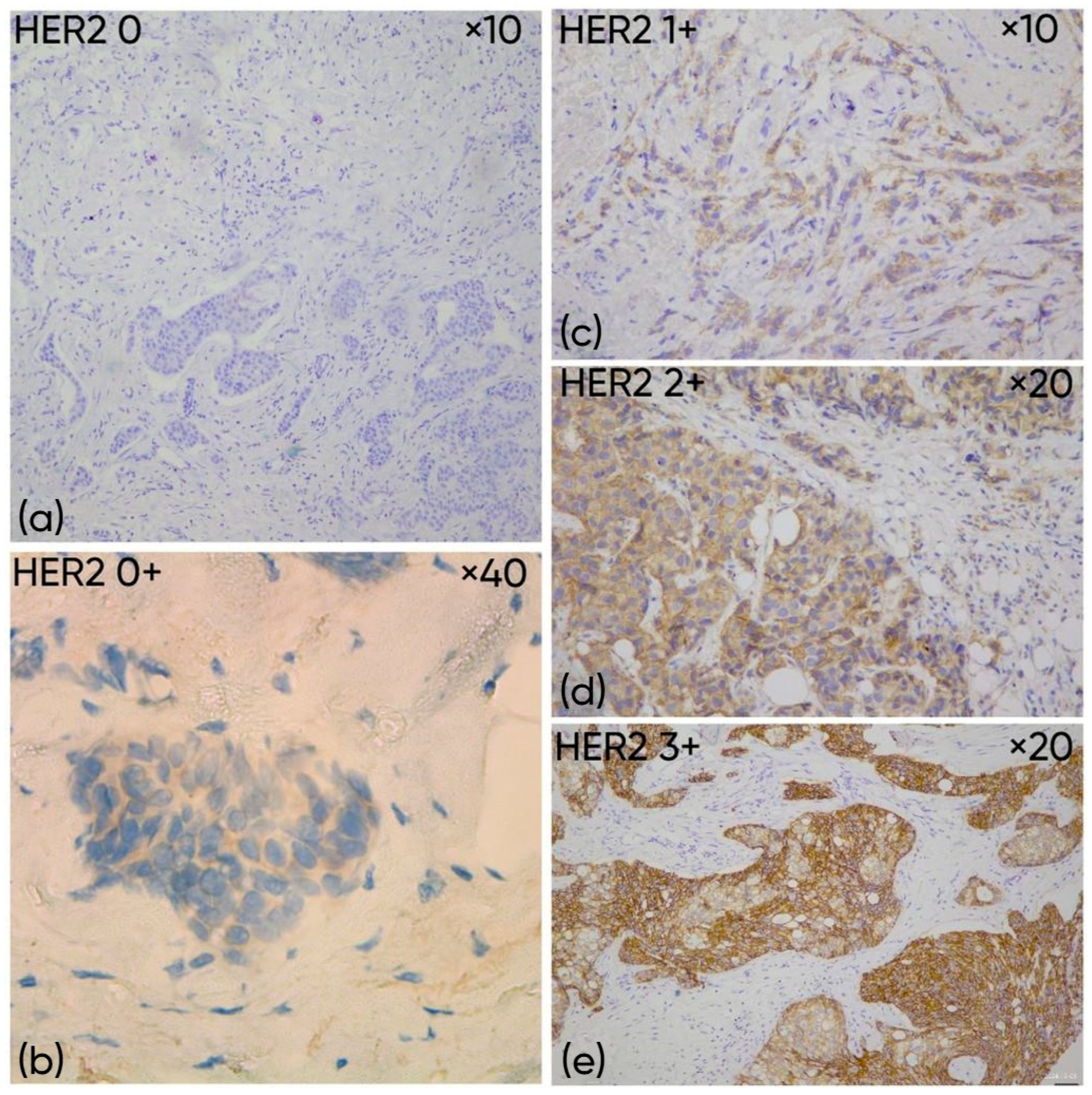
HER2-low breast cancers are defined as tumors that do not meet the criteria for HER2 positivity but show detectable low-level membranous HER2 expression on IHC. In line with current American Society of Clinical Oncology/College of American Pathologists (ASCO/CAP) reporting criteria, this category includes tumors scored IHC 1+ or IHC 2+ with negative ISH findings [
2,
3,
4,
5,
6,
7,
8,
9,
10]. To frame the HER2-low concept within routine scoring, HER2 IHC is assessed across a continuum. IHC 0 indicates no membranous staining, while HER2 0+ shows incomplete staining in ≤10% of tumor cells. IHC 1+ corresponds to faint and incomplete membranous staining in >10% of tumor cells. IHC 2+ is an equivocal category, typically reflecting weak-to-moderate complete membranous staining in >10% of tumor cells and requires ISH for final classification. IHC 3+ is defined by intense, complete, circumferential membranous staining in >10% of tumor cells and is considered HER2-positive [
1,
4,
5] (
Figure 1).
Importantly, a tumor can still be classified as triple-negative despite showing HER2-low characteristics, because this pattern is considered HER2-negative under ASCO/CAP criteria. Thus, the triple-negative breast cancer label is driven by estrogen and progesterone receptor negativity together with the absence of HER2 positivity, rather than by a complete lack of any HER2 signal [
24,
25].
3.2. HER2-Low as a Biological and Diagnostic Continuum
HER2-low breast cancer initially emerged as a diagnostic category defined by IHC criteria; however, accumulating molecular and functional data increasingly support the view that HER2-low represents a biologically meaningful intermediate state along a continuous spectrum of erb-B2 receptor tyrosine kinase (ERBB2) expression and signaling. Rather than constituting a discrete entity, HER2-low tumors appear to occupy a dynamic zone between complete absence of HER2 expression and HER2-overexpression-driven oncogenic addiction, with important implications for tumor biology, therapeutic vulnerability, and phenotypic instability [
26].
From the perspective of intrinsic molecular subtypes, HER2-low tumors are unevenly distributed across breast cancer classes. They are most frequently observed within hormone receptor-positive disease, particularly luminal A and luminal B subtypes, whereas they are less common in basal-like tumors [
26]. Nonetheless, a non-negligible fraction of triple-negative breast cancers also fall within the HER2-low category, highlighting the heterogeneity of this group. Compared with HER2-negative tumors, HER2-low cancers show a greater association with luminal differentiation, estrogen receptor signaling, and lower proliferative indices, suggesting that low-level HER2 expression may be linked to broader transcriptional programs characteristic of luminal biology rather than representing a random technical finding [
2,
27,
28].
At the genomic level, HER2-low tumors are defined by the absence of ERBB2 amplification; however, they frequently exhibit detectable ERBB2 mRNA expression, placing them quantitatively between HER2-0 and HER2-amplified tumors. Large genomic studies have demonstrated that HER2-low tumors do not harbor a unique or pathognomonic mutational landscape; instead, their genomic profiles largely overlap with those of HER2-negative breast cancers, with recurrent alterations in genes such as
PIK3CA,
TP53,
MAP3K1, and
GATA3, depending on hormone receptor status. However, subtle differences in ERBB2 transcript abundance and the co-expression of ERBB family members suggest that HER2-low tumors may sustain a basal level of HER2-related signaling competence that is absent in truly HER2-null tumors [
2,
26].
Transcriptomic and proteomic data further reinforce the view of HER2-low as a biological intermediate. Relative to HER2-0 disease, HER2-low tumors show a modest enrichment of HER2-associated gene signatures and downstream signaling activity, particularly within the PI3K/AKT and MAPK pathways. Importantly, although this signaling is typically insufficient to confer classic HER2 oncogene addiction, it may provide survival advantages or modulate responsiveness to systemic therapies. Ligand-dependent heterodimerization between HER2 and other ERBB receptors, such as EGFR or HER3, likely plays a central role in sustaining this low-intensity signaling state, reinforcing the notion that HER2-low biology is context-dependent rather than driven by gene amplification alone [
28].
From a biological standpoint, HER2-ultralow tumors can be viewed as a natural extension of the continuous spectrum of HER2 expression in HER2-negative disease, suggesting a state in which HER2-related signaling may persist at very low expression levels. In this setting, ultralow does not imply an ERBB-driven phenotype; rather, it likely reflects minimal receptor availability shaped by intratumoral heterogeneity, fine regulation of expression at the single-cell level, and context-dependent crosstalk within the ERBB network. As such, its biological relevance lies more in gradual variation and continuity than in delineating a distinct molecular entity [
29].
Taken together, these observations support the view that HER2-low and, by extension, HER2-ultralow tumors are best understood as a biologically and diagnostically dynamic state emerging from the intersection of intrinsic disease biology, signaling context, and technical assessment variability. Furthermore, clinical experience with trastuzumab deruxtecan has demonstrated that ERBB2 amplification is not an absolute prerequisite for therapeutic benefit. In selected settings, even low-level HER2 expression can suffice for HER2 to serve as an anchoring target for an ADC, enabling intracellular cytotoxic payload delivery and broadening the practical implications of the HER2 expression continuum [
2,
26,
30].
3.3. The Boundary Between HER2-Negative and HER2-Low
From a pathology perspective, this concept of HER2-low has emerged gradually, as successive guideline updates and accumulating clinical data have shifted the focus from a strict positive/negative result to recognition of an intermediate, low-expression range. This evolution has brought HER2-low to the forefront as both a biologically and clinically relevant label and a diagnostic challenge, particularly in ensuring reproducible distinction between HER2-0 and HER2-low in routine practice [
4,
5].
In daily practice, one of the most challenging aspects of HER2 assessment is distinguishing between IHC scores of 0 and 1+. Traditional HER2 testing algorithms were primarily designed to separate clearly HER2-positive tumors (IHC 2+ with positive ISH findings and IHC 3+) from HER2-negative cases; thus, pathologists and laboratories were less focused on refining the lower end of the scoring spectrum. As a result, very weak, incomplete, or focal membranous staining can be interpreted differently between observers, and even small variations in pre-analytical factors (such as fixation time or cold ischemia), the antibody clone used, or detection systems may shift a case across the 0/1+ threshold [
4,
5,
19,
20].
An additional area of uncertainty at the lower end of the HER2 spectrum is the emerging concept of HER2-ultralow. In practical terms, this label is generally used for tumors that remain classified as HER2-negative, yet show minimal, faint, and typically incomplete membranous staining in a very small proportion of invasive tumor cells, findings that fall below the conventional threshold for IHC 1+ [
4,
5,
14,
19,
20,
21]. The term HER2-ultralow was introduced to refine reporting within the HER2-negative continuum and better capture cases clustered around the IHC 0/1+ decision boundary. The clinical interest in this subgroup has increased as contemporary trials have begun to define and include it explicitly [
21,
22]. In the DESTINY study, “ultralow” eligibility has been operationalized as IHC 0 with detectable membrane staining, extending the evaluation beyond the traditional HER2-low definition [
14,
31]. However, terminology and implementation remain heterogeneous across institutions, and the approach has not been fully harmonized in routine guidelines in the same way as the established IHC scoring system. For now, HER2-ultralow should be viewed as a descriptive term for the lowest detectable HER2 expression level, with its reporting still evolving alongside ongoing clinical studies [
32,
33].
3.4. HER2-Low After Chemotherapy
In routine practice, the HER2 score should not be treated as a fixed label. Paired-sample studies have shown that HER2 expression can change over time under systemic treatment pressure and during disease progression, most often around the HER2-negative boundary between HER2-0 and HER2-low [
Table 1] [
19]. Miglietta et al. (2021) provided early, quantitative evidence of this instability in matched primary and relapse specimens, reporting an overall HER2 discordance of 38%, largely driven by bidirectional switching, alongside smaller fractions of changes involving HER2-positive disease [
18]. In parallel, the DESTINY program made the practical consequences of this borderline range very clear at scale. Although these trials were designed to test treatment efficacy, central reassessment during screening demonstrated that classification at the 0/low interface is frequently not reproducible across testing contexts [
13,
31]. In the DESTINY-Breast04 trial, local and central assessments agreed on HER2-low status in approximately 78% of cases, and in DESTINY-Breast06, 64% of tumors previously reported as HER2 IHC 0 locally were classified as HER2-low/ultralow on central testing [
13,
31].
One of the earliest large-scale demonstrations that HER2 is not stable under systemic treatment came from Niikura et al., who analyzed a nationwide registry and showed that a substantial subset of tumors initially classified as HER2-positive were reclassified as HER2-negative after neoadjuvant chemotherapy. Although the HER2-low category did not exist at that time, these findings provided early evidence of clinically relevant HER2 conversion and laid the groundwork for later studies focusing on low-level HER2 expression [
34]. Within the HER2-negative spectrum, subsequent neoadjuvant paired-sample cohorts have reinforced that most variability concentrates around the HER2-0/HER2-low boundary. Zhu et al. found frequent category changes between primary and residual disease, including substantial proportions of HER2-0 cases shifting to HER2-low and HER2-low cases reverting to HER2-0 among non-pCR cases, supporting the concept that low-level HER2 expression is dynamically reclassified after NAT [
35]. Consistently, Kang et al. reported a high discordance rate after neoadjuvant chemotherapy, with prominent bidirectional transitions between HER2-0 and HER2-low, while also documenting smaller fractions of shifts involving HER2-positive conversion [
36].
Two additional neoadjuvant series by Shang et al. and Sung et al. reported overall inconsistency rates in a similar range and, importantly for interpretation, suggested that loss of low-level expression (HER2-low to HER2-0) can be at least as common as gain (HER2-0 to HER2-low) in certain datasets, although the dominant direction varies across cohorts and subgroups [
37,
38]. Schettini et al., focusing on an HR-positive/HER2-negative paired-sample cohort, likewise observed frequent reclassification around the 0/low threshold, aligning with the broader message that HER2-negative continuum is not biologically or diagnostically static [
27].
Finally, beyond neoadjuvant chemotherapy, real-world datasets have documented receptor–phenotype discordance between primary and metastatic disease at scale, as in the French ESME cohort, supporting the notion that HER2 reclassification can also reflect tumor evolution and sampling context progression, rather than solely treatment-related effects [
39].
Biologically, therapy-associated shifts in HER2 status are most plausibly driven by treatment-imposed selective pressure, which can enrich tumor cell populations with lower ERBB2 amplification or induce adaptive reduction in membranous HER2 (including transcriptional downregulation or receptor internalization). However, the relative weight of these mechanisms across clinical cohorts remains incompletely defined and an active area for translational investigation [
40,
41].
3.5. Intratumoral Heterogeneity
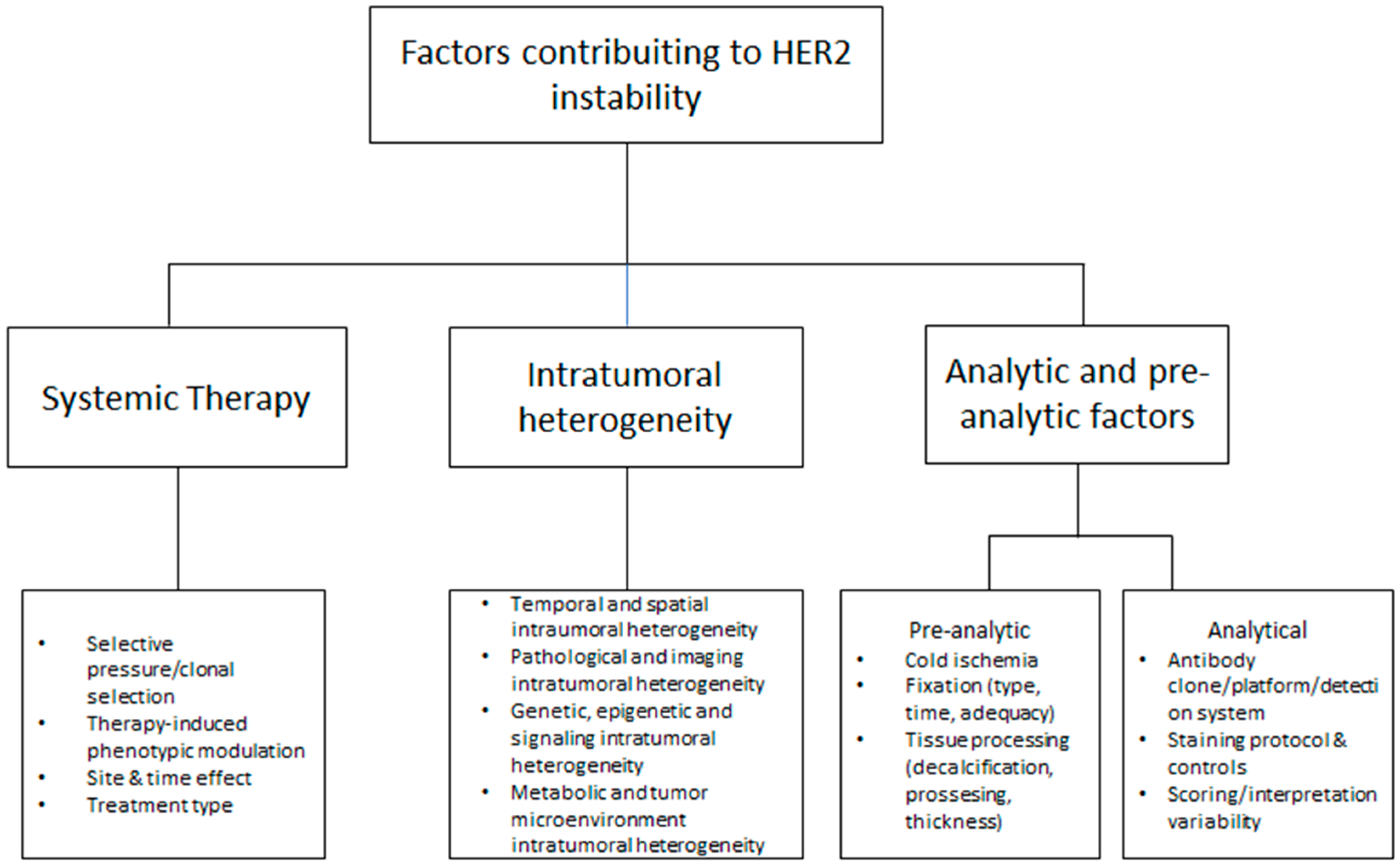
Another mechanism, beyond the selective pressure of systemic therapy, that may contribute to apparent HER2 instability is intratumoral heterogeneity (ITH) (
Figure 2). ITH denotes the coexistence, within a single breast carcinoma, of distinct cellular subpopulations and micro-niches that differ in molecular profile, phenotype, and behavior, with direct implications for biomarker assessment, prognosis, and treatment response [
42]. From an integrated perspective, ITH encompasses temporal heterogeneity (the evolution of tumor features over time due to natural progression and therapy-driven selection), spatial heterogeneity (regional differences within the tumor and between primary and metastatic sites), genetic heterogeneity (subclonal variation in somatic mutations and copy-number alterations), epigenetic heterogeneity (divergent DNA methylation and chromatin states shaping transcriptional programs without changes in DNA sequence), signaling heterogeneity (uneven activation of oncogenic and stress-response pathways), and metabolic heterogeneity (distinct metabolic adaptations driven by oxygen and nutrient gradients). Importantly, ITH also includes tumor microenvironment (TME) heterogeneity, referring to spatially variable immune and stromal composition, vascularization, and extracellular matrix features that can modulate clonal fitness and influence protein expression patterns [
43,
44]. These ITH dimensions provide a direct mechanistic link to HER2-low instability. Spatial heterogeneity can yield different HER2 scores when biopsy and resection samples do not overlap, or when primary and metastatic lesions capture distinct tumor areas. In parallel, genetic heterogeneity and TME-driven heterogeneity can shift the fraction of low-expressing cells and local expression states over time and across sites, leading to discordant HER2 categorizations between primary and metastasis on re-biopsy. Accordingly, this variability is particularly relevant near the HER2-0/HER2-low decision boundary, where limited sampling may capture different tumor regions and generate discordant results between core biopsy and the surgical specimen [
42,
43,
44,
45,
46,
47].
3.6. Pre-Analytical and Analytical Variability in Breast Cancer
Beyond biological mechanisms, HER2 status instability between core biopsies and surgical specimens may also reflect a combination of pre-analytical and analytical factors, which become particularly critical when low HER2 expression lies at the 0 vs. 1+ decision boundary [
4,
5]. Pre-analytically, major sources of variability include cold ischemia time (delay of fixation), the type of fixative and duration of fixation (typically 10% neutral buffered formalin, within guideline-recommended windows), tissue size and thickness (especially in large specimens with uneven fixative penetration), procedures that alter antigenicity (decalcification, suboptimal processing), block/slide storage conditions, and repeated recuts [
48,
49]. Analytically, variability may arise from the use of different platforms and assay reagents (primary antibody, detection chemistry, antigen retrieval), differences in instrument calibration and maintenance, lot-to-lot variation, incomplete assay validation or revalidation, and inconsistent implementation of internal/external controls and quality assurance programs. In this context, the choice of HER2 IHC assay and antibody clone is not trivial: differences in antibody affinity or epitope recognition, as well as in manufacturer-defined antigen retrieval conditions, can shift signal intensity in cases with weak staining. This shift may affect categorization around the boundary between IHC 0 and 1+ and, in borderline cases, give the impression of conversion between core biopsy and resection (
Table 2) [
50]. An additional layer is the interpretative component (interobserver reproducibility of IHC scoring, area selection, borderline cut-offs, and ISH counting/interpretation criteria), which can shift a case with very faint staining from one category to another. Accordingly, ASCO/CAP guidance and CAP reporting tools emphasize rigorous standardization of pre-analytical and analytical steps and, where feasible, documentation of key parameters (e.g., cold ischemia time and fixation) to minimize variability that can mimic true changes in HER2 status [
4,
5,
49,
51].
3.7. AI and HER2-Low Instability
Emerging data indicate that AI-assisted assessment of HER2 IHC can improve scoring reproducibility, with the clearest benefit at the most problematic threshold for HER2-low classification, distinguishing IHC 0 from 1+. Wu et al. reported that AI assistance improved the accuracy and consistency of interpreting HER2 IHC scores 0 and 1+ and reduced observer-related variability, supporting its role as a practical decision-support tool in borderline cases [
55].
However, implementation requires careful attention to limitations, especially those relevant to HER2-low/ultralow. Real-world performance can be affected by domain shifts, including differences in staining intensity, fixations, antibody clones, scanning devices, and image compression, as well as the fact that low-level membranous signals are inherently subtle and spatially heterogeneous. Quality-assurance studies in routine settings have also highlighted pitfalls in discordant cases and remind us that digital tools may not uniformly reduce variability unless carefully calibrated and monitored within the local workflow [
47,
56,
57,
58].
Accordingly, the CAP emphasizes that computational pathology tools, including quantitative image analysis and AI, should be implemented within a rigorous validation and quality assurance framework and serve as decision support rather than replace the pathologist’s interpretation. In this context, decision support refers to validating the digital pathology system used for primary diagnosis, validating the HER2 quantitative/AI workflow in the intended clinical context, and establishing ongoing quality control, performance monitoring, and clear reporting practices [
59].
4. Conclusions
The recognition of HER2-low and ultralow status supports a more nuanced, clinically actionable view of HER2 expression. Because HER2 status may vary over time and between the primary tumor and metastatic lesions, driven by treatment-related selective pressure and intratumoral heterogeneity, and by pre-analytical and analytical variability, HER2 retesting, when clinically appropriate, can identify patients previously deemed ineligible who may become candidates for targeted therapies. Rigorous standardization and transparent reporting remain essential, particularly at the challenging IHC 0 vs 1+ boundary.
5. Future Directions
Accurately identifying very low levels of HER2 expression has become clinically important in the era of HER2-directed ADCs. As HER2-low/ultralow status may vary over time, biomarker reassessment is increasingly relevant across the disease course. Observed changes can reflect spatial and temporal intratumoral heterogeneity, therapy-related effects, and pre-analytical and analytical variability. Thus, future strategies should move toward a more systematic approach to HER2 retesting whenever new clinically meaningful tissue becomes available, including local recurrence, metastatic progression, and residual disease after neoadjuvant therapy. Such an approach may reduce misclassification at the IHC 0/1+ boundary and help identify patients who may become eligible for HER2-targeted ADCs despite prior HER2-negative results.
To make retesting actionable and comparable across centers, research should prioritize standardized testing pathways (tissue handling and fixation, assay selection, on-slide controls, and reporting) and prospectively evaluate paired sampling across timepoints and sites. In parallel, the role of AI-assisted scoring and complementary quantitative methods should be explored primarily as tools to improve reproducibility at low expression thresholds, but only within robust validation and quality assurance frameworks. Ultimately, aligning retesting practices with rigorous analytical standards and transparent reporting is essential for translating the HER2-low/ultralow concept into consistent patient selection and equitable access to effective therapies.
Author Contributions
Conceptualization, A.-M.G. and L.-F.R.; methodology, A.-M.G.; software, D.M.; validation, A.-M.G. and D.M.; formal analysis, C.-B.S.; investigation, A.-M.G.; resources, A.M.R.; data curation, C.-B.S.; writing—original draft preparation, A.-M.G. and L.-F.R.; writing—review and editing, L.-F.R.; visualization, C.-B.S.; supervision, L.-F.R.; project administration, L.-F.R. All authors have read and agreed to the published version of the manuscript.
Funding
This research received no external funding.
Institutional Review Board Statement
Not applicable.
Informed Consent Statement
Not applicable.
Data Availability Statement
No new data were created or analyzed in this study.
Conflicts of Interest
The authors declare no conflicts of interest.
Abbreviations
The following abbreviations are used in this manuscript:
| IHC | Immunohistochemestry |
| ISH | In situ hybridization |
| HR | Hormone receptor |
| ADC | Antibody-drug conjugate |
| T-DXd | Trastuzumab deruxtecan |
| ASCO/CAP | American Society of Clinical Oncology/College of American Pathology |
| NAT | Neoadjuvant therapy |
| ITH | Intratumoral heterogeneity |
| TME | Tumor microenvironment |
| AI | Artificial intelligence |
References
- WHO Classification of Tumours Editorial Board. Breast Tumours, 5th ed.; WHO Classification of Tumours; International Agency for Research on Cancer: Lyon, France, 2019; ISBN 978-92-832-4500-1. [Google Scholar]
- Cheng, X. A Comprehensive Review of HER2 in Cancer Biology and Therapeutics. Genes 2024, 15, 903. [Google Scholar] [CrossRef]
- Shaaban, A.M.; Kaur, T.; Provenzano, E. HER2-low Breast Cancer-Current Knowledge and Future Directions. Medicina 2025, 61, 644. [Google Scholar] [CrossRef]
- College of American Pathologists. Reporting Template for Reporting Results of Biomarker Testing of Specimens from Patients with Carcinoma of the Breast (Breast.Bmk_1.6.0.0.REL.CAPCP). 2025. Available online: https://documents.cap.org/documents/New-Cancer-Protocols-June-2025/Breast.Bmk_1.6.1.0.-REL_CAPCP.pdf (accessed on 21 January 2026).
- Evan, R.J.; Goyette, M.D.; Kristen, E.; Muller, D.O. Breast Cancer: Molecular Subtypes. PathologyOutlines.com. 2024. Available online: https://www.pathologyoutlines.com/topic/breastmolecularsubtypes.html (accessed on 21 January 2026).
- Rebegea, L.-F.; Firescu, D.; Trifanescu, O.-G.; Rahnea-Nita, R.-A.; Bilteanu, L.; Dumitru, M.; Lacatus, F.; Rahnea-Nita, G. Our Experience and Literature Update Regarding Concomitant Radiotherapy with CDK4/6 Inhibitors and Hormonal Therapy in Metastatic Breast Cancer. J. Mind Med Sci. 2025, 12, 33. [Google Scholar] [CrossRef]
- Vâlcu, E.G.; Firescu, D.; Nechita, A.; Ciubară, A.; Constantin, G.B.; Rahnea-Nita, G.; Rebegea, L.F. Considerations Regarding Online Group Psychotherapy Sessions for Breast Cancer Patients in Active Phase of Oncological Treatment. Healthcare 2023, 11, 2311. [Google Scholar] [CrossRef] [PubMed] [PubMed Central]
- Kang, S.; Kim, S.B. HER2-Low Breast Cancer: Now and in the Future. Cancer Res. Treat. 2024, 56, 700–720. [Google Scholar] [CrossRef] [PubMed] [PubMed Central]
- Corti, C.; Giugliano, F.; Nicolò, E.; Tarantino, P.; Criscitiello, C.; Curigliano, G. HER2-Low Breast Cancer: A New Subtype? Curr. Treat. Options Oncol. 2023, 24, 468–478. [Google Scholar] [CrossRef] [PubMed]
- Zhang, H.; Katerji, H.; Turner, B.M.; Hicks, D.G. HER2-Low Breast Cancers. Am. J. Clin. Pathol. 2022, 157, 328–336. [Google Scholar] [CrossRef] [PubMed]
- Bu, H.; Fan, Y.; Fan, Z.; Hu, X.; Li, M.; Li, Q.; Liao, N.; Luo, T.; Nie, J.; Pan, Y.; et al. Concensus on medical diagnosis and medical treatment of HER2-low breast cancer (2022 edition). J. Natl. Cancer Cent. 2023, 3, 266–272. [Google Scholar] [CrossRef]
- Fusco, N.; Viale, G. The “lows”: Update on ER-low and HER2-low breast cancer. Breast 2024, 78, 103831. [Google Scholar] [CrossRef] [PubMed] [PubMed Central]
- Modi, S.; Jacot, W.; Yamashita, T.; Sohn, J.; Vidal, M.; Tokunaga, E.; Tsurutani, J.; Ueno, N.T.; Prat, A.; Chae, Y.S.; et al. Trastuzumab Deruxtecan in Previously Treated HER2-Low Advanced Breast Cancer (DESTINY-Breast04). N. Engl. J. Med. 2022, 387, 9–20. [Google Scholar] [CrossRef] [PubMed]
- Tarantino, P.; Viale, G.; Press, M.F.; Hu, X.; Penault-Llorca, F.; Bardia, A.; Batistatou, A.; Burstein, H.; Carey, L.; Cortes, J.; et al. ESMO expert consensus statements (ECS) on the definiton, diagnosis, and management of HER2-low breast cancer. Ann. Oncol. 2023, 34, 645–659. [Google Scholar] [CrossRef]
- Khalil, M.A.; Habibian, L.; Martin, C.; Semaan, K.; Khaddage, A.; El Kassis, N.; Kesserouani, C.; Kourie, H.R.; Atallah, D. Landscape of HER2-low breast cancer: Insights from a six-year study on prevalence and clinicopathological characteristics. Ann. Diagn. Pathol. 2024, 72, 152326. [Google Scholar] [CrossRef]
- Dong, Y.-h.; Xu, Y.-t.; Jiang, X.-z.; Xu, L.; Yu, R.-j.; Wang, R.; Zhang, Q.-f. HER2-low and ultralow expression of invasive breast carcinoma: Clinicopathological features and immunohistochemical consistency analysis. npj Breast Cancer 2025, 12, 9. [Google Scholar] [CrossRef]
- Jin, J.; Liu, T.; Cai, M.; Zhao, M.; Guo, D.; Lv, H.; Wang, L.; Wang, B.; Wang, H.; Tao, Z.; et al. Clinical and genomic characteristics of HER2-ultralow breast cancer and implications for T-DXd therapy. Precis. Clin. Med. 2025, 8, pbaf026. [Google Scholar] [CrossRef] [PubMed] [PubMed Central]
- Miglietta, F.; Griguolo, G.; Bottosso, M.; Giarratano, T.; Mele, M.L.; Fassan, M.; Cacciatore, M.; Genovesi, E.; De Bartolo, D.; Vernaci, G.; et al. Evolution of HER2-low expression from primary to recurrent breast cancer. npj Breast Cancer 2021, 7, 137. [Google Scholar] [CrossRef]
- Guan, F.; Ju, X.; Chen, L.; Ren, J.; Ke, X.; Luo, B.; Huang, A.; Yuan, J. Comparison of clinicopathological characteristics, efficacy of neoadjuvant therapy, and prognosis in HER2-low and HER2-ultralow breast cancer. Diagn. Pathol. 2024, 19, 131. [Google Scholar] [CrossRef] [PubMed] [PubMed Central]
- Chen, Z.; Jia, H.; Zhang, H.; Chen, L.; Zhao, P.; Zhao, J.; Fu, G.; Xing, X.; Li, Y.; Wang, C. Is HER2 ultra-low breast cancer different from HER2 null or HER2 low breast cancer? A study of 1363 patients. Breast Cancer Res. Treat. 2023, 202, 313–323. [Google Scholar] [CrossRef] [PubMed] [PubMed Central]
- Akay, S.; Emiroglu, M.; Kelten Talu, C.; Unal, O.U. Comparison of Clinicopathological Characteristics for HER2-Null, HER2-Ultralow and HER2-Low Breast Cancer: A Single-Center Study. Medicina 2025, 61, 719. [Google Scholar] [CrossRef] [PubMed]
- Satala, C.B.; Jung, I.; Stefan-van Staden, R.I.; Kovacs, Z.; Molnar, C.; Bara, T.; Fulop, Z.Z.; Gurzu, S. HER2 Heterogeneity in Gastric Cancer: A Comparative Study, Using Two Commercial Antibodies. J. Oncol. 2020, 2020, 8860174. [Google Scholar] [CrossRef] [PubMed] [PubMed Central]
- Menshikova, E.; Deeb, K.; Genega, E.M.; Hanley, K.; Turashvili, G. Analysis of Human Epidermal Growth Factor Receptor 2 (HER2) Heterogeneity at the Protein and Gene Levels in Endometrial Cancer: Refining HER2 Reporting and HER2-Directed Therapies. Lab. Investig. 2025, 105, 104240. [Google Scholar] [CrossRef] [PubMed]
- Agostinetto, E.; Rediti, M.; Fimereli, D.; Debien, V.; Piccart, M.; Aftimos, P.; Sotiriou, C.; de Azambuja, E. HER2-Low Breast Cancer: Molecular Characteristics and Prognosis. Cancers 2021, 13, 2824. [Google Scholar] [CrossRef] [PubMed] [PubMed Central]
- Yang, Y.; Pan, L.; Zhou, W.; Shao, Z. Clinical and molecular characteristics of HER2-low triple-negative breast cancer: Insights from multi-omics analysis. Breast 2025, 84, 104584. [Google Scholar] [CrossRef] [PubMed] [PubMed Central]
- Tarantino, P.; Gupta, H.; Hughes, M.E.; Files, J.; Strauss, S.; Kirkner, G.; Feeney, A.-M.; Li, Y.; Garrido-Castro, A.C.; Barroso-Sousa, R.; et al. Comprehensive genomic characterization of HER2-low and HER2-0 breast cancer. Nat. Commun. 2023, 14, 7496. [Google Scholar] [CrossRef]
- Schettini, F.; Chic, N.; Brasó-Maristany, F.; Paré, L.; Pascual, T.; Conte, B.; Martínez-Sáez, O.; Adamo, B.; Vidal, M.; Barnadas, E.; et al. Clinical, pathological, and PAM50 gene expression features of HER2-low breast cancer. npj Breast Cancer 2021, 7, 1. [Google Scholar] [CrossRef]
- Berrino, E.; Annaratone, L.; Bellomo, S.E.; Ferrero, G.; Gagliardi, A.; Bragoni, A.; Grassini, D.; Guarrera, S.; Parlato, C.; Casorzo, L.; et al. Integrative genomic and transcriptomic analyses illuminate the ontology of HER2-low breast carcinomas. Genome Med. 2022, 14, 98. [Google Scholar] [CrossRef]
- Misiakou, M.A.; Jensen, M.B.; Talman, M.L.; Ejlertsen, B.; Rossing, M. Enhancing HER2-low breast cancer detection with quantitative transcriptomics. npj Breast Cancer 2025, 11, 98. [Google Scholar] [CrossRef] [PubMed] [PubMed Central]
- Riecke, K.; Witzel, I. Targeting the Human Epidermal Growth Factor Receptor Family in Breast Cancer beyond HER2. Breast Care 2020, 15, 579–585. [Google Scholar] [CrossRef] [PubMed] [PubMed Central]
- Bardia, A.; Hu, X.; Dent, R.; Yonemori, K.; Barrios, C.H.; O’sHaughnessy, J.A.; Wildiers, H.; Pierga, J.-Y.; Zhang, Q.; Saura, C.; et al. Trastuzumab Deruxtecan after Endocrine Therapy in Metastatic Breast Cancer. N. Engl. J. Med. 2024, 391, 2110–2122. [Google Scholar] [CrossRef] [PubMed]
- Bagegni, N.A.; Giridhar, K.V.; Stewart, D. HER2-Low and HER2-Ultralow Metastatic Breast Cancer and Trastuzumab Deruxtecan: Common Clinical Questions and Answers. Cancers 2025, 17, 4021. [Google Scholar] [CrossRef] [PubMed] [PubMed Central]
- Rakha, E.A.; Tan, P.H.; Van Bockstal, M.R.; Allison, K.H.; Brogi, E.; Callagy, G.; Cserni, G.; Jaffer, S.; Foschini, M.P.; Gobbi, H.; et al. International Expert Consensus Recommendations for HER2 Reporting in Breast Cancer: Focus on HER2-Low and Ultralow Categories. Mod. Pathol. 2025, 39, 100925. [Google Scholar] [CrossRef] [PubMed]
- Niikura, N.; Tomotaki, A.; Miyata, H.; Iwamoto, T.; Kawai, M.; Anan, K.; Hayashi, N.; Aogi, K.; Ishida, T.; Masuoka, H.; et al. Changes in tumor expression of HER2 and hormone receptors status after neoadjuvant chemotherapy in 21,755 patients from the Japanese breast cancer registry. Ann. Oncol. 2016, 27, 480–487. [Google Scholar] [CrossRef] [PubMed]
- Zhu, S.; Lu, Y.; Fei, X.; Shen, K.; Chen, X. Pathological complete response, category change, and prognostic significance of HER2-low breast cancer receiving neoadjuvant treatment: A multicenter analysis of 2489 cases. Br. J. Cancer 2023, 129, 1274–1283. [Google Scholar] [CrossRef]
- Kang, S.; Lee, S.H.; Lee, H.J.; Jeong, H.; Jeong, J.H.; Kim, J.E.; Ahn, J.-H.; Jung, K.H.; Gong, G.; Kim, H.H.; et al. Prognostic implications of HER2 changes after neoadjuvant chemotherapy in patients with HER2-zero and HER2-low breast cancer. Eur. J. Cancer 2023, 191, 112956. [Google Scholar] [CrossRef]
- Shang, J.; Sun, X.; Xu, Z.; Cai, L.; Liu, C.; Wu, S.; Liu, Y. Evolution and clinical significance of HER2-low status after neoadjuvant therapy of breast cancer. Front. Oncol. 2023, 13, 1086480. [Google Scholar] [CrossRef]
- Sung, H.J.; Kwon, H.J.; Bai, K.; Chung, Y.R.; Shin, H.C.; Kim, E.K.; Suh, K.J.; Kim, S.H.; Kim, J.H.; Park, S.Y. Alteration of HER2 Status Following Neoadjuvant Chemotherapy in Breast Cancer: A Clinicopathological Analysis Focusing on HER2-Low Status. Cancer Res. Treat. 2025. [Google Scholar] [CrossRef]
- Grinda, T.; Joyon, N.; Lusque, A.; Lefèvre, S.; Arnould, L.; Penault-Llorca, F.; Macgrogan, G.; Treilleux, I.; Vincent-Salomon, A.; Haudebourg, J.; et al. Phenotypic discordance between primary and metastatic breast cancer in the large-scale real-life multicenter French ESME i9cohort. npj Breast Cancer 2021, 7, 41. [Google Scholar] [CrossRef]
- Li, Z.; Filho, O.M.; Viale, G.; Dell’orto, P.; Russo, L.; Goyette, M.-A.; Kamat, A.; Yardley, D.A.; Abramson, V.G.; Arteaga, C.L.; et al. HER2 heterogeneity and treatment response-associated profiles in HER2-positive breast cancer in the NCT02326974 clinical trial. J. Clin. Investig. 2024, 134, e176454. [Google Scholar] [CrossRef]
- Al-Zeheimi, N.; Adham, S.A. Modeling Neoadjuvant chemotherapy resistance in vitro increased NRP-1 and HER2 expression and converted MCF7 breast cancer subtype. Br. J. Pharmacol. 2020, 177, 2024–2041. [Google Scholar] [CrossRef] [PubMed] [PubMed Central]
- Marchiò, C.; Annaratone, L.; Marques, A.; Casorzo, L.; Berrino, E.; Sapino, A. Evolving concepts in HER2 evaluation in breast cancer: Heterogeneity, HER2-low carcinomas and beyond. Semin. Cancer Biol. 2021, 72, 123–135. [Google Scholar] [CrossRef] [PubMed]
- Gu, T.-Q.; Xiao, Y.-L.; Shao, Z.-M. Intratumoral heterogeneity in breast cancer: Tracing its origins and translating findings into clinical practice. Precis. Med. Eng. 2024, 1, 100006. [Google Scholar] [CrossRef]
- Lüönd, F.; Tiede, S.; Christofori, G. Breast cancer as an example of tumour heterogeneity and tumour cell plasticity during malignant progression. Br. J. Cancer 2021, 125, 164–175. [Google Scholar] [CrossRef]
- Shi, Z.; Huang, X.; Cheng, Z.; Xu, Z.; Lin, H.; Liu, C.; Chen, X.; Liu, C.; Liang, C.; Lu, C.; et al. MRI-based Quantification of Intratumoral Heterogeneity for Predicting Treatment Response to Neoadjuvant Chemotherapy in Breast Cancer. Radiology 2023, 308, e222830, Erratum in Radiology 2023, 308, e239021. https://doi.org/10.1148/radiol.239021. [Google Scholar] [CrossRef] [PubMed]
- Liu, K.; Han, H.; Xiong, K.; Zhai, S.; Yang, X.; Yu, X.; Chen, B.; Liu, M.; Dong, Q.; Meng, H.; et al. Single-cell landscape of intratumoral heterogeneity and tumor microenvironment remolding in pre-nodal metastases of breast cancer. J. Transl. Med. 2024, 22, 804. [Google Scholar] [CrossRef] [PubMed] [PubMed Central]
- Hou, Y.; Nitta, H.; Li, Z. HER2 Intratumoral Heterogeneity in Breast Cancer, an Evolving Concept. Cancers 2023, 15, 2664. [Google Scholar] [CrossRef]
- Salgkamis, D.; Sifakis, E.G.; Agartz, S.; Wirta, V.; Hartman, J.; Bergh, J.; Foukakis, T.; Matikas, A.; Zerdes, I. Systematic review and feasibility study on pre-analytical factors and genomic analyses on archival formalin-fixed paraffin-embedded breast cancer tissue. Sci. Rep. 2024, 14, 18275. [Google Scholar] [CrossRef] [PubMed] [PubMed Central]
- Pramick, M.; Mehr, C.; Prichard, J.; Monaco, S. Analysis of Impact of Pre-Analytical Factors on Theranostic Markers in Small Biopsies of Breast Cancer Remote Locations. J. Am. Soc. Cytopathol. 2021, 10, S34. [Google Scholar] [CrossRef]
- Hempenius, M.A.; Eenkhoorn, M.A.; Hoeg, H.; Dabbs, D.J.; van der Vegt, B.; Sompuram, S.R.; ‘t Hart, N.A. Quantitative comparison of immunohistochemical HER2-low detection in an interlaboratory study. Histopathology 2024, 85, 920–928. [Google Scholar] [CrossRef] [PubMed]
- Karakas, C.; Tyburski, H.; Turner, B.M.; Wang, X.; Schiffhauer, L.M.; Katerji, H.; Hicks, D.G.; Zhang, H. Interobserver and Interantibody Reproducibility of HER2 Immunohistochemical Scoring in an Enriched HER2-Low–Expressing Breast Cancer Cohort. Am. J. Clin. Pathol. 2023, 159, 484–491. [Google Scholar] [CrossRef] [PubMed]
- Ventana Medical Systems, Inc. (Roche). Pathway Anti-HER-2/neu (4B5) Rabbit Monoclonal Primary Antibody. Instructions for Use. 2026. Available online: https://elabdoc-prod.roche.com/eLD/api/downloads/fc569ff5-2236-ea11-fc90-005056a71a5d?countryIsoCode=XG (accessed on 22 January 2026).
- Dako (Agilent Technologies). HercepTestTM Interpretation Manual—Breast Cancer. n.d. Available online: https://www.agilent.com.cn/cs/library/usermanuals/public/29348_d43889_herceptest_%20mab_pharmDx_dako_omnis_breast_im.pdf?srsltid=AfmBOoqSMdXQaj1jkZBAuQ0F-CsB_q4OLeBW-Q1Uo3kw8aeaG2rnOGC7 (accessed on 22 January 2026).
- Leica Biosystems. Bond™ Oracle™ HER2 IHC, Instructions for Use. 2020. Available online: https://www.leicabiosystems.com/sites/default/files/2020-10/Bond_Oracle_HER2_IHC_System_TA9145_ROW-EN-CE_Rev_D.pdf (accessed on 22 January 2026).
- Wu, S.; Yue, M.; Zhang, J.; Li, X.; Li, Z.; Zhang, H.; Wang, X.; Han, X.; Cai, L.; Shang, J.; et al. The Role of Artificial Intelligence in Accurate Interpretation of HER2 Immunohistochemical Scores 0 and 1+ in Breast Cancer. Mod. Pathol. 2023, 36, 100054. [Google Scholar] [CrossRef] [PubMed]
- Kaul, N.; Zaman, M.; Bakshi, W.J.; Kaul, S.; Bhat, B.; Fayaz, S.A. Analytical Study of Breast Cancer and Treatment Techniques. Procedia Comput. Sci. 2024, 235, 578–587. [Google Scholar] [CrossRef]
- Sode, M.; Thagaard, J.; Eriksen, J.O.; Laenkholm, A.V. Digital image analysis and assisted reading of the HER2 score display reduced concordance: Pitfalls in the categorisation of HER2-low breast cancer. Histopathology 2023, 82, 912–924. [Google Scholar] [CrossRef] [PubMed]
- Evans, A.J.; Brown, R.W.; Bui, M.M.; Chlipala, E.A.; Lacchetti, C.; Milner, D.A.; Pantanowitz, L.; Parwani, A.V.; Reid, K.; Riben, M.W.; et al. Validating Whole Slide Imaging Systems for Diagnostic Purposes in Pathology. Arch. Pathol. Lab. Med. 2022, 146, 440–450. [Google Scholar] [CrossRef] [PubMed]
- Bui, M.M.; Riben, M.W.; Allison, K.H.; Chlipala, E.; Colasacco, C.; Kahn, A.G.; Lacchetti, C.; Madabhushi, A.; Pantanowitz, L.; Salama, M.E.; et al. Quantitative Image Analysis of Human Epidermal Growth Factor Receptor 2 Immunohistochemistry for Breast Cancer: Guideline From the College of American Pathologists. Arch. Pathol. Lab. Med. 2019, 143, 1180–1195. [Google Scholar] [CrossRef] [PubMed] [PubMed Central]
| Disclaimer/Publisher’s Note: The statements, opinions and data contained in all publications are solely those of the individual author(s) and contributor(s) and not of MDPI and/or the editor(s). MDPI and/or the editor(s) disclaim responsibility for any injury to people or property resulting from any ideas, methods, instructions or products referred to in the content. |
© 2026 by the authors. Published by MDPI on behalf of the Lithuanian University of Health Sciences. Licensee MDPI, Basel, Switzerland. This article is an open access article distributed under the terms and conditions of the Creative Commons Attribution (CC BY) license.



 ,
,