Exercise and Sports Among Working-Age Citizens in Lithuania Since the COVID-19 Pandemic: An Annual Comparative Study (2021–2024)

 ,
,  ,
,  ,
,
Abstract
1. Introduction
2. Materials and Methods
2.1. Data Collection
2.2. Description of the Questionnaire
2.3. Statistical Analysis
3. Results
4. Discussion
Limitations
5. Conclusions
Author Contributions
Funding
Institutional Review Board Statement
Informed Consent Statement
Data Availability Statement
Conflicts of Interest
References
- Copperstone, C.; Flint, S.W.; Brown, A.; Sammut, F. Impact of the first COVID-19 lockdown period on diet and health-related behaviours of Maltese adults. Discov. Public Health 2025, 22, 346. [Google Scholar] [CrossRef]
- Kozai, A.C.; Jones, M.A.; Borrowman, J.D.; Hauspurg, A.; Catov, J.M.; Kline, C.E.; Whitaker, K.M.; Barone Gibbs, B. Patterns of physical activity, sedentary behavior, and sleep across pregnancy before and during two COVID pandemic years. Midwifery 2025, 141, 104268. [Google Scholar] [CrossRef] [PubMed]
- García-García, J.; Mañas, A.; González-Gross, M.; Espin, A.; Ara, I.; Ruiz, J.R.; Ortega, F.B.; Casajús, J.A.; Rodriguez-Larrad, A.; Irazusta, J. Physical activity, sleep, and mental health during the COVID-19 pandemic: A one-year longitudinal study of Spanish university students. Heliyon 2023, 9, e19338. [Google Scholar] [CrossRef]
- Morris, E.A.; Speroni, S.; Taylor, B.D. Going Nowhere Faster: Did the Covid-19 Pandemic Accelerate the Trend Toward Staying Home? J. Am. Plan. Assoc. 2025, 91, 361–379. [Google Scholar] [CrossRef]
- Bifolco, G.; Cardinali, L.; Mocini, E.; Duradoni, M.; Baldari, C.; Ciampi, M.; Migliaccio, S.; Cianferotti, L. Long-term effects of COVID-19 pandemic on physical activity and eating behaviour of the Italian population: A longitudinal study. Endocrine 2024, 86, 1003–1013. [Google Scholar] [CrossRef]
- Puścion-Jakubik, A.; Bielecka, J.; Grabia, M.; Mielech, A.; Markiewicz-Żukowska, R.; Mielcarek, K.; Moskwa, J.; Naliwajko, S.K.; Soroczyńska, J.; Gromkowska-Kępka, K.J.; et al. Consumption of Dietary supplements during the Three COVID-19 Waves in Poland—Focus on Zinc and Vitamin D. Nutrients 2021, 13, 3361. [Google Scholar] [CrossRef]
- Grebrow, J. Peak Dietary Supplement Sales Leveling off during COVID-19 Pandemic, but Growth Still Remains Strong over Last Year, Marker Researchers Report during Webcast. Nutritional Outlook. 2020. Available online: https://www.nutritionaloutlook.com/view/peak-dietary-supplement-sales-leveling-during-covid-19-pandemic-growth-still-remains-strong (accessed on 11 December 2025).
- Arlauskas, R.; Austys, D.; Stukas, R. COVID-19 Pandemic and Consumption of Dietary Supplements among Adult Residents of Lithuania. Int. J. Environ. Res. Public Health 2022, 19, 9591. [Google Scholar] [CrossRef]
- Monroe-Lord, L.; Harrison, E.; Ardakani, A.; Duan, X.; Spechler, L.; Jeffery, T.D.; Jackson, P. Changes in Food Consumption Trends among American Adults since the COVID-19 Pandemic. Nutrients 2023, 15, 1769. [Google Scholar] [CrossRef]
- Strain, T.; Flaxman, S.; Guthold, R.; Semenova, E.; Cowan, M.; Riley, L.M.; Bull, F.C.; Stevens, G.A.; Abdul Raheem, R.; Agoudavi, K.; et al. National, regional, and global trends in insufficient physical activity among adults from 2000 to 2022: A pooled analysis of 507 population-based surveys with 5·7 million participants. Lancet Glob. Health 2024, 12, e1232–e1243. [Google Scholar] [CrossRef]
- Michelini, E.; Bortoletto, N.; Porrovecchio, A. COVID-19 and (the health-related promotion of) physical activity. The situation before, during and after the pandemic. Contemp. Soc. Sci. 2024, 19, 678–694. [Google Scholar] [CrossRef]
- Barkley, J.E.; Lepp, A.; Glickman, E.; Farnell, G.; Beiting, J.; Wiet, R.; Dowdell, B. The acute effects of the COVID-19 pandemic on physical activity and sedentary behavior in university students and employees. Int. J. Exerc. Sci. 2020, 13, 1326–1339. [Google Scholar] [CrossRef] [PubMed]
- Pachetti, M.; Marini, B.; Giudici, F.; Benedetti, F.; Angeletti, S.; Ciccozzi, M.; Masciovecchio, C.; Ippodrino, R.; Zella, D. Impact of lockdown on Covid-19 case fatality rate and viral mutations spread in 7 countries in Europe and North America. J. Transl. Med. 2020, 18, 338. [Google Scholar] [CrossRef] [PubMed]
- Al-Hasan, A.; Yim, D.; Khuntia, J. Citizens’ adherence to COVID-19 mitigation recommendations by the gov¬ernment: A 3-country comparative evaluation using web-based cross-sectional survey data. J. Med. Internet Res. 2020, 22, e20634. [Google Scholar] [CrossRef] [PubMed]
- Woods, J.A.; Hutchinson, N.T.; Powers, S.K.; Roberts, W.O.; Gomez-Cabrera, M.C.; Radak, Z.; Berkes, I.; Boros, A.; Boldogh, I.; Leeuwenburgh, C.; et al. The COVID-19 pandemic and physical activity. Sports Med. Health Sci. 2020, 2, 55–64. [Google Scholar] [CrossRef]
- Füzéki, E.; Groneberg, D.A.; Banzer, W. Physical activity during COVID-19 induced lockdown: Recommendations. J. Occup. Med. Toxicol. 2020, 15, 25. [Google Scholar] [CrossRef]
- Khoramipour, K.; Basereh, A.; Hekmatikar, A.A.; Castell, L.; Ruhee, R.T.; Suzuki, K. Physical activity and nutrition guidelines to help with the fight against COVID-19. J. Sports Sci. 2021, 39, 101–107. [Google Scholar] [CrossRef]
- Jurak, G.; Morrison, S.A.; Leskošek, B.; Kovač, M.; Hadžić, V.; Vodičar, J.; Truden, P.; Starc, G. Physical activity recommendations during the coronavirus disease—2019 virus outbreak. J. Sport. Health Sci. 2020, 9, 325–327. [Google Scholar] [CrossRef]
- Lim, M.A.; Pranata, R. Sports activities during any pandemic lockdown. Ir. J. Med. Sci. 2021, 190, 447–451. [Google Scholar] [CrossRef]
- Europe WHOROF. How to Stay Physically Active During COVID-19 Self-Quarantine. 2020. Available online: https://www.who.int/europe/news/item/25-03-2020-how-to-stay-physically-active-during-covid-19-self-quarantine (accessed on 31 December 2025).
- Polero, P.; Rebollo-Seco, C.; Adsuar, J.C.; Pérez-Gómez, J.; Rojo-Ramos, J.; Manzano-Redondo, F.; Garcia-Gordillo, M.Á.; Carlos-Vivas, J. Physical Activity Recommendations during COVID-19: Narrative Review. Int. J. Environ. Res. Public Health 2021, 18, 65. [Google Scholar] [CrossRef]
- Schwendinger, F.; Pocecco, E. Counteracting Physical Inactivity during the COVID-19 Pandemic: Evidence-Based Recommendations for Home-Based Exercise. Int. J. Environ. Res. Public Health 2020, 17, 3909. [Google Scholar] [CrossRef]
- Government of the Republic of Lithuania. Nuo Šeštadienio-Karantinas Visoje Šalyje. Korona STOP. 4 November 2020. Available online: https://koronastop.lrv.lt/lt/naujienos/nuo-sestadienio-karantinas-visoje-salyje (accessed on 30 December 2025).
- Government of the Republic of Lithuania. Karantinas Šalyje. Korona STOP. 4 November 2020. Available online: https://koronastop.lrv.lt/lt/naujienos/karantinas-salyje (accessed on 30 December 2025).
- Sauliune, S.; Kalediene, R.; Kalibatas, V.; Kaseliene, S.; Mesceriakova, O. Lifestyle changes among older adults during and after COVID-19 pandemic in Lithuania. Front. Public Health 2025, 12, 1504193. [Google Scholar] [CrossRef]
- Dourado, V.Z.; Morais Pereira Simões, M.; Lauria, V.T.; Gulayin, P.; Gutierrez, L.; Peña-Silva, R.; Pereyra-González, I.; Ortiz, A.; Lopez-Arana, S.; Widyahening, I.S.; et al. Long-term impact of the COVID-19 pandemic on physical activity and estimated cardiorespiratory fitness in south American adults: A multi-country cross-sectional online survey. Arch. Public Health 2025, 83, 203. [Google Scholar] [CrossRef]
- Sandri, E.; Werner, L.U.; Bernalte Martí, V. Lifestyle Habits and Nutritional Profile of the Spanish Population: A Comparison Between the Period During and After the COVID-19 Pandemic. Foods 2024, 13, 3962. [Google Scholar] [CrossRef]
- Wang, S.; Lu, M.; Dong, X.; Xu, Y. Does physical activity-based intervention decrease repetitive negative thinking? A systematic review. PLoS ONE 2025, 20, e0319806. [Google Scholar] [CrossRef]


| Question | Categories with Relevant Response Options * |
|---|---|
| Do you consume dietary supplements (vitamins, minerals, polyunsaturated fatty acids, plant-based preparations, etc.)? | Yes (yes, always/yes, more than 6 months per year/yes, 4–6 months per year/yes, 2–3 months per year/yes, 1 month per year/yes, but shortly or accidentally) No (no, I do not consume) Excluded from the analysis (I do not know/cannot answer) |
| What is the most important for you when selecting food products? | Health strengthening (Benefits to health) Other (Taste/Price/Preferences of other family members/The necessity of diet/Other) Excluded from the analysis (I do not know/cannot answer) |
| How would you assess your nutrition? | Positively (Very good/Rather good/Neither good nor bad) Negatively (Rather bad/Very bad) Excluded from the analysis (I do not know/cannot answer) |
| Is it important to you that food products are healthy, natural, organic, and free from artificial additives? | Pay attention to buying healthy products (I always pay attention to the food products I buy and look only for healthy options/I sometimes pay attention to the descriptions or labels about healthiness or naturalness of the food products I purchase) Do not care about the healthiness of products (I do not bother about what is written on food packaging; I simply buy what I need) |
| How would you assess your health? | Positively (Very good/Rather good/Neither good nor bad) Negatively (Rather bad/Very bad) Excluded from the analysis (I do not know/cannot answer) |
| Please select the most appropriate statement about your COVID-19 infection: | Suffered from an asymptomatic or a mild form of COVID-19 (I had an asymptomatic form of this disease/I had a mild form of this disease)/Suffered from a severe COVID-19 form (I had a severe form of this disease/I had a very severe form of this disease) |
| How would you assess your physical activity? | Engagement in regular exercise and sports (I engage in regular exercise or sports and attend training sessions systematically) Engagement in irregular exercise and sports (I engage in exercise or sports during my leisure time (irregularly, occasionally, or a few times per month)) No engagement in exercise and sports (I do not engage in exercise or sports activities) Excluded from the analysis (I do not know/cannot answer) |
| Factor | Sample of 2021 | Sample of 2022 | Sample of 2023 | Sample of 2024 | p-Value | ||||
|---|---|---|---|---|---|---|---|---|---|
| n | % | n | % | n | % | n | % | ||
| Sex | 1600 | 1600 | 1600 | 1600 | 0.957 | ||||
| Male | 792 | 49.5% | 800 | 50.0% | 785 | 49.0% | 788 | 49.3% | |
| Female | 808 | 50.5% | 800 | 50.0% | 815 | 51.0% | 812 | 50.8% | |
| Age | 1600 | 1600 | 1600 | 1600 | 0.752 | ||||
| 41 years old or younger | 769 | 48.1% | 784 | 49.0% | 753 | 47.1% | 768 | 48.0% | |
| 42 years old or older | 831 | 51.9% | 816 | 51.0% | 847 | 52.9% | 832 | 52.0% | |
| Education | 1484 | 1495 | 1506 | 1509 | 0.065 | ||||
| Non-university education | 474 | 31.9% | 495 | 33.1% | 465 | 30.9% | 532 ^ | 35.3% ^ | |
| University education | 1010 | 68.1% | 1000 | 66.9% | 1041 | 69.1% | 977 * | 64.7% * | |
| Place of residence | 1600 | 1600 | 1600 | 1600 | 0.949 | ||||
| A small town or village | 922 | 57.6% | 914 | 57.1% | 930 | 58.1% | 918 | 57.4% | |
| City | 678 | 42.4% | 686 | 42.9% | 670 | 41.9% | 682 | 42.6% | |
| Marital status | 1600 | 1600 | 1600 | 1600 | <0.001 ** | ||||
| Married | 964 | 60.2% | 956 | 59.8% | 1092 ^ | 68.2% ^ | 1074 | 67.1% | |
| Single | 636 | 39.8% | 644 | 40.2% | 508 * | 31.8% * | 526 | 32.9% | |
| Number of family members | 1600 | 1600 | 1600 | 1600 | 0.150 | ||||
| Two or more | 1408 | 88.0% | 1370 * | 85.6% * | 1369 | 85.6% | 1378 | 86.1% | |
| One | 192 | 12.0% | 230 ^ | 14.4% ^ | 231 | 14.4% | 222 | 13.9% | |
| With children under 18 years old | 1600 | 1600 | 1600 | 1600 | 0.306 | ||||
| Yes | 609 | 38.1% | 633 | 39.6% | 610 | 38.1% | 654 | 40.9% | |
| No | 991 | 61.9% | 967 | 60.4% | 990 | 61.9% | 946 | 59.1% | |
| Employment | 1494 | 1471 | 1480 | 1467 | 0.542 | ||||
| Employed | 1174 | 78.6% | 1135 | 77.1% | 1139 | 76.9% | 1155 | 78.7% | |
| Unemployed | 321 | 21.4% | 336 | 22.9% | 341 | 23.1% | 312 | 21.3% | |
| Income | 1248 | 1226 | 1275 | 1278 | 0.026 ** | ||||
| Higher | 836 | 67.0% | 789 | 64.3% | 866 | 67.9% | 803 * | 62.8% * | |
| Lower | 412 | 33.0% | 437 | 35.7% | 409 | 32.1% | 475^ | 37.2%^ | |
| Food selection criteria | 1569 | 1541 | 1576 | 1573 | <0.001 ** | ||||
| Other | 1081 | 68.9% | 1256 ^ | 81.5% ^ | 1195 * | 75.8% * | 1129 * | 71.8% * | |
| Health strengthening | 489 | 31.1% | 286 * | 18.5% * | 381 ^ | 24.2% ^ | 444 ^ | 28.2% ^ | |
| Severity of COVID-19 | 343 | 385 | 385 | 349 | 0.053 | ||||
| Suffered from an asymptomatic or a mild form of COVID-19 | 264 | 77.1% | 293 | 76.2% | 287 | 74.4% | 240 | 68.8% | |
| Suffered from a severe form of COVID-19 | 78 | 22.9% | 92 | 23.8% | 99 | 25.6% | 109 | 31.2% | |
| Subjective assessment of health status | 1587 | 1569 | 1570 | 1600 | 0.104 | ||||
| Positive | 1472 | 92.7% | 1433 | 91.3% | 1419 | 90.4% | 1471 | 91.9% | |
| Negative | 115 | 7.3% | 136 | 8.7% | 151 | 9.6% | 129 | 8.1% | |
| Subjective assessment of nutrition | 1596 | 1577 | 1573 | 1571 | 0.002 ** | ||||
| Positive | 1419 | 88.9% | 1349 * | 85.5% * | 1339 | 85.1% | 1332 | 84.8% | |
| Negative | 177 | 11.1% | 228 ^ | 14.5% ^ | 234 | 14.9% | 239 | 15.2% | |
| Consumption of dietary supplements | 1587 | 1579 | 1573 | 1592 | <0.001 ** | ||||
| No | 347 | 21.9% | 448^ | 28.4%^ | 410 | 27.3% | 432 | 27.1% | |
| Yes | 1240 | 78.1% | 1131 * | 71.6%* | 1163 | 72.7% | 1160 | 72.9% | |
| Health-consciousness in product choice | 1600 | 1600 | 1600 | 1600 | <0.001 ** | ||||
| Pays attention to buying healthy products | 1315 | 82.2% | 1166 * | 72.9% * | 1266 ^ | 79.1% ^ | 1261 | 78.8% | |
| Does not care about the healthiness of products | 285 | 17.8% | 434 ^ | 27.1% ^ | 334 * | 20.9% * | 339 | 21.2% | |
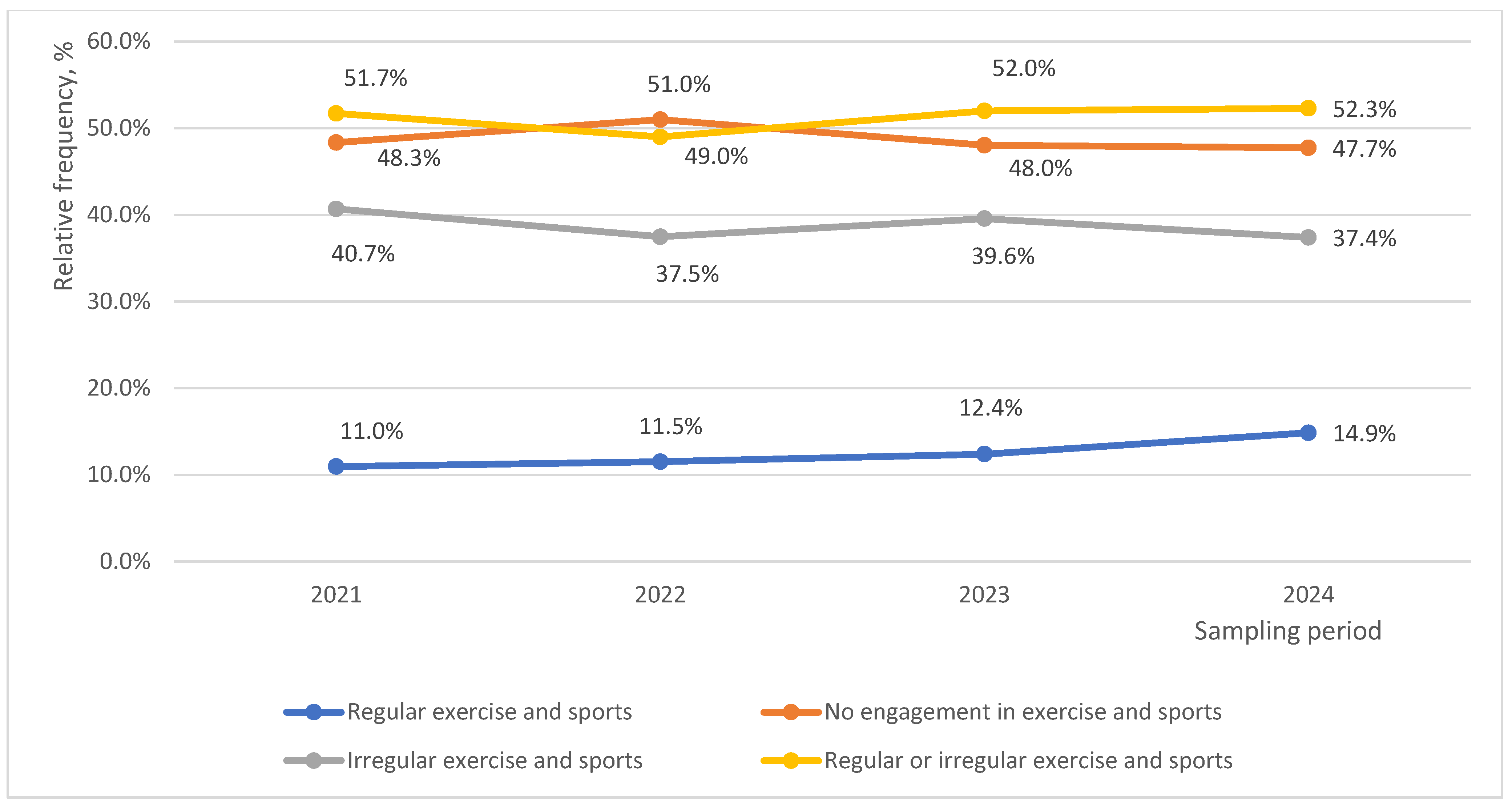
| Engages in exercise and sports (regular or irregular) | 1556 | 1516 | 1521 | 1517 | 0.146 | ||||
| No | 746 | 47.9% | 772 | 50.9% | 721 | 47.4% | 717 | 47.3% | |
| Yes | 810 | 52.1% | 744 | 49.1% | 800 | 52.6% | 800 | 52.7% | |
| Engages in regular exercise and sports | 1556 | 1516 | 1521 | 1517 | 0.006 ** | ||||
| No | 1381 | 88.8% | 1332 | 87.9% | 1330 | 87.4% | 1285 * | 84.7% * | |
| Yes | 175 | 11.2% | 184 | 12.1% | 191 | 12.6% | 232 ^ | 15.3% ^ | |
| Factor | Sample of 2021 | Sample of 2022 | Sample of 2023 | Sample of 2024 | p-Value | ||||
|---|---|---|---|---|---|---|---|---|---|
| n | % | n | % | n | % | n | % | ||
| Sex | 0.627 | ||||||||
| Male | 348 | 46.6% | 370 | 47.9% | 324 | 44.9% | 324 | 45.2% | |
| Female | 398 | 53.4% | 402 | 52.1% | 397 | 55.1% | 393 | 54.8% | |
| Age | 0.764 | ||||||||
| 41 years old or younger | 352 | 47.2% | 383 | 49.6% | 342 | 47.4% | 349 | 48.7% | |
| 42 years old or older | 394 | 52.8% | 389 | 50.4% | 379 | 52.6% | 368 | 51.3% | |
| Education | 0.491 | ||||||||
| Non-university education | 254 | 37.0% | 261 | 36.6% | 241 | 35.4% | 266 | 39.3% | |
| University education | 432 | 63.0% | 453 | 63.4% | 440 | 64.6% | 410 | 60.7% | |
| Place of residence | 0.302 | ||||||||
| A small town or village | 383 | 51.3% | 392 | 50.8% | 395 | 54.8% | 389 | 54.3% | |
| City | 363 | 48.7% | 380 | 49.2% | 326 | 45.2% | 328 | 45.7% | |
| Marital status | <0.001 ** | ||||||||
| Married | 452 | 60.6% | 482 | 62.4% | 505 ^ | 70.0% ^ | 504 | 70.3% | |
| Single | 294 | 39.4% | 290 | 37.6% | 216 * | 30.0% * | 213 | 29.7% | |
| Number of family members | 0.403 | ||||||||
| Two or more | 664 | 89.0% | 668 | 86.5% | 623 | 86.4% | 624 | 87.0% | |
| One | 82 | 11.0% | 104 | 13.5% | 98 | 13.6% | 93 | 13.0% | |
| With children under 18 years old | 0.102 | ||||||||
| Yes | 297 | 39.8% | 337 | 43.7% | 286 | 39.7% | 321 | 44.8% | |
| No | 449 | 60.2% | 435 | 56.3% | 435 | 60.3% | 396 | 55.2% | |
| Employment | 0.496 | ||||||||
| Employed | 534 | 76.6% | 553 | 77.6% | 497 | 74.3% | 512 | 77.1% | |
| Unemployed | 163 | 23.4% | 160 | 22.4% | 172 | 25.7% | 152 | 22.9% | |
| Income | 0.268 | ||||||||
| Higher | 367 | 63.2% | 385 | 63.8% | 386 | 65.9% | 358 | 60.4% | |
| Lower | 214 | 36.8% | 218 | 36.2% | 200 | 34.1% | 235 | 39.6% | |
| Food selection criteria | <0.001 ** | ||||||||
| Other | 559 | 76.4% | 644 ^ | 85.8% ^ | 574 * | 80.5% * | 552 | 78.1% | |
| To strengthen health | 173 | 23.6% | 107 * | 14.2% * | 139 ^ | 19.5% ^ | 155 | 21.9% | |
| Severity of COVID-19 | 0.296 | ||||||||
| Suffered from an asymptomatic or a mild form of COVID-19 (or did not have COVID-19 at all) | 702 | 94.1% | 726 | 94.0% | 674 | 93.5% | 659 | 91.9% | |
| Suffered from a severe form of COVID-19 | 44 | 5.9% | 46 | 6.0% | 47 | 6.5% | 58 | 8.1% | |
| Subjective assessment of health status | 0.075 | ||||||||
| Positive | 660 | 89.2% | 687 | 90.2% | 614 * | 86.1% * | 641 | 89.4% | |
| Negative | 80 | 10.8% | 75 | 9.8% | 99 ^ | 13.9% ^ | 76 | 10.6% | |
| Subjective assessment of nutrition | 0.148 | ||||||||
| Positive | 617 | 83.5% | 607 | 80.0% | 574 | 80.6% | 559 | 79.0% | |
| Negative | 122 | 16.5% | 152 | 20.0% | 138 | 19.4% | 149 | 21.0% | |
| Consumption of dietary supplements | 0.016 ** | ||||||||
| No | 180 | 24.4% | 235 ^ | 30.7% ^ | 222 | 30.9% | 214 | 29.9% | |
| Yes | 558 | 75.6% | 530 * | 69.3% * | 496 | 69.1% | 502 | 70.1% | |
| Health-consciousness in product choice | <0.001 ** | ||||||||
| Pays attention to buying healthy products | 579 | 77.6% | 496 * | 64.2% * | 542 ^ | 75.2% ^ | 515 | 71.8% | |
| Does not care about the healthiness of products | 167 | 22.4% | 276 ^ | 35.8% ^ | 179 * | 24.8% * | 202 | 28.2% | |
| Factor | Sample of 2021 | Sample of 2022 | Sample of 2023 | Sample of 2024 | p-Value | ||||
|---|---|---|---|---|---|---|---|---|---|
| n | % | n | % | n | % | n | % | ||
| Sex | 0.729 | ||||||||
| Male | 405 | 50.0% | 360 | 48.4% | 405 | 50.6% | 409 | 51.1% | |
| Female | 405 | 50.0% | 384 | 51.6% | 395 | 49.4% | 391 | 48.9% | |
| Age | 0.966 | ||||||||
| 41 years old or younger | 408 | 50.4% | 378 | 50.8% | 413 | 51.6% | 409 | 51.1% | |
| 42 years old or older | 402 | 49.6% | 366 | 49.2% | 387 | 48.4% | 391 | 48.9% | |
| Education | 0.018 ** | ||||||||
| Non-university education | 169 | 22.0% | 189 ^ | 26.4% ^ | 189 | 24.7% | 223 | 28.9% | |
| University education | 598 | 78.0% | 527 * | 73.6% * | 577 | 75.3% | 549 | 71.1% | |
| Place of residence | 0.938 | ||||||||
| A small town or village | 379 | 46.8% | 345 | 46.4% | 370 | 46.3% | 362 | 45.3% | |
| City | 431 | 53.2% | 399 | 53.6% | 430 | 53.8% | 438 | 54.8% | |
| Marital status | <0.001 ** | ||||||||
| Married | 497 | 61.4% | 426 | 57.3% | 541 ^ | 67.6% ^ | 524 | 65.5% | |
| Single | 313 | 38.6% | 318 | 42.7% | 259 * | 32.4% * | 276 | 34.5% | |
| Number of family members | 0.082 | ||||||||
| Two or more | 714 | 88.1% | 624 * | 83.9% * | 677 | 84.6% | 682 | 85.3% | |
| One | 96 | 11.9% | 120 ^ | 16.1% ^ | 123 | 15.4% | 118 | 14.8% | |
| With children under 18 years old | 0.949 | ||||||||
| Yes | 305 | 37.7% | 277 | 37.2% | 308 | 38.5% | 307 | 38.4% | |
| No | 505 | 62.3% | 467 | 62.8% | 492 | 61.5% | 493 | 61.6% | |
| Employment | 0.009 ** | ||||||||
| Employed | 628 | 82.8% | 532* | 76.9% * | 608^ | 81.2% ^ | 610 | 83.1% | |
| Unemployed | 130 | 17.2% | 160^ | 23.1% ^ | 141* | 18.8%* | 124 | 16.9% | |
| Income | 0.180 | ||||||||
| Higher | 458 | 72.8% | 390 | 69.3% | 459 | 72.4% | 433 | 68.1% | |
| Lower | 171 | 27.2% | 173 | 30.7% | 175 | 27.6% | 203 | 31.9% | |
| Food selection criteria | <0.001 ** | ||||||||
| Other | 463 | 58.2% | 533 ^ | 73.3% ^ | 536 * | 68.0% * | 517 | 65.6% | |
| Health strengthening | 332 | 41.8% | 194 * | 26.7% * | 252 ^ | 32.0% ^ | 271 | 34.4% | |
| Severity of COVID-19 | 0.257 | ||||||||
| Suffered from an asymptomatic or a mild form of COVID-19 (or did not have COVID-19 at all) | 774 | 95.6% | 698 | 93.8% | 756 | 94.5% | 747 | 93.4% | |
| Suffered from a severe form of COVID-19 | 36 | 4.4% | 46 | 6.2% | 44 | 5.5% | 53 | 6.6% | |
| Subjective assessment of health status | 0.301 | ||||||||
| Positive | 766 | 95.0% | 689 | 93.0% | 755 | 94.7% | 757 | 94.6% | |
| Negative | 40 | 5.0% | 52 | 7.0% | 42 | 5.3% | 43 | 5.4% | |
| Subjective assessment of nutrition | 0.003 ** | ||||||||
| Positive | 753 | 93.4% | 673 | 90.9% | 704 | 88.4% | 709 | 89.2% | |
| Negative | 53 | 6.6% | 67 | 9.1% | 92 | 11.6% | 86 | 10.8% | |
| Consumption of dietary supplements | 0.010 ** | ||||||||
| No | 142 | 17.6% | 171 ^ | 23.2% ^ | 148 * | 18.7% * | 180 | 22.6% | |
| Yes | 666 | 82.4% | 567 * | 76.8% * | 645^ | 81.3% ^ | 617 | 77.4% | |
| Health-consciousness in product choice | 0.241 | ||||||||
| Pays attention to buying healthy products | 705 | 87.0% | 623 | 83.7% | 674 | 84.3% | 686 | 85.8% | |
| Does not care about the healthiness of products | 105 | 13.0% | 121 | 16.3% | 126 | 15.8% | 114 | 14.3% | |
| Factor | Sample of 2021 | Sample of 2022 | Sample of 2023 | Sample of 2024 | p-Value | ||||
|---|---|---|---|---|---|---|---|---|---|
| n | % | n | % | n | % | n | % | ||
| Sex | 0.352 | ||||||||
| Male | 95 | 54.3% | 93 | 50.5% | 99 | 51.8% | 106 | 45.7% | |
| Female | 80 | 45.7% | 91 | 49.5% | 92 | 48.2% | 126 | 54.3% | |
| Age | 0.609 | ||||||||
| 41 years old or younger | 107 | 61.1% | 100 | 54.3% | 112 | 58.6% | 137 | 59.1% | |
| 42 years old or older | 68 | 38.9% | 84 | 45.7% | 79 | 41.4% | 95 | 40.9% | |
| Education | 0.044 ** | ||||||||
| Non-university education | 30 | 18.0% | 54 ^ | 30.3% ^ | 39 * | 21.3% * | 56 | 24.8% | |
| University education | 137 | 82.0% | 124 * | 69.7% * | 144 ^ | 78.7% ^ | 170 | 75.2% | |
| Place of residence | 0.897 | ||||||||
| A small town or village | 66 | 37.7% | 72 | 39.1% | 79 | 41.4% | 94 | 40.5% | |
| City | 109 | 62.3% | 112 | 60.9% | 112 | 58.6% | 138 | 59.5% | |
| Marital status | 0.044 ** | ||||||||
| Married | 110 | 62.9% | 103 | 56.0% | 134 ^ | 70.2% ^ | 147 | 63.4% | |
| Single | 65 | 37.1% | 81 | 44.0% | 57 * | 29.8% * | 85 | 36.6% | |
| Number of family members | 0.832 | ||||||||
| Two or more | 149 | 85.1% | 159 | 86.4% | 161 | 84.3% | 193 | 83.2% | |
| One | 26 | 14.9% | 25 | 13.6% | 30 | 15.7% | 39 | 16.8% | |
| With children under 18 years old | 0.864 | ||||||||
| Yes | 72 | 41.1% | 74 | 40.2% | 73 | 38.2% | 98 | 42.2% | |
| No | 103 | 58.9% | 110 | 59.8% | 118 | 61.8% | 134 | 57.8% | |
| Employment | 0.019 ** | ||||||||
| Employed | 135 | 82.8% | 125 * | 71.4% * | 153 ^ | 83.2% ^ | 172 | 81.1% | |
| Unemployed | 28 | 17.2% | 50^ | 28.6% ^ | 31 * | 16.8% * | 40 | 18.9% | |
| Income | 0.013 ** | ||||||||
| Higher | 111 | 81.0% | 89 * | 65.0% * | 112 ^ | 78.3% ^ | 128 | 74.0% | |
| Lower | 26 | 19.0% | 48 ^ | 35.0% ^ | 31 * | 21.7% * | 45 | 26.0% | |
| Food selection criteria | 0.024 ** | ||||||||
| Other | 90 | 51.7% | 116 ^ | 65.5% ^ | 122 | 64.6% | 146 | 63.8% | |
| Health strengthening | 84 | 48.3% | 61 * | 34.5% * | 67 | 35.4% | 83 | 36.2% | |
| Severity of COVID-19 | 0.512 | ||||||||
| Suffered from an asymptomatic or a mild form of COVID-19 (or did not have COVID-19 at all) | 168 | 96.0% | 173 | 94.0% | 185 | 96.9% | 219 | 94.4% | |
| Suffered from a severe form of COVID-19 | 7 | 4.0% | 11 | 6.0% | 6 | 3.1% | 13 | 5.6% | |
| Subjective assessment of health status | 0.449 | ||||||||
| Positive | 170 | 97.1% | 175 | 95.6% | 185 | 97.4% | 228 | 98.3% | |
| Negative | 5 | 2.9% | 8 | 4.4% | 5 | 2.6% | 4 | 1.7% | |
| Subjective assessment of nutrition | 0.177 | ||||||||
| Positive | 167 | 95.4% | 169 | 92.3% | 172 | 90.1% | 217 | 94.3% | |
| Negative | 8 | 4.6% | 14 | 7.7% | 19 | 9.9% | 13 | 5.7% | |
| Consumption of dietary supplements | 0.165 | ||||||||
| No | 33 | 18.9% | 45 | 24.7% | 31 * | 16.5% * | 54 | 23.4% | |
| Yes | 142 | 81.1% | 137 | 75.3% | 157 ^ | 83.5% ^ | 177 | 76.6% | |
| Health-consciousness in product choice | 0.426 | ||||||||
| Pays attention to buying healthy products | 152 | 86.9% | 154 | 83.7% | 171 | 89.5% | 200 | 86.2% | |
| Does not care about the healthiness of products | 23 | 13.1% | 30 | 16.3% | 20 | 10.5% | 32 | 13.8% | |
| Factor | Sample of 2021 | Sample of 2022 | Sample of 2023 | Sample of 2024 | ||||
|---|---|---|---|---|---|---|---|---|
| n | % | n | % | n | % | n | % | |
| Sex | ||||||||
| Male | 405 | 53.8% | 360 | 49.3% | 405 h | 55.6% | 409 h | 55.8% |
| Female | 405 | 50.4% | 384 | 48.9% | 395 * | 49.9% | 391 * | 49.9% |
| Age | ||||||||
| 41 years old or younger | 408 | 53.7% | 378 | 49.7% | 413 | 54.7% | 409 | 54.0% |
| 42 years old or older | 402 | 50.5% | 366 | 48.5% | 387 | 50.5% | 391 | 51.5% |
| Education | ||||||||
| Non-university education | 169 * | 40.0% | 189 * | 42.0% | 189 * | 44.0% | 223 * | 45.6% |
| University education | 598 h | 58.1% | 527 h | 53.8% | 577 h | 56.7% | 549 h | 57.2% |
| Place of residence | ||||||||
| A small town or village | 379 | 49.7% | 345 | 46.8% | 370 * | 48.4% | 362 * | 48.2% |
| City | 431 | 54.3% | 399 | 51.2% | 430 h | 56.9% | 438 h | 57.2% |
| Marital status | ||||||||
| Married | 497 | 52.4% | 426 * | 46.9% | 541 | 51.7% | 524 * | 51.0% |
| Single | 313 | 51.6% | 318 h | 52.3% | 259 | 54.5% | 276 h | 56.4% |
| Number of family members | ||||||||
| Two or more | 714 | 51.8% | 624 | 48.3% | 677 | 52.1% | 682 | 52.2% |
| One | 96 | 53.9% | 120 | 53.6% | 123 | 55.7% | 118 | 55.9% |
| With children under 18 years old | ||||||||
| Yes | 305 | 50.7% | 277 * | 45.1% | 308 | 51.9% | 307 * | 48.9% |
| No | 505 | 52.9% | 467 h | 51.8% | 492 | 53.1% | 493 h | 55.5% |
| Employment | ||||||||
| Employed | 628 h | 54.0% | 532 | 49.0% | 608 h | 55.0% | 610 h | 54.4% |
| Unemployed | 130 * | 44.4% | 160 | 50.0% | 141 * | 45.0% | 124 * | 44.9% |
| Income | ||||||||
| Higher | 458 h | 55.5% | 390 h | 50.3% | 459 h | 54.3% | 433 h | 54.7% |
| Lower | 171 * | 44.4% | 173 * | 44.2% | 175 * | 46.7% | 203 * | 46.3% |
| Food selection criteria | ||||||||
| Other | 463 * | 45.3% | 533 * | 45.3% | 536 * | 48.3% | 517 * | 48.4% |
| Health strengthening | 332 h | 65.7% | 194 h | 64.5% | 252 h | 64.5% | 271 h | 63.6% |
| Severity of COVID-19 | ||||||||
| Suffered from an asymptomatic or a mild form of COVID-19 (or did not have COVID-19 at all) | 774 | 52.4% | 698 | 49.0% | 756 | 52.9% | 747 | 53.1% |
| Suffered from a severe form of COVID-19 | 36 | 45.0% | 46 | 50.0% | 44 | 48.4% | 53 | 47.7% |
| Subjective assessment of health status | ||||||||
| Positive | 766 h | 53.7% | 689 h | 50.1% | 755 h | 55.1% | 757 h | 54.1% |
| Negative | 40 * | 33.3% | 52 * | 40.9% | 42 * | 29.8% | 43 * | 36.1% |
| Subjective assessment of nutrition | ||||||||
| Positive | 753 h | 55.0% | 673 h | 52.6% | 704 h | 55.1% | 709 h | 55.9% |
| Negative | 53 * | 30.3% | 67 * | 30.6% | 92 * | 40.0% | 86 * | 36.6% |
| Consumption of dietary supplements | ||||||||
| No | 142 * | 44.1% | 171 * | 42.1% | 148 * | 40.0% | 180 * | 45.7% |
| Yes | 666 h | 54.4% | 567 h | 51.7% | 645 h | 56.5% | 617 h | 55.1% |
| Health-consciousness in product choice | ||||||||
| Pays attention to buying healthy products | 705 h | 54.9% | 623 h | 55.7% | 674 h | 55.4% | 686 h | 57.1% |
| Does not care about the healthiness of products | 105 * | 38.6% | 121 * | 30.5% | 126 * | 41.3% | 114 * | 36.1% |
| Factor | Odds Ratio (95% CI) | p-Value |
|---|---|---|
| Being male | 1.26 (1.115–1.425) | <0.001 |
| Being single | 1.223 (1.067–1.402) | 0.004 |
| Absence of children under 18 years of age | 1.222 (1.061–1.408) | 0.005 |
| Selecting foods for health strengthening | 1.736 (1.5–2.009) | <0.001 |
| Positive assessment of nutrition | 2.069 (1.726–2.48) | <0.001 |
| Positive assessment of health status | 1.746 (1.385–2.201) | <0.001 |
| Use of dietary supplements | 1.469 (1.268–1.701) | <0.001 |
| Pays attention to buying healthy products | 1.478 (1.26–1.733) | <0.001 |
| University education | 1.58 (1.369–1.824) | <0.001 |
| Higher income | 1.134 (0.984–1.308) | 0.083 |
| Increase in age (per year) | 0.986 (0.982–0.991) | <0.001 |
| Factor | Sample of 2021 | Sample of 2022 | Sample of 2023 | Sample of 2024 | ||||
|---|---|---|---|---|---|---|---|---|
| n | % | n | % | n | % | n | % | |
| Sex | ||||||||
| Male | 95 | 12.6% | 93 | 12.7% | 99 | 13.6% | 106 | 14.5% |
| Female | 80 | 10.0% | 91 | 11.6% | 92 | 11.6% | 126 | 16.1% |
| Age | ||||||||
| 41 years old or younger | 107 h | 14.1% | 100 | 13.1% | 112 h | 14.8% | 137 h | 18.1% |
| 42 years old or older | 68 * | 8.5% | 84 | 11.1% | 79 * | 10.3% | 95 * | 12.5% |
| Education | ||||||||
| Non-university education | 30 * | 7.1% | 54 | 12.0% | 39 * | 9.1% | 56 * | 11.5% |
| University education | 137 h | 13.3% | 124 | 12.7% | 144 h | 14.2% | 170 h | 17.7% |
| Place of residence | ||||||||
| A small town or village | 66 * | 8.7% | 72 * | 9.8% | 79 * | 10.3% | 94 * | 12.5% |
| City | 109 h | 13.7% | 112 h | 14.4% | 112 h | 14.8% | 138 h | 18.0% |
| Marital status | ||||||||
| Married | 110 | 11.6% | 103 | 11.3% | 134 | 12.8% | 147 | 14.3% |
| Single | 65 | 10.7% | 81 | 13.3% | 57 | 12.0% | 85 | 17.4% |
| Number of family members | ||||||||
| Two or more | 149 | 10.8% | 159 | 12.3% | 161 | 12.4% | 193 | 14.8% |
| One | 26 | 14.6% | 25 | 11.2% | 30 | 13.6% | 39 | 18.5% |
| With children under 18 years old | ||||||||
| Yes | 72 | 12.0% | 74 | 12.1% | 73 | 12.3% | 98 | 15.6% |
| No | 103 | 10.8% | 110 | 12.2% | 118 | 12.7% | 134 | 15.1% |
| Employment | ||||||||
| Employed | 135 | 11.6% | 125 | 11.5% | 153 | 13.8% | 172 | 15.3% |
| Unemployed | 28 | 9.6% | 50 | 15.6% | 31 | 9.9% | 40 | 14.5% |
| Income | ||||||||
| Higher | 111 h | 13.5% | 89 | 11.5% | 112 h | 13.3% | 128 h | 16.2% |
| Lower | 26 * | 6.8% | 48 | 12.3% | 31 * | 8.3% | 45 * | 10.3% |
| Food selection criteria | ||||||||
| Other | 90 * | 8.8% | 116 * | 9.9% | 122 * | 11.0% | 146 * | 13.7% |
| Health strengthening | 84 h | 16.6% | 61 h | 20.3% | 67 h | 17.1% | 83 h | 19.5% |
| Severity of COVID-19 | ||||||||
| Suffered from an asymptomatic or a mild form of COVID-19 (or did not have COVID-19 at all) | 168 | 11.4% | 173 | 12.1% | 185 | 12.9% | 219 | 15.6% |
| Suffered from a severe form of COVID-19 | 7 | 8.8% | 11 | 12.0% | 6 | 6.6% | 13 | 11.7% |
| Subjective assessment of health status | ||||||||
| Positive | 170 h | 11.9% | 175 h | 12.7% | 185 h | 13.5% | 228 h | 16.3% |
| Negative | 5 * | 4.2% | 8 * | 6.3% | 5 * | 3.5% | 4 * | 3.4% |
| Subjective assessment of nutrition | ||||||||
| Positive | 167 h | 12.2% | 169 h | 13.2% | 172 h | 13.5% | 217 h | 17.1% |
| Negative | 8 * | 4.6% | 14 * | 6.4% | 19 * | 8.3% | 13 * | 5.5% |
| Consumption of dietary supplements | ||||||||
| No | 33 | 10.2% | 45 | 11.1% | 31 * | 8.4% | 54 | 13.7% |
| Yes | 142 | 11.6% | 137 | 12.5% | 157 h | 13.8% | 177 | 15.8% |
| Health-consciousness in product choice | ||||||||
| Pays attention to buying healthy products | 152 | 11.8% | 154 h | 13.8% | 171 h | 14.1% | 200 h | 16.7% |
| Does not care about the healthiness of products | 23 | 8.5% | 30 * | 7.6% | 20 * | 6.6% | 32 * | 10.1% |
| Factor | Odds Ratio (95% CI) | p-Value |
|---|---|---|
| Selecting foods for health strengthening | 1.806 (1.483–2.2) | <0.001 |
| Positive assessment of nutrition | 2.324 (1.633–3.308) | <0.001 |
| Positive assessment of health status | 2.964 (1.71–5.138) | <0.001 |
| Use of dietary supplements | 1.229 (0.974–1.551) | 0.083 |
| Pays attention to buying healthy products | 1.25 (0.954–1.637) | 0.105 |
| University education | 1.441 (1.15–1.806) | 0.001 |
| Higher income | 1.217 (0.981–1.511) | 0.075 |
| Later survey year | 1.106 (1.021–1.197) | 0.014 |
| Urban residence | 1.485 (1.229–1.793) | <0.001 |
| Increase in age (per year) | 0.977 (0.97–0.984) | <0.001 |
Disclaimer/Publisher’s Note: The statements, opinions and data contained in all publications are solely those of the individual author(s) and contributor(s) and not of MDPI and/or the editor(s). MDPI and/or the editor(s) disclaim responsibility for any injury to people or property resulting from any ideas, methods, instructions or products referred to in the content. |
© 2026 by the authors. Published by MDPI on behalf of the Lithuanian University of Health Sciences. Licensee MDPI, Basel, Switzerland. This article is an open access article distributed under the terms and conditions of the Creative Commons Attribution (CC BY) license.
Share and Cite
Arlauskas, R.; Austys, D.; Stukas, R.; Dobrovolskij, V.; Rimkevičius, A.; Bulotaitė, G. Exercise and Sports Among Working-Age Citizens in Lithuania Since the COVID-19 Pandemic: An Annual Comparative Study (2021–2024). Medicina 2026, 62, 131. https://doi.org/10.3390/medicina62010131
Arlauskas R, Austys D, Stukas R, Dobrovolskij V, Rimkevičius A, Bulotaitė G. Exercise and Sports Among Working-Age Citizens in Lithuania Since the COVID-19 Pandemic: An Annual Comparative Study (2021–2024). Medicina. 2026; 62(1):131. https://doi.org/10.3390/medicina62010131
Chicago/Turabian StyleArlauskas, Rokas, Donatas Austys, Rimantas Stukas, Valerij Dobrovolskij, Arūnas Rimkevičius, and Gabija Bulotaitė. 2026. "Exercise and Sports Among Working-Age Citizens in Lithuania Since the COVID-19 Pandemic: An Annual Comparative Study (2021–2024)" Medicina 62, no. 1: 131. https://doi.org/10.3390/medicina62010131
APA StyleArlauskas, R., Austys, D., Stukas, R., Dobrovolskij, V., Rimkevičius, A., & Bulotaitė, G. (2026). Exercise and Sports Among Working-Age Citizens in Lithuania Since the COVID-19 Pandemic: An Annual Comparative Study (2021–2024). Medicina, 62(1), 131. https://doi.org/10.3390/medicina62010131