Review

Dermatitis Herpetiformis: An Update on Diagnosis, Disease Monitoring, and Management
by
Christopher N. Nguyen
1 and
Soo-Jung Kim
2,*
1
School of Medicine, Baylor College of Medicine, Houston, TX 77030, USA
2
Department of Dermatology, Baylor College of Medicine, Houston, TX 77030, USA
*
Author to whom correspondence should be addressed.
Medicina 2021, 57(8), 843; https://doi.org/10.3390/medicina57080843

Submission received: 19 July 2021 / Revised: 15 August 2021 / Accepted: 18 August 2021 / Published: 20 August 2021

Abstract

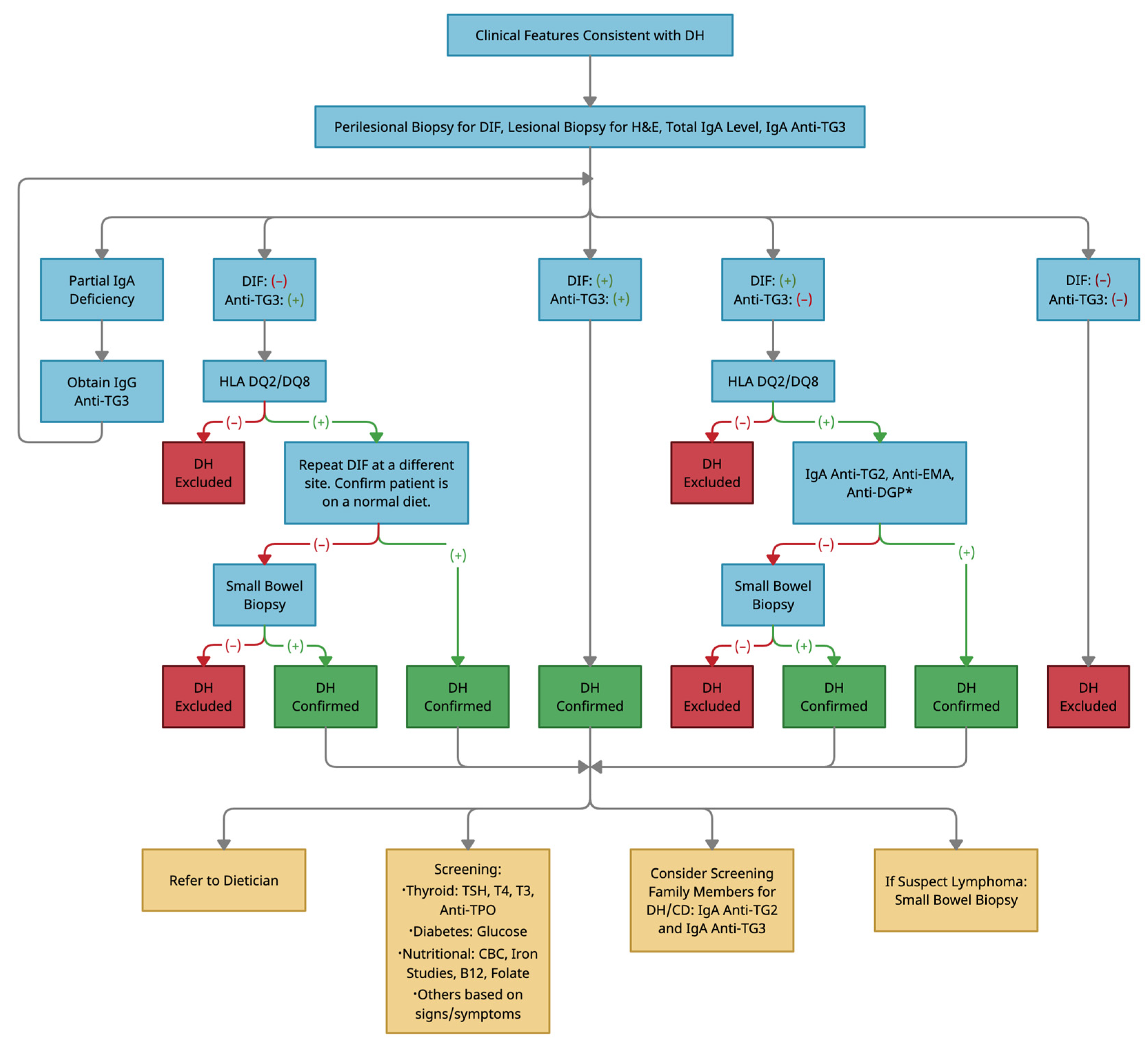
Dermatitis herpetiformis (DH), Duhring disease, is caused by gluten sensitivity and affects 11.2 to 75.3 per 100,000 people in the United States and Europe with an incidence of 0.4 to 3.5 per 100,000 people per year. DH is characterized by a symmetrical blistering rash on the extensor surfaces with severe pruritus. The diagnosis continues to be made primarily by pathognomonic findings on histopathology, especially direct immunofluorescence (DIF). Recently, anti-epidermal transglutaminase (TG3) antibodies have shown to be a primary diagnostic serology, while anti-tissue transglutaminase (TG2) and other autoantibodies may be used to support the diagnosis and for disease monitoring. Newly diagnosed patients with DH should be screened and assessed for associated diseases and complications. A gluten-free diet (GFD) and dapsone are still mainstays of treatment, but other medications may be necessary for recalcitrant cases. Well-controlled DH patients, managed by a dermatologist, a gastroenterologist, and a dietician, have an excellent prognosis. Our review comprehensively details the current diagnostic methods, as well as methods used to monitor its disease course. We also describe both the traditional and novel management options reported in the literature.
Keywords: dermatitis herpetiformis; celiac disease; bullous; autoimmune; pruritis; disease monitoring dermatitis herpetiformis; celiac disease; bullous; autoimmune; pruritis; disease monitoring