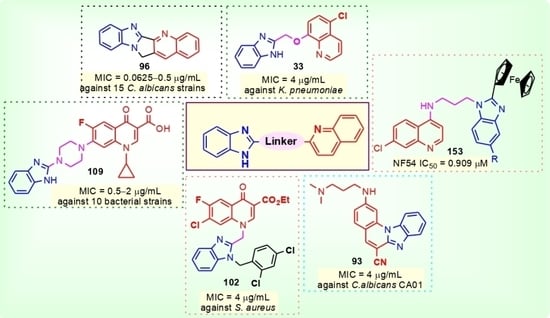
Benzimidazole-Quinoline Hybrids: Synthesis and Antimicrobial Properties


Abstract
1. Introduction
2. Benzimidazole-Quinoline Hybrids with Antimicrobial Properties
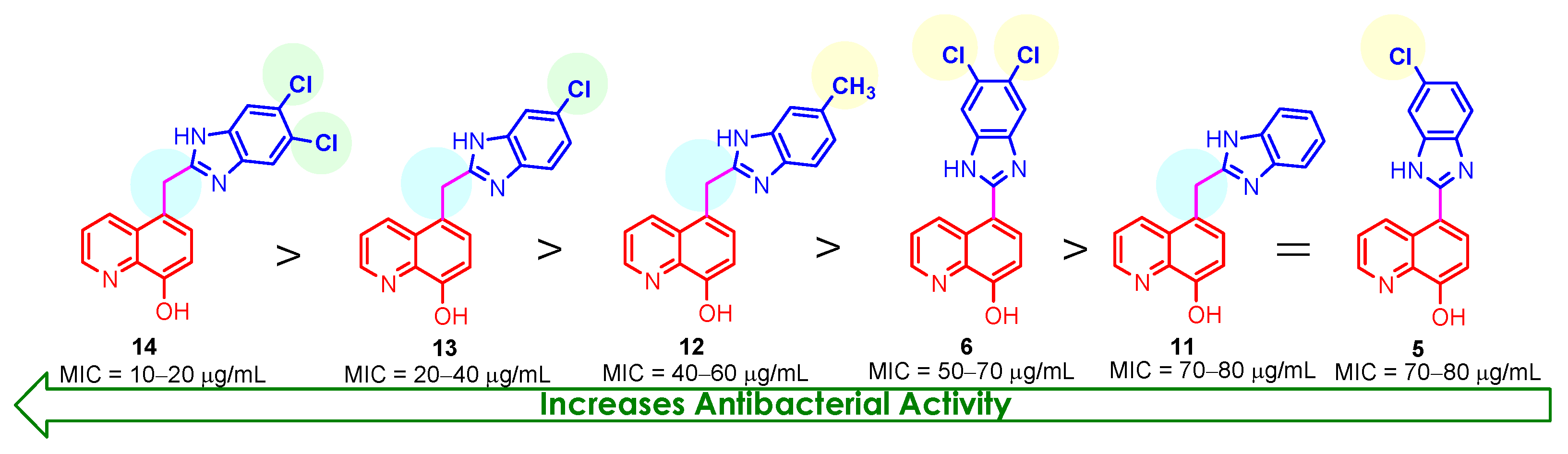
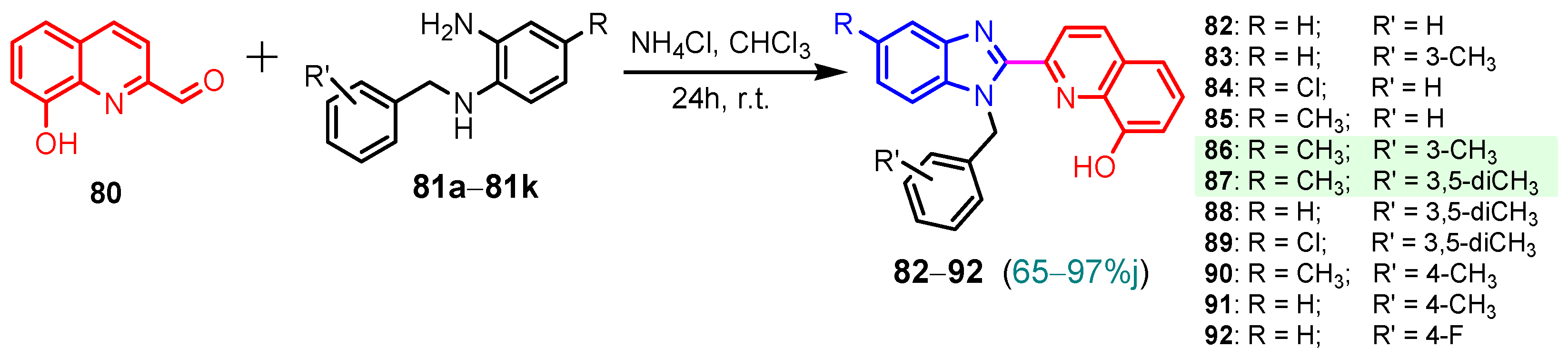
- The presence of a chlorine atom at the “5” position of the benzimidazole ring [76].
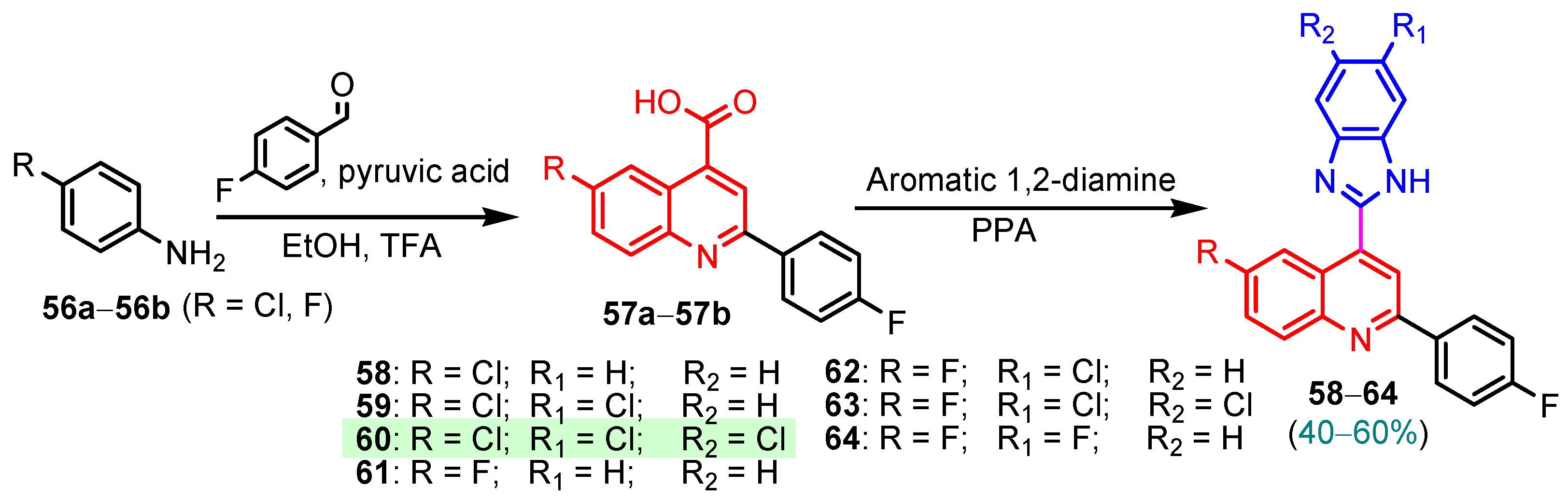
- The presence of two chlorine atoms at the “5” and “6” positions further enhances activity [77].
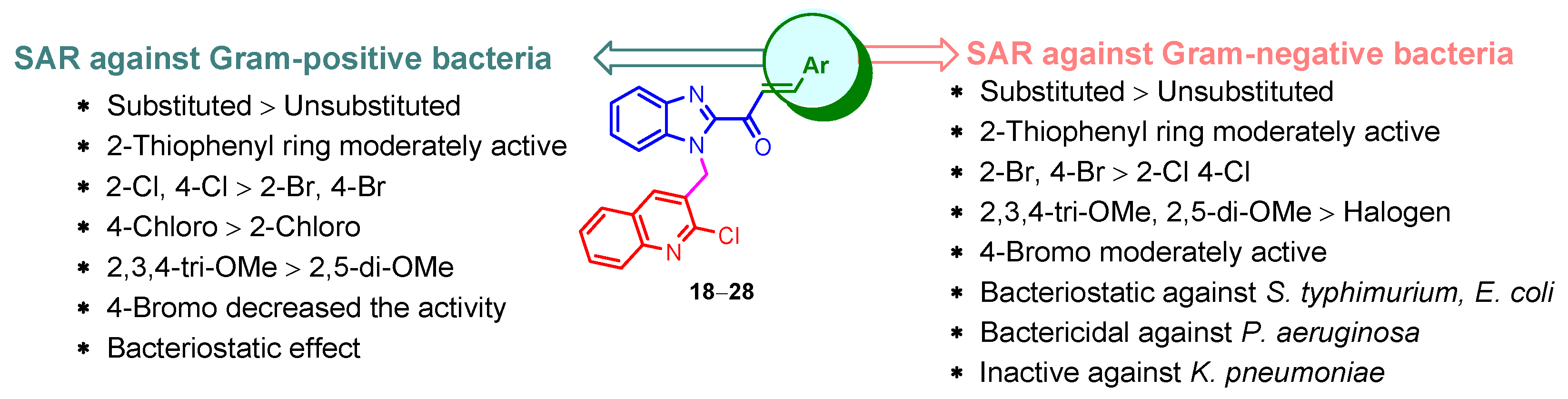
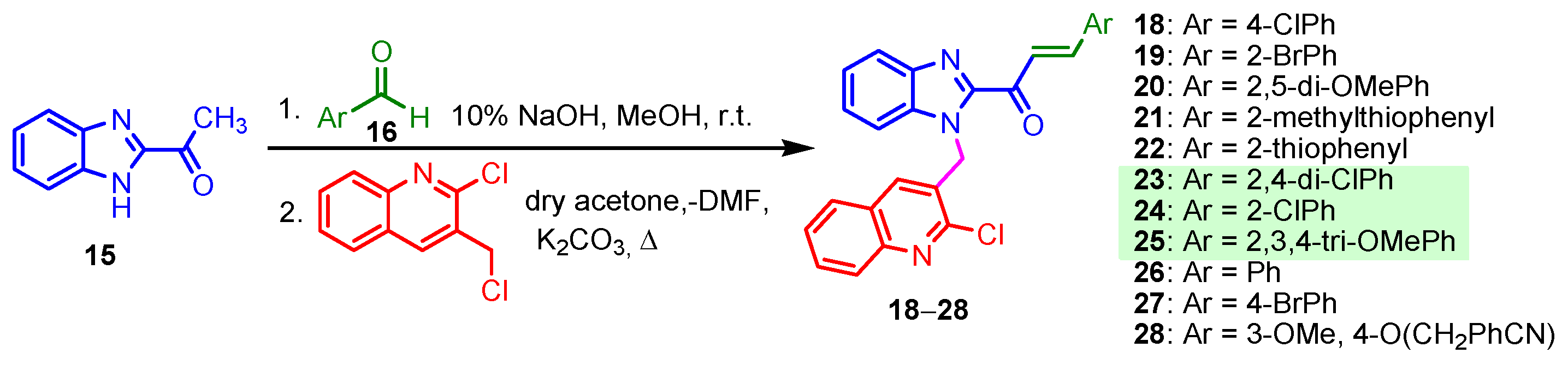
- Chlorine atoms at the “4” and “2” positions of a phenyl ring.
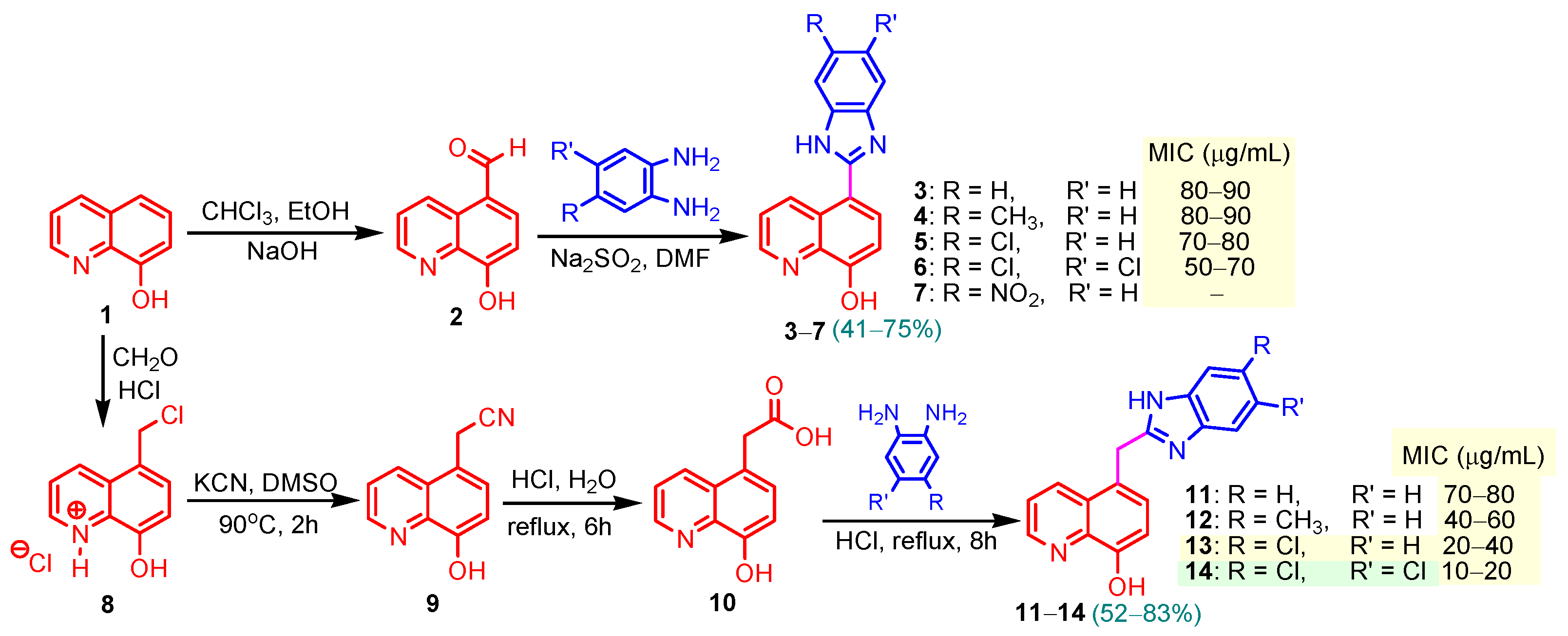
- The methylene linker between the “5” position of quinoline and the “2” position of benzimidazole [24].
- Bromine substitution on the phenyl ring improves activity against Gram-negative bacteria.
- Substitution with three methoxy groups on a phenyl ring.
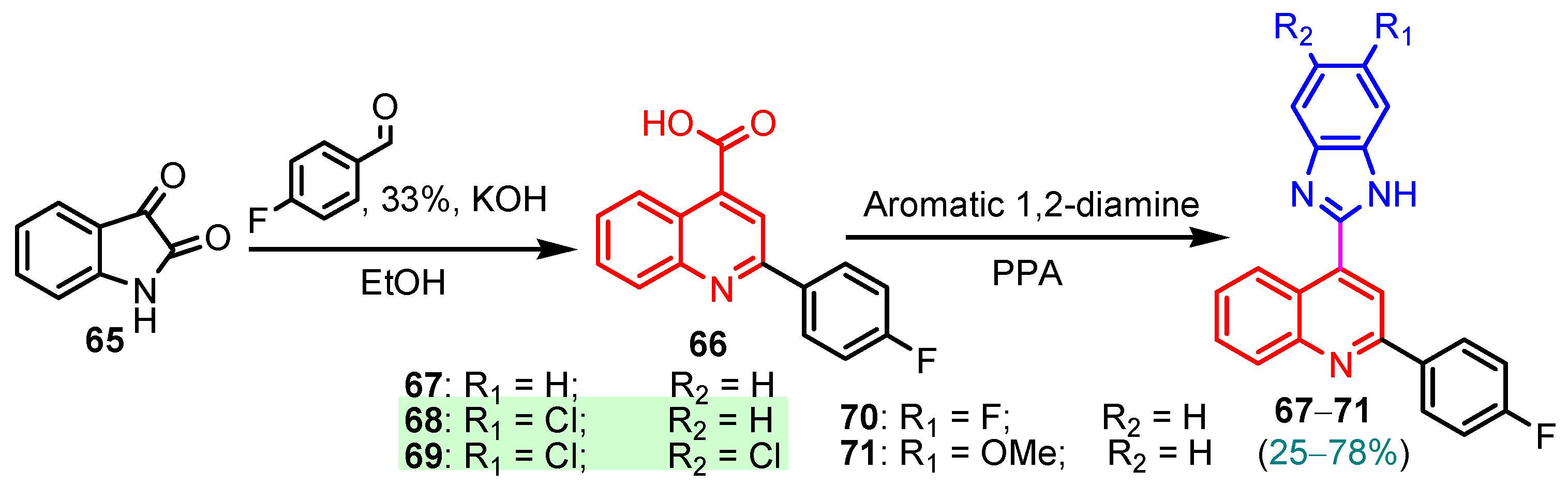
- A 4-fluorophenyl group at the C “2” position of the quinoline moiety [78].
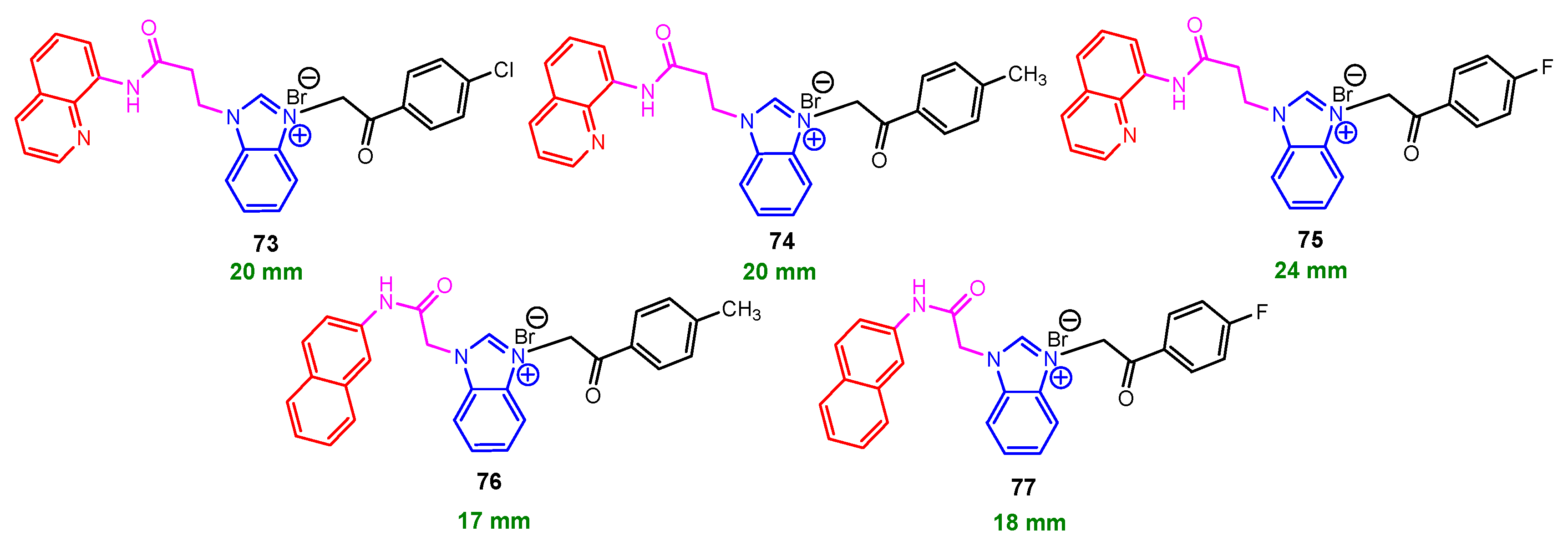
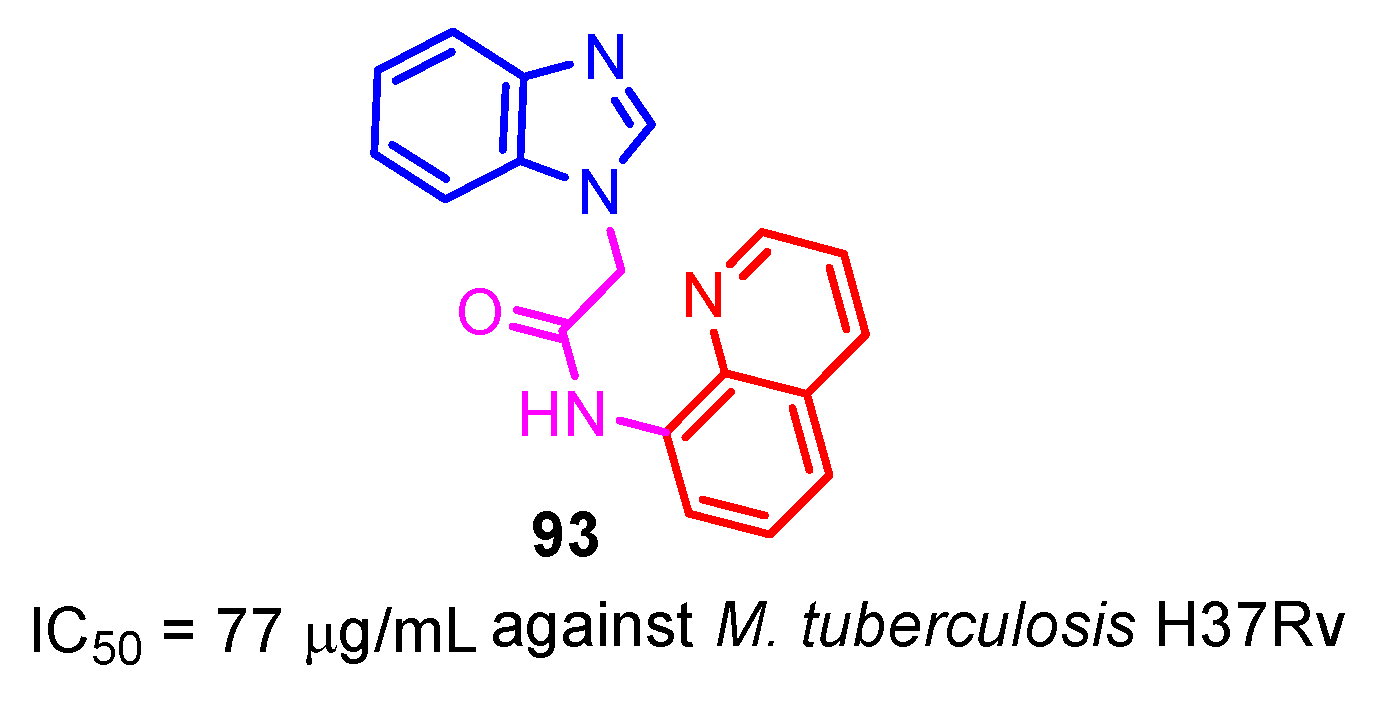
- An alkyl-amide group present between the “8” position of the quinoline ring and the “1” position of the benzimidazole ring.
- The absence of a nitro group at the “5” position of the benzimidazole ring.
- The presence of a nitro group at the “6” position of the quinoline ring [79].
- Alkyl substituents on the phenyl ring, linked by a methylene bridge to the benzimidazole nitrogen.
- An alkyl group attached to the amino moiety, which increases the lipophilicity of the compounds.
- Compound 97 from this section exhibited the strongest antimicrobial activity, with MIC values ranging from 0.0625 to 1 µg/mL against 26 clinical fungal pathogens, compared with Fluconazole as the reference drug.
3. Benzimidazole-Quinolinolone Hybrids with Antimicrobial Properties
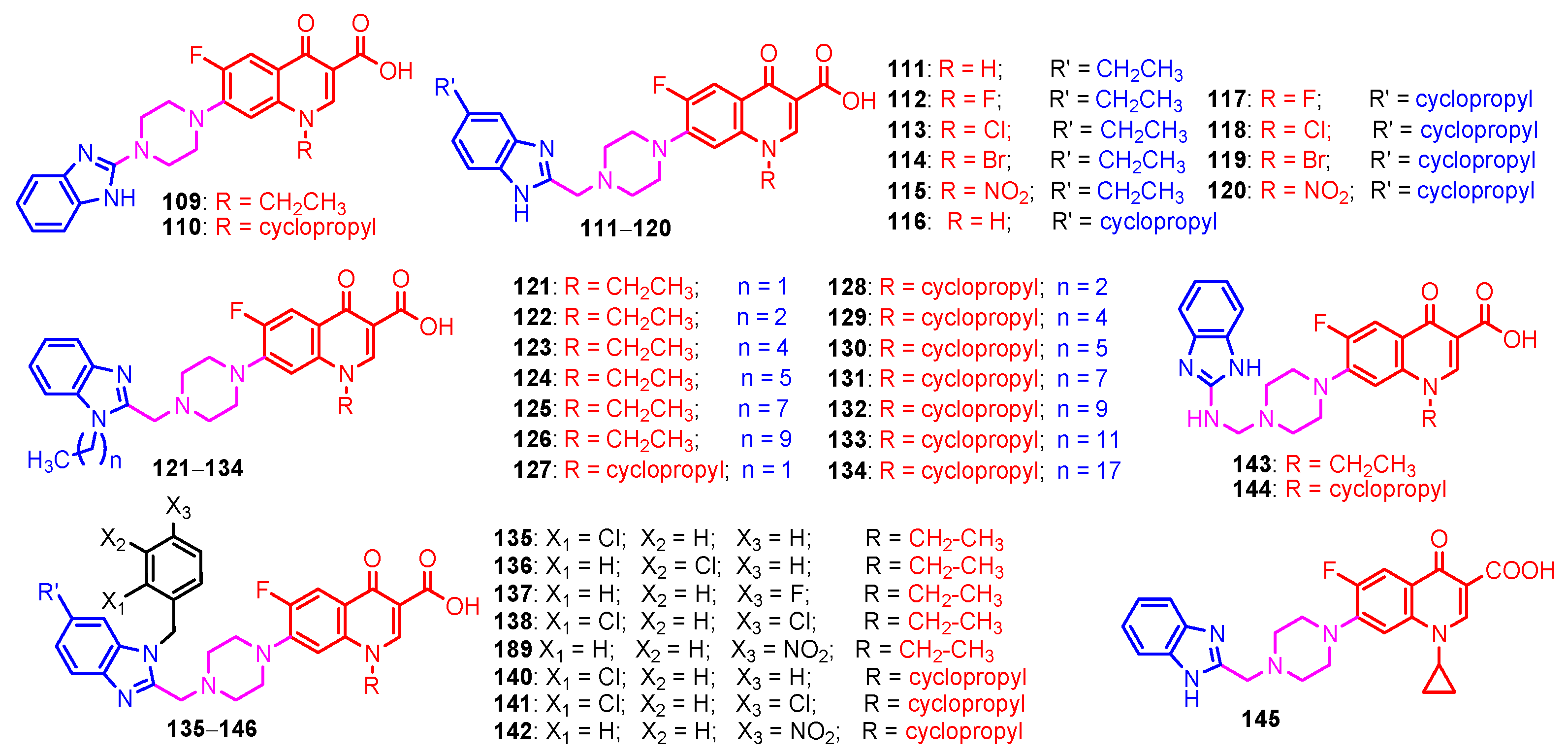
- The methylene–piperazine bridge between the benzimidazole ring and the quinoline moiety plays a crucial role in antimicrobial activity.
- Alkyl substituents such as ethyl or cyclopropyl at the quinoline nitrogen are favorable for antimicrobial activity, whereas longer alkyl chains containing three or more carbon atoms are less effective [87].
- The presence of a methylene linker between the “2” position of the benzimidazole ring and the quinoline nitrogen is important for biological activity.
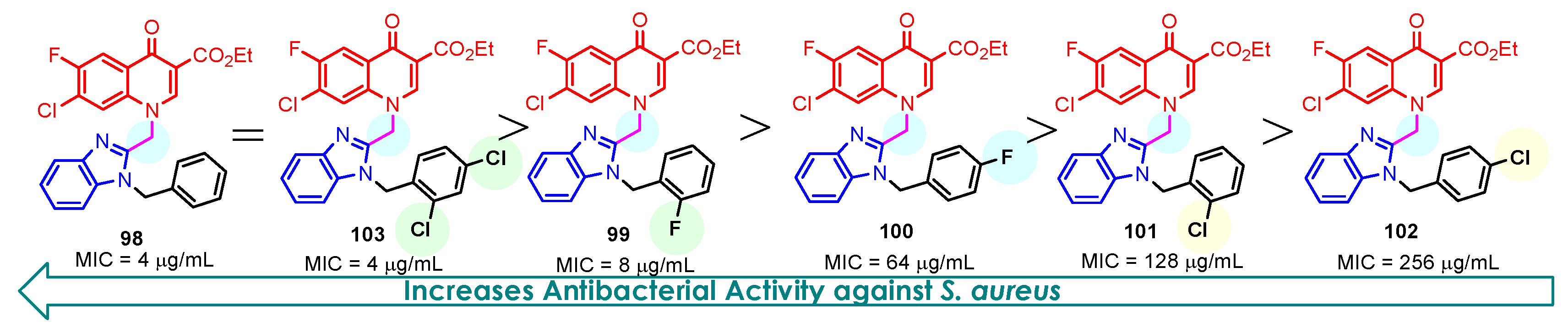
- Compounds bearing a dichlorophenyl ring exhibit higher activity than those containing only a single halogen substituent [90].
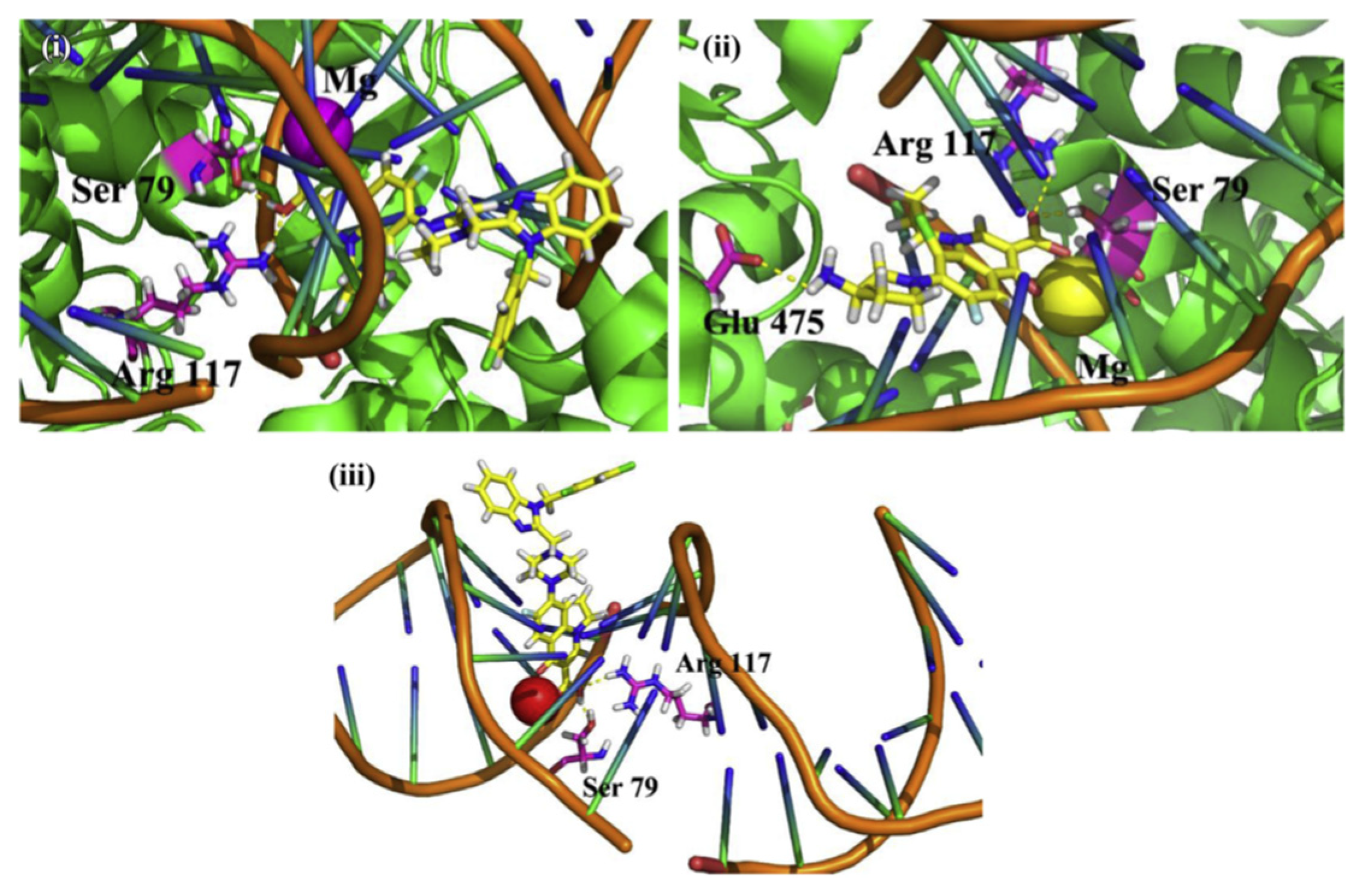
- Among the two series of compounds presented here (98–103 and 109–144), compounds 99 and 141 showed the best performance combined with reduced cytotoxicity. Docking studies were therefore conducted for these compounds, revealing their mechanisms of action through interactions with key residues of topoisomerase IV.
4. Benzimidazole-Quinoline Hybrids with Antimalarial Properties
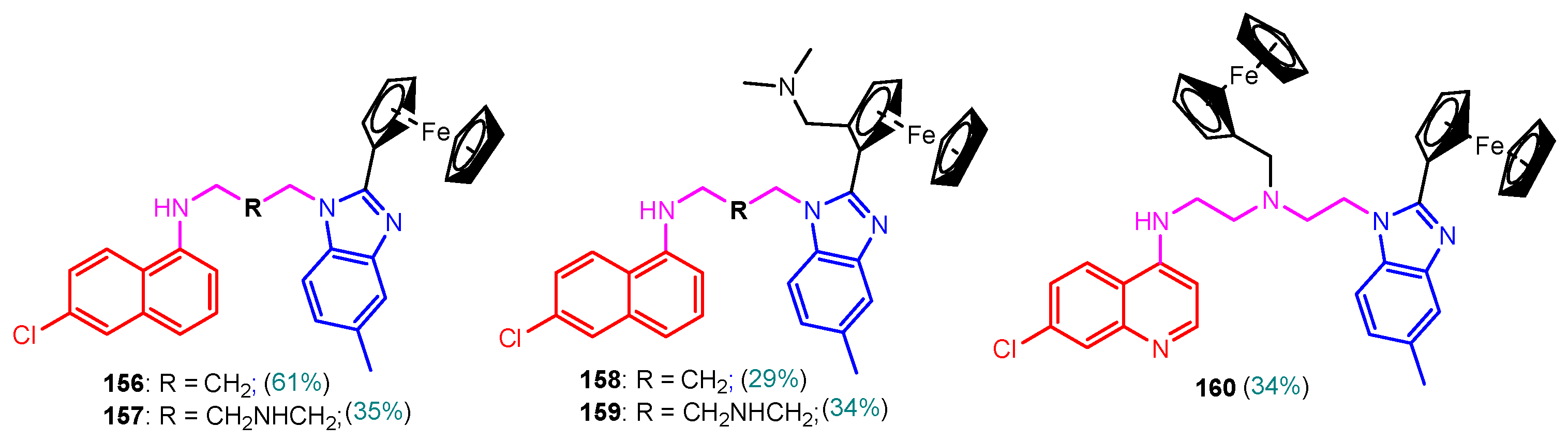
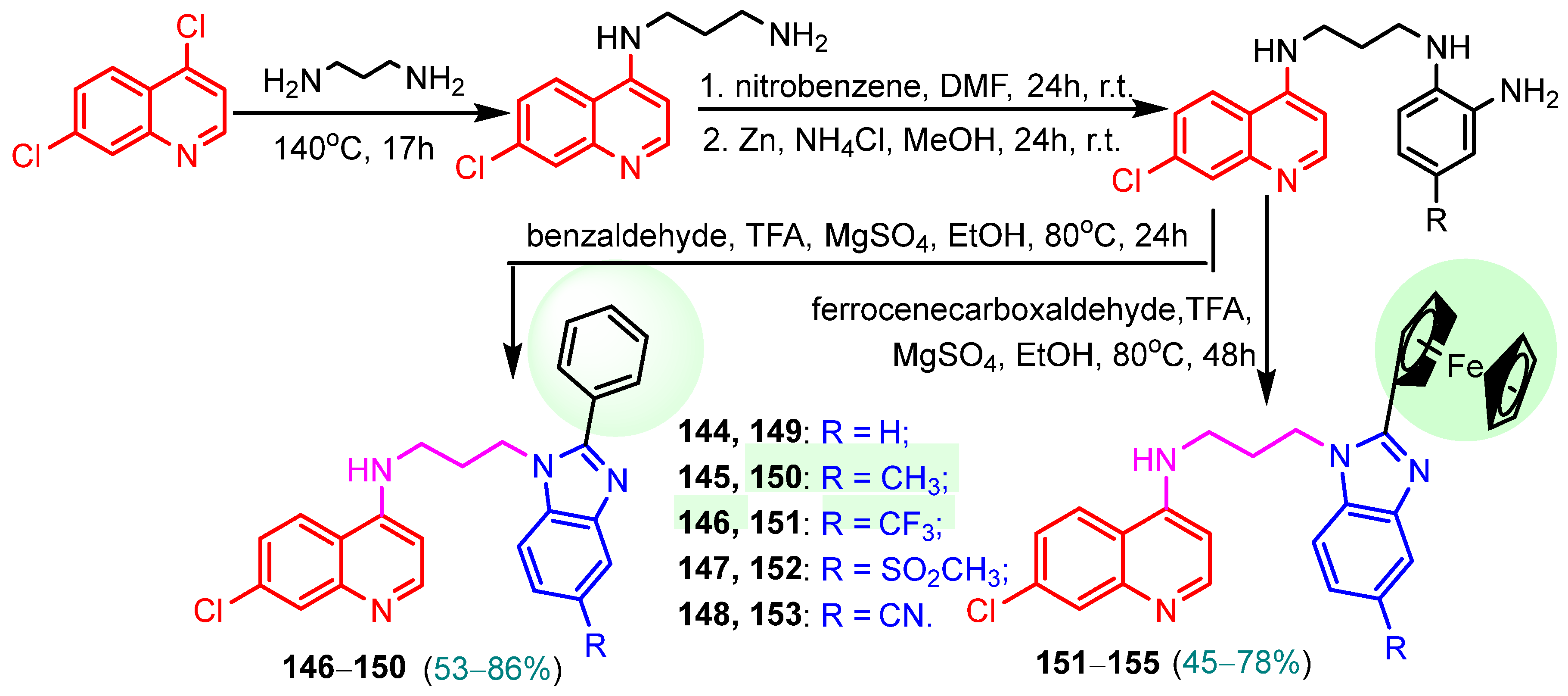
- The presence of a ferrocene moiety at the “2” position of the benzimidazole ring enhances antimicrobial activity [97].
- The inclusion of a second ferrocene unit in the molecule does not contribute to further increases in antimicrobial activity [98].
- The alkyl or aminoalkyl bridge between the quinoline and benzimidazole rings is essential for maintaining good antimicrobial activity [99].
5. Benzimidazole-Quinoline Hybrids Containing a Five-Membered Heterocyclic Ring with Antimicrobial Properties
- The incorporation of an oxadiazole ring into the benzimidazole–quinoline hybrids significantly enhances antibacterial activity [106].
- The presence of a phenoxymethyl group at the “2” position of benzimidazole improves antimicrobial activity more than the naphthylmethyl or naphthoxymethyl groups at the same position.
- A fluorine atom at the “6” position of benzimidazole greatly enhances its antimicrobial activity [107].
6. Benzimidazole-Quinoline Hybrids with Antitrypanosomal Properties
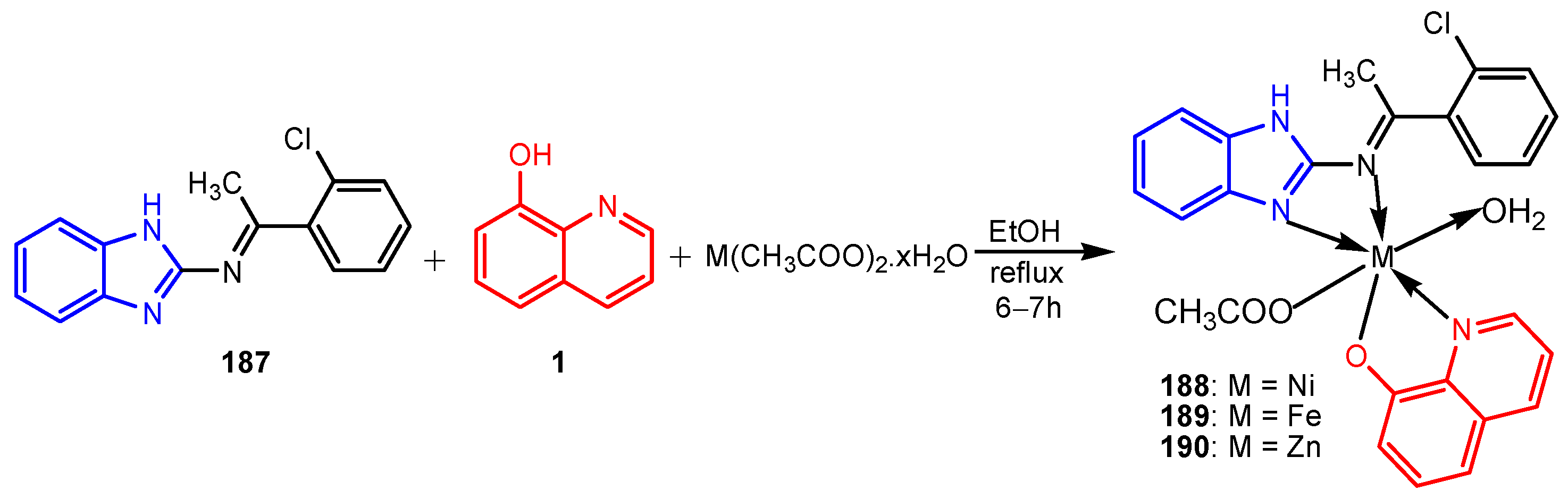
7. Benzimidazole-Quinoline Hybrid Complexes
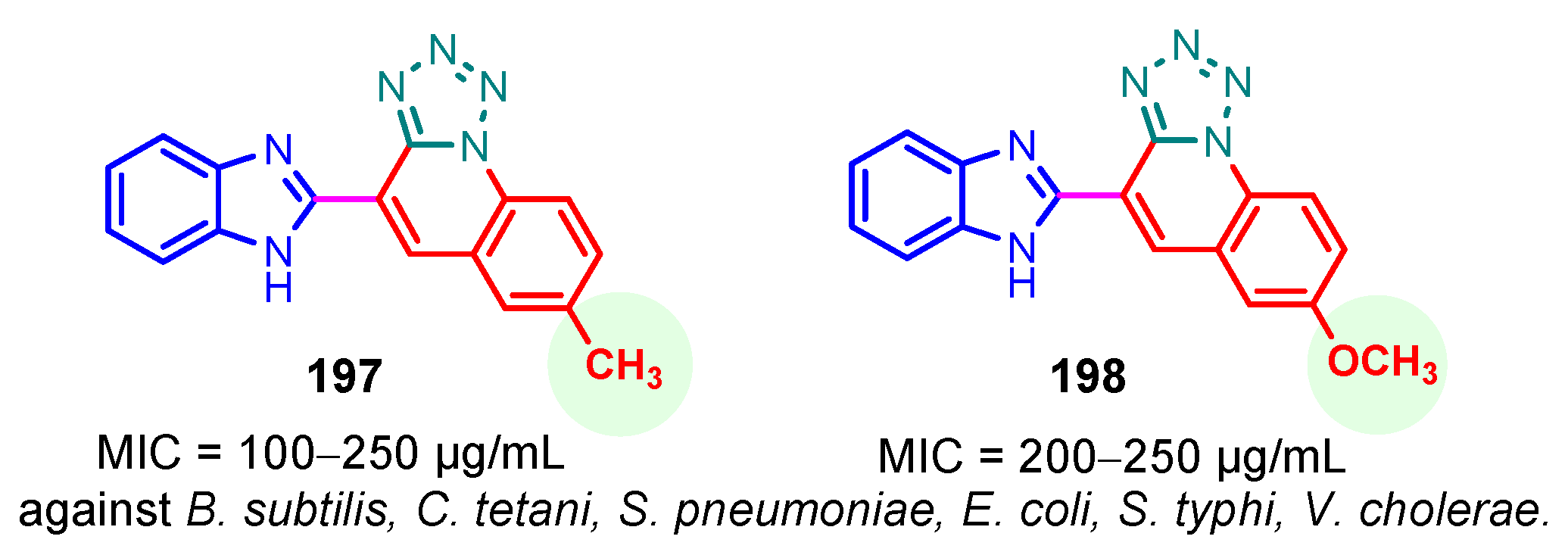
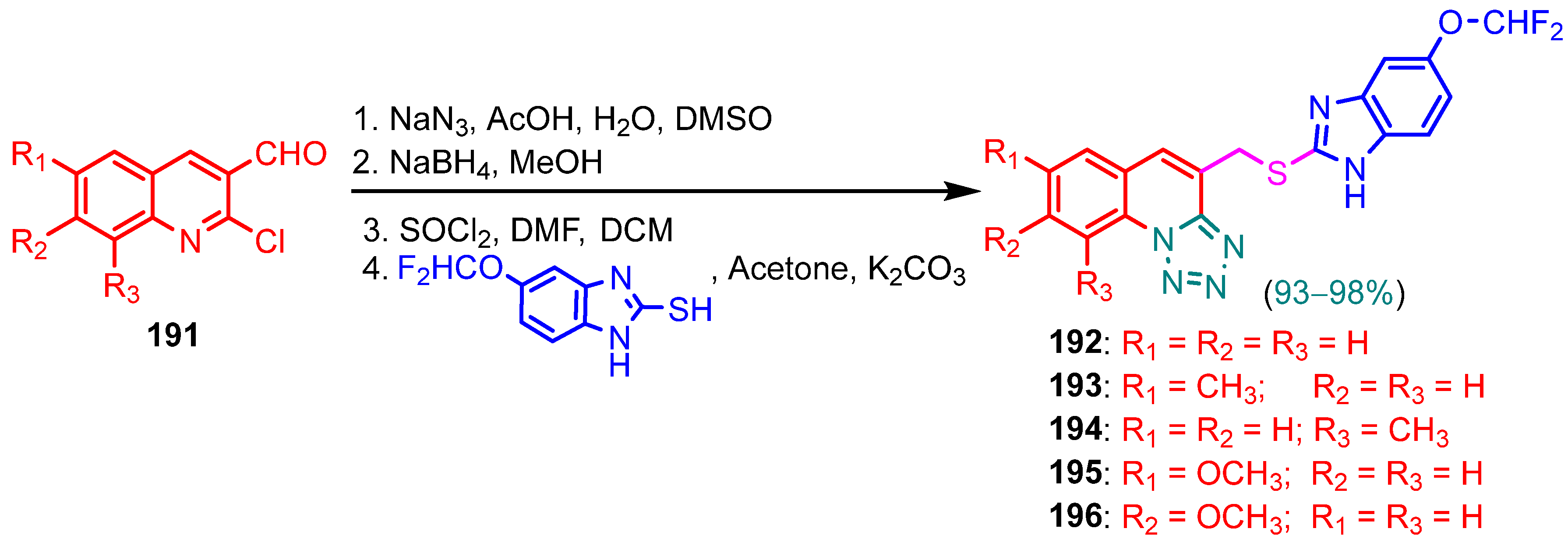
8. Benzimidazole-Tetrazolo[1,5-a]quinoline Hybrids with Antimicrobial Properties
9. Challenges, Limitation and Future Directions
- Identifying new reactions that lead to benzimidazole–quinoline hybrids with reduced optimization times, while achieving good selectivity and high yields. This review highlights that many synthetic routes result in moderate yields (50–60% or lower). Several ‘one-pot’ reactions have been proposed in the literature as potential new avenues for synthesizing these hybrids [129,130]. Further studies are required to establish a correlation between the electronic effects in the molecules, the reaction mechanisms, and the yields of the desired hybrids.
- Addressing current limitations in understanding the mode of action of benzimidazole–quinoline hybrids will require the integration of advanced computational tools capable of predicting optimal molecular structures and conformations, thereby guiding the rational design of compounds with superior antimicrobial activity.
- As highlighted in this article, much of the existing research remains at an early, exploratory stage. Many studies report only preliminary qualitative assessments of antimicrobial activity, without comprehensive evaluation of minimum inhibitory concentrations (MICs), ADME properties, DFT calculations, in silico modeling, or in vivo validation. Consequently, substantial additional experimental and computational efforts are required to advance these initial findings toward fully developed and biologically validated antimicrobial candidates.
- Future progress in the development of antimicrobial hybrids will depend on the consolidation of structure–activity relationship data from multiple studies into accessible and standardized databases, enabling the rational design of compounds with improved antimicrobial efficacy.
- Achieving high solubility in antimicrobial hybrids is essential for their effectiveness and represents a key direction for future research aimed at improving the therapeutic potential of these compounds.
- Further work is needed to explore formulations that improve their bioavailability, efficacy, and safety for potential therapeutic use.
10. Conclusions
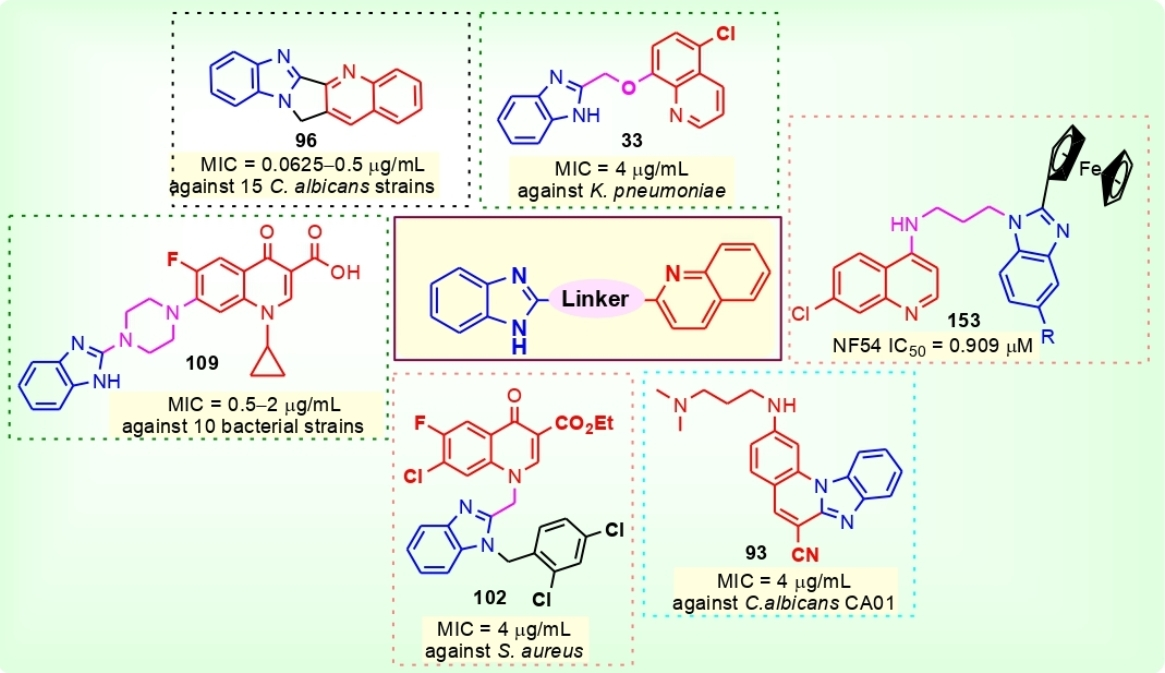
- Substitution at the C “5” or C “6” positions of the benzimidazole nucleus enhances the antimicrobial activity of benzimidazole–quinoline hybrids (compounds 3–7, 12–14, 58–64, 67–71, 93, 149–153, 167–169, 171–174, 178, 179).
- Substituents at the C “2” position of the benzimidazole ring, such as quinoline (hybrid 5), phenyl (hybrid 164), naphthyl (hybrid 165), or ferrocene (hybrids 154–158), further increase antimicrobial activity.
- Incorporation of a methylene spacer between the benzimidazole and quinoline rings leads to enhanced antimicrobial activity (compounds 12–14, 23–25, 98, 102).
- The presence of a hydroxyl group at the C-8 position of the quinoline nucleus improves antimicrobial activity (compounds 12, 14, 29).
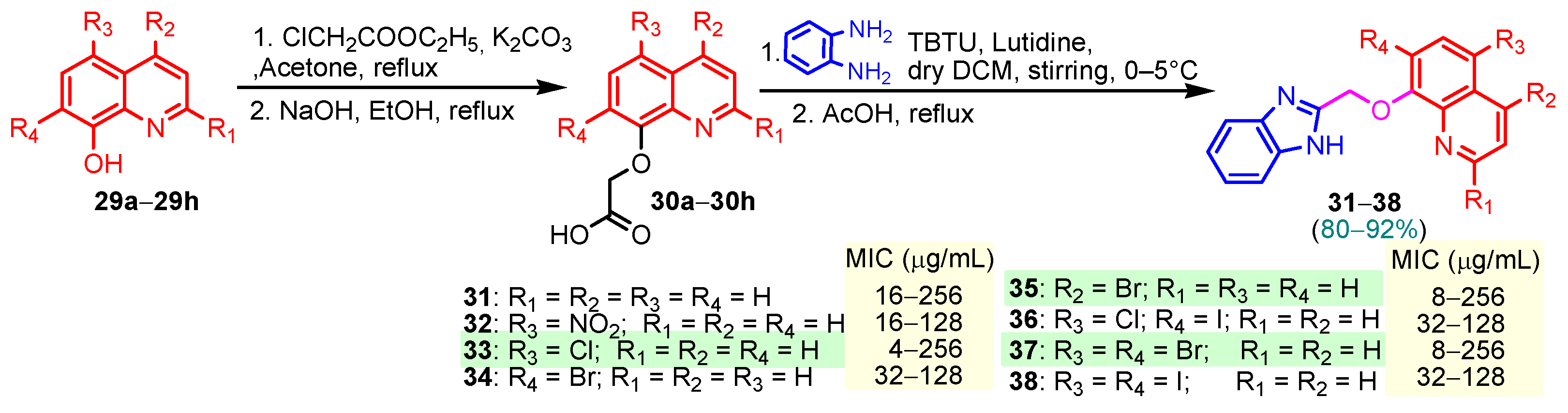
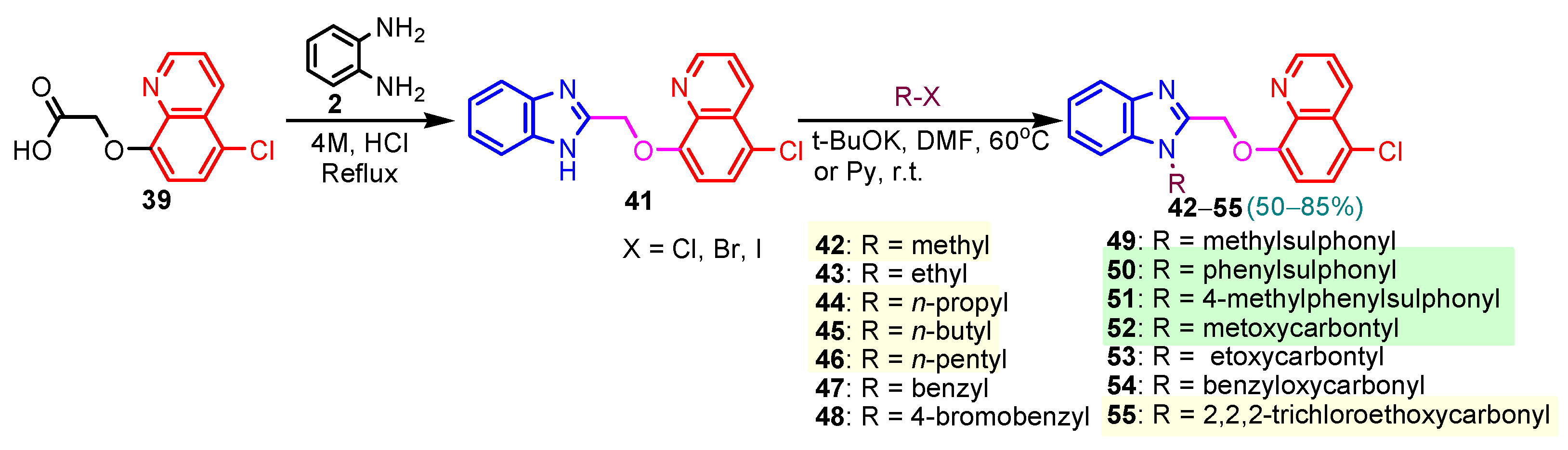
- Chlorine substitution at the C “2” or C “5” positions of the quinoline ring is associated with increased antimicrobial activity (compounds 33, 49–51).
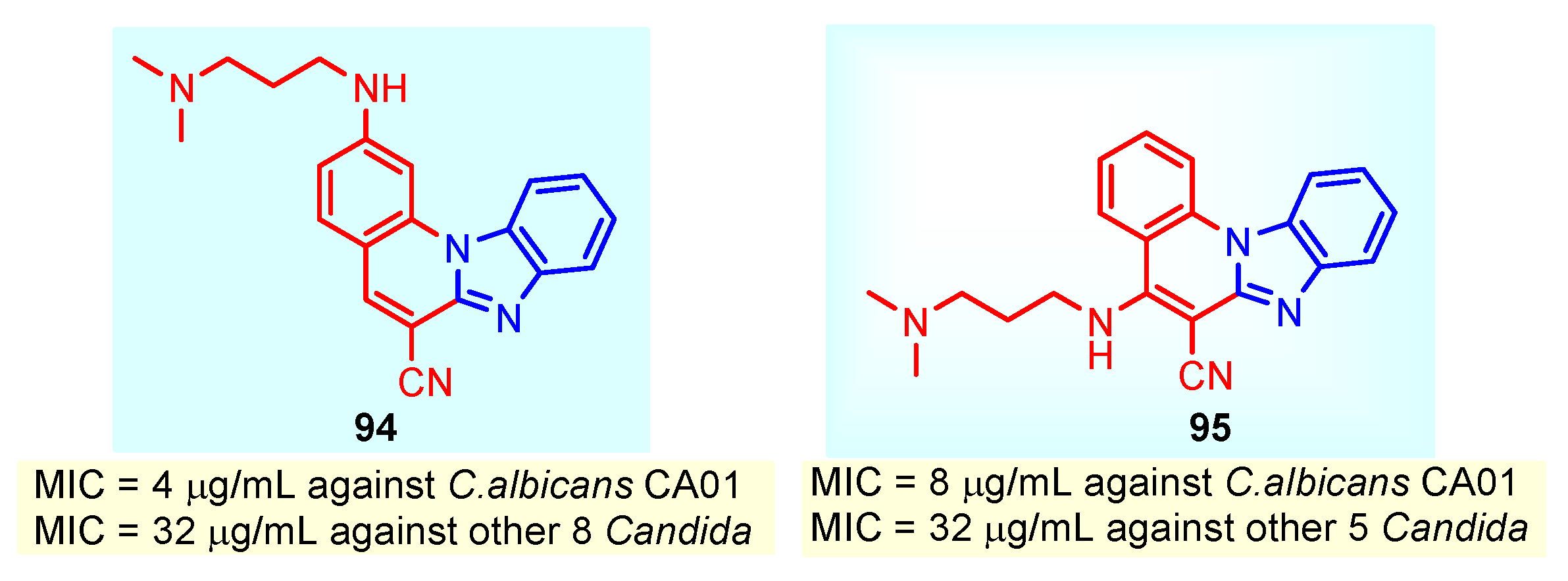
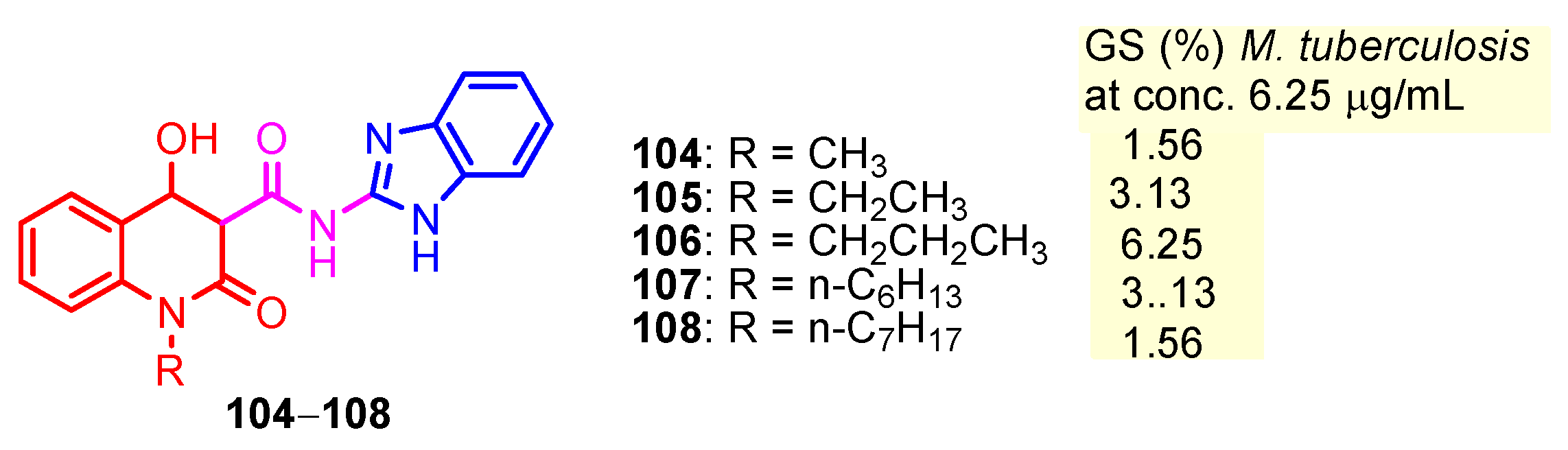
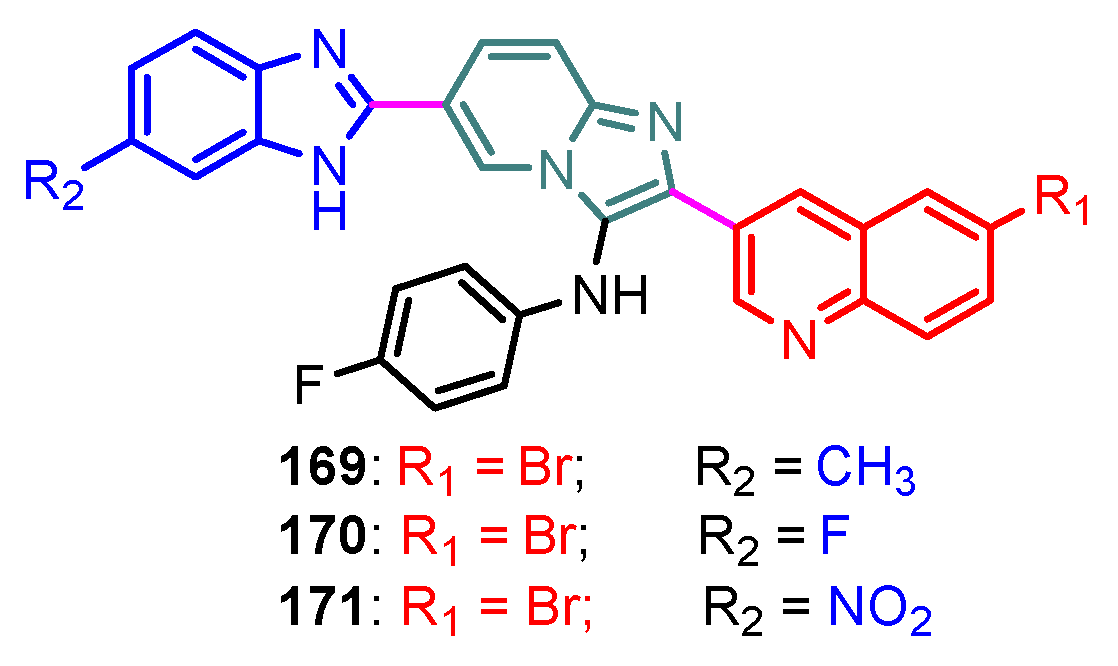
- Insertion of an additional heterocyclic ring between the benzimidazole and quinoline nuclei, such as thiazole (161), morpholine (109–117), pyrrole (95), thiophene (170–173), or oxadiazole (166), enhances the antimicrobial activity of the hybrids.
- The presence of heteroatoms in the linker connecting the two aromatic rings, including sulfur (194), oxygen (33, 35, 37, 50), or an amide group (NH–CO, compound 105), further contributes to increased antimicrobial activity.
Funding
Institutional Review Board Statement
Informed Consent Statement
Data Availability Statement
Conflicts of Interest
Abbreviations
| AcOH | Acetic acid |
| AcONa | Sodium acetate |
| DCM | Dichloromethan |
| DMF | Dimethylformamid |
| DMSO | Dimethylsulfoxid |
| Et | Ethyl |
| EtOH | Ethanol |
| Me | Methyl |
| MeOH | Methanol |
| MIC | Minimum inhibitory concentration |
| PPA | Polyphosphoric acid |
| Ph | Phenyl |
| Py | Pyridine |
| SAR | Structure–activity relationship |
| TBTU | 2-(1H-Benzotriazol-1-yl)-1,1,3,3-tetramethyluronium tetrafluoroborate |
| t-BuOK | Potassium tert-butoxide |
References
- Shearer, J.; Castro, J.L.; Lawson, A.D.G.; MacCoss, M.; Taylor, R.D. Rings in Clinical Trials and Drugs: Present and Future. J. Med. Chem. 2022, 65, 8699–8712. [Google Scholar] [CrossRef] [PubMed]
- Jampilek, J. Heterocycles in Medicinal Chemistry II. Molecules 2024, 29, 4810. [Google Scholar] [CrossRef]
- Kabir, E.; Uzzaman, M. A review on biological and medicinal impact of heterocyclic compounds. Res. Chem. 2022, 4, 100606. [Google Scholar] [CrossRef]
- Marinescu, M.; Emandi, A.; Marton, G.; Cinteza, L.O.; Constantinescu, C. Structural Studies and Optical Nonlinear Response of Some Pyrazole-5-Ones. Nanosci. Nanotechnol. Lett. 2015, 7, 846–854. [Google Scholar] [CrossRef]
- Singh, A.K.; Kumar, A.; Singh, H.; Sonawane, P.; Paliwal, H.; Thareja, S.; Pathak, P.; Grishina, M.; Jaremko, M.; Emwas, A.-H.; et al. Concept of Hybrid Drugs and Recent Advancements in Anticancer Hybrids. Pharmaceuticals 2022, 15, 1071. [Google Scholar] [CrossRef]
- Bąchor, U.; Mączyński, M.; Sochacka-Ćwikła, A. Therapeutic Potential of Isoxazole–(Iso)oxazole Hybrids: Three Decades of Research. Int. J. Mol. Sci. 2025, 26, 7082. [Google Scholar] [CrossRef]
- Sadek, K.U.; Mekheimer, R.A.; Abd-Elmonem, M.; Abo-Elsoud, F.A.; Hayallah, A.M.; Mostafa, S.M.; Abdellattif, M.H.; Abourehab, M.A.S.; Farghaly, T.A.; Elkamhawy, A. Recent developments in the synthesis of hybrid heterocycles, a promising approach to develop multi-target antibacterial agents. J. Mol. Struct. 2023, 1286, 135616. [Google Scholar] [CrossRef]
- Amariucai-Mantu, D.; Mangalagiu, V.; Bejan, I.; Aricu, A.; Mangalagiu, I.I. Hybrid Azine Derivatives: A Useful Approach for Antimicrobial Therapy. Pharmaceutics 2022, 14, 2026. [Google Scholar] [CrossRef] [PubMed]
- Murtazaeva, Z.; Nasrullaev, A.; Buronov, A.; Gaybullaev, S.; Nie, L.; Numonov, S.; Khushnazarov, Z.; Turgunov, D.; Kuryazov, R.; Zhao, J.; et al. Imidazole Hybrids: A Privileged Class of Heterocycles in Medicinal Chemistry with New Insights into Anticancer Activity. Molecules 2025, 30, 2245. [Google Scholar] [CrossRef]
- Salahuddin; Shaharyar, M.; Mazumder, A. Benzimidazoles: A biologically active compounds. Arab. J. Chem. 2017, 10, S157–S173. [Google Scholar] [CrossRef]
- Banerjee, S.; Mukherjee, S.; Nath, P.; Mukherjee, A.; Mukherjee, S.; Kumar, S.K.A.; De, S.; Banerjee, S. A critical review of benzimidazole: Sky-high objectives towards the lead molecule to predict the future in medicinal chemistry. Res. Chem. 2023, 6, 101013. [Google Scholar] [CrossRef]
- Farag, B.; Zaki, M.E.A.; Elsayed, D.A.; Gomha, S.M. Benzimidazole chemistry in oncology: Recent developments in synthesis, activity, and SAR analysis. RSC Adv. 2025, 15, 18593. [Google Scholar] [CrossRef]
- Ahmadfilab, P.; Pordel, M.; Kheirkhahnia, S.; Ziaei, S. Advances in benzimidazole coordination chemistry: From synthetic innovations to emerging therapeutic potentials. J. Mol. Struct. 2025, 1342, 142646. [Google Scholar] [CrossRef]
- Ibrahim, A.A.; Said, E.G.; AboulMagd, A.M.; Amin, N.H.; Abdel-Rahman, H.M. Synthesis and SARs of benzimidazoles: Insights into antimicrobial innovation (2018–2024). RSC Adv. 2025, 15, 22097. [Google Scholar] [CrossRef]
- Balaes, T.; Mangalagiu, V.; Antoci, V.; Amariucai-Mantu, D.; Diaconu, D.; Mangalagiu, I.I. Hybrid Bis-(Imidazole/Benzimidazole)-Pyridine Derivatives with Antifungal Activity of Potential Interest in Medicine and Agriculture via Improved Efficiency Methods. Pharmaceuticals 2025, 18, 495. [Google Scholar] [CrossRef]
- Arnautova, A.O.; Aleksakhina, I.A.; Zorina, E.A.; Berzina, M.Y.; Fateev, I.V.; Eletskaya, B.Z.; Antonov, K.V.; Smirnova, O.S.; Paramonov, A.S.; Kayushin, A.L.; et al. New Benzimidazole 3′-Deoxynucleosides: Synthesis and Antiherpes Virus Properties. Biomolecules 2025, 15, 922. [Google Scholar] [CrossRef]
- Hagar, F.F.; Abbas, S.H.; Atef, E.; Abdelhamid, D.; Abdel-Aziz, M. Benzimidazole scaffold as a potent anticancer agent with different mechanisms of action (2016–2023). Mol. Div. 2025, 29, 1821–1849. [Google Scholar] [CrossRef]
- Yadav, G. Biology and Chemistry of Benzimidazole Derivatives as Antiulcer Agents: A Review. Der. Pharma Chem. 2025, 17, 584–590. [Google Scholar]
- Rudrapal, M.; Mojammil, M.; Farooque, A.; Ansari, M.; de Oliveira, A.M.; Khan, J. Synthesis, toxicity and antioxidant activity of phenolic benzimidazole derivatives: In vitro and in silico studies. Chem. Phys. Imp. 2025, 10, 100875. [Google Scholar] [CrossRef]
- Bano, S.; Nadeem, H.; Zulfiqar, I.; Shahzadi, T.; Anwar, T.; Bukhari, A.; Masaud, S.M. Synthesis and anti-inflammatory activity of benzimidazole derivatives; an in vitro, in vivo and in silico approach. Heliyon 2024, 10, e30102. [Google Scholar] [CrossRef] [PubMed]
- Poddar, S.K.; Saha, P.; Spriha, S.E.; Rahman, S.M.A. Synthesis, In Vivo and In Silico Evaluation of Analgesic, Anti-Inflammatory and Antidiarrheal Activities of Benzimidazole Derivatives. Chem. Select 2025, 10, e202401267. [Google Scholar] [CrossRef]
- Ullah, H.; Alam, A.; Elhenawy, A.A.; Ahmad, I.; Latif, A.; Ali, M.; Ahmad, M. Exploring the anti-diabetic potential of bis-Schiff base derivatives of benzimidazole: In-Vitro α-amylase, α-glucosidase inhibition, molecular docking, ADMET and DFT studies. Comput. Biol. Chem. 2025, 118, 108497. [Google Scholar] [CrossRef] [PubMed]
- Aroua, L.M.; Alminderej, F.M.; Almuhaylan, H.R.; Alosaimi, A.H.; Medini, F.; Mohammed, H.A.; Almahmoud, S.A.; Khan, R.A.; Mekni, N.H. Benzimidazole(s): Synthons, bioactive lead structures, total synthesis, and the profiling of major bioactive categories. RSC Adv. 2025, 15, 7571. [Google Scholar] [CrossRef]
- Marinescu, M.; Zalaru, C. Benzimidazole–Pyrimidine Hybrids: Synthesis and Medicinal Properties. Pharmaceuticals 2025, 18, 1225. [Google Scholar] [CrossRef]
- Anastassova, N.; Aluani, D.; Hristova-Avakumova, N.; Tzankova, V.; Kondeva-Burdina, M.; Rangelov, M.; Todorova, N.; Yancheva, D. Study on the Neuroprotective, Radical-Scavenging and MAO-B Inhibiting Properties of New Benzimidazole Arylhydrazones as Potential Multi-Target Drugs for the Treatment of Parkinson’s Disease. Antioxidants 2022, 11, 884. [Google Scholar] [CrossRef]
- Arya, C.G.; Gondru, R.; Li, Y.; Banothu, J. Coumarin-benzimidazole hybrids: A review of developments in medicinal chemistry. Eur. J. Med. Chem. 2022, 227, 113921. [Google Scholar] [CrossRef]
- Marinescu, M. Synthesis of Antimicrobial Benzimidazole–Pyrazole Compounds and Their Biological Activities. Antibiotics 2021, 10, 1002. [Google Scholar] [CrossRef]
- Marinescu, M. Benzimidazole-Triazole Hybrids as Antimicrobial and Antiviral Agents: A Systematic Review. Antibiotics 2023, 12, 1220. [Google Scholar] [CrossRef]
- Nandwana, N.K.; Singh, R.P.; Patel, O.P.S.; Dhiman, S.; Saini, H.K.; Jha, P.N.; Kumar, A. Design and Synthesis of Imidazo/Benzimidazo[1,2-c]quinazoline Derivatives and Evaluation of Their Antimicrobial Activity. ACS Omega 2018, 3, 16338–16346. [Google Scholar] [CrossRef]
- Liu, H.-B.; Gao, W.-W.; Tangadanchu, V.K.R.; Zhou, C.-H.; Geng, R.-X. Novel aminopyrimidinyl benzimidazoles as potentially antimicrobial agents: Design, synthesis and biological evaluation. Eur. J. Med. Chem. 2018, 143, 66–84. [Google Scholar] [CrossRef] [PubMed]
- Saifi, Z.; Ali, A.; Inam, A.; Azam, A.; Kamthan, M.; Abid, M.; Ali, I. Synthesis and antibacterial evaluation of quinoline–sulfonamide hybrid compounds: A promising strategy against bacterial resistance. RSC Adv. 2025, 15, 1680. [Google Scholar] [CrossRef]
- Chavan, N.D.; Sarveswari, S.; Vijayakumar, V. Quinoline derivatives’ biological interest for antimalarial and anti-cancer activities: An overview. RSC Adv. 2025, 15, 30576. [Google Scholar] [CrossRef] [PubMed]
- Rufa’i, M.S.; Abdulganiyyu, I.A.; Ajala, A.; Abdalla, M.; Alahmadi, R.A.; Awadalla, M.E.; Abdulganiyyu, K.; Mahe, A.; Gwarzo, Y.S.; Kabir, N. In-silico design and evaluation of quinolinedione derivatives as Mycobacterium tuberculosis DprE1 inhibitors. Discov. Mol. 2025, 2, 21. [Google Scholar] [CrossRef]
- Da Silva, M.C.; de Oliveira Viana, J.; Rodrigues Olegário, T.; Sabino, J.M.; Guimarães Barbosa, E.; Ferreira Chaves, E.J.; Rocha, J.B.; Lima-Junior, C.G.; Webe, K.C. In silico target identification and pharmacokinetic profiling of 2-aryl-quinoline-4-carboxylic acid derivatives as potential antileishmanial agents. Front. Pharmacol. 2025, 16, 1621059. [Google Scholar] [CrossRef] [PubMed]
- Lu, J.-X.; Lan, H.-R.; Zeng, D.; Song, J.-Y.; Hao, Y.-T.; Xing, A.-P.; Shen, A.; Yuan, J. Design, synthesis, anticancer activity and molecular docking of quinoline-based dihydrazone derivatives. RSC Adv. 2025, 15, 231. [Google Scholar] [CrossRef]
- Rao, I.R.; Punitha, P.; Premalatha, B.; Prasad, T.S.; Suresh, M. Synthesis, structure identification, antioxidant and antimicrobial activities of some novel quinoline derivatives. Discov. Chem. 2024, 1, 65. [Google Scholar] [CrossRef]
- Jadhav, P.; Liang, X.; Ansari, A.; Tan, B.; Tan, H.; Li, K.; Chi, X.; Ford, A.; Ruiz, F.; Arnold, E.; et al. Design of quinoline SARS-CoV-2 papain-like protease inhibitors as oral antiviral drug candidates. Nat. Commun. 2025, 16, 1604. [Google Scholar] [CrossRef]
- Vunnam, K.K.; Yamajala, K.D.B.; Gorja, D.R.; Boddapati, S.N.M.; Katari, N.K. Novel 2,4-thiazolidinedione-quinoline hybrid molecules as REV-ERBα modulators for the treatment of diabetes mellitus. J. Mol. Struct. 2026, 1349, 143716. [Google Scholar] [CrossRef]
- Tanaka, M.; Szatmári, I.; Vécsei, L. Quinoline Quest: Kynurenic Acid Strategies for Next-Generation Therapeutics via Rational Drug Design. Pharmaceuticals 2025, 18, 607. [Google Scholar] [CrossRef] [PubMed]
- Parmar, M.C.; Patel, B.Y. Green and traditional one-pot synthesis techniques for bioactive quinoline derivatives: A review. Tetrahedron Green Chem. 2025, 5, 100062. [Google Scholar] [CrossRef]
- Nayak, N.; Ramprasad, J.; Dalimba, U. Synthesis and antitubercular and antibacterial activity of some active fluorine containing quinoline-pyrazole hybrid derivatives. J. Fluor. Chem. 2016, 183, 59–68. [Google Scholar] [CrossRef]
- Sharma, V.; Das, R.; Mehta, D.K.; Sharma, D.; Aman, S.; Khan, M.U. Quinolone scaffolds as potential drug candidates against infectious microbes: A review. Mol. Div. 2025, 29, 711–737. [Google Scholar] [CrossRef]
- Sun, B.-L.; Wang, Y.-Y.; Yang, S.; Tu, M.-T.; Shao, Y.-Y.; Hua, Y.; Zhou, Y.; Tan, C.-X. Benzamides Substituted with Quinoline-Linked 1,2,4-Oxadiazole: Synthesis, Biological Activity and Toxicity to Zebrafish Embryo. Molecules 2022, 27, 3946. [Google Scholar] [CrossRef]
- La Monica, G.; Gallo, A.; Bono, A.; Alamia, F.; Lauria, A.; Alduina, R.; Martorana, A. Novel Antibacterial 4-Piperazinylquinoline Hybrid Derivatives Against Staphylococcus aureus: Design, Synthesis, and In Vitro and In Silico Insights. Molecules 2025, 30, 28. [Google Scholar] [CrossRef]
- Gaikwad, N.B.; Bansode, S.; Biradar, S.; Ban, M.; Srinivas, N.; Godugu, C.; Yaddanapudi, V.M. New 3-(1H-benzo[d]imidazol-2-yl)quinolin-2(1H)-one-based triazole derivatives: Design, synthesis, and biological evaluation as antiproliferative and apoptosis-inducing agents. Arch. Pharm. 2021, 354, 2100074. [Google Scholar] [CrossRef]
- Srinivasa, S.B.; Poojary, B.; Kalal, B.S.; Brahmavara, U.; Vaishali, D.; Das, A.J.; Kalenga, T.M.; Paidikondala, M.; Shankar, M.K. Design, synthesis and anticancer activity of Novel benzimidazole containing quinoline hybrids. Res. Chem. 2024, 9, 101631. [Google Scholar] [CrossRef]
- Macan, A.M.; Perin, N.; Jakopec, S.; Mio, M.; Stojkovic, M.R.; Kralj, M.; Hranjec, M.; Raic-Malic, S. Synthesis, antiproliferative activity and DNA/RNA-binding properties of mono- and bis-(1,2,3-triazolyl)-appended benzimidazo[1,2-a]quinoline derivatives. Eur. J. Med. Chem. 2020, 185, 111845. [Google Scholar] [CrossRef]
- Pragathi, Y.J.; Veronica, D.; Anitha, K.; Rao, M.V.B.; Raju, R.R. Synthesis and biological evaluation of chalcone derivatives of 1,2,4-thiadiazol-benzo[d]imidazol-2-yl)quinolin-2(1H)-one as anticancer agents. Chem. Data Coll. 2020, 30, 100556. [Google Scholar] [CrossRef]
- Bharadwaj, S.S.; Poojary, B.; Nandish, S.K.M.; Kengaiah, J.; Kirana, M.P.; Shankar, M.K.; Das, A.J.; Kulal, A.; Sannaningaiah, D. Efficient Synthesis and in Silico Studies of the Benzimidazole Hybrid Scaffold with the Quinolinyloxadiazole Skeleton with Potential α-Glucosidase Inhibitory, Anticoagulant, and Antiplatelet Activities for Type-II Diabetes Mellitus Management and Treating Thrombotic Disorders. ACS Omega 2018, 3, 12562–12574. [Google Scholar] [CrossRef] [PubMed]
- Kumar, R.; Abdullah, M. Synthesis, Characterization and Anticonvulsant Potential of 2,5-Disubstituted 1,3,4-Oxadiazole Analogues. Asian J. Chem. 2019, 31, 1389–1397. [Google Scholar] [CrossRef]
- Madawali, I.M.; Das, K.K.; Gaviraj, E.N.; Kalyane, N.V.; Shivakumar, B. Synthesis and Anti-Inflammatory Activity of Some New 2-Chloro-3-[3-(6-Nitro-1H-Benzimidazol-2-Yl)-1H-Pyrazol-5-Yl] Quinolines. IOSR J. Pharm. Biol. Sci. 2018, 13, 83–88. [Google Scholar]
- El-Feky, S.A.; Thabet, H.K.; Ubeid, M.T. Synthesis, molecular modeling and anti-inflammatory screening of novel fluorinated quinoline incorporated benzimidazole derivatives using the Pfitzinger reaction. J. Fluor. Chem. 2014, 161, 87–94. [Google Scholar] [CrossRef]
- Effendi, N.; Mishiro, K.; Takarada, T.; Makino, A.; Yamada, D.; Kitamura, Y.; Shiba, K.; Kiyono, Y.; Odani, A.; Ogawa, K. Radiobrominated benzimidazole-quinoline derivatives as Platelet derived growth factor receptor beta (PDGFRβ) imaging probes. Sci. Rep. 2018, 8, 10369. [Google Scholar] [CrossRef]
- Adardour, M.; Ait Lahcen, M.; Oubahmane, M.; Ettahiri, W.; Hdoufane, I.; Bouamama, H.; Alanazi, M.M.; Cherqaoui, D.; Taleb, M.; Garcia, E.Z.; et al. Design, Synthesis, Molecular Modeling and Biological Evaluation of Novel Pyrazole Benzimidazolone Derivatives as Potent Antioxidants. Pharmaceuticals 2023, 16, 1648. [Google Scholar] [CrossRef] [PubMed]
- Ajani, O.O.; Iyaye, K.T.; Ademosun, O.T. Recent advances in chemistry and therapeutic potential of functionalized quinoline motifs—A review. RSC Adv. 2022, 12, 18594. [Google Scholar] [CrossRef]
- El Faydy, M.; Dahaieh, N.; Ounine, K.; Lakhrissi, B.; Warad, I.; Tüzün, B.; Zarrouk, A. Synthesis, Identification, Antibacterial Activity, ADME/T and 1BNA-Docking Investigations of 8-Quinolinol Analogs Bearing a Benzimidazole Moiety. Arab. J. Sci. Eng. 2022, 47, 497–510. [Google Scholar] [CrossRef]
- Fang, W.-Y.; Ravindar, L.; Rakesh, K.P.; Manukumar, H.M.; Shantharam, C.S.; Alharbi, N.S.; Qin, H.-L. Synthetic approaches and pharmaceutical applications of chloro-containing molecules for drug discovery: A critical review. Eur. J. Med. Chem. 2019, 173, 117–153. [Google Scholar] [CrossRef] [PubMed]
- Marinescu, M. Bisindole Compounds—Synthesis and Medicinal Properties. Antibiotics 2024, 13, 1212. [Google Scholar] [CrossRef]
- Karmur, M.B.; Rakholiya, K.; Kaneria, M.; Karmur, S.B.; Bapodra, A.; Patel, R.; Maliwal, D.; Pissurlenkar, R.R.S.; Kapuriya, N.P.; Bhalodia, J. Synthesis and Characterization of Some New Hybrids of 2-Chloroquinoline-Benzimidazole Chalcones as Potential Antibacterial Agents. Chem. Select 2025, 10, e06199. [Google Scholar] [CrossRef]
- Singh, V.K.; Kumari, P.; Som, A.; Rai, S.; Mishra, R.; Singh, R.K. Design, synthesis and antimicrobial activity of novel quinoline derivatives: An in silico and in vitro study. J. Biomol. Struct. Dynam. 2024, 42, 6904–6924. [Google Scholar] [CrossRef]
- Prashanth, T.; Ranganatha, V.L.; Al-Ghorbani, M.; Girish, S.; Khamees, H.A.; Khanum, S.A. Design, synthesis and characterization of 8-[(1H-benzo[d]imidazol-2-yl)methoxy] quinoline derivatives as antimicrobial agents. Discov. Chem. 2025, 2, 19. [Google Scholar] [CrossRef]
- Chaudhari, R.B.; Rindhe, S.S. Synthesis and antimicrobial activities of novel 8-(1-alkyl/alkylsulphonyl/alkoxycarbonyl-benzimidazol-2-ylmethoxy)-5-chloroquinolines. J. Serb. Chem. Soc. 2011, 76, 1199–1206. [Google Scholar] [CrossRef]
- Garudachari, B.; Satyanarayana, M.N.; Thippeswamy, B.; Shivakumar, C.K.; Shivananda, K.N.; Hegde, G.; Isloor, A.M. Synthesis, characterization and antimicrobial studies of some new quinoline incorporated benzimidazole derivatives. Eur. J. Med. Chem. 2012, 54, 900–906. [Google Scholar] [CrossRef]
- Goyal, A.; Kharkwal, H.; Piplani, M.; Singh, Y.; Murugesan, S.; Aggarwal, A.; Kumar, P.; Chander, S. Spotlight on 4-substituted quinolines as potential anti-infective agents: Journey beyond chloroquine. Arch. Pharm. 2023, 356, 2200361. [Google Scholar] [CrossRef] [PubMed]
- Diaconu, D.; Antoci, V.; Mangalagiu, V.; Amariucai-Mantu, D.; Mangalagiu, I.I. Quinoline–imidazole/benzimidazole derivatives as dual-/multi-targeting hybrids inhibitors with anticancer and antimicrobial activity. Sci. Rep. 2022, 12, 16988. [Google Scholar] [CrossRef]
- Molchanova, N.; Nielsen, J.E.; Sørensen, K.B.; Prabhala, B.K.; Hansen, P.R.; Lund, R.; Barron, A.E.; Jenssen, H. Halogenation as a tool to tune antimicrobial activity of peptoids. Pharm. Chem. J. 2023, 57, 196–203. [Google Scholar] [CrossRef]
- El-Gohary, N.S.; Shaaban, M.I. Synthesis and biological evaluation of a new series of benzimidazole derivatives as antimicrobial, antiquorum-sensing and antitumor agents. Eur. J. Med. Chem. 2017, 131, 255–262. [Google Scholar] [CrossRef] [PubMed]
- Sanwer, S.; Nasreen, A.; Swain, B.; Peddapaka, J.; Alvala, R.; Arifuddin, M. Synthesis and antimicrobial evaluation of novel 8-hydroxyquinoline containing benzimidazole hybrids. Discov. Chem. 2025, 2, 17. [Google Scholar] [CrossRef]
- Mantu, D.; Antoci, V.; Moldoveanu, C.; Zbancioc, G.; Mangalagiu, I.I. Hybrid imidazole (benzimidazole)/pyridine (quinoline) derivatives and evaluation of their anticancer and antimycobacterial activity. J. Enzyme Inhib. Med. Chem. 2016, 31, 96–103. [Google Scholar] [CrossRef]
- Perin, N.; Nhili, R.; Ester, K.; Laine, W.; Karminski-Zamola, G.; Kralj, M.; David-Cordonnier, M.-H.; Hranjec, M. Synthesis, antiproliferative activity and DNA binding properties of novel 5-Aminobenzimidazo[1,2-a]quinoline-6-carbonitriles. Eur. J. Med. Chem. 2014, 80, 218–227. [Google Scholar] [CrossRef] [PubMed]
- Perin, N.; Martin-Kleiner, I.; Nhili, R.; Laine, W.; David-Cordonnier, M.-H.; Vugrek, O.; Karminski-Zamola, G.; Kralj, M.; Hranjec, M. Biological activity and DNA binding studies of 2-substituted benzimidazo[1,2-a]quinolines bearing different amino side chains. Med. Chem. Commun. 2013, 4, 1537–1550. [Google Scholar] [CrossRef]
- Perin, N.; Bobanovic, K.; Zlatar, I.; Jelic, D.; Kelava, V.; Kostrun, S.; Markovic, V.G.; Brajsa, K.; Hranjec, M. Antiproliferative activity of amino substituted benzo[b]thieno[2,3-b]pyrido[1,2-a] benzimidazoles explored by 2D and 3D cell culture system. Eur. J. Med. Chem. 2017, 125, 722–735. [Google Scholar] [CrossRef] [PubMed]
- Perin, N.; Alić, J.; Liekens, S.; Van Aerschot, A.; Vervaeke, P.; Gadakh, B.; Hranjec, M. Different positions of amide side chains on the benzimidazo[1,2-a]quinoline skeleton strongly influenced biological activity. New J. Chem. 2018, 42, 7096–7104. [Google Scholar] [CrossRef]
- de Souza, I.O.P.; Schrekker, C.M.L.; Lopes, W.; Orru, R.V.A.; Hranjec, M.; Perine, N.; Machado, M.; Oliveira, L.F.; Ricardo, K.; Donato, R.K.; et al. Bifunctional fluorescent benzimidazo[1,2-α]quinolines for Candida spp. biofilm detection and biocidal activity. J. Photochem. Photobiol. B Biol. 2016, 163, 319–326. [Google Scholar] [CrossRef]
- Villa, P.; Arumugam, N.; Almansour, A.I.; Kumar, R.S.; Mahalingam, S.M.; Maruoka, K.; Thangamanie, S. Benzimidazole tethered pyrrolo[3,4-b]quinoline with broad-spectrum activity against fungal pathogens. Biorg. Med. Chem. Lett. 2019, 29, 729–733. [Google Scholar] [CrossRef]
- Salazar, V.Z.; Ravanal, R.B.; Soto-Flores, J.; Sabadini, G.; González, J.V.; Mella, J.; Romero-Parra, J. Synthesis of Novel Chloro-Benzo [d]imidazole Regioisomers as Selective CB2 Receptor Agonists: Indirect Functional Evaluation and Molecular Insights. Pharmaceuticals 2025, 18, 1599. [Google Scholar] [CrossRef]
- Marinescu, M.; Cinteza, L.O.; Marton, G.I.; Marutescu, L.G.; Chifiriuc, M.-C.; Constantinescu, C. Density functional theory molecular modeling and antimicrobial behaviour of selected 1,2,3,4,5,6,7,8-octahydroacridine-N(10)-oxides. J. Mol. Struct. 2017, 1144, 14–23. [Google Scholar] [CrossRef]
- Silva, C.F.M.; Pinto, D.C.G.A.; Fernandes, P.A.; Silva, A.M.S. Evolution of the Quinoline Scaffold for the Treatment of Leishmaniasis: A Structural Perspective. Pharmaceuticals 2024, 17, 285. [Google Scholar] [CrossRef] [PubMed]
- Ferreira, L.M.; García-García, P.; García, P.A.; Castro, M.A. A review on quinolines: New green synthetic methods and bioactive potential. Eur. J. Pharm. Sci. 2025, 209, 107097. [Google Scholar] [CrossRef] [PubMed]
- El-mrabet, A.; Haoudi, A.; Kandri-Rodi, Y.; Mazzah, A. An Overview of Quinolones as Potential Drugs: Synthesis, Reactivity and Biological Activities. Organics 2025, 6, 16. [Google Scholar] [CrossRef]
- Spencer, A.C.; Panda, S.S. DNA Gyrase as a Target for Quinolones. Biomedicines 2023, 11, 371. [Google Scholar] [CrossRef]
- Tiglani, D.; Salahuddin; Mazumder, A.; Yar, M.S.; Kumar, R.; Ahsan, M.J. Benzimidazole-Quinoline Hybrid Scaffold as Promising Pharmacological Agents: A Review. Polycycl. Aromat. Compd. 2022, 42, 5044–5066. [Google Scholar] [CrossRef]
- Wang, Y.-N.; Bheemanaboina, R.R.Y.; Gao, W.-W.; Kang, J.; Cai, G.-X.; Zhou, C.-H. Discovery of Benzimidazole–Quinolone Hybrids as New Cleaving Agents Toward Drug-Resistant Pseudomonas aeruginosa DNA. ChemMedChem 2018, 13, 1004–1017. [Google Scholar] [CrossRef] [PubMed]
- Ukrainets, I.V.; Grinevich, L.A.; Tkach, A.A.; Gorokhova, O.V.; Kravchenko, V.N.; Sim, G. 4-Hydroxy-2-quinolones. 191. Synthesis, tautomerism and biological activity of benzimidazol-2-ylamides of 1-R-4-hydroxy-2-oxo-1,2-dihydro quinoline-3-carboxylic acids. Chem. Het. Comp. 2011, 46, 1364–1370. [Google Scholar] [CrossRef]
- Zhang, L.; Addla, D.; Ponmani, J.; Wang, A.; Xie, D.; Wang, Y.-N.; Zhang, S.-L.; Geng, R.-X.; Cai, G.-X.; Li, S.; et al. Discovery of membrane active benzimidazole quinolones-based topoisomerase inhibitors as potential DNA-binding antimicrobial agents. Eur. J. Med. Chem. 2016, 111, 160–182. [Google Scholar] [CrossRef] [PubMed]
- Arab, H.-A.; Faramarzi, M.A.; Samadi, N.; Hamid Irannejad, H.; Foroumadi, A.; Emami, S. New 7-piperazinylquinolones containing (benzo[d]imidazol-2-yl)methylmoiety as potent antibacterial agents. Mol. Divers. 2018, 22, 815–825. [Google Scholar] [CrossRef]
- Gach-Janczak, K.; Piekielna-Ciesielska, J.; Waśkiewicz, J.; Krakowiak, K.; Wtorek, K.; Janecka, A. Quinolin-4-ones: Methods of Synthesis and Application in Medicine. Molecules 2025, 30, 163. [Google Scholar] [CrossRef]
- Ma, X.; Wang, Q.; Ren, K.; Xu, T.; Zhang, Z.; Xu, M.; Rao, Z.; Zhang, X. A Review of Antimicrobial Peptides: Structure, Mechanism of Action, and Molecular Optimization Strategies. Fermentation 2024, 10, 540. [Google Scholar] [CrossRef]
- van der Walt, M.; Möller, D.S.; van Wyk, R.J.; Ferguson, P.M.; Hind, C.K.; Clifford, M.; Carmo Silva, P.D.C.; Sutton, J.M.; Mason, A.J.; Bester, M.J.; et al. QSAR Reveals Decreased Lipophilicity of Polar Residues Determines the Selectivity of Antimicrobial Peptide Activity. ACS Omega 2024, 9, 26030–26049. [Google Scholar] [CrossRef]
- Jeong, C.Y.; Kim, C.-E.; Byun, E.-B.; Jeon, J. Chrysin as a Bioactive Scaffold: Advances in Synthesis and Pharmacological Evaluation. Int. J. Mol. Sci. 2025, 26, 9467. [Google Scholar] [CrossRef]
- Chugh, A.; Ashwani Kumar, A.; Verma, A.; Kumar, S.; Kumar, P. A review of antimalarial activity of two or three nitrogen atoms containing heterocyclic compounds. Med. Chem. Res. 2020, 29, 1723–1750. [Google Scholar] [CrossRef]
- Ornelas, C.; Astruc, D. Ferrocene-Based Drugs, Delivery Nanomaterials and Fenton Mechanism: State of the Art, Recent Developments and Prospects. Pharmaceutics 2023, 15, 2044. [Google Scholar] [CrossRef] [PubMed]
- Matei, A.; Marinescu, M.; Constantinescu, C.; Ion, V.; Mitu, B.; Ionita, I.; Dinescu, M.; Emandi, A. Nonlinear optical studies on 4-(ferrocenylmethylimino)-2-hydroxy-benzoic acid thin films deposited by matrix-assisted pulsed laser evaporation (MAPLE). Appl. Surf. Sci. 2016, 374, 206–212. [Google Scholar] [CrossRef]
- Baartzes, N.; Stringer, T.; Seldon, R.; Warner, D.F.; Taylor, D.; Wittlin, S.; Chibale, K.; Smith, G.S. Bioisosteric ferrocenyl aminoquinoline-benzimidazole hybrids: Antimicrobial evaluation and mechanistic insights. Eur. J. Med. Chem. 2019, 180, 121–133. [Google Scholar] [CrossRef] [PubMed]
- Golding, T.M.; Garnie, L.M.; Rabie, T.; Reader, J.; Birkholtz, L.-M.; Wicht, K.J.; Smith, G.S. Ferrocenyl Quinoline-Benzimidazole Hybrids: A Multistage Strategy to Combat Drug-Resistant Malaria. Inorg. Chem. 2025, 64, 16152–16167. [Google Scholar] [CrossRef]
- Makler, M.T.; Hinrichs, D.J. Measurement of the Lactate Dehydrogenase Activity of Plasmodium falciparum as an Assessment of Parasitemia. Am. J. Trop. Med. Hyg. 1993, 48, 205–210. [Google Scholar] [CrossRef]
- Rauf, U.; Shabir, G.; Bukhari, S.; Albericio, F.; Saeed, A. Contemporary Developments in Ferrocene Chemistry: Physical, Chemical, Biological and Industrial Aspects. Molecules 2023, 28, 5765. [Google Scholar] [CrossRef]
- Snegur, L.V. Modern Trends in Bio-Organometallic Ferrocene Chemistry. Inorganics 2022, 10, 226. [Google Scholar] [CrossRef]
- Rusu, A.; Moga, I.-M.; Uncu, L.; Hancu, G. The Role of Five-Membered Heterocycles in the Molecular Structure of Antibacterial Drugs Used in Therapy. Pharmaceutics 2023, 15, 2554. [Google Scholar] [CrossRef] [PubMed]
- Abbas, A.A.; Farghaly, T.A.; Dawood, K.M. Recent advances on anticancer and antimicrobial activities of directly-fluorinated five-membered heterocycles and their benzo-fused systems. RSC Adv. 2024, 14, 19752–19779. [Google Scholar] [CrossRef]
- Abdel-Mohsen, S.A. Heterocycles Derived from 5-(2-Aminothiazol-4-yl)-8-hydroxyquinoline: Synthesis and Antimicrobial Activity. J. Chin. Chem. Soc. 2003, 50, 1085–1092. [Google Scholar] [CrossRef]
- Salahuddin; Mazumder, A.; Shaharyar, M. Synthesis, antibacterial and anticancer evaluation of 5-substituted (1,3,4-oxadiazol-2-yl)quinoline. Med. Chem. Res. 2015, 24, 2514–2528. [Google Scholar] [CrossRef]
- Douglas, E.J.A.; Marshall, B.; Alghamadi, A.; Joseph, E.A.; Duggan, S.; Vittorio, S.; De Luca, L.; Serpi, M.; Laabei, M. Improved Antibacterial Activity of 1,3,4-Oxadiazole-Based Compounds That Restrict Staphylococcus aureus Growth Independent of LtaS Function. ACS Infect. Dis. 2023, 9, 2141–2159. [Google Scholar] [CrossRef] [PubMed]
- Al-Tel, T.H.; Al-Qawasmeh, R.A.; Zaarour, R. Design, synthesis and in vitro antimicrobial evaluation of novel Imidazo[1,2-a] pyridine and imidazo[2,1-b][1,3]benzothiazole motifs. Eur. J. Med. Chem. 2011, 46, 1874–1881. [Google Scholar] [CrossRef] [PubMed]
- Gowda, J.; Khader, A.M.A.; Kalluraya, B.; Hidayathulla, S. Synthesis, characterization and antibacterial activity of benzimidazole derivatives carrying quinoline moiety. Ind. J. Chem. 2011, 50B, 1491–1495. [Google Scholar] [CrossRef]
- Glomb, T.; Świątek, P. Antimicrobial Activity of 1,3,4-Oxadiazole Derivatives. Int. J. Mol. Sci. 2021, 22, 6979. [Google Scholar] [CrossRef] [PubMed]
- Al-Harthy, T.; Zoghaib, W.; Abdel-Jalil, R. Importance of Fluorine in Benzazole Compounds. Molecules 2020, 25, 4677. [Google Scholar] [CrossRef]
- Dofuor, A.K.; Ademolue, T.S.; Amisigo, C.M.; Kyeremeh, K.; Gwira, T.M. Chemical Derivatization and Characterization of Novel Antitrypanosomals for African Trypanosomiasis. Molecules 2021, 26, 4488. [Google Scholar] [CrossRef]
- Beteck, R.M.; Jordaan, A.; Seldon, R.; Laming, D.; Hoppe, H.C.; Warner, D.F.; Khanye, S.D. Easy-To-Access Quinolone Derivatives Exhibiting Antibacterial and Anti-Parasitic Activities. Molecules 2021, 26, 1141. [Google Scholar] [CrossRef]
- Marinescu, M.; Popa, C.V.; Tănase, M.A.; Soare, A.C.; Tablet, C.; Bala, D.; Cinteza, L.O.; Diţu, L.M.; Gifu, I.C.; Petcu, C. Synthesis, Characterization, DFT Study and Antifungal Activities of Some Novel 2-(Phenyldiazenyl)phenol Based Azo Dyes. Materials 2022, 15, 8162. [Google Scholar] [CrossRef]
- Potmischil, F.; Marinescu, M.; Nicolescu, A.; Deleanu, C.; Hillebrand, M. Hydroacridines: Part 29. 15N NMR chemical shifts of 9-substituted 1,2,3,4,5,6,7,8-octahydroacridines and their N-oxides—Taft, Swain–Lupton, and other types of linear correlations. MRC 2008, 46, 1141–1147. [Google Scholar] [CrossRef]
- Angula, K.T.; Legoabe, L.J.; Swart, T.; Hoppe, H.C.; Beteck, R.M. Synthesis and in vitro antitrypanosomal evaluation of novel 6-heteroarylidene-substituted quinolone derivatives. Eur. J. Med. Chem. 2022, 227, 113913. [Google Scholar] [CrossRef] [PubMed]
- Pomel, S.; Dubar, F.; Forge, D.; Loiseau, P.M.; Biot, C. New heterocyclic compounds: Synthesis and antitrypanosomal properties. Bioorg. Med. Chem. 2015, 23, 5168–5174. [Google Scholar] [CrossRef] [PubMed]
- Alheety, N.F.; Awad, S.A.; Alheety, M.A.; Darwesh, M.Y.; Abbas, J.A.; Besbes, R. Benzimidazole Derivatives: A Review of Advances in Synthesis, Biological Potential, Computational Modelling, and Specialized Material Functions. Chemistry 2026, 8, 1. [Google Scholar] [CrossRef]
- Ceramella, J.; Catalano, A.; Mariconda, A.; D’Amato, A.; Aquila, S.; Saturnino, C.; Rosano, C.; Sinicropi, M.S.; Longo, P. Silver N-Heterocyclic Carbene (NHC) Complexes as Antimicrobial and/or Anticancer Agents. Pharmaceuticals 2025, 18, 9. [Google Scholar] [CrossRef]
- Baartzes, N.; Jordaan, A.; Warner, D.F.; Combrinck, J.; Taylor, D.; Chibale, K.; Smith, G.S. Antimicrobial evaluation of neutral and cationic iridium(III) and rhodium(III) aminoquinoline-benzimidazole hybrid complexes. Eur. J. Med. Chem. 2020, 206, 112694. [Google Scholar] [CrossRef]
- Seema; Kumari, S.S.; Sharma, S.; Yadav, P.; Ranka, M. Synthesis of ternary metal complexes of bivalent metal ions with benzimidazole derivative and their antimicrobial studies. Ind. J. Chem. 2023, 62, 956–961. [Google Scholar] [CrossRef]
- Nasiri Sovari, S.; Zobi, F. Recent Studies on the Antimicrobial Activity of Transition Metal Complexes of Groups 6–12. Chemistry 2020, 2, 418–452. [Google Scholar] [CrossRef]
- Sonar, S.S.; Sadaphal, S.A.; Pokalwar, R.U.; Shingate, B.B.; Shingare, M.S. Synthesis and Antibacterial Screening of New 4-((5-(Difluoromethoxy)-1H-benzo[d]imidazol-2-ylthio)methyl)-tetrazolo[1,5-a]quinoline Derivatives. J. Heterocycl. Chem. 2010, 47, 441–445. [Google Scholar] [CrossRef]
- Mungra, D.C.; Patel, M.P.; Patel, R.G. Microwave-assisted synthesis of some new tetrazolo[1,5-a]quinoline-based benzimidazoles catalyzed by p-TsOH and investigation of their antimicrobial activity. Med. Chem. Res. 2011, 20, 782–789. [Google Scholar] [CrossRef]
- Uttarwar, R.B.; Nawale, R.B.; Shamkuwar, P.B. Synthesis and pharmacological screening of derivatives of benzimidazole linked with quinoline and tetrazole. J. Chem. Pharm. Res. 2013, 5, 41–46. [Google Scholar]
- El-Atawy, M.A.; Hamed, E.A.; Alhadi, M.; Omar, A.Z. Synthesis and Antimicrobial Activity of Some New Substituted Quinoxalines. Molecules 2019, 24, 4198. [Google Scholar] [CrossRef]
- Ion, V.; Matei, A.; Constantinescu, C.; Ionita, I.; Marinescu, M.; Dinescu, M.; Ana Emandi, A. Octahydroacridine thin films grown by matrix-assisted pulsed laser evaporation for non linear optical applications. Mat. Sci. Semicon. Process. 2015, 36, 78–83. [Google Scholar] [CrossRef]
- Potmischil, F.; Deleanu, C.; Marinescu, M.; Gheorghiu, M.D. Hydroacridines: Part 23.† 1H and 13C NMR spectra of sym-octahydroacridine, its 9-(3-pyridyl) and 9-(4-pyridyl) derivatives and the corresponding N(10)-oxides. An experimental approach to the diamagnetic anisotropy of the pyridine nucleus. Magn. Reson. Chem. 2002, 40, 237–240. [Google Scholar] [CrossRef]
- Insuasty, D.; Vidal, O.; Bernal, A.; Marquez, E.; Guzman, J.; Insuasty, B.; Quiroga, J.; Svetaz, L.; Zacchino, S.; Puerto, G.; et al. Antimicrobial Activity of Quinoline-Based Hydroxyimidazolium Hybrids. Antibiotics 2019, 8, 239. [Google Scholar] [CrossRef] [PubMed]
- Burcă, I.; Diaconescu, A.-M.; Badea, V.; Péter, F. Synthesis, Characterization, Antimicrobial and Anticancer Evaluation of Novel Heterocyclic Diazene Compounds Derived from 8-Quinolinol. Pharmaceuticals 2026, 19, 4. [Google Scholar] [CrossRef]
- Kashyap, P.; Verma, S.; Gupta, P.; Narang, R.; Lal, S.; Devgun, M. Recent insights into antibacterial potential of benzothiazole derivatives. Med. Chem. Res. 2023, 32, 1543–1573. [Google Scholar] [CrossRef] [PubMed]
- Beč, A.; Zlatić, K.; Banjanac, M.; Radovanović, V.; Starčević, K.; Kralj, M.; Hranjec, M. Design, Synthesis and Biological Activity of Novel Methoxy- and Hydroxy-Substituted N-Benzimidazole-Derived Carboxamides. Molecules 2024, 29, 2138. [Google Scholar] [CrossRef]
- Samreen, S.; Ali, A.; Ahmedi, S.; Raghib, M.; Haque, A.; Manzoor, N.; Hussain, A.; Abid, M.; Inam, A. A Convenient One-Pot Synthesis of Novel Benzimidazole–Thiazinone Derivatives and Their Antimicrobial Activity. Antibiotics 2024, 13, 1155. [Google Scholar] [CrossRef]
- Hong, W.P.; Shin, I.; Lim, H.N. Recent Advances in One-Pot Modular Synthesis of 2-Quinolones. Molecules 2020, 25, 5450. [Google Scholar] [CrossRef]



| No | Drug Class | Exemple Drugs |
|---|---|---|
| 1. | Proton Pump Inhibitors (PPIs) | Omeprazole (Prilosec) |
| Pantoprazole (Protonix) | ||
| Rabeprazole (AcipHex) | ||
| Lansoprazole (Prevacid) | ||
| Dexlansoprazole | ||
| Dexrabeprazole | ||
| 2. | Anthelmintics (Anti-parasitic) | Albendazole (Albenza) |
| Mebendazole (Vermox) | ||
| Thiabendazole (Mintezol) | ||
| Triclabendazole | ||
| Flubendazole (veterinary use) | ||
| Fenbendazole (veterinary use) | ||
| 3. | Anticancer agents | Bendamustine (Treanda) |
| Binimetinib (Mektovi) | ||
| Selumetinib (Koselugo) | ||
| 4. | Antipsychotic agent | Pimozide (Orap) |
| 5. | Anticoagulant agent | Dabigatran etexilate (Pradaxa) |
| No | Drug Class | Exemple Drugs |
|---|---|---|
| 1. | Antimalarial agent | Tafenoquine (Krintafel) |
| 2. | Antimicrobial agents | Ciprofloxacin |
| Levofloxacin (Levaquin) | ||
| Moxifloxacin (Avelox) | ||
| Ofloxacin (Floxin) | ||
| Norfloxacin (Noroxin) | ||
| 3. | Antimycobacterial agent | Bedaquiline (Sirturo) |
| 4. | Antiviral agent | Simeprevir (Olysio) |
| 5. | Anticancer agents | Bosutinib (Bosulif) |
| Lenvatinib (Lenvima) | ||
| Cabozantinib (Cabometyx, Cometriq) | ||
| Neratinib (Nerlynx) | ||
| Capmatinib (Tabrecta) | ||
| Tivozanib (Fotivda) | ||
| 6. | Allosteric enzyme activator | Mitapivat (Pyrukynd, Aqvesme) |
| 7. | HMG-CoA reductase inhibitor (cholesterol) | Pitavastatin (Livalo, Zypitamag) |
| Hybrid | Antibacterial Activity | Antifungal Activity | ||||||
|---|---|---|---|---|---|---|---|---|
| S. aureus | E. coli | Xanthomonas sp. | Salmonella sp. | A. niger | A. flavus | Penicillium sp. | A. terreus | |
| 58 | 13 | 13 | 10 | 9 | 12 | 1 | 18 | 14 |
| 59 | 16 | 12 | 10 | 13 | 10 | 17 | 17 | 9 |
| 60 | 12 | 17 | 16 | 28 | 12 | 13 | 19 | 10 |
| 61 | 15 | 15 | 14 | 15 | 12 | 10 | 12 | 9 |
| 62 | 12 | 11 | 12 | 11 | 10 | 10 | 17 | 14 |
| 63 | 15 | 12 | 16 | 12 | 13 | 15 | 12 | 9 |
| 64 | 12 | 16 | 14 | 13 | 17 | 1 | 13 | 9 |
| 67 | 13 | 16 | 12 | 15 | 12 | 12 | 17 | 14 |
| 68 | 13 | 16 | 15 | 17 | 18 | 16 | 12 | 16 |
| 69 | 16 | 16 | 22 | 12 | 12 | 10 | 12 | 11 |
| 70 | 16 | 11 | 13 | 11 | 14 | 14 | 15 | 12 |
| 71 | 12 | 14 | 14 | 11 | 12 | 10 | 18 | 13 |
| Ciprofloxacin | 20 | 21 | 22 | 31 | – | – | – | – |
| Fluconazole | – | – | – | – | 18 | 20 | 21 | 18 |
| Compound | MIC (µg/mL) | ||||
|---|---|---|---|---|---|
| E. coli | B. cereus | S. aureus | C. albicans | A. fumigatus | |
 | 625 | 156.25 | 1250 | 1250 | 1250 |
 | 1250 | 312.5 | 2500 | 2500 | 2500 |
| Ampicillin | 19.53 | 1250 | 312.5 | – | – |
| Fluconazole | – | – | – | 2500 | – |
| Compound | Antibacterial Activity | Antifungal Activity | ||||
|---|---|---|---|---|---|---|
| S. aureus | B. subtilis | E. coli | P. aeruginosa | A. niger | C. albicans | |
| 82 | 15.625 | 15.625 | 7.8 | 7.8 | 125 | 250 |
| 83 | 7.8 | 15.625 | 15.625 | 3.9 | 125 | 250 |
| 84 | 15.625 | 7.8 | 15.625 | 3.9 | 125 | 250 |
| 85 | 125 | 62.5 | 62.5 | 62.5 | 20.1 | 21.2 |
| 86 | 31.25 | 31.25 | 15.625 | 3.9 | 22.3 | 19.2 |
| 87 | 15.625 | 15.625 | 3.9 | 3.9 | 62.5 | 62.5 |
| 88 | 15.625 | 15.625 | 15.625 | 3.9 | 62.5 | 31.25 |
| 89 | 31.25 | 31.25 | 15.625 | 15.625 | 250 | 250 |
| 90 | 31.25 | 31.25 | 31.25 | 15.625 | 500 | 500 |
| 91 | 15.625 | 15.625 | 7.8 | 3.9 | 500 | 500 |
| 92 | 15.625 | 31.25 | 7.8 | 7.8 | 250 | 500 |
| Ciprofloxacin | 1.95 | 1.95 | 1.95 | 1.95 | – | – |
| Voriconazole | – | – | – | – | 15.625 | 15.625 |
| No | Strain | 97 (µg/mL) | Fluconazole (µg/mL) |
|---|---|---|---|
| 1 | C. albicans 29434 | 0.25 | 0.5 |
| 2 | C. albicans 29449 | 0.0625 | 0.5 |
| 3 | C. albicans 29435 | 0.5 | 0.25 |
| 4 | C. albicans 29448 | 0.25 | >64 |
| 5 | C. albicans 29437 | 0.0625 | 2 |
| 6 | C. albicans 29446 | 0.5 | >64 |
| 7 | C. albicans 29453 | 0.0625 | 2 |
| 8 | C. albicans 29438 | 0.25 | 0.5 |
| 9 | C. albicans 29366 | 0.5 | >64 |
| 10 | C. albicans 29367 | 0.5 | >64 |
| 11 | C. albicans 29439 | 0.5 | >64 |
| 12 | C. albicans 29440 | 0.5 | 2 |
| 13 | C. albicans 29441 | 0.5 | 4 |
| 14 | C. albicans 29442 | 0.5 | 16 |
| 15 | C. albicans 29444 | 0.25 | 2 |
| 16 | C. parapsilosis ATCC 22019 | 1 | 0.25 |
| 17 | C. glabrata ATCC 90030 | 1 | 1 |
| 18 | C. albicans ATCC 10231 | 0.5 | 1 |
| 19 | C. neoformans 41291 | 1 | 1 |
| 20 | C. neoformans 41292 | 0.5 | 1 |
| 21 | C. neoformans 41296 | 1 | 1 |
| 22 | C. neoformans 41295 | 2 | 2 |
| 23 | C. neoformans 41294 | 1 | 2 |
| 24 | C. neoformans 41297 | 0.5 | 0.5 |
| 25 | C. neoformans 41298 | 2 | 4 |
| 26 | C. neoformans 41299 | 2 | 2 |
| Compound | Gram-Positive Bacteria | Gram-Negative Bacteria | |||||||||
|---|---|---|---|---|---|---|---|---|---|---|---|
| MRSA | E. faecalis | S. aureus | S. aureus ATCC25923 | S. aureus ATCC29213 | K. pneumoniae | E. coli | P. aeruginosa | A. baumanii | P. aeruginosa ATCC27853 | E. coli ATCC25922 | |
| 98 | 64 | 32 | 4 | 64 | 64 | 4 | 256 | 4 | 256 | 512 | 512 |
| 99 | 8 | 64 | 8 | 64 | 32 | 16 | 128 | 1 | 128 | 32 | 64 |
| 100 | 128 | 16 | 64 | 128 | 128 | 4 | 256 | 16 | 128 | 32 | 64 |
| 101 | 64 | 256 | 128 | 128 | 256 | 64 | 256 | 8 | 128 | 256 | 128 |
| 102 | 256 | 256 | 256 | 128 | 256 | 25 | 128 | 32 | 128 | >512 | 512 |
| 103 | 8 | 512 | 4 | 12 | 128 | 8 | 512 | 4 | 512 | 512 | 512 |
| Clinafloxacin | >512 | 2 | 0.5 | 0.5 | 0.5 | 32 | 64 | 32 | 8 | 32 | 0.5 |
| Norfloxacin | >512 | 256 | 64 | 32 | 8 | >512 | >512 | 4 | 32 | 512 | 1 |
| Hybrid | Gram-Positive Bacteria | Gram-Negative Bacteria | ||||||||
|---|---|---|---|---|---|---|---|---|---|---|
| MRSA | S. aureus | B. subtilis | M. luteus | E. coli DH52 | E. coli JM109 | S. dysenteriae | P. aeruginosa | B. proteus | S. enterica | |
| 109 | 4 ± 0.58 | 2 ± 0.23 | 2 ± 0.23 | 4 ± 0.58 | 2 ± 0.23 | 8 ± 1.15 | 4 ± 0.58 | 2 ± 0.23 | 1 ± 0.12 | 2 ± 0.23 |
| 110 | 0.5 ± 0.05 | 1 ± 0.12 | 2 ± 0.23 | 1 ± 0.12 | 1 ± 0.12 | 2 ± 0.23 | 0.5 ± 0.05 | 0.5 ± 0.05 | 2 ± 0.23 | 1 ± 0.12 |
| 111 | 1 ± 0.12 | 2 ± 0.23 | 1 ± 0.12 | 1 ± 0.12 | 0.5 ± 0.05 | 4 ± 0.58 | 2 ± 0.23 | 1 ± 0.12 | 0.5 ± 0.05 | 0.5 ± 0.05 |
| 112 | 16 ± 1.73 | 16 ± 1.73 | 8 ± 1.15 | 0.5 ± 0.05 | 16 ± 1.73 | 32 ± 3.46 | 8 ± 1.15 | 4 ± 0.58 | 2 ± 0.23 | 8 ± 1.15 |
| 113 | 1 ± 0.12 | 2 ± 0.23 | 16 ± 1.73 | 1 ± 0.12 | 0.5 ± 0.05 | 2 ± 0.23 | 1 ± 0.12 | 1 ± 0.12 | 0.5 ± 0.05 | 0.5 ± 0.05 |
| 114 | 32 ± 3.46 | 64 ± 6.35 | 8 ± 1.15 | 2 ± 0.23 | 16 ± 1.73 | 16 ± 1.73 | 16 ± 1.73 | 2 ± 0.23 | 4 ± 0.58 | 8 ± 1.15 |
| 115 | 8 ± 1.15 | 16 ± 1.73 | 8 ± 1.15 | 1 ± 0.12 | 8 ± 1.15 | 32 ± 3.46 | 4 ± 0.58 | 2 ± 0.23 | 2 ± 0.23 | 4 ± 0.58 |
| 116 | 0.125 ± 0.01 | 0.25 ± 0.02 | 0.125 ± 0.01 | 0.125 ± 0.01 | 0.125 ± 0.01 | 0.5 ± 0.05 | 1 ± 0.12 | 0.5 ± 0.05 | 0.125 ± 0.01 | 0.125 ± 0.01 |
| 117 | 2 ± 0.23 | 4 ± 0.58 | 0.5 ± 0.05 | 2 ± 0.23 | 1 ± 0.12 | 4 ± 0.58 | 2 ± 0.23 | 2 ± 0.23 | 1 ± 0.12 | 1 ± 0.12 |
| 118 | 0.5 ± 0.05 | 0.5 ± 0.05 | 0.5 ± 0.05 | 0.25 ± 0.02 | 0.5 ± 0.05 | 0.5 ± 0.05 | 0.5 ± 0.05 | 0.5 ± 0.05 | 0.5 ± 0.05 | 0.5 ± 0.05 |
| 119 | 4 ± 0.58 | 64 ± 6.35 | 16 ± 1.73 | 16 ± 1.73 | 8 ± 1.15 | 32 ± 3.46 | 16 ± 1.73 | 1 ± 0.12 | 8 ± 1.15 | 4 ± 0.58 |
| 120 | 2 ± 0.23 | 16 ± 1.73 | 8 ± 1.15 | 8 ± 1.15 | 4 ± 0.58 | 8 ± 1.15 | 4 ± 0.58 | 0.5 ± 0.05 | 4 ± 0.58 | 4 ± 0.58 |
| 121 | 8 ± 1.15 | 128 ± 68.65 | 2 ± 0.23 | 4 ± 0.58 | 4 ± 0.58 | 32 ± 3.46 | 128 ± 68.65 | 32 ± 3.46 | 1 ± 0.12 | 0.5 ± 0.05 |
| 122 | 16 ± 1.73 | 256 ± 137.29 | 2 ± 0.23 | 8 ± 1.15 | 32 ± 3.46 | 128 ± 68.65 | 32 ± 3.46 | 32 ± 3.46 | 128 ± 68.65 | 16 ± 1.73 |
| 123 | 64 ± 6.35 | 512 ± 49.65 | 32 ± 3.46 | 16 ± 1.73 | 8 ± 1.15 | 128 ± 68.65 | 128 ± 68.65 | 64 ± 6.35 | 8 ± 1.15 | 256 ± 137.29 |
| 124 | 32 ± 3.46 | 256 ± 137.29 | 16 ± 1.73 | 4 ± 0.58 | 4 ± 0.58 | 64 ± 6.35 | 32 ± 3.46 | 16 ± 1.73 | 4 ± 0.58 | 8 ± 1.15 |
| 125 | 2 ± 0.23 | 32 ± 3.46 | 32 ± 3.46 | 4 ± 0.58 | 8 ± 1.15 | 32 ± 3.46 | 16 ± 1.73 | 2 ± 0.23 | 4 ± 0.58 | 4 ± 0.58 |
| 126 | 8 ± 1.15 | 32 ± 3.46 | 4 ± 0.58 | 16 ± 1.73 | 0.5 ± 0.05 | 32 ± 3.46 | 8 ± 1.15 | 4 ± 0.58 | 8 ± 1.15 | 8 ± 1.15 |
| 127 | 128 ± 68.65 | 256 ± 137.29 | 0.5 ± 0.05 | 2 ± 0.23 | 2 ± 0.23 | 128 ± 68.65 | 8 ± 1.15 | 2 ± 0.23 | 0.5 ± 0.05 | 0.5 ± 0.05 |
| 128 | 2 ± 0.23 | 32 ± 3.46 | 32 ± 3.46 | 1 ± 0.12 | 1 ± 0.12 | 4 ± 0.58 | 4 ± 0.58 | 1 ± 0.12 | 32 ± 3.46 | 4 ± 0.58 |
| 129 | 64 ± 6.35 | 128 ± 68.65 | 4 ± 0.58 | 4 ± 0.58 | 1 ± 0.12 | 128 ± 68.65 | 8 ± 1.15 | 2 ± 0.23 | 2 ± 0.23 | 4 ± 0.58 |
| 130 | 128 ± 68.65 | 256 ± 137.29 | 16 ± 1.73 | 32 ± 3.46 | 16 ± 1.73 | 64 ± 6.35 | 64 ± 6.35 | 16 ± 1.73 | 16 ± 1.73 | 16 ± 1.73 |
| 131 | 1 ± 0.12 | 16 ± 1.73 | 32 ± 3.46 | 1 ± 0.12 | 0.5 ± 0.05 | 2 ± 0.23 | 4 ± 0.58 | 1 ± 0.12 | 0.5 ± 0.05 | 4 ± 0.58 |
| 132 | 64 ± 6.35 | 64 ± 6.35 | 64 ± 6.35 | 128 ± 68.65 | 128 ± 68.65 | 128 ± 68.65 | 64 ± 6.35 | 32 ± 3.46 | 32 ± 3.46 | 32 ± 3.46 |
| 133 | 64 ± 6.35 | 32 ± 3.46 | 4 ± 0.58 | 4 ± 0.58 | 8 ± 1.15 | 16 ± 1.73 | 2 ± 0.23 | 4 ± 0.58 | 4 ± 0.58 | 16 ± 1.73 |
| 134 | 64 ± 6.35 | 64 ± 6.35 | 64 ± 6.35 | 128 ± 68.65 | 128 ± 68.65 | 128 ± 68.65 | 64 ± 6.35 | 32 ± 3.46 | 64 ± 6.35 | 16 ± 1.73 |
| 135 | 0.125 ± 0.01 | 8 ± 1.15 | 16 ± 1.73 | 0.5 ± 0.05 | 2 ± 0.23 | 16 ± 1.73 | 16 ± 1.73 | 1 ± 0.12 | 4 ± 0.58 | 0.5 ± 0.05 |
| 136 | 2 ± 0.23 | 64 ± 6.35 | 16 ± 1.73 | 2 ± 0.23 | 8 ± 1.15 | 64 ± 6.35 | 64 ± 6.35 | 2 ± 0.23 | 32 ± 3.46 | 4 ± 0.58 |
| 137 | 16 ± 1.73 | 8 ± 1.15 | 8 ± 1.15 | 8 ± 1.15 | 32 ± 3.46 | 32 ± 3.46 | 16 ± 1.73 | 8 ± 1.15 | 32 ± 3.46 | 8 ± 1.15 |
| 138 | 0.125 ± 0.01 | 4 ± 0.58 | 8 ± 1.15 | 0.125 ± 0.01 | 1 ± 0.12 | 4 ± 0.58 | 2 ± 0.23 | 1 ± 0.12 | 1 ± 0.12 | 0.25 ± 0.02 |
| 139 | 8 ± 1.15 | 4 ± 0.58 | 2 ± 0.23 | 4 ± 0.58 | 16 ± 1.73 | 8 ± 1.15 | 4 ± 0.58 | 4 ± 0.58 | 16 ± 1.73 | 4 ± 0.58 |
| 140 | 4 ± 0.58 | 16 ± 1.73 | 0.5 ± 0.05 | 4 ± 0.58 | 2 ± 0.23 | 16 ± 1.73 | 16 ± 1.73 | 2 ± 0.23 | 1 ± 0.12 | 2 ± 0.23 |
| 141 | 0.125 ± 0.01 | 8 ± 1.15 | 4 ± 0.58 | 0.0625 ± 0.007 | 0.125 ± 0.01 | 1 ± 0.12 | 1 ± 0.12 | 0.5 ± 0.05 | 0.0312 ± 0.005 | 0.0312 ± 0.005 |
| 142 | 2 ± 0.23 | 4 ± 0.58 | 4 ± 0.58 | 8 ± 1.15 | 16 ± 1.73 | 8 ± 1.15 | 8 ± 1.15 | 4 ± 0.58 | 8 ± 1.15 | 16 ± 1.73 |
| 143 | 0.5 ± 0.05 | 2 ± 0.23 | 8 ± 1.15 | 4 ± 0.58 | 1 ± 0.12 | 16 ± 1.73 | 0.5 ± 0.05 | 1 ± 0.12 | 8 ± 1.15 | 2 ± 0.23 |
| 144 | 0.25 ± 0.02 | 1 ± 0.12 | 1 ± 0.12 | 1 ± 0.12 | 1 ± 0.12 | 4 ± 0.58 | 0.25 ± 0.02 | 0.5 ± 0.05 | 1 ± 0.12 | 1 ± 0.12 |
| Chloromicin | 16 ± 1.73 | 16 ± 1.73 | 32 ± 3.46 | 8 ± 1.15 | 32 ± 3.46 | 32 ± 3.46 | 16 ± 1.73 | 32 ± 3.46 | 32 ± 3.46 | 32 ± 3.46 |
| Norfloxacin | 8 ± 1.15 | 2 ± 0.23 | 4 ± 0.58 | 2 ± 0.23 | 1 ± 0.12 | 1 ± 0.12 | 16 ± 1.73 | 16 ± 1.73 | 8 ± 1.15 | 4 ± 0.58 |
| Ciprofloxacin | 2 ± 0.23 | 0.5 ± 0.05 | 2 ± 0.23 | 2 ± 0.23 | 2 ± 0.23 | 2 ± 0.23 | 2 ± 0.23 | 1 ± 0.12 | 2 ± 0.23 | 1 ± 0.12 |
| Clinafloxacin | 1 ± 0.12 | 0.5 ± 0.05 | 0.5 ± 0.05 | 0.5 ± 0.05 | 0.5 ± 0.05 | 0.5 ± 0.05 | 0.5 ± 0.05 | 0.5 ± 0.05 | 0.5 ± 0.05 | 0.25 ± 0.02 |
| Compound | IC50 (µM) ± SEM | RI a | |
|---|---|---|---|
| NF54 | KI | ||
| 146 | 5.55 ± 0.0627 | 0.201 ± 0.00268 | 0.0362 |
| 147 | 0.784 ± 0.0163 | 0.457 ± 0.0945 | 0.583 |
| 148 | 0.431 ± 0.0115 | 0.151 ± 0.00351 | 0.350 |
| 149 | 0.559 ± 0.0105 | 1.83 ± 0.0797 | 3.28 |
| 150 | 0.975 ± 0.0174 | 0.179 ± 0.00365 | 0.183 |
| 151 | 2.88 ± 0.0479 | 0.339 ± 0.0113 | 0.118 |
| 152 | 0.329 ± 0.005 | 0.283 ± 0.00376 | 0.860 |
| 153 | 1.22 ± 0.0996 | 0.658 ± 0.0392 | 0.538 |
| 154 | 0.848 ± 0.0069 | 0.579 ± 0.00770 | 0.683 |
| 155 | 0.909 ± 0.0194 | 0.565 ± 0.00751 | 0.622 |
| Chloroquine | 0.0102 ± 0.0023 | 0.205 ± 0.00709 | 20.20 |
| Artesunate | 0.0098 ± 0.0011 | not determined | – |
| Compound | IC50 (µM) ± SE | RI a | ||
|---|---|---|---|---|
| Pf NF54 IC50 ± SEM b (μM) | Pf K1 IC50 ± SEM (μM) b | CC50 (CHO) ± SEM (μM) c | ||
| 156 | 9.91 ± 0.71 | 6.29 ± 0.51 | 43.7 ± 2.5 | 0.63 |
| 157 | 0.038 ± 0.002 | 0.0094 ± 0.0009 | >50 | 0.25 |
| 158 | 0.025 ± 0.001 | 0.113 ± 0.005 | 6.1 ± 1.2 | 4.4 |
| 159 | 0.038 ± 0.003 | 0.17 ± 0.02 | 29.8 ± 0.5 | 4.5 |
| 160 | 1.51 ± 0.14 | 14.47 ± 1.14 | >50 | 9.6 |
| Chloroquine | 0.015 ± 0.001 | 0.17 ± 0.01 | not determined | 11.3 |
| Ferroquine | 0.0020 ± 0.003 | 0.0239 ± 0.0002 | not determined | 1.20 |
| Hybrid | S. sonnei | E. coli 35B | V. cholerae | P. vulgaris | B. subtilis | K. pneumoniae | A. aceti | P. putida | S. dysenteriae | M. morganii | E. coli Rho7/12 | B. cereus |
|---|---|---|---|---|---|---|---|---|---|---|---|---|
| 166 | – | 200 | – | – | 25 | – | – | 100 | >200 | 100 | 100 | 25 |
| 167 | >200 | 100 | 100 | 50 | 100 | 100 | 50 | 50 | 100 | 50 | – | – |
| 168 | 100 | 25 | 200 | 100 | 25 | 50 | 50 | 100 | 200 | 100 | 50 | 25 |
| Ciprofloxacin | 12.5 | 12.5 | 12.5 | 12.5 | 12.5 | 12.5 | 12.5 | 12.5 | 12.5 | 12.5 | 12.5 | 12.5 |
| Compound | Gram-Positive Bacteria | Gram-Negative Bacteria | ||||
|---|---|---|---|---|---|---|
| S. aureus | E. faecalis | B. megaterium | E. coli | P. aeruginosa | E. aerogenes | |
| 169 | 7.43 ± 1.15 | 7.34 ± 1.21 | 7.54 ± 1.12 | 6.21 ± 1.12 | 5.45 ± 0.92 | 5.35 ± 0.77 |
| 170 | 1.46 ± 0.01 | 1.47 ± 0.04 | 2.53 ± 1.01 | 1.34 ± 0.04 | 1.35 ± 0.06 | 1.55 ± 0.02 |
| 171 | 2.12 ± 0.26 | 3.36 ± 0.18 | 4.12 ± 0.53 | 2.14 ± 0.11 | 2.32 ± 0.15 | 3.15 ± 0.10 |
| Amoxicillin | 12.92 ± 1.32 | 1.62 ± 0.03 | 2.28 ± 0.12 | 15.32 ± 1.12 | 14.67 ± 1.11 | 3.45 ± 0.21 |
| Cefixime | 34.64 ± 2.32 | 28.36 ± 1.32 | 126.32 ± 4.35 | 2.12 ± 0.01 | 16.43 ± 1.21 | 27.13 ± 1.33 |
| Compound | IC50 (µM) ± SE | RI | |
|---|---|---|---|
| NF54 | K1 | ||
| 179 | 5.553 ± 0.63 | 0.201 ± 0.003 | 0.036 |
| 180 | 0.784 ± 0.016 | 0.457 ± 0.95 | 0.583 |
| 181 | 0.431 ± 0.012 | 0.151 ± 0.004 | 0.350 |
| 182 | 2.007 ± 0.075 | 2.844 ± 0.030 | 1.417 |
| 183 | 1.676 ± 0.171 | 2.181 ± 0.025 | 1.301 |
| 184 | 0.488 ± 0.062 | 0.688 ± 0.32 | 1.410 |
| 185 | 1.073 ± 0.028 | 2.217 ± 0.167 | 2.066 |
| 186 | 1.327 ± 0.255 | 1.810 ± 0.176 | 1.364 |
| Chloroquine | 0.016 ± 0.001 | 0.164 ± 0.018 | 10.250 |
| Hybrid | Gram Positive | Gram Negative | ||||||
|---|---|---|---|---|---|---|---|---|
| Bacillus subtilis | Staphylococcus aureus ATCC6538 | Escherichia coli ATCC8739 | Salmonella aboney NCTC6017 | |||||
| Concentration (mg/mL) | ||||||||
| 10 | 20 | 10 | 20 | 10 | 20 | 10 | 20 | |
| 192 | 12 | 15 | 9 | 11 | 10 | 12 | 11 | 14 |
| 193 | 11 | 13 | 10 | 14 | 14 | 15 | 13 | 16 |
| 194 | 13 | 16 | 9 | 13 | 15 | 17 | 11 | 13 |
| 195 | 10 | 13 | 7 | 10 | 13 | 15 | 10 | 13 |
| 196 | 12 | 16 | 10 | 15 | 17 | 19 | 14 | 17 |
| Streptomycin | 18 | – | 19 | – | 22 | – | 20 | – |
Disclaimer/Publisher’s Note: The statements, opinions and data contained in all publications are solely those of the individual author(s) and contributor(s) and not of MDPI and/or the editor(s). MDPI and/or the editor(s) disclaim responsibility for any injury to people or property resulting from any ideas, methods, instructions or products referred to in the content. |
© 2026 by the author. Licensee MDPI, Basel, Switzerland. This article is an open access article distributed under the terms and conditions of the Creative Commons Attribution (CC BY) license.
Share and Cite
Marinescu, M. Benzimidazole-Quinoline Hybrids: Synthesis and Antimicrobial Properties. Pharmaceuticals 2026, 19, 180. https://doi.org/10.3390/ph19010180
Marinescu M. Benzimidazole-Quinoline Hybrids: Synthesis and Antimicrobial Properties. Pharmaceuticals. 2026; 19(1):180. https://doi.org/10.3390/ph19010180
Chicago/Turabian StyleMarinescu, Maria. 2026. "Benzimidazole-Quinoline Hybrids: Synthesis and Antimicrobial Properties" Pharmaceuticals 19, no. 1: 180. https://doi.org/10.3390/ph19010180
APA StyleMarinescu, M. (2026). Benzimidazole-Quinoline Hybrids: Synthesis and Antimicrobial Properties. Pharmaceuticals, 19(1), 180. https://doi.org/10.3390/ph19010180