Article

Enhancing Crop Yield Prediction Utilizing Machine Learning on Satellite-Based Vegetation Health Indices

1
School of Earth and Planetary Science, Spatial Science Discipline, Curtin University, Perth 6102, Australia
2
Faculty of Surveying, Mapping and Geographic Information, Hanoi University of Natural Resources and Environment, Hanoi 100000, Vietnam
3
Geodetic Institute, Karlsruhe Institute of Technology, Engler-Strasse 7, D-76131 Karlsruhe, Germany
4
Geology Faculty, Hanoi University of Natural Resources and Environment, Hanoi 100000, Vietnam
5
Faculty of Geomatics and Land Administration, Hanoi University of Mining and Geology, Hanoi 100000, Vietnam
*
Author to whom correspondence should be addressed.
Sensors 2022, 22(3), 719; https://doi.org/10.3390/s22030719
Submission received: 17 December 2021 / Revised: 13 January 2022 / Accepted: 13 January 2022 / Published: 18 January 2022
(This article belongs to the Special Issue Probing for Environmental Monitoring)

Abstract

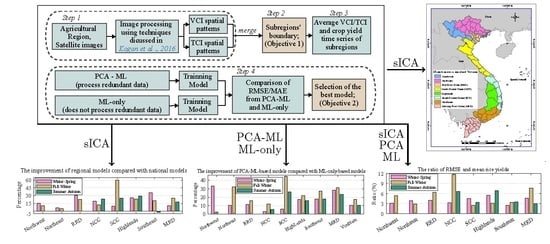
Accurate crop yield forecasting is essential in the food industry’s decision-making process, where vegetation condition index (VCI) and thermal condition index (TCI) coupled with machine learning (ML) algorithms play crucial roles. The drawback, however, is that a one-fits-all prediction model is often employed over an entire region without considering subregional VCI and TCI’s spatial variability resulting from environmental and climatic factors. Furthermore, when using nonlinear ML, redundant VCI/TCI data present additional challenges that adversely affect the models’ output. This study proposes a framework that (i) employs higher-order spatial independent component analysis (sICA), and (ii), exploits a combination of the principal component analysis (PCA) and ML (i.e., PCA-ML combination) to deal with the two challenges in order to enhance crop yield prediction accuracy. The proposed framework consolidates common VCI/TCI spatial variability into their respective subregions, using Vietnam as an example. Compared to the one-fits-all approach, subregional rice yield forecasting models over Vietnam improved by an average level of 20% up to 60%. PCA-ML combination outperformed ML-only by an average of 18.5% up to 45%. The framework generates rice yield predictions 1 to 2 months ahead of the harvest with an average of 5% error, displaying its reliability.
Keywords: crop yield prediction; vegetation condition index (VCI); thermal condition index (TCI); independent component analysis (ICA); principle component analysis (PCA); machine learning crop yield prediction; vegetation condition index (VCI); thermal condition index (TCI); independent component analysis (ICA); principle component analysis (PCA); machine learning
Graphical Abstract