Article

A Low-Cost Optoacoustic Sensor for Environmental Monitoring

by
Antonios Stylogiannis
1,2,†,
Nikolaos Kousias
3,†,
Anastasios Kontses
3,
Leonidas Ntziachristos
3 and
Vasilis Ntziachristos
1,2,*
1
Technical University of Munich, School of Medicine, Chair of Biological Imaging, 80333 Munich, Germany
2
Helmholtz Zentrum München (GmbH), Institute of Biological and Medical Imaging, 85764 Neuherberg, Germany
3
Mechanical Engineering Department, Aristotle University of Thessaloniki, P.O. Box 458, GR 54124 Thessaloniki, Greece
*
Author to whom correspondence should be addressed.
These authors contributed equally to this work.
Sensors 2021, 21(4), 1379; https://doi.org/10.3390/s21041379
Submission received: 8 January 2021 / Revised: 3 February 2021 / Accepted: 11 February 2021 / Published: 16 February 2021
(This article belongs to the Section Optical Sensors)

Abstract

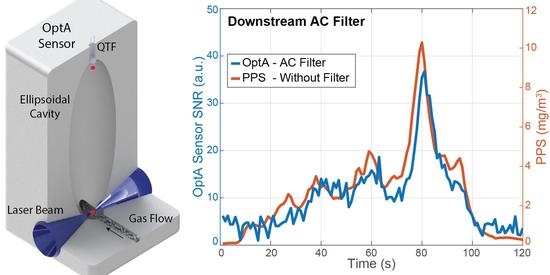
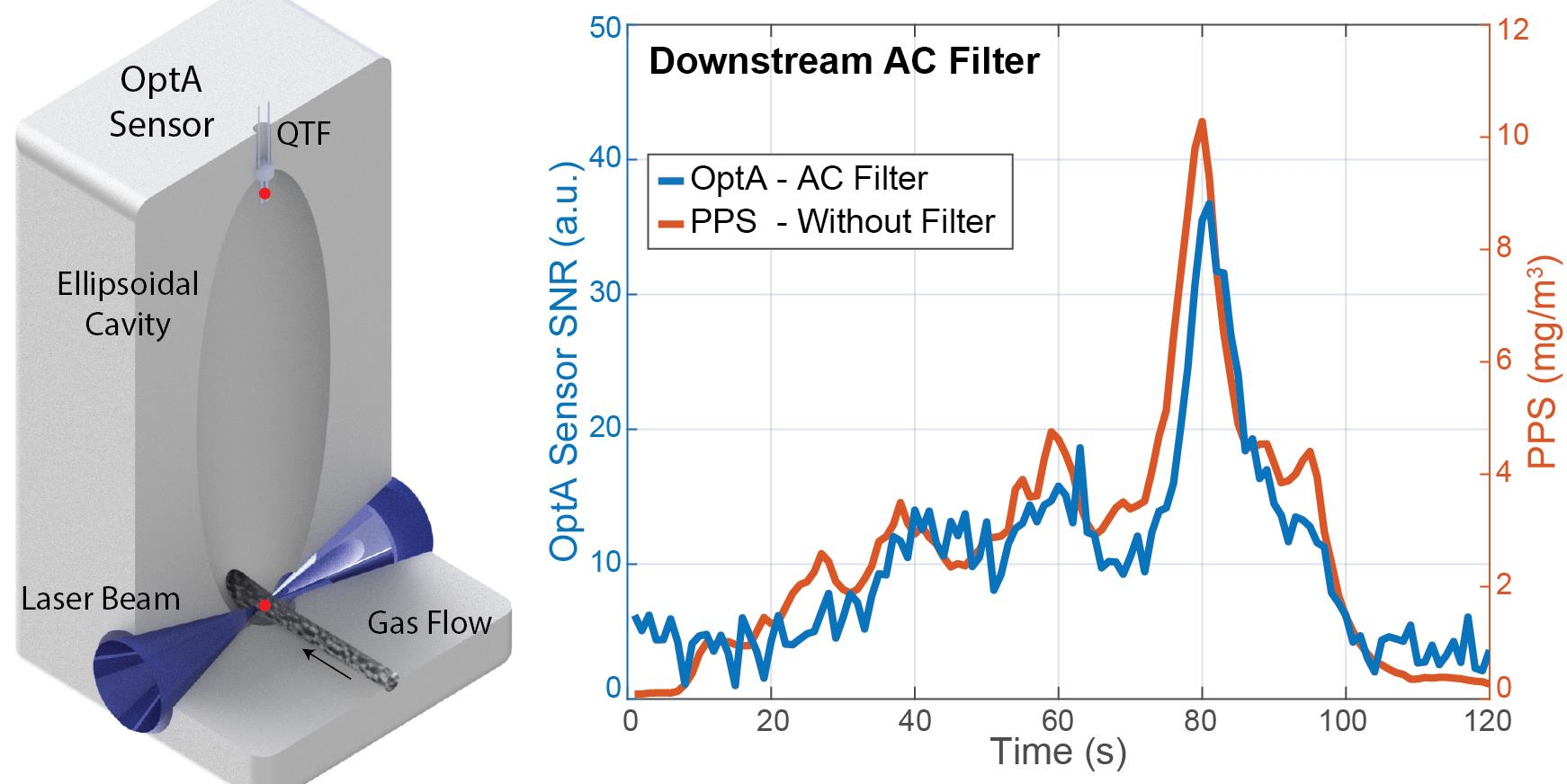
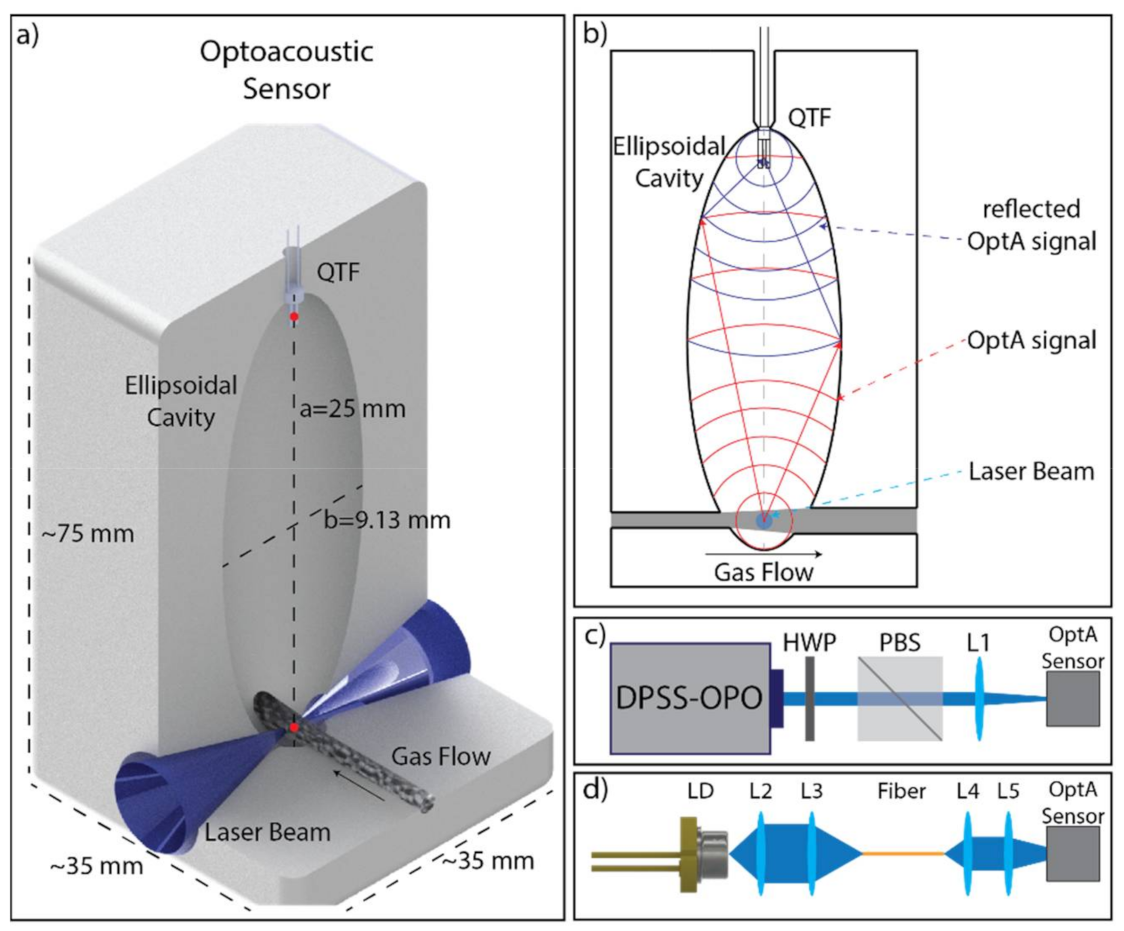
Attention to Black Carbon (BC) has been rising due to its effects on human health as well its contribution to climate change. Measurements of BC are challenging, as currently used devices are either expensive or impractical for continuous monitoring. Here, we propose an optoacoustic sensor to address this problem. The sensor utilizes a novel ellipsoidal design for refocusing the optoacoustic signal with minimal acoustic energy losses. To reduce the cost of the system, without sacrificing accuracy, an overdriven laser diode and a Quartz Tuning Fork are used as the light source and the sound detector, respectively. The prototype was able to detect BC particles and to accurately monitor changes in concentration in real time and with very good agreement with a reference instrument. The response of the sensor was linearly dependent on the BC particles concentration with a normalized noise equivalent absorption coefficient (NNEA) for soot equal to 7.39 × 10⁻⁹ W cm−1 Hz−1/2. Finally, the prototype was able to perform NO2 measurements, demonstrating its ability to accurately monitor both particulate and gaseous pollutants. The proposed sensor has the potential to offer a significant economic impact for BC environmental measurements and source appointment technologies.
Keywords: photoacoustic; soot; black carbon; NO2; QTF; miniaturized; QEPAS; exhaust gas photoacoustic; soot; black carbon; NO2; QTF; miniaturized; QEPAS; exhaust gas
Graphical Abstract