Article

Cultivation Mode Reshapes Root Fungal Endophyte Communities in Dendrobium officinale (Orchidaceae)

1
Life and Environmental Science College, Wenzhou University, Wenzhou 325003, China
2
Zhejiang Provincial Key Laboratory of Water Environment and Marine Biological Resources Protection, Wenzhou University, Wenzhou 325003, China
3
SuBuqing Honors College, Wenzhou University, Wenzhou 325003, China
4
Zhejiang Juyoupin Biotechnology Co., Ltd., Yueqing County, Wenzhou 325604, China
*
Authors to whom correspondence should be addressed.
Diversity 2026, 18(6), 359; https://doi.org/10.3390/d18060359
Submission received: 4 May 2026 / Revised: 9 June 2026 / Accepted: 9 June 2026 / Published: 12 June 2026
(This article belongs to the Section Microbial Diversity and Culture Collections)

Abstract

Background: Symbiotic fungi play essential roles throughout the entire cycle of orchid plants, including seed germination, seedling development, and maturation. Dendrobium officinale Kimura & Migo (Orchidaceae) (D. officinale) is a rare and highly valued traditional Chinese medicinal herb. Currently, artificial breeding using tissue culture technology is widely adopted and essential in the Dendrobium industry; however, this approach may impair or disrupt the plant’s ability to establish and maintain symbiotic relationships with mycorrhizal fungi. Methods: In this study, the fungal endophyte community (FEC) in the roots of D. officinale cultivated under four different modes was analyzed using high-throughput sequencing. Correlation analyses were also carried out to examine the relationships between bioactive compounds and the FEC. Results: (1) The FEC in D. officinale roots was dominated by Ascomycota and Basidiomycota, with significant differences in abundance, diversity, and community structure among cultivation modes; (2) the FEC under greenhouse cultivation differed significantly from those under tree epiphytic cultivation in terms of fungal nutritional types and dominant taxa; (3) six major mycorrhizal fungal taxa were identified in Dendrobium roots, although non-mycorrhizal fungi accounted for approximately 97% of the community; and (4) polysaccharide content in Dendrobium stems was positively correlated with certain root fugal endophytes (Exophiala, alaromyces, Pseudodactylaria, and Fellomyces). Conclusions: This study provides a foundation for understating the growth of D. officinale under different cultivation modes and highlights the relationship between bioactive compound accumulation and fungal endophyte communities.

1. Introduction

Endophytes are all organisms that inhabit plants at some time in their life cycle, and they can colonize internal plant tissues without causing apparent harm to their host [1]. When it comes to orchid roots, certain fungal endophytes can form specialized symbiotic structures called pelotons within orchid root cortex cells as interfaces for nutrient exchange [2]. These fungi are referred to as orchid mycorrhizal fungi (OMF). Orchid mycorrhizal fungi (OMF), together with arbuscular mycorrhizal fungi (AMF), ectomycorrhizal fungi (EcMF), and ericoid mycorrhizal fungi (ErMF), are considered the four major types of mycorrhizal fungi, and they play a key role in supplying plants’ nitrogen (N) and phosphorus (P) requirements [3]. The most common and evolutionarily ancient OMF are members of the families Tulasnellaceae, Ceratobasidiaceae, and Serendipitaceae, collectively referred to as “Rhizoctonia-like” Basidiomycetes [2]. Non-mycorrhizal endophytic fungi (ONF) in orchid roots do not form a peloton structure, and the majority of them are Ascomycetes. Common ONF include Phialocephala, Fusarium, Hadrotrichum, Epicoccum, Lasiodiplodia, Xylaria, and Pestalotiopsis, among others [4]. Even though their role within a plant is yet to be established, ONF are widely recognized to play important roles in plant nutrient acquisition, growth promotion, and stress resistance enhancement [5].
The relationship between endophytic fungi and host plants may be symbiotic, commensal, or parasitic, or may shift from one part of this symbiotic continuum to another depending on the plant growth stage and environmental conditions [4]. Evidence suggests that extant mycorrhizal fungi evolved from endophytic fungi that once colonized the ancestors of orchids [6], and certain fungi generally regarded as endophytes, including Helotiales sp. F229, Serendipita indica, Colletotrichum tofieldiae, Heteroconium chaetospira, and other dark septate endophytes (DSE), have also been confirmed to form mycorrhiza-like symbiotic relationships and to transfer nitrogen, phosphorus, sulfur, and iron to plants [7], implying that endophytic fungi play an important role in the nutritional plasticity of orchids.
Dendrobium officinale is a perennial herb and a highly valued traditional Chinese medicinal plant, known for its pharmacological properties, including anti-oxidation, anti-inflammation, immunomodulatory effects, free radical scavenging, and inhibition of tumorigenesis and metastasis [8]. However, wild populations of D. officinale have been severely depleted, and the surviving wild individuals are extremely rare and classified as endangered under Appendix II of the Convention on International Trade in Endangered Species of Wild Fauna and Flora (CITES) due to habitat destruction and over-harvesting [9]. To meet commercial demand, large-scale cultivation of Dendrobium has been practiced in southern China for several decades, facilitated by advances in plant tissue culture technology [8]. However, propagation under sterile conditions, combined with reduced environmental selection pressure and the frequent use of fungicides, may impair the ability of Dendrobium to establish and maintain symbiotic relationships with mycorrhizal fungi and plant-growth-promoting rhizobacteria [10,11].
The establishment of obligate symbiotic relationships outside the native habitat of orchids presents a significant challenge for large-scale cultivation and population restoration [12]. Studies comparing endophytic fungal communities in wild and cultivated crops, such as rice and wheat, have shown that beneficial endophytes are often absent or underrepresented in domesticated systems [13,14]. Similarly, preliminary studies suggest that the fungal endophytic communities (FEC) reconstructed in cultivated orchids differ from those in wild populations. Following transplantation, fungi belonging to Atractiellales, Auriculariales, Ceratobasidiaceae, and Fusarium tend to increase, whereas the abundance of Tulasnellaceae and Pyronemataceae decreases [15,16,17]. This shift indicates a constrained reassembly and a potential loss of key OMF taxa [18]. Such alterations may ultimately affect the quality and medicinal value of cultivated orchids. Previous studies have demonstrated interactions between the plant metabolites and microbial communities within and surrounding Dendrobium plants [19,20]. However, knowledge of the fungal endophyte communities established by artificially propagated Dendrobium plants under cultivation conditions remains limited.
This study aimed to characterize the fungal endophyte communities (FEC) in the roots of D. officinale roots under four different cultivation modes and to evaluate how stimulated natural habitat conditions influence these communities and D. officinale growth. The findings will provide a foundation for understanding the plasticity of orchid–endophyte associations for developing potential applications of fungal-based fertilizers in Dendrobium cultivation.

2. Materials and Methods

2.1. Sample Collection

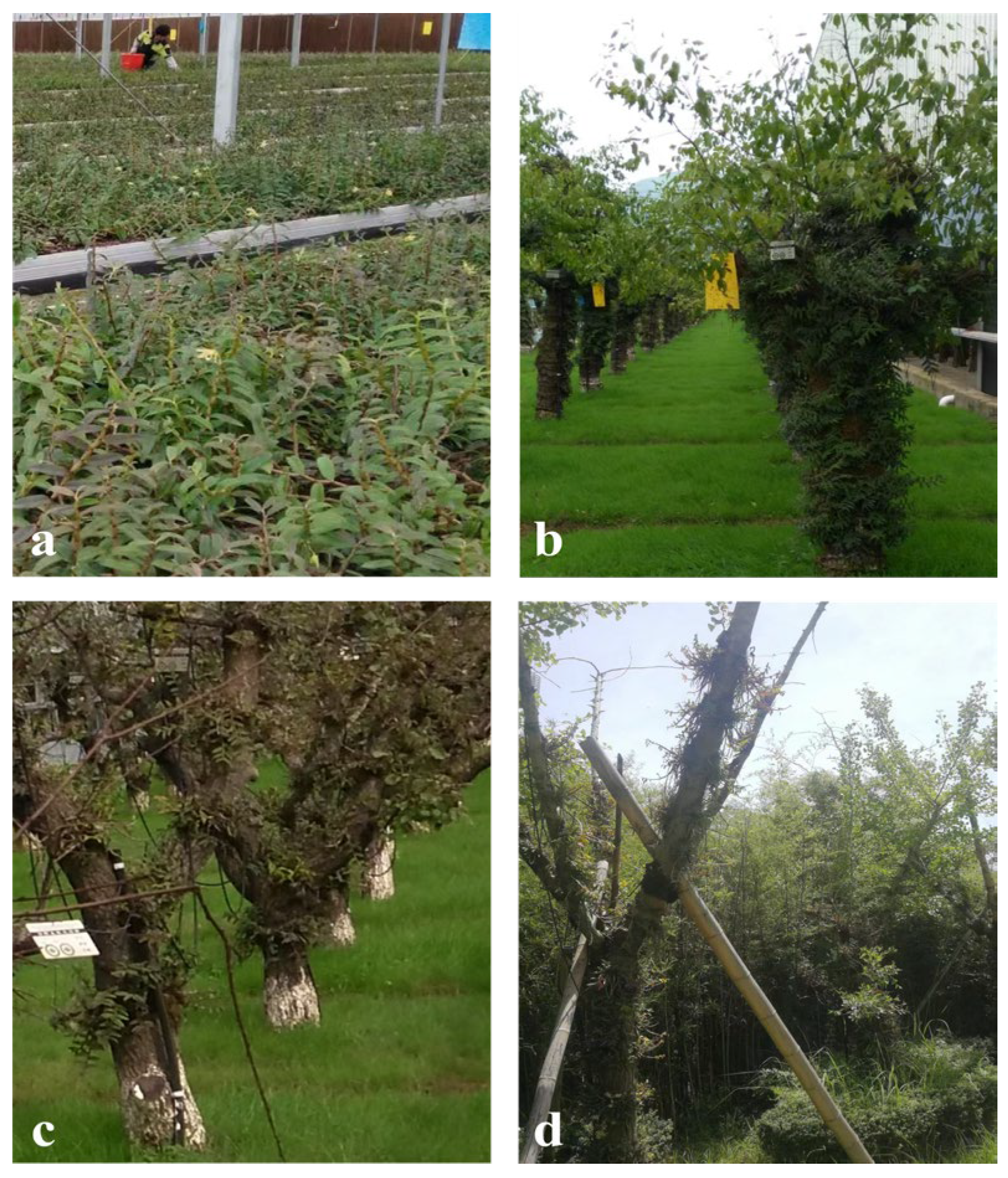
All samples used in the study were collected from Zhejiang Juyoupin Biotechnology Co. Ltd. (Wenzhou, China), located in the Dendrobium ecological cultivation base in Yueqing County (28.41394 N, 121.17977 E), a native habitat and one of the most suitable cultivation areas for D. officinale in Wenzhou, China. The region is characterized by a typical mild and humid climate (sampling-day temperature: 26–31 °C; relative humidity: ~70%). Under the epiphytic cultivation (EC) modes, D. officinale plants were attached to the main trunks of living Ginkgo (GEC), Jujube (JEC), or Pear (PEC) trees, respectively. In contrast, the raised bed cultivation (RBC) system in a greenhouse utilized crushed pine bark as the substrate and maintained approximately 80% air humidity and temperatures of 23–25 °C (Figure 1).
Three parallel samples of leaves, stems, and roots of D. officinale were collected from each of the four cultivation modes (GEC, JEC, PEC, and RBC) for fungal community analysis and determination of major chemical components. Healthy two-year-old D. officinale plants were selected for the experiment. The samples were thoroughly washed under running water, followed by surface sterilization using 1% sodium hypochlorite solution for 4 min. Subsequently, the samples were rinsed twice with sterile water and dried using sterile filter paper. Additionally, substrate samples were collected from the RBC system: rhizosphere substrate (RS) in direct contact with Dendrobium roots and non-rhizosphere substrate (NRS) not in contact with the roots. A total of 18 samples were collected, including 12 plant samples and 6 substrate samples. All samples were quickly frozen in liquid nitrogen and stored at −80 °C until subsequent analysis. All samples used in the study, including plant samples and substrate samples, were collected in July 2023.
Figure 1. Different cultivation modes of Dendrobium officinale  in an ecological base in Yueqing County, Wenzhou, Zhejiang Province, China. (a) Raised-bed cultivation (RBC). D. officinale grow in a multi-span plastic greenhouse with planting beds approximately 1.2 m in width placed on elevated benches about 50 cm above the ground. Crushed pine bark is used as the cultivation substrate in the beds. (b) Jujube epiphytic cultivation (JEC). (c) Pear epiphytic cultivation (PEC). (d) Ginkgo epiphytic cultivation (GEC). Under the epiphytic cultivation (EC) modes, D. officinale was fixed with a linen strip to the living tree trunks of Juibe, pear and ginkgo, respectively.
Diversity 18 00359 g001

2.2. Genome DNA Extraction and Target Fragment Sequencing

DNA was extracted from the roots of D. officinale and associated cultivation substrates using the cetyltrimethylammonium bromide (CTAB) method [21]. DNA concentration and quality were assessed using Nanodrop (Thermo Scientific, Waltham, MA, USA, NC2000) and by 1.2% agarose gel electrophoresis analysis, respectively.
The internal transcribed spacer1 (ITS1) region (including partial 18S rDNA, full ITS1, and partial 5.8S rDNA) was amplified using the forward primer ITS1F 5′-CTTGGTCATTTAGAGGAAGTAA-3′ and the reverse primer ITS2 5′-GCTGCGTTCTTCATCGATGC-3′ [22]. Sample-specific 7-nucleotide barcodes were incorporated into the primers to enable multiplex sequencing. The PCR reaction mixture (25 μL total volume) consisted of 5 μL of 5× buffer, 0.25 μL of Fast pfu DNA polymerase (5 U/μL), 2 μL (2.5 mM) of dNTPs, 1 μL (10 mM) of each forward and reverse primer, 1 μL of DNA template, and 15.75 μL of double-distilled water (ddH2O). The PCR thermal cycling conditions were as follows: initial denaturation at 98 °C for 2 min; 30 cycles of denaturation at 98 °C for 15 s, annealing at 55 °C for 30 s, and extension at 72 °C for 45 s; followed by a final extension at 72 °C for 5 min.
PCR amplicons were purified using Vazyme VAHTSTM DNA Clean Beads (Vazyme, Nanjing, China) and quantified using the Quant-iT PicoGreen dsDNA Assay Kit (Invitrogen, Carlsbad, CA, USA). After individual quantification, amplicons were pooled in equimolar amounts and sent to Shanghai Personal Biotechnology Co., Ltd. (Shanghai, China) for pair-end 2 × 250 bp sequencing using the Illumina NovaSeq platform (NovaSeq 6000 SP Reagent Kit, Illumina, Inc.; San Diego, CA, USA).

2.3. Sequencing Data Processing and Analysis

The DADA2 pipeline was used for primer removal, quality filtering, denoising, sequence merging, and chimera removal [23]. The above steps were performed separately for each library. After denoising was completed for all libraries, the resulting ASV feature sequences and the ASV table were merged. Finally, singleton ASVs were removed, following the default setting. The corrected sequences were analyzed for their length distribution to ensure consistency with the expected fragment size. Taxonomic annotation was performed using the UNITE database (Release 8.0), and the amplicon sequence variant (ASV) abundance table was rarefied to 95% of the minimum sequencing depth across samples using the “feature-table rarefy” function in QIIME2 (2019.4). Statistical analyses of fungal endophytic community (FEC) composition were conducted at multiple taxonomic levels.
Alpha (α)-diversity indices were calculated using QIIME2 (2019.4), The “qiime diversity alpha-rarefaction” command was invoked with the parameters “--p-steps 10 --p-min-depth 10 --p-iterations 10” to calculate the selected alpha diversity indices of the unrarefied ASV/OTU table. The average score at the maximum rarefaction depth was taken as the alpha diversity index. Statistical significance was assessed using the Kruskal–Wallis test followed by Dunn’s post hoc test. Beta (β)-diversity was calculated in QIIME2, and non-metric multidimensional scaling (NMDS) analysis based on the Bray–Curtis distance matrix was performed using R 4.5.2 scripts. Linear discriminant analysis effect size (LEfSe) was conducted using the LEfSe (1.1.2-1) package in Python 3.10. The FUNGuild database was used to predict the functional guilds within the fungal communities associated with Dendrobium roots.

2.4. Measurement of Bioactive Components and Ecophysiological Indicators

Polysaccharides from D. officinale stems were extracted and quantified according to the Chinese Pharmacopeia [24]. Briefly, samples were subjected to water-bath reflux extraction, followed by ethanol precipitation and quantification using the phenol-sulfuric acid colorimetric assay. A glucose standard curve was prepared for calibration. The polysaccharide content was calculated using the following formula: mg/g = C × (Vt/V) × D × 0.001/m, where C represents the sugar concentration determined from the standard curve, Vt is the volume used for measurement, V is the total extraction volume, D is the dilution factor, and m is the sample weight (g) (Nanjing Convinced-Test Company, Nanjing, China).
For the measurement of ethanol-soluble crude extractives (ESE), samples were dried to a constant weight and extracted by refluxing with ethanol, followed by evaporation to dryness and weighing after cooling. The ESE content was calculated based on dry weight [24].
The photosynthetic photon flux density (PPFD) was measured in situ at the sampling Dendrobium cultivation sites using a quantum PAR meter (AZ8584, Hengxin, Taiwan). The morphological and physiological traits of D. officinale were measured under laboratory conditions, including stem length (from the second internode to the base), stem diameter (measured at the middle of the stem), and chlorophyll content (measured on fully expanded young leaves and the two leaves immediately below) using a chlorophyll meter (SPAD-502 Plus, Konica Minolta, Metamorfosi, Greece).

2.5. RDA and Correlation Analysis

The distribution of endophytic fungal genera in relation to ecophysiological factors was analyzed using Redundancy Analysis (RDA). The correlations between endophytic fungal genera and ecophysiological variables were visualized using a heatmap. Both analyses were performed using the Wekemo Bioincloud platform (www.bioincloud.tech).

3. Results

3.1. α-Diversity of Fungal Communities in Dendrobium Roots and Cultivation Substrates

The ITS amplification libraries were analyzed using Illumina NovaSeq high-throughput sequencing which generated 2,171,876 quality-filtered reads and 1,983,040 chimera-free reads (Table 1), with an average length of 230 to 323 bp. A total of 550 ASVs were identified, of which 388 were derived from root samples and 274 from cultivation substrate samples. The raw sequencing data have been submitted to the NCBI SRA database (BioProject ID: PRJNA1299063).
Alpha-diversity analysis showed that the rhizosphere substrate (RS) sample had the highest number of ASVs (217), with a Shannon index of 4.92, while the RBC sample had the lowest number of ASVs (121), with a Shannon index of 3.32. The RS samples show significantly higher α-diversity, with Chao1 and observed species indices of 330 and 325, respectively, compared with 112 and 111 in the RBC samples (p < 0.05). Compared with the RBC samples, the living tree-epiphytic cultivation samples exhibited slightly higher α-diversity; however, these differences were not statistically significant (Table 2).

3.2. β-Diversity, Venn and LEfSe Analysis of Fungal Communities in Dendrobium Roots and Cultivation Substrates

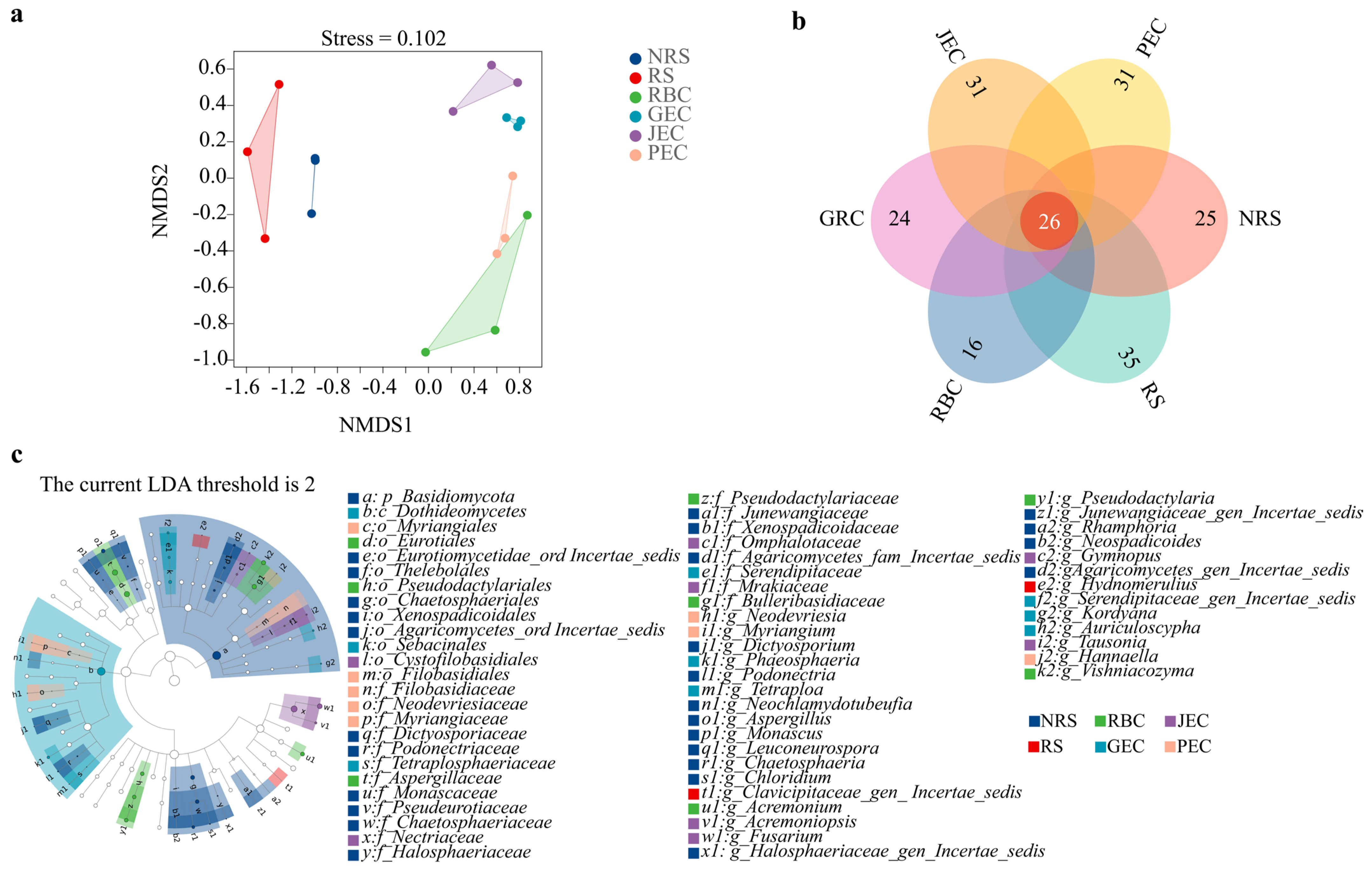
The stress value of the NMDS analysis was 0.102, indicating that the ordination adequately represented the differences among fungal communities across the six samples. The fungal communities of the four Dendrobium root samples and two cultivation substrate samples clustered in distinct regions along the NMDS1 axis. In addition, the communities in roots from the three epiphytic cultivation modes were positioned closer to each other along the NMDS2 axis, whereas the RBC samples were more distant from the three epiphytic samples (Figure 2a).
A core set of 26 genera was identified as shared among all samples (Figure 2b). An additional eight fungal genera were shared exclusively among Dendrobium root samples across the four cultivation modes and were absent from the two cultivation substrate samples (Table S1). LEfSe analysis identified a total of 63 biomarkers that differed significantly among the four Dendrobium root samples and two cultivation substrate samples (Figure 2c). The highest number of differential taxa was detected in NRS (28), whereas RS contained the fewest (2).

3.3. Fungal Community Composition in Dendrobium Roots and Cultivation Substrates

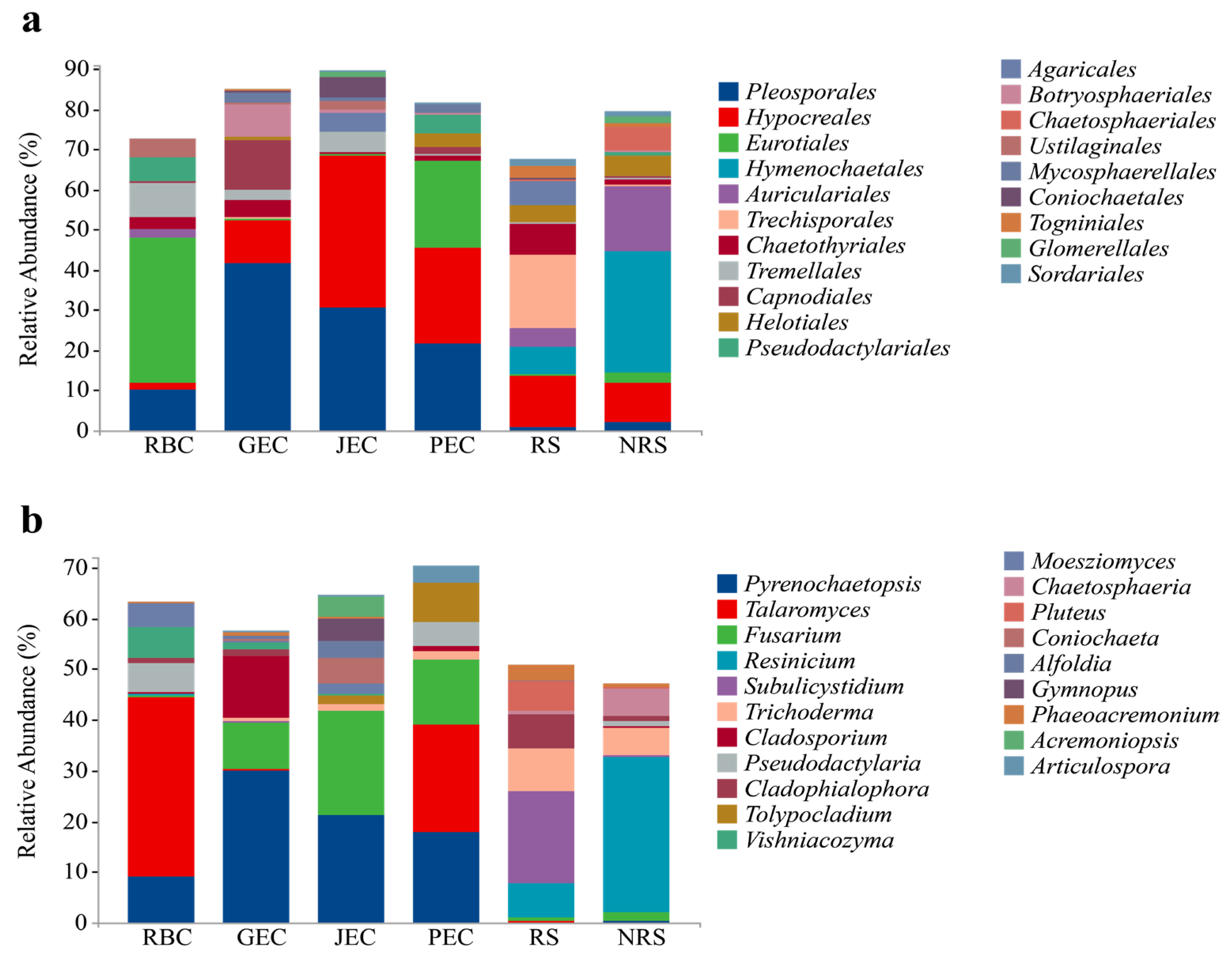
The ASV sequences obtained in this study were taxonomically annotated using the UNITE database, which revealed that the endophytic fungi in Dendrobium roots were classified into 5 phyla, 22 classes, 85 orders, 176 families, and 276 genera. The dominant phyla in Dendrobium roots were Ascomycota and Basidiomycota, with a combined mean relative abundance (RA) of 89%. At the order level, the dominant orders were Pleosporales, Hypocreales, and Eurotiales, with a combined mean RA of 44% (Figure 3a). At the genus level, the dominant genera were Pyrenochaetopsis, Talaromyces, and Fusarium, with a combined mean RA of 30%. Among these, Pyrenochaetopsis exhibited the highest average RA (13.1%) (Figure 3b).
The RA of Ascomycota and Basidiomycota varied significantly among samples. The RBC sample was characterized by a low Ascomycota/Basidiomycota ratio (58%/17%), whereas the PEC sample showed a ratio of 86%/2%. At the genus level, the top 10 fungal genera identified in D. officinale roots were collectively distributed across 27 genera, with each sample exhibiting distinct dominant genera. The cultivation substrate samples did not share the same top 10 genera as the root samples. Instead, Resinicium, Subulicystidium, and Trichoderma were the most abundant genera in the substrates (Table S2).

3.4. Functional Analysis of Fungal Communities in Dendrobium Roots and Cultivation Substrates

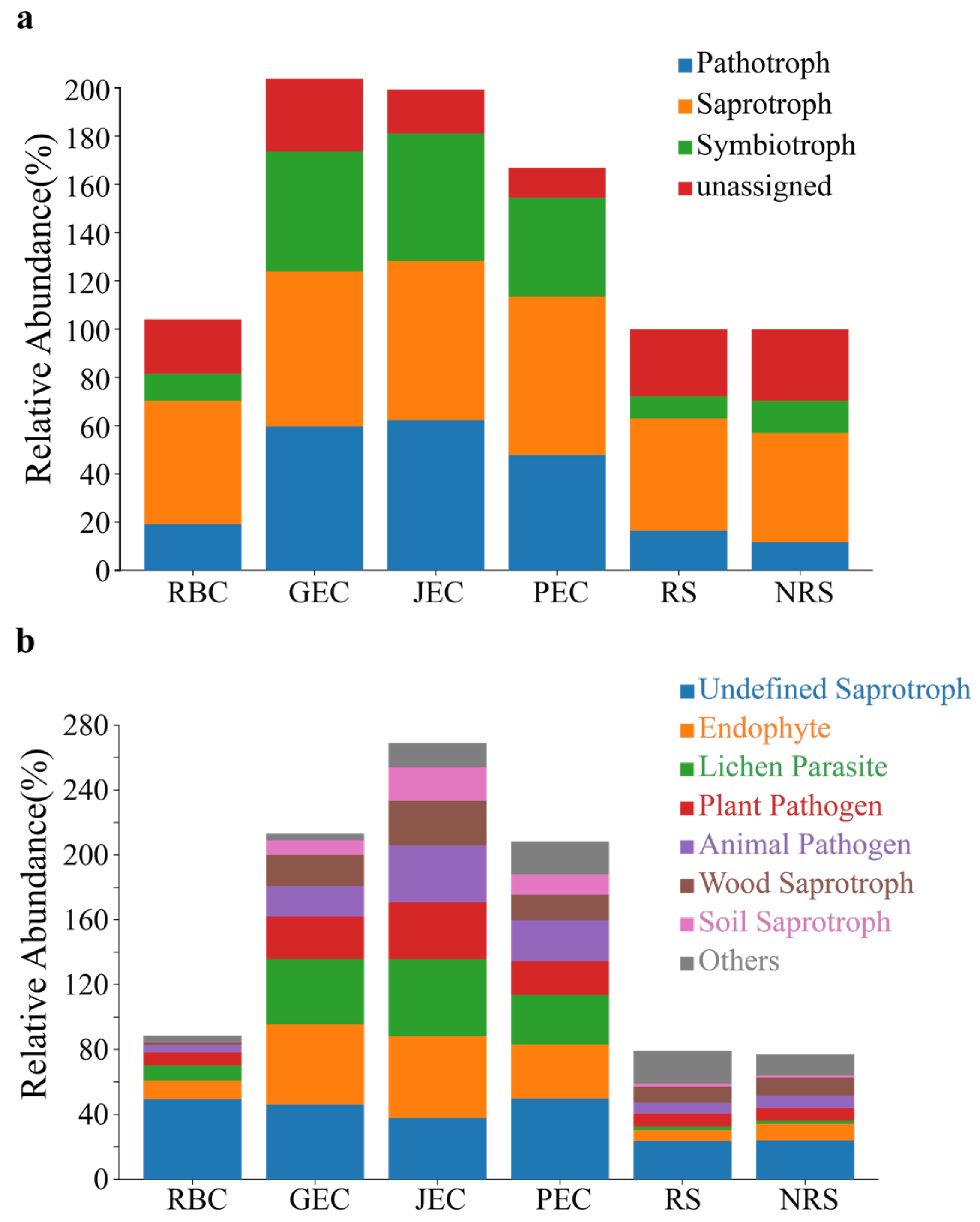
The FUNGuild database was used to predict the functional guilds within the fungal communities associated with Dendrobium roots. The analysis showed that Dendrobium roots were primarily inhabited by pathotrophic, symbiotrophic, and saprotrophic fungi. Additionally, 12.37–30.15% of the fungal taxa could not be assigned into specific functional guilds (Figure 4a). Further subdivision of the functional categories revealed that the fungal community in Dendrobium roots was mainly composed of saprotrophs (45.68%), endophytes (36.20%), lichen parasites (31.85%), and plant pathogens (22.64%) (Figure 4b).
The RA values of fungi classified as pathotrophic and symbiotrophic in the epiphytic cultivation samples were 2.98-fold and 4.25-fold higher, respectively, than those in the RBC samples (p < 0.05). The sum of the RA values across different nutritional types exceeded 100% in the epiphytic cultivation samples, which was significantly higher than that in the RBC samples, indicating that the endophytic fungi in Dendrobium roots under epiphytic cultivation exhibited more complex nutritional modes, with many fungal taxa displaying multiple trophic lifestyles.
Three ASVs were annotated as orchid mycorrhizal fungi (OMF): an unclassified fungus belonging to Sebacinaceae, Serendipita vermifera (Serendipitaceae), both within the order Sebacinales, and an unclassified fungus assigned to Meliniomyces (order Helotiales). The two Sebacinales fungi were detected at very low RA (0.00022%) and low detection frequency (8%), whereas the unclassified Meliniomyces was detected in 50% of the samples with an RA of 0.064%.
Given that the number of reported OMF taxa has continued to increase, we expanded the search for potential mycorrhizal fungi based on taxa reported in previous studies [25,26]. Three additional groups were identified as putative OMF: Herpotrichiellaceae (including Cladophialophora, Exophiala, and seven other genera; present in all samples, RA 2.48%), Psathyrellaceae (detected almost exclusively in the epiphytic cultivation samples, RA 0.01%), and Russulaceae (detected almost exclusively in the substrate samples, RA 0.08%).

3.5. D. officinale Stem Bioactive Components and Morphological Indicators

Bioactive components and phenotypic traits of D. officinale under different cultivation methods were determined as described in the Methods section. In this study, the polysaccharide content in Dendrobium stems was significantly higher in the samples from the RBC than in those from the EC modes (p < 0.01). The ethanol-soluble extractives (ESE) content, chlorophyll content, and stem length were also significantly higher in the samples from RBC compared with those from EC modes (Table 3). Among the three EC samples, the samples from GEC showed higher values of ESE content, stem length, and stem diameter, whereas samples from PEC exhibited higher polysaccharide and chlorophyll contents.

3.6. Relationship Between Endophytic Fungi and Stem Characteristics

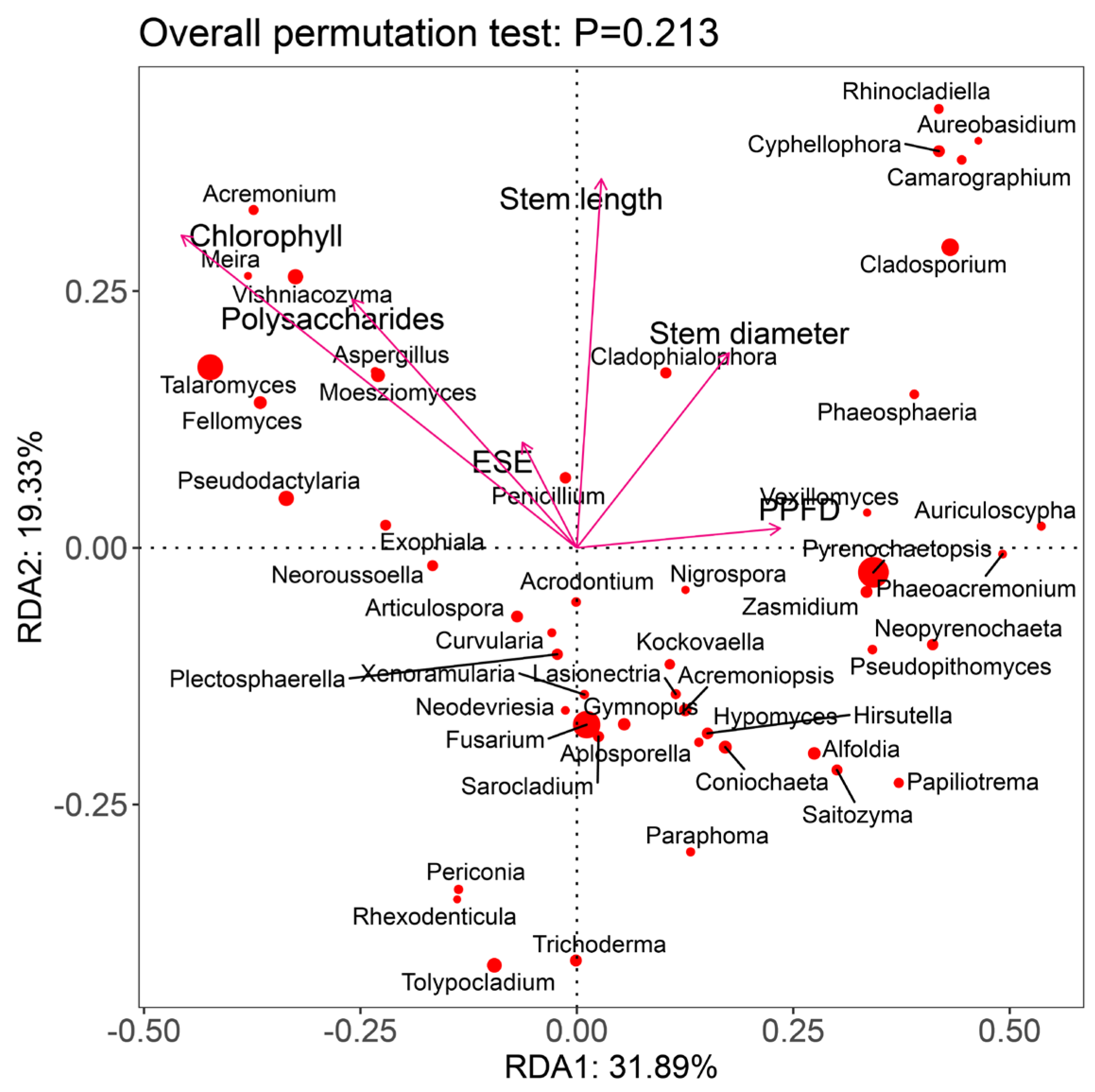
To explore the relationship between the abundance of fungal genera and the ecophysiological index of Dendrobium, RDA was performed using the top 50 genera. Factors including stem length, stem diameter, chlorophyll content, stem polysaccharide content, ESE content, and photosynthetic photon flux density (PPFD) were included in the analysis. The RDA results showed that the first two axes explained 51.22% of the total variance in the fungal community structure. Among these factors, chlorophyll content (R2 = 0.91, p < 0.001) was the most significant variable influencing the microbial community, followed by stem length (R2 = 0.59, p < 0.01) and polysaccharide content (R2 = 0.59, p < 0.01). Several genera were positively correlated with stem polysaccharide content, including Meira, Aspergillus, Vishniacozyma, Acremonium, Moesziomyces, Talaromyces, Exophiala, Pseudodactylaria, and Fellomyces. In contrast, genera positively correlated with light intensity (PPFD) included Phaeoacremonium, Pyrenochaetopsis, Vexillomyces, and Auriculoscypha (Figure 5).
The main bioactive components in D. officinale were located in the stem. The stem diameter, internode length, and bioactive component content varied among different cultivation modes (Table 3). Correlation analysis between stem characteristics and FEC showed that Moesziomyces and Rhinocladiella were positively correlated with stem diameter, whereas Meria and Acremonium were positively correlated with internode length. Exophiala and Talaromyces were significantly and positively correlated with the stem polysaccharide, while Pseudodactylaria and Fellomyces were highly significantly and positively correlated with the stem polysaccharide (p < 0.01) (Figure S1).

4. Discussion

4.1. FEC Structure in D. officinale Roots Under Different Cultivation Modes

Fungal community diversity was found to vary among cultivation modes. Fungal richness and diversity under the three epiphytic cultivation modes were slightly higher than those under the RBC mode (Table 2). This pattern may be driven by the stressful conditions of the epiphytic niche [27], combining with the physiological state of epiphytic roots affected by this stressful habitat [28]. The diversity values observed under RBC conditions (Chao1 113, Shannon index 3.3) were comparable to those reported for D. officinale cultivated in bark-based substrate across multiple regions (Chao1 114–185, Shannon index 2.5–3.2) [19,29,30]. Beta (β)-diversity analysis further showed that fungal communities in D. officinale roots under epiphytic cultivation were clearly separated from those under RBC conditions (Figure 2a), consistent with previous findings that orchid-associated fungal communities vary with environmental conditions [2,19,31].
Among the shared taxa, 34 fungal genera were identified across cultivation modes. Of these, six genera have so far been reported only in soil and freshwater environments, whereas the remaining 28 have been widely documented in orchid-associated microbiomes [32,33,34,35]. Notably, genera such as Cladosporium, Resinicium, and Fusarium are considered part of the core plant microbiome [29,33,36,37,38]. The combined mean RA of these shared genera reached 72.47%, with no significant differences among cultivation modes, suggesting that these fungal taxa were shared without isolation across different cultivation modes.
Several biomarkers identified by LEfSe, including Aspergillus and members of Nectriaceae, have also been reported as dominant endophytes in other orchids. For example, Aspergillus dominates in tropical terrestrial orchids (20–30%) [39] and in Calanthe (10.9%) [39,40], while Nectriaceae is prevalent in D. officinale and Neuwiedia singapureana [29,30]. These dominant fungal taxa found in cultivated Dendrobium roots show a consistent association across multiple orchid hosts.

4.2. FEC Composition in D. officinale Roots from Different Cultivation Modes

At the phylum level, fungal endophytic communities in cultivated D. officinale roots were dominated by Ascomycota and Basidiomycota, consistent with previous studies [20,29]. However, the RA ratio of Ascomycota to Basidiomycota was markedly higher in the epiphytically cultivated samples (85%/7%) than in the RBC samples (58%/17%) and previously reported values (46%/28%) [29]. The differences are consistent with some previous observations that Ascomycota are often associated with stress-tolerant strategies, whereas Basidiomycota are typically linked to nutrient-rich conditions [41]. However, the ecological implications of this shift in the composition of root FEC remain unclear.
At the genus level, dominant taxa included Pyrenochaetopsis (RA 19%, the most common genus in epiphytic cultivation), Fusarium (RA 14%), Talaromyces (RA 12%, the most common genus in the RBC mode), and Cladosporium (RA 4%), along with less abundant genera such as Vishniacozyma (RA 2%) and Pseudodactylaria (RA 2%) (Figure 3b). Many of these taxa, including Fusarium, Cladosporium, and members of Aspergillaceae, are commonly reported as dominant orchid endophytes [33,42]. In contrast, the ecological roles of other genera remain less well understood, although they have been identified as endophytes in other plant species [5,37,43].

4.3. Functional Groups of Endophytic Fungi in D. officinale Roots from Different Cultivation Modes

Tulasnellaceae is widely recognized as the most prevalent OMF in wild D. officinale, accounting for up to 82.98–95.2% of OMF sequences [44,45]. However, this group was not detected in the present study. Recent studies suggest that Tulasnellaceae requires organic nitrogen for symbiosis, and mineral nitrogen conditions may disrupt this association [46,47]. Similar patterns have been observed in cultivated orchid Cypripedium and other ericoid plants [46,48]. In addition to Tulasnellaceae, other common mycorrhizal taxa such as Ceratobasidiaceae and Serendipita. indica (which also relies on organic nitrogen) were also absent. These results suggest that cultivation practices may alter FEC composition and disrupt typical mycorrhizal associations.
Although classical “rhizoctonia-like” fungi were largely absent, several non-rhizoctonia fungal taxa with potential mycorrhizal functions were detected. These fungi are typically saprobic or ectomycorrhizal and may contribute to nutrient transfer under certain conditions [6,49]. In this study, these taxa were present at low relative abundance, and display multiple trophic lifestyles (Figure 4). Their mycorrhizal ability and ecological lifestyle still await verification.
Non-mycorrhizal fungi (ONF) accounted for the majority of the fungal endophytic community (~97%), consistent with previous reports [33,35,50]. These fungi occupy ecological niches within plant roots without forming classical mycorrhizal structures and potentially contribute to stress tolerance and nutrient acquisition [7]. The dominance of orders such as Pleosporales and Hypocreales is consistent with studies on grasses and non-mycorrhizal plant systems [51,52]. Seasonal and environmental factors, such as temperature and drought, may further influence their prevalence [53].
Overall, in cultivated D. officinale, classical OMF were largely absent, whereas diverse ONF and potential alternative mycorrhizal fungi were detected. This flexibility of orchid–fungi association may allow orchids to respond to varying environmental conditions and maintain functional resilience under cultivation.

4.4. Comparative Analysis of Main Components of Dendrobium from Different Cultivation Modes

Polysaccharides and ethanol-soluble extractives (ESEs) are major bioactive components of medicinal D. officinale. In this study, both polysaccharide and ESE contents were significantly higher in the RBC samples than in the epiphytic cultivation samples (p < 0.01) (Table 3), consistent with previous findings [54]. These results suggest that controlled greenhouse conditions may promote the accumulation of bioactive compounds in D. officinale (Table 3). Such differences may be attributed to environmental factors. RBC systems provide relatively stable conditions, including optimized temperature, humidity, light, and nutrient availability, which are known to influence metabolite accumulation [55]. However, some studies report higher polysaccharide content under more stressful conditions, such as rock epiphytic environments [56], indicating that metabolite accumulation is influenced by complex interactions between environmental stress and physiological regulation.

4.5. Correlation Between Dendrobium Polysaccharides and Endophytic Fungi

Polysaccharides are key bioactive compounds responsible for the antioxidant, anti-tumor, and immune-boosting properties of D. officinale [8,57]. In this study, RDA showed a significant correlation between stem polysaccharide content and fungal community composition (R2 = 0.58, p = 0.004) (Figure 5), consistent with previous correlation studies [19,29] and co-culture experiments. Previous studies show that mycorrhizal fungi such as Mycena sp., Tulasnella sp., and other endophytes can enhance polysaccharide accumulation in Dendrobium [58,59]. In the present study, several fungal taxa, including Exophiala, were positively correlated with polysaccharide content (Figure S1). Exophiala belongs to dark septate endophyte (DSE) fungus. Exophiala strains have been reported to enhance phosphorus absorption, seedling growth and drought tolerance in orchid and maize [60,61].
In addition, several non-mycorrhizal fungi, including Talaromyces, Pseudodactylaria, and Fellomyces, showed significant positive correlations with polysaccharide content in Dendrobium stems (Figure S1). Talaromyces is widely distributed in plant roots [62], T. verruculosus was reported to facilitate phosphorus solubilization and improve plant stress resistance [63]. The biotic elicitors prepared from Talaromyce sp. have been shown to stimulate bioactive compound accumulation in Dendrobium [64]. The ecological roles of Pseudodactylaria and Fellomyce remain less well characterized, although they have been reported in other plant-associated (e.g., ferns and lichens) systems [65,66].

4.6. Futural Research and Application in Practice

Dendrobium officinale is a highly valuable medicinal herb with multiple health-promoting functions. This study focused on the abundance and taxonomic classification of fungi interacting with the roots of D. officinale under four cultivation modes. The following aspects of mycorrhizal interactions with D. officinale should be considered in future studies. First, the nutrient metabolism of D. officinale in association with specific fungal populations under different cultivation modes should be investigated. Second, the precise correlation among the accumulation of bioactive compounds (e.g., polysaccharides, dendrobine, and flavonoids), specific fungal populations associated with D. officinale, and the cultivation modes, should be determined. Third, more suitable host tree species should be identified for wild-simulated cultivation of D. officinale, as the commercial and medicinal value of D. officinale from wild-simulated cultivation is significantly higher than that from greenhouse cultivation. Fourth, the symbiotic fungal banks associated with D. officinale should be established for potential future applications [67]. Finally, eco-friendly fungal fertilizers should be developed and applied [68] for the cultivation management of D. officinale and other Orchidaceae plants based on the findings of this study.

5. Conclusions

This study revealed significant differences in the abundance, diversity, and community structure of endophytic fungi in Dendrobium officinale roots across four cultivation modes. The greenhouse cultivation mode (RBC) promoted plant growth and enhanced the accumulation of key bioactive compounds, including stem polysaccharides and ethanol-soluble extractives (ESE). These bioactive components, together with selected plant phenotypic traits, were positively associated with variations in microbial community structure. The fungal endophyte community in D. officinale roots was dominated by non-mycorrhizal fungi (ONF, ~97%), whereas only a small proportion (~3%) was attributed to orchid mycorrhizal fungi (OMF), represented by six taxa. These findings highlight the potential importance of establishing local and novel root-fugus associations for Dendrobium cultured in agricultural ecosystems, particularly when classic OMF are absent under artificial breeding and cultivation conditions.

Supplementary Materials

The following supporting information can be downloaded at: https://www.mdpi.com/article/10.3390/d18060359/s1. Figure S1: Correlation analysis between the composition and abundance of top 50 endophytic fungi and OMF and the morphological traits, light density, and compound contents of Dendrobium officinale; Table S1: Thirty-four fungal genera shared in Dendrobium roots across four different cultivation modes; Table S2: Top 10 fungal genera found in Dendrobium roots and substrates.

Author Contributions

Conceptualization, X.W. and C.J.; methodology, X.W., L.L. and C.J.; validation, J.C., Y.C. and J.D.; formal analysis, X.H. and L.L.; investigation, L.L., J.J., J.D. and J.C.; resources, X.W. and J.Z.; data curation, J.J., C.F. and L.L.; writing—original draft preparation, L.L.; writing—review and editing, X.W.; visualization, J.D. and L.L.; supervision, X.W.; project administration, L.L.; funding acquisition, X.W. and L.L.; All authors have read and agreed to the published version of the manuscript.

Funding

This research was funded by the Wenzhou Basic Research Project (Grant No. N20210009 and Grant No. N2023013) and the Zhejiang Province Basic Commonweal Research Project (Grant No. LGN22C030001).

Institutional Review Board Statement

Not applicable.

Data Availability Statement

The data presented in this study are available in SRA database of NCBI (www.ncbi.nlm.nih.gov/bioproject/PRJNA1299063/) (PRJNA1299063).

Acknowledgments

We thank Zhejiang Juyoupin Biotechnology Co., Ltd. for kindly providing samples, and Alan K. Chang from the College of Life and Environmental Sciences at Wenzhou University for his kind effort in revising the language of the manuscript.

Conflicts of Interest

Author Jianhong Zhou was employed by the company Zhejiang Juyoupin Biotechnology Co., Ltd. The remaining authors declare that the research was conducted in the absence of any commercial or financial relationships that could be construed as a potential conflict of interest.

Abbreviations

The following abbreviations are used in this manuscript:
RBCRaised bed cultivation
GECGinkgo tree-epiphytic cultivation
JECJujube tree-epiphytic cultivation
PECPear tree-epiphytic cultivation
RSRhizosphere substrate
NRSNon-rhizosphere substrate
ESEEthanol-soluble crude extractives
OMFOrchid mycorrhizal fungi
ASVAmplicon sequence variant
FECFungal endophyte community
LEfSeLinear discriminant analysis effect size
RDARedundancy analysis
RARelative abundance

References

  1. Pereini, O. Fungal endophytes of tree leaves. In Microbial Ecology of Leaves; Andrews, J.H., Hirano, S.S., Eds.; Springer: New York, NY, USA, 1991; pp. 179–197. [Google Scholar]
  2. Dearnaley, J.D.W.; Martos, F.; Selosse, M.A. 12 Orchid Mycorrhizas: Molecular Ecology, Physiology, Volution and Conservation Aspects. In Fungal Associations, 2nd ed.; Hock, B., Ed.; Springer: Berlin, Germany, 2012; pp. 207–230. [Google Scholar]
  3. van der Heijden, M.G.A.; Martin, F.M.; Selosse, M.A.; Sanders, I.R. Mycorrhizal ecology and evolution: The past, the present, and the future. New Phytol. 2015, 205, 1406–1423. [Google Scholar] [CrossRef] [PubMed]
  4. Bayman, P.; Otero, J.T. Microbial Endophytes of Orchid Roots. In Microbial Root Endophytes; Schulz, B., Boyle, C., Sieber, T., Eds.; Springer: Berlin/Heidelberg, Germany, 2006; pp. 153–177. [Google Scholar]
  5. Liao, C.F.; Doilom, M.; Jeewon, R.; Hyde, K.D.; Manawasinghe, I.S.; Chethana, K.W.T.; Balasuriya, A.; Thakshila, S.A.D.; Luo, M.; Mapook, A.; et al. Challenges and update on fungal endophytes: Classification, definition, diversity, ecology, evolution and functions. Fungal Divers. 2025, 131, 301–367. [Google Scholar] [CrossRef]
  6. Selosse, M.A.; Petrolli, R.; Mujica, M.I.; Laurent, L.; Perez-Lamarque, B.; Figura, T.; Bourceret, A.; Jacquemyn, H.; Li, T.Q.; Gao, J.Y.; et al. The Waiting Room Hypothesis revisited by orchids: Were orchid mycorrhizal fungi recruited among root endophytes? Ann. Bot. 2022, 129, 259–270. [Google Scholar] [CrossRef]
  7. Almario, J.; Fabianska, I.; Saridis, G.; Bucher, M. Unearthing the plant-microbe quid pro quo in root associations with beneficial fungi. New Phytol. 2022, 234, 1967–1976. [Google Scholar] [CrossRef]
  8. Cheng, J.; Dang, P.P.; Zhao, Z.; Yuan, L.C.; Zhou, Z.H.; Wolf, D.; Luo, Y.B. An assessment of the Chinese medicinal Dendrobium industry: Supply, Demand and Sustainability. J. Ethnopharmacol. 2019, 229, 81–88. [Google Scholar] [CrossRef]
  9. Nigel, D.S.; Kingsley, W.D. Perspectives on orchid conservation in botanic gardens. Trends Plant Sci. 2009, 14, 590–598. [Google Scholar] [CrossRef]
  10. Porter, S.S.; Sachs, J.L. Agriculture and the Disruption of Plant-Microbial Symbiosis. Trends Ecol. Evol. 2020, 35, 426–439. [Google Scholar] [CrossRef]
  11. Cordovez, V.; Dini-Andreote, F.; Carrión, V.J.; Raaijmakers, J.M. Ecology and Evolution of Plant Microbiomes. Annu. Rev. Microbiol. 2019, 73, 69–88. [Google Scholar] [CrossRef]
  12. Phillips, R.D.; Reiter, N.; Peakall, R. Orchid conservation: From theory to practice. Ann. Bot. 2020, 126, 345–362. [Google Scholar] [CrossRef] [PubMed]
  13. Ofek-Lalzar, M.; Gur, Y.; Ben-Moshe, S.; Sharon, O.; Kosman, E.; Mochli, E.; Sharon, A. Diversity of fungal endophytes in recent and ancient wheat ancestors Triticum dicoccoides and Aegilops sharonensis. FEMS Microbiol. Ecol. 2016, 92, fiw152. [Google Scholar] [CrossRef]
  14. Engelhard, M.; Hurek, T.; Reinhold-Hurek, B. Preferential occurrence of diazotrophic endophytes, Azoarcus spp., in wild rice species and land races of Oryza sativa in comparison with modern races. Environ. Microbiol. 2000, 2, 131–141. [Google Scholar] [CrossRef]
  15. Downing, J.L.; Liu, H.; Shao, S.C.; Wang, X.L.; McCormick, M.; Deng, R.Y.; Gao, J.Y. Contrasting changes in biotic interactions of orchid populations subject to conservation introduction vs. conventional translocation in tropical China. Biol. Conserv. 2017, 212, 29–38. [Google Scholar] [CrossRef]
  16. Qin, J.; Zhang, W.; Ge, Z.W.; Zhang, S.B. Molecular identifications uncover diverse fungal symbionts of Pleione (Orchidaceae). Fungal Ecol. 2019, 37, 19–29. [Google Scholar] [CrossRef]
  17. May, M.; Jakaski, M.; Novotna, A.; Dietel, J.; Ayasse, M.; Lallemand, F.; Figura, T.; Minasiewicz, J.; Selosse, M.A. Three-year pot culture of Epipactis helleborine reveals autotrophic survival, without mycorrhizal networks, in a mixotrophic species. Mycorrhiza 2020, 30, 51–61. [Google Scholar] [CrossRef]
  18. Li, T.Q.; Wu, S.; Yang, W.K.; Selosse, M.A.; Gao, J.Y. How Mycorrhizal Associations Influence Orchid Distribution and Population Dynamics. Front. Plant Sci. 2021, 12, 647114. [Google Scholar] [CrossRef] [PubMed]
  19. Zhu, M.M.; Chen, H.H.; Si, J.P.; Wu, L.S. Effect of cultivation mode on bacterial and fungal communities of Dendrobium catenatum. BMC Microbiol. 2022, 22, 221. [Google Scholar] [CrossRef]
  20. Yu, C.X.; Wang, P.; Ding, H.Y.; Hu, Y.; Wang, F.; Chen, H.P.; Chen, L.; Liu, Y.P. Effects of the epiphytic patterns on endophytes and metabolites of Dendrobium nobile Lindl. Front. Plant Sci. 2024, 15, 1326998. [Google Scholar] [CrossRef] [PubMed]
  21. Gill, K.; Negi, S.; Kumar, P.; Irfan, M. Improved genomic DNA extraction from citrus species using a modified CTAB method. Mol. Biol. Rep. 2025, 52, 638. [Google Scholar] [CrossRef]
  22. Borodus, A.; Nikolajeva, J.; Fridmanis, D.; Gudra, D.; Ustinova, M.; Senkovs, M.; Nikolajeva, V. Does peptide-nucleic acid (PNA) clamping of host plant DNA benefit ITS1 amplicon-based characterization of the fungal endophyte community? Fungal Ecol. 2023, 61, 101181. [Google Scholar] [CrossRef]
  23. Callahan, B.J.; McMurdie, P.J.; Rosen, M.J.; Han, A.W.; Johnson, A.J.A.; Holmes, S.P. Dada2: High-resolution sample inference from illumina amplicon data. Nat. Methods 2016, 13, 581–583. [Google Scholar] [CrossRef]
  24. Chinese Pharmacopoeia Commission. Dendrobium officinale. In Pharmacopoeia of the People’s Republic of China; Part 1; China Medical Science and Technology Press: Beijing, China, 2020; p. 94. [Google Scholar]
  25. Liu, H.C.; Jacquemyn, H.; Yu, S.; Chen, W.; He, X.Y.; Huang, Y.Q. Mycorrhizal diversity and community composition in co-occurring Cypripedium species. Mycorrhiza 2023, 33, 107–118. [Google Scholar] [CrossRef] [PubMed]
  26. Jacquemyn, H.; Waud, M.; Merckx, V.S.F.T.; Brys, R.; Tyteca, D.; Hedrén, M.; Lievens, B. Habitat-driven variation in mycorrhizal communities in the terrestrial orchid genus Dactylorhiza. Sci. Rep. 2016, 6, 37182. [Google Scholar] [CrossRef] [PubMed]
  27. Martos, F.; Munoz, F.; Pailler, T.; Kottke, I.; Gonneau, C.; Selosse, M.A. The role of epiphytism in architecture and evolutionary constraint within mycorrhizal networks of tropical orchids. Mol. Ecol. 2012, 21, 5098–5109. [Google Scholar] [CrossRef] [PubMed]
  28. Qin, J.; Feng, J.Q.; Zhang, W.; Zhang, S.B. Mycorrhizal Fungal Partners Remain Constant during a Root Lifecycle of Pleione bulbocodioides (Orchidaceae). J. Fungi 2021, 7, 994. [Google Scholar] [CrossRef]
  29. Zhou, D.Y.; Hou, M.Y.; Leng, C.Y.; Li, R.J.; Xing, Y.M.; Chen, J. Deciphering the root microbiome and its relationship with active compound accumulation in medicinal Dendrobium officinale (Orchidaceae) from different regions. Ind. Crops Prod. 2025, 226, 120692. [Google Scholar] [CrossRef]
  30. Xie, G.J.; Yin, Z.C.; Zhang, Z.L.; Wang, X.Y.; Sun, C.B. Microbial diversity and potential functional dynamics within the rhizocompartments of Dendrobium huoshanense. Front. Plant Sci. 2024, 15, 1450716. [Google Scholar] [CrossRef]
  31. Wang, D.Y.; Gebauer, G.; Jacquemyn, H.; Zahn, F.E.; Gomes, S.I.F.; Lorenz, J.; van der Hagen, H.; Schilthuizen, M.; Merckx, V.S.F.T. Variation in mycorrhizal communities and the level of mycoheterotrophy in grassland and Forest populations of Neottia ovata (Orchidaceae). Funct. Ecol. 2023, 37, 1948–1961. [Google Scholar] [CrossRef]
  32. Shan, T.T.; Chen, T.Y.; Chen, X.M.; Guo, S.X.; Wang, A.R. Advance on the association between mycorrhizal fungi and Orchidaceae in nitrogen nutrition. Chin. J. Plant Ecol. 2022, 46, 516–528. [Google Scholar] [CrossRef]
  33. Li, T.Q.; Yang, W.K.; Wu, S.M.; Selosse, M.A.; Gao, J.Y. Progress and Prospects of Mycorrhizal Fungal Diversity in Orchids. Front. Plant Sci. 2021, 12, 646325. [Google Scholar] [CrossRef]
  34. Wang, M.N.; Hu, Y.; Li, H.J.; Li, J.; Chen, J.B.; Lan, S.R. New insights into orchid mycorrhizal fungi research. Guihaia 2021, 41, 487–502. [Google Scholar]
  35. Wang, T.; Chi, M.; Chen, J.; Liang, L.X.; Wang, Y.K.; Chen, Y. The Diversity and Growth- Promoting Potential of the Endophytic Fungi of Neuwiedia singapureana (Orchidaceae) in China. Diversity 2024, 16, 34. [Google Scholar] [CrossRef]
  36. Trivedi, P.; Leach, J.E.; Tringe, S.G.; Sa, T.M.; Singh, B.K. Plant-microbiome interactions: From community assembly to plant health. Nat. Rev. Microbiol. 2020, 18, 607–621. [Google Scholar] [CrossRef]
  37. Fan, S.P.; Miao, L.Y.; Li, H.D.; Lin, A.H.; Song, F.J.; Zhang, P. Illumina-based analysis yields new insights into the diversity and composition of endophytic fungi in cultivated Huperzia serrata. PLoS ONE 2020, 15, e0242258. [Google Scholar] [CrossRef]
  38. Leroy, C.; Maes, A.Q.; Louisanna, E.; Schimann, H.; Séjalon-Delmas, N. Taxonomic, phylogenetic and functional diversity of root-associated fungi in bromeliads: Effects of host identity, life forms and nutritional modes. New Phytol. 2021, 231, 1195–1209. [Google Scholar] [CrossRef] [PubMed]
  39. Hu, X.Y.; Qi, X.J.; Ramírez, M.D.A.; Wu, Q.; Liu, S.Y.; Deng, Z.H.; Li, X.Z.; Zhang, N.; Zhang, H.F.; Dai, H.R.; et al. Analysis of the Fungal Community Composition in Endemic Orchids with Terrestrial Habitat in Subtropical Regions. Microorganisms 2024, 12, 1412. [Google Scholar] [CrossRef] [PubMed]
  40. Huang, M.; Gao, D.Z.; Lin, L.L.; Wang, S.C.; Xing, S.H. Spatiotemporal dynamics and functional characteristics of the composition of the main fungal taxa in the root microhabitat of Calanthe sieboldii (Orchidaceae). BMC Plant Biol. 2022, 22, 556. [Google Scholar] [CrossRef] [PubMed]
  41. Wu, X.F.; Yang, J.J.; Ruan, H.; Wang, S.N.; Yang, Y.R.; Naeem, I.; Wang, L.; Liu, L.E.; Wang, D.L. The diversity and co-occurrence network of soil bacterial and fungal communities and their implications for a new indicator of grassland degradation. Ecol. Indic. 2021, 129, 107989. [Google Scholar] [CrossRef]
  42. Liang, J.Y.; Zou, R.; Huang, Y.; Qin, H.Z.; Tang, J.M.; Wei, X.; Liang, Y.; Chai, S.F. Structure and diversity of mycorrhizal fungi communities of different part of Bulbophyllum tianguii in three terrestrial environments. Front. Plant Sci. 2022, 13, 992184. [Google Scholar] [CrossRef]
  43. Sun, X.; Kosman, E.; Sharon, O.; Ezrati, S.; Sharon, A. Significant host- and environment- dependent differentiation among highly sporadic fungal endophyte communities in cereal crops-related wild grasses. Environ. Microbiol. 2020, 22, 3357–3374. [Google Scholar] [CrossRef]
  44. Xing, X.K.; Ma, X.T.; Men, J.X.; Chen, Y.H.; Guo, S.X. Phylogenetic constrains on mycorrhizal specificity in eight Dendrobium (Orchidaceae) species. Sci. China Life Sci. 2017, 60, 536–544. [Google Scholar] [CrossRef]
  45. Arifin, A.R.; Phillips, R.D.; Linde, C.C. Strong phylogenetic congruence between Tulasnella fungi and their associated Drakaeinae orchids. J. Evol. Biol. 2023, 36, 221–237. [Google Scholar] [CrossRef] [PubMed]
  46. Zhang, Y.W.; Feng, H.; Druzhinina, I.S.; Xie, X.A.; Wang, E.R.; Martin, F.; Yuan, Z.L. Phosphorus/nitrogen sensing and signaling in diverse root-fungus symbioses. Trends Microbiol. 2024, 32, 200–215. [Google Scholar] [CrossRef] [PubMed]
  47. Fochi, V.; Chitarra, W.; Kohler, A.; Voyron, S.; Singan, V.R.; Lindquist, E.A.; Barry, K.W.; Girlanda, M.; Grigoriev, I.V.; Martin, F.; et al. Fungal and plant gene expression in the Tulasnella calospora-Serapias vomeracea symbiosis provides clues about nitrogen pathways in orchid mycorrhizas. New Phytol. 2017, 213, 365–379. [Google Scholar] [CrossRef] [PubMed]
  48. Wu, Y.L. Diversity and Composition of Endophytic Fungi of the Genus Paphiopedilum and Dendrobium in the Region. Master’s Thesis, Yunnan University, Kunming, China, 2019. [Google Scholar]
  49. Wu, Y.H.; Chen, D.Y.; Wang, X.J.; Li, N.Q.; Gao, J.Y. Using Ex Situ Seedling Baiting to Capture Seedling-Associated Mycorrhizal Fungi in Medicinal Orchid Dendrobium officinale. J. Fungi. 2022, 8, 1036. [Google Scholar] [CrossRef]
  50. Yuan, Z.L.; Chen, Y.C.; Yang, Y. Diverse non-mycorrhizal fungal endophytes inhabiting an epiphytic, medicinal orchid (Dendrobium nobile): Estimation and characterization. World J. Microbiol. Biotechnol. 2009, 25, 295–303. [Google Scholar] [CrossRef]
  51. Jumpponen, A.; Herrera, J.; Porras-Alfaro, A.; Jennifer Rudgers, J. Biogeography of Root-Associated Fungal Endophytes. In Biogeography of Mycorrhizal Symbiosis; Tedersoo, L., Ed.; Springer Press: Gewerbestrasse, Switzerland, 2017; Volume 230, pp. 195–222. [Google Scholar]
  52. Glynou, K.; Nam, B.; Thines, M.; Maciá-Vicente, J.G. Facultative root-colonizing fungi dominate endophytic assemblages in roots of nonmycorrhizal Microthlaspi species. New Phytol. 2018, 217, 1190–1202. [Google Scholar] [CrossRef]
  53. Ndinga-Muniania, C.; Mueller, R.C.; Kuske, C.R.; Porras-Alfaro, A. Seasonal variation and potential roles of dark septate fungi in an arid grassland. Mycologia 2021, 113, 1181–1198. [Google Scholar] [CrossRef]
  54. Yang, D.; Song, Y.Y.; Lu, A.J.; Qin, L.; Tan, D.P.; Zhang, Q.R.; He, Y.Q.; Lu, Y.L. Metabolomics-Based Analysis of the Effects of Different Cultivation Strategies on Metabolites of Dendrobium officinale Kimura et Migo. Metabolites 2023, 13, 389. [Google Scholar] [CrossRef]
  55. Yuan, Y.D.; Tang, X.G.; Jia, Z.H.; Li, C.; Ma, J.Y.; Zhang, J.C. The Effects of Ecological Factors on the Main Medicinal Components of Dendrobium officinale Under Different Cultivation Modes. Forests 2020, 11, 94. [Google Scholar] [CrossRef]
  56. Lin, Y.K.; Zhu, Y.Q.; Si, J.P.; Qin, L.; Zhu, Y.; Wu, L.S.; Liu, J.J. Effects of cultivation environments on Dendrobium catenatum. China J. Chin. Mater. Med. 2017, 42, 3084–3089. [Google Scholar]
  57. Xie, J.H.; Jin, M.L.; Morris, G.A.; Zha, X.Q.; Chen, H.Q.; Yi, Y.; Li, J.E.; Wang, Z.J.; Gao, J.; Nie, S.P.; et al. Advances on Bioactive Polysaccharides from Medicinal Plants. Crit. Rev. Food Sci. Nutr. 2016, 56, S60–S84. [Google Scholar] [CrossRef]
  58. Li, Q.; Li, B.; Zhou, L.S.; Ding, G.; Li, B.; Guo, S.X. Molecular analysis of polysaccharide accumulation in Dendrobium nobile infected with the mycorrhizal fungus Mycena sp. RSC Adv. 2017, 7, 25872–25884. [Google Scholar] [CrossRef]
  59. Wu, L.S.; Dong, W.G.; Si, J.P.; Liu, J.J.; Zhu, Y.Q. Endophytic fungi, host genotype, and their interaction influence the growth and production of key chemical components of Dendrobium catenatum. Fungal Biol. 2020, 124, 864–876. [Google Scholar] [CrossRef]
  60. Liu, N.; Jacquemyn, H.; Liu, Q.; Shao, S.C.; Ding, G.; Xing, X.K. Effects of a Dark Septate Fungal Endophyte on the Growth and Physiological Response of Seedlings to Drought in an Epiphytic Orchid. Front. Microbiol. 2022, 13, 961172. [Google Scholar] [CrossRef] [PubMed]
  61. Xu, R.B.; Li, T.; Shen, M.; Yang, Z.L.; Zhao, Z.W. Evidence for a Dark Septate Endophyte (Exophiala pisciphila, H93) Enhancing Phosphorus Absorption by Maize Seedlings. Plant Soil 2020, 452, 249–266. [Google Scholar] [CrossRef]
  62. Nicoletti, R.; Andolfi, A.; Salvatore, M.M. Endophytic fungi of the genus Talaromyces and plant health. In Microbial Endophytes and Plant Growth; Solanki, M.K., Yadav, M.K., Singh, B.P., Gupta, V.K., Eds.; Academic Press: New York, NY, USA, 2022; pp. 183–213. [Google Scholar]
  63. Zeng, Q.P.; Dong, J.W.; Lin, X.R.; Zhou, X.F.; Xu, H.W. Isolation and Identification of Acer truncatum Endophytic Fungus Talaromyces verruculosus and Evaluation of Its Effects on Insoluble Phosphorus Absorption Capacity and Growth of Cucumber Seedlings. J. Fungi 2024, 10, 136. [Google Scholar] [CrossRef]
  64. Zhu, B.; Wu, L.S.; Wan, H.T.; Yang, K.; Si, J.P.; Qin, L.P. Fungal elicitors stimulate biomass and active ingredients accumulation in Dendrobium catenatum plantlets. Biologia 2018, 73, 917–926. [Google Scholar] [CrossRef]
  65. Bao, D.F.; Zhang, J.Y.; Lu, Y.Z.; Tian, X.G.; Hyde, K.D.; Liu, N.G.; Xiao, Y.P.; Luo, Z.L.; Karunarathna, S.C.; Samarakoon, M.C.; et al. Endophytic fungi associated with medicinal ferns in Guizhou Province, China I: Morpho-molecular characterization of culturable endophytic fungi associated with Dicranopteris spp. Mycosphere 2025, 16, 2259–2455. [Google Scholar] [CrossRef]
  66. Lopandic, K.; Molnár, O.; Prillinger, H. Fellomyces mexicanus sp nov., a new member of the yeast genus Fellomyces isolated from lichen Cryptothecia rubrocincta collected in Mexico. Microbiol. Res. 2005, 160, 1–11. [Google Scholar] [CrossRef]
  67. Shao, S.C.; Jacquemyn, H.; Selosse, M.A. Improved use of mycorrhizal fungi for upscaling of orchid cultivation and population restoration of endangered orchids in China. Symbiosis 2024, 92, 149–158. [Google Scholar] [CrossRef]
  68. Lugtenberg, B.J.J.; Caradus, J.R.; Johnson, L.J. Fungal endophytes for sustainable crop production. FEMS Microbiol. Ecol. 2016, 92, fiw194. [Google Scholar] [CrossRef]
Figure 2. Analysis of fungal community structure, core taxa, and differential taxa of the fungal communities from different cultivation modes and substrates. (a) Results of NMDS analysis using Bray–Curtis distance. (b) Venn diagram showing the number of fungal genera uniquely detected in each sample. (c) Results of LEfSe analysis. The taxonomic cladogram displays the classification hierarchy of major taxa (from phylum to genus, inner to outer circles) in the sample community. Hollow nodes represent taxa with no significant intergroup differences, while nodes of other colors indicate taxa that exhibit significant intergroup differences. Colored regions represent different cultivation modes and substrates. The size of each node is proportional to the abundance of the taxonomic unit. The LDA threshold value is set at 2. Fungal community from Dendrobium officinale plants and substrate samples collected from the RBC system were used for the analysis. GEC: Ginkgo epiphytic cultivation, JEC: Jujube epiphytic cultivation, PEC: Pear epiphytic cultivation, RBC: raised bed cultivatio, RS: rhizosphere substrate, and NRS: non-rhizosphere substrate.
Diversity 18 00359 g002
Figure 3. Taxonomic composition of fungal communities in Dendrobium officinal roots and cultivation substrates. (a) The top 20 fungal orders. (b) The top 20 fungal genera. The fungal community from Dendrobium officinale plants and substrate samples collected from the RBC system were used for the analysis. RBC: raised bed cultivation, GEC: Ginkgo epiphytic cultivation, JEC: Jujube epiphytic cultivation, PEC: Pear epiphytic cultivation, RS: rhizosphere substrate, and NRS: non-rhizosphere substrate.
Diversity 18 00359 g003
Figure 4. Nutritional function classification of fungal communities in Dendrobium officinal roots from different cultivation modes and substrates. (a) Nutritional type classification; (b) detailed guild classification. Fungal community from D. officinale plants and substrate samples collected from the RBC system were used for the analysis. RBC: raised bed cultivation, GEC: Ginkgo epiphytic cultivation, JEC: Jujube epiphytic cultivation, PEC: Pear epiphytic cultivation, RS: rhizosphere substrate, and NRS: non-rhizosphere substrate.
Diversity 18 00359 g004
Figure 5. RDA of endophytic fungi at the genus level in Dendrobium under different cultivation methods. The top 50 most abundant genera are shown with red solid circles, and the size of each circle indicates the relative abundance of that genus. The red arrows represent photosynthetic photon flux density (PPFD), stem length, stem thickness, leaf chlorophyll content, stem polysaccharide content, and ethanol-soluble extractives (ESE) content, respectively. The analysis was performed using Wekemo Bioncloud (www.bioincloud.tech).
Diversity 18 00359 g005
Table 1. Fungal sequencing characteritic from Dendrobium roots and cultivation substrates. The fungal community of D. officinale plants and substrate samples collected from the RBC system were used for the analysis. The ITS amplification libraries were analyzed using Illumina NovaSeq high-throughput sequencing. NRS: non-rhizosphere substrate, RS: rhizosphere substrate, RBC: raised bed cultivation, GEC: Ginkgo epiphytic cultivation, JEC: Jujube epiphytic cultivation, and PEC: Pear epiphytic cultivation.
GroupNRSRSRBCGECJECPEC
Quality-filtered reads 415,626403,429416,673418,838409,947423,952
Chimera-free reads 348,932330,496286,547337,800349,208330,057
Number of ASVs 573786384507458389
% of unclassified7.616.518.32.84.712.6
Number of families 807352818072
Number of genera14416497138151132
Table 2. Alpha diversity of fungal communities in Dendrobium roots and substrates.
SampleChao1Goods_ CoverageObserved_ SpeciesPielou_
Evenness
ShannonSimpson
NRS296.79 ± 5.43 ab1.00 ± 0292.23 ± 6.79 ab0.59 ± 0.08 a4.83 ± 0.64 a0.84 ± 0.09 a
RS329.61 ± 29.46 a1.00 ± 0324.80 ± 28.91 a0.59 ± 0.12 a4.92 ± 1.06 a0.88 ± 0.13 a
RBC112.55 ± 35.77 b1.00 ± 0111.07 ± 34.07 b0.49 ± 0.10 a3.32 ± 0.66 b0.76 ± 0.14 a
GEC210.76 ± 62.55 ab1.00 ± 0207.10 ± 61.71 ab0.58 ± 0.04 a4.43 ± 0.44 ab0.89 ± 0.03 a
JEC191.35 ± 73.48 ab1.00 ± 0186.73 ± 70.63 ab0.58 ± 0.10 a4.33 ± 0.76 ab0.85 ± 0.09 a
PEC165.30 ± 6.08 ab1.00 ± 0163.03 ± 6.45 ab0.52 ± 0.04 a3.85 ± 0.29 ab0.86 ± 0.04 a
Note: Statistical significance among different sample groups was assessed using the Kruskal–Wallis test followed by Dunn’s post hoc test. Lowercase letters denote significant differences (p < 0.05). n = 3.
Table 3. Bioactive components and phenotypic characteristics of Dendrobium officinale under different cultivation methods.
Cultivation MethodsPolysaccharide
/mg/g (DW)
Ethanol-Soluble Extract/% (DW)Chlorophyll/SPADStem Length/cmStem Diameter/mm
RBC194.2 ± 20.5 A3.74 ± 0.67 a61.1 ± 4.2 A21.3 ± 2.2 A5.0 ± 0.0 a
GEC98.7 ± 22.1 B2.57 ± 1.18 ab36.0 ± 4.0 C19.7 ± 3.0 A5.3 ± 0.6 a
JEC99.4 ± 12.9 B2.15 ± 0.60 b36.2 ± 4.1 C13.2 ± 1.9 B4.7 ± 0.6 a
PEC119.0 ± 15.5 B1.71 ± 0.35 b42.5 ± 3.4 B11.7 ± 1.5 B4.7 ± 0.6 a
Notes: The samples include 4 Dendrobium officinale roots and 2 cultivation substances. Statistical significance of differences was determined by the t-test. Capital letters denote extremely significant differences (p < 0.01), whereas lowercase letters denote significant differences (p < 0.05).
Disclaimer/Publisher’s Note: The statements, opinions and data contained in all publications are solely those of the individual author(s) and contributor(s) and not of MDPI and/or the editor(s). MDPI and/or the editor(s) disclaim responsibility for any injury to people or property resulting from any ideas, methods, instructions or products referred to in the content.