
Taxonomy, Phylogeny and Ecological Assessment of the Truffle Genus Genea in Central Europe with a New Species and a New Record

 , ,
, ,  , , ,
, , ,  and
and
Abstract
1. Introduction
2. Materials and Methods
2.1. Sampling
2.2. Morphological Measurement
2.3. Molecular Study
2.4. Phylogenetic Analysis
2.5. Ecological Studies
3. Results
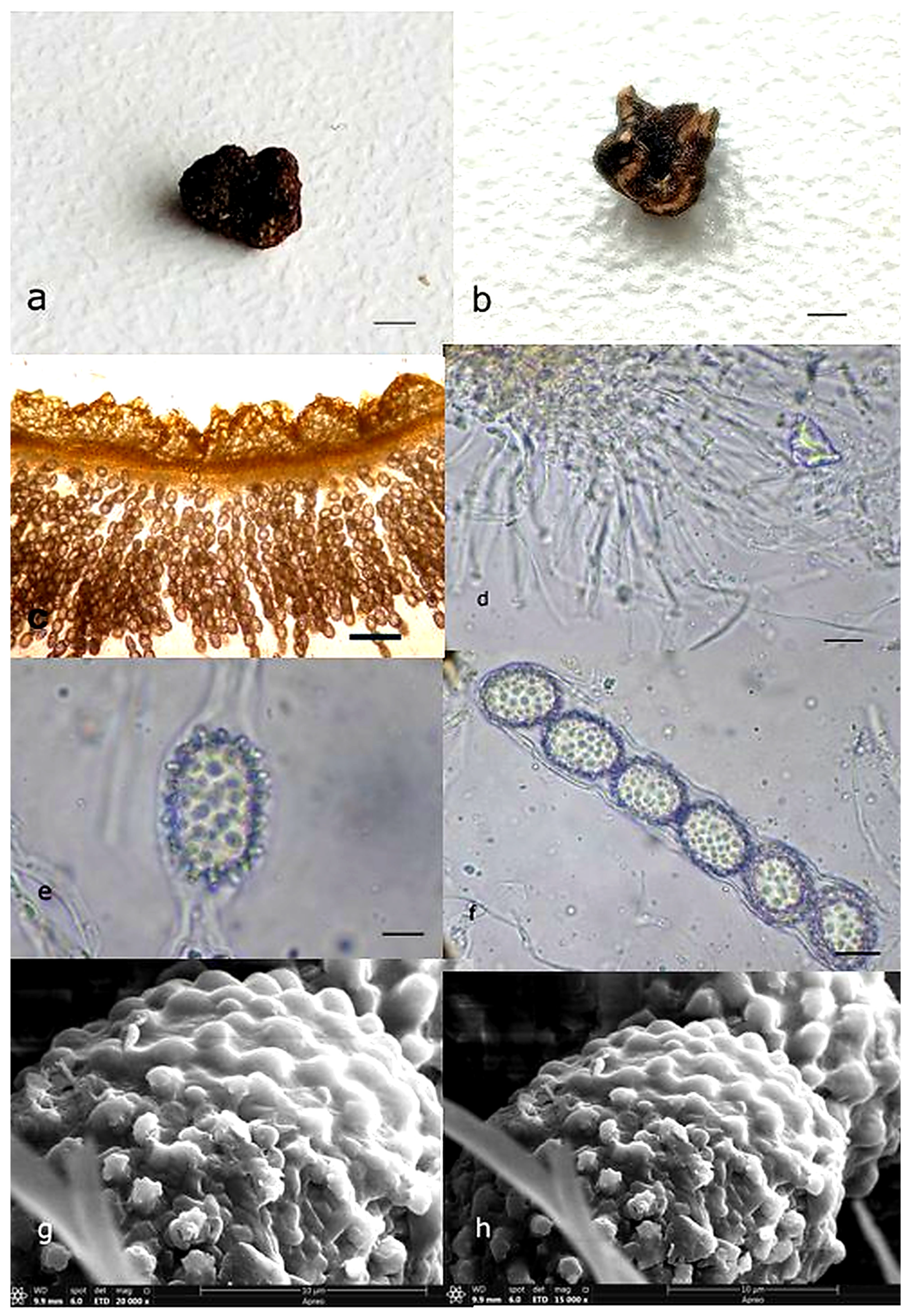
3.1. Morphology
3.2. Molecular Phylogeny
4. Taxonomy
5. Ecology
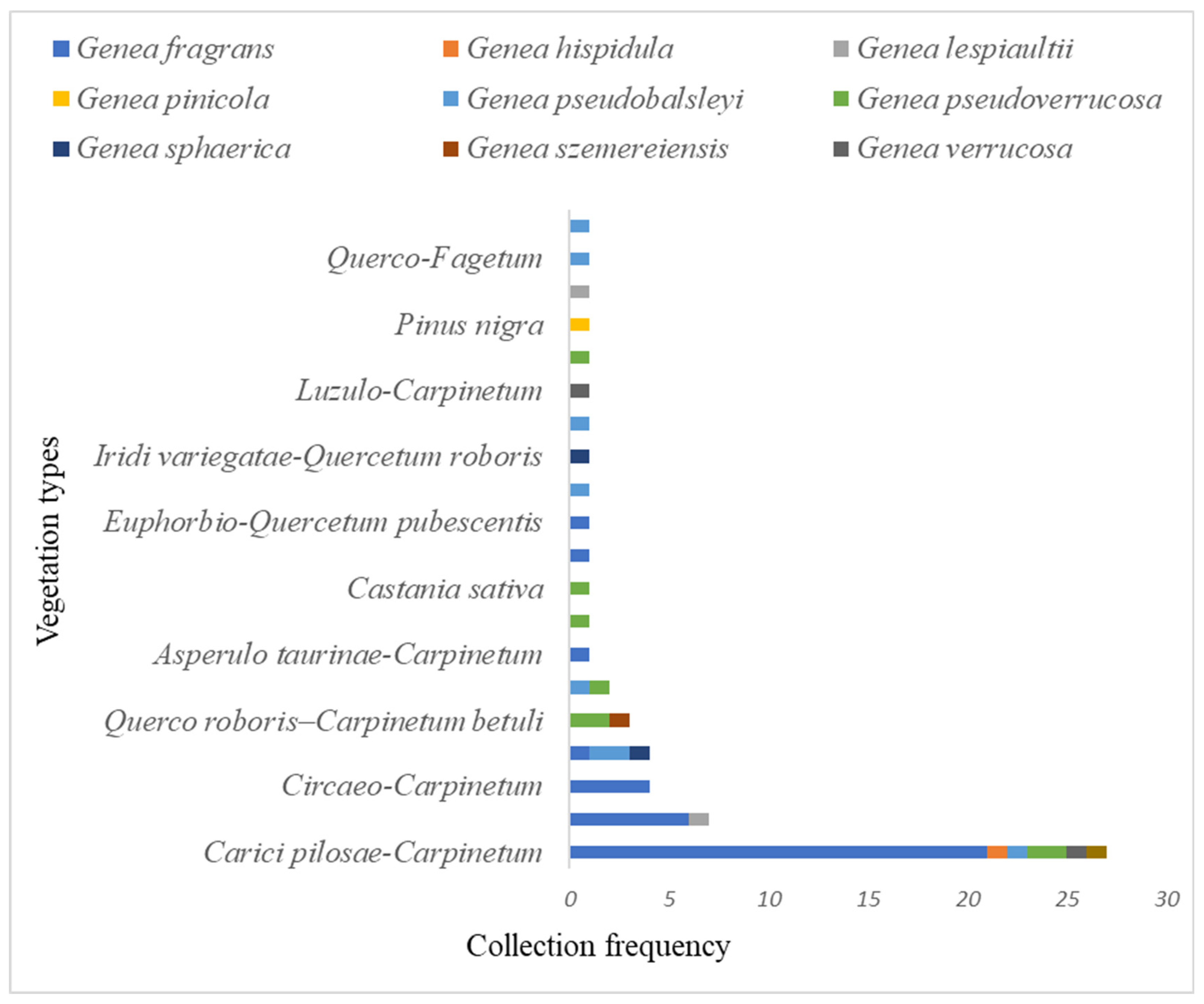
5.1. Habitat
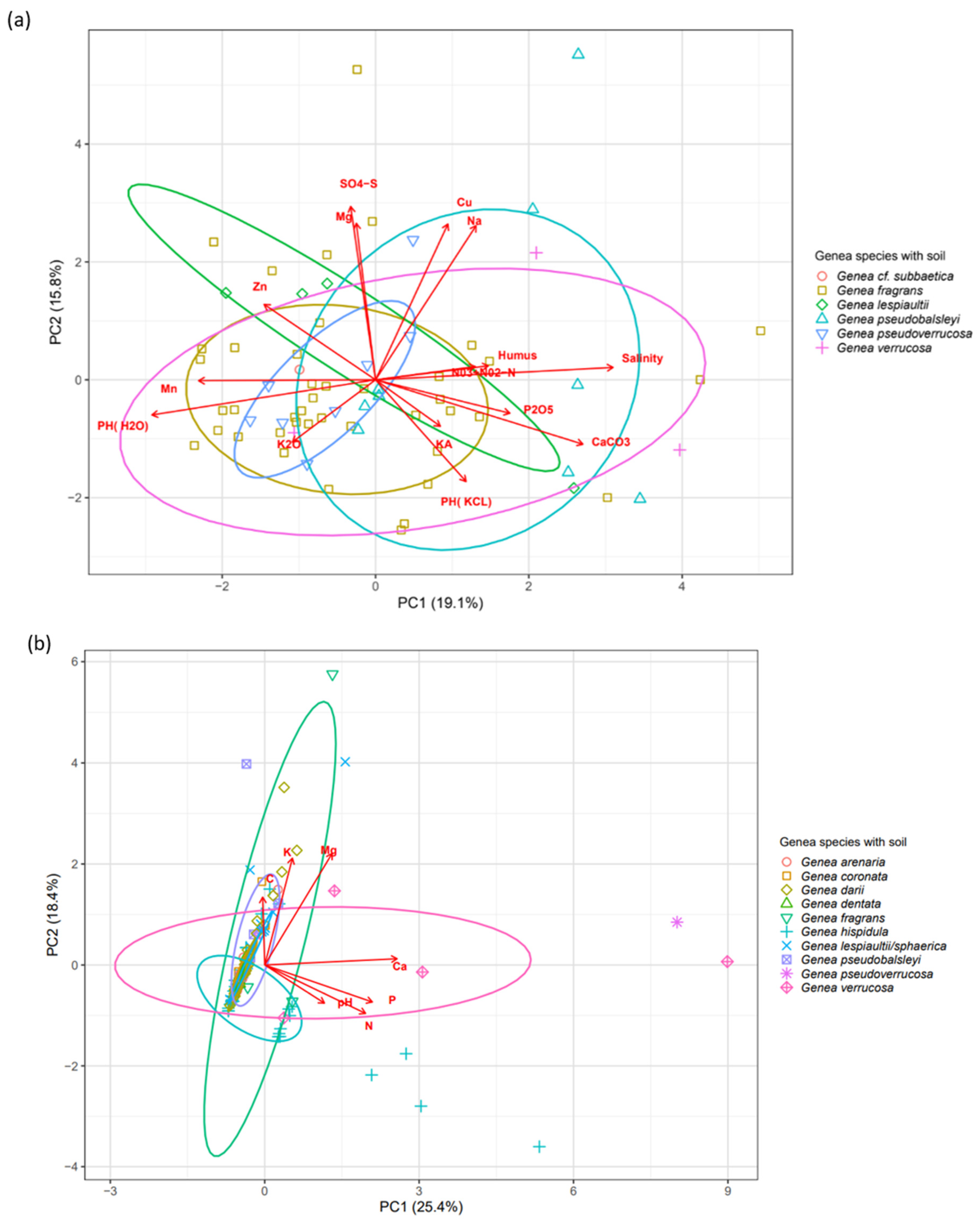
5.2. Soil Characteristics
- Key to European Genea species
| 1a. Ascomata black or reddish, often regularly lobed……………………………………2 |
| 1b. Ascomata black or reddish, generally irregularly lobed, ………….…………………3 |
| 1c. Ascomata brown, tan, yellowish or reddish……………………………………………7 |
| 2a. Spores ornamented with flat warts…………………………….………… G. lespiaultii |
| 2b. Spores ornamented with small irregular warts…………………………… G. lobulata |
| 2c. Spores ornamented with hemispherical warts………………….………… G. sphaerica |
| 3a. Spores > 32 μm long with anvil-shaped warts (see also 6g) …………………………4 |
| 3b. Spores < 32 μm long ……………………………………………………………………5 |
| 4a. Irregularly lobed, tiny, blunt warts, small tuft of hyphae……….……… G. fragrans |
| 4b. Moderately lobed, polygonal warts, abundant tuft of hyphae………… G. fageticola |
| 5a. Truncated sporal warts > 2 μm broad ……………………………G. pseudoverrucosa |
| 5b. Sporal warts typically > 2 μm broad, covered with conical and irregular and occasionally truncated ornamentation………………………………………… G. szemereiensis |
| 5c. Sporal warts < 2 μm broad, with small polygonal peridial warts……G. pseudobalsleyi |
| 5d. Spores with a combination of irregular, pointed or conical warts…….…………… 6 |
| 6a. Sporal warts > 3 μm high, either fang-like or molarlike …………………G. dentata |
| 6b. Sporal warts pyramidal/pointed, irregularly lobed with truncated spore ornaments 3–5 (–6) μm high………………………………………………………G. cephalonicae |
| 6c. Subglobose spores, mucronate warts with tooth-like sporal ornaments………………….…………………………………………….………….… G. coronata |
| 6d. Irregular, pointed, conical spores, fruiting in spring or summer………. G.verrucosa |
| 6e. Irregular, rounded or pointed spores, fruiting in winter………………. G. subbaetica |
| 6f. Conical sporal warts < 32 μm long……………………………………… G. compressa |
| 6g. Conical sporal warts > 32 μm long……………………………………. G. vagans |
| 7a. Spores > 36 μm long, obtuse, roundish warts…………………………… G. hispidula |
| 7b. Spores < 30 μm long, trunco-conical or almost cubical warts, reddish color layer between external |
| pseudoparenchymatic layer and an inner prosenchymatic layer………… G. zamorana |
| 7c. Spores > 21 μm long ……………………………….………………….………………… 8 |
| 8a. Associated with Pinus spp., with medium truncated warts ……………. G. pinicola |
| 8b. Associated with Quercus spp., with medium truncated warts …… G. brunneocarpa |
| 8c. Large hemispherical sporal warts ……………………………………………G. oxygala |
| 8d. Small pointed sporal warts ………………………….…………….…… G. tuberculata |
6. Discussion
Supplementary Materials
Author Contributions
Funding
Institutional Review Board Statement
Informed Consent Statement
Data Availability Statement
Acknowledgments
Conflicts of Interest
References
- Vittadini, C. Monographia Tuberacearum; Mediolani: Milan, Italy, 1831. [Google Scholar]
- Læssøe, T.; Hansen, K. Truffle Trouble: What Happened to the Tuberales? Mycol. Res. 2007, 111, 1075–1099. [Google Scholar] [CrossRef] [PubMed]
- Alvarado, P.; Moreno, G.; Bratek, Z. Species Diversity of Genea (Ascomycota, Pezizales) in Europe. Ascomycete 2014, 6, 41–51. [Google Scholar] [CrossRef]
- Trappe, J.M. The Orders, Families, and Genera of Hypogeous Ascomycotina (Truffles and Their Relatives). Mycotaxon 1979, 9, 297–340. [Google Scholar] [CrossRef]
- Pfister, D.H. Genea-Jafneadelphus—A Tuberalean-Pezizalean Connection. Mycologia 1984, 76, 170–172. [Google Scholar] [CrossRef]
- Smith, M.E.; Trappe, J.M.; Rizzo, D.M. Genea, Genabea and Gilkeya Gen. Nov.: Ascomata and Ectomycorrhiza Formation in a Quercus Woodland. Mycologia 2006, 98, 699–716. [Google Scholar] [CrossRef] [PubMed]
- Perry, B.A.; Hansen, K.; Pfister, D.H. A Phylogenetic Overview of the Family Pyronemataceae (Ascomycota, Pezizales). Mycol. Res. 2007, 111, 549–571. [Google Scholar] [CrossRef] [PubMed]
- Zhang, B.C. Taxonomic Status of Genabea, with Two New Species of Genea (Pezizales). Mycol. Res. 1991, 95, 986–994. [Google Scholar] [CrossRef]
- Moreno-Arroyo, B.; Gómez, J.; Calonge, F.D. Genea subbaetica, sp. nov., from Spain. Bol. Soco Mico/Madr. 1998, 23, 85–89. [Google Scholar]
- Smith, M.E. NATS truffle and truffle-like fungi 15: Genea balsleyi sp. nov. (Pyronemataceae), a new hypogeous ascomycete from New Jersey. Mycotaxon 2007, 99, 239–244. [Google Scholar] [CrossRef]
- Guevara-Guerrero, G.; Stielow, B.; Tamm, H.; Cázares-Gonzalez, E.; Göker, M. Genea Mexicana, Sp. Nov., and Geopora Tolucana, Sp. Nov., New Hypogeous Pyronemataceae from Mexico, and the Taxonomy of Geopora Reevaluated. Mycol. Prog. 2011, 11, 711–724. [Google Scholar] [CrossRef]
- Alvarado, P.; Cabero, J.; Moreno, G.; Bratek, Z.; van Vooren, N.; Kaounas, V.; Konstantinidis, G.; Agnello, C.; Merényi, Z.; Smith, M.E.; et al. Phylogenetic Overview of the Genus Genea (Pezizales, Ascomycota) with an Emphasis on European Taxa. Mycologia 2016, 108, 441–456. [Google Scholar] [CrossRef]
- Agnello, C.; Kaounas, V.; Alvarado, P. Genea gorii, una nuova specie descritta dall’Italia meridionale. Riv. Micol. 2016, 59, 195–202. [Google Scholar]
- Paz, A.; Chautrand, P.; Lavoise, C. Genea amici una especie nueva encontrada en Córcega. Yesca 2016, 28, 139–150. [Google Scholar]
- Paz, A.; Chautrand, P.; Lavoise, C. Genea darii une nouvelle espèce du sud de l’Europe. Bull. Féd. Des. Assoc. Mycol. Méditerr. 2019, 55, 3–14. [Google Scholar]
- Ribes, M.A.; Hernanz, J.; Tello, S.; Campos, J.C.; Paz, I.; Sánchez, G.; Pancorbo, F.; Serrano, F. Contribución al Conocimiento de La Biodiversidad Fúngica Del Parque Nacional de Ordesa y Monte Perdido I. Pirineos 2016, 171, e021. [Google Scholar] [CrossRef]
- Kaounas, V.; Agnello, C.; Alvarado, P. Genea cephalonicae sp. nov. Ascomycota, Pezizales, a new hypogeous species from Greece. Ascomycete.org J. 2016, 8, 105–110. [Google Scholar] [CrossRef]
- Crous, P.W.; Osieck, E.R.; Jurjević, Ž.; Boers, J.; van Iperen, A.L.; Starink-Willemse, M.; Dima, B.; Balashov, S.; Bulgakov, T.S.; Johnston, P.R.; et al. Fungal Planet Description Sheets: 1284–1382. Pers. Mol. Phylogeny Evol. Fungi 2021, 47, 178–374. [Google Scholar] [CrossRef]
- Bidartondo, M.I.; Baar, J.; Bruns, T.D. Low Ectomycorrhizal Inoculum Potential and Diversity from Soils in and near Ancient Forests of Bristlecone Pine (Pinus longaeva). Can. J. Bot. 2001, 79, 293–299. [Google Scholar] [CrossRef]
- Izzo, A.; Agbowo, J.; Bruns, T.D. Detection of Plot-Level Changes in Ectomycorrhizal Communities across Years in an Old-Growth Mixed-Conifer Forest. New Phytol. 2005, 166, 619–630. [Google Scholar] [CrossRef]
- Izzo, A.D.; Meyer, M.; Trappe, J.M.; North, M.; Bruns, T.D. Hypogeous Ectomycorrhizal Fungal Species on Roots and in Small Mammal Diet in a Mixed-Conifer Forest. For. Sci. 2005, 51, 243–254. [Google Scholar] [CrossRef]
- Vrålstad, T.; Holst-Jensen, A.; Schumacher, T. The postfire discomycete Geopyxis carbonaria (Ascomycota) is a biotrophic root associate with Norway spruce (Picea abies) in nature. Mol. Ecol. 1998, 7, 609–616. [Google Scholar] [CrossRef] [PubMed]
- Grogan, P.; Baar, J.; Bruns, T.D. Below-ground ectomycorrhizal community structure in a recently burned bishop pine forest. J. Ecol. 2000, 88, 1051–1062. [Google Scholar] [CrossRef]
- Fujimura, K.E.; Smith, J.E.; Horton, T.R.; Weber, N.S.; Spatafora, J.W. Pezizalean Mycorrhizas and Sporocarps in Ponderosa Pine (Pinus ponderosa) after Prescribed Fires in Eastern Oregon, USA. Mycorrhiza 2004, 15, 79–86. [Google Scholar] [CrossRef] [PubMed]
- Parks, H.E. California Hypogaeous Fungi—Tuberaceae. Mycologia 1921, 13, 301–314. [Google Scholar] [CrossRef]
- Maser, C.; Trappe, J.M.; Nussbaum, R.A. Fungal-Small Mammal Interrelationships with Emphasis on Oregon Coniferous Forests. Ecology 1978, 59, 799–809. [Google Scholar] [CrossRef]
- Berkeley, M.J.; Broome, C.E. IX- Notices of British Hypogœous Fungi. Ann. Mag. Nat. Hist. 1846, 18, 73–82. [Google Scholar] [CrossRef]
- Tulasne, L.R.; Tulasne, C. Fungi Hypogaei: Histoire et Monographie des Champignons Hypogés; F. Klincksieck: Paris, France, 1851. [Google Scholar]
- Corda, A.C.I. Icones Fungorum Hucusque Cognitorum; F. Ehrlich: Prague, Czech Republic, 1854; Volume 6. [Google Scholar]
- Saccardo, P.A. Sylloge Fungorum Hucusque Cognitorum; Patavii, Italia; 1889; Volume 8, Available online: https://archive.org/details/syllogefungorumo08sacc/page/n9/mode/2up (accessed on 5 June 2026).
- Bresadola, J. Mycetes australienses novi, ct emendanda ad Floram Mycologicam Australiae. Hedwigw 1893, 32, 118–119. [Google Scholar]
- Harkness, H.W. California Hypogaeous Fungi; California Academy of Sciences: San Francisco, CA, USA, 1899; Volume 1. [Google Scholar]
- Mattirolo, O. Elenco dei “fungi hypogaei” raccolti nelle Foreste di Vallombrosa negli anni 1899–1900. Malpighia 1990, 14, 1–24. [Google Scholar]
- Mattirolo, O. Gli ipogei di Sardegna e di Sicilia. Malpighia 1990, 14, 39–110. [Google Scholar]
- Velenovský, J. České Houby; České Botanické Společnosti: Prague, Czech Republic, 1992; Volumes 4–5. [Google Scholar]
- Imai, S. On Two New Species of Tuberaceae. Proc. Imp. Acad. 1933, 9, 182–185. [Google Scholar] [CrossRef][Green Version]
- Gilkey, H. Tuberales of North America; Oregon State College: Corvallis, OR, USA, 1939; Volume 1. [Google Scholar]
- Cribb, J.W. Two New Species of Subterranean Ascomycetes from Queensland; Papers from the Department of Botany; The University of Queensland: Brisbane, Australia, 1960; Volume 4, pp. 35–37. [Google Scholar]
- Trappe, J.M.; Guzmán, G. Notes on Some Hypogeous Fungi from Mexico. Mycologia 1971, 63, 317–332. [Google Scholar] [CrossRef]
- Stewart, E.L.; Heblack, R.K. Hypogeous fungi of Minnesota: Genea anthracina sp. nov. Mycotaxon 1979, 9, 451–458. [Google Scholar] [CrossRef]
- Alvarado, P.; Pérez, J.B.; van Vooren, N.; Bernauer, T.; Hensel, G.; Scholler, M. Genea coronata (Pyronemataceae, Pezizales), a Cryptic New Species in a Highly Polymorphic Genus. Sydowia 2021, 73, 1–12. [Google Scholar] [CrossRef]
- Bratek, Z.; Bratek, Z.; Merényi, Z.; Varga, T. Changes of Hypogeous Funga in the Carpathian-Pannonian Region in the Past Centuries. Acta Mycol. 2013, 48, 33–39. [Google Scholar] [CrossRef][Green Version]
- Merényi, Z.; Illyés, Z.; Völcz, G.; Bratek, Z. A database and its application for the development of truffle cultivation methods. Osterr. Z. Für Pilzkd. 2010, 19, 239–244. [Google Scholar]
- Royal Botanic Garden Edinburgh. Flora of British Fungi: Colour Identification Chart; Her Majesty’s Stationery Office: Edinburgh, UK, 1969. [Google Scholar]
- Koske, R.E.; Tessier, B. A convenient, permanent slide mounting medium. Newsl. Mycol. Soc. Amer. 1983, 34, 133–142. [Google Scholar]
- Gardes, M.; Bruns, T.D. ITS Primers with Enhanced Specificity for Basidiomycetes—Application to the Identification of Mycorrhizae and Rusts. Mol. Ecol. 1993, 2, 113–118. [Google Scholar] [CrossRef] [PubMed]
- O’Donnell, K. Fusarium and its near relatives. In The Fungal Holomorph: Mitotic, Meiotic and Pleomorphic Speciation in Fungal Systematics; Reynolds, D.R., Taylor, J.W., Eds.; CAB International: Wallingford, UK, 1993; pp. 225–233. [Google Scholar]
- Altschul, S.F.; Madden, T.L.; Schäffer, A.A.; Zhang, J.; Zhang, Z.; Miller, W.; Lipman, D.J. Gapped BLAST and PSI-BLAST: A New Generation of Protein Database Search Programs. Nucleic Acids Res. 1997, 25, 3389–3402. [Google Scholar] [CrossRef] [PubMed]
- Lemoine, F.; Correia, D.; Lefort, V.; Doppelt-Azeroual, O.; Mareuil, F.; Cohen-Boulakia, S.; Gascuel, O. NGPhylogeny.Fr: New Generation Phylogenetic Services for Non-Specialists. Nucleic Acids Res. 2019, 47, W260–W265. [Google Scholar] [CrossRef]
- Abarenkov, K.; Nilsson, R.H.; Larsson, K.H.; Taylor, A.F.S.; May, T.W.; Frøslev, T.G.; Pawlowska, J.; Lindahl, B.; Põldmaa, K.; Truong, C.; et al. The UNITE Database for Molecular Identification and Taxonomic Communication of Fungi and Other Eukaryotes: Sequences, Taxa and Classifications Reconsidered. Nucleic Acids Res. 2024, 52, D791–D797. [Google Scholar] [CrossRef]
- Katoh, K.; Standley, D.M. MAFFT Multiple Sequence Alignment Software Version 7: Improvements in Performance and Usability. Mol. Biol. Evol. 2013, 30, 772–780. [Google Scholar] [CrossRef]
- Notredame, C.; Higgins, D.G.; Heringa, J. T-Coffee: A Novel Method for Fast and Accurate Multiple Sequence Alignment. J. Mol. Biol. 2000, 302, 205–217. [Google Scholar] [CrossRef]
- Tamura, K.; Stecher, G.; Peterson, D.; Filipski, A.; Kumar, S. MEGA6: Molecular Evolutionary Genetics Analysis Version 6.0. Mol. Biol. Evol. 2013, 30, 2725–2729. [Google Scholar] [CrossRef]
- Darriba, D.; Taboada, G.L.; Doallo, R.; Posada, D. jModelTest 2: More Models, New Heuristics and Parallel Computing. Nat. Methods 2012, 9, 772. [Google Scholar] [CrossRef]
- Guindon, S.; Gascuel, O. A simple, fast, and accurate algorithm to estimate large phylogenies by maximum likelihood. Syst. Biol. 2003, 52, 696–704. [Google Scholar] [CrossRef] [PubMed]
- Guindon, S.; Dufayard, J.F.; Lefort, V.; Anisimova, M.; Hordijk, W.; Gascuel, O. New Algorithms and Methods to Estimate Maximum-Likelihood Phylogenies: Assessing the Performance of PhyML 3.0. Syst. Biol. 2010, 59, 307–321. [Google Scholar] [CrossRef]
- Tamura, K.; Nei, M. Estimation of the Number of Nucleotide Substitutions in the Control Region of Mitochondrial DNA in Humans and Chimpanzees. Mol. Biol. Evol. 1993, 10, 512–526. [Google Scholar] [CrossRef] [PubMed]
- Huelsenbeck, J.P.; Ronquist, F. MRBAYES: Bayesian Inference of Phylogenetic Trees. Bioinformatics 2001, 17, 754–755. [Google Scholar] [CrossRef] [PubMed]
- Letunic, I.; Bork, P. Interactive Tree of Life (iTOL) v6: Recent Updates to the Phylogenetic Tree Display and Annotation Tool. Nucleic Acids Res. 2024, 52, W78–W82. [Google Scholar] [CrossRef]
- Wickham, H. Ggplot2; Springer: Berlin/Heidelberg, Germany, 2016. [Google Scholar] [CrossRef]
- Lê, S.; Josse, J.; Husson, F. FactoMineR: An R Package for Multivariate Analysis. J. Stat. Softw. 2008, 25, 1–18. [Google Scholar] [CrossRef]
- Türkoğlu, A.; Castellano, M.A. New Records of Some Ascomycete Truffle Fungi from Turkey. Turk. J. Bot. 2014, 38, 406–416. [Google Scholar] [CrossRef]
- Bertolini, V. Funghi ipogei: Uno sguardo alle Genea. Boll. Del Circ. Micol. G. Carini 2014, 67, 21–40. [Google Scholar]
- Salman, A.; Tsror, L.; Pomerantz, A.; Moreh, R.; Mordechai, S.; Huleihel, M. FTIR Spectroscopy for Detection and Identification of Fungal Phytopathogenes. J. Spectrosc. 2010, 24, 261–267. [Google Scholar] [CrossRef]
- Ji, Y.; Yang, X.; Ji, Z.; Zhu, L.; Ma, N.; Chen, D.; Jia, X.; Tang, J.; Cao, Y. DFT-Calculated IR Spectrum Amide I, II, and III Band Contributions of N-Methylacetamide Fine Components. ACS Omega 2020, 5, 8572–8578. [Google Scholar] [CrossRef]
- Abarenkov, K.; Tedersoo, L.; Nilsson, R.H.; Vellak, K.; Saar, I.; Veldre, V.; Parmasto, E.; Prous, M.; Aan, A.; Ots, M.; et al. Plutof-a Web Based Workbench for Ecological and Taxonomic Research, with an Online Implementation for Fungal ITS Sequences. Evol. Bioinform. 2010, 6, 189–196. [Google Scholar] [CrossRef]
- Simon, T. Determination Book on Vesicular Flora in Hungary; Nemzeti Tankonyvkiado: Budapest, Hungary, 2000. [Google Scholar]
- Jiao, S.; Chen, W.; Wang, J.; Du, N.; Li, Q.; Wei, G. Soil Microbiomes with Distinct Assemblies through Vertical Soil Profiles Drive the Cycling of Multiple Nutrients in Reforested Ecosystems. Microbiome 2018, 6, 146. [Google Scholar] [CrossRef]
- Li, P.; Li, W.; Dumbrell, A.J.; Liu, M.; Li, G.; Wu, M.; Jiang, C.; Li, Z. Spatial Variation in Soil Fungal Communities across Paddy Fields in Subtropical China. mSystems 2020, 5, 10–1128. [Google Scholar] [CrossRef]
- Li, J.; Xu, Y.; Zhao, J.; Yin, X.; Xu, Z. Response of Microbial Diversity in Soil under Plastic Shed to Different Years of Continuous Cropping. Eurasian Soil Sci. 2022, 55, 1598–1608. [Google Scholar] [CrossRef]
- Kumru, E.; Ediş, G.; Şahin, E.; Keskin, E.; Akata, I. Expanding the Diversity of Genea Vittad. (Ascomycota, Pezizales) in Türkiye: Morphological and Molecular Insights into Newly Recorded Species. Trak. Univ. J. Nat. Sci. 2025, 26, 106–117. [Google Scholar]
- White, T.J.; Bruns, T.; Lee, S.; Taylor, J. Amplification and direct sequencing of fungal ribosomal RNA genes for phylogenetics. In PCR Protocols. A Guide to Methods and Applications; Academic Press: San Diego, CA, USA, 1990; pp. 315–322. [Google Scholar] [CrossRef]
- Crouch, J.A.; Clarke, B.B.; Hillman, B.I. What Is the Value of ITS Sequence Data in Colletotrichum Systematics and Species Diagnosis? A Case Study Using the Falcate-Spored Graminicolous Colletotrichum Group. Mycologia 2009, 101, 648–656. [Google Scholar] [CrossRef]
- Shapkin, V.; Zelenka, T.; Větrovský, T.; Kostovčík, M.; Eichlerová, I.; Kohout, P.; Žifčáková, L.; Borovička, J.; Tomšovský, M.; Adamčík, S.; et al. Limitations of Common Molecular Markers in Fungal Biodiversity Analysis and the Benefits of Their Synergistic Use. Mol. Ecol. Resour. 2026, 26, e70123. [Google Scholar] [CrossRef]
- Kapli, P.; Lutteropp, S.; Zhang, J.; Kobert, K.; Pavlidis, P.; Stamatakis, A.; Flouri, T. Multi-Rate Poisson Tree Processes for Single-Locus Species Delimitation under Maximum Likelihood and Markov Chain Monte Carlo. Bioinformatics 2017, 33, 1630–1638. [Google Scholar] [CrossRef]
- Zhang, J.; Kapli, P.; Pavlidis, P.; Stamatakis, A. A General Species Delimitation Method with Applications to Phylogenetic Placements. Bioinformatics 2013, 29, 2869–2876. [Google Scholar] [CrossRef]
- Carstens, B.C.; Pelletier, T.A.; Reid, N.M.; Satler, J.D. How to Fail at Species Delimitation. Mol. Ecol. 2013, 22, 4369–4383. [Google Scholar] [CrossRef]
- Hollós, L. Magyarország Földalatti Gombái, Szarvasgombaféléi. (Fungi Hypogaei Hungariae.); K.M. Természettudományi Társulat: Budapest, Hungary, 1911. [Google Scholar]
- Szemere, L. Die Unterirdischen Pilze des Karpatenbeckens; Akadémiai Kiadó: Budapest, Hungary, 1965. [Google Scholar]
- Jakucs, E.; Erős-Honti, Z.; Seress, D.; Kovács, G.M. Enhancing Our Understanding of Anatomical Diversity in Tomentella Ectomycorrhizas: Characterization of Six New Morphotypes. Mycorrhiza 2015, 25, 419–429. [Google Scholar] [CrossRef]
- Habtemariam, A.A.; Cseh, P.; Péter, B.; Heller, Á.; Pitlik, P.; Brandt, S.; László, P.; Bratek, Z. Analysis of Mycorrhization Trends and Undesired Fungi Species in Three- and Six-Year-Old Tuber Aestivum Plantations in Hungary. J. Fungi 2024, 10, 696. [Google Scholar] [CrossRef]
- Jakucs, E.; Bratek, Z.; Agerer, R. Genea verrucosa Vitt.+ Quercus spec. Descr. Ectomycorrhizae 1998, 3, 7–11. [Google Scholar]
- Rogerson, C.T.; Samuels, G.J. Species of Hypomyces and Nectria Occurring on Discomycetes. Mycologia 1985, 77, 763–783. [Google Scholar] [CrossRef]


Disclaimer/Publisher’s Note: The statements, opinions and data contained in all publications are solely those of the individual author(s) and contributor(s) and not of MDPI and/or the editor(s). MDPI and/or the editor(s) disclaim responsibility for any injury to people or property resulting from any ideas, methods, instructions or products referred to in the content. |
© 2026 by the authors. Licensee MDPI, Basel, Switzerland. This article is an open access article distributed under the terms and conditions of the Creative Commons Attribution (CC BY) license.
Share and Cite
Chakraborty, S.; Tirpude, S.A.; Péter, B.D.; Walle, G.C.; Habtemariam, A.A.; Kedves, A.; Balogh, M.; Kónya, Z.; Bratek, Z. Taxonomy, Phylogeny and Ecological Assessment of the Truffle Genus Genea in Central Europe with a New Species and a New Record. Diversity 2026, 18, 360. https://doi.org/10.3390/d18060360
Chakraborty S, Tirpude SA, Péter BD, Walle GC, Habtemariam AA, Kedves A, Balogh M, Kónya Z, Bratek Z. Taxonomy, Phylogeny and Ecological Assessment of the Truffle Genus Genea in Central Europe with a New Species and a New Record. Diversity. 2026; 18(6):360. https://doi.org/10.3390/d18060360
Chicago/Turabian StyleChakraborty, Swagata, Shruti Anand Tirpude, Balázs Domonkos Péter, Getnet Chekole Walle, Akale Assamere Habtemariam, Alfonz Kedves, Máté Balogh, Zoltán Kónya, and Zoltán Bratek. 2026. "Taxonomy, Phylogeny and Ecological Assessment of the Truffle Genus Genea in Central Europe with a New Species and a New Record" Diversity 18, no. 6: 360. https://doi.org/10.3390/d18060360
APA StyleChakraborty, S., Tirpude, S. A., Péter, B. D., Walle, G. C., Habtemariam, A. A., Kedves, A., Balogh, M., Kónya, Z., & Bratek, Z. (2026). Taxonomy, Phylogeny and Ecological Assessment of the Truffle Genus Genea in Central Europe with a New Species and a New Record. Diversity, 18(6), 360. https://doi.org/10.3390/d18060360