Article

A Step Too Far: Culling a Native Australian Honeyeater, the Noisy Miner (Manorina melanocephalis), for ‘Conservation’: Biases, Contradictions, and Myth-Making

by
Gisela Kaplan
School of Science and Technology, University of New England, Armidale, NSW 2350, Australia
Diversity 2026, 18(2), 99; https://doi.org/10.3390/d18020099
Submission received: 16 June 2025 / Revised: 16 January 2026 / Accepted: 18 January 2026 / Published: 5 February 2026
(This article belongs to the Special Issue Socioecology and Biodiversity Conservation—2nd Edition)

Abstract

Birds of the Anthropocene have to adapt to changing and often very unfavourable conditions, among them habitat fragmentation or outright habitat loss. Many organisations worldwide are deeply committed to stemming the tide of extinctions of native species and maintaining biodiversity. The question is how far scientists and practitioners are willing to go to achieve conservation goals in situations that are not entirely resolved, are contradictory, or involve dubious claims about alleged causative agents. The noisy miner, Manorina melanocephala, has been painted as such a causative agent in the decline of small woodland birds. The noisy miner is a highly successful, flexible, and socially complex small native Australian honeyeater (woodland bird). As will be shown in a new data analysis, the noisy miner also ranks highly in cognitive abilities. Despite its status as a native species, a protracted campaign against the species has led to government policies permitting its culling in New South Wales due to its alleged ‘overabundance’ and ‘harmful’ impact on small woodland birds. As a consequence, noisy miners can now be shot legally and have been culled in their thousands in the last decade. Allegedly, these actions have been taken for conservation purposes. This paper raises significant doubts about the claims against this species, and the methods and ethics of how a native species can become the sole bearer of the ills of the Anthropocene. This paper exposes bias or misinterpreted evidence and shows how myth-making is possible in modern science and how language can purposefully mislead the public via characterisations of avian behaviour. In essence, this paper is a case study of ethical issues in science: about the degree and type of intervention, and how far we are willing to go in the name of conservation, particularly when based on spurious or contradictory evidence and at the cost of native animals.

1. Introduction

Birds function in a range of social, ecological, and human-manipulated environments and must learn to adapt and survive under very specific and often dramatically changing and challenging conditions. Social organization shapes the behavioural options available to birds and profoundly influences the evolution of their social behaviour and reproductive strategies [1]. External circumstances can lead to unfavourable conditions that individual groups and species may have to overcome and solve via cooperation [2]. Species have had to deal with such issues throughout their evolution, and speciation has often depended on changes in environments, but never with so many variables and in such a short period of time as in the Anthropocene [3]. Birds may adapt by changing their behaviour, location, or even food sources to reproduce successfully, or, if none of these strategies has worked and other strategies of adaptation have so far failed in the short period of time that human encroachments on their living space have allowed, they slide towards extinction.
The decline of bird numbers is well-known, and the decline of woodland-dependent birds, especially small woodland birds [4,5,6], is not specific or unique to Australia but is a worldwide phenomenon. Woodland birds (of a similar weight range) are declining all over the world [7,8], although this is not limited to their category alone. Farmland and grassland bird numbers and species are also declining [9,10,11,12]. Many publications on the current state of birds centre around conservation and focus on identifying (and rectifying) some of the causes of decline. To save birds and other vertebrates, we need to know as much as we can about why their numbers are declining, and this presupposes knowledge about every aspect of their life histories, along with their basic needs, behaviour, abilities, and reproductive habits. Indeed, we have never collected so much information on every aspect of avian life as in the last 50 years [13,14,15].
However, conservation has moved in many different directions and actions. Some theories and practices have been very insightful, progressive, and successful, while other recent actions might be regarded as highly controversial or counter-conservationist. This paper will report on the latter: concerning just one native Australian honeyeater species, the noisy miner, Manorina melanocephala [16], raising many issues, including the ‘kill for conservation’ dictum [17], which has no redress if the culls turn out to be futile, wrong, or based on false assumptions. The noisy miner is such a test case. Particularly in the last twenty-five years or so, a truly extraordinary attitudinal shift from positive to negative opinions has occurred [18], possibly unique in recent conservation history, excepting the long-standing persecutory history of the common starling (Sturnus vulgaris) [19]. The shift in attitude perhaps gained momentum with the publication of the Handbook of Australian, New Zealand and Antarctic Birds [20].
Since then, the noisy miner has been denigrated in all sorts of ways. No effort seems to have been spared to create and reinforce the disrepute of this species that occurs by calling it ‘aggressive’ [21,22], ’hyper-aggressive’ [23], ‘despotic’ [24,25,26,27,28,29,30], and even ‘notorious’ [31]. These adjectives are opinion-based, value judgments usually applied to humans, not scientific, neutral, or descriptive terms for animal characteristics.
Recent scientific publications have argued that the behaviour of noisy miners is undesirable and needs to be managed and that the birds need to be eliminated from areas in which they are deemed ‘overabundant’ [32,33]. The term ‘overabundance’ originated from (a) sightings of noisy miners congregating in large numbers at specific sites (apparently as many as 200/250 individuals), and (b) observations that the miners excluded other woodland-dependent birds from their territory [23].
The focus on this apparently ‘villainous’ songbird reached the point at which the media published negative views of noisy miners. In 2011, the Adelaide Advertiser newspaper reported that “Scientists want noisy miners culled” [33], and I am not aware that the public had any major objections at the time. The Australian Broadcasting Corporation (ABC) broadened the condemnation of the species to apply throughout Australia and proclaimed that the noisy miner is allegedly “Australia’s most hated bird” [34,35]. I doubt that this statement is correct. Time and again the public has tended to confuse (in name at least, not necessarily in appearance) the noisy miner (60–80 g) with the common myna, Acridotheres tristis, an introduced, clever and highly invasive, large starling species (110–140 g) that actively competes and even kills native parrots for access to their nest holes [36]. In 2017, in a newsletter of a local Bird Observers Club, there appeared an article with the dubious title “Miner surgery: repairing woodland bird diversity by Noisy Minectomy” [37].
Based on the published evidence [23,24,25,26,27,28,29,30], it was considered an urgent task for the survival of avian woodland species to address the noisy miner ‘problem’ by acting decisively to reduce noisy miner numbers. Such action, it was believed, would be restorative and allow other woodland-dependent avian species to recover [38]. Eventually, these characterisations of the noisy miner escalated into declaring the bird a threat to the survival of avian woodland species [21,39]. The matter culminated in 2013 in a ‘final determination’ of a legally enshrined framework that the noisy miner was a threat and had to be suppressed [40]. Alarmingly, this officially now permitted the killing of noisy miners where and when the bird was considered ‘overabundant’ [40].
Once the conclusion of ‘overabundance’ was reached and the ‘suppression’ of noisy miners was put in place for reasons of the alleged positive consequences for woodland birds, a strategy was devised to shoot thousands of noisy miners (mainly between 2010 and 2020). This killing spree happened with government approval, with the full permission of university ethics committees, and the methods were not queried by journals that accepted the resulting papers for publication, since culling this native bird was permitted within new state government regulations specifically naming the noisy miner as a threat and giving the green light to cull them [40].
The official condemnation of noisy miners is a permanent legislative feature and, as I understand it, would need to be challenged and rescinded if its native status as a protected species is to be regained. The species is now an outlaw in New South Wales, the state that has probably the majority of all noisy miners extant in Australia. If the legal determination allowing culling is not removed in the near future, the policy is, in fact, an official verdict on and recipe for the legislated extinction of a native bird. Perhaps this new category of ‘legislated extinction’ is a novelty in conservation, although so far, the birds have fought back and recolonised in most places [41].
Moreover, there may be very different interpretations for the phenomenon of ‘over-abundance’, and some of these will be proposed in this paper. For instance, unusual bird assemblages may be an indicator (an outcome) of ecosystem dysfunction and instability in general [42], i.e., they cannot be attributed to one species alone. Indeed, it is now recognised that whole ecosystems are degrading even more rapidly than previously thought [43]. Hence, the perceived overabundance of noisy miners, even if just in some areas, might be an outcome and symptom of ecosystem dysfunction, not based on the threatening quality of the outcast species. If this conclusion applies, the case against noisy miners becomes very weak. The judgement of the species as an intrinsic disruptor may have hinged on false premises and led to incorrect conclusions, which, nevertheless, have led and could well lead to more and more lethal outcomes for many miners.
Further, to imply or state that a single native bird alone is responsible for the decline of other woodland birds is both scientifically and logically implausible, as well as ethically questionable, thus ultimately misleading, if not entirely incorrect. One also fails to see how the decision-making process of meeting ecological instability by creating even harsher instability could be a logical solution for creating stability. Further, whether a native bird is ‘too’ abundant (‘overabundant’) and/or is a perceived risk to other native bird communities may not be all that easy to establish over the species’ entire range (especially difficult in a continent as large as Australia).
Woinarski asked the broad question of whether it is right to ‘kill Peter to save Paul’ [44]. This question has broad theoretical and applied ramifications for how species are managed. It has sparked ongoing ethical and policy debates in conservation circles, for instance, in North American debates about two native owls, one declining, the other invading the territory of the declining one [45]. It raises the questions of what purpose such management decisions serve and whether any such management plans consider the entire life history, needs, and possible stress levels of the concerned species, regardless of numbers (too few or too many individuals).
This paper will give a summary of what we know about the noisy miner’s evolutionary history, ecology, social life, cognition, and reproductive and feeding strategies, and it will refer to the proximate and ultimate causes of this species’ behaviour. This is to provide a framework for arguing that noisy miners are mostly victims, as are other birds, and indeed other vertebrates and invertebrates [46], and that they do not qualify as perpetrators of environmental damage or the decline of other species. The many reasons for the declining status of birds have been well explored worldwide and in Australia. In Australia, the specific points of concern are habitat fragmentation, dangerous agricultural practices causing sudden resource reductions [47], increased and often inappropriate fire regimes [48], and climate change, including the increasing occurrence of unprecedented and, for birds, non-survivable heatwaves [49], as well as substantial and ongoing habitat loss [50].
Another objective of this paper is to examine the risks of sometimes choosing interpretations that may seem obvious but fail to examine or overlook vital factors, which may well offer more insight into this species and into specific environmental factors. Indeed, the noisy miner case is shown here as an example of why the simplest explanations are not always the best [51] and why ‘naîve’ anthropomorphisms (Burghardt’s term [52]) slipping into descriptions of animal behaviour may invalidate current interpretations of noisy miner behaviour [53,54]. The management plans for noisy miners are used as an example of the risks and misdirection caused by killing native species for conservation purposes.
This paper aims to expose the contradictions and how conservation of native small- to medium-sized avian woodland species, of which the noisy miner is a part, can go so spectacularly wrong and even fall prey to myth-making (details can be found in Section 7.3).
Tragically, the noisy miner may be “innocent”, and the behavioural evidence against it spurious. Even if this were not so, the question is whether conservation efforts are now overstepping the mark by manipulating avian dynamics in natural environments through selective culling and determining which species shall live or die.
Ultimately, this paper raises the often-controversial ethical issues about the degree and type of intervention concerning native species in the natural world (the issue of invasive species is another debate not raised here), how far we are willing to go in the name of conservation [55,56,57,58], and how much harm may be caused by misinformation or perhaps influenced by powerful vested interests.

2. Evolution, Distribution, and Confirmed Positive Attributes of Noisy Miners

2.1. Evolution and Social Ecology of Noisy Miners

It has now been acknowledged for at least two decades that all modern songbirds (post the mass extinctions of 65 mya) first evolved in Australia [59,60]. Only much later did the first oscines, the clade formed by Sylviida, Muscicapida, and Passerida, radiate to Eurasia [61]. The evidence thus shows that Australian songbirds have a distinct indigenous and continuous evolutionary history in East Gondwana, now Australia [59,60,61,62]. The 22 lineages that are said to have survived the mass extinction [62] are purported to have their origin as far back as the late Cretaceous [63], while modern songbirds speciated after the mass extinction of 65 million years ago [63,64,65].
Speciation may happen for several reasons [66,67,68]. Successful adaptive radiation may also depend on the discovery of underused food sources, a process that led to the evolution of and shift to ancestral nectivory. This shift resulted in the exceptional diversity of a large songbird clade, the honeyeaters, Meliphagidae [69], containing co-occurring species that vary in size more than non-nectivorous clades [70]. Latest assessments indicate that the family of honeyeaters (Meliphagidae) consists of 195 species and 74 genera [71]. Some 34 genera are found exclusively in Australia, and some 23 genera on islands and nations around the north and east of Australia (including New Zealand), with a particularly strong presence in New Guinea, once part of the Australian landmass [72].
The Australian honeyeaters include several families: the Australian chats (Epthianura ssp); Myzomelas, the largest group of honeyeaters with 40 species, widespread through Oceania; the spinebills (genus Acanthorhynchus); the friarbirds (genus Philemon); and the wattlebirds (genus Anthochaera), including the seriously endangered regent honeyeater, Anthochaera phrygia, as well as the miners (Manorina). The noisy miner belongs to the latter.
The Meliphagidae have been described as “an iconic and largely Australo-Papuan group” for which “the complexity of the biogeography underlying the group’s spectacular radiation, especially within Australia”, has now been revealed [72]. Ecological and phenotypic diversity is particularly pronounced in the honeyeater subclade (Table 1). Marki et al. [70] pointed out, as others have done before, that the honeyeaters possess a number of unique morphological and physiological adaptations for nectarivory, including structural modifications to the renal system for more efficient balancing of fluid intake [73] and a brush-tipped protrusible tongue [74]. These adaptations helped honeyeaters exploit a novel food source (nectar) and take up an ecological niche largely unoccupied, at least by birds. Their radiation seemed to coincide broadly with the accelerating aridification of Australia [75] in the earlier part of the Oligocene (33.9–23.03 million years ago) and later during the Miocene epoch (23.03–5.03 million years ago) in the absence of any human populations, which, in Australia, began to appear only about 55–65 thousand years ago [76,77].
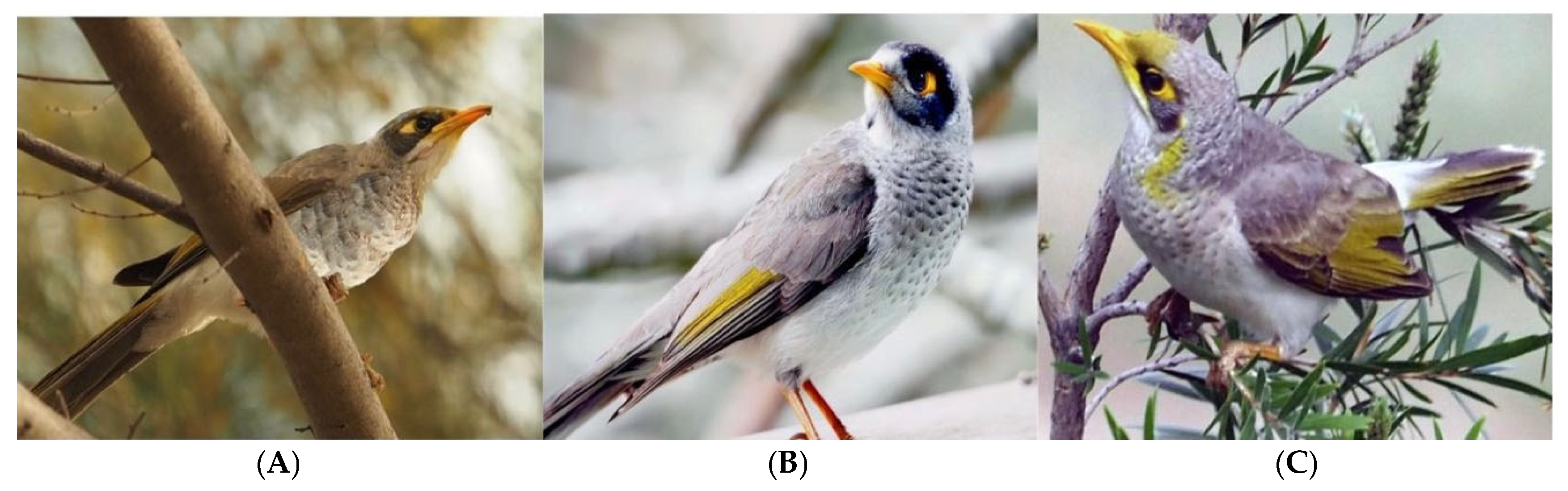
As the small sample of honeyeaters from smallest to largest shows (Table 1), the differences between various taxa in the same family can be substantial, not just in size and weight range but in mobility and range of food sources. The noisy miner and the other miner species (Figure 1) are thus part of a remarkable evolutionary history and an extremely diverse group found in Australia.
Manorina, the special focus of this paper, contains four species: the bell miner (M. melanophrys), noisy miner (M. melanocephala), yellow-throated miner (M. flavigula), and black-eared miner (M. melanotis). The bell miner (Manorina melanophrys) is distinct from the other three by its green plumage and smaller size, but the other three are very similar (Figure 1) and can easily be confused. Although the black-eared and noisy miners live in very different habitats, the yellow-throated miner overlaps with the habitat of the noisy miner in coastal Queensland and central New South Wales.
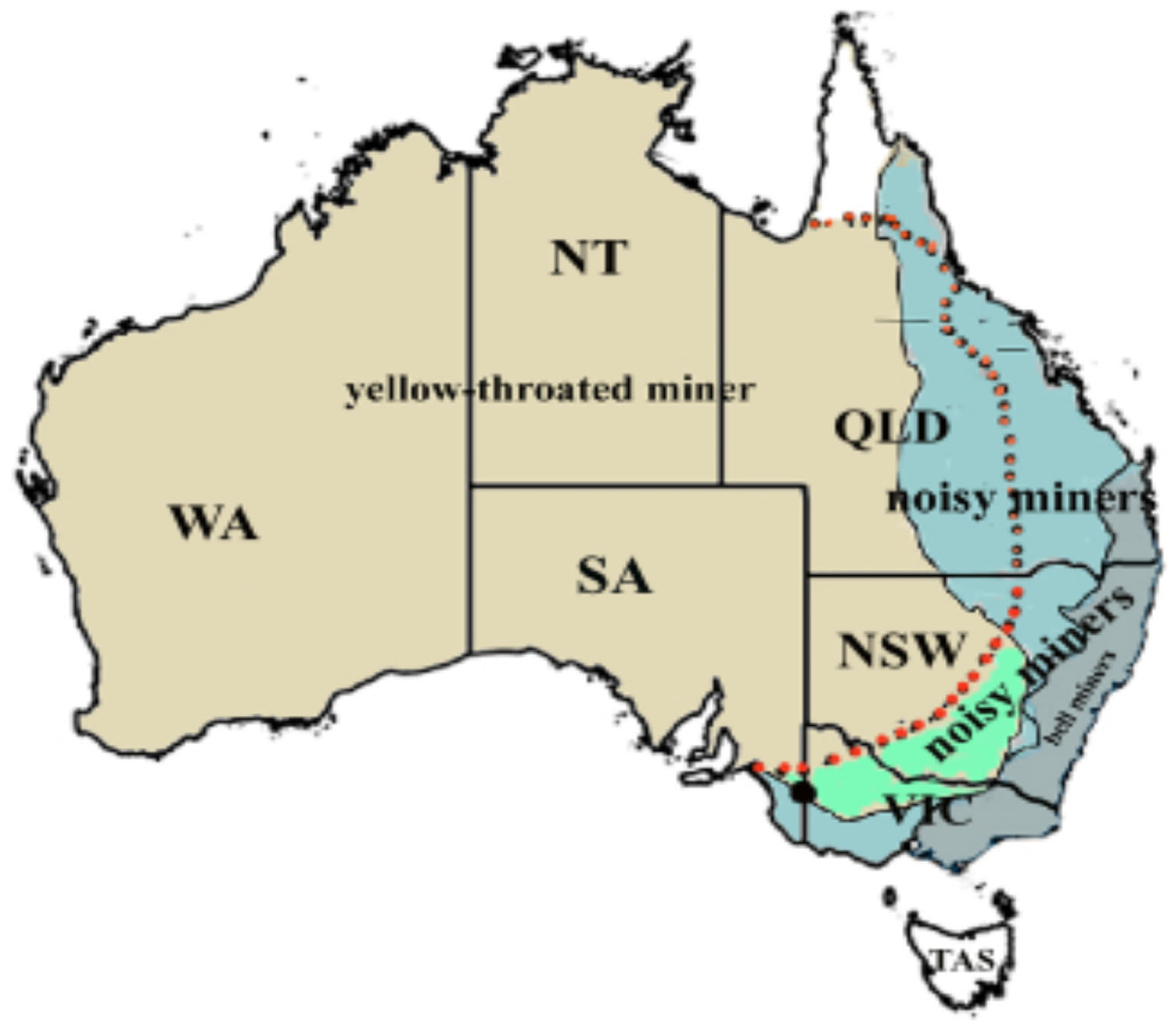
Unlike the relatively smaller ranges of other honeyeaters, the noisy miner and the yellow-throated miner together cover the entirety of the Australian continent: noisy miners occur in a broad sweep along the Eastern Seaboard right up to the tropics and the north-eastern reaches of Australia, while the yellow-throated miner covers almost the rest of the continent, overlapping only slightly in some eastern regions with the range of the noisy miner (Figure 2).
The overlap between noisy and bell miners on the Eastern Seaboard is somewhat misleading because bell miners and noisy miners are rarely found in the same territories. However, there may be quite a few other honeyeaters that live in proximity to each other, such as blue-faced honeyeaters (Entomyzon cyanotis) and little wattlebirds (Anthochaera chrysoptera), sometimes up to five different Meliphagidae species.
The black-eared miner is the same size and more or less has the same plumage as the noisy miner, but it has a dark facial mask and an orange tinge on its beak and legs (Figure 1). The difference is one of habitat. Noisy miners live in the woodlands of eastern Australia, while their black-eared cousin is now confined to a very small plot in the Murray Mallee region in the far southwest of NSW. The Threatened Bird Index identified the key threats for the black-eared miner: (1) destruction of habitat via fire, (2) overgrazing, and (3) fragmentation of habitat [78].

2.2. Loss of Avian Biodiversity

The precarious situation of the black-eared miner is just one example of the trends over recent decades. Increasingly, the contest between humans and birds for the very same territories and environments has made many native mammals and birds losers on a large scale. As is well-known, urbanisation alone has often meant a significant drop in species richness [79,80,81]. Although great efforts have been made to halt the avian extinction rate in Australia by a myriad of organisations, often funded only by donations, the sharp decline of avian biodiversity has continued [81,82,83,84,85]. The Threatened Bird Index [78] showed an overall decline of 60 percent since 1985 for all bird taxa across Australia, slightly higher in Queensland and South Australia, and slightly lower in New South Wales. Australia’s ‘Environment Protection and Biodiversity Conservation Act 1999’ (EPBC Act) [78] list was updated on 5 March 2025. One bird was added, the little tern (Sternula albifrons), which is now listed as ‘vulnerable’.
The latest government report [78] on threatened species, as part of its ten-year Action Plan 2023–2032, has also identified 22 priority birds for conservation work in NSW, and despite the large clade of honeyeaters, only two have so far been identified to be at high risk of extinction: the black-eared miner, already mentioned, and the regent honeyeater Anthochaera phrygia. Other threatened species include several island birds and, on the Australian mainland, priorities include several parrots, two species of black cockatoos (Carnaby cockatoo, Zanda latirostris, and the red-tailed black cockatoo, Calyptorhynchus banksii graptogyne), and, among several other taxa, the noisy scrubbird, Atrichornis clamosus, and some species specific to New South Wales [78]. It is important to mention this here because none of the small woodland birds for whose decline noisy miners have been deemed responsible, and ‘punished’ by the elimination of thousands of them, are listed among the threatened species at this time.
Of the four passerines on the list, scrubbirds (order Passeriformes, family Atrichornithidae, size 16 cm) are found in terrestrial/rainforest habitat. The decline of the rufous scrubbird, Atrichornis rufescens, is believed to have been driven by the clearance of the species’ lowland habitat and the ongoing logging practices and subsequent disappearance of the understorey of the remaining eucalypt stands [78]. Of course, decline is not just measured in categories of threatened species but in declines in numbers within species and by a species’ disappearance from specific sites, and this is a challenge for present-day conservation [86].
Considering noisy miners in this context, however, creates a puzzle. Their alleged ‘overabundance’ runs counter to general international and Australian trends chronicling the ubiquitous decline of half of all avian species on every continent, and according to the State of the World’s Birds Report [50], only 6% of avian species worldwide are increasing in number. Apart from natural adaptations, these relatively rare examples are often due to intense conservation efforts.
Moreover, after decades of emphasising the negative attributes of noisy miners, be this in the media or in research papers, some of their ecologically important and positive characteristics are often no longer mentioned or are entirely forgotten, even though they may have a bearing on the perception and assessment of the role of noisy miners in the ecosystem.

2.3. The Overlooked Beneficial Role of Noisy Miners

The social ecology of honeyeaters has rarely been fully investigated [87], although they play an important role in the ecosystem. Noisy miners are no doubt of great importance to avian communities in the bush and in biodiverse environments. They may cohabit with several species of honeyeaters in one transect and live in stable multispecies bird communities [88].
Indeed, with their loud and persistent alarm calls, noisy miners warn the bird community about any predators in the vicinity. Moreover, they fly close to the source if the threat is terrestrial and/or stationary (e.g., as may be the case with snakes and lace monitors), thus giving an indication of the location of a potential threat. Noisy miners also collaborate with other species, chiefly Australian magpies (Gymnorhina tibicen) [89], in driving out predators, thereby protecting themselves and other species, including small woodland birds living in their territory (pers.observ.)
Collaboration between Australian magpies and noisy miners in instances of danger (such as spotting predators) is well-known [89,90]. I have observed noisy miners coming to the aid of a magpie pair when the magpies were unable to shift a stationary wedge-tailed eagle from a ground position in the magpies’ territory. These collaborative defences of territory seem to hold in Australia’s Eastern Seaboard. ‘Squabbles’ between magpies and noisy miners have been reported in South Australia—although of a different subspecies of magpie than in the east [91,92].
Individually, noisy miners have few, if any, physical defences. They do not have sharp claws or a pronounced beak, cryptic colouration, or venomous defences against any predator or larger birds. Towards birds their own size, they may use mobbing flights in certain situations, or, when a rare food source is discovered, they may squabble amongst each other, and the more dominant bird may give a double beak-clapping warning (pers. observ.), a signal that is understood not just among conspecifics but also heterospecifics and is usually sufficient to make one of the competing birds retreat.
Mostly, however, noisy miners behave like the sentinels of the bush. Usually first on the scene, they have the rare ability to warn others about danger or an intrusion within their territory, and they are equipped to do so because they have specific, functionally referential (and different) alarm calls that other birds have also learned to decipher, judging by the response of other birds within their territory. As Cunningham and Magrath [93] discovered, the noisy miners they studied gave different calls to airborne raptor models compared to terrestrial or perched raptor models and even switched from ‘aerial’ alarm calls to ‘chur’ alarm calls when a hawk had landed on the ground.
Noisy miners are among a few songbirds that use referential signals (Australian magpies also use functionally referential signals, such as their ‘eagle alarm calls’ [89] to indicate to conspecifics when a predator has been spotted [89]. As a deterrent to predators, noisy miners can also use a synchronised chorus (pers. observ.). Hall and Magrath [94] found in their study of duetting in magpie larks, Grallina cyanoleuca, that the temporal coordination of duetting signalled more than just their pair status. To competitors and possibly to predators, it was ‘read’ as a signal of the pair’s coalition quality [94]. One might well draw the same conclusion about the highly coordinated physical and vocal performance of noisy miners that also includes duetting and displays [95]. They indeed have a rich repertoire of vocal signals used for and expressed as cooperative behaviour, particularly in the context of threats (such as avian predators, competitors, cats).
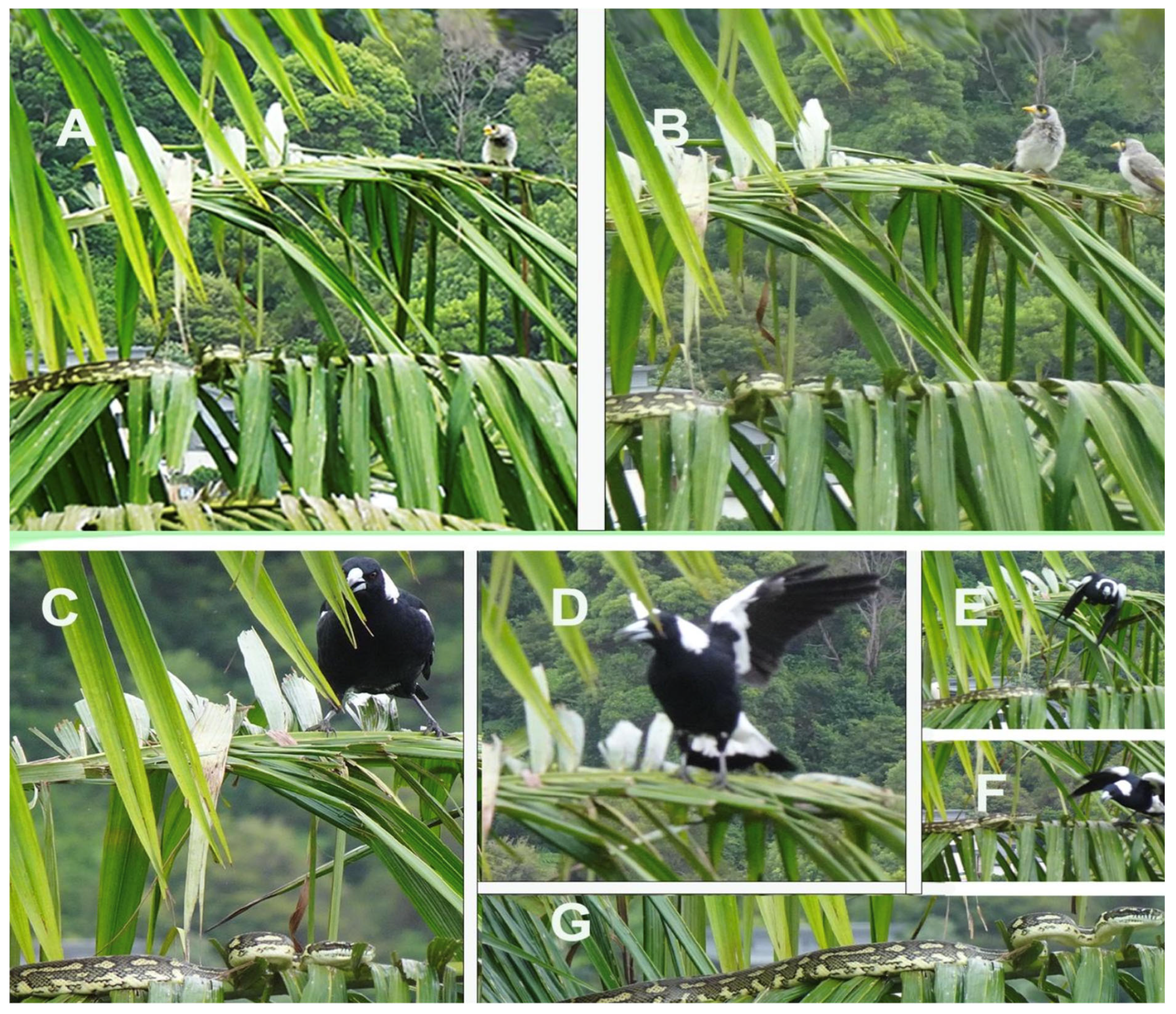
Dealing with reptiles also involves noisy miners. Noisy miners can do little about snakes such as pythons (genus) or lace monitors (Varanus various) that may be 2.5 m in length, but they can warn others. In Figure 3, an excerpt of a sequence of photographed events is shown (which took less than three minutes) that took place in a native bangalow palm tree (Archontophoenix cunninghamiana) in which a large carpet python, Morelia spilota spilota, had taken position. The upper horizontal fronds of this palm tree were used regularly by many different birds as a (usually brief) strategic lookout. Landing on one of these fronds would certainly have risked the life of any bird because it was located within striking distance of the snake (Figure 3).
Pythons do not seem to respond much to vocal signals and tend to have relatively poor eyesight, but via mechanoreceptors, thermo- and chemoreceptors, they are excellent at spotting any warm-blooded or moving target. Via a “cheek pit” structure on their heads, pythons can sense subtle changes in heat emanating from a living organism [96], detect odours, and respond to the slightest movement [96]. Apart from birds of prey, pythons or lace monitors are largely the reason for heterospecific collaboration between noisy miners and Australian magpies. In some groups, this heterospecific collaboration is well established. In one instance, I observed such a collaborative effort between noisy miners and magpies. In this incident, the noisy miners had alarm-called and then seemed to wait for support. First, another noisy miner arrived and, less than a minute later, a magpie landed, immediately found the snake, and then chose an effective, if rather risky, strategy of stopping in front of the snake’s head and flapping its wings. The method was successful, and the snake left (see Figure 3).
This level of cross-species cooperation is a remarkable and cognitively highly advanced method of keeping an entire bird community/assembly safe. It must be noted, however, that no general agreement exists as to what determines community dynamics, in which direction such dynamics move, and whether there are clear winners and losers or whether homeostasis maintains such communities, ironically via competition. By contrast, Garcìa-Navas et al. argued that the presence of noisy miners increases the instability of bird communities [97]. However, Hubbell suggested that the total number of individuals in a community remains relatively constant or only tends to vary “as a result of stochastic forces” [98]. Such theoretical positions do not help very much in ascertaining whether noisy miners have a destabilising role to play in communities or bird assemblies, or whether instability of stochastic forces is at all related to the presence of noisy miners.
One notes, however, that the many positive qualities of noisy miners remain generally unmentioned, have not been reported in detail in recent journal articles, or might have simply been regarded as immaterial. Such omissions of crucial abilities and manifest cognitive behaviour are, in fact, manipulating evidence, be this inadvertently or intentionally, if the charge of the miners’ major influence on the decline of small woodland birds is to be upheld. The argument might be the other way around: manifest cooperative behaviour and collaborative efforts of noisy miners are not the signature of the disrupters of bird communities. What their ability to warn and actively engage in assisting heterospecific members suggests, however, is that their presence and actions establish or preserve stability rather than disrupt bird assemblies. This is the very opposite of what has been proposed by recent papers that have recommended and/or carried out noisy miner culls [29,38,41].

2.4. Cognitive Abilities and Cooperative Kinship Ties in Noisy Miners

Cooperative behaviour, which is expressed during the breeding season and beyond, is an important strategy for survival. For vast stretches of Eurasia and the Americas, avian species showing cooperative behaviour rank below 2%, and in some pockets up to 5%, but in Australia, cooperative behaviour has been identified in almost a quarter of all avian species [2,99] (see also maps of the worldwide distribution of cooperative behaviour in Feeney et al. 2013 [100]).
Social and vocal skills and most other survival skills are important learned behaviours that are imparted by parents and the family unit. Since, in birds, over 95% of species raise offspring in bi-parental care (compared to a mere 5% of mammals [101]), the additional support by helpers in a significant number of species, including noisy miners, suggests strong social support, protection, and opportunities to acquire new skills while safe. Making important decisions throughout life depends on the ability to have learned, memorised, and successfully acted on relevant memory when finding food or encountering potentially dangerous situations [102], and this involves cognitive competence.
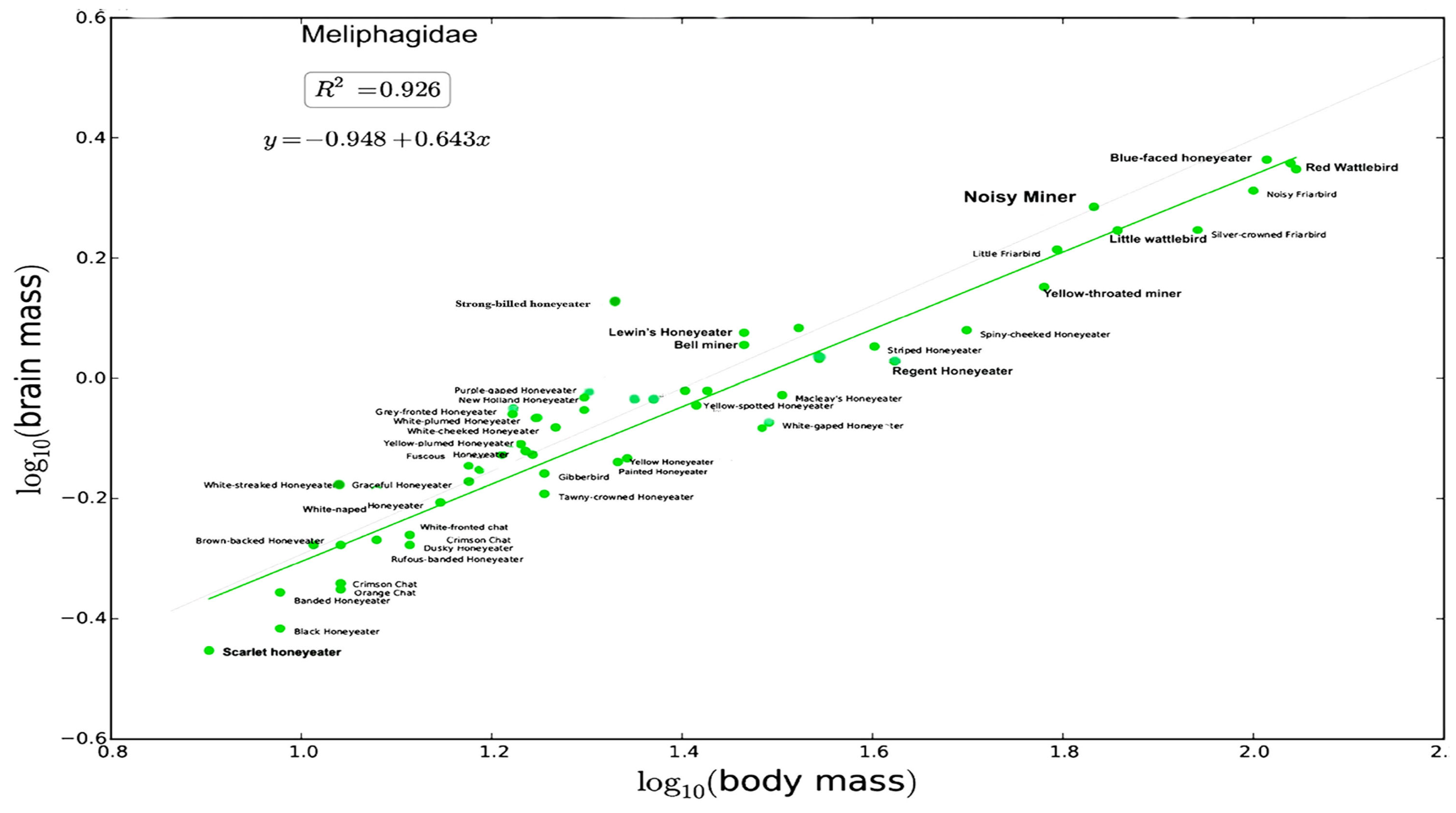
Using an extensive published data set of log-transformed brain and body weights of native Australian birds [103,104], I was able to extract data on the brain mass of the Meliphagidae relative to body mass and compare these data with all other recorded Australian songbirds, identifying the position of noisy miners among Meliphagidae and with the mean relative brain size of Australian songbirds in general. The results are 391 presented in Figure 4. The figure shows that some honeyeaters, including noisy miners, belong to the top 5% of honeyeaters with the largest brain (by weight relative to body weight) and among the top 10% in log-transformed measures, on par with some of the Corvoidea such as Australian magpies (in log-transformed brain size relative to body weight) (Figure 4).
Note that the noisy miner has a substantially larger brain size relative to body weight than its close relative, the yellow-throated miner (bolded in Figure 4). Darwin has often been misquoted as saying that the strongest survive (survival of the fittest), but he said in On the Origin of the Species that the species that survive are the ones that can best adapt and adjust to the changing environment in which they find themselves [105,106]. In terms of cognitive ability, one might expect that noisy miners might be better adapted to changing environments.
Presumably, such adaptability would be fostered by both cooperation and possibly a more complex cognitive ability that allows for problem solving, innovation, and flexibility [107,108,109,110]. The noisy miner has shown such flexibility in great measure by its adaptability to urban and changing environments, a trait that was confirmed in a recent PhD thesis [111].
In recent decades, comparative studies on brain sizes in birds have revealed very specific differences, some of which are relevant to noisy miners. For instance, it was shown in earlier research that certain brain structures differ in size between sedentary and migratory birds of the same species [112]. Cristol and colleagues showed that in migratory dark-eyed juncos (Junco hyemalis), the density of neurons in the hippocampus is higher than that in resident juncos [113]. Upon this finding, Sol and colleagues [114] investigated whether whole brain sizes were also different in other migratory versus sedentary birds. They found that, in passerine birds, migratory species tend to have substantially smaller brains (relative to body size) than sedentary species. They suggested that selection for smaller brains in migratory birds may arise from the energetic and developmental costs associated with a highly mobile life cycle, and perhaps with costs associated with cognitive functions that have become less necessary in migratory species [114]. Noisy miners belong to the sedentary species among honeyeaters and hence, according to Sol et al. [114], should fall into the group of songbirds with larger brains. As shown in Figure 4, they do.
The ‘big brain’ theory suggests that there are several benefits and identifiable advantages that protect against extinction and stabilize populations [115]. This is achieved by behavioural plasticity, strongly associated with cognition, including the ability to live in variable habitats [115,116]. Indeed, noisy miners have adjusted admirably well to suburban and urban life. This is why every bird count conducted by citizen science identifies the noisy miner as one of the top three birds seen [117].
Another behavioural aspect associated with brain size [118], specifically with neuron density in the forebrain [118,119], and high levels of associative neuron numbers [119,120] are innovation, problem solving, and feeding innovations. Feeding innovations, whether in identifying or retrieving new food items and sources [121,122], changing nest location or materials [123], or recognition of and strategies against a predator [124], have been examined globally, and the link between cognition and innovation has been firmly established over the last two decades. These details are particularly relevant to noisy miners. Thanks to extensive research by Sulikowski and Burke [125] using wild-caught noisy miners [125,126,127,128,129], we know about the species’ different food-searching strategies for finding either invertebrates or nectar [128]. Via the research conducted by Cunningham and Magrath [92], we also know that noisy miners have functionally referential alarm calls specifically designed to communicate about predator behaviour [92].
Note also in Figure 4 that the brain mass relative to body weight of the yellow-throated miner, while closely related to the noisy miner, is well below the brain mass relative to body weight of the noisy miner, and so is the brain mass relative to body weight of the endangered regent honeyeater (Figure 4). However, the noisy miner, bell miner, and Lewin’s honeyeater, as well as a cluster of other smaller honeyeaters, share in proportionately large brain weights relative to body mass (Figure 4). Larger brain weights relative to body weight usually indicate expanded cognitive abilities, with positive effects on sociality [130] and on dealing more effectively and quickly with complex and stressful situations and conditions [131,132,133,134,135].
To summarise this section, noisy miners are flexible; they are feeding generalists with sophisticated resource-searching strategies [126,127,128,129], and they support each other and defend others by driving predators out (see also Figure 3). They communicate effectively in variations of duets, alarm calls, and in referential and cryptic signals [93,129], and they even recognise each other individually through acoustic means alone [135]. Indeed, their vocalisations have been called a ‘complex’ acoustic repertoire [136]. They are resourceful problem solvers [137,138], cooperative, not just in raising offspring but in active conspecific and even heterospecific collaboration and defence [139], and cognitively complex [140].
Indeed, noisy miners are in the top 5% of honeyeaters in (log-transformed) brain weight relative to body weight (Figure 4) and cognition and most likely among the top 10 percent of passerines with a highly developed complex cognitive skill set, something they may have in common with many of the Corvoideae, such as Australian magpies and butcherbirds, and even with some corvids [141].
In my work with noisy miners, I also found that they recognise faces and cars (in prep.), just as do common ravens, Corvus corax [141], American crows, Corvus brachyrhynchos [142,143], Australian magpies [89], northern mockingbirds, Mimus polyglottos [144], and possibly a whole range of other avian species, as has recently been discovered in barn swallows, Hirundo rustica [145,146].
There is no doubt that the noisy miner is an exceptionally clever and resourceful bird, with the ability to access a wide range of foods, live near allies, and form close ties with conspecifics and even some heterospecifics for defence. What this miner species lacks in personal prowess and size, it makes up for with vigilance, cooperation in coalitions, and a range of remarkable cognitive abilities.
In future research, it might be worth comparing common raven life histories and behaviour with that of noisy miners and their cooperative behaviour, alliances, sub-alliances, and flexibility in food intake because noisy miners, just as ravens, may have among the most complex social organisation among songbirds [147,148].

3. Vulnerabilities of Noisy Miners

3.1. Noisy Miners and Natural Predators
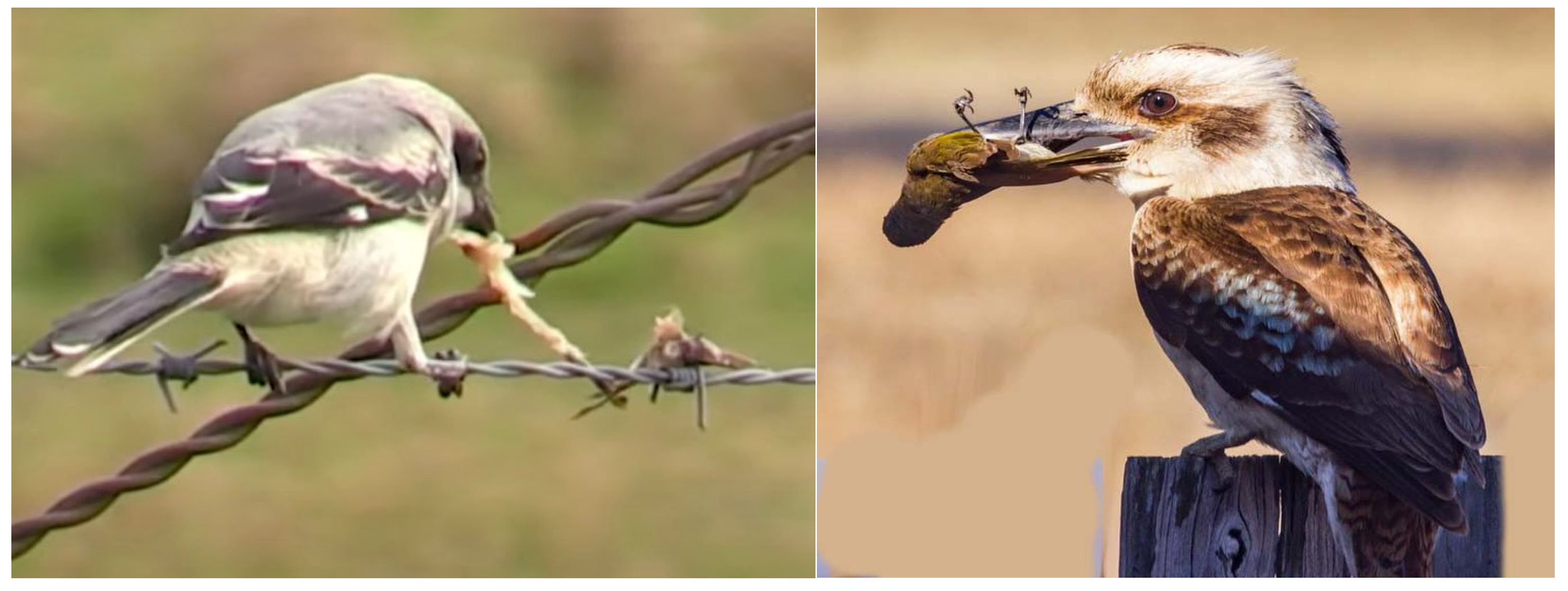
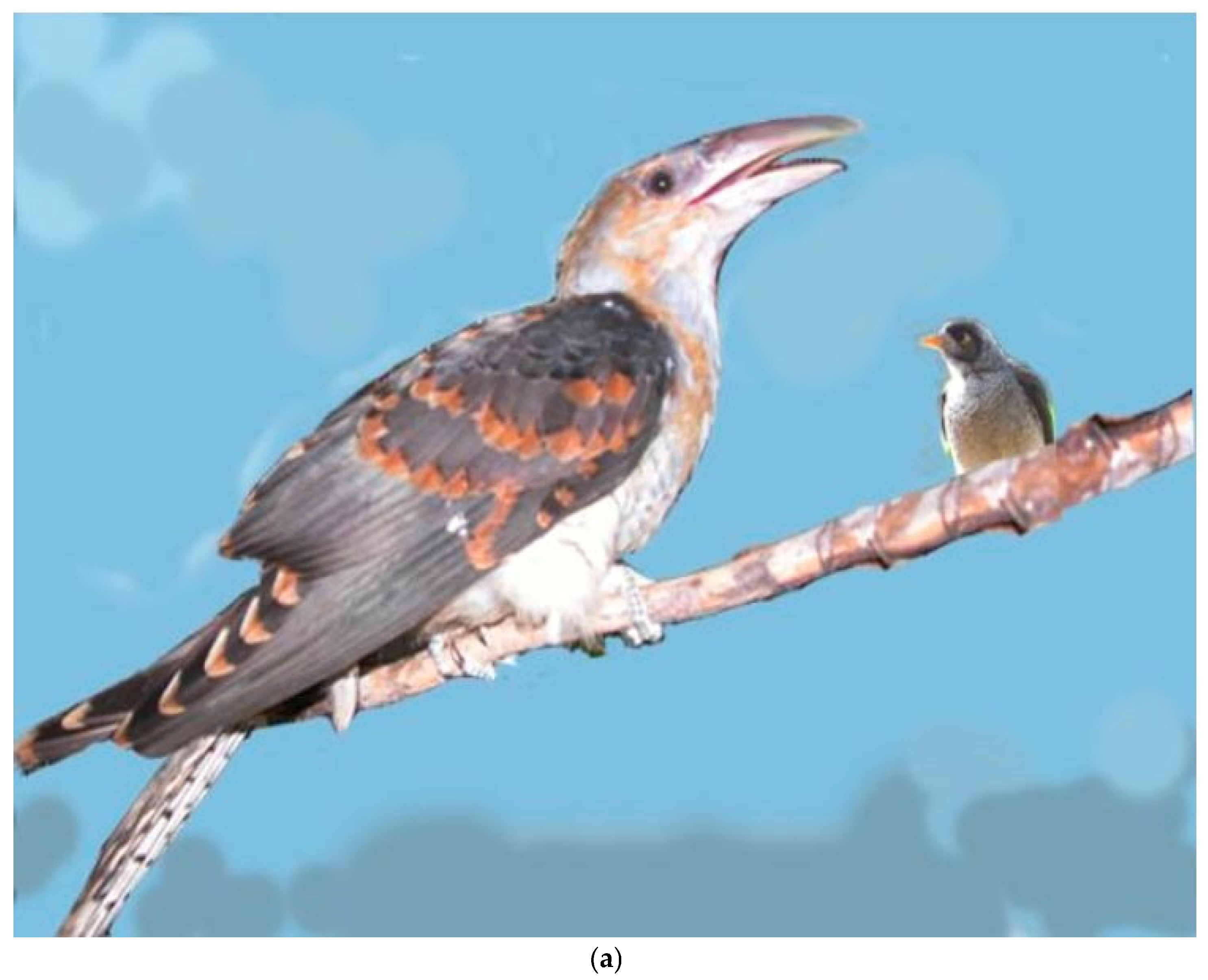
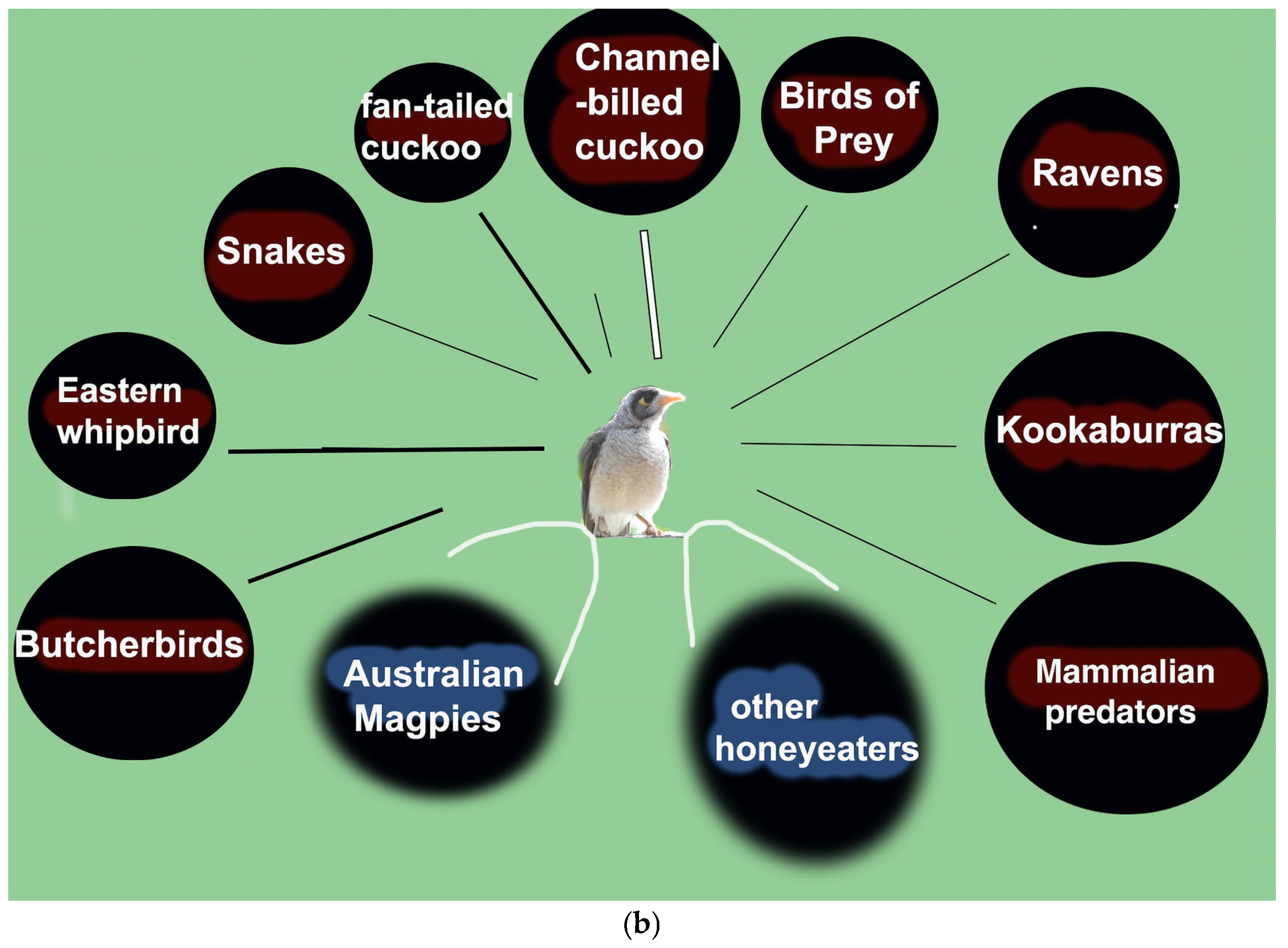
No matter what a small songbird’s attributes might be, noisy miners are at risk from a whole range of native predators, and their breeding attempts are regularly thwarted by a wide range of predators (Figure 5). There are also ‘silent’ or indirect killers, rarely taken into account. These are the Australian cuckoos, secretive quasi-predators, who disrupt or eliminate nesting attempts by woodland birds, including noisy miners. Native cuckoos are plentiful on the Australian continent. Europe has one cuckoo species, Australia has twelve species, of which only one, unusually, raises its own brood (the pheasant coucal, Centropus phasianinus). In 1933, Alex Chisholm wrote that “Sydney itself is surely the most cuckoo-haunted city in the world, since in any normal springtime, one may see or hear nine species of cuckoos upon its fringes, and some of them occasionally near the center of the city” [149]. This may have changed, since bird populations have declined in urban environments, but a recent survey of birdlife at Bootawa Dam near Taree (mid-north coast of New South Wales) listed several cuckoo species as being present in a relatively small area [150]. Fantailed-cuckoos, Cacomantis flavelli formis, preferentially parasitise the nests of flycatchers (Monarchidae), fairy-wrens (Maluridae), scrubwrens (Acanthizidae), and, in particular, brown thornbills, Acanthiza pusilla. Guppy et al. [151] showed that small woodland birds may have their nests raided or parasitised to the extent of 90%. Such losses might increase in fragmented woodlands, even on second or third renesting attempts, because activities near nest sites are easy to spot by predators and cuckoos alike. Fragmentation and diminished understorey cover of woodlands may further dramatically reduce the effectiveness of cryptic nests [152,153], and this factor may be one important contributor to the decline of woodland birds.
There are further risks for nestlings and even adults from a variety of other avian species. At breeding times, many birds that are otherwise peaceful neighbours can turn into dangerous marauders (no matter what their main food sources are as adults) and steal eggs or nestlings from other nests to secure high-value protein for their own growing broods [154]. Eggs are probably the single most sought-after food item in the world for any vertebrate (including humans) because of their concentrated protein and other nutritious properties.
Some songbirds, such as shrikes, however, are year-round killers of birds at any stage of development and also adult birds, especially targeting small woodland birds. In Australia, examples are the pied butcherbirds, Cracticus nigrogularis, and grey butcherbirds, Cracticus torquatus (Figure 5). They are known to prey on lizards and even snakes and on adults of small as well as relatively large-sized birds year-round [155]. They, as well as kookaburras, share the same forest environment as small woodland birds (Figure 5).
Figure 5. Shrike (left) and kookaburra (right) with prey. Australian butcherbirds tend to wedge their prey between the forks of trees. The kookaburra has caught and killed a brown honeyeater, and the head of the small woodland bird hangs down lifelessly. The bird was consumed shortly thereafter. (Photocredit: Left: source unknown; Right: Teale Britstra, appeared in an ABC radio and online program called ‘Australia All Over’ [156].
Diversity 18 00099 g005
Apart from raptors specialising in feeding on birds, such as the Little Eagle, Hieraaetus morphnoides [157], and the small Australian hobby, Falco longipennis [157,158], larger passerines, normally with various food preferences, may feed their nestlings on protein-rich fare. Currawongs, for instance, are largely fruit eaters [159] and, as mentioned previously, one of the most important species for seed dispersal of native fruiting shrubs across Australia. However, when raising their own young, currawongs will also kill lizards, steal eggs, and kill small nestlings, while Australian ravens, Corvus coronoides, may kill mice, lizards, and even relatively large birds, such as pigeons, noisy miners, and starlings [160].
However, there is one important reprieve for the victims. Large birds, including pied currawongs, commonly raise only one brood per season. Nest-raiding of other bird nests tends to stop completely when their own offspring fledge and the adults and juveniles switch to fruit and berries.
Food switching is quite common in birds for several reasons, such as seasonal supplies of food, changing nutritional needs [161], or a reduction in food acquisition. The latter means that smaller-sized birds can renest, and they usually succeed in raising at least one brood per breeding season (pers. observ.), although often at a smaller clutch size [162,163]. Parasitising a nest may be more destructive because the parasitised parents often successfully fledge the cuckoo chick and may not renest. In the case of parental death, the nestlings may starve to death unless youngsters are adopted, which tends to happen only very rarely.
One study showed that as many as 87% of currawong nests had been parasitised by channel-billed cuckoos [164]. Figure 6b shows the potential causes of nest failure in noisy miners and in woodland birds in general. Many nest failures in woodland birds, especially in cup- or dome-shaped nests (noisy miners have cup-shaped nests), are due to nest predation. Fulton showed that cup- and dome nests were at the highest risk level, and in his study, he identified 94 different nest predators in total [165], a long list of potential dangers during the breeding season, particularly for woodland birds in general or noisy miners specifically.
However, one would have thought that researchers keen on noisy miner suppression would be aware of their struggle with cuckoos and other nest raiders, but this is never or rarely mentioned when noisy miners and their allegedly destructive role are mentioned.

3.2. Difficulties in Reproduction

Overall, the impression has been that noisy miners have bullied their way into dominance, overwhelming hapless bird communities and taking over territories in large numbers. The idea of overabundance inevitably suggests that a species is particularly successful in reproduction due to having access to plentiful resources, showing foraging efficiency, and/or facing low predation risks.
Further, successful reproduction may depend on good defence of an existing clutch or successful renesting to counteract the negative effects of various reproductive failures within the same season. Small passerines in Australia tend to have larger clutches and longer breeding seasons and may breed more frequently within one season than larger species [166], that is, some species may have time to renest, suggesting that they may raise at least one surviving clutch per season. However, the success rate of surviving nestlings may vary vastly between species, regardless of intact or fragmented environments, and also within species of small woodland birds, as earlier research by Ford and colleagues found [167]. It is a biological puzzle that the reproductive data of noisy miners do not fit the description of an ‘overabundant’ species. Noisy miners tend to have the smallest clutch sizes of any small Australian passerine, on average, just two eggs [168]. Dow [168], who conducted one of the very few detailed studies on breeding in noisy miners, found that while adults were conscientiously and incessantly feeding offspring (at rates as high as 87 times per hour), nest success was extremely low at 15% and at best 16.7% in any given year, in a three-year study (Table 2). The study area offered a reasonably large sample size—within seven hectares, birds had been colour-ring-banded. The sex ratio favoured males by as much as 3.3: (with most males acting as helpers). In the study area used by Dow, the noisy miner population did not grow but declined over the three years from 9.0 to 7.7 birds per hectare [168], despite a very long breeding season. In fact, the breeding season for Meliphagidae is particularly long. Noisy miners seem to be able to breed at any time of year [168] but generally do so between June and January. Arnold’s study of nesting success and timing/position [169] also found that nearly twice as many nests were built in winter/early spring (August/September) than later in summer (from October to January) and that early broods were significantly less likely to be preyed upon than those built later in the year [169], a view also reflected by the NSW Department of Education [170].
Table 2 clearly shows that in terms of reproductive success noisy miners rank in the lowest group of woodland nesting success [179]. In summary, the unusual combination of the exceptional qualities of noisy miners, linked with the pronounced vulnerabilities of the species, has never been fully considered or explained. However, neither aspect (smart adaptations on the one hand and vulnerabilities on the other) would seem to qualify noisy miners for the harsh assessment that, single-handedly, these small passerines are allegedly responsible for the decline of the multitude of small woodland birds in their range.

3.3. From Protected Native Species to Outcast

The call to cull noisy miners, as mentioned previously, reached the level of state government intervention in 2013, devising a framework that legally enshrined a statement that the noisy miner was a threat. It explicitly permitted noisy miners to be suppressed or eliminated [38]. Alarmingly, this officially permitted the killing of noisy miners where and when considered ‘overabundant’ [31,38]. This was supported and welcomed by researchers at major Australian universities. Approved culling was carried out at specific sites, systematically testing at each site whether the removal of noisy miners improved the conditions for other woodland birds [22,23,24,25,28,29,37]. Thousands of miners died in the process (the most detailed studies across several sites alone stated that well over 6000 miners were killed). The results ranged from mildly successful, in the sense that numbers of some small woodland species briefly increased, to unchanged conditions for other species and outright failure. As one report stated, “Before the culls, we counted 510 noisy miners across the sites, and after the culls, there were 512”. This was clear evidence that culling noisy miners does not work in certain landscapes [180].
Noisy miners, dubbed “a reverse keystone species” [97,111,181], have been a strong focus of research and ‘ameliorative’ attention for several decades. Reverse keystone species is the name given to a species that is thought to be disruptive to other species by competing for the same resources, driving competitors out, and thereby decreasing the biodiversity and local stability of bird communities.
There are apparently sites where noisy miners appear in large flocks of hundreds and then stay, while chasing out or displacing other avian species [22,25,26,27].
This may not be the norm, of course. The noisy miner communities I have seen in many different locations in New South Wales consisted at best of 12–20 individuals and often fewer than this. And my observations tally closely with early fieldwork observations of noisy miner behaviour [95,139], before the most recent waves of drastic clearing of Australia’s subtropical, temperate forests, and bushlands happened between 2000 and 2017, totalling some 43 million hectares [182,183].
This level of destruction of prime habitat in such a short time is almost unfathomable in terms of its impact and consequences for the entire natural world. Of this total deforestation, nearly a million hectares of forest were cleared in Queensland and New South Wales alone in a mere decade, often in hotspot areas [184,185]. I suspect that the cleared areas were precisely the favoured habitat of noisy miners.
The recent and overwhelmingly negative verdict on Australia’s conservation record, expressed in statistics on deforestation (amongst the worst in the world according to the WWF Living Planet Report 2024 [183]), makes blaming the decline of woodland birds on one species, the noisy miner, an argument ad absurdum. Surely, it is impossible to overlook the fact that small birds, especially species dependent on forests and woodlands, are the most likely group of animals to be directly harmed by the drastic and relatively sudden contraction of their habitat.
Further, from the discrepancies between my observations and those that report ‘overabundance’ and have recommended culling, one may surmise that incidents of the so-called disruptive behaviour of noisy miners have remained sporadic and, so far, seem confined to specific localities. The noisy miners’ change from living in small family groups to forming large assemblies, if only in some locations, is significant in terms of social behaviour and needs to be explained first before proceeding to kill native birds
Those who have promoted ‘culling’ seem not to have queried such inconsistencies, let alone explored any potential alternative reasons for the dramatic switch in social groupings and behaviour by noisy miners. At the very least, one ought to consider explanations for this abnormal and sudden alleged clustering in large groups. It is possible that some of their behaviour might well be related to the substantial curtailment of suitable habitat, which, by itself, has nothing to do with being ‘despotic’ [25,26,27]. The moment scientists switched language from scientific reporting to calling a species ‘despotic’ or even ‘notorious’ [31] suggests a noteworthy shift from science to opinion.

3.4. The Victimisation of Noisy Miners—A Miscarriage of Justice?

So far, the debate on the role of noisy miners has centred on a very skilled public trial of noisy miners until public opinion of this species shifted to consider noisy miners the ‘most hated bird’ in Australia [35], and government support for their culling was achieved surprisingly readily [21,40]. The one-sided evidence contributed to a view that noisy miners are aggressors, not, as they often are, victims of bad luck and consistent threats around them at breeding time, very similar to the predatory and/or also anthropogenic threats experienced by other small- to middle-sized woodland birds and indeed birds in general.
Furthermore, the assumption that one single native species is largely responsible for the decline of other woodland birds is unlikely. Monocausal explanations are rarely correct, considering the complexity of natural (dynamic) environments and the anthropogenic factors acting on such environments. For instance, vegetation heterogeneity is of great basic importance (known as the vegetation heterogeneity hypothesis [186]) but has rarely been critically examined in research papers on noisy miner ‘overabundance’ (more on this can be found in Section 6.3).
The ‘aggression hypothesis’, which has resulted in the extensive culling of thousands of noisy miners, may be partially misleading. Instead of aggression, one usually refers to ‘resource competition’ as one of the well-established drivers of evolution. The damage that large flocks can cause (through displacement and taking over food supplies) may account for less overall damage to other birds, however, than actual predation rates and environmentally detrimental factors, as found in several studies [7,12], and this may apply to noisy miners as well, perhaps specifically in fragmented habitats. Assessing resource competition has also become more complicated due to the human role as major competitors, working in practice very much against biodiversity [187,188].
The designation of noisy miners as a ‘reverse keystone species’ may also be problematic, as stated in the recommendations to cull noisy miners [97,111,181]. One notes that neither European nor African ornithologists use the term ‘reverse keystone species’ for their native avian species that flock and are known to be a problem for agriculture. For instance, the flocks of starlings (Sturnus vulgaris) in Europe [189,190] or of quelea (weaver family Ploceidae) in Africa [191] can be spectacularly large. However, the purpose of such displays (murmuration) of thousands of starlings, a breath-taking spectacle even if the birds cause damage, has been found to be largely an anti-predator strategy, i.e., an evolutionarily important adaptation to the many aerial predators of these species [190,191].
As far as can be ascertained, the noisy miner may be one of the very few, if not the only native songbird in the world that has been named a reverse keystone species, suggesting an extravagant exaggeration, the consequences of which are deadly for noisy miners.
Finally, in the specific case of noisy miners, there is also an opportunity to reexamine theoretical frameworks. For instance, the role of competition and cooperation in evolution. As Heinsohn and colleagues put it so succinctly, ‘cooperate or speciate’ [2]. Conversely, Day and Young asked what the role of competition is in evolution. They argued, and I quote:
“Theory and empirical evidence have shown that competition between existing species can promote evolutionary diversification through ecological character displacement and, more recently, that competition may play a role both in producing species and in driving their evolutionary divergence”.
[187]
Competition has, after all, a major facilitative role to play in evolutionary diversification as well as stability [192], and such theoretical positions raise doubts at least that competitiveness in some contexts of noisy miner behaviour is a convincing example of a reverse keystone species. One may therefore surmise that decisions about the impact of noisy miners (even if sporadic and confined to specific areas) were made prematurely, unilaterally, and likely based on incomplete or biased information.

4. Pitfalls in Measuring Bird Numbers and Drawing Conclusions

Since noisy miners have been identified as being ‘overabundant’ by the pro-culling lobby [32,33,39], it is relevant to at least identify some ways in which a false perception of ‘overabundance’ may arise. In Australia, as in many other countries, knowledge of bird numbers has been largely or even exclusively derived from data collected via citizen science, a large cohort of volunteers who have signed up to take notes on species and numbers of birds, as well as sightings of nests, in assigned transects. The data available from this activity are then used to draw conclusions about nesting locations, abundance, and overabundance of individual birds and species for annual or longer-term records and trends. Given the willingness and the readily available large numbers of volunteers, whether for the authoritative ‘Atlases of Australian Birds’ [193,194], for ‘BirdLife Australia 2023’ [195], or for very specific projects such as ‘Big City Birds’ [196], citizen science has become a tremendously important and indispensable part of gaining information about bird abundance and bird locations in Australia and worldwide [197,198].
While valuable, it is important to be aware of possible skewing of such citizen data collections. Some recent publications have analyzed the potential reasons or risks for such a survey, which may have resulted in skewed data. One main concern is the size of birds: large birds are apparently recorded more often than small birds [199]. In addition, participants in cities and towns may have made many sightings of one or two species without ever leaving their own backyard. City-tolerant avian species may appear abundant when they stay/become sedentary in specific backyards and are therefore recorded frequently, i.e., such surveys are, in fact, not necessarily designed to be capable of identifying a decline of even common birds, as a Danish study found [200]. A recent American study argued that recorded abundance and the actual annual population decline of the same species are unrelated factors [201]. These are important findings and worth noting in the context of native Australian birds deemed overabundant (noisy miners) and/or ‘nuisance’ native species, such as some cockatoos.
As native species, whether they be songbirds or psittacines, they should normally fall under the legal environmental protection act (Environment Protection and Biodiversity Conservation Act 1999 (EPBC Act)), but their designation as ‘overabundant’ makes it possible for them to be officially/legally shot in large numbers [21,39,40]. It might also suggest that perhaps the existing ‘environmental protection legislation’ may be too weak if loopholes and amendments can so easily override such protection. In fact, the lack of enforcement of the act and its not being ‘fit for purpose’ have drawn much criticism [202].
At the very least, turning against a specific native woodland bird (noisy miner) with a long Gondwanan evolutionary history and blaming it for the decline of other native woodland species must be regarded as highly controversial if not outright questionable. Yet these are firm and ongoing determinations and decisions, rarely publicly debated, let alone contested. Other Australian native species, also believed to be ‘overabundant’, are sulphur-crested cockatoos (Cacatua galerita) and little corellas (Cacatua sanguinea). These cockatoo species, including galahs (Eolophus roseicapilla), although for different reasons, have suffered from official condemnation, partly also dubbed ‘expanding’ species. In their cases, either implied invasion or overabundance seems to provide sufficient reason to remove these species from the list of protected species, leaving them vulnerable to being destroyed, whether in the name of science or for the sake of agriculturalists and industrialists [203]. It is more than clear that removing any native species from legal protection against poaching, poisoning, and shooting is anti-conservationist and a substantial embarrassment in terms of the international agreements Australia has signed. Such agreements state directly that each signatory is involved in safeguarding, restoring, protecting, and supporting native wildlife.
In 2025, the Department of Primary Industries and Regions (PIRSA) of the Government of South Australia conducted a workshop for stakeholders on 3 February 2025 titled ‘Pest bird impacts in South Australia’ [204] with the objectives of (1) understanding and quantifying the impacts of pest birds, and (2) planning for the development of a new bait for pest bird management. One needs to read further down the document to find that the majority of so-called ‘pest birds’ are almost exclusively native species. The same government document (on p. 6) informs readers that the South Australian state government is working on a new Biodiversity Bill, under which, so the text claims, “all native species will be protected”. However, on the same page there is a separate category called ‘Unprotected species’ (NPW Act) that may be shot or otherwise culled with or without a permit in some cases, and that the government is working towards a new and more effective bait ‘solution’ to deal with pest species (i.e., they mean native birds), even though there are alternative strategies already available that protect birds and agricultural producers alike [205]. Reframing native birds as threats to other species or as nuisances to humans offers almost a ‘carte blanche’ to accelerate the decline of any bird species that falls under such regulations.

5. Creating Misleading Information to Influence Public Opinion with Anti-Conservation Outcomes

5.1. Bias Against Native Birds

Australia’s official actions against a native bird are not new. To give just three prominent examples, there were the infamous ‘Emu Wars’ against emus, blamed for the prickly pear problem, even though English settlers had introduced them for cultivation; however, due to emus enjoying and feeding on the fruit, the seeds spread and overwhelmed the countryside [206]. Instead of fining the farmers and trying to exterminate the introduced plant, a price was put on the heads of emus, and thousands were killed or their eggs collected. In Western Australia, the native Australian raven (Corvus coronoides) and in Tasmania, the forest raven (Corvus tasmanicus), have repeatedly been classified as ‘pests’ in some regions [207]. Recently, there was also a concerted campaign against pied currawongs (Strepera graculina) because some ornithologists were certain then that currawongs were largely responsible for the decline of small woodland birds [208]. As recently as 2025, ‘Birds in the Backyard’, an online site [209], includes in its statement on pied currawongs that, “the currawong problem is a case of a predator getting out of control. … [the species] is believed to have increased dramatically… pied currawongs are voracious nest predators with a strong negative influence on smaller birds in some areas” [209]. Such statements are very dubious claims. Phrasings such as ‘out of control’, ‘increased dramatically’, and ‘voracious predators’ may well be effective rhetorical means for achieving public support against a species but are not a good educational strategy.
Unfortunately, these claims are often unsubstantiated. They also invariably fail to mention the positive role that currawongs have in the ecosystem, referred to as ecosystem services [210,211]. Currawongs indeed have a key role to play in the ecosystem and are very important to Australian forests and native fruiting plants. As a largely frugivorous species, currawongs (Strepera spp.) are semi-nomadic and, apart from bats, are the most important seed dispersers of native berry-producing plants in Australia [212,213]. They also protect highland montane areas from stick insect (phasmid) defoliation [214]. Other vital information concerning their own experience as victims is usually also not mentioned. Currawongs are heavily parasitised, largely by two migratory species of cuckoo: the channel-billed cuckoo (Scythrops novaehollandiae) and the common koel (Eudynamys orientalis). In one specific study, it was found that 87% of currawong nests had been parasitised by channel-billed cuckoos, and this had led to a local decline in currawong numbers [214].
In the examples given above, the bias is obvious: it is achieved by using value judgements (anthropomorphising) and demonising the species, and, significantly, by leaving out vital information, as occurred in the recent literature on currawongs and now noisy miners.
While this paper has not been able to discuss the role of invasive species (incl. exotic species such as domestic cats), it is worth remembering, as Low and Booth pointed out recently, that 86% of Australian wildlife extinctions have been caused by invasive species [215]. Humans introduced some 650 vertebrate species to Australia [216], and cats alone kill over 250 million birds annually in Australia [12]. So far, there has been little visible effort and interest by governments and local councils to address and solve some of these very real threats (of unsustainable magnitude) to native birds and other native vertebrates. In this context, the pursuit of an alleged noisy miner ‘problem’ looks more like a strange side-show.

5.2. Bias Expressed in Non-Scientific Language and Distortions

The Australian Museum Fact Sheet maintains the description of noisy miners as ‘bold and curious’, but then, from the many facts the museum might have chosen to convey, the text proceeds to single out and describe the mobbing of hawks and kookaburras by noisy miners [217]. Kookaburras and hawks are, of course, both dangerous predators of small woodland birds, and some hawk species are obligate bird killers. Kookaburras, in fact, take noisy miner eggs, nestlings, and even adults (see Figure 5). Mobbing to deter predators is usually not described as aggression but referred to as anti-predator and/or territorial defence [218]. It is a functional behaviour that is common to most native Australian birds of different sizes and species. Such defence has evolved as a biologically essential strategy and an aspect of parental care to secure the survival of offspring anywhere in the world [219,220]. Why then single this out in a brief fact sheet as though predator defence was specific to noisy miners when so many positive things could be stated that would be biologically correct and important to convey and also support native birds.
Some of the biases obviously survive for a long time and stand uncorrected. The question remains, why would a museum, devoted to public education, single out mobbing behaviour without making it clear that anti-predator behaviour is a key element of the strategy for survival? This behavior is found in plants, in the smallest invertebrates, in birds, and in mammals. Indeed, predator–prey relationships are one dynamic driving force in shaping ecosystems, population sizes, biodiversity, and the very fabric of life. This predator–prey relationship is thought to be as old as the Cambrian period (Cambrian Explosion), some 500 million years ago, when the first mobile invertebrate predators had evolved [221]. Like every other organism, birds have survived by developing some form of anti-predator behaviour, but a comment like the one cited above, if it stands alone, may be read as if it were an especially negative trait of this specific species, the noisy miner.
To address inaccuracies in some of the public characterisations of native species, it is vitally important to provide balanced and objective statements about any species and to make it known publicly that all living things, here native birds, have an important role to play in the ecosystem, as mentioned previously [211]. Perhaps one should feel ethically obliged to agree that they all have a right to live.

5.3. Bias Against Avian Mobility of Native Species

Of late, there is another category used for native birds of Australia, calling them ‘introduced’ when found in geographical areas of Australia where they had not been recorded before [222,223], and this may even include geographically close regions within the same state. This seems to be borrowed from a description of plants, native to one area of Australia and then introduced to another (possibly with a different climate and different soil conditions), where they multiply like weeds, especially if competing plants or parasitising insects are absent in the new location. The idea that native Australian wildlife should conform to arbitrary state borders on this vast continent and that we can chase them from one area to another (with most of the movement caused by human activity and the removal of food sources and habitat) must surely be controversial and perhaps even bizarre.
The Victorian Corella Strategy 2022–2032, issued by the Victorian State Government’s Department of Energy, Environment and Climate Action (wildlife.vic.gov.au), mentioned previously [203], does not use the word ‘introduced’ but instead reports that corellas have ‘expanded their range’ (see the section within the ‘Corella Strategy’ called ‘Distribution and Populations’, pp. 9ff), implying that either their population is increasing or they are now invasive. Neither may be the case. In natural environments substantially altered by anthropogenic activities (e.g., expansion of cities, logging, agricultural expansion), should one not expect that many avian species, as well as native mammals and megapods, may have been forced to move?
In general, the attitude at the government level has not encouraged conservation. Governments, whether local, state, or federal, have not always been known to set a good example for respecting and needing to protect Australia’s unique flora and fauna. This has implications for public attitudes as well. Periodically, officially unprotected, i.e., targeted, native species (cockatoos, lorikeets) are found dead or dying in mass poisoning episodes of unknown sources [224,225], and on private properties, many non-official, even illegal culls are suspected to occur.
All too often, birds have been judged as not conforming to an expectation of staying put and behaving well. Given that the human species has been the most invasive on Earth (expanding its home range to every corner of every continent), one wonders how such judgements about bird movements can be justified. Of late, noisy miners are certainly not beneficiaries of any benign attitudes to birds.

5.4. Bias Created via Catch Phrases of ‘Explosive Reproduction’—The Large Flock Syndrome

When large flocks of birds, including noisy miners, are seen, it is rather easy to sell to a wider public the idea that they have ‘explosively’ reproduced and increased in number. But such a conclusion can often be entirely incorrect: large flocks may have nothing to do with the overall increase in numbers.
Petrenko and colleagues [201] argued recently that the idea of ‘explosive reproduction’ may well be the wrong conclusion when seeing large flocks. The formation of large flocks of usually non-migratory birds may have several causes, one related to the ‘boom-and-bust’ phenomenon of arid Australia. The breeding strategy of Australian pelicans (Pelicanus conspicillatus) is one example [226], and that of nomadic red-necked avocets (Recurvirostra novaehollandiae) is an example of waterbirds [227]. They may fly thousands of kilometers to a fickle inland salt lake to breed, called Kati Thanda, Lake Eyre. They can only hope to breed successfully there if the lake, often nearly dry, fills to three-quarters or full capacity; the former may happen only every ten to fifteen years, whereas the latter (full capacity) has been recorded only three times in 160 years (1860–2025). This happens so rarely because it requires substantial rainfall and flooding in locations hundreds of kilometres away from the lake. Based on observations by Reid [228], in one of those very rare years at Lake Eyre, some 50,000 pelicans had raised 90,000 chicks to a successful stage of fledging. In other words, these are rare events, typical for boom-and-bust periods in outback Australia [229,230]. While ‘explosive reproduction’ was possible in one year, such singular events often just replenish numbers (lost through droughts) to their former levels, and this in itself does not indicate abundance, let alone ‘overabundance’.
Flocking is a widespread phenomenon amongst birds worldwide, but most studied in detail are mixed-species flocks [231]. A substantial number of hypotheses have been developed to account for this behaviour [231]. One recent large-scale study of flocking established that even in single-species flocking, the overall benefit was shown to be an increase in adult survival rates [232]. Hence, flocking in noisy miners in recent decades and setting up large colonies are relatively new phenomena, and once one knows about the reproductive problems in noisy miners, this is a contradiction that will require further study and explanation in the future, beyond current management plans [233]. Importantly, if assembling in large groups fosters adult survival, and if this should apply to noisy miners, it might well have been triggered by a perceived threat. One may cite an example of an interesting inconsistency in the 2023 “Aussie Bird Count”, which may explain the possible misinterpretation of the results [117]. In this count, the ‘little corella’ (Cacatua sanguinea) appears in 12th position in numbers counted, a total of 75,561 times. However, the rate of reporting is particularly low (only 9.27%), and this can only mean that many corellas were observed in large clusters but in very few locations across Australia [117]. This corresponds with my outback research experiences that corellas could only be seen in very few locations and then in flocks larger than they usually prefer to travel [234]. It is hardly a sign of overabundance when most of this vast continent had to be scanned to find corellas at all. In 2022, their presence was confined to only a few places. Yet councils and policymakers tend to be readily persuaded that the appearance of a large flock means abundance or ‘overabundance’. As previously mentioned, calling noisy miners ‘overabundant’ [233] may not be correct either. Citizen science is often city-based, and noisy miners have adjusted well to urban life; hence, miners have been recorded as one of the top three birds seen [117]. This may be true, but unless colour-banded, noisy miners are indistinguishable from one another, and since they are territorial, the same individuals could have been counted on multiple occasions.
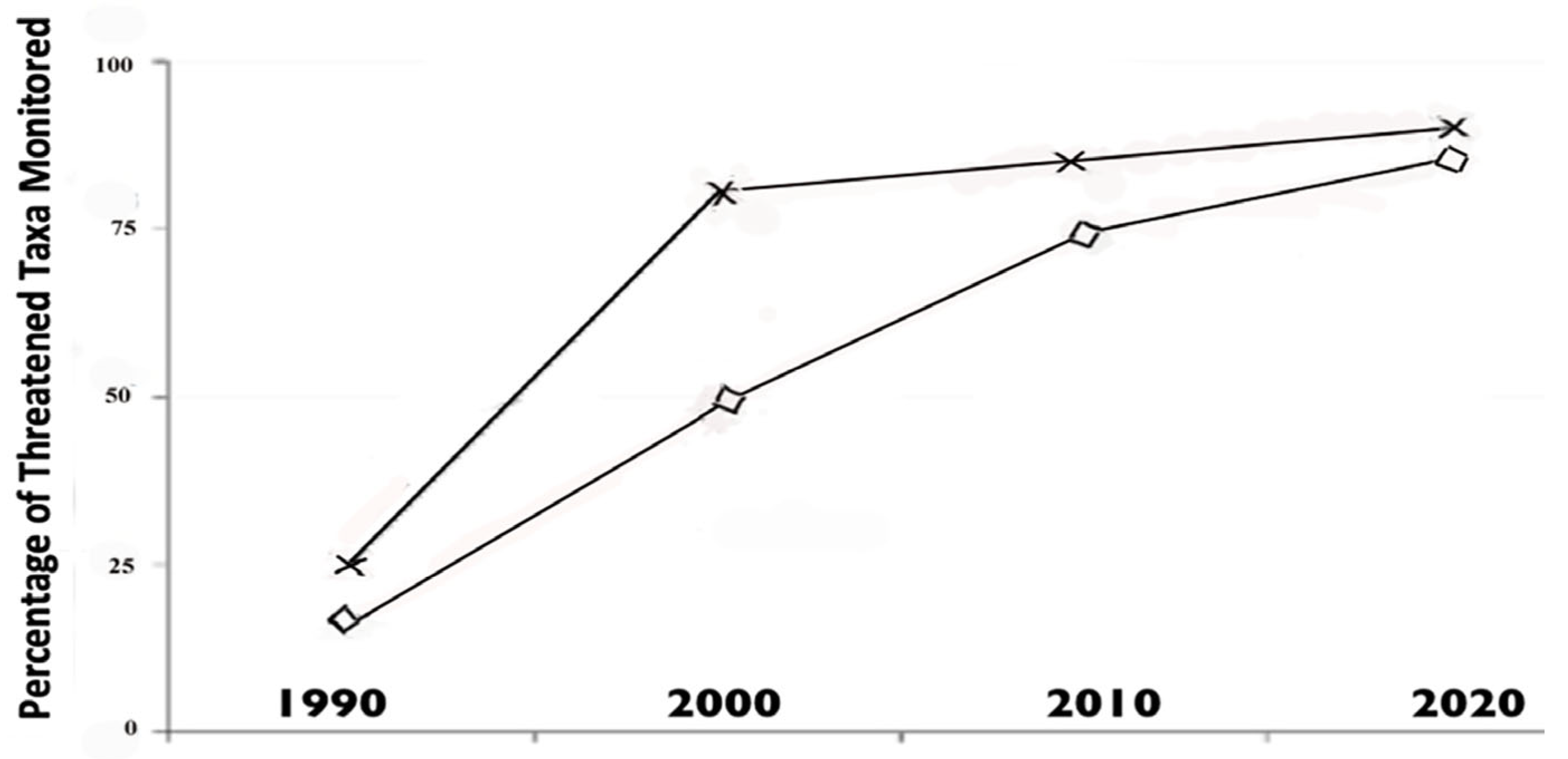
It is also worth remembering that systematic attempts to document which avian species are most threatened with extinction are rather recent in Australia, marked by a 1990 publication [234] and finally enshrined in the ‘Endangered Species Act 1990’, then replaced with the ‘Endangered Species Protection Act 1992’, coming into force in 1999. Consistent and reliable monitoring of specific species in Australia is still relatively selective (specific to threatened species; Figure 7) and has only increased and been consistent in the last few decades or so. One suspects that there are still substantial gaps in our knowledge of the presence and abundance of certain species [235]. Moreover, one may further surmise that the role of native avian species in the Australian ecosystem, in some cases, as well as their behaviour, may not yet be fully understood. As Rayner and colleagues argued [5], apart from a relative paucity of rigorous population studies and time frames that are too short, observed changes in year-to-year population size can be driven by environmental factors not included in the study [5].
Obtaining comprehensive data across all living things in Australia, whether invertebrates, fish [236], amphibians [237], birds [238], mammals [239,240,241], forests, or plants in general [242], is a mammoth task in a vast country/continent with a small population. Not surprisingly, there are still major inadequacies in monitoring Australian biodiversity [243,244]. Also, soil conditions have rarely been mentioned but are very important to consider for the survival of invertebrates relevant to the conservation of woodland birds that are insectivorous and terrestrial [245].
Yet, whatever the shortcomings, the available literature documents incontrovertibly major and dramatic downturns in bird numbers (an average of 44%), mammals (35%), and plants (72%) [239] in the first 25 years of the twenty-first century alone [246]. Focusing on one species, here the noisy miner, as the sole cause of all problems, obviously ignores many factors. It is important to remember that small woodland birds and larger passerines have coevolved and have lived and survived for millions of years, suggesting that checks and balances also evolved to ensure the survival of all. In a study of the nest fate of regent honeyeaters, the researchers found that daily nest survival rates showed no negative relationship with predator-community measures but rather a non-significant positive relationship between nest success and both predator abundance and predator species richness [247]. These are obviously complex relationships that may trigger different responses under different circumstances.
One would have to conclude that presenting one or two avian species as perpetrators and all others as victims is a misrepresentation and oversimplification of the dynamics of bird communities, and this also neglects the idea that human action led to the unstable and detrimental habitat conditions.

5.5. The Problem with Bias: Ultimately a Backwards Anti-Conservation Logic

While Australia has the highest rate of mammal extinction in the world [248], actual extinctions of birds (and those seriously endangered) have so far been largely confined to islands due to invasive predators and landscape modification [246]. Indeed, Australia has experienced radical alteration of its landscape due to the logging and felling of some 80% of pre-colonial forests, agricultural expansion, and the growth of cities, along with their increase in landscape-wide impervious surface areas from zero to about 80%, resulting in an almost immediate reduction of 50% of bird species. Climate change is also usually mentioned. And, as Wenzel et al. noted in a different context and geography, overall, open woodland birds are the biggest losers because their habitats have disappeared, been fragmented, or significantly altered in other ways [249]. One notes that noisy miners are also woodland birds, which might indicate that noisy miners, like other avian species, need help. They need help because living in constantly altered habitats or shrinking suitable habitats has and continues to turn many species into refugees in their own native environments. But this is not the conclusion drawn by lawmakers who have declared noisy miners threats to the environment and then allowed them to be eradicated and/or their numbers reduced wherever and whenever indicated [21].
In the 1800s, John Gould described noisy miners’ social and individual characteristics as typically “moving in groups of four to ten individuals” and the general disposition of the species as being “restless, inquisitive, bold and noisy” [250]. ‘Noisy’ usually refers to alarm calls being issued if there is a perceived danger. Little had changed in this perception of noisy miners, but in the space of just a few decades, human opinion of this species has turned from a charming honeyeater to a rogue bird, from an assessment of an exquisite and clever little songbird to a destructive and dangerous bird that had to be sacrificed, often termed ‘miner suppression’, as though the killings could be made more palatable by using the term suppression [29,38].
This elimination of a small songbird probably represents one of the most dramatic and extraordinary public responses at government and senior academic levels to a single native bird. Beggs recently wrote a very detailed account of the changes in attitudes to noisy miners from positive to negative [18]. Suffice it to say that, ethically [55], the approach to noisy miners has been questionable and scientifically mono-causal or extremely reductionist in its explanations [251]. Such an approach, guilty due to limited evidence (and even inconsistent evidence, as shown here), reduces the chances of resolving any complex problems under investigation. This approach again raises questions of ethics, of commitment to local wildlife, and of research methods and data that can lead to intuitive but perhaps premature and certainly narrowly focused and unhelpful conclusions.
One has to be extra careful about the political fallout and by-product of blaming one native avian species for the decline of other birds and even claiming that ‘habitat-clearing, fragmentation, and degradation’ have created more suitable habitats for noisy miners [252,253]. This sounds very much like backwards logic against evolutionary evidence and conservation aims. No doubt, logging companies will look particularly kindly on such expert conclusions. This leaves logging companies, multinational agribusinesses, local councils, and politicians entirely without blame for the decline of biodiversity, plants, and animals in general. This is astonishing since we know that at the turn of the 21st century, approximately only 8% of woodlands in any climatic region remained in Australia [182]. Moreover, Watson and colleagues showed that there were substantial negative effects on birds due to loss of habitat and habitat complexity [254]. This, in turn, has knock-on effects, for instance, in the agricultural sector, such as the decline of insects [46,255], not to mention the devastating effects of chemicals used in agriculture, of which 42% are known to be lethal for any biota, mainly insects, including birds [256].
As many as 85% of insectivorous species foraging above ground were statistically affected by patch size and/or loss of habitat complexity, including many small woodland birds, such as Jacky winters Microeca fascinans, Australian robins (Petroicidae), weebills (Smicrornis brevirostris), golden whistlers (Pachycephala pectoralis), thornbills and gerygones (Acanthizidae), pardalotes (Pardalotidae), as well as some honeyeaters, including noisy miners, that feed on insects from ground level but also glean insects from foliage [159,256].
It is very difficult to imagine that noisy miners were not as affected by these dramatic changes as the other small, afore-mentioned woodland birds, and even more difficult to believe that noisy miners specifically were the only species that allegedly “benefitted” from the destruction of their habitat or from the presence of white settlers, as has been claimed [253].
In fact, not all surveys of birdlife in eastern Australian woodlands have shown a decline of woodland birds or specifically highlighted a dominance of noisy miners. In a century-long study of a region in the south of New South Wales, the Tapitallee region, it was shown, for instance, that small woodland birds had thrived and noisy miners had declined over the years [88]. Some writers have argued that there is a problem. Culling programs that play off one native species against another native species are of concern to many conservationists [44,257] and one might consider the view by Batavia and colleagues pertinent to the treatment of noisy miners, and I quote, “Under these circumstances, continuing an ineffective program that perpetrates mass violence is not a right decision. It is simply wrong. Conservation is riddled with such moral conflicts.” [258].

6. Environmental Factors: The Understorey and Characteristics of Woodlands

6.1. Nest Position and the Importance of the Understorey

Arnold’s study [169] is one of the very few more recent research reports on noisy miners that has paid close attention not just to the timing of breeding but also to nest position. Importantly, the study found that nests in low positions (less than 2.5 m high) were more likely to be successful than nests built at heights of over 4 m. Low nests, Arnold explained, are less visible and less accessible to raptors [169].
The latter point is of special interest: researchers involved in projects designed to cull miners have repeatedly claimed that noisy miners prefer woodlands without an understorey. A fact sheet on noisy miners, made available online by the NSW Department of Education (n.d.) [170], states that “Noisy miners prefer to live in areas with eucalyptus, namely trees, and a clear understorey” (emphasis added) [170]. It is hard to find any evidence to show that this is, in fact, the case, but this alleged “fact” has been copied from one publication to the next, including, damagingly, by the NSW Department of Education, information that can trickle down to the entire education system [170].
Hence, the claim that noisy miners prefer no understorey is clearly contradicted by the carefully observed behaviour and circumstances in Arnold’s study of the impact of timing and location on nest success. To repeat, Arnold’s results show that noisy miners are more successful when nesting in a lower understorey [169]. An understorey is usually described as consisting of plants with heights ranging from 2 to 4 m (and possibly lower than 2 m), suggesting that contrary to the claims made for many years now, the understorey might well be of major importance for the breeding success of noisy miners and possibly of other woodland birds. Conversely, it should follow that patches without an understorey and consisting of trees with heights of 10 m or more are not suitable environments for noisy miners to successfully raise their young. One may therefore surmise that the assumption of a cleared understorey as the preferred habitat for noisy miners is at best on very shaky ground, if not outright incorrect.
No doubt, noisy miners have been seen to occupy open woodlands without an understorey, but does this mean that (a) they choose to be there, and (b) they prefer such an environment? It is also possible to argue that they can be found in such open spaces because they can find no other, more suitable environment. This point is discussed further in the next section.

6.2. Ideal Environments but No Noisy Miners?

In a long-term banding project (2007–2020), bird numbers and species were recorded in a 54 ha area designated as an environmentally significant zone (the River Flat Forest) at Camden Airport, about 30 km from Sydney near the Nepean River. Although most of the large river eucalypts had been removed during WW II, there has been significant (secondary) regrowth, with an understorey and woody weeds at the time of publication [259], and the area was recorded as being home to some 50 species of birds, 20 of which were small woodland passerines, among which 9 species were honeyeaters, including the bell miner (Manorina melanophrys), but no noisy miners were ever recorded [259].
These discrepancies raise several concerns: Why would the behaviour of noisy miners vary so markedly at different sites? Why do they flock in large colonies in some places when the previous literature suggests that their preferred social units ‘normally’ consist of two to three pairs and helpers? Most reports on noisy miners describe their preferred habitat as open woodlands. The problem is that such generic descriptions may not be sufficient in any project that describes a decline or increase in species and numbers. Steve Debus’s account [260] is one of the most detailed descriptions of the kind of woodland on which his study was centred. He writes that noisy miners primarily inhabit dry, open eucalypt forests dominated by spotted gum, box, and ironbark, as well as degraded woodland where the understory has been cleared, such as recently burned areas, farming and grazing areas, roadside reserves, suburban parks and gardens with trees and grass, but “without dense shrubbery”, not without any shrubbery—a factor that might be of some importance. BirdLife Australia, in one of its ten booklets for the public, proposes to “restore native understorey in remnant patches or establish shrubby understorey in order "to deter noisy miners or other competitors”, suggesting that noisy miners avoid the native understory but not specifying what the vegetative conditions should ideally be [261]. The comment makes little sense in light of Arnold’s results, since breeding success in noisy miners was shown to be greater when nests were placed in understorey plants of 2.5–4 m height or even lower [169].

6.3. Lacking Detailed Descriptions of Woodlands/Open Woodlands/with or Without an Understorey

Descriptions of ‘woodlands’ and ‘understorey’ in the noisy miner literature are often too imprecise or contradictory, making it difficult to obtain any factual basis for the species’ alleged ‘preferred’ environment. Therefore, it is vitally important to identify important nuances in environmental architecture, including height, structure, or density.
There are two ways to remedy the general vagueness in the description of the architecture of plants in environments, or, I believe, the discredited claim that noisy miners prefer to have no understorey [170]. The latter claim was only possible because the description and naming of plant architecture have not yet been fully standardised. Such standardisation is necessary and easy to achieve because an authoritative classification system already exists: The Atlas of Australian Resources (NATMAP) (vol.6) [262], which clearly defines the differences between forest and woodlands, as well as the differences between various types of woodland, understorey, and shrubbery. The definitions set out in volume 6 of the Atlas are easy to follow, and if these definitions were rigorously applied and made explicit across all projects, one might eventually find common ground and identify the specific environments in which species, such as small woodland birds and noisy miners, might find stability.
The ‘Atlas of Australian Resources’ volume 6, titled ‘Vegetation’, provides a way to standardise exactly what a woodland is. Notably, an undisturbed woodland does have an understorey [262]. On p. 11, the Atlas presents a diagrammatic ‘pictorial key to the structural forms of Australian vegetation’. There are drawings of six types of ‘forest’. In their definition, the unifying characteristics are the closed canopy and the amount of light reaching the ground that defines a ‘forest’, identified as foliage cover:
(1) Closed forests fall into two groups: (a) more than 70%, and (b) 30–70%, meaning that in such environments, canopies overlap and create at best dappled light on the forest floor. There is very little left in Australia of ‘tall, closed forests’ (one of the very few well-known examples is the ‘Daintree’ in northern Queensland, which, since 1988, has been listed as part of the Wet Tropics World Heritage Area (WTWHA). Hence, all other treed areas are classified as ‘woodlands’.
(2) There are five types of woodland identified. ‘Open’ refers to the fact that canopies do not overlap and allow more light on the forest floor: (i) tall woodlands (T2); (ii) woodlands (M2); (iii) open and (iv) low woodlands, whose canopies have 10–30% foliage cover; and (v) two types of open woodlands that provide less than 10% foliage cover. Open and low open woodlands have very sparsely distributed trees that offer less than 10% foliage cover and low native understorey vegetation [262], p. 11. Importantly, the height of trees in open woodlands is still about 20 m, and in low open woodlands it is about 10 m, but there is no understorey. Below these heights, classifications change to shrubland (4 m or less).
The woodlands in which I have observed resident noisy miners rarely belonged to the category of tall woodlands (T2) but largely to the ‘woodland’ category (M2), meaning that trees were 20–30 m in height and the crowns did not meet but were still relatively close together. Importantly, the T2 and M2 classifications include details of understorey heights that could reach 5–8 m (Figure 8).
However, parks established for human enjoyment, i.e., places where large numbers of noisy miners allegedly prefer to be, usually have very little, if any, understorey. In fact, these parks are artificially created, and the understorey is removed for safety reasons, i.e., to suit human needs. In natural environments, such parks may not fit into any of the categories described in the authoritative source of this Atlas.
In Figure 8, woodland profiles are shown. Figure 8D shows the parkland (woodland without an understorey) that more than one author claimed was the preferred environment of noisy miners [19]. The same statement has been repeated by the NSW Department of Education (n.d.) [170], as shown in Figure 8D. And this assumed fact is also built into description of noisy miners as a ‘reverse keystone species’ [181].
There is no evidence to show that a preference for an environment without an understorey for the species as a whole exists. At the culling sites, some large colonies of noisy miners have been seen in habitats with a ‘cleared understorey’. The justification for culling noisy miners largely rests on both the numbers seen in one location and the assumption that they ‘prefer’ such a habitat and will fight to exclude others from their patch. Talking about ‘preferred habitat’ is risky at the best of times. As a generalisation, it is misleading, particularly when evidence exists of noisy miners breeding successfully within the understorey [168,169] (paper in prep.). To repeat, selecting the understorey for nest sites (especially at lower heights) has led to greater reproductive success than in higher trees or canopies [139].
One would therefore have to conclude that the assumption of noisy miners preferring no understorey, as so many authors have now claimed, is unresolved if not incorrect, unless noisy miners choose not to breed at all or risk even lower (and possibly unsustainable) levels of nesting success rates than those reported in the past [168] (see Table 2).
Alternatively, it is argued here that research on habitat preference (vegetation type and architecture) has simply not been described in sufficient detail and not standardised as to what understorey and ‘woodlands’ mean in height, density, and light. Habitat quality often determines levels of cooperation and thus also reproductive success. And since the lives of native birds depend on human judgement, this would seem to be especially urgent. With some exceptions [221], many recent publications proposing or reporting culling events of noisy miners do not spell out details of the physical properties of the selected noisy miner habitat and sometimes avoid doing so by calling noisy miners ‘edge specialists’. To end one aspect of controversy and contradiction, standardised habitat descriptions could be adopted in all papers using the categories provided by the Atlas (vol. 6, Vegetation [262]). This would help distinguish degrees of habitat complexity and enable more precise predictions of the suitability and sustainability of native bird assemblies in general and of small- to medium-sized woodland birds in particular.
A very thorough study by Oldland and colleagues [263] of the environmental conditions in which noisy miners are found in Victoria suggested that the idea of ‘preferred habitat’ is more complex than just a question of understorey [263]. They found that the most powerful predictors of the presence of noisy miners at remnant corners were associated with deeper, more fertile soils and higher proportions of yellow gums (Eucalyptus leucoxylon). Yellow gums are prolific and reliable nectar producers, and nectar availability might be “more important in determining the attractiveness of a site to noisy miners than structural attributes like the presence or absence of an understorey” [263].
However, resource availability may also not be the most important factor that explains the absence or presence of noisy miners. One needs to recall that noisy miners are, in fact, more appropriately called feeding generalists than predominantly or exclusively nectivorous [125,159], as I have also observed them gleaning insects and smaller butterflies. Unfortunately, many urban-adapted birds have also taken to a variety of often harmful anthropogenic foods [264], a new avian habit that is a global problem [265,266,267]. Diet flexibility may be a specific adaptation to urban life, but substantial discrepancies still exist in identifying their preferred habitats in conjunction with resource availability. In a recent and very detailed review of workable and non-workable strategies for the conservation of woodland birds, Walsh and colleagues [268] showed that most conservation strategies yielded mixed results or were not successful. Condensed from hundreds of papers, mixed and unsuccessful strategies include fire control, management of noisy miners, and grazing management. Even natural regeneration and habitat protection on their own yielded mixed results.
The authors found, however, that methods of active revegetation showed consistently positive results for species richness and abundance across all bird species, including woodland birds in general and declining/threatened small woodland birds [268]. Similarly, leaving or adding large woody debris also showed consistently positive results across all birds and ground foragers.
One notes, by contrast, that almost none of the culling projects of noisy miners reported replanting activities (active revegetation). No attempts were made to reintroduce native plants, understorey, and/or ground debris to see whether, after a few years, the behaviour of noisy miners had changed, prior to making the decision to shoot the birds. Indeed, in only a few projects was some replanting undertaken or considered, even after the noisy miners had been removed, and then only to avoid the noisy miner resettlement. According to Walsh et al. [268], one could conclude (with hindsight) that none of the projects should have proceeded until the strategically important step of active revegetation was completed.

7. Scientific Objections and Alternative Explanations

One of the concerns underlying the biased characterisations of a native species is that the substantial findings of the proximate causes of avian behaviour were overlooked or not applied. It seems, for instance, that the only emotion that noisy miners are described as displaying is ongoing aggression, usually considered a rather extreme, if not dysfunctional, behaviour. Across all the literature against the noisy miner, it is evident that Descartes’ views have not quite disappeared. He was thought to have believed that animals are genetically hardwired and are able to act purely mechanistically. In short, animals are ‘automata’, incapable of thinking, and, crucially, Descartes apparently believed and expressed the view that humans therefore had no moral obligation towards them. While these claims have been reinvestigated repeatedly [269], Descartes’ views in the popularised version were influential well into the middle of the 20th century. In the mid-20th century, Tinbergen broke away from some of the implications of animals as ‘automata’ when he published two influential books on bird and animal social behaviour [270,271], for which he was later awarded a Nobel Prize. His admission that animals had emotions was modest but broke away from Descartian concepts of animals as ‘automata’. He argued that animal emotions existed, were tied to motivational systems, and were basic to survival. To put it bluntly, the four fs are feed, flee, fight, and fornicate. These four basic tenets of emotions can be demonstrated and tested because each is regulated by hormones. Indeed, later research found that birds have the same or functionally equivalent hormones and neurotransmitters as humans [272], including serotonin, the dopamine system [273,274], prolactin (once thought to be unique to mammals), adrenalin, and corticosterone (the avian equivalent of cortisol), controlling and expressing fear. One does not necessarily expect a discussion on the function of hormones when concerned with the conservation of specific species. But should one not expect to ask why birds, here noisy miners, have switched behaviour and made a choice to congregate in large numbers and in environments they would not normally choose? First, it is worth remembering that humans, not other vertebrates, are generally believed to have a major impact on species extinction [275,276]. In other words, one would expect more detail by first trying to understand the environment from the bird’s perspective.
How is this relevant to noisy miners and ongoing efforts to reduce their numbers? First, killing part of a community of a cooperative species is bound to have repercussions for their future success in breeding and even for their survival because of systematic culling. Possible motivations by noisy miners to behave as they do in some locations are questions worth asking, since the behaviour is not uniform.
It is generally agreed that fear is one of the fundamental emotions in all animals. In birds, there is a centre (both sides of the brain) designed to respond to such emotions called the amygdala or archistriatum. Activating the amygdala does two things: increases adrenalin and raises vigilance levels, enabling memory formation of the specific event that induced the fear or stress response [277,278].
Memory formation of this kind is crucial to survival. Fear can also be caused by uncertainty. Agnvall and colleagues [279] tested the relationship of fear (of humans) by examining a number of physiological and behavioural traits in junglefowl (Gallus gallus). They found that in fowl with low fear, basal metabolic rates were higher, feeding efficiency was greater, plasma levels of serotonin were higher, and exploratory behaviour was greater compared to birds with high levels of fear [279]. Ecology, not known to concentrate on emotions and cognition in birds, nevertheless recognises that fear is an important factor in bird behaviour, and this, I believe, might well have some explanatory power in the case of noisy miners.

7.1. The Ecology of Fear

Contradictory results and seemingly biased reporting and terminology have proposed many reasons as to why this is so. One problem is the characterisation of noisy miners as aggressive or hyper-aggressive. These words alone are value-loaded and generally not used in animal behaviour studies, brushing aside a century of research and fine discrimination of animal behaviour since Darwin, or at least since Tinbergen [280]. Indeed, papers on noisy miners have used the word ‘aggression’ and even ‘hyper-aggression’ rather lavishly when, perhaps, the term ‘agonistic’ would have been more appropriate. The latter tends to have survival-function connotations, such as nest defence, territorial defence [281,282], site-related dominance [283], defence of food resources, competition for a mate, and, if possible, driving out a predator or at least driving the predator away from offspring [284]. While styles and methods of these defences may vary between species, their functions are similar or identical and have a long evolutionary history. The question is whether the assertion of noisy miner dominance and driving out other species represents something fundamental and perhaps even alarming. It is possible and even likely that dominance behaviour may have developed in some locations in response to specific external factors.

7.1.1. Stress and Its Costs

Many external factors present in the environment (urban or natural, social or predatory) cause stress [285]. Short-term stress, such as predator–prey interactions [286], may result in actions that reduce stress [287], but in some situations, stress may become chronic, alter behaviour, and lead to poorer outcomes in social life, decision-making in general, and reproductive success [288,289,290]. Predator–prey interplay is a central theme in ecology [291], yet it seems to have played no role in the latest assessments of the behaviour of noisy miners. One needs to ask how it is that there are some noisy miners that suddenly appear in large social groups, seemingly at the exclusion of other birds, but not consistently throughout their range, and such new formations are found in some locations and not in others.
Owing to neuroscience research, it is now known that the fear and stress of life-threatening experiences can have a significant impact on the brain [292]. In humans, this is now mostly recognised and referred to as post-traumatic stress disorder (PTSD) [293], while in birds, such trauma is recognised but generally described as brain- and behaviour-altering events. In captive birds, however, PTSD has been adopted as a diagnostic tool [294]. At its core is the trauma of one or several usually life-threatening experiences that result in a number of qualitative and behavioural changes.
In 2006, Blumstein established what is known as the ecology of fear [295], and such fear is associated with identified risks, thus predominantly with predators. Notably, as Clinchy and colleagues showed, humans have now advanced to the role of ‘super-predator’, even more feared than larger native carnivores [296,297]. The ecology of fear in animals has been recognised as an important way to explain the total impact of predators on prey populations and bird communities, and it would be advantageous for the survival and health of avian species to understand that human presence is not an innocuous stimulus but one that, in many situations, contributes significantly to levels of fear and distress. Signs of ‘hyper-aggression’, as many researchers have noted in noisy miners [21,22,23], should immediately raise some serious concerns about noisy miners because it is atypical behaviour, out of season, and likely a consequence of ongoing stress and fear. Human presence alone and/or hostile actions against noisy miners may therefore substantially increase the birds’ distress. One might expect in the future that observers watching such behaviour would show some empathetic concern for the birds’ overall health and then investigate further.
Regrettably, researchers have chosen instead to interpret this in human terms as ‘badly behaved bullies’ and then made a case for their elimination. As Zanette and Clinchy put it so clearly:
“The ecology of fear posits that the behavioural, physiological, and neurobiological costs of avoiding predation (‘fear’ for short) may additionally reduce prey fecundity and survival, and the total reduction in prey numbers resulting from exposure to predators may thus far exceed that due to direct killing alone. If this is the case, then failing to consider fear as a factor risks profoundly underestimating the ecological role predators play.” [298].
The distinction between functional and dysfunctional behaviour has become evident after 100 years or so of research into adaptive avian behaviour: almost all agonistic behaviour has a clear survival function [299] that is identifiable across vertebrates and indicates a long evolutionary history [220]. The 19th to 21st centuries have added a substantial number of anthropogenic stressors that did not exist before, which now often simultaneously affect the daily lives of native animals, including birds [13,300].
As mentioned previously, many studies have shown that any number of such stressors can lead to reduced foraging, increased vigilance [13,273], and reduced reproductive success, all factors that can affect behaviour and health [286,287,288,289], as they can negatively affect the functional diversity of birds [275]. The question is whether noisy miner dominance and aggression are species-typical or atypical behaviour, or have developed in some locations in response to specific external factors?
The basic emotion of fear is experienced during a stress response [301]. A study by Willcox found that free-living woodland birds in more fear-inducing habitats show a cognitive bias by making more pessimistic judgements about an ambiguous stimulus [302]. According to Willcox, location has a significant effect on fear levels, i.e., it induces different affective states. Willcox showed that the impact of understorey cover is positive and human disturbance is negative on birds’ welfare [302].
With such findings, it is at least possible to hypothesise that the lack of an understorey can induce fear because of exposure to an environment in which hiding or cryptic approaches have been made impossible and thus have exposed the birds to a greater risk of predation. Would one expect behavioural changes as a result of living in denuded environments?
There are several ways to answer this. Schmidt and Kuijper [303] suggested that the landscape of fear contains a “real death trap” because cleared environments are transparent, have no distinct refuges for prey, and make prey distribution more predictable for predators, even or especially when prey avoid the riskiest sites [303]. This is very relevant to noisy miner colonies having settled in open woodlands without an understorey. When the prey birds concentrate their foraging in fewer areas, this helps predators find prey more readily. Prey animals are aware of varying levels of predation risk ‘at a spatial scale’ [304]. If this is so, it is conceivable that noisy miners are also aware of varying levels of predation risk and have learned to protect themselves by forming large groups and warning other small birds of the high predatory risk. Indeed, for woodland birds, the heightened sense of exposure could well signal fear and induce chronic stress, i.e., in a negative affective state with physiological and behavioural consequences [305]. We have heard often enough that habitat loss and fragmentation threaten birds via structural changes and the ensuing reduction in resources, but as Teckentrup and colleagues [306] rightly said, this also occurs via inevitable modifications in species’ interactions. They argued that an additional consequence “is perceived predation risk and hence feared, which is rarely explicitly addressed in studies on habitat modification” and, significantly, they found that fear alone had negative consequences for biodiversity [306].
The question is, why would noisy miners prevent other birds from taking residence in their territory when, in other contexts (woodland with an understorey), they live peacefully with the same species they chased away in open spaces? Clearly, such questions need answers and may require innovative research designs. We know that there is a link between cognitive bias and affective states [307]. Birds can be ‘optimistic’ or ‘pessimistic’ in their behaviour, depending on the experience and environment [308,309]. To hypothesise, it may be that other woodland birds, especially small ones, are not perceived by noisy miners as suitable recruits to help defend such an exposed environment, and hence, just to cope, the noisy miners require the recruitment of as many conspecifics as possible to defend a perceived high-risk environment. Koolhaas and colleagues suggested that stressors can result in proactive coping styles marked by higher aggressiveness, higher routine formation, and lower cue dependency [310]. Whether fear lowers or heightens response patterns, it is clear that “fear effects” can significantly alter the physiology, behaviour, and life history of prey species [311], or expressed differently, all of life becomes one of uncertainty and a perceived lack of safety.
The first response in perceived high-risk environments is usually vigilance behaviour [312]. Vigilance is an expensive form of self-preservation because the vigilant bird cannot feed while trying to look out for predators. And a simple solution, where possible, is to increase the size of the group. Vigilance for predators as a social phenomenon is one of the most studied aspects of behaviour under risk of predation [311,312]. The common observation is that individuals in a foraging group spend less time being vigilant with increasing group size, and larger flocks have a higher survival chance [313]. As shown for other classes of social animals, large-scale ecological effects can be linked back to fear. For example, the reintroduction of wolves to Yellowstone National Park increased predation risk and fear for elk, resulting in grazing changes and avoiding more wooded areas, which altered the vegetation in the park and literally changed the landscape to the point of stability for all animal groups [314].
It is also plausible that landscapes can engender fear when individuals feel too exposed. There may be no place to hide or no safe place to nest [315]. Urban environments, for instance, have been shown to induce fear. Behavioural observations of birds corroborate the importance of cover, not just for roosting and sleeping but also, and perhaps especially, when foraging. In a study on foraging, a video recording showed that Eurasian jays, when offered worms at an open feeder, rarely consumed the worms at the feeder but took them away to a more covered area. Carrying food to protective cover minimises exposure to predators [315], suggesting that birds perceive a high level of risk when foraging in open areas. Behavioural differences at different locations also imply that birds at ‘high-fear’ locations experience a negatively valenced affective state. These findings are consistent with previous research demonstrating that birds alter their foraging decisions based on their proximity to protective cover, leading Laundré et al. to argue that the concept of a ‘landscape of fear’ is valid and unifying in animal ecology [304].

7.1.2. Refined New Culling Techniques: An Elevated Level of Trauma for Birds

Unfortunately, the persecution of noisy miners has not ended. Just as this paper was about ready to be submitted in its final version, a paper was published that proffered a ‘solution’ to the noisy miner ‘problem’ and claimed to have found a new culling technique: culling by shooting noisy miners in the centre of the territory and letting those in the outer circle live. This was reportedly to prevent another group of noisy miners from recolonising the territory and was said to have made the surviving miners less aggressive and ‘calmer’ [316].
This claim of success in dealing with noisy miners and the interpretation of noisy miners’ behaviour may be far off the mark. The culling technique, usually referred to as the ‘doughnut tactic’, may be new when applied to animals, but in the military, it is a familiar term used for eliminating the centre of a group containing ‘high-value targets’ and subjugating the remainder of the outer layer (hence, ‘doughnut’ tactic).
Stress tends not to remain with a target group but may spread from families to close allies and even throughout animal communities. As outlined in a previous section, considering the ecology of fear, the more probable interpretation would be to predict that the level of fear and stress in the surviving noisy miners was extremely high.
Also, a more likely explanation is that they are not ‘calmer’ [316] but traumatised to the point of ‘freezing’, with a poor prognosis for their own survival as a result of witnessing this event. One hopes that ethics committees in research institutes would counsel staff about the potential effects of this ‘technique’, be this for any purpose, let alone for conservation purposes.
No anti-predator defence that has ever evolved could have prepared miners to cope with this culling event: none of the strategies that any avian species might have perfected would have worked in this context. Had the surviving birds been tested for corticosterone levels, predictions might well be that they were highly elevated, i.e., showed signs of extreme distress, probably turning into chronic stress. These physiological changes would have been followed by behavioural signs of confusion, poor foraging, and a limited number of activities. Serotonin levels might have dropped to critical levels, leading to depression, poor digestion, and declining health. As noted previously and shown in countless studies, particularly stressful events can significantly alter the physiology, behaviour, and life history of prey species [317]. And there is a further consequence that may not have been intended but is well-known: the effects of frightening stimuli (such as predators) generally do not just remain with the targeted individual or species but tend to spread throughout the assembly of species, that is, including any other woodland birds that might have witnessed the culling, including species that the culling event was meant to protect and help, thereby contributing to a further decline in or complete collapse of diversity [318].

7.2. Territorial Behaviour

The idea that a definition of territoriality should include ‘aggression ‘as a ‘requirement’, as Pike and colleagues recommended [305], defies long-standing documented evidence and insights. In 1956, Hinde confirmed and established the biological significance of territories and suggested that territorial defence and impulsive/emotive ‘aggression’ can be two very different things [281]. Indeed, a large number of species in most classes of animals, including invertebrates, have developed some form of strategy to protect at least their own breeding sites [172,174] that involves no aggression at all. Such strategies may involve deception, camouflage, or distraction displays, designed and usually successful in luring away predators. These activities are, however, largely confined to ground nesters and are common in grasslands and waterbirds worldwide. There are several kinds of these displays: feigning injury, performing impeded flight motions, feigning lameness, and playing dead. Sometimes, a combination of activities is used. Golden plovers feign injury. Oystercatchers (Haematopus ssp.) use ‘impeded flight’, hopping along with futile wing flutters or very slow flight. Some species mimic dying in groups, such as stilts (e.g., the pied stilt of New Zealand). Australian white-fronted chats (Epthianura albifrons), when performing disablement displays, encourage their neighbours to join in [319]. Stylised threat displays may involve vocalisations or parading around with wings fanned out widely. Other forms of territorial defence are purely vocal, of which duetting is the most common form. These vocal signals are usually respected, but they can also be deceitful [319]. Of course, there are also clashes and fights when nothing else works, but that is also nest defence.
Sometimes, small birds may have no choice but to flee and abandon their nest. However, not all small birds are entirely defenceless. For instance, the brown thornbill, Acanthiza pusilla, a bird weighing a mere 7 g, has in its repertoire aerial predator alarm calls that it can use deceptively to make potential nest raiders flee [320]. Many Australian small bush birds are not timid or anxious but quite feisty and fearless, at least when facing intruders or competition, and will mob potential predators even if they are substantially larger (including humans) [299]. Such bush birds include brown thornbills (mentioned previously); grey fantails, Rhipidura fuliginosa (8 g); superb fairy-wrens, Malurus cyaneus (10 g); rufous fantails, Rhipidura rufifrons (10 g); scrubwrens, Acanthizidae (12 g); willie wagtails, Rhipidura leucophrys (20 g); eastern yellow robins, Eopsaltria australis (20 g); rufous whistlers, Pachycephala rufiventris (25 g); sacred kingfishers, Todirhampus sancta (≈50 g); and as many as nine species of honeyeaters, including the bell miner, Manorina melanophrys (10–12 g), and the noisy miner (50 g). During the breeding season, males of such small woodland birds can be seen attacking their image in windows or in rear vision mirrors on cars, indicating that any competing male would be fought.
While many confrontations among male birds may be well stylised and expressed in symbolic displays, in some cases, fights can be quite savage and, in equally matched males, may lead to severe injury or even death, which happens on rare occasions during territorial establishment or fights for a choice among capercaillie males, Tetrao urogallus [321]. These are some strategies for territorial maintenance, breeding success, and self-defence as part of natural selection.
Non-lethal alternatives in the management of a native bird would clearly be a more meaningful option, but to do so might involve several time-consuming and dedicated steps. One step involves appropriate plant restoration programs for natural open woodlands, including the understorey. This is a bottom-up approach to conservation. A top-down strategy, as argued in a recent PhD thesis by Fielding [322], considers the possible reintroduction/rewilding of top native carnivores. The author reminded us that large carnivores at the top of the food chain are also in decline but are essential for functioning and healthy ecosystems [322]. He commented on top predators that “they can trigger trophic cascades throughout an ecosystem” which, in turn, “can cause changes in behaviour at all levels”: (a) a reduction in the abundance of mesoscavengers (which are a direct risk to woodland birds), and (b) decreased predation on smaller prey species, such as woodland birds, which are not the direct targets of top predators. And he believed that the reintroduction/rewilding of top carnivores is an important conservation tool for woodland bird communities [323]. As the dramatic example of the reintroduction of wolves to Yellowstone National Park so clearly showed, natural balance and dynamics can be, or become, self-regulatory once all the right elements and interactions are in place. And there is plenty of evidence to show that top predators have an important regulatory role in maintaining or restoring ecosystems [322,323]. In this chain of interdependent variables, it seems somewhat futile to single out a species, here the noisy miner, from among the multitude of living things and blame it for the failures above and below that interactive chain.

7.3. Myth-Making

Myth-making has been used rather assiduously in the pro-culling literature on noisy miners, either through omission, suggestiveness, conjecture, or other rhetorical means:
(1) Describing noisy miners using vocabulary usually reserved for value judgements of human behaviour (such as ‘bullies’, ‘despotic’ [27,28,29], and even ‘notorious’) is counterproductive [31].
Comment: Name-calling is a powerful rhetorical weapon for denigrating and/or digressing, but it is not science. Moreover, throughout the literature on noisy miner culling, the harmful role humans have played in habitat destruction (now often called the sixth mass extinction) of the Anthropocene is consistently excluded.
(2) Myth-making has been further strengthened by the claim that noisy miners have “benefitted from habitat-clearing, fragmentation, and degradation”, because these have allegedly created more suitable habitats for noisy miners [253].
Comment: Since when have species benefitted from global human action? This may be a comforting thought, but it contradicts the documented evidence of both, the accelerating decline as well as the increase in extinctions of living things in the Anthropocene. In current prognoses, avian species rank highest in either category among all recorded classes of animals [[12]; Figure 1].
(3) Some writers added ‘overabundance’ as an ecological category, and this claim has since been further embellished. In a media publication from 2019, it was claimed (or perhaps misquoted?) that the “lead researcher […] from the Australian National University [had said that] noisy miner numbers are now greater than before Europeans arrived in Australia, and on top of the loss of 80% of southern temperate woodlands, this is having a devastating impact on many other species of woodland birds.” [180].
In another public document, a slightly less contentious, but possibly just as misleading reference, was made to overabundance: “since European arrival, the noisy miner, a hyper-aggressive Australian honeyeater, has become overabundant.” [252], implying that the overabundance of noisy miners is a long-standing problem, but again, historical records are scarce and too recent to support such assertions at all!
Comment: The claim that “numbers [of noisy miners] are now higher than prior to or at the time of European arrival” is completely fictitious. It is also very regrettable to use such falsehood, even if ‘just’ as a dramatic device, seemingly to justify the killing of noisy miners.
To clarify and correct this statement: any information about species in Australia, let alone numbers, prior to European arrival, is unknown, except insofar as fossils have revealed some prehistoric presence of birds, dinosaurs, and megafauna, largely found and excavated in the 20th century. Taxonomy and palaeontology have provided the complex details of Australia’s avian evolution, phylogeny, and diversification [59,60,61,62,63,64,65,66,67], but this is not about individual numbers of birds. Citizen science bird counts started in the 1970s, and the ‘big data counts’ of ‘Birds in the Backyard’ are in their 13th year. The long and continuous presence of Aboriginal nations over at least 55,000 years, if not more [76,324], has been largely maintained as an oral and partly pictorial culture, but they almost certainly did not count bird numbers. Europeans first claimed/invaded Australia as a permanent colony in 1788. The first ornithological organisations were formed a century later (the South Australian Ornithological Association in 1899, the Royal Australasian Ornithologists’ Union in 1901, and the Bird Observer’s Club in 1905). At the time of Federation in 1901 at the turn of the 20th century, Australia’s white population was about 3.8 million (indigenous populations were not counted), and little was known about bird numbers, let alone their distribution across the continent, which remained relatively unexplored, as the small human population huddled mainly near the coast on the east and south, southwest of the continent.
John and Elizabeth Gould’s visit to Australia between 1838 and April 1840, on which the seven volumes of Australian birds (The Birds of Australia, 1848) were based, produced the first meticulous collection, descriptions, and detailed illustrations of Australian birds, but it was inevitably limited in scope [304]. Their visit included Tasmania and about a 200 km radius around Sydney and Newcastle, a small section of rural New South Wales, and some forays into South Australia (Murray River, Kangaroo Island, and Mt Lofty) [325,326]. Actual systematic monitoring of some species numbers (see Figure 7), and only of select and endangered groups, started in the latter part of the 20th century [234,235].
Comment: Given these facts, how could one possibly assert or know what noisy miner numbers were like at the time of Federation, let alone ‘before European arrival’? Nobody did any counting, either in the 18th or 19th centuries, and citizen science is a relatively recent phenomenon, emerging in the second half of the 20th century. Myth-making can work to legitimise whatever actions may be deemed desirable at a given time, but it diminishes science and makes a commitment to protecting native species difficult, and, of course, it is the latter that we must try to do.

8. Concluding Remarks

We have placed the noisy miner, a native bird, in an untenable position and neither solved its problems nor those of other bird assemblies. Condemning the bird’s behaviour using criteria that humans find unacceptable is hardly a way forward. The proximate causes of species’ decline often remain poorly understood, partly because there may be many factors involved that are difficult to analyse, and partly because such studies can be extremely time-consuming and resource-intensive. However, a very detailed study undertaken by the Royal Ornithological Society of Britain found at least seven major potential causes of avian decline [7]. Of the seven major causes, their report identified one obvious one, namely the decline of woodlands, as well as another, the decline of invertebrates as an essential food source for many woodland birds, causes that are likely to apply also to other countries, including Australia. Many other studies blamed the expansion of agriculture [8,9,10]. Another study from Poland wondered why two closely related species showed opposite trends: one was declining, the other increasing in numbers (Firecrests, Regulus ingicapilla, and Goldcrests, Regulus regulus, both very small migratory songbirds). In one case, climate change arose as a major reason for decline, and the major reason for increase was the regeneration of a forest and planting of many more of their favourite feeding and roosting trees [327]. In another recent study, Bennett et al. [328] raised the question of ‘revegetation’ and ‘remnant’ landscapes as a precondition for slowing or reversing avian decline. Hence, the matter of the decline of woodland-dependent birds in Australia may not be solved by simply culling ‘aggressive’ [21,23,329] noisy miners [34,57], even if the public can easily accept such an argument. The extensive culling of noisy miners, according to official edicts, was based on the species’ perceived risk to other small woodland birds. The anti-noisy-miner project was discussed in this paper as a case study of ethical dilemmas in conservation, or, in this case, as taking license with lethal outcomes, on a reductionist and on what one might well perceive as a biased premise.
Moreover, the ongoing removal or reduction of noisy miners has generally not been very successful in the context of the goals set by researchers. The latest report of noisy miner culling [316], however, sounds almost self-congratulatory, as it states that the miner ‘problem’ has been solved. Such confidence may be premature. Using a ‘doughnut technique’ for targets to be shot (see Section 7.1.2) means that survivors (i.e., deliberately non-targeted birds) witnessed the carnage. This deliberate technique may have done perhaps unintended but nevertheless substantial and even long-term damage to noisy miners and even woodland bird communities as a whole. The level of intimidation and trauma from seeing one bird after another, be it their partner, kin, team member, or associate, being shot and killed, can barely be imagined. This may lead to long-term changes in behaviour, in terms of either depression (PTSD) [294] or aggression as a dysfunctional way of ‘lashing out’ at everything and everybody. In fact, judging by the description of noisy miner behaviour in some of the papers, this may have already happened.
This paper has suggested that the reported atypical behaviour displayed by this species may be a symptom rather than a cause of the decline of woodland birds. The reasons one species behaves entirely differently in different locations in similar environments are indeed very unusual and puzzling, and this paper recommends that more research be undertaken to understand this phenomenon.
The social organisation of noisy miners can be complicated, or one may call this extreme flexibility, rarely seen in songbirds. Noisy miners have been described as colonial, territorial, and cooperative. Some or most of these characteristics are shared by only a few other avian species, such as grey herons, Ardea cinerea [330]; white-fronted bee-eaters (Merops bullockoides) [331]; and the pied kingfisher, Ceryle rudis rudis [332], and these characteristics will also require some research effort to clarify how such a complex social organisation might be beneficial for the species and how effective it might be as a specific strategy for ecologically and behaviourally challenging conditions. This research is yet to be carried out. But why have noisy miners been singled out as ‘nest interrupters’? This would be applicable to scores of songbirds and, of course, to the majority of birds of prey. Yet the blame has landed specifically on noisy miners, which have been deemed to cause ‘avifaunal disarray’ [25,26]. The claim that noisy miners have benefitted from habitat degradation [253] is an extraordinary claim that remains without any biological or ecological foundation.
The concept of the ecology of fear has thus emerged as an important concept in the Anthropocene to explain how predation risks (including pet cats and humans as super-predators [297,333]) affect animal behaviour and physiology, with potential consequences for population demography, species interactions, and ecosystem functioning [310,311]. We can help avian species by reducing their reasons for chronic fear, namely by creating usable refuges not easily accessible to predators [312] and ensuring that there are adequate and appropriate food resources for all endangered species, thereby increasing their ability to successfully reproduce and helping them survive:
1. Actively modifying/restoring habitat structures in favour of prey species threatened by adverse conditions.
2. Learn precisely in which habitat noisy miners maintain family groups of up to 20 in stable and peaceful populations (which requires due consideration of the understorey, as outlined in NATMAP [262]).
3. Establish why and when noisy miners form large social groups. In house sparrows, for instance, it was found that flock size is correlated with the level of perceived predation risk [313].
4. Resolve the discrepancy between poor reproductive success and cognitive abilities in noisy miners, and possibly in many other species. The potential causes of poor reproduction may, at times, be quite complex. For instance, it has been shown that removing predators does not improve annual nest and female survival, but in some instances, habitat manipulations can [168].
5. One may consider further, based on robust research, that birds experience negative emotions such as fear, stress, and frustration [317], and that they understand the world cognitively much better than had been thought even a few decades ago.
6. Active habitat restoration is likely to be a promising avenue for reducing the dynamics that create the ecology of fear in any native species, including birds. Where this is not feasible, additional conservation strategies may be required to compensate for detrimental, fear-mediated effects of land use. As Walsh and colleagues found [268], these are strategies that have demonstrated consistent success in restoring small woodland birds and biodiversity in general [268].
However, habitat restoration by planting a few trees is insufficient without considering the usefulness and compatibility of the species planted, whether in terms of structure, providing cover, or food value. It is also important not to overlook the importance of the types of understorey, with their different structures and heights, even including ‘refurbishing’ the ground with natural debris. Recent global research has suggested that only complex landscapes stabilise bird communities and reestablish their ecosystem services [6,314].
Having considered some of the important life history events and behavioural and cognitive strengths of the noisy miner, the conclusion, albeit tentative, is that the case of noisy miner management is a miscarriage of justice, a conservation failure, and unfinished business. Palmer and colleagues recently argued that killing for conservation is talked about in black-and-white terms and uses “demonisation to support the case that killing is necessary and morally right” and that we ought to be aware of “demonising language and imagery” [55]. These warnings may well apply to the stated attitudes toward noisy miners. This is not even just a case of killing Peter to save Paul [44], because, as has so far been shown, small woodland birds as well as most other birds continue to decline, whether noisy miners are present or not. Indeed, some may think that the culling, suppression, or local extermination of noisy miners is an anti-conservation action in terms of actual outcomes. Here, a victim of extremely stressful circumstances (and a native species that might have existed for many millions of years) is declared the perpetrator. Despite the well-documented and rapid destruction of the environment [82,83,84,334,335], in this particular case of noisy miners, humans and human activities seem to be excused from any wrongdoing.
The case study of the current fate of the noisy miner is a small example of a much larger problem in our relationship with nature and our environment in general. As Legge and colleagues rightly argued, if we really want recovery, it would require “society to reframe its relationship with the environment” [83].

Funding

This research required no internal or external funding.

Institutional Review Board Statement

Not applicable.

Data Availability Statement

The original contributions presented in this study are included in the article. Further inquiries can be directed to the corresponding author.

Acknowledgments

My sincere thanks go to L.J. Rogers for the detailed comments on the draft of this paper, and special thanks to the anonymous reviewers for their valuable suggestions.

Conflicts of Interest

The author declares no conflicts of interest.

References

  1. Farine, D.R. Collective action in birds. Curr. Biol. 2022, 32, R1140–R1144. [Google Scholar] [CrossRef]
  2. Heinsohn, R.G.; Double, M.C. Cooperate or speciate: New theory for the distribution of passerine birds. Trends Ecol. Evol. 2004, 19, 55–57. [Google Scholar] [CrossRef]
  3. Jørgensen, P.S.; Folke, C.; Carroll, S.P. Evolution in the Anthropocene: Informing governance and policy. Ann. Rev. Ecol. Evol. System 2019, 50, 527–546. [Google Scholar] [CrossRef]
  4. Barrett, G.; Ford, H.A.; Recher, H. Conservation of woodland birds in a fragmented rural landscape. Pac. Conserv. Biol. 1994, 1, 245–256. [Google Scholar] [CrossRef]
  5. Rayner, L.; Lindenmayer, D.B.; Gibbons, P.; Manning, A.D. Evaluating empirical evidence for decline in temperate woodland birds: A nationally threatened assemblage of species. Biol. Conserv. 2014, 171, 145–155. [Google Scholar] [CrossRef]
  6. Belder, D.; Lindenmayer, D.; Pierson, J.; Rudder, A. Survival and home ranges of woodland birds in restoration plantings. Ecol. Appl. 2020, 31, e2268. [Google Scholar] [CrossRef]
  7. Vanhinsbergh, D.; Fuller, R.J.; Noble, D. A Review of Possible Causes of Recent Changes in Populations of Woodland Birds in Britain; BTO Research Report No 245; The British Trust for Ornithology & Joint Nature Conservation Committee: Thetford, UK, 2003. [Google Scholar]
  8. Chollet, S.; Martin, J.L. Declining woodland birds in North America: Should we blame Bambi? Divers. Distrib. 2013, 19, 481–483. [Google Scholar] [CrossRef]
  9. Rigal, S.; Dakos, V.; Alonso, H.; Auniņš, A.; Benkő, Z.; Brotons, L.; Chodkiewicz, T.; Chylarecki, P.; De Carli, E.; Del Moral, J.; et al. Farmland practices are driving bird population decline across Europe. Proc. Natl. Acad. Sci. USA 2023, 120, e2216573120. [Google Scholar] [CrossRef]
  10. Douglas, D.J.; Waldinger, J.; Buckmire, Z.; Gibb, K.; Medina, J.P.; Sutcliffe, L.; Beckmann, C.; Collar, N.J.; Jansen, R.; Kamp, J.; et al. A global review identifies agriculture as the main threat to declining grassland birds. IBIS 2023, 165, 1107–1128. [Google Scholar] [CrossRef]
  11. Lauck, K.S.; Ke, A.; Olimpi, E.M.; Paredes, D.; Hood, K.; Phillips, T.; Anderegg, W.R.; Karp, D.S. Agriculture and hot temperatures interactively erode the nest success of habitat generalist birds across the United States. Science 2023, 382, 290–294. [Google Scholar] [CrossRef] [PubMed]
  12. Kaplan, G. Human-caused high direct mortality in birds: Unsustainable trends and ameliorative actions. Animals 2025, 15, 73. [Google Scholar] [CrossRef] [PubMed]
  13. Bart, J. Monitoring the abundance of bird populations. Auk 2005, 122, 15–25. [Google Scholar] [CrossRef]
  14. Greenwood, J.J. Citizens, science and bird conservation. J. Ornithol. 2007, 148, 77–124. [Google Scholar] [CrossRef]
  15. Latham, J. Supplementum Indicis Ornithologici, Sive Systematis Ornithologiae; Leigh, J.G., Sotheby, S., Eds.; Prostat apud G. Leigh, J. et S. Sotheby: London, UK, 1801; p. 1912 xxviii, xxxiii, xxxiv, xxxv. (In Latin) [Google Scholar]
  16. Wikipedia. Noisy Miner. Available online: https://en.wikipedia.org/wiki/Noisy_miner (accessed on 17 January 2026).
  17. Fleming, P.J.; Ballard, G. Yes, killing is sometimes essential for conservation. Aust. Zool. 2019, 40, 5–12. [Google Scholar] [CrossRef]
  18. Beggs, R. Native to Nemesis: A cultural and environmental history of the Noisy Miner 1788-2019. Aust. Zool. 2022, 42, 770–810. [Google Scholar] [CrossRef]
  19. Stark, M. Starlings: The Curious Odyssey of a Most Hated Bird; University of Nebraska Press: Lincoln, NE, USA, 2025. [Google Scholar]
  20. Higgins, P.J.; Peter, J.M.; Steele, W.K. (Eds.) Handbook of Australian, New Zealand and Antarctic Birds, (Tyrant-Flycatchers to Chats); Oxford University Press: Melbourne, Australia, 2001; Volume 5, pp. 626–650. [Google Scholar]
  21. TSSC. Aggressive Exclusion of Birds from Potential Woodland and Forest Habitat by Over-Abundant Noisy Miners (Manorina melanocephala); Threatened Species Scientific Committee, Department of the Environment: Canberra, Australia, 2013. [Google Scholar]
  22. Dow, D.D. Indiscriminate interspecific aggression leading to almost sole occupancy of space by a single species of bird. Emu Austral Ornithol. 1977, 77, 115–121. [Google Scholar] [CrossRef]
  23. Piper, S.D.; Catterall, C.P. A particular case and a general pattern: Hyperaggressive behaviour by one species may mediate avifaunal decreases in fragmented Australian forests. Oikos 2003, 101, 602–614. [Google Scholar] [CrossRef]
  24. Vickers, J.A.T. Demographic Shifts in Noisy Miner (Manorina melanocephala) Populations Following Removal. Bachelor’s Thesis, School of Earth & Environmental Science, University of Wollongong, Wollongong, Australia, 2017. Available online: https://ro.uow.edu.au/thsci/145 (accessed on 20 June 2025).
  25. Maron, M.; Grey, M.J.; Catterall, C.P.; Major, R.E.; Oliver, D.L.; Clarke, M.F.; Loyn, R.H.; MacNally, R.; Davidson, I.; Thomson, J.R. Avifaunal disarray due to a single despotic species. Divers. Distrib. 2012, 19, 1468–1479. [Google Scholar] [CrossRef]
  26. Thomson, J.R.; Maron, M.; Grey, M.J.; Catterall, C.P.; Major, R.E.; Oliver, D.L.; Clarke, M.F.; Loyn, R.H.; Davidson, I.; Ingwersen, D.; et al. Avifaunal disarray: Quantifying models of the occurrence and ecological effects of a despotic bird species. Divers. Distrib. 2015, 21, 451–464. [Google Scholar] [CrossRef]
  27. Barati, A.; Etezadifar, F.; McDonald, P.G. Fragmentation in eucalypt woodlands promotes nest-tree occupancy by a despotic species, the noisy miner (Manorina melanocephala). Austral Ecol. 2016, 41, 897–905. [Google Scholar] [CrossRef]
  28. Mortelliti, A.; Ikin, K.; Tulloch, A.I.; Cunningham, R.; Stein, J.; Michael, D.; Lindenmayer, D.B. Surviving with a resident despot: Do revegetated patches act as refuges from the effects of the noisy miner (Manorina melanocephala) in a highly fragmented landscape? Divers. Distrib. 2016, 22, 770–782. [Google Scholar] [CrossRef]
  29. Crates, R.; Terauds, A.; Rayner, L.; Stojanovic, D.; Heinsohn, R.; Wilkie, C.; Webb, M. Spatially and temporally targeted suppression of despotic noisy miners has conservation benefits for highly mobile and threatened woodland birds. Biol. Conserv. 2018, 227, 343–351. [Google Scholar] [CrossRef]
  30. Davitt, G.; Maute, K.; Major, R.E.; McDonald, P.G.; Maron, M. Short-term response of a declining woodland bird assemblage to the removal of a despotic competitor. Ecol. Evol. 2018, 8, 4771–4780. [Google Scholar] [CrossRef] [PubMed]
  31. Kern, J.M.; McDonald, P.G. Location and caller familiarity influence mobbing behaviour and the likely ecological impact of noisy miners around colony edges. J. Avian Biol. 2024, e03231. [Google Scholar] [CrossRef]
  32. Beggs, R.; Pierson, J.; Tulloch, A.I.; Blanchard, W.; Westgate, M.J.; Lindenmayer, D. An experimental test of a compensatory nest predation model following lethal control of an overabundant native species. Biol. Conserv. 2019, 231, 122–132.27. [Google Scholar] [CrossRef]
  33. Grey, M.; Clarke, M.; Davidson, I.; Maron, M.; Ingwersen, D.; Tzaros, C. The Noisy Miner: Challenges in Managing an Overabundant Species; LaTrobe University: Melbourne, Australia, 2011. [Google Scholar]
  34. Peddie, C. Scientists want noisy miner cull. Adelaide Advertiser, 10 December 2011. [Google Scholar]
  35. Stone, L. Noisy Miners Are One of Australia’s ‘Most Hated Birds’; ABC Radio: Brisbane, Australia, 2022. [Google Scholar]
  36. BirdLife Australia. What Bird Is That? Myna and Miner. How to Tell the Difference Between Commonly Confused Birds: Myna and Miner. Available online: https://birdlife.org.au/news/what-bird-is-that-myna-and-miner/? (accessed on 17 January 2026).
  37. Major, R. Miner Surgery: Repairing Woodland Bird Diversity by Noisy Minectomy; Cumberland Bird Observers Club.: Sydney, Australia, 2017; Volume 3. [Google Scholar]
  38. Crates, R.; Rayner, L.; Webb, M.; Stojanovic, D.; Wilkie, C.; Heinsohn, R. Sustained and delayed noisy miner suppression at an avian hotspot. Austral Ecol. 2020, 45, 636–643. [Google Scholar] [CrossRef]
  39. Melton, C. The Value of Understorey Vegetation to Woodland and Forest Bird Communities as a Resource and Potential Deterrent of Key Threatening Process: Overabundant Native Noisy Miners (Manorina melanocephala). Ph.D. Thesis, University of Queensland, Brisbane, Australia, 2022. [Google Scholar]
  40. NSWSC. Final Determination to List Aggressive Exclusion of Birds from Woodland and Forest Habitat by Abundant Noisy Miners Manorina melanocephala (Latham 1802) as a Key Threatening Process; New South Wales Scientific Committee: Sydney, Australia, 2013. [Google Scholar]
  41. Beggs, R.; Tulloch, A.I.T.; Pierson, J.; Blanchard, W.; Lindenmayer, D. Patch-scale culls of an overabundant bird defeated by immediate recolonization. Ecol. Appl. 2019, 29, e01846. [Google Scholar] [CrossRef]
  42. Birkett, S.; Rapport, D. A framework for identifying and classifying ecosystem dysfunctions. Environmentalist 1998, 18, 15–25. [Google Scholar] [CrossRef]
  43. Willcock, S.; Cooper, G.S.; Addy, J.; Dearing, J.A. Earlier collapse of Anthropocene ecosystems driven by multiple faster and noisier drivers. Nat. Sustain. 2022, 6, 1331–1342. [Google Scholar] [CrossRef]
  44. Woinarski, J.C.Z. Killing Peter to save Paul: An ethical and ecological basis for evaluating whether a native species should be culled for the conservation benefit of another native species. Austral. Zool. 2019, 40, 49–62. [Google Scholar] [CrossRef]
  45. Odenbaugh, J. Should we kill one owl to save another? Ethics Policy Environ. 2025, 28, 159–177. [Google Scholar] [CrossRef]
  46. Braby, M.F.; Yeates, D.K.; Joseph, L. Woodland birds and insect decline. Emu-Austral Ornithol. 2023, 123, 255–257. [Google Scholar] [CrossRef]
  47. Moreau, J.; Rabdeau, J.; Badenhausser, I.; Giraudeau, M.; Sepp, T.; Crépin, M.; Gaffard, A.; Bretagnolle, V.; Monceau, K. Pesticide impacts on avian species with special reference to farmland birds: A review. Environ. Monit. Assess. 2022, 194, 790. [Google Scholar] [CrossRef]
  48. Woinarski, J.C.Z. Fire and Australian birds: A review. In Australia’s Biodiversity: Responses to Fire: Plants, Birds and Invertebrates; Gill, A.M., Woinarksi, J.C.Z., York, A., Eds.; Environment Australia: Canberra, Australia, 1999; pp. 55–111. [Google Scholar]
  49. Conradie, S.R.; Woodborne, S.M.; Wolf, B.O.; Pessato, A.; Mariette, M.M.; McKechnie, A.E. Avian mortality risk during heat waves will increase greatly in arid Australia during the 21st century. Conserv. Physiol. 2020, 8, coaa048. [Google Scholar] [CrossRef]
  50. Lees, A.C.; Haskell, L.; Allinson, T.; Bezeng, S.B.; Burfield, I.J.; Renjifo, L.M.; Rosenberg, K.V.; Viswanathan, A.; Butchart, S.H. State of the World’s Birds. Annu. Rev. Environ. Resour. 2022, 47, 231–260. [Google Scholar] [CrossRef]
  51. Dyer, E.L.; Kording, K. Why the simplest explanation isn’t always the best. Proc. Natl. Acad. Sci. USA 2023, 120, e2319169120. [Google Scholar] [CrossRef]
  52. Burghardt, G.M. Cognitive ethology and critical anthropo- morphism: A snake with two heads and hognose snakes that play dead. In Cognitive Ethology: The Minds of Other Animals: Essays in Honor of Donald R. Griffin; Ristau, C.A., Ed.; Lawrence Erlbaum Associates: Hillsdale, NJ, USA, 1991; pp. 53–90. [Google Scholar]
  53. Wynne, C.D.L. The emperor’s new anthropomorphism. Behav. Anal. Today 2005, 6, 151–154. [Google Scholar] [CrossRef]
  54. Wynne, C.D. The perils of anthropomorphism. Nature 2004, 428, 606. [Google Scholar] [CrossRef] [PubMed]
  55. Palmer, C.; Fischer, B.; Gamborg, C.; Hampton, J.; Sandøe, P. Wildlife Ethics. The Ethics of Wildlife Management and Conservation; UFAW Animal Welfare Series; John Wiley & Sons: Hoboken, NJ, USA; Chichester, UK, 2023. [Google Scholar]
  56. Kennedy, B.P.; Boyle, N.; Fleming, P.J.; Harvey, A.M.; Jones, B.; Ramp, D.; Dixon, R.; McGreevy, P.D. Ethical Treatment of Invasive and Native Fauna in Australia: Perspectives through the One Welfare Lens. Animals 2022, 12, 1405. [Google Scholar] [CrossRef]
  57. Hooper, J.; Aiello, T.; Hill, K.; Szydlowski, M.; Oxley Heaney, S. Nothing more than ‘anti-cull activists’: Accusations of bias and the politics of research that advocates for non-human animals. Anim. Stud. J. 2023, 12, 71–95. [Google Scholar] [CrossRef]
  58. Wallach, A.D.; Batavia, C.; Nelson, M.P.; Bekoff, M.; Baker, L.; Ben-Ami, D.; Boronyak, L.; Cardilini, A.; Carmel, Y.; Celermajer, D.; et al. Recognizing animal personhood in compassionate conservation. Conserv. Biol. 2020, 34, 1097–1106. [Google Scholar] [CrossRef]
  59. Cracraft, J. Avian evolution, Gondwana biogeography and the Cretaceous-Tertiary mass extinction event. Proc. R. Soc. B 2001, 268, 459–469. [Google Scholar] [CrossRef]
  60. Cracraft, J.; Barker, F.K. Passerine birds (Passeriformes). In The Timetree of Life; Blair Hedges, S., Kumar, S., Eds.; Oxford University Press: New York, USA, 2009; pp. 423–431. [Google Scholar]
  61. Barker, F.K.; Cibois, A.; Schikler, P.; Feinstein, J.; Cracraft, J. Phylogeny and diversification of the largest avian radiation. Proc. Natl. Acad. Sci. USA 2004, 101, 11040–11045. [Google Scholar] [CrossRef] [PubMed]
  62. Wright, T.F.; Schirtzinger, E.E.; Matsumoto, T.; Eberhard, J.R.; Graves, G.R.; Sanchez, J.J.; Capelli, S.; Müller, H.; Scharpegge, J.; Chambers, G.K.; et al. A multilocus molecular phylogeny of the parrots (Psittaciformes): Support for Gondwanan origin during the Cretaceous. Mol. Biol. Evol. 2008, 25, 2141–2156. [Google Scholar] [CrossRef]
  63. Cooper, A.; Penny, D. Mass survival of birds across the Cretaceous-Tertiary boundary: Molecular evidence. Science 1997, 275, 1109–1113. [Google Scholar] [CrossRef] [PubMed]
  64. Oliveros, C.H.; Field, D.J.; Ksepka, D.T.; Barker, F.K.; Aleixo, A.; Andersen, M.J.; Alström, P.; Benz, B.W.; Braun, E.L.; Braun, M.J.; et al. Earth history and the passerine super radiation. Proc. Natl. Acad. Sci. USA 2019, 116, 7916–7925. [Google Scholar] [CrossRef]
  65. Ksepka, D.T.; Stidham, T.A.; Williamson, T.E. Early Paleocene landbird supports rapid phylogenetic and morphological diversification of crown birds after the K–Pg mass extinction. Proc. Natl. Acad. Sci. USA 2017, 114, 8047–8052. [Google Scholar] [CrossRef]
  66. McLennan, D.A.; Brooks, D.R. Complex histories of speciation and dispersal in communities: A re-analysis of some Australian bird data using BPA. J. Biogeogr. 2002, 29, 1055–1066. [Google Scholar] [CrossRef]
  67. Joseph, L. Species limits in birds: Australian perspectives on interrelated challenges of allopatry, introgression of mitochondrial DNA, recent speciation, and selection. Auk 2021, 138, ukab012. [Google Scholar] [CrossRef]
  68. Schluter, D. The Ecology of Adaptive Radiation; OUP: Oxford, UK, 2000. [Google Scholar]
  69. Hay, E.M.; McGee, M.D.; Chown, S.L. Geographic range size and speciation in honeyeaters. BMC Ecol. Evol. 2022, 22, 86. [Google Scholar] [CrossRef]
  70. Marki, P.Z.; Kennedy, J.D.; Cooney, C.R.; Rahbek, C.; Fjeldså, J. Adaptive radiation and the evolution of nectarivory in a large songbird clade. Evolution 2019, 73, 1226–1240. [Google Scholar] [CrossRef]
  71. Gill, F.; Donsker, D.; Rasmussen, P. (Eds.) IOC World Bird List (v 15.1). 2025. Available online: https://www.worldbirdnames.org (accessed on 17 January 2026).
  72. Joseph, L.; Toon, A.; Nyári, Á.S.; Longmore, N.W.; Rowe, K.M.; Haryoko, T.; Trueman, J.; Gardner, J.L. A new synthesis of the molecular systematics and biogeography of honeyeaters (Passeriformes: Meliphagidae) highlights biogeographical and ecological complexity of a spectacular avian radiation. Zool. Scr. 2014, 43, 235–248. [Google Scholar] [CrossRef]
  73. Goldstein, D.L.; Bradshaw, S.D. Regulation of water and sodium balance in the field by Australian honeyeaters (Aves: Meliphagidae). Physiol. Zool. 1998, 71, 214–225. [Google Scholar] [CrossRef] [PubMed]
  74. Paton, D.C.; Collins, B.G. Bills and tongues of nectar-feeding birds: A review of morphology, function and performance, with intercontinental comparisons. Austr. J. Ecol. 1989, 14, 473–506. [Google Scholar] [CrossRef]
  75. Owen, C.L.; Marshall, D.C.; Hill, K.B.R.; Simon, C. How the Aridification of Australia Structured the Biogeography and Influenced the Diversification of a Large Lineage of Australian Cicadas. Syst. Biol. 2017, 66, 569–589. [Google Scholar] [CrossRef]
  76. Clarkson, C.; Jacobs, Z.; Marwick, B.; Fullagar, R.; Wallis, L.; Smith, M.; Roberts, R.G.; Hayes, E.; Lowe, K.; Carah, X.; et al. Human occupation of northern Australia by 65,000 years ago. Nature 2017, 547, 306–310. [Google Scholar] [CrossRef]
  77. Bird, M.I.; Beaman, R.J.; Condie, S.A.; Cooper, A.; Veth, P. Palaeogeography and voyage modelling indicates early human colonization of Australia was likely from Timor-Roti. Quatern. Sci. Rev. 2018, 191, 431–439. [Google Scholar] [CrossRef]
  78. DCCEEW. The 2023 Threatened Bird Index, TSX; Department of Climate Change, Energy, the Environment and Water (DCCEEW), Australian Government: Canberra, Australia, 2023. Available online: https://www.dcceew.gov.au (accessed on 17 January 2026).
  79. Sol, D.; González-Lagos, C.; Moreira, D.; Maspons, J.; Lapiedra, O. Urbanisation tolerance and the loss of avian diversity. Ecol. Lett. 2014, 17, 942–950. [Google Scholar] [CrossRef] [PubMed]
  80. Banville, M.J.; Bateman, H.L.; Earl, S.R.; Warren, P.S. Decadal declines in bird abundance and diversity in urban riparian zones. Landsc. Urban Plan. 2017, 159, 48–61. [Google Scholar] [CrossRef]
  81. Mohring, B.; Henry, P.Y.; Jiguet, F.; Malher, F.; Angelier, F. Investigating temporal and spatial correlates of the sharp decline of an urban exploiter bird in a large European city. Urban Ecosyst. 2021, 24, 501–513. [Google Scholar] [CrossRef]
  82. Ritchie, E.; Bradshaw, C.; Dickman, C.; Hobbs, R.; Johnson, C.; Johnston, E.; Laurance, W.; Lindenmayer, D.; McCarthy, M.; Nimmo, D.; et al. Continental-scale governance and the hastening of loss of Australia’s biodiversity. Conserv. Biol. 2013, 27, 1133–1135. [Google Scholar] [CrossRef]
  83. Legge, S.; Rumpff, L.; Garnett, S.T.; Woinarski, J.C.Z. Loss of terrestrial biodiversity in Australia: Magnitude, causation, and response. Science 2023, 381, 622–631. [Google Scholar] [CrossRef]
  84. Isbell, F.; Balvanera, P.; Mori, A.S.; He, J.S.; Bullock, J.M.; Regmi, G.R.; Seabloom, E.W.; Ferrier, S.; Sala, O.E.; Guerrero-Ramírez, N.R.; et al. Expert perspectives on global biodiversity loss and its drivers and impacts on people. Front. Ecol. Environ. 2023, 21, 94–103. [Google Scholar] [CrossRef]
  85. Churchill, T.B.; Laidlaw, M.J.; McCall, A.H.; Hines, H.B.; Gynther, I.C.; Molyneux, J.; Teixeira, D.; Stewart, D.; Rix, M.G.; Burwell, C.J.; et al. Bushfire Recovery 2020–2022: Priority Actions for Threatened Species in the Gondwana Rainforests of Australia World Heritage Area, South-East Queensland; Department of Environment and Science, Queensland Government: Brisbane, Australia, 2023.
  86. Bennett, A.F.; Haslem, A.; Garnett, S.T.; Loyn, R.H.; Woinarski, J.C.; Ehmke, G. Declining but not (yet) threatened: A challenge for avian conservation in Australia. Emu-Austral Ornithol. 2024, 124, 123–145. [Google Scholar] [CrossRef]
  87. Andersson, E.; Barthel, S.; Ahrné, K. Measuring social–ecological dynamics behind the generation of ecosystem services. Ecol. Appl. 2007, 17, 1267–1278. [Google Scholar] [CrossRef] [PubMed]
  88. Daly, G. Changes to the status of birds in the Tapitallee region on the south coast of New South Wales from 1928 to 2020. Aust. Zool. 2022, 42, 30–54. [Google Scholar] [CrossRef]
  89. Kaplan, G. Australian Magpie. Biology and Behaviour of an Unusual Songbird, 2nd ed.; CSIRO Publishing: Melbourne, Australia, 2019. [Google Scholar]
  90. Johnsson, R.D.; Connelly, F.; Lesku, J.A.; Roth, T.C. Australian magpies. Curr. Biol. 2024, 34, R41–R43. [Google Scholar] [CrossRef] [PubMed]
  91. Mo, M. Agonistic behaviour from Noisy Miners. South Aust. Ornithol. 2023, 47, 2. [Google Scholar]
  92. Mo, M. Agonistic behaviour from Noisy Miners Manorina melanocephala toward Australian Magpies Gymnorhina tibicen swooping humans. South Aust. 2024, 47, 72. [Google Scholar]
  93. Cunningham, S.; Magrath, R.D. Functionally referential alarm calls in noisy miners communicate about predator behaviour. Anim. Behav. 2017, 129, 171–179. [Google Scholar] [CrossRef]
  94. Hall, M.L.; Magrath, R.D. Temporal coordination signals coalition quality. Curr. Biol. 2007, 17, R406–R407. [Google Scholar] [CrossRef]
  95. Dow, D.D. Displays of the Honeyeater Manorina melanocephala. Zeitschr. Für Tierpsychol. 1975, 38, 70–96. [Google Scholar] [CrossRef]
  96. Zhang, X.Z.; He, J. Evolution of sensory systems in snakes: Infrared detection, chemoreception, and ecological adaptation. Biol. Evid. 2025, 15, 138–148. [Google Scholar] [CrossRef]
  97. Garcîa-Naas, V.; Bliard, L.; Ozgul, A. Impact of a ‘reverse keystone species’ on the temporal dynamics of bird communities in Australia. Biol. Conserv. 2024, 296, 110698. [Google Scholar] [CrossRef]
  98. Hubbell, S.P. Neutral theory in community ecology and the hypothesis of functional equivalence. Funct. Ecol. 2005, 19, 166–172. [Google Scholar] [CrossRef]
  99. Cockburn, A. Prevalence of different modes of parental care in birds. Proc. Roy. Soc. B 2006, 273, 1375–1383. [Google Scholar] [CrossRef] [PubMed]
  100. Feeney, W.E.; Medina, I.; Somveille, M.; Heinsohn, R.; Hall, M.L.; Mulder, R.A.; Stein, J.A.; Kilner, R.M.; Langmore, N.E. Brood parasitism and the evolution of cooperative breeding in birds. Science 2013, 342, 1506–1508. [Google Scholar] [CrossRef]
  101. Clutton-Brock, T. The Evolution of Parental Care; Princeton University Press: Princeton, NJ, USA, 1991. [Google Scholar]
  102. Aplin, L.; Crates, R.; Flack, A.; McGregor, P. Social learning and culture in birds: Emerging patterns and relevance to conservation. Philos. Trans. R. Soc. B 2025, 380, 20240128. [Google Scholar] [CrossRef]
  103. Kaplan, G. Brain size and life history data of Australian landbirds. In Bird Minds; Appendix; CSIRO Publishing: Melbourne, Australia, 2015; pp. 239–254, 110698. [Google Scholar]
  104. Franklin, D.C.; Garnett, S.; Luck, G.; Gutierrez-Ibanez, C.; Iwaniuk, A. Relative brain size in Australian birds. Emu-Austral Ornithol. 2014, 114, 160–170. [Google Scholar] [CrossRef]
  105. Darwin, C. On the Origin of Species by Natural Selection; John Murray: London, UK, 1859. [Google Scholar]
  106. Kaplan, G.; Rogers, L.J. Charles Darwin and animal behavior. In Encyclopedia of Animal Behavior; Bekoff, M., Goodall, J., Eds.; Greenwood Publishing: Westport, CT, USA, 2004; Volume 2, pp. 471–479. ISBN 0-313-32745-9. [Google Scholar]
  107. Lefebvre, L.; Reader, S.M.; Sol, D. Brains, innovations and evolution in birds and primates. Brain Behav. Evol. 2004, 63, 233–246. [Google Scholar] [CrossRef]
  108. Lefebvre, L. Brains, innovations, tools and cultural transmission in birds, non-human primates, and fossil hominins. Front. Hum. Neurosci. 2013, 7, 245. [Google Scholar] [CrossRef]
  109. Sol, D.; Duncan, R.P.; Blackburn, T.M.; Cassey, P.; Lefebvre, L. Big brains, enhanced cognition, and response of birds to novel environments. Proc. Natl. Acad. Sci. USA 2005, 102, 5460–5465. [Google Scholar] [CrossRef]
  110. Iwaniuk, A.N. The evolution of cognitive brains in non-mammals. In Evolution of the Brain, Cognition, and Emotion in Vertebrates; Watanabe, S., Hofman, M.A., Shimizu, T., Eds.; Springer: Tokyo, Japan, 2017; pp. 101–124. [Google Scholar]
  111. Farrow, L.F.; Hamlin, A.S.; McDonald, P. Exploring the Brain and Behaviour of a Reverse Keystone Species, the Noisy Miner (Manorina Melanocephala). Ph.D. Thesis, University of New England, Armidale, Australia, 2024. Available online: https://hdl.handle.net/1959.11/60851 (accessed on 17 January 2026).
  112. Mettke-Hoffmann, C.; Greenberg, R.S. Behavioral and cognitive adaptations to long-distance migration. In Birds of Two Worlds: The Ecology and Evolution of Migration; Greenberg, R.S., Marra, P.P., Eds.; Smithsonian Institution, John Hopkins University Press: Baltimore, MD, USA, 2005; p. 114. [Google Scholar]
  113. Cristol, D.A.; Reynolds, E.B.; Leclerc, J.E.; Donner, A.H.; Farabaugh, C.S.; Ziegenfus, C.W. Migratory dark-eyed juncos, Junco hyemalis, have better spatial memory and denser hippocampal neurons than nonmigratory conspecifics. Anim. Behav. 2003, 66, 317–328. [Google Scholar] [CrossRef]
  114. Sol, D.; Garcia, N.; Iwaniuk, A.; Davis, K.; Meade, A.; Boyle, W.A.; Szekely, T. Evolutionary Divergence in Brain Size between Migratory and Resident Birds. PLoS ONE 2010, 5, e9617. [Google Scholar] [CrossRef] [PubMed]
  115. Fristoe, T.S.; Iwaniuk, A.N.; Botero, C.A. Big brains stabilize populations and facilitate colonization of variable habitats in birds. Nat. Ecol. Evol. 2017, 1, 1706–1715. [Google Scholar] [CrossRef] [PubMed]
  116. Ducatez, S.; Sol, D.; Sayol, F.; Lefebvre, L. Behavioural plasticity is associated with reduced extinction risk in birds. Nat. Ecol. Evol. 2020, 4, 788–793. [Google Scholar] [CrossRef]
  117. BirdLife Australia. Aussie-Bird-Count. National and State-Wide Counts and Reporting Rates. 2024. Available online: https://aussiebirdcount.org.au/ (accessed on 17 January 2026).
  118. Sol, D.; Olkowicz, S.; Sayol, F.; Kocourek, M.; Zhang, Y.; Marhounová, L.; Osadnik, C.; Corssmit, E.; Garcia-Porta, J.; Martin, T.E.; et al. Neuron numbers link innovativeness with both absolute and relative brain size in birds. Nat. Ecol. Evol. 2022, 6, 1381–1389. [Google Scholar] [CrossRef]
  119. Herculano-Houzel, S. Number of neurons as biological correlates of cognitive capability. Curr. Opin. Behav. Sci. 2017, 16, 1–7. [Google Scholar] [CrossRef]
  120. Ströckens, F.; Neves, K.; Kirchem, S.; Schwab, C.; Herculano-Houzel, S.; Güntürkün, O. High associative neuron numbers could drive cognitive performance in corvid species. J. Comp. Neurol. 2020, 530, 1588–1605. [Google Scholar] [CrossRef] [PubMed]
  121. Lefebvre, L.; Whittle, P.; Lascaris, E.; Finkelstein, A. Feeding innovations and forebrain size in birds. Anim. Behav. 1997, 53, 549–560. [Google Scholar] [CrossRef]
  122. Lefebvre, L. A global database of feeding innovations in birds. Wilson J. Ornithol. 2021, 132, 803–809. [Google Scholar] [CrossRef]
  123. Overington, S.E.; Morand-Ferron, J.; Boogert, N.J.; Lefebvre, L. Technical innovations drive the relationship between innovativeness and residual brain size in birds. Anim. Behav. 2009, 78, 1001–1010. [Google Scholar] [CrossRef]
  124. Ferrari, M.C.; Crane, A.L.; Chivers, D.P. Certainty and the cognitive ecology of generalization of predator recognition. Anim. Behav. 2016, 111, 207–2011. [Google Scholar] [CrossRef]
  125. Sulikowski, D.; Burke, D. Food-specific spatial memory biases in an omnivorous bird. Biol. Lett. 2007, 3, 245–248. [Google Scholar] [CrossRef]
  126. Sulikowski, D.; Burke, D. Reward type influences performance and search structure of an omnivorous bird in an open-field maze. Behav. Process. 2010, 83, 31–35. [Google Scholar] [CrossRef]
  127. Sulikowski, D.; Burke, D. When a place is not a place: Encoding of spatial information is dependent on reward type. Behaviour 2010, 147, 1461–1479. [Google Scholar] [CrossRef]
  128. Sulikowski, D.; Burke, D. Movement and memory: Different cognitive strategies are used to search for resources with different natural distributions. Behav. Ecol. Sociobiol. 2011, 65, 621–631. [Google Scholar] [CrossRef]
  129. Sulikowski, D.; Burke, D. Noisy miners plan ahead: Cryptic signalling of reward location impairs search for nectar, but not for invertebrates. Anim. Behav. 2015, 102, 149–155. [Google Scholar] [CrossRef]
  130. Kaplan, G. Long-term attachments and complex cognition in birds and humans are linked to pre-reproductive prosociality and cooperation constructing a hypothesis. Ann. Cogn. Sci. 2020, 4, 127–142. [Google Scholar]
  131. Øverli, Ø.; Sørensen, C.; Pulman, K.G.; Pottinger, T.G.; Korzan, W.; Summers, C.H.; Nilsson, G.E. Evolutionary background for stress-coping styles: Relationships between physiological, behavioral, and cognitive traits in non-mammalian vertebrates. Neurosci. Biobehav. Rev. 2007, 31, 396–412. [Google Scholar] [CrossRef] [PubMed]
  132. Sandi, C. Stress and cognition. Wiley Interdiscip. Rev. Cogn. Sci. 2013, 4, 245–261. [Google Scholar] [CrossRef]
  133. Pravosudov, V.V. Cognitive ecology in the wild—Advances and challenges in avian cognition research. Curr. Opin. Behav. Sci. 2022, 45, 101138. [Google Scholar] [CrossRef]
  134. Cram, D.L. Oxidative stress and cognition in ecology. J. Zool. 2022, 318, 229–240. [Google Scholar] [CrossRef]
  135. Farrow, L.; Barati, A.; Hamlin, A.; McDonald, P. I remember you; Experimental evidence of true acoustic individual recognition in a wild passerine. Res. Sq. 2023, preprint. [Google Scholar] [CrossRef]
  136. Holt, J.; Barati, A.; McDonald, P.G. The complex acoustic repertoire of a highly social species, the noisy miner, Manorina melanocephala. Emu-Austral Ornithol. 2017, 117, 19–30. [Google Scholar] [CrossRef]
  137. Audet, J.N.; Couture, M.; Lefebvre, L.; Jarvis, E.D. Problem-solving skills are predicted by technical innovations in the wild and brain size in passerines. Nat. Ecol. Evol. 2024, 8, 806–816. [Google Scholar] [CrossRef] [PubMed]
  138. Griffin, A.S.; Diquelou, M.C. Innovative problem solving in birds: A cross-species comparison of two highly successful passerines. Anim. Behav. 2015, 100, 84–94. [Google Scholar] [CrossRef]
  139. Arnold, K.E. Group mobbing behaviour and nest defence in a cooperatively breeding Australian bird. Ethology 2000, 106, 385–393. [Google Scholar] [CrossRef]
  140. Boucherie, P.H.; Loretto, M.C.; Massen, J.J.; Bugnyar, T. What constitutes “social complexity” and “social intelligence” in birds? Lessons from ravens. Behav. Ecol. Sociobiol. 2019, 73, 12. [Google Scholar] [CrossRef]
  141. Bugnyar, T. Social cognition in ravens. Comp. Cogn. Behav. Rev. 2013, 8, 1–12. [Google Scholar] [CrossRef]
  142. Marzluff, J.M.; Walls, J.; Cornell, H.N.; Withey, J.; Craig, D.P. Lasting recognition of threatening people by wild American crows. Anim. Behav. 2010, 79, 699–707. [Google Scholar] [CrossRef]
  143. Marzluff, J.M.; Miyaoka, R.; Minoshima, S.; Cross, D. Brain imaging reveals neuronal circuitry underlying the crow’s perception of human faces. Proc. Natl. Acad. Sci. USA 2012, 109, 15912–15917. [Google Scholar] [CrossRef]
  144. Levey, D.J.; Poulsen, J.R.; Schaeffer, A.P. Wild mockingbirds distinguish among familiar humans. Sci. Rep. 2023, 13, 10259. [Google Scholar] [CrossRef] [PubMed]
  145. Liu, Y.; Liu, Y.; Liang, W. Breeding barn swallows recognize householders from strangers. Anim. Cogn. 2025, 28, 33. [Google Scholar] [CrossRef] [PubMed]
  146. Niu, X.; Jiang, Z.; Peng, Y.; Huang, S.; Wang, Z.; Shi, L. Visual cognition of birds and its underlying neural mechanism: A review. Avian Res. 2022, 13, 100023. [Google Scholar] [CrossRef]
  147. Dow, D.D. Agonistic and spacing behaviour of the noisy miner Manorina melanocephala, a communally breeding honeyeater. IBIS 1979, 121, 423–436. [Google Scholar] [CrossRef]
  148. Barati, A. Cooperative Breeding in the Noisy Miner (Manorina melanocephala): The Role of Genetic Relatedness, Sex, Extra-Pair Paternity and Acoustic Signals. Ph.D. Thesis, University of New England, Armidale, Australia, 2016. [Google Scholar]
  149. Chisholm, A.H. The cuckoo problem in Australia. Auk 1933, 50, 385–395. [Google Scholar] [CrossRef]
  150. Carlson, A.J. Two years of bird surveys at Bootawa Dam, Bootawa, NSW. Whistler 2023, 17, 88–96. [Google Scholar]
  151. Guppy, M.; Guppy, S.; Priddel, D.; Fullagar, P. Nest predation of woodland birds in south-east Australia: Importance of unexpected predators. Aust. Zool. 2014, 37, 105–116. [Google Scholar] [CrossRef]
  152. Stephens, S.E.; Koons, D.N.; Rotella, J.J.; Willey, D.W. Effects of habitat fragmentation on avian nesting success: A review of the evidence at multiple spatial scales. Biol. Conserv. 2004, 115, 101–110. [Google Scholar] [CrossRef]
  153. Mainwaring, M.C.; Reynolds, S.J.; Weidinger, K. The influence of predation on the location and design of nests. In Nests, Eggs, and Incubation: New Ideas About Avian Reproduction; Deeming, D.C., Reynolds, S.J., Eds.; Oxford University Press: Oxford, UK, 2015; pp. 50–64. [Google Scholar]
  154. Hocking, P.M. Nutritional interactions with reproduction in birds. Proc. Nutr. Soc. 1987, 46, 217–225. [Google Scholar] [CrossRef]
  155. Noske, R.A. Grey butcherbird killing an adult little lorikeet and a review of adult avian prey of butcherbirds and pied currawongs. Corella 2024, 48, 66–69. [Google Scholar]
  156. Australian Broadcast Commission (ABC). ‘Australia All Over’ (13 September 2019) Segment: ‘Did you Know That Kookaburras Eat Other Birds? Interview with and Photo by Teale Britstra, Calliope, Qld.
  157. Debus, S.J.S.; Hatfield, T.S.; Ley, A.J.; Rose, A.B. Breeding Biology and Diet of the Little Eagle Hieraaetus morphnoides in the New England Region of New South Wales. Aust. Field Ornithol. 2007, 24, 137–157. [Google Scholar]
  158. Debus, S.J.S.; Olsen, J.; Trost, S.; Judge, D. Diet of the Australian Hobby Falco longipennis breeding in Canberra, Australian Capital Territory, in 2002–2004 and 2005–2008. Aust. Field Ornithol. 2020, 37, 174–183. [Google Scholar] [CrossRef]
  159. Barker, R.D.; Vestjens, W.J.M. The Food of Australian Birds; CSIRO Publishing: Melbourne, Australia, 1990; Volume 2. [Google Scholar]
  160. Rowley, I.; Vestjens, W.J. The comparative ecology of Australian corvids. V: Food. CSIRO Wildl. Res. 1973, 18, 131–155. [Google Scholar] [CrossRef]
  161. Blendinger, P.G.; Rojas, T.N.; Ramírez-Mejía, A.F.; Bender, I.M.; Lomáscolo, S.; Magro, J.; Núñez Montellano, M.G.; Ruggera, R.A.; Valoy, M.; Ordano, M. Nutrient balance and energy-acquisition effectiveness: Do birds adjust their fruit diet to achieve intake targets? Funct. Ecol. 2022, 36, 2649–2660. [Google Scholar] [CrossRef]
  162. Morris, D.L.; Faaborg, J.; Washburn, B.E.; Millspaugh, J.J. Predator-induced renesting and reproductive effort in indigo buntings: More work for less pay? Conserv. Physiol. 2015, 3, cou063. [Google Scholar] [CrossRef]
  163. Langmore, N.E. Australian cuckoos and their adaptations for brood parasitism. Avian Res. 2013, 4, 86–92. [Google Scholar] [CrossRef][Green Version]
  164. Wood, K.A. The Channel-billed Cuckoo at Wollongong, New South Wales: Notes on migration, abundance and breeding. Aust. Field Ornith. 2004, 21, 89–106. [Google Scholar]
  165. Fulton, G.R. Meta-analyses of nest predation in temperate Australian forests and woodlands. Austral Ecol. 2019, 44, 389–396. [Google Scholar] [CrossRef]
  166. Yom-Tov, Y. The reproductive rates of Australian passerines. Aust. Wildl. Res. 1987, 14, 310–330. [Google Scholar] [CrossRef]
  167. Ford, H.A.; Barrett, G.W.; Saunders, D.A.; Recher, H.F. Why have birds in the woodlands of Southern Australia declined? Biol. Conserv. 1978, 97, 71–88. [Google Scholar] [CrossRef]
  168. Dow, D.D. Breeding biology and development of the young of Manorina melanocephala, a communally breeding honeyeater. Emu-Austral Ornithol. 2016, 78, 207–222. [Google Scholar] [CrossRef]
  169. Arnold, K.E. Strategies of the cooperatively breeding noisy miner to reduce nest predation. Emu-Austral Ornithol. 2000, 100, 280–285. [Google Scholar] [CrossRef]
  170. NSW Department of Education. Field of Mars Environmental Education Centre>Factsheets>Bird Facts sheets>Noisy Miner. n.d. Available online: https://fieldofmar-e.schools.nsw.gov.au/fact-sheets/birds/noisy-miner-fact-sheet (accessed on 2 April 2025).
  171. Robinson, D. The nesting ecology of sympatric scarlet robin Petroica multicolor and flame robin P. phoenicea populations in open eucalypt forest. Emu-Austral Ornithol. 1990, 90, 40–52. [Google Scholar] [CrossRef]
  172. Bridges, L. Breeding biology of a migratory population of the rufous whistler Pachycephala rufiventris. Emu-Austral Ornithol. 1994, 94, 106–115. [Google Scholar] [CrossRef]
  173. Bell, H.L.; Ford, H.A. A comparison of the social organisation of three syntopic species of Australian thornbills Acanthiza. Behav. Ecol. Sociobiol. 1986, 19, 381–392. [Google Scholar] [CrossRef]
  174. Nias, R.C. Cooperative Breeding in the Superb Fairy-Wren Malurus cyaneus. Ph.D. Thesis, University of New England, Armidale, Australia, 1987. [Google Scholar]
  175. Paton, D.C. Food supply, population structure and behaviour of New Holland honeyeaters Phylidonyris novaehollandiae in woodland near Horsham, Victoria. In Birds of Eucalypt Forests and Woodlands: Ecology, Conservation, Management; Keast, A., Recher, H.F., Ford, H., Saunders, D., Eds.; Surrey Beatty and Sons: Chipping Norton, NSW, Australia, 1985; p. 219. [Google Scholar]
  176. Ford, H.A. Nest site selection and breeding success in large Australian honeyeaters: Are there benefits from being different? Emu-Austral Ornithol. 1999, 99, 91–99. [Google Scholar] [CrossRef]
  177. Ford, J.R. Breeding behaviour of the yellow-tailed thornbill in south-western Australia. Emu-Austral Ornithol. 1963, 63, 185–200. [Google Scholar] [CrossRef]
  178. Cameron, E. Habitat usage and foraging behaviour of three fantails (Rhipidura: Pachycephalidae). In Birds of Eucalypt Forests and Woodlands: Ecology, Conservation, Management; Keast, A., Recher, H.F., Ford, H., Saunders, D., Eds.; Surrey Beatty and Sons: Chipping Norton, NSW, Australia, 1985; pp. 177–191. [Google Scholar]
  179. Clarke, M.F. The reproductive behaviour of the bell miner Manorina melanophrys. Emu-Austral Ornithol. 1988, 88, 88–100. [Google Scholar] [CrossRef]
  180. Dielenberg, J. Culling Noisy Miners Fails in NSW Trial, Study. The Threatened Species Recovery Hub, National Environmental Science Program, 4 March 2019. Available online: https://www.nespthreatenedspecies.edu.au/news-and-media/media-releases/culling-noisy-miners-fails-in-nsw-trial-study (accessed on 17 January 2026).
  181. Montague-Drake, R.M.; Lindenmayer, D.B.; Cunningham, R.B.; Stein, J.A. A reverse keystone species affects the landscape distribution of woodland avifauna: A case study using the Noisy Miner (Manorina melanocephala) and other Australian birds. Landsc. Ecol. 2011, 26, 1383–1394. [Google Scholar] [CrossRef]
  182. Ward, M.; Ashman, K.; Lindenmayer, D.; Legge, S.; Kindler, G.; Cadman, T.; Fletcher, R.; Whiterod, N.; Lintermans, M.; Zylstra, P. The impacts of contemporary logging after 250 years of deforestation and degradation on forest-dependent threatened species. bioRxiv 2023. [Google Scholar] [CrossRef]
  183. WWF. Living Planet Report 2024—A System in Peril; WWF: Gland, Switzerland, 2024. [Google Scholar]
  184. Bradshaw, C.J. Little left to lose: Deforestation and forest degradation in Australia since European colonization. J. Plant Ecol. 2012, 5, 109–120. [Google Scholar] [CrossRef]
  185. Thomas, H.; Ward, M.S.; Simmonds, J.S.; Taylor, M.F.; Maron, M. Poor compliance and exemptions facilitate ongoing deforestation. Conserv. Biol. 2025, 39, e14354.147. [Google Scholar] [CrossRef]
  186. Farwell, L.S.; Gudex-Cross, D.; Anise, I.E.; Bosch, M.J.; Olah, A.M.; Radeloff, V.C.; Razenkova, E.; Rogova, N.; Silveira, E.M.; Smith, M.M. Satellite image texture captures vegetation heterogeneity and explains patterns of bird richness. Remote Sens. Environ. 2021, 253, 112175. [Google Scholar] [CrossRef]
  187. Day, T.; Young, K.A. Competitive and facilitative evolutionary diversification. BioScience 2004, 54, 101–109. [Google Scholar] [CrossRef]
  188. Guillaumet, A.; Russell, I.J. Bird Communities in a Changing World: The Role of Interspecific Competition. Diversity 2022, 14, 857. [Google Scholar] [CrossRef]
  189. Hildenbrandt, H.; Carere, C.; Hemelrijk, C.K. Self-organized aerial displays of thousands of starlings: A model. Behav. Ecol. 2010, 21, 1349–1359. [Google Scholar] [CrossRef]
  190. Dekker, D. The murmurations of European starlings; an anti-predator strategy and a historical misnomer. Northwestern Nat. 2022, 103, 194–197. [Google Scholar] [CrossRef]
  191. Crook, J.H. Studies on the social behaviour of Quelea q. quelea (Linn.) in French West Africa. Behaviour 1960, 16, 1–55. [Google Scholar] [CrossRef]
  192. Hatton, I.A.; Mazzarisi, O.; Altieri, A.; Smerlak, M. Diversity begets stability: Sublinear growth and competitive coexistence across ecosystems. Science 2024, 383, eadg8488. [Google Scholar] [CrossRef]
  193. Blakers, M.; Davies, S.J.J.F.; Reilly, P.N. The Atlas of Australian Birds; Melbourne University Press: Melbourne, Australia, 1984. [Google Scholar]
  194. Barrett, G.; Silcocks, A.; Barry, S.; Cunningham, R.; Poulter, R. The New Atlas of Australian Birds; Royal Ornithologists Union, Melbourne University Press: Melbourne, Australia, 2003. [Google Scholar]
  195. BirdLife Australia. Aussie Bird Count. 2023 Results. Available online: https://aussiebirdcount.org.au (accessed on 2 May 2025).
  196. Spotteron Citizen Science, ‘Big City Birds’. Available online: https://www.spotteron.net (accessed on 23 February 2025).
  197. De Camargo Barbosa, K.V.; Develey, P.F.; Ribeiro, M.C.; Jahn, A.E. The contribution of citizen science to research on migratory and urban birds in Brazil. Ornithol. Res. 2021, 29, 1–11. [Google Scholar] [CrossRef]
  198. Tubelis, D.P. Spatiotemporal distribution of photographic records of Brazilian birds available in the WikiAves citizen science database. Birds 2023, 4, 28–45. [Google Scholar] [CrossRef]
  199. Callaghan, C.T.; Poore, A.G.; Hofmann, M.; Roberts, C.J.; Pereira, H.M. Large-bodied birds are over-represented in unstructured citizen science data. Sci. Rep. 2021, 11, 19073. [Google Scholar] [CrossRef]
  200. Kamp, J.; Oppel, S.; Heldbjerg, H.; Nyegaard, T.; Donald, P.F. Unstructured citizen science data fail to detect long-term population declines of common birds in Denmark. Divers. Distrib. 2016, 22, 1024–1035. [Google Scholar] [CrossRef]
  201. Petrenko, J.A.; Martin, P.R.; Fanelli, R.E.; Bonier, F. Urban tolerance does not protect against population decline in North American birds. Biol. Lett. 2024, 20, 20230507. [Google Scholar] [CrossRef]
  202. Bell-James, J. Australia Desperately Needs a Strong Federal Environmental Protection Agency. Our Chances Aren’t Looking Good. The Conversation, 18 September 2024. Available online: https://theconversation.com/australia-desperately-needs-a-strong-federal-environmental-protection-agency-our-chances-arent-looking-good-239099 (accessed on 10 May 2025).
  203. The Victorian Corella Strategy 2022–2032 9 May 2024. Available online: https://www.wildlife.vic.gov.au/__data/assets/pdf_file/0042/637989/Victorian-Corella-Strategy-2022-2032.pdf (accessed on 10 May 2025).
  204. Department of Primary Industries and Regions (PIRSA). Pest Bird Impacts in South Australia, Stake Holder Workshop 3 February 2025, Adelaide. LGA, S.A. Available online: https://www.lga.sa.gov.au/__data/assets/pdf_file/0044/1778948/ECM_834740_v1_2024-97-Developing-a-new-bait-for-pest-birds-of-the-grains-industry-Stakeholder-Workshop-data-an.pdf (accessed on 1 March 2025).
  205. Bird Advocacy Foundation. Cherrp-myREGION.au. Available online: https://birdadvocacyfoundation.org./ (accessed on 17 January 2026).
  206. Johnson, M. ‘Feathered Foes’: Soldier Settlers and Western Australia’s ‘Emu War’of 1932. J. Aust. Stud. 2006, 30, 147–157. [Google Scholar] [CrossRef]
  207. Professional Pest Manager. Native Birds as Pests in Australia, 2 September 2024. Available online: https://australian.museum/learn/animals/birds/noisy-miner/ (accessed on 17 November 2024).
  208. Bayly, K.L.; Blumstein, D.T. Pied Currawongs and the decline of native birds. Emu-Austral Ornithol. 2001, 101, 199–204. [Google Scholar] [CrossRef]
  209. BirdLife. Birds in Backyards-Currawongs. Available online: https://birdlife.org.au/bird-profiles/pied-currawong/ (accessed on 17 January 2026).
  210. Whelan, C.J.; Şekercioğlu, Ç.H.; Wenny, D.G. Why birds matter: From economic ornithology to ecosystem services. J. Ornithol. 2015, 156, 227–238. [Google Scholar] [CrossRef]
  211. Gaston, K.J. Birds and ecosystem services. Curr. Biol. 2022, 32, R1163–R1166. [Google Scholar] [CrossRef] [PubMed]
  212. Green, R.J. Avian seed dispersal in and near subtropical rainforests. Wildl. Res. 1993, 20, 535–557. [Google Scholar] [CrossRef]
  213. Wood, K.A. Seasonal changes in diet of pied currawongs Strepera graculina at Wollongong, New South Wales. Emu-Austral Ornithol. 1998, 98, 157–170. [Google Scholar] [CrossRef]
  214. Brock, P.D.; Hasenpusch, J.W. The Complete Field Guide to Stick and Leaf Insects of Australia; CSIRO Publishing: Melbourne, Australia, 2009. [Google Scholar]
  215. Low, T.; Booth, C. GONE: Australian Animals Extinct Since the 1960s; Invasive Species Council Inc.: Katoomba, Australia, 2023. [Google Scholar]
  216. Whisson, D.A.; Rendall, A.R.; Gibson, M. History of Australian plant and vertebrate pests: Introductions and impacts. Victorian Nat. 2020, 137, 162–169. [Google Scholar]
  217. Murray, M. Noisy Miner, Manorina melanocephala. Australian Museum. Online Discover & Learn/Animal Factsheets/Birds. Last updated 23/07/24. Available online: https://australian.museum/learn/animals/birds/ (accessed on 2 May 2025).
  218. Kikuchi, D.W.; Allen, W.L.; Arbuckle, K.; Aubier, T.G.; Briolat, E.S.; Burdfield-Steel, E.R.; Cheney, K.L.; Daňková, K.; Elias, M.; Hämäläinen, L.; et al. The evolution and ecology of multiple antipredator defences. J. Evol. Biol. 2023, 36, 975–991. [Google Scholar] [CrossRef] [PubMed]
  219. Bengtson, S. Origins and early evolution of predation. In The Fossil Record of Predation; Kowalewski, M., Kelley, P.H., Eds.; The Paleontological Society Papers 8; The Paleontological Society: Knoxville, TN, USA, 2002; pp. 289–317. [Google Scholar]
  220. Yogeshpriya, S.; Rajeshwari, K.; Sivaraman, S. Predation detection and anti-predator defenses. In Principles of Animal Behaviour: Aspects of Behavioural Biology and Evolution; Rana, T., Ed.; CRC Press: Boca Raton, FL, USA, 2025; Chapter 11; pp. 103–110. [Google Scholar] [CrossRef]
  221. Bicknell, R.D.; Campione, N.E.; Brock, G.A.; Paterson, J.R. Adaptive responses in Cambrian predator and prey highlight the arms race during the rise of animals. Curr. Biol. 2025, 35, 882–888. [Google Scholar] [CrossRef]
  222. Blythman, M. Guidelines for the Approved Control Technique for Introduced Corellas; Western Australian Department of Parks & Wildlife: Perth, Australia, 2017. [Google Scholar]
  223. Blythman, M.; Porter, G. Movement of introduced Little Corellas Cacatua sanguinea and Long-billed Corellas C. tenuirostris in south-western Western Australia. Aust. Field Ornith. 2020, 37, 48–55. [Google Scholar] [CrossRef]
  224. Stock, P. ‘Heartbreaking’: Poisoning suspected after mass deaths of more than 200 little corellas in Newcastle. The Guardian, 18 March 2025. [Google Scholar]
  225. The NSW Environment Protection Authority (EPA). EPA Investigating Suspected Corella Mass Poisoning in Newcastle 18 March 2025; EPA: Parramatta, Australia, 2025. [Google Scholar]
  226. Johnston, G.R. Breeding biology of Australian Pelicans (Pelecanus conspicillatus) on the coast of South Australia. Waterbirds 2016, 39, 300–305. [Google Scholar] [CrossRef]
  227. Mott, R.; Prowse, T.A.A.; Jackson, M.V.; Sanchez-Gomez, S.; Bennet, A.T.D.; O’Connor, J.; Rogers, D.J.; Brookes, J.D.; Cassey, P. Red-necked avocets disperse at continental scales and breed following high rainfall in distant locations. Sci. Rep. 2025, 15, 16134. [Google Scholar] [CrossRef]
  228. Reid, J. Australian pelican: Flexible responses to uncertainty. In Boom and Bust. Bird Stories for a Dry Country; Robin, L., Heinsohn, R., Joseph, L., Eds.; BioOne Digital Library: Washington, DC, USA, 2009. [Google Scholar] [CrossRef]
  229. Jordan, R.; James, A.I.; Moore, D.; Franklin, D.C. Boom and bust (or not?) among birds in an Australian semi-desert. J. Arid Environ. 2017, 139, 58–66. [Google Scholar] [CrossRef]
  230. Pascoe, B.A.; Pavey, C.R.; Morton, S.R.; Schlesinger, C.A. Dynamics of bird assemblages in response to temporally and spatially variable resources in arid Australia. Ecol. Evol. 2021, 11, 3977–3990. [Google Scholar] [CrossRef]
  231. Mangini, G.G.; Rutt, C.L.; Sridhar, H.; Buitron, G.; Muñoz, J.; Robinson, S.K.; Montaño-Centellas, F.; Zarco, A.; Fanjul, M.E.; Fernández-Arellano, G.; et al. A classification scheme for mixed-species bird flocks. Philos. Trans. R. Soc. B 2023, 378, 20220100. [Google Scholar] [CrossRef]
  232. Beauchamp, G. Flocking in birds increases annual adult survival in a global analysis. Oecologia 2021, 197, 387–394. [Google Scholar] [CrossRef]
  233. Crates, R.; McDonald, P.G.; Melton, C.B.; Maron, M.; Ingwersen, D.; Mowat, E.; Breckenridge, M.; Murphy, L.; Heinsohn, R. Towards effective management of an overabundant native bird: The noisy miner. Conserv. Sci. Pract. 2023, 5, e12875. [Google Scholar] [CrossRef]
  234. Brouwer, J.; Garnett, S.T. (Eds.) Threatened Birds of Australia. An Annotated List; Royal Australasian Ornithologists Union: Melbourn, Australia, 1990. [Google Scholar]
  235. Verdon, S.J.; Davis, R.A.; Tulloch, A.; Legge, S.M.; Watson, D.M.; Woinarski, J.C.; Baker, G.B.; Driessen, J.; Geyle, H.M.; Possingham, H.; et al. Trends in monitoring of Australia’s threatened birds (1990–2020): Much improved but still inadequate. Emu-Austral Ornithol. 2024, 124, 21–36. [Google Scholar] [CrossRef]
  236. Lintermans, M.; Geyle, H.M.; Beatty, S.; Brown, C.; Ebner, B.C.; Freeman, R.; Hammer, M.P.; Humphreys, W.F.; Kennard, M.J.; Kern, P.; et al. Big trouble for little fish: Identifying Australian freshwater fishes in imminent risk of extinction. Pac. Conserv. Biol. 2020, 26, 365–377. [Google Scholar] [CrossRef]
  237. Heatwole, H.; Rowley, J. (Eds.) Status of Conservation and Decline of Amphibians: Australia, New Zealand, and Pacific Islands; CSIRO Publishing: Melbourne, Australia, 2018. [Google Scholar]
  238. Bayraktarov, E.; Ehmke, G.; Tulloch, A.I.; Chauvenet, A.L.; Avery-Gomm, S.; McRae, L.; Wintle, B.A.; O’Connor, J.; Driessen, J.; Watmuff, J.; et al. A threatened species index for Australian birds. Conserv. Sci. Pract. 2021, 3, e322. [Google Scholar] [CrossRef]
  239. Woinarski, J.C.Z.; Burbidge, A.A.; Harrison, P.L. Ongoing unravelling of a continental fauna: Decline and extinction of Australian mammals since European settlement. Proc. Natl. Acad. Sci. USA 2015, 112, 4531–4540. [Google Scholar] [CrossRef] [PubMed]
  240. Brodie, J.F.; Williams, S.; Garner, B. The decline of mammal functional and evolutionary diversity worldwide. Proc. Natl. Acad. Sci. USA 2021, 118, e1921849118. [Google Scholar] [CrossRef]
  241. Santos, J.L.; Hradsky, B.A.; Keith, D.A.; Rowe, K.C.; Senior, K.L.; Sitters, H.; Kelly, L.T. Beyond inappropriate fire regimes: A synthesis of fire-driven declines of threatened mammals in Australia. Conserv. Lett. 2022, 15, e12905. [Google Scholar] [CrossRef]
  242. Lavery, T.; Lindenmayer, D.; Blanchard, W.; Carey, A.; Cook, E.; Copley, P.; Macgregor, N.A.; Melzer, R.; Nano, C.; Prentice, L.; et al. Counting plants: The extent and adequacy of monitoring for a continental-scale list of threatened plant species. Biol. Conserv. 2021, 260, 109193. [Google Scholar] [CrossRef]
  243. Woinarski, J.C.; Garnett, S.T.; Gillespie, G.; Legge, S.M.; Lintermans, M.; Rumpff, L. Lights at the end of the tunnel: The incidence and characteristics of recovery for Australian threatened animals. Biol. Conserv. 2023, 279, 109946. [Google Scholar] [CrossRef]
  244. Scheele, B.C.; Legge, S.; Blanchard, W.; Garnett, S.; Geyle, H.; Gillespie, G.; Harrison, P.; Lindenmayer, D.; Lintermans, M.; Robinson, N.; et al. Continental-scale assessment reveals inadequate monitoring for threatened vertebrates in a megadiverse country. Biol. Conserv. 2019, 235, 273–278. [Google Scholar] [CrossRef]
  245. Watson, D.M. A productivity-based explanation for woodland bird declines: Poorer soils yield less food. Emu-Austral Ornithol. 2011, 111, 10–18. [Google Scholar] [CrossRef]
  246. Woinarski, J.C.Z.; Braby, M.F.; Burbidge, A.A.; Coates, D.; Garnett, S.T.; Fensham, R.J.; Legge, S.M.; McKenzie, N.L.; Silcock, J.L.; Murphy, B.P. Reading the black book: The number, timing, distribution and causes of listed extinctions in Australia. Biol. Conserv. 2016, 239, 108261. [Google Scholar] [CrossRef]
  247. Gautschi, D.; Heinsohn, R.; Murphy, L.; Crates, R. Landscape-scale distribution of nest predators and its relationship with regent honeyeater nest success. Austral Ecol. 2021, 46, 1322–1334. [Google Scholar] [CrossRef]
  248. Threatened Species Recovery Hub. A Review of Listed Extinctions in Australia. 2019. Available online: https://www.nespthreatenedspecies.edu.au/news-and-media/latest-news/a-review-of-listed-extinctions-in-australia (accessed on 17 January 2026).
  249. Wenzel, A.; Grass, I.; Raj, V.; Nölke, N.; Subramanya, S.; Tscharntke, T. High losses of farmland birds and potential biocontrol along an urbanization gradient in a tropical megacity. Agric. Ecosyst. Environ. 2023, 354, 108571. [Google Scholar] [CrossRef]
  250. Gould, J. A Synopsis of the Birds of Australia and the Adjacent Islands; 73 hand-coloured lithographic plates by and after Elizabeth Gould; Published by the Author: London, UK, 1837–1838. [Google Scholar]
  251. Rose, S. What is wrong with reductionist explanations of behaviour? In Novartis Foundation Symposium; John Wiley & Sons, Ltd.: Chichester, UK, 2007; Volume 213, pp. 176–192. [Google Scholar]
  252. Threatened Species Recovery Hub. Project 1.2.1.2. Can Culling Noisy Miners Save Declining Small Woodland Birds in Fragmented Temperate Woodlands? Research Findings Fact Sheet. National Environmental Science Programme. Available online: https://www.nespthreatenedspecies.edu.au/publications-and-tools/can-culling-noisy-miners-save-declining-small-woodland-birds-in-fragmented-temperate-woodlands (accessed on 17 January 2026).
  253. Threatened Species Recovery Hub. Project 3.2.6. Does Culling Noisy Miners have Conservation Benefits for Small Woodland birds? Evidence from 45 Removals. Research Findings Fact Sheet. (n.d.) National Environmental Science Programme. Available online: https://www.nespthreatenedspecies.edu.au (accessed on 17 January 2026).
  254. Watson, J.; Watson, A.; Paull, D.; Freudenberger, D. Woodland fragmentation is causing the decline of species and functional groups of birds in southeastern Australia. Pac. Conserv. Biol. 2002, 8, 261–270. [Google Scholar] [CrossRef]
  255. Green, K.; Caley, P.; Baker, M.; Dreyer, D.; Wallace, J.; Warrant, E. Australian Bogong moths Agrotis infusa (Lepidoptera: Noctuidae), 1951–2020: Decline and crash. Austral Entomol. 2021, 60, 66–81. [Google Scholar] [CrossRef] [PubMed]
  256. Parsons, K.C.; Mineau, P.; Renfrew, R.B. Effects of pesticide use in rice fields on birds. Waterbirds 2010, 33, 193–218. [Google Scholar] [CrossRef]
  257. Warwick, H. Cull of the Wild: Killing in the Name of Conservation; Bloomsbury Publishing: London, UK, 2024. [Google Scholar]
  258. Batavia, C.; Nelson, M.P.; Wallach, A.D. The moral residue of conservation. Conserv. Biol. 2020, 34, 1114–1121. [Google Scholar] [CrossRef]
  259. Leishman, A.; Leishman, A. Banding Project Report No.10. Corella 2021, 45, S1–S11. [Google Scholar]
  260. Debus, S.J. The effect of noisy miners on small bush birds: An unofficial cull and its outcome. Pac. Conserv. Biol. 2008, 14, 185–190201. [Google Scholar] [CrossRef][Green Version]
  261. BirdLife Australia. Shrubby-Understorey Specialists. A Guide to Functional Groups. Available online: https://birdlife.org.au/?srsltid=AfmBOoqxqqRqKI8DrNQvgXRAENr3A63M8X2b3z6JcwkZ3ZdHWwVjAFTv (accessed on 8 April 2025).
  262. NATMAP; Bullen, F.; Carnahan, J.; Deveson, T. Atlas of Australian Resources Third Series, Volume 6: Vegetation; Commonwealth of Australia (Geoscience Australia); GA Publication: Canberra, Australia, 1990. [Google Scholar]
  263. Oldland, J.M.; Taylor, R.S.; Clarke, M.F. Habitat preferences of the noisy miner (Manorina melanocephala)—A propensity for prime real estate? Austral Ecol. 2009, 34, 306–316. [Google Scholar] [CrossRef]
  264. Fountain, J.; McDonald, P.G. Do differences in the availability of anthropogenic food resources influence the observed levels of agonistic behaviour in Noisy Miners (Manorina melanocephala)? Emu-Austral Ornith. 2022, 122, 61–70. [Google Scholar] [CrossRef]
  265. Ottoni, I.; de Oliveira, F.F.; Young, R.J. Estimating the diet of urban birds: The problems of anthropogenic food and food digestibility. Appl. Anim. Behav. Sci. 2009, 117, 42–46. [Google Scholar] [CrossRef]
  266. Burger, J.; Gochfeld, M. Habitat, Population Dynamics, and Metal Levels in Colonial Waterbirds: A Food Chain Approach; CRC Press: Boca Raton, FL, USA, 2016; p. 254. [Google Scholar]
  267. Fehlmann, G.; Martin, J.M.; Safi, K.; Aplin, L.M. Wild Sulphur-crested Cockatoos match human activity rhythms to access food in the urban environment. Urban Ecosyst. 2024, 27, 2179–2189. [Google Scholar] [CrossRef]
  268. Walsh, J.C.; Gibson, M.R.; Simmonds, J.S.; Mayfield, H.J.; Bracey, C.; Melton, C.B.; Reside, A.E.; Maron, M. Effectiveness of conservation interventions for Australian woodland birds: A systematic review. Biol. Conserv. 2023, 282, 11003. [Google Scholar] [CrossRef]
  269. Miller, M.R. Descartes on animals revisited. J. Philos. Res. 2013, 38, 89–114. [Google Scholar] [CrossRef]
  270. Tinbergen, N. The Herring Gull’s World: A Study of the Social Behaviour of Birds; Collins: London, UK, 1953. [Google Scholar]
  271. Tinbergen, N. Social Behaviour in Animals, with Special Reference to Vertebrates; Psych. Press: London, UK, 1964. [Google Scholar]
  272. Wright, P.; Caryl, P.G.; Vowles, D.M. (Eds.) Neural and Endocrine Aspects of Behaviour in Birds; Elsevier Scientific Publishing Company: Amsterdam, The Netherlands; Oxford, UK; New York, NY, USA, 1975. [Google Scholar]
  273. Puig, M.V.; Rose, J.; Schmidt, R.; Freund, N. Dopamine modulation of learning and memory in the prefrontal cortex: Insights from studies in primates, rodents, and birds. Front. Neural Circuits 2014, 8, 93. [Google Scholar] [CrossRef]
  274. Dietl, M.M.; Palacios, J.M. Neurotransmitter receptors in the avian brain. I. Dopamine receptors. Brain Res. 1988, 439, 354–359. [Google Scholar] [CrossRef]
  275. Pimm, S.; Raven, P.; Peterson, A.; Şekercioğlu, Ç.H.; Ehrlich, P.R. Human impacts on the rates of recent, present, and future bird extinctions. Proc. Natl. Acad. Sci. USA 2006, 103, 10941–10946. [Google Scholar] [CrossRef] [PubMed]
  276. Taylor-Brown, A.; Booth, R.; Gillett, A.; Mealy, E.; Ogbourne, M.; Polkinghorne, A.; Conroy, G.C. The impact of human activities on Australian wildlife. PLoS ONE 2019, 14, e0206958. [Google Scholar] [CrossRef]
  277. Feldman-Hall, O.; Glimcher, P.; Baker, A.L.; Nyu Prospec Collaboration; Phelps, E.A. The functional roles of the amygdala and prefrontal cortex in processing uncertainty. J. Cogn. Neurosci. 2019, 31, 1742–1754. [Google Scholar] [CrossRef]
  278. LeDoux, J.E. The Amygdala: Contributions to fear and stress. In Seminars in Neuroscience; Academic Press: New York, NY, USA, 1994; Volume 6, pp. 231–237. [Google Scholar]
  279. Agnvall, B.; Katajamaa, R.; Altimiras, J.; Jensen, P. Is domestication driven by reduced fear of humans? Boldness, metabolism and serotonin levels in divergently selected red junglefowl (Gallus gallus). Biol. Lett. 2015, 11, 20150509. [Google Scholar] [CrossRef]
  280. Tinbergen, N. On aims and methods of ethology. Z. Für Tierpsychol. 1963, 20, 410–433. [Google Scholar] [CrossRef]
  281. Hinde, A. The biological significance of the territories of birds. IBIS 1956, 98, 340–369. [Google Scholar] [CrossRef]
  282. Redondo, T. Avian nest defence: Theoretical models and evidence. Behaviour 1989, 1111, 161–195. [Google Scholar] [CrossRef]
  283. Oberski, I.M.; Wilson, J.D. Territoriality and site-related dominance: On two related concepts in avian social organization. Ethology 1991, 87, 225–236. [Google Scholar] [CrossRef]
  284. Briffa, M. Agonistic signals: Integrating analysis of functions and mechanisms. In Animal Signaling and Function: An Integrative Approach; Irschick, D.J., Briffa, M., Podos, J., Eds.; Wiley Online Library: Hoboken, NJ, USA, 2014; Chapter 6; pp. 141–173. [Google Scholar] [CrossRef]
  285. Brandl, H.B.; Farine, D.R. Stress in the social environment: Behavioural and social consequences of stress transmission in bird flocks. Proc. B 2024, 291, 20241961. [Google Scholar] [CrossRef]
  286. Lima, S.L. Nonlethal effects in the ecology of predator-prey interactions. Bioscience 1998, 48, 25–34. [Google Scholar] [CrossRef]
  287. Lin, H.Y.; Song, G.; Lei, F.; Li, D.; Qu, Y. Avian corticosteroid-binding globulin: Biological function and regulatory mechanisms in physiological stress responses. Front. Zool. 2021, 18, 22. [Google Scholar] [CrossRef] [PubMed]
  288. Beattie, U.K.; Ysrael, M.C.; Lok, S.E.; Romero, L.M. The effect of a combined fast and chronic stress on body mass, blood metabolites, corticosterone, and behavior in house sparrows (Passer domesticus). Yale J. Biol. Med. 2022, 95, 19. [Google Scholar] [PubMed]
  289. Cyr, N.E.; Romero, L.M. Chronic stress in free-living European starlings reduces corticosterone concentrations and reproductive success. Gen. Comp. Endocrinol. 2007, 151, 82–89. [Google Scholar] [CrossRef] [PubMed]
  290. Wada, H.; Coutts, V. Detrimental or beneficial? Untangling the literature on developmental stress studies in birds. J. Exp. Biol. 2021, 224, jeb227363. [Google Scholar] [CrossRef]
  291. Exnerová, A.; Kang, C.; Rowland, H.M.; Kikuchi, D.W. Evolution of multiple prey defences: From predator cognition to community ecology. J. Evol. Biol. 2023, 36, 961–966. [Google Scholar] [CrossRef]
  292. Clinchy, M.; Schulkin, J.; Zanette, L.Y.; Sheriff, M.J.; McGowan, P.O.; Boonstra, R. The neurological ecology of fear: Insights neuroscientists and ecologists have to offer one another. Front. Behav. Neurosci. 2011, 5, 21. [Google Scholar] [CrossRef]
  293. Friedman, M.J.; Keane, T.M.; Resick, P.A. (Eds.) Handbook of PTSD: Science and Practice; Guilford Press: New York, NY, USA, 2007. [Google Scholar]
  294. Yenkosky, J.P.; Bradshaw, G.A.; McCarthy, E. Post-Traumatic Stress Disorder among parrots in captivity: Treatment considerations. In Proceedings of the Association of Avian Veterinarians; Association of Avian Veterinarians: Watkinsville, GA, USA, 2010; pp. 17–27. [Google Scholar]
  295. Blumstein, D.T. Developing an evolutionary ecology of fear: How life history and natural history traits affect disturbance tolerance in birds. Anim. Behav. 2006, 71, 389–399. [Google Scholar] [CrossRef]
  296. Clinchy, M.; Sheriff, M.J.; Zanette, L.Y. Predator-induced stress and the ecology of fear. Funct. Ecol. 2013, 27, 56–65. [Google Scholar] [CrossRef]
  297. Clinchy, M.; Zanette, L.Y.; Roberts, D.; Suraci, J.P.; Buesching, C.D.; Newman, C.; Macdonald, D.W. Fear of the human “super predator” far exceeds the fear of large carnivores in a model mesocarnivore. Behav. Ecol. 2016, 27, 1826–1832. [Google Scholar] [CrossRef]
  298. Zanette, L.Y.; Clinchy, M. Ecology of fear. Curr. Biol. 2019, 29, R309–R313. [Google Scholar] [CrossRef]
  299. Young, C. Agonistic Behavior. In Encyclopedia of Animal Cognition and Behavior; Springer International Publishing: Cham, Switzerland, 2022; pp. 143–148. [Google Scholar]
  300. Blackburn, G.; Ashton, B.J.; Ridley, A.R. Evidence that multiple anthropogenic stressors cumulatively affect foraging and vigilance in an urban-living bird. Anim. Behav. 2024, 211, 81–90. [Google Scholar] [CrossRef]
  301. Caro, T.M. Antipredator Defenses in Birds and Mammals; University of Chicago Press: Chicago, IL, USA, 2005. [Google Scholar]
  302. Willcox, K. Using Cognition to Assess the Welfare of Wild Birds. Master’s Thesis, School of Life Sciences, University of Lincoln, Lincoln, UK, 2021. [Google Scholar]
  303. Schmidt, K.; Kuijper, D.P. A “death trap” in the landscape of fear. Mammal Res. 2015, 60, 275–284. [Google Scholar] [CrossRef]
  304. Laundré, J.W.; Hernández, L.; Ripple, W.J. The landscape of fear: Ecological implications of being afraid. Open Ecol. J. 2010, 3, 1–7. [Google Scholar] [CrossRef]
  305. Pike, G.H.; Christy, M.; Major, R.E. Territoriality in Honeyeaters: Reviewing the concept and evaluating available information. Aust. J. Zool. 1996, 44, 297–317. [Google Scholar] [CrossRef]
  306. Teckentrup, L.; Kramer-Schadt, S.; Jeltsch, F. The risk of ignoring fear: Underestimating the effects of habitat loss and fragmentation on biodiversity. Landsc. Ecol. 2019, 34, 2851–2868. [Google Scholar] [CrossRef]
  307. Harding, E.J.; Paul, E.S.; Mendl, M. Cognitive bias and affective state. Nature 2004, 427, 312. [Google Scholar] [CrossRef] [PubMed]
  308. Bateson, M. Optimistic and pessimistic biases: A primer for behavioural ecologists. Curr. Opin. Behav. Sci. 2016, 12, 115–121. [Google Scholar] [CrossRef]
  309. Siewert, V.; Kaiser, S.; Sachser, N.; Richter, S.H. Optimism and pessimism: A concept for behavioural ecology. Biol. Rev. 2025, 100, 1152–1162. [Google Scholar] [CrossRef]
  310. Koolhaas, J.M.; Korte, S.M.; De Boer, S.F.; Van Der Vegt, B.J.; Van Reenen, C.G.; Hopster, H.; De Jong, I.C.; Ruis, M.A.W.; Blokhuis, H.J. Coping styles in animals: Current status in behavior and stress-physiology. Neurosci. Biobehav. Rev. 1999, 23, 925–935. [Google Scholar] [CrossRef]
  311. Kaplan, G. Vigilance. Encyclopaedic essays. In Encyclopaedia of Animal Behaviour and Animal Cognition; Vonk, J., Shackelford, T.K., Eds.; Springer International Publishing AG/Nature: Cham, Switzerland, 2022. [Google Scholar]
  312. Beauchamp, G. A comparative analysis of vigilance in birds. Evol. Ecol. 2010, 24, 1267–1276. [Google Scholar] [CrossRef]
  313. Elgar, M.A. The establishment of foraging flocks in house sparrows: Risk of predation and daily temperature. Behav. Ecol. Sociobiol. 1986, 19, 433–438. [Google Scholar] [CrossRef]
  314. Beschta, R.L.; Ripple, W.J. Riparian vegetation recovery in Yellowstone: The first two decades after wolf reintroduction. Biol. Conserv. 2016, 198, 93–103. [Google Scholar] [CrossRef]
  315. Valone, T.J.; Lima, S.L. Carrying food items to cover for consumption: The behavior of ten bird species feeding under the risk of predation. Oecologia 1987, 71, 286–294. [Google Scholar] [CrossRef]
  316. Phillips, L.J.J.; Barati, A.; McDonald, P.G. New culling technique provides localised reductions in interspecific aggression and density of Noisy Miners (Manorina melanocephala) without recolonisation. Emu-Austral Ornithol. 2025, 125, 2–13. [Google Scholar] [CrossRef]
  317. Gaynor, K.M.; Brown, J.S.; Middleton, A.D.; Power, M.E.; Brashares, J.S. Landscapes of fear: Spatial patterns of risk perception and response. Trends Ecol. Evol. 2019, 34, 355–368. [Google Scholar] [CrossRef] [PubMed]
  318. Şekercioğlu, Ç.H.; Sutherland, W.J.; Buechley, E.R.; Li, B.V.; Ocampo-Peñuela, N.; Mahamued, B.A. Avian biodiversity collapse in the Anthropocene: Drivers and consequences. Front. Ecol. Evol. 2023, 11, 1202621. [Google Scholar] [CrossRef]
  319. Armstrong, E.A. Bird Display and Behavior; Dover Publications: New York, NY, USA, 1965. [Google Scholar]
  320. Igic, B.; Magrath, R. Turning the tables: A tiny bird uses alarm calls and mimicry to deceive its nest predator. Biol. Lett. 2025, 21, 20240710. [Google Scholar] [CrossRef] [PubMed]
  321. Lumsden, H.G. The display of the capercaillie. Br. Birds 1961, 54, 257–272. [Google Scholar]
  322. Fielding, M. The Cascading Effects of Top Scavenger Loss on Bird Communities: A Case Study on a Shifting Strait. Ph.D. Thesis, University of Tasmania, Hobart, Australia, 2024. [Google Scholar] [CrossRef]
  323. Natsukawa, H.; Sergio, F.J. Top predators as biodiversity indicators: A meta-analysis. Ecol. Lett. 2022, 25, 2062–2075. [Google Scholar] [CrossRef]
  324. O’Connell, J.F.; Allen, J.; Williams, M.A.J.; Williams, A.N.; Turney, C.S.M.; Spooner, N.A.; Kamminga, J.; Brown, G.; Cooper, A. When did Homo sapiens first reach Southeast Asia and Sahul? Proc. Natl. Acad. Sci. USA 2018, 115, 8482–8490. [Google Scholar] [CrossRef]
  325. Hindwood, K.A. John Gould in Australia. Emu-Austral Ornith. 1938, 38, 95–118. [Google Scholar] [CrossRef]
  326. Carpenter, G.; Black, A. John Gould in South Australia and a reappraisal of his type locality,’ The Belts of the Murray’. South Austral. Ornithologist 2015, 15, 41. [Google Scholar]
  327. Maciag, T.; Remisiewicz, M. Climate Change Impact on the Populations of Goldcrest Regulus regulus and Firecrest regulus ignicapilla Migrating Through the Southern Baltic Coast. Sustainability 2025, 17, 1243. [Google Scholar] [CrossRef]
  328. Bennett, A.F.; Holland, G.J.; Haslem, A.; Stewart, A.; Radford, J.Q.; Clarke, R.H. Restoration promotes recovery of woodland birds in agricultural environments: A comparison of ‘revegetation’ and ‘remnant’ landscapes. J. Appl. Ecol. 2022, 59, 1334–1346. [Google Scholar] [CrossRef]
  329. Maron, M. Threshold effect of eucalypt density on an aggressive avian competitor. Biol. Conserv. 2007, 136, 100–107. [Google Scholar] [CrossRef]
  330. Marion, L. Territorial feeding and colonial breeding are not mutually exclusive: The case of the Grey Heron (Ardea cinerea). J. Anim. Ecol. 1989, 58, 693–710. [Google Scholar] [CrossRef]
  331. Hegner, R.E.; Emlen, S.T.; Demong, N.J. Spatial organization of the white-fronted bee-eater. Nature 1982, 298, 264–266. [Google Scholar] [CrossRef]
  332. Reyer, H.U. Flexible helper structure as an ecological adaptation in the pied kingfisher (Ceryle rudis rudis). Behav. Ecol. Sociobiol. 1980, 6, 219–227. [Google Scholar] [CrossRef]
  333. Trouwborst, A.; McCormack, P.C.; Camacho, E.M. Domestic cats and their impacts on biodiversity: A blind spot in the application of nature conservation law. People Nat. 2020, 2, 235–250. [Google Scholar] [CrossRef]
  334. Chace, J.F.; Walsh, J.J. Urban effects on native avifauna: A review. Landsc. Urban Plan. 2006, 74, 46–69. [Google Scholar] [CrossRef]
  335. Matthews, T.J.; Triantis, K.A.; Wayman, J.P.; Martin, T.E.; Hume, J.P.; Cardoso, P.; Faurby, S.; Mendenhall, C.D.; Dufour, P.; Rigal, F.; et al. The global loss of avian functional and phylogenetic diversity from anthropogenic extinctions. Science 2024, 386, 55–60. [Google Scholar] [CrossRef]
Figure 1. Three miner species: (A) black-eared miner; (B) noisy miner; (C) yellow-throated miner (Photocredit: G. Kaplan).
Diversity 18 00099 g001
Figure 2. Distribution of miners (Manorina). Beige: Range of the yellow-throated miner (M. flavigula) across Australia, from Western Australia to the red dotted line in the east. The overlapping area with the noisy miner is shown in blue. Grey: Range of the bell miner (M. melanophrys), which is in the same territory as the noisy miner. Green: Potential overlaps of the yellow-throated miner and the noisy miner. The range of the bell miner and noisy miner is largely the same in NSW and part of southern Victoria. Black dot: Range of the black-eared miner (M. melanotis), a highly endangered species, now only found in the mallee region of north-western Victoria, east to Hattah-Kulkyne National Park, and through the Murray Mallee of South Australia. (WA = Western Australia; NT = Northern Territory; QLD = Queensland; SA = South Australia; NSW = New South Wales; VIC = Victoria; TAS = Tasmania).
Diversity 18 00099 g002
Figure 3. Deterring a snake: (A) a noisy miner arrives after spotting a carpet python on the palm frond below and is alarm-calling loudly; (B) a second noisy miner arrives, and the two birds seem to be calling for help and then waiting; (C) a magpie arrives promptly on the scene and, on seeing the snake, emits a short alarm call; (D) the magpie flaps its wings as a warning to the snake; (E) the magpie flies closely over the snake; (F) in a daring manoeuvre, the magpie lands in front of the snake’s head; (G) the harassment is enough to make the snake slowly slither away and down from the palm tree. (Collage via Adobe Photoshop version 22.4.3; Photocredit: G. Kaplan).
Diversity 18 00099 g003
Figure 4. Brain sizes (log-transformed body versus brain mass) in Meliphagidae. The faint grey line represents the mean of all passerines, and the green line is the mean of all Meliphagidae. Only some of them are named here, and the noisy miner is marked in bold large font, showing that its brain size relative to body size is well above the mean of honeyeaters and at the mean of all passerines (the faint grey line includes honeyeaters). Note that the bell miner ranks well above the mean of passerines, while the yellow-throated miner is well below the mean of honeyeaters. Data calculated from [103,104].
Diversity 18 00099 g004
Figure 6. (a) Channel-billed cuckoo (migratory, from New Guinea). Left: Juvenile channel-billed cuckoo, the largest cuckoo in the world. Right: Adult noisy miner. A single channel-billed cuckoo female may parasite up to 5 nests per breeding season, one per host nest [163], preferentially choosing currawong and magpie hosts. (b) Aerial and other native predators and parasitic birds (red background) and straight lines, with the lower two circles (blue) with rounded lines showing potential allies. Centre image: Noisy miner. The inclusion of the eastern whipbird and the fan-tailed cuckoo is based on discoveries of their nest-raiding or parasitising [151]. Not listed are frogs and ant invasions, which are relatively rare. (Photocredit 6a + 6b: G. Kaplan).
Diversity 18 00099 g006aDiversity 18 00099 g006b
Figure 7. Percentage of endangered species monitored over time. Crosses: parrots; squares: songbirds. Excerpt and simplified from Verdon et al. [235].
Diversity 18 00099 g007
Figure 8. Woodland profiles. (A) The amount of light penetrating through the canopy determines the category. This is an open woodland scenario: a large blackbutt tree towers above the rest but offers an open canopy. (B,C) Vistas of the substantial but open understorey, varying in height from 2 to 6 m. Note the small white bar on the lower left of (C), which indicates a height of 2 m. (D) A typical parkland landscape entirely cleared of the understorey, also called a ‘woodland’, which is not necessarily suitable for vulnerable woodland birds. Sources: (AC) Photocredit: G. Kaplan; (D) excerpt of Lowanna Park/Chatswood, Sydney, with Red Mahogany and Sydney Red Gum, by Poytr CC BY-NC 2.0).
Diversity 18 00099 g008
Table 1. Examples of weights and sizes of honeyeaters. Source [20]: S, small; N, nectar; Fr, fruit, berries, flowers; Ins., insects/may incl. Spiders; R, small reptiles/amphibians; E/B, eggs; B, small birds; Sd, seeds; M, migratory; HM, highly mobile; LM, locally mobile/seasonally nomadic; S, sedentary. (In the food column: Lower-case letters indicate a secondary food source; capital letters indicate the main food source or food of equal value). Focal species is bolded.
Common NameLatin NameWeight (g)Size (cm)Small-LargeFoodMobility
Scarlet honeyeaterMyzomela sanguinolenta8–911smallestN/Fr/Ins.N/S
Brown honeyeaterLichmera indistincta9–1112–16smallN/InsectsLM
Eastern spinebillAcanthorhynchus tenuirostris1113–16smallN/Ins.LM
Bell minerManorina melanophrys25–2917–20smalllerps Ins.S
Lewin’s honeyeaterMeliphaga lewinii27–4920–22small to mediumN/Fr/Ins.LM
Regent honeyeaterXanthomyza phrygia35–5024–28mediumN/Ins.HM
Noisy minerManorina melanocephalis40–8024–28mediumN/Fr/I/RS/LM
Blue-faced honeyeaterEntomyzon cyanotis10526–32med. to largeINS/Fr,n.+S/LM
Little wattlebirdAnthochaera lunulata45–8527–35largeN/Fr/Ins.S/LM
Noisy friarbirdPhilemon corniculatus80–13030–35largeN/Fr/Ins./E/BLM
Yellow wattlebirdAnthochaera paradoxa123–16837–45largestN/Fr/Ins.S/M/LM
Table 2. Nesting success of various species (NSW only) (Source [167], excerpts only). There are 3 categories: very low (less than 20%), low (more than 30%), high (more than 50%) of nestling survival. Examples are of (a) intact or (b) fragmented environments.
SpeciesLatin NameHabitatNesting Success (%)Reference
(a)-general (b) fragmentedless than 20%
Scarlet RobinPetroica multicolora10Robinson [171]
Rufous WhistlerPachycephala rufiventrisb13Bridges [172]
Noisy MinerManorina melanocephalab15Dow [168]
Brown ThornbillAcanthiza pusillaa16Bell & Ford [173]
more than 30%
Superb Fairy-wrenMalurus cyaneusb37Nias [174]
New Holland HoneyeaterPhylidonyris novaehollandiaea37Paton [175]
Red WattlebirdAnthochaera carunculatab38Ford [176]
more than 50%
Yellow-rumped ThornbillAcanthiza chrysorrhoaa52Ford [177]
Willie WagtailRhipidura leucophrya67Cameron [178]
Rufous FantailRhipidura rufiventrisa71Cameron [178]
Disclaimer/Publisher’s Note: The statements, opinions and data contained in all publications are solely those of the individual author(s) and contributor(s) and not of MDPI and/or the editor(s). MDPI and/or the editor(s) disclaim responsibility for any injury to people or property resulting from any ideas, methods, instructions or products referred to in the content.