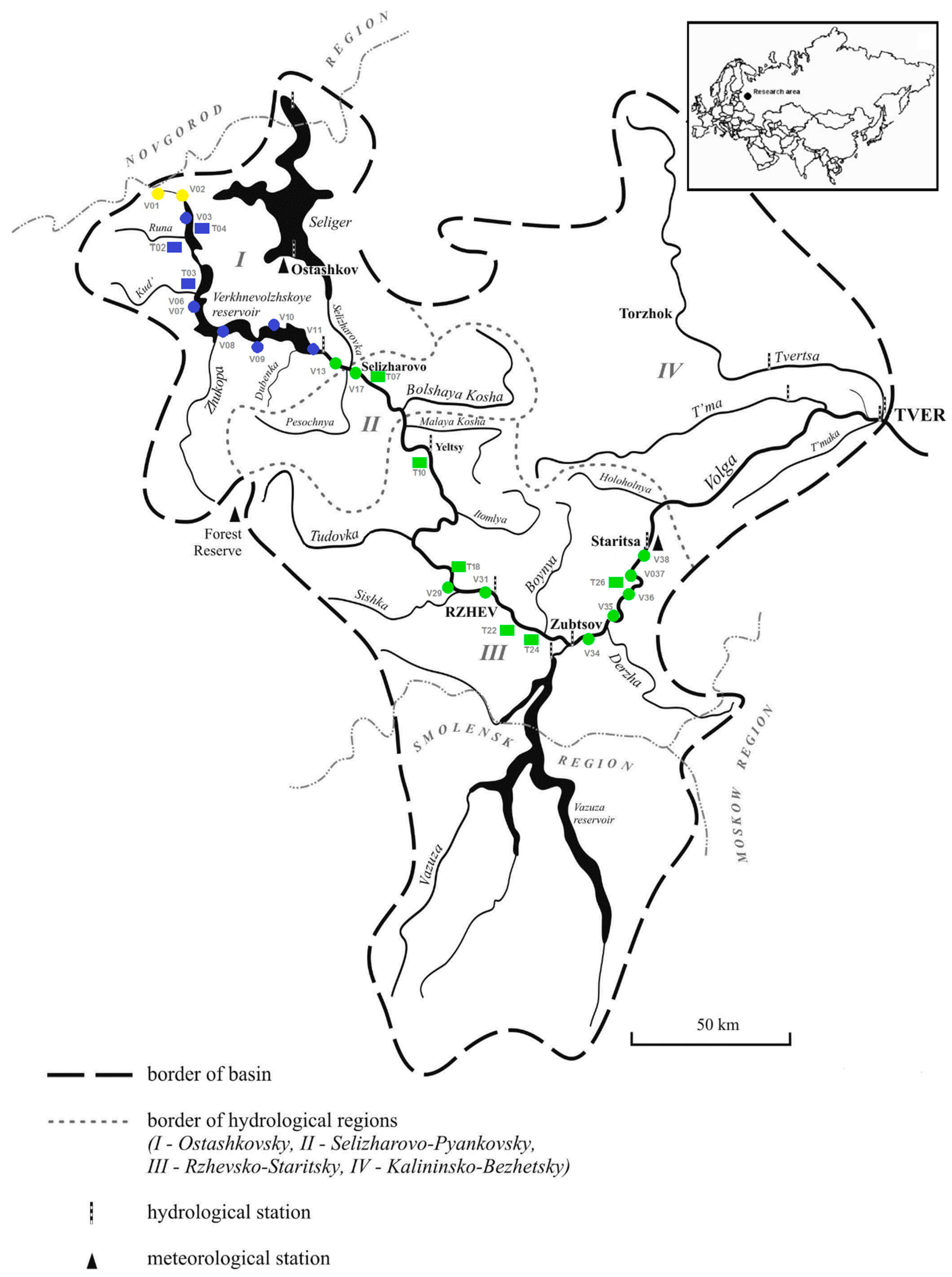

Diversity of Benthic Diatoms and Abiotic Patterns in the Headwaters of the Volga River

 , , and
Abstract
1. Introduction
- Are there longitudinal changes, i.e., according to the hydromorphological reaches, within the diatom community of the headwaters of the Volga?
- Are there differences in the species richness and composition between the tributaries and the main channel? If so, how is the influence of tributaries on the main channel?
- How do physico-chemical and hydromorphological parameters affect the diatom community in the headwaters of the Volga?
2. Materials and Methods
2.1. Field Work
2.2. Preparation and Determination
2.3. Analyses
3. Results
3.1. Species Richness
3.1.1. Longitudinal Gradient of Species Richness
3.1.2. Diversity
3.2. Species Dominance
3.2.1. Longitudinal Characterization of Dominance Relationships
3.2.2. Characterization of the Dominance Relationships in the Tributaries
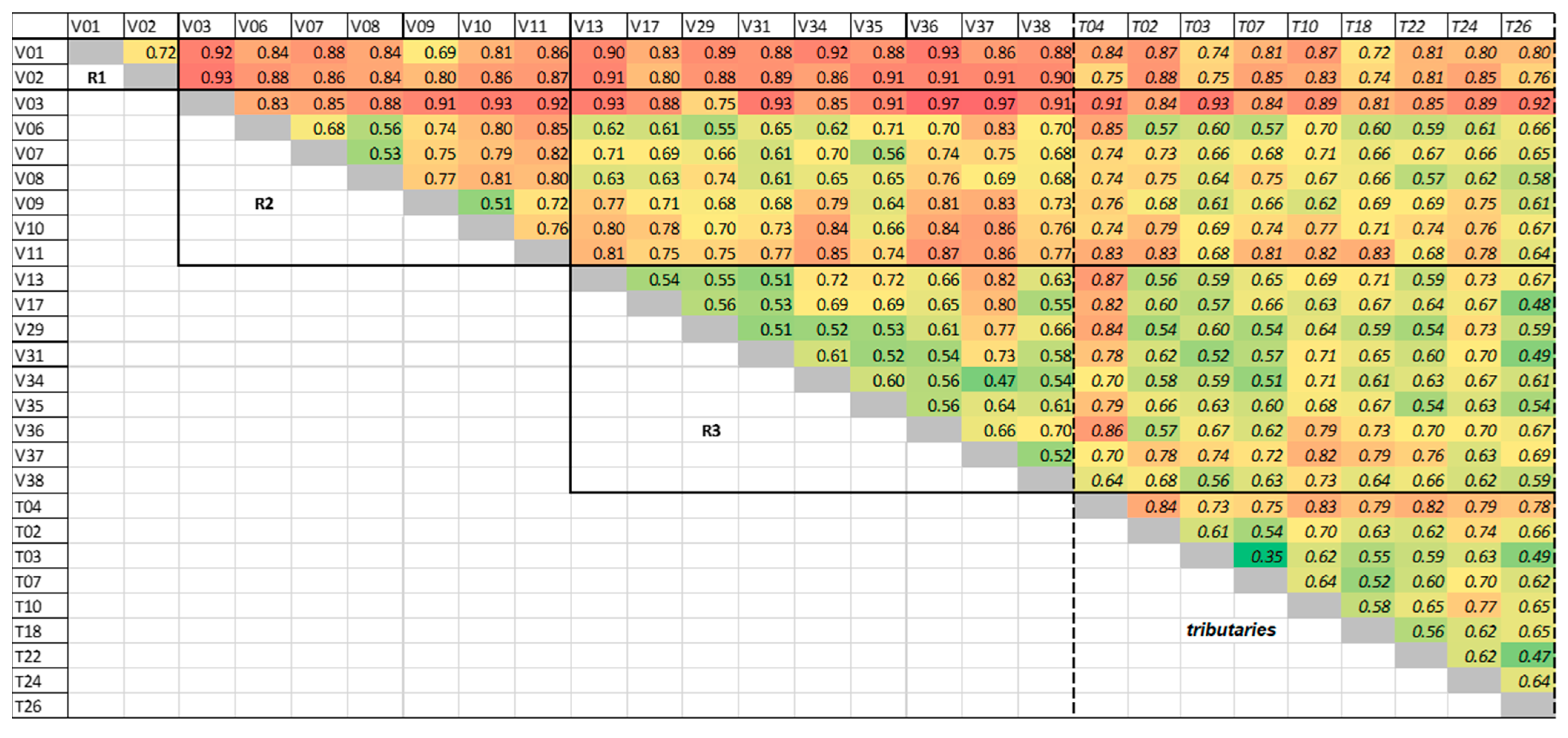
3.3. Characterization of the Sampling Locations According to Their Diatom Community
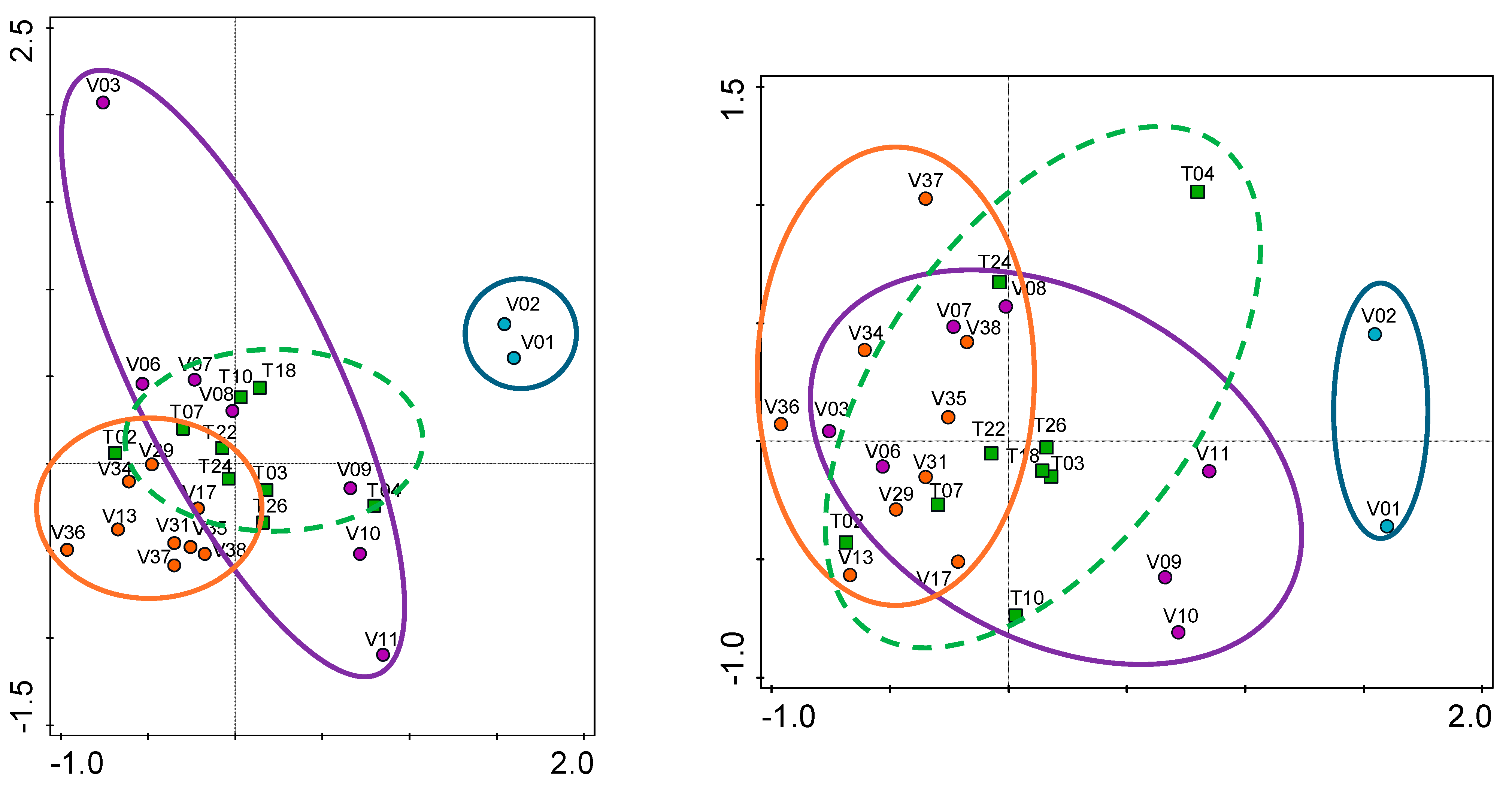
3.3.1. PCA Grouping Based on NMDS
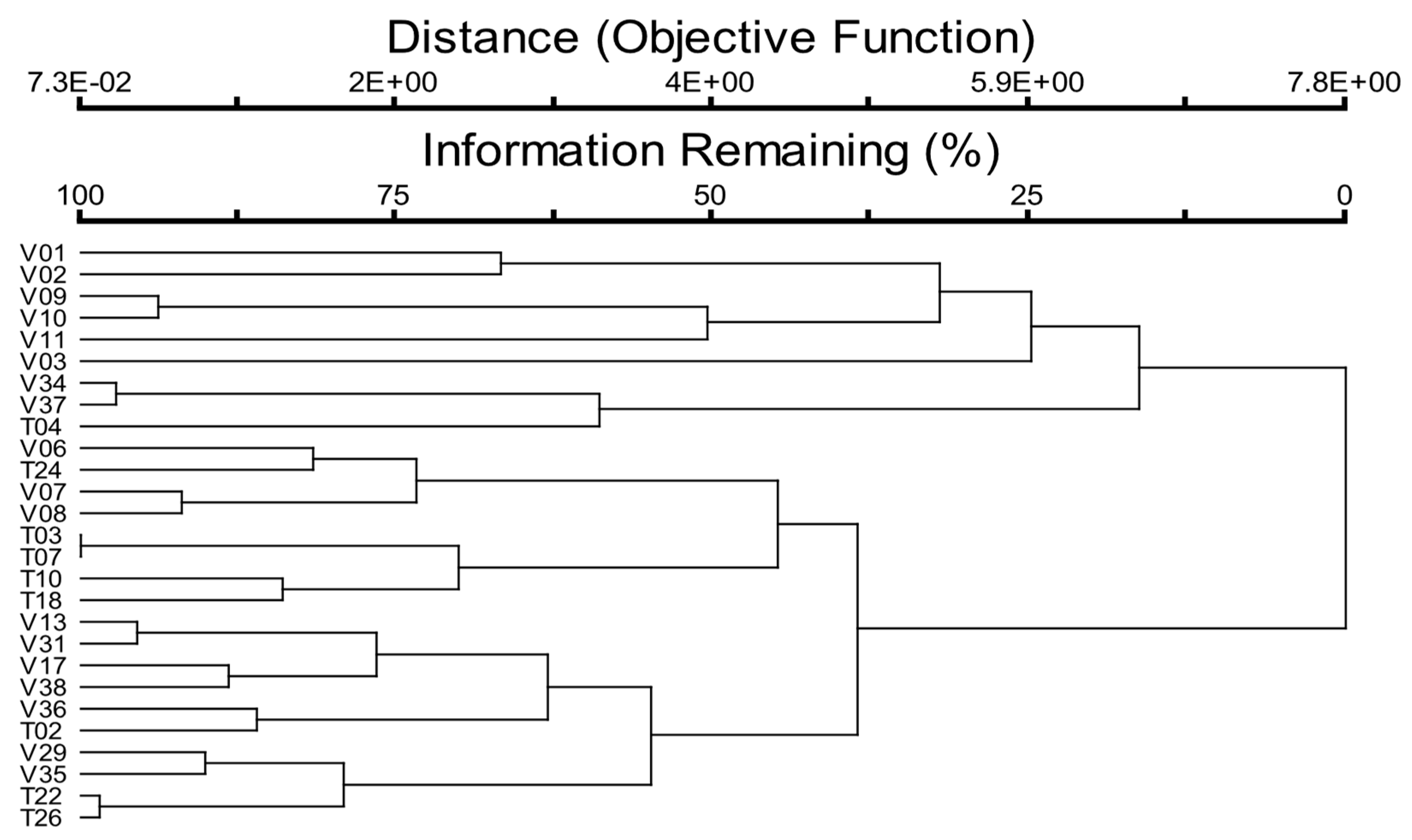
3.3.2. Grouping Based on Cluster Analysis
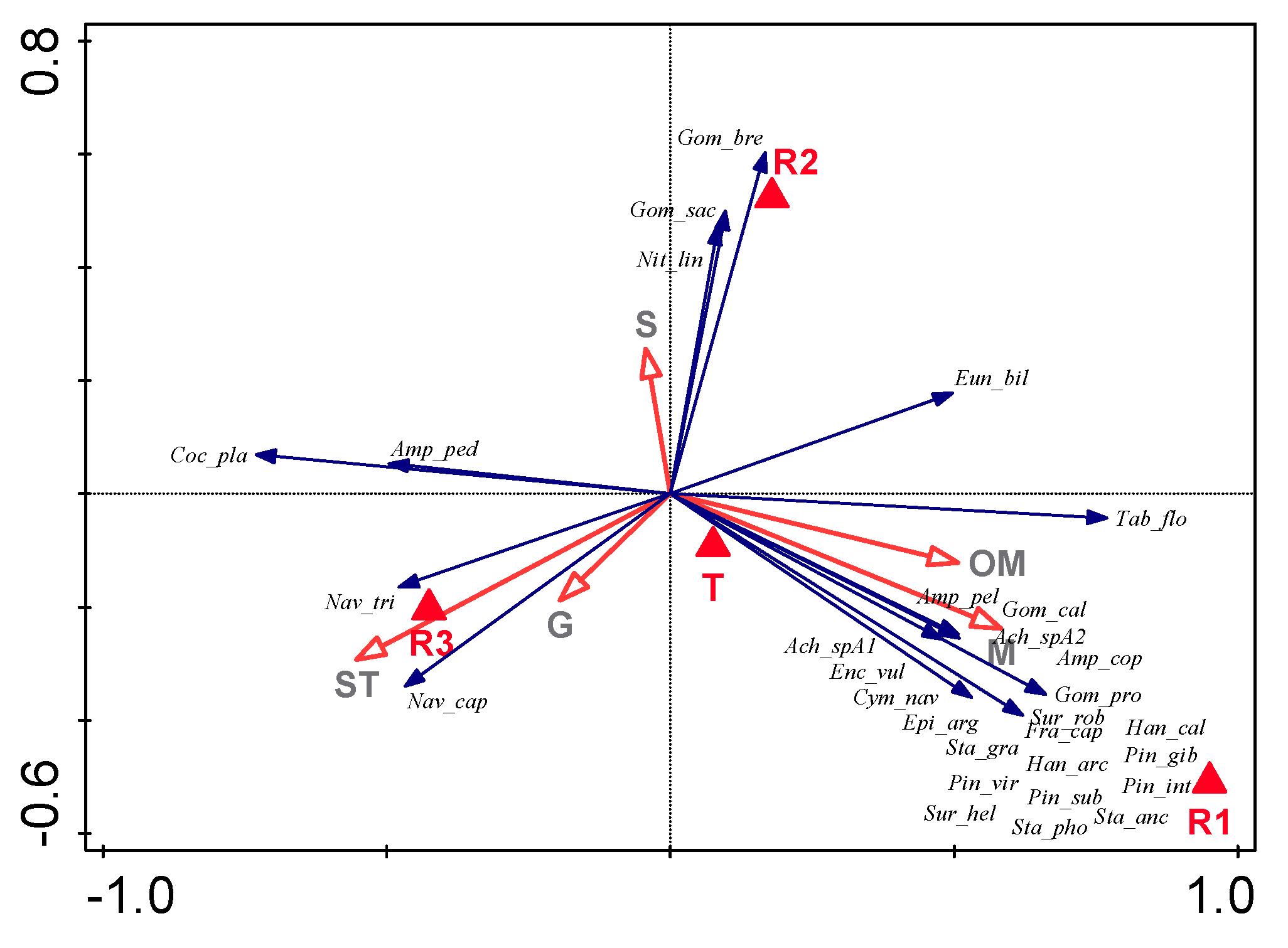
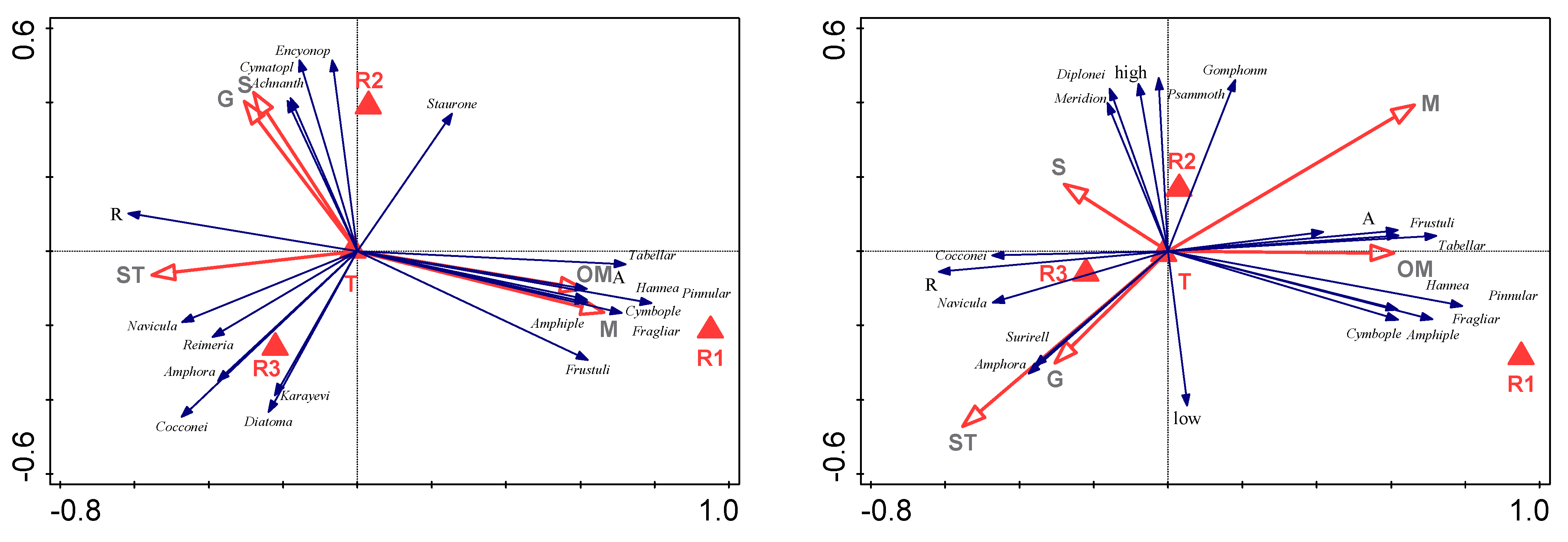
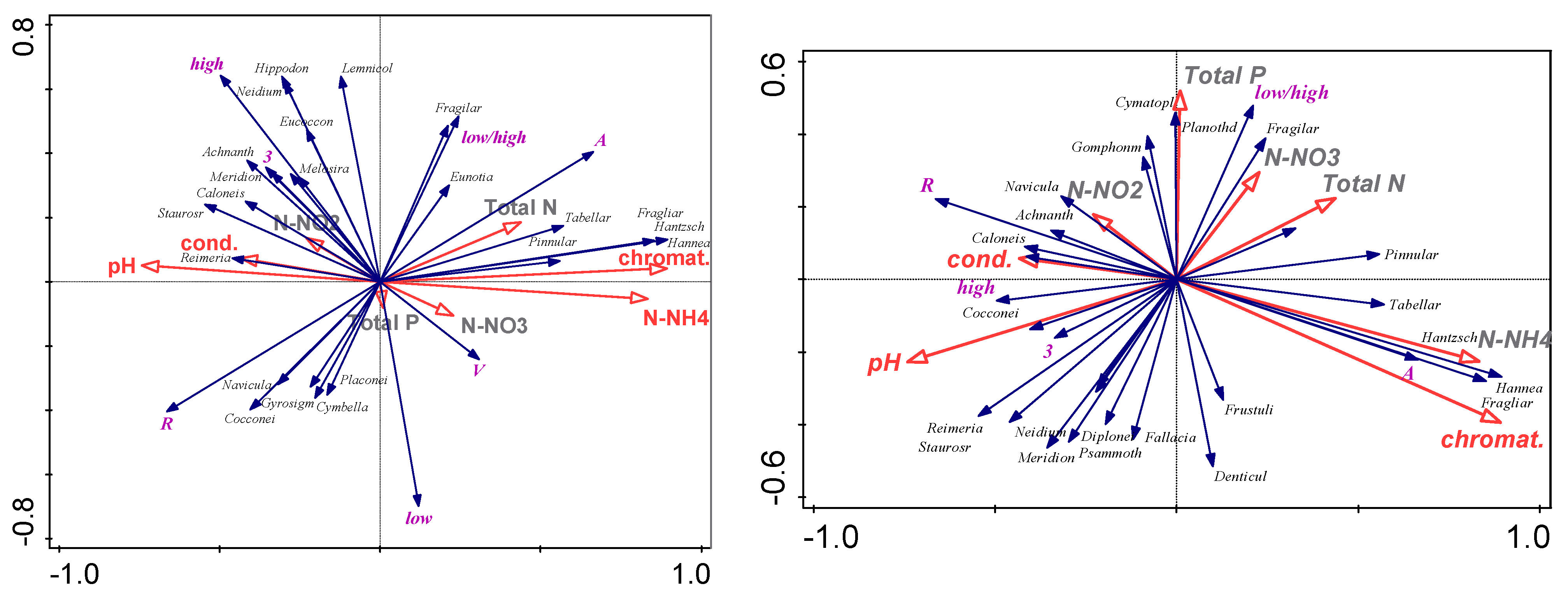
3.3.3. Spatial Distribution of Diatoms in Relation to Environmental Parameters
4. Discussion
Author Contributions
Funding
Institutional Review Board Statement
Data Availability Statement
Acknowledgments
Conflicts of Interest
References
- Kolkwitz, R.; Marsson, M. Ökologie der pflanzlichen Saprobien. Berichte Dtsch. Bot. Ges. 1908, 26, 505–519. [Google Scholar]
- Lange-Bertalot, H. Toleranzgrenzen und Populationsdynamik benthischer Diatomeen bei unterschiedlich starker Abwasserbelastung. Algol. Stud./Archiv für Hydrobiol. (Suppl. Vol.) 1979, 23, 184–219. [Google Scholar]
- Patrick, R.; Hohn, M.H.; Wallace, J.H. A new method for determining the pattern of the diatom flora. Not. Naturae Acad. Nat. Sci. Phila. 1954, 259, 3–12. [Google Scholar]
- Cox, E.J. What is the basis for using diatoms as monitors of river quality? In Use of Algae for Monitoring Rivers; Whitton, B.A., Rott, E., Friedrich, G., Eds.; Institut für Botanik, Universität Innsbruck: Innsbruck, Austria, 1991; pp. 33–40. [Google Scholar]
- Rhodes, C.; Bingham, A.; Heard, A.M.; Hewitt, J.; Lynch, J.; Waite, R.; Bell, M.D. Diatoms to human uses: Linking nitrogen deposition, aquatic eutrophication, and ecosystem services. Ecosphere 2017, 8, e01858. [Google Scholar] [CrossRef]
- Bona, F.; Falasco, E.; Nizzoli, D.; Zoppi, M.; La Morgia, V. A diatom-based approach to refine nutrient concentrations compatible with the “good” status of Northern Italy rivers. Sci. Total Environ. 2024, 912, 169444. [Google Scholar] [CrossRef] [PubMed]
- Marella, T.K.; Saxena, A.; Tiwari, A. Diatom mediated heavy metal remediation: A review. Bioresour. Technol. 2020, 305, 123068. [Google Scholar] [CrossRef]
- Birks, H.J.B.; Line, J.M.; Juggins, S.; Stevenson, A.C.; Ter Braak, C.J.F. Diatoms and pH Reconstruction. Philos. Trans. R. Soc. Lond. Ser. B Biol. Sci. 1990, 327, 263–278. [Google Scholar] [CrossRef]
- Battarbee, R.W.; Charles, D.F.; Bigler, C.; Cumming, B.F.; Renberg, I. Diatoms as indicators of surface-water acidity. In The Diatoms: Applications for the Environmental and Earth Sciences; Smol, J.P., Stoermer, E.F., Eds.; Cambridge University Press: Cambridge, UK, 2010; pp. 98–121. [Google Scholar]
- Sienkiewicz, E.; Gąsiorowski, M. The diatom-inferred pH reconstructions for a naturally neutralized pit lake in south-west Poland using the Mining and the Combined pH training sets. Sci. Total Environ. 2017, 605–606, 75–87. [Google Scholar] [CrossRef] [PubMed]
- Mangadze, T.; Wasserman, R.J.; Dalu, T. Use of Diatom Communities as Indicators of Conductivity and Ionic Composition in a Small Austral Temperate River System. Water Air Soil Pollut. 2017, 228, 428. [Google Scholar] [CrossRef]
- Rott, E.; Pipp, E.; Pfister, P. Diatom methods developed for river quality assessment in Austria and a cross-check against numerical trophic indication methods used in Europe. Algolog. Stud. 2003, 110, 91–115. [Google Scholar] [CrossRef]
- Taurozzi, D.; Cesarini, G.; Scalici, M. Diatoms as bioindicators for health assessments of ephemeral freshwater ecosystems: A comprehensive review. Ecol. Indic. 2014, 166, 112309. [Google Scholar] [CrossRef]
- Charles, D.F.; Kelly, M.G.; Stevenson, R.J.; Poikane, S.; Theroux, S.; Zgrundo, A.; Cantonati, M. Benthic algae assessments in the EU and the US: Striving for consistency in the face of great ecological diversity. Ecol. Indic. 2021, 121, 107082. [Google Scholar] [CrossRef]
- Stoermer, E.F.; Smol, J.P. (Eds.) The Diatoms. Applications for the Environmental and Earth Sciences, 1st ed.; Cambridge University Press: Cambridge, UK, 2001; 469p. [Google Scholar]
- Prygiel, J.; Whitton, B.A.; Bukowska, J. Use of Algae for Monitoring Rivers III; Agence de l’Eau Artois-Picardie: Arras, France, 1999; 271p. [Google Scholar]
- Strelnikova, N.I. The history of diatom research in Russia. Int. J. Algae 2007, 9, 9–104. [Google Scholar] [CrossRef]
- Genkal, S.I.; Kulikovskiy, M. Cyclotella horstii sp. nov. (Bacillariophyta) from Ivankovskoe reservoir (Volga reservoirs, Russia). Phytotaxa 2012, 59, 55–63. [Google Scholar] [CrossRef]
- Genkal, S.I. Atlas Diatomovyh Vodoroslei Planktona Reki Volgi; Gidrometeoizdat: St. Petersburg, Russia, 1992; 128p. [Google Scholar]
- Kulikovskiy, M.; Glushchenko, A.; Genkal, S.I.; Kuznetsova, I. Identification Book of Diatoms from Russia; Filigran: Yaroslavl, Russia, 2016; 804p. [Google Scholar]
- Genkal, S.I.; Kulikovskiy, M.S.; Kuznetsova, I.V. The Recent Freshwater Centric Diatoms of Russia; Filigran: Yaroslavl, Russia, 2020; 433p. [Google Scholar]
- Komulaynen, S.F.; Morozov, A.K. Variations in phytoperiphyton structure in small rivers flowing over urbanized areas. Water Resour. 2007, 34, 332–339. [Google Scholar] [CrossRef]
- Komulaynen, S.F. Phytoperiphyton of the Kem River and Its Tributaries (Republic of Karelia, Russia). Int. J. Algae 2019, 21, 123–136. [Google Scholar] [CrossRef]
- Komulaynen, S.F. Phytoperiphyton of Watercourses of the White Sea Basin (Murmansk Region, Republic of Karelia, Russia). Int. J. Algae 2020, 22, 383–398. [Google Scholar] [CrossRef]
- Schletterer, M.; Schönhuber, M.; Füreder, L. Biodiversity of diatoms and macroinvertebrates in an east European lowland river, the Tudovka River (Tver Region, Russia). Boreal Environ. Res. 2011, 16, 79–90. [Google Scholar]
- Genkal, S.I.; Okhapkin, A.G. Centric Diatoms (Centrophyceae) of the Lower Reaches of the Oka River (Russian Federation). Hydrobiol. J. 2013, 49, 41–57. [Google Scholar] [CrossRef]
- Schletterer, M.; Füreder, L.; Kuzovlev, V.V.; Zhenikov, Y.N.; Grigorieva, I.L. Lowland river reference condition: Spatial and temporal patterns of the zoobenthos community in the Volga headwaters (2006–2010). Hydrobiologia 2014, 729, 175–189. [Google Scholar] [CrossRef]
- Schletterer, M.; Füreder, L.; Kuzovlev, V.V.; Zhenikov, K.Y.; Zhenikov, Y.N. REFCOND_VOLGA: A monitoring programme for water quality in the headwaters of the Volga River (Tver region, Russia). Rev. Eletrônica De Gestão E Tecnol. Ambient. GESTA 2016, 4, 18–40. [Google Scholar] [CrossRef][Green Version]
- Ismaiel, N.; Schletterer, M. Diatoms in the headwaters of the Volga River (raw data from the Upper Volga Expedition 2005). Zenodo 2025. [Google Scholar] [CrossRef]
- Kuzovlev, V.V.; Schletterer, M. (Eds.) Upper Volga Expedition 2005—Technical Report. Proceedings of Freshwater Research; DAV: Berlin, Germany, 2006. [Google Scholar]
- ÖNORM M 6232; Richtlinien für die ökologische Untersuchung und Bewertung von Fließgewässern. Austrian Standards International: Wien, Austria, 1997; 84p.
- Raven, P.J.; Fox, P.J.A.; Everard, M.; Holmes, N.T.H.; Dawson, F.D. River Habitat Survey: A new system for classifying rivers according to their habitat quality. In Freshwater Quality: Defining the Indefinable? Boon, P.J., Howell, D.L., Eds.; The Stationery Office: Edinburgh, UK, 1997; pp. 215–234. [Google Scholar]
- BS 6068-5.36:2004; Water Quality—Guidance Standard for Assessing the Hydromorphological Features of Rivers (=EN 14614:2004). British Standards Institution: London, UK, 2004; 24p.
- Kingston, J. Diatom Analysis. Paleoecological Investigation of Recent Lake Acidification (Pirla); Interim Version; Indiana University: Bloomington, IN, USA, 1985. [Google Scholar]
- Hofmann, G.; Werum, M.; Lange-Bertalot, H. Diatomeen im Süßwasser—Benthos von Mitteleuropa. Bestimmungsflora Kieselalgen für die ökologische Praxis; über 700 der häufigsten Arten und ihre Ökologie, 2nd ed.; Koeltz: Königstein, Germany, 2013; 908p. [Google Scholar]
- Krammer, K.; Lange-Bertalot, H. Bacillariophyceae. 1. Teil: Naviculaceae. In Süsswasserflora von Mitteleuropa, Band 2/1; Ettl, H., Gerloff, J., Heynig, H., Mollenhauer, D., Eds.; Gustav Fisher Verlag: Jena, Germany, 1986; 876p. [Google Scholar]
- Krammer, K.; Lange-Bertalot, H. Bacillariophyceae. 2 Teil: Bacillariaceae, Epithemiaceae, Surirellaceae. In Süßwasserflora von Mitteleuropa. Band 2/2; Ettl, H., Gerloff, J., Heynig, H., Mollenhauer, D., Eds.; Gustav Fischer Verlag: Jena, Germany, 1988; pp. [i]-x, [1]-610. [Google Scholar]
- Krammer, K.; Lange-Bertalot, H. Bacillariophyceae. 3. Teil: Centrales, Fragilariaceae, Eunotiaceae. In Süsswasserflora von Mitteleuropa 2/3; Gustav Fischer Verlag: Stuttgart, Germany; New York, NY, USA; Jena, Germany, 1991; 576p. [Google Scholar]
- Krammer, K.; Lange-Bertalot, H. Bacillariophyceae. 4. Teil: Achnanthaceae; Kritische Ergänzungen zu Navicula (Lineolatae und Gomphonema); Gesamtliteraturverzeichnis Teil 1-4. In Süsswasserflora von Mitteleuropa 2/4; Gustav Fischer Verlag: Stuttgart, Germany; Jena, Germany, 1991; 437p. [Google Scholar]
- Krammer, K.; Lange-Bertalot, H.; Pascher, A.; Ettl, H.; Büdel, B. Achnanthaceae. Kritische Ergänzungen zu Achnanthes s.l., Navicula s.str., Gomphonema. Gesamtliteraturverzeichnis Teil 1-4, 1st ed.; Spektrum Akademischer Verlag: Heidelberg, Germany, 2004; 468p. [Google Scholar]
- Krammer, K.; Lange-Bertalot, H.; Pascher, A.; Ettl, H.; Büdel, B. Naviculaceae, 2nd ed.; Elsevier Spektrum Akademischer Verlag: Heidelberg, Germany, 2010; pp. 442–876. [Google Scholar]
- Blanco Lanza, S. Atlas de las Diatomeas de la Cuenca del Duero. Diatom Atlas of the Duero Basin, 1st ed.; Universidad de León, Área de Publicaciones: León, Spain, 2010. [Google Scholar]
- Krebs, C.J. Ecological Methodology, 2nd ed.; Benjamin/Cummings: Menlo Park, CA, USA, 2004. [Google Scholar]
- Pilou, E.C. Ecological Diversity; Wiley: New York, NY, USA, 1975; 165p. [Google Scholar]
- Bray, R.J.; Curtis, J.T. An ordination of the upland forest communities of southern Wisconsin. Ecol. Monogr. 1957, 27, 325–349. [Google Scholar] [CrossRef]
- Whittaker, R.H. Dominance and Diversity in Land Plant Communities: Numerical relations of species express the importance of competition in community function and evolution. Science 1965, 147, 250–260. [Google Scholar] [CrossRef] [PubMed]
- Potapova, M. Use of algae for monitoring rivers in Russia. In Use of Algae for Monitoring Rivers (III); Prygiel, J., Whitton, B.A., Bukowska, J., Eds.; Agence de l’Eau Artois-Picardie: Arras, France, 1999; pp. 96–101. [Google Scholar]
- Moog, O.; Hartmann, A.; Schmidt-Kloiber, A.; Vogl, R.; Koller-Kreimel, V. EcoProf—Version 4.0. Software zur Bewertung des ökologischen Zustandes von Fließgewässern nach WRRL; Wien: Vienna, Austria, 2013. [Google Scholar]
- Pfister, P.; Pipp, E. Leitfaden zur Erhebung der biologischen Qualitätselemente. Teil A3. Phytobenthos; Bundesministerium für Land- und Forstwirtschaft. A3-01i_PHB; Wien: Vienna, Austria, 2013; ISBN 978-3-85174-061-5. [Google Scholar]
- Rott, E.; Hofmann, G.; Pall, K.; Pfister, P.; Pipp, E. Indikationslisten für Aufwuchsalgen, Teil 1: Saprobielle Indikation; Bundesministerium für Land- und Forstwirtschaft; Wien: Vienna, Austria, 1997. [Google Scholar]
- Rott, E.; Pfister, P.; van Dam, H.; Pall, K.; Binder, N.; Ortler, K. Indikationslisten für Aufwuchsalgen, Teil 2: Trophieindikation und autökologische Anmerkungen; Bundesministerium für Land- und Forstwirtschaft, Wien: Vienna, Austria, 1999. [Google Scholar]
- Minchin, P.R. An evaluation of the relative robustness of techniques for ecological ordination. In Theory and Models in Vegetation Science; Springer: Dordrecht, The Netherlands, 1987; pp. 89–107. [Google Scholar]
- McCune, B.; Mefford, M.J. PC-ORD. Multivariate Analysis of Ecological Data, version 6; MjM Software: Gleneden Beach, OR, USA, 2011.
- Lepš, J.; Šmilauer, P. Multivariate Analysis of Ecological Data Using CANOCO; Cambridge University Press: Cambridge, UK, 2003. [Google Scholar]
- Ter Braak, C.J.F.; Šmilauer, P. Canoco Reference Manual and User’s Guide: Software for Ordination, version 5.0; Microcomputer Power: Ithaca, NY, USA, 2013.
- Mielke, P.W., Jr.; Berry, K.J.; Johnson, E.S. Multi-response permutation procedures for a-priori classifications. Commun. Stat.-Theory Methods 1976, 5, 1409–1424. [Google Scholar] [CrossRef]
- Bundesamt für Naturschutz. Rote Liste der Pflanzen Deutschlands. 1996. Available online: https://www.rote-liste-zentrum.de/ (accessed on 7 September 2025).
- Shaporenko, S.I.; Kuzovlev, V.V.; Terentyev, I.I. Hydrological and hydrochemical investigations on the Upper Volga River. In Upper Volga Expedition 2005—Technical Report—Proceedings of Freshwater Research; Kuzovlev, V.V., Schletterer, M., Eds.; DAV: Berlin, Germany, 2006. [Google Scholar]
- Mineeva, N.; Lazareva, V.; Litvinov, A.; Stepanova, I.; Chuiko, G.; Papchenkov, V.; Korneva, L.; Shcherbina, G.; Pryanichnikova, E.; Perova, S.; et al. Chapter 2—The Volga River. In Rivers of Europe, 2nd ed.; Tockner, K., Zarfl, C., Robinson, C.T., Eds.; Elsevier: Amsterdam, The Netherlands, 2022; pp. 27–79. 922p. [Google Scholar] [CrossRef]
- Stenger-Kovács, C.; Korponai, J.; Abubaker, B.; Béres, V.B.; Buczkó, K.; Gligora Udovič, M.; Király, E.; Padisák, J.; Selmeczy, G.B.; Tapolczai, K.; et al. Role of rare species in benthic diatom communities: Patterns, processes and networks. Biodivers Conserv. 2025, 34, 2095–2118. [Google Scholar] [CrossRef]
- Cantonati, M.; Hofmann, G.; Spitale, D.; Werum, M.; Lange-Bertalot, H. Diatom Red Lists: Important tools to assess and preserve biodiversity and habitats in the face of direct impacts and environmental change. Biodivers Conserv. 2022, 31, 453–477. [Google Scholar] [CrossRef]
- Kuzovlev, V.V.; Grigoryeva, I.L.; Chekmareva, E.A.; Schletterer, M. Water Quality Monitoring in the Volga Headwaters. Water 2024, 16, 491. [Google Scholar] [CrossRef]
- Okhapkin, A.G.; Genkal, S.I.; Scharagina, E.M.; Vodeneeva, E.L. Structure and dynamics of phytoplankton in the Oka River mouth at the beginning of the 21th century. Inland Water Biol. 2014, 7, 357–365. [Google Scholar] [CrossRef]



| ID | Location | Sampling Date | Distance from the Source of Volga River [km] | pH | EC [µS/cm] | Color [°] | Total N [mg/L] | Total P [mg/L] |
|---|---|---|---|---|---|---|---|---|
| V01 | Volgoverkhovie | 7 August 2005 | 0 | 6.3 | 49 | 640 | 3.40 | 0.42 |
| V02 | Upstream Sterzh | 7 August 2005 | 9.3 | 7.3 | 89 | 250 | 1.70 | 0.46 |
| V03 | Novinka (L1, r.b.) | 9 August 2005 | 10.8 | 7.8 | 109 | 220 | 4.20 | 1.36 |
| V06 | Lk. Vselug–Lk. Peno | 8 August 2005 | 44.1 | 8.0 | 113 | 180 | 0.72 | 0.24 |
| V07 | Lk. Peno Pionerlag | 8 August 2005 | 45.8 | - | 113 | 98 | - | - |
| V08 | Lk. Peno (Peno) | 8 August 2005 | 53.9 | 8.1 | 130 | 168 | 0.59 | 0.19 |
| V09 | Lk. Volgo 1 (Ilinskoe, l.b.) | 10 August 2005 | 66.3 | 7.8 | 100 | 181 | 0.98 | 0.01 |
| V10 | Lk. Volgo 1 (Zaneprechje, l.b.) | 10 August 2005 | 68.4 | 7.4 | 155 | 188 | 1.30 | 0.26 |
| V11 | Lk. Volgo 2 (near Bejshlot) | 11 August 2005 | 103.9 | 7.4 | 92 | 220 | 1.50 | 1.96 |
| V13 | Bejshlot (L2, r.b.) | 11 August 2005 | 105.1 | 8.0 | 101 | 220 | 0.22 | 0.07 |
| V17 | Selisharowo | 12 August 2005 | 118.5 | - | 100 | 180 | 4.64 | 1.52 |
| V29 | Petunovo (L9, r.b.) | 19 August 2005 | 238.9 | - | 185 | - | - | - |
| V31 | Rzhev (upst. main bridge) | 19 August 2005 | 262.7 | 8.6 | 191 | 92 | 2.90 | 0.07 |
| V34 | Rublevo (L12, r. bank) | 22 August 2005 | 314.8 | 8.0 | 218 | 98 | 1.50 | 2.88 |
| V35 | Danilovo Sloboda (l.b.) | 22 August 2005 | 329.0 | - | 221 | - | - | - |
| V36 | Borovaja (Bottom Sill 210) | 22 August 2005 | 336.0 | - | 223 | - | - | - |
| V37 | Molokovo | 23 August 2005 | 341.9 | - | 227 | 110 | 3.00 | 1.70 |
| V38 | Staritsa (downstr. bridge, r.b.) | 23 August 2005 | 353.0 | 8.4 | 228 | 109 | 1.20 | 0.25 |
| T02 | Runa | 8 August 2005 | 27.2 | 8.5 | 154 | 184 | 1.03 | 1.28 |
| T03 | Kud’ | 9 August 2005 | 47.2 | 8.3 | 167 | 175 | 1.00 | 0.76 |
| T04 | Shirkovo | 9 August 2005 | 16.1 | 7.3 | 252 | 52 | 0.50 | 0.32 |
| T07 | Selizharovka | 12 August 2005 | 119.0 | 7.9 | 146 | 50 | 1.00 | 1.60 |
| T10 | Solodomlya | 14 August 2005 | 155.0 | 8.5 | 300 | 98 | 1.80 | 2.28 |
| T18 | Koksha | 18 August 2005 | 234.0 | 7.9 | 452 | 38 | 0.78 | 0.42 |
| T22 | Locha | 19 August 2005 | 269.0 | 7.4 | 540 | 41 | 3.50 | 1.08 |
| T24 | Vazuza | 20 August 2005 | 289.0 | 8.5 | 273 | 65 | 2.80 | 0.29 |
| T26 | Iruzha | 22 August 2005 | 319.0 | 8.3 | 537 | 49 | 2.50 | 1.16 |
| Reach | H’ Mean | H’ min/max | H’ SD | E’ Mean | E’ min/max | E’ SD |
|---|---|---|---|---|---|---|
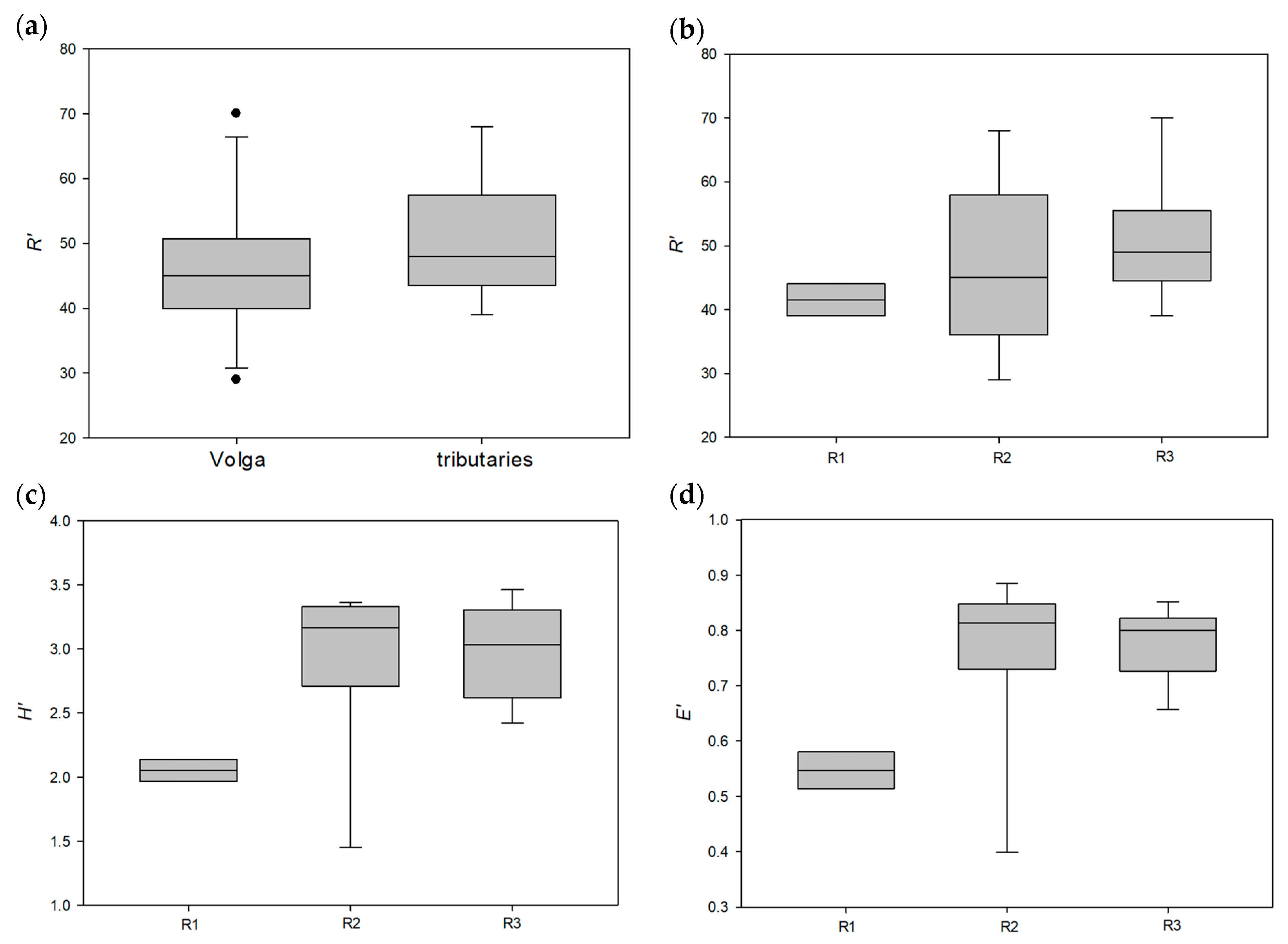
| Volga (R1–R3) | 2.84 | 1.46/3.46 | 0.56 | 0.74 | 0.40/0.89 | 0.13 |
| >R1 | 2.05 | 1.97/2.14 | 0.12 | 0.55 | 0.51/0.58 | 0.05 |
| >R2 | 2.88 | 1.46/3.37 | 0.68 | 0.76 | 0.40/0.89 | 0.17 |
| >R3 | 2.99 | 2.42/3.46 | 0.37 | 0.77 | 0.66/0.85 | 0.06 |
| tributaries | 3.22 | 2.86/3.61 | 0.28 | 0.83 | 0.72/0.93 | 0.06 |
| Species (CCA) | Axis 1 | Axis 2 | Axis 3 | Axis 4 |
|---|---|---|---|---|
| Eigenvalues | 0.20 | 0.14 | 0.12 | 0.10 |
| Explained variation (cumulative) [%] | 8.15 | 13.72 | 18.61 | 22.85 |
| Pseudo-canonical correlation | 0.98 | 0.97 | 0.95 | 0.93 |
| Explained fitted variation (cumulative) [%] | 24.64 | 41.49 | 56.29 | 68.29 |
| Species (RCA) | Axis 1 | Axis 2 | Axis 3 | Axis 4 |
|---|---|---|---|---|
| Eigenvalues | 0.11 | 0.09 | 0.06 | 0.06 |
| Explained variation (cumulative) [%] | 10.76 | 19.49 | 25.71 | 31.76 |
| Pseudo-canonical correlation | 0.97 | 0.95 | 0.89 | 0.95 |
| Explained fitted variation (cumulative) [%] | 23.37 | 42.36 | 55.86 | 69.01 |
| ID | Location | Sampling Date | Benthic Taxa | Planktonic Taxa | SI | TI |
|---|---|---|---|---|---|---|
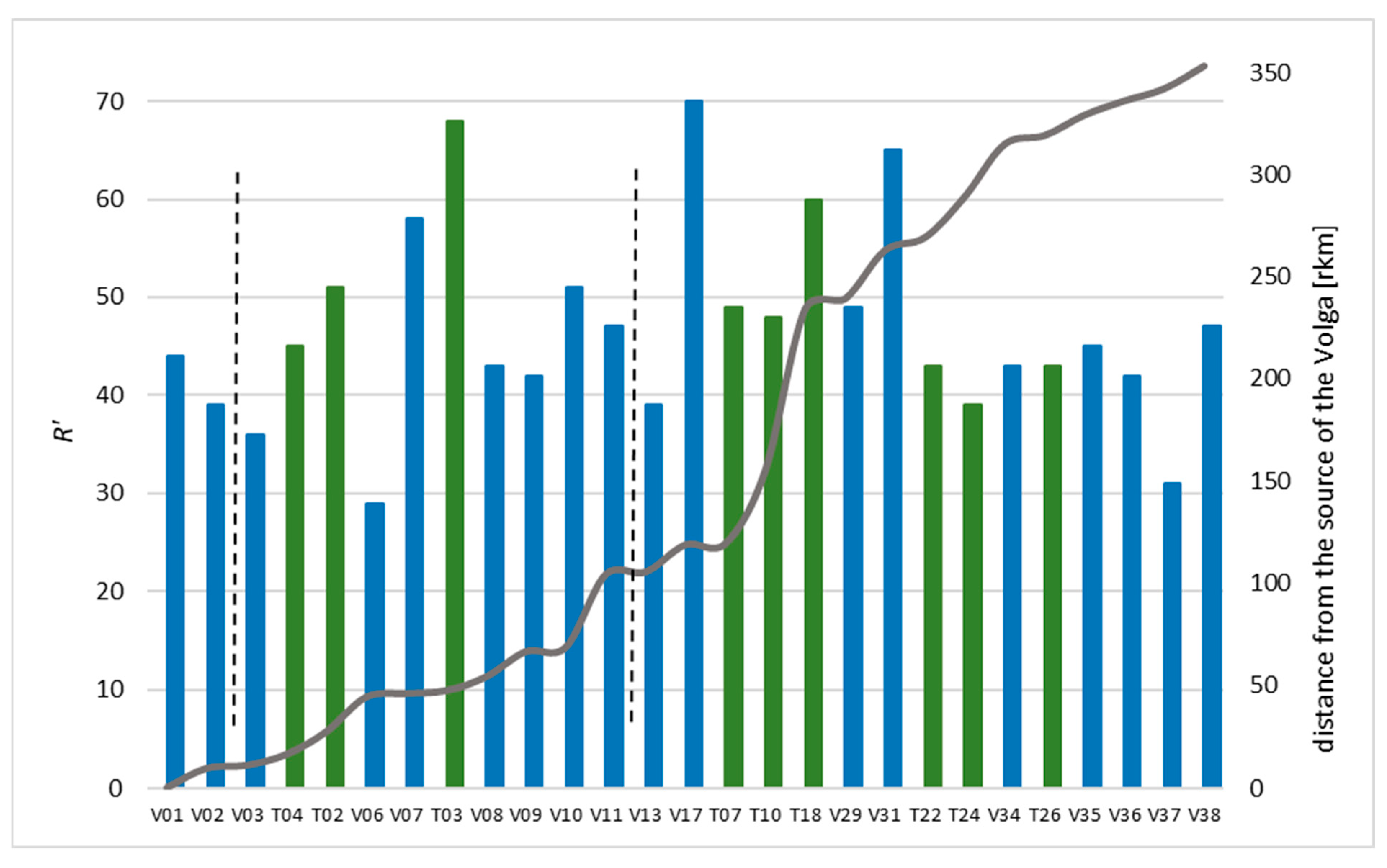
| V01 | Volgoverkhovie | 7 August 2005 | 42 | 0 | 1.71 | 2.71 |
| V02 | Upstream Sterzh | 7 August 2005 | 40 | 0 | 1.44 | 1.93 |
| V03 | Novinka (L1, r.b.) | 9 August 2005 | 36 | 6 | 1.47 | 1.39 |
| V06 | Lk. Vselug–Lk. Peno | 8 August 2005 | 29 | 4 | 1.93 | 2.82 |
| V07 | Lk. Peno Pionerlag | 8 August 2005 | 57 | 12 | 1.96 | 2.62 |
| V08 | Lk. Peno (Peno) | 8 August 2005 | 41 | 9 | 1.97 | 2.86 |
| V09 | Lk. Volgo 1 (Ilinskoe, l.b.) | 10 August 2005 | 42 | 4 | 1.74 | 2.49 |
| V10 | Lk. Volgo 1 (Zaneprechje, l.b.) | 10 August 2005 | 51 | 4 | 2.19 | 2.97 |
| V11 | Lk. Volgo 2 (near Bejshlot) | 11 August 2005 | 48 | 11 | 1.48 | 2.38 |
| V13 | Bejshlot (L2, r.b.) | 11 August 2005 | 39 | 10 | 1.72 | 2.72 |
| V17 | Selisharowo | 12 August 2005 | 65 | 16 | 1.74 | 2.38 |
| V29 | Petunovo (L9, r.b.) | 19 August 2005 | 53 | 6 | 1.88 | 2.49 |
| V31 | Rzhev (upst. main bridge) | 19 August 2005 | 65 | 7 | 1.87 | 2.86 |
| V34 | Rublevo (L12, r. bank) | 22 August 2005 | 45 | 3 | 2.05 | 2.84 |
| V35 | Danilovo Sloboda (l.b.) | 22 August 2005 | 47 | 5 | 2.04 | 2.92 |
| V36 | Borovaja (Bottom Sill 210) | 22 August 2005 | 42 | 8 | 2.00 | 2.74 |
| V37 | Molokovo | 23 August 2005 | 30 | 3 | 2.24 | 3.26 |
| V38 | Staritsa (downstr. bridge, r.b.) | 23 August 2005 | 46 | 8 | 2.11 | 3.06 |
| T02 | Runa | 8 August 2005 | 54 | 6 | 1.54 | 2.25 |
| T03 | Kud’ | 9 August 2005 | 66 | 9 | 1.80 | 2.64 |
| T04 | Shirkovo | 9 August 2005 | 46 | 1 | 2.38 | 2.89 |
| T07 | Selizharovka | 12 August 2005 | 50 | 9 | 1.69 | 2.48 |
| T10 | Solodomlya | 14 August 2005 | 46 | 2 | 1.74 | 2.31 |
| T18 | Koksha | 18 August 2005 | 64 | 6 | 2.16 | 2.88 |
| T22 | Locha | 19 August 2005 | 44 | 2 | 1.96 | 2.67 |
| T24 | Vazuza | 20 August 2005 | 39 | 7 | 2.08 | 2.84 |
| T26 | Iruzha | 22 August 2005 | 43 | 6 | 1.98 | 2.85 |
Disclaimer/Publisher’s Note: The statements, opinions and data contained in all publications are solely those of the individual author(s) and contributor(s) and not of MDPI and/or the editor(s). MDPI and/or the editor(s) disclaim responsibility for any injury to people or property resulting from any ideas, methods, instructions or products referred to in the content. |
© 2025 by the authors. Licensee MDPI, Basel, Switzerland. This article is an open access article distributed under the terms and conditions of the Creative Commons Attribution (CC BY) license (https://creativecommons.org/licenses/by/4.0/).
Share and Cite
Ismaiel, N.; Kuzovlev, V.V.; Shaporenko, S.I.; Holzinger, A.; Schletterer, M. Diversity of Benthic Diatoms and Abiotic Patterns in the Headwaters of the Volga River. Diversity 2025, 17, 842. https://doi.org/10.3390/d17120842
Ismaiel N, Kuzovlev VV, Shaporenko SI, Holzinger A, Schletterer M. Diversity of Benthic Diatoms and Abiotic Patterns in the Headwaters of the Volga River. Diversity. 2025; 17(12):842. https://doi.org/10.3390/d17120842
Chicago/Turabian StyleIsmaiel, Natalie, Vyacheslav V. Kuzovlev, Sergey I. Shaporenko, Andreas Holzinger, and Martin Schletterer. 2025. "Diversity of Benthic Diatoms and Abiotic Patterns in the Headwaters of the Volga River" Diversity 17, no. 12: 842. https://doi.org/10.3390/d17120842
APA StyleIsmaiel, N., Kuzovlev, V. V., Shaporenko, S. I., Holzinger, A., & Schletterer, M. (2025). Diversity of Benthic Diatoms and Abiotic Patterns in the Headwaters of the Volga River. Diversity, 17(12), 842. https://doi.org/10.3390/d17120842