Abstract
A study was conducted to ascertain the taxonomic validity of the endangered taxon Echinocactus horizonthalonius var. nicholii and whether there may be other groups of populations worthy of subspecies status within the range of the species. To test the hypothesis that individuals of E. horizonthalonius var. nicholii are morphologically distinct from those of the typical variety, a multivariate analysis was done to compare the degree of morphological variation or phenotypic plasticity of stem characters within populations to the variation among populations of E. horizonthalonius throughout its known range. Populations of E. texensis were sampled for outgroup comparison. Discriminant function analysis (DFA) assigning individuals by population showed loose groupings of geographically correlated populations. The DFA assigning individuals to regions or potential subspecific taxa indicated high percentages of correct classification for individuals within populations grouped into the Chihuahuan Desert, Sonoran Desert, and Central Mexican Plateau regions. Taxonomically, these groups correspond to E. horizonthalonius subsp. horizonthalonius (Chihuahuan Desert), E. horizonthalonius var. nicholii (Sonoran Desert), and unnamed taxon of E. horizonthalonius (Central Mexican Plateau). Because these morphological entities are correlated with regional distributions, they are placed here under subspecies, including a newly described taxon, E. horizonthalonius subsp. australis. Because no type for E. horizonthalonius could be located, a neotype is designated.
1. Introduction
A study was conducted using multivariate analyses of morphological stem characters within Echinocactus horizonthalonius Lemaire and E. texensis Hopffer. The primary objective of this study was to ascertain the taxonomic validity of E. horizonthalonius var. nicholii and whether there may be other taxonomically worthy groups of populations occurring elsewhere within the range of the species. The null hypothesis is that there are no groups of populations that possess morphological character values significantly different from those of other groups of populations. The scope of the study included populations of E. horizonthalonius throughout the range of the species. Morphological studies are critical for the understanding of phenological variation within taxa and the development of taxonomic descriptions and keys. Several similar studies within the Cactaceae exemplify these points, some which have been further augmented with genetic studies [1,2,3].
Authors have long suggested that Echinocactus horizonthalonius deserves closer taxonomic scrutiny, based on morphological differences across the species range [4,5,6]. Vargas-Luna et al. [7] also found genetic evidence for the existence of infraspecific groups within the species. Morphological studies are usually the first step toward defining subspecies and are often followed by genetic analyses once a general circumscription of the populations is made. Subspecies are taxonomically important because they represent groups of populations that are morphologically coherent but apparently interbreed to a limited extent with other subspecies.
The divisions between species and subspecies are often debated and subjective, but they are of paramount importance for conservation. Cacti are among the most threatened groups assessed by the International Union for the Conservation of Nature (IUCN), which in 2015 determined that 31% of cactus species are in imminent danger of extinction [8]. Although the IUCN Red List does not address subspecies separately, many cacti have rare subspecies requiring protection. Detailed morphological studies to quantify differences at the subspecies level are required to produce accurate keys for identification of taxa in habitat, which is of utmost importance for determining critical habitat and focusing limited conservation resources in the most effective areas.
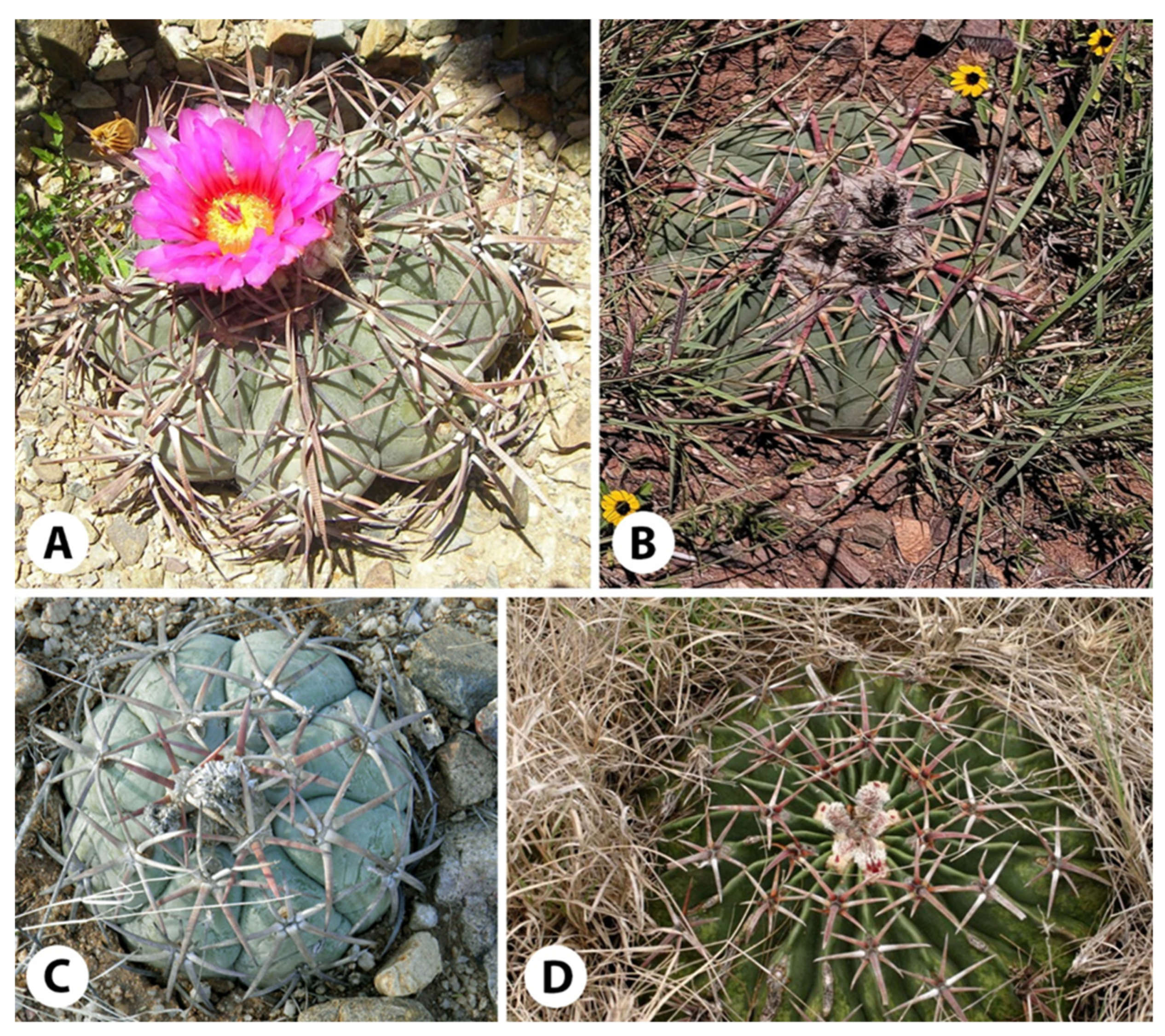
Echinocactus horizonthalonius is a small barrel cactus occurring primarily in the Chihuahuan Desert from New Mexico southward to the Central Mexican Plateau (Figure 1). Populations are densest in the Chihuahuan Desert, rare in the Sonoran Desert, and uncommon in the Central Mexican Plateau. Thus, the demography of the species suggests that the Chihuahuan Desert is the center of origin and that populations are dispersing into surrounding areas. Individuals of E. horizonthalonius have stems that are generally solitary, pale gray–green to bright gray–blue, up to 15 cm (20 cm) in diameter and 25 cm (45 cm) tall, forming a flattened hemisphere when young, and becoming cylindrical with age. The stem ribs are generally 8 (7–11), very broad and rounded, and oriented vertically to helically curving around the stem. Branching and multiheaded individuals often result from apical meristem damage. The areoles generally produce three central spines and five radial spines, all of which are primarily bone-white, often with a pink hue, strongly annulate-ridged, and often noticeably flattened dorsal-ventrally. The flowers are bright rose–pink to magenta, up to 7 cm broad, and borne among the long dense hairs of the areole. Fruits are pink to red, up to 3 cm long, and spheric to ovoid-spheric. Seeds are up to 3 mm long, black or gray, angular or slightly wrinkled, and spheric to obovoid. All chromosome reports thus far for E. horizonthalonius have been diploid, 2n = 22 [5]. Flowers generally appear between April and July, depending upon the timing and amount of precipitation [5]. In years of good rainfall, some individuals can flower up to three additional times within a year [9], and populations can flower synchronously across almost the entirety of the Chihuahuan Desert [5].
Figure 1.
Echinocereus horizonthalonius and E. texensis in habitat: (A) E. horizonthalonius subsp. horizonthalonius; (B) E. horizonthalonius from the Central Mexican Plateau, photo by Michelle Cloud-Hughes; (C) E. horizonthalonius subsp. nicholii, photo by Tom Van Devender; (D) E. texensis.
In the Chihuahuan Desert, Echinocactus horizonthalonius populations are common between 750–1675 m elevation on a variety of topographic forms on igneous and sedimentary substrates, most commonly limestone and gypsum soils. Populations occur throughout central and southeastern New Mexico, western Texas, and southward to Monterrey, Mexico.
In the Sonoran Desert, isolated populations of Echinocactus horizonthalonius occur in southern Arizona and Sonora, Mexico as far south as Mazatán. It was first recorded in the Sonoran Desert in 1918 when Forrest Shreve collected an individual from Pima County, Arizona. In 1969, Benson [10] named the Arizona populations E. horizonthalonius var. nicholii after A.A. Nichol, who studied the populations in the 1930s. Sonoran Desert populations identified as E. horizonthalonius var. nicholii have also been found in Sonora, Mexico [11,12]. In a later treatment, Benson [13] differentiates E. horizonthalonius var. nicholii from the typical variety as merely being taller and darker. Both height and darkness of the stems are dubious characters, as height is correlated with age, and darkness is subjective, difficult to quantify, and often environmental rather than inherent. According to Zimmerman and Parfitt [6], morphology of E. horizonthalonius individuals within Sonoran Desert populations are similar to those in New Mexico and extreme western Texas, while much greater morphologic diversity occurs within populations farther east and south. Similarly, Powell and Weedin [5] do not recognize E. horizonthalonius var. nicholii as a valid taxon, stating that individuals resembling Benson’s original description occur in Big Bend National Park and that such plants in Texas appear merely to be older individuals in harsher desert habitats. They further suggest, however, that there are distinctive groups of populations within the Chihuahuan Desert that should be validly described and named. In contrast to the opinions of Zimmerman and Parfitt [6] and Powell and Weedin [5], Anderson [14] does recognize E. horizonthalonius var. nicholii on the basis of Benson’s diagnosis of the taxon. Anderson maintains that stem clustering is unique to individuals of E. horizonthalonius var. nicholii and that there is a significant difference in maximum height between individuals of the two varieties. The diversity of professional opinions combined with the paucity of available scientific data on E. horizonthalonius emphasizes the need for biosystematic work on the species. This need is further amplified by the fact that E. horizonthalonius var. nicholii is federally listed as endangered pursuant to the Endangered Species Act of 1973 (50 CFR 17.12; P.L. 93–205, 87 Stat. 884; 16 U.S.C. 1531–1540) [15].
Arizona populations of Echinocactus horizonthalonius var. nicholii occur between 750–1250 m elevation on limestone substrates of dissected alluvial fans, inclined terraces, and saddles between ridges [16,17]. Populations are recorded from southwestern Pinal County [10] and Pima County in the Abbey Waterman and Silver Bell Mountains. Individuals in Sonora are very sparsely distributed on a few limestone ridgetops [12]. Exact locality data are not presented here, as this taxon is of conservation concern.
Populations of Echinocereus horizonthalonius in the Central Mexican Plateau occur from San Luis Potosí southward to Guanajuato and occur on sedimentary and igneous, mostly shallow, gravelly or silty substrates in grasslands and low scrublands.
Echinocactus texensis was chosen as an outgroup because it represents single-stemmed individuals with the most similar morphology to E. horizonthalonius and occurs sympatrically with it over much of their ranges. There have been no reports of hybridization between the two species [5], and chloroplast DNA data suggest that the two species are not closely related [7,18]. Vargas-Luna et al. [7] suggested placing E. texensis within the genus Homalocephala, as H. texensis Britton & J. N. Rose. This would leave only E. platyacanthus Link & Otto as an option for the outgroup, but the morphology of this species is extremely different from that of E. horizonthalonius. Populations of the outgroup, Echinocactus texensis, occur from 0–1000 m elevation from southeastern New Mexico to southwestern Oklahoma, and south though much of Texas into northern Chihuahua and east of the Sierra Madre Oriental into Nuevo León and Tamaulipas. Individuals of E. texensis have stems that are generally solitary, pale gray–green to yellow–green, 10–20 (30) cm in diameter at maturity, sometimes flush with the soil surface but up to 30 cm tall, forming a flattened hemisphere when young, and becoming cylindrical with age. The prominent ribs are most often 21 in number (13–27), up to approximately 2 cm tall, narrowing to approximately 0.5 cm at the apex, and are straight, vertical, or sometimes sinuous on desiccated plants. The central spines are mostly three in number, all recurved or with one porrect and straight. These central spines are pale tan to gray, often tinted pink or red, terete to flattened dorsal-ventrally, annulate, and minutely canescent. The radial spines are mostly 4–5 in number and similar to the centrals in morphology. The flowers are up to 6 cm long and 6 cm broad, with inner tepals that are variously bright pink, and stigma lobes that are white to pale pink. The red fruits are spheric to ovoid with glossy black, irregularly spheric to obovoid seeds up to 3 mm long.
2. Methods
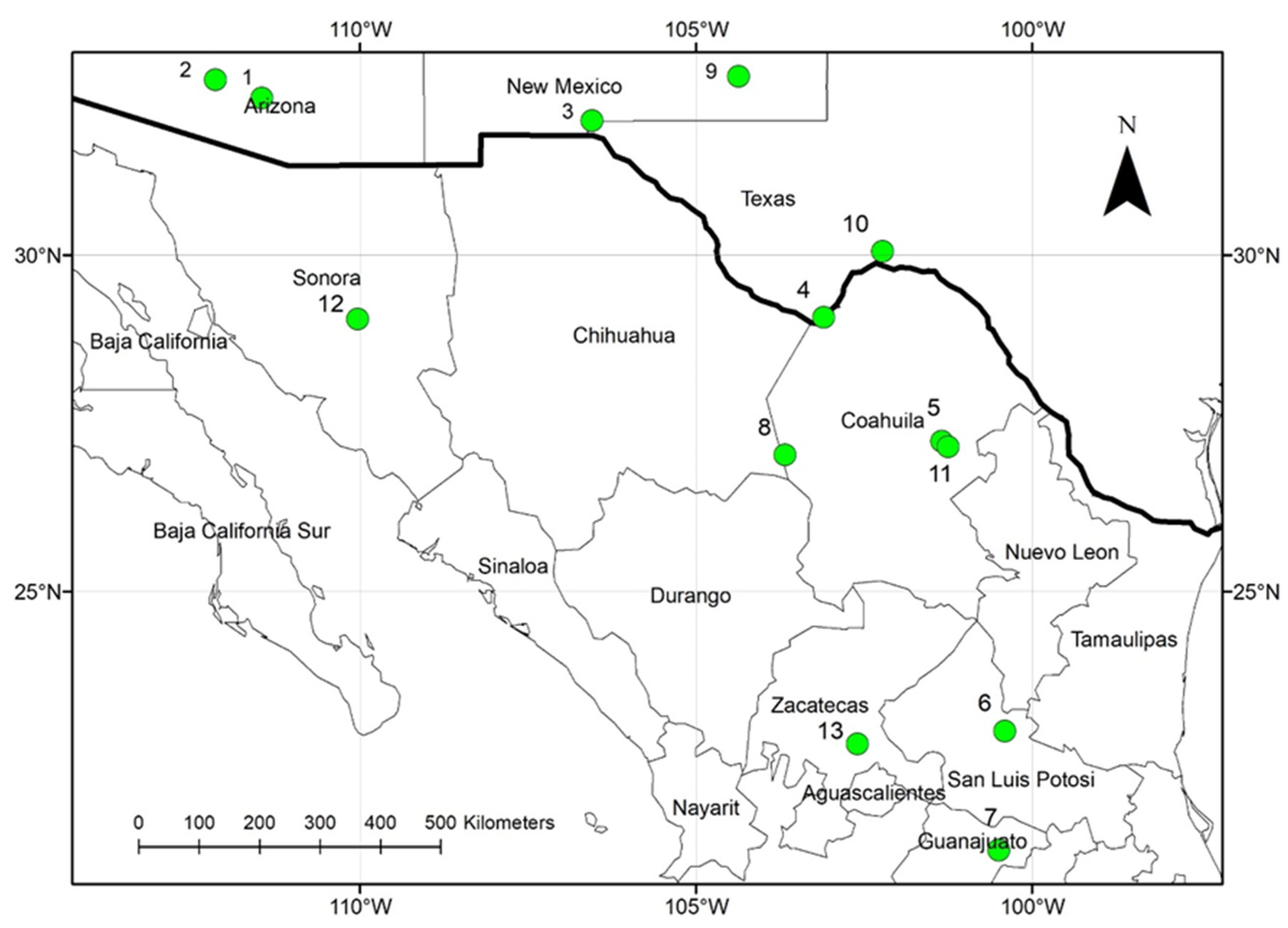
Localities were chosen to include as widely representative an area as possible within the geographic distributions of the taxa (Figure 2). Historic locality data were gathered from government agency reports, journal articles, and herbarium collections. Fieldwork was conducted between 3 May 2007 and 22 August 2021. Locality and voucher specimen data are presented in Appendix A. Exact geographic coordinates have been omitted for populations of conservation concern. Vouchers were made for undocumented populations and deposited at ARIZ and ASU. Photographic vouchers were made where collection permits were not available.
Figure 2.
Locations of study sites for the multivariate analysis of morphological characters in Echinocactus horizonthalonius and E. texensis. Numbers refer to populations listed in Appendix A. Populations 9, 10, and 11 represent E. texensis.
Seventeen stem characters were measured for approximately 30 individuals from each population. These and the three characters derived from the data are presented in Table 1. Characters measured three times per individual were averaged for each individual prior to further statistical analysis. The data were transformed as necessary to meet the assumptions of MANOVA. P-P plots were generated for all variables in order to test for multivariate normality. Deviation from the normal ranged between 0.04 and 0.13. Mahalanobis distances were used to identify outliers, which were then removed from the analysis. Discriminant function analysis (DFA) was used to assess populations both a priori and a posteriori. For the a priori analysis, individuals were grouped by population and not by taxon. This assumes that all individuals within a population were of the same taxon. Once potential taxonomic groupings of populations were determined, a second DFA was performed to test the significance of the taxonomic groupings. Once the grouping of populations was evaluated, multivariate analysis of variance (MANOVA) was performed to ascertain which characters were statistically significant among the population groups. MANOVA and DFA analyses were performed using SPSS® 28.0.1.1 [19].
Table 1.
Explanation of characters used in the morphological analysis of Echinocactus horizonthalonius. Stem height and diameter are age-dependent and are not used directly in the multivariate analyses (denoted by *).
3. Results
3.1. Discriminant Function Analysis
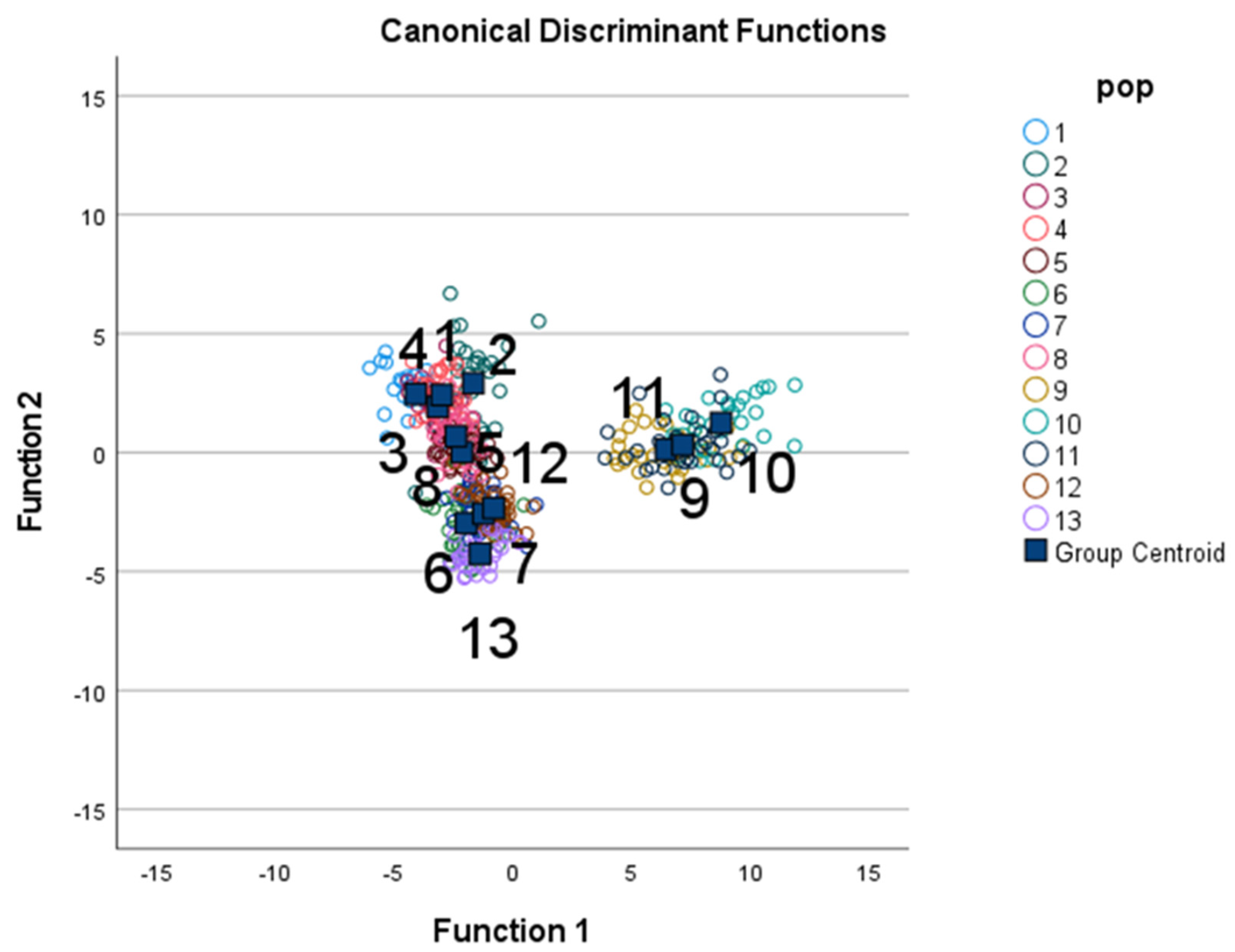
A DFA defining individuals by population but not by potential taxon indicated a clear separation of populations of Echinocactus texensis from those of E. horizonthalonius but did not show good resolution of any groupings among populations of E. horizonthalonius (Figure 3).
Figure 3.
Scatterplot of first two discriminant functions for DFA of individuals defined by sample population number. For Echinocactus horizonthalonius, populations 1, 2, and 12 are from the Sonoran Desert, populations 3, 4, 5, and 8, are from the Chihuahuan Desert, and populations 6, 7, and 13 are from the Central Mexican Plateau. Populations 9, 10, and 11 represent E. texensis (see Figure 1).
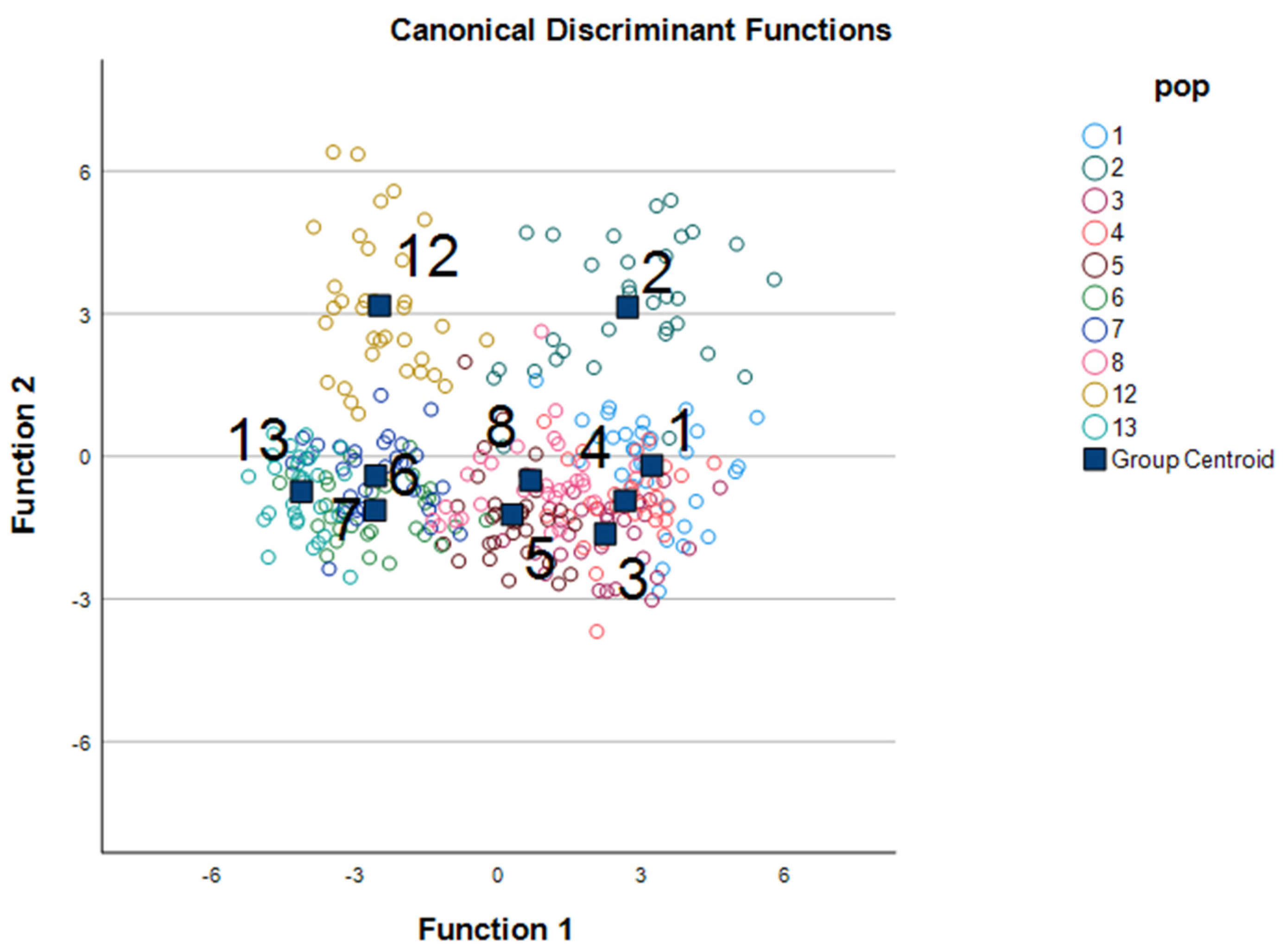
In order to increase the resolution among the populations of Echinocactus horizonthalonius, a DFA was performed defining individuals by population but omitting populations of E. texensis (Figure 4). Individuals occurring in the Central Mexico Plateau, represented by populations 6, 7, and 13, grouped together. Populations from the Sonoran Desert, however, do not form a well-defined cluster, with population three being particularly disjunct. By considering other functions, populations from the Sonoran Desert are better clustered.
Figure 4.
Scatterplot of first two discriminant functions for DFA of individuals defined by sample population number, with populations of Echinocactus texensis omitted for clarity. Populations 1, 2, and 12 are from the Sonoran Desert; populations 3, 4, 5, and 8, are from the Chihuahuan Desert; and populations 6, 7, and 13 are from the Central Mexican Plateau (see Figure 1).
A final DFA was run to test whether the characters sampled would be sufficient to define populations by geographic population; the Sonoran Desert, represented by Echinocactus horizonthalonius var. nicholii; the Chihuahuan Desert, represented by E. horizonthalonius var. horizonthalonius; and the Central Mexican Plateau, represented by a potential new taxon. Eigenvalues for this analysis are presented in Table 2 and Table 3 showing the resulting classification of individuals by potential taxon. Individuals of Echinocactus horizonthalonius var. nicholii are correctly classified as the least often of the four potential taxa (91.9%), indicating that it is a relatively weakly supported subspecific grouping. Individuals for populations occurring in the Central Mexican Plateau region are well-classified (98.3%) and, as expected, individuals of the outgroup are 100% correctly classified. Other DFAs were run for various population groupings, but none resulted in a higher correct classification of individuals.
Table 2.
Eigenvalues for the first three canonical discriminant functions used in the discriminant function analysis.
Table 3.
Predicted group membership for DFA defining groups of Echinocactus populations by geographic region. 1 = E. texensis; 2 = Chihuahuan Desert (E. horizonthalonius subsp. horizonthalonius); 3 = Sonoran Desert (E. horizonthalonius subsp. nicholii), 4 = Central Mexican Plateau (E. horizonthalonius subsp. nov.). 97.3% of the original grouped cases were correctly classified.
3.2. MANOVA
Using MANOVA, significant differences among mean character values were tested for the three geographically defined population groupings or subspecific taxa and the outgroup. Means of several characters were significantly different for all four test groups at the p < 0.001 level, and several more were significant for the individual potential subspecies within Echinocactus horizonthalonius (Table 4). Nine character value means were significantly different for E. texensis. Surprisingly, 13 means were significantly different for the Central Mexican Plateau populations, while only five were significant for the Sonoran Desert populations (E. horizonthalonius var. nicholii). Only five means were significantly different from the other population groupings for the Chihuahuan Desert populations (E. horizonthalonius var. horizonthalonius), which may be a reflection of its close relationship to the other two potential subspecific taxa or may simply be the result of the larger sample size for that taxon.
Table 4.
Selected homogeneous subsets from MANOVA of stem characters based on Duncan’s multiple range test. Bold indicates significance shared by two taxa combined; * indicates significant difference from the other varieties. All continuous data mean values are given in mm, except for spine thicknesses and widths, which are given in 0.001 mm.
4. Discussion and Conclusions
Multivariate analyses of morphology among populations within Echinocactus horizonthalonius indicate certain correlations among character states and geography. Although DFA defining individuals by population did not indicate distinct groupings of populations within E. horizonthalonius, especially when compared to those of the outgroup, E. texensis, DFA defining individuals by geographic regions representing potential subspecific taxa did indicate moderately high percentages of correct classification. The best population grouping was that of the Central Mexican Plateau populations, corresponding to an unnamed subspecific taxon. Correct classification of individuals was lower for E. horizonthalonius var. nicholii, in the Sonoran Desert. Based on the evidence thus far, it is clear that if populations of E. horizonthalonius var. nicholii represent a taxonomic unit, then so do those of the Central Mexican Plateau. Although the correct classification of individuals is weak for E. horizonthalonius var. nicholii, it is at least as high as those for subspecific taxa in other cactus species, such as Cylindropuntia whipplei [20] and C. acanthocarpa [21].
MANOVA also indicated good support for distinguishing the Central Mexican Plateau populations from their more northern counterparts. The Sonoran Desert populations of Echinocactus horizonthalonius var. nicholii possess only five character value means that distinguish them statistically from the remaining populations, while the Central Mexican Plateau populations possess 13 significantly different character means. Several mean character values reflected a cline from the Sonoran group of populations to the San Luis Potosí/Guanajuato populations. For example, mean character values decreased for stem mid-diameter divided by stem base diameter, rib height, upper and lower central and radial spine length, lower central spine angle, upper and lower central spine curvature, and lower central spine flatness. Reduction in mean character values coincides with the smaller average height of the Central Mexican Plateau populations (58.9 mm) compared to that for E. horizonthalonius var. horizonthalonius (108.6 mm) and E. horizonthalonius var. nicholii (125.1 mm).
In summary, the data and subsequent analyses here indicate good support for the taxonomic recognition of the Central Mexico Plateau populations but only weak support for recognizing Echinocactus horizonthalonius var. nicholii of the Sonoran Desert. Because the population groupings described below are correlated to geography, they are defined as subspecies [22,23]. This includes the description of a new subspecies of E. horizonthalonius, E. horizonthalonius subsp. australis, representing the Central Mexican Plateau populations. Because the type specimen for Echinocereus horizonthalonious has been lost, a new neotype is designated.
4.1. Taxonomy
Echinocactus horizonthalonius subsp. horizonthalonius
Echinocactus horizonthalonius Lemaire, Cact. Gen, Sp. Nov. 19. 1839
HOLOTYPE: None given. NEOTYPE (designated here): Texas, Brewster Co., Alpine, TX, USA, Big Bend National Park, base of Dead Horse Mountains, Kim I. Miller 1273 & Lillian W. Miller, 2 August 1961 (BRIT341625).
Synonyms:
Echinocactus equitans Scheidw. Bull. Acad. Sci. Brux. 6(1): 88. 1839
Echinocactus horizonthalonius var. equitans Schmoll, Catalog., 1947
E. horizontalis Hort, ex Forster, Handb. Cacteenk. 327, 1846, pro syn.
E. laticostatus Engelm. U.S. Senate Rept. Expl. & Surv. R. R. Route Pacific Ocean. Botany 4: 32. 1857, nom. nov, (without data)
Echinocactus horizonthalonius Lemaire var. centrispinus Engelm. Proc. Amer. Acad. 3: 276. 1857 (preprint, 1856); in Emory, Rept. U.S. & Mex. Bound. Surv. 2: Cactaceae 26. Pl. 21; 22, f. 1–5. 1859.
Echinocactus horizonthalonius f. centrispinus (Engelm.) Schelle, Proceedings of the American Academy of Arts and Sciences 3: 276, 1856
Echinocactus horizonthalonius f. centrispinus (Engelm.) Schelle, Die Kakteen (Schelle) 186. 1926
Echinocactus horizonthalonius f. curvispinus (Salm-Dyck) Schelle, Handb. Kakteenkult. 146 (1907)
E. horizonthalonius Lemaire var. laticostatus Schmoll, Catalog 1947.
E. horizonthalonius Lemaire var. equitans Schmoll, Catalog 1947 “Descriptio nonnullarum Cactacearum quae domino Galeotti in finibus Potosi, Guanaxato et al. iis, regni Mexicani invenientur a M. J. Scheidweiler”.
Echinocactus horizonthalonius f. curvispinus (Salm-Dyck) Schelle, Handbuch Kakteenkult. 146. 1907 (GCI)
Echinocactus horizonthalonius f. curvispinus (Salm-Dyck) Schelle, Cacteae in Horto Dyckensi Cultae 146 (1849), 1850
Echinocactus horizonthalonius var. curvispinus Salm-Dyck–Cacteae Horto Dyckensi Cultae Anno 1849
Echinocactus horizonthalonius subsp. jarmilae Halda & Horácek, Acta Mus. Richnov., Sect. Nat. 7(1): 34. 2000 (GCI)
Echinocactus horizonthalonius var. obscurispinus Rud. Mey., Monatsschrift für Kakteenkunde 21: 181. 1911 (GCI)
Echinocactus horizonthalonius f. obscurispinus (Rud. Mey.) Schelle, Kakteen (Schelle) 186. 1926 (GCI)
Echinocactus horizonthalonius Lem. var. subikii Staník & Dráb, Cactaceae, etc., 8(1): 8–9 (1998); 1999 (IK).
Echinocactus horizonthalonius Lem. var. subikii Staník & Dráb, cf. Repert. Pl. Succ. (I.O.S.), 49: 15 (1998 publ. 1999). (IK)
E. horizonthalonius var. moelle“i “Haage J”.,” ex Weniger, nom, nud.; without Latin diagnosis, type specimen, or page reference to a previous publication
Homalocephala horizonthalonius Weniger, Cacti S. W. 69. 1970, nom. nud. (Art. 33) and illegitimate (not accepted by its author)
Meyerocactus horizonthalonius (Lem.) Doweld in Succulenta, 75(6): 271 (1996).
Echinocactus horizonthalonius var. subikii Stanik & Drab 1998
Echinocactus horizonthalonius var. laticostatus Schmoll, Catalog., 1947
Echinocactus horizonthalonius subsp. diabolicus Halda, L.Vacek & Vaško, Acta Mus. Richnov., Sect. Nat. 13(1): 1 (3; figs.) (2006). From the Chihuahuan Desert portion of northern Zacatecas. Plants with “hooked” spines.
Note: Varieties E. horizonthalonius recognized by Weniger [24] as occurring in the Trans-Pecos, E. horizonthalonius var. curvispinus Salm-Dyck and E. horizonthalonius var. moelle“i “Haage J”.,” are not accepted by Powell and Weedin (2004). The type specimen of E. horizonthalonius was sent to Europe by the Galeotti, who had collected it from central Mexico, possibly in San Luis Potosí. According to Powell and Weedin [5], individuals within these populations are very different morphologically from those in the Trans-Pecos.
Echinocactus horizonthalonius subsp. nicholii (L.D.Benson) U.Guzmán, Cactaceae Syst. Init. 16: 17 (11 October 2003) (2003).
In addition to the characters listed in the key below, Vargas et al. (2018) distinguish this subspecies from the typical subspecies as having seedlings commonly with 4 spines per areole, compared to 1 or 2; mature plants frequently with short cylindrical stems vs. depressed stems; curved spines vs. straight; and pink to crimson flowers vs. light pink flowers. Our data do not suggest that the spines of Echinocactus horizonthalonius subsp. horizonthalonius are straight but that they are slightly less curved than those of E. horizonthalonius subsp. nicholii.
Synonyms:
Echinocactus horizonthalonius Lemaire var. nicholii L. Benson, Cacti Ariz. ed. 3. 23, 175. 1969“ “Arizona in Pima County, several miles southwest of Silver Bell, Silver Bell Mountains, 2,800 feet elevation, Arizona Desert, Lyman Benson 16663, July 3, 19”6,” POM311314.
Meyerocactus horizonthalonius subsp, nicholii (L. D. Benson) Doweld, Sukkulenty 1(2):27 (1999).
Echinocactus horizonthalonius subsp, australis M.A. Baker subsp. nov. HOLOTYPE: México. Guanajuato, 21°13.5′, −100°29.71′, Lomas al N. del poblado de Mineral de Pozos, ca 8 km. Al S de San Luis de la Paz, 21 February 1994, R.T. Barcenas T-115 with R.D. Luna, MEXU638114.
Echinocactus horizonthalonius subsp. australis differs from other subspecies of E. horizonthalonius by its low ribs averaging 2.5 mm in height; upper and lower central spines nearly straight, generally with curvature no more than ca. 0.3 mm; upper central spines, lower central spines, and radial spines shorter, averaging 21 mm. 22 mm, and 20 mm, respectively. Populations occur in the Central Mexican Plateau from portions of Zacatecas to San Luis Potosí and southward.
Echinocactus texensis
Vargas et. al. (2018) present a good argument for placing this species under Homalocephala.
Echinocactus texensis Hopffer, Allg. Otto and Dietr. Gartenz. 10: 207. 1842.
Synonyms:
Echinocactus texensis Hopffer ex Regel. Gartenflora xxxvii (1888):633, t1286
Homalocephala texensis Britton & Rose, Cactaceae 3: 181. 192“. “…Aus Samen gezogen, welchen der hiesige KBnigl. botanische Garten 1835 von Texas erhielt.”.”
Echinocactus lindheimeri Engelm. Pl. Lindh. I. Bost. Jour. Nat. Hist. 5: 246. 1845 “…near the Colorado River [Texas”].” LECTOTYPE designation “: “St. Louis, Cult, from Texas, June, 18”5,” doubtless collected by F. Lindheimer, Mo. (Benson 1982).
Echinocactus platycephalus Mühlenpfordt, Allg. Gratenz. 16:9. 184“. “Aus Mexico”.
Echinocactus texensis var. gourgensii Cels in Labouret, Monogr. Cact. 196. 1853. nom. nud.
Homacephala texensis (Hopffer) Britton & Rose var. gourgensii Y. Ito, Cacti 1952: 108. 1952, nom. nud.
Echinocactus courantianus Lemaire ex Labouret, Monogr. Cact. 196. 1853. pro syn., nom. nud.
Echinocactus texensis Hopffer f. longispinus Schelle, Handb. Kakteenkulter 161. 190“. “Tejas” Garden material.
Echinocactus texensis cristata Pirtle, Cactus and Succulent Journal (Amer.) 7:71. f. 1935, nom. nud. Labelled photograph.
4.2. Key to the Subspecies within Echinocactus Horizonthalonius
Because of overlapping character states, we recommend examining a number of individuals within a population in order to obtain an approximate average for key characters. Values given as averages unless otherwise indicated.
1. Rib height 12.5 mm; lower central spines 22 mm long; upper and lower central spines straight, generally with curvature ≤0.3 mm; upper central spine and radial spines generally <22 mm long. Populations occurring in the Central Mexican Plateau from portions of Zacatecas to San Luis Potosí and southward…………………………………………………… E. horizonthalonius subsp. australis (Figure 5C)
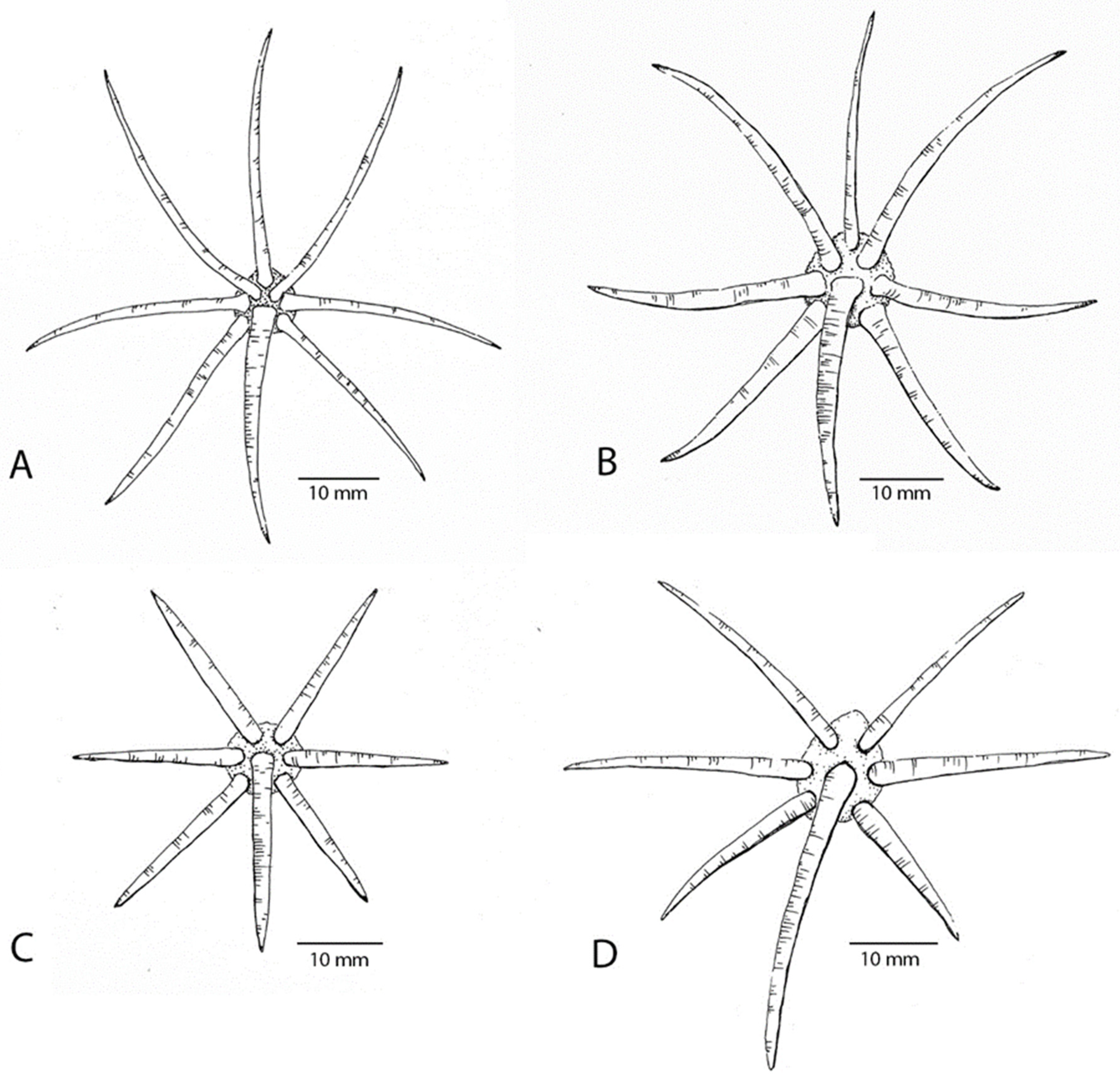
Figure 5.
Idealized drawings of spine clusters for (A) Echinocactus horizonthalonius subsp. horizonthalonius, (B) E. horizonthalonius subsp. nicholii, (C) E. horizonthalonius subsp. australis, and (D) E. texensis. Spines were drawn from specimens, and average character values were used to determine proportions. Drawings by Mara Guerrero.
1. Rib height generally >15 mm; lower central spines 30 mm long; upper and lower central spines generally with curvature to ca. 1.5 mm; upper central spine and radial spines generally >25 mm long. Populations occurring in the Chihuahuan and Sonoran Deserts.
2. Lower central spine >2 mm wide and the upper central spine generally >1.5mm wide. Upper central spine 35 mm long. Populations occurring in the Sonoran Desert ………………..…………………………………. horizonthalonius subsp. nicholii (Figure 5B)
2. Lower central spine <2 mm wide and the upper central spine generally <1.5mm wide. Upper central spine 30 mm long. Populations occurring in the Chihuahuan Desert ……………………………………… E. horizonthalonius subsp. horizonthalonius (Figure 5A)
Funding
This study was made possible from a grant from the U. S. Fish and Wildlife Service, Flagstaff, Arizona (Grant no. 20153060144).
Institutional Review Board Statement
Not applicable.
Data Availability Statement
Morphological data are available upon request from the author.
Acknowledgments
Many thanks for the efforts of Rafael Routson who aided in the fieldwork and a special thanks to Michelle Cloud-Hughes both for her efforts in the field and for rigorously editing the manuscript. Igor Drab was kind enough to send me his article with the original description of Echinocacactus horizonthalonius var. subikii. Locality information was obtained from Alan Zimmerman (Tucson, Arizona), Richard Worthington (University of Texas at El Paso), Michael Powell (Sul Ross University, Texas), Richard Spellenberg (Las Cruces, New Mexico), Tom Van Devender (Tucson, Arizona), Ana Lilia Reina (Tucson, Arizona), and Dave Ferguson (Albuquerque, New Mexico). Mara Guerrero produced the line drawing of the spine clusters and Stephanie Ickert-Bond produced the plate.
Conflicts of Interest
The author declares no conflict of interest.
Appendix A
Table A1.
Populations used for the morphological analysis, including locality, habitat, and voucher data.
Table A1.
Populations used for the morphological analysis, including locality, habitat, and voucher data.
| Site No. | A priori Taxon | Locality | Habitat | Voucher |
| 1 | E. horizonthalonius var. nicholii | Arizona, Pima County, 735–780 m elevation; Waterman Mountains, ca. 50 km NW of Tucson. | Sparse scrub on limestone outcroppings and associated alluvium with Acacia constricta, Ambrosia deltoidea, Aristida purpurea, Calliandra eriophylla, Carnegiea gigantea, Cylindropuntia acanthocarpa, C. bigelovii, C. fulgida, C. leptocaulis, Dasyochloa pulchella, Echinocereus engelmannii, Encelia farinosa, Eriogonum inflatum, Ferocactus cylindraceus, Fouquieria splendens, Krameria erecta, Larrea tridentata, Cochemiea grahamii, Olneya tesota, Opuntia engelmannii, Parkinsonia microphylla, and Tiquilia canescens. | Parfitt 2788 (ASU) |
| 2 | E. horizonthalonius var. nicholii | Pinal County, Northwest end of Vekol Mountains, Tohono O’odham Nation. | Sparse scrub on lower bajada of limestone rock and gravel with Acacia biuncifera, Ambrosia deltoidea, A. dumosa, Carnegiea gigantea, Cylindropuntia acanthocarpa, C. fulgida, C. leptocaulis, Echinocereus engelmannii, Ephedra fasciculata, Eriogonum inflatum, Fouquieria splendens, Grusonia parishii, Janusia gracilis, Krameria bicolor, Larrea tridentata, Lycium berlandieri, Cochemiea grahamii, Muhlenbergia porteri, Olneya tesota, Opuntia engelmannii, Parkinsonia microphylla, and Zinnia acerosa. | Bruner 11572 (ASU) |
| 3 | E. horizonthalonius var. horizonthalonius | New Mexico, Doña Ana County, 32.006° N 106.554° W; 1255–1270 m elevation; Franklin Mountains, 2.8 km WSW of Anthony Gap, 38 km SE of Las Cruces | Larrea tridentata scrub on limestone hills with Agave lechuguilla, Aloysia wrightii, Bahia absinthifolia, Cylindropuntia leptocaulis, Echinocereus coccineus, E. dasyacanthus, Fouquieria splendens, Gutierrezia microcephala, Koeberlinia spinosa, Krameria erecta, Muhlenbergia porteri, Opuntia spinosibacca, Parthenium incanum, Thymophylla acerosa, T. pentachaeta, Tiquilia canescens, T. greggii, Yucca treculeana, and Zinnia acerosa. | Baker 16593 (ASU) |
| 4 | E. horizonthalonius var. horizonthalonius | Texas, Brewster County, 29.077° N 103.104° W; 690 m elevation; 550 m WSW of Boquillas, 500 m north of the confluence of Fresno Creek with the Rio Grande River; 1 km SE of the summit of Tally Mountain. | Limestone ridges with Acacia neovernicosa, Ariocarpus fissuratus, Bouteloua trifida, Cylindropuntia leptocaulis, Dasyochloa pulchella, Echinocactus horizonthalonius, E. dasyacanthus, Ephedra trifurca, Glandulicactus uncinatus, Guaiacum angustifolium, Leucophyllum frutescens, Opuntia spinosibacca, Porophyllum gracilis, Prosopis glandulosa, Selaginella lepidophylla, Tiquilia canescens, and Tridens mutica. | Baker 16595.2 (ASU, photos only) |
| 5 | E. horizonthalonius var. horizonthalonius | México, Coahuila, 27.231° N 101.350° W; 1135 m elevation; 3 km north of Plan de Guadalupe, 90 km NNW of Saltillo. | Larrea tridentata scrub with Agave lechuguilla, Bahia absinthifolia, Cylindropuntia imbricata, C. kleiniae, Dasyochloa pulchella, Euphorbia antisyphilitica, Fouquieria splendens, Jatropha dioica, Lippia graveolens, Lophophora williamsii, Opuntia engelmannii, O. rufida, Parkinsonia texana, Pennisetum ciliare, Thelocactus bicolor, Tiquilia canescens, and Yucca treculeana. | Baker 16612 (ASU) |
| 6 | E. horizonthalonius var. horizonthalonius | México, San Luis Potosí, 22.928° N 100.411° W; 1400 m elevation; 97 km NNE of San Luis Potosí; 1 km ENE of El Entronque, northern tip of Sierra Cuchillo de Enmedio; along Hwy 80, 5 km (by road) east of its junction with Hwy 57. | Larrea tridentata scrub with Agave scabra, Celtis pallida, Cylindropuntia kleiniae, C. leptocaulis, C. tunicata, Echinocactus platyacanthus, Echinocereus pectinatus, Jatropha dioica, Koeberlinia spinosa, Myrtillocactus geometrizans, Opuntia engelmannii, Prosopis laevigata, Thelocactus bicolor, Tiquilia canescens, and Yucca decipiens. | Baker 16119 (ASU) |
| 7 | E. horizonthalonius var. horizonthalonius | México, Guanajuato, 21.163° N 100.500° W; 2130 elevation; 15 km south of San Luis de la Paz (Mineral de la Pozos), just NE of the Ejido of Espinas Blancas. | Disclimax grassland on rocky volcanic soil with Bouteloua curtipendula, Cathestecum erectum, Coryphantha erecta, Cylindropuntia imbricata, C. tunicata, Dasyochloa pulchella, Erioneuron pilosum, Jatropha dioica, Myrtillocactus geometrizans, Opuntia engelmannii, Opuntia leucotricha, Parthenium incanum, and Yucca filifolia | R. T. Barcenas T-115 |
| 8 | E. horizonthalonius var. horizonthalonius | México, Coahuila, 27.029° N 103.682° W; 1115 m elevation; 28 km south of La Esmeralda; 5 km east of Guimbalete, 7 km SSE of Cerro el Venado Pelón. | Larrea tridentata scrub with Acacia neovernicosa, Bahia absinthifolia, Coryphantha macromeris, C. poselgeriana, Cylindropuntia leptocaulis, C. imbricata, Echinocereus stramineus, Ferocactus hamatacanthus, Euphorbia antisyphilitica, Flourensia cernua, Fouquieria splendens, Jatropha dioica, Mammillaria heyderi, Opuntia rufida, Parthenium incanum, and Viguiera stenoloba. | Baker 16608 (ASU) |
| 9 | E. texensis | New Mexico, Eddy County, 32.661° N 104.375° W; 1020 m elevation; 1 km south of Fourmile Draw, 6 km west of the Pecos River, 20 km south of the center of Artesia. | Scleropogon brevifolius grassland with Coryphantha macromeris, Croton pottsii, Flourensia cernua, Gutierrezia sarothrae, Krameria erecta, Larrea tridentata, Lesquerella fendleri, Opuntia tortispina, Pleuraphis mutica, Prosopis glandulosa, Rhus microphylla, and Yucca glauca. | Baker 16617 (ASU) |
| 10 | E. texensis | Texas, Terrell County, 30.058° N 102.235° W; 695 m elevation; 18 km ESE of Sanderson, between Hwy 90 and the railroad tracks, just west of the old Mofeta Railroad stop. | Larrea tridentata scrub with Coryphantha macromeris, Cylindropuntia leptocaulis, Echinocactus horizonthalonius, Echinocereus coccineus, Flourensia cernua, Koeberlinia spinosa, Lycium berlandieri, Opuntia engelmannii, O. mackenensii, O. strigil, Panicum hallii, Parthenium incanum, Prosopis glandulosa, Tiquilia canescens, Viguiera stenoloba, and Yucca treculeana. | Baker 16596 (ASU) |
| 11 | E. texensis | México, Coahuila, 27.153° N 101.257° W; 395 m elevation; just east of Río Monclova, 10 km SSW of Primero de Mayo, 5 km west of Cuchillo de Arco, 30 km ENE of San Bueno Ventura. | Larrea tridentata scrub with Bahia absinthifolia, Coryphantha macromeris, Cylindropuntia kleiniae, C. leptocaulis, Echinocereus enneacanthus, Flourensia cernua, Fouquieria splendens, Guaiacum angustifolium, Lycium berlandieri, Mammillaria heyderi, Muhlenbergia porteri, Opuntia engelmannii, Prosopis glandulosa, and Tiquilia canescens. | Baker 16609 (ASU) |
| 12 | E. horizonthalonius var. horizonthalonius | México, Sonora, 660 m elevation, 90 km east of Hermosillo, 11 km ENE Mazatán, 14 km ESE of the summit of Sierra Mazatán. | Low ridges of igneous and sedimentary alluvium, including a surface layer of rocks and gravel, grassland/sparse shrubland with Acacia constricta, Agave angustifolia var. angustifolia, Agave shrevei subsp. matapensis, Allionia incarnata, Aristida adscensionis, A. ternipes var. ternipes, Bouteloua barbata var. barbata, B. diversispicula, Bursera fagaroides var. elongata, Bursera laxiflora, Caesalpinia pulcherrima, Callaeum macropterum, Calliandra eriophylla, Condalia warnockii, Cottsia linearis, Dalea mollis, Ditaxis neomexicana, Evolvulus alsinoides var. angustifolia, Eysenhardtia orthocarpa var. orthocarpa, Fouquieria splendens, Guaiacum coulteri, Haematoxylum brasiletto, Hedeoma nanum, Jatropha cardiophylla, Karwinskia humboldtiana, Krameria erecta, Lysiloma watsonii, Mimosa distachya, Opuntia durangensis, Parkinsonia × sonorae, Plantago ovata, Polygala macradenia, Porophyllum gracile, and Turnera diffusa. | Baker 17574 (ASU, photos only) |
| 13 | E. horizonthalonius var. horizonthalonius | México, Zacatecas, 22.73435° N 102.60492° W (WGS84), 2385 m elevation, just south of the outskirts of the metropolis of Zacatecas, 5 km SSW of its center. | Low scrub/ grassland with Acalypha phleoides, Astragalus diphacus, Baccharis pteronioides, Bouteloua curtipendula, B. gracilis, Calylophus hartwegii, Dalea prostrata, Dasyochloa pulchella, Echeveria paniculata, Euphorbia cuphosperma, Krameria pauciflora, Lycurus phleoides, Mammillaria heyderi, Mimosa biuncifera, Oenothera kunthiana, Opuntia leucotricha, O. robustispina, Penstemon roseus, Sanvitalia procumbens, Solanum elaeagnifolium, Thelesperma megapotamicum, Viguiera dentata, Xanthisma spinulosum, and Yucca decipiens. | Photo info? Maybe reference Figure 1. |
References
- Baker, M.A.; Butterworth, C. Geographic distribution and taxonomic circumscription of populations within Coryphantha section Robustispina (Cactaceae). Am. J. Bot. 2013, 100, 984–997. [Google Scholar] [CrossRef]
- Baker, M.A.; Porter, J.M. The use of multivariate analyses of morphological characters and DNA analyses for assessing the taxonomic ranking of rare plant taxa: An example comparing populations of Echinomastus erectocentrus var. acunensis with those of its relatives E. erectocentrus var. erectocentrus and E. johnsonii. In Endangered Species: Threats, Conservation and Future Research; Quinn, M., Ed.; Nova Science Publishers, Inc., Hauppauge: New York, NY, USA, 2016; pp. 19–61. [Google Scholar]
- Majure, L.C.; Baker, M.A.; Cloud-Hughes, M.; Salywon, A.; Neubig, K.M. Phylogenomics in Cactaceae: A case study using the chollas sensu lato (Cylindropuntieae, Opuntioideae) reveals a common pattern out of the Chihuahuan and Sonoran deserts. Am. J. Bot. 2019, 106, 1327–1345. [Google Scholar] [CrossRef] [PubMed]
- Bravo-Hollis, H. Las Cactáceas de México; México UNAM: Mexico City, México, 1937. [Google Scholar]
- Powell, M.A.; Weedin, J.F. Cacti of the Trans-Pecos and Adjacent Areas; Texas Tech University Press: Lubbock, TX, USA, 2004. [Google Scholar]
- Zimmerman, A.D.; Parfitt, B.D. Cactaceae: Echinocactus. In Flora of North America Editorial Committee, Flora of North America; Missouri Botanical Garden Press: St. Louis, MO, USA, 2003; Volume 4. [Google Scholar]
- Vargas-Luna, M.D.; Hernández-Ledesma, P.; Majure, L.C.; Puente-Martínez, R.; Macías, H.M.H.; Luna, R.T.B. Splitting Echinocactus: Morphological and molecular evidence support the recognition of Homalocephala as a distinct genus in the Cactaceae. PhytoKeys 2018, 111, 31–59. [Google Scholar] [CrossRef]
- Goettsch, B.; Hilton-Taylor, C.; Cruz-Piñón, G.; Duffy, J.P.; Frances, A.; Hernández, H.M.; Inger, R.; Pollock, C.; Schipper, J.; Superina, M.; et al. High proportion of cactus species threatened with extinction. Nat. Plants 2015, 1, 15142. [Google Scholar] [CrossRef]
- Worthington, R.D. Observations on the flowering cacti from the vicinity of El Paso, Texas. Cactus Succul. J. 1986, 58, 213–217. [Google Scholar]
- Benson, L. The Cacti of Arizona, 3rd ed.; University of Arizona Press: Tucson, AZ, USA, 1969. [Google Scholar]
- Aguilar, R.P.; van Devender, T.R.; Felger, R.S. Cactáceas de Sonora, México: Su Diversidad, Uso y Conservación; Arizona-Sonora Desert Museum Press: Tucson, AZ, USA, 2000. [Google Scholar]
- Yatskievych, G.; Fischer, P.C. New plant records from the Sonoran Desert. Desert Plants 1983, 5, 180–185. [Google Scholar]
- Benson, L. The Cacti of the United States and Canada; Stanford University Press: Stanford, CA, USA, 1982. [Google Scholar]
- Anderson, E. The Cactus Family; Timber Press: Portland, OR, USA, 2001. [Google Scholar]
- U.S. Fish and Wildlife Service. Nichol Turk’s Head Cactus (Echinocactus horizonthalonius var. nicholii) Recovery Plan; U.S. Fish and Wildlife Service: Albuquerque, NM, USA, 1986. [Google Scholar]
- Butterwick, M. Nichol’s Turk’s Head Cactus Habitat Management Plan; BLM: Phoenix, AZ, USA, 1985. [Google Scholar]
- Phillips, A.M., III; Phillips, B.G.; Green, L.T., III; Mazzoni, J.; Peterson, E.M. Status Report: Echinocactus Horizonthalonius Lemaire var. nicholii L. Benson; USFWS: Albuquerque, NM, USA, 1979. [Google Scholar]
- Wallace, R.S. Molecular systematic study of the Cactaceae: Using chloroplast DNA variation to elucidate cactus phylogeny. Bradleya 1995, 13, 1–12. [Google Scholar] [CrossRef]
- IBM SPSS Statistics for Windows, Version 28.0.1.1; IBM Corp: Armonk, NY, USA, 2015.
- Baker, M.A. Morphological and cytological analyses in Cylindropuntia (Cactaceae): The taxonomic circumscription of C. echinocarpa, C. multigeniculata, and C. whipplei. J. Bot. Res. Inst. Tex. 2016, 10, 325–343. [Google Scholar]
- Baker, M.A.; Pinkava, D.J.; Cloud-Hughes, M.A. Analysis of infraspecific taxa within Cylindropuntia acanthocarpa using multivariate analysis of morphological characters. Canotia 2018, 14, 66–92. [Google Scholar]
- Stebbins, G.L. Variation and Evolution in Plants; Columbia University Press: New York, NY, USA; London, UK, 1950. [Google Scholar]
- Baker, M.A.; Cloud-Hughes, M.A.; Rebman, J.P.; Majure, L.C. Nomenclatural changes in Cylindropuntia (Cactaceae). Madroño 2019, 66, 92. [Google Scholar] [CrossRef]
- Weniger, D. Cacti of Texas and Neighboring States; University of Texas Press: Austin, TX, USA, 1984. [Google Scholar]
Publisher’s Note: MDPI stays neutral with regard to jurisdictional claims in published maps and institutional affiliations. |
© 2022 by the author. Licensee MDPI, Basel, Switzerland. This article is an open access article distributed under the terms and conditions of the Creative Commons Attribution (CC BY) license (https://creativecommons.org/licenses/by/4.0/).