


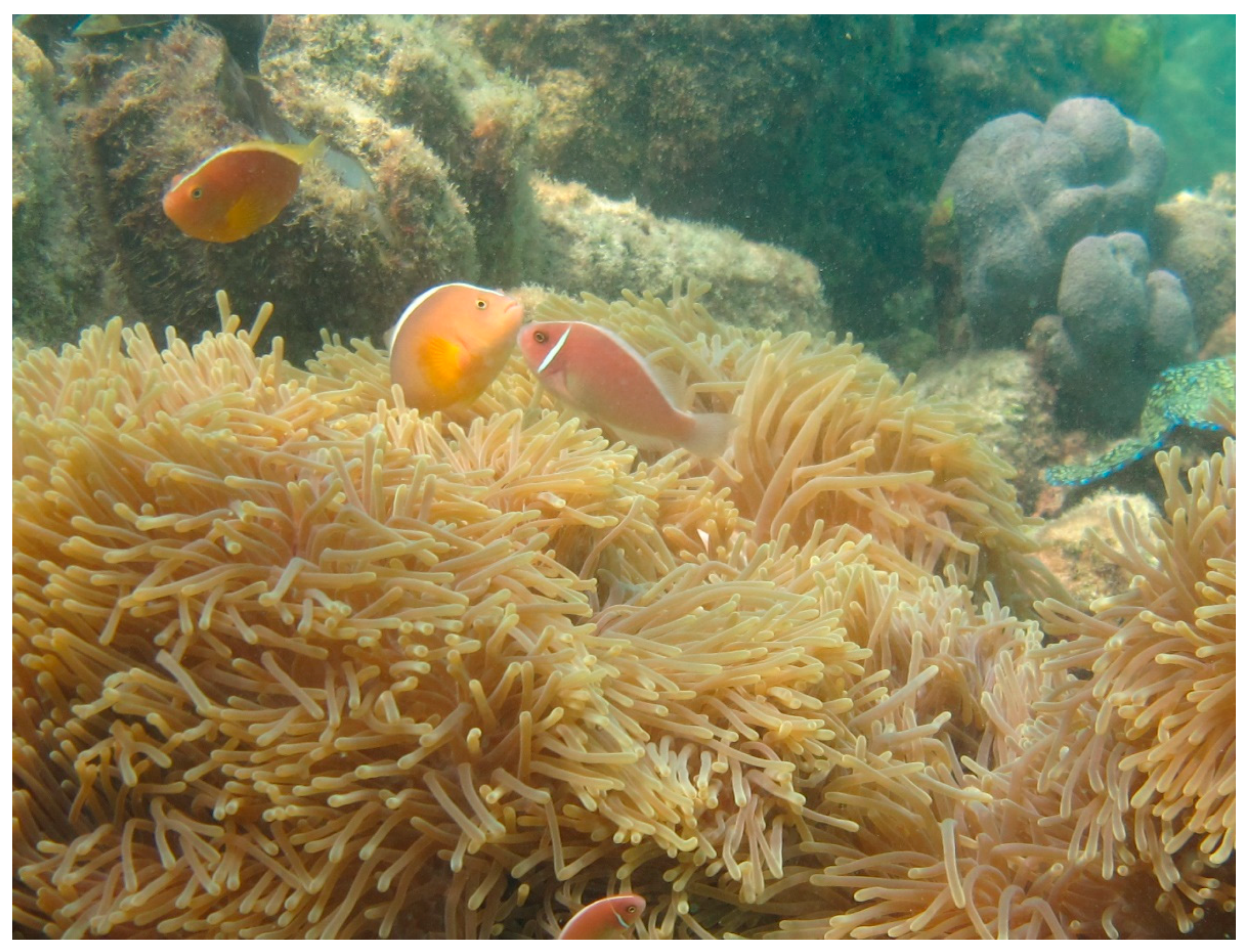
The Sharing of the Same Host of Two Species of Anemonefish in the Gulf of Thailand, One of Which Is Possibly Introduced


Author Contributions
Funding
Institutional Review Board Statement
Informed Consent Statement
Data Availability Statement
Acknowledgments
Conflicts of Interest
References
- Fautin, D.G.; Allen, G.R. Field Guide to Anemonefishes and Their Host Sea Anemones; Western Australian Museum: Perth, Australia, 1992; pp. 1–65.
- Kuiter, R.H.; Tonozuka, T. Pictorial Guide to Indonesian Reef Fishes; Zoonetics: Seaford, Australia, 2001. [Google Scholar]
- De Brauwer, M.; Camp, E.; Jompa, J.; Smith, D.J. High levels of heterospecific cohabitation among anemonefishes in Hoga Island, Indonesia. Mar. Biodivers. 2015, 46, 19–20. [Google Scholar] [CrossRef]
- Bos, A.R. Clownfishes Amphiprion clarkii and A. sandaracinos (Pomacentridae) coexist in the sea anemone Stichodactyla mertensii. Coral Reefs 2011, 30, 369. [Google Scholar] [CrossRef] [Green Version]
- Satapoomin, U. A preliminary checklist of coral reef fishes of the Gulf of Thailand, South China Sea. Raffles Bull. Zool. 2000, 48, 31–53. [Google Scholar]
- Moyer, J.T. Anemonefishes of the World; TBS-Britanica Co., Ltd.: Tokyo, Japan, 2001. [Google Scholar]
- Hattori, A. Small and large anemonefishes can coexist using the same patchy resources on a coral reef, before habitat destruction. J. Anim. Ecol. 2002, 71, 824–883. [Google Scholar] [CrossRef] [Green Version]
- Camp, E.F.; Hobbs, J.-P.A.; De Brauwer, M.; Dumbrell, A.J.; Smith, D.J. Cohabitation promotes high diversity of clownfishes in the Coral Triangle. Proc. R. Soc. B Biol. Sci. 2016, 283, 20160277. [Google Scholar] [CrossRef] [PubMed] [Green Version]
Publisher’s Note: MDPI stays neutral with regard to jurisdictional claims in published maps and institutional affiliations. |
© 2021 by the authors. Licensee MDPI, Basel, Switzerland. This article is an open access article distributed under the terms and conditions of the Creative Commons Attribution (CC BY) license (https://creativecommons.org/licenses/by/4.0/).
Share and Cite
Songploy, S.; Chavanich, S.; Mariasingarayan, Y.; Viyakarn, V. The Sharing of the Same Host of Two Species of Anemonefish in the Gulf of Thailand, One of Which Is Possibly Introduced. Diversity 2021, 13, 304. https://doi.org/10.3390/d13070304
Songploy S, Chavanich S, Mariasingarayan Y, Viyakarn V. The Sharing of the Same Host of Two Species of Anemonefish in the Gulf of Thailand, One of Which Is Possibly Introduced. Diversity. 2021; 13(7):304. https://doi.org/10.3390/d13070304
Chicago/Turabian StyleSongploy, Se, Suchana Chavanich, Yosuva Mariasingarayan, and Voranop Viyakarn. 2021. "The Sharing of the Same Host of Two Species of Anemonefish in the Gulf of Thailand, One of Which Is Possibly Introduced" Diversity 13, no. 7: 304. https://doi.org/10.3390/d13070304
APA StyleSongploy, S., Chavanich, S., Mariasingarayan, Y., & Viyakarn, V. (2021). The Sharing of the Same Host of Two Species of Anemonefish in the Gulf of Thailand, One of Which Is Possibly Introduced. Diversity, 13(7), 304. https://doi.org/10.3390/d13070304

