


The largest scyphozoan jellyfish of the Mediterranean Sea, Drymonema dalmatinum was first described by Haeckel [1] from material collected off the Dalmatian coast of the Adriatic Sea. According to Malej [2], there is no information on Drymonema in the Adriatic from 1937 till 1984, when a diver photographed one individual in the small eastern Adriatic Bay of Žrnovnica. Since the year 2000, the number and frequency of sightings have increased slightly throughout the Adriatic Sea, but the species must still be considered rare in the region.
There are few documented sightings in the literature on the Mediterranean Sea in the last 10 years. According to Malej et al. [2], in the Adriatic Sea, there was one sighting in 2010 (Murter, HR) and two sightings in 2014 (Kotor bay, MNE; Gulf of Trieste, ITA). In the Mediterranean, there was a well-documented sighting in the Sea of Marmara in 2020 [3], and one sighting was reported along the Spanish coast in 2013 [4].
Drymonema belongs to the Cyaneidae family, which presents three valid genera—Cyanea, Desmonema, Drymonema—with about 20 valid species, and shows a considerable variance for the three characteristics diagnostics of the family. Although Haeckel in 1880 recognized the distinctiveness of Drymonema, coining the subfamily Drymonemidae, Bayha, and Dawson [5], he demonstrated the family Cyaneidae to be polyphyletic, and that Drymonema is clearly reciprocally monophyletic with respect to Cyaneaidae. Moreover, phylogeny and the high genetic differences highlight the need for assignment of a neotype of D. dalmatinum, in order to support the recognition of a new western Atlantic Drymonema species.
The umbrella is in the form of a flat disc, consisting of a thicker and more rigid central part and a thin, peripheric, marginal area without tentacles, with 20 lappets per octant. Four oral arms are very broad; have a large, curtain-like surface; and are nearly as long as the diameter of the bell. In larger specimens, there are clear brownish radial strakes on the exumbrellar surface.
A distinctive feature of the genus Drymonema is that large specimens feed primarily on Aurelia [6], which was taken up by Bayha and Dawson [4], who supposed an external digestion by protease given the reduction of gastric filaments. From the present observation, it can be assumed that Drymonema does not only prey on Aurelia, but also other jellyfish, even larger ones like Rhizostoma. According to this hypothesis, the increase in the number of sightings of Drymonema could be linked not only to the presence of Aurelia, but also to the regular presence of Rhizostoma in the Gulf of Trieste throughout the year.
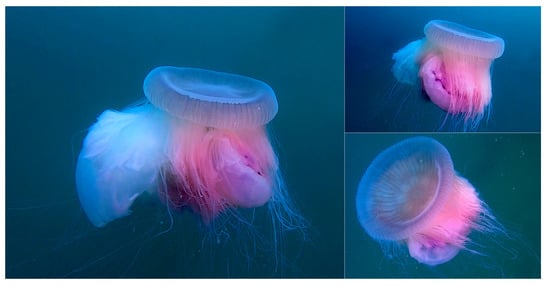
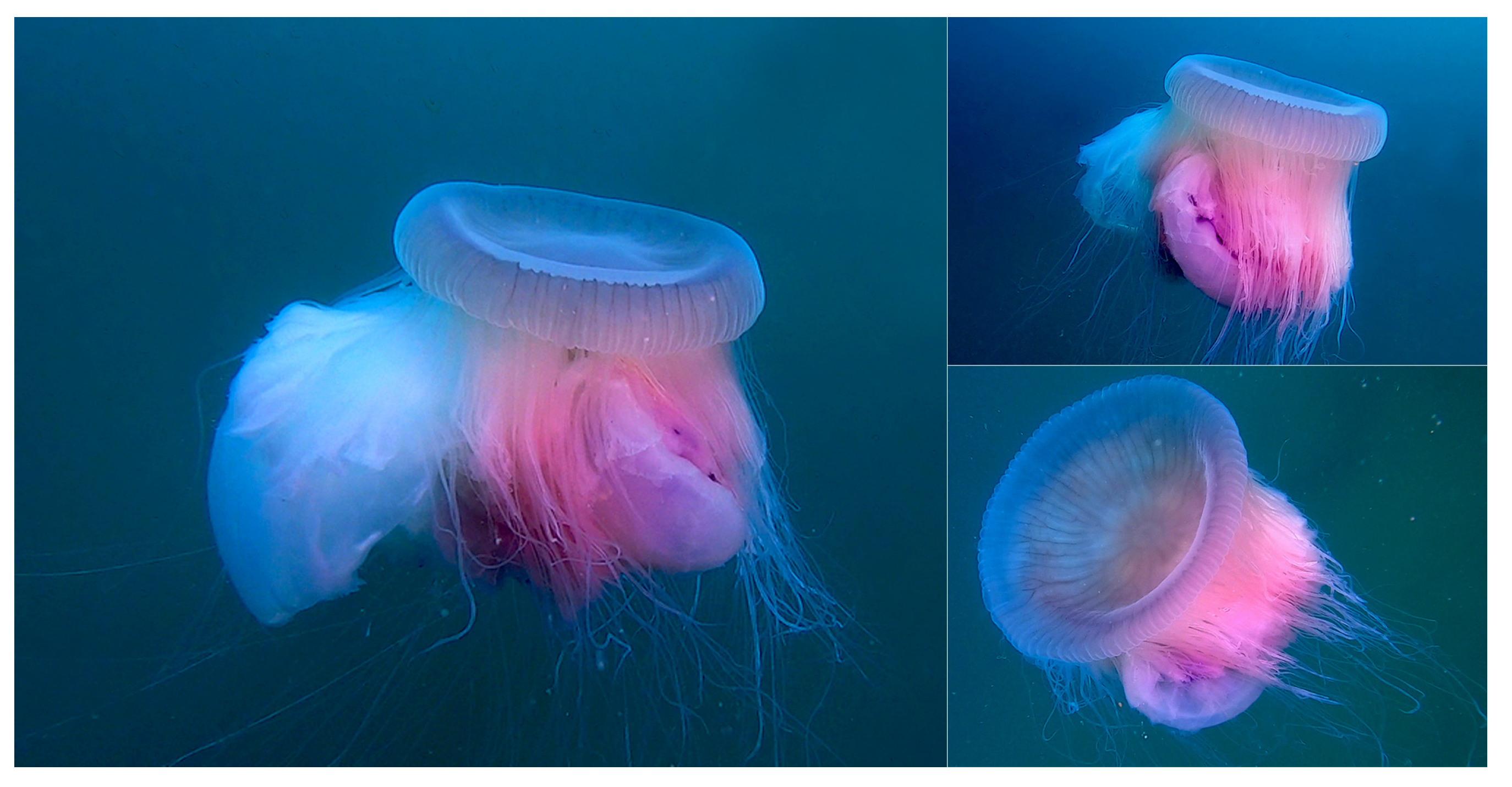
On 1 June 2020, researchers from the Miramare Marine Protected Area performed monitoring activity in the areas adjacent to the Miramare MPA, and made an unusual sighting: a specimen of Drymonema dalmatinum (Figure 1). The underwater visibility was about 10 m, and a large number of jellies, including Rhizostoma pulmo, were present along the column. The specimen was found at a depth of about 10 m (in a 14 m seabed), and the sea temperature was around 20 °C. In his oral arms were two prey of the species Rhizostoma pulmo. The organism was not collected, due to the regulations on monitoring activities for Miramare MPA staff. The planned monitoring activity did not involve the use of measuring instruments, but the researchers were able to estimate the approximate size thanks to the experience gained during the visual fish census activities they usually carry out for the MPA. The bell diameter was approximately 40 cm, as were the length of oral arms.
Figure 1.
Drymonema dalmatinum preying on two Rhizostoma pulmo medusae.
Video is available here: https://youtu.be/HZUmpDXytp4 (accessed on 2 March 2021).
Author Contributions
Conceptualization, S.C. and M.S.; software, S.C.; writing—original draft preparation, M.S., L.F. and S.C.; writing—review and editing, S.C. and M.S.; supervision, M.S. All authors have read and agreed to the published version of the manuscript.
Funding
This research received no external funding.
Institutional Review Board Statement
Not applicable.
Informed Consent Statement
Not applicable.
Data Availability Statement
The data presented in this study are available on request from the corresponding author.
Conflicts of Interest
The authors declare no conflict of interest.
References
- Haeckel, E. System der Acraspeden; Zweite Halfte des System der Medusen; Verlag von Gustav Fischer: Jena, Germany, 1880; pp. 361–672. [Google Scholar]
- Malej, A.; Vodopivec, M.; Pestorić, B.; Lucic, D.; Onofri, I. The lesser-known medusa Drymonema dalmatinum in the Adriatic Sea. Annales Ser. Hist. Nat. 2014, 9, 79–86. [Google Scholar]
- Öztürk, İ.D. The first record of Drymonema sp. From the Sea of Marmara, Turkey. J. Black Sea Medit. Environ. 2020, 26, 231–237. [Google Scholar]
- Kienberger, K.; Prieto, L. The first record of Drymonema dalmatinum from the northern Alboran Sea (western Mediterranean). Mar. Biodivers. 2018, 48, 1281–1282. [Google Scholar] [CrossRef] [Scilit]
- Bayha, K.M.; Dawson, M.N. New family of allomorphic jellyfishes, Drymonematidae (Scyphozoa, Discomedusae), emphasizes evolution in the functional morphology and trophic ecology of gelatinous zooplankton. Biol. Bull. 2010, 219, 249–267. [Google Scholar] [CrossRef] [Scilit] [PubMed]
- Larson, R.J. First report of the little-known Scyphomedusa Drymonema dalmatinum in the Caribbean Sea, with notes on its biology. Bull. Mar. Sci. 1987, 40, 437–441. [Google Scholar]
Publisher’s Note: MDPI stays neutral with regard to jurisdictional claims in published maps and institutional affiliations. |
© 2021 by the authors. Licensee MDPI, Basel, Switzerland. This article is an open access article distributed under the terms and conditions of the Creative Commons Attribution (CC BY) license (https://creativecommons.org/licenses/by/4.0/).