Communication

Formation of a β-(3-Chlorobenzoyloxy)-α-hydroxyketone from a TBS-Protected Chalcone upon Oxidation with m-Chloroperbenzoic Acid


by
Sonia Berenguel-Gómez
,
Irene Moreno-Gutiérrez
,
Jenifer Acien-García
,
Manuel Muñoz-Dorado
,
Míriam Álvarez-Corral
and
Ignacio Rodríguez-García
*
Organic Chemistry, University of Almeria, CIAIMBITAL, E04120 Almería, Spain
*
Author to whom correspondence should be addressed.
Molbank 2026, 2026(3), M2175; https://doi.org/10.3390/M2175 (registering DOI)
Submission received: 20 March 2026 / Revised: 4 May 2026 / Accepted: 7 May 2026 / Published: 9 May 2026
(This article belongs to the Section Organic Synthesis and Biosynthesis)

Abstract

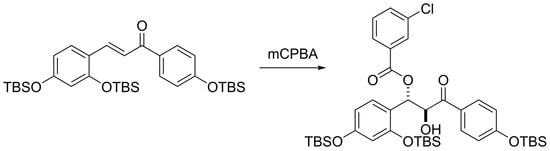
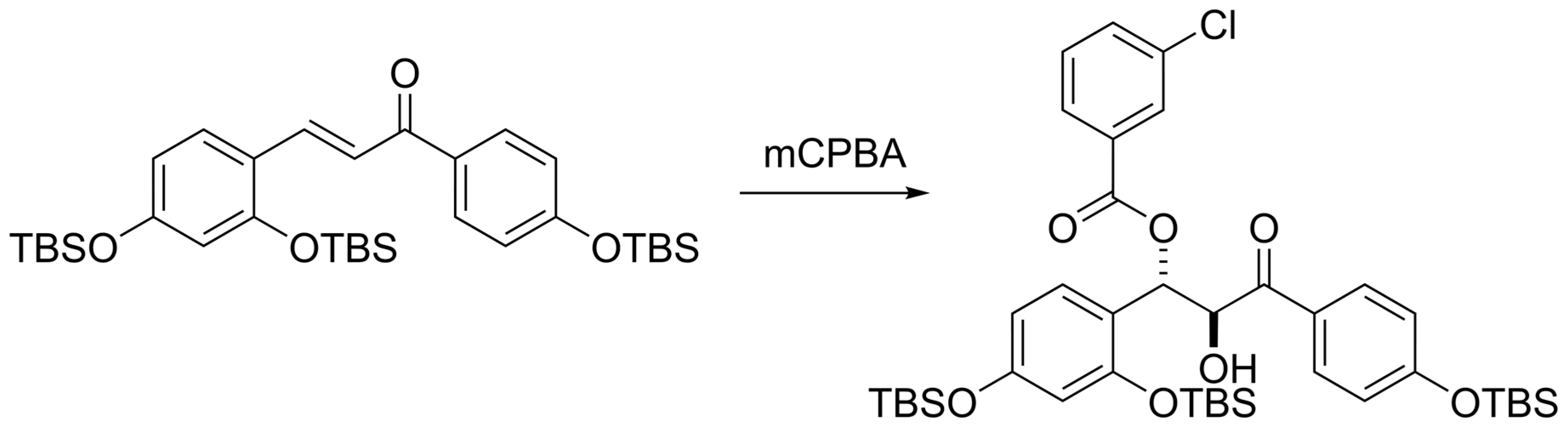
A new tert-butyldimethylsilyl-protected polyoxygenated chalcone was prepared by Claisen–Schmidt condensation of suitably protected acetophenone and benzaldehyde derivatives. Treatment of this chalcone with m-chloroperbenzoic acid (mCPBA) afforded β-(3-chlorobenzoyloxy)-α-hydroxyketone 5, which was fully characterized by spectroscopic methods. The structure of 5 is consistent with initial epoxidation of the enone double bond followed by in situ nucleophilic opening of the transient epoxide by m-chlorobenzoate generated in the reaction medium. This work reports the preparation of the chalcone precursor and the characterization of the unexpected oxidation product 5.

Graphical Abstract

1. Introduction

Chalcones constitute an important class of α,β-unsaturated ketones characterized by two aromatic rings linked through a three-carbon enone system. They are widely distributed in nature, particularly in plant-derived metabolites, and many naturally occurring or structurally related chalcones have attracted sustained interest because of their diverse biological properties and their central role as biosynthetic and synthetic intermediates [1,2,3]. Owing to the presence of the conjugated carbonyl system, chalcones also occupy a privileged position in organic synthesis, where they serve as versatile precursors to a broad range of oxygenated, cyclized, and otherwise functionally elaborated derivatives [4].
From a synthetic point of view, chalcones are most commonly prepared by Claisen–Schmidt condensation between an aromatic ketone and an aromatic aldehyde. Although this transformation is straightforward in many simple cases, the synthesis of densely substituted or polyoxygenated chalcones is often less trivial [2,5]. Electronic deactivation, steric congestion, competitive self-condensation, and the intrinsic sensitivity of oxygenated aromatic substrates may complicate both the generation of the required enolate and the subsequent formation of the desired crossed-condensation product. As a result, the preparation of highly functionalized chalcones frequently requires careful substrate design and the use of appropriately chosen bases and protecting groups.
The reactivity of chalcones is likewise strongly influenced by the substitution pattern of the two aromatic rings. Both the electronic nature and the steric demand of the substituents can markedly affect the polarization of the enone system, the accessibility of the double bond, and the stability of intermediates formed in subsequent transformations [1,5]. This is particularly relevant in oxidation reactions, where the expected course of the transformation may be altered by neighboring substituents or by the nature of the reaction medium [6]. Thus, even when chalcones share the same formal enone framework, differences in aromatic oxygenation and substitution can lead to significantly different outcomes [7].
These effects become especially important in polyoxygenated systems. Free phenolic hydroxyl groups, although synthetically valuable, often interfere with condensation or later functionalization steps by engaging in acid–base processes, hydrogen bonding, or competitive side reactions [8]. For this reason, phenol protection is commonly required in the synthesis of elaborated chalcone derivatives. Among the available protecting groups, silyl ethers such as tert-butyldimethylsilyl (TBS) groups are particularly useful because they are readily introduced, generally stable under basic conditions, and compatible with many transformations commonly used in aromatic and enone chemistry [9].
Epoxidation of the α,β-unsaturated double bond represents one of the most useful transformations of chalcones, since the resulting α,β-epoxyketones are valuable intermediates for further functionalization [10,11]. However, in structurally complex substrates, the initially formed epoxides may display limited stability and may undergo rapid secondary processes before isolation [12]. In such cases, the final product may not simply reflect the primary oxidation event, but rather the combined effect of epoxidation and subsequent ring opening or rearrangement. Documenting such outcomes is important, since apparently routine oxidation conditions may become unsuitable for the isolation of the targeted epoxide in highly substituted substrates.
As part of our ongoing interest in polyoxygenated chalcone derivatives bearing this substitution pattern [13], we prepared a new TBS-protected chalcone and examined its oxidation with m-chloroperbenzoic acid (mCPBA). Instead of the expected epoxide, the reaction afforded a β-(3-chlorobenzoyloxy)-α-hydroxyketone as the only stable and isolable product. The present work describes the preparation of the chalcone precursor and the characterization of this unexpected oxidation product.

2. Results and Discussion

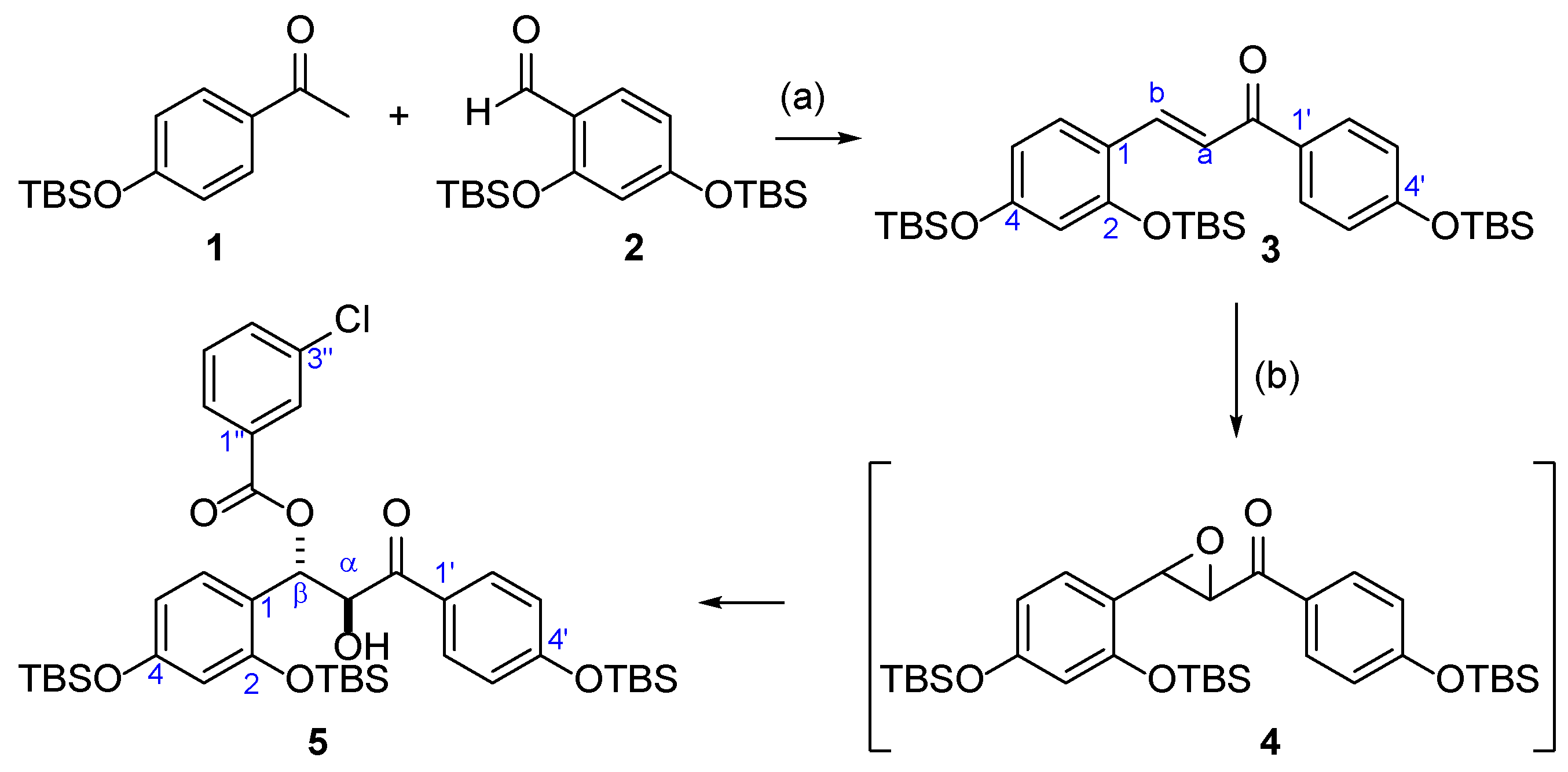
Protected chalcone 3 was synthesized by Claisen–Schmidt condensation of ketone 1 with aldehyde 2, both prepared according to literature procedures (Scheme 1) [14,15,16]. For this purpose, the lithium enolate of 1 was generated in situ with LDA in THF at −78 °C and then reacted with aldehyde 2 to afford chalcone 3 in 42% yield. Although the yield was only moderate, the reaction provided enough material to evaluate the subsequent oxidation step. The structure of 3 was supported by its spectroscopic data, and the E geometry of the enone was established from the large coupling constant between Hα (δ = 7.38 ppm) and Hβ (δ = 8.12 ppm) in the 1H NMR spectrum (J = 15.8 Hz).
With chalcone 3 in hand, its oxidation with m-chloroperbenzoic acid (mCPBA) was examined. Instead of the expected α,β-epoxyketone 4, the reaction afforded β-(3-chlorobenzoyloxy)-α-hydroxyketone 5 in 72% yield (Scheme 1). This outcome is most plausibly explained by initial epoxidation of the enone double bond to give transient epoxide 4, followed by in situ nucleophilic opening by m-chlorobenzoate generated in the reaction medium. Under the reaction conditions employed, the intermediate epoxide could not be isolated. In contrast, oxidation attempts using hydrogen peroxide under basic conditions (6% H2O2, 10 equiv; 1 M NaOH, 2 equiv; MeOH, room temperature) led to extensive TBS deprotection and decomposition, and no defined epoxide product could be isolated.
The structure of 5 was established from its spectroscopic data. In the 1H NMR spectrum, the signals corresponding to the α,β-unsaturated system of chalcone 3 disappeared and were replaced by three coupled resonances at δ 6.60 (d, J = 3.7 Hz, 1H), 5.33 (dd, J = 7.6, 3.7 Hz, 1H), and 4.05 (d, J = 7.6 Hz, 1H). This pattern is consistent with a spin system in which Hα couples both with Hβ and with the OH proton. Accordingly, the signal at δ 5.33 ppm was assigned to Hα, the resonance at δ 6.60 ppm to Hβ, and the signal at δ 4.05 ppm to the hydroxyl proton. This assignment supports the proposed α-hydroxy-β-(3-chlorobenzoyloxy) ketone structure for 5 rather than the alternative regioisomer. In the 13C NMR spectrum, the two oxygenated methine carbons appeared at δ 72.1 and 74.4 ppm, while the ketone carbonyl resonance was shifted from δ 189.7 ppm in chalcone 3 to δ 197.3 ppm in product 5, in agreement with the loss of conjugation associated with disappearance of the enone system. The presence of an additional ester carbonyl signal at δ 163.8 ppm further supported the proposed structure. Based on the E geometry of chalcone 3 and the expected anti opening of epoxide 4, compound 5 is plausibly formed as a racemic pair arising from a single relative configuration, configuration (R, R + S, S), which is consistent with the observation of a single set of NMR signals in an achiral medium.

3. Materials and Methods

The reactions were monitored by thin-layer chromatography was performed using 0.2 mm thick Scharlau Si UV254 TLC silica gel plates (Scharlau, Barcelona, Spain)with an aluminum support. Spot detection was achieved by two methods: exposing the plate to 254 nm ultraviolet light using a Philips T5 8W lamp (Amsterdam, The Netherlands), or by immersing the plate in a phosphomolybdic acid solution (7% in ethanol), followed by development by heating. Throughout the process, the reactions were monitored by thin-layer chromatography until the limiting reagent disappeared Infrared spectra were recorded on a Bruker Alpha spectrometer (Bruker Corporation, Billerica, MA, USA) using a single-reflection ATR platinum module (Bruker Corporation, Billerica, MA, USA). The 1H-NMR and 13C-NMR spectra were acquired on a Bruker Avance HD 300 (Bruker Corporation, Billerica, MA, USA), operating at 300 MHz for 1H-NMR and 75 MHz for 13C-NMR. Measurements were performed using a 5 mm GA(Z)-QNP probe (1H and 13C) (Bruker 300, (Bruker Corporation, Billerica, MA, USA)) equipped with magnetic field gradients. The spectra were recorded in CDCl3 (Eurisotop, Saint-Aubin, France) with a deuteration degree of 99.9%. Chemical shifts (δ) are reported in parts per million (ppm), and coupling constants are expressed in hertz (Hz). Signal multiplicities are designated as s (singlet), d (doublet), t (triplet), q (quartet), m (multiplet), and dd (double doublet). To determine the carbon substitution degree, the DEPT 135 pulse sequence was employed. High-resolution and accurate mass measurements were performed in a Bruker MaXis Impact spectrometer (Bruker Corporation, Billerica, MA, USA) (positive electrospray ionization).

3.1. (E)-3-(2,4-Bis((tert-butyldimethylsilyl)oxy)phenyl)1-(4-((tert-butyldimethylsilyl)oxy) phenyl)prop-2-en-1-one (3)

Under N2 atmosphere at −78 °C, a solution of 1 M LDA in THF (0.80 mL) was added dropwise to a solution of 1 (200 mg, 0.80 mmol, 1 eq) in THF (1 mL). After 15 min a so-lution of 2 (322 mg, 0.88 mmol, 1.1 eq) in THF (1 mL) was added to the reaction mixture. After 24 h, the reaction was quenched with saturated NH4Cl, extracted with diethyl ether, and purified by column chromatography (hexane/EtOAc) to afford 3 as a yellow oil (204 mg, 0.34 mmol, 42%).
1H-NMR (300 MHz, CDCl3) δ (ppm): 8.12 (d, J = 15.8 Hz, 1H, Hβ), 7.96 (d, J = 8.7 Hz, 2H, H2′), 7.59 (d, J = 8.5 Hz, 1H, H6), 7.38 (d, J = 15.8 Hz, 1H, Hα), 6.92 (d, J = 8.7 Hz, 2H, H3′), 6.53 (dd, J = 8.5, 2.3 Hz, 1H, H5), 6.37 (d, J = 2.3 Hz, 1H, H3), 1.04 (s, 9H, C(CH3)3), 1.02 (s, 9H, C(CH3)3), 1.01 (s, 9H, C(CH3)3), 0.26 (s, 12H, Si(CH3)2), 0.25 (s, 6H, Si(CH3)2) (Figure S7).
13C-NMR (75 MHz, CDCl3) δ (ppm): 189.7 (C, CO), 159.7 (C, C4′*), 158.9 (C, C4*), 156.5 (C, C2*), 139.8 (CH, Cβ), 132.2 (C, C1′), 130.6 (CH, C2′#), 128.5 (CH, C6#), 120.2 (C, C1), 119.9 (CH), 119.9 (CH), 114.2 (CH), 111.6 (CH), 25.8 (CH3, C(CH3)3), 25.6 (CH3, C(CH3)3), 25.5 (CH3, C(CH3)3), 18.4 (C, SiC), 18.3 (C, SiC), 18.3 (C, SiC), −4.2 (CH3, Si(CH3)2), −4.3 (CH3, Si(CH3)2), −4.3 (CH3, Si(CH3)2). *,# Interchangeable signals (Figure S8).
IR νmax: 2933, 2859, 1655, 1593, 14997, 1470, 1419, 1359, 1300, 1258, 1214, 1169, 1106, 997, 904, 831, 777 (Figure S9).
HRMS (ESI) m/z: [M + H]+ calcd for C33H55O4Si3+ 599.34026; found: 599.34081 (100.00%), 600.34416 (35.69%), 600.34038 (15.24%).

3.2. 1-(2,4-Bis((tert-butyldimethylsilyl)oxy)phenyl)-3-(4-((tert-butyldimethylsilyl)oxy) phenyl)-2-hydroxy-3-oxopropyl 3-chlorobenzoate of (6)

To a solution of chalcone 3 (115 mg, 0.19 mmol, 1 eq) in DCM (8.5 mL) at 0 °C under N2 atmosphere, commercial mCPBA (70–75% purity, water-stabilized; 186.37 mg, ca. 4 equiv of active oxidant) was added. The mixture was stirred at room temperature for 34 h. After treatment with 20% Na2S2O3, saturated NaHCO3, and column chromatography, 5 was obtained as a yellow oil (102 mg, 0.12 mmol, 72%).
1H-NMR (300 MHz, CDCl3) δ (ppm): 7.98 (t, J = 1.7 Hz, 1H, H2”), 7.91 (dt, J = 7.7, 1.2 Hz, 1H, H6′′), 7.84 (d, J = 8.7 Hz, 2H, H2′,H6′), 7.53 (ddd, J = 8.0, 2.2, 1.2 Hz, 1H, H4′′), 7.42–7.33 (m, 2H, H6, H5′′), 6.85 (d, J = 8.7 Hz, 2H, H3′,H5′), 6.60 (d, J = 3.7 Hz, 1H, Hβ), 6.49 (dd, J = 8.5, 2.3 Hz, 1H, H5), 6.27 (d, J = 2.3 Hz, 1H, H3), 5.33 (dd, J = 7.6, 3.7 Hz, Hα), 4.05 (d, J = 7.6 Hz, 1H, OH), 1.09 (s, 9H, C(CH3)3), 1.01 (s, 9H, C(CH3)3), 0.99 (s, 9H, C(CH3)3), 0.31 (s, 6H, Si(CH3)2), 0.26 (da, J = 1.2 Hz, 6H, Si(CH3)2), 0.20 (s, 6H, Si(CH3)2) (Figure S10).
13C-NMR (75 MHz, CDCl3) δ (ppm): 197.3 (C, CO), 163.8 (C, COO), 161.1 (C, C4′), 156.4 (C, C4*), 153.3 (C, C2*), 134.5 (C), 133.0 (CH), 131.8 (C), 131.0 (CH, C2′,C6′), 129.8 (CH), 129.7 (CH), 129.0 (CH), 127.8 (CH), 127.4 (C), 120.2 (C), 120.1 (CH, C3′,C5′), 113.3 (CH), 110.4 (CH), 74.4 (CH, Cβ#), 72.1 (CH, Cα#), 26.0 (CH3, C(CH3)3), 25.6 (CH3, C(CH3)3), 25.6 (CH3, C(CH3)3), 18.6 (C, SiC), 18.3 (C, SiC), 18.2 (C, SiC), −3.7 (CH3, Si(CH3)3), −3.9 (CH3, Si(CH3)3), −4.3 (CH3, Si(CH3)3), −4.3 (CH3, Si(CH3)3), −4.4 (CH3, Si(CH3)3), −4.4 (CH3, Si(CH3)3). *,# Interchangeable signals (Figure S11).
IR νmax: 2954, 2930, 2858, 1728, 1673, 1598, 1574, 1506, 1472, 1420, 1362, 1250, 1170, 1107, 999, 902, 831, 803, 779 (Figure S12).
HRMS (ESI) m/z: [M + H]+ calcd for C40H60ClO7Si3+ 771.33299; found: m/z: 771. 33323 (100.00%), 772.33689 (43.26%), 773.33058 (31.99%).

4. Conclusions

A new TBS-protected polyoxygenated chalcone 3 was prepared and its oxidation with m-chloroperbenzoic acid was examined. Under these conditions, the expected α,β-epoxyketone could not be isolated, and β-(3-chlorobenzoyloxy)-α-hydroxyketone 5 was obtained instead. This result is consistent with initial epoxidation of the enone followed by in situ opening of the transient epoxide by m-chlorobenzoate. In addition to reporting two new compounds, this work highlights that oxidation of highly oxygenated protected chalcones with mCPBA may lead to ring-opened products rather than isolable epoxides.

Supplementary Materials

The following supporting information can be downloaded online. Figure S1: 1H NMR spectrum of 1; Figure S2: 13C NMR and DEPT 135 of 1; Figure S3: IR spectrum of 1; Figure S4: 1H NMR spectrum of 2; Figure S5: 13C NMR and DEPT 135 of 2; Figure S6: IR spectrum of 2; Figure S7: 1H NMR spectrum of 3; Figure S8: 13C NMR and DEPT 135 of 3; Figure S9: IR spectrum of 3; Figure S10: 1H NMR spectrum of 5; Figure S11: 13C NMR and DEPT 135 of 5; Figure S12: IR spectrum of 5.

Author Contributions

Conceptualization, S.B.-G. and I.R.-G.; Investigation, S.B.-G., I.M.-G. and J.A.-G.; Writing—review & editing, S.B.-G., I.M.-G., M.M.-D., M.Á.-C. and I.R.-G. All authors have read and agreed to the published version of the manuscript.

Funding

This research received no external funding.

Data Availability Statement

The original contributions presented in this study are included in the article/Supplementary Materials. Further inquiries can be directed to the corresponding author.

Acknowledgments

I.M.-G. thanks Junta de Andalucia for the contract DGP_PRED_2024_02216, financed by CUII and FSE.

Conflicts of Interest

The authors declare no conflicts of interest.

References

  1. Zhuang, C.; Zhang, W.; Sheng, C.; Zhang, W.; Xing, C.; Miao, Z. Chalcone: A Privileged Structure in Medicinal Chemistry. Chem. Rev. 2017, 117, 7762–7810. [Google Scholar] [CrossRef] [PubMed]
  2. Elkanzi, N.A.A.; Hrichi, H.; Alolayan, R.A.; Derafa, W.; Zahou, F.M.; Bakr, R.B. Synthesis of Chalcones Derivatives and Their Biological Activities: A Review. ACS Omega 2022, 7, 27769–27786. [Google Scholar] [CrossRef] [PubMed]
  3. Zhai, J.; Sun, B.; Sang, F. Progress of isolation, chemical synthesis and biological activities of natural chalcones bearing 2-hydroxy-3-methyl-3-butenyl group. Front. Chem. 2022, 10, 964089. [Google Scholar] [CrossRef] [PubMed]
  4. Gaonkar, S.L.; Vignesh, U.N. Synthesis and pharmacological properties of chalcones: A review. Res. Chem. Intermed. 2017, 43, 6043–6077. [Google Scholar] [CrossRef]
  5. Donaire-Arias, A.; Poulsen, M.L.; Ramón-Costa, J.; Montagut, A.M.; Estrada-Tejedor, R.; Borrell, J.I. Synthesis of Chalcones: An Improved High-Yield and Substituent-Independent Protocol for an Old Structure. Molecules 2023, 28, 7576. [Google Scholar] [CrossRef] [PubMed]
  6. Holt, H., Jr.; LeBlanc, R.; Dickson, J.; Brown, T.; Maddox, J.R.; Lee, M. Reaction of Chalcones with Basic Hydrogen Peroxide: A Structure and Reactivity Study. Heterocycl. Commun. 2005, 11, 465–470. [Google Scholar] [CrossRef]
  7. Mathew, S.P.; Gunathilagan, S.; Roberts, S.M.; Blackmond, D.G. Mechanistic Insights from Reaction Progress Kinetic Analysis of the Polypeptide-Catalyzed Epoxidation of Chalcone. Org. Lett. 2005, 7, 4847–4850. [Google Scholar] [CrossRef] [PubMed]
  8. Osorio-Olivares, M.E.; Vásquez-Martínez, Y.; Díaz, K.; Canelo, J.; Taborga, L.; Espinoza-Catalán, L. Antibacterial and Antioxidant Activity of Synthetic Polyoxygenated Flavonoids. Int. J. Mol. Sci. 2024, 25, 5999. [Google Scholar] [CrossRef] [PubMed]
  9. Wuts, P.G.M. Greene’s Protective Groups in Organic Synthesis; John Wiley & Sons, Inc.: Hoboken, NJ, USA, 2025. [Google Scholar]
  10. Lauret, C. Epoxy ketones as versatile building blocks in organic synthesis. Tetrahedron Asymmetry 2001, 12, 2359–2383. [Google Scholar] [CrossRef]
  11. Majdecki, M.; Tyszka-Gumkowska, A.; Jurczak, J. Highly Enantioselective Epoxidation of α,β-Unsaturated Ketones Using Amide-Based Cinchona Alkaloids as Hybrid Phase-Transfer Catalysts. Org. Lett. 2020, 22, 8687–8691. [Google Scholar] [CrossRef] [PubMed]
  12. House, H.O. The Rearrangement of α,β-Epoxy Ketones. I. Chalcone Oxides. J. Am. Chem. Soc. 1954, 76, 1235–1237. [Google Scholar] [CrossRef]
  13. Berenguel Gómez, S.; Moreno-Gutiérrez, I.; Muñoz-Dorado, M.; Álvarez-Corral, M.; Rodríguez-García, I. (E)-4,2′,4′-Trimethoxychalcone (Z)-N-Tosyl Hydrazone. Molbank 2025, 2025, M1997. [Google Scholar] [CrossRef]
  14. Wang, Y.; Shou, X.; Xu, Y.; Zhou, X. Versatile C─H Alkylation and Alkylidenation via Catalytic Alkylidene Transfer of Enones. Angew. Chem. Int. Ed. 2025, 64, e202502619. [Google Scholar] [CrossRef] [PubMed]
  15. Aslam, S.N.; Stevenson, P.C.; Phythian, S.J.; Veitch, N.C.; Hall, D.R. Synthesis of cicerfuran, an antifungal benzofuran, and some related analogues. Tetrahedron 2006, 62, 4214–4226. [Google Scholar] [CrossRef]
  16. Almtorp, G.T.; Bachmann, T.L.; Torssell, K.B.G. Syntheses of flavonoids via the isoxazoline route. Acta Chem. Scand. 1991, 45, 212. [Google Scholar] [CrossRef]
Scheme 1. Synthesis of chalcone 3 and formation of compound 5. (a) LDA, THF, −78 °C; (b) mCPBA, DCM.
Molbank 2026 m2175 sch001
Disclaimer/Publisher’s Note: The statements, opinions and data contained in all publications are solely those of the individual author(s) and contributor(s) and not of MDPI and/or the editor(s). MDPI and/or the editor(s) disclaim responsibility for any injury to people or property resulting from any ideas, methods, instructions or products referred to in the content.