Next Article in Journal
Formation of a β-(3-Chlorobenzoyloxy)-α-hydroxyketone from a TBS-Protected Chalcone upon Oxidation with m-Chloroperbenzoic Acid
Previous Article in Journal
(R)-10-((((2-(3,4-Dihydroxyphenyl)-2-hydroxyethyl)(methyl)carbamoyl)oxy)methyl)-1,3,5,5,7,9-hexamethyl-5H-dipyrrolo[1,2-c:2′,1′-f][1,3,2]diazaborinin-4-ium-5-uide
 
 
Correction published on 9 June 2026, see Molbank 2026, 2026(3), M2190.
Short Note

N-(2,5-Difluorobenzylidene)-1-(2,5-difluorobenzyl)methanimine

by
Tiffany L. Chen
,
Manisha Sharma
and
Nicholas E. Leadbeater
*
Department of Chemistry, University of Connecticut, 55 North Eagleville Road, Storrs, CT 06269-3060, USA
*
Author to whom correspondence should be addressed.
Molbank 2026, 2026(3), M2174; https://doi.org/10.3390/M2174
Submission received: 21 April 2026 / Revised: 28 April 2026 / Accepted: 2 May 2026 / Published: 8 May 2026 / Corrected: 9 June 2026
(This article belongs to the Section Organic Synthesis and Biosynthesis)

Abstract

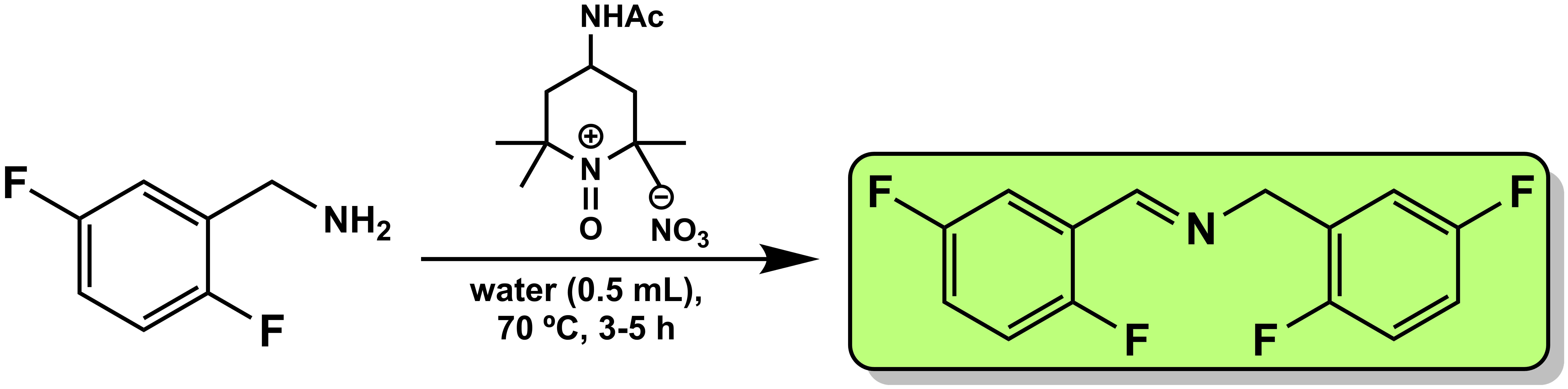
The conversion of 2,5-difluorobenzylamine to N-(2,5-difluorobenzylidene)-1-(2,5-difluorobenzyl)methanimine using an oxoammonium salt bearing the nitrate anion is reported. The reaction is operationally simple, and the product is obtained with good yield.

Graphical Abstract

1. Introduction

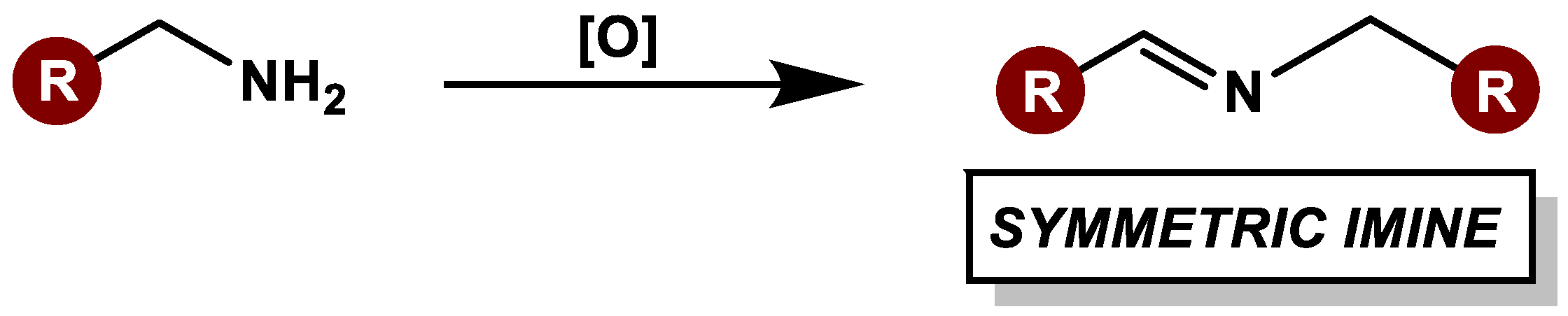
The conversion of amines into imines is an important transformation in the synthetic chemist’s toolkit [1,2]. This is because imine products show biological activity, such as anti-inflammatory, antimalarial, antifungal, antibacterial, and antiviral properties [3]. Additionally, the stability of imines against moisture and elevated temperatures makes them ideal for use as ligands for metal complexes [4]. One route for the preparation of imines from amines is by means of oxidative coupling (Scheme 1). This often involves reagents such as phenyl iodonium acetate or N-tert-phenylsulfinimidoyl chloride [5], or alternatively transition metal catalysts (e.g., Pd, Rh, Fe, Cu, and Au) [6], metal–organic frameworks [7], or hydrosilanes [8]. A drawback to these approaches is that they are often non-specific.
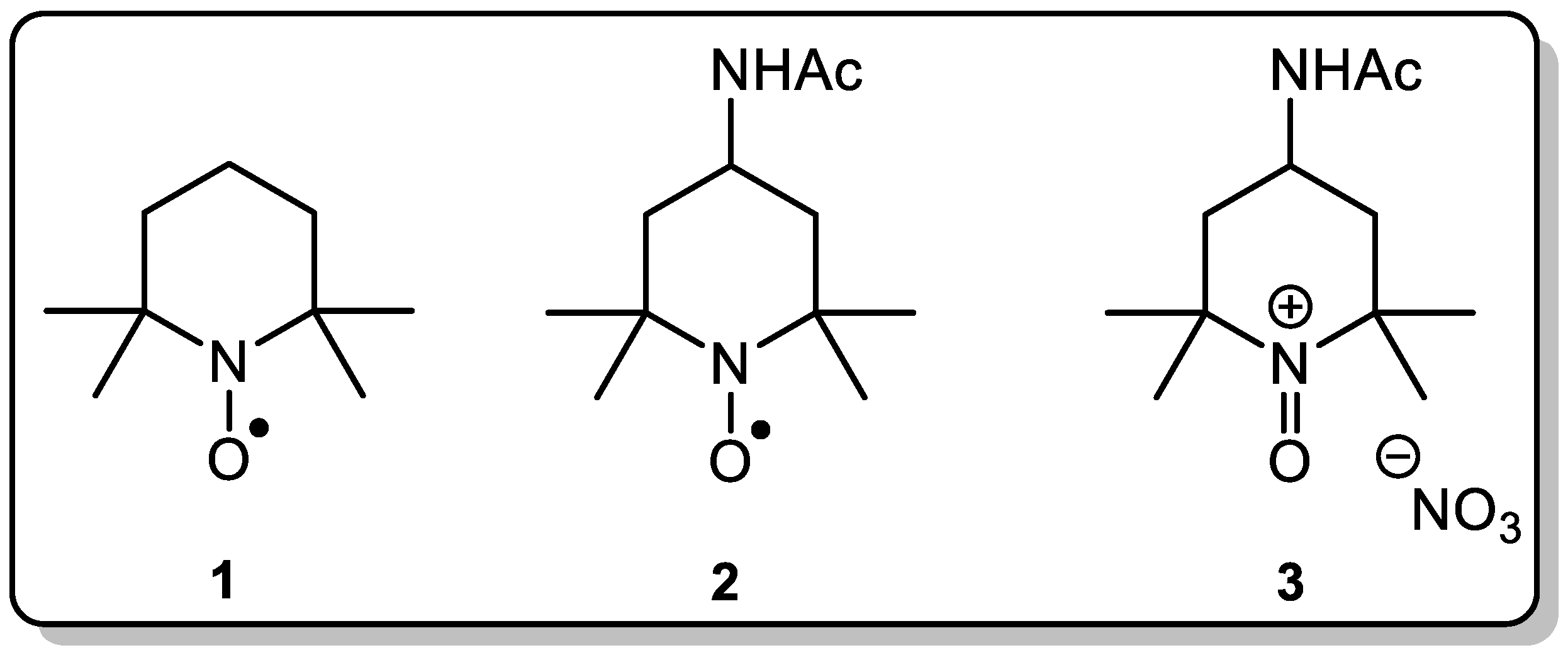
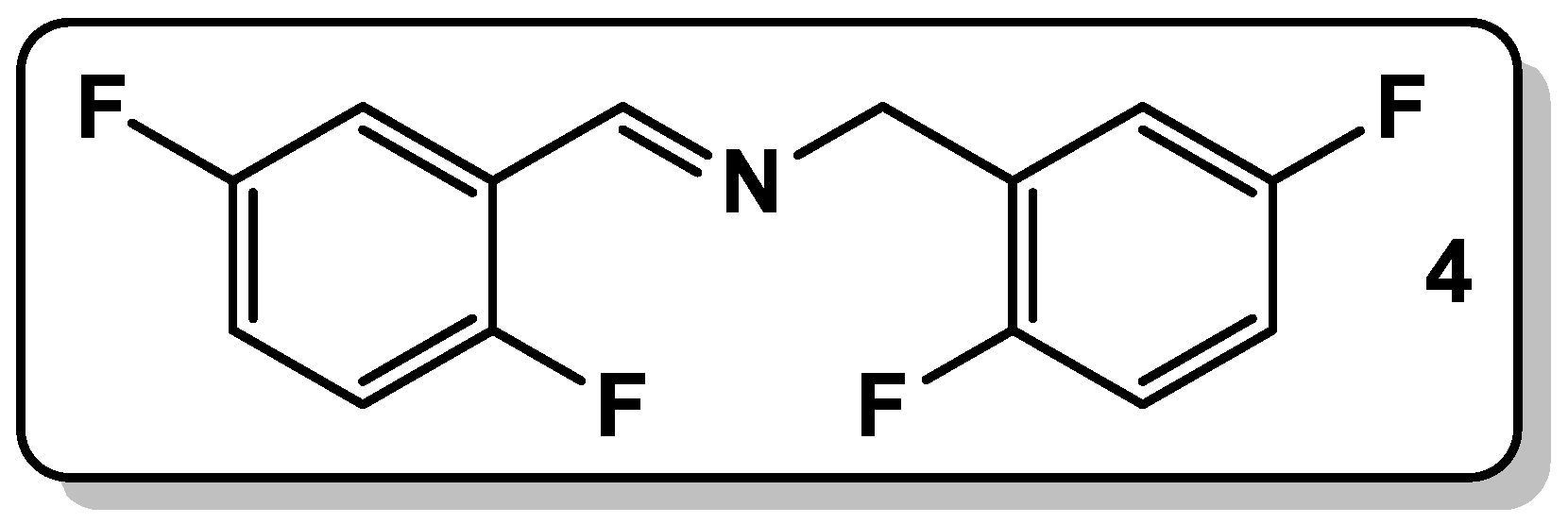
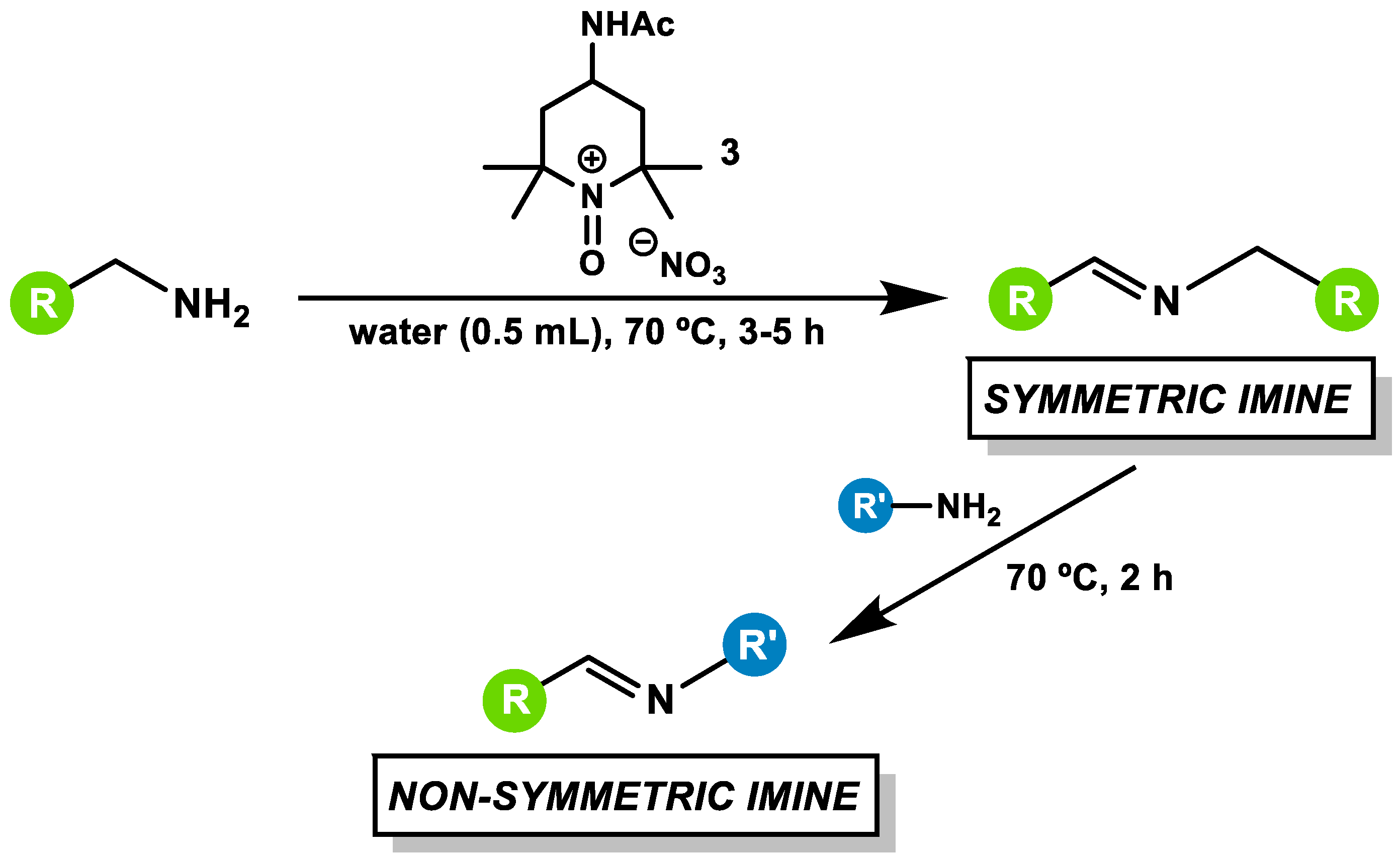
From an oxidation chemistry perspective, interest in TEMPO [(2,2,6,6-Tetramethylpiperidin-1-yl)oxyl], 1, and its derivatives as metal-free alternatives for oxidation has grown rapidly (Figure 1) [9]. These compounds offer a range of advantages over traditional oxidants as they are metal-free and recyclable. In addition, they can be employed under mild reaction conditions. Our group is advancing this field by exploring oxidative functionalization reactions using 4-acetamido TEMPO, 2, and its oxoammonium salt derivatives, in particular those bearing a nitrate counterion, 3 [10,11]. When using 3, due to its unique recycling mechanism, reactions can often be performed using a sub-stoichiometric quantity of the oxidant and in much shorter reaction times than when employing other analogs. We find this to be the case in the oxidative functionalization of amines to symmetric and non-symmetric imines (Scheme 2) [12]. Here we showcase our protocol in the preparation of a novel fluorine-containing imine, 4 (Figure 2).

2. Results and Discussion

To prepare our desired imine, 4, we decided to use microwave heating while operating in a sealed vessel. This offers a convenient alternative to traditional oil-bath heating. Using 1 equiv. of 2,5-difluorobenzylamine 5, 0.7 equiv. of oxoammonium salt 3, and 0.5 mL of water, with heating at 70 °C for 4 h, led to near-quantitative conversion to the desired imine, 4. The product isolation stage was initiated using the procedure that had proven successful for imines we prepared previously. This entailed an aqueous/organic extraction step using hexane as the organic component. However, product recovery was not as high as anticipated. We changed the organic component from pure hexane to a 7:3 mixture of hexane and ethyl acetate. This proved more successful; the product, 4, being isolated resulted in a 71% yield. Thus, our process involved adding a 7:3 hexane/ethyl acetate mix to the reaction vessel and decanting the solution into a separatory funnel. After washing the organics with water and then extracting the aqueous layer with 7:3 hexane/ethyl acetate three times, we combined the organics and washed them twice with deionized water and twice with saturated sodium chloride solution. The organic layer was then dried over sodium sulfate, and the solvent was removed to obtain pure 4. Spectroscopic data for 4 is presented in the Supporting Information.

3. Materials and Methods

3.1. General

All microwave-heating reactions were performed using a CEM Discover SP microwave unit (CEM Corporation, Matthews, NC, USA) in closed-vessel configuration. Temperature was measured by means of an IR temperature sensorlocated below the reaction vessel. 1H-, 13C-, and 19F-NMR spectra were measured at 300 K on a Bruker 400 MHz spectrometer (Bruker, Billerica, MA, USA)). 1H-NMR spectra were referenced to residual CHCl3 (7.26 ppm) in CDCl3. 13C-NMR spectra were referenced to CDCl3 (77.16 ppm), and 19F-NMR spectra were referenced to hexafluorobenzene (−161.64 ppm).

3.2. Chemicals

2,5-Difluorobenzylamine was purchased from Sigma-Aldrich (St. Louis, MO, USA). Hexane and ethyl acetate were obtained from Baker (Radnor, PA, USA). Deuterated chloroform (CDCl3) was purchased from Cambridge Isotope Laboratories (Tewksbury, MA, USA). Oxoammonium salt 3 was prepared using a literature procedure.

3.3. Preparation of N-(2,5-Difluorobenzylidene)-1-(2,5-difluorobenzyl)methanimine

To a 10 mL glass microwave vial with a stir bar, the following were added: 2,5-difluorobenzylamine (5, 1 mmol, 117.14 µL, 1 equiv.), 4-acetamido-2,2,6,6-tetramethyl-oxo-piperidinium nitrate (3, 0.7 mmol, 193 mg, 0.7 equiv.), and deionized water (0.5 mL). The vessel was sealed with a cap and placed into a CEM Discover SP microwave unit. The content of the vessel was heated to 70 °C and held at this temperature for 4 h, with the microwave power automatically fluctuating to hold the reaction mixture at the desired temperature. The reaction mixture was stirred constantly. After the allotted time, the reaction mixture was allowed to cool to below 50 °C before taking the vessel out of the microwave unit. The content of the vial was decanted into a glass separatory funnel, and the vial was rinsed with a 7:3 hexane/ethyl acetate mixture (20 mL). Deionized water (20 mL) was added to the separatory funnel, and the organic layer was washed and separated. The aqueous layer was then washed with three aliquots of 7:3 hexane/ethyl acetate (3 × 20 mL). The combined organics were then placed into a separatory funnel and washed twice with deionized water (100 mL) and then twice with a saturated sodium chloride solution in water (100 mL). The organic layer was dried over sodium sulfate, and the solvent was removed in vacuo at 264 mbar for 10–15 min and at 153 mbar for 10 min, and then air dried with nitrogen gas for 10 min to obtain the product, N-(2,5-difluorobenzylidene)-1-(2,5-difluorobenzyl)methanimine, 4, as a white solid (95 mg, 71% yield). 1H-NMR (400 MHz, CDCl3) δ 8.66 (q, J = 1.8 Hz, 1H), 7.74 (ddd, J = 8.6, 5.5, 3.1 Hz, 1H), 7.16–7.07 (m, 2H), 7.11–6.97 (m, 2H), 7.00–6.88 (m, 1H), 4.84 (d, J = 1.6 Hz, 2H). 13C-NMR (101 MHz, CDCl3) δ 160.05 (dd, J = 7.7, 2.3 Hz), 159.57 (d, J = 2.4 Hz), 157.75–157.52 (m), 157.09 (d, J = 2.2 Hz), 155.47 (dd, J = 4.4, 2.2 Hz), 127.78 (dd, J = 17.5, 7.7 Hz), 124.82 (dd, J = 11.7, 7.7 Hz), 119.27 (dd, J = 24.9, 8.9 Hz), 117.12 (dd, J = 24.1, 8.3 Hz), 116.26 (ddd, J = 24.5, 15.3, 6.6 Hz), 115.07 (dd, J = 24.2, 8.5 Hz), 113.75 (d, J = 3.3 Hz), 113.50 (d, J = 3.3 Hz), 58.64–54.95 (m). 19F-NMR (376 MHz CDCl3): δ −117.93–−118.08 (m), −118.83 (ddt, J = 21.6, 8.2, 4.4 Hz), −124.89 (ddt, J = 18.3, 9.6, 4.8 Hz), −127.44 (ddt, J = 18.3, 9.3, 4.9 Hz). IR (neat, ν/cm−1): 1640 (C = N). HRMS (ESI) m/z calculated for C14H10NF4 [M + H]+ 268.0749, found 268.0763. MP: 43.4–45.2 °C.

4. Conclusions

In summary, we report the preparation of N-(2,5-difluorobenzylidene)-1-(2,5-difluorobenzyl)methanimine (4) by means of an oxidative functionalization reaction using oxoammonium salt 3. The reaction is operationally simple and compares favorably with previous literature examples for the same transformation.

Supplementary Materials

The following supporting information can be downloaded online: Characterization of N-(2,5-difluorobenzylidene)-1-(2,5-difluorobenzyl)methanimine (4); Figure S1: 1H-NMR (400 MHz CDCl3) of N-(2,5-difluorobenzylidene)-1-(2,5 difluorobenzyl)methanimine (4); Figure S2: 13C-NMR (101 MHz CDCl3) of N-(2,5-difluorobenzylidene)-1-(2,5-difluorobenzyl)methanimine (4); Figure S3: 19F-NMR (376 MHz CDCl3) of N-(2,5-difluorobenzylidene)-1-(2,5 difluorobenzyl)methanimine (4); Figure S4: IR spectrum of N-(2,5-difluorobenzylidene)-1-(2,5 difluorobenzyl)methanimine (4); Figure S5: HRMS of N-(2,5-difluorobenzylidene)-1-(2,5 difluorobenzyl)methanimine (4).

Author Contributions

Conceptualization, N.E.L. and M.S.; methodology, T.L.C. and M.S.; data curation, T.L.C. and M.S.; writing—original draft preparation, T.L.C. and N.E.L.; writing—review and editing, T.L.C., M.S. and N.E.L.; supervision, M.S. and N.E.L.; project administration, N.E.L.; funding acquisition, N.E.L. All authors have read and agreed to the published version of the manuscript.

Funding

This research was funded by the University of Connecticut.

Data Availability Statement

The original contributions presented in this study are included in the Supplementary Materials. Further inquiries can be directed to the corresponding author.

Acknowledgments

The University of Connecticut is thanked for financial support.

Conflicts of Interest

The authors declare no conflicts of interest.

References

  1. Purohit, M.; Kalla, S.; Jangir, R. A Comprehensive Review on Cu-Catalysed Aerobic Oxidation of Amines to Imines. ChemistrySelect 2023, 8, e202300386. [Google Scholar] [CrossRef]
  2. Yamamoto, Y.; Kodama, S.; Nomoto, A.; Ogawa, A. Innovative green oxidation of amines to imines under atmospheric oxygen. Org. Biomol. Chem. 2022, 20, 9503–9521. [Google Scholar] [CrossRef] [PubMed]
  3. Mushtaq, I.; Ahmad, M.; Saleem, M.; Ahmed, A. Pharmaceutical significance of Schiff bases: An overview. Future J. Pharm. Sci. 2024, 10, 16. [Google Scholar] [CrossRef]
  4. Boulechfar, C.; Ferkous, H.; Delimi, A.; Djedouani, A.; Kahlouche, A.; Boublia, A.; Darwish, A.S.; Lemaoui, T.; Verma, R.; Benguerba, Y. Schiff bases and their metal Complexes: A review on the history, synthesis, and applications. Inorg. Chem. Commun. 2023, 150, 110451. [Google Scholar] [CrossRef]
  5. Mukaiyama, T.; Kawana, A.; Fukuda, Y.; Matsuo, J. Oxidation of Various Secondary Amines to Imines with N-tert-Butylphenylsulfinimidoyl Chloride. Chem. Lett. 2001, 30, 390–391. [Google Scholar] [CrossRef]
  6. Park, L.H.; Leitao, E.M.; Weber, C.C. Green imine synthesis from amines using transition metal and micellar catalysis. Org. Biomol. Chem. 2024, 22, 202–227. [Google Scholar] [CrossRef] [PubMed]
  7. Wang, D.; Sun, C.; Wang, Y. Photocatalytic Oxidation of Benzylamine by Cadmium-Based MOF Constructed with Flexible Carboxylic Acid. Eur. J. Inorg. Chem. 2024, 27, e202300575. [Google Scholar] [CrossRef]
  8. Gandhamsemy, N.; Jeong, J.; Park, J.; Park, S.; Chang, S. Boron-Catalyzed Silylative Reduction of Nitriles in Accessing Primary Amines and Imines. J. Org. Chem. 2015, 80, 7281–7287. [Google Scholar] [CrossRef] [PubMed]
  9. Bray, J.M.; Stephens, S.M.; Weierbach, S.M.; Vargas, K.; Lambert, K.M. Recent advancements in the use of Bobbitt’s salt and 4-acetamidoTEMPO. Chem. Commun. 2023, 59, 14063–14092. [Google Scholar] [CrossRef] [PubMed]
  10. Miller, S.A.; León Sandoval, A.; Leadbeater, N.E. Oxidation of alcohols using an oxoammonium salt bearing the nitrate anion. Tetrahedron Lett. 2020, 61, 151464. [Google Scholar] [CrossRef]
  11. Sharma, M.; León Sandoval, A.; Leadbeater, N.E. Oxidation of Alcohols to Aldehydes and Ketones Using a Catalytic Pairing of a Nitroxide and Nitric Acid. SynOpen 2023, 7, 718–722. [Google Scholar] [CrossRef]
  12. Sharma, M.; Leadbeater, N.E. Preparation of Symmetric and Nonsymmetric Imines from Primary Benzyl Amines by Means of an Oxidative Functionalization Reaction Using an Oxoammonium Salt Bearing the Nitrate Anion. Synlett 2025, 36, 1231–1236. [Google Scholar] [CrossRef]
Scheme 1. Oxidative functionalization of amines to prepare imines.
Molbank 2026 m2174 sch001
Figure 1. TEMPO, 1; its 4-acetamido analog, 2; and oxoammonium salt 3.
Molbank 2026 m2174 g001
Scheme 2. Preparation of symmetric and nonsymmetric imines using oxoammonium salt 3.
Molbank 2026 m2174 sch002
Figure 2. N-(2,5-Difluorobenzylidene)-1-(2,5-difluorobenzyl)methanimine, 4.
Molbank 2026 m2174 g002
Disclaimer/Publisher’s Note: The statements, opinions and data contained in all publications are solely those of the individual author(s) and contributor(s) and not of MDPI and/or the editor(s). MDPI and/or the editor(s) disclaim responsibility for any injury to people or property resulting from any ideas, methods, instructions or products referred to in the content.