Short Note

(2RS,3aRS,9aRS)-3a-Methyl-2-phenyl-3,3a,9,9a-tetrahydro-1H-benzo[f]indol-4(2H)-one Hydrobromide

by
Denis A. Tiunov
,
Victor A. Tafeenko
and
Alexander V. Kurkin
*
Department of Chemistry, Lomonosov Moscow State University, Moscow 119234, Russia
*
Author to whom correspondence should be addressed.
Molbank 2026, 2026(1), M2130; https://doi.org/10.3390/M2130
Submission received: 24 November 2025 / Revised: 26 January 2026 / Accepted: 29 January 2026 / Published: 2 February 2026
(This article belongs to the Collection Heterocycle Reactions)

Abstract

(2RS,3aRS,9aRS)-3a-methyl-2-phenyl-3,3a,9,9a-tetrahydro-1H-benzo[f]indol-4(2H)-one hydrobromide was first synthesized via a tandem aza-Cope rearrangement and Mannich reaction from (1RS,2SR)-2-amino-1-(prop-1-en-2-yl)-2,3-dihydro-1H-inden-1-ol, which, in turn, was obtained in four steps from commercially available 2,3-dihydro-1H-inden-1-one. The molecular and crystal structure features of the new compounds were characterized using NMR spectroscopy (1H, 13C spectra).

1. Introduction

Development of novel synthetic methodologies for biologically active compounds represents a critical tool for organic chemists. This complex process requires in-depth knowledge of organic chemistry, an understanding of the fundamental principles governing the activity of biologically active compounds, and insight into pharmacokinetics and pharmacodynamics. Recently, the synthesis of saturated heterocyclic compounds has attracted considerable attention, as these structural motifs are frequently encountered in natural products, and methods for their synthesis hold significant interest in constructing new chemical platforms in drug discovery. Pyrrolidine derivatives occupy a prominent position in such investigations, as these compounds exhibit a broad spectrum of biological activities [1,2,3,4,5,6,7]. Various pyrrolidine derivatives demonstrate anticancer [8,9,10,11], antibacterial [12,13,14,15], and antiviral [16,17,18,19,20] activities.

2. Results and Discussion

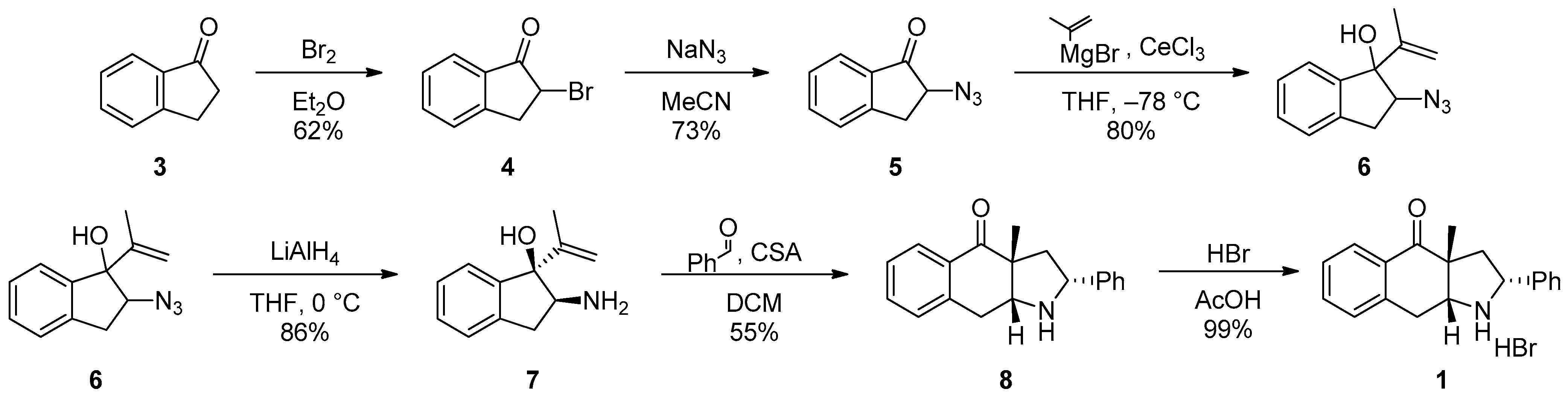
The synthetic sequence for the preparation of compound 1 is presented in Scheme 1. 2,3-dihydro-1H-inden-1-one 3 was transformed to bromoketone 4 by introducing a bromine atom at the α-position to the carbonyl group, followed by nucleophilic substitution with sodium azide. Subsequently, isopropenylmagnesium bromide was added to azidoketone 5. In general, this reaction should yield a mixture of two diastereomeric pairs of enantiomers, since isopropenylmagnesium bromide can approach from either the azide group side or the opposite side. However, the transformation was carried out in the presence of anhydrous cerium chloride, which ensures stereospecific addition of the Grignard reagent. Further reduction in the azide 6 yielded amino alcohol 7, which was subjected to tandem aza-Cope rearrangement and Mannich reaction conditions to afford the tricyclic pyrrolidine 8 (see Supplementary Materials).
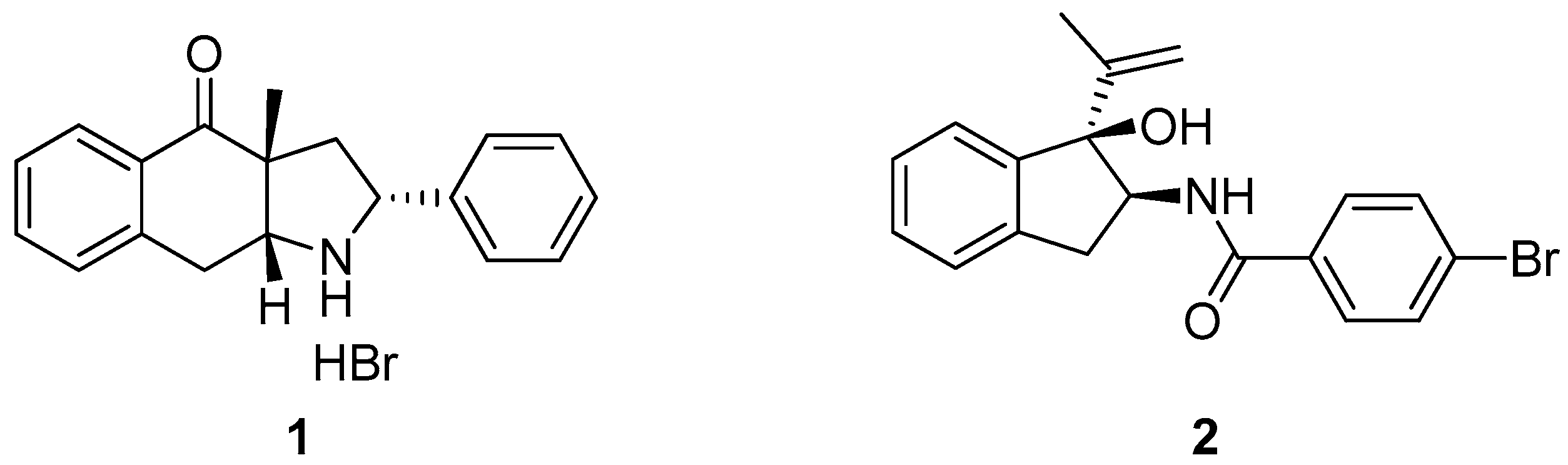
To determine the relative spatial arrangement of substituents in compound 8, 2D NMR spectra were acquired. ROESY spectra showed cross-peaks between the methyl group and the hydrogen atoms at the 2- and 4-positions of the pyrrolidine fragment. Since there are no stereochemical data for the substituents in compound 7, their relative configuration can only be inferred from the known stereochemistry of the substituents in compound 8 and the mechanism of this transformation. To elucidate the structures of compounds 7 and 8 more precisely, it was decided to grow their single crystals. However, both compounds 7 and 8 are oily substances. None of the tested crystallization conditions or various solvent mixtures yielded these compounds in a crystalline form suitable for X-ray diffraction analysis. Therefore, it was decided to modify compounds 7 and 8 (Figure 1). To achieve conditions suitable for growing a single crystal from compound 8, the hydrobromide salt 1 was prepared. To determine the stereochemistry of the substituents in compound 7, an amidation reaction with p-bromobenzoic acid was carried out. Crystals suitable for X-ray diffraction analysis were obtained by recrystallization from a hexane/ethyl acetate mixed solvent solution.

X-Ray Crystallography

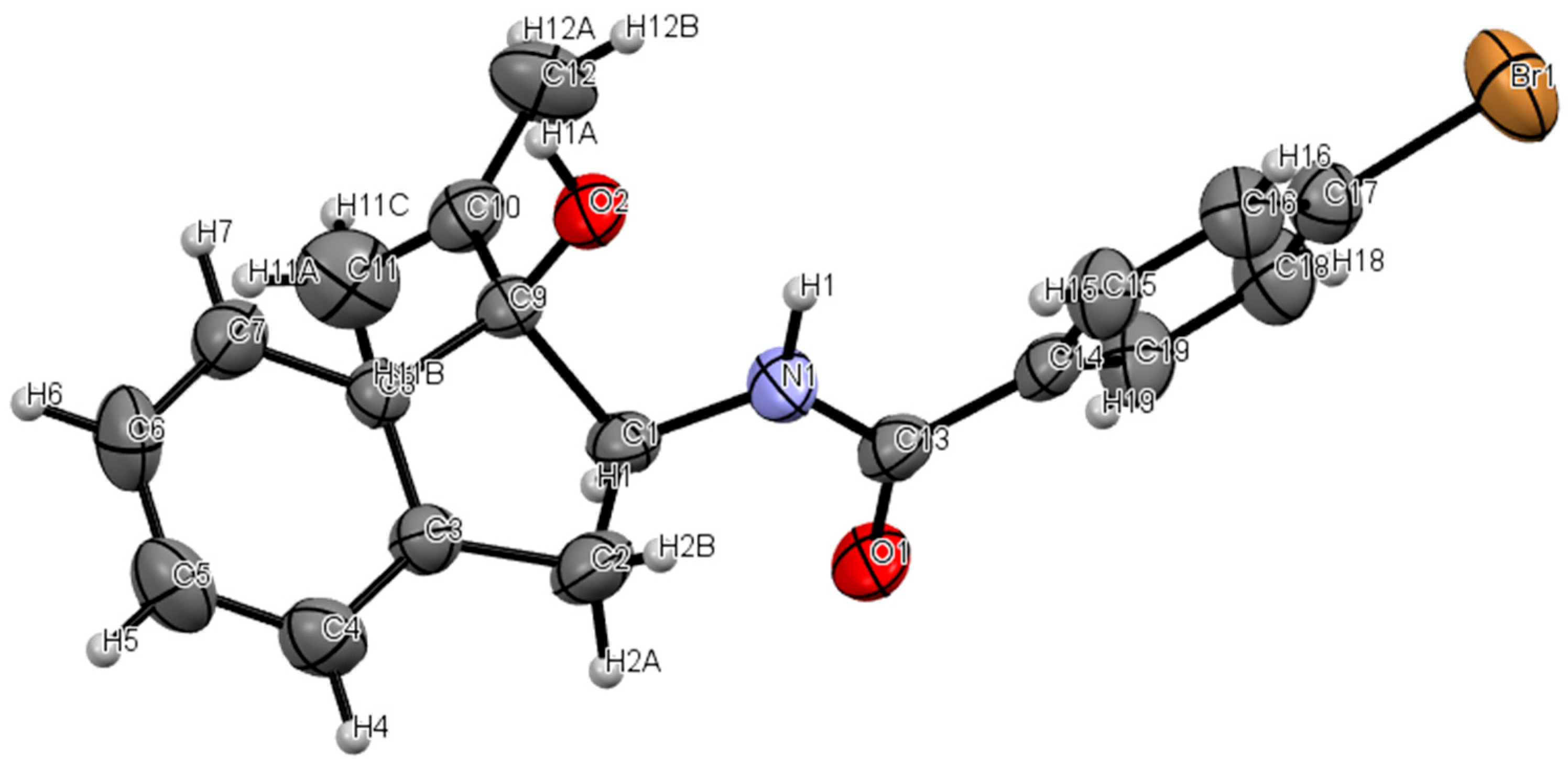
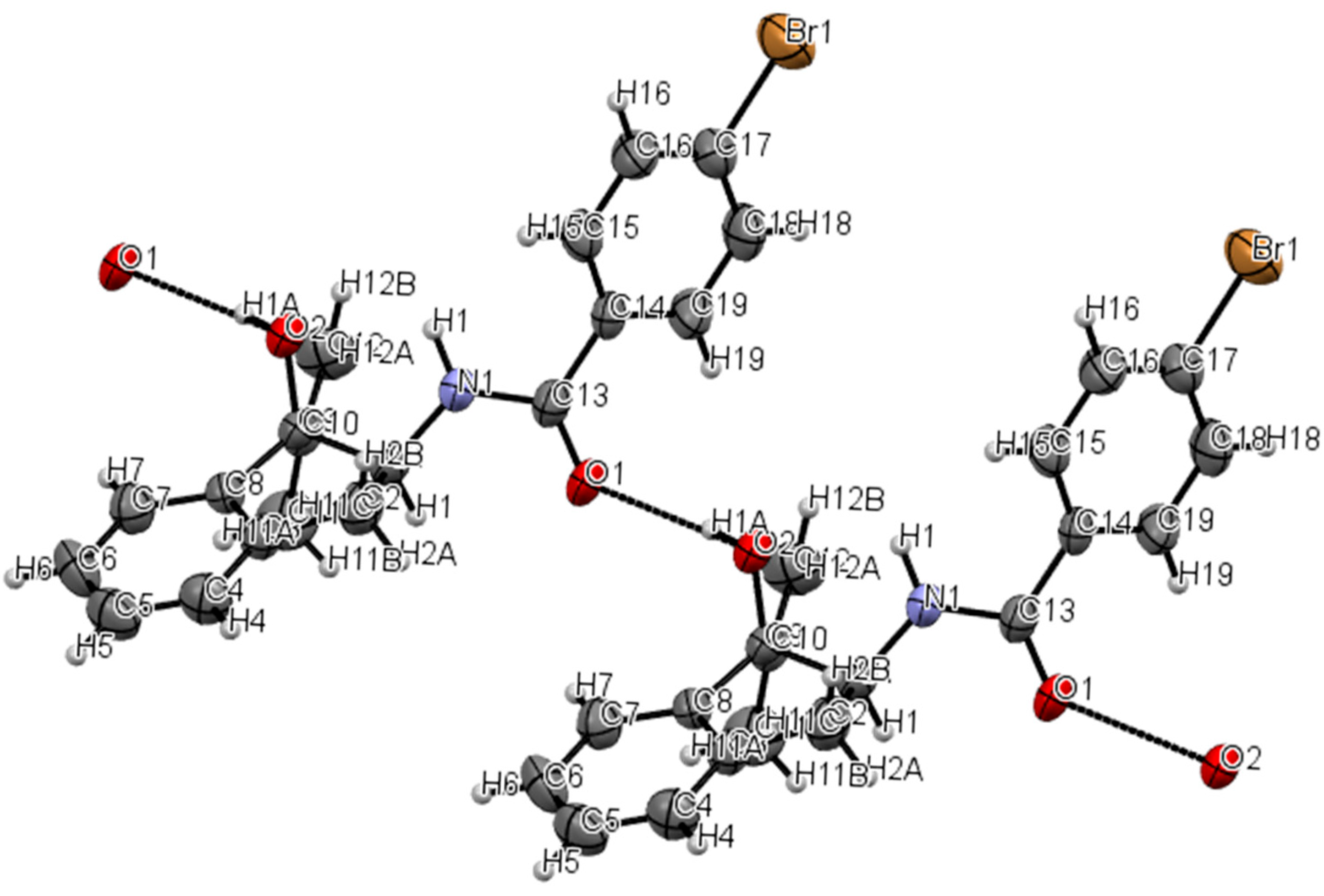
X-ray diffraction analysis showed that amino alcohol 2 (Figure 2) crystallizes in the monoclinic space group P21/n. The crystal structure is further stabilized by intermolecular hydrogen bonds between O(2)-H(1A)···O(1) (1.995 Å) (Figure 3).
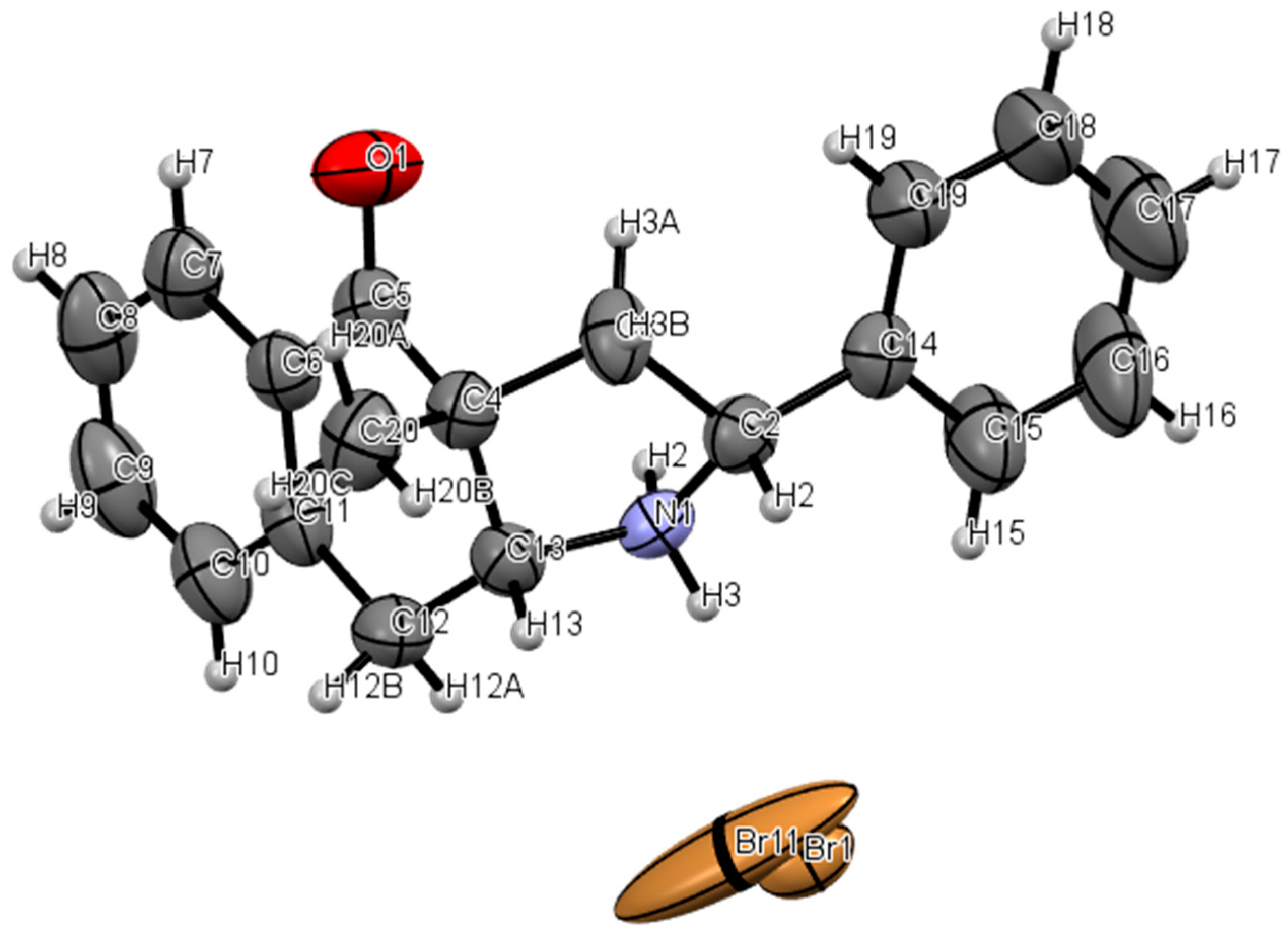
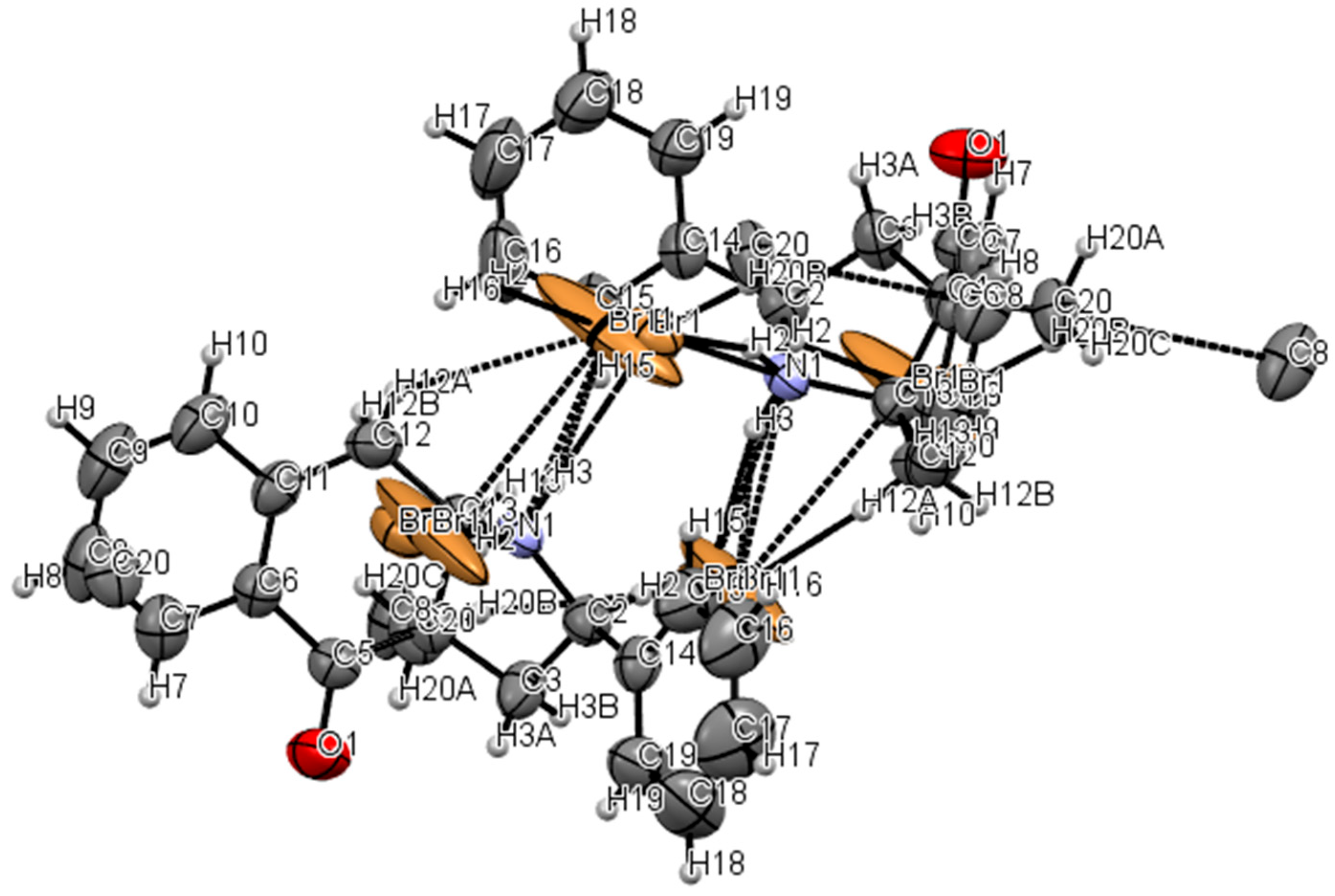
Compound 1 crystallizes in the orthorhombic space group P212121. The cyclohexane fragment adopts a half-chair conformation, while the pyrrolidine ring exhibits an “envelope” conformation. The anion is slightly disordered over two positions with a ratio of 0.96/0.04 (Figure 4). Two hydrogen bonds are observed: an intramolecular C(12)-H(12A)···Br(11) (2.969 Å) and an intermolecular C(2)-H(2)···Br(1)#1 (3.080 Å), C(2)-H(2)···Br(11)#1 (2.820 Å) (Figure 5).
Detailed crystallographic data for the compounds studied are presented in Table 1. Characteristics of main intermolecular and intramolecular hydrogen bonding are presented in Table 2 and Table 3.

3. Materials and Methods

1H and 13C NMR spectra were recorded using a Bruker Avance 400 instrument (Billerica, MA, USA) with operating frequencies of 400 and 100 MHz, respectively, and calibrated using residual undeuterated chloroform (δ1H = 7.27 ppm) and CDCl313C = 77.16 ppm) as internal references. The following abbreviations were used to set multiplicities: s = singlet, d = doublet, t = triplet, q = quartet, m = multiplet, br = broad. The purity of the final compounds was checked through liquid chromatography–mass spectrometry (LCMS) via a Shimadzu LCMS-2010A (Kyoto, Japan) using three types of detection systems: EDAD, ELSD, and UV. We used commercial reagents and solvents without further purification. Reactions were monitored by thin-layer chromatography (TLC) performed on Merck TLC Silica gel plates (60 F254) (Darmstadt, Germany), using UV light for visualization and basic aqueous potassium permanganate or iodine fumes as a developing agent.

3.1. 2-Bromo-2,3-dihydro-1H-inden-1-one

2,3-dihydro-1H-inden-1-one (50 g, 1 eq) was dissolved in Et2O (400 mL), cooled down to 0 °C, and Br2 (19.38 mL, 1 eq) was added dropwise. The reaction mixture was stirred overnight. The reaction mixture was then washed with a saturated solution of Na2SO3, a saturated solution of NaHCO3, and brine. The organic phase was separated, dried over anhydrous Na2SO4, and the solvent was distilled under reduced pressure. The residue was purified by column chromatography. Yield: 66.33 g (83%). Rf = 0.7 in hexane/EtOAc (3:1). 1H NMR (400 MHz, CDCl3) δ: 3.44 (dd, 1 H), 3.85 (dd, J = 18.1, 7.5 Hz, 1 H), 4.67 (dd, J = 7.5, 3.2 Hz, 1 H), 7.40–7.50 (m, 2 H), 7.64–7.71 (m, 1 H), and 7.86 (d, J = 7.6 Hz, 1 H).

3.2. 2-Azido-2,3-dihydro-1H-inden-1-one

2-bromo-2,3-dihydro-1H-inden-1-one (60 g, 1 eq) was dissolved in MeCN (285 mL), and NaN3 (36.96 g, 2 eq) was added and stirred overnight. The solvent was distilled under reduced pressure. The residue was diluted with water, extracted with EtOAc, and washed with brine. The organic phase was separated, dried over anhydrous Na2SO4, and the solvent was distilled under reduced pressure. The residue was purified by column chromatography. Yield: 36.31 g (74%). Rf = 0.7 in hexane/EtOAc (3:1). 1H NMR (400 MHz, CDCl3) δ: 2.94 (dd, 1 H), 3.51 (dd, J = 17.1, 8.2 Hz, 1 H), 4.33 (dd, J = 8.1, 4.6 Hz, 1 H), 7.40–7.48 (m, 2 H), 7.66 (td, J = 7.5, 1.2 Hz, 1 H), and 7.80 (d, J = 7.4 Hz, 1 H).

3.3. 2-Azido-1-(prop-1-en-2-yl)-2,3-dihydro-1H-inden-1-ol

3.3.1. Anhydrous CeCl3

CeCl3*7H2O (105.92 g, 1 eq) and a magnetic stirrer were placed in a 3-neck round-bottom flask equipped with two glass stoppers and a glass stopcock. The flask was heated in an oil bath without stirring (90 < T < 100 °C. The oil level should be as high as possible, and the parts of the flask that are not covered with oil should be heated with a heat gun periodically under high vacuum (<1 Torr) for 1 h. Then the flask was heated under the same conditions but with slow stirring for one more hour. The white powder formed was CeCl3*H2O. Then the temperature was raised to 140–150 °C and maintained for 6–8 h. The flask was cooled to r.t. under high vacuum and filled with nitrogen.

3.3.2. Grignard Addition

Freshly distilled THF (583 mL) was added rapidly to the cooled anhydrous CeCl3 prepared from CeCl3*7H2O, and the resulting slurry was stirred under the nitrogen atmosphere at r.t. for 24 h. The CeCl3 slurry in THF was cooled to −78 °C, and prop-1-en-2-ylmagnesium bromide (1M in THF, 426 mL, 1.5 eq) was added dropwise at this temperature. The resulting mixture was stirred for 1 h at −78 °C before a solution of 2-azido-2,3-dihydro-1H-inden-1-one (36.31 g, 1 eq) in THF (285 mL) was added dropwise at −78 °C. The mixture was stirred for 2 h at this temperature and then poured into a saturated NH4Cl solution (1 L) containing acetic acid (24.37 mL, 1.5 eq). The organic layer was separated, and the water layer was extracted with Et2O. The combined organic phases were dried over Na2SO4, evaporated, and purified by column chromatography. Yield: 29.68 g (66%). Rf = 0.7 in hexane/EtOAc (3:1). 1H NMR (400 MHz, CDCl3) δ: 1.81 (d, J = 0.6 Hz, 3 H), 2.53 (s, 1 H), 3.06–3.29 (m, 2 H), 4.26 (t, J = 6.5 Hz, 1 H), 5.09 (d, J = 0.7 Hz, 1 H), 5.14 (t, J = 1.4 Hz, 1 H), 7.20–7.36 (m, 4 H). 13C NMR (100 MHz, CDCl3) δ: 19.3, 34.7, 67.1, 85.6, 114.3, 124.1, 124.8, 127.4, 129.0, 139.8, 143.2, and 144.6.

3.4. (1RS,2SR)-2-Amino-1-(prop-1-en-2-yl)-2,3-dihydro-1H-inden-1-ol

LiAlH4 (7.85 g, 1.5 eq) was suspended in THF (275 mL), cooled down to 0 °C, and a solution of 2-azido-1-(prop-1-en-2-yl)-2,3-dihydro-1H-inden-1-ol (29.68 g, 1 eq) in THF (275 mL) was added dropwise; then the reaction mixture was stirred at 0 °C overnight. Following this, 7.85 mL of water, 7.85 mL of 15% NaOH solution, and 23.55 mL of water were added, and the resulting mixture was stirred for 30 min. The formed precipitate was filtered off, and the filtrate was evaporated and purified by column chromatography. Yield: 16.46 g (63%). Rf = 0.4 in DCM/MeOH (NH3) (20:1). 1H NMR (400 MHz, CDCl3) δ: 1.70 (d, 3 H), 2.73 (dd, J = 15.3, 7.7 Hz, 1 H), 3.18 (dd, J = 15.4, 7.2 Hz, 1 H), 3.68 (t, J = 7.5 Hz, 1 H), 5.09 (dd, J = 2.0, 1.5 Hz, 1 H), 5.23 (dd, J = 1.4, 0.7 Hz, 1 H), and 7.20–7.27 (m, 4 H). 13C NMR (100 MHz, CDCl3) δ: 19.4, 38.1, 57.2, 83.2, 112.6, 124.3, 124.5, 126.6, 128.0, 141.2, 144.6, and 145.8.

3.5. (2RS,3aRS,9aRS)-3a-Methyl-2-phenyl-3,3a,9,9a-tetrahydro-1H-benzo[f]indol-4(2H)-one

2-amino-1-(prop-1-en-2-yl)-2,3-dihydro-1H-inden-1-ol (2 g, 1 eq) was dissolved in toluene (100 mL), and benzaldehyde (2.15 mL, 2 eq), Na2SO4 (10.51 g, 7 eq), CSA (2.21 g, 0.9 eq) were added; the resulting mixture was refluxed overnight. The reaction mixture was poured into a saturated solution of NaHCO3 and extracted with EtOAc. The organic phase was separated and washed with water and brine. The organic phase was then dried over anhydrous Na2SO4, and the solvent was distilled under reduced pressure. Residue was purified by column chromatography. Yield: 1.18 g (40%). Rf = 0.5 in hexane/EtOAc (3:1). 1H NMR (400 MHz, CDCl3) δ: 1.35 (s, 3 H), 2.24 (dd, J = 13.5, 9.3 Hz, 1 H), 2.62 (dd, J = 13.4, 6.5 Hz, 1 H), 3.11 (dd, J = 17.4, 2.8 Hz, 1 H), 3.35 (dd, J = 17.4, 4.5 Hz, 1 H), 3.59 (dd, J = 4.4, 2.9 Hz, 1 H), 4.31 (dd, J = 9.3, 6.6 Hz, 1 H), 7.13–7.27 (m, 6 H), 7.35 (t, J = 7.6 Hz, 1 H), 7.52 (td, J = 7.5, 1.4 Hz, 1 H), 8.05 (dd, J = 7.8, 1.0 Hz, 1 H). 13C NMR (100 MHz, CDCl3) δ: 20.9, 29.7, 45.4, 51.8, 59.2, 63.4, 126.6 (s, 3 C), 126.7, 127.5, 128.1 (s, 2 C), 129.0, 130.7, 133.4, 139.6, 144.0, and 202.2.

4. Conclusions

As a result of this study, the target pyrrolidine derivative was obtained, its synthesis was confirmed, and the compounds were characterized by spectral analysis methods. Compounds 1 and 2 were studied by X-ray structural analysis, which allowed the determination of the relative stereochemistry of the substituents.

Supplementary Materials

The following data are available online. 1H-NMR, 13C-NMR of 4, 5, 6, 7, 8, and 1.

Author Contributions

Conceptualization, A.V.K.; methodology, A.V.K.; performance of chemical synthesis, D.A.T.; registration and interpretation of NMR data and structural characterization of compounds, D.A.T. and A.V.K.; X-ray crystallography study of the crystals, V.A.T. The manuscript was written by D.A.T. and A.V.K. All authors have read and agreed to the published version of the manuscript.

Funding

This research was supported by the Russian Science Foundation (RSF) (project No. 25-13-00131).

Data Availability Statement

The raw data supporting the conclusions of this article will be made available by the authors on request.

Conflicts of Interest

The authors declare no conflicts of interest.

References

  1. Chen, Y.C.; Hartley, R.M.; Anastasio, N.C.; Cunningham, K.A.; Gilbertson, S.R. Synthesis and Structure-Activity Relationships of Tool Compounds Based on WAY163909, a 5-HT2C Receptor Agonist. ACS Chem. Neurosci. 2017, 8, 1004–1010. [Google Scholar] [CrossRef] [PubMed]
  2. Desai, M.C.; Lefkowitz, S.L.; Bryce, D.K.; McLean, S. Articulating a Pharmacophore Driven Synthetic Strategy: Discovery of a Potent Substance P Antagonist. Bioorganic Med. Chem. Lett. 1994, 4, 1865–1868. [Google Scholar] [CrossRef]
  3. Lin, C.H.; Haadsma-Svensson, S.R.; Phillips, G.; Lahti, R.A.; McCall, R.B.; Piercey, M.F.; Schreur, P.J.K.D.; Von Voigtlander, P.F.; Smith, M.W.; Chidester, C.G. Centrally Acting Serotonergic and Dopaminergic Agents. 2. Synthesis and Structure-Activity Relationships of 2,3,3a,4,9,9a-Hexahydro-1H-Benz[f]Indole Derivatives. J. Med. Chem. 1993, 36, 1069–1083. [Google Scholar] [CrossRef] [PubMed]
  4. Mantegani, S.; Baumer, L.; Brambilla, E.; Caccia, C.; Fornaretto, M.G.; McArthur, R.A.; Varasi, M. 5(10→9)Abeo-Ergoline Derivatives: Synthesis, 5-HT(1A)-Receptor Affinity and Selectivity. Eur. J. Med. Chem. 1998, 33, 279–292. [Google Scholar] [CrossRef]
  5. Petersen, I.N.; Crestey, F.; Jensen, A.A.; Indurthi, D.C.; Pedersen, H.; Andreasen, J.T.; Balle, T.; Kristensen, J.L. Tying up Nicotine: New Selective Competitive Antagonist of the Neuronal Nicotinic Acetylcholine Receptors. ACS Med. Chem. Lett. 2015, 6, 472–475. [Google Scholar] [CrossRef] [PubMed]
  6. Shishido, Y.; Ito, F.; Morita, H.; Ikunaka, M. Stereoselective Synthesis of a Novel 2-Aza-7-Oxabicyclo [3.3.0]Octane as Neurokinin-1 Receptor Antagonist. Bioorganic Med. Chem. Lett. 2007, 17, 6887–6890. [Google Scholar] [CrossRef] [PubMed]
  7. Tamiz, A.P.; Smith, M.P.; Kozikowski, A.P. Design, Synthesis and Biological Evaluation of 7-Azatricyclodecanes: Analogues of Cocaine. Bioorganic Med. Chem. Lett. 2000, 10, 297–300. [Google Scholar] [CrossRef] [PubMed]
  8. Gonda, J.; Široký, M.; Martinková, M.; Homolya, S.; Vilková, M.; Pilátová, M.B.; Šesták, S. Synthesis and Biological Activity of Diastereoisomeric Octahydro-1H-Indole-5,6,7-Triols, Analogues of Castanospermine. Tetrahedron 2019, 75, 398–408. [Google Scholar] [CrossRef]
  9. Li, J.; Ji, X.; Xia, C.; Wang, J.; Su, M.; Zhang, L.; Dong, T.; Li, Z.; Wan, X.; Li, J.; et al. Design, Synthesis and Biological Evaluation of 4-Fluoropyrrolidine-2-Carbonitrile and Octahydrocyclopenta[b]Pyrrole-2-Carbonitrile Derivatives as Dipeptidyl Peptidase IV Inhibitors. Eur. J. Med. Chem. 2014, 86, 242–256. [Google Scholar] [CrossRef]
  10. Marivet, M.C.; Bourguignon, J.J.; Lugnier, C.; Mann, A.; Stoclet, J.C.; Wermuth, C.G. Inhibition of Cyclic Adenosine-3′,5′-Monophosphate Phosphodiesterase from Vascular Smooth Muscle by Rolipram Analogs. J. Med. Chem. 1989, 32, 1450–1457. [Google Scholar] [CrossRef] [PubMed]
  11. Suh, M.E.; Park, S.Y.; Lee, C.O. Synthesis of Pyridino [2,3-f]Indole-4,9-Dione 6,7-Disubstituted Quinoline-5,8-Dione Derivatives and Evaluation on Their Cytotoxic Activity. Bioorganic Med. Chem. 2001, 9, 2979–2986. [Google Scholar] [CrossRef] [PubMed]
  12. Döndaş, H.A.; Nural, Y.; Duran, N.; Kilner, C. Synthesis, Crystal Structure and Antifungal/Antibacterial Activity of Some Novel Highly Functionalized Benzoylaminocarbothioyl Pyrrolidines. Turk. J. Chem. 2006, 30, 573–583. [Google Scholar]
  13. Hensler, M.E.; Bernstein, G.; Nizet, V.; Nefzi, A. Pyrrolidine Bis-Cyclic Guanidines with Antimicrobial Activity against Drug-Resistant Gram-Positive Pathogens Identified from a Mixture-Based Combinatorial Library. Bioorganic Med. Chem. Lett. 2006, 16, 5073–5079. [Google Scholar] [CrossRef] [PubMed]
  14. Narayana Babu, M.; Sharma, L.; Madhavan, V. Synthesis and Antimicrobial Activity of Some Novel Pyrrolidine Derivatives. Int. J. ChemTech Res. 2012, 4, 903–909. [Google Scholar]
  15. Yanni, A.S. Synthesis of Some New Bisindole Derivatives and Their Biological Activity. Int. J. Org. Chem. 2016, 06, 187–191. [Google Scholar] [CrossRef]
  16. Borthwick, A.D.; Angier, S.J.; Crame, A.J.; Exall, A.M.; Haley, T.M.; Hart, G.J.; Mason, A.M.; Pennell, A.M.K.; Weingarten, G.G. Design and Synthesis of Pyrrolidine-5,5-Trans-Lactams (5-Oxo-Hexahydro-Pyrrolo [3,2-b]Pyrroles) as Novel Mechanism-Based Inhibitors of Human Cytomegalovirus Protease. 1. The α-Methyl-Trans-Lactam Template. J. Med. Chem. 2000, 43, 4452–4464. [Google Scholar] [CrossRef] [PubMed]
  17. Danilova, O.; Li, B.; Szardenings, A.K.; Huber, B.T.; Rosenblum, J.S. Synthesis and Activity of a Potent, Specific Azabicyclo [3.3.0]-Octane-Based DPP II Inhibitor. Bioorganic Med. Chem. Lett. 2007, 17, 507–510. [Google Scholar] [CrossRef] [PubMed]
  18. Kaushik-Basu, N.; Ratmanova, N.K.; Manvar, D.; Belov, D.S.; Cevik, O.; Basu, A.; Yerukhimovich, M.M.; Lukyanenko, E.R.; Andreev, I.A.; Belov, G.M.; et al. Bicyclic Octahydrocyclohepta[b]Pyrrol-4(1H)One Derivatives as Novel Selective Anti-Hepatitis C Virus Agents. Eur. J. Med. Chem. 2016, 122, 319–325. [Google Scholar] [CrossRef] [PubMed]
  19. Łysek, R.; Vogel, P. Synthesis of N-Substituted (3S,4S)- and (3R,4R)-Pyrrolidine-3,4-Diols: Search for New Glycosidase Inhibitors. Helv. Chim. Acta 2004, 87, 3167–3181. [Google Scholar] [CrossRef]
  20. Zhu, Y.; Cleaver, L.; Wang, W.; Podoll, J.D.; Walls, S.; Jolly, A.; Wang, X. Tetracyclic Indolines as a Novel Class of β-Lactam-Selective Resistance-Modifying Agent for MRSA. Eur. J. Med. Chem. 2017, 125, 130–142. [Google Scholar] [CrossRef] [PubMed]
Scheme 1. Synthesis scheme for compound 1.
Molbank 2026 m2130 sch001
Figure 1. Structures of (2RS,3aRS,9aRS)-3a-methyl-2-phenyl-3,3a,9,9a-tetrahydro-1H-benzo[f]indol-4(2H)-one hydrobromide 1 and 4-bromo-N-((1RS,2SR)-1-hydroxy-1-(prop-1-en-2-yl)-2,3-dihydro-1H-inden-2-yl)benzamide 2.
Molbank 2026 m2130 g001
Figure 2. Molecular structure of amino alcohol 2.
Molbank 2026 m2130 g002
Figure 3. Crystal packing view of amino alcohol 2, showing intermolecular interactions.
Molbank 2026 m2130 g003
Figure 4. Molecular structure of compound 1.
Molbank 2026 m2130 g004
Figure 5. Crystal packing view of compound 1, showing intermolecular interactions.
Molbank 2026 m2130 g005
Table 1. Crystallographic data for compounds 1 and 2.
12
FormulaC19H20BrNOC19H18BrNO2
Molecular weight358.27372.26
Crystal systemOrthorhombicMonoclinic
Space groupP212121P21/n
a, Å7.8766 (3)8.9569 (4)
b, Å11.1570 (4)7.3922 (2)
c, Å19.1408 (8)26.4840 (10)
α, °9090
β, °9099.513 (3)
γ, °9090
Volume, Å31682.081729.42
Z44
ρcacl, g/cm31.4151.430
μ/mm−13.3293.308
F(000)736760
2Θ range/°4.620 to 66.9615.013 to 66.918°
Index ranges−9 ≤ h ≤ 7, −13 ≤ k ≤ 10, −22 ≤ l ≤ 18−10 ≤ h ≤ 10, −5 ≤ k ≤ 8, −31 ≤ l ≤ 25
Reflections collected1154011324
Independent reflections2748 [R(int) = 0.0489]3038 [R(int) = 0.1093]
Data/restraints/parameters2748/0/2183038/0/226
Goodness of fit on F21.0320.610
Final R indexes [I ≥ 2σ (I)]R1 = 0.0381, wR2 = 0.0957R1 = 0.0345, wR2 = 0.0521
Final R indexes [all data]R1 = 0.0493, wR2 = 0.1029R1 = 0.1322, wR2 = 0.0687
Largest diff. peak/hole/e Å−30.221/−0.4880.262/−0.251
Table 2. Hydrogen bond geometry for amino alcohol 2, Å, and °.
D-H...AA d(D-H)d(H...A)d(D...A)<(DHA)
O(2)-H(1A)...O(1)#10.75 (4)1.99 (4)2.731 (4)170 (5)
Table 3. Hydrogen bond geometry for compound 1, Å, and °.
D-H...Ad(D-H)d(H...A)d(D...A)<(DHA)
C(2)-H(2)...Br(1)#10.983.083.892 (5)141.0
C(2)-H(2)...Br(11)#10.982.823.70 (3)149.8
C(12)-H(12A)...Br(11)0.972.973.58 (5)122.2
N(1)-H(2)...Br(1)#21.04 (6)2.26 (7)3.274 (4)163 (5)
N(1)-H(2)...Br(11)#21.04 (6)2.53 (8)3.51 (4)155 (5)
N(1)-H(3)...Br(1)0.83 (5)2.41 (5)3.212 (5)164 (4)
N(1)-H(3)...Br(11)0.83 (5)2.20 (5)2.97 (2)155 (4)
Disclaimer/Publisher’s Note: The statements, opinions and data contained in all publications are solely those of the individual author(s) and contributor(s) and not of MDPI and/or the editor(s). MDPI and/or the editor(s) disclaim responsibility for any injury to people or property resulting from any ideas, methods, instructions or products referred to in the content.