Communication

Synthesis of 1-(Naphthalen-2-yl)-3-(3-(triethoxysilyl)propyl)urea and Determination of Its Crystal Structure


1
Université Marie et Louis Pasteur, Institut UTINAM (CNRS UMR 6213), F-25000 Besançon, France
2
Technische Universität Dortmund, Anorganische Chemie, Otto-Hahn Straße 6, 44227 Dortmund, Germany
*
Authors to whom correspondence should be addressed.
Molbank 2026, 2026(1), M2129; https://doi.org/10.3390/M2129
Submission received: 26 November 2025 / Revised: 20 January 2026 / Accepted: 23 January 2026 / Published: 28 January 2026

Abstract

The addition of 3-isocyanatopropyltriethoxysilane and 2-aminonaphthalene in THF affords the title compound 1-(naphthalen-2-yl)-3-(3-(triethoxysilyl)propyl)urea 1. A determination of the crystal structure of this naphthyl urea reveals the occurrence of strong intermolecular N-H···O hydrogen bonds, giving rise to a 1D supramolecular ribbon, whose interactions have also been assessed by a Hirshfeld surface analysis. The propensity of 1 to sense halide ions by intramolecular trapping through N-H···Hal bonding was also investigated by UV-vis spectroscopy and fluorescence measurements.

1. Introduction

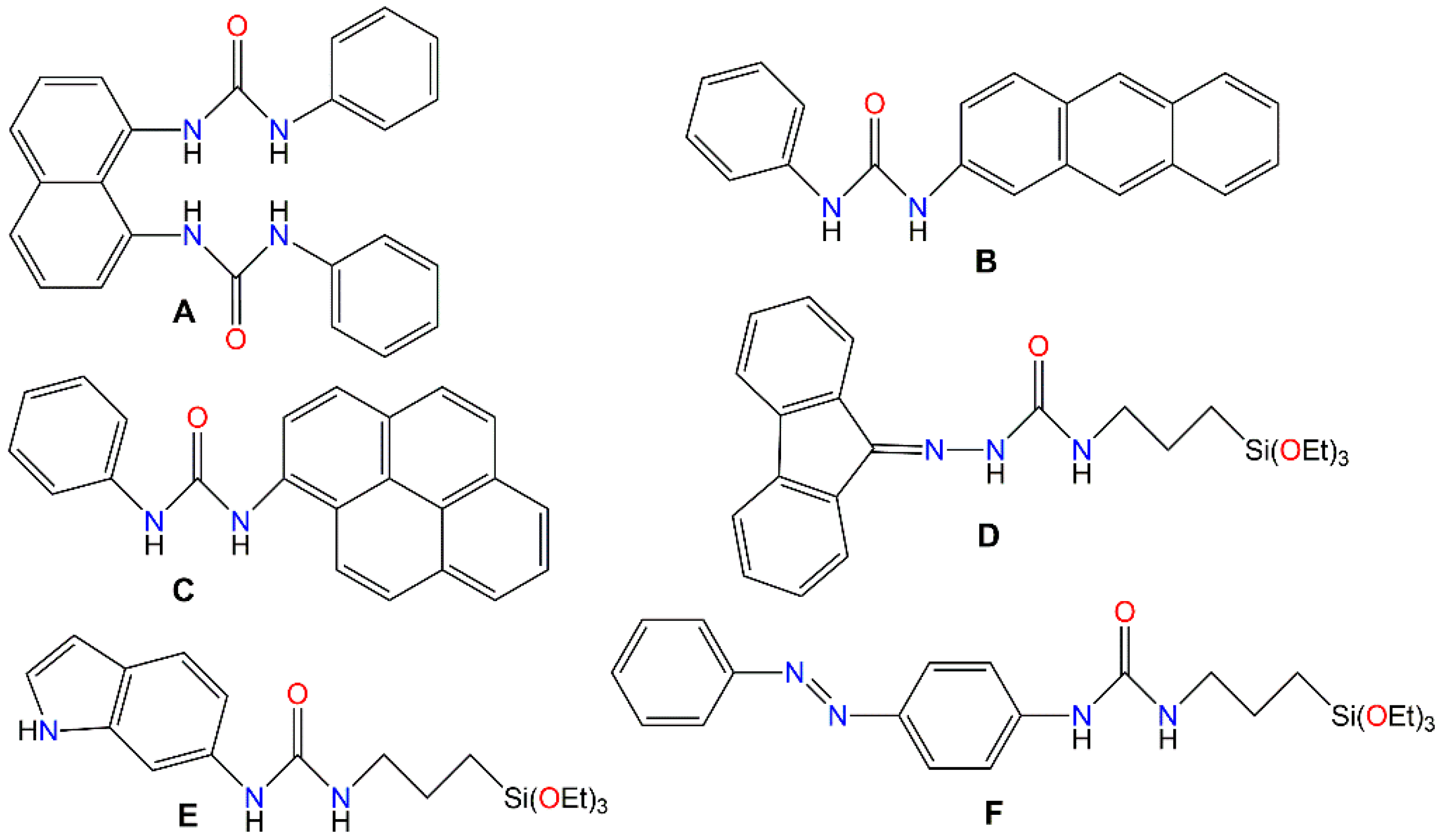
The synthesis of selective and/or sensitive chemosensors for anions has continued to attract considerable interest due to its potential role for a wide range of chemical and biological processes [1,2,3,4,5,6]. One of the functions most often used for this purpose is the urea motif because it can readily form hydrogen bonds with anions. Since the first publication of Wilcox [7] concerning the use of urea derivatives as a receptor, a huge number of articles has been published in the literature [8,9,10,11,12,13,14,15]. Selected examples of aryl urea motifs substituted by chromophores such as naphthalene (A) [16], anthracene (B), pyrene (C) [17], or 9-N-fluorenimine rings (D) [18] are shown in Figure 1. Another possibility to further functionalize the aryl urea scaffold is the attachment of alkoxysilane (-Si(OR)3) groups allowing additional applications. For example, the alkoxysilane-urea (E) bearing an indole ring has been prepared to design hybrid membranes for ionic conduction [19]; or compound (F) bearing an azobenzene group has been used as a precursor to develop photosensitive mesoporous materials whose properties can be controlled by photoirradiation [20].
We previously synthesized the 9-N-fluorenimine urea (D) and electrodeposited this alkoxysilyl-functionalized urea as a monolayer on an electrode surface for the detection of halide ions [18]. In continuation of this work, we focused on developing other molecules containing a chromophore, a urea function, and a trialkoxysilane group for anchoring on a SiO2 surface. Therefore, we describe, in this paper, the synthesis and spectroscopic and crystallographic characterization of N-(2-naphthyl)-N′-(triethoxysilanepropyl) urea (1). The preparation of this title compound 1 and its use as a stationary phase for the separation of cyclodextrins has been mentioned in a patent, but no characterization data were provided [21]. The objectives for investigating this chromophoric molecule are threefold: (i) to fully characterize this molecule in solution by several spectroscopic techniques such as NMR, IR, and UV-vis; (ii) to synthesize an organically modified silicate film (ORMOSIL) and exploit the presence of the triethoxysilane group to prepare a polymeric material by the sol–gel process; and (iii) to study its anion sensing properties. The study of the absorption and fluorescence properties of these molecules in the presence of halide anions has revealed selective optical properties, allowing the detection of chloride and fluoride anions due to their interaction through hydrogen bonding with the urea function.

2. Results and Discussion

2.1. Synthesis and Characterization of N-(2-Naphthyl)-N′-(triethoxysilanepropyl) Urea

N-(2-naphthyl)-N′-(triethoxysilanepropyl) urea (1) was prepared by the nucleophilic addition of 2-aminonaphthalene to commercial 3-isocyanatopropyltriethoxysilane in THF under a nitrogen atmosphere (Scheme 1). After 2 h of stirring at room temperature, the pure product is obtained by recrystallization from dichloromethane/hexane with a yield of 91%.
The structure of compound 1 was confirmed by IR and NMR spectroscopy. In the IR spectrum of 1 (Figure S1 of the Supplementary Materials), two bands at 3325 and 3277 cm−1 were assigned to N-H stretching. The N-H bending is observed at 1563 cm−1. The carbonyl C=O stretching band appears at 1640 cm−1. The intense band at 1073 cm−1 corresponds to the Si-O stretching. These attributions agree with those reported in the literature [22,23].
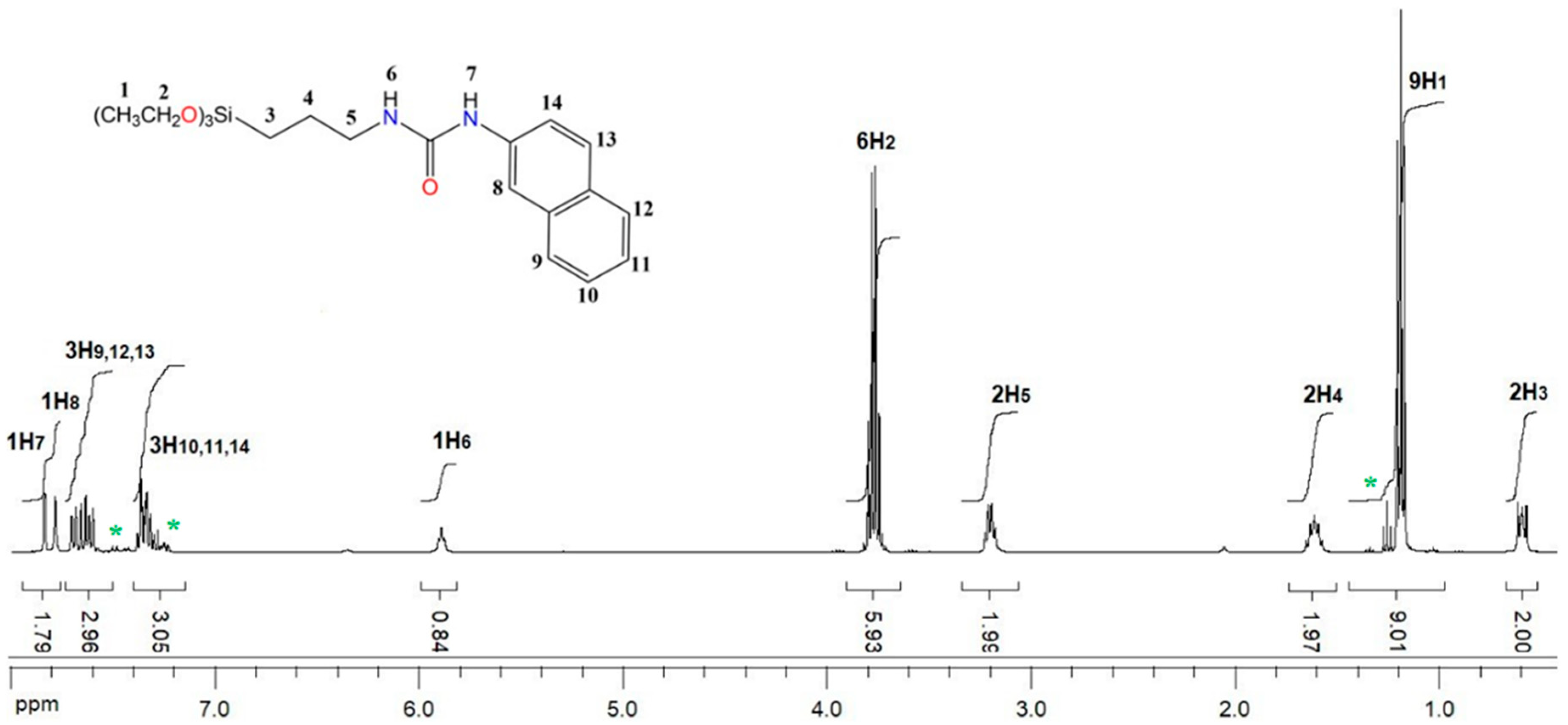
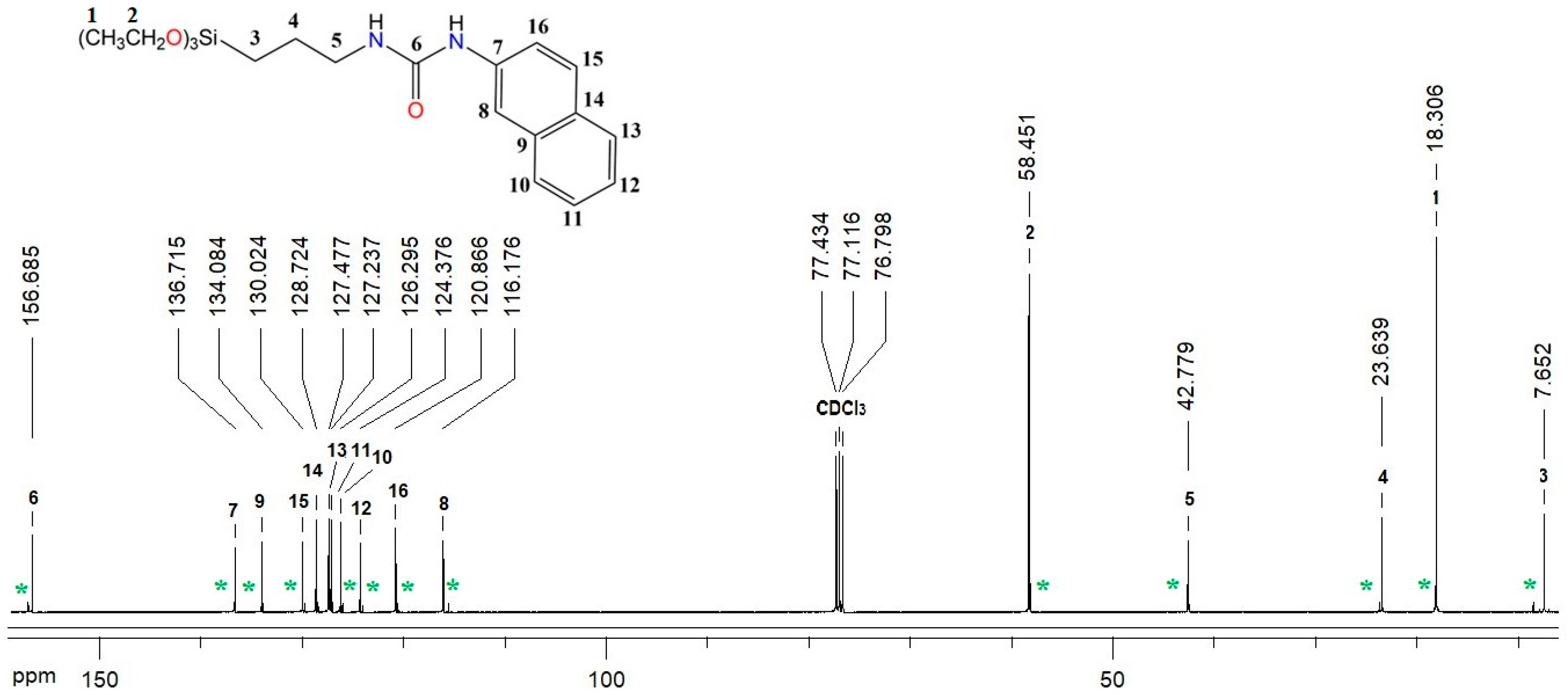
The 1H NMR spectrum recorded in CDCl3 (Figure 2) shows the signals of the triethoxysilanepropyl group between δ 0.60 and 3.77 ppm. The triplet at δ 5.90 ppm (J = 5.5 Hz) corresponds to the NH proton of the -HNCH2 fragment. The naphthyl signals appear between 7.28 and 7.84 ppm. A distinctive singlet at 7.79 ppm is assigned to the NH proton of the -HNC=O- fragment. This latter assignment is supported by its shift towards a stronger field (7.51 ppm) observed when recording the 1H NMR spectrum at 323 K (Figure S2). The proton-decoupled 13C NMR spectrum recorded in CDCl3 (Figure 3) reveals five signals between 7.65 and 58.45 ppm of the triethoxysilanepropyl group. Ten signals between δ 116.18 and 136.72 ppm correspond to the naphthyl moiety, and one signal at δ 156.69 ppm is characteristic of the carbonyl group. The 1H and 13C NMR spectra also reveal the presence of other weak signals. This minor species features a set of signals with an integration ratio of ca. 10% close to the resonances of the dominant species. The corresponding peaks, which are quite distinct, notably in the 13C NMR spectrum, are marked in Figure 2 and Figure 3 by an asterisk. The observation of a second carbonyl signal in the 13C NMR spectrum at about δ 158 ppm, close to the resonance at δ 156.69 ppm, suggests that the minor species also contains a N(H)-C(=O)N(H) urea motif. Note that quite a similar duplication of the resonances is also observable in the 13C{1H} NMR spectrum of 1-(3-(triethoxysilyl)propyl)-3-(1H-indol-5-yl)urea (E) [19].
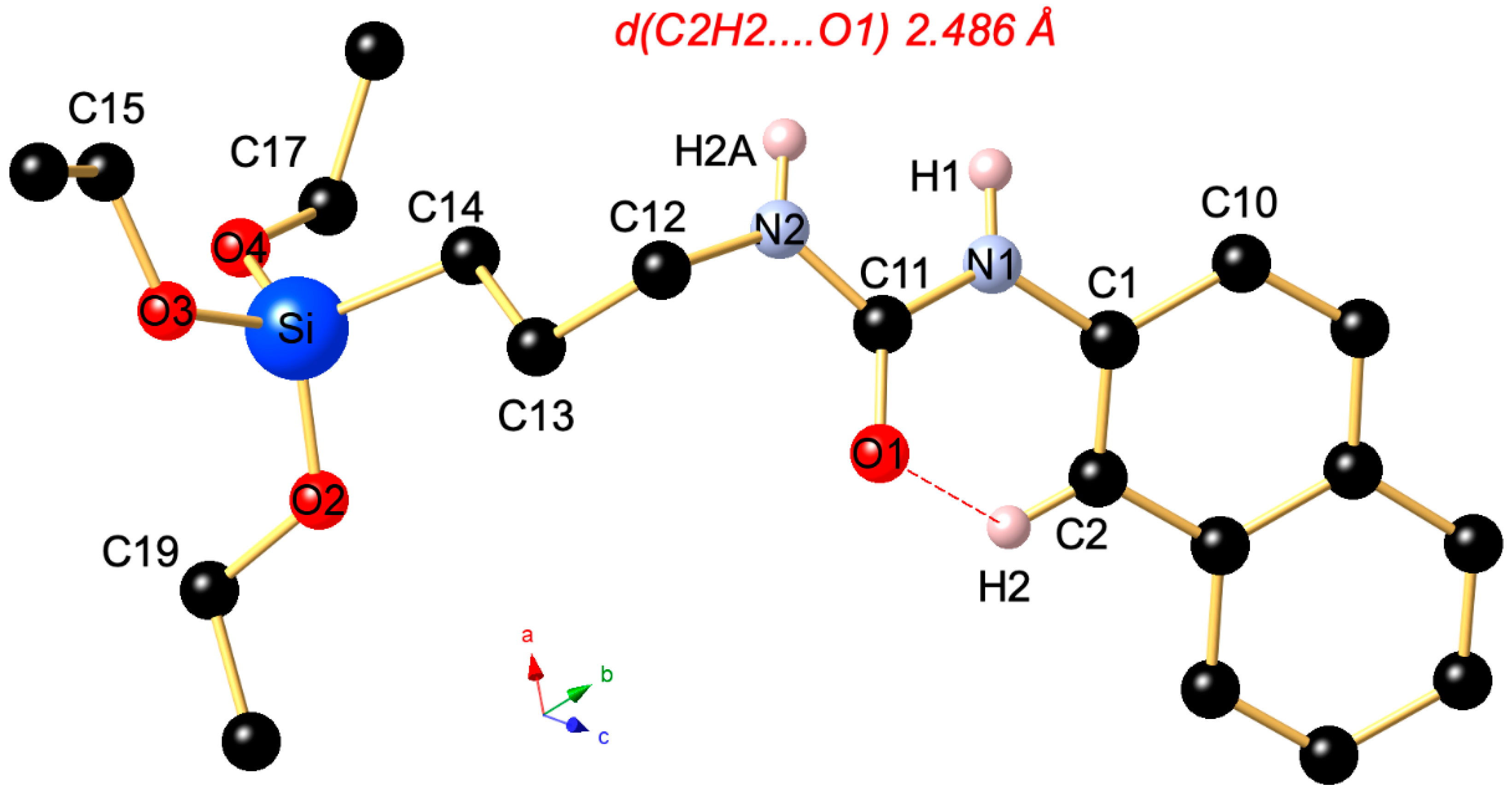
To complete the characterization of this compound, we examined compound 1 by an X-ray diffraction study performed at 173 K. X-ray suitable crystals (orthorhombic space group P212121) were grown from CH2Cl2 layered by hexane. As shown in Figure 4, a naphthyl group is attached to the N1 atom of the urea motif, and a triethoxysilanepropyl moiety to the N2 atom. The bond length of the C11=O1 double bond (1.241(3) Å) matches that of 1,3-bis-(2-naphtylureido)adamantane (CSD refcod LETLIH) (1.256 Å) [24], 1,1′-propane-1,3-diylbis(3-(2-naphthyl)urea) (CSD refcod LETLON) (1.232 Å), and that of anthracen-2-phenylurea (CSD refcod IFANIO) (1.241 Å) (compound B in Figure 1) [17]. Also noteworthy is the occurrence of a weak intramolecular hydrogen bonding C2-H2···O1 of 2.486 Å, giving rise to a six-membered pseudo-cycle.

2.2. Supramolecular Features

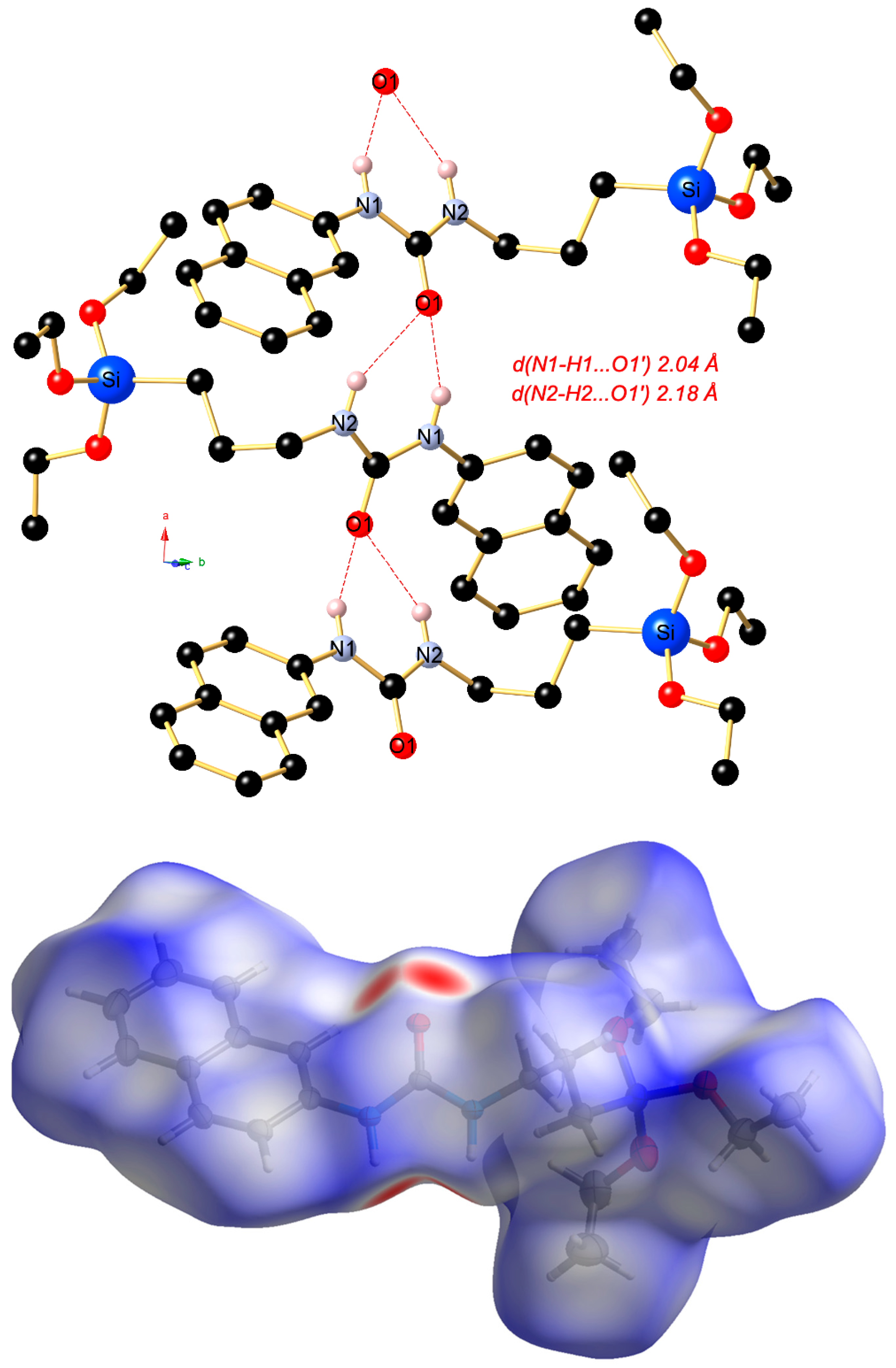
As reported for the crystal structures of several other aryl ureas, the individual molecules of 1 are associated with the neighboring ones through strong intermolecular hydrogen bonds of the carbonyl oxygen atom with the two N-H groups, giving rise to a supramolecular 1D ribbon, in which the molecules are arranged in an alternating manner (Figure 5). The N1-H1···O1′ and N2-H2···O1′ distances of 2.04 and 2.18 Å [d(N1···O1′) 2.875(3); d(N2···O1′) 2.971(3) Å] indicate strong hydrogen bonding and match with those reported for 4-(N′-(3-(triethoxysilyl)propyl)ureido)azobenzene (CSD refcode VAJFU) (2.03 and 2.08 Å), and N,N′-bis((3-(triethoxysilyl)propyl)aminocarbonyl)-p-phenylenediamine (CSD refcode ASUQEK) (2.06 and 2.08 Å) [20,22].
The N-H···O angles amount to 157.6 and 150.2°. The supramolecular 1D ribbon is also supported by a weak contact involving the naphtyl moiety and the triethoxysilyl group [d(C10····H18C′ 2.876 Å]. Finally, weak π-π interactions occur between the naphthyl aromatic rings of adjacent 1D ribbons [d(C5····H9″) 2.876 Å, Symmetry operation: “−x, −1/2 + y, 5/2 − z], which contribute to extending the supramolecular network.
This supramolecular bonding was also investigated by means of a Hirshfeld surface analysis using the CrystalExplorer21 software package [25,26]. A plot of the Hirshfeld surface (dnorm −0.526–1.5225) is shown at the bottom of Figure 5. Further plots of the intermolecular N-H···O interaction and the fingerprint plots (H···C, H···H, H···N, H···O) are depicted in the Supporting Material as Figures S3 and S4.

2.3. Investigation of Halide Detection by UV–Vis Absorption and Emission Spectroscopy

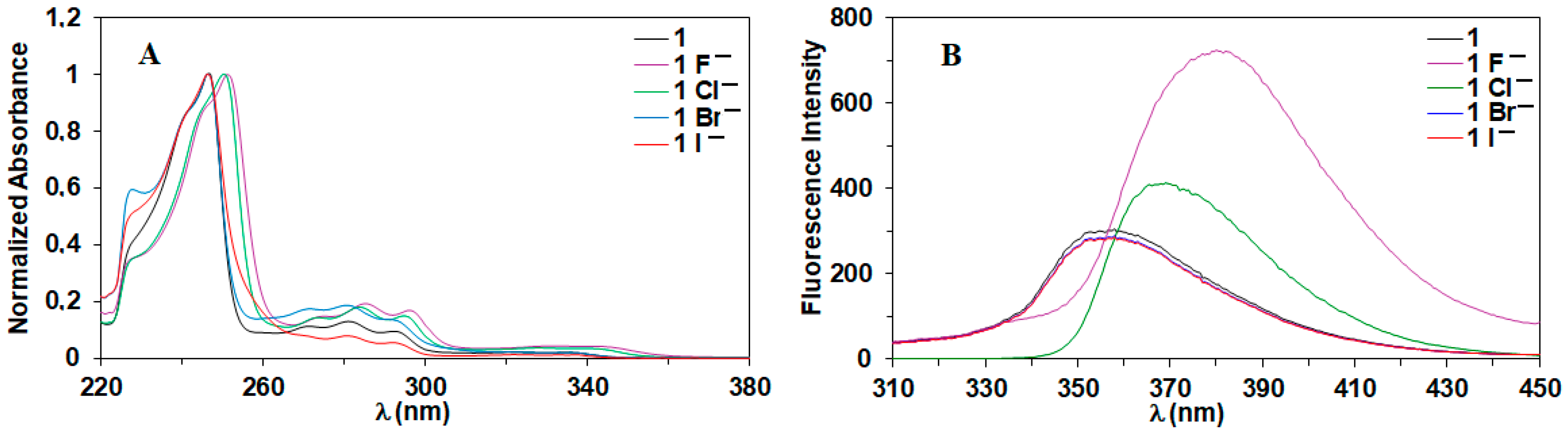
The normalized absorption spectra of 1 upon the addition of tetrabutylammonium fluoride (1 F), chloride (1 Cl), bromide (1 Br), and iodide (1 I) measured in dichloromethane at room temperature are depicted in Figure 6A, exhibiting several bands below 350 nm. Both absorption maxima for solutions containing fluoride or chloride ions were shifted to lower energy. This shift can be attributed to a high binding selectivity of 1 for fluoride and chloride ions, whereas the softer bromide and iodide anions only interact weakly with the urea function.
An analogous behavior is evidenced by a study of the fluorescence properties of 1 (Figure 6B). Upon excitation at 300 nm, fluorescence maxima are observed at 358 nm for 1, (1 Br), and (1 I), whereas the peak of the fluorescence is shifted progressively to 369 and 380 nm for (1 Cl) and (1 F), respectively. The fluorescence band of compound 1 can unambiguously be attributed to a π,π* state due to the lowest energy singlet state S0⟶S1 transition.
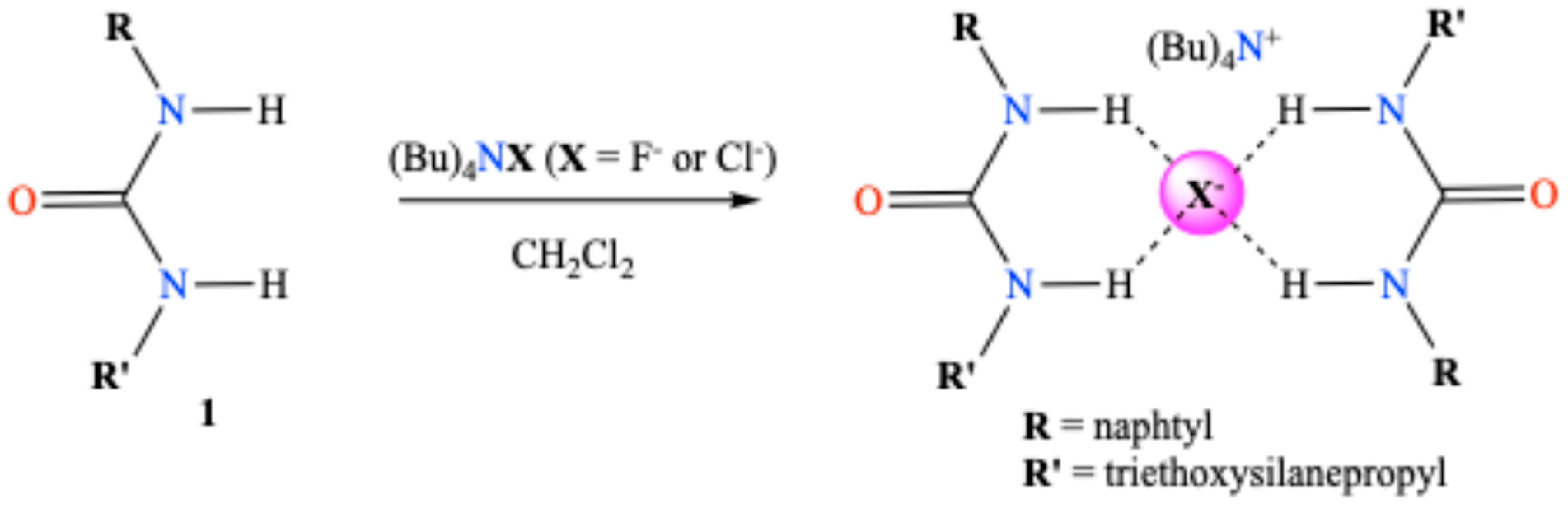
As illustrated in Figure 7, the bathochromic effect observed both in the absorption as well as in emission spectra is accompanied by an exaltation of the intensity of the latter in the presence of fluoride or chloride ions. This is attributed to the formation of complexes in solution with these anions, establishing hydrogen bonds with the two urea functions of 1. This hypothesis of the formation of hydrogen bonds with anions is corroborated by previous work concerning the use of the urea function for the detection of halide [16,17,27,28], carboxylate [17], or phosphate [28] anions. The proposed chelating bonding interaction of halides with both N-H groups has also been crystallographically ascertained [29,30].

3. Materials and Methods

All reagents were purchased from commercial suppliers and used as received. Melting points were obtained on a Büchi SMP 10 capillary melting point apparatus. 1H and 13C NMR spectra were recorded on a Bruker AC 400 (Bruker, Wissembourg, France) spectrometer at 400 and 100 MHz, respectively. The infrared spectrum was recorded on a Vertex 70 spectrometer (Bruker, Wissembourg, France) in ATR mode. UV-vis spectra were recorded on a VARIAN-Cary300 array spectrophotometer (Varian, Melbourne, Australia) in dichloromethane at ambient temperature. The fluorescence spectrum was measured on a Jobin-Yvon Fluoro Log 3 spectrometer (Edinburgh, UK). The luminescence experiments were performed in dilute dichloromethane solutions (ca. 10−6 M) at room temperature. For the halide detection study, compound 1 and the halide salts are used in a 2:1 molar ratio.
Preparation of compound 1. Into a Schlenk flask charged with 24 mL of dry THF, 2 g (1.35 × 10⁻² mol) of 2-aminonaphtalene and 4 g (1.62 × 10⁻² mol) of 3-isocyanatopropyltriethoxysilane were added under a nitrogen atmosphere. After stirring at room temperature for 2 h, the solvent was removed under vacuum. The crude product was purified by recrystallization from CH2Cl2/hexane to afford 4.78 g of 1 (91%). m. p. 102–103 °C; 1H NMR (CDCl3) at 298 K: 0.60 (t, J = 8.3 Hz, SiCH2, 2H), 1.20 (t, J = 7.0 Hz, CH3, 9H), 1.62 (sex, J = 7.7 Hz, SiCH2CH2, 2H), 3.23 (q, J = 6.8 Hz, HNCH2, 2H), 3.77 (q, J = 7.0 Hz, OCH2, 6H), 5.90 (t, J = 5.5 Hz, HNCH2), 7.28–7.71 (m, 6H, H-naphtyl), 7.79 (s, HNCO), 7.84 (d, J = 1.8 Hz, 1H, H-naphtyl); 13C{1H} NMR (CDCl3) at 298K: 7.65 (C3), 18.31 (C1), 23.64 (C4), 42.78 (C5), 58.45 (C2), 116.18 (C8), 120.87 (C16), 124.38 (12), 126.30 (C10), 127.24 (11), 127.48 (13), 128.72 (C14), 130.02 (C15), 134.08 (C9), 136.72 (C7), 156.69 (C6); IR-ATR (cm−1): 3325 vw, νasym (N-H), 3277 vw, νsym (N-H), 1640 s, ν(C=O), 1563 s, δ(N-H), 1073 s, ν(Si-O); UV-vis (CH2Cl2) λ, nm (ε, M−1cm−1) 247 (56,500), 272 (9300), 282 (9900), 295 (7200), 326 (1300); Elem. Anal: Calcd. for C20H30N2O4Si: C, 61.51; H, 7.74; N, 7.17. Found: C, 61.41; H, 7.55; N, 7.10.
A suitable crystal was mounted on an Oxford Diffraction Xcalibur four-circle diffractometer equipped with a Sapphire3 CCD detector. Crystal data for C20H30N2O4Si, M = 390.55 g·mol−1, colorless block, crystal size 0.40 × 0.40 × 0.30 mm3, orthorhombic, space group P212121: a = 8.8966(3) Å, b = 9.8533(3) Å, c = 24.4734(9) Å, α = 90°, β = 90°, γ = 90°, V = 2145.37(13) Å3, Z = 4, Dcalc = 1.209 g·cm−3, T = 173 K, F(000) = 840, θmax = 26.998°. Data were collected with graphite-monochromated MoKα radiation (λ = 0.71073 Å) [31]. An empirical multi-scan absorption correction was applied (Tmin/Tmax = 0.933/1.000). The structure was solved using direct methods with SHELXT (2018/2) and refined by full-matrix least squares on F2 using SHELXL-2019/2 [32,33]. Final R1 = 0.0403 for 4264 reflections with I ≥ 2σ(I), R1(all) = 0.0457, wR2(all) = 0.1101, GOF = 1.053 on 4684 independent reflections. Largest diff. peak/hole: 0.401/–0.228 e·Å−3. Crystallographic data have been prepared for deposition at the Cambridge Crystallographic Data Centre as CCDC 2489350 (Supplementary Materials). The data can be obtained free of charge from the Cambridge Crystallographic Data Centre via http://www.ccdc.cam.ac.uk/getstructures (accessed on 22 January 2026).

4. Conclusions

We have presented the synthesis of a novel urea-derived fluorescent chemosensor. The overall simplicity of the procedure, the use of mild reaction conditions, and the high yield obtained suggest that this strategy is promising for the preparation of other luminescent moieties intended for attachment to a substrate surface (SiO2 particles, quartz) via condensation of the Si(OEt)3 function with surface-bound silanol groups. Absorption and fluorescence spectroscopy experiments reveal that this product exhibits selectivity for detecting fluoride and chloride ions.

Supplementary Materials

The following supporting information, Figure S1. IR-ATR spectrum of N-(2-naphtyl)-N’-(triethoxysilanepropyl)urea (1); Figure S2. 1H NMR spectrum (400 MHz, CDCl3) of urea 1 at 323 K; Figure S3. Hirshfeld fingerprint plots of 1 showing the percentages participations to the total Hirshfeld surface area; Figure S4. Hirshfeld plot of 1 showing the intermolecular N-H…O hydrogen bonding.

Author Contributions

A.K. prepared the compound; C.S. and T.S. collected the X-ray data and solved the structure; I.J., A.K. and M.K. designed the study, analyzed the data, and wrote the paper. All authors have read and agreed to the published version of the manuscript.

Funding

This work has been achieved in the frame of the EIPHI Graduate school (contract “ANR-17-EURE-0002”).

Data Availability Statement

The X-ray data are deposited at CCDC as stated in the paper.

Acknowledgments

We thank Stéphanie Beffy for recording the IR and NMR spectra.

Conflicts of Interest

The authors declare no conflicts of interest.

References

  1. Schmidtchen, F.P.; Berger, M. Artificial Organic Host Molecules for Anions. Chem. Rev. 1997, 97, 1609–1646. [Google Scholar] [CrossRef]
  2. Beer, P.D.; Gale, P.A. Anion Recognition and Sensing: The State of the Art and Future Perspectives. Angew. Chem. Int. Ed. 2001, 40, 486–516. [Google Scholar] [CrossRef]
  3. Gale, P.A. Anion and ion-pair receptor chemistry: Highlights from 2000 and 2001. Coord. Chem. Rev. 2003, 240, 191–221. [Google Scholar] [CrossRef]
  4. Andrews, N.J.; Haynes, C.J.E.; Light, M.E.; Moore, S.J.; Tong, C.C.; Davis, J.T.; William, A.; Harrell, W.A.; Gale, P.A. Structurally simple lipid bilayer transport agents for chloride and bicarbonate. Chem. Sci. 2012, 3, 2501–2509. [Google Scholar] [CrossRef]
  5. Busschaert, N.; Caltagirone, C.; Van Rossom, W.; Gale, P.A. Applications of Supramolecular Anion Recognition. Chem. Rev. 2015, 115, 8038–8155. [Google Scholar] [CrossRef]
  6. Singh, G.; Saroa, A.; Girdhar, S.; Rani, S.; Choquesillo-Lazarte, D.; Sahoo, S.C. Incorporation of azo group at axial position of silatranes: Synthesis, characterization and antimicrobial activity. Appl. Organometal. Chem. 2015, 29, 549–555. [Google Scholar] [CrossRef]
  7. Smith, P.J.; Reddington, M.V.; Wilcox, C.S. Ion pair binding by a urea in chloroform solution. Tetrahedron Lett. 1992, 33, 6085–6088. [Google Scholar] [CrossRef]
  8. Fan, E.; van Arman, S.A.; Kincaid, S.; Hamilton, A.D. Molecular recognition: Hydrogen-bonding receptors that function in highly competitive solvent. J. Am. Chem. Soc. 1993, 115, 369–370. [Google Scholar] [CrossRef]
  9. Scheerder, J.; Engbersen, J.F.J.; Casnati, A.; Ungaro, R.; Reinhoudt, D.N. Complexation of Halide Anions and Tricarboxylate Anions by Neutral Urea-Derivatized p-tert-Butylcalix [6] arenes. J. Org. Chem. 1995, 60, 6448–6454. [Google Scholar] [CrossRef]
  10. Hughes, M.P.; Shang, M.; Smith, B.D. High affinity, carboxylate binding using neutral urea-based receptors with internal Lewis acid coordination. J. Org. Chem. 1996, 61, 4510–4511. [Google Scholar] [CrossRef]
  11. Hughes, M.P.; Smith, B.D. Enhanced carboxylate binding using urea and amide-based receptors with internal Lewis acid coordination: A cooperative polarization effect. J. Org. Chem. 1997, 62, 4492–4499. [Google Scholar] [CrossRef]
  12. Fitzmaurice, R.J.; Kyne, G.M.; Douheret, D.; Kilburn, J.D. Synthetic receptors for carboxylic acids and carboxylates. J. Chem. Soc. Perkin Trans. 1 2002, 841–864. [Google Scholar] [CrossRef]
  13. Evans, A.J.; Matthews, S.E.; Cowley, A.R.; Beer, P.D. Anion binding by calix [4] arene ferrocene ureas. Dalton Trans. 2003, 4644–4650. [Google Scholar] [CrossRef]
  14. Miyaji, H.; Collinson, S.R.; Prokes, I.; Tucker, J.H.R. A ditopic ferrocene receptor for anions and cations that functions as a chromogenic molecular switch. Chem. Commun. 2003, 64–65. [Google Scholar] [CrossRef] [PubMed]
  15. Barboiu, M.; Vaughan, G.; van der Lee, A. Self-Organized Heteroditopic Macrocyclic Superstructures. Org. Lett. 2003, 5, 3073–3076. [Google Scholar] [CrossRef]
  16. Cho, E.J.; Moon, J.W.; Ko, S.W.; Lee, J.Y.; Kim, S.K.; Yoon, J.; Nam, K.C. A New Fluoride Selective Fluorescent as Well as Chromogenic Chemosensor Containing a Naphthalene Urea Derivative. J. Am. Chem, Soc. 2003, 125, 12376–12377. [Google Scholar] [CrossRef]
  17. Amendola, V.; Bergamaschi, G.; Boiocchi, M.; Fabbrizzi, L.; Mosca, L. The Interaction of Fluoride with Fluorogenic Ureas: An ON1−OFF−ON2 Response. J. Am. Chem. Soc. 2013, 135, 6345–6355. [Google Scholar] [CrossRef]
  18. Herlem, G.; Kandory, A.; Kinghat Tangou, R.; Gharbi, T.; Cattey, H.; Knorr, M.; Khatyr, A. Electrochemical deposition of a luminescent alkoxysilyl-based fluorenone film exhibiting halide sensitivity. J. Solid State Sci. Technol. 2017, 6, 7–13. [Google Scholar] [CrossRef]
  19. Barboiu, M.; Caraballo, R.; Arnal-Hrault, C.; Perriat, P.; Lee, A.; Pasc, A. Ion-Conduction Pathways in Self-Organised Ureidoarene-Heteropolysiloxane Hybrid Membranes. Chem. Eur. J. 2008, 14, 1776–1783. [Google Scholar] [CrossRef]
  20. Liu, N.; Dunphy, D.R.; Rodriguez, M.A.; Singerb, S.; Brinker, J. Synthesis and crystallographic structure of a novel photoresponsive azobenzene-containing organosilane. Chem. Commun. 2003, 1144–1145. [Google Scholar] [CrossRef]
  21. Varga, G.; Szeman, J.; Szente, L.; Csabai, P.; Kékesi, K. Chromatographic Stationary Phase for Separation of Cyclodextrine and Derivatives Thereof. International Patent WO 2005/105257 A1, 2005. [Google Scholar]
  22. Moreau, J.E.; Pichon, B.P.; Man, M.W.C.; Bied, C.; Pritzkow, H.; Bantignies, J.-L.; Dieudonn, P.; Sauvajol, J.-L. ABetter Understanding of the Self-Structuration of Bridged Silsesquioxanes. Angew. Chem. Int. Ed. 2004, 43, 203–206. [Google Scholar] [CrossRef] [PubMed]
  23. Singha, G.; Saroa, A.; Rani, S.; Girdhar, S.; Sahoo, S.; Choquesillo-Lazarte, D. Substituted phenyl urea and thiourea silatranes: Synthesis, characterization and anion recognition properties by photophysical and theoretical studies. Polyhedron 2016, 112, 51–60. [Google Scholar] [CrossRef]
  24. Blažek, V.; Molčanov, K.; Mlinarić-Majerski, K.; Kojić-Prodić, B.; Basarić, N. Adamantane bisurea derivatives: Anion binding in the solution and in the solid state. Tetrahedron 2013, 69, 517–526. [Google Scholar] [CrossRef]
  25. Spackman, M.A.; Jayatilaka, D. Hirshfeld Surface Analysis. Cryst. Eng. Comm. 2009, 11, 19–32. [Google Scholar] [CrossRef]
  26. Turner, M.J.; McKinnon, J.J.; Wolff, S.K.; Grimwood, D.J.; Spackman, P.R.; Jayatilaka, D.; Spackman, M.A. CrystalExplorer17.5; University of Western Australia: Perth, Australia, 2017; Available online: https://crystalexplorer.net (accessed on 1 June 2025).
  27. Moore, S.J.; Wenzel, M.; Light, M.E.; Morley, R.; Bradberry, S.J.; Gomez-Iglesias, P.; Soto-Cerrato, V.; Perez-Tomasc, R.; Gale, P.A. Towards ‘‘drug-like’’ indole-based transmembrane anion transporters. Chem. Sci. 2012, 3, 2501–2509. [Google Scholar] [CrossRef]
  28. Amendola, V.; Boiocchi, M.; Colasson, B.; Fabbrizzi, L. Metal-Controlled Assembly and Selectivity of a Urea-Based Anion Receptor. Inorg.Chem. 2006, 45, 6138–6147. [Google Scholar] [CrossRef]
  29. Pramanik, A.; Powell, D.R.; Wong, B.M.; Hossain, M.A. Spectroscopic, Structural, and Theoretical Studies of Halide Complexes with a Urea-Based Tripodal Receptor. Inorg. Chem. 2012, 51, 4274–4284. [Google Scholar] [CrossRef]
  30. Basak, M.; Das, A.; Das, G. Exploring cyclohexane/piperazine-urea motifs for spherical halide (X = Cl/Br) recognition: Effects on anion coordination, photoluminescence, and morphological tunability. CrystEngComm 2021, 23, 7771–7780. [Google Scholar] [CrossRef]
  31. Dolomanov, O.V.; Bourhis, L.J.; Gildea, R.J.; Howard, J.A.K.; Puschmann, H. Olex2: A Complete Structure Solution, Refinement and Analysis Program. J. Appl. Crystallogr. 2009, 42, 339–341. [Google Scholar] [CrossRef]
  32. Sheldrick, G.M. SHELXT—Integrated Space-Group and Crystal-Structure Determination. Acta Crystallogr. Sect. A 2015, 71, 3–8. [Google Scholar] [CrossRef]
  33. Sheldrick, G.M. Crystal Structure Refinement with SHELXL. Acta Crystallogr. Sect. C 2015, 71, 3–8. [Google Scholar] [CrossRef]
Figure 1. Examples of literature-known molecules (AF) containing urea fragments functionalized by aryl-chromophores.
Molbank 2026 m2129 g001
Scheme 1. Synthesis of N-(2-naphthyl)-N′-(triethoxysilanepropyl) urea 1.
Molbank 2026 m2129 sch001
Figure 2. 1H NMR spectrum (400 MHz, CDCl3) of urea 1 at 298 K. The set of weak resonances labeled by asterisks (*) indicates the presence of a second minor species in solution.
Molbank 2026 m2129 g002
Figure 3. 13C{1H} NMR spectrum (100 MHz, CDCl3) of compound 1 at 298 K. The set of weak resonances labeled by asterisks (*) indicates the presence of a second minor species in solution.
Molbank 2026 m2129 g003
Figure 4. Molecular structure of 1. Selected bond lengths (Å) and angles (deg). Apart from H1 and H2, all other H atoms are omitted for clarity. C1–N1 1.418(3), N1–C11 1.374(3), C11–O1 1.241(3), C11–N2 1.351(1), N2–C12 1.456(3), C12–C13 1.528(4), C14–Si 1.857(3), Si–O2 1.624(2), Si–O3 1.624(2), Si–O4 1.632(2); C11–N1–C1 126.1(2), N1–C11–N2 114.0(2), N1–C11–O1 123.1(2), C11–N2–C12 122.1(2), C12–C13–C14 112.9(2), C13–C14–Si 113.46(18), C14–Si–O2 107.12(12), C14–Si–O3 112.08(12), C14–Si–O4 112.94(12).
Molbank 2026 m2129 g004
Figure 5. (top) View of a segment of the supramolecular one-dimensional ribbon of 1 running along the a axis. Symmetry operation: ‘1/2 + x, 3/2 − y, 2 – z’. (bottom) Hirshfeld surface plot of 1.
Molbank 2026 m2129 g005
Figure 6. Normalized absorption spectra (A) and emission spectra (B) of 1 upon the addition of tetrabutylammonium fluoride (1 F), bromide (1 Br), chloride (1 Cl), and iodide (1 I) in CH2Cl2 at rt.
Molbank 2026 m2129 g006
Figure 7. Illustration of the formation of the halide complex [1-X--1] (Bu)4N+ (X = F, Cl) after addition of 0.5 equivalents of (Bu)4NX.
Molbank 2026 m2129 g007
Disclaimer/Publisher’s Note: The statements, opinions and data contained in all publications are solely those of the individual author(s) and contributor(s) and not of MDPI and/or the editor(s). MDPI and/or the editor(s) disclaim responsibility for any injury to people or property resulting from any ideas, methods, instructions or products referred to in the content.