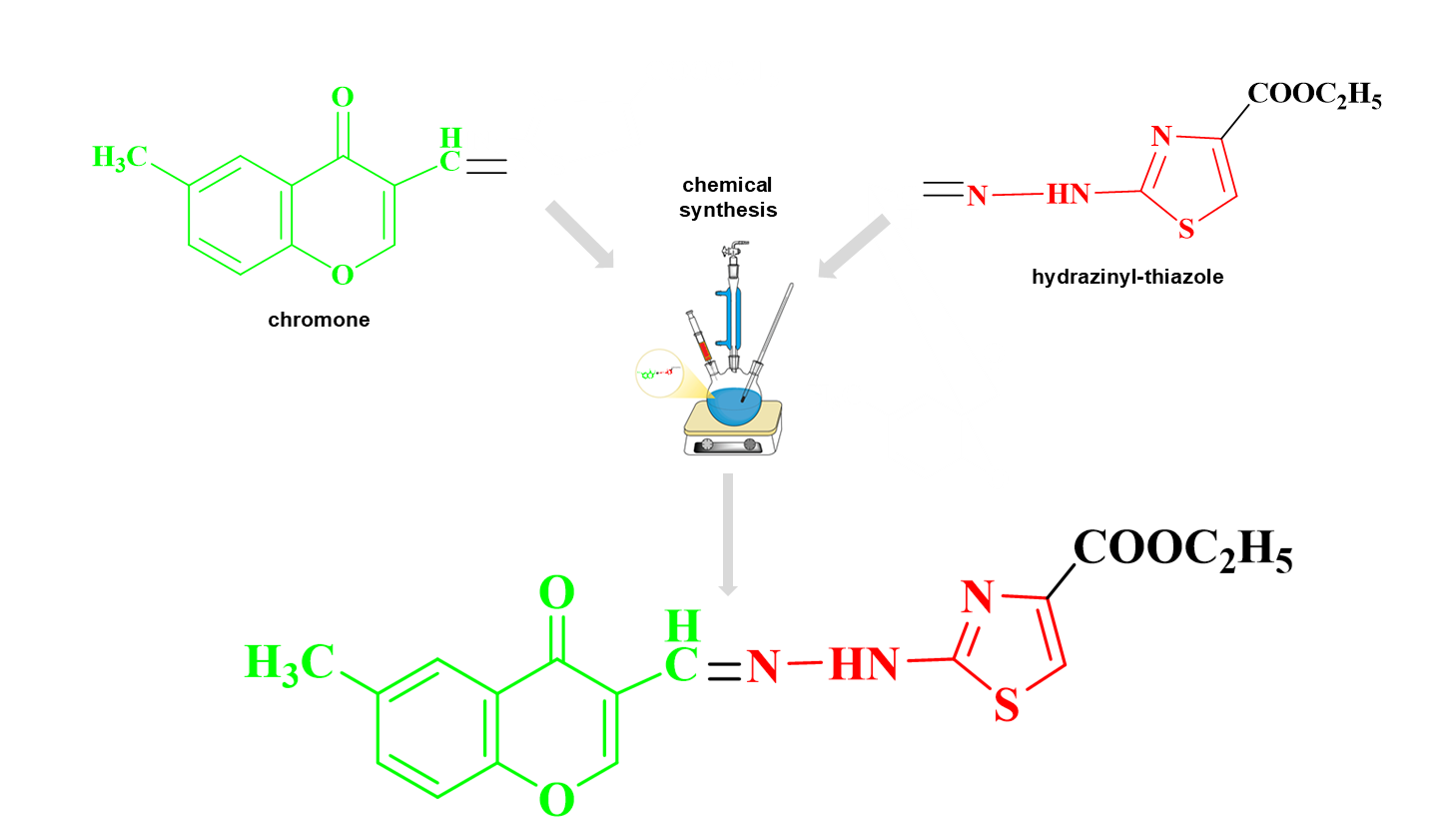

Ethyl 2-(2-((6-Methyl-4-oxo-4H-chromen-3-yl)methylene)hydrazineyl)thiazole-4-carboxylate

 , ,
, ,  ,
,
Abstract
1. Introduction
2. Results
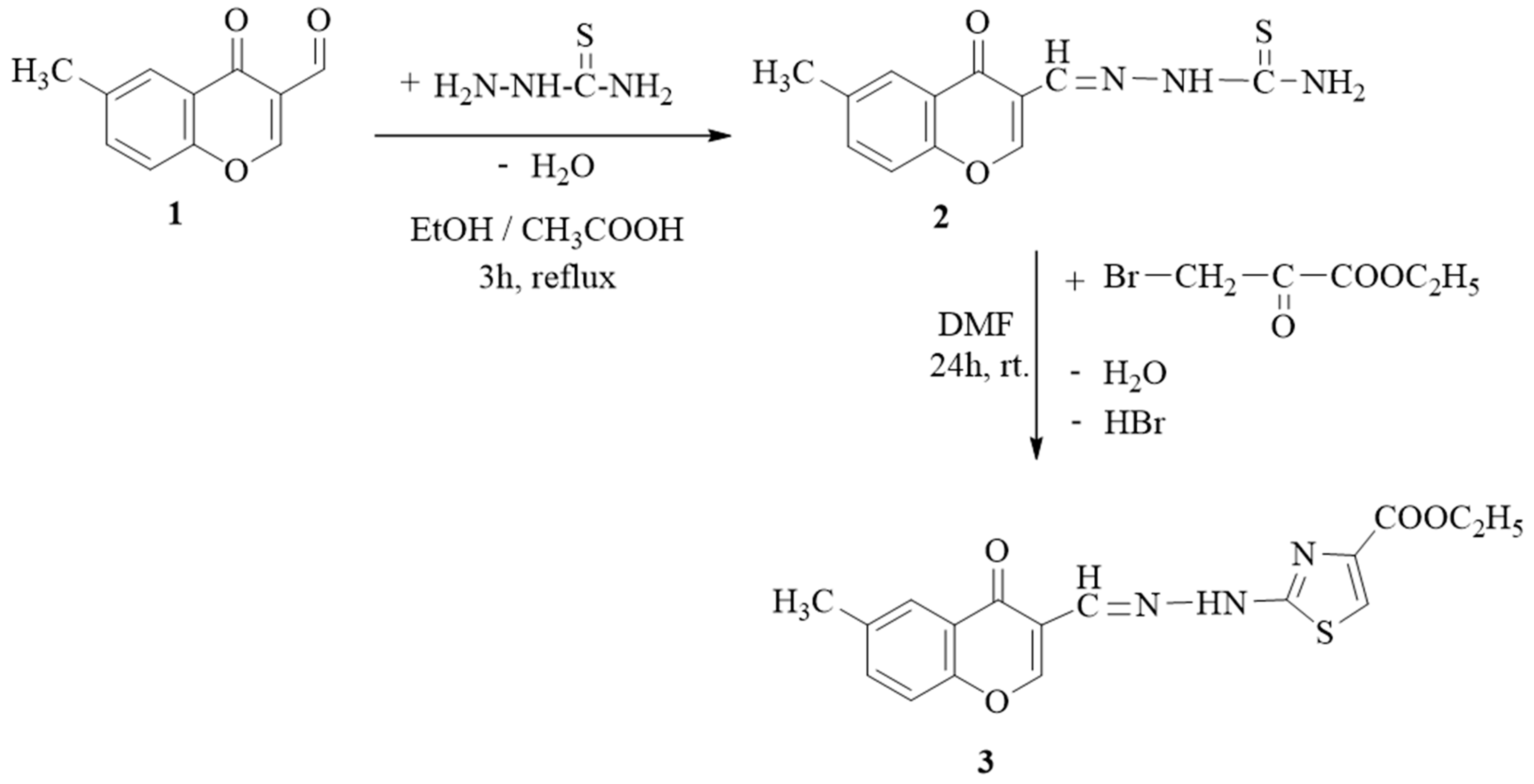
Chemical Synthesis
3. Discussion
4. Materials and Methods
4.1. Chemical Synthesis
4.1.1. Synthesis Protocol of 2-((6-Methyl-4-oxo-4H-chromen-3-yl)methylene]thiosemicarbazone (Intermediate Compound 2)
4.1.2. Synthesis Protocol of Ethyl 2-(2-((6-Methyl-4-oxo-4H-chromen-3-yl)methylene)hydrazineyl)thiazole-4-carboxylate (Compound 3)
Supplementary Materials
Author Contributions
Funding
Data Availability Statement
Conflicts of Interest
Abbreviations
| DMF | Dimethylformamide |
| DMSO | Dimethyl sulfoxide |
| M.P. | Melting Point |
References
- Kanzouai, Y.; Chalkha, M.; Hadni, H.; Laghmari, M.; Bouzammit, R.; Nakkabi, A.; Benali, T.; Tüzün, B.; Akhazzane, M.; El Yazidi, M.; et al. Design, synthesis, in-vitro and in-silico studies of chromone-isoxazoline conjugates as anti-bacterial agents. J. Mol. Struct. 2023, 1293, 136205. [Google Scholar] [CrossRef] [Scilit]
- Bonvicini, F.; Menegaldo, L.; Orioli, R.; Belluti, F.; Gentilomi, G.A.; Gobbi, S.; Bisi, A. Extended Antimicrobial Profile of Chromone–Butenafine Hybrids. Molecules 2025, 30, 2973. [Google Scholar] [CrossRef] [Scilit] [PubMed]
- Benny, A.T.; Arikkatt, S.D.; Vazhappilly, C.G.; Kannadasan, S.; Thomas, R.; Leelabaiamma, M.S.N.; Radhakrishnan, E.K.; Shanmugam, P. Chromone, A Privileged Scaffold in Drug Discovery: Developments in the Synthesis and Bioactivity. Mini-Rev. Med. Chem. 2022, 22, 1030–1063. [Google Scholar] [CrossRef] [Scilit] [PubMed]
- Lee, J.-H.; Kim, Y.-G.; Kim, Y.; Lee, J. Antifungal and antibiofilm activities of chromones against nine Candida species. Microbiol. Spectr. 2023, 11, e0173723. [Google Scholar] [CrossRef] [Scilit]
- Shatokhin, S.S.; Tuskaev, V.A.; Gagieva, S.C.; Pozdnyakov, D.I.; Oganesyan, E.T. Synthesis and Antioxidant Activity of (E)-3-(3-(4-oxo-4H-chromen-3-yl)acryloyl) 2H-chromen-2-one Derivatives. Pharm. Pharmacol. 2021, 9, 367–376. [Google Scholar] [CrossRef] [Scilit]
- Pawar, S.P.; Kondhare, D.D.; Zubaidha, P.K. Synthesis and evaluation of antioxidant activity of 2-styrylchromones. Med. Chem. Res. 2013, 22, 753–757. [Google Scholar] [CrossRef] [Scilit]
- Csepanyi, E.; Szabados-Furjesi, P.; Kiss-Szikszai, A.; Frensemeier, L.M.; Karst, U.; Lekli, I.; Haines, D.D.; Tosaki, A.; Bak, I. Antioxidant Properties and Oxidative Transformation of Different Chromone Derivatives. Molecules 2017, 22, 588. [Google Scholar] [CrossRef] [Scilit]
- Maicheen, C.; Ungwitayatorn, J. Antimalarial and β-hematin formation inhibitory activities of chromone derivatives. ScienceAsia 2019, 45, 221–228. [Google Scholar] [CrossRef] [Scilit]
- ul Amin Mohsin, N.; Irfan, M.; ul Hassan, S.; Saleem, U. Current Strategies in Development of New Chromone Derivatives with Diversified Pharmacological Activities: A Review. Pharm. Chem. J. 2020, 54, 241–257. [Google Scholar] [CrossRef] [Scilit]
- Patil, V.M.; Masand, N.; Verma, S.; Masand, V. Chromones: Privileged scaffold in anticancer drug discovery. Chem. Biol. Drug Des. 2021, 98, 943–953. [Google Scholar] [CrossRef] [Scilit]
- Ejaz, S.A.; Miliutina, M.; Langer, P.; Saeed, A.; Iqbal, J. Anti-proliferative Effects of Chromones: Potent Derivatives Affecting Cell Growth and Apoptosis in Breast, Bone-marrow and Cervical Cancer Cells. Med. Chem. 2019, 15, 883–891. [Google Scholar] [CrossRef] [Scilit]
- Sharma, V.; Panwar, A.; Sankhyan, A.; Ram, G.; Sharma, A.K. Exploring the Potential of Chromones as Inhibitors of Novel Coronavirus Infection Based on Molecular Docking and Molecular Dynamics Simulation Studies. Biointerface Res. Appl. Chem. 2022, 13, 104. [Google Scholar] [CrossRef] [Scilit]
- Zheng, Y.; Li, M.; Wu, S.; Li, L.; Xiong, Z.; Xu, X.; Zhang, K.; Wen, Y. Synthesis and biological evaluation of chromone-thiazolidine-2,4-dione derivatives as potential α-glucosidase inhibitors. Arab. J. Chem. 2023, 16, 105279. [Google Scholar] [CrossRef] [Scilit]
- Yun, X.; Chen, L.; Lv, Y.; Lu, Z.; Huang, K.; Yan, S. Multicomponent cascade reaction of 3-formylchromones: Highly regioselective synthesis of functionalized pyridin-2(1H)-ones. Green Synth. Catal. 2023, 4, 231–239. [Google Scholar] [CrossRef] [Scilit]
- Iaroshenko, V.; Mkrtchyan, S.; Volochnyuk, D.; Langer, P.; Sosnovskikh, V.; Ostrovskyi, D.; Dudkin, S.; Kotljarov, A.; Miliutina, M.; Savych, I.; et al. 3-Formylchromones, Acylpyruvates, and Chalcone as Valuable Substrates for the Syntheses of Fused Pyridines. Synthesis 2010, 2010, 2749–2758. [Google Scholar] [CrossRef] [Scilit]
- Kashyap, A.; Adhikari, N.; Das, A.; Shakya, A.; Ghosh, S.K.; Singh, U.P.; Bhat, H.R. Review on Synthetic Chemistry and Antibacterial Importance of Thiazole Derivatives. Curr. Drug Discov. Technol. 2018, 15, 214–228. [Google Scholar] [CrossRef] [Scilit]
- Hosseininezhad, S.; Ramazani, A. Thiazole ring- the antimicrobial, anti-inflammatory, and anticancer active scaffold. Arab. J. Chem. 2023, 16, 105234. [Google Scholar] [CrossRef] [Scilit]
- Chimenti, F.; Bizzarri, B.; Maccioni, E.; Secci, D.; Bolasco, A.; Fioravanti, R.; Chimenti, P.; Granese, A.; Carradori, S.; Rivanera, D.; et al. Synthesis and in vitro activity of 2-thiazolylhydrazone derivatives compared with the activity of clotrimazole against clinical isolates of Candida spp. Bioorg. Med. Chem. Lett. 2007, 17, 4635–4640. [Google Scholar] [CrossRef] [Scilit]
- Sá, N.P.; Lima, C.M.; dos Santos, J.R.A.; Costa, M.C.; de Barros, P.P.; Junqueira, J.C.; Vaz, J.A.; Oliveira, R.B.; Fuchs, B.B.; Mylonakis, E.; et al. A phenylthiazole derivative demonstrates efficacy on treatment of the cryptococcosis & candidiasis in animal models. Futur. Sci. OA 2018, 4, FSO305. [Google Scholar] [CrossRef] [Scilit]
- De Logu, A.; Saddi, M.; Cardia, M.C.; Borgna, R.; Sanna, C.; Saddi, B.; Maccioni, E. In vitro activity of 2-cyclohexylidenhydrazo-4-phenyl-thiazole compared with those of amphotericin B and fluconazole against clinical isolates of Candida spp. and fluconazole-resistant Candida albicans. J. Antimicrob. Chemother. 2005, 55, 692–698. [Google Scholar] [CrossRef] [Scilit]
- Gidaro, M.C.; Alcaro, S.; Secci, D.; Rivanera, D.; Mollica, A.; Agamennone, M.; Giampietro, L.; Carradori, S. Identification of new anti-Candida compounds by ligand-based pharmacophore virtual screening. J. Enzym. Inhib. Med. Chem. 2016, 31, 1703–1706. [Google Scholar] [CrossRef] [Scilit]
- Kalita, T.; Choudhury, A.; Shakya, A.; Ghosh, S.K.; Singh, U.P.; Bhat, H.R. A Review on Synthetic Thiazole Derivatives as an Antimalarial Agent. Curr. Drug Discov. Technol. 2024, 21, 2024. [Google Scholar] [CrossRef] [Scilit]
- Petrou, A.; Fesatidou, M.; Geronikaki, A.; Damiano Altomare, C. Thiazole Ring—A Biologically Active Scaffold. Molecules 2021, 26, 3166. [Google Scholar] [CrossRef] [Scilit] [PubMed]
- Singh, I.P.; Gupta, S.; Kumar, S. Thiazole Compounds as Antiviral Agents: An Update. Med. Chem. 2020, 16, 4–23. [Google Scholar] [CrossRef] [Scilit]
- Gohar, N.A.; Fayed, E.A.; Ammar, Y.A.; Abu Ali, O.A.; Ragab, A.; Mahfoz, A.M.; Abusaif, M.S. Fluorinated indeno-quinoxaline bearing thiazole moieties as hypoglycaemic agents targeting α-amylase, and α-glucosidase: Synthesis, molecular docking, and ADMET studies. J. Enzym. Inhib. Med. Chem. 2024, 39, 2367128. [Google Scholar] [CrossRef] [Scilit] [PubMed]
- Fayed, E.A.; Thabet, A.; El-Gilil, S.M.A.; Elsanhory, H.M.A.; Ammar, Y.A. Fluorinated thiazole–thiosemicarbazones hybrids as potential PPAR-γ agonist and α-amylase, α-glucosidase antagonists: Design, synthesis, in silico ADMET and docking studies and hypoglycemic evaluation. J. Mol. Struct. 2024, 1301, 137374. [Google Scholar] [CrossRef] [Scilit]
- Rahim, F.; Ullah, H.; Javid, M.T.; Wadood, A.; Taha, M.; Ashraf, M.; Shaukat, A.; Junaid, M.; Hussain, S.; Rehman, W.; et al. Synthesis, in vitro evaluation and molecular docking studies of thiazole derivatives as new inhibitors of α-glucosidase. Bioorg. Chem. 2015, 62, 15–21. [Google Scholar] [CrossRef] [Scilit]
- Narasimhamurthy, K.H.; Swaroop, T.R.; Rangappa, K.S. A review on progress of thiazole derivatives as potential anti-inflammatory agents. Eur. J. Med. Chem. Rep. 2024, 12, 100225. [Google Scholar] [CrossRef] [Scilit]
- Mohareb, R.M.; Zaki, M.Y.; Abbas, N.S. Synthesis, anti-inflammatory and anti-ulcer evaluations of thiazole, thiophene, pyridine and pyran derivatives derived from androstenedione. Steroids 2015, 98, 80–91. [Google Scholar] [CrossRef] [Scilit]
- Badran, A.-S.; Ibrahim, M.A. Chemical reactivity of 3-substituted-6,8-dimethylchromones towards 1H-benzimidazol-2-ylacetonitrile and 5-amino-2,4-dihydro-3H-pyrazol-3-one: Spectroscopic, theoretical and in silico ADME studies. J. Mol. Struct. 2023, 1291, 136023. [Google Scholar] [CrossRef] [Scilit]
- Grozav, A.; Hanganu, D.; Crișan, O.; Porumb, D.I.; Cristea, C. Synthesis and Antioxidant Capacity of (Chlorobenzylidene)Hydrazinyl-Thiazoles. Stud. Univ. Babeș-Bolyai Chem. 2019, 64, 509–516. [Google Scholar] [CrossRef] [Scilit]
- Tayade, K.; Yeom, G.-S.; Sahoo, S.K.; Puschmann, H.; Nimse, S.B.; Kuwar, A. Exploration of Molecular Structure, DFT Calculations, and Antioxidant Activity of a Hydrazone Derivative. Antioxidants 2022, 11, 2138. [Google Scholar] [CrossRef] [Scilit]
- Brem, B.; Gal, E.; Găină, L.; Silaghi-Dumitrescu, L.; Fischer-Fodor, E.; Tomuleasa, C.I.; Grozav, A.; Zaharia, V.; Filip, L.; Cristea, C. Novel Thiazolo[5,4-b]phenothiazine Derivatives: Synthesis, Structural Characterization, and In Vitro Evaluation of Antiproliferative Activity against Human Leukaemia. Int. J. Mol. Sci. 2017, 18, 1365. [Google Scholar] [CrossRef] [Scilit]
- Pricopie, A.-I.; Ionuț, I.; Marc, G.; Arseniu, A.-M.; Vlase, L.; Grozav, A.; Găină, L.I.; Vodnar, D.C.; Pîrnău, A.; Tiperciuc, B.; et al. Design and Synthesis of Novel 1,3-Thiazole and 2-Hydrazinyl-1,3-Thiazole Derivatives as Anti-Candida Agents: In Vitro Antifungal Screening, Molecular Docking Study, and Spectroscopic Investigation of their Binding Interaction with Bovine Serum Albumin. Molecules 2019, 24, 3435. [Google Scholar] [CrossRef] [Scilit]
- Mbaveng, A.T.; Ignat, A.G.; Ngameni, B.; Zaharia, V.; Ngadjui, B.T.; Kuete, V. In Vitro antibacterial activities of p-toluenesulfonyl-hydrazinothiazoles and hydrazinoselenazoles against multi-drug resistant Gram-negative phenotypes. BMC Pharmacol. Toxicol. 2016, 17, 3. [Google Scholar] [CrossRef] [Scilit] [PubMed]
- Salar, U.; Khan, K.M.; Chigurupati, S.; Taha, M.; Wadood, A.; Vijayabalan, S.; Ghufran, M.; Perveen, S. New Hybrid Hydrazinyl Thiazole Substituted Chromones: As Potential α-Amylase Inhibitors and Radical (DPPH & ABTS) Scavengers. Sci. Rep. 2017, 7, 16980. [Google Scholar] [CrossRef] [Scilit]
- Salar, U.; Khan, K.M.; Jabeen, A.; Hussain, S.; Faheem, A.; Naqvi, F.; Perveen, S. Diversified Thiazole Substituted Coumarins and Chromones as Non-Cytotoxic ROS and NO Inhibitors. Lett. Drug Des. Discov. 2020, 17, 547–555. [Google Scholar] [CrossRef] [Scilit]
- Saadh, M.J.; Jawad, Z.N.; Younis, S.M.D.; Mohammed, W.K.; Sultan, M.K.; Rizaev, J.; Altimari, U.S.; Naser, M.J.; Shaghnab, M.L.; Shareef, H.K.; et al. Design and synthesis of chromene-triazole hybrids via recyclable magnetic nanocatalyst: Potent dual-acting anticancer agents targeting apoptotic and microtubule dynamics. J. Mol. Struct. 2025, 1338, 142093. [Google Scholar] [CrossRef] [Scilit]

Disclaimer/Publisher’s Note: The statements, opinions and data contained in all publications are solely those of the individual author(s) and contributor(s) and not of MDPI and/or the editor(s). MDPI and/or the editor(s) disclaim responsibility for any injury to people or property resulting from any ideas, methods, instructions or products referred to in the content. |
© 2026 by the authors. Licensee MDPI, Basel, Switzerland. This article is an open access article distributed under the terms and conditions of the Creative Commons Attribution (CC BY) license.
Share and Cite
Grozav, A.; Azarov, C.; Marc, G.; Pîrnău, A.; Manolov, S.; Oniga, O.; Crișan, O. Ethyl 2-(2-((6-Methyl-4-oxo-4H-chromen-3-yl)methylene)hydrazineyl)thiazole-4-carboxylate. Molbank 2026, 2026, M2127. https://doi.org/10.3390/M2127
Grozav A, Azarov C, Marc G, Pîrnău A, Manolov S, Oniga O, Crișan O. Ethyl 2-(2-((6-Methyl-4-oxo-4H-chromen-3-yl)methylene)hydrazineyl)thiazole-4-carboxylate. Molbank. 2026; 2026(1):M2127. https://doi.org/10.3390/M2127
Chicago/Turabian StyleGrozav, Adriana, Cristina Azarov, Gabriel Marc, Adrian Pîrnău, Stanimir Manolov, Ovidiu Oniga, and Ovidiu Crișan. 2026. "Ethyl 2-(2-((6-Methyl-4-oxo-4H-chromen-3-yl)methylene)hydrazineyl)thiazole-4-carboxylate" Molbank 2026, no. 1: M2127. https://doi.org/10.3390/M2127
APA StyleGrozav, A., Azarov, C., Marc, G., Pîrnău, A., Manolov, S., Oniga, O., & Crișan, O. (2026). Ethyl 2-(2-((6-Methyl-4-oxo-4H-chromen-3-yl)methylene)hydrazineyl)thiazole-4-carboxylate. Molbank, 2026(1), M2127. https://doi.org/10.3390/M2127
 Display in JSmol Viewer