Short Note

2-(3′,5′-Bis((dodecyloxy)carbonyl)-2′,6′-dimethyl-1′,4′-dihydro-[3,4′-bipyridin]-1-ium-1-yl)-1,3-dioxo-2,3-dihydro-1H-inden-2-ide


1
Institute of Chemistry and Chemical Technology, Faculty of Natural Sciences and Technology, Riga Technical University, P. Valdena 3, LV-1048 Riga, Latvia
2
Latvian Institute of Organic Synthesis, Aizkraukles 21, LV-1006 Riga, Latvia
3
Department of Applied Pharmacy, Faculty of Pharmacy, Riga Stradiņš University, Konsula 21, LV-1007 Riga, Latvia
*
Author to whom correspondence should be addressed.
Molbank 2026, 2026(1), M2133; https://doi.org/10.3390/M2133
Submission received: 17 January 2026 / Revised: 30 January 2026 / Accepted: 2 February 2026 / Published: 4 February 2026
(This article belongs to the Collection Heterocycle Reactions)

Abstract

Indane-1,3-dione and 1,4-dihydropyridine (1,4-DHP) scaffolds are of significant interest in medicinal chemistry. Herein, we report the synthesis characterization of a new lipid-like indane-1,3-dione–1,4-DHP betaine, 2-(3′,5′-bis((dodecyloxy)carbonyl)-2′,6′-dimethyl-1′,4′-dihydro-[3,4′-bipyridin]-1-ium-1-yl)-1,3-dioxo-2,3-dihydro-1H-inden-2-ide (3). Compound 3 was synthesized from 2,2-dicyanomethylideneindan-1,3-dione (1) oxide and a didodecyl-substituted 1,4-DHP derivative 2 and characterized by UV–Vis spectroscopy, 1H-NMR, 13C-NMR, and HRMS. The obtained results demonstrate a promising strategy for the design of delivery agents, exploiting the lipid-like properties of the synthesized betaine.

1. Introduction

Indane-1,3-dione is a well-established and multifunctional chemical scaffold that has found broad utility across diverse research areas, including medicinal chemistry organic electronics, optical sensing, and non-linear optical (NLO) applications [1]. Over the past several years, indane-1,3-dione has been widely employed as a valuable synthon in organic transformations owing to its availability and versatile reactivity [2,3]. Indane-1,3-dione derivatives is also widely used electron acceptor in the design of dyes for solar cell applications [4,5], photoinitiators for polymerization [6], and chromophores for NLO [7,8] applications. The structural similarity between indane-1,3-dione and indanone has led to sustained interest in this scaffold as a versatile intermediate for the design of biologically active molecules [9].
N-heterocyclic compounds form a major class of organic molecules with broad biological relevance and extensive used applications in medicine. Among these, pyridine and related dihydropyridine and pyridinium derivatives are prominent structural motifs present in numerous pharmaceutical agents [10,11]. Pyridinium-containing lipophilic 1,4-dihydropyridine (1,4-DHP) derivatives have attracted considerable attention due to their ability to self-assemble into liposomal structures and their potential applications in DNA delivery [12]. Moreover, 4-(N-dodecylpyridinium)-1,4-DHP has been shown to cross the blood–brain barrier and to inhibit calcium channels [13].
In view of the significant relevance of both indane-1,3-dione and 1,4-dihydropyridine moieties in medicinal chemistry, we report herein the synthesis and characterization of a new lipid-like compound—indane-1,3-dione–1,4-DHP betaine, 2-(3′,5′-bis((dodecyloxy)carbonyl)-2′,6′-dimethyl-1′,4′-dihydro-[3,4′-bipyridin]-1-ium-1-yl)-1,3-dioxo-2,3-dihydro-1H-inden-2-ide (3).

2. Results and Discussion

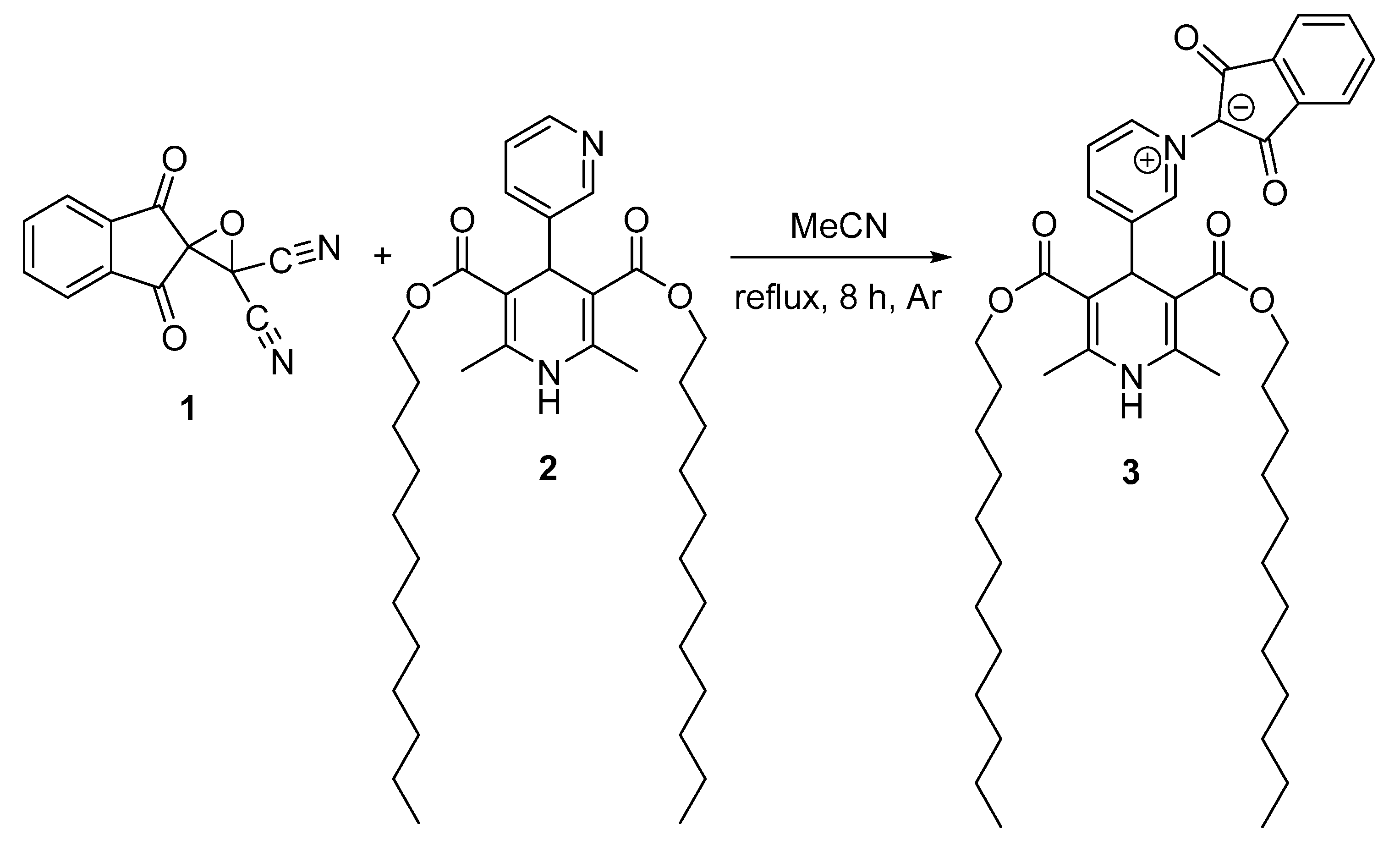
Synthesis of the target betaine 3 is described in Scheme 1. Reaction completion was monitored by TLC, after which the crude product was purified by flash chromatography.
The substrates 1 and 2 for this reaction were synthesized according to previously reported procedures. 2-(dicyanomethylidene)indan-1,3-dione oxide (1) was obtained by oxidation of 2-(dicyanomethylene)indane-1,3-dione (also known as (1,3-dioxo-1,3-dihydro-2H-inden-2-ylidene)malononitrile) with hydrogen peroxide in dioxane [14]. Didodecyl 2′,6′-dimethyl-1′,4′-dihydro-[3,4′-bipyridine]-3′,5′-dicarboxylate (2) was prepared in a Hantzsch-type reaction from dodecyl 3-oxobutanoate, 3-pyridinecarboxaldehyde and ammonium acetate under reflux in ethanol [15].
In the 1H-NMR spectrum of betaine 3, the characteristic protons of the 1,4-DHP moiety appear as a singlet at 5.11 ppm corresponding to the proton at the fourth position, and as a broad singlet at 6.97 ppm assigned to the proton of N–H group. Nitrogen quaternization leads to strong deshielding of the pyridinium ring protons, which resonate at 10.20–10.00 ppm compared with 8.52–8.31 ppm for the corresponding protons in the precursor pyridyl-1,4-DHP 2 [15], as well as deshielding of another pyridinium ring proton, observed at 7.83 ppm versus 7.58 ppm in compound 2 [15]. The aromatic protons of the indane-1,3-dione moiety appear as a multiplet in the range of 7.53–7.37 ppm overlapping with the signal of one pyridinium proton. In the UV–Vis spectrum two absorption bands at 235 nm and 386 nm were observed.
The structure of target compound 3 was successfully confirmed by spectroscopic methods, including 1H-NMR (Figure S1, Supplementary Materials), 13C-NMR (Figure S2, Supplementary Materials), 2D NMR (HSQC) (Figure S3, Supplementary Materials), UV–Vis spectrometry (Figure S6, Supplementary Materials), and HRMS data (Figure S4, Supplementary Materials). Based on HPLC data, the purity of the obtained compound 3 is >95%.

3. Materials and Methods

3.1. General Information

All reagents were purchased from BLDpharm (Karlsruhe, Germany), Sigma-Aldrich (St. Louis, MO, USA) or Merck KGaA (Darmstadt, Germany) in >97% purity and used without further purification. TLC was performed on 20 × 20 cm, silica gel 60 F254 aluminum sheets (Merck KGaA, Darmstadt, Germany). Silica gel of particle size 35–70 µm (Merck KGaA, Darmstadt, Germany) was used for column chromatography for purifications of the compounds. Flash column chromatography was accomplished using flow chromatography (Armen Instrument—Spot Flash System Interchim, Montluçon, France). 1H-NMR spectra were recorded with a Bruker Avance Neo (400 MHz) spectrometer, but 13C-NMR spectra were recorded with a Bruker Avance Neo (151 MHz) spectrometer (Bruker Biospin Gmbh, Rheinstetten, Germany). The coupling constants J are expressed in Hertz (Hz). The chemical shifts in the hydrogen and carbon atoms are presented in parts per million (ppm) and referred to the residual signals of the non-deuterated CDCl3 (δ: 7.26) solvent for 1H-NMR spectra and CDCl3 (δ: 77.2) solvent for 13C-NMR, respectively. Multiplicities are abbreviated as s = singlet; bs = broad singlet; d = doublet; t = triplet; and m = multiplet. Low-resolution mass spectra (MS) were determined on an Acquity UPLC system (Waters, Milford, MA, USA) connected to a Waters SQ detector2 operating in the electrospray ionization (ESI) positive on mode on a Waters Acquity UPLC® BEH C18 column (1.7 μm, 2.1 mm × 50 mm), using gradient elution with acetonitrile (0.01% formic acid) in water (0.01% formic acid). High-resolution mass spectra (HRMS) were determined on an Acquity UPLC system (Waters, Milford, MA, USA) connected to a Waters Synapt GII Q-ToF operating in the ESI positive ion mode on a Waters Acquity UPLC® BEH C18 column (1.7 µm, 2.1 mm × 50 mm), using gradient elution with acetonitrile (0.01% formic acid) in water (0.01% formic acid).

3.2. Synthesis

2,2-dicyanomethylideneindan-1,3-dione oxide (1) (0.6 mmol, 135 mg) was added portion wise to a stirred solution of compound 2 (0.6 mmol, 367 mg) in MeCN (50 mL) at 60 °C under an inert atmosphere (Ar). The reaction mixture was stirred under reflux for 8 h, and the progress of the reaction was monitored by TLC. After completion, the solvent was evaporated under vacuum, and the resulting residue was purified by flash chromatography using a DCM/MeOH as the eluent, with a linear gradient from 5% to 6% MeOH over 15 min. The solvent was evaporated and the residue dried under high vacuum, giving 2-(3′,5′-bis((dodecyloxy)carbonyl)-2′,6′-dimethyl-1′,4′-dihydro-[3,4′-bipyridin]-1-ium-1-yl)-1,3-dioxo-2,3-dihydro-1H-inden-2-ide (3) as a pale yellow amorphous solid (324 mg, 43%). Rf = 0.25 (EtOAc:PE = 1:1).
1H-NMR (400 MHz, CDCl3) δ 10.20 (s, 1H), 10.00 (dt, J = 6.4, 1.4 Hz, 1H), 7.83 (dt, J = 7.9, 1.4 Hz, 1H), 7.53–7.37 (m, 5H), 6.97 (bs, 1H), 5.11 (s, 1H), 4.10–4.01 (m, 4H), 2.43 (s, 6H), 1.64–1.53 (m, 4H), 1.31–1.19 (m, 36H), 0.89–0.85 (m, 6H) ppm.
13C-NMR (101 MHz, CDCl3) δ 183.3, 167.0, 147.5, 146.4, 136.8, 136.5, 135.8, 133.8, 131.8, 124.8, 119.9, 102.2, 64.7, 39.0, 32.1, 29.8, 29.8, 29.7, 29.5, 29.4, 28.9, 26.3, 22.8, 19.7, 14.3 ppm.
UV–Vis (EtOH) λmax, nm (log ε): 235 (4.50); 386 (3.96).
HRMS (TOF MS ES+): calculated [C47H66N2O6 + H] 755.4999; found 755.4985.

4. Conclusions

The lipid-like indane-1,3-dione–1,4-DHP betaine 3 was synthesized from 2,2-dicyanomethylideneindan-1,3-dione oxide (1) and didodecyl 2′,6′-dimethyl-1′,4′-dihydro-[3,4′-bipyridine]-3′,5′-dicarboxylate (2). The structure of compound 3 was confirmed by UV–Vis spectroscopy, 1H-NMR, 13C-NMR and HRMS. The synthesized betaine exhibited lipid-like behavior and may be useful for the development of liposomal delivery systems.

Supplementary Materials

The following supporting information can be downloaded at: Figure S1: 1H-NMR spectrum of 2-(3′,5′-bis((dodecyloxy)carbonyl)-2′,6′-dimethyl-1′,4′-dihydro-[3,4′-bipyridin]-1-ium-1-yl)-1,3-dioxo-2,3-dihydro-1H-inden-2-ide (3); Figure S2: 13C-NMR spectrum of 2-(3′,5′-bis((dodecyloxy)carbonyl)-2′,6′-dimethyl-1′,4′-dihydro-[3,4′-bipyridin]-1-ium-1-yl)-1,3-dioxo-2,3-dihydro-1H-inden-2-ide (3); Figure S3: 1H-13C-NMR (HSQC) spectrum of 2-(3′,5′-bis((dodecyloxy)carbonyl)-2′,6′-dimethyl-1′,4′-dihydro-[3,4′-bipyridin]-1-ium-1-yl)-1,3-dioxo-2,3-dihydro-1H-inden-2-ide (3); Figure S4: HRMS data of 2-(3′,5′-bis((dodecyloxy)carbonyl)-2′,6′-dimethyl-1′,4′-dihydro-[3,4′-bipyridin]-1-ium-1-yl)-1,3-dioxo-2,3-dihydro-1H-inden-2-ide (3); Figure S5: Low-resolution LC-MS data of 2-(3′,5′-bis((dodecyloxy)carbonyl)-2′,6′-dimethyl-1′,4′-dihydro-[3,4′-bipyridin]-1-ium-1-yl)-1,3-dioxo-2,3-dihydro-1H-inden-2-ide (3); Figure S6: UV–Vis spectra of 2-(3′,5′-bis((dodecyloxy)carbonyl)-2′,6′-dimethyl-1′,4′-dihydro-[3,4′-bipyridin]-1-ium-1-yl)-1,3-dioxo-2,3-dihydro-1H-inden-2-ide (3) solution in EtOH (0.5 mM).

Author Contributions

Conceptualization, M.P. and A.P.; methodology, M.P. and K.P.; software, K.P.; validation, M.P., A.P. and A.S.; formal analysis, M.P.; investigation, K.A. and K.P.; resources, M.P. and A.S.; data curation, K.A. and K.P.; writing—original draft preparation, A.P.; writing—review and editing, M.P. and A.S.; visualization, K.P. and K.A.; supervision, M.P. and A.P.; project administration and funding acquisition, M.P. and A.S. All authors have read and agreed to the published version of the manuscript.

Funding

This work has been supported by grant No RTU-ZG-2024/1-0009 under the EU Recovery and Resilience Facility funded project No. 5.2.1.1.i.0/2/24/I/CFLA/003 (M.P.) and the M-ERA.NET 3 project SMARTPIEZO (K.A., K.P., A.P. and A.S.).

Data Availability Statement

The data presented in this study are available in this article.

Acknowledgments

The authors are indebted to Marina Petrova for recording the NMR spectra and to Dace Žīgure for the mass spectral analyses.

Conflicts of Interest

The authors declare no conflicts of interest. The funders had no role in the design of the study; in the collection, analyses, or interpretation of data; in the writing of the manuscript; or in the decision to publish the results.

References

  1. Pigot, C.; Brunel, D.; Dumur, F. Indane-1,3-Dione: From Synthetic Strategies to Applications. Molecules 2022, 27, 5976. [Google Scholar] [CrossRef] [PubMed]
  2. Das, S. Recent Applications of 1,3-Indanedione in Organic Transformations for the Construction of Fused- and Spiro Scaffolds. Tetrahedron 2022, 122, 132954. [Google Scholar] [CrossRef]
  3. Meena, S.; Jubie, S.; Pramila, C.; Manal, T.N.A.; Gigi, S. Synthesis and Screening of Cyclic Diketone Indanedione Derivatives as Future Scaffolds for Neutrophil Elastase Inhibition. RSC Adv. 2023, 13, 11838–11852. [Google Scholar] [CrossRef]
  4. Traskovskis, K.; Kokars, V.; Tokmakovs, A.; Mihailovs, I.; Nitiss, E.; Petrova, M.; Belyakov, S.; Rutkis, M. Stereoselective Synthesis and Properties of 1,3-Bis(Dicyanomethylidene)Indane-5-Carboxylic Acid Acceptor Fragment Containing Nonlinear Optical Chromophores. J. Mater. Chem. C 2016, 4, 5019–5030. [Google Scholar] [CrossRef]
  5. Bui, T.T.; Péralta, S.; Dumur, F. Synthesis and Optical Properties of a Series of Push-Pull Dyes Based on Pyrene as the Electron Donor. Molecules 2023, 28, 1489. [Google Scholar] [CrossRef]
  6. Sun, K.; Liu, S.; Pigot, C.; Brunel, D.; Graff, B.; Nechab, M.; Gigmes, D.; Morlet-Savary, F.; Zhang, Y.; Xiao, P.; et al. Novel Push–Pull Dyes Derived from 1H-Cyclopenta[b]Naphthalene-1,3(2H)-Dione as Versatile Photoinitiators for Photopolymerization and Their Related Applications: 3d Printing and Fabrication of Photocomposites. Catalysts 2020, 10, 1196. [Google Scholar] [CrossRef]
  7. Rutkis, M.; Tokmakovs, A.; Jecs, E.; Kreicberga, J.; Kampars, V.; Kokars, V. Indanedione Based Binary Chromophore Supramolecular Systems as a NLO Active Polymer Composites. Opt. Mater. 2010, 32, 796–802. [Google Scholar] [CrossRef]
  8. Traskovskis, K.; Zarins, E.; Laipniece, L.; Tokmakovs, A.; Kokars, V.; Rutkis, M. Structure-Dependent Tuning of Electro-Optic and Thermoplastic Properties in Triphenyl Groups Containing Molecular Glasses. Mater. Chem. Phys. 2015, 155, 232–240. [Google Scholar] [CrossRef]
  9. Mozaffarnia, S.; Teimuri-Mofrad, R.; Rashidi, M.R. Design, Synthesis and Biological Evaluation of 2,3-Dihydro-5,6-Dimethoxy-1H-Inden-1-One and Piperazinium Salt Hybrid Derivatives as HAChE and HBuChE Enzyme Inhibitors. Eur. J. Med. Chem. 2020, 191, 112140. [Google Scholar] [CrossRef] [PubMed]
  10. Ling, Y.; Hao, Z.Y.; Liang, D.; Zhang, C.L.; Liu, Y.F.; Wang, Y. The Expanding Role of Pyridine and Dihydropyridine Scaffolds in Drug Design. Drug Des. Devel. Ther. 2021, 15, 4289–4338. [Google Scholar] [CrossRef] [PubMed]
  11. Kerru, N.; Gummidi, L.; Maddila, S.; Gangu, K.K.; Jonnalagadda, S.B. A Review on Recent Advances in Nitrogen-Containing Molecules and Their Biological Applications. Molecules 2020, 25, 1909. [Google Scholar] [CrossRef]
  12. Pajuste, K.; Hyvonen, Z.; Petrichenko, O.; Kaldre, D.; Rucins, M.; Cekavicus, B.; Ose, V.; Skrivele, B.; Gosteva, M.; Morin-Picardat, E.; et al. Gene Delivery Agents Possessing Antiradical Activity: Self-Assembling Cationic Amphiphilic 1,4-Dihydropyridine Derivatives. New J. Chem. 2013, 37, 3062–3075. [Google Scholar] [CrossRef]
  13. Jansone, B.; Kadish, I.; Van Groen, T.; Beitnere, U.; Moore, D.R.; Plotniece, A.; Pajuste, K.; Klusa, V. A Novel 1,4-Dihydropyridine Derivative Improves Spatial Learning and Memory and Modifies Brain Protein Expression in Wild Type and Transgenic APPSweDI Mice. PLoS ONE 2015, 10, e0127686. [Google Scholar] [CrossRef] [PubMed]
  14. Raiskuma, I.K.; Pukitis, G.G.; Neiland, O.Y. Synthesis of N-Heteroaromatic Onium Betaines of Indane-1,3-Dione. Chem. Heterocycl. Compd. 1978, 14, 714–717. [Google Scholar] [CrossRef]
  15. Kaukulis, M.; Rucins, M.; Muhamadejevs, R.; Mishnev, A.; Pajuste, K.; Plotniece, A.; Sobolev, A.; Pikun, N. Multistep Synthesis of Cationic Lipid-like Compounds Based on a Difluorotetrahydropyridine Scaffold as Amphiphilic Nanocarriers. Org. Biomol. Chem. 2025, 23, 6174–6190. [Google Scholar] [CrossRef] [PubMed]
Scheme 1. Synthesis of the target lipid-like 2-(3′,5′-bis((dodecyloxy)carbonyl)-2′,6′-dimethyl-1′,4′-dihydro-[3,4′-bipyridin]-1-ium-1-yl)-1,3-dioxo-2,3-dihydro-1H-inden-2-ide (3).
Molbank 2026 m2133 sch001
Disclaimer/Publisher’s Note: The statements, opinions and data contained in all publications are solely those of the individual author(s) and contributor(s) and not of MDPI and/or the editor(s). MDPI and/or the editor(s) disclaim responsibility for any injury to people or property resulting from any ideas, methods, instructions or products referred to in the content.