Next Article in Journal
Synthesis and Investigation of a Symmetrical Bis(methoxycarbonyl)-Substituted Rubrene Derivative
Previous Article in Journal
(Benzo[h]quinoline-κ2C,N)-[2,2′-bis(diphenylphosphino)-1,1′-binaphthalene-κ2P,P′]-platinum(II) Hexafluorophosphate
Previous Article in Special Issue
4-(4-Chlorophenyl)-6-phenyl-2-(prop-2-yn-1-yloxy)nicotinonitrile
error_outline You can access the new MDPI.com website here. Explore and share your feedback with us.
 
 
Short Note

6-((2-Oxoindolin-3-ylidene)hydrazineylidene)indolo[2,1-b]qui-nazolin-12(6H)-one

by
Elizaveta I. Samorodova
,
Anastasia R. Kovrizhina
and
Andrei I. Khlebnikov
*
Kizhner Research Center, National Research Tomsk Polytechnic University, Tomsk 634050, Russia
*
Author to whom correspondence should be addressed.
Molbank 2026, 2026(1), M2121; https://doi.org/10.3390/M2121
Submission received: 7 November 2025 / Revised: 26 December 2025 / Accepted: 5 January 2026 / Published: 6 January 2026
(This article belongs to the Collection Heterocycle Reactions)

Abstract

A novel unsymmetrical azine, 6-((2-oxoindolin-3-ylidene)hydrazineylidene)indolo[2,1-b]quinazolin-12(6H)-one, was synthesized through a condensation reaction between tryptanthrin-6-hydrazone and isatin in chloroform under reflux conditions. Structural characterization revealed the compound exists as a mixture of geometric isomers with one predominant form. Density functional theory (DFT) calculations identified the E,E configuration as the most stable isomer. The isomerization barriers for both C=N bonds were calculated at approximately 18.5 kcal/mol via nitrogen inversion. Given the established biological activities of tryptanthrin and isatin derivatives, this hybrid azine represents a promising lead compound for developing bifunctional drug candidates.

1. Introduction

Imine-functionalized heterocycles constitute a valuable class of compounds characterized by versatile reactivity and pharmacological relevance. Azines, which follow the general formula RR′C=N–N=CR″R″′ and are considered derivatives of hydrazine, serve as key representatives. Interest in these compounds is driven particularly by their therapeutic activities [1,2]. The synthesis of azines can be performed via the condensation of hydrazine with two equivalents of carbonyl compound (aldehyde or ketone) under reflux [3,4]. A complementary preparative method employs the reaction of a nucleophilic carbene with a diazoalkane [5].
The influence of substituents on conjugation within the azine core remains underexplored. A detailed investigation into their isomerism, physicochemical properties, and electronic structures is therefore essential, especially for azines incorporating pharmacologically relevant heterocycles. Tryptanthrin (indolo[2,1-b]quinazolin-6,12-dione, 1), isatin (indoline-2,3-dione, 2), and their derivatives are highly promising compounds due to their well-established biological profiles [6,7,8,9]. In this work, we have synthesized the first representative of an unsymmetrical azine linking tryptanthrin and isatin, namely 6-((2-oxoindolin-3-ylidene)hydrazineylidene)indolo[2,1-b]quinazolin-12(6H)-one, which is of interest as a potential biologically active compound that could find application in medicinal chemistry, particularly for anticancer drug development.

2. Results and Discussion

2.1. Synthesis

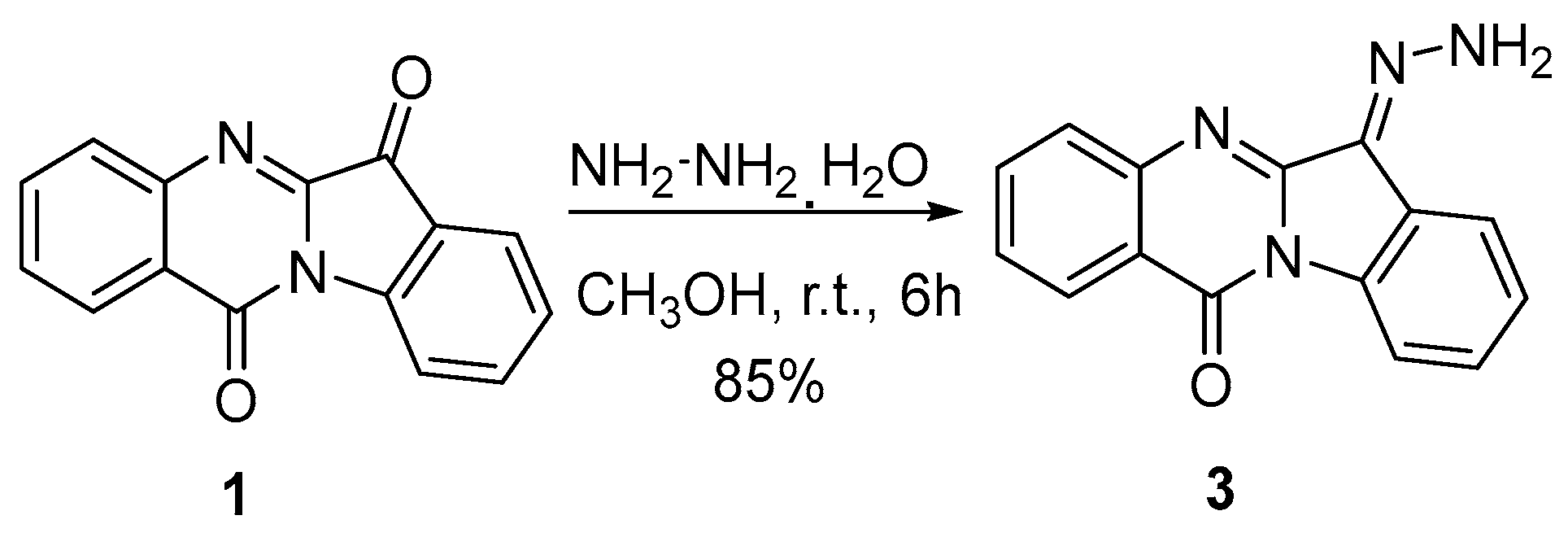
Tryptanthrin-6-hydrazone (3) was prepared beforehand via the selective nucleophilic addition of hydrazine hydrate to the more electrophilic C-6 carbonyl of tryptanthrin (1) (Scheme 1). This transformation typically involves heating of tryptanthrin with excess hydrazine hydrate in an organic solvent [10].
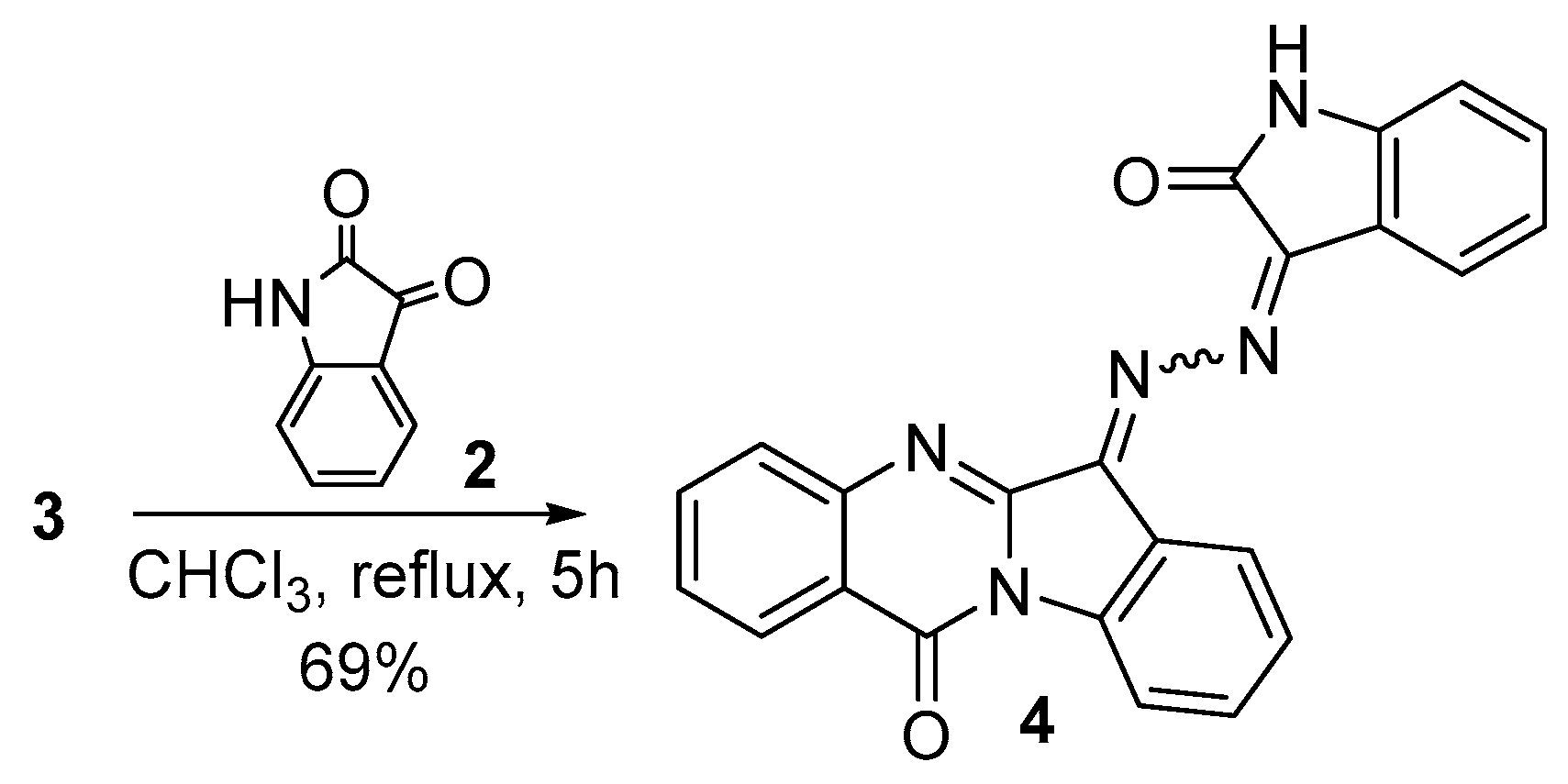
The target unsymmetrical azine 6-((2-oxoindolin-3-ylidene)hydrazineylidene)indolo[2,1-b]quinazolin-12(6H)-one (4) was prepared for the first time by condensing tryptanthrin-6-hydrazone (3) with isatin (2) under reflux in chloroform for 5 h, without added acid or base catalysts (Scheme 2). Complete conversion was monitored by TLC (hexane/EtOAc, 2:1), affording the crude brick-orange precipitate upon filtration. Final purification by silica gel column chromatography (CHCl3 eluent) provided the analytically pure product in 69% yield.

According to the NMR data (DMSO-d6), the purified compound 4 was obtained as a mixture of geometric isomers, with one being predominant. The 1H NMR spectrum revealed a minor isomer, as evidenced by an approximately 1:6 ratio of integral intensities for the low-field doublets near 8.3 and 8.5 ppm corresponding to protons in the tryptanthrin fragment. Other signals also exhibited minor counterparts (Figure S1), which could not be attributed to protons in the starting compounds. Separation of the isomers proved impossible, likely due to a relatively low energy barrier for isomerization of the carbon-nitrogen double bond [4,11] (see also the DFT results described in Section 2.2). In this context, the absence of separate 13C NMR signals for the Z/E isomers stems from rapid isomerization across a low barrier, which averages resonances on the 13C NMR timescale [12].
The main characteristics of the title compound 4 are as follows: brick-orange powder, m.p. 277–280 °C, low soluble in chloroform and DMSO.

2.2. DFT Investigation of Geometric Isomerism

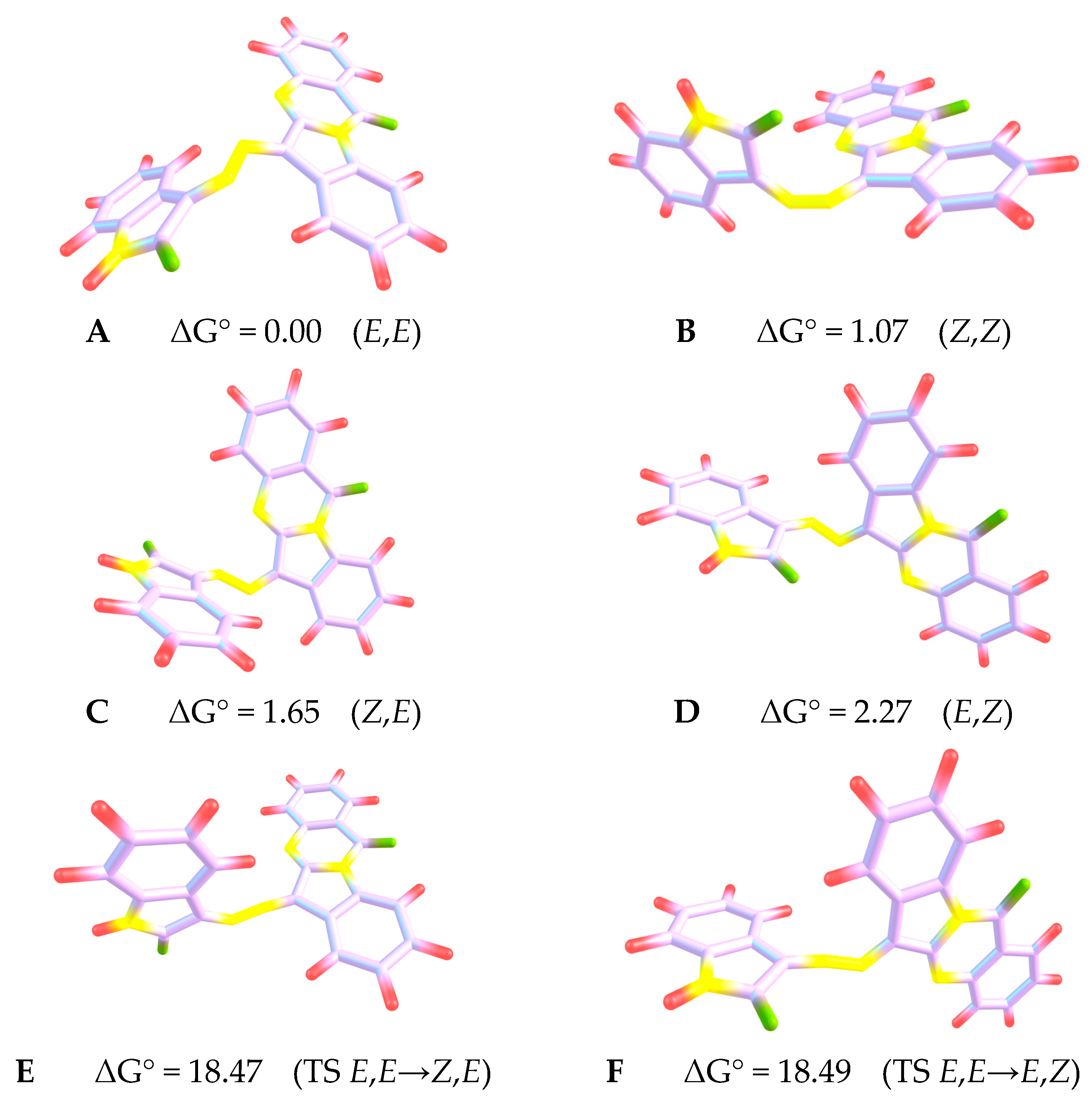
Due to the presence of two imine bonds, azines may display geometric isomerism [13]. To assess the energetic preferences among the four possible isomers of compound 4, we employed density functional theory (DFT) computations. Initial conformational exploration for each configuration (E,E; Z,Z; Z,E; E,Z) was carried out based on molecular mechanics (see Materials and Methods). Subsequent geometry optimizations were performed using the PBEh-3c method [14] followed by M06-2X/def2-TZVP refinements [15,16]. Computations revealed the E,E form as the energetically favored isomer. The relative Gibbs free energies of the Z,Z, Z,E, and E,Z structures are 1.1–2.3 kcal/mol above the energy minimum of the E,E isomer conformation (Figure 1). Notably, all the optimized structures exhibited deviations from planarity, characterized by C=N-N=C dihedral angles of 132° (E,E), 103° (Z,Z), 109° (Z,E), and 107° (E,Z).
Energy barriers for isomer interconversion were estimated using the nudged elastic band (NEB) approach [17,18] with refinement at the M06-2X/def2-TZVP level. The Gibbs free energy barriers for the E,EZ,E and E,EE,Z processes are nearly 18.5 kcal/mol (Figure 1). The mechanism of isomerization involves nitrogen atom in-plane inversion, evidenced by N-N=C bond angles of approximately 169° (tryptanthrin-adjacent) and 170° (isatin-adjacent) in the transition state structures. The calculated energy barriers are sufficiently elevated to impede rapid interconversion between the geometric isomers at ambient temperatures, thereby enabling the resolution of distinct signals for a minor isomer in the 1H NMR spectrum. Nevertheless, these barriers are of a close resemblance to the rotational energy barrier associated with the partial double-bond character of the C-N bond in acetamide [19], which allows for conformational equilibration on a longer timescale, thus rendering the isolation of pure isomers infeasible under standard laboratory conditions.

3. Materials and Methods

3.1. General

All reagents were purchased from commercial sources and used without further purification. Thin-layer chromatography (TLC) was performed on Merck plates (Merck KGaA, Darmstadt, Germany), silica gel 60, F254 with visualization under UV light (254 nm). Column chromatography was carried out using silica gel 60 (0.063–0.200 mm). LC/MS analysis was performed on an Agilent Infinity chromatograph with an AccurateMass QTOF 6530 mass detector (Santa Clara, CA, USA). Chromatographic conditions: column Zorbax EclipsePlusC18 1.8 μm, 2.1 × 50 mm; eluent H2O: ACN (85%); flow 0.2 mL/min. Ionization source: ESI in positive mode. 1H and 13C NMR spectra were recorded on a Bruker AVANCE III 400 spectrometer (Bruker corporation, Billerica, CA, USA) at 400 MHz and 100 MHz, respectively, in DMSO-d6 with TMS as the internal standard. The melting point of the synthesized compound was measured using a Melting Point Apparatus SMP30 (Cole-Parmer Instrument Company, Vernon Hills, IL, USA), heating rate 3.0 °C/min. Elemental analysis was made using a Carlo Erba analyzer (Thermo Fisher Scientific, Waltham, MA, USA). IR spectrum was recorded on a FT-IR spectrometer Agilent Cary 630 (Agilent Technologies, Santa Clara, CA, USA).

3.2. Synthesis and Characterization

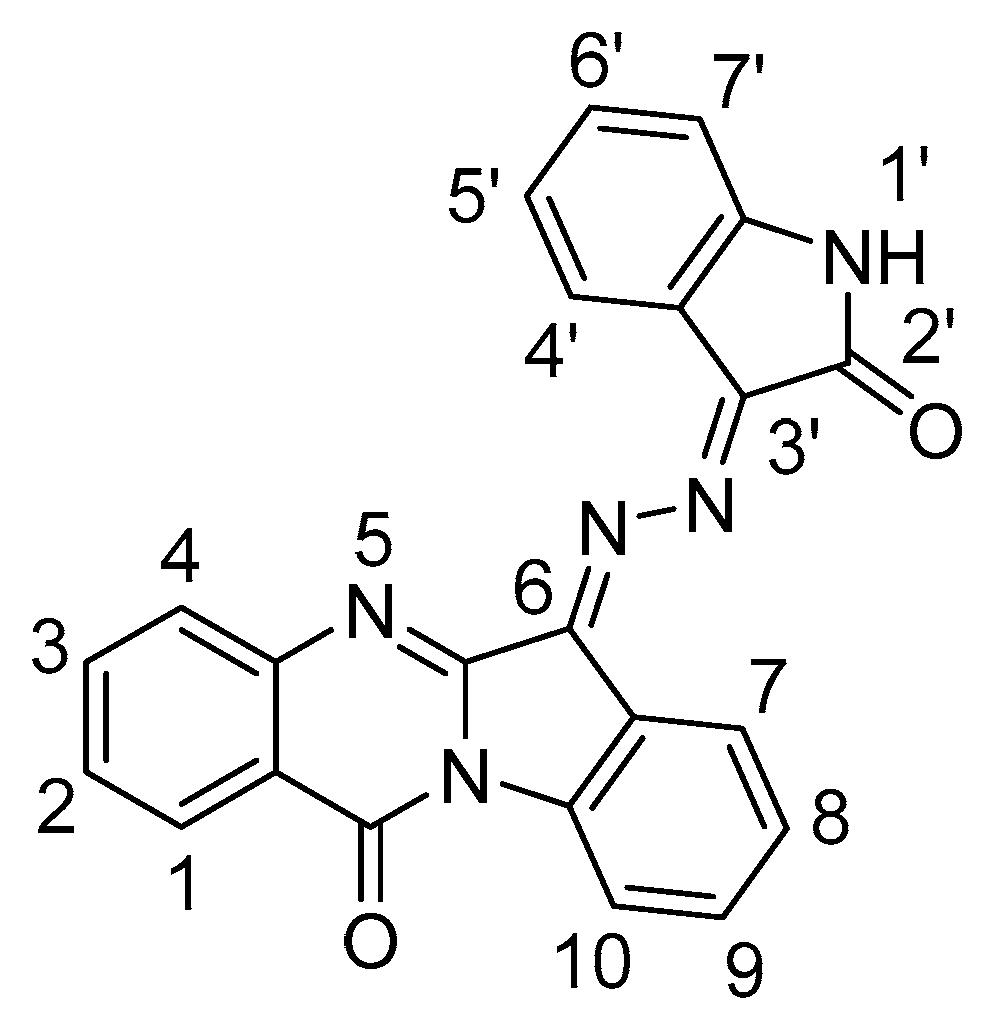
A mixture of tryptanthrin-6-hydrazone (0.1311 g, 0.5 mmol) and isatin (0.074 g, 0.5 mmol) in chloroform (50 mL) was refluxed for 5 h, with reaction progress monitored by TLC (hexane:ethyl acetate, 2:1 v/v). Upon completion, the brick-orange precipitate was filtered off, yielding the crude product (0.171 g). Purification by column chromatography (silica gel, chloroform) afforded 0.135 g (69%) of the title compound as an orange solid (m.p. 277–280 °C). 1H NMR (400 MHz, DMSO-d6): δ 6.89–7.03 (m, 2H, H-5′, H-6′), 7.34–7.40 (m, 0.25H, H-8, H-7′ of minor isomer), 7.41–7.51 (m, 1.7H, H-8, H-7′), 7.68–7.76 (m, 3H, H-2, H-9, H-4′), 7.94–8.00 (m, 3H, H-3, H-7, H-10), 8.11 (d, 0.15H, J 8 Hz, H-7 of minor isomer), 8.28 (d, 0.15H, J 8 Hz, H-4 of minor isomer), 8.35 (d, 0.85H, J 8 Hz, H-4), 8.50 (d, 0.14H, J 8 Hz, H-1 of minor isomer), 8.54 (d, 0.85H, J 8 Hz, H-1), 11.05 (s, 1H, NH) (atom numbering is shown in Scheme 3). 13C NMR (100 MHz, DMSO-d6): δ 111.1, 115.9, 116.7, 119.2, 122.2, 122.6, 126.8, 126.9, 128.5, 128.6, 128.8, 129.0, 134.2, 134.6, 135.0, 141.6, 145.4, 145.5, 147.0, 148.0, 158.4, 163.7. Elemental analysis: found, %: C, 70.32; H, 3.46; N, 17.74, C23H13N5O2, calculated, %: C, 70.58; H, 3.35; N, 17.89. IR (cm–1): 3532 ν(N-H), 1729, 1674 ν(C=O), 1636, 1606 ν(C=N), 1595 (arom.), 1157 ν(N-N). LC/MS (ESI+)—m/z: 392.1153 experimental ([C23H13N5O2 + H]+ = 392.1148 theor.).
The 1H NMR and 13C NMR spectra are shown in Figures S1 and S2. The IR spectrum is presented in Figure S3.

3.3. Computational Details

Conformational searches for compound 4 were conducted using the GFN-FF force field [20] with the GOAT algorithm [21] in ORCA software [22] (version 6.1.0). Additional searches were performed with VConf 2.0 program (VeraChem, LLC, Germantown, MD, USA). Both methods overcame stereochemical constraints and generated conformational ensembles for all the four geometric isomers. Up to 25 low-energy conformers from the combined ensembles were optimized with the PBEh-3c composite DFT method [14]. The lowest-energy conformer for each isomer was subsequently refined at the M06-2X/def2-TZVP level in the gas phase. Transition states for Z,E isomerization were located using the climbing image nudged elastic band (CI-NEB-zoom) technique with HF-3c energy evaluations [23] in ORCA 6.1.0 and refined similarly to the geometric isomers. The nature of all stationary points was confirmed by vibrational frequency analysis.

4. Conclusions

In summary, we have synthesized the novel unsymmetrical azine 6-((2-oxoindolin-3-ylidene)hydrazineylidene)indolo[2,1-b]quinazolin-12(6H)-one through a straightforward condensation reaction between tryptanthrin-6-hydrazone and isatin, achieving high yield and purity. This compound represents the first reported hybrid linking the tryptanthrin and isatin scaffolds via an azine bridge, expanding the chemical diversity of such pharmacologically relevant heterocycles [8]. Structural characterization confirmed its identity as a mixture of geometric isomers with one predominant form, while DFT calculations elucidated the geometric isomerism, identifying the E,E configuration as the most stable with noticeable energy differences (1.1–2.3 kcal/mol) among alternatives. The calculated isomerization barriers (~18.5 kcal/mol) via nitrogen inversion highlight challenges in the isomer separation, consistent with behaviors observed in related imine systems [13]. Given the established pharmacological potentials of tryptanthrin and isatin derivatives, this azine is promising as a lead for developing bifunctional agents targeting cancer pathways.

Supplementary Materials

The following are available online. Figure S1: The 1H NMR spectrum of compound 4; Figure S2: The 13C NMR spectrum of compound 4; Figure S3: The IR spectrum of compound 4. Files: ORCA 6.1.0 output files for four geometric isomers of the title compound and transition states of the E,Z-isomerizations.

Author Contributions

Conceptualization was conducted by A.R.K. and A.I.K.; methodology and experimental work were conducted by E.I.S.; data analysis, writing and editing of the paper were conducted by E.I.S., A.R.K. and A.I.K.; project administration and supervision was conducted by A.I.K. All authors have read and agreed to the published version of the manuscript.

Funding

The synthesis and characterization of compound 4 was funded by the Russian Science Foundation (grant No. 24-15-00334).

Data Availability Statement

The original contributions presented in this study are included in the article and Supplementary Material. Further inquiries can be directed to the corresponding author.

Acknowledgments

The computational investigation of E,Z-isomerization was supported by the Ministry of Science and Higher Education of the Russian Federation (project No. FSWW-2023-0008).

Conflicts of Interest

The authors declare no conflicts of interest.

References

  1. Almutairi, F.M.; Ali, A.G.; Abdelhamid, A.O.; Alalawy, A.I.; Bishr, M.K.; Mohamed, M.S. The Identification of a Novel Unsymmetrical Azine as an Apoptosis Inducer in Colorectal Cancer. Anticancer Agents Med. Chem. 2021, 21, 406–413. [Google Scholar] [CrossRef] [PubMed]
  2. Sundberg, R.J.; Dahlhausen, D.J.; Manikumar, G.; Mavunkel, B.; Biswas, A.; Srinivasan, V.; Musallam, H.A.; Reid, W.A., Jr.; Ager, A.L. Cationic antiprotozoal drugs. Trypanocidal activity of 2-(4′-formylphenyl)imidazo[1,2-a]pyridinium guanylhydrazones and related derivatives of quaternary heteroaromatic compounds. J. Med. Chem. 1990, 33, 298–307. [Google Scholar] [CrossRef] [PubMed]
  3. Chourasiya, S.S.; Kathuria, D.; Wani, A.A.; Bharatam, P.V. Azines: Synthesis, structure, electronic structure and their applications. Org. Biomol. Chem. 2019, 17, 8486–8521. [Google Scholar] [CrossRef] [PubMed]
  4. Kovrizhina, A.R.; Samorodova, E.I.; Khlebnikov, A.I. 11H-Indeno[1,2-b]quinoxalin-11-one 2-(4-ethylbenzylidene)hydrazone. Molbank 2021, 2021, M1299. [Google Scholar] [CrossRef]
  5. Hopkins, J.M.; Bowdridge, M.; Robertson, K.N.; Cameron, T.S.; Jenkins, H.A.; Clyburne, J.A. Generation of azines by the reaction of a nucleophilic carbene with diazoalkanes: A synthetic and crystallographic study. J. Org. Chem. 2001, 66, 5713–5716. [Google Scholar] [CrossRef] [PubMed]
  6. Zhou, X. Recent advances of tryptanthrin and its derivatives as potential anticancer agents. RSC Med. Chem. 2024, 15, 1127–1147. [Google Scholar] [CrossRef] [PubMed] [PubMed Central]
  7. Yu, S.T.; Chern, J.W.; Chen, T.M.; Chiu, Y.F.; Chen, H.T.; Chen, Y.H. Cytotoxicity and reversal of multidrug resistance by tryptanthrin-derived indoloquinazolines. Acta Pharmacol. Sin. 2010, 31, 259–264. [Google Scholar] [CrossRef] [PubMed] [PubMed Central]
  8. Cheke, R.S.; Patil, V.M.; Firke, S.D.; Ambhore, J.P.; Ansari, I.A.; Patel, H.M.; Shinde, S.D.; Pasupuleti, V.R.; Hassan, M.I.; Adnan, M.; et al. Therapeutic Outcomes of Isatin and Its Derivatives against Multiple Diseases: Recent Developments in Drug Discovery. Pharmaceuticals 2022, 15, 272. [Google Scholar] [CrossRef] [PubMed] [PubMed Central]
  9. Ding, Z.; Zhou, M.; Zeng, C. Recent advances in isatin hybrids as potential anticancer agents. Arch. Pharm. 2020, 353, 1900367. [Google Scholar] [CrossRef] [PubMed]
  10. Rajan, S.; Rajendar, G.; Lankalapalli, R.S. Synthetic diversification of tryptanthrin through its C6-hydrazone. Tetrahedron Lett. 2023, 129, 154752. [Google Scholar] [CrossRef]
  11. Warren, C.H.; Wettermark, G.; Weiss, K. Cis-trans isomerization about the carbon-nitrogen double bond. Structures of the isomers of N-benzylideneaniline. J. Am. Chem. Soc. 1971, 93, 4658–4663. [Google Scholar]
  12. Bain, A.D. Chemical exchange in NMR. Prog. Nucl. Magn. Reson. Spectrosc. 2003, 43, 63–103. [Google Scholar] [CrossRef]
  13. Dugave, C.; Demange, L. cis-trans isomerization of organic molecules and biomolecules: Implications and applications. Chem. Rev. 2003, 103, 2475–2532. [Google Scholar] [CrossRef] [PubMed]
  14. Grimme, S.; Brandenburg, J.G.; Bannwarth, C.; Hansen, A. Consistent structures and interactions by density functional theory with small atomic orbital basis sets. J. Chem. Phys. 2015, 143, 054107. [Google Scholar] [CrossRef] [PubMed]
  15. Zhao, Y.; Truhlar, D.G. The M06 suite of density functionals for main group thermochemistry, thermochemical kinetics, noncovalent interactions, excited states, and transition elements: Two new functionals and systematic testing of four M06-class functionals and 12 other functionals. Theor. Chem. Acc. 2008, 120, 215–241. [Google Scholar] [CrossRef]
  16. Weigend, F.; Ahlrichs, R. Balanced basis sets of split valence, triple zeta valence and quadruple zeta valence quality for H to Rn: Design and assessment of accuracy. Phys. Chem. Chem. Phys. 2005, 7, 3297–3305. [Google Scholar] [CrossRef]
  17. Henkelman, G.; Jónsson, H. Improved tangent estimate in the nudged elastic band method for finding minimum energy paths and saddle points. J. Chem. Phys. 2008, 113, 9978–9985. [Google Scholar] [CrossRef]
  18. Ásgeirsson, V.; Birgisson, B.O.; Bjornsson, R.; Becker, U.; Neese, F.; Riplinger, C.; Jónsson, H. Nudged Elastic Band Method for Molecular Reactions Using Energy-Weighted Springs Combined with Eigenvector Following. J. Chem. Theory Comput. 2021, 17, 4929–4945. [Google Scholar] [CrossRef] [PubMed]
  19. Jasien, P.G.; Stevens, W.G.; Krauss, M. Ab initio calculations of the rotational barriers in formamide and acetamide. The effects of polarization functions and correlation. J. Mol. Struct. THEOCHEM 1986, 139, 197–206. [Google Scholar] [CrossRef]
  20. Spicher, S.; Grimme, S. Robust Atomistic Modeling of Materials, Organometallic, and Biochemical Systems. Angew. Chem. Int. Ed. Engl. 2020, 59, 15665–15673. [Google Scholar] [CrossRef]
  21. de Souza, B. GOAT: A Global Optimization Algorithm for Molecules and Atomic Clusters. Angew. Chem. Int. Ed. Engl. 2025, 64, E202500393. [Google Scholar] [CrossRef] [PubMed]
  22. Neese, F. Software Update: The ORCA Program System—Version 6.0. Wiley Interdiscip. Rev. Comput. Mol. Sci. 2025, 15, e70019. [Google Scholar] [CrossRef]
  23. Sure, R.; Grimme, S. Corrected small basis set Hartree-Fock method for large systems. J. Comput. Chem. 2013, 34, 1672–1685. [Google Scholar] [CrossRef] [PubMed]
Scheme 1. Synthesis of compound 3.
Molbank 2026 m2121 sch001
Scheme 2. Synthesis of the title compound 4 (mixture of isomers).
Molbank 2026 m2121 sch002
Figure 1. The geometric isomers of compound 4 (Panels AD) and transition states of Z,E-isomerization (Panels E,F) optimized at M06-2X/def2-TZVP level. The relative Gibbs free energies at 298 K are presented in kcal/mol. Carbon, nitrogen, oxygen, and hydrogen atoms are shown as pink, yellow, green, and red tubes, respectively.
Molbank 2026 m2121 g001
Scheme 3. Atom numbering for NMR assignments in molecule 4.
Molbank 2026 m2121 sch003
Disclaimer/Publisher’s Note: The statements, opinions and data contained in all publications are solely those of the individual author(s) and contributor(s) and not of MDPI and/or the editor(s). MDPI and/or the editor(s) disclaim responsibility for any injury to people or property resulting from any ideas, methods, instructions or products referred to in the content.