

Exploring EBNA3C Genetic Variability and Recombination in Epstein–Barr Virus-Associated Cancers
 , , and
Abstract
1. Introduction
2. Results
2.1. EBNA3C Sequences Metadata
2.2. Recombination Rates and Recombination-Induced Motifs Distribution in the EBNA3C Gene
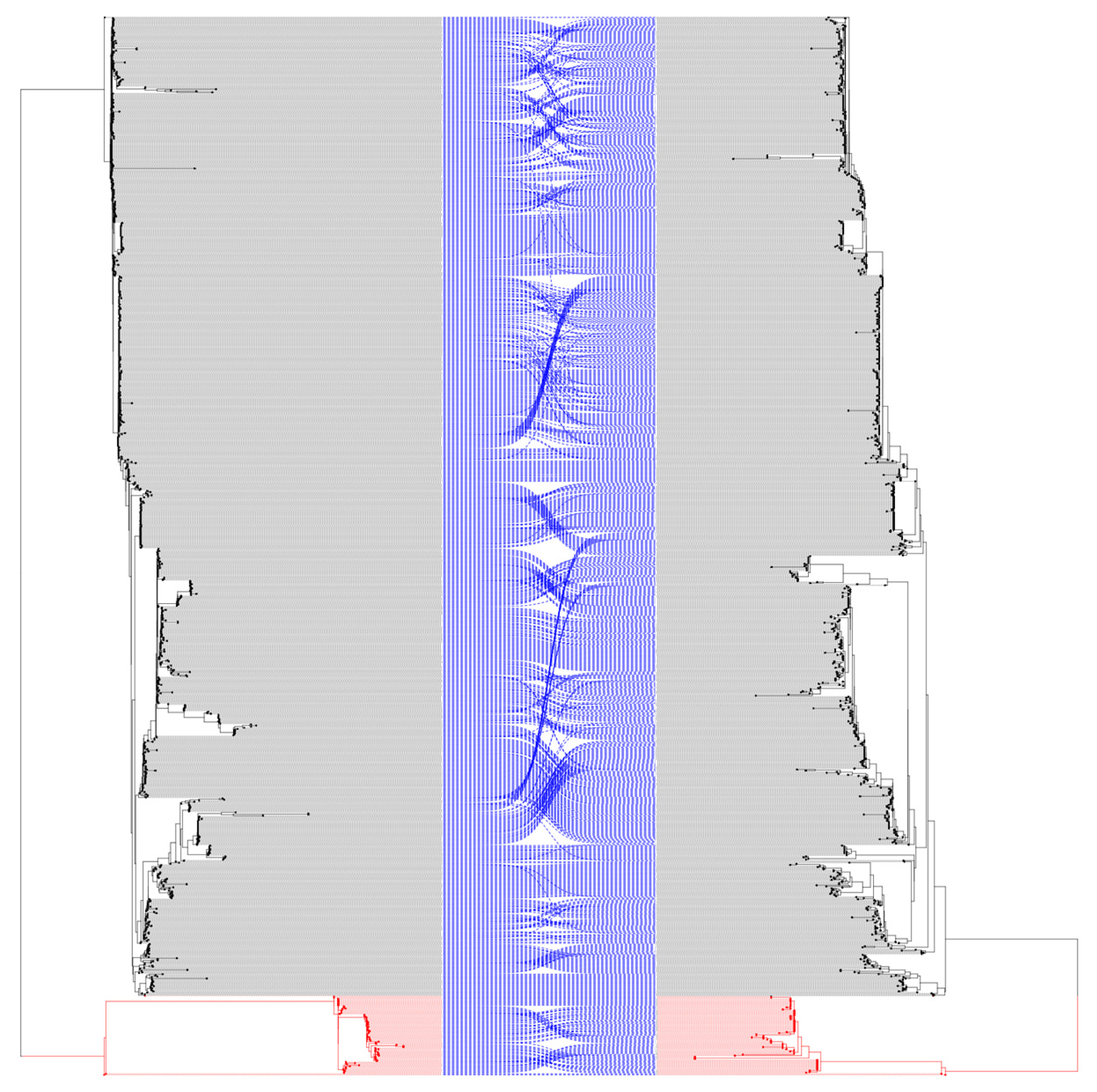
2.3. Phylogenetic Reconstruction of EBNA3C
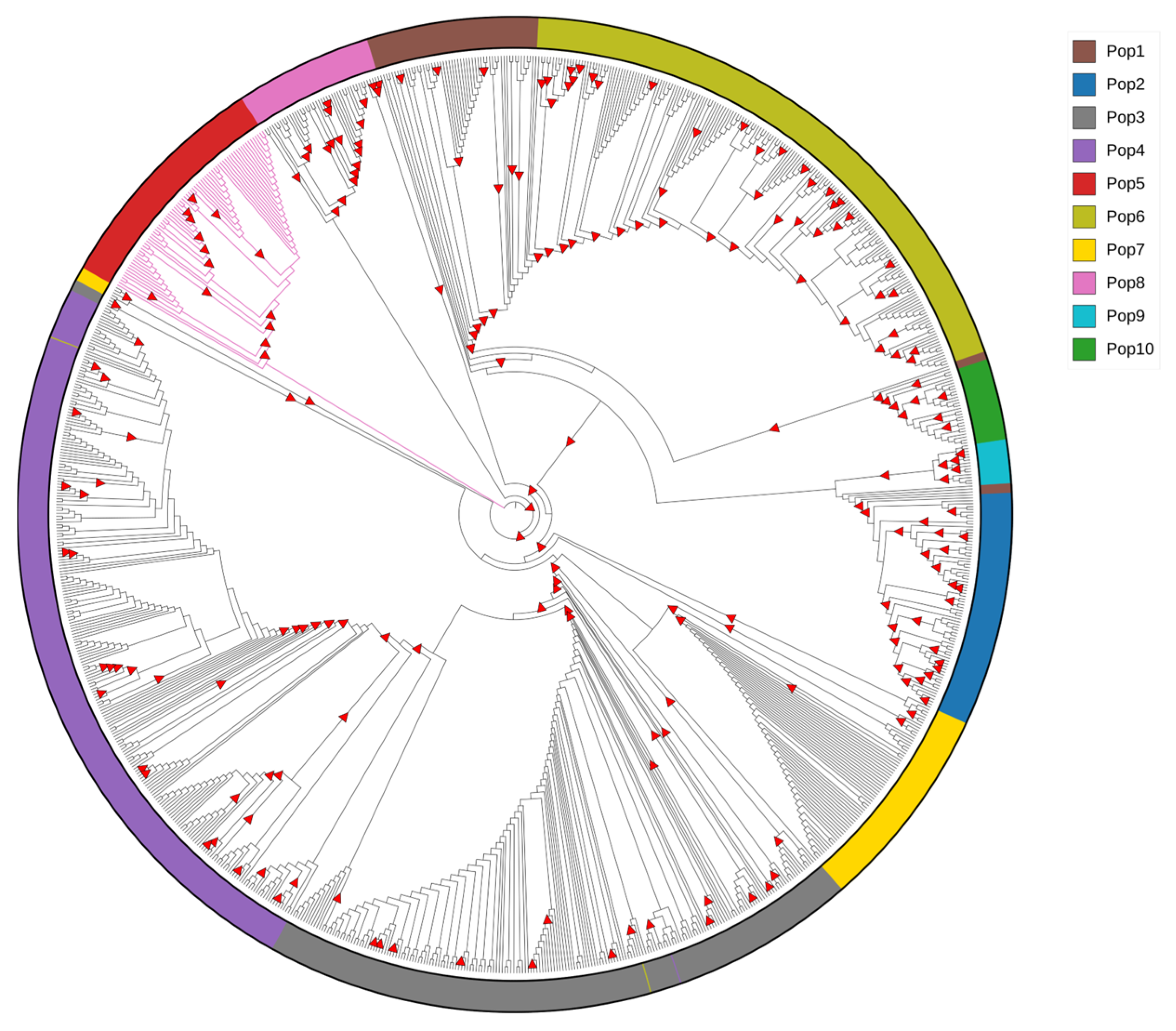
2.4. EBNA3C Phylopopulations Estimation
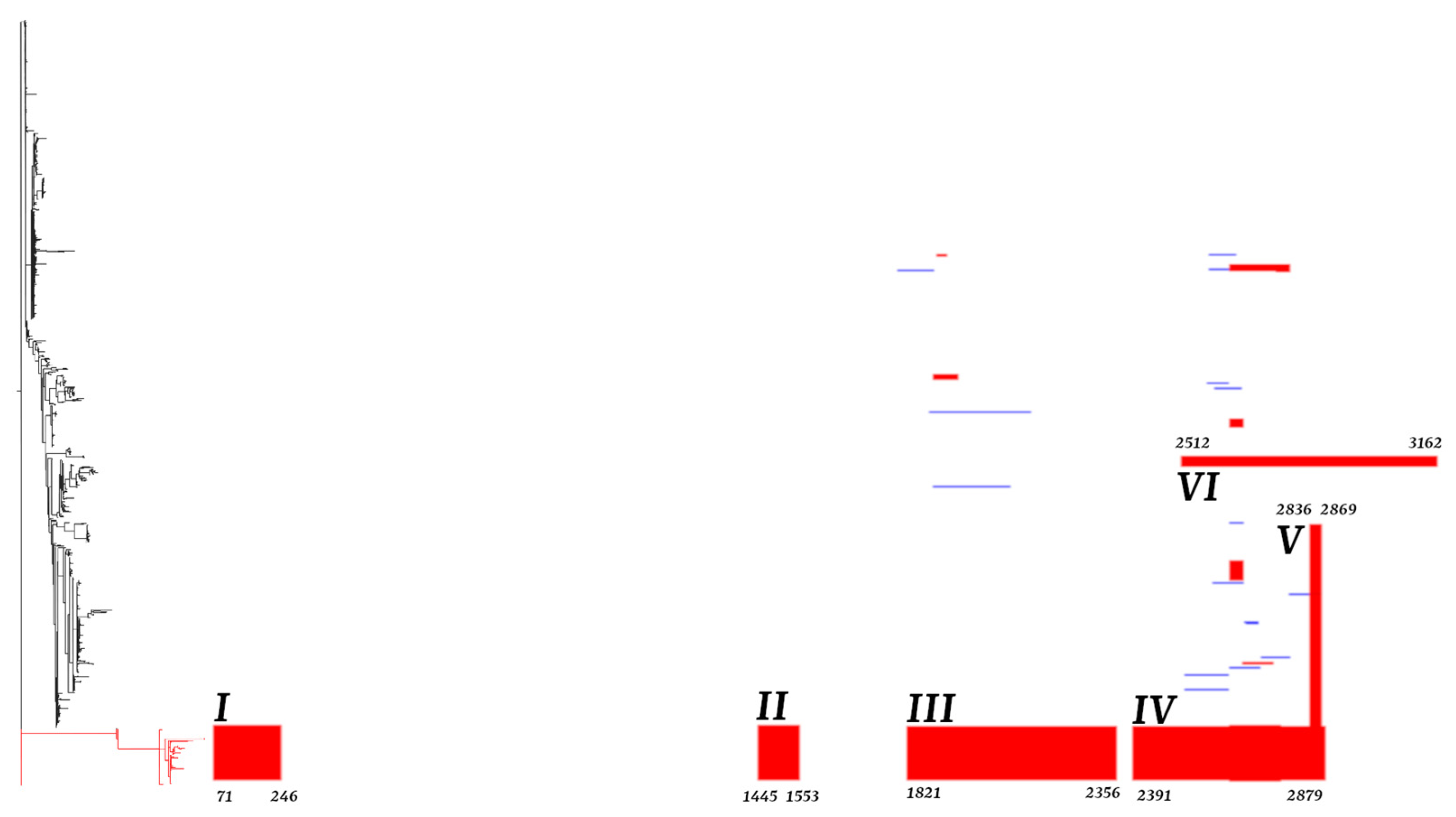
2.5. Identification of Putative Recombinant Regions in EBNA3C
2.6. EBNA3C Sequence Variation Context
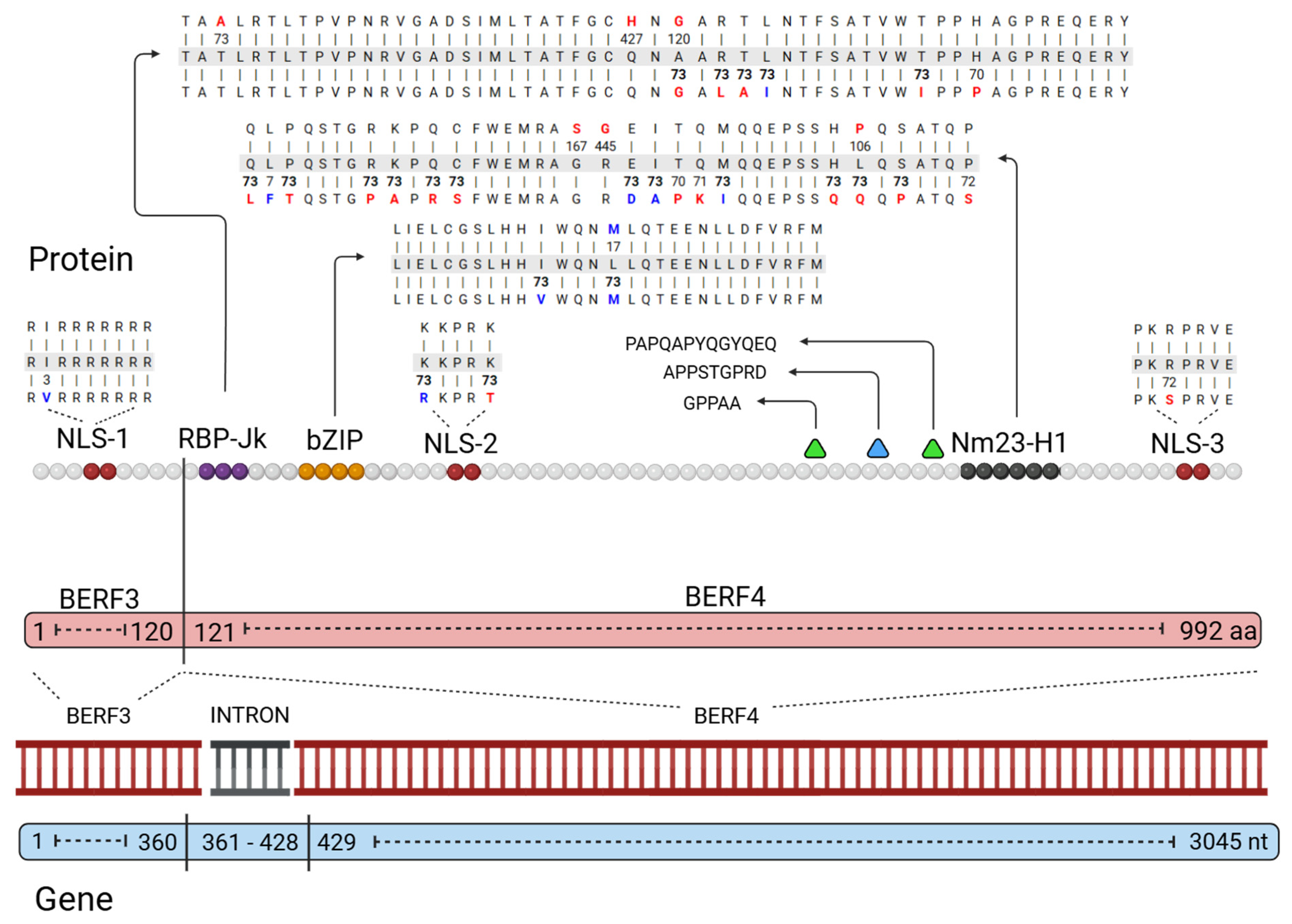
2.7. Variations in EBNA3C Functional Motifs
2.8. Variability of Epitopes Among EBNA3C
2.9. Geographic and Clinical Associations of EBNA3C Mutations
3. Discussion
4. Materials and Methods
4.1. EBNA3C Recovery
4.2. Annotation of EBNA3C Motifs
4.3. Recombination Analysis
4.4. Phylogenetic Reconstructions and Identification of Population Groups
4.5. Statistical Analysis
5. Conclusions
Supplementary Materials
Author Contributions
Funding
Institutional Review Board Statement
Informed Consent Statement
Data Availability Statement
Conflicts of Interest
References
- Zanella, L.; Riquelme, I.; Buchegger, K.; Abanto, M.; Ili, C.; Brebi, P. A Reliable Epstein-Barr Virus Classification Based on Phylogenomic and Population Analyses. Sci. Rep. 2019, 9, 9829. [Google Scholar] [CrossRef] [Scilit]
- Nilsson, K.; Klein, G.; Henle, W.; Henle, G. The Establishment of Lymphoblastoid Lines from Adult and Fetal Human Lymphoid Tissue and Its Dependence on EBV. Int. J. Cancer 1971, 8, 443–450. [Google Scholar] [CrossRef] [Scilit] [PubMed]
- Peng, R.; Gordadze, A.V.; Fuentes Pananá, E.M.; Wang, F.; Zong, J.; Hayward, G.S.; Tan, J.; Ling, P.D. Sequence and Functional Analysis of EBNA-LP and EBNA2 Proteins from Nonhuman Primate Lymphocryptoviruses. J. Virol. 2000, 74, 379–389. [Google Scholar] [CrossRef] [Scilit] [PubMed]
- Zanella, L.; Reyes, M.E.; Riquelme, I.; Abanto, M.; León, D.; Viscarra, T.; Ili, C.; Brebi, P. Genetic Patterns Found in the Nuclear Localization Signals (NLSs) Associated with EBV-1 and EBV-2 Provide New Insights into Their Contribution to Different Cell-Type Specificities. Cancers 2021, 13, 2569. [Google Scholar] [CrossRef] [Scilit]
- Tomkinson, B.; Robertson, E.; Yalamanchili, R.; Longnecker, R.; Kieff, E. Epstein-Barr Virus Recombinants from Overlapping Cosmid Fragments. J. Virol. 1993, 67, 7298–7306. [Google Scholar] [CrossRef] [Scilit] [PubMed]
- Hertle, M.L.; Popp, C.; Petermann, S.; Maier, S.; Kremmer, E.; Lang, R.; Mages, J.; Kempkes, B. Differential Gene Expression Patterns of EBV Infected EBNA-3A Positive and Negative Human B Lymphocytes. PLoS Pathog. 2009, 5, e1000506. [Google Scholar] [CrossRef] [Scilit]
- Yenamandra, S.P.; Sompallae, R.; Klein, G.; Kashuba, E. Comparative Analysis of the Epstein-Barr Virus Encoded Nuclear Proteins of EBNA-3 Family. Comput. Biol. Med. 2009, 39, 1036–1042. [Google Scholar] [CrossRef] [Scilit]
- Chen, A.; DiVisconte, M.; Jiang, X.; Quink, C.; Wang, F. Epstein-Barr Virus with the Latent Infection Nuclear Antigen 3B Completely Deleted Is Still Competent for B-Cell Growth Transformation In Vitro. J. Virol. 2005, 79, 4506–4509. [Google Scholar] [CrossRef] [Scilit]
- Knight, J.S.; Lan, K.; Subramanian, C.; Robertson, E.S. Epstein-Barr Virus Nuclear Antigen 3C Recruits Histone Deacetylase Activity and Associates with the Corepressors MSin3A and NCoR in Human B-Cell Lines. J. Virol. 2003, 77, 4261–4272. [Google Scholar] [CrossRef] [Scilit]
- Allday, M.J.; Crawford, D.H.; Griffin, B.E. Prediction and Demonstration of a Novel Epstein-Barr Virus Nuclear Antigen. Nucleic Acids Res. 1988, 16, 4353–4367. [Google Scholar] [CrossRef] [Scilit]
- Petti, L.; Sample, J.; Wang, F.; Kieff, E. A Fifth Epstein-Barr Virus Nuclear Protein (EBNA3C) Is Expressed in Latently Infected Growth-Transformed Lymphocytes. J. Virol. 1988, 62, 1330–1338. [Google Scholar] [CrossRef] [Scilit]
- Lu, J.; Wu, T.; Zhang, B.; Liu, S.; Song, W.; Qiao, J.; Ruan, H. Types of Nuclear Localization Signals and Mechanisms of Protein Import into the Nucleus. Cell Commun. Signal. 2021, 19, 60. [Google Scholar] [CrossRef] [Scilit]
- Krauer, K.; Buck, M.; Flanagan, J.; Belzer, D.; Sculley, T. Identification of the Nuclear Localization Signals within the Epstein-Barr Virus EBNA-6 Protein. J. Gen. Virol. 2004, 85, 165–172. [Google Scholar] [CrossRef] [Scilit]
- West, M. Structure and Function of the Epstein-Barr Virus Transcription Factor, EBNA 3C. Curr. Protein Pept. Sci. 2006, 7, 123–136. [Google Scholar] [CrossRef] [Scilit]
- Saha, A.; Murakami, M.; Kumar, P.; Bajaj, B.; Sims, K.; Robertson, E.S. Epstein-Barr Virus Nuclear Antigen 3C Augments Mdm2-Mediated P53 Ubiquitination and Degradation by Deubiquitinating Mdm2. J. Virol. 2009, 83, 4652–4669. [Google Scholar] [CrossRef] [Scilit]
- Jha, H.C.; Lu, J.; Saha, A.; Cai, Q.; Banerjee, S.; Prasad, M.A.J.; Robertson, E.S. EBNA3C-Mediated Regulation of Aurora Kinase B Contributes to Epstein-Barr Virus-Induced B-Cell Proliferation through Modulation of the Activities of the Retinoblastoma Protein and Apoptotic Caspases. J. Virol. 2013, 87, 12121–12138. [Google Scholar] [CrossRef] [Scilit] [PubMed]
- Bajaj, B.G.; Murakami, M.; Cai, Q.; Verma, S.C.; Lan, K.; Robertson, E.S. Epstein-Barr Virus Nuclear Antigen 3C Interacts with and Enhances the Stability of the c-Myc Oncoprotein. J. Virol. 2008, 82, 4082–4090. [Google Scholar] [CrossRef] [Scilit]
- Rosendorff, A.; Illanes, D.; David, G.; Lin, J.; Kieff, E.; Johannsen, E. EBNA3C Coactivation with EBNA2 Requires a SUMO Homology Domain. J. Virol. 2004, 78, 367–377. [Google Scholar] [CrossRef] [Scilit] [PubMed]
- Yan, X.; Mouillet, J.-F.; Ou, Q.; Sadovsky, Y. A Novel Domain within the DEAD-Box Protein DP103 Is Essential for Transcriptional Repression and Helicase Activity. Mol. Cell Biol. 2003, 23, 414–423. [Google Scholar] [CrossRef] [Scilit] [PubMed]
- Subramanian, C.; Hasan, S.; Rowe, M.; Hottiger, M.; Orre, R.; Robertson, E.S. Epstein-Barr Virus Nuclear Antigen 3C and Prothymosin Alpha Interact with the P300 Transcriptional Coactivator at the CH1 and CH3/HAT Domains and Cooperate in Regulation of Transcription and Histone Acetylation. J. Virol. 2002, 76, 4699–4708. [Google Scholar] [CrossRef] [Scilit]
- Yi, F.; Saha, A.; Murakami, M.; Kumar, P.; Knight, J.S.; Cai, Q.; Choudhuri, T.; Robertson, E.S. Epstein-Barr Virus Nuclear Antigen 3C Targets P53 and Modulates Its Transcriptional and Apoptotic Activities. Virology 2009, 388, 236–247. [Google Scholar] [CrossRef] [Scilit]
- Lee, S.; Sakakibara, S.; Maruo, S.; Zhao, B.; Calderwood, M.A.; Holthaus, A.M.; Lai, C.-Y.; Takada, K.; Kieff, E.; Johannsen, E. Epstein-Barr Virus Nuclear Protein 3C Domains Necessary for Lymphoblastoid Cell Growth: Interaction with RBP-Jκ Regulates TCL1. J. Virol. 2009, 83, 12368–12377. [Google Scholar] [CrossRef] [Scilit]
- Saha, A.; Bamidele, A.; Murakami, M.; Robertson, E.S. EBNA3C Attenuates the Function of P53 through Interaction with Inhibitor of Growth Family Proteins 4 and 5. J. Virol. 2011, 85, 2079–2088. [Google Scholar] [CrossRef] [Scilit]
- Pandey, S.; Robertson, E.S. Oncogenic Epstein–Barr Virus Recruits Nm23-H1 to Regulate Chromatin Modifiers. Lab. Investig. 2018, 98, 258–268. [Google Scholar] [CrossRef] [Scilit]
- Subramanian, C.; Robertson, E.S. The Metastatic Suppressor Nm23-H1 Interacts with EBNA3C at Sequences Located between the Glutamine- and Proline-Rich Domains and Can Cooperate in Activation of Transcription. J. Virol. 2002, 76, 8702–8709. [Google Scholar] [CrossRef] [Scilit]
- Sawada, K.; Yamamoto, M.; Tabata, T.; Smith, M.; Tanaka, A.; Nonoyama, M. Expression of EBNA-3 Family in Fresh B Lymphocytes Infected with Epstein-Barr Virus. Virology 1989, 168, 22–30. [Google Scholar] [CrossRef] [Scilit]
- Briercheck, E.L.; Ravishankar, S.; Ahmed, E.H.; Carías Alvarado, C.C.; Barrios Menéndez, J.C.; Silva, O.; Solórzano-Ortiz, E.; Siliézar Tala, M.M.; Stevenson, P.; Xu, Y.; et al. Geographic EBV Variants Confound Disease-Specific Variant Interpretation and Predict Variable Immune Therapy Responses. Blood Adv. 2024, 8, 3731–3744. [Google Scholar] [CrossRef] [Scilit]
- Hirabayashi, M.; Georges, D.; Clifford, G.M.; de Martel, C. Estimating the Global Burden of Epstein-Barr Virus–Associated Gastric Cancer: A Systematic Review and Meta-Analysis. Clin. Gastroenterol. Hepatol. 2023, 21, 922–930.e21. [Google Scholar] [CrossRef] [Scilit]
- Lucchesi, W.; Brady, G.; Dittrich-Breiholz, O.; Kracht, M.; Russ, R.; Farrell, P.J. Differential Gene Regulation by Epstein-Barr Virus Type 1 and Type 2 EBNA2. J. Virol. 2008, 82, 7456–7466. [Google Scholar] [CrossRef] [Scilit]
- Chang, C.M.; Yu, K.J.; Mbulaiteye, S.M.; Hildesheim, A.; Bhatia, K. The Extent of Genetic Diversity of Epstein-Barr Virus and Its Geographic and Disease Patterns: A Need for Reappraisal. Virus Res. 2009, 143, 209–221. [Google Scholar] [CrossRef] [Scilit]
- Chabay, P.; De Matteo, E.; Merediz, A.; Preciado, M. V High Frequency of Epstein Barr Virus Latent Membrane Protein-1 30 Bp Deletion in a Series of Pediatric Malignancies in Argentina. Arch. Virol. 2004, 149, 1515–1526. [Google Scholar] [CrossRef] [Scilit]
- Correa, R.M.; Fellner, M.D.; Alonio, L.V.; Durand, K.; Teyssié, A.R.; Picconi, M.A. Epstein-Barr Virus (EBV) in Healthy Carriers: Distribution of Genotypes and 30 Bp Deletion in Latent Membrane Protein-1 (LMP-1) Oncogene. J. Med. Virol. 2004, 73, 583–588. [Google Scholar] [CrossRef] [Scilit]
- Arturo-Terranova, D.; Giraldo-Ocampo, S.; Castillo, A. Caracterización Molecular de Las Variantes Del Virus de Epstein-Barr Detectadas En La Cavidad Oral de Adolescentes de Cali, Colombia. Biomédica 2020, 40, 76–88. [Google Scholar] [CrossRef] [Scilit]
- Zimber, U.; Adldinger, H.K.; Lenoir, G.M.; Vuillaume, M.; Knebel-Doeberitz, M.V.; Laux, G.; Desgranges, C.; Wittmann, P.; Freese, U.-K.; Schneider, U.; et al. Geographical Prevalence of Two Types of Epstein-Barr Virus. Virology 1986, 154, 56–66. [Google Scholar] [CrossRef] [Scilit]
- Berenstein, A.J.; Lorenzetti, M.A.; Preciado, M.V. Recombination Rates along the Entire Epstein Barr Virus Genome Display a Highly Heterogeneous Landscape. Infect. Genet. Evol. 2018, 65, 96–103. [Google Scholar] [CrossRef] [Scilit]
- Palser, A.L.; Grayson, N.E.; White, R.E.; Corton, C.; Correia, S.; Ba, M.; Watson, S.J.; Cotten, M.; Arrand, J.R.; Murray, P.G.; et al. Genome Diversity of Epstein-Barr Virus from Multiple Tumor Types and Normal Infection. J. Virol. 2015, 89, 5222–5237. [Google Scholar] [CrossRef] [Scilit]
- Norberg, P.; Kasubi, M.J.; Haarr, L.; Bergström, T.; Liljeqvist, J.-A. Divergence and Recombination of Clinical Herpes Simplex Virus Type 2 Isolates. J. Virol. 2007, 81, 13158–13167. [Google Scholar] [CrossRef] [Scilit]
- Szpara, M.L.; Gatherer, D.; Ochoa, A.; Greenbaum, B.; Dolan, A.; Bowden, R.J.; Enquist, L.W.; Legendre, M.; Davison, A.J. Evolution and Diversity in Human Herpes Simplex Virus Genomes. J. Virol. 2014, 88, 1209–1227. [Google Scholar] [CrossRef] [Scilit]
- Houldcroft, C.J. Human Herpesvirus Sequencing in the Genomic Era: The Growing Ranks of the Herpetic Legion. Pathogens 2019, 8, 186. [Google Scholar] [CrossRef] [Scilit]
- Morga, B.; Jacquot, M.; Pelletier, C.; Chevignon, G.; Dégremont, L.; Biétry, A.; Pepin, J.-F.; Heurtebise, S.; Escoubas, J.-M.; Bean, T.P.; et al. Genomic Diversity of the Ostreid Herpesvirus Type 1 Across Time and Location and Among Host Species. Front. Microbiol. 2021, 12, 711377. [Google Scholar] [CrossRef] [Scilit]
- Telford, M.; Navarro, A.; Santpere, G. Whole Genome Diversity of Inherited Chromosomally Integrated HHV-6 Derived from Healthy Individuals of Diverse Geographic Origin. Sci. Rep. 2018, 8, 3472, Erratum in Sci Rep. 2018, 8, 6357. [Google Scholar] [CrossRef] [Scilit]
- Zhang, X.; Chen, Y.; Liang, J.; Yang, Y.; Chen, H.; Chen, Z.; Li, M.; Chen, S.; Chen, T.; He, H.; et al. Out-of-Africa Migration and Clonal Expansion of a Recombinant Epstein-Barr Virus Drives Frequent Nasopharyngeal Carcinoma in Southern China. Natl. Sci. Rev. 2025, 12, nwae438. [Google Scholar] [CrossRef] [Scilit]
- Agwati, E.O.; Oduor, C.I.; Ayieko, C.; Ong’echa, J.M.; Moormann, A.M.; Bailey, J.A. Profiling Genome-Wide Recombination in Epstein Barr Virus Reveals Type-Specific Patterns and Associations with Endemic-Burkitt Lymphoma. Virol. J. 2022, 19, 208. [Google Scholar] [CrossRef] [Scilit]
- Manzano, M.; Patil, A.; Waldrop, A.; Dave, S.S.; Behdad, A.; Gottwein, E. Gene Essentiality Landscape and Druggable Oncogenic Dependencies in Herpesviral Primary Effusion Lymphoma. Nat. Commun. 2018, 9, 3263. [Google Scholar] [CrossRef] [Scilit]
- Liao, Y.; Bajwa, K.; Reddy, S.M.; Lupiani, B. Methods for the Manipulation of Herpesvirus Genome and the Application to Marek’s Disease Virus Research. Microorganisms 2021, 9, 1260. [Google Scholar] [CrossRef] [Scilit]
- Kienzle, N.; Young, D.B.; Liaskou, D.; Buck, M.; Greco, S.; Sculley, T.B. Intron Retention May Regulate Expression of Epstein-Barr Virus Nuclear Antigen 3 Family Genes. J. Virol. 1999, 73, 1195–1204. [Google Scholar] [CrossRef] [Scilit]
- Li, R.; Gao, S.; Chen, H.; Zhang, X.; Yang, X.; Zhao, J.; Wang, Z. Virus Usurps Alternative Splicing to Clear the Decks for Infection. Virol. J. 2023, 20, 131. [Google Scholar] [CrossRef] [Scilit]
- Rekosh, D.; Hammarskjold, M. Intron Retention in Viruses and Cellular Genes: Detention, Border Controls and Passports. WIREs RNA 2018, 9, e1470. [Google Scholar] [CrossRef] [Scilit]
- Monteuuis, G.; Wong, J.J.L.; Bailey, C.G.; Schmitz, U.; Rasko, J.E.J. The Changing Paradigm of Intron Retention: Regulation, Ramifications and Recipes. Nucleic Acids Res. 2019, 47, 11497–11513. [Google Scholar] [CrossRef] [Scilit]
- Thompson, M.P.; Kurzrock, R. Epstein-Barr Virus and Cancer. Clin. Cancer Res. 2004, 10, 803–821. [Google Scholar] [CrossRef] [Scilit]
- Sample, J.; Young, L.; Martin, B.; Chatman, T.; Kieff, E.; Rickinson, A.; Kieff, E. Epstein-Barr Virus Types 1 and 2 Differ in Their EBNA-3A, EBNA-3B, and EBNA-3C Genes. J. Virol. 1990, 64, 4084–4092. [Google Scholar] [CrossRef] [Scilit]
- Brooks, J.M.; Croom-Carter, D.S.G.; Leese, A.M.; Tierney, R.J.; Habeshaw, G.; Rickinson, A.B. Cytotoxic T-Lymphocyte Responses to a Polymorphic Epstein-Barr Virus Epitope Identify Healthy Carriers with Coresident Viral Strains. J. Virol. 2000, 74, 1801–1809. [Google Scholar] [CrossRef] [Scilit]
- Brown, J.C. The Role of DNA Repair in Herpesvirus Pathogenesis. Genomics 2014, 104, 287–294. [Google Scholar] [CrossRef] [Scilit]
- Alves, P.D.; Rohan, P.; Hassan, R.; Abdelhay, E. Lytic and Latent Genetic Diversity of the Epstein–Barr Virus Reveals Raji-Related Variants from Southeastern Brazil Associated with Recombination Markers. Int. J. Mol. Sci. 2024, 25, 5002. [Google Scholar] [CrossRef] [Scilit]
- Kalderon, D.; Roberts, B.L.; Richardson, W.D.; Smith, A.E. A Short Amino Acid Sequence Able to Specify Nuclear Location. Cell 1984, 39, 499–509. [Google Scholar] [CrossRef] [Scilit]
- Döhner, K.; Ramos-Nascimento, A.; Bialy, D.; Anderson, F.; Hickford-Martinez, A.; Rother, F.; Koithan, T.; Rudolph, K.; Buch, A.; Prank, U.; et al. Importin A1 Is Required for Nuclear Import of Herpes Simplex Virus Proteins and Capsid Assembly in Fibroblasts and Neurons. PLoS Pathog. 2018, 14, e1006823. [Google Scholar] [CrossRef] [Scilit]
- Aswad, A.; Katzourakis, A. Cell-Derived Viral Genes Evolve under Stronger Purifying Selection in Rhadinoviruses. J. Virol. 2018, 92, 10-1128. [Google Scholar] [CrossRef] [Scilit]
- Andrade-Martínez, J.S.; Moreno-Gallego, J.L.; Reyes, A. Defining a Core Genome for the Herpesvirales and Exploring Their Evolutionary Relationship with the Caudovirales. Sci. Rep. 2019, 9, 11342. [Google Scholar] [CrossRef] [Scilit]
- Sankhala, R.S.; Lokareddy, R.K.; Cingolani, G. Divergent Evolution of Nuclear Localization Signal Sequences in Herpesvirus Terminase Subunits. J. Biol. Chem. 2016, 291, 11420–11433. [Google Scholar] [CrossRef] [Scilit]
- Fossum, E.; Friedel, C.C.; Rajagopala, S.V.; Titz, B.; Baiker, A.; Schmidt, T.; Kraus, T.; Stellberger, T.; Rutenberg, C.; Suthram, S.; et al. Evolutionarily Conserved Herpesviral Protein Interaction Networks. PLoS Pathog. 2009, 5, e1000570. [Google Scholar] [CrossRef] [Scilit]
- Zhao, B.; Marshall, D.R.; Sample, C.E. A Conserved Domain of the Epstein-Barr Virus Nuclear Antigens 3A and 3C Binds to a Discrete Domain of Jkappa. J. Virol. 1996, 70, 4228–4236. [Google Scholar] [CrossRef] [Scilit]
- Zhao, B.; Dalbiès-Tran, R.; Jiang, H.; Ruf, I.K.; Sample, J.T.; Wang, F.; Sample, C.E. Transcriptional Regulatory Properties of Epstein-Barr Virus Nuclear Antigen 3C Are Conserved in Simian Lymphocryptoviruses. J. Virol. 2003, 77, 5639–5648. [Google Scholar] [CrossRef] [Scilit]
- Bhattacharjee, S.; Ghosh Roy, S.; Bose, P.; Saha, A. Role of EBNA-3 Family Proteins in EBV Associated B-Cell Lymphomagenesis. Front. Microbiol. 2016, 7, 457. [Google Scholar] [CrossRef] [Scilit]
- Maruo, S.; Wu, Y.; Ito, T.; Kanda, T.; Kieff, E.D.; Takada, K. Epstein-Barr Virus Nuclear Protein EBNA3C Residues Critical for Maintaining Lymphoblastoid Cell Growth. Proc. Natl. Acad. Sci. USA 2009, 106, 4419–4424. [Google Scholar] [CrossRef] [Scilit]
- Wang, L.; Wang, N.; Zhang, W.; Cheng, X.; Yan, Z.; Shao, G.; Wang, X.; Wang, R.; Fu, C. Therapeutic Peptides: Current Applications and Future Directions. Signal Transduct. Target. Ther. 2022, 7, 48. [Google Scholar] [CrossRef] [Scilit]
- Kapat, K.; Kumbhakarn, S.; Sable, R.; Gondane, P.; Takle, S.; Maity, P. Peptide-Based Biomaterials for Bone and Cartilage Regeneration. Biomedicines 2024, 12, 313. [Google Scholar] [CrossRef] [Scilit]
- Levin, A.; Armon-Omer, A.; Rosenbluh, J.; Melamed-Book, N.; Graessmann, A.; Waigmann, E.; Loyter, A. Inhibition of HIV-1 Integrase Nuclear Import and Replication by a Peptide Bearing Integrase Putative Nuclear Localization Signal. Retrovirology 2009, 6, 112. [Google Scholar] [CrossRef] [Scilit] [PubMed]
- Burslem, G.M.; Crews, C.M. Proteolysis-Targeting Chimeras as Therapeutics and Tools for Biological Discovery. Cell 2020, 181, 102–114. [Google Scholar] [CrossRef] [Scilit] [PubMed]
- Mukerjee, N.; Mukherjee, D. PROTAC-Based Therapeutics for Targeting HPV Oncoproteins in Head and Neck Cancers. Nano TransMed 2025, 4, 100071. [Google Scholar] [CrossRef] [Scilit]
- Sugiokto, F.G.; Li, R. Targeting EBV Episome for Anti-Cancer Therapy: Emerging Strategies and Challenges. Viruses 2025, 17, 110. [Google Scholar] [CrossRef] [Scilit] [PubMed]
- Katoh, K.; Rozewicki, J.; Yamada, K.D. MAFFT Online Service: Multiple Sequence Alignment, Interactive Sequence Choice and Visualization. Brief. Bioinform. 2019, 20, 1160–1166. [Google Scholar] [CrossRef] [Scilit]
- Okonechnikov, K.; Golosova, O.; Fursov, M. Unipro UGENE: A Unified Bioinformatics Toolkit. Bioinformatics 2012, 28, 1166–1167. [Google Scholar] [CrossRef] [Scilit]
- Midgley, R.S.; Bell, A.I.; McGeoch, D.J.; Rickinson, A.B. Latent Gene Sequencing Reveals Familial Relationships among Chinese Epstein-Barr Virus Strains and Evidence for Positive Selection of A11 Epitope Changes. J. Virol. 2003, 77, 11517–11530. [Google Scholar] [CrossRef] [Scilit] [PubMed]
- Moss, D.J.; Burrows, S.R.; Silins, S.L.; Misko, I.; Khanna, R. The Immunology of Epstein–Barr Virus Infection. Philos. Trans. R. Soc. Lond. B Biol. Sci. 2001, 356, 475–488. [Google Scholar] [CrossRef] [Scilit]
- Martin, D.P.; Varsani, A.; Roumagnac, P.; Botha, G.; Maslamoney, S.; Schwab, T.; Kelz, Z.; Kumar, V.; Murrell, B. RDP5: A Computer Program for Analyzing Recombination in, and Removing Signals of Recombination from, Nucleotide Sequence Datasets. Virus Evol. 2021, 7, veaa087. [Google Scholar] [CrossRef] [Scilit] [PubMed]
- Croucher, N.J.; Page, A.J.; Connor, T.R.; Delaney, A.J.; Keane, J.A.; Bentley, S.D.; Parkhill, J.; Harris, S.R. Rapid Phylogenetic Analysis of Large Samples of Recombinant Bacterial Whole Genome Sequences Using Gubbins. Nucleic Acids Res. 2015, 43, e15. [Google Scholar] [CrossRef] [Scilit]
- Didelot, X.; Wilson, D.J. ClonalFrameML: Efficient Inference of Recombination in Whole Bacterial Genomes. PLoS Comput. Biol. 2015, 11, e1004041. [Google Scholar] [CrossRef] [Scilit] [PubMed]
- Martin, D.P.; Posada, D.; Crandall, K.A.; Williamson, C. A Modified Bootscan Algorithm for Automated Identification of Recombinant Sequences and Recombination Breakpoints. AIDS Res. Hum. Retroviruses 2005, 21, 98–102. [Google Scholar] [CrossRef] [Scilit] [PubMed]
- Martin, D.; Rybicki, E. RDP: Detection of Recombination amongst Aligned Sequences. Bioinformatics 2000, 16, 562–563. [Google Scholar] [CrossRef] [Scilit]
- Padidam, M.; Sawyer, S.; Fauquet, C.M. Possible Emergence of New Geminiviruses by Frequent Recombination. Virology 1999, 265, 218–225. [Google Scholar] [CrossRef] [Scilit]
- Smith, J. Analyzing the Mosaic Structure of Genes. J. Mol. Evol. 1992, 34, 126–129. [Google Scholar] [CrossRef] [Scilit] [PubMed]
- Posada, D. Evaluation of Methods for Detecting Recombination from DNA Sequences: Empirical Data. Mol. Biol. Evol. 2002, 19, 708–717. [Google Scholar] [CrossRef] [Scilit]
- Gibbs, M.J.; Armstrong, J.S.; Gibbs, A.J. Sister-Scanning: A Monte Carlo Procedure for Assessing Signals in Recombinant Sequences. Bioinformatics 2000, 16, 573–582. [Google Scholar] [CrossRef] [Scilit]
- Lam, H.M.; Ratmann, O.; Boni, M.F. Improved Algorithmic Complexity for the 3SEQ Recombination Detection Algorithm. Mol. Biol. Evol. 2018, 35, 247–251. [Google Scholar] [CrossRef] [Scilit] [PubMed]
- Letunic, I.; Bork, P. Interactive Tree of Life (ITOL) v3: An Online Tool for the Display and Annotation of Phylogenetic and Other Trees. Nucleic Acids Res. 2016, 44, W242–W245. [Google Scholar] [CrossRef] [Scilit] [PubMed]
- Tonkin-Hill, G.; Lees, J.A.; Bentley, S.D.; Frost, S.D.W.; Corander, J. RhierBAPS: An R Implementation of the Population Clustering Algorithm HierBAPS. Wellcome Open Res. 2018, 3, 93. [Google Scholar] [CrossRef] [Scilit]
- Robinson, D.F.; Foulds, L.R. Comparison of Phylogenetic Trees. Math. Biosci. 1981, 53, 131–147. [Google Scholar] [CrossRef] [Scilit]
- Bogdanowicz, D.; Giaro, K. Matching Split Distance for Unrooted Binary Phylogenetic Trees. IEEE/ACM Trans. Comput. Biol. Bioinform. 2012, 9, 150–160. [Google Scholar] [CrossRef] [Scilit]
- Kuhner, M.K.; Felsenstein, J. A Simulation Comparison of Phylogeny Algorithms under Equal and Unequal Evolutionary Rates. Mol. Biol. Evol. 1994, 11, 459–468. [Google Scholar] [CrossRef] [Scilit]
- Steel, M.A.; Penny, D. Distributions of Tree Comparison Metrics-Some New Results. Syst. Biol. 1993, 42, 126. [Google Scholar] [CrossRef] [Scilit]



| Region | Amino Acid Substitution Pattern | Frequency (%) | Disease (%) | Country (%) |
|---|---|---|---|---|
| BERF3 EBV-1 | T107I | 4.6 | Healthy (88.1) | China (97.3) |
| Taiwan (2.7) | ||||
| T104A + T107V | 19.0 | CAEBV (28.5%) | Japan (100.0) | |
| Healthy (21.2) | China (89.5) | |||
| Taiwan (5.3) | ||||
| UK (5.3) | ||||
| NPC (14.0) | China (96.0) | |||
| Indonesia (4.0) | ||||
| NKTCL (8.4) | Japan (60.0) | |||
| China (13.3) | ||||
| Indonesia (13.3) | ||||
| Singapore (13.3) | ||||
| L45F + Q60P + T104A + T107V | 1.8 | IM (37.5) | USA (100.0) | |
| PTLD (25.0) | UK (100.0) | |||
| BL (18.8) | Africa (33.3) | |||
| North Africa (33.3) | ||||
| USA (33.3) | ||||
| R11I + N21D + R44G + Y51D | 16.3 | NPC (24.8) | China (100.0) | |
| CAEBV (24.2) | Japan (97.2) | |||
| USA (2.8) | ||||
| Healthy (15.4) | China (91.3) | |||
| UK (8.7) | ||||
| GC (13.4) | China (65.0) | |||
| South Korea (25.0) | ||||
| Japan (5.0) | ||||
| Korea (5.0) | ||||
| R11I + N21D + R44G + Y51D + T107I | 30.4 | NPC (62.6) | China (99.4) | |
| Indonesia (0.6) | ||||
| Healthy (25.2) | China (98.6) | |||
| Taiwan (1.4) | ||||
| pLELC (7.6) | China (100.0) | |||
| BERF4 EBV-1 | I141V + Q213H + E336D + I348L + R656G + E701Q | 27.0 | NPC (64.8) | China (99.4) |
| Indonesia (0.6) | ||||
| Healthy (22.7) | China (98.2) | |||
| UK (1.8) | ||||
| pLELC (7.3) | China (100.0) | |||
| I348L + L669P + S690P + E701Q + H831Y + C915W | 3.8 | Healthy (88.6) | China (96.8) | |
| Taiwan (3.2) | ||||
| NKTCL (11.4) | China (75.0) | |||
| Singapore (25.0) | ||||
| I141V + Q213H + E336D + I348L + L669P + E701Q + C915W | 2.4 | CAEBV (50.0) | Japan (100.0) | |
| I141V + Q213H + E336D + I348L + L669P + E701Q + C915W + A978V | 1.5 | GC (42.9) | South Korea (50.0) | |
| China (16.7) | ||||
| Japan (16.7) | ||||
| Korea (16.7) | ||||
| CAEBV (35.7) | Japan (100.0) | |||
| A162V + G357V + G655S + T677M + A683V + E701Q + Q740P + Q744R + P753Q + L866S | 4.7 | Healthy (46.5) | China (90.0) | |
| Taiwan (5.0) | ||||
| UK (5.0) | ||||
| CAEBV (18.6) | Japan (100.0) | |||
| I141V + A162V + T188A + A215G + T356M + G357V + E701Q + A840S + M904L + A921S | 2.4 | IM (54.5) | USA (100.0) | |
| ND (22.7) | UK (80.0) | |||
| Germany (20.0) | ||||
| A162V + S557L + G655S + T677M + A683V + E701Q + Q740P + Q744R + P753Q + L866S + K976E | 2.5 | CAEBV (65.2) | Japan (100.0%) | |
| IM (17.4) | Japan (50.0) | |||
| NKTCL (13.0) | Japan (100.0) | |||
| BERF4 EBV-2 | R376S + G472E + V719T + F806V + P829S+ S868L + L881S | 11.0 | Healthy (62.5) | China (100) |
| 404…434 + 680…702 + 713…731 + 818…824 | 13.7 | BL (84) | Kenya (100) |
| Epitope | Viral Type | Amino Acid Substitutions | Frequency (%) | Clinical Condition (%) | Country (%) |
|---|---|---|---|---|---|
| FRKAQIQGL | EBV-1 | I348L | 55.8 | NPC (46.7) | China (100) |
| Healthy (25.3) | |||||
| I348M | 1.5 | BL (85.7) | Kenya (92) | ||
| EBV-2 | R344L + I348R | 100 | BL (27) | Kenya (80) | |
| Healthy (35) | China (80) | ||||
| KEHVIQNAF | EBV-1 | E336D | 46.8 | NPC (51.6) | China (100) |
| Healthy (20.3) | |||||
| H337Q | 1.5 | BL (85.7) | Kenya (92) | ||
| EBV-2 | H337Q + N341K | 100 | BL (27) | Kenya (80) | |
| Healthy (35) | China (80) | ||||
| LRGKWQRRYR | EBV-2 | Y257F | 100 | BL (27) | Kenya (80) |
| Healthy (35) | China (80) | ||||
| RRIYDLIEL | EBV-1 | R259K | 3.2 | Healthy (20.7) | United Kingdom (100) |
| IM (20.7) | United States (100) | ||||
| PTLD (13.8) | United Kingdom (100) | ||||
| Y261F | 2.4 | NPC (50) | Indonesia (91) | ||
| EBV-2 | Y261F | 100 | BL (27) | Kenya (80) | |
| Healthy (35) | China (80) | ||||
| QPRAPIRPI | EBV-2 | Q761P + R763P | 19 | Healthy (14) | Kenya (100) |
| BL (20) |
Disclaimer/Publisher’s Note: The statements, opinions and data contained in all publications are solely those of the individual author(s) and contributor(s) and not of MDPI and/or the editor(s). MDPI and/or the editor(s) disclaim responsibility for any injury to people or property resulting from any ideas, methods, instructions or products referred to in the content. |
© 2026 by the authors. Licensee MDPI, Basel, Switzerland. This article is an open access article distributed under the terms and conditions of the Creative Commons Attribution (CC BY) license.
Share and Cite
Barra, A.; Vasquez-Aguilar, P.; Braz-Silva, P.H.; Zanella, L. Exploring EBNA3C Genetic Variability and Recombination in Epstein–Barr Virus-Associated Cancers. Int. J. Mol. Sci. 2026, 27, 3054. https://doi.org/10.3390/ijms27073054
Barra A, Vasquez-Aguilar P, Braz-Silva PH, Zanella L. Exploring EBNA3C Genetic Variability and Recombination in Epstein–Barr Virus-Associated Cancers. International Journal of Molecular Sciences. 2026; 27(7):3054. https://doi.org/10.3390/ijms27073054
Chicago/Turabian StyleBarra, Abdiel, Paulina Vasquez-Aguilar, Paulo Henrique Braz-Silva, and Louise Zanella. 2026. "Exploring EBNA3C Genetic Variability and Recombination in Epstein–Barr Virus-Associated Cancers" International Journal of Molecular Sciences 27, no. 7: 3054. https://doi.org/10.3390/ijms27073054
APA StyleBarra, A., Vasquez-Aguilar, P., Braz-Silva, P. H., & Zanella, L. (2026). Exploring EBNA3C Genetic Variability and Recombination in Epstein–Barr Virus-Associated Cancers. International Journal of Molecular Sciences, 27(7), 3054. https://doi.org/10.3390/ijms27073054