Molecular Mechanisms of Islet Amyloid Polypeptide Aggregation: Towards Chemical Strategies to Prevent Amyloid Formation and to Design Non-Aggregating Peptide Therapeutics

Abstract
1. Introduction
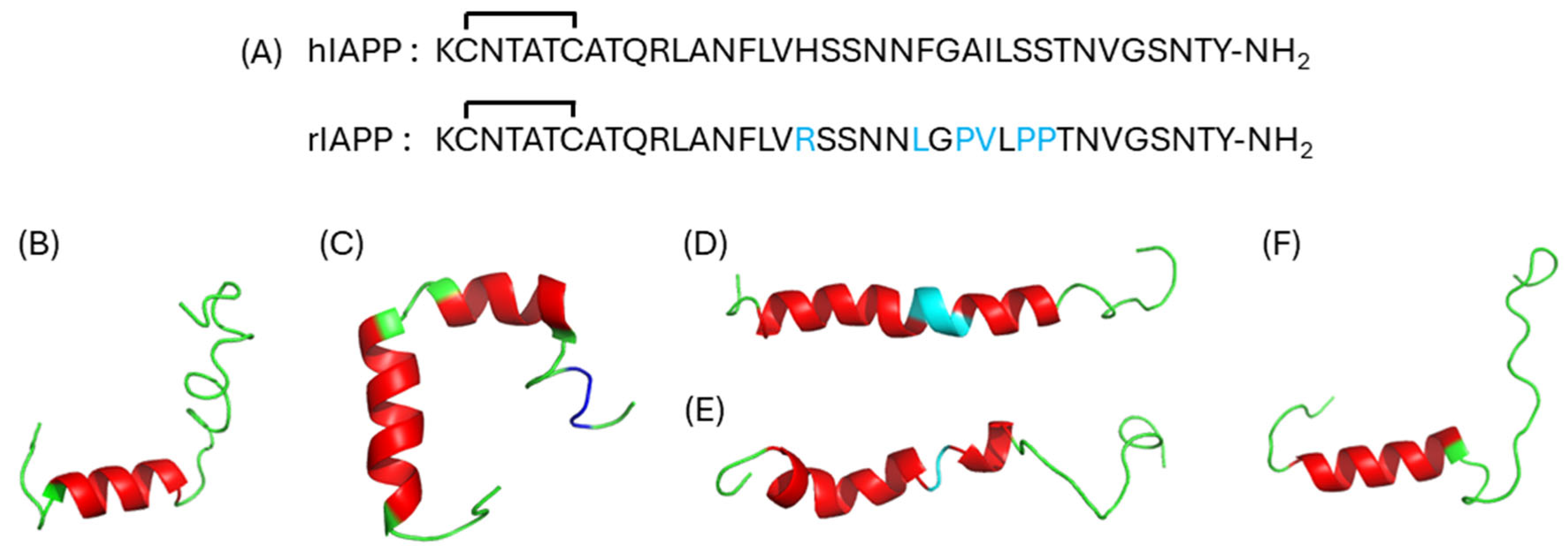
2. Islet Amyloid Polypeptide (IAPP)
2.1. Secondary Structures

2.2. Molecular Pharmacology
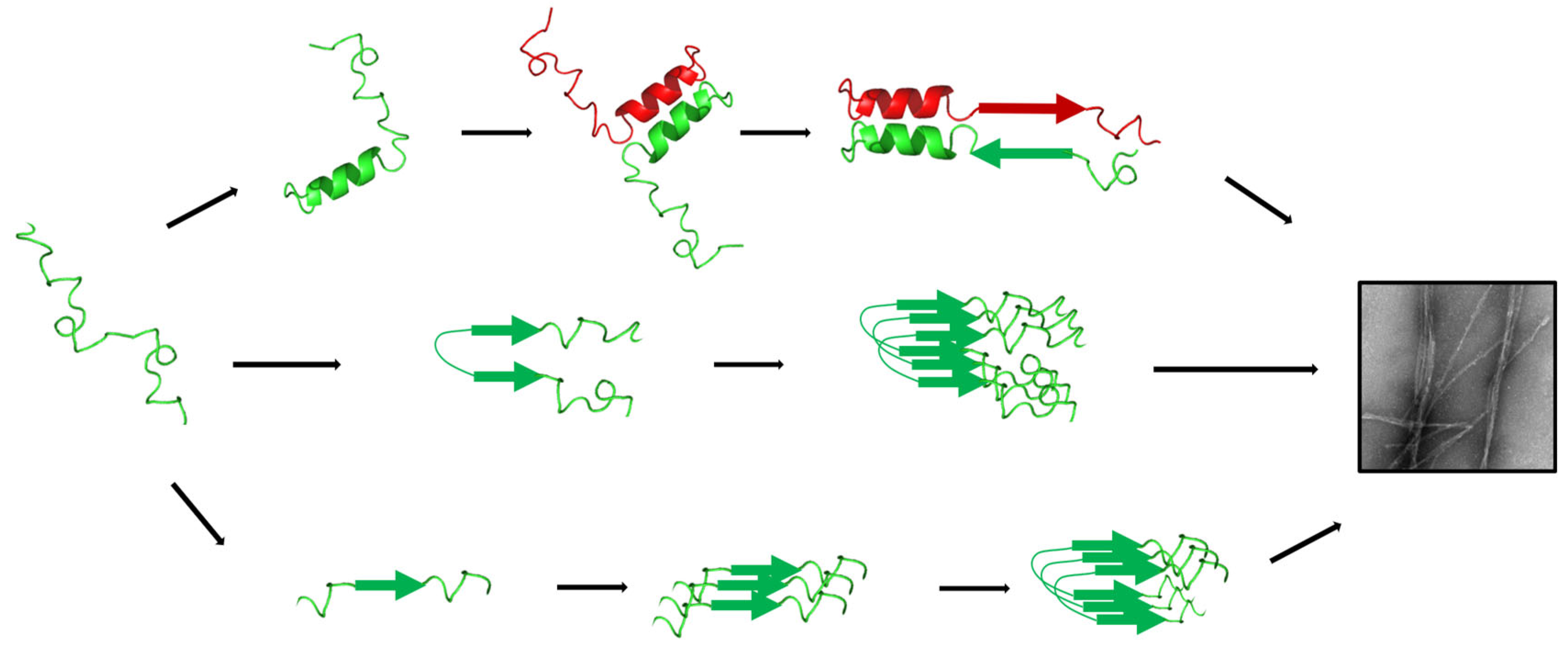
3. Mechanisms of Amyloid Formation
3.1. Role of Helical Intermediates in Nucleus Formation
3.2. The β-Hairpin Oligomers
3.3. Oligomers Assembled from Stacks of β-Strands
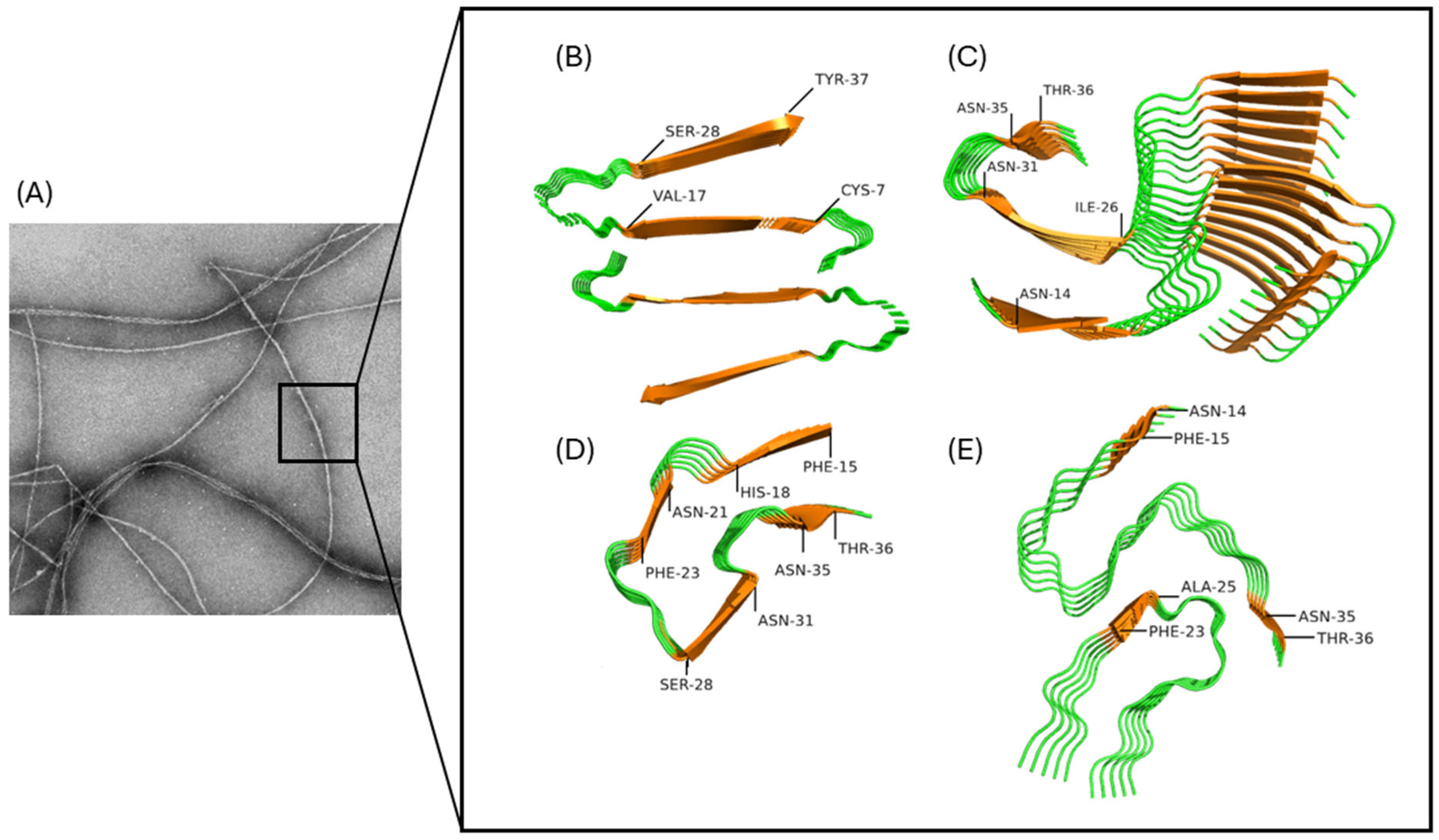
4. Molecular Architectures of Amyloid Fibrils
5. Chemical Strategies to Prevent IAPP Amyloid Formation
5.1. Small Molecules as Inhibitors of IAPP Amyloid Formation

| Inhibitors | Proposed Mechanisms of Action and/or Experimental Observations |
|---|---|
| Epigallocatechin gallate | Inhibition of amyloid formation and remodeling of amyloid fibrils [110] |
| Corilagin | Inhibition of secondary nucleation and fibril elongation by targeting oligomers and/or pre-fibrillar aggregates [113] |
| Yakuchinone B | Inhibition of IAPP aggregation by binding to monomeric IAPP [114] |
| Tetraquinoline | Inhibition of primary nucleation and fibril formation by targeting monomers and/or oligomers [119] |
| Pentaquinoline | Interaction with helical oligomers in the presence of lipid vesicles [117] |
| Pyridylamides | Inhibition of fibril formation by targeting monomers and/or low-order oligomers [118] |
| 2,5-diarylated thiophenes | Partial inhibition of primary nucleation and amyloid elongation [120] |
| Oligopyridylamide | Inhibition of fibril formation by targeting monomers and disassembly of fibrils [122] |
| Anle145c | Stabilization of non-toxic oligomers and disassembly of fibrils into non-cytotoxic oligomers [121] |
| Metformin | Reduction of IAPP insoluble aggregates of IAPP in the pancreas and formation of amorphous aggregates [124,125] |
5.2. Peptides as Inhibitors of IAPP Amyloid Formation
| Inhibitors | Proposed Mechanisms of Action and/or Experimental Observations |
|---|---|
| [(N-Me)G24, (N-Me)I26]IAPP(20–29) | Inhibition of the formation of β-sheet structure [126] |
| [(N-Me)V18, (N-Me)Phe20, V24Nle, G25Nle, S26Nle, M35Nle]Aβ(15–40) | Delay of primary nucleation by binding to nucleus/oligomers and formation of fibrils that can be eliminated by proteolytic cleavage [128] |
| cyclo[δOrn8-δOrn15]NNFGAILKF * HaoYV | Stabilization of the monomer in a non-aggregating conformation [92] |
| [I26P]IAPP | Inhibition of IAPP amyloid formation by interfering with fibril elongation [88] |
| [A13Aib, L16Aib]IAPP(13–18) | Inhibition of IAPP amyloid formation [130] |
| c[Pra20; AzK24]IAPP | Delay in IAPP amyloid formation by forming coiled-coil assemblies mainly by binding to monomers [77] |
| [I26ΔF]IAPP(23–27) | Stabilization of the IAPP monomer into an helicoidal conformation likely by interacting with monomers [134] |
| H2NAIL[piperidine-pyrolidine-β-turn]FaLaVCOCH3 | Delay in primary nucleation and inhibition of amyloid fibril elongation [135] |
| Insulin | Binding and stabilization of the monomer in an non-aggregating helicoidal conformation [137] |
| [NS20S]IAPP(12–27) | Blockage of the interactions between two monomers by binding interactions [140] |
5.3. Passive Immunotherapy with Antibodies
| Antibodies | Mechanisms of Action |
|---|---|
| Oligomer-specific antibody | Reduction of IAPP aggregation in the pancreas and increased production of insulin [144] |
| m81 | Recognition of oligomers and amyloid fibrils and inhibition of IAPP oligomerization [143,145] |
| 07G10 and 10H04 | Recognition of IAPP protofibrils and inhibition of amyloid formation [146] |
| α-IAPP-O | Recognition of transient prefibrillar oligomers and inhibition of primary nucleation [147] |
5.4. Proteins as Inhibitors of IAPP Amyloid Formation
| Inhibitors | Proposed Mechanisms and Experimental Observations |
|---|---|
| Hsp 40, Hsp70, Grp78 | Increase of the lag phase and decrease of amyloid loads by targeting oligomers [149] |
| HI18 | Binding to monomers and oligomers [83] |
| Bri2 BRICHOS | Inhibition of IAPP aggregation at low molecular ratio by preferentially interacting with fibrils [154,155] |
| ApoE | Interference with primary nucleation and amyloid fibril elongation [157] |
| TTR | Elongation of the lag phase by binding to monomer and prefibrillar aggregates [159] |
| Prefoldin | Inhibition of primary and secondary nucleation [150] |
5.5. Alternative Chemical Identities Inhibiting IAPP Amyloid Formation
| Inhibitors | Proposed Mechanisms and Experimental Observations |
|---|---|
| NiPAM:BAM nanoparticles | Increase of the lag phase and reduction of the elongation phase by interacting with the oligomers [161] |
| Au@ABA | Partial inhibition of the aggregation by binding preferentially to monomers [162] |
| SWCNT-OH | Inhibition of the formation of β-sheets and partial inhibition of fibril elongation [163] |
| βcas IONPS | Inhibition of amyloid aggregation by targeting monomers and oligomers [168] |
| Anionic dendrimers | Acceleration of aggregation into cytocompatible aggregates [165] |
| PHEA dendrimer | Acceleration of IAPP aggregation and reduction of toxicity in vivo and ex vivo [166] |
| DNA nanostructures | Inhibition of the aggregation process and disassembly of amyloid fibrils into cytocompatible spherical complexes [167] |
6. Design of Non-Aggregating IAPP Peptide Derivatives to Treat Metabolic Disorders
| Peptide | Sequence | Stage of Clinical Development |
|---|---|---|
| IAPP | KCNTATCATQRLANFLVHSSNNFGAILSSTNVGSNTY-NH2 | N.A. |
| Pramlintide | KCNTATCATQRLANFLVHSSNNFGPILPPTNVGSNTY-NH2 | FDA approved |
| sCalcitonin | CSNLSTCVLGKLSQELHKLQTYPRTNTGSGTP-NH2 | N.A. |
| Davalintide | KCNTATCVLGRLSQELHRLQTYPRTNTGSNTY-NH2 | Phase 2 |
| KBP-042 | Ac-CSNLSTCVLGKLSQELHKLQTYPRTDVGANAP-NH2 | Phase 2 [184] |
| NN1213 | (LFa)CNTATCATQRLARHSSPNFGAIPSSTNVGSRTY-NH2 | Pre-clinical [180] |
| Petrelintide | [19CD]-isoGlu-RDGTATKATERLA-Aad-FLQRSSFGly(Me)-A-Ile(Me)-LSSTEVGSNT-Hyp-NH2 | Phase 2 [185] |
| Eloralintide | (γGlu)-ANTATCATGOrnLAE ((α-Me-Phe))LVRSSN ((N-Me-Asn))FGP(LFa)LPPTGVESNTY-NH2 | Phase 2 [186] |
| Cagrilintide | (LFa)KCNTATCATQRLAEFLRHSSNNFGPILPPTNVGSNTP-NH2 | Phase 3a [187] |
7. Conclusions
Author Contributions
Funding
Data Availability Statement
Conflicts of Interest
References
- Sanke, T.; Bell, G.I.; Sample, C.; Rubenstein, A.H.; Steiner, D.F. An islet amyloid peptide is derived from an 89-amino acid precursor by proteolytic processing. J. Biol. Chem. 1988, 263, 17243–17246. [Google Scholar] [CrossRef] [Scilit]
- Clementi, G.; Caruso, A.; Cutuli, V.M.; de Bernardis, E.; Prato, A.; Amico-Roxas, M. Amylin given by central or peripheral routes decreases gastric emptying and intestinal transit in the rat. Experientia 1996, 52, 677–679. [Google Scholar] [CrossRef] [Scilit]
- Mulder, H.; Ahren, B.; Sundler, F. Islet amyloid polypeptide and insulin gene expression are regulated in parallel by glucose in vivo in rats. Am. J. Physiol. 1996, 271, E1008–E1014. [Google Scholar] [CrossRef] [Scilit]
- Rushing, P.A.; Hagan, M.M.; Seeley, R.J.; Lutz, T.A.; Woods, S.C. Amylin: A novel action in the brain to reduce body weight. Endocrinology 2000, 141, 850–853. [Google Scholar] [CrossRef] [PubMed]
- Cornish, J.; Callon, K.E.; Lin, C.Q.; Xiao, C.L.; Mulvey, T.B.; Coy, D.H.; Cooper, G.J.; Reid, I.R. Dissociation of the effects of amylin on osteoblast proliferation and bone resorption. Am. J. Physiol. 1998, 274, E827–E833. [Google Scholar] [CrossRef] [Scilit] [PubMed]
- Pullman, J.; Darsow, T.; Frias, J.P. Pramlintide in the management of insulin-using patients with type 2 and type 1 diabetes. Vasc. Health Risk Manag. 2006, 2, 203–212. [Google Scholar] [CrossRef] [Scilit] [PubMed]
- Cooper, G.J.; Willis, A.C.; Clark, A.; Turner, R.C.; Sim, R.B.; Reid, K.B. Purification and characterization of a peptide from amyloid-rich pancreases of type 2 diabetic patients. Proc. Natl. Acad. Sci. USA 1987, 84, 8628–8632. [Google Scholar] [CrossRef] [Scilit]
- Westermark, P.; Wilander, E.; Johnson, K.H. Islet amyloid polypeptide. Lancet 1987, 2, 623. [Google Scholar] [CrossRef] [Scilit]
- Hull, R.L.; Westermark, G.T.; Westermark, P.; Kahn, S.E. Islet amyloid: A critical entity in the pathogenesis of type 2 diabetes. J. Clin. Endocrinol. Metab. 2004, 89, 3629–3643. [Google Scholar] [CrossRef] [Scilit]
- Opie, E.L. The Relation Oe Diabetes Mellitus to Lesions of the Pancreas. Hyaline Degeneration of the Islands Oe Langerhans. J. Exp. Med. 1901, 5, 527–540. [Google Scholar] [CrossRef] [Scilit]
- Lorenzo, A.; Razzaboni, B.; Weir, G.C.; Yankner, B.A. Pancreatic islet cell toxicity of amylin associated with type-2 diabetes mellitus. Nature 1994, 368, 756–760. [Google Scholar] [CrossRef] [Scilit] [PubMed]
- Lau, D.C.W.; Erichsen, L.; Francisco, A.M.; Satylganova, A.; le Roux, C.W.; McGowan, B.; Pedersen, S.D.; Pietilainen, K.H.; Rubino, D.; Batterham, R.L. Once-weekly cagrilintide for weight management in people with overweight and obesity: A multicentre, randomised, double-blind, placebo-controlled and active-controlled, dose-finding phase 2 trial. Lancet 2021, 398, 2160–2172. [Google Scholar] [CrossRef] [Scilit] [PubMed]
- Enebo, L.B.; Berthelsen, K.K.; Kankam, M.; Lund, M.T.; Rubino, D.M.; Satylganova, A.; Lau, D.C.W. Safety, tolerability, pharmacokinetics, and pharmacodynamics of concomitant administration of multiple doses of cagrilintide with semaglutide 2.4 mg for weight management: A randomised, controlled, phase 1b trial. Lancet 2021, 397, 1736–1748. [Google Scholar] [CrossRef] [Scilit] [PubMed]
- Dehestani, B.; Stratford, N.R.; le Roux, C.W. Amylin as a Future Obesity Treatment. J. Obes. Metab. Syndr. 2021, 30, 320–325. [Google Scholar] [CrossRef] [Scilit]
- Milardi, D.; Gazit, E.; Radford, S.E.; Xu, Y.; Gallardo, R.U.; Caflisch, A.; Westermark, G.T.; Westermark, P.; Rosa, C.; Ramamoorthy, A. Proteostasis of Islet Amyloid Polypeptide: A Molecular Perspective of Risk Factors and Protective Strategies for Type II Diabetes. Chem. Rev. 2021, 121, 1845–1893. [Google Scholar] [CrossRef] [Scilit]
- Asthana, S.; Mallick, B.; Alexandrescu, A.T.; Jha, S. IAPP in type II diabetes: Basic research on structure, molecular interactions, and disease mechanisms suggests potential intervention strategies. Biochim. Biophys. Acta Biomembr. 2018, 1860, 1765–1782. [Google Scholar] [CrossRef] [Scilit]
- Bishoyi, A.K.; Roham, P.H.; Rachineni, K.; Save, S.; Hazari, M.A.; Sharma, S.; Kumar, A. Human islet amyloid polypeptide (hIAPP)—A curse in type II diabetes mellitus: Insights from structure and toxicity studies. Biol. Chem. 2021, 402, 133–153. [Google Scholar] [CrossRef] [Scilit]
- Fortier, M.; Côté-Cyr, M.; Nguyen, V.; Babych, M.; Nguyen, P.T.; Gaudreault, R.; Bourgault, S. Contribution of the 12–17 hydrophobic region of islet amyloid polypeptide in self-assembly and cytotoxicity. Front. Mol. Biosci. 2022, 9, 1017336. [Google Scholar] [CrossRef] [Scilit]
- Gilead, S.; Gazit, E. The Role of the 14–20 Domain of the Islet Amyloid Polypeptide in Amyloid Formation. J. Diabetes Res. 2008, 2008, 256954. [Google Scholar] [CrossRef] [Scilit]
- Koo, B.W.; Hebda, J.A.; Miranker, A.D. Amide inequivalence in the fibrillar assembly of islet amyloid polypeptide. Protein Eng. Des. Sel. 2008, 21, 147–154. [Google Scholar] [CrossRef] [Scilit]
- Scrocchi, L.A.; Ha, K.; Chen, Y.; Wu, L.; Wang, F.; Fraser, P.E. Identification of minimal peptide sequences in the (8–20) domain of human islet amyloid polypeptide involved in fibrillogenesis. J. Struct. Biol. 2003, 141, 218–227. [Google Scholar] [CrossRef] [Scilit] [PubMed]
- Fortin, J.S.; Benoit-Biancamano, M.O. Wildlife sequences of islet amyloid polypeptide (IAPP) identify critical species variants for fibrillization. Amyloid 2015, 22, 194–202. [Google Scholar] [CrossRef] [Scilit] [PubMed]
- Lee, S.-M.; Hay, D.L.; Pioszak, A.A. Calcitonin and Amylin Receptor Peptide Interaction Mechanisms. J. Biol. Chem. 2016, 291, 8686–8700, Erratum in J. Biol. Chem. 2016, 291, 16416. https://doi.org/10.1074/jbc.A115.713628. [Google Scholar] [CrossRef] [Scilit] [PubMed]
- Cao, J.; Belousoff, M.J.; Liang, Y.-L.; Johnson, R.M.; Josephs, T.M.; Fletcher, M.M.; Christopoulos, A.; Hay, D.L.; Danev, R.; Wootten, D.; et al. A structural basis for amylin receptor phenotype. Science 2022, 375, 6587. [Google Scholar] [CrossRef] [Scilit]
- Neumann, J.-M.; Couvineau, A.; Murail, S.; Lacapère, J.-J.; Jamin, N.; Laburthe, M. Class-B GPCR activation: Is ligand helix-capping the key? Trends Biochem. Sci. 2008, 33, 314–319. [Google Scholar] [CrossRef] [Scilit]
- Westermark, P.; Engstrom, U.; Johnson, K.H.; Westermark, G.T.; Betsholtz, C. Islet amyloid polypeptide: Pinpointing amino acid residues linked to amyloid fibril formation. Proc. Natl. Acad. Sci. USA 1990, 87, 5036–5040. [Google Scholar] [CrossRef] [Scilit]
- Green, J.; Goldsbury, C.; Mini, T.; Sunderji, S.; Frey, P.; Kistler, J.; Cooper, G.; Aebi, U. Full-length rat amylin forms fibrils following substitution of single residues from human amylin. J. Mol. Biol. 2003, 326, 1147–1156. [Google Scholar] [CrossRef] [Scilit]
- Christensen, M.; Skeby, K.K.; Schiott, B. Identification of Key Interactions in the Initial Self-Assembly of Amylin in a Membrane Environment. Biochemistry 2017, 56, 4884–4894. [Google Scholar] [CrossRef] [Scilit]
- Brender, J.R.; Hartman, K.; Nanga, R.P.; Popovych, N.; de la Salud Bea, R.; Vivekanandan, S.; Marsh, E.N.; Ramamoorthy, A. Role of zinc in human islet amyloid polypeptide aggregation. J. Am. Chem. Soc. 2010, 132, 8973–8983. [Google Scholar] [CrossRef] [Scilit]
- Khemtemourian, L.; Antoniciello, F.; Sahoo, B.R.; Decossas, M.; Lecomte, S.; Ramamoorthy, A. Investigation of the effects of two major secretory granules components, insulin and zinc, on human-IAPP amyloid aggregation and membrane damage. Chem. Phys. Lipids 2021, 237, 105083. [Google Scholar] [CrossRef] [Scilit]
- Sakagashira, S.; Hiddinga, H.J.; Tateishi, K.; Sanke, T.; Hanabusa, T.; Nanjo, K.; Eberhardt, N.L. S20G mutant amylin exhibits increased in vitro amyloidogenicity and increased intracellular cytotoxicity compared to wild-type amylin. Am. J. Pathol. 2000, 157, 2101–2109. [Google Scholar] [CrossRef] [Scilit]
- Seino, S. S20G mutation of the amylin gene is associated with Type II diabetes in Japanese. Study Group of Comprehensive Analysis of Genetic Factors in Diabetes Mellitus. Diabetologia 2001, 44, 906–909. [Google Scholar] [CrossRef] [Scilit]
- Akter, R.; Bower, R.L.; Abedini, A.; Schmidt, A.M.; Hay, D.L.; Raleigh, D.P. Amyloidogenicity, Cytotoxicity, and Receptor Activity of Bovine Amylin: Implications for Xenobiotic Transplantation and the Design of Nontoxic Amylin Variants. ACS Chem. Biol. 2018, 13, 2747–2757. [Google Scholar] [CrossRef] [Scilit] [PubMed]
- Nguyen, P.T.; Zottig, X.; Sebastiao, M.; Bourgault, S. Role of Site-Specific Asparagine Deamidation in Islet Amyloid Polypeptide Amyloidogenesis: Key Contributions of Residues 14 and 21. Biochemistry 2017, 56, 3808–3817. [Google Scholar] [CrossRef] [Scilit] [PubMed]
- Tu, L.-H.; Raleigh, D.P. Role of Aromatic Interactions in Amyloid Formation by Islet Amyloid Polypeptide. Biochemistry 2013, 52, 333–342. [Google Scholar] [CrossRef] [Scilit] [PubMed]
- Godin, E.; Nguyen, P.T.; Zottig, X.; Bourgault, S. Identification of a hinge residue controlling islet amyloid polypeptide self-assembly and cytotoxicity. J. Biol. Chem. 2019, 294, 8452–8463. [Google Scholar] [CrossRef] [Scilit]
- Nguyen, P.T.; Zottig, X.; Sebastiao, M.; Arnold, A.A.; Marcotte, I.; Bourgault, S. Identification of transmissible proteotoxic oligomer-like fibrils that expand conformational diversity of amyloid assemblies. Commun. Biol. 2021, 4, 939. [Google Scholar] [CrossRef] [Scilit]
- Doran, T.M.; Kamens, A.J.; Byrnes, N.K.; Nilsson, B.L. Role of amino acid hydrophobicity, aromaticity, and molecular volume on IAPP(20–29) amyloid self-assembly. Proteins Struct. Funct. Bioinform. 2012, 80, 1053–1065. [Google Scholar] [CrossRef] [Scilit]
- Ridgway, Z.; Eldrid, C.; Zhyvoloup, A.; Ben-Younis, A.; Noh, D.; Thalassinos, K.; Raleigh, D.P. Analysis of Proline Substitutions Reveals the Plasticity and Sequence Sensitivity of Human IAPP Amyloidogenicity and Toxicity. Biochemistry 2020, 59, 742–754. [Google Scholar] [CrossRef] [Scilit]
- Dupuis, N.F.; Wu, C.; Shea, J.E.; Bowers, M.T. Human islet amyloid polypeptide monomers form ordered beta-hairpins: A possible direct amyloidogenic precursor. J. Am. Chem. Soc. 2009, 131, 18283–18292. [Google Scholar] [CrossRef] [Scilit]
- Williamson, J.A.; Loria, J.P.; Miranker, A.D. Helix stabilization precedes aqueous and bilayer-catalyzed fiber formation in islet amyloid polypeptide. J. Mol. Biol. 2009, 393, 383–396. [Google Scholar] [CrossRef] [Scilit] [PubMed]
- Rodriguez Camargo, D.C.; Tripsianes, K.; Buday, K.; Franko, A.; Gobl, C.; Hartlmuller, C.; Sarkar, R.; Aichler, M.; Mettenleiter, G.; Schulz, M.; et al. The redox environment triggers conformational changes and aggregation of hIAPP in Type II Diabetes. Sci. Rep. 2017, 7, 44041. [Google Scholar] [CrossRef] [Scilit] [PubMed]
- Nanga, R.P.; Brender, J.R.; Vivekanandan, S.; Ramamoorthy, A. Structure and membrane orientation of IAPP in its natively amidated form at physiological pH in a membrane environment. Biochim. Biophys. Acta 2011, 1808, 2337–2342. [Google Scholar] [CrossRef] [Scilit] [PubMed]
- Patil, S.M.; Xu, S.; Sheftic, S.R.; Alexandrescu, A.T. Dynamic alpha-helix structure of micelle-bound human amylin. J. Biol. Chem. 2009, 284, 11982–11991. [Google Scholar] [CrossRef] [Scilit]
- Nanga, R.P.; Brender, J.R.; Xu, J.; Hartman, K.; Subramanian, V.; Ramamoorthy, A. Three-dimensional structure and orientation of rat islet amyloid polypeptide protein in a membrane environment by solution NMR spectroscopy. J. Am. Chem. Soc. 2009, 131, 8252–8261. [Google Scholar] [CrossRef] [Scilit]
- McLatchie, L.M.; Fraser, N.J.; Main, M.J.; Wise, A.; Brown, J.; Thompson, N.; Solari, R.; Lee, M.G.; Foord, S.M. RAMPs regulate the transport and ligand specificity of the calcitonin-receptor-like receptor. Nature 1998, 393, 333–339. [Google Scholar] [CrossRef] [Scilit]
- Sexton, P.M.; Albiston, A.; Morfis, M.; Tilakaratne, N. Receptor activity modifying proteins. Cell. Signal. 2001, 13, 73–83. [Google Scholar] [CrossRef] [Scilit]
- Barwell, J.; Gingell, J.J.; Watkins, H.A.; Archbold, J.K.; Poyner, D.R.; Hay, D.L. Calcitonin and calcitonin receptor-like receptors: Common themes with family B GPCRs? Br. J. Pharmacol. 2012, 166, 51–65. [Google Scholar] [CrossRef] [Scilit]
- Bower, R.L.; Yule, L.; Rees, T.A.; Deganutti, G.; Hendrikse, E.R.; Harris, P.W.R.; Kowalczyk, R.; Ridgway, Z.; Wong, A.G.; Swierkula, K.; et al. Molecular Signature for Receptor Engagement in the Metabolic Peptide Hormone Amylin. ACS Pharmacol. Transl. Sci. 2018, 1, 32–49. [Google Scholar] [CrossRef] [Scilit]
- Roth, J.; Mack, C.; Soares, C.; Ghosh, S.; Parkes, D. Amylin-Based Pharmacotherapy-Past, Present Future. Agents Med. Chem. 2008, 8, 317–324. [Google Scholar] [CrossRef] [Scilit]
- Roberts, A.N.; Leighton, B.; Todd, J.A.; Cockburn, D.; Schofield, P.N.; Sutton, R.; Holt, S.; Boyd, Y.; Day, A.J.; Foot, E.A.; et al. Molecular and functional characterization of amylin, a peptide associated with type 2 diabetes mellitus. Proc. Natl. Acad. Sci. USA 1989, 86, 9662–9666. [Google Scholar] [CrossRef] [Scilit]
- Janciauskiene, S.; Ahren, B. Fibrillar islet amyloid polypeptide differentially affects oxidative mechanisms and lipoprotein uptake in correlation with cytotoxicity in two insulin-producing cell lines. Biochem. Biophys. Res. Commun. 2000, 267, 619–625. [Google Scholar] [CrossRef] [Scilit]
- Janson, J.; Ashley, R.H.; Harrison, D.; McIntyre, S.; Butler, P.C. The mechanism of islet amyloid polypeptide toxicity is membrane disruption by intermediate-sized toxic amyloid particles. Diabetes 1999, 48, 491–498. [Google Scholar] [CrossRef] [Scilit] [PubMed]
- Raleigh, D.; Zhang, X.; Hastoy, B.; Clark, A. The β-cell assassin: IAPP cytotoxicity. J. Mol. Endocrinol. 2017, 59, R121–R140. [Google Scholar] [CrossRef] [Scilit] [PubMed]
- Marmentini, C.; Branco, R.C.S.; Boschero, A.C.; Kurauti, M.A. Islet amyloid toxicity: From genesis to counteracting mechanisms. J. Cell. Physiol. 2022, 237, 1119–1142. [Google Scholar] [CrossRef] [Scilit] [PubMed]
- Rodriguez Camargo, D.C.; Chia, S.; Menzies, J.; Mannini, B.; Meisl, G.; Lundqvist, M.; Pohl, C.; Bernfur, K.; Lattanzi, V.; Habchi, J.; et al. Surface-Catalyzed Secondary Nucleation Dominates the Generation of Toxic IAPP Aggregates. Front. Mol. Biosci. 2021, 8, 757425. [Google Scholar] [CrossRef] [Scilit]
- Harper, J.D.; Lansbury, P.T., Jr. Models of amyloid seeding in Alzheimer’s disease and scrapie: Mechanistic truths and physiological consequences of the time-dependent solubility of amyloid proteins. Annu. Rev. Biochem. 1997, 66, 385–407. [Google Scholar] [CrossRef] [Scilit]
- Padrick, S.B.; Miranker, A.D. Islet amyloid: Phase partitioning and secondary nucleation are central to the mechanism of fibrillogenesis. Biochemistry 2002, 41, 4694–4703. [Google Scholar] [CrossRef] [Scilit]
- Green, J.D.; Goldsbury, C.; Kistler, J.; Cooper, G.J.; Aebi, U. Human amylin oligomer growth and fibril elongation define two distinct phases in amyloid formation. J. Biol. Chem. 2004, 279, 12206–12212. [Google Scholar] [CrossRef] [Scilit]
- Wetzel, R. Kinetics and thermodynamics of amyloid fibril assembly. Acc. Chem. Res. 2006, 39, 671–679. [Google Scholar] [CrossRef] [Scilit]
- Abedini, A.; Plesner, A.; Cao, P.; Ridgway, Z.; Zhang, J.; Tu, L.-H.; Middleton, C.T.; Chao, B.; Sartori, D.J.; Meng, F.; et al. Time-resolved studies define the nature of toxic IAPP intermediates, providing insight for anti-amyloidosis therapeutics. eLife 2016, 5, e12977. [Google Scholar] [CrossRef] [Scilit]
- Caillon, L.; Lequin, O.; Khemtémourian, L. Evaluation of membrane models and their composition for islet amyloid polypeptide-membrane aggregation. Biochim. Biophys. Acta (BBA) Biomembr. 2013, 1828, 2091–2098. [Google Scholar] [CrossRef] [Scilit]
- Kelly, J.W. Mechanisms of amyloidogenesis. Nat. Struct. Biol. 2000, 7, 824–826. [Google Scholar] [CrossRef] [Scilit]
- Lee, J.; Culyba, E.K.; Powers, E.T.; Kelly, J.W. Amyloid-beta forms fibrils by nucleated conformational conversion of oligomers. Nat. Chem. Biol. 2011, 7, 602–609. [Google Scholar] [CrossRef] [Scilit] [PubMed]
- Gosal, W.S.; Morten, I.J.; Hewitt, E.W.; Smith, D.A.; Thomson, N.H.; Radford, S.E. Competing pathways determine fibril morphology in the self-assembly of beta2-microglobulin into amyloid. J. Mol. Biol. 2005, 351, 850–864. [Google Scholar] [CrossRef] [Scilit] [PubMed]
- Hurshman, A.R.; White, J.T.; Powers, E.T.; Kelly, J.W. Transthyretin aggregation under partially denaturing conditions is a downhill polymerization. Biochemistry 2004, 43, 7365–7381. [Google Scholar] [CrossRef] [Scilit]
- Nag, S.; Sarkar, B.; Bandyopadhyay, A.; Sahoo, B.; Sreenivasan, V.K.; Kombrabail, M.; Muralidharan, C.; Maiti, S. Nature of the amyloid-beta monomer and the monomer-oligomer equilibrium. J. Biol. Chem. 2011, 286, 13827–13833. [Google Scholar] [CrossRef] [Scilit] [PubMed]
- Abedini, A.; Raleigh, D.P. A critical assessment of the role of helical intermediates in amyloid formation by natively unfolded proteins and polypeptides. Protein Eng. Des. Sel. 2009, 22, 453–459. [Google Scholar] [CrossRef] [Scilit]
- Ling, Y.L.; Strasfeld, D.B.; Shim, S.H.; Raleigh, D.P.; Zanni, M.T. Two-dimensional infrared spectroscopy provides evidence of an intermediate in the membrane-catalyzed assembly of diabetic amyloid. J. Phys. Chem. B 2009, 113, 2498–2505. [Google Scholar] [CrossRef] [Scilit]
- Knight, J.D.; Hebda, J.A.; Miranker, A.D. Conserved and cooperative assembly of membrane-bound alpha-helical states of islet amyloid polypeptide. Biochemistry 2006, 45, 9496–9508. [Google Scholar] [CrossRef] [Scilit]
- Jayasinghe, S.A.; Langen, R. Lipid membranes modulate the structure of islet amyloid polypeptide. Biochemistry 2005, 44, 12113–12119. [Google Scholar] [CrossRef] [Scilit]
- Sepehri, A.; Nepal, B.; Lazaridis, T. Distinct Modes of Action of IAPP Oligomers on Membranes. J. Chem. Inf. Model. 2021, 61, 4645–4655. [Google Scholar] [CrossRef] [Scilit] [PubMed]
- De Carufel, C.A.; Nguyen, P.T.; Sahnouni, S.; Bourgault, S. New insights into the roles of sulfated glycosaminoglycans in islet amyloid polypeptide amyloidogenesis and cytotoxicity. Biopolymers 2013, 100, 645–655. [Google Scholar] [CrossRef] [Scilit] [PubMed]
- Maj, M.; Lomont, J.P.; Rich, K.L.; Alperstein, A.M.; Zanni, M.T. Site-specific detection of protein secondary structure using 2D IR dihedral indexing: A proposed assembly mechanism of oligomeric hIAPP. Chem. Sci. 2018, 9, 463–474. [Google Scholar] [CrossRef] [Scilit] [PubMed]
- Rawat, A.; Maity, B.K.; Chandra, B.; Maiti, S. Aggregation-induced conformation changes dictate islet amyloid polypeptide (IAPP) membrane affinity. Biochim. Biophys. Acta Biomembr. 2018, 1860, 1734–1740. [Google Scholar] [CrossRef] [Scilit]
- De Carufel, C.A.; Quittot, N.; Nguyen, P.T.; Bourgault, S. Delineating the Role of Helical Intermediates in Natively Unfolded Polypeptide Amyloid Assembly and Cytotoxicity. Angew. Chem. 2015, 127, 14591–14595. [Google Scholar] [CrossRef] [Scilit]
- Babych, M.; Garelja, M.L.; Nguyen, P.T.; Hay, D.L.; Bourgault, S. Converting the Amyloidogenic Islet Amyloid Polypeptide into a Potent Nonaggregating Peptide Ligand by Side Chain-to-Side Chain Macrocyclization. J. Am. Chem. Soc. 2024, 146, 25513–25526. [Google Scholar] [CrossRef] [Scilit]
- Singh, S.; Chiu, C.C.; Reddy, A.S.; de Pablo, J.J. alpha-helix to beta-hairpin transition of human amylin monomer. J. Chem. Phys. 2013, 138, 155101. [Google Scholar] [CrossRef] [Scilit]
- Skeby, K.K.; Andersen, O.J.; Pogorelov, T.V.; Tajkhorshid, E.; Schiott, B. Conformational Dynamics of the Human Islet Amyloid Polypeptide in a Membrane Environment: Toward the Aggregation Prone Form. Biochemistry 2016, 55, 2031–2042. [Google Scholar] [CrossRef] [Scilit]
- Dupuis, N.F.; Wu, C.; Shea, J.E.; Bowers, M.T. The amyloid formation mechanism in human IAPP: Dimers have beta-strand monomer-monomer interfaces. J. Am. Chem. Soc. 2011, 133, 7240–7243. [Google Scholar] [CrossRef] [Scilit]
- Wu, C.; Shea, J.E. Structural similarities and differences between amyloidogenic and non-amyloidogenic islet amyloid polypeptide (IAPP) sequences and implications for the dual physiological and pathological activities of these peptides. PLoS Comput. Biol. 2013, 9, e1003211. [Google Scholar] [CrossRef] [Scilit] [PubMed]
- Luca, S.; Yau, W.M.; Leapman, R.; Tycko, R. Peptide conformation and supramolecular organization in amylin fibrils: Constraints from solid-state NMR. Biochemistry 2007, 46, 13505–13522. [Google Scholar] [CrossRef] [Scilit] [PubMed]
- Mirecka, E.A.; Feuerstein, S.; Gremer, L.; Schröder, G.F.; Stoldt, M.; Willbold, D.; Hoyer, W. β-Hairpin of Islet Amyloid Polypeptide Bound to an Aggregation Inhibitor. Sci. Rep. 2016, 6, 33474. [Google Scholar] [CrossRef] [Scilit]
- Xu, W.; Jiang, P.; Mu, Y. Conformation Preorganization: Effects of S20G Mutation on the Structure of Human Islet Amyloid Polypeptide Segment. J. Phys. Chem. B 2009, 113, 7308–7314. [Google Scholar] [CrossRef] [Scilit] [PubMed]
- Goldsbury, C.; Goldie, K.; Pellaud, J.; Seelig, J.; Frey, P.; Muller, S.A.; Kistler, J.; Cooper, G.J.; Aebi, U. Amyloid fibril formation from full-length and fragments of amylin. J. Struct. Biol. 2000, 130, 352–362. [Google Scholar] [CrossRef] [Scilit]
- Tenidis, K.; Waldner, M.; Bernhagen, J.; Fischle, W.; Bergmann, M.; Weber, M.; Merkle, M.L.; Voelter, W.; Brunner, H.; Kapurniotu, A. Identification of a penta- and hexapeptide of islet amyloid polypeptide (IAPP) with amyloidogenic and cytotoxic properties. J. Mol. Biol. 2000, 295, 1055–1071. [Google Scholar] [CrossRef] [Scilit]
- Betsholtz, C.; Christmansson, L.; Engstrom, U.; Rorsman, F.; Svensson, V.; Johnson, K.H.; Westermark, P. Sequence divergence in a specific region of islet amyloid polypeptide (IAPP) explains differences in islet amyloid formation between species. FEBS Lett. 1989, 251, 261–264. [Google Scholar] [CrossRef] [Scilit]
- Abedini, A.; Meng, F.; Raleigh, D.P. A Single-Point Mutation Converts the Highly Amyloidogenic Human Islet Amyloid Polypeptide into a Potent Fibrillization Inhibitor. J. Am. Chem. Soc. 2007, 129, 11300–11301. [Google Scholar] [CrossRef] [Scilit]
- Roder, C.; Kupreichyk, T.; Gremer, L.; Schafer, L.U.; Pothula, K.R.; Ravelli, R.B.G.; Willbold, D.; Hoyer, W.; Schroder, G.F. Cryo-EM structure of islet amyloid polypeptide fibrils reveals similarities with amyloid-beta fibrils. Nat. Struct. Mol. Biol. 2020, 27, 660–667. [Google Scholar] [CrossRef] [Scilit]
- Gallardo, R.; Iadanza, M.G.; Xu, Y.; Heath, G.R.; Foster, R.; Radford, S.E.; Ranson, N.A. Fibril structures of diabetes-related amylin variants reveal a basis for surface-templated assembly. Nat. Struct. Mol. Biol. 2020, 27, 1048–1056, Erratum in Nat. Struct. Mol. Biol. 2020, 27, 1094. https://doi.org/10.1038/s41594-020-00525-x. [Google Scholar] [CrossRef] [Scilit]
- Cao, Q.; Boyer, D.R.; Sawaya, M.R.; Abskharon, R.; Saelices, L.; Nguyen, B.A.; Lu, J.; Murray, K.A.; Kandeel, F.; Eisenberg, D.S. Cryo-EM structures of hIAPP fibrils seeded by patient-extracted fibrils reveal new polymorphs and conserved fibril cores. Nat. Struct. Mol. Biol. 2021, 28, 724–730. [Google Scholar] [CrossRef] [Scilit]
- Buchanan, L.E.; Dunkelberger, E.B.; Tran, H.Q.; Cheng, P.N.; Chiu, C.C.; Cao, P.; Raleigh, D.P.; de Pablo, J.J.; Nowick, J.S.; Zanni, M.T. Mechanism of IAPP amyloid fibril formation involves an intermediate with a transient beta-sheet. Proc. Natl. Acad. Sci. USA 2013, 110, 19285–19290. [Google Scholar] [CrossRef] [Scilit] [PubMed]
- Serrano, A.L.; Lomont, J.P.; Tu, L.-H.; Raleigh, D.P.; Zanni, M.T. A Free Energy Barrier Caused by the Refolding of an Oligomeric Intermediate Controls the Lag Time of Amyloid Formation by hIAPP. J. Am. Chem. Soc. 2017, 139, 16748–16758. [Google Scholar] [CrossRef] [Scilit] [PubMed]
- Quittot, N.; Sebastiao, M.; Al-Halifa, S.; Bourgault, S. Kinetic and Conformational Insights into Islet Amyloid Polypeptide Self-Assembly Using a Biarsenical Fluorogenic Probe. Bioconjugate Chem. 2018, 29, 517–527. [Google Scholar] [CrossRef] [Scilit] [PubMed]
- Wiltzius, J.J.; Sievers, S.A.; Sawaya, M.R.; Cascio, D.; Popov, D.; Riekel, C.; Eisenberg, D. Atomic structure of the cross-beta spine of islet amyloid polypeptide (amylin). Protein Sci. 2008, 17, 1467–1474. [Google Scholar] [CrossRef] [Scilit]
- Bedrood, S.; Li, Y.; Isas, J.M.; Hegde, B.G.; Baxa, U.; Haworth, I.S.; Langen, R. Fibril structure of human islet amyloid polypeptide. J. Biol. Chem. 2012, 287, 5235–5241. [Google Scholar] [CrossRef] [Scilit]
- Kajava, A.V.; Aebi, U.; Steven, A.C. The parallel superpleated beta-structure as a model for amyloid fibrils of human amylin. J. Mol. Biol. 2005, 348, 247–252. [Google Scholar] [CrossRef] [Scilit]
- Alexandrescu, A.T. Amide proton solvent protection in amylin fibrils probed by quenched hydrogen exchange NMR. PLoS ONE 2013, 8, e56467. [Google Scholar] [CrossRef] [Scilit]
- Eanes, E.D.; Glenner, G.G. X-ray diffraction studies on amyloid filaments. J. Histochem. Cytochem. 1968, 16, 673–677. [Google Scholar] [CrossRef] [Scilit]
- Wolfe, L.S.; Calabrese, M.F.; Nath, A.; Blaho, D.V.; Miranker, A.D.; Xiong, Y. Protein-induced photophysical changes to the amyloid indicator dye thioflavin T. Proc. Natl. Acad. Sci. USA 2010, 107, 16863–16868. [Google Scholar] [CrossRef] [Scilit]
- Pithadia, A.; Brender, J.R.; Fierke, C.A.; Ramamoorthy, A. Inhibition of IAPP Aggregation and Toxicity by Natural Products and Derivatives. J. Diabetes Res. 2016, 2016, 2046327. [Google Scholar] [CrossRef] [Scilit]
- Bulawa, C.E.; Connelly, S.; Devit, M.; Wang, L.; Weigel, C.; Fleming, J.A.; Packman, J.; Powers, E.T.; Wiseman, R.L.; Foss, T.R.; et al. Tafamidis, a potent and selective transthyretin kinetic stabilizer that inhibits the amyloid cascade. Proc. Natl. Acad. Sci. USA 2012, 109, 9629–9634. [Google Scholar] [CrossRef] [Scilit]
- Garcia-Pavia, P.; Aus Dem Siepen, F.; Donal, E.; Lairez, O.; Van Der Meer, P.; Kristen, A.V.; Mercuri, M.F.; Michalon, A.; Frost, R.J.A.; Grimm, J.; et al. Phase 1 Trial of Antibody NI006 for Depletion of Cardiac Transthyretin Amyloid. N. Engl. J. Med. 2023, 389, 239–250. [Google Scholar] [CrossRef] [Scilit] [PubMed]
- Söderberg, L.; Johannesson, M.; Nygren, P.; Laudon, H.; Eriksson, F.; Osswald, G.; Möller, C.; Lannfelt, L. Lecanemab, Aducanumab, and Gantenerumab—Binding Profiles to Different Forms of Amyloid-Beta Might Explain Efficacy and Side Effects in Clinical Trials for Alzheimer’s Disease. Neurotherapeutics 2023, 20, 195–206. [Google Scholar] [CrossRef] [Scilit] [PubMed]
- Chen, G.-F.; Xu, T.-H.; Yan, Y.; Zhou, Y.-R.; Jiang, Y.; Melcher, K.; Xu, H.E. Amyloid beta: Structure, biology and structure-based therapeutic development. Acta Pharmacol. Sin. 2017, 38, 1205–1235. [Google Scholar] [CrossRef] [Scilit] [PubMed]
- Bourgault, S.; Choi, S.; Buxbaum, J.N.; Kelly, J.W.; Price, J.L.; Reixach, N. Mechanisms of transthyretin cardiomyocyte toxicity inhibition by resveratrol analogs. Biochem. Biophys. Res. Commun. 2011, 410, 707–713, Erratum in Biochem. Biophys. Res. Commun. 2011, 412, 196. https://doi.org/10.1016/j.bbrc.2011.04.133. [Google Scholar] [CrossRef] [Scilit]
- Khalifa, J.; Bourgault, S.; Gaudreault, R. Interactions of Polyphenolic Gallotannins with Amyloidogenic Polypeptides Associated with Alzheimer’s Disease: From Molecular Insights to Physiological Significance. Curr. Alzheimer Res. 2023, 20, 603–617. [Google Scholar] [CrossRef] [Scilit]
- Rioux Bilan, A.; Freyssin, A.; Page, G.; Fauconneau, B. Natural polyphenols effects on protein aggregates in Alzheimer’s and Parkinson’s prion-like diseases. Neural Regen. Res. 2018, 13, 955. [Google Scholar] [CrossRef] [Scilit]
- Fraga, C.G.; Croft, K.D.; Kennedy, D.O.; Tomás-Barberán, F.A. The effects of polyphenols and other bioactives on human health. Food Funct. 2019, 10, 514–528. [Google Scholar] [CrossRef] [Scilit]
- Meng, F.; Abedini, A.; Plesner, A.; Verchere, C.B.; Raleigh, D.P. The Flavanol (−)-Epigallocatechin 3-Gallate Inhibits Amyloid Formation by Islet Amyloid Polypeptide, Disaggregates Amyloid Fibrils, and Protects Cultured Cells against IAPP-Induced Toxicity. Biochemistry 2010, 49, 8127–8133. [Google Scholar] [CrossRef] [Scilit]
- Cao, P.; Raleigh, D.P. Analysis of the Inhibition and Remodeling of Islet Amyloid Polypeptide Amyloid Fibers by Flavanols. Biochemistry 2012, 51, 2670–2683. [Google Scholar] [CrossRef] [Scilit]
- Li, X.; Deng, Y.; Zheng, Z.; Huang, W.; Chen, L.; Tong, Q.; Ming, Y. Corilagin, a promising medicinal herbal agent. Biomed. Pharmacother. 2018, 99, 43–50. [Google Scholar] [CrossRef] [Scilit] [PubMed]
- Khalifa, J.; Sulaimon, R.; Côté-Cyr, M.; Nguyen, P.T.; Peslherbe, G.; Bourgault, S.; Gaudreault, R. Polyphenolic Gallotannins 1,3,6-Tri-O-galloyl-β-D-glucose and Corilagin Attenuate IAPP Amyloid Formation and Cytotoxicity by Primarily Targeting Secondary Nucleation. Biochemistry 2025, 64, 3570–3584. [Google Scholar] [CrossRef] [Scilit] [PubMed]
- Hsu, J.-Y.; Rao Sathyan, A.; Hsu, K.-C.; Chen, L.-C.; Yen, C.-C.; Tseng, H.-J.; Wu, K.-C.; Liu, H.-K.; Huang, W.-J. Synthesis of Yakuchinone B-Inspired Inhibitors against Islet Amyloid Polypeptide Aggregation. J. Nat. Prod. 2021, 84, 1096–1103. [Google Scholar] [CrossRef] [Scilit]
- Tu, L.-H.; Young, L.M.; Wong, A.G.; Ashcroft, A.E.; Radford, S.E.; Raleigh, D.P. Mutational Analysis of the Ability of Resveratrol to Inhibit Amyloid Formation by Islet Amyloid Polypeptide: Critical Evaluation of the Importance of Aromatic–Inhibitor and Histidine–Inhibitor Interactions. Biochemistry 2015, 54, 666–676. [Google Scholar] [CrossRef] [Scilit] [PubMed]
- Goodman, C.M.; Choi, S.; Shandler, S.; Degrado, W.F. Foldamers as versatile frameworks for the design and evolution of function. Nat. Chem. Biol. 2007, 3, 252–262. [Google Scholar] [CrossRef] [Scilit]
- Kumar, S.; Miranker, A.D. A foldamer approach to targeting membrane bound helical states of islet amyloid polypeptide. Chem. Commun. 2013, 49, 4749–4751. [Google Scholar] [CrossRef] [Scilit]
- Saraogi, I.; Hebda, J.A.; Becerril, J.; Estroff, L.A.; Miranker, A.D.; Hamilton, A.D. Synthetic α-Helix Mimetics as Agonists and Antagonists of Islet Amyloid Polypeptide Aggregation. Angew. Chem. Int. Ed. 2010, 49, 736–739. [Google Scholar] [CrossRef] [Scilit]
- Kumar, S.; Birol, M.; Schlamadinger, D.E.; Wojcik, S.P.; Rhoades, E.; Miranker, A.D. Foldamer-mediated manipulation of a pre-amyloid toxin. Nat. Commun. 2016, 7, 11412. [Google Scholar] [CrossRef] [Scilit]
- Hassanpour, A.; De Carufel, C.A.; Bourgault, S.; Forgione, P. Synthesis of 2,5-Diaryl-Substituted Thiophenes as Helical Mimetics: Towards the Modulation of Islet Amyloid Polypeptide (IAPP) Amyloid Fibril Formation and Cytotoxicity. Chem. A Eur. J. 2014, 20, 2522–2528. [Google Scholar] [CrossRef] [Scilit]
- Saravanan, M.S.; Ryazanov, S.; Leonov, A.; Nicolai, J.; Praest, P.; Giese, A.; Winter, R.; Khemtemourian, L.; Griesinger, C.; Killian, J.A. The small molecule inhibitor anle145c thermodynamically traps human islet amyloid peptide in the form of non-cytotoxic oligomers. Sci. Rep. 2019, 9, 19023. [Google Scholar] [CrossRef] [Scilit]
- Maity, D.; Kumar, S.; Alhussein, R.; Gremer, L.; Howarth, M.; Karpauskaite, L.; Hoyer, W.; Magzoub, M.; Hamilton, A.D. Sub-stoichiometric inhibition of IAPP aggregation: A peptidomimetic approach to anti-amyloid agents. RSC Chem. Biol. 2020, 1, 225–232. [Google Scholar] [CrossRef] [Scilit] [PubMed]
- Zhou, G.; Myers, R.; Li, Y.; Chen, Y.; Shen, X.; Fenyk-Melody, J.; Wu, M.; Ventre, J.; Doebber, T.; Fujii, N.; et al. Role of AMP-activated protein kinase in mechanism of metformin action. J. Clin. Investig. 2001, 108, 1167–1174. [Google Scholar] [CrossRef] [PubMed]
- Hull, R.L.; Shen, Z.-P.; Watts, M.R.; Kodama, K.; Carr, D.B.; Utzschneider, K.M.; Zraika, S.; Wang, F.; Kahn, S.E. Long-Term Treatment With Rosiglitazone and Metformin Reduces the Extent of, but Does Not Prevent, Islet Amyloid Deposition in Mice Expressing the Gene for Human Islet Amyloid Polypeptide. Diabetes 2005, 54, 2235–2244. [Google Scholar] [CrossRef] [Scilit] [PubMed]
- Congiu, T.; Alghrably, M.; Emwas, A.-H.; Jaremko, L.; Lachowicz, J.I.; Piludu, M.; Piras, M.; Faa, G.; Pichiri, G.; Jaremko, M.; et al. Undercover Toxic Ménage à Trois of Amylin, Copper (II) and Metformin in Human Embryonic Kidney Cells. Pharmaceutics 2021, 13, 830. [Google Scholar] [CrossRef] [Scilit]
- Kapurniotu, A.; Schmauder, A.; Tenidis, K. Structure-based design and study of non-amyloidogenic, double N-methylated IAPP amyloid core sequences as inhibitors of IAPP amyloid formation and cytotoxicity. J. Mol. Biol. 2002, 315, 339–350. [Google Scholar] [CrossRef] [Scilit]
- Andreetto, E.; Yan, L.M.; Tatarek-Nossol, M.; Velkova, A.; Frank, R.; Kapurniotu, A. Identification of Hot Regions of the Aβ–IAPP Interaction Interface as High-Affinity Binding Sites in both Cross- and Self-Association. Angew. Chem. Int. Ed. 2010, 49, 3081–3085. [Google Scholar] [CrossRef] [Scilit]
- Taş, K.; Volta, B.D.; Lindner, C.; El Bounkari, O.; Hille, K.; Tian, Y.; Puig-Bosch, X.; Ballmann, M.; Hornung, S.; Ortner, M.; et al. Designed peptides as nanomolar cross-amyloid inhibitors acting via supramolecular nanofiber co-assembly. Nat. Commun. 2022, 13, 5004. [Google Scholar] [CrossRef] [Scilit]
- Tan, J.; Zhang, J.; Luo, Y.; Ye, S. Misfolding of a Human Islet Amyloid Polypeptide at the Lipid Membrane Populates through β-Sheet Conformers without Involving α-Helical Intermediates. J. Am. Chem. Soc. 2019, 141, 1941–1948. [Google Scholar] [CrossRef] [Scilit]
- Gilead, S.; Gazit, E. Inhibition of Amyloid Fibril Formation by Peptide Analogues Modified with α-Aminoisobutyric Acid. Angew. Chem. 2004, 116, 4133–4136. [Google Scholar] [CrossRef] [Scilit]
- Formaggio, F.; Bettio, A.; Moretto, V.; Crisma, M.; Toniolo, C.; Broxterman, Q.B. Disruption of the β-sheet structure of a protected pentapeptide, related to the β-amyloid sequence 17–21, induced by a single, helicogenic Cα-tetrasubstituted α-amino acid. J. Pept. Sci. 2003, 9, 461–466. [Google Scholar] [CrossRef] [Scilit]
- Toniolo, C.; Benedetti, E. Structures of polypeptides from α-amino acids disubstituted at the α-carbon. Macromolecules 1991, 24, 4004–4009. [Google Scholar] [CrossRef] [Scilit]
- Babych, M.; Nguyen, P.T.; Berube, F.; Bourgault, S. Probing the Effect of alpha-Helical Stapling Strategies on the Inhibition of Peptide Aggregation and Amyloid Cytotoxicity. ACS Chem. Biol. 2026, 21, 96–106. [Google Scholar] [CrossRef] [Scilit]
- Mishra, A.; Misra, A.; Sri Vaishnavi, T.; Thota, C.; Gupta, M.; Ramakumar, S.; Chauhan, V.S. Conformationally restricted short peptides inhibit human islet amyloid polypeptide (hIAPP) fibrillization. Chem. Commun. 2013, 49, 2688. [Google Scholar] [CrossRef] [Scilit]
- Lesma, J.; Bizet, F.; Berardet, C.; Tonali, N.; Pellegrino, S.; Taverna, M.; Khemtemourian, L.; Soulier, J.-L.; Van Heijenoort, C.; Halgand, F.; et al. β-Hairpin Peptide Mimics Decrease Human Islet Amyloid Polypeptide (hIAPP) Aggregation. Front. Cell Dev. Biol. 2021, 9, 729001. [Google Scholar] [CrossRef] [PubMed]
- Larson, J.L.; Miranker, A.D. The Mechanism of Insulin Action on Islet Amyloid Polypeptide Fiber Formation. J. Mol. Biol. 2004, 335, 221–231. [Google Scholar] [CrossRef] [Scilit] [PubMed]
- Wiltzius, J.J.W.; Sievers, S.A.; Sawaya, M.R.; Eisenberg, D. Atomic structures of IAPP (amylin) fusions suggest a mechanism for fibrillation and the role of insulin in the process. Protein Sci. 2009, 18, 1521–1530. [Google Scholar] [CrossRef] [Scilit]
- Gilead, S.; Wolfenson, H.; Gazit, E. Molecular Mapping of the Recognition Interface between the Islet Amyloid Polypeptide and Insulin. Angew. Chem. 2006, 118, 6626–6630. [Google Scholar] [CrossRef] [Scilit]
- Halim, A.; Brinkmalm, G.; Rüetschi, U.; Westman-Brinkmalm, A.; Portelius, E.; Zetterberg, H.; Blennow, K.; Larson, G.; Nilsson, J. Site-specific characterization of threonine, serine, and tyrosine glycosylations of amyloid precursor protein/amyloid β-peptides in human cerebrospinal fluid. Proc. Natl. Acad. Sci. USA 2011, 108, 11848–11853. [Google Scholar] [CrossRef] [Scilit]
- Zhang, Q.; Mei, X.; Li, Y.; Wang, Z.; Li, A.; Liu, D.; Kumar, S.; Kong, D.; Hamilton, A.D.; Zhang, C. O-glycosylated peptides curtail the aggregation and toxicity of human islet amyloid polypeptide. Commun. Biol. 2025, 8, 1532. [Google Scholar] [CrossRef] [Scilit]
- Nowick, J.S.; Chung, D.M.; Maitra, K.; Maitra, S.; Stigers, K.D.; Sun, Y. An Unnatural Amino Acid that Mimics a Tripeptide β-Strand and Forms β-Sheetlike Hydrogen-Bonded Dimers. J. Am. Chem. Soc. 2000, 122, 7654–7661. [Google Scholar] [CrossRef] [Scilit]
- Kim, B.-H.; Kim, S.; Nam, Y.; Park, Y.H.; Shin, S.M.; Moon, M. Second-generation anti-amyloid monoclonal antibodies for Alzheimer’s disease: Current landscape and future perspectives. Transl. Neurodegener. 2025, 14, 6. [Google Scholar] [CrossRef] [Scilit]
- Roesti, E.S.; Boyle, C.N.; Zeman, D.T.; Sande-Melon, M.; Storni, F.; Cabral-Miranda, G.; Knuth, A.; Lutz, T.A.; Vogel, M.; Bachmann, M.F. Vaccination Against Amyloidogenic Aggregates in Pancreatic Islets Prevents Development of Type 2 Diabetes Mellitus. Vaccines 2020, 8, 116. [Google Scholar] [CrossRef] [Scilit]
- Bram, Y.; Peled, S.; Brahmachari, S.; Harlev, M.; Gazit, E. Active Immunization Against hIAPP Oligomers Ameliorates the Diabetes- Associated Phenotype in a Transgenic Mice Model. Sci. Rep. 2017, 7, 14031. [Google Scholar] [CrossRef] [Scilit] [PubMed]
- Vogt, A.-C.S.; Roesti, E.S.; Mohsen, M.O.; Leonchiks, A.; Vogel, M.; Bachmann, M.F. Anti-IAPP Monoclonal Antibody Improves Clinical Symptoms in a Mouse Model of Type 2 Diabetes. Vaccines 2021, 9, 1316. [Google Scholar] [CrossRef] [Scilit] [PubMed]
- Bortoletto, A.S.; Graham, W.V.; Trout, G.; Bonito-Oliva, A.; Kazmi, M.A.; Gong, J.; Weyburne, E.; Houser, B.L.; Sakmar, T.P.; Parchem, R.J. Human Islet Amyloid Polypeptide (hIAPP) Protofibril-Specific Antibodies for Detection and Treatment of Type 2 Diabetes. Adv. Sci. 2022, 9, 2202342. [Google Scholar] [CrossRef] [Scilit] [PubMed]
- Wirth, F.; Heitz, F.D.; Seeger, C.; Combaluzier, I.; Breu, K.; Denroche, H.C.; Thevenet, J.; Osto, M.; Arosio, P.; Kerr-Conte, J.; et al. A human antibody against pathologic IAPP aggregates protects beta cells in type 2 diabetes models. Nat. Commun. 2023, 14, 6294. [Google Scholar] [CrossRef] [Scilit]
- Ahmed, M.; Forsberg, J.; Bergsten, P. Protein Profiling of Human Pancreatic Islets by Two-Dimensional Gel Electrophoresis and Mass Spectrometry. J. Proteome Res. 2005, 4, 931–940. [Google Scholar] [CrossRef] [Scilit]
- Chien, V.; Aitken, J.F.; Zhang, S.; Buchanan, C.M.; Hickey, A.; Brittain, T.; Cooper, G.J.S.; Loomes, K.M. The chaperone proteins HSP70, HSP40/DnaJ and GRP78/BiP suppress misfolding and formation of β-sheet-containing aggregates by human amylin: A potential role for defective chaperone biology in Type 2 diabetes. Biochem. J. 2010, 432, 113–121. [Google Scholar] [CrossRef] [Scilit]
- Törner, R.; Kupreichyk, T.; Gremer, L.; Debled, E.C.; Fenel, D.; Schemmert, S.; Gans, P.; Willbold, D.; Schoehn, G.; Hoyer, W.; et al. Structural basis for the inhibition of IAPP fibril formation by the co-chaperonin prefoldin. Nat. Commun. 2022, 13, 2363. [Google Scholar] [CrossRef] [Scilit]
- Ghosh, D.; Torres, F.; Schneider, M.M.; Ashkinadze, D.; Kadavath, H.; Fleischmann, Y.; Mergenthal, S.; Güntert, P.; Krainer, G.; Andrzejewska, E.A.; et al. The inhibitory action of the chaperone BRICHOS against the α-Synuclein secondary nucleation pathway. Nat. Commun. 2024, 15, 10038. [Google Scholar] [CrossRef] [Scilit] [PubMed]
- Willander, H.; Presto, J.; Askarieh, G.; Biverstål, H.; Frohm, B.; Knight, S.D.; Johansson, J.; Linse, S. BRICHOS Domains Efficiently Delay Fibrillation of Amyloid β-Peptide. J. Biol. Chem. 2012, 287, 31608–31617. [Google Scholar] [CrossRef] [Scilit] [PubMed]
- Mörman, C.; Leppert, A.; Pizzirusso, G.; Zheng, Z.; Sun, X.; Kumar, R.; Biverstål, H.; Landreh, M.; Johansson, J.; Arroyo-Garcia, L.E.; et al. Chaperone-Mediated Regulation of Tau Phase Separation, Fibrillation, and Toxicity. J. Am. Chem. Soc. 2025, 147, 23504–23518. [Google Scholar] [CrossRef] [Scilit] [PubMed]
- Oskarsson, M.E.; Hermansson, E.; Wang, Y.; Welsh, N.; Presto, J.; Johansson, J.; Westermark, G.T. BRICHOS domain of Bri2 inhibits islet amyloid polypeptide (IAPP) fibril formation and toxicity in human beta cells. Proc. Natl. Acad. Sci. USA 2018, 115, E2752–E2761. [Google Scholar] [CrossRef] [Scilit]
- Zhang, Z.; Huang, G.; Gupta, S.; Sargent, E.; Tang, H.; Ding, F. Determinants for Substoichiometric Inhibition of IAPP and Aβ Amyloid Aggregations by Bri2 BRICHOS. ACS Chem. Neurosci. 2025, 16, 1150–1160. [Google Scholar] [CrossRef] [Scilit]
- Yu, J.-T.; Tan, L.; Hardy, J. Apolipoprotein E in Alzheimer’s Disease: An Update. Annu. Rev. Neurosci. 2014, 37, 79–100. [Google Scholar] [CrossRef] [Scilit]
- Gharibyan, A.L.; Islam, T.; Pettersson, N.; Golchin, S.A.; Lundgren, J.; Johansson, G.; Genot, M.; Schultz, N.; Wennström, M.; Olofsson, A. Apolipoprotein E Interferes with IAPP Aggregation and Protects Pericytes from IAPP-Induced Toxicity. Biomolecules 2020, 10, 134. [Google Scholar] [CrossRef] [Scilit]
- Ghadami, S.A.; Chia, S.; Ruggeri, F.S.; Meisl, G.; Bemporad, F.; Habchi, J.; Cascella, R.; Dobson, C.M.; Vendruscolo, M.; Knowles, T.P.J.; et al. Transthyretin Inhibits Primary and Secondary Nucleations of Amyloid-β Peptide Aggregation and Reduces the Toxicity of Its Oligomers. Biomacromolecules 2020, 21, 1112–1125. [Google Scholar] [CrossRef] [Scilit]
- Wasana Jayaweera, S.; Surano, S.; Pettersson, N.; Oskarsson, E.; Lettius, L.; Gharibyan, A.; Anan, I.; Olofsson, A. Mechanisms of Transthyretin Inhibition of IAPP Amyloid Formation. Biomolecules 2021, 11, 411. [Google Scholar] [CrossRef] [Scilit]
- Mirecka, E.A.; Gremer, L.; Schiefer, S.; Oesterhelt, F.; Stoldt, M.; Willbold, D.; Hoyer, W. Engineered aggregation inhibitor fusion for production of highly amyloidogenic human islet amyloid polypeptide. J. Biotechnol. 2014, 191, 221–227. [Google Scholar] [CrossRef] [Scilit]
- Cabaleiro-Lago, C.; Lynch, I.; Dawson, K.A.; Linse, S. Inhibition of IAPP and IAPP(20−29) Fibrillation by Polymeric Nanoparticles. Langmuir 2010, 26, 3453–3461. [Google Scholar] [CrossRef] [Scilit] [PubMed]
- Deng, Y.; Gao, G.; Yu, L.; Zhang, Z.; Zhang, B.; Li, H.; Zhang, X.; Shen, L.; Sun, T. Engineering Core/Ligands Interfacial Anchors of Nanoparticles for Efficiently Inhibiting Both Aβ and Amylin Fibrillization. Small 2024, 20, 2312046. [Google Scholar] [CrossRef] [Scilit] [PubMed]
- Mo, Y.; Brahmachari, S.; Lei, J.; Gilead, S.; Tang, Y.; Gazit, E.; Wei, G. The Inhibitory Effect of Hydroxylated Carbon Nanotubes on the Aggregation of Human Islet Amyloid Polypeptide Revealed by a Combined Computational and Experimental Study. ACS Chem. Neurosci. 2018, 9, 2741–2752. [Google Scholar] [CrossRef] [Scilit] [PubMed]
- Andrikopoulos, N.; Tang, H.; Wang, Y.; Liang, X.; Li, Y.; Davis, T.P.; Ke, P.C. Exploring Peptido-Nanocomposites in the Context of Amyloid Diseases. Angew. Chem. Int. Ed. 2024, 63, e202309958. [Google Scholar] [CrossRef] [Scilit]
- Nguyen, P.T.; Sharma, R.; Rej, R.; De Carufel, C.A.; Roy, R.; Bourgault, S. Low generation anionic dendrimers modulate islet amyloid polypeptide self-assembly and inhibit pancreatic β-cell toxicity. RSC Adv. 2016, 6, 76360–76369. [Google Scholar] [CrossRef] [Scilit]
- Pilkington, E.H.; Lai, M.; Ge, X.; Stanley, W.J.; Wang, B.; Wang, M.; Kakinen, A.; Sani, M.-A.; Whittaker, M.R.; Gurzov, E.N.; et al. Star Polymers Reduce Islet Amyloid Polypeptide Toxicity via Accelerated Amyloid Aggregation. Biomacromolecules 2017, 18, 4249–4260. [Google Scholar] [CrossRef] [Scilit]
- Kihal, N.; Nguyen, P.T.; Nazemi, A.; Greschner, A.A.; Gauthier, M.A.; Bourgault, S. DNA nanostructures prevent the formation of and convert toxic amyloid proteospecies into cytocompatible and biodegradable spherical complexes. Aggregate 2024, 5, e502. [Google Scholar] [CrossRef] [Scilit]
- Andrikopoulos, N.; Song, Z.; Wan, X.; Douek, A.M.; Javed, I.; Fu, C.; Xing, Y.; Xin, F.; Li, Y.; Kakinen, A.; et al. Inhibition of Amyloid Aggregation and Toxicity with Janus Iron Oxide Nanoparticles. Chem. Mater. 2021, 33, 6484–6500. [Google Scholar] [CrossRef] [Scilit]
- Culhane, K.J.; Liu, Y.; Cai, Y.; Yan, E.C. Transmembrane signal transduction by peptide hormones via family B G protein-coupled receptors. Front. Pharmacol. 2015, 6, 264. [Google Scholar] [CrossRef] [Scilit]
- Zapadka, K.L.; Becher, F.J.; Gomes Dos Santos, A.L.; Jackson, S.E. Factors affecting the physical stability (aggregation) of peptide therapeutics. Interface Focus 2017, 7, 20170030. [Google Scholar] [CrossRef] [Scilit]
- Yan, L.M.; Tatarek-Nossol, M.; Velkova, A.; Kazantzis, A.; Kapurniotu, A. Design of a mimic of nonamyloidogenic and bioactive human islet amyloid polypeptide (IAPP) as nanomolar affinity inhibitor of IAPP cytotoxic fibrillogenesis. Proc. Natl. Acad. Sci. USA 2006, 103, 2046–2051. [Google Scholar] [CrossRef] [Scilit]
- Yan, L.M.; Velkova, A.; Tatarek-Nossol, M.; Rammes, G.; Sibaev, A.; Andreetto, E.; Kracklauer, M.; Bakou, M.; Malideli, E.; Goke, B.; et al. Selectively N-methylated soluble IAPP mimics as potent IAPP receptor agonists and nanomolar inhibitors of cytotoxic self-assembly of both IAPP and Abeta40. Angew. Chem. Int. Ed. Engl. 2013, 52, 10378–10383. [Google Scholar] [CrossRef] [Scilit]
- Kolterman, O.G. Amylin and glycaemic regulation: A possible role for the human amylin analogue pramlintide. Diabet. Med. 1997, 14, S35–S38. [Google Scholar] [CrossRef] [Scilit]
- Younk, L.M.; Mikeladze, M.; Davis, S.N. Pramlintide and the treatment of diabetes: A review of the data since its introduction. Expert. Opin. Pharmacother. 2011, 12, 1439–1451. [Google Scholar] [CrossRef] [Scilit] [PubMed]
- Mathiesen, D.S.; Lund, A.; Holst, J.J.; Knop, F.K.; Lutz, T.A.; Bagger, J.I. THERAPY OF ENDOCRINE DISEASE: Amylin and calcitonin—Physiology and pharmacology. Eur. J. Endocrinol. 2022, 186, R93–R111. [Google Scholar] [CrossRef] [Scilit] [PubMed]
- Nonoyama, A.; Laurence, J.S.; Garriques, L.; Qi, H.; Le, T.; Middaugh, C.R. A biophysical characterization of the peptide drug pramlintide (AC137) using empirical phase diagrams. J. Pharm. Sci. 2008, 97, 2552–2567. [Google Scholar] [CrossRef] [Scilit]
- Singh-Franco, D.; Robles, G.; Gazze, D. Pramlintide acetate injection for the treatment of type 1 and type 2 diabetes mellitus. Clin. Ther. 2007, 29, 535–562. [Google Scholar] [CrossRef] [Scilit]
- Hay, D.L.; Chen, S.; Lutz, T.A.; Parkes, D.G.; Roth, J.D. Amylin: Pharmacology, Physiology, and Clinical Potential. Pharmacol. Rev. 2015, 67, 564–600. [Google Scholar] [CrossRef] [Scilit]
- Fletcher, M.M.; Keov, P.; Truong, T.T.; Mennen, G.; Hick, C.A.; Zhao, P.; Furness, S.G.B.; Kruse, T.; Clausen, T.R.; Wootten, D.; et al. AM833 Is a Novel Agonist of Calcitonin Family G Protein-Coupled Receptors: Pharmacological Comparison with Six Selective and Nonselective Agonists. J. Pharmacol. Exp. Ther. 2021, 377, 417–440. [Google Scholar] [CrossRef] [Scilit]
- Dahl, K.; Raun, K.; Hansen, J.L.; Poulsen, C.; De La Cour, C.D.; Clausen, T.R.; Hansen, A.M.K.; John, L.M.; Plesner, A.; Sun, G.; et al. NN1213—A Potent, Long-Acting, and Selective Analog of Human Amylin. J. Med. Chem. 2024, 67, 11688–11700, Erratum in J. Med. Chem. 2024, 67, 22342. https://doi.org/10.1021/acs.jmedchem.4c02359. [Google Scholar] [CrossRef] [Scilit]
- Sonne, N.; Larsen, A.T.; Karsdal, M.A.; Henriksen, K. The Impact of Exposure Profile on the Efficacy of Dual Amylin and Calcitonin Receptor Agonist Therapy. Biomedicines 2022, 10, 2365. [Google Scholar] [CrossRef] [Scilit] [PubMed]
- Griffin, J. Analogues with Improved Properties. WO2024261259A1, 26 December 2024. [Google Scholar]
- Briere, D.A.; Qu, H.; Lansu, K.; He, M.M.; Moyers, J.S.; Coskun, T.; Long, A.; Allen, D.; O’Farrell, L.; Bowen, B.; et al. Eloralintide (LY3841136), a novel amylin receptor agonist for the treatment of obesity: From discovery to clinical proof of concept. Mol. Metab. 2025, 102, 102271. [Google Scholar] [CrossRef] [Scilit] [PubMed]
- Henriksen, K.; Broekhuizen, K.; de Boon, W.M.I.; Karsdal, M.A.; Bihlet, A.R.; Christiansen, C.; Dillingh, M.R.; de Kam, M.; Kumar, R.; Burggraaf, J.; et al. Safety, tolerability and pharmacokinetic characterisation of DACRA KBP-042 in healthy male subjects. Br. J. Clin. Pharmacol. 2021, 87, 4786–4796. [Google Scholar] [CrossRef] [Scilit] [PubMed]
- Fischer Munch, H.; Just, R.; Mosolff Mathiesen, J.; Eriksson, P.-O.; Skodborg Villadsen, J.; Vestergaard, B.; Deryabina, M.; Demmer, O.; Skarbaliene, J.; Hamprecht, D.W.; et al. Development of Petrelintide: A Potent, Stable, Long-Acting Human Amylin Analogue. J. Med. Chem. 2025, 68, 23925–23940. [Google Scholar] [CrossRef] [Scilit]
- Billings, L.K.; Hsia, S.; Bays, H.; Tidemann-Miller, B.; O’Hagan, J.; Tham, L.S.; Butler, A.; Kazda, C.; Mather, K.J.; Coskun, T. Eloralintide, a selective amylin receptor agonist for the treatment of obesity: A 48-week phase 2, multicentre, double-blind, randomised, placebo-controlled trial. Lancet 2025, 406, 2631–2643. [Google Scholar] [CrossRef] [Scilit]
- Garvey, W.T.; Blüher, M.; Osorto Contreras, C.K.; Davies, M.J.; Winning Lehmann, E.; Pietiläinen, K.H.; Rubino, D.; Sbraccia, P.; Wadden, T.; Zeuthen, N.; et al. Coadministered Cagrilintide and Semaglutide in Adults with Overweight or Obesity. N. Engl. J. Med. 2025, 393, 635–647. [Google Scholar] [CrossRef] [Scilit]
- Wang, H.; Raleigh, D.P. The Ability of Insulin to Inhibit the Formation of Amyloid by Pro-Islet Amyloid Polypeptide Processing Intermediates Is Significantly Reduced in the Presence of Sulfated Glycosaminoglycans. Biochemistry 2014, 53, 2605–2614. [Google Scholar] [CrossRef] [Scilit]
- Nguyen, P.T.; Andraka, N.; De Carufel, C.A.; Bourgault, S. Mechanistic Contributions of Biological Cofactors in Islet Amyloid Polypeptide Amyloidogenesis. J. Diabetes Res. 2015, 2015, 515307. [Google Scholar] [CrossRef] [Scilit]

Disclaimer/Publisher’s Note: The statements, opinions and data contained in all publications are solely those of the individual author(s) and contributor(s) and not of MDPI and/or the editor(s). MDPI and/or the editor(s) disclaim responsibility for any injury to people or property resulting from any ideas, methods, instructions or products referred to in the content. |
© 2026 by the authors. Licensee MDPI, Basel, Switzerland. This article is an open access article distributed under the terms and conditions of the Creative Commons Attribution (CC BY) license.
Share and Cite
Bousch, C.; Bérubé, F.; Babych, M.; Ongeri, S.; Bourgault, S. Molecular Mechanisms of Islet Amyloid Polypeptide Aggregation: Towards Chemical Strategies to Prevent Amyloid Formation and to Design Non-Aggregating Peptide Therapeutics. Int. J. Mol. Sci. 2026, 27, 2598. https://doi.org/10.3390/ijms27062598
Bousch C, Bérubé F, Babych M, Ongeri S, Bourgault S. Molecular Mechanisms of Islet Amyloid Polypeptide Aggregation: Towards Chemical Strategies to Prevent Amyloid Formation and to Design Non-Aggregating Peptide Therapeutics. International Journal of Molecular Sciences. 2026; 27(6):2598. https://doi.org/10.3390/ijms27062598
Chicago/Turabian StyleBousch, Cécile, Frédérique Bérubé, Margaryta Babych, Sandrine Ongeri, and Steve Bourgault. 2026. "Molecular Mechanisms of Islet Amyloid Polypeptide Aggregation: Towards Chemical Strategies to Prevent Amyloid Formation and to Design Non-Aggregating Peptide Therapeutics" International Journal of Molecular Sciences 27, no. 6: 2598. https://doi.org/10.3390/ijms27062598
APA StyleBousch, C., Bérubé, F., Babych, M., Ongeri, S., & Bourgault, S. (2026). Molecular Mechanisms of Islet Amyloid Polypeptide Aggregation: Towards Chemical Strategies to Prevent Amyloid Formation and to Design Non-Aggregating Peptide Therapeutics. International Journal of Molecular Sciences, 27(6), 2598. https://doi.org/10.3390/ijms27062598