Targeting Macrophages in Immunotherapy: The Ascent of CAR-Macrophages


Abstract
1. Introduction
2. Biology of Macrophages in Cancer
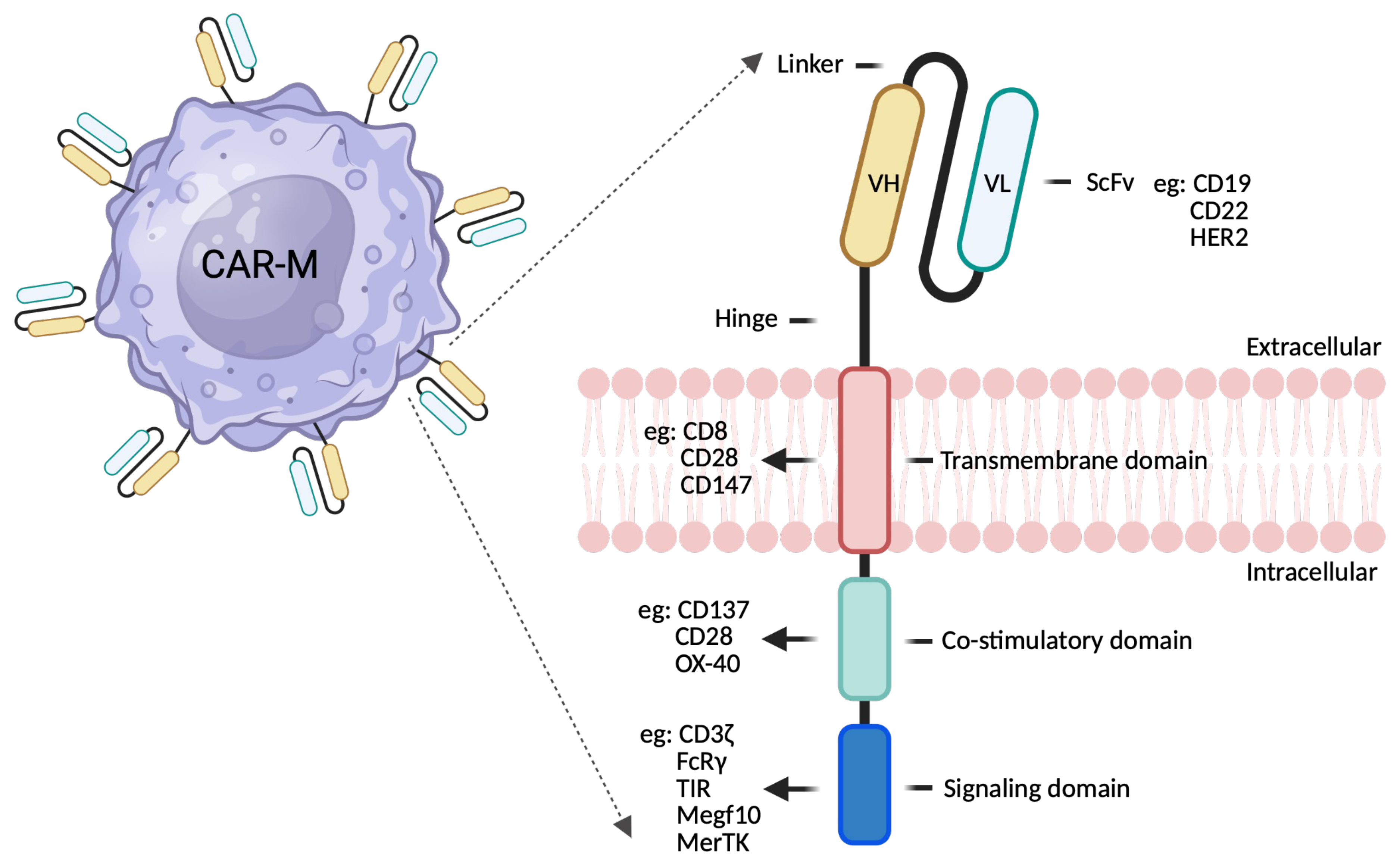
3. CAR-Macrophage Design and Engineering
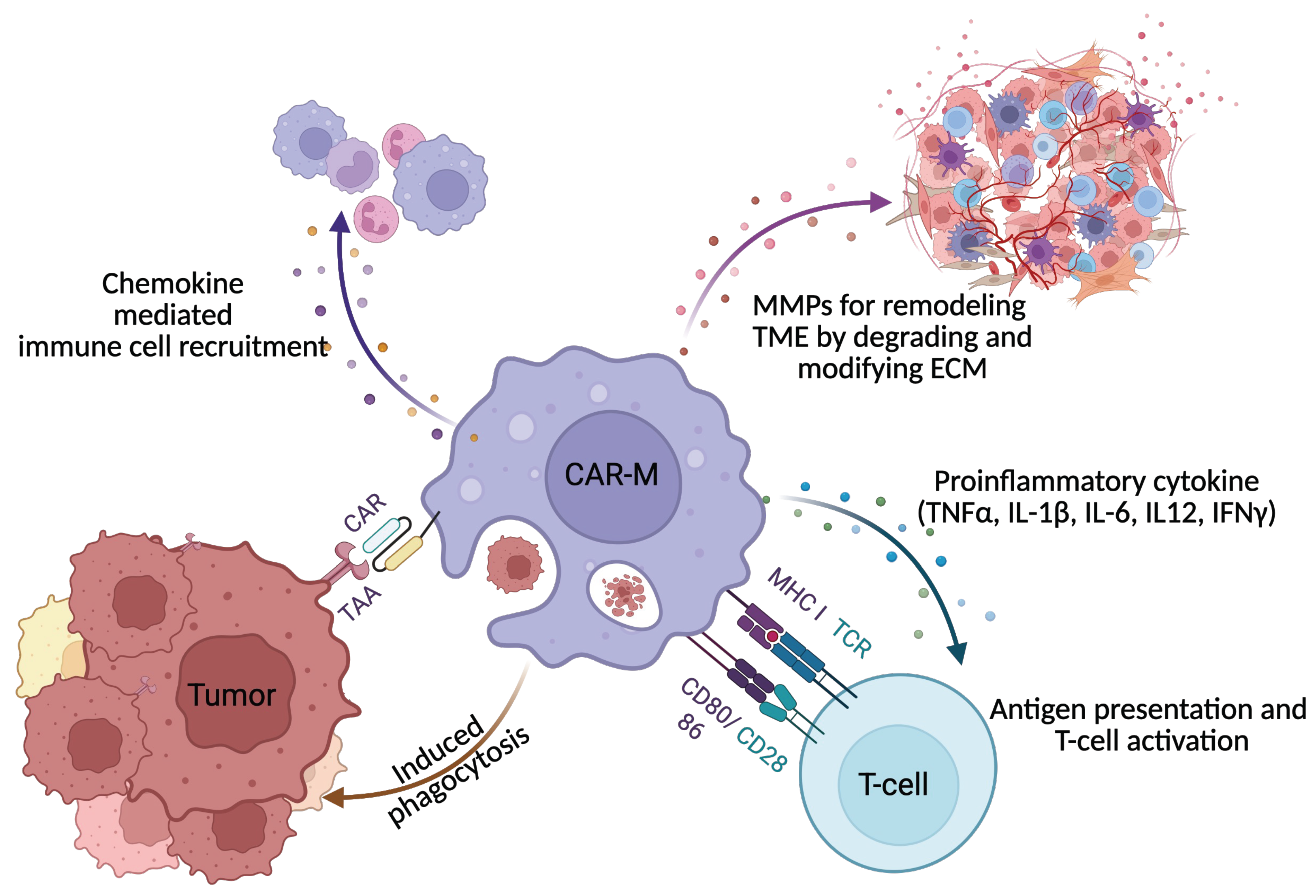
4. CAR-Macrophage Mechanisms of Action
5. Preclinical and Clinical Studies
6. Preclinical Promise Versus Clinical Uncertainty in CAR-Macrophage Therapy
7. Emerging Strategies and Innovations
8. Future Perspectives
9. Conclusions
Author Contributions
Funding
Data Availability Statement
Conflicts of Interest
References
- Zhang, W.Y.; Yang, L.Y.; Fan, X.X. CAR-T therapy-based innovations in the enhancement of contemporary anti-tumor therapies. Front. Immunol. 2025, 16, 1622433. [Google Scholar] [CrossRef]
- Li, Y.R.; Zhu, Y.; Yang, L. Clinical technology advances driving in vivo CAR therapy. Trends Biotechnol. 2025. [Google Scholar] [CrossRef] [PubMed]
- Muller, B.J.; Inaba, H. Chimeric antigen receptor T-cells in B-acute lymphoblastic leukemia: History, current situation, and future. Transl. Pediatr. 2023, 12, 1900–1907. [Google Scholar] [CrossRef] [PubMed]
- Dagar, G.; Gupta, A.; Masoodi, T.; Nisar, S.; Merhi, M.; Hashem, S.; Chauhan, R.; Dagar, M.; Mirza, S.; Bagga, P.; et al. Harnessing the potential of CAR-T cell therapy: Progress, challenges, and future directions in hematological and solid tumor treatments. J. Transl. Med. 2023, 21, 449, Correction in J. Transl. Med. 2023, 21, 571. https://doi.org/10.1186/s12967-023-04404-z. [Google Scholar] [CrossRef] [PubMed]
- Ali, A.; DiPersio, J.F. ReCARving the future: Bridging CAR T-cell therapy gaps with synthetic biology, engineering, and economic insights. Front. Immunol. 2024, 15, 1432799. [Google Scholar] [CrossRef]
- Bot, A.; Scharenberg, A.; Friedman, K.; Guey, L.; Hofmeister, R.; Andorko, J.I.; Klichinsky, M.; Neumann, F.; Shah, J.V.; Swayer, A.J.; et al. In vivo chimeric antigen receptor (CAR)-T cell therapy. Nat. Rev. Drug Discov. 2025, 24, 1–22. [Google Scholar] [CrossRef]
- Cao, L.Y.; Zhao, Y.; Chen, Y.; Ma, P.; Xie, J.C.; Pan, X.M.; Zhang, X.; Chen, Y.C.; Wang, Q.; Xie, L.L. CAR-T cell therapy clinical trials: Global progress, challenges, and future directions from ClinicalTrials.gov insights. Front. Immunol. 2025, 16, 1583116. [Google Scholar] [CrossRef]
- Goyco Vera, D.; Waghela, H.; Nuh, M.; Pan, J.; Lulla, P. Approved CAR-T therapies have reproducible efficacy and safety in clinical practice. Hum. Vaccin. Immunother. 2024, 20, 2378543. [Google Scholar] [CrossRef]
- Nadella, V.; Wang, Z.; Johnson, T.S.; Griffin, M.; Devitt, A. Transglutaminase 2 interacts with syndecan-4 and CD44 at the surface of human macrophages to promote removal of apoptotic cells. Biochim. Biophys. Acta 2015, 1853, 201–212. [Google Scholar] [CrossRef]
- Chen, S.; Saeed, A.; Liu, Q.; Jiang, Q.; Xu, H.; Xiao, G.G.; Rao, L.; Duo, Y. Macrophages in immunoregulation and therapeutics. Signal Transduct. Target. Ther. 2023, 8, 207. [Google Scholar] [CrossRef]
- Haydar, D.; Ibanez-Vega, J.; Crawford, J.C.; Chou, C.H.; Guy, C.S.; Meehl, M.; Yi, Z.; Perry, S.; Laxton, J.; Cunningham, T.; et al. CAR T-cell Design-dependent Remodeling of the Brain Tumor Immune Microenvironment Modulates Tumor-associated Macrophages and Anti-glioma Activity. Cancer Res. Commun. 2023, 3, 2430–2446. [Google Scholar] [CrossRef]
- Unver, N. Sophisticated genetically engineered macrophages, CAR-Macs, in hitting the bull’s eye for solid cancer immunotherapy approaches. Clin. Exp. Med. 2023, 23, 3171–3177. [Google Scholar] [CrossRef] [PubMed]
- Sloas, C.; Gill, S.; Klichinsky, M. Engineered CAR-Macrophages as Adoptive Immunotherapies for Solid Tumors. Front. Immunol. 2021, 12, 783305. [Google Scholar] [CrossRef] [PubMed]
- Chupradit, K.; Muneekaew, S.; Wattanapanitch, M. Engineered CD147-CAR macrophages for enhanced phagocytosis of cancers. Cancer Immunol. Immunother. 2024, 73, 170. [Google Scholar] [CrossRef] [PubMed]
- Alrehaili, M.; Couto, P.S.; Khalife, R.; Rafiq, Q.A. CAR-macrophages in solid tumors: Promise, progress, and prospects. npj Precis. Oncol. 2025, 9, 382. [Google Scholar] [CrossRef]
- Nadella, V.; Singh, S.; Jain, A.; Jain, M.; Vasquez, K.M.; Sharma, A.; Tanwar, P.; Rath, G.K.; Prakash, H. Low dose radiation primed iNOS + M1macrophages modulate angiogenic programming of tumor derived endothelium. Mol. Carcinog. 2018, 57, 1664–1671. [Google Scholar] [CrossRef]
- Nadella, V.; Garg, M.; Kapoor, S.; Barwal, T.S.; Jain, A.; Prakash, H. Emerging neo adjuvants for harnessing therapeutic potential of M1 tumor associated macrophages (TAM) against solid tumors: Enusage of plasticity. Ann. Transl. Med. 2020, 8, 1029. [Google Scholar] [CrossRef]
- Voisin, B.; Nadella, V.; Doebel, T.; Goel, S.; Sakamoto, K.; Ayush, O.; Jo, J.H.; Kelly, M.C.; Kobayashi, T.; Jiang, J.X.; et al. Macrophage-mediated extracellular matrix remodeling controls host Staphylococcus aureus susceptibility in the skin. Immunity 2023, 56, 1561–1577.e9. [Google Scholar] [CrossRef]
- Bied, M.; Ho, W.W.; Ginhoux, F.; Bleriot, C. Roles of macrophages in tumor development: A spatiotemporal perspective. Cell Mol. Immunol. 2023, 20, 983–992. [Google Scholar] [CrossRef]
- Vogel, A.; Weichhart, T. Tissue-resident macrophages—Early passengers or drivers in the tumor niche? Curr. Opin. Biotechnol. 2023, 83, 102984. [Google Scholar] [CrossRef]
- de Visser, K.E.; Joyce, J.A. The evolving tumor microenvironment: From cancer initiation to metastatic outgrowth. Cancer Cell 2023, 41, 374–403. [Google Scholar] [CrossRef]
- Xu, J.; Ding, L.; Mei, J.; Hu, Y.; Kong, X.; Dai, S.; Bu, T.; Xiao, Q.; Ding, K. Dual roles and therapeutic targeting of tumor-associated macrophages in tumor microenvironments. Signal Transduct. Target. Ther. 2025, 10, 268. [Google Scholar] [CrossRef]
- Kim, S.W.; Kim, C.W.; Moon, Y.A.; Kim, H.S. Reprogramming of tumor-associated macrophages by metabolites generated from tumor microenvironment. Anim. Cells Syst. 2024, 28, 123–136. [Google Scholar] [CrossRef] [PubMed]
- Rannikko, J.H.; Hollmen, M. Clinical landscape of macrophage-reprogramming cancer immunotherapies. Br. J. Cancer 2024, 131, 627–640. [Google Scholar] [CrossRef]
- Guan, F.; Wang, R.; Yi, Z.; Luo, P.; Liu, W.; Xie, Y.; Liu, Z.; Xia, Z.; Zhang, H.; Cheng, Q. Tissue macrophages: Origin, heterogenity, biological functions, diseases and therapeutic targets. Signal Transduct. Target. Ther. 2025, 10, 93. [Google Scholar] [CrossRef]
- Peng, M.; Li, N.; Wang, H.; Li, Y.; Liu, H.; Luo, Y.; Lang, B.; Zhang, W.; Li, S.; Tian, L.; et al. Macrophages: Subtypes, Distribution, Polarization, Immunomodulatory Functions, and Therapeutics. MedComm 2025, 6, e70304. [Google Scholar] [CrossRef] [PubMed]
- Gordon, S.; Pluddemann, A.; Martinez Estrada, F. Macrophage heterogeneity in tissues: Phenotypic diversity and functions. Immunol. Rev. 2014, 262, 36–55. [Google Scholar] [CrossRef] [PubMed]
- Wang, S.; Wang, J.; Chen, Z.; Luo, J.; Guo, W.; Sun, L.; Lin, L. Targeting M2-like tumor-associated macrophages is a potential therapeutic approach to overcome antitumor drug resistance. npj Precis. Oncol. 2024, 8, 31. [Google Scholar] [CrossRef]
- Locati, M.; Mantovani, A.; Sica, A. Macrophage activation and polarization as an adaptive component of innate immunity. Adv. Immunol. 2013, 120, 163–184. [Google Scholar] [CrossRef]
- Han, J.; Dong, L.; Wu, M.; Ma, F. Dynamic polarization of tumor-associated macrophages and their interaction with intratumoral T cells in an inflamed tumor microenvironment: From mechanistic insights to therapeutic opportunities. Front. Immunol. 2023, 14, 1160340. [Google Scholar] [CrossRef]
- Toledo, B.; Zhu Chen, L.; Paniagua-Sancho, M.; Marchal, J.A.; Peran, M.; Giovannetti, E. Deciphering the performance of macrophages in tumour microenvironment: A call for precision immunotherapy. J. Hematol. Oncol. 2024, 17, 44. [Google Scholar] [CrossRef]
- Cruceriu, D.; Baldasici, O.; Balacescu, O.; Berindan-Neagoe, I. The dual role of tumor necrosis factor-alpha (TNF-alpha) in breast cancer: Molecular insights and therapeutic approaches. Cell Oncol. 2020, 43, 1–18. [Google Scholar] [CrossRef] [PubMed]
- Kzhyshkowska, J.; Shen, J.; Larionova, I. Targeting of TAMs: Can we be more clever than cancer cells? Cell Mol. Immunol. 2024, 21, 1376–1409. [Google Scholar] [CrossRef] [PubMed]
- Qin, R.; Ren, W.; Ya, G.; Wang, B.; He, J.; Ren, S.; Jiang, L.; Zhao, S. Role of chemokines in the crosstalk between tumor and tumor-associated macrophages. Clin. Exp. Med. 2023, 23, 1359–1373. [Google Scholar] [CrossRef] [PubMed]
- Shi, Y.; Xu, Z.; Wang, H.; Tang, B.; Maihemuti, N.; Jiang, X.; Chen, X.; Xiao, M.; Jiang, S.; Xu, Y.; et al. Scaffolding Protein ENH Promotes Tumor Angiogenesis and Growth Through Macrophage Recruitment and Polarization. Adv. Sci. 2025, 12, e16476. [Google Scholar] [CrossRef]
- Sun, M.; Xiao, Q.; Wang, X.; Yang, C.; Chen, C.; Tian, X.; Wang, S.; Li, H.; Qiu, S.; Shu, J.; et al. Tumor-associated macrophages modulate angiogenesis and tumor growth in a xenograft mouse model of multiple myeloma. Leuk. Res. 2021, 110, 106709. [Google Scholar] [CrossRef]
- Shibutani, M.; Nakao, S.; Maeda, K.; Nagahara, H.; Kashiwagi, S.; Hirakawa, K.; Ohira, M. The Impact of Tumor-associated Macrophages on Chemoresistance via Angiogenesis in Colorectal Cancer. Anticancer. Res. 2021, 41, 4447–4453. [Google Scholar] [CrossRef]
- Piperigkou, Z.; Mangani, S.; Koletsis, N.E.; Koutsakis, C.; Mastronikolis, N.S.; Franchi, M.; Karamanos, N.K. Principal mechanisms of extracellular matrix-mediated cell-cell communication in physiological and tumor microenvironments. FEBS J. 2025, 293, 26–41. [Google Scholar] [CrossRef]
- Prakash, J.; Shaked, Y. The Interplay between Extracellular Matrix Remodeling and Cancer Therapeutics. Cancer Discov. 2024, 14, 1375–1388. [Google Scholar] [CrossRef]
- von Locquenghien, M.; Zwicky, P.; Xie, K.; Jaitin, D.A.; Sheban, F.; Yalin, A.; Uhlitz, F.; Gur, C.; Eshed, R.S.; David, E.; et al. Macrophage-targeted immunocytokine leverages myeloid, T, and NK cell synergy for cancer immunotherapy. Cell 2025, 188, 7099–7117 e7026. [Google Scholar] [CrossRef]
- Naik, S.; Velasquez, M.P.; Gottschalk, S. Chimeric antigen receptor T-cell therapy in childhood acute myeloid leukemia: How far are we from a clinical application? Haematologica 2024, 109, 1656–1667. [Google Scholar] [CrossRef] [PubMed]
- Sadelain, M.; Brentjens, R.; Riviere, I. The basic principles of chimeric antigen receptor design. Cancer Discov. 2013, 3, 388–398. [Google Scholar] [CrossRef] [PubMed]
- Zheng, R.; Chen, Y.; Zhang, Y.; Liang, S.; Zhao, X.; Wang, Y.; Wang, P.; Meng, R.; Yang, A.; Yan, B. Humanized single-domain antibody targeting HER2 enhances function of chimeric antigen receptor T cells. Front. Immunol. 2023, 14, 1258156. [Google Scholar] [CrossRef] [PubMed]
- Wickman, E.; Lange, S.; Wagner, J.; Ibanez, J.; Tian, L.; Lu, M.; Sheppard, H.; Chiang, J.; Koo, S.C.; Vogel, P.; et al. IL-18R supported CAR T cells targeting oncofetal tenascin C for the immunotherapy of pediatric sarcoma and brain tumors. J. Immunother. Cancer 2024, 12, e009743. [Google Scholar] [CrossRef]
- Jayaraman, J.; Mellody, M.P.; Hou, A.J.; Desai, R.P.; Fung, A.W.; Pham, A.H.T.; Chen, Y.Y.; Zhao, W. CAR-T design: Elements and their synergistic function. EBioMedicine 2020, 58, 102931. [Google Scholar] [CrossRef]
- Reiss, K.A.; Angelos, M.G.; Dees, E.C.; Yuan, Y.; Ueno, N.T.; Pohlmann, P.R.; Johnson, M.L.; Chao, J.; Shestova, O.; Serody, J.S.; et al. CAR-macrophage therapy for HER2-overexpressing advanced solid tumors: A phase 1 trial. Nat. Med. 2025, 31, 1171–1182. [Google Scholar] [CrossRef]
- Peche, V.; Gottschalk, S. Engineering immunotherapy from within. Science 2025, 388, 1273–1274. [Google Scholar] [CrossRef]
- Gu, K.; Liang, T.; Hu, L.; Zhao, Y.; Ying, W.; Zhang, M.; Chen, Y.; Liang, B.; Lin, X.; Zhang, Y.; et al. Intraperitoneal programming of tailored CAR macrophages via mRNA lipid nanoparticle to boost cancer immunotherapy. Nat. Commun. 2025, 17, 941. [Google Scholar] [CrossRef]
- Garg, P.; Singhal, G.; Pareek, S.; Kulkarni, P.; Horne, D.; Nath, A.; Salgia, R.; Singhal, S.S. Unveiling the potential of gene editing techniques in revolutionizing Cancer treatment: A comprehensive overview. Biochim. Biophys. Acta Rev. Cancer 2025, 1880, 189233. [Google Scholar] [CrossRef]
- Pierini, S.; Gabbasov, R.; Oliveira-Nunes, M.C.; Qureshi, R.; Worth, A.; Huang, S.; Nagar, K.; Griffin, C.; Lian, L.; Yashiro-Ohtani, Y.; et al. Chimeric antigen receptor macrophages (CAR-M) sensitize HER2+ solid tumors to PD1 blockade in pre-clinical models. Nat. Commun. 2025, 16, 706, Correction in Nat. Commun. 2025, 16, 2692. https://doi.org/10.1038/s41467-025-57496-0. [Google Scholar] [CrossRef]
- Gao, C.; Hong, F.; Dong, Y.; Fu, Y.; Ma, Y.; Sun, X.; Zhang, J.; Chen, J.; Huang, Z. Lifespan-Regulated CAR-Macrophages from Myeloid Progenitors for Enhanced Colorectal Cancer Therapy. Adv. Sci. 2025, 12, e17677. [Google Scholar] [CrossRef] [PubMed]
- Cherkassky, L.; Morello, A.; Villena-Vargas, J.; Feng, Y.; Dimitrov, D.S.; Jones, D.R.; Sadelain, M.; Adusumilli, P.S. Human CAR T cells with cell-intrinsic PD-1 checkpoint blockade resist tumor-mediated inhibition. J. Clin. Investig. 2016, 126, 3130–3144. [Google Scholar] [CrossRef] [PubMed]
- Klichinsky, M.; Ruella, M.; Shestova, O.; Lu, X.M.; Best, A.; Zeeman, M.; Schmierer, M.; Gabrusiewicz, K.; Anderson, N.R.; Petty, N.E.; et al. Human chimeric antigen receptor macrophages for cancer immunotherapy. Nat. Biotechnol. 2020, 38, 947–953. [Google Scholar] [CrossRef] [PubMed]
- Di Stasi, A.; Tey, S.K.; Dotti, G.; Fujita, Y.; Kennedy-Nasser, A.; Martinez, C.; Straathof, K.; Liu, E.; Durett, A.G.; Grilley, B.; et al. Inducible apoptosis as a safety switch for adoptive cell therapy. N. Engl. J. Med. 2011, 365, 1673–1683. [Google Scholar] [CrossRef]
- Morva, A.; Arroyo, A.B.; Andreeva, L.; Tapia-Abellan, A.; Luengo-Gil, G. Unleashing the power of CAR-M therapy in solid tumors: A comprehensive review. Front. Immunol. 2025, 16, 1615760. [Google Scholar] [CrossRef]
- Blanchard, L.; Mijacika, A.; Osorio, J.C. Targeting Myeloid Cells for Cancer Immunotherapy. Cancer Immunol. Res. 2025, 13, 1700–1715. [Google Scholar] [CrossRef]
- Norton, J.; Stiff, P. CAR-T therapy toxicities: The importance of macrophages in their development and possible targets for their management. Discov. Oncol. 2025, 16, 49. [Google Scholar] [CrossRef]
- Jing, J.; Chen, Y.; Chi, E.; Li, S.; He, Y.; Wang, B.; Shen, H.; Fan, L.; Wang, J.; Shangguan, T.; et al. New power in cancer immunotherapy: The rise of chimeric antigen receptor macrophage (CAR-M). J. Transl. Med. 2025, 23, 1182. [Google Scholar] [CrossRef]
- Liu, T.; Zhang, M.; Farsh, T.; Li, H.; Kishishita, A.; Barpanda, A.; Leung, S.G.; Zhu, J.; Jung, H.; Hua, J.T.; et al. Exploitable mechanisms of antibody and CAR mediated macrophage cytotoxicity. Nat. Commun. 2025, 16, 5616. [Google Scholar] [CrossRef]
- Chettri, D.; Satapathy, B.P.; Yadav, R.; Uttam, V.; Jain, A.; Prakash, H. CAR-macrophages: Tailoring cancer immunotherapy. Front. Immunol. 2024, 15, 1532833. [Google Scholar] [CrossRef]
- Brancewicz, J.; Kucharzewska, P. Emerging macrophage-based therapies for cancer: A review of preclinical and clinical advances. Front. Immunol. 2025, 16, 1679271. [Google Scholar] [CrossRef] [PubMed]
- Chen, Y.; Zhu, X.; Liu, H.; Wang, C.; Chen, Y.; Wang, H.; Fang, Y.; Wu, X.; Xu, Y.; Li, C.; et al. The application of HER2 and CD47 CAR-macrophage in ovarian cancer. J. Transl. Med. 2023, 21, 654. [Google Scholar] [CrossRef] [PubMed]
- Dai, H.; Zhu, C.; Huai, Q.; Xu, W.; Zhu, J.; Zhang, X.; Zhang, X.; Sun, B.; Xu, H.; Zheng, M.; et al. Chimeric antigen receptor-modified macrophages ameliorate liver fibrosis in preclinical models. J. Hepatol. 2024, 80, 913–927. [Google Scholar] [CrossRef] [PubMed]
- Hou, Y.; Hu, S.; Liu, C.; Chen, X.; Wang, Y.; Li, Y.; Fu, Z.; Feng, C.; Gong, Y.; Liu, Z.; et al. Beyond CAR-T Cells: Exploring CAR-NK, CAR-M, and CAR-gammadelta T strategies in solid tumor immunotherapy. Front. Immunol. 2025, 16, 1675807. [Google Scholar] [CrossRef]
- Zhang, H.; Huo, Y.; Zheng, W.; Li, P.; Li, H.; Zhang, L.; Sa, L.; He, Y.; Zhao, Z.; Shi, C.; et al. Silencing of SIRPalpha enhances the antitumor efficacy of CAR-M in solid tumors. Cell Mol. Immunol. 2024, 21, 1335–1349. [Google Scholar] [CrossRef]
- Du, F.; Ye, Z.; He, A.; Yuan, J.; Su, M.; Jia, Q.; Wang, H.; Yang, P.; Yang, Z.; Ning, P.; et al. An engineered alpha1beta1 integrin-mediated FcgammaRI signaling component to control enhanced CAR macrophage activation and phagocytosis. J. Control Release 2025, 377, 689–703. [Google Scholar] [CrossRef]
- Xiang, S.; Zhan, H.; Zhan, J.; Li, X.; Lin, X.; Sun, W. Breaking hypoxic barrier: Oxygen-supplied nanomaterials for enhanced T cell-mediated tumor immunotherapy. Int. J. Pharm. X 2025, 10, 100400. [Google Scholar] [CrossRef]
- Mariathasan, S.; Turley, S.J.; Nickles, D.; Castiglioni, A.; Yuen, K.; Wang, Y.; Kadel, E.E., III; Koeppen, H.; Astarita, J.L.; Cubas, R.; et al. TGFbeta attenuates tumour response to PD-L1 blockade by contributing to exclusion of T cells. Nature 2018, 554, 544–548. [Google Scholar] [CrossRef]
- Li, J.; Chen, P.; Ma, W. The next frontier in immunotherapy: Potential and challenges of CAR-macrophages. Exp. Hematol. Oncol. 2024, 13, 76. [Google Scholar] [CrossRef]
- Chen, S.; Wang, Y.; Dang, J.; Song, N.; Chen, X.; Wang, J.; Huang, G.N.; Brown, C.E.; Yu, J.; Weissman, I.L.; et al. CAR macrophages with built-In CD47 blocker combat tumor antigen heterogeneity and activate T cells via cross-presentation. Nat. Commun. 2025, 16, 4069. [Google Scholar] [CrossRef]
- Liu, Y.; Xiao, L.; Yang, M.; Chen, X.; Liu, H.; Wang, Q.; Guo, M.; Luo, J. CAR-armored-cell therapy in solid tumor treatment. J. Transl. Med. 2024, 22, 1076. [Google Scholar] [CrossRef] [PubMed]
- Fretwell, E.C.; Houldsworth, A. Oncolytic Virus Therapy in a New Era of Immunotherapy, Enhanced by Combination with Existing Anticancer Therapies: Turn up the Heat! J. Cancer 2025, 16, 1782–1793. [Google Scholar] [CrossRef] [PubMed]
- Look, T.; Sankowski, R.; Bouzereau, M.; Fazio, S.; Sun, M.; Buck, A.; Binder, N.; Mastall, M.; Prisco, F.; Seehusen, F.; et al. CAR T cells, CAR NK cells, and CAR macrophages exhibit distinct traits in glioma models but are similarly enhanced when combined with cytokines. Cell Rep. Med. 2025, 6, 101931. [Google Scholar] [CrossRef] [PubMed]
- Wei, D.; Wang, L.; Liu, Y.; Zuo, X.; Shen, X.; Bresalier, R.S. CAR-Macrophage Cell Therapy: A New Era of Hope for Pancreatic Cancer. Clin. Cancer Res. 2025, 31, 4018–4031. [Google Scholar] [CrossRef]
- Guoyun, J.; Yuefeng, Q.; Zhenglan, H.; Zuowei, Y.; Hongyan, Z.; Ying, Y.; Wenli, F. CAR-macrophages targets CD26 to eliminate chronic myeloid leukemia stem cells. Exp. Hematol. Oncol. 2025, 14, 14. [Google Scholar] [CrossRef]
- International Council for Harmonisation of Technical Requirements for Pharmaceuticals for Human Use. ICH Q7 Good Manufacturing Practice Guide for Active Pharmaceutical Ingredients; ICH: Geneva, Switzerland, 2018. [Google Scholar]



| Generation | CAR Design Focus | Key Strengths | Limitations |
|---|---|---|---|
| First | T cell-style CARs (CD3ζ, ±CD28/4-1BB) | Enhanced antigen presentation; Activates macrophage APC function; High safety profile | Weak phagocytosis; Not optimized for myeloid signaling |
| Second | Phagocytic receptor CARs (e.g., FCγR, Megf10, MERTK, DAP12) | Strong engulfment; Balanced activation; Low inflammation | Some constructs produce local inflammatory cytokines; Requires antigen accessibility for phagocytosis |
| Third | TME reprogramming CAR-M (e.g., CD40L, TLR, Cytokine secreting) | Potent TMR modeling; Drives M1 like polarization; Recruits and primes T cells | Higher inflammatory potential; Required tuned regulation for safety |
| Fourth | Gene edited armored CAR-M (e.g., IL-6 KO, PD-1 DNR, SIRPα KO) | Low CRS risk; Enhanced persistence; Improved specificity | Increased manufacturing complexity; Needs validated safety switches |
| Fifth | Synthetic circuit CAR-M (Logic gated, inducible, multi-input designs) | Highly specific tumor targeting; Minimal-off tumor activation; | Preclinical stage; Complex validation and safety validation |
| CAR Design | Strength | Limitation | Therapeutic Application |
|---|---|---|---|
| FcγR-based (CD32A/CD64 ITAMs) | Strong phagocytosis; Robust Syk-mediated activation; Effective in antibody resistant tumors | Higher local inflammatory cytokines (TNFα, IL-1β); Requires careful control in inflamed tissue | Solid tumors with high antigen density; Tumors requiring potent direct clearance |
| Megf10 | Efficient Efferocytosis; Minimal inflammatory cytokine release; High safety and tissue compatibility | Limited TME remodeling compared to TLR-based and CD40L-enhanced CAR-M | Tumors near sensitive tissues (CNS, GI tract); Situations requiring strong but quite phagocytosis |
| MerTK | Moderate phagocytosis with very low inflammation; Promotes M1-like reprogramming under engineered conditions; Good balance of safety and efficacy | Less aggressive tumor clearance than FcγR or Megf10; May require co-therapies to maximize TME remodeling | Tumors with immunosuppressive TME; combination strategies with checkpoint inhibitor CAR-T |
| TLR (TLR2/4 fusion) | Potent M1 polarization; High secretion of IL-2, TNFα, and ROS, Strong TME remodeling | High inflammatory potential, Requires safeguard mechanisms for safety | Immunologically cold tumors, Tumors needing immune activation and T-cell recruitment |
| CD3ζ (T-cell) | Enhanced antigen presentation and cross priming; low toxicity; Synergizes with adaptive immunity | Weak phagocytosis; limited autonomous tumor killing | Combination with CAR-T, vaccines, checkpoint therapy; TME activation |
| DAP12 | Balanced ITAM signaling; Moderate-strong phagocytosis; Lower inflammatory footprint than FcγR | Less potent antigen uptake than FcγR; Moderate cytokine induction | Solid tumors needing controlled activation; Myeloid-enrichment tumors |
| CD40L | Superior T-cell recruitment through CD40-CD40L axis; Strong APC function; Combats suppressive TMEs | Requires tight regulation due to APC activation; Unwanted local inflammation | Solid tumors requiring T-cell priming and recruitment; improving immunotherapy response rates |
| IL-6 KO | Enhanced safety via reduced CRS cytokines; Suitable for systemic delivery; Improved persistence | Requires genome editing; Complex manufacturing | High-risk patients; multi-dose strategies; Solid tumors requiring sustained macrophage activity |
| Next-generation synthetic Circuit CAR-M (logic-gated, inducible) | Tumor specific activation (AND/NOT gates); High precision; programmable TME reshaping | Still preclinical; Needed complex engineering and validation | Precision solid tumor targeting; Deep-tissue tumors; Scenarios requiring spatial or temporal control |
| Features | CAR-T | CAR-NK | CAR-M |
|---|---|---|---|
| Origin | Autologous or allogeneic T lymphocytes | Autologous, allogeneic, or cell lines (e.g., NK-92) | Monocyte-derived or cell line macrophages |
| Primary Mechanism | Cytokine killing via perforin/granzyme, cytokine release | Cytokine killing via perforin/granzyme, ADCC, cytokine release | Phagocytosis, cytokine release, antigen presentation |
| Tumor Infiltration | Moderate | Moderate to good | Excellent |
| Antigen Presentation | Limited | Limited | Strong |
| Cytokine Release Syndrome (CRS) Risk | High | Lower than CAR-T | Very low |
| Graft-vs-Host Disease (GvHD) Risk | Possible | Very low | Very low |
| Limited (mainly autologous) | High (allogeneic, cell lines feasible) | Moderate (potential for allogeneic products) | |
| Current Clinical Status | FDA-approved for several cancers | Early-phase clinical trails | Preclinical and early-phase clinical trails |
| Main Advantages | Proven efficiency in hematologic cancers, long-term persistence | Lower CRS risk, off-the-shelf potential, innate immunity | TME modulation, phagocytosis, antigen presentation |
| Main Challenges | CRS, neurotoxicity, limited efficiency in solid tumors | Persistence, expansion, transduction efficiency | Optimization of CAR design, in vivo persistence and safety |
| Trial Name/Identifier | Sponsor | Indication | Target Antigen | CAR-M Source | Phase | Status |
|---|---|---|---|---|---|---|
| CT-1119 NCT0572596 | Carisma Therapeutics, Philadelphia, PA, USA | Mesothelin + Solid Tumors primarily focusing on patients with ovarian and pancreatic cancers | Mesothelin | Autologous | Phase 1 | Actively advancing in late 2025 |
| NCT05138458 | CREATE Medicines, Inc., Cambridge, MA, USA, formerly known as Myeloid Therapeutics, Inc. | CD5+ Advanced solid tumors | CD5 | Autologous | Phase 1/2 | Active |
| NCT06224738 | NCI, NIH grant P30DK056338 | HER2+ Solid Tumors | Advanced HER2+ gastric cancer and peritoneal metastases | Autologous | Phase 1 | Active |
| CT-0525 NCT06254807 | Carisma Therapeutics | HER2+ Solid Tumors | HER2 | Autologous | Phase 1 | Active |
| ChiCTR2400082776/ChiCTR2400080078 | First People’s Hospital of Hangzhou | HER2-positive and HER2-low solid tumors. | HER2 | Autologous | Phase 1 | Active |
| MCY-M11 NCT03608618 | MaxCyte, Inc. Rockville, MD, USA/CARMA Cell Therapies | Mesothelin expressing solid ovarian and peritoneal mesothelioma | Mesothelin | Autologous | Phase 1; dose-escalation study | Completed |
| CT-0508 NCT04660929 | Carisma Therapeutics | HER2+ Solid Tumors | HER2 | Autologous | Phase 1 | Completed |
Disclaimer/Publisher’s Note: The statements, opinions and data contained in all publications are solely those of the individual author(s) and contributor(s) and not of MDPI and/or the editor(s). MDPI and/or the editor(s) disclaim responsibility for any injury to people or property resulting from any ideas, methods, instructions or products referred to in the content. |
© 2026 by the authors. Licensee MDPI, Basel, Switzerland. This article is an open access article distributed under the terms and conditions of the Creative Commons Attribution (CC BY) license.
Share and Cite
Nadella, V.; Sharma, A. Targeting Macrophages in Immunotherapy: The Ascent of CAR-Macrophages. Int. J. Mol. Sci. 2026, 27, 1292. https://doi.org/10.3390/ijms27031292
Nadella V, Sharma A. Targeting Macrophages in Immunotherapy: The Ascent of CAR-Macrophages. International Journal of Molecular Sciences. 2026; 27(3):1292. https://doi.org/10.3390/ijms27031292
Chicago/Turabian StyleNadella, Vinod, and Anu Sharma. 2026. "Targeting Macrophages in Immunotherapy: The Ascent of CAR-Macrophages" International Journal of Molecular Sciences 27, no. 3: 1292. https://doi.org/10.3390/ijms27031292
APA StyleNadella, V., & Sharma, A. (2026). Targeting Macrophages in Immunotherapy: The Ascent of CAR-Macrophages. International Journal of Molecular Sciences, 27(3), 1292. https://doi.org/10.3390/ijms27031292