Review

Unraveling the Roles of UBE3A in Neurodevelopment and Neurodegeneration

1
The Department of Molecular Biology, Cell Biology & Biochemistry, Brown University, Providence, RI 02903, USA
2
Carney Institute for Brain Science, Brown University, Providence, RI 02903, USA
3
Center for Translational Neuroscience in Brown Institute for Translational Sciences, Brown University, Providence, RI 02903, USA
*
Authors to whom correspondence should be addressed.
Int. J. Mol. Sci. 2025, 26(5), 2304; https://doi.org/10.3390/ijms26052304
Submission received: 24 January 2025 / Revised: 18 February 2025 / Accepted: 26 February 2025 / Published: 5 March 2025
(This article belongs to the Special Issue Challenges and Innovation in Neurodegenerative Diseases, 2nd Edition)

Abstract

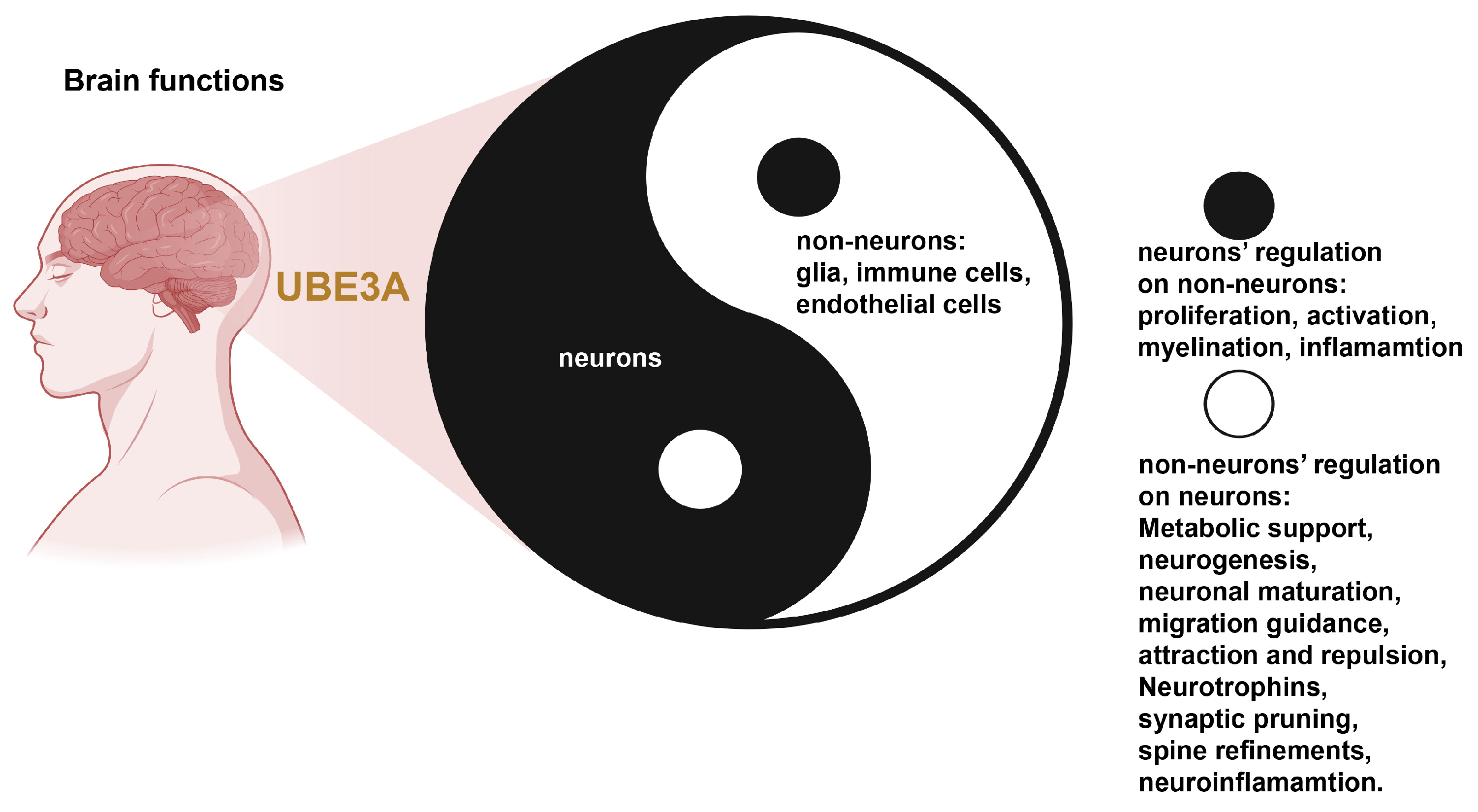
The ubiquitin-protein ligase E3A (UBE3A, aka E6-AP), an E3 ligase belonging to the HECT family, plays crucial roles in the stability of various proteins through the proteasomal degradation system. Abnormal UBE3A activity is essential for the initiation and progression of several cancers. A gain of function and an overdosage of maternal UBE3A is associated with an increased risk of autism spectrum disorders. Conversely, a loss of function due to mutations, deletions, paternal duplications, or imprinting defects in neurons leads to Angelman syndrome. Emerging evidence suggests that abnormal UBE3A activity may also contribute to the development of various brain disorders, including schizophrenia, Huntington’s disease, Parkinson’s disease, and Alzheimer’s disease, making UBE3A a protein of significant interest. However, research on UBE3A’s functions in the brain has primarily focused on neurons due to the imprinting of UBE3A in mature neuronal cells, while being obscured in glia. This review outlines the expression of UBE3A in neurons and glial cells based on published studies, highlights newly identified patterns of UBE3A, such as its secretion, and emphasizes the involvement of UBE3A in neurodegenerative diseases. Furthermore, we summarize glial UBE3A and propose a model of bi-directional interactions between the neurons and glia mediated by UBE3A that underlies brain functions. Insights gained from this research could provide new avenues for therapeutic interventions targeting various brain disorders.
Keywords: UBE3A; autism spectrum; Angelman syndrome; brain disorders; neuron–glia interactions; neurodegeneration UBE3A; autism spectrum; Angelman syndrome; brain disorders; neuron–glia interactions; neurodegeneration