Hidden Industrial Trans-Fatty Acids: Mechanistic Insights into Dyslipidemia, Cardiovascular Disease, and Metabolic Dysfunction-Associated Steatotic Liver Disease


 , ,
, ,  and
and
Abstract
1. Introduction
2. Summary of the Most Widely Studied Trans-Fatty Acids
3. Impact of Trans-Fatty Acids on Dyslipidemia and Cardiovascular Risk
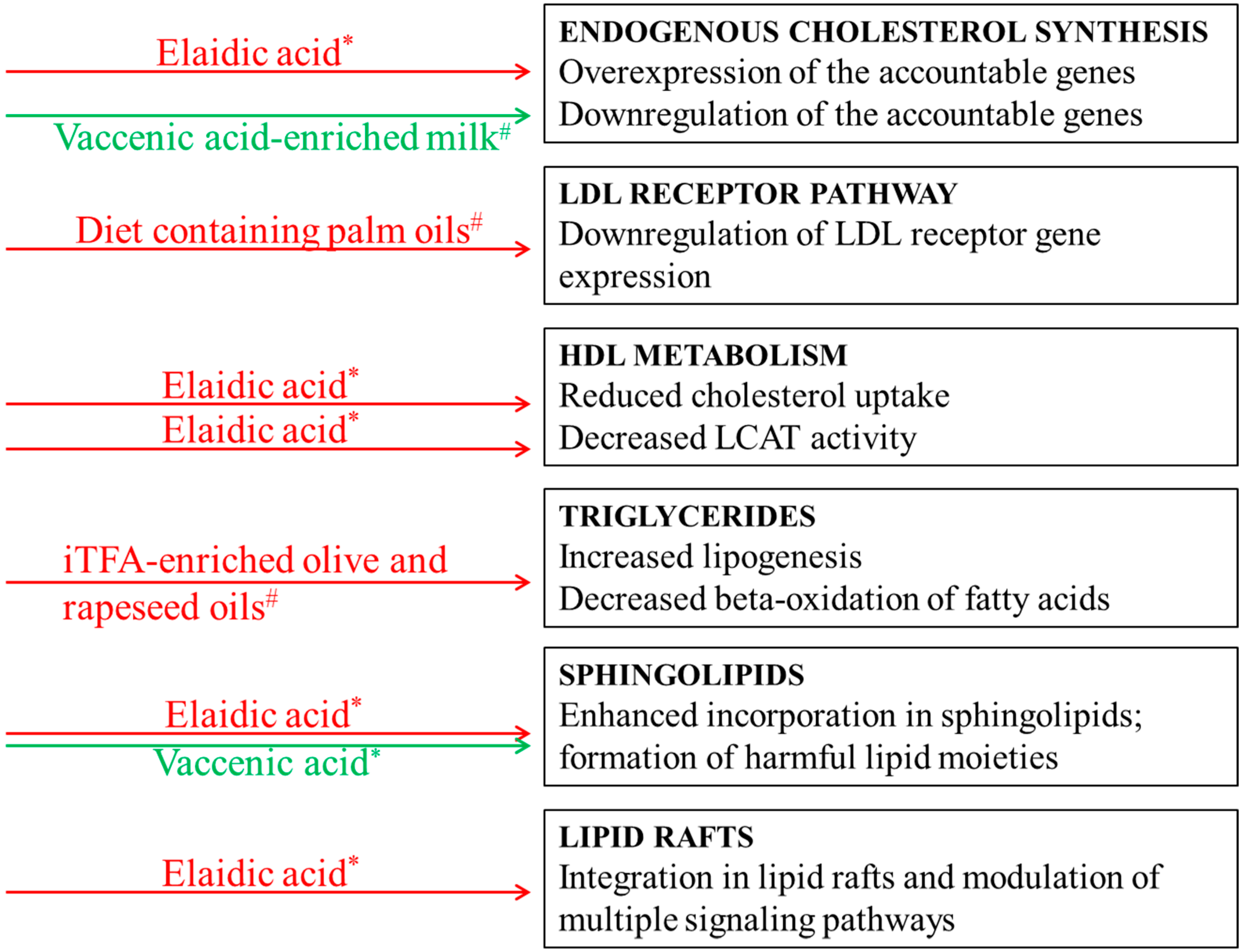
3.1. Modulation of Lipoprotein Structure and Lipid Metabolism Pathways by Trans-Fatty Acids
3.2. Overview of the Impact of Trans-Fatty Acids on Vascular Oxidative Stress and Inflammation
3.3. Human Studies Assessing the Link Between TFAs, Dyslipidemia, Oxidative Stress, Inflammation, and Cardiovascular Risk

| Study | Study Design | Study Population | Assessment of TFAs Intake | Assessed CVD Risk Factors or Outcomes | Main Findings |
|---|---|---|---|---|---|
| Riley et al., 2024 [31] | Meta-analysis | Subgroup analysis of 8 randomized controlled trials including 334 healthy or at-risk participants | Intake of partially hydrogenated vegetable oils | Levels of Lp(a) | Replacement of saturated fatty acids with TFAs led to a significant increase in Lp(a) levels. |
| Chandra et al., 2020 [55] | Cross-sectional study | 3706 subjects from Norway | Intake assessed by plasma fatty acid composition | Lipid profile, body mass index, systolic and diastolic blood pressure | Both ruminant and industrial TFAs levels in plasma were associated with favorable CVD risk profile. |
| Mesa et al., 2021 [68] | Cross-sectional study | 167 patients with type 1 diabetes mellitus from Spain | Intake assessed by fatty acids composition of erythrocyte membranes | Presence of carotid plaques | Positive association between all-C18:1trans levels in the erythrocyte membranes and the presence of ≥3 carotid plaques. |
| Lechner et al., 2023 [69] | Prospective cohort study | 404 patients with heart failure with preserved ejection fraction in Aldo-DHF trial from Germany and Austria | Intake assessed by whole blood fatty acid composition | Cardiometabolic risk factors, aerobic capacity, and cardiac function | Higher levels of industrial TFAs were associated with increased LDL-C, TG, and HbA1c levels and lower aerobic capacity. Natural TFAs were inversely associated with cardiometabolic risk factors. |
| Wang et al., 2025 [70] | Cross-sectional study | 1478 participants of the NHANES study from US | Intake assessed by plasma fatty acid composition | Levels of NT-proBNP | Higher levels of major TFAs in plasma (elaidic, vaccenic, and linolelaidic acids) and their sum were positively associated with elevated NT-proBNP. |
| Mitri et al., 2021 [71] | Randomized clinical trial | 111 participants with type 2 diabetes mellitus from US | Intake from dairy products | Metabolic control, body weight, and CVD risk factors | Increased dairy consumption was linked to higher trans-palmitoleic acid levels, which positively correlated with TC and TG levels. |
| Trieu et al., 2021 [72] | Meta-analysis | Subgroup analysis of 6 studies including 3477 participants | Intake from dairy products | CVD incidence and all-cause mortality | No association between trans-palmitoleic acid levels and CVD risk and all-cause mortality. |
| Zhu et al., 2019 [73] | Meta-analysis | 744,736 subjects from 24 studies | Intake assessed by food frequency questionnaire, 7-day weighed food record or 24 h dietary recall | CVD incidence or mortality | A positive dose–response association was found between dietary TFAs intake and CVD risk. |
| Ivey et al., 2023 [74] | Prospective cohort study | 158,198 participants in the Million Veteran Program from US | Intake assessed by food frequency questionnaire and estimated total fatty acid composition of commonly consumed oils and fats | Atherosclerotic CVD event (ischemic heart disease, ischemic cerebrovascular disease, and peripheral artery disease) | Higher intakes of monounsaturated TFAs and rumenic acid were linked to increased risks of ischemic heart disease and peripheral artery disease. |
| Zeinalabedini et al., 2024 [75] | Case–control study | 443 patients with ischemic heart disease and 453 controls from Iran | Intake assessed by food frequency questionnaire | Ischemic heart disease | Intake of TFAs was not associated with ischemic heart disease. |
| Yao et al., 2021 [76] | Prospective cohort study | 101,832 subjects from PLCO cancer screening trial from US | Intake assessed by food frequency questionnaire | All-cause, CVD, and cancer mortality | Dietary intake of TFAs was associated with all-cause mortality, but not with CVD and cancer mortality. |
4. Impact of Trans-Fatty Acids on Hepatic Steatosis, Fibrosis, and MASLD Progression
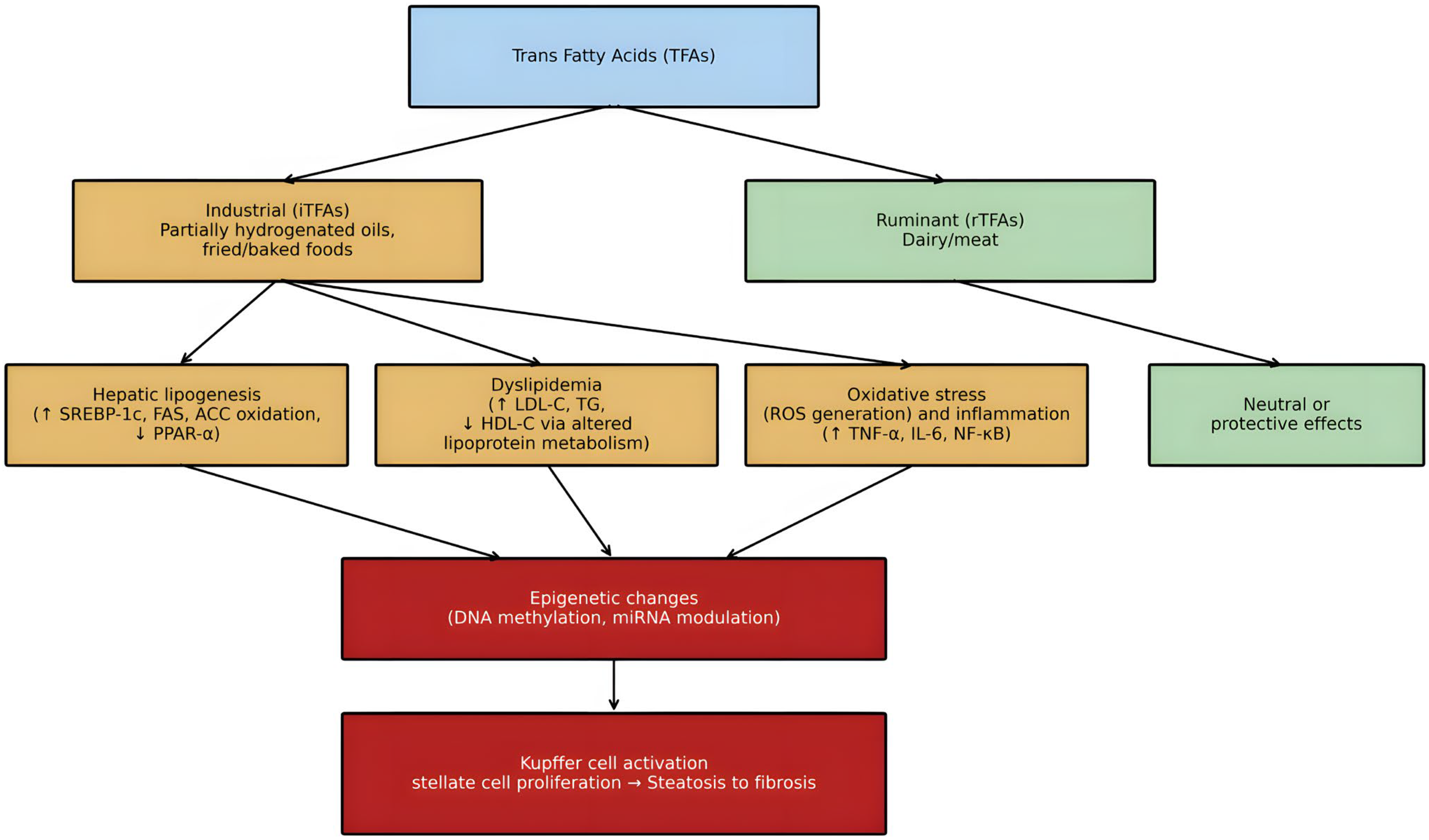
4.1. Modulation of Hepatic Lipid Metabolism by Trans-Fatty Acids
4.2. The Impact of Trans-Fatty Acids on Hepatic Oxidative Stress and Inflammation
4.3. Trans-Fatty Acids and Hepatic Fibrosis
4.4. Changes in Hepatic Function Induced by Trans-Fatty Acids
4.5. Human Studies Assessing the Link Between TFAs, MASLD, and Lipoproteins
5. The Issue of Hidden Trans-Fatty Acids and Food Labeling Regulations
6. Future Directions
7. Conclusions
8. Recommendations
- Strengthen regulations to eliminate iTFAs from processed and restaurant foods.
- Enhance food labeling to improve consumer awareness of hidden TFAs.
- Promote dietary education on the risks of TFAs and healthier fat alternatives.
- Advance research on TFA-induced epigenetic changes and precision nutrition strategies.
Author Contributions
Funding
Institutional Review Board Statement
Informed Consent Statement
Data Availability Statement
Acknowledgments
Conflicts of Interest
Abbreviations
| TFAs | Trans-fatty acids |
| MUFAs | Monounsaturated fatty acids |
| PUFAs | Polyunsaturated fatty acids |
| iTFAs | Industrially produced trans-fatty acids |
| rTFAs | Ruminant trans-fatty acids |
| CVD | Cardiovascular disease |
| MASLD | Metabolic dysfunction-associated fatty liver disease |
| TC | Total cholesterol |
| LDL-C | Low-density lipoprotein cholesterol |
| HDL-C | High-density lipoprotein cholesterol |
| TG | Triglycerides |
| CETP | Cholesteryl ester transfer protein |
| LCAT | Lecithin-cholesterol acyltransferase |
| CRP | C-reactive protein |
| ROS | Reactive oxygen species |
| FLI | Fatty liver index |
| GC | Gas chromatography |
| miRNA | Micro RNA |
References
- Wanders, A.J.; Zock, P.L.; Brouwer, I.A. Trans Fat Intake and Its Dietary Sources in General Populations Worldwide: A Systematic Review. Nutrients 2017, 9, 840. [Google Scholar] [CrossRef]
- Pietinen, P.; Ascherio, A.; Korhonen, P.; Hartman, A.M.; Willett, W.C.; Albanes, D.; Virtamo, J. Intake of fatty acids and risk of coronary heart disease in a cohort of Finnish men. The Alpha-Tocopherol, Beta-Carotene Cancer Prevention Study. Am. J. Epidemiol. 1997, 145, 876–887. [Google Scholar] [CrossRef]
- Oomen, C.M.; Ocke, M.C.; Feskens, E.J.; van Erp-Baart, M.A.; Kok, F.J.; Kromhout, D. Association between trans fatty acid intake and 10-year risk of coronary heart disease in the Zutphen Elderly Study: A prospective population-based study. Lancet 2001, 357, 746–751. [Google Scholar] [CrossRef]
- Mozaffarian, D.; Katan, M.B.; Ascherio, A.; Stampfer, M.J.; Willett, W.C. Trans fatty acids and cardiovascular disease. N. Engl. J. Med. 2006, 354, 1601–1613. [Google Scholar] [CrossRef]
- Brouwer, I.A.; Wanders, A.J.; Katan, M.B. Effect of animal and industrial trans fatty acids on HDL and LDL cholesterol levels in humans—A quantitative review. PLoS ONE 2010, 5, e9434, Erratum in PLoS ONE 2010, 5. [Google Scholar] [CrossRef]
- Jakobsen, M.U.; Overvad, K.; Dyerberg, J.; Heitmann, B.L. Intake of ruminant trans fatty acids and risk of coronary heart disease. Int. J. Epidemiol. 2008, 37, 173–182. [Google Scholar] [CrossRef] [PubMed]
- Willett, W.C.; Stampfer, M.J.; Manson, J.E.; Colditz, G.A.; Speizer, F.E.; Rosner, B.A.; Sampson, L.A.; Hennekens, C.H. Intake of trans fatty acids and risk of coronary heart disease among women. Lancet 1993, 341, 581–585. [Google Scholar] [CrossRef]
- Nagpal, T.; Sahu, J.K.; Khare, S.K.; Bashir, K.; Jan, K. Trans fatty acids in food: A review on dietary intake, health impact, regulations and alternatives. J. Food Sci. 2021, 86, 5159–5174. [Google Scholar] [CrossRef] [PubMed]
- Oteng, A.B.; Kersten, S. Mechanisms of Action of trans Fatty Acids. Adv. Nutr. 2020, 11, 697–708. [Google Scholar] [CrossRef]
- Pipoyan, D.; Stepanyan, S.; Stepanyan, S.; Beglaryan, M.; Costantini, L.; Molinari, R.; Merendino, N. The Effect of Trans Fatty Acids on Human Health: Regulation and Consumption Patterns. Foods 2021, 10, 2452. [Google Scholar] [CrossRef]
- Bruce, J.H. Eliminating industrially produced trans fats from our diet-How well is it going? Nutr. Bull. 2023, 48, 427–434. [Google Scholar] [CrossRef]
- Dhaka, V.; Gulia, N.; Ahlawat, K.S.; Khatkar, B.S. Trans fats-sources, health risks and alternative approach—A review. J. Food Sci. Technol. 2011, 48, 534–541. [Google Scholar] [CrossRef]
- Silva, T.J.; Barrera-Arellano, D.; Ribeiro, A.P.B. Margarines: Historical approach, technological aspects, nutritional profile, and global trends. Food Res. Int. 2021, 147, 110486. [Google Scholar] [CrossRef] [PubMed]
- Mavlanov, U.; Czaja, T.P.; Nuriddinov, S.; Dalimova, D.; Dragsted, L.O.; Engelsen, S.B.; Khakimov, B. The effects of industrial processing and home cooking practices on trans-fatty acid profiles of vegetable oils. Food Chem. 2025, 469, 142571. [Google Scholar] [CrossRef]
- Manzoor, S.; Masoodi, F.A.; Rashid, R. Influence of food type, oil type and frying frequency on the formation of trans-fatty acids during repetitive deep-frying. Food Control 2023, 147, 109557. [Google Scholar] [CrossRef]
- Obi, J.; Furihata, K.; Sato, S.; Honda, M. Natural Sulfur Compounds, Allyl Isothiocyanate and Diallyl Disulfide, Promote Cis to Trans Isomerization of Fatty Acid Esters during Heat Treatment. J. Oleo Sci. 2023, 72, 881–887. [Google Scholar] [CrossRef]
- Hatem, O.; Kacar, O.F.; Kacar, H.K.; Szentpeteri, J.L.; Marosvolgyi, T.; Szabo, E. Trans isomeric fatty acids in human milk and their role in infant health and development. Front. Nutr. 2024, 11, 1379772. [Google Scholar] [CrossRef] [PubMed]
- Niwińska, B. Endogenous synthesis of rumenic acid in humans and cattle. J. Anim. Feed Sci. 2010, 19, 171–182. [Google Scholar] [CrossRef]
- Guillocheau, E.; Legrand, P.; Rioux, V. Trans-palmitoleic acid (trans-9-C16:1, or trans-C16:1 n-7): Nutritional impacts, metabolism, origin, compositional data, analytical methods and chemical synthesis. A review. Biochimie 2020, 169, 144–160. [Google Scholar] [CrossRef]
- Menounou, G.; Giacometti, G.; Scanferlato, R.; Dambruoso, P.; Sansone, A.; Tueros, I.; Amezaga, J.; Chatgilialoglu, C.; Ferreri, C. Trans Lipid Library: Synthesis of Docosahexaenoic Acid (DHA) Monotrans Isomers and Regioisomer Identification in DHA-Containing Supplements. Chem. Res. Toxicol. 2018, 31, 191–200. [Google Scholar] [CrossRef]
- Hung, W.L.; Hwang, L.S.; Shahidi, F.; Pan, M.H.; Wang, Y.; Ho, C.T. Endogenous formation of trans fatty acids: Health implications and potential dietary intervention. J. Funct. Foods 2016, 25, 14–24. [Google Scholar] [CrossRef]
- Chatgilialoglu, C.; Ferreri, C.; Melchiorre, M.; Sansone, A.; Torreggiani, A. Lipid geometrical isomerism: From chemistry to biology and diagnostics. Chem. Rev. 2014, 114, 255–284. [Google Scholar] [CrossRef]
- Devillard, E.; McIntosh, F.M.; Duncan, S.H.; Wallace, R.J. Metabolism of linoleic acid by human gut bacteria: Different routes for biosynthesis of conjugated linoleic acid. J. Bacteriol. 2007, 189, 2566–2570. [Google Scholar] [CrossRef] [PubMed]
- Banni, S.; Petroni, A.; Blasevich, M.; Carta, G.; Cordeddu, L.; Murru, E.; Melis, M.P.; Mahon, A.; Belury, M.A. Conjugated linoleic acids (CLA) as precursors of a distinct family of PUFA. Lipids 2004, 39, 1143–1146. [Google Scholar] [CrossRef]
- Vekic, J.; Stromsnes, K.; Mazzalai, S.; Zeljkovic, A.; Rizzo, M.; Gambini, J. Oxidative Stress, Atherogenic Dyslipidemia, and Cardiovascular Risk. Biomedicines 2023, 11, 2897. [Google Scholar] [CrossRef]
- Vekic, J.; Zeljkovic, A.; Al Rasadi, K.; Cesur, M.; Silva-Nunes, J.; Stoian, A.P.; Rizzo, M. A New Look at Novel Cardiovascular Risk Biomarkers: The Role of Atherogenic Lipoproteins and Innovative Antidiabetic Therapies. Metabolites 2022, 12, 108. [Google Scholar] [CrossRef] [PubMed]
- Vekic, J.; Stefanovic, A.; Zeljkovic, A. Obesity and Dyslipidemia: A Review of Current Evidence. Curr. Obes. Rep. 2023, 12, 207–222. [Google Scholar] [CrossRef]
- Schoeneck, M.; Iggman, D. The effects of foods on LDL cholesterol levels: A systematic review of the accumulated evidence from systematic reviews and meta-analyses of randomized controlled trials. Nutr. Metab. Cardiovasc. Dis. 2021, 31, 1325–1338. [Google Scholar] [CrossRef]
- Feingold, K.R. The Effect of Diet on Cardiovascular Disease and Lipid and Lipoprotein Levels. In Endotext; Feingold, K.R., Anawalt, B., Blackman, M.R., Boyce, A., Chrousos, G., Corpas, E., de Herder, W.W., Dhatariya, K., Dungan, K., Hofland, J., et al., Eds.; MDText.com, Inc.: South Dartmouth, MA, USA, 2000. [Google Scholar]
- Islam, M.A.; Amin, M.N.; Siddiqui, S.A.; Hossain, M.P.; Sultana, F.; Kabir, M.R. Trans fatty acids and lipid profile: A serious risk factor to cardiovascular disease, cancer and diabetes. Diabetes Metab. Syndr. 2019, 13, 1643–1647. [Google Scholar] [CrossRef]
- Riley, T.M.; Sapp, P.A.; Kris-Etherton, P.M.; Petersen, K.S. Effects of saturated fatty acid consumption on lipoprotein (a): A systematic review and meta-analysis of randomized controlled trials. Am. J. Clin. Nutr. 2024, 120, 619–629. [Google Scholar] [CrossRef]
- Helgadottir, H.; Thorisdottir, B.; Gunnarsdottir, I.; Halldorsson, T.I.; Palsson, G.; Thorsdottir, I. Lower Intake of Saturated Fatty Acids Is Associated with Improved Lipid Profile in a 6-Year-Old Nationally Representative Population. Nutrients 2022, 14, 671. [Google Scholar] [CrossRef]
- Oteng, A.B.; Loregger, A.; van Weeghel, M.; Zelcer, N.; Kersten, S. Industrial Trans Fatty Acids Stimulate SREBP2-Mediated Cholesterogenesis and Promote Non-Alcoholic Fatty Liver Disease. Mol. Nutr. Food Res. 2019, 63, e1900385. [Google Scholar] [CrossRef]
- Izuddin, W.I.; Loh, T.C.; Nayan, N.; Akit, H.; Noor, A.M.; Foo, H.L. Blood lipid profiles, fatty acid deposition and expression of hepatic lipid and lipoprotein metabolism genes in laying hens fed palm oils, palm kernel oil, and soybean oil. Front. Vet. Sci. 2023, 10, 1192841. [Google Scholar] [CrossRef] [PubMed]
- Krogager, T.P.; Nielsen, L.V.; Kahveci, D.; Dyrlund, T.F.; Scavenius, C.; Sanggaard, K.W.; Enghild, J.J. Hepatocytes respond differently to major dietary trans fatty acid isomers, elaidic acid and trans-vaccenic acid. Proteome Sci. 2015, 13, 31. [Google Scholar] [CrossRef]
- Berriozabalgoitia, A.; Ruiz de Gordoa, J.C.; Amores, G.; Santamarina-Garcia, G.; Hernandez, I.; Virto, M. Normal-Fat vs. High-Fat Diets and Olive Oil vs. CLA-Rich Dairy Fat: A Comparative Study of Their Effects on Atherosclerosis in Male Golden Syrian Hamsters. Metabolites 2023, 13, 827. [Google Scholar] [CrossRef] [PubMed]
- Singh, V.P.; Fontaine, M.A.; Mangat, R.; Fouhse, J.M.; Diane, A.; Willing, B.P.; Proctor, S.D. High Vaccenic Acid Content in Beef Fat Attenuates High Fat and High Carbohydrate Western Diet Induced Changes in Lipid Metabolism and Gut Microbiota in Pigs. Microorganisms 2021, 9, 2517. [Google Scholar] [CrossRef] [PubMed]
- Reichard, J.F.; Haber, L.T. Mode-of-action evaluation for the effect of trans fatty acids on low-density lipoprotein cholesterol. Food Chem. Toxicol. 2016, 98, 282–294. [Google Scholar] [CrossRef]
- Sain, J.; Gonzalez, M.A.; Lavandera, J.V.; Scalerandi, M.V.; Bernal, C.A. The effects of trans-fatty acids on TAG regulation in mice depend on dietary unsaturated fatty acids. Br. J. Nutr. 2016, 116, 611–620. [Google Scholar] [CrossRef]
- Gengatharan, J.M.; Handzlik, M.K.; Chih, Z.Y.; Ruchhoeft, M.L.; Secrest, P.; Ashley, E.L.; Green, C.R.; Wallace, M.; Gordts, P.; Metallo, C.M. Altered sphingolipid biosynthetic flux and lipoprotein trafficking contribute to trans-fat-induced atherosclerosis. Cell Metab. 2025, 37, 274–290.e9. [Google Scholar] [CrossRef]
- Sarnyai, F.; Donko, M.B.; Matyasi, J.; Gor-Nagy, Z.; Marczi, I.; Simon-Szabo, L.; Zambo, V.; Somogyi, A.; Csizmadia, T.; Low, P.; et al. Cellular toxicity of dietary trans fatty acids and its correlation with ceramide and diglyceride accumulation. Food Chem. Toxicol. 2019, 124, 324–335. [Google Scholar] [CrossRef]
- Sarnyai, F.; Somogyi, A.; Gor-Nagy, Z.; Zambo, V.; Szelenyi, P.; Matyasi, J.; Simon-Szabo, L.; Kereszturi, E.; Toth, B.; Csala, M. Effect of cis- and trans-Monounsaturated Fatty Acids on Palmitate Toxicity and on Palmitate-induced Accumulation of Ceramides and Diglycerides. Int. J. Mol. Sci. 2020, 21, 2626. [Google Scholar] [CrossRef] [PubMed]
- Kishi, S.; Fujiwara-Tani, R.; Luo, Y.; Kawahara, I.; Goto, K.; Fujii, K.; Ohmori, H.; Nakashima, C.; Sasaki, T.; Kuniyasu, H. Pro-metastatic signaling of the trans fatty acid elaidic acid is associated with lipid rafts. Oncol. Lett. 2018, 15, 4423–4426. [Google Scholar] [CrossRef]
- Qiu, B.; Wang, Q.; Liu, W.; Xu, T.C.; Liu, L.N.; Zong, A.Z.; Jia, M.; Li, J.; Du, F.L. Biological effects of trans fatty acids and their possible roles in the lipid rafts in apoptosis regulation. Cell Biol. Int. 2018, 42, 904–912. [Google Scholar] [CrossRef] [PubMed]
- Aleksandrova, K.; Koelman, L.; Rodrigues, C.E. Dietary patterns and biomarkers of oxidative stress and inflammation: A systematic review of observational and intervention studies. Redox Biol. 2021, 42, 101869. [Google Scholar] [CrossRef]
- Monguchi, T.; Hara, T.; Hasokawa, M.; Nakajima, H.; Mori, K.; Toh, R.; Irino, Y.; Ishida, T.; Hirata, K.I.; Shinohara, M. Excessive intake of trans fatty acid accelerates atherosclerosis through promoting inflammation and oxidative stress in a mouse model of hyperlipidemia. J. Cardiol. 2017, 70, 121–127. [Google Scholar] [CrossRef]
- Hirata, Y. trans-Fatty Acids as an Enhancer of Inflammation and Cell Death: Molecular Basis for Their Pathological Actions. Biol. Pharm. Bull. 2021, 44, 1349–1356. [Google Scholar] [CrossRef]
- Iwata, N.G.; Pham, M.; Rizzo, N.O.; Cheng, A.M.; Maloney, E.; Kim, F. Trans fatty acids induce vascular inflammation and reduce vascular nitric oxide production in endothelial cells. PLoS ONE 2011, 6, e29600. [Google Scholar] [CrossRef]
- Hirata, Y.; Inoue, A.; Suzuki, S.; Takahashi, M.; Matsui, R.; Kono, N.; Noguchi, T.; Matsuzawa, A. trans-Fatty acids facilitate DNA damage-induced apoptosis through the mitochondrial JNK-Sab-ROS positive feedback loop. Sci. Rep. 2020, 10, 2743. [Google Scholar] [CrossRef]
- Ma, W.W.; Zhao, L.; Yuan, L.H.; Yu, H.L.; Wang, H.; Gong, X.Y.; Wei, F.; Xiao, R. Elaidic acid induces cell apoptosis through induction of ROS accumulation and endoplasmic reticulum stress in SH-SY5Y cells. Mol. Med. Rep. 2017, 16, 9337–9346. [Google Scholar] [CrossRef]
- Lee, J.S.; Lim, J.N.; Wang, T.; Lee, S.B.; Hwang, J.H.; Jung, U.S.; Kim, M.J.; Choi, S.H.; Ishizuka, S.; Lee, H.G. Physiological concentrations of trans-11 18:1 vaccenic acid suppress pro-inflammatory markers under acute inflammation in isolated ICR mice splenocytes. Food Sci. Biotechnol. 2016, 25, 275–281. [Google Scholar] [CrossRef]
- Downs, S.M.; Bloem, M.Z.; Zheng, M.; Catterall, E.; Thomas, B.; Veerman, L.; Wu, J.H. The Impact of Policies to Reduce trans Fat Consumption: A Systematic Review of the Evidence. Curr. Dev. Nutr. 2017, 1, cdn-117. [Google Scholar] [CrossRef]
- Stender, S. Trans fat in foods in Iran, South-Eastern Europe, Caucasia and Central Asia: A market basket investigation. Food Policy 2020, 96, 101877. [Google Scholar] [CrossRef]
- Al-Jawaldeh, A.; Taktouk, M.; Chatila, A.; Naalbandian, S.; Abdollahi, Z.; Ajlan, B.; Al Hamad, N.; Alkhalaf, M.M.; Almamary, S.; Alobaid, R.; et al. A Systematic Review of Trans Fat Reduction Initiatives in the Eastern Mediterranean Region. Front. Nutr. 2021, 8, 771492. [Google Scholar] [CrossRef]
- Chandra, A.; Lyngbakken, M.N.; Eide, I.A.; Rosjo, H.; Vigen, T.; Ihle-Hansen, H.; Orstad, E.B.; Ronning, O.M.; Berge, T.; Schmidt, E.B.; et al. Plasma Trans Fatty Acid Levels, Cardiovascular Risk Factors and Lifestyle: Results from the Akershus Cardiac Examination 1950 Study. Nutrients 2020, 12, 1419. [Google Scholar] [CrossRef]
- Guggisberg, D.; Burton-Pimentel, K.J.; Walther, B.; Badertscher, R.; Blaser, C.; Portmann, R.; Schmid, A.; Radtke, T.; Saner, H.; Fournier, N.; et al. Molecular effects of the consumption of margarine and butter varying in trans fat composition: A parallel human intervention study. Lipids Health Dis. 2022, 21, 74. [Google Scholar] [CrossRef]
- Verneque, B.J.F.; Machado, A.M.; de Abreu Silva, L.; Lopes, A.C.S.; Duarte, C.K. Ruminant and industrial trans-fatty acids consumption and cardiometabolic risk markers: A systematic review. Crit. Rev. Food Sci. Nutr. 2022, 62, 2050–2060. [Google Scholar] [CrossRef] [PubMed]
- Iino, T.; Toh, R.; Nagao, M.; Shinohara, M.; Harada, A.; Murakami, K.; Irino, Y.; Nishimori, M.; Yoshikawa, S.; Seto, Y.; et al. Effects of Elaidic Acid on HDL Cholesterol Uptake Capacity. Nutrients 2021, 13, 3112. [Google Scholar] [CrossRef] [PubMed]
- Mendivil, E.J.; Barcenas-Rivera, G.; Ramos-Lopez, O.; Hernandez-Guerrero, C.; Rivera-Iniguez, I.; Perez-Beltran, Y.E. Interaction of CETP rs708272 Polymorphism on Trans Fatty Acid Intake and Glucose Metabolism Markers. Nutrients 2024, 16, 3683. [Google Scholar] [CrossRef]
- Gupta, R.; Abraham, R.A.; Kondal, D.; Dhatwalia, S.; Jeemon, P.; Reddy, K.S.; Prabhakaran, D.; Ramakrishnan, L. Association of trans fatty acids with lipids and other cardiovascular risk factors in an Indian industrial population. BMC Res. Notes 2019, 12, 342. [Google Scholar] [CrossRef]
- Hastert, T.A.; de Oliveira Otto, M.C.; Le-Scherban, F.; Steffen, B.T.; Steffen, L.M.; Tsai, M.Y.; Jacobs, D.R., Jr.; Baylin, A. Association of plasma phospholipid polyunsaturated and trans fatty acids with body mass index: Results from the Multi-Ethnic Study of Atherosclerosis. Int. J. Obes. 2018, 42, 433–440. [Google Scholar] [CrossRef]
- Del Pozo, M.D.P.; Lope, V.; Criado-Navarro, I.; Pastor-Barriuso, R.; Fernandez de Larrea, N.; Ruiz, E.; Castello, A.; Lucas, P.; Sierra, A.; Romieu, I.; et al. Serum Phospholipid Fatty Acids Levels, Anthropometric Variables and Adiposity in Spanish Premenopausal Women. Nutrients 2020, 12, 1895. [Google Scholar] [CrossRef]
- Baer, D.J.; Judd, J.T.; Clevidence, B.A.; Tracy, R.P. Dietary fatty acids affect plasma markers of inflammation in healthy men fed controlled diets: A randomized crossover study. Am. J. Clin. Nutr. 2004, 79, 969–973. [Google Scholar] [CrossRef] [PubMed]
- Lopez-Garcia, E.; Schulze, M.B.; Meigs, J.B.; Manson, J.E.; Rifai, N.; Stampfer, M.J.; Willett, W.C.; Hu, F.B. Consumption of trans fatty acids is related to plasma biomarkers of inflammation and endothelial dysfunction. J. Nutr. 2005, 135, 562–566. [Google Scholar] [CrossRef]
- Mozaffarian, D.; Rimm, E.B.; King, I.B.; Lawler, R.L.; McDonald, G.B.; Levy, W.C. trans fatty acids and systemic inflammation in heart failure. Am. J. Clin. Nutr. 2004, 80, 1521–1525. [Google Scholar] [CrossRef]
- Hadj Ahmed, S.; Kharroubi, W.; Kaoubaa, N.; Zarrouk, A.; Batbout, F.; Gamra, H.; Najjar, M.F.; Lizard, G.; Hininger-Favier, I.; Hammami, M. Correlation of trans fatty acids with the severity of coronary artery disease lesions. Lipids Health Dis. 2018, 17, 52. [Google Scholar] [CrossRef]
- Pranger, I.G.; Muskiet, F.A.J.; Kema, I.P.; Singh-Povel, C.; Bakker, S.J.L. Potential Biomarkers for Fat from Dairy and Fish and Their Association with Cardiovascular Risk Factors: Cross-sectional Data from the LifeLines Biobank and Cohort Study. Nutrients 2019, 11, 1099. [Google Scholar] [CrossRef]
- Mesa, A.; Cofan, M.; Esmatjes, E.; Perea, V.; Boswell, L.; Gimenez, M.; Sala-Vila, A.; Vinagre, I.; Vinals, C.; Chiva-Blanch, G.; et al. Biomarkers of fatty acid intake are independently associated with preclinical atherosclerosis in individuals with type 1 diabetes. Eur. J. Nutr. 2021, 60, 4595–4605. [Google Scholar] [CrossRef]
- Lechner, K.; Bock, M.; von Schacky, C.; Scherr, J.; Lorenz, E.; Lechner, B.; Haller, B.; Krannich, A.; Halle, M.; Wachter, R.; et al. Trans-fatty acid blood levels of industrial but not natural origin are associated with cardiovascular risk factors in patients with HFpEF: A secondary analysis of the Aldo-DHF trial. Clin. Res. Cardiol. 2023, 112, 1541–1554. [Google Scholar] [CrossRef]
- Wang, X.; Chen, X.; Jiang, F.; Cheng, Y.; Li, Y. Circulating trans fatty acids are related to serum levels of NT-proBNP in general population. Int. J. Cardiol. 2025, 422, 132974. [Google Scholar] [CrossRef]
- Mitri, J.; Tomah, S.; Furtado, J.; Tasabehji, M.W.; Hamdy, O. Plasma Free Fatty Acids and Metabolic Effect in Type 2 Diabetes, an Ancillary Study from a Randomized Clinical Trial. Nutrients 2021, 13, 1145. [Google Scholar] [CrossRef]
- Trieu, K.; Bhat, S.; Dai, Z.; Leander, K.; Gigante, B.; Qian, F.; Korat, A.V.A.; Sun, Q.; Pan, X.F.; Laguzzi, F.; et al. Biomarkers of dairy fat intake, incident cardiovascular disease, and all-cause mortality: A cohort study, systematic review, and meta-analysis. PLoS Med. 2021, 18, e1003763. [Google Scholar] [CrossRef]
- Zhu, Y.; Bo, Y.; Liu, Y. Dietary total fat, fatty acids intake, and risk of cardiovascular disease: A dose-response meta-analysis of cohort studies. Lipids Health Dis. 2019, 18, 91. [Google Scholar] [CrossRef]
- Ivey, K.L.; Nguyen, X.T.; Li, R.; Furtado, J.; Cho, K.; Gaziano, J.M.; Hu, F.B.; Willett, W.C.; Wilson, P.W.; Djousse, L. Association of dietary fatty acids with the risk of atherosclerotic cardiovascular disease in a prospective cohort of United States veterans. Am. J. Clin. Nutr. 2023, 118, 763–772. [Google Scholar] [CrossRef]
- Zeinalabedini, M.; Ladaninezhad, M.; Mobarakeh, K.A.; Hoshiar-Rad, A.; Shekari, S.; Askarpour, S.A.; Ardekanizadeh, N.H.; Esmaeili, M.; Abdollahi, M.; Doaei, S.; et al. Association of dietary fats with ischemic heart disease (IHD): A case-control study. J. Health Popul. Nutr. 2024, 43, 19, Erratum in J. Health Popul. Nutr. 2024, 43, 51. [Google Scholar] [CrossRef]
- Yao, X.; Xu, X.; Wang, S.; Xia, D. Associations of Dietary Fat Intake with Mortality From All Causes, Cardiovascular Disease, and Cancer: A Prospective Study. Front. Nutr. 2021, 8, 701430. [Google Scholar] [CrossRef]
- Huang, N.K.; Buzkova, P.; Matthan, N.R.; Djousse, L.; Hirsch, C.H.; Kizer, J.R.; Longstreth, W.T., Jr.; Mukamal, K.J.; Lichtenstein, A.H. Associations of Serum Nonesterified Fatty Acids with Coronary Heart Disease Mortality and Nonfatal Myocardial Infarction: The CHS (Cardiovascular Health Study) Cohort. J. Am. Heart Assoc. 2021, 10, e019135. [Google Scholar] [CrossRef]
- Jayedi, A.; Soltani, S.; Emadi, A.; Ghods, K.; Shab-Bidar, S. Dietary intake, biomarkers and supplementation of fatty acids and risk of coronary events: A systematic review and dose-response meta-analysis of randomized controlled trials and prospective observational studies. Crit. Rev. Food Sci. Nutr. 2024, 64, 12363–12382. [Google Scholar] [CrossRef]
- Bjoernsbo, K.S.; Joensen, A.M.; Joergensen, T.; Lundbye-Christensen, S.; Bysted, A.; Christensen, T.; Fagt, S.; Capewell, S.; O’Flaherty, M. Quantifying benefits of the Danish transfat ban for coronary heart disease mortality 1991–2007: Socioeconomic analysis using the IMPACTsec model. PLoS ONE 2022, 17, e0272744. [Google Scholar] [CrossRef]
- Sansone, A.; Tolika, E.; Louka, M.; Sunda, V.; Deplano, S.; Melchiorre, M.; Anagnostopoulos, D.; Chatgilialoglu, C.; Formisano, C.; Di Micco, R.; et al. Hexadecenoic Fatty Acid Isomers in Human Blood Lipids and Their Relevance for the Interpretation of Lipidomic Profiles. PLoS ONE 2016, 11, e0152378. [Google Scholar] [CrossRef]
- Kechagias, S.; Nasr, P.; Blomdahl, J.; Ekstedt, M. Established and emerging factors affecting the progression of nonalcoholic fatty liver disease. Metabolism 2020, 111, 154183. [Google Scholar] [CrossRef]
- Li, Y.; Yang, P.; Ye, J.; Xu, Q.; Wu, J.; Wang, Y. Updated mechanisms of MASLD pathogenesis. Lipids Health Dis. 2024, 23, 117. [Google Scholar] [CrossRef]
- Buzzetti, E.; Pinzani, M.; Tsochatzis, E.A. The multiple-hit pathogenesis of non-alcoholic fatty liver disease (NAFLD). Metabolism 2016, 65, 1038–1048. [Google Scholar] [CrossRef]
- Nguyen, P.; Leray, V.; Diez, M.; Serisier, S.; Le Bloc’h, J.; Siliart, B.; Dumon, H. Liver lipid metabolism. J. Anim. Physiol. Anim. Nutr. 2008, 92, 272–283. [Google Scholar] [CrossRef]
- Kawano, Y.; Cohen, D.E. Mechanisms of hepatic triglyceride accumulation in non-alcoholic fatty liver disease. J. Gastroenterol. 2013, 48, 434–441. [Google Scholar] [CrossRef]
- Shao, F.; Ford, D.A. Elaidic acid increases hepatic lipogenesis by mediating sterol regulatory element binding protein-1c activity in HuH-7 cells. Lipids 2014, 49, 403–413. [Google Scholar] [CrossRef]
- Zhao, X.; Shen, C.; Zhu, H.; Wang, C.; Liu, X.; Sun, X.; Han, S.; Wang, P.; Dong, Z.; Ma, X.; et al. Trans-Fatty Acids Aggravate Obesity, Insulin Resistance and Hepatic Steatosis in C57BL/6 Mice, Possibly by Suppressing the IRS1 Dependent Pathway. Molecules 2016, 21, 705. [Google Scholar] [CrossRef]
- Machado, R.M.; Stefano, J.T.; Oliveira, C.P.; Mello, E.S.; Ferreira, F.D.; Nunes, V.S.; de Lima, V.M.; Quintao, E.C.; Catanozi, S.; Nakandakare, E.R.; et al. Intake of trans fatty acids causes nonalcoholic steatohepatitis and reduces adipose tissue fat content. J. Nutr. 2010, 140, 1127–1132. [Google Scholar] [CrossRef]
- Ismail, H.; Mubashar, Z.; Khan, H.; Naveed, Z.; Dilshad, E.; Bhatti, M.Z.; Anwaar, S.; Saleem, S.; Mehmood, S.; Rahman, A.; et al. Effects of a High Trans Fatty Acid Diet on Kidney-, Liver-, and Heart-Associated Diseases in a Rabbit Model. Metabolites 2024, 14, 442. [Google Scholar] [CrossRef]
- Afonso, M.S.; Lavrador, M.S.; Koike, M.K.; Cintra, D.E.; Ferreira, F.D.; Nunes, V.S.; Castilho, G.; Gioielli, L.A.; Paula Bombo, R.; Catanozi, S.; et al. Dietary interesterified fat enriched with palmitic acid induces atherosclerosis by impairing macrophage cholesterol efflux and eliciting inflammation. J. Nutr. Biochem. 2016, 32, 91–100, Erratum in J. Nutr. Biochem. 2016, 36, 89–90. [Google Scholar] [CrossRef]
- Koppe, S.W.; Elias, M.; Moseley, R.H.; Green, R.M. Trans fat feeding results in higher serum alanine aminotransferase and increased insulin resistance compared with a standard murine high-fat diet. Am. J. Physiol. Gastrointest. Liver Physiol. 2009, 297, G378–G384. [Google Scholar] [CrossRef]
- Obara, N.; Fukushima, K.; Ueno, Y.; Wakui, Y.; Kimura, O.; Tamai, K.; Kakazu, E.; Inoue, J.; Kondo, Y.; Ogawa, N.; et al. Possible involvement and the mechanisms of excess trans-fatty acid consumption in severe NAFLD in mice. J. Hepatol. 2010, 53, 326–334. [Google Scholar] [CrossRef]
- Trevaskis, J.L.; Griffin, P.S.; Wittmer, C.; Neuschwander-Tetri, B.A.; Brunt, E.M.; Dolman, C.S.; Erickson, M.R.; Napora, J.; Parkes, D.G.; Roth, J.D. Glucagon-like peptide-1 receptor agonism improves metabolic, biochemical, and histopathological indices of nonalcoholic steatohepatitis in mice. Am. J. Physiol. Gastrointest. Liver Physiol. 2012, 302, G762–G772. [Google Scholar] [CrossRef]
- Daniels, S.J.; Leeming, D.J.; Detlefsen, S.; Bruun, M.F.; Hjuler, S.T.; Henriksen, K.; Hein, P.; Krag, A.; Karsdal, M.A.; Nielsen, M.J.; et al. Addition of trans fat and alcohol has divergent effects on atherogenic diet-induced liver injury in rodent models of steatohepatitis. Am. J. Physiol. Gastrointest. Liver Physiol. 2020, 318, G410–G418. [Google Scholar] [CrossRef]
- Hu, X.; Wang, X.; Jia, F.; Tanaka, N.; Kimura, T.; Nakajima, T.; Sato, Y.; Moriya, K.; Koike, K.; Gonzalez, F.J.; et al. A trans-fatty acid-rich diet promotes liver tumorigenesis in HCV core gene transgenic mice. Carcinogenesis 2020, 41, 159–170. [Google Scholar] [CrossRef]
- Paik, J.M.; Mir, S.; Alqahtani, S.A.; Younossi, Y.; Ong, J.P.; Younossi, Z.M. Dietary Risks for Liver Mortality in NAFLD: Global Burden of Disease Data. Hepatol. Commun. 2022, 6, 90–100. [Google Scholar] [CrossRef]
- Mazidi, M.; Katsiki, N.; Mikhailidis, D.P.; Banach, M. Link between plasma trans-fatty acid and fatty liver is moderated by adiposity. Int. J. Cardiol. 2018, 272, 316–322. [Google Scholar] [CrossRef]
- Kratz, M.; Marcovina, S.; Nelson, J.E.; Yeh, M.M.; Kowdley, K.V.; Callahan, H.S.; Song, X.; Di, C.; Utzschneider, K.M. Dairy fat intake is associated with glucose tolerance, hepatic and systemic insulin sensitivity, and liver fat but not beta-cell function in humans. Am. J. Clin. Nutr. 2014, 99, 1385–1396. [Google Scholar] [CrossRef]
- Araya, J.; Rodrigo, R.; Videla, L.A.; Thielemann, L.; Orellana, M.; Pettinelli, P.; Poniachik, J. Increase in long-chain polyunsaturated fatty acid n-6/n-3 ratio in relation to hepatic steatosis in patients with non-alcoholic fatty liver disease. Clin. Sci. 2004, 106, 635–643. [Google Scholar] [CrossRef]
- Byrd, D.A.; Sinha, R.; Weinstein, S.J.; Albanes, D.; Freedman, N.D.; Sampson, J.; Loftfield, E. An investigation of cross-sectional associations of a priori-selected dietary components with circulating bile acids. Am. J. Clin. Nutr. 2021, 114, 1802–1813. [Google Scholar] [CrossRef]
- Kontis, V.; Cobb, L.K.; Mathers, C.D.; Frieden, T.R.; Ezzati, M.; Danaei, G. Three Public Health Interventions Could Save 94 Million Lives in 25 Years. Circulation 2019, 140, 715–725. [Google Scholar] [CrossRef]
- Steele, L.; Drummond, E.; Nishida, C.; Yamamoto, R.; Branca, F.; Parsons Perez, C.; Allemandi, L.; Arnanz, L.; Schoj, V.; Khanchandani, H.S.; et al. Ending Trans Fat-The First-Ever Global Elimination Program for a Noncommunicable Disease Risk Factor: JACC International. J. Am. Coll. Cardiol. 2024, 84, 663–674. [Google Scholar] [CrossRef]
- Micha, R.; Khatibzadeh, S.; Shi, P.; Fahimi, S.; Lim, S.; Andrews, K.G.; Engell, R.E.; Powles, J.; Ezzati, M.; Mozaffarian, D.; et al. Global, regional, and national consumption levels of dietary fats and oils in 1990 and 2010: A systematic analysis including 266 country-specific nutrition surveys. BMJ 2014, 348, g2272, Erratum in BMJ 2015, 350, h1702. [Google Scholar] [CrossRef]
- Nishida, C.; Uauy, R. WHO Scientific Update on health consequences of trans fatty acids: Introduction. Eur. J. Clin. Nutr. 2009, 63 (Suppl. S2), S1–S4. [Google Scholar] [CrossRef]
- Żbikowska, A.; Onacik-Gür, S.; Kowalska, M.; Rutkowska, J. trans Fatty Acids in Polish Pastry. J. Food Prot. 2019, 82, 1028–1033. [Google Scholar] [CrossRef]
- Torabi, P.; Moraffah, F.; Amini, M.; Pourjabar, Z.; Kargar, S.; Hajimahmoodi, M. Fatty acid composition of Iranian sweetened confectionery creams, with an emphasis on trans fatty acids. J. Food Compos. Anal. 2022, 105, 104153. [Google Scholar] [CrossRef]
- Zupanic, N.; Hribar, M.; Hristov, H.; Lavrisa, Z.; Kusar, A.; Gregoric, M.; Blaznik, U.; Korousic Seljak, B.; Golja, P.; Vidrih, R.; et al. Dietary Intake of trans Fatty Acids in the Slovenian Population. Nutrients 2021, 13, 207. [Google Scholar] [CrossRef]
- Aued-Pimentel, S.; Kus-Yamashita, M.M.M. Analysis of the fat profile of industrialized food in Brazil with emphasis on trans-fatty acids. J. Food Compos. Anal. 2021, 97, 103799. [Google Scholar] [CrossRef]
- Marakis, G.; Fotakis, C.; Tsigarida, E.; Mila, S.; Palilis, L.; Skoulika, S.; Petropoulos, G.; Papaioannou, A.; Proestos, C. Fatty acid profile of processed foods in Greece with focus on trans fatty acids. J. Consum. Prot. Food Saf. 2020, 15, 373–381. [Google Scholar] [CrossRef]
- WHO. Replace Trans Fat by 2023: An Action Package to Eliminate Industrially-Produced Trans Fat from the Global Food Supply; World Health Organization: Geneva, Switzerland, 2018. [Google Scholar]
- Ismail, G.; Abo El Naga, R.; El Sayed Zaki, M.; Jabbour, J.; Al-Jawaldeh, A. Analysis of Fat Content with Special Emphasis on Trans Isomers in Frequently Consumed Food Products in Egypt: The First Steps in the Trans Fatty Acid Elimination Roadmap. Nutrients 2021, 13, 3087. [Google Scholar] [CrossRef]
- Toshtay, K.; Auyezov, A.; Azat, S.; Busquets, R. Trans fatty acids and saturated fatty acids in margarines and spreads in Kazakhstan: Study period 2015–2021. Food Chem. X 2025, 25, 102246. [Google Scholar] [CrossRef]
- Sarwar, S.; Shaheen, N.; Ashraf, M.M.; Bahar, N.; Akter, F.; Hossain, M.M.; Mridha, M.K.; Kajal, M.A.M.; Rasul, S.S.B.; Khondker, R.; et al. Fatty acid profile emphasizing trans-fatty acids in commercially available soybean and palm oils and its probable intake in Bangladesh. Food Chem. Adv. 2024, 4, 100611. [Google Scholar] [CrossRef]
- Fang, H.; Cao, M.; Zhang, X.; Wang, K.; Deng, T.; Lin, J.; Liu, R.; Wang, X.; Liu, A. The assessment of trans fatty acid composition in edible oil of different brands and regions in China in 2021. J. Food Compos. Anal. 2023, 121, 105394. [Google Scholar] [CrossRef]
- Timic, J.B.; Duricic, I.D.; Ristic-Medic, D.K.; Sobajic, S. Fatty acid composition including trans-fatty acids in salty snack food from the Serbian market. J. Serbian Chem. Soc. 2018, 83, 685–698. [Google Scholar] [CrossRef]
- Ristic-Medic, D.; Petrovic, S.; Polak, T.; Bertoncelj, J.; Arsic, A.; Takic, M.; Vucic, V.; Gurinovic, M.; Korosec, M. Trans fatty acids in frequently consumed products from Serbian and Slovenian market. Cent. Eur. J. Public Health 2022, 30, 51–57. [Google Scholar] [CrossRef]
- Ghebreyesus, T.A.; Frieden, T.R. REPLACE: A roadmap to make the world trans fat free by 2023. Lancet 2018, 391, 1978–1980. [Google Scholar] [CrossRef]
- Ratnayake, W.M. Overview of methods for the determination of trans fatty acids by gas chromatography, silver-ion thin-layer chromatography, silver-ion liquid chromatography, and gas chromatography/mass spectrometry. J. AOAC Int. 2004, 87, 523–539. [Google Scholar]
- Kuiper, H.C.; Wei, N.; McGunigale, S.L.; Vesper, H.W. Quantitation of trans-fatty acids in human blood via isotope dilution-gas chromatography-negative chemical ionization-mass spectrometry. J. Chromatogr. B Analyt. Technol. Biomed. Life Sci. 2018, 1076, 35–43. [Google Scholar] [CrossRef]
- Bystricka, Z.; Durackova, Z. Gas chromatography determination of fatty acids in the human erythrocyte membranes—A review. Prostaglandins Leukot. Essent. Fat. Acids 2016, 115, 35–40. [Google Scholar] [CrossRef]
- Flores-Sierra, J.; Arredondo-Guerrero, M.; Cervantes-Paz, B.; Rodriguez-Rios, D.; Alvarado-Caudillo, Y.; Nielsen, F.C.; Wrobel, K.; Wrobel, K.; Zaina, S.; Lund, G. The trans fatty acid elaidate affects the global DNA methylation profile of cultured cells and in vivo. Lipids Health Dis. 2016, 15, 75. [Google Scholar] [CrossRef]
- Zeljkovic, A.; Vekic, J.; Stefanovic, A. Obesity and dyslipidemia in early life: Impact on cardiometabolic risk. Metabolism 2024, 156, 155919. [Google Scholar] [CrossRef] [PubMed]
- Molnar, R.; Szabo, L.; Tomesz, A.; Deutsch, A.; Darago, R.; Ghodratollah, N.; Varjas, T.; Nemeth, B.; Budan, F.; Kiss, I. In vivo effects of olive oil and trans-fatty acids on miR-134, miR-132, miR-124-1, miR-9-3 and mTORC1 gene expression in a DMBA-treated mouse model. PLoS ONE 2021, 16, e0246022. [Google Scholar] [CrossRef] [PubMed]
- Desgagne, V.; Guerin, R.; Guay, S.P.; Corbin, F.; Couture, P.; Lamarche, B.; Bouchard, L. Changes in high-density lipoprotein-carried miRNA contribution to the plasmatic pool after consumption of dietary trans fat in healthy men. Epigenomics 2017, 9, 669–688. [Google Scholar] [CrossRef] [PubMed]


| Name | Structure | Origin |
|---|---|---|
| Elaidic acid | C18:1n-9t | Industrial TFA |
| Linoelaidic acid | C18:2n-6tt | Industrial TFA |
| Palmitelaidic acid | C16:1n-7t | Ruminant TFA |
| Vaccenic acid | C18:1n-7t | Ruminant TFA |
| Rumenic acid | C18:2n-9c, 11t | Ruminant TFA |
| Study | Study Design | Study Population | Source of TFAs | Assessment of MASLD | Main Findings |
|---|---|---|---|---|---|
| Lechner et al., 2023 [69] | Cohort study | 404 heart failure patients with preserved ejection fraction (HFpEF) have a mean age of 67 years, with 52% being female | Naturally occurring and iTFAs | Liver enzymes (ALT and GGT) | Plasma naturally occurring TFAs were inversely associated with dyslipidemia, BMI, MASLD markers, and inflammation. iTFAs were positively associated with dyslipidemia and dysglycemia. |
| Paik et al., 2022 [96] | Data collected from the 2017 GBD (global population-level retrospective study) | Population-level retrospective risk–outcome analysis (using Global Burden of Disease data) | All sources, including ruminant products and partially hydrogenated vegetable oils | Variable due to the different countries where the data are collected | MASLD liver deaths were 2.3 per 100,000 (2017) and correlated with a high intake of sugar-sweetened beverages, red meat, TFAs, and a low intake of nuts/seeds and milk, IKF, increased BMI, FG, and BP. |
| Mazidi et al., 2018 [97] | Cross-sectional study | A total of 4252 participants, comprising 46.4% men. The mean age was 50.6 years | iTFAs | Liver tests and FLI | Positive significant associations between TFA levels and the possibility of MASLD determined by FLI, liver tests, and BMI. |
| Kratz et al., 2014 [98] | Cross-sectional study | 17 patients with MASLD and 15 controls matched for age and BMI | Naturally occurring TFAs | By either liver biopsy within only the past 3 years or elevated liver enzymes combined with fatty liver by US or CT after other causes of liver dysfunction were excluded | Dairy fat, including naturally occurring TFAs, was in inverse association with FG and hepatic fat content, while it had a positive association with systemic and liver insulin sensitivity. |
| Araya et al., 2004 [99] | Cohort study | 30 patients with a BMI of 45.6 ± 8.3 kg/m2 and with age range of 39–45 years, who had voluntary therapeutic gastroplasty or gastrectomy. The control group consisted of those who underwent voluntary anti-reflux surgery | iTFAs | Haematoxylin/eosin-stained liver sections | MASLD patients exhibited a significantly high elaidic acid level, were significantly more obese, and had higher fasting insulin levels, higher plasma TC, lower HDL-cholesterol levels, higher hepatic TG content, a disturbed FA composition in hepatic and abdominal TG, and a higher lipid peroxidation index. |
Disclaimer/Publisher’s Note: The statements, opinions and data contained in all publications are solely those of the individual author(s) and contributor(s) and not of MDPI and/or the editor(s). MDPI and/or the editor(s) disclaim responsibility for any injury to people or property resulting from any ideas, methods, instructions or products referred to in the content. |
© 2025 by the authors. Licensee MDPI, Basel, Switzerland. This article is an open access article distributed under the terms and conditions of the Creative Commons Attribution (CC BY) license (https://creativecommons.org/licenses/by/4.0/).
Share and Cite
Hegazy, M.A.; Vidovic, B.; Abobakr, S.; Zeljkovic, A.; Stefanovic, A.; Vekic, J. Hidden Industrial Trans-Fatty Acids: Mechanistic Insights into Dyslipidemia, Cardiovascular Disease, and Metabolic Dysfunction-Associated Steatotic Liver Disease. Int. J. Mol. Sci. 2025, 26, 11715. https://doi.org/10.3390/ijms262311715
Hegazy MA, Vidovic B, Abobakr S, Zeljkovic A, Stefanovic A, Vekic J. Hidden Industrial Trans-Fatty Acids: Mechanistic Insights into Dyslipidemia, Cardiovascular Disease, and Metabolic Dysfunction-Associated Steatotic Liver Disease. International Journal of Molecular Sciences. 2025; 26(23):11715. https://doi.org/10.3390/ijms262311715
Chicago/Turabian StyleHegazy, Mona A, Bojana Vidovic, Shimaa Abobakr, Aleksandra Zeljkovic, Aleksandra Stefanovic, and Jelena Vekic. 2025. "Hidden Industrial Trans-Fatty Acids: Mechanistic Insights into Dyslipidemia, Cardiovascular Disease, and Metabolic Dysfunction-Associated Steatotic Liver Disease" International Journal of Molecular Sciences 26, no. 23: 11715. https://doi.org/10.3390/ijms262311715
APA StyleHegazy, M. A., Vidovic, B., Abobakr, S., Zeljkovic, A., Stefanovic, A., & Vekic, J. (2025). Hidden Industrial Trans-Fatty Acids: Mechanistic Insights into Dyslipidemia, Cardiovascular Disease, and Metabolic Dysfunction-Associated Steatotic Liver Disease. International Journal of Molecular Sciences, 26(23), 11715. https://doi.org/10.3390/ijms262311715