Integrative Multi-Omics and Network Analyses Reveal Pathogenic and Protective Pathways in Centronuclear Myopathies

Abstract
1. Introduction
2. Results
2.1. Weighted Gene Correlation Network Analysis of Several Mouse Models of CNM
2.1.1. Transcriptomic and Phenotypic Data Collection
2.1.2. Identification of Gene Co-Expression Modules Correlated to Phenotypic Traits
2.1.3. Enrichment Analysis of Modules Significantly Correlated to Phenotypic Traits
2.2. Multi-Omics Integration in X-Linked CNMs
2.2.1. Identification and Removal of Nonspecific Hub Nodes with Random Seeding
2.2.2. Investigation of the Pathomechanism of XLCNM Using a Multilayer Heterogeneous Network
3. Discussion
3.1. Gene Co-Expression Modules and Phenotype Correlation
3.2. Implications of Multi-Omics Integration and Network Exploration
3.3. Study Limitations
4. Materials and Methods
4.1. Transcriptomic Data
4.2. Proteomic Data
4.3. Metabolomic Data
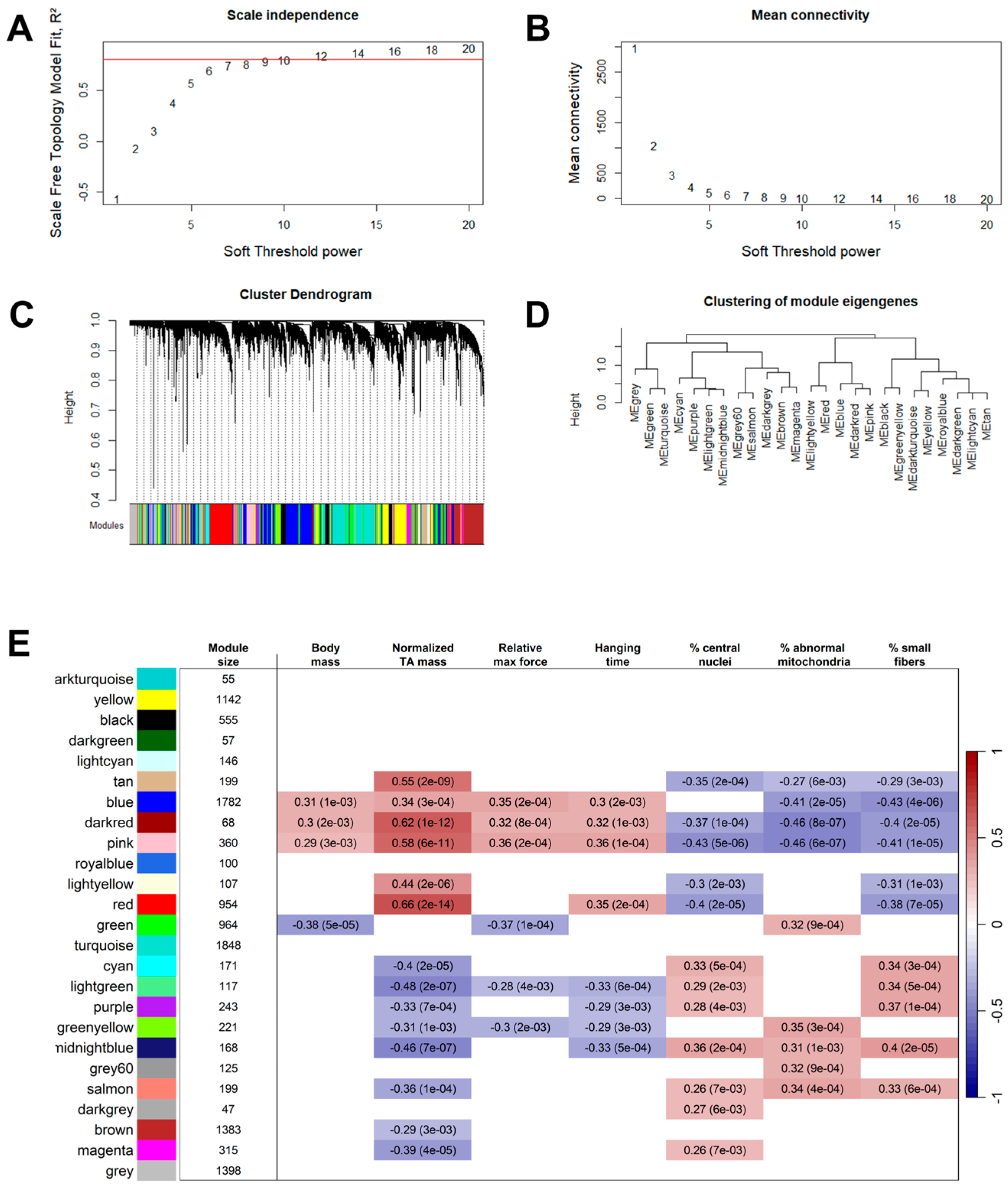
4.4. Weighed Gene Correlation Network Analysis
4.5. Multi-Omics Integration with Knowledge from Public Databases
4.5.1. Biological Network Construction
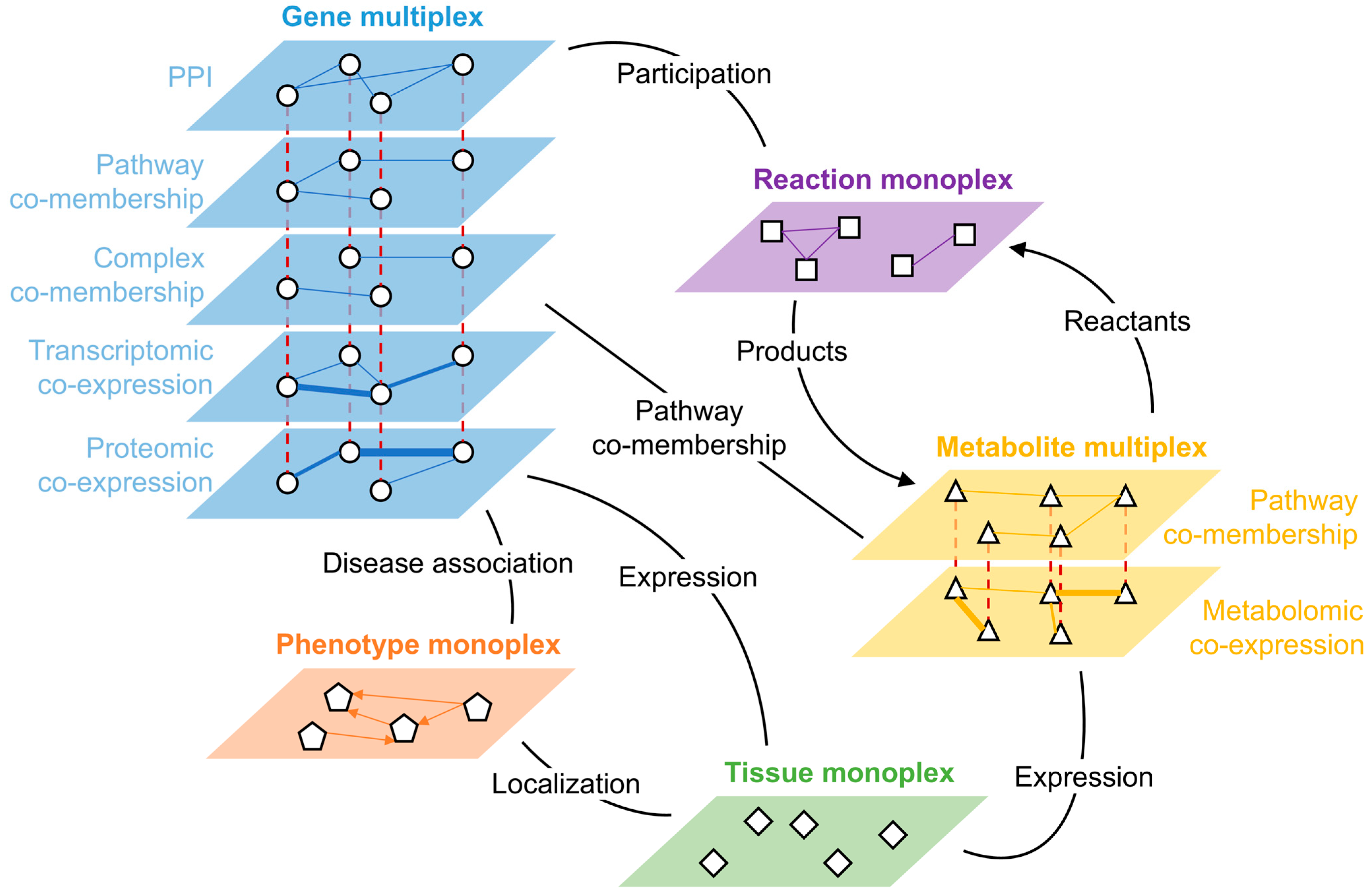
4.5.2. Description of the Multiplex Networks (Table 2)
- The first network is a gene multiplex network composed of five layers, each encoding different gene–gene interactions. Three layers were constructed based on publicly available knowledge: protein–protein interactions (PPIs) extracted from the STRING database (experimental confidence score > 700), molecular complex co-membership extracted from the CORUM database, and pathway co-membership extracted from the Reactome database [32,33,34]. The remaining two weighted layers were constructed with WGCNA of bulk transcriptomic and proteomic datasets from WT and Mtm1−/y mice. For the transcriptomic layer, samples of cohorts (A–C) were used. After gene expression normalization and batch effect correction with DESeq2 and limma [35], the topological overlap matrix was computed using a soft power of 10, and edges with an adjacency > 0.15 were exported. The proteomic layer was built similarly. The wrMisc (version 1.15.4) and wrProteo (version 1.13.3) R packages were used to normalize and to impute missing data with default parameters. Then, the topological overlap matrix was computed using a soft power of 12, and edges with an adjacency > 0.25 were exported.
- The second network is a metabolite multiplex network, composed of two layers, with one layer encoding pathway co-membership extracted from the Reactome database, and one weighted layer built with WGCNA from metabolomics data (WT and Mtm1−/y samples, soft power = 5, adjacency > 0.05).
- The third network is a directed monoplex network containing phenotypes described in the Human Phenotype Ontology (HPO) [36]. Directed edges linking HPO terms to their parents were retrieved using custom SPARQL queries on the OWL file provided by the HPO and loaded in Apache Foundation’s JENA suite (v4.7.0) (Supplementary Information S1).
- The fourth network is a monoplex network containing the reactions described in the mouse genome-scale metabolic model (Mouse-GEM) [37]. Reactions belonging to the same subsystem (sharing a similar metabolic function) are linked together.
- The fifth network is a monoplex network containing tissues found in the Genotype-Tissue Expression project (GTEx) [38] and is linked to other multiplexes through bipartite networks.
- Description of the bipartite networks (Table 3):
- The first network is a weighted gene–tissue bipartite network extracted from the GTEx project. This bipartite network links genes to the tissues in which they are expressed. Median transcript per million (TPM) values were used as edge weights, only keeping edges with TPM > 5.
- The next network is a gene–metabolite bipartite network extracted from Reactome, based on pathway co-membership [34].
- The next network is a metabolite–tissue bipartite network extracted from the Human Metabolome Database (HMDB), linking metabolites to the tissues in which they have been detected [39].
- The three bipartite networks extracted from the Mouse-GEM are as follows: two directed networks linking metabolites to reactions (reactants to reaction and reaction to products), and one network linking genes to the reactions in which the proteins they encode are implicated [37].
- The two bipartite networks extracted from the HPO are as follows: one network linking phenotypes to the genes associated with diseases in which the phenotype can be observed, and one network linking phenotypes to the tissues they affect. The second network was obtained using custom SPARQL queries on the OWL file provided by the HPO and loaded in Apache Foundation’s JENA suite (v4.7.0) (Supplementary Information S1).
4.6. Heterogeneous Multiplex Exploration
4.7. Metabolite ID Mapping
4.8. Network Visualization
4.9. Enrichment Analyses
5. Conclusions
Supplementary Materials
Author Contributions
Funding
Institutional Review Board Statement
Informed Consent Statement
Data Availability Statement
Acknowledgments
Conflicts of Interest
Abbreviations
| CNMs | Centronuclear and myotubular myopathies |
| WGCNA | Weighted Gene Correlation Network Analysis |
References
- Gómez-Oca, R.; Cowling, B.S.; Laporte, J. Common Pathogenic Mechanisms in Centronuclear and Myotubular Myopathies and Latest Treatment Advances. Int. J. Mol. Sci. 2021, 22, 11377. [Google Scholar] [CrossRef] [PubMed]
- Lawlor, M.W.; Beggs, A.H.; Buj-Bello, A.; Childers, M.K.; Dowling, J.J.; James, E.S.; Meng, H.; Moore, S.A.; Prasad, S.; Schoser, B.; et al. Skeletal Muscle Pathology in X-Linked Myotubular Myopathy: Review with cross-species comparisons. J. Neuropathol. Exp. Neurol. 2016, 75, 102–110, Erratum in J. Neuropathol. Exp. Neurol. 2016, 75, 479. [Google Scholar] [CrossRef]
- Djeddi, S.; Reiss, D.; Menuet, A.; Freismuth, S.; Neves, J.d.C.; Djerroud, S.; Massana-Muñoz, X.; Sosson, A.-S.; Kretz, C.; Raffelsberger, W.; et al. Multi-omics comparisons of different forms of centronuclear myopathies and the effects of several therapeutic strategies. Mol. Ther. 2021, 29, 2514–2534. [Google Scholar] [CrossRef]
- Buj-Bello, A.; Laugel, V.; Messaddeq, N.; Zahreddine, H.; Laporte, J.; Pellissier, J.-F.; Mandel, J.-L. The lipid phosphatase myotubularin is essential for skeletal muscle maintenance but not for myogenesis in mice. Proc. Natl. Acad. Sci. USA 2002, 99, 15060–15065. [Google Scholar] [CrossRef] [PubMed]
- Silva-Rojas, R.; Nattarayan, V.; Jaque-Fernandez, F.; Gomez-Oca, R.; Menuet, A.; Reiss, D.; Goret, M.; Messaddeq, N.; Lionello, V.M.; Kretz, C.; et al. Mice with muscle-specific deletion of Bin1 recapitulate centronuclear myopathy and acute downregulation of dynamin 2 improves their phenotypes. Mol. Ther. 2022, 30, 868–880. [Google Scholar] [CrossRef]
- Muñoz, X.M.; Kretz, C.; Silva-Rojas, R.; Ochala, J.; Menuet, A.; Romero, N.B.; Cowling, B.S.; Laporte, J. Physiological impact and disease reversion for the severe form of centronuclear myopathy linked to dynamin. J. Clin. Investig. 2020, 5, e137899. [Google Scholar] [CrossRef]
- Poinsignon, T.; Poulain, P.; Gallopin, M.; Lelandais, G. Working with Omics Data: An Interdisciplinary Challenge at the Crossroads of Biology and Computer Science. In Machine Learning for Brain Disorders; Colliot, O., Ed.; Humana: New York, NY, USA, 2023. Available online: http://www.ncbi.nlm.nih.gov/books/NBK597481/ (accessed on 21 October 2024).
- Subramanian, I.; Verma, S.; Kumar, S.; Jere, A.; Anamika, K. Multi-omics Data Integration, Interpretation, and Its Application. Bioinform. Biol. Insights 2020, 14, 1177932219899051. [Google Scholar] [CrossRef]
- Langfelder, P.; Horvath, S. WGCNA: An R package for weighted correlation network analysis. BMC Bioinform. 2008, 9, 559. [Google Scholar] [CrossRef]
- Zitnik, M.; Li, M.M.; Wells, A.; Glass, K.; Gysi, D.M.; Krishnan, A.; Murali, T.M.; Radivojac, P.; Roy, S.; Baudot, A.; et al. Current and future directions in network biology. Bioinform. Adv. 2024, 4, vbae099. [Google Scholar] [CrossRef]
- Gineste, C.; Simon, A.; Braun, M.; Reiss, D.; Laporte, J. Tamoxifen improves muscle structure and function of Bin1—And Dnm2-related centronuclear myopathies. Brain 2022, 146, awac489. [Google Scholar] [CrossRef] [PubMed]
- Cowling, B.S.; Chevremont, T.; Prokic, I.; Kretz, C.; Ferry, A.; Coirault, C.; Koutsopoulos, O.; Laugel, V.; Romero, N.B.; Laporte, J. Reducing dynamin 2 expression rescues X-linked centronuclear myopathy. J. Clin. Investig. 2014, 124, 1350–1363. [Google Scholar] [CrossRef]
- Lionello, V.M.; Nicot, A.-S.; Sartori, M.; Kretz, C.; Kessler, P.; Buono, S.; Djerroud, S.; Messaddeq, N.; Koebel, P.; Prokic, I.; et al. Amphiphysin 2 modulation rescues myotubular myopathy and prevents focal adhesion defects in mice. Sci. Transl. Med. 2019, 11, eaav1866. [Google Scholar] [CrossRef]
- Gayi, E.; Neff, L.A.; Muñoz, X.M.; Ismail, H.M.; Sierra, M.; Mercier, T.; Décosterd, L.A.; Laporte, J.; Cowling, B.S.; Dorchies, O.M.; et al. Tamoxifen prolongs survival and alleviates symptoms in mice with fatal X-linked myotubular myopathy. Nat. Commun. 2018, 9, 4848. [Google Scholar] [CrossRef]
- Baptista, A.; Gonzalez, A.; Baudot, A. Universal multilayer network exploration by random walk with restart. Commun. Phys. 2022, 5, 170. [Google Scholar] [CrossRef]
- Benarroch, L.; Bonne, G.; Rivier, F.; Hamroun, D. The 2023 version of the gene table of neuromuscular disorders (nuclear genome). Neuromuscul. Disord. 2023, 33, 76–117. [Google Scholar] [CrossRef]
- Dowling, J.J.; Joubert, R.; Low, S.E.; Durban, A.N.; Messaddeq, N.; Li, X.; Dulin-Smith, A.N.; Snyder, A.D.; Marshall, M.L.; Marshall, J.T.; et al. Myotubular myopathy and the neuromuscular junction: A novel therapeutic approach from mouse models. Dis. Model. Mech. 2012, 5, 852–859. [Google Scholar] [CrossRef]
- Gibbs, E.M.; Clarke, N.F.; Rose, K.; Oates, E.C.; Webster, R.; Feldman, E.L.; Dowling, J.J. Neuromuscular junction abnormalities in DNM2-related centronuclear myopathy. J. Mol. Med. 2013, 91, 727–737. [Google Scholar] [CrossRef] [PubMed]
- Saito, Y.; Hayashi, S.; Noguchi, S.; Nishino, I. VP.05 Innervation defect: New pathomechanism of centronuclear myopathy? Neuromuscul. Disord. 2022, 32, S48. [Google Scholar] [CrossRef]
- Dark, C.; Ali, N.; Golenkina, S.; Dhyani, V.; Blazev, R.; Parker, B.L.; Murphy, K.T.; Lynch, G.S.; Senapati, T.; Millard, S.S.; et al. Mitochondrial fusion and altered beta-oxidation drive muscle wasting in a Drosophila cachexia model. EMBO Rep. 2024, 25, 1835–1858. [Google Scholar] [CrossRef]
- Fukawa, T.; Yan-Jiang, B.C.; Min-Wen, J.C.; Jun-Hao, E.T.; Huang, D.; Qian, C.-N.; Ong, P.; Li, Z.; Chen, S.; Mak, S.Y.; et al. Excessive fatty acid oxidation induces muscle atrophy in cancer cachexia. Nat. Med. 2016, 22, 666–671. [Google Scholar] [CrossRef] [PubMed]
- Cheng, F.; Zhang, Q.; Yan, F.F.; Wan, J.F.; Lin, C.S. Lutein protects against ischemia/reperfusion injury in rat skeletal muscle by modulating oxidative stress and inflammation. Immunopharmacol. Immunotoxicol. 2015, 37, 329–334. [Google Scholar] [CrossRef]
- Ren, T.; Xu, M.; Lin, W.; Luo, W.; Zhang, X. Transcriptome sequencing reveals the potential mechanisms of dietary lutein regulation on chicken leg muscle development. Poult. Sci. 2024, 103, 104265. [Google Scholar] [CrossRef]
- Koch, C.; Buono, S.; Menuet, A.; Robé, A.; Djeddi, S.; Kretz, C.; Gomez-Oca, R.; Depla, M.; Monseur, A.; Thielemans, L.; et al. Myostatin: A Circulating Biomarker Correlating with Disease in Myotubular Myopathy Mice and Patients. Mol. Ther. Methods Clin. Dev. 2020, 17, 1178–1189. [Google Scholar] [CrossRef]
- Mariot, V.; Joubert, R.; Hourdé, C.; Féasson, L.; Hanna, M.; Muntoni, F.; Maisonobe, T.; Servais, L.; Bogni, C.; Le Panse, R.; et al. Downregulation of myostatin pathway in neuromuscular diseases may explain challenges of anti-myostatin therapeutic approaches. Nat. Commun. 2017, 8, 1859. [Google Scholar] [CrossRef]
- Foley, A.R.; Zou, Y.; Dunford, J.E.; Rooney, J.; Chandra, G.; Xiong, H.; Straub, V.; Voit, T.; Romero, N.; Donkervoort, S.; et al. GGPS1 Mutations Cause Muscular Dystrophy/Hearing Loss/Ovarian Insufficiency Syndrome. Ann. Neurol. 2020, 88, 332–347. [Google Scholar] [CrossRef] [PubMed]
- Wang, L.; Zheng, Z.-G.; Meng, L.; Zhu, L.; Li, P.; Chen, J.; Yang, H. Statins induce skeletal muscle atrophy via GGPP depletion-dependent myostatin overexpression in skeletal muscle and brown adipose tissue. Cell Biol. Toxicol. 2021, 37, 441–460, Erratum in Cell Biol. Toxicol. 2025, 41, 98. [Google Scholar] [CrossRef] [PubMed]
- Agabiti, S.S.; Li, J.; Wiemer, A.J. Geranylgeranyl diphosphate synthase inhibition induces apoptosis that is dependent upon GGPP depletion, ERK phosphorylation and caspase activation. Cell Death Dis. 2017, 8, e2678. [Google Scholar] [CrossRef]
- Laporte, J.; Blondeau, F.; Gansmuller, A.; Lutz, Y.; Vonesch, J.L.; Mandel, J.L. The PtdIns3P phosphatase myotubularin is a cytoplasmic protein that also localizes to Rac1-inducible plasma membrane ruffles. J. Cell Sci. 2002, 115 Pt 15, 3105–3117. [Google Scholar] [CrossRef] [PubMed]
- Chen, S.; Lu, X.; He, T.; Yishake, D.; Tan, X.; Hou, M.; Luo, Y.; Long, J.; Tang, Z.; Zhong, R.; et al. Betaine Delayed Muscle Loss by Attenuating Samtor Complex Inhibition for mTORC1 Signaling Via Increasing SAM Level. Mol. Nutr. Food Res. 2021, 65, 2100157. [Google Scholar] [CrossRef]
- Love, M.I.; Huber, W.; Anders, S. Moderated estimation of fold change and dispersion for RNA-seq data with DESeq2. Genome Biol. 2014, 15, 550. [Google Scholar] [CrossRef]
- Szklarczyk, D.; Kirsch, R.; Koutrouli, M.; Nastou, K.; Mehryary, F.; Hachilif, R.; Gable, A.L.; Fang, T.; Doncheva, N.T.; Pyysalo, S.; et al. The STRING database in 2023: Protein-protein association networks and functional enrichment analyses for any sequenced genome of interest. Nucleic Acids Res. 2023, 51, D638–D646. [Google Scholar] [CrossRef] [PubMed]
- Tsitsiridis, G.; Steinkamp, R.; Giurgiu, M.; Brauner, B.; Fobo, G.; Frishman, G.; Montrone, C.; Ruepp, A. CORUM: The comprehensive resource of mammalian protein complexes–2022. Nucleic Acids Res. 2023, 51, D539–D545. [Google Scholar] [CrossRef]
- Milacic, M.; Beavers, D.; Conley, P.; Gong, C.; Gillespie, M.; Griss, J.; Haw, R.; Jassal, B.; Matthews, L.; May, B.; et al. The Reactome Pathway Knowledgebase 2024. Nucleic Acids Res. 2024, 52, D672–D678. [Google Scholar] [CrossRef]
- Ritchie, M.E.; Phipson, B.; Wu, D.; Hu, Y.; Law, C.W.; Shi, W.; Smyth, G.K. limma powers differential expression analyses for RNA-sequencing and microarray studies. Nucleic Acids Res. 2015, 43, e47. [Google Scholar] [CrossRef]
- Köhler, S.; Carmody, L.; Vasilevsky, N.; Jacobsen, J.O.B.; Danis, D.; Gourdine, J.P.; Gargano, M.; Harris, N.L.; Matentzoglu, N.; McMurry, J.A.; et al. Expansion of the Human Phenotype Ontology (HPO) knowledge base and resources. Nucleic Acids Res. 2019, 47, D1018–D1027. [Google Scholar] [CrossRef] [PubMed]
- Wang, H.; Robinson, J.L.; Kocabas, P.; Gustafsson, J.; Anton, M.; Cholley, P.-E.; Huang, S.; Gobom, J.; Svensson, T.; Uhlen, M.; et al. Genome-scale metabolic network reconstruction of model animals as a platform for translational research. Proc. Natl. Acad. Sci. USA 2021, 118, e2102344118. [Google Scholar] [CrossRef] [PubMed]
- Lonsdale, J.; Thomas, J.; Salvatore, M.; Phillips, R.; Lo, E.; Shad, S.; Hasz, R.; Walters, G.; Garcia, F.; Young, N.; et al. The Genotype-Tissue Expression (GTEx) project. Nat. Genet. 2013, 45, 580–585. [Google Scholar] [CrossRef]
- Wishart, D.S.; Guo, A.; Oler, E.; Wang, F.; Anjum, A.; Peters, H.; Dizon, R.; Sayeeda, Z.; Tian, S.; Lee, B.L.; et al. HMDB 5.0: The Human Metabolome Database for 2022. Nucleic Acids Res. 2022, 50, D622–D631. [Google Scholar] [CrossRef]
- Brunk, E.; Sahoo, S.; Zielinski, D.C.; Altunkaya, A.; Dräger, A.; Mih, N.; Gatto, F.; Nilsson, A.; Preciat Gonzalez, G.A.; Aurich, M.K.; et al. Recon3D enables a three-dimensional view of gene variation in human metabolism. Nat. Biotechnol. 2018, 36, 272–281. [Google Scholar] [CrossRef]
- Moretti, S.; Tran, V.D.T.; Mehl, F.; Ibberson, M.; Pagni, M. MetaNetX/MNXref: Unified namespace for metabolites and biochemical reactions in the context of metabolic models. Nucleic Acids Res. 2021, 49, D570–D574. [Google Scholar] [CrossRef]
- Shannon, P.; Markiel, A.; Ozier, O.; Baliga, N.S.; Wang, J.T.; Ramage, D.; Amin, N.; Schwikowski, B.; Ideker, T. Cytoscape: A Software Environment for Integrated Models of Biomolecular Interaction Networks. Genome Res. 2003, 13, 2498–2504. [Google Scholar] [CrossRef] [PubMed]
- Wu, T.; Hu, E.; Xu, S.; Chen, M.; Guo, P.; Dai, Z.; Feng, T.; Zhou, L.; Tang, W.; Zhan, L.; et al. clusterProfiler 4.0: A universal enrichment tool for interpreting omics data. Innov. 2021, 2, 100141. [Google Scholar] [CrossRef] [PubMed]
- Yu, G. Gene Ontology Semantic Similarity Analysis Using GOSemSim. Methods Mol. Biol. 2020, 2117, 207–215. [Google Scholar] [PubMed]




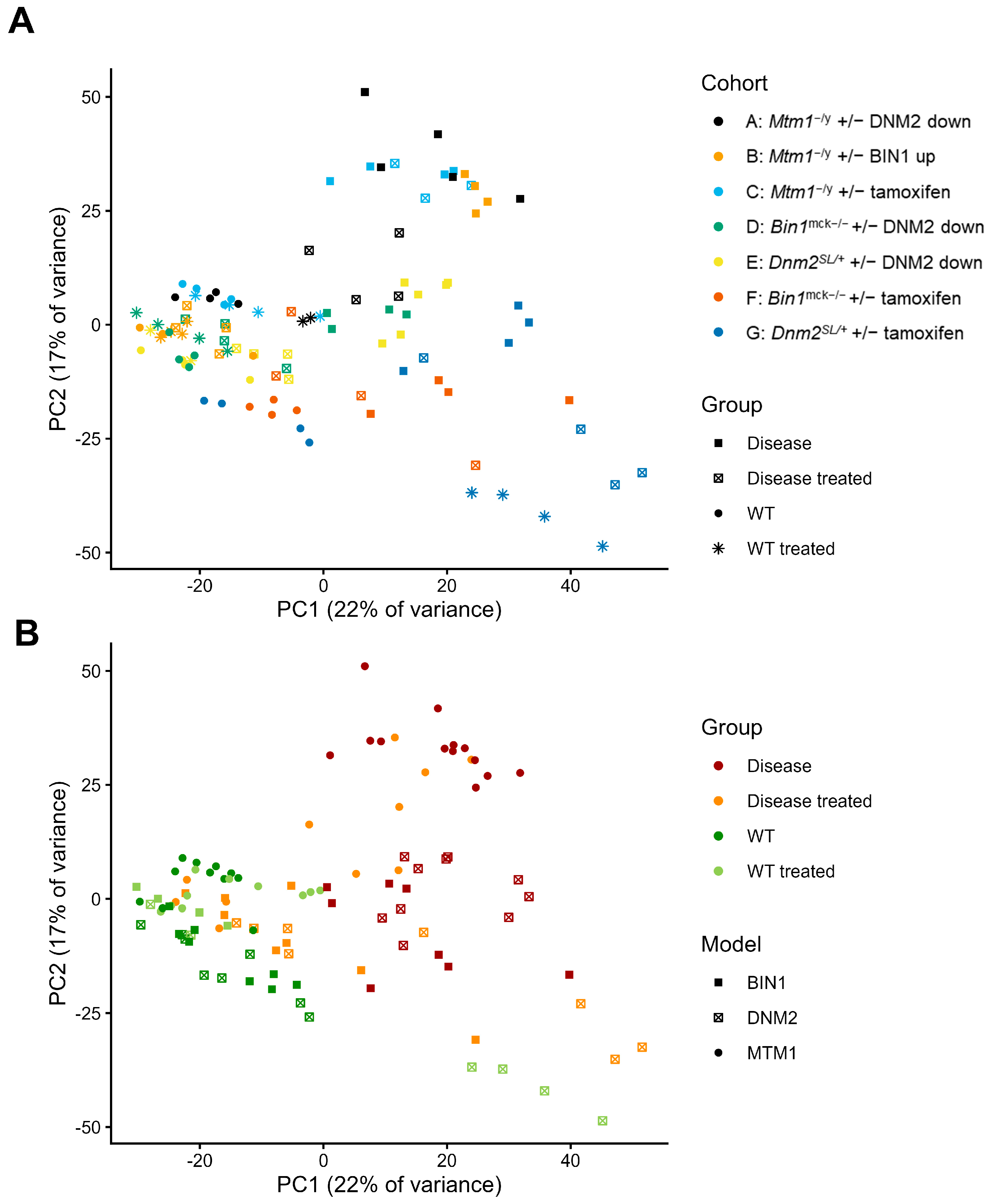
| Cohort | Mouse Model | Model Severity | Therapeutic Approach | Therapeutic Effect | Age (Weeks) | Genetic Background | n | Original Phenotypic Study | Original RNA-Seq Study |
|---|---|---|---|---|---|---|---|---|---|
| A | Mtm1−/y | Severe | * Dnm2+/− | Complete rescue | 7 | 50% 129 Pas, 50% C57BL/6N | 17 | [12] | [3] |
| B | * TgBIN1 | Complete rescue | 7 | 129 Pas | 15 | [13] | |||
| C | Tamoxifen | Partial | 7 | 129 Pas | 14 | [14] | |||
| D | Bin1mck−/− | Mild | ASO Dnm2 | Partial rescue | 7 | C57BL/6N | 16 | [5] | |
| E | Dnm2S619L/+ | Intermediate | ASO Dnm2 | Complete rescue | 7 | C57BL/6N | 16 | [6] | |
| F | Bin1mck−/− | Mild | Tamoxifen | Partial rescue | 8 | C57BL/6N | 12 | [11] | This study |
| G | Dnm2S619L/+ | Intermediate | Tamoxifen | Partial rescue | 8 | C57BL/6N | 16 | [11] |
| Multiplex Network | Layer | Number of Nodes | Number of Edges | Density | Weighted | Directed |
|---|---|---|---|---|---|---|
| Genes | PPI (Protein–protein interaction) | 5521 | 34,668 | 0.003 | No | No |
| Complex co-membership | 4893 | 47,802 | 0.005 | No | No | |
| Pathway co-membership | 9063 | 674,975 | 0.017 | No | No | |
| Gene co-expression | 5222 | 879,879 | 0.065 | Yes | No | |
| Protein co-expression | 2046 | 695,171 | 0.358 | Yes | No | |
| Metabolites | Pathway co-membership | 1604 | 20,590 | 0.017 | No | No |
| Metabolite co-expression | 831 | 115,171 | 0.334 | Yes | No | |
| Reactions | 12,987 | 10,557,827 | 0.125 | No | Yes | |
| Phenotypes | 10,093 | 16,791 | <0.001 | No | Yes | |
| Tissues | 30 | 0 | ||||
| Bipartite Network | Number of Nodes | Number of Edges | Density | Weighted | Directed |
|---|---|---|---|---|---|
| Genes—metabolites | 6062 | 69,470 | 0.004 | No | No |
| Genes—reactions | 10,115 | 22,788 | 0.004 | No | No |
| Metabolites—reactions | 15,047 | 18,867 | <0.001 | No | Yes |
| Reactions—metabolites | 13,460 | 18,064 | <0.001 | No | Yes |
| Genes—tissues | 16,683 | 533,921 | 0.002 | Yes | No |
| Genes—phenotypes | 15,134 | 262,415 | 0.002 | No | No |
| Metabolites—tissues | 3384 | 6425 | 0.001 | No | No |
| Phenotypes—tissues | 3926 | 4569 | 0.001 | No | No |
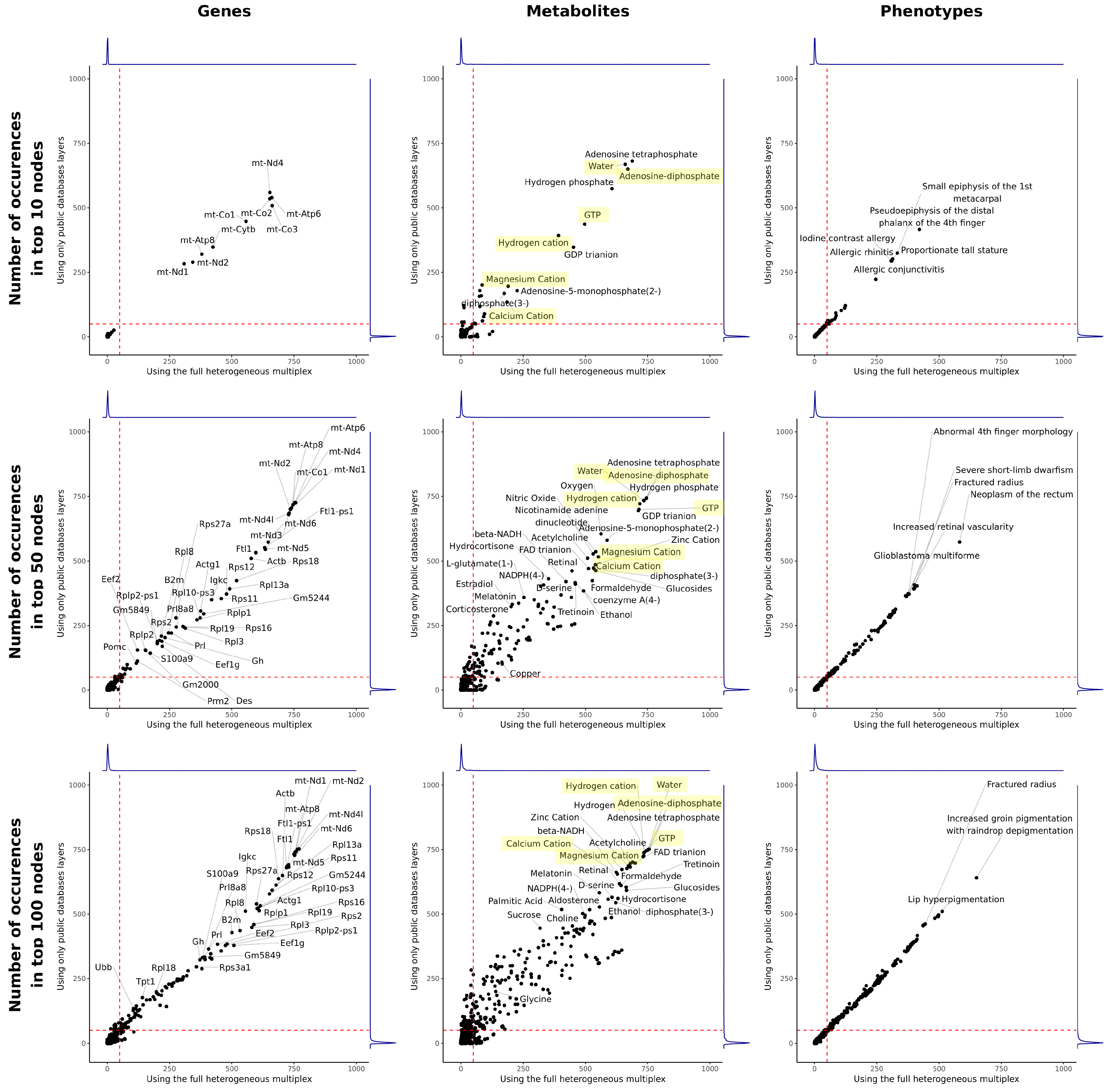
| Seeds | Genes | Metabolites |
|---|---|---|
| Mtm1 HP:0003202 (skeletal muscle atrophy) | Trpv4 Capn3 Lmna Neb Ryr1 Pomt2 Fkrp Crppa Tnnt1 Fktn Inpp5k Pomt1 | Dexamethasone Diacetyl Epitestosterone Oxytocin |
| Mtm1 HP:0001324 (muscle weakness) | Fhl1 Tnnc2 Klhl41 Chrna1 Itga7 Col6a1 Col6a2 Scn4a Col12a1 Hnrnpa2b1 Col13a1 Pik3r5 | 9-O-acetylneuraminic acid Einecs 307-780-4 (2s)-1-(Alpha-D-Glucopyranosyloxy)-3-(Hexadecanoyloxy)propan-2-Yl (11z)-Octadec-11-Enoate 1-O-(alpha-D-galactopyranuronosyl)-N-tetradecanoyldihydrosphingosine |
| Mtm1 HP:0003687 (centrally nucleated skeletal muscle fibers) | Mtmr14 Myot Hnrnpa1l2-ps2 Hnrnpa1 Selenon Pyroxd1 Adgrg6 Bves Ccdc78 Syne1 Sil1 Matr3 Unc45b Fxr1 Orai1 Tpm3 Myf6 | Thromboxane A2 Tetrahydrobiopterin Uric Acid 9-Anthroic acid Naadp Niflumic acid Aspirin Diacetyl |
Disclaimer/Publisher’s Note: The statements, opinions and data contained in all publications are solely those of the individual author(s) and contributor(s) and not of MDPI and/or the editor(s). MDPI and/or the editor(s) disclaim responsibility for any injury to people or property resulting from any ideas, methods, instructions or products referred to in the content. |
© 2025 by the authors. Licensee MDPI, Basel, Switzerland. This article is an open access article distributed under the terms and conditions of the Creative Commons Attribution (CC BY) license (https://creativecommons.org/licenses/by/4.0/).
Share and Cite
Simon, A.; Gineste, C.; Reiss, D.; Thompson, J.D.; Laporte, J. Integrative Multi-Omics and Network Analyses Reveal Pathogenic and Protective Pathways in Centronuclear Myopathies. Int. J. Mol. Sci. 2025, 26, 11572. https://doi.org/10.3390/ijms262311572
Simon A, Gineste C, Reiss D, Thompson JD, Laporte J. Integrative Multi-Omics and Network Analyses Reveal Pathogenic and Protective Pathways in Centronuclear Myopathies. International Journal of Molecular Sciences. 2025; 26(23):11572. https://doi.org/10.3390/ijms262311572
Chicago/Turabian StyleSimon, Alix, Charlotte Gineste, David Reiss, Julie D. Thompson, and Jocelyn Laporte. 2025. "Integrative Multi-Omics and Network Analyses Reveal Pathogenic and Protective Pathways in Centronuclear Myopathies" International Journal of Molecular Sciences 26, no. 23: 11572. https://doi.org/10.3390/ijms262311572
APA StyleSimon, A., Gineste, C., Reiss, D., Thompson, J. D., & Laporte, J. (2025). Integrative Multi-Omics and Network Analyses Reveal Pathogenic and Protective Pathways in Centronuclear Myopathies. International Journal of Molecular Sciences, 26(23), 11572. https://doi.org/10.3390/ijms262311572