Molecular Modeling and Analysis of Cannabinoid and Cannabinoid-like Molecules Combining K-Means Clustering with Pearson Correlation and PCA



Abstract
1. Introduction
2. Results
3. Discussion
4. Materials and Methods
4.1. Docking and Electronic Structure Study
4.2. ADMET Data
4.3. MolSimEx Framework
4.4. Similarity Matrix
| Algorithm 1 Similarity matrix algorithm |
4.5. K-Means
- Initially, the total set of data A is divided into k-subsets or clusters:
| Algorithm 2 Lloyd’s algorithm with similarity matrix as input |
5. Conclusions
Supplementary Materials
Author Contributions
Funding
Institutional Review Board Statement
Informed Consent Statement
Data Availability Statement
Acknowledgments
Conflicts of Interest
References
- Xie, Z.; Mi, Y.; Kong, L.; Gao, M.; Chen, S.; Chen, W.; Meng, X.; Sun, W.; Chen, S.; Xu, Z. Cannabis sativa: Origin and history, glandular trichome development, and cannabinoid biosynthesis. Hortic. Res. 2023, 10, uhad150. [Google Scholar] [CrossRef] [PubMed]
- Rock, E.M.; Parker, L.A. Constituents of Cannabis sativa. In Cannabinoids and Neuropsychiatric Disorders; Springer: Berlin/Heidelberg, Germany, 2021; pp. 1–13. [Google Scholar] [CrossRef]
- Pagano, C.; Navarra, G.; Coppola, L.; Avilia, G.; Bifulco, M.; Laezza, C. Cannabinoids: Therapeutic use in clinical practice. Int. J. Mol. Sci. 2022, 23, 3344. [Google Scholar] [CrossRef]
- Hanuš, L.O.; Meyer, S.M.; Muñoz, E.; Taglialatela-Scafati, O.; Appendino, G. Phytocannabinoids: A unified critical inventory. Nat. Prod. Rep. 2016, 33, 1357–1392. [Google Scholar] [CrossRef]
- Gülck, T.; Møller, B.L. Phytocannabinoids: Origins and biosynthesis. Trends Plant Sci. 2020, 25, 985–1004. [Google Scholar] [CrossRef]
- Finn, D.; Haroutounian, S.; Hohmann, A.; Krane, E.; Soliman, N.; Rice, A. Cannabinoids, the endocannabinoid system, and pain: A review of preclinical studies. Pain 2021, 162, S5–S25. [Google Scholar] [CrossRef]
- Gojani, E.G.; Wang, B.; Li, D.P.; Kovalchuk, O.; Kovalchuk, I. Anti-Inflammatory Effects of Minor Cannabinoids CBC, THCV, and CBN in Human Macrophages. Molecules 2023, 28, 6487. [Google Scholar] [CrossRef]
- Kwiecień, E.; Kowalczuk, D. Therapeutic Potential of Minor Cannabinoids in Dermatological Diseases—A Synthetic Review. Molecules 2023, 28, 6149. [Google Scholar] [CrossRef]
- Cooray, R.; Gupta, V.; Suphioglu, C. Current aspects of the endocannabinoid system and targeted THC and CBD phytocannabinoids as potential therapeutics for Parkinson’s and Alzheimer’s diseases: A review. Mol. Neurobiol. 2020, 57, 4878–4890. [Google Scholar] [CrossRef]
- Cassano, T.; Villani, R.; Pace, L.; Carbone, A.; Bukke, V.N.; Orkisz, S.; Avolio, C.; Serviddio, G. From Cannabis sativa to cannabidiol: Promising therapeutic candidate for the treatment of neurodegenerative diseases. Front. Pharmacol. 2020, 11, 124. [Google Scholar] [CrossRef] [PubMed]
- Walsh, K.B.; McKinney, A.E.; Holmes, A.E. Minor cannabinoids: Biosynthesis, molecular pharmacology and potential therapeutic uses. Front. Pharmacol. 2021, 12, 777804. [Google Scholar] [CrossRef] [PubMed]
- Montero, J.M.S.; Agis-Torres, A.; Solano, D.; Söllhuber, M.; Fernandez, M.; Villaro, W.; Gómez-Cañas, M.; García-Arencibia, M.; Fernández-Ruiz, J.; Egea, J.; et al. Analogues of cannabinoids as multitarget drugs in the treatment of Alzheimer’s disease. Eur. J. Pharmacol. 2021, 895, 173875. [Google Scholar] [CrossRef] [PubMed]
- Fernández-Ruiz, J. The biomedical challenge of neurodegenerative disorders: An opportunity for cannabinoid-based therapies to improve on the poor current therapeutic outcomes. Br. J. Pharmacol. 2019, 176, 1370–1383. [Google Scholar] [CrossRef]
- Zou, S.; Kumar, U. Cannabinoid receptors and the endocannabinoid system: Signaling and function in the central nervous system. Int. J. Mol. Sci. 2018, 19, 833. [Google Scholar] [CrossRef]
- Aymerich, M.S.; Aso, E.; Abellanas, M.A.; Tolon, R.M.; Ramos, J.A.; Ferrer, I.; Romero, J.; Fernández-Ruiz, J. Cannabinoid pharmacology/therapeutics in chronic degenerative disorders affecting the central nervous system. Biochem. Pharmacol. 2018, 157, 67–84. [Google Scholar] [CrossRef]
- Vasquez, R.; Batista, L.; Cuya, T. Computational Study on the Enzyme–Ligand Relationship between Cannabis Phytochemicals and Human Acetylcholinesterase: Implications in Alzheimer’s Disease. J. Phys. Chem. B 2023, 127, 8780–8795. [Google Scholar] [CrossRef]
- Peña-Guerrero, J.; Nguewa, P.A.; García-Sosa, A.T. Machine learning, artificial intelligence, and data science breaking into drug design and neglected diseases. Wiley Interdiscip. Rev. Comput. Mol. Sci. 2021, 11, e1513. [Google Scholar] [CrossRef]
- McCarthy, M.; Lee, K.L.K. Molecule identification with rotational spectroscopy and probabilistic deep learning. J. Phys. Chem. A 2020, 124, 3002–3017. [Google Scholar] [CrossRef]
- Walters, W.P.; Barzilay, R. Applications of deep learning in molecule generation and molecular property prediction. Accounts Chem. Res. 2020, 54, 263–270. [Google Scholar] [CrossRef]
- Tunyasuvunakool, K.; Adler, J.; Wu, Z.; Green, T.; Zielinski, M.; Žídek, A.; Bridgland, A.; Cowie, A.; Meyer, C.; Laydon, A.; et al. Highly accurate protein structure prediction for the human proteome. Nature 2021, 596, 590–596. [Google Scholar] [CrossRef] [PubMed]
- Guo, Z.; Wu, S.; Ohno, M.; Yoshida, R. Bayesian algorithm for retrosynthesis. J. Chem. Inf. Model. 2020, 60, 4474–4486. [Google Scholar] [CrossRef] [PubMed]
- Dara, S.; Dhamercherla, S.; Jadav, S.S.; Babu, C.M.; Ahsan, M.J. Machine learning in drug discovery: A review. Artif. Intell. Rev. 2022, 55, 1947–1999. [Google Scholar] [CrossRef]
- Lavecchia, A. Machine-learning approaches in drug discovery: Methods and applications. Drug Discov. Today 2015, 20, 318–331. [Google Scholar] [CrossRef] [PubMed]
- Stephenson, N.; Shane, E.; Chase, J.; Rowland, J.; Ries, D.; Justice, N.; Zhang, J.; Chan, L.; Cao, R. Survey of machine learning techniques in drug discovery. Curr. Drug Metab. 2019, 20, 185–193. [Google Scholar] [CrossRef] [PubMed]
- Cabello-Solorzano, K.; Ortigosa de Araujo, I.; Peña, M.; Correia, L.; Tallón-Ballesteros, A.J. The Impact of Data Normalization on the Accuracy of Machine Learning Algorithms: A Comparative Analysis. In Proceedings of the International Conference on Soft Computing Models in Industrial and Environmental Applications, Salamanca, Spain, 5–7 September 2023; Springer: Berlin/Heidelberg, Germany, 2023; pp. 344–353. [Google Scholar] [CrossRef]
- Crismon, M.L. Tacrine: First Drug Approved for Alzheimer’s Disease. Ann. Pharmacother. 1994, 28, 744–751. [Google Scholar] [CrossRef] [PubMed]
- Li, J.; Wu, H.M.; Zhou, R.L.; Liu, G.J.; Dong, B.R. Huperzine A for Alzheimer’s disease. Cochrane Database Syst. Rev. 2008, 2, CD005592. [Google Scholar] [CrossRef]
- Camps, P.; Cusack, B.; Mallender, W.D.; Achab, R.E.; Morral, J.; Muñoz-Torrero, D.; Rosenberry, T.L. Huprine X is a Novel High-Affinity Inhibitor of Acetylcholinesterase That Is of Interest for Treatment of Alzheimer’s Disease. Mol. Pharmacol. 2000, 57, 409–417. [Google Scholar] [CrossRef]
- Nachon, F.; Carletti, E.; Ronco, C.; Trovaslet, M.; Nicolet, Y.; Jean, L.; Renard, P.Y. Crystal structures of human cholinesterases in complex with huprine W and tacrine: Elements of specificity for anti-Alzheimer’s drugs targeting acetyl- and butyryl-cholinesterase. Biochem. J. 2013, 453, 393–399. [Google Scholar] [CrossRef]
- Olin, J.; Schneider, L. Galantamine for dementia due to Alzheimer’s disease. Cochrane Database Syst. Rev. 2002, 3, cd001747. [Google Scholar] [CrossRef]
- Triggle, D.J.; Mitchell, J.M.; Filler, R. The Pharmacology of Physostigmine. CNS Drug Rev. 1998, 4, 87–136. [Google Scholar] [CrossRef]
- Weinreb, O.; Amit, T.; Bar-Am, O.; Youdim, M.B.H. Ladostigil: A Novel Multimodal Neuroprotective Drug with Cholinesterase and Brain-Selective Monoamine Oxidase Inhibitory Activities for Alzheimers Disease Treatment. Curr. Drug Targets 2012, 13, 483–494. [Google Scholar] [CrossRef]
- Nascimento, É.C.M.; Martins, J.B. Electronic structure and PCA analysis of covalent and non-covalent acetylcholinesterase inhibitors. J. Mol. Model. 2011, 17, 1371–1379. [Google Scholar] [CrossRef]
- El Khattabi, M.Z.; El Jai, M.; Lahmadi, Y.; Oughdir, L.; Rahhali, M. Understanding the interplay between metrics, normalization forms, and data distribution in K-means clustering: A comparative simulation study. Arab. J. Sci. Eng. 2024, 49, 2987–3007. [Google Scholar] [CrossRef]
- Ding, C.; He, X. Cluster Structure of K-means Clustering via Principal Component Analysis. In Proceedings of the Advances in Knowledge Discovery and Data Mining, Sydney, Australia, 26–28 May 2004; Dai, H., Srikant, R., Zhang, C., Eds.; Springer: Berlin/Heidelberg, Germay, 2004; pp. 414–418. [Google Scholar]
- Asakawa, Y.; Kondo, K.; Tori, M. Cyclopropanochroman derivatives from the liverwort Radula javanica. Phytochemistry 1991, 30, 325–328. [Google Scholar] [CrossRef]
- Leláková, V.; Béraud-Dufour, S.; Hošek, J.; Šmejkal, K.; Prachyawarakorn, V.; Pailee, P.; Widmann, C.; Václavík, J.; Coppola, T.; Mazella, J.; et al. Therapeutic potential of prenylated stilbenoid macasiamenene F through its anti-inflammatory and cytoprotective effects on LPS-challenged monocytes and microglia. J. Ethnopharmacol. 2020, 263, 113147. [Google Scholar] [CrossRef] [PubMed]
- Shen, J.; Zhou, Q.; Li, P.; Wang, Z.; Liu, S.; He, C.; Zhang, C.; Xiao, P. Update on Phytochemistry and Pharmacology of Naturally Occurring Resveratrol Oligomers. Molecules 2017, 22, 2050. [Google Scholar] [CrossRef]
- Dvir, H.; Silman, I.; Harel, M.; Rosenberry, T.L.; Sussman, J.L. Acetylcholinesterase: From 3D structure to function. Chem.-Biol. Interact. 2010, 187, 10–22. [Google Scholar] [CrossRef] [PubMed]
- Silman, I.; Sussman, J.L. Acetylcholinesterase: ‘classical’ and ‘non-classical’ functions and pharmacology. Curr. Opin. Pharmacol. 2005, 5, 293–302. [Google Scholar] [CrossRef]
- Eubanks, L.M.; Rogers, C.J.; Beuscher.; Koob, G.F.; Olson, A.J.; Dickerson, T.J.; Janda, K.D. A Molecular Link between the Active Component of Marijuana and Alzheimer’s Disease Pathology. Mol. Pharm. 2006, 3, 773–777. [Google Scholar] [CrossRef]
- Gessa, G.L.; Casu, M.A.; Carta, G.; Mascia, M.S. Cannabinoids decrease acetylcholine release in the medial-prefrontal cortex and hippocampus, reversal by SR 141716A. Eur. J. Pharmacol. 1998, 355, 119–124. [Google Scholar] [CrossRef]
- Acquas, E.; Pisanu, A.; Marrocu, P.; Di Chiara, G. Cannabinoid CB1 receptor agonists increase rat cortical and hippocampal acetylcholine release in vivo. Eur. J. Pharmacol. 2000, 401, 179–185. [Google Scholar] [CrossRef]
- Toyota, M.; Shimamura, T.; Ishii, H.; Renner, M.; Braggins, J.; Asakawa, Y. New Bibenzyl Cannabinoid from the New Zealand Liverwort Radula marginata. Chem. Pharm. Bull. 2002, 50, 1390–1392. [Google Scholar] [CrossRef]
- Silva, M.A.; Kiametis, A.S.; Treptow, W. Donepezil Inhibits Acetylcholinesterase via Multiple Binding Modes at Room Temperature. J. Chem. Inf. Model. 2020, 60, 3463–3471. [Google Scholar] [CrossRef]
- Zhao, Q.; Tang, X.C. Effects of huperzine A on acetylcholinesterase isoforms in vitro: Comparison with tacrine, donepezil, rivastigmine and physostigmine. Eur. J. Pharmacol. 2002, 455, 101–107. [Google Scholar] [CrossRef]
- de Paula, A.A.N.; Martins, J.B.L.; Gargano, R.; dos Santos, M.L.; Romeiro, L.A.S. Electronic structure calculations toward new potentially AChE inhibitors. Chem. Phys. Lett. 2007, 446, 304–308. [Google Scholar] [CrossRef]
- Nascimento, E.C.M.; Martins, J.B.L.; dos Santos, M.L.; Gargano, R. Theoretical study of classical acetylcholinesterase inhibitors. Chem. Phys. Lett. 2008, 458, 285–289. [Google Scholar] [CrossRef]
- Nascimento, E.C.M.; Oliva, M.; swiderek, K.; Martins, J.B.L.; Andres, J. Binding Analysis of Some Classical Acetylcholinesterase Inhibitors: Insights for a Rational Design Using Free Energy Perturbation Method Calculations with QM/MM MD Simulations. J. Chem. Inf. Model. 2017, 57, 958–976. [Google Scholar] [CrossRef] [PubMed]
- Morris, G.M.; Huey, R.; Lindstrom, W.; Sanner, M.F.; Belew, R.K.; Goodsell, D.S.; Olson, A.J. AutoDock4 and AutoDockTools4: Automated docking with selective receptor flexibility. J. Comput. Chem. 2009, 30, 2785–2791. [Google Scholar] [CrossRef]
- Nascimento, L.A.; Nascimento, É.C.; Martins, J.B. In silico study of tacrine and acetylcholine binding profile with human acetylcholinesterase: Docking and electronic structure. J. Mol. Model. 2022, 28, 252. [Google Scholar] [CrossRef]
- Colovic, M.B.; Krstic, D.Z.; Lazarevic-Pasti, T.D.; Bondzic, A.M.; Vasic, V.M. Acetylcholinesterase Inhibitors: Pharmacology and Toxicology. Curr. Neuropharmacol. 2013, 11, 315–335. [Google Scholar] [CrossRef] [PubMed]
- Kryger, G.; Silman, I.; Sussman, J.L. Structure of acetylcholinesterase complexed with E2020 (Aricept®): Implications for the design of new anti-Alzheimer drugs. Structure 1999, 7, 297–307. [Google Scholar] [CrossRef] [PubMed]
- Søndergaard, C.R.; Olsson, M.H.M.; Rostkowski, M.; Jensen, J.H. Improved Treatment of Ligands and Coupling Effects in Empirical Calculation and Rationalization of pKa Values. J. Chem. Theory Comput. 2011, 7, 2284–2295. [Google Scholar] [CrossRef] [PubMed]
- Olsson, M.H.M.; Søndergaard, C.R.; Rostkowski, M.; Jensen, J.H. PROPKA3: Consistent Treatment of Internal and Surface Residues in Empirical pKaPredictions. J. Chem. Theory Comput. 2011, 7, 525–537. [Google Scholar] [CrossRef] [PubMed]
- Kramer, B.; Rarey, M.; Lengauer, T. Evaluation of the FLEXX incremental construction algorithm for protein-ligand docking. Proteins Struct. Funct. Genet. 1999, 37, 228–241. [Google Scholar] [CrossRef]
- Eberhardt, J.; Santos-Martins, D.; Tillack, A.F.; Forli, S. AutoDock Vina 1.2.0: New docking methods, expanded force field, and python bindings. J. Chem. Inf. Model. 2021, 61, 3891–3898. [Google Scholar] [CrossRef]
- Stone, N.L.; Murphy, A.J.; England, T.J.; O’Sullivan, S.E. A systematic review of minor phytocannabinoids with promising neuroprotective potential. Br. J. Pharmacol. 2020, 177, 4330–4352. [Google Scholar] [CrossRef]
- Hussain, T.; Espley, R.V.; Gertsch, J.; Whare, T.; Stehle, F.; Kayser, O. Demystifying the liverwort Radula marginata, a critical review on its taxonomy, genetics, cannabinoid phytochemistry and pharmacology. Phytochem. Rev. 2019, 18, 953–965. [Google Scholar] [CrossRef]
- BIOVIA, Dassault Systèmes, Discovery Studio Visualizer, Version 21.1.0.20298, 2021, San Diego. Available online: https://www.3ds.com/products/biovia (accessed on 3 November 2025).
- Shinbo, Y.; Nakamura, Y.; Altaf-Ul-Amin, M.; Asahi, H.; Kurokawa, K.; Arita, M.; Saito, K.; Ohta, D.; Shibata, D.; Kanaya, S. KNApSAcK: A comprehensive species-metabolite relationship database. In Plant Metabolomics; Springer: Berlin/Heidelberg, Germany, 2006; pp. 165–181. [Google Scholar] [CrossRef]
- Liu, S. (Ed.) Conceptual Density Functional Theory: Towards a New Chemical Reactivity Theory; Wiley: Hoboken, NJ, USA, 2022. [Google Scholar] [CrossRef]
- Geerlings, P. From Density Functional Theory to Conceptual Density Functional Theory and Biosystems. Pharmaceuticals 2022, 15, 1112. [Google Scholar] [CrossRef]
- Geerlings, P.; De Proft, F.; Langenaeker, W. Conceptual Density Functional Theory. Chem. Rev. 2003, 103, 1793–1874. [Google Scholar] [CrossRef] [PubMed]
- Fukui, K.; Yonezawa, T.; Shingu, H. A Molecular Orbital Theory of Reactivity in Aromatic Hydrocarbons. J. Chem. Phys. 1952, 20, 722–725. [Google Scholar] [CrossRef]
- Tsuneda, T. Chemical reaction analyses based on orbitals and orbital energies. Int. J. Quantum Chem. 2014, 115, 270–282. [Google Scholar] [CrossRef]
- Martínez, J. Local reactivity descriptors from degenerate frontier molecular orbitals. Chem. Phys. Lett. 2009, 478, 310–322. [Google Scholar] [CrossRef]
- Klopman, G. Chemical reactivity and the concept of charge- and frontier-controlled reactions. J. Am. Chem. Soc. 1968, 90, 223–234. [Google Scholar] [CrossRef]
- Salem, L. Intermolecular orbital theory of the interaction between conjugated systems. I. General theory. J. Am. Chem. Soc. 1968, 90, 543–552. [Google Scholar] [CrossRef]
- Matysiak, J. Evaluation of electronic, lipophilic and membrane affinity effects on antiproliferative activity of 5-substituted-2-(2,4-dihydroxyphenyl)-1,3,4-thiadiazoles against various human cancer cells. Eur. J. Med. Chem. 2007, 42, 940–947. [Google Scholar] [CrossRef]
- Raya, A.; Barrientos-Salcedo, C.; Rubio-Póo, C.; Soriano-Correa, C. Electronic structure evaluation through quantum chemical descriptors of 17β-aminoestrogens with an anticoagulant effect. Eur. J. Med. Chem. 2011, 46, 2463–2468. [Google Scholar] [CrossRef]
- Wong, K.Y.; Mercader, A.G.; Saavedra, L.M.; Honarparvar, B.; Romanelli, G.P.; Duchowicz, P.R. QSAR analysis on tacrine-related acetylcholinesterase inhibitors. J. Biomed. Sci. 2014, 21, 84. [Google Scholar] [CrossRef]
- Holikulov, U.; Kazachenko, A.S.; Issaoui, N.; Kazachenko, A.S.; Raja, M.; Al-Dossary, O.M.; Xiang, Z. The molecular structure, vibrational spectra, solvation effect, non-covalent interactions investigations of psilocin. Spectrochim. Acta Part Mol. Biomol. Spectrosc. 2024, 320, 124600. [Google Scholar] [CrossRef]
- e Silva, T.B.; Pereira, M.A.; Malta, V.S.; Bento, E.S.; San-Miguel, M.A.; Ziolli, R.L.; Martins, J.B.L.; Sih, A.; Taft, C.A. Study of the structure-activity relationship for theoretical molecular descriptors using density functional theory and chemometric methods in cannabinoid metabolites. Int. J. Quantum Chem. 2008, 108, 2530–2539. [Google Scholar] [CrossRef]
- Becke, A.D. Density-functional thermochemistry. I. The effect of the exchange-only gradient correction. J. Chem. Phys. 1992, 96, 2155–2160. [Google Scholar] [CrossRef]
- Lee, C.; Yang, W.; Parr, R.G. Development of the Colle-Salvetti correlation-energy formula into a functional of the electron density. Phys. Rev. B 1988, 37, 785. [Google Scholar] [CrossRef] [PubMed]
- Vosko, S.H.; Wilk, L.; Nusair, M. Accurate spin-dependent electron liquid correlation energies for local spin density calculations: A critical analysis. Can. J. Phys. 1980, 58, 1200–1211. [Google Scholar] [CrossRef]
- Stephens, P.J.; Devlin, F.J.; Chabalowski, C.F.; Frisch, M.J. Ab initio calculation of vibrational absorption and circular dichroism spectra using density functional force fields. J. Phys. Chem. 1994, 98, 11623–11627. [Google Scholar] [CrossRef]
- Marenich, A.V.; Cramer, C.J.; Truhlar, D.G. Universal solvation model based on solute electron density and on a continuum model of the solvent defined by the bulk dielectric constant and atomic surface tensions. J. Phys. Chem. B 2009, 113, 6378–6396. [Google Scholar] [CrossRef]
- Breneman, C.M.; Wiberg, K.B. Determining atom-centered monopoles from molecular electrostatic potentials. The need for high sampling density in formamide conformational analysis. J. Comput. Chem. 1990, 11, 361–373. [Google Scholar] [CrossRef]
- Frisch, M.J.; Trucks, G.W.; Schlegel, H.B.; Scuseria, G.E.; Robb, M.A.; Cheeseman, J.R.; Scalmani, G.; Barone, V.; Petersson, G.A.; Nakatsuji, H.; et al. Gaussian∼16 Revision C.01; Gaussian Inc.: Wallingford, CT, USA, 2016. [Google Scholar]
- Zhurko, G. Chemcraft-Graphical Software for Visualization of Quantum Chemistry. 2005. Available online: https://chemcraftprog.com (accessed on 3 November 2025).
- Pedregosa, F.; Varoquaux, G.; Gramfort, A.; Michel, V.; Thirion, B.; Grisel, O.; Blondel, M.; Prettenhofer, P.; Weiss, R.; Dubourg, V.; et al. Scikit-learn: Machine Learning in Python. J. Mach. Learn. Res. 2011, 12, 2825–2830. [Google Scholar] [CrossRef]
- McKinney, W. Data Structures for Statistical Computing in Python. In Proceedings of the 9th Python in Science Conference, Austin, TX, USA, 28 June–3 July 2010; van der Walt, S., Millman, J., Eds.; pp. 56–61. [Google Scholar] [CrossRef]
- Daina, A.; Michielin, O.; Zoete, V. SwissADME: A free web tool to evaluate pharmacokinetics, drug-likeness and medicinal chemistry friendliness of small molecules. Sci. Rep. 2017, 7, 42717. [Google Scholar] [CrossRef]
- Sander, T.; Freyss, J.; von Korff, M.; Reich, J.R.; Rufener, C. OSIRIS, an entirely in-house developed drug discovery informatics system. J. Chem. Inf. Model. 2009, 49, 232–246. [Google Scholar] [CrossRef]
- Adeshina, Y.O.; Deeds, E.J.; Karanicolas, J. Machine learning classification can reduce false positives in structure-based virtual screening. Proc. Natl. Acad. Sci. USA 2020, 117, 18477–18488. [Google Scholar] [CrossRef]
- Khan, M.I.; Taehwan, P.; Cho, Y.; Scotti, M.; Priscila Barros de Menezes, R.; Husain, F.M.; Alomar, S.Y.; Baig, M.H.; Dong, J.J. Discovery of novel acetylcholinesterase inhibitors through integration of machine learning with genetic algorithm based in silico screening approaches. Front. Neurosci. 2023, 16, 1007389. [Google Scholar] [CrossRef] [PubMed]
- Doring, T.H. Tropmol: A Cloud-Based Web Tool to Predict Acetylcholinesterase Inhibitors by Machine Learning. SSRN 2025. [CrossRef]
- Kumar, H.; Datusalia, A.K.; Khatik, G.L. Virtual screening of acetylcholinesterase inhibitors through pharmacophore-based 3D-QSAR modeling, ADMET, molecular docking, and MD simulation studies. Silico Pharmacol. 2024, 12, 13. [Google Scholar] [CrossRef]
- Ahlgren, P.; Jarneving, B.; Rousseau, R. Requirements for a cocitation similarity measure, with special reference to Pearson’s correlation coefficient. J. Am. Soc. Inf. Sci. Technol. 2003, 54, 550–560. [Google Scholar] [CrossRef]
- Di Lena, P.; Fariselli, P.; Margara, L.; Vassura, M.; Casadio, R. Is There an Optimal Substitution Matrix for Contact Prediction with Correlated Mutations? IEEE/ACM Trans. Comput. Biol. Bioinform. 2011, 8, 1017–1028. [Google Scholar] [CrossRef] [PubMed]
- Lloyd, S.P. Least squares quantization in PCM. IEEE Trans. Inf. Theory 1982, 20, 129–137. [Google Scholar] [CrossRef]
- Malhat, M.G.; Mousa, H.M.; El-Sisi, A.B. Clustering of chemical data sets for drug discovery. In Proceedings of the 2014 9th International Conference on Informatics and Systems, St. Petersburg, Russia, 24–27 June 2014; p. DEKM-11. [Google Scholar] [CrossRef]
- Akondi, V.S.; Menon, V.; Baudry, J.; Whittle, J. Novel K-means clustering-based undersampling and feature selection for drug discovery applications. In Proceedings of the 2019 IEEE International Conference on Bioinformatics and Biomedicine (BIBM), San Diego, CA, USA, 18–21 November 2019; pp. 2771–2778. [Google Scholar] [CrossRef]
- Hadipour, H.; Liu, C.; Davis, R.; Cardona, S.T.; Hu, P. Deep clustering of small molecules at large-scale via variational autoencoder embedding and K-means. BMC Bioinform. 2022, 23, 132. [Google Scholar] [CrossRef]
- Bholowalia, P.; Kumar, A. EBK-means: A clustering technique based on elbow method and k-means in WSN. Int. J. Comput. Appl. 2014, 105, 8887. [Google Scholar] [CrossRef]
- Rousseeuw, P.J. Silhouettes: A graphical aid to the interpretation and validation of cluster analysis. J. Comput. Appl. Math. 1987, 20, 53–65. [Google Scholar] [CrossRef]
- Tibshirani, R.; Walther, G.; Hastie, T. Estimating the Number of Clusters in a Data Set Via the Gap Statistic. J. R. Stat. Soc. Ser. Stat. Methodol. 2002, 63, 411–423. [Google Scholar] [CrossRef]
- Appendino, G.; Giana, A.; Gibbons, S.; Maffei, M.; Gnavi, G.; Grassi, G.; Sterner, O. A po-lar cannabinoid from Cannabis sativa var. Carma. Nat. Prod. Commun. 2008, 3, 1934578X0800301207. [Google Scholar] [CrossRef]
- Radwan, M.M.; Chandra, S.; Gul, S.; ElSohly, M.A. Cannabinoids, phenolics, terpenes and alkaloids of cannabis. Molecules 2021, 26, 2774. [Google Scholar] [CrossRef]
- Gollapudi, S.R.; Telikepalli, H.; Keshavarz-Shokri, A.; Vander Velde, D.; Mitscher, L.A. Glepi-dotin C: A minor antimicrobial bibenzyl from Glycyrrhiza lepidota. Phytochemistry 1989, 28, 3556–3557. [Google Scholar] [CrossRef]
- Toyota, M.; Kinugawa, T.; Asakawa, Y. Bibenzyl cannabinoid and bisbibenzyl derivative from the liverwort Radula perrottetii. Phytochemistry 1994, 37, 859–862. [Google Scholar] [CrossRef]
- Tinto, F.; Villano, R.; Kostrzewa, M.; Ligresti, A.; Straker, H.; Manzo, E. Synthesis of the Major Mammalian Metabolites of THCV. J. Nat. Prod. 2020, 83, 2060–2065. [Google Scholar] [CrossRef]
- Pollastro, F.; De Petrocellis, L.; Schiano-Moriello, A.; Chianese, G.; Heyman, H.; Appendino, G.; Taglialatela-Scafati, O. Amorfrutin-type phytocannabinoids from Helichrysum umbraculigerum. Fitoterapia 2017, 123, 13–17, Correction in Reprint of: Amorfrutin-type phytocannabinoids from Helichrysum umbraculigerum. Fitoterapia 2018, 126, 35–39. [Google Scholar] [CrossRef]
- Chang, J.C.; Lai, Y.H.; Djoko, B.; Wu, P.L.; Liu, C.D.; Liu, Y.W.; Chiou, R.Y.Y. Biosynthesis enhancement and antioxidant and anti-inflammatory activities of peanut (Arachis hypogaea L.) arachidin-1, arachidin-3, and isopentadienylresveratrol. J. Agric. Food Chem. 2006, 54, 10281–10287. [Google Scholar] [CrossRef]
- Muhammad, I.; Ibrahim, M.A.; Kumarihamy, M.; Lambert, J.A.; Zhang, J.; Mohammad, M.H.; Khan, S.I.; Pasco, D.S.; Balachandran, P. Cannabinoid and Opioid Receptor Affinity and Modulation of Cancer-Related Signaling Pathways of Machaeriols and Machaeridiols from Machaerium Pers. Molecules 2023, 28, 4162. [Google Scholar] [CrossRef]
- Asakawa, Y.; Nagashima, F.; Ludwiczuk, A. Distribution of bibenzyls, prenyl bibenzyls, bis-bibenzyls, and terpenoids in the liverwort genus Radula. J. Nat. Prod. 2020, 83, 756–769. [Google Scholar] [CrossRef]
- Serino, E.; Iannotti, F.A.; Al-Hmadi, H.B.; Caprioglio, D.; Moriello, C.; Masi, F.; Hammami, S.; Appendino, G.; Vitale, R.M.; Taglialatela-Scafati, O. PPARα/γ-targeting amorfrutin phy-tocannabinoids from aerial parts of Glycyrrhiza foetida. J. Nat. Prod. 2023, 86, 2435–2447. [Google Scholar] [CrossRef]
- Al-Hmadi, H.B.; Serino, E.; Pastore, A.; Chianese, G.; Hammami, S.; Stornaiuolo, M.; Taglialatela-Scafati, O. Metabolites from Aerial Parts of Glycyrrhiza foetida as Modulators of Targets Related to Metabolic Syndrome. Biomolecules 2024, 14, 467. [Google Scholar] [CrossRef]
- Weidner, C.; Rousseau, M.; Micikas, R.J.; Fischer, C.; Plauth, A.; Wowro, S.J.; Siems, K.; Het-terling, G.; Kliem, M.; Schroeder, F.C.; et al. Amorfrutin C induces apoptosis and inhibits proliferation in colon cancer cells through targeting mitochondria. J. Nat. Prod. 2016, 79, 2–12. [Google Scholar] [CrossRef]
- Delle Monache, G.; Botta, B.; Vinciguerra, V.; de Mello, J.; de Andrade Chiappeta, A. Antimicrobial isoflavanones from Desmodium canum. Phytochemistry 1996, 41, 537–544. [Google Scholar] [CrossRef]



| ADMET | ES | ADMET + ES |
|---|---|---|
| GNT-PHYSO, GNT-HUP, RIVA-PHYSO, PHYSO-HUP, CNBRPL-TCNT, CNBRPL-HD11, OMCNB-PRT, OMCNB-THCP, OMCNB-MCRA, PRT-MCRA, THC-THCP, THC-D9CT, THC-HD11, THCP-D9CT, CNBA-MCDC, RDLA-RDLI, RDLA-RDLJ, RDLK-RDLH, RDLK-RDL59, RDLI-RDLJ, RDLH-RDL59, RDLJ-DCBA, DCBA-DDAA, DMDD-DMDE, D9CT-HD11 | LADO-HHC, RIVA-PHYSO, DOP-HD11, DOP-R6E, HUX-CNBA, HUW-HHC, HUW-RDL59, CNBRPL-TCNT, CNBRPL-HD11, GLDC-CNBD, GLDC-RDLA, GLDC-DCBA, OMCNB-RDLJ, PRT-RDLA, THC-THCP, THC-D9CT, THC-HD11, THC-R6E, THCP-D9CT, THCP-HD11, CNBD-DCBA, CNBD-DDAA, ARAC1-RDLI, ARAC2-MCDD, ARAC2-RDLK, MCDC-DMDD, MCDC-DMDE, RDLA-DCBA, RDLA-DDAA, RDLH-RDL59, RDLH-DMDE, DCBA-DDAA, DMDD-DMDE, D9CT-HD11, D9CT-R6E, HD11-R6E | GNT-PHYSO, RIVA-PHYSO, CNBRPL-TCNT, CNBRPL-HD11, PRT-MCRA, THC-THCP, THC-D9CT, THC-HD11, THCP-D9CT, ARAC2-RDLK, RDLA-DCBA, RDLA-DDAA, RDLH-RDL59, DCBA-DDAA, DMDD-DMDE, D9CT-HD11 |
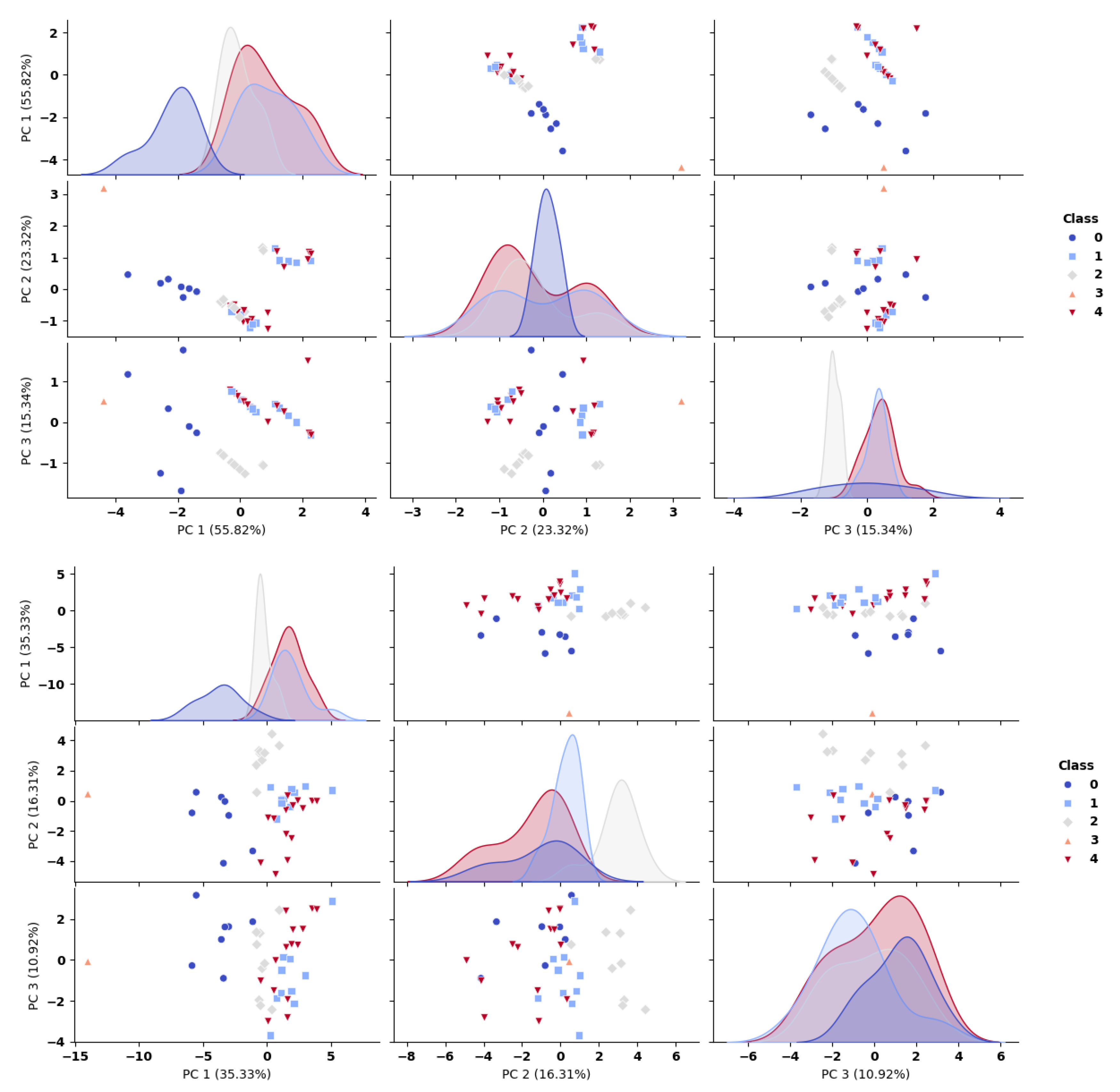
| PC1 | PC2 | PC3 | |
|---|---|---|---|
| MW | 0.60 | 0.06 | −0.39 |
| Num. Aromatic Rings | 0.48 | −0.21 | 0.85 |
| BBB | 0.33 | 0.88 | 0.05 |
| Score (kcal/mol) | −0.55 | 0.42 | 0.35 |
Disclaimer/Publisher’s Note: The statements, opinions and data contained in all publications are solely those of the individual author(s) and contributor(s) and not of MDPI and/or the editor(s). MDPI and/or the editor(s) disclaim responsibility for any injury to people or property resulting from any ideas, methods, instructions or products referred to in the content. |
© 2025 by the authors. Licensee MDPI, Basel, Switzerland. This article is an open access article distributed under the terms and conditions of the Creative Commons Attribution (CC BY) license (https://creativecommons.org/licenses/by/4.0/).
Share and Cite
Vieira, R.C.; Nascimento, É.C.M.; Martins, J.B.L. Molecular Modeling and Analysis of Cannabinoid and Cannabinoid-like Molecules Combining K-Means Clustering with Pearson Correlation and PCA. Int. J. Mol. Sci. 2025, 26, 11520. https://doi.org/10.3390/ijms262311520
Vieira RC, Nascimento ÉCM, Martins JBL. Molecular Modeling and Analysis of Cannabinoid and Cannabinoid-like Molecules Combining K-Means Clustering with Pearson Correlation and PCA. International Journal of Molecular Sciences. 2025; 26(23):11520. https://doi.org/10.3390/ijms262311520
Chicago/Turabian StyleVieira, Rafael Campos, Érica C. M. Nascimento, and João B. L. Martins. 2025. "Molecular Modeling and Analysis of Cannabinoid and Cannabinoid-like Molecules Combining K-Means Clustering with Pearson Correlation and PCA" International Journal of Molecular Sciences 26, no. 23: 11520. https://doi.org/10.3390/ijms262311520
APA StyleVieira, R. C., Nascimento, É. C. M., & Martins, J. B. L. (2025). Molecular Modeling and Analysis of Cannabinoid and Cannabinoid-like Molecules Combining K-Means Clustering with Pearson Correlation and PCA. International Journal of Molecular Sciences, 26(23), 11520. https://doi.org/10.3390/ijms262311520