2.1. Small Molecules
We demonstrate our method carrying out calculations on a set of small molecules: water (H
2O), methane (CH
4), carbon monoxide (CO), and nitrogen (N
2). These are among the most prevalent substances in many aspects of our lives and are an important component in numerous biological and chemical processes occurring in surfaces, in the atmosphere, and in solution. We address only singlet excited states as these can be optically activated. We begin with the isolated water and methane molecules. We first optimize the geometry of these molecules. As a result, for H
2O molecule, the bond length (O-H) and bond angle (H-O-H) are 0.9674 Å and 104.554° respectively, which agree with the experimental [
37]/theoretical [
38] values of 0.9572/0.969 Å and 104.5/105.5°. On the other hand, in the case of the CH
4 molecule, the bond length (C-H) and bond angle (H-C-H) are 1.0942 Å and 109.471°.
The point group symmetries of the H
2O and CH
4 molecules are
and
, which includes four and twenty-four symmetry operators divided into four and five irreducible representations, respectively, as shown in
Table 1 and
Table 2. For H
2O, beside the identity operator
E we have the 2-fold rotation operator
by 180° about the z-axis along the H-O-H bisector, the
and
plane inversions with respect to the molecular plane and the symmetry plane perpendicular to it, respectively. The excited states of H
2O will belong to one of the
,
,
, and
irreducible representations.
As for H2O all the irreducible representations have dimension one and the excited states are not degenerate we just evaluated the expectation values of the symmetry operators in order to classify them.
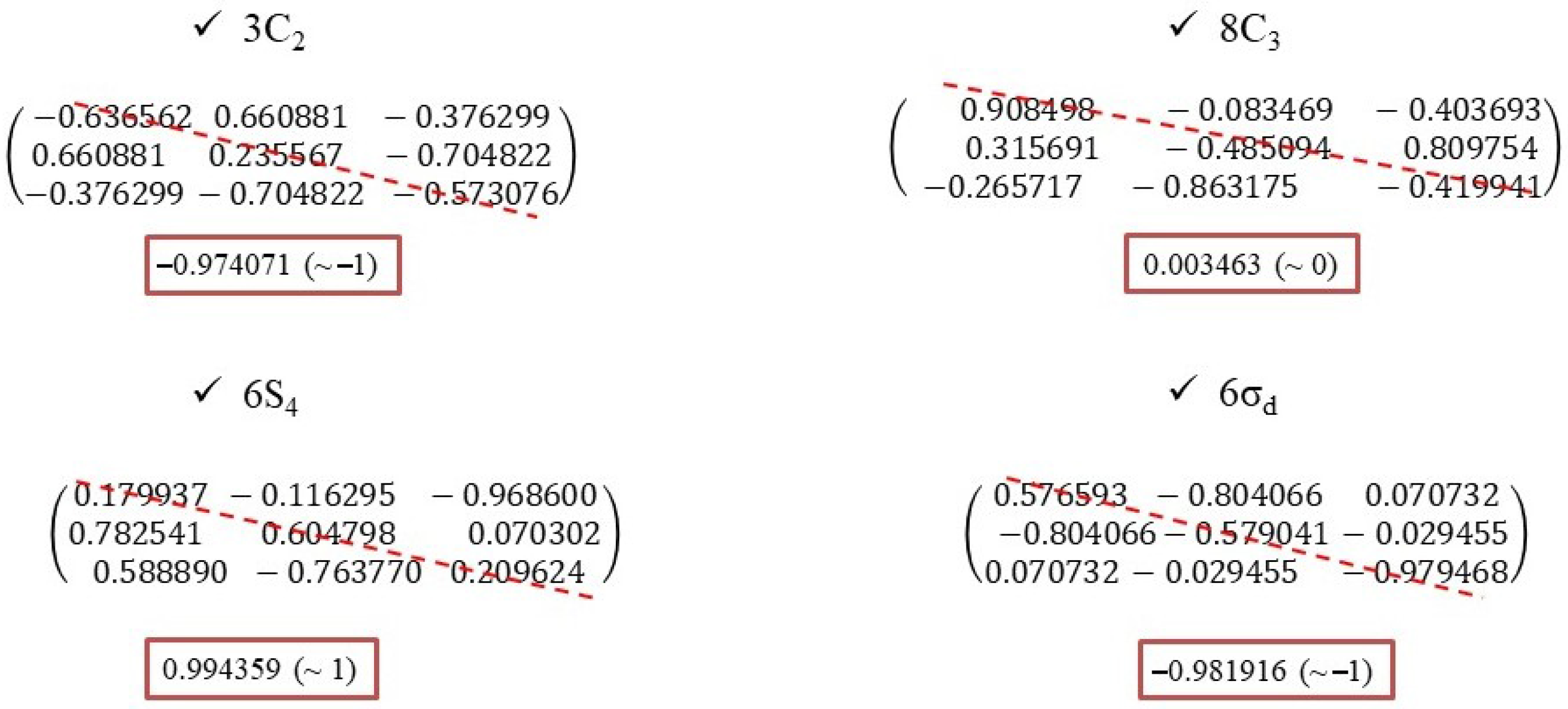
In the case of CH4, beside the identity operator E we find eight 3-fold rotation operators , involving 120° rotations through the body diagonals, three 2-fold rotation operators , involving 180° rotations across axis passing through opposite edges, six plane inversions and six improper rotations S4. Hence, the excited states of CH4 will belong to one of the , , E, , and irreducible representations. The A’s are non-degenerate, while E and the T’s are doubly and triple degenerate, respectively.
The symmetry analysis of excited states for molecules H
2O and CH
4 has been performed and the characters of the symmetry matrices are reported in
Table 3 and
Table 4.
From the results in
Table 3, the excited states of the H
2O molecule are eigen-states of the
,
, and
symmetry operators with odd (−) or even (+) parity. The first, fourth, and seventh excited states are an eigen-states with odd (−) parity under the
and
operators, while they have even (+) parity under the
operator, respectively. The second and eighth excited states are eigen-states with even (+) parity under the
operator and odd (−) parity under the mirror planes
and
. On the other hand, the third and fifth excited states are eigen-states with even (+) parity under all operators. The sequence of vertical excitation energies for the H
2O molecule is illustrated in
Table 5. It’s worth noting that the small discrepancies between the present results and previous GW-BSE studies mainly arise from the different methodologies used to obtain quasi-particle energies and the screened Coulomb interaction. Previous works employed different approaches: Grossman et al. [
39] employed a single-shot
-BSE approach based on LDA eigenvalues and a plasmon-pole approximation, while Hirose et al. [
24] used an all-electron GW-BSE scheme starting from PBE. These approaches are known to be sensitive to the starting point, the treatment of dynamical screening and numerical convergence parameters. Here, we avoid an explicit GW step by using Koopmans’-compliant functionals for the calculation of the quasiparticle energies and by employing linear-response theory to evaluate the static screened Coulomb interaction. We note that the first excited state exhibits
symmetry. The order of states belonging to the same irreducible representation is given by an integer number on the left of the symmetry label.
For the CH
4 molecule, as reported in
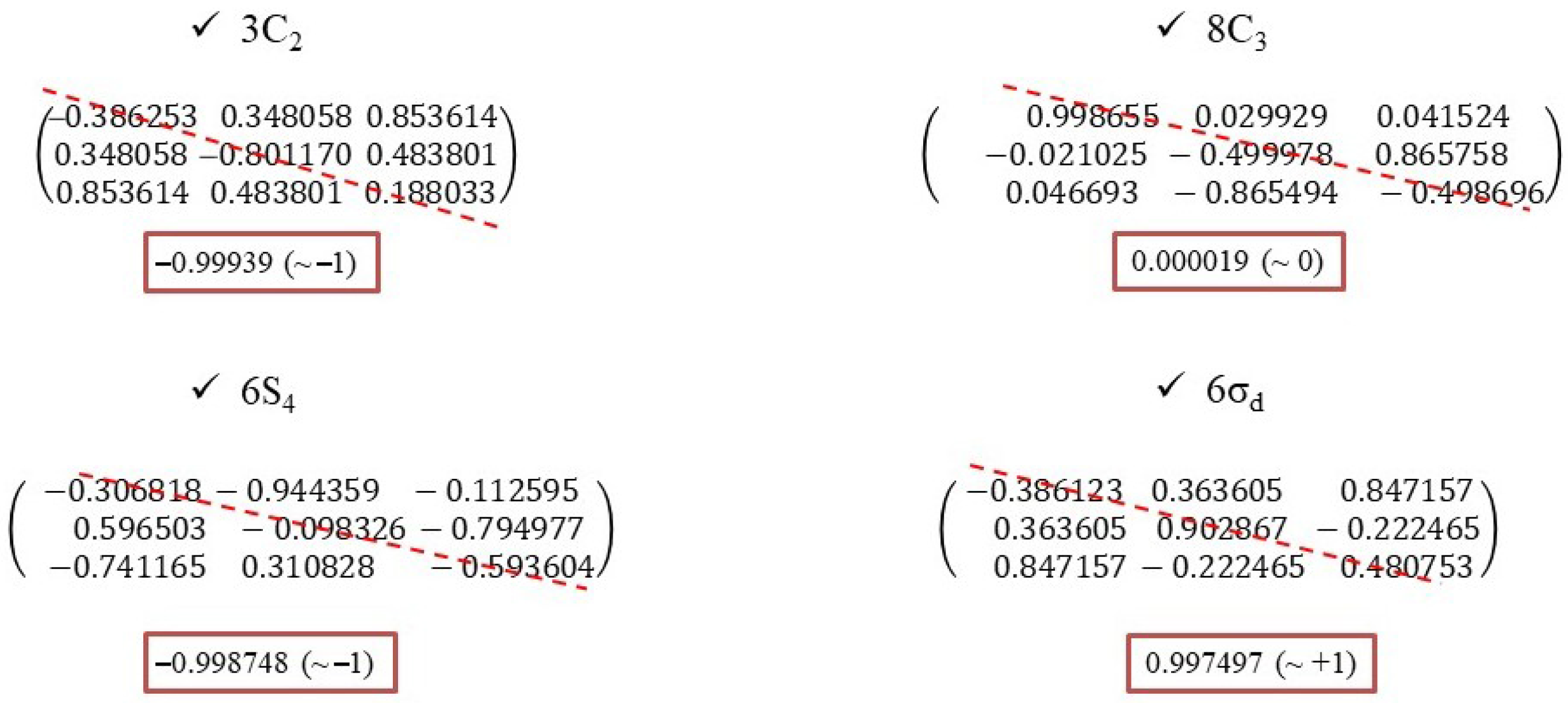
Table 4, we can observe that all states considered represent multidimensional representations describing degenerate states featuring double or triple degeneracy. Moreover, where states are degenerate, any symmetry operators typically mix degenerate eigenvectors. Therefore, for each degenerate triple subspace (first or second), as well as for double degenerate subspace, we have constructed an m × m matrix (i.e., a 3 × 3 or 2 × 2 matrix) of each symmetry operator restricted to these subspaces, as indicated in
Figure A1 and
Figure A2. Consequently, the corresponding characters for each sub-group are presented in
Table 4. Comparison with the character table (
Table 2) of
reveals that the three first (1–3) and second (4–6) states match the three-dimensional irreducible representations
and
, respectively. Meanwhile, the first double states (7–8) reveal a two-dimensional irreducible representation,
E, indicating that the degeneracy originates from the inherent symmetry of the molecule.
In
Table 5 and
Table 6 we compare the calculated GW-BSE excitation energies with reference theoretical and experimental values. We find that our results are consistent with those obtained in a previous GW-BSE investigations for both molecules. Furthermore, these studies do not explicitly mention the symmetry of the excited states. In contrast, we note that both GW-BSE calculations consistently underestimate the experimental and other theoretical excitation energies for the H
2O molecule. Whereas, in the case of the CH
4 molecule, the results obtained with GW-BSE a agree with those achieved with the quantum Monte Carlo (
QMC) approach, and over estimates the experimental result.
In the next section, we perform a symmetry analysis of the excited states of diatomic molecules, including carbon monoxide (CO) and nitrogen (N2). In diatomic molecules, excited states exhibit rotational symmetry relative to the internuclear axis. This symmetry implies that the projection of the orbital angular momentum, , onto this axis is a conserved quantity. Consequently, the electronic excited states of a diatomic molecule can be chosen as eigen-functions of with eigen-values . If m = 0, the state is labeled (non-degenerate state), whereas = 1, 2, etc. are labeled with capital Greek letters , , etc. These means that in diatomic molecules the excited states are either non-degenerate or doubly degenerate. In order to correctly assign the symmetry of doubly degenerate states, we prefer to calculate the expectation values of which assumes the values for states, respectively.
Furthermore, the state is also distinguished via the total spin S of all electrons. This is given as 2S + 1. So that we have a superscript 3 for triplet states and a superscript 1 for singlet states.
In addition, we consider also plane inversion for planes containing the molecular axis and, only for homonuclear diatomic molecules, point inversion I with respect to the midpoint along the molecular axis. This implies that, relative to plane inversion the excited states have even (+)/odd (−) parity and relative to point inversion (+) or odd (−) parity.The latter are denoted by the subscripts “g” (gerade) and “u” (ungerade), respectively. Thus, the labeling scheme for the electronic state of a diatomic molecule is as follows with L a capital Latin letter specifying the order:
The symmetry analysis of the excited states of the CO and N
2 diatomic molecules has been examined with respect to the symmetry operations: angular momentum squared (
), mirror planes (
), and point inversion for the latter. The results are summarized in
Table 7 and
Table 8. Furthermore, in case of CO, the first and second states are degenerate, confirming their
1Π-type nature. The excited states 3, 6, and 7 are non-degenerate with symmetry
1Σ
−,
1Σ
+, and
1Σ
+, respectively.
For the N2 molecule, the results show that the third and sixth states are non-degenerate with symmetry and , respectively. While the other states are degenerate with = 1 or = 4, confirming their 1Π-type or 1Δ-type nature.
The lowest excitation energies obtained for CO and N
2 are reported in
Table 9. From this table, our findings are consistent with those of a previous GW-BSE investigation for both diatomic molecules, CO and N
2. Nevertheless, the results obtained with both GW-BSE approaches are overestimated compared to the experimental results. Whereas, for CO, GW-BSE reproduces the first excitation energy with an accuracy close to that obtained experimentally. Indeed, in similar systems better results can be achieved only using multi-reference methods.
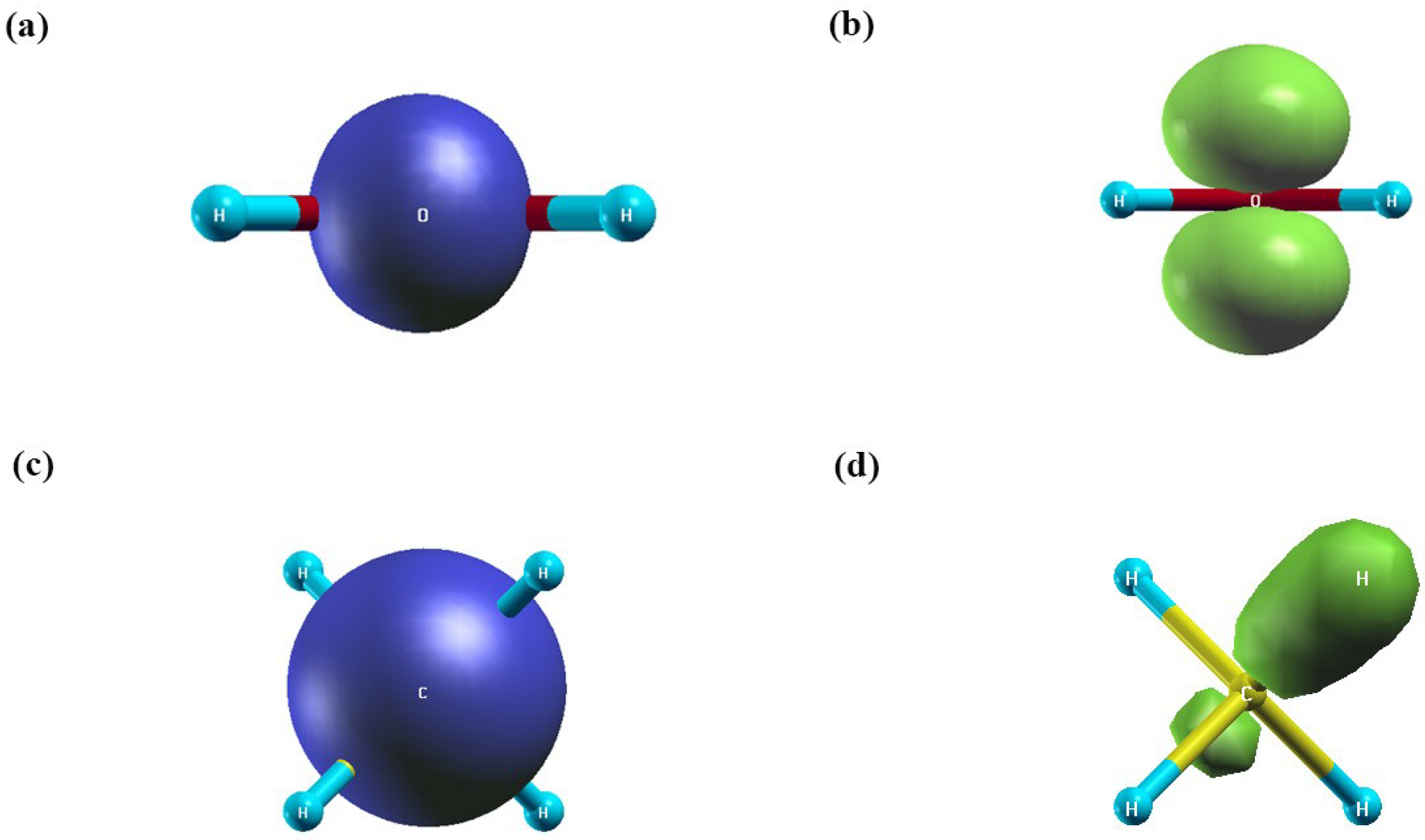
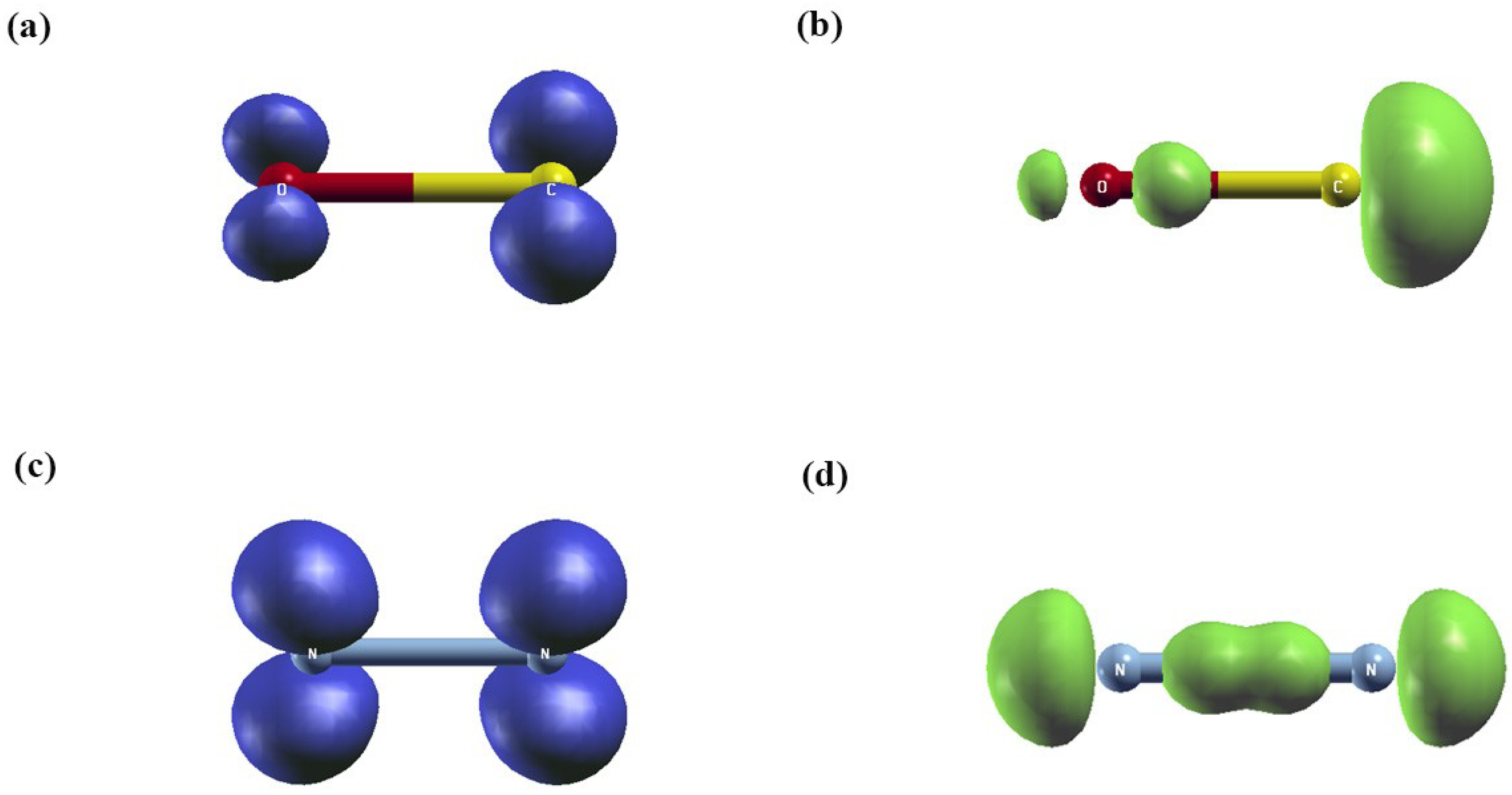
In order to obtain more insight into the nature and spatial localization of excited states, such as charge transfer or localized excitations, we depicted the real-space analysis of the excitonic hole and electron densities for CO and N
2 relative to the first excited state, as illustrated in
Figure 1 and
Figure 2. From the results, it can be observed that the hole density is highly localized on the oxygen atom in H
2O and around the carbon atom with slight extension toward the hydrogen atoms in CH
4. This indicates that the removed electron originates mainly from the non-bonding lone-pair orbitals on oxygen in H
2O and from the C–H bonding orbitals in CH
4. In contrast, the electron density is centered on the oxygen and carbon atoms and extends along the O-H and C-H bonds toward the hydrogen atoms, emphasizing the delocalized and antibonding character of the excited states.
On the other hand, the excitonic electron and hole densities of the CO molecule are predominantly localized on the oxygen and carbon atoms, respectively. This spatial separation reveals a clear charge-transfer excitation from carbon to oxygen, reflecting the difference in electronegativity between the two atoms. In contrast, for the N2 molecule, both the electron and hole densities are symmetrically distributed over the two nitrogen atoms, consistent with its homonuclear and highly symmetric () character. Unlike CO, no net charge transfer occurs upon excitation, as the electronic transition is delocalized and equally shared between the two nitrogen atoms.
2.2. Fragment
In this section, we perform the symmetry analysis of the excited states of the uracil nucleobase of RNA. The uracil molecule has point group symmetry
, which includes only two symmetry operations, as shown in
Table 10: the identity operator
E and the reflection across the molecular plane
, as uracil is a flat molecule. Excited states must belong to one of the two A′ and A″ irreducible representations. The symmetry analysis is summarized in
Table 11. One can see that the excited states of uracil are eigen-states of the reflection symmetry operator
with odd (−) or even (+) parity. Furthermore, the sequence of excitation energies for the uracil molecule is A″, A′, A″, A″, and A′, etc., as listed in
Table 12.
Table 12 compares our computed vertical excitation energies with previously available experimental and theoretical values. Our results align closely with previous theoretical and experimental findings. For instance, the first and second excited states appear with considerable precision, deviating by less than 0.1–0.3 eV from the experimental values, improving over previous BSE results. Furthermore, the
state has been consistently predicted at 6.0 eV, aligning closely with the experimental findings, and being slightly lower than the values obtained with the multi-reference CASPT2 and the best theoretical estimates (BTE-2) reported in Ref. [
49].
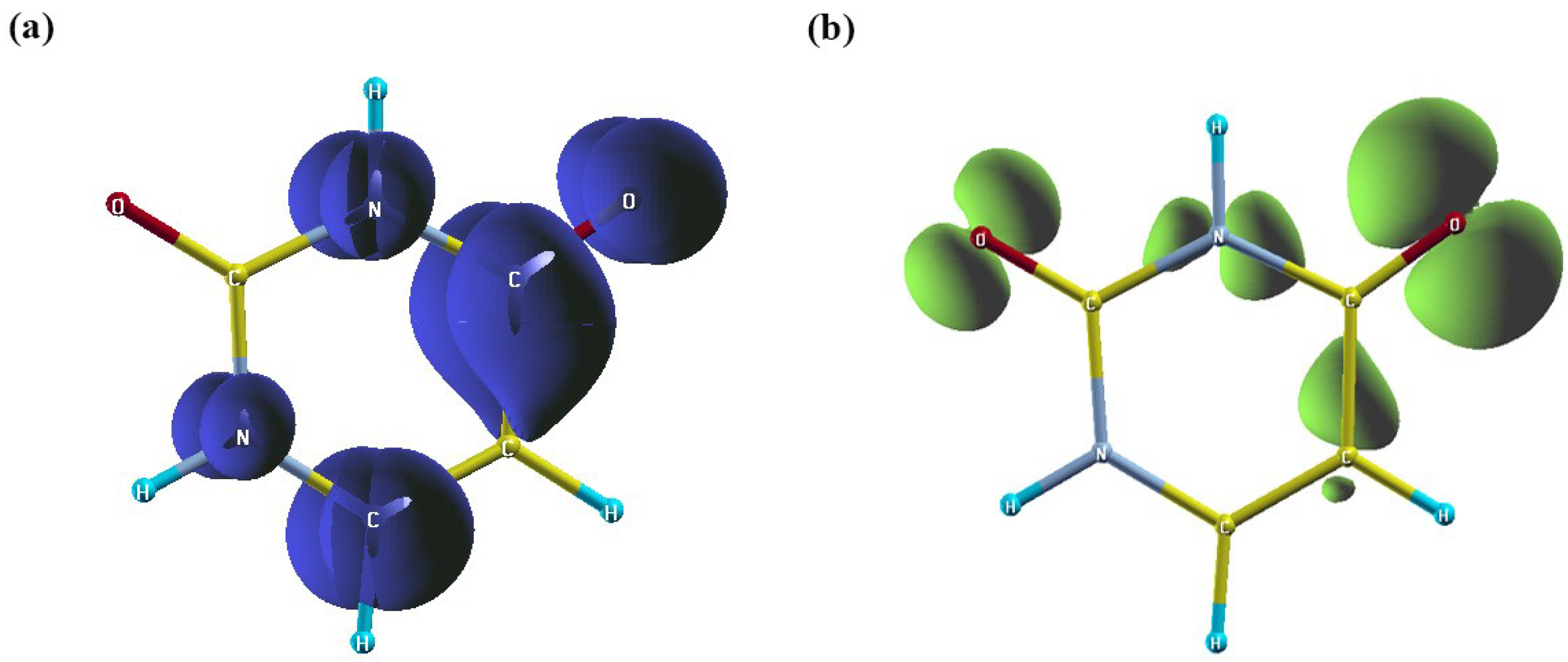
On the other hand, to better understand the nature and spatial distribution of the excited states in uracil, the excitonic hole and electron densities relative to the first excited state were analyzed in real space and are shown in
Figure 3. It can be seen that the excitonic electron density is mainly localized in the C=O bond region of uracil and slightly extends toward the adjacent C-N bond, consistent with the population of the antibonding
orbital of the carbonyl group. In contrast, the corresponding hole density is predominantly localized on the oxygen atom, indicating that an electron has been removed from a nonbonding (n) orbital. Our results are in excellent agreement with previous theoretical investigations, particularly those employing wave-function-based methods such as CC2 and CCSD, which consistently report the same state assignments and qualitative electronic character for the low-energy excited states of uracil [
54].
These observations clearly demonstrate that the first excited state possesses a localized character.
To gain deeper insight into these spatial features, we employ the concept of local symmetry. In the context of quantum chemistry, local symmetry denotes the spatial characteristics of excitations that are confined to specific regions of a molecule. Unlike the overall molecular symmetry, local symmetry represents an approximate or fragmental symmetry associated with particular bonds, functional groups, or subunits of the molecular structure. As mentioned above, the uracil nucleobase has relatively low global molecular symmetry () because its molecular structure is planar but not perfectly symmetric across all atoms. Therefore, when analyzing the first excited state, the excitonic wavefunction (or electron-hole pair) is primarily localized on the C=O bond. This implies that this part of the molecule has a local environment that closely resembles the point group , which has the same symmetry as the H2O molecule, discussed previously.
As the first excited state is localized on the C=O bond we want to analyze it in terms of the local
symmetry. For this goal, we first obtain the local excitation through the procedure described in the Theory Section. Then we computed the expectation values of the
,
and
operators. These yield
,
and
, respectively. This means, from a comparison with the character table (
Table 1) of
, that locally the first excited state displays a partial
symmetry.




 ,
,