Article

Al-Doped Octahedral Cu2O Nanocrystal for Electrocatalytic CO2 Reduction to Produce Ethylene

State Key Laboratory of High-Efficiency Utilization of Coal and Green Chemical Engineering, College of Chemistry and Chemical Engineering, Ningxia University, Yinchuan 750021, China
*
Author to whom correspondence should be addressed.
These authors contributed equally to this work.
Int. J. Mol. Sci. 2023, 24(16), 12680; https://doi.org/10.3390/ijms241612680
Submission received: 9 July 2023 / Revised: 4 August 2023 / Accepted: 8 August 2023 / Published: 11 August 2023
(This article belongs to the Special Issue Nanoparticle for Catalysis—2nd Edition)

Abstract

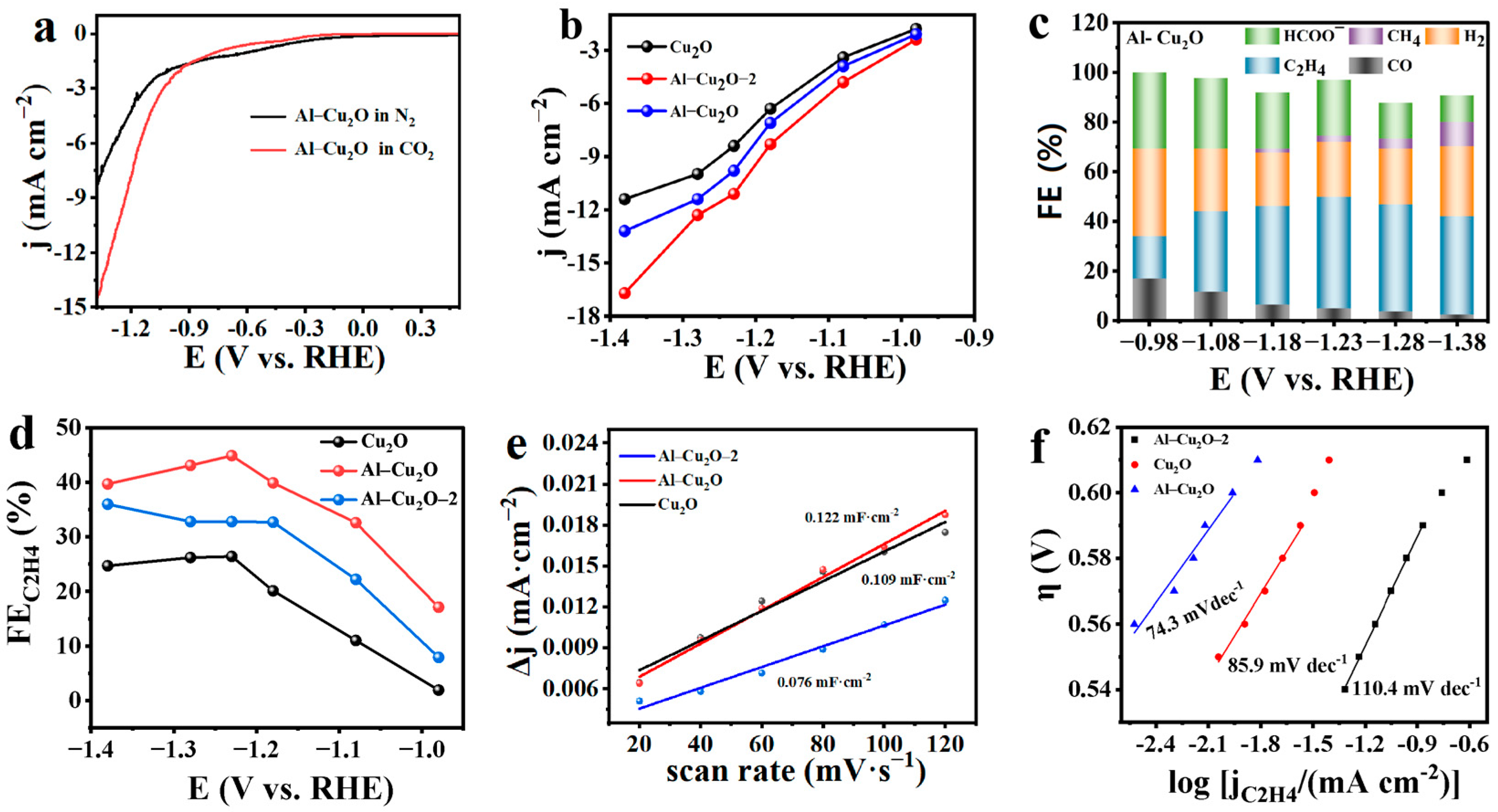
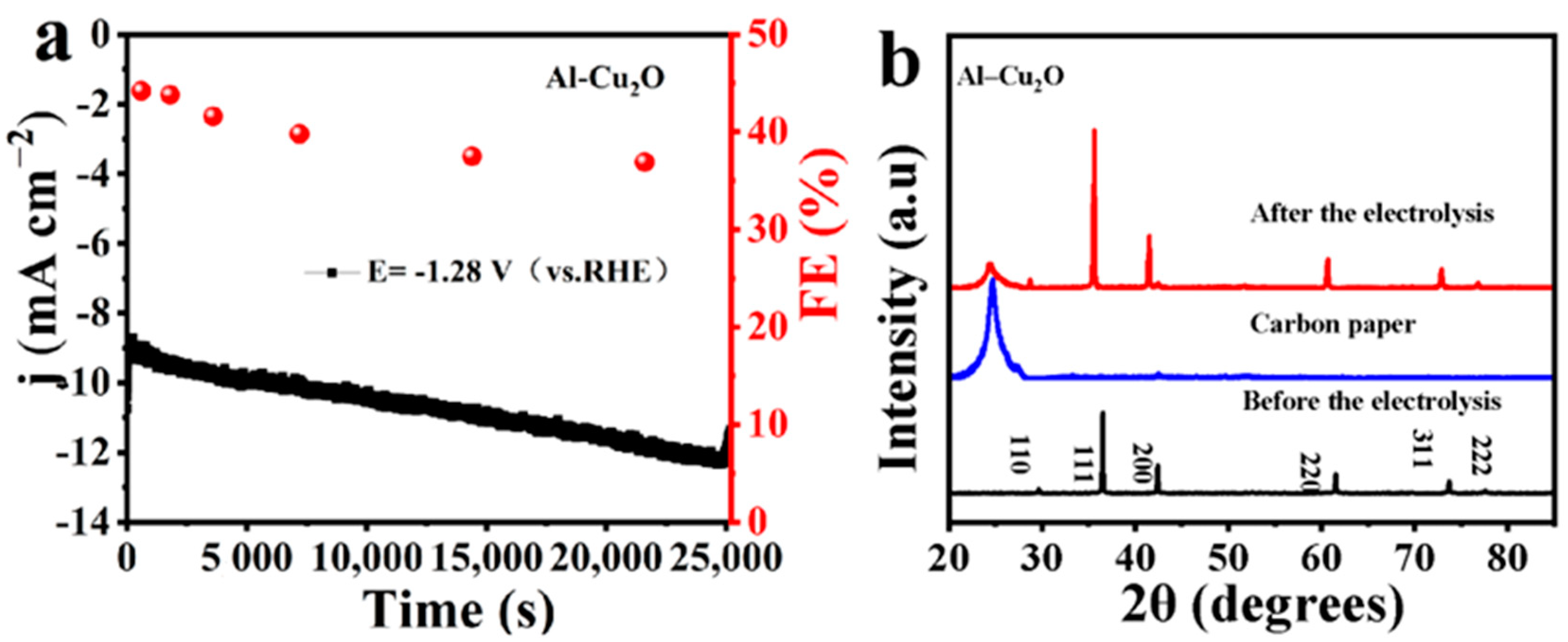
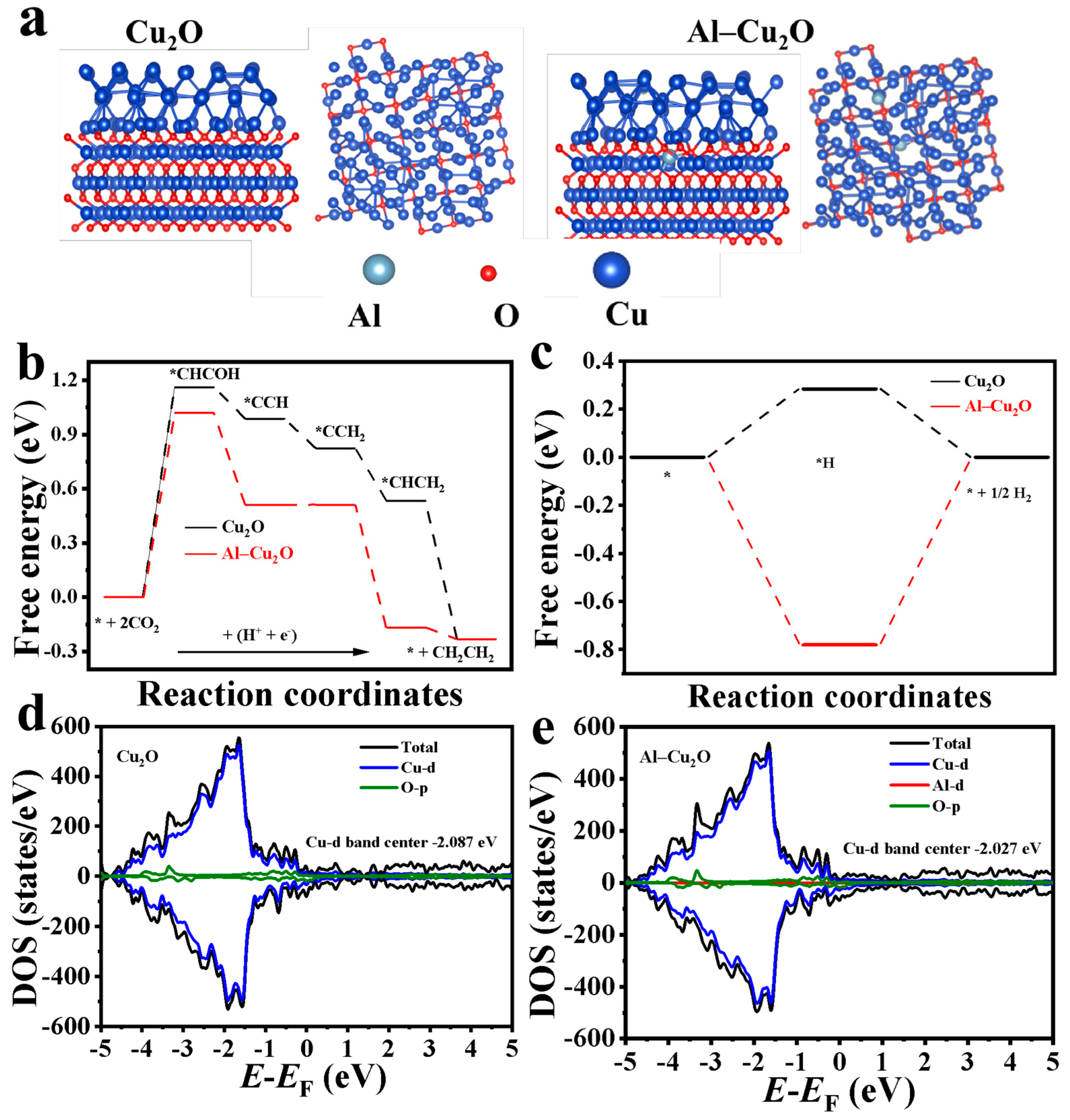
Ethylene is an ideal CO2 product in an electrocatalytic CO2 reduction reaction (CO2RR) with high economic value. This paper synthesised Al-doped octahedral Cu2O (Al–Cu2O) nanocrystal by a simple wet chemical method. The selectivity of CO2RR products was improved by doping Al onto the surface of octahedral Cu2O. The Al–Cu2O was used as an efficient electrocatalyst for CO2RR with selective ethylene production. The Al–Cu2O exhibited a high % Faradic efficiency (FEC2H4) of 44.9% at −1.23 V (vs. RHE) in CO2 saturated 0.1 M KHCO3 electrolyte. Charge transfer from the Al atom to the Cu atom occurs after Al doping in Cu2O, optimizing the electronic structure and facilitating CO2RR to ethylene production. The DFT calculation showed that the Al–Cu2O catalyst could effectively reduce the adsorption energy of the *CHCOH intermediate and promote the mass transfer of charges, thus improving the FEC2H4. After Al doping into Cu2O, the center of d orbitals shift positively, which makes the d–band closer to the Fermi level. Furthermore, the density of electronic states increases due to the interaction between Cu atoms and intermediates, thus accelerating the electrochemical CO2 reduction process. This work proved that the metal doping strategy can effectively improve the catalytic properties of Cu2O, thus providing a useful way for CO2 cycling and green production of C2H4.
Keywords: electrocatalysis; electronic structure; faradaic efficiency; ethylene electrocatalysis; electronic structure; faradaic efficiency; ethylene